Chapter XV · (continued 2)
Reading edition
Essex was now stimulated by his passions into a most perilous position. He was actively engaged in dangerous courses; and though some pains were taken to conceal his real designs, by the chief coadjutors in the conspiracy meeting at the Earl of Southampton's, and communicating privately by letter with Essex, the proceedings could not escape the ever-open ears of Cecil and his party. The conspirators had concluded that the safest thing to do in the first instance was for Sir Christopher Blount, Sir John Davis, and Sir Charles Davers to head three parties, and to take possession of the gate of Westminster palace, the guard, and the presence chamber, whilst Essex threw himself on his knees before the queen, and refused to rise till she had complied with his petition, and dismissed the obnoxious ministers. But while they were planning, Cecil and his friends acted. The secretary Herbert arrived with a summons for Essex to appear before the Council. He replied that he was too unwell to attend; and while he was thus evading the summons, he received an anonymous note warning him to escape as he valued his life; and this was immediately followed by the intelligence that the guard had been doubled at the palace. It was high time now to act, as his arrest was certain. In the night he despatched messages to collect his friends; and it was resolved that the next morning, which was Sunday, the 8th of February, 1601, the Earls of Southampton and Rutland, the Lords Sandys and Mounteagle, and about 600 gentlemen, should enter the City with Essex during sermon time, and assembling at St. Paul's Cross, where the Lord Mayor, Aldermen, and Companies were wont to attend, to call upon them to accompany them to the palace to assist in obtaining the removal of the pernicious advisers of the Crown.
When they were on the point of executing this plan they were interrupted by a visit from the Lord Keeper Egerton, the Earl of Worcester, Knollys, the comptroller of the household, and the Lord Chief Justice. Essex ordered them to be admitted through the wicket, but without any of their attendants, except the purse-bearer. When the officers of the Crown found themselves in the midst of an armed company, Egerton demanded what was the meaning of it; on which Essex replied in a loud and excited tone, "There is a plot laid for my life. Letters have been counterfeited in my name; men have been hired to murder me in my bed. We are met to defend our lives, since my enemies cannot be satisfied without sucking my blood."
"If such be the case," said the Lord Chief Justice Popham, "let it be proved. We will relate it fairly, and the queen will do impartial justice." "Impartial justice!" said the Earl of Southampton; "then why is it not done on Lord Grey?" Grey had attacked Southampton in the Strand with a number of followers on account of an old grudge, Southampton having only a foot-boy with him, whose hand was struck off, and Southampton himself was in great danger, till a number of people with clubs came to his help. Popham replied that Grey was imprisoned for the offence; and Egerton desired Essex to explain his grievances in private, when there was a cry of "They abuse you, my lord; they are undoing you; you lose your time!" Egerton put on his cap, and commanded every man, in the queen's name, to lay down his arms and depart. The crowd outside continued to shout, "Kill them, kill them! Keep them for hostages! Throw the great seal out of the window!" The queen's officers, being shown into a back room guarded by musketeers, Essex begged them to have patience for half an hour and locking the door upon them, left them. Sir John Davis, Sir Gilly Merrick, Francis Tresham, and Owen Salisbury were left in charge of them.
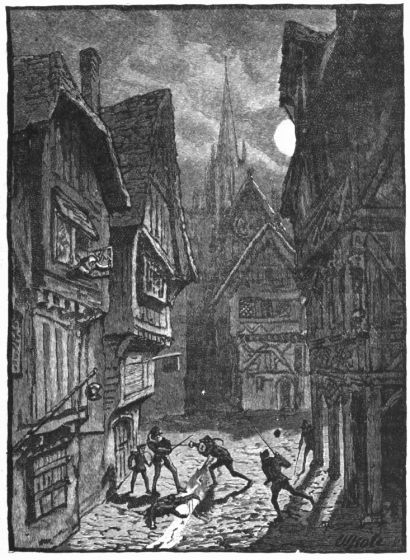
LORD GREY AND HIS FOLLOWERS ATTACKING THE EARL OF SOUTHAMPTON. (See p. 336.)
Then Essex, rushing into the street, drew his sword, and followed by Southampton, Rutland, Sandys, Mounteagle, and most of the knights and gentlemen, he made for the City. They were joined on the way by the Earl of Bedford and Lord Cromwell, with 200 others. At Ludgate the guard suffered them to pass, Essex declaring that he was endeavouring to save his life from Raleigh, Cobham, and their accomplices. To their great disappointment they found nobody at St. Paul's Cross, the queen having warned the Corporation to keep away, and to see that the people remained within their houses. Essex rode along shouting, "For the queen, my mistress! a plot is laid for my life!" and called upon the citizens to come and follow him. He had relied on his popularity with the masses; but he now found himself miserably deceived. The common people shouted "God bless your honour!" but no man joined him. He returned crestfallen to his house; but it was presently surrounded by a military force with a battering train, and not a soul rose in his defence. The case was hopeless, and about ten o'clock at night Essex and Southampton held a parley from the top of the house with Sir Robert Sidney, and surrendered on promise of a fair trial. They were conveyed for the night to Lambeth Palace. The next day Essex and Southampton were committed to the Tower, and the other prisoners to different gaols in London and Westminster. Essex was tried, and on the whole fairly, for his technical guilt was obvious; and, after the usual hesitation on the part of Elizabeth, suffered the penalty of the law on the 25th of February, 1601. Southampton was imprisoned for life.
Lord Mountjoy, the friend of Essex, though advanced to the deputyship of Ireland in his room, knew that Elizabeth had become aware of his offer to attempt a release of Essex from his confinement before his last rash outbreak, and he was prepared to escape to the Continent on the first symptom of an attempt to arrest him; but to his agreeable surprise he received a very gracious letter from Elizabeth, in which she stated that the defection and death of Essex had caused her deep grief, but his, Mountjoy's, loyalty and success in Ireland had been a comfort to her. This had been done at the suggestion of Cecil, who represented to her that Mountjoy's loyalty might be secured by not seeming to doubt it, and it was a great consequence to have so able a general in Ireland, as the Spaniards were now meditating a descent on the coast of that island. Indeed, in September, 4,000 Spaniards landed at Kinsale, under Don Juan D'Aguilar, fortified the town, and called on the people to join them against the heretic and excommunicated Queen of England, their oppressor. Whilst Mountjoy marched his forces to Kinsale and shut up the Spaniards in their own lines, Elizabeth summoned her last Parliament. She opened it in person on the 27th of October, 1601, but she was now so enfeebled that she was actually sinking under the weight of the robes of State, when the nobleman who stood nearest to her caught her in his arms and supported her. Notwithstanding this exhibition of her weakness, her determined will enabled her to rally and to go through the ceremony. The Session was a very stormy one. The great object of calling it together was to obtain money. Money the House of Commons expressed its willingness to grant, but at the same time called for the abolition of a number of monopolies which were sapping the very vitals of the nation. These monopolies were patents granted to her courtiers, for the exclusive sale of some article of commerce. It was a custom which had commenced in the seventeenth year of her reign, and by the greediness of her favourites had grown into a monstrous abuse. Scarcely a man about her but had one or more of these monopolies in his hand, by which the price of all sorts of the necessities of life was doubled, or more than doubled. Sometimes the patentee exercised the monopoly himself, sometimes he farmed it out to others, whose only object was to screw as much as possible out of it. The members for counties and boroughs had been repeatedly called on by their constituents to demand the abolition of these detestable abuses; but they had always been silenced by Ministers, on the ground that the queen would highly resent any interference with her prerogatives.
On the 18th of November a motion to put an end to these monopolies was made, which received the regular Ministerial answer, with the addition that it was useless to endeavour to tie the Royal hands, because, even if it were done by both Houses, the queen could loose them at her pleasure. Cecil said that the Speaker was very much to blame to admit of such a motion at the commencement of a Session, knowing that it was contrary to the Royal command. But, nothing daunted, the members of the Commons replied that they had found, however useless it was to petition for the removal of these grievances, that the remedy lay in their own hands, and the patentees were such blood-suckers of the commonwealth, that the people would no longer bear the burden of them. When the list of the monopolies was read over, a member asked if bread were not amongst them. The House appeared amazed at the question. "Nay," said he, "if no remedy be found for these, bread will be there before next Parliament." Bacon and Cecil still talked loudly of prerogative, but the House went on with so much resolution that the favourites began to tremble, and Raleigh, who had monopolies of tar and various other commodities, saw such a storm brewing that he offered to give them all up. For four days the debate continued with such an agitation as had not been witnessed through the whole reign; and Cecil found it necessary to give way, and the monopolies were withdrawn. On the 25th the queen sent for the Speaker, and in the presence of the Council, addressed him in a truly noble speech, saying that she had rather her heart and hand should perish than that either heart or hand should allow such privileges to monopolists as might injure her people.
While these events had been taking place in Parliament, Mountjoy had defeated the queen's enemies in Ireland. He had united his forces with those of the President of Munster, and kept the Spaniards shut up in Kinsale. On Christmas Eve the Earl of Tyrone advanced to the assistance of the besieged, with 6,000 Irish and 200 fresh Spaniards, who had landed at Castlehaven under the command of Ocampo. His plan was to surprise the English before daylight, and to have a second division of his army ready with a supply oprovisions to throw into the town. But Mountjoy was already aware of his approach, which was delayed by the fears of Ocampo—only too well founded—of the fatal want of discipline amongst the natives, and by his endeavours to bring them into some regularity. Mountjoy surprised these wild hordes as they were crossing a stream, and thoroughly routed them. The Spaniards, left on the field alone, surrendered, and Tyrone retreated northwards with the remnant of his army. About 500 Irish were killed.
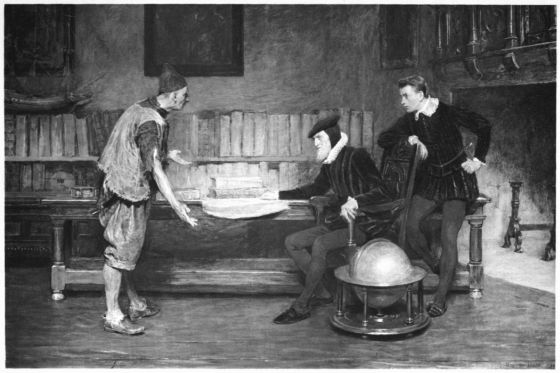
A STORY OF THE SPANISH MAIN
From the Picture by Seymour Lucas, R.A.
The Spaniards in Kinsale yielded the place on this defeat of their allies, on condition of being allowed to return home with their arms and ammunition. Tyrone was then pursued by Mountjoy with great vigour, and after a number of defeats retired still more northward. Munster was reduced, and Tyrone offered to submit on favourable terms; but Mountjoy could obtain no such terms from the queen; she insisted on unconditional surrender. Her ministers strongly advised her to concede and settle the state of Ireland, which was now costing her £300,000 a year to defend it against the natives. Sometimes she appeared disposed to comply, and then again was as obstinate as ever; and matters remained in this position till 1603, when Mountjoy, hearing that the queen was not likely to live long, agreed to receive Tyrone's submission, to grant him and his followers a full pardon, and restore the whole of his territories, with some few exceptions. Tyrone then accompanied Mountjoy to Dublin, where they heard of the death of Elizabeth; and Tyrone burst into tears and regretted his too hasty surrender. The deed, however, was done, and tranquillity ensured to Ireland for a short time.
The last warlike demonstration of the reign of Elizabeth was an expedition to the coast of Spain to prevent the passage of fresh fleets to Ireland. Admirals Levison and Monson proceeded thither with a fleet; but, tempted by a carrack of immense value in the harbour of Sesimbria, they seized it and returned home. This desertion of their duty to satisfy their greed of prize-money, would, in Elizabeth's days of vigour, have cost the commanders dearly. While they were guarding their treasure homewards the Spanish fleet might have made sail. Therefore no time was lost in sending back the fleet under Monson, who found six Spanish galleys out, and stealing along the French coast. Before he could pursue them they were met by a squadron of Dutch and English ships, and after some hard fighting three of them were sunk, and three escaped into Sluys.
The reign of Queen Elizabeth was now drawing to a close. She was approaching her seventieth year, and till lately had still listened to the voice of flattery as if she were yet in the glory of her youth. But nature had begun to give her stern warnings, and the failing of her strength brought deep melancholy. At one time she affected an unnatural gaiety; at another she withdrew into solitude, and was often found in tears. One of her household says in a letter—"She sleepeth not so much by day as she used, neither taketh rest by night. Her delight is to sit in the dark, and sometimes with shedding tears to bewail Essex."
Yet she still strove against the advancing infirmities of age. She would insist to the last on making her annual progress and on hunting. Only five months before her death Lord Henry Howard wrote to the Earl of Mar—"The queen our sovereign was never so gallant many years, nor so set upon jollity." A letter of April 7th, 1602, says—"The queen walks often on Richmond Green with greater show of ability than can well stand with her years. Mr. Secretary sways all of importance, albeit of late much absent from the Court and about London, but not omitting in his absence daily to present Her Majesty with some jewel or toy that may be acceptable. The other of the Council or nobility estrange themselves from Court by all occasions, so as, besides the master of the horse, vice-chamberlain, and comptroller, few of account appear there."
When Cecil was present it required all his art to conceal his correspondence with the King of Scotland. One day a packet was delivered to him from James in the queen's presence. She ordered him instantly to open it, and show its contents to her. It was a critical moment, and none but a long-practised diplomatist could have escaped the exposure which it would probably occasion; but recollecting her excessive dislike of bad smells and terror of contagion, he observed as he was cutting the string that "it had a strange and evil smell," and hinted that it might have been in contact with infected persons or goods. Elizabeth immediately ordered the cunning Minister to take it away and have it purified, and no doubt he did purify it of any dangerous contents before displaying them to Her Majesty.
Meanwhile, not only Cecil and Howard, but another clique, was busy paying court to James. These were Raleigh, Cobham, and the Earl of Northumberland. They met at Durham House, and kept up a warm correspondence with James; but they were as zealously counteracted by Cecil and Howard, who warned James of all things not to trust to them, Howard declaring that as for Raleigh and Cobham, "hell did never spew up such a couple when it cast up Cerberus and Phlegethon."
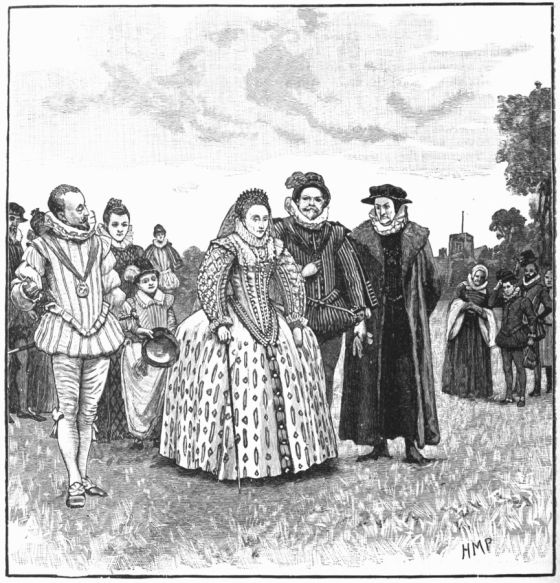
ELIZABETH'S PROMENADE ON RICHMOND GREEN. (See p. 339.)
While these self-seeking courtiers were thus anxiously labouring to stand first with the heir, Elizabeth was sinking fast into a most pitiable condition. She was weighed down by a complication of complaints, and her mind was affrighted by strange spectres. When the Lord Admiral urged her to go to bed, she said, "No, no; there were spirits there that troubled her;" and added that, "if he were in the habit of seeing such things in his bed as she did in hers, he would not try to persuade her to go there." Cecil hearing this, asked if Her Majesty had seen any spirits. At this she cast one of her old lightning flashes at him, and said, "I shall not answer you such a question." Cecil then said she must go to bed to content the people. "Must," she said, smiling scornfully; "must is a word not to be used to princes;" adding, "Little man! little man! if your father had lived you durst not have said so much, but you know I must die, and that makes you so presumptuous." She now saw Cecil's real character, and ordering him and all the rest except the Lord Admiral out of her chamber, she said, "My lord, I am tied with a chain of iron round my neck." He endeavoured to dissipate the idea, but she only said, "I am tied! I am tied! and the case is altered with me."
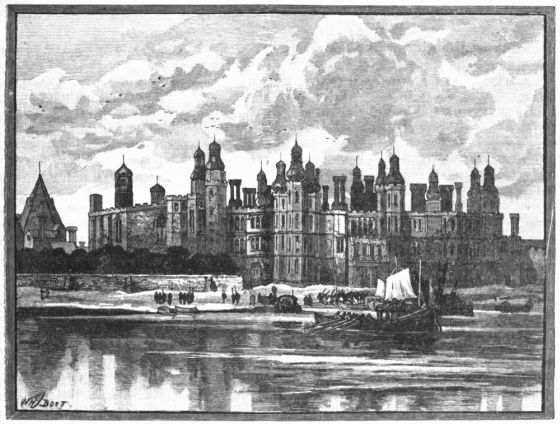
RICHMOND PALACE. (See p. 382.)
"The queen," says Lady Southwell, "kept her bed fifteen days, besides the three days she sat upon a stool, and one day, when, being pulled up by force, she obstinately stood upon her feet for fifteen hours." What a most miserable scene was the death-bed of this glorious woman! Surely nothing was ever more melancholy and terrible in its mixture of mental decay, dark remorse, and indomitable hardiness and self-will. At one and the same time around her bed were men urging her to take broth, to name her successor, and to hear prayers. The kings of France and Scotland were mentioned to her, but without eliciting the slightest notice; but when they named Beauchamp, the son of the Earl of Hertford and Catherine Grey, one of Elizabeth's victims, she fired up and exclaimed, "I will have no rascal's son in my nest, but one worthy to be a king!"
At length they persuaded her to listen to a prayer by the Archbishop of Canterbury, and when he had once begun she appeared unwilling to let him leave off; half-hour after half-hour she kept the primate on his knees. She then sank into a state of insensibility, and died at three o'clock in the morning of the 24th of March, 1603, in the seventieth year of her age, and the forty-fifth of her reign. Robert Carey, afterwards Earl of Monmouth, was anxiously waiting under the window of Elizabeth's room at Richmond Palace for the first news of her death, which Lady Scrope, his sister, communicated to him by silently letting fall, as a signal, a sapphire ring, afterwards celebrated as "the blue ring," which he caught, and the moment after was galloping off towards Scotland to be the first herald of the mighty event to the expecting James. Three hours later Cecil, the Lord Keeper, and the Lord Admiral were with the Council in London, and it was resolved to proclaim James VI. of Scotland James I. of England.