Chapter VI · (continued 2)
Reading edition
On the fourth day Charles embarked at Sandwich for the Netherlands, less anxious regarding the approaching interview of Henry and Francis, for he had made an ardent impression on the king, and had put a strong hook into the nose of his great leviathan—the hope of the triple crown. Simultaneously with the departure of Charles, Henry, his queen and court, embarked at Dover for Calais; and on the 4th of June, 1520, Henry, with his queen, the Queen Dowager of France, and all his court, rode on to Guines, where 2,000 workmen, most of them clever artificers from Holland and Flanders, had been busily engaged for several months in erecting a palace of wood for their reception.
The meeting-place was called, from the splendour of the retinues of the two monarchs, the "Field of the Cloth of Gold," but it did little to cement the alliance between England and France.
On the 25th of June the English Court returned to Calais; half the followers of the nobles were sent home, and then preparations were made for visiting the emperor at Gravelines, and receiving a visit from him at Calais. By the 10th of July all was ready, and Henry set out with a splendid retinue. He was met on the way, and conducted into Gravelines by Charles, with every circumstance of honour and display. Charles, whose object was avowedly to efface any impression which Francis and the French might have made on the mind of Henry at the late interview, had given orders to receive the English with every demonstration of friendship and hospitality, and his orders were so well executed that the English were enchanted with their visit.
On the departure of Charles, Henry and his court embarked for Dover, returning proud of his sham prowess and mock battles, and of all his finery, but both himself and his followers loaded with a fearful amount of debt for this useless and hypocritical display. When the nobles and gentlemen got home, and began to reflect coolly on the heavy responsibilities they had incurred for their late showy but worthless follies, they could not help grumbling amongst themselves, and even blaming Wolsey, as loudly as they dared, as being at the bottom of the whole affair. One amongst them was neither nice nor cautious in his expressions of chagrin at the ruinous and foolish expense incurred, and denounced the proud cardinal's ambition as the cause of it all. This was the Duke of Buckingham. He was executed in 1521 on the absurd charge of having intercourse with astrologers.
The various causes of antipathy between Francis I. and Charles V., which had been long fomenting, now reached that degree of activity when they must burst all restraint. War was inevitable. The first breach was made by Francis. At this crisis Charles appealed to Henry to act as mediator, according to the provisions of the treaty of 1518. Henry at once accepted the office, and entered upon it with high professions of impartiality and of his sincere desire to promote justice and amity, but really with about the same amount of sincerity as was displayed by each of the contending parties. Francis had certainly been the aggressor, and Charles, having intercepted some of his letters, had already convinced Henry, to whom he had shown them, that the invasion of both Spain and Flanders was planned in the French cabinet. Henry's mind, therefore, was already made up before he assumed the duty of deciding; and Charles, from being aware of this, proposed his arbitration. Henry, moreover, was anxious to invade France on his own account, spite of treaties and the dallyings of the Field of the Cloth of Gold, but he had not yet the funds necessary. With these feelings and secrets in his own heart, Henry opened his proposal of arbitration to Francis by declarations of the extraordinary affection which he had contracted for him at the late interview.
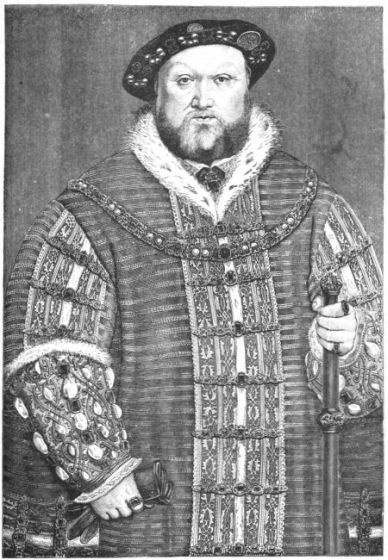
HENRY VIII. (After the Portrait by Holbein.)
There was no alternative for the French king but to acquiesce in the proposal; the place of negotiations was appointed to be Calais, and, of course, Wolsey was named as the only man able and fitting to decide between two such great monarchs—Wolsey, who was bound hand and foot to the emperor by the hope of the Popedom. It was a clear case that Francis must be victimised, or the negotiation must prove abortive. Wolsey set out with something more than regal state to decide between the kings. In addition to his dignity of Papal legate a latere, he received the extraordinary powers of creating fifty counts-palatine, fifty knights, fifty chaplains, and fifty notaries; of legitimising bastards, and conferring the degree of doctor in medicine, law, and divinity. By another bull, he was empowered to grant licences to such as he thought proper to read the heretical works of Martin Luther, in order that some able man, having read them, might refute them. This was to pave the way for a royal champion of the Catholic Church against Luther and the devil, and that such a champion was already at work we shall shortly have occasion to show. Such were the pomp and splendour of the cardinal, that when he continued his journey into the Netherlands, with his troops of gentlemen attending him, clad in scarlet coats, with borders of velvet of a full hand's breadth, and with massive gold chains: when they saw him served on the knee by these attendants, and expending money with the most marvellous profusion, Christian, King of Denmark, and other princes then at the Court of the Emperor at Bruges, were overwhelmed with astonishment, for such slavish homage was not known in Germany.
Wolsey landed at Calais on the 2nd of July, 1521, and was received with great reverence. The ambassadors of the emperor had taken care to be there first, that they might secretly settle with Wolsey all the points to be insisted on. The French embassy arrived the next day, and the discussions were at once entered upon with all that air of solemn impartiality and careful weighing of propositions which such conferences assume, when the real points at issue have been determined upon privately beforehand by the parties who mean to carry out their own views. The French plenipotentiaries alleged that the emperor had broken the treaty of Noyon of 1516, by retaining possession of Navarre, and by neglecting to do homage for Flanders and Artois, fiefs of the French crown. On the other hand, the Imperial representatives retorted on the French the breach of the treaty of Noyon, and denounced in strong terms the late invasion of Spain and the clandestine support given to the Duke of Bouillon. The cardinal laboured to bring the fiery litigants to terms, but the demands of the emperor were purposely pitched so high that it was impossible. The differences became only the more inflamed; and on the Imperial chancellor, Gattinara, declaring that he could not concede a single demand made by his master, and that he came there to obtain them through the aid of the King of England, who was bound to afford it by the late treaty, Wolsey said that there, of necessity, his endeavours must end, unless the emperor could be induced to modify his expectations; and that, as his ambassador had no power to grant such modification, rather than all hope of accommodation should fail, he would himself take the trouble to make a journey to the Imperial Court, and endeavour to procure better terms. Nothing could appear more disinterested on the part of the cardinal, but the French ambassadors were struck with consternation at the proposal. They were too well aware of the cardinal's leaning towards Charles; they did not forget the coquetting of the English and the emperor both before and after the meeting at the Field of the Cloth of Gold; and they opposed this proposal of Wolsey with all their power. But their opposition was useless. There can be no doubt that the prime object of Wolsey in his embassy was to make this visit to Charles for his own purpose, and that it had been agreed upon between himself and Charles before he left London. In vain the French protested that such a visit, made by the umpire in the midst of the conference to one of the parties concerned, was contrary to all ideas of the impartiality essential to a mediator; and they declared that, if the thing was persisted in, they would break off the negotiation and retire. But Wolsey told them that if they did not remain at Calais till his return, he would pronounce them in the wrong, as the real aggressors in the war, and the enemies to peace and to the King of England. There was nothing for it but to submit.
The cardinal set out on his progress to Bruges on the 12th of August, attended by the Imperial ambassadors and a splendid retinue of prelates, nobles, knights, and gentlemen, amounting altogether to 400 horsemen. The emperor met him a mile out of Bruges, and conducted him into the city in a kind of triumph. Thirteen days—a greater number than had been occupied at Calais—were spent in the pretended conferences for reducing the emperor's demands on France, but in reality in strengthening Wolsey's interest with Charles for the Popedom, and in settling the actual terms of a treaty between Charles, the Pope, and the King of England for a war against France. So deep was the hypocrisy of these parties, that before Wolsey had quitted the shores of England he had received a commission from Henry investing him with full authority to make a treaty of confederacy with the Pope, the emperor, the King of France, or any other potentate, offensive or defensive, which the king bound himself to ratify; the words "King of France, or other king, prince, or state," being clearly inserted to cover with an air of generality the particular design. The proposed marriage between the Dauphin and the Princess Mary was secretly determined to be set aside, and a marriage between Charles and that princess was agreed upon; and, moreover, it was settled that Charles should pay another visit to England on his voyage to Spain. Writing from Bruges to Henry, Wolsey told him all this, and added that it was to be kept a profound secret till Charles came to England, so that, adds Wolsey, "convenient time may be had to put yourself in good readiness for war."
After all this scandalous treachery—called in State language diplomacy—Wolsey returned to Calais, and resumed the conferences, as if he were the most honest man in the world, and was serving two kings about as honest as himself. He proposed to the plenipotentiaries a plan of a pacification, the conditions of which he knew the French would never accept. All this time hostilities were going on between Francis and the emperor. The emperor had taken Mouzon and laid siege to Mézières, and Francis, advancing, raised the siege, but was checked in his further pursuit of the enemy by the Count of Nassau. At this crisis Wolsey interposed, insisting that the belligerents should lay down their arms, and abide the award of King Henry; but this proposal was by no means likely to be met with favour on the part of the French, after what had been going on at Bruges, and therefore Wolsey pronounced that Francis was the aggressor, and that Henry was bound by the treaty to aid the emperor.
This was but a very thin varnish for the proceedings which immediately took place at Calais, and revealed the result of the interview at Bruges, in an avowed treaty between the Pope, the emperor, and Henry, by which they arranged—in order to promote an intended demonstration against the Turks, and to restrain the ambition of Francis—that the three combined powers should, in the spring of 1523, invade France simultaneously from as many different quarters; that, if Francis would not conclude a peace with the emperor on the arrival of Charles in England, Henry should declare war against France, and should break off the proposed marriage between the Dauphin and the Princess Mary.
In the meantime, the united forces of the Pope and Charles had prevailed in Italy, and expelled the French from Milan; the emperor had made himself master of Tournay, for which Francis had lately paid so heavy a price, and all the advantages that the French could boast of in the campaign to balance these losses were the capture of the little fortresses of Hesdin and Bouchain. Wolsey landed at Dover on the 27th of November, after the discharge of these important functions, having laid the foundation of much trouble to Europe, by destroying the balance of power between France, the Empire, and Spain, which it was the real interest of Henry to have maintained; and having equally inconvenienced the Government at home by carrying the Great Seal with him, so that those who had any business with it were obliged to go over to Calais, and so that there could be no nomination of sheriffs that year. But his power at this period was unlimited, and nothing could open Henry's eyes to his mischievous and inflated pride—not even his placing himself wholly on a par with the king in the treaty just signed, when he made himself a joint-guarantee, as if he had been a crowned head.
Wolsey had laboured assiduously and unscrupulously for Charles V. in furtherance of his own ambitious views. What convulsions disorganised Europe, what nations suffered or triumphed, troubled him not, so long as he could pave the way to the Papal chair. The time which was to test the gratitude of Charles came much sooner than any one had anticipated. Leo X., who was in the prime of life, elated with the expulsion of the French from Italy, was occupied in celebrating the triumph with every kind of public rejoicing. The moment he heard of the fall of Milan he ordered a Te Deum, and set off from his villa of Magliana to Rome, which he entered in triumph; but that very night he was seized with a sudden illness, and on the 1st of December, but a few days afterwards, it was announced that he was dead, at the age of only forty-six. Strong suspicions of poison were entertained, and it was believed that it had been administered by his favourite valet, Bernabo Malaspina, who was supposed to have been bribed to it by the French party.
The news of Leo's death travelled with speed to England, and Wolsey, who, amid all his secret exertions to attain the Papal tiara, had declared with mock humility that he was too unworthy for so great and sacred a station, now threw off his garb of indifference, and despatched Dr. Pace to Rome, with the utmost celerity, to promote his election; and he sent to put the emperor in mind of his promises. On the 27th of December the conclave commenced its sittings. Another of the Medici family, Cardinal Giulio, appeared to have the majority of votes, but for twenty-three days the election remained undecided. The French cardinals opposed Giulio with all the persevering virulence of enemies smarting under national defeat. Numbers of others were opposed to electing a second member of the same family, and Giulio, growing impatient of the stormy and interminable debates which kept him from attending to pressing affairs out of doors, suddenly nominated Cardinal Adrian, a Belgian. This extraordinary stroke was supposed to be intended merely to prolong the time, till Giulio could throw more force into his own party; but Cardinal Cajetan, a man of great art and eloquence, who knew and admired the writings of Adrian, and had probably suggested his name to Giulio, advocated his election with such persuasive power, that Adrian, though a foreigner, and personally unknown, was carried almost by acclamation. And thus, as Lingard observes, within nine years from the time when Julius drove the barbarians out of Italy, a barbarian was seated as his successor on the Papal throne.
The cardinals had no sooner elected the new Pope than they appeared to wake from a dream, and wondered at their own work. The act appeared to be one of those sudden impulses which seize bodies of people in a condition of great and prolonged excitement, and they declared that it must have been the inspiration of the Holy Ghost. As for Wolsey, it does not appear that his sincere friend the emperor, who had protested that he would have him elected if it were at the head of his army, moved a finger in his behalf. The proud cardinal, however, was obliged to swallow his chagrin, and wait for the next change, Adrian being already an old man; and Dr. Pace remained at Rome to congratulate the new Pontiff on his arrival, and solicit a renewal of his legatine authority.
Francis at this crisis made strenuous efforts to regain the friendship of Henry. Probably he thought that the disappointment of Wolsey might cool his friendship for the emperor, or, which was the same thing, diminish his confidence in his promises; whilst Charles was very well aware that Wolsey was much more serviceable to him as minister of England than he could be or would be as Pope. Francis attacked Henry on his weakest side—his vanity. He heaped compliments upon him, and entreated that if he could not be his fast and avowed friend, he would, at least, abstain from being his enemy. To give force to his flatteries, he held out hopes of increasing his annual payments to England; and when that did not produce the due effect, he stopped the disbursements of that which he had been wont to remit. Finding that even this did not influence Henry, who was kept steady by Wolsey, he laid an embargo on the English shipping in his ports, and seized the property of the English merchants.
At this act of decided hostility Henry was transported with one of those fits of rage which became habitual in after years. As if he had not long been plotting against Francis, and preparing to make war upon him—as if he had not coolly and even insolently repulsed all his advances and offers of advantage and alliance—he regarded Francis as an aggressor without any cause, ordered the French ambassador to be confined to his house, all Frenchmen in London to be arrested, and despatched an envoy to Paris with a mortal defiance. What particularly exasperated Henry was the news that a whole fleet, loaded with wine, had been seized at Bordeaux, and the merchants and seamen thrown into prison. The English were ordered to make reprisals, and this was the actual state of things when Sir Thomas Cheney, his ambassador, announced by dispatch that the envoy had declared war on the 21st of May at Lyons; to which the king had replied, "I looked for this a great while ago; for, since the cardinal was at Bruges, I looked for nothing else." The wily manœuvres of Wolsey had deceived nobody.
On the 26th of May, only five days after the declaration of war with France, the Emperor Charles V. landed at Dover. The passion of Henry had precipitated the outbreak of hostilities, for it was not intended that war should be declared till Charles was on the eve of departure from England, so that he might continue his voyage in safety to Spain. The king, however, received his illustrious guest with as much gaiety and splendour as if nothing but peace were in prospect. Wolsey waited on Charles at the landing-place, and, after embracing him, led him by the arm to the castle, where Henry soon welcomed him with great cordiality. Charles calculated much, in the approaching war, on the fleet of Henry; and, to show him its extent and equipment, Henry conducted him to the Downs, and led him over all his ships, especially his great ship, Henri, Grâce à Dieu, which was considered one of the wonders of the world. He then conducted his Imperial guest by easy journeys to Greenwich, where the Court was then residing, and introduced him to his aunt, the queen, and her infant daughter, whom it was arranged that he should marry.
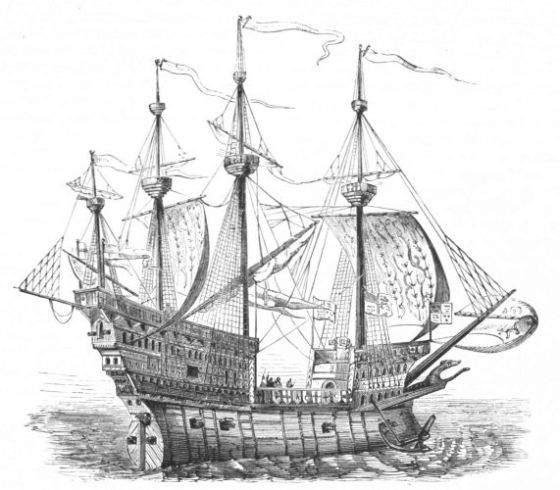
GREAT SHIP OF HENRY VIII. (From the Drawing by Holbein.)
On the 6th of June Henry conducted the emperor with great state into London, where the inhabitants received him with a variety of shows and pageants. Sir Thomas More spoke the emperor's welcome in a learned oration, and there was a profusion of Latin verses in honour of the occasion. The two monarchs feasted, hunted, and rode at tournaments, whilst their ministers were busily employed in carrying out the terms agreed upon at Bruges into a treaty, which was signed on the 19th at Windsor. The subject of this treaty was the marriage of Charles with the infant Princess Mary, which the two monarchs bound themselves to see completed, under a penalty, in case of breach of engagement, of 400,000 crowns. Charles also engaged to indemnify Henry for the sums of money due to him from Francis; and, what was most extraordinary, both monarchs bound themselves to appear before Cardinal Wolsey in case of any dispute, and submit absolutely to his decision, thus making a subject the arbiter of monarchs.
The emperor also engaged to indemnify the cardinal for his losses in breaking with Francis, by a grant of 9,000 crowns annually; thus paying this proud priest for being the author of the war. Yet, after all his courting and flattering of Wolsey, after again assuring him of his determination to set him in the Papal chair, it is certain that he hated the man, and used him only as a tool. His aunt, Queen Catherine, had deeply resented the cardinal's pursuit of the Duke of Buckingham to death, for whom she entertained a high regard; and Wolsey was aware of it, and never forgave her. It was, probably, in reply to Catherine's relation of this tragic event that Charles, whilst on this visit, was overheard to say, "Then the butcher's dog has pulled down the fairest buck in Christendom"—a witticism which flew all over the Court, and was not forgotten by the vindictive Wolsey.
Having agreed that each was to bring 40,000 men into the field, that France was to be attacked simultaneously on the north and the south, and that Charles was to co-operate with the English for the re-conquest of Guienne, the emperor embarked on the 6th of July, and pursued his voyage to Spain.