Chapter XVII · (continued 2)
Reading edition
The conspirators met to decide on their plan of action. Some of them advised instant flight to the Continent; Catesby, Winter, and others were perfectly convinced that Tresham was in communication with Monteagle, and perhaps with Cecil; but some of them would not believe such treason, and the arguments of Percy finally nailed them to their fate. This discussion took place on the 3rd of November. Percy conjured them to wait and see what the next day would bring forth, the very last day before the grand crisis. He represented all the labour, the anxieties, the plannings they had gone through, the costs they had incurred, the difficulties they had overcome, and he demanded whether, on the very point of complete success, they were to abandon their enterprise through the fears of a recreant colleague, who probably described what only his affrighted fancy pictured to him. He reminded them that his vessel still lay in the Thames at their service, and on the first positive proof of danger, they had only to hasten on board and drop down the river out of reach of their enemies.
These arguments prevailed, but they changed their plan of operations. Fawkes was still to keep guard in the cellar, Percy and Winter to superintend the necessary operations in London; but Catesby and John Wright were to hasten to Dunchurch and put Sir Everard Digby and the party on their guard.
On the evening of Monday the 4th of November, the Earl of Suffolk, in prosecution of his duty as Lord Chamberlain, to see all necessary preparations made for the opening of Parliament, went down to the House accompanied by Lord Monteagle.
After they had been some time in the Parliament chamber, on pretence that some necessary articles were missing, they went down to the cellars to make a search. They entered the vault where the mine was prepared and where Fawkes was at his post. The Lord Chamberlain, casually casting his eyes round the place, inquired by whom it was occupied, and who Fawkes was. The staunch traitor replied that it was occupied by Mr. Percy, whose servant he was; on which Suffolk observed in a careless manner, "Your master has laid in a good stock of fuel;" and he and Monteagle left the cellar. No sooner were they off the ground, than Fawkes hastened to inform Percy of what had occurred, but the warning was lost upon him. He persuaded himself that all was yet undiscovered, and Fawkes returned to the cellar to await the fatal hour.
A little after midnight, being now actually the 5th of November, Guy Fawkes had occasion to open the door of the vault, and he was immediately seized by Sir Thomas Knevett a magistrate of Westminster, who, with a party of soldiers, had silently invested the place. Fawkes was found to be booted and spurred, ready for a precipitate flight after lighting the train; three matches were found in his pocket, and a dark lantern containing a light was placed behind the door. The least delay in seizing the desperado, and he would have blown himself and the guard all into the air together. But he was instantly pinioned, bound hand and foot, and conveyed to Whitehall, where the Council had assembled in the king's bed-chamber by four o'clock to interrogate him. Fast fettered as he was, the determined look of the undaunted traitor struck terror into the spectators. He appeared quite self-possessed, calm in aspect, and bold, though respectful in speech. Nothing could be drawn from him regarding the conspiracy. He said his name was Johnson, and that Percy was his master. He avowed that his object was to annihilate King and Parliament, as the only possible means of ridding the Catholics of their persecutions. When asked who were his accomplices, he replied that should never be known from him. Finding that nothing could be extracted from the conspirator, on the morning of the 6th of November he was sent to the Tower, accompanied by orders that the secret was to be extorted from him by torture. The instructions of James directed that the gentle tortures were to be tried first, with gradual resort to the severer forms if necessary. For three or four days this man of iron nerve and will endured the utmost agony they could put him to, without divulging a syllable, nor did he relax till he learned for certain that the conspirators had proclaimed themselves by appearing in arms.
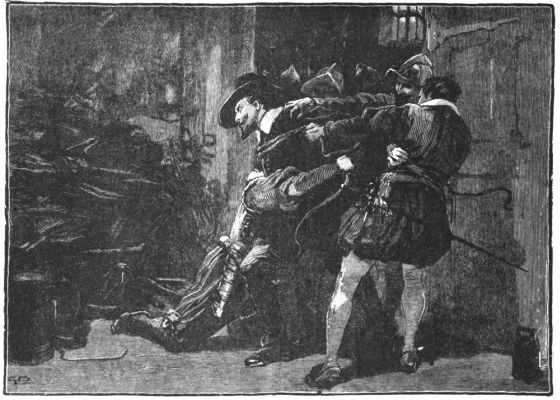
ARREST OF GUY FAWKES. (See p. 427.)
Catesby and John Wright had left on the evening of the 4th for Dunchurch as agreed; Percy and Christopher Wright maintained their watch in London till they heard of the arrest of Fawkes, when they mounted and rode after Catesby and John Wright. Keyes and Rookwood still waited till morning, when finding the whole known and all London in a state of terror, Keyes got away after the rest. Rookwood lingered in town till near noon, as he had a relay of vigorous horses ready, and when mounted, he rode furiously, overtook Keyes on Finchley Common, whence they rode to Turvey in Bedfordshire. Rookwood still pursued his gallop till he overtook first Percy and Christopher Wright, and then Catesby and John Wright, and the whole troop rode on together till they came to Lady Catesby's, at Ashby St. Legers, in Northamptonshire. They arrived there at six o'clock in the evening, Rookwood having ridden the whole eighty miles from London in little more than six hours. A party of conspirators, with whom was Winter, were just sitting down to supper when the fugitives came in, covered with mud and sinking with fatigue. Yet no time was to be lost. After a hasty refreshment, the whole company got to horse, and rode with all speed to Dunchurch.
The strange, haggard, and dejected appearance of the conspirators, and their eager closeting with Sir Everard Digby, awoke the suspicions of the hunting party. Before midnight, a whisper of treason and its failure flew amongst them, and they quickly got to horse and rode off each his own way. In the morning there remained only Catesby, Digby, Percy, the Wrights, Winter, and a few servants.
Catesby now advised that they should strike across Worcestershire for Wales, where he flattered himself they might assemble the Catholic gentry and make a formidable stand. In pursuance of this romantic plan, they mounted and rode to Warwick, whence, after obtaining fresh horses for their jaded ones, they made for Grant's house at Norbrook, and thence rode on through Warwickshire and Worcestershire to Holbeach House, on the borders of Staffordshire. All the way they had called on the Catholics to arm and join them for the rescue of their faith, but not a man would listen to the appeal. On this decided failure, instead of pushing for the mountains of Wales, they resolved to make a stand at Holbeach.
Meanwhile Sir Richard Walsh the sheriff of Worcestershire, with the whole posse comitatus and a number of volunteer gentlemen, was in chase of them. They had diverged from their original route in the hope of being joined by the gentry, who only drove them from their doors; and now, no sooner did Stephen Littleton, the owner of Holbeach, learn the real facts, than, horrified at the certain destruction impending over these desperate men, he escaped at the earliest opportunity from the house. He was soon followed by Sir Everard Digby, on the plea of endeavouring to muster assistance. The remaining conspirators—who, with servants, did not amount to more than forty men—put the house in a state of defence; but as they were drying some powder before the fire, it exploded, scorching Catesby and some others of the bystanders.
This accident so appalled them, impressing them with the idea that their enterprise was displeasing to God, that Robert Winter, Bates the servant of Catesby, and others got away. About noon Sir Richard Walsh came up with his troop, surrounded the house, and summoned them to surrender. But preferring death in arms to the gallows, they defied their assailants, and resolved to fight to the last. On this the sheriff ordered one part of his followers to set fire to the house, and the other to batter in the gates. Catesby, blackened and nearly blinded by the powder, called on the rest to make a rush and die hand to hand with their assailants. In the courtyard, Catesby, the two Wrights, and Percy were mortally wounded. Catesby crawled on hands and knees into the house to a crucifix, which he seized in his hands and expired. Rookwood, dreadfully burnt and wounded, was seized as well as Winter, whose arm was broken. Percy died the next day. The rest of them were soon taken. Robert Winter had overtaken Stephen Littleton in a wood, and together they made their way to the house of a Mrs. Littleton, near Hagley, where they were secreted, without her knowledge, by her cousin Humphrey Littleton, but were betrayed by a servant of Mrs. Littleton. Sir Everard Digby was pursued and taken in a wood near Dudley. They were all captured, with Keyes and Bates Catesby's servant, who was taken in Staffordshire. Four days after the seizure of the captives at Holbeach, Tresham was arrested in London, notwithstanding his affected innocence and his offers of assistance to the Council; and thus were the authors of this conspiracy destroyed, or safe in the hands of Government. Soon afterwards Garnet was discovered hiding at Hendip in a secret chamber.
The trials, of course, excited intense interest, and the king, queen, and prince were said to be present, where they could see and hear without attracting public notice. The prisoners were eight, Sir Everard Digby, Robert and Thomas Winter, Rookwood, Grant, Guido Fawkes, Keyes, and Bates. Sir Everard Digby pleaded guilty, all the rest not guilty, on the ground that many things were included in the indictments which were not true. There were no witnesses called, but the written depositions of the prisoners and of a servant of Sir Everard's were taken as sufficient proof. The accused, for the most part, denied that the three Jesuits (Garnet and two others who had been implicated) had any part in the plot, though they might more or less be aware of it; nor was there any proof brought forward or admission made which affected the Catholic body generally. On the contrary, it was too notorious that the Catholics had everywhere shrunk from the conspirators with horror; and Sir Everard Digby, in his letters to his wife, written from the Tower, pathetically laments that the Catholics so far from supporting the conspiracy, shunned and condemned them, and adds that he would never have engaged in it if he had not thought it lawful. The prisoners who pleaded not guilty, excused their conduct by the cruelty of the persecutions which they were enduring, the ruin and sufferings of their families, the violated promises of the king, and their consequent despair of any other termination of their oppressions, as well as their natural desire to effect the restoration of what they deemed the only true church. The Earls of Salisbury and Northampton denied, on the part of the king, the breach of any promises; and the prisoners were condemned to the death of traitors, which they endured, in all its revolting severity, at the west end of St. Paul's Churchyard. Digby, Robert Winter, Grant, and Bates, on the 31st of January, and Thomas Winter, Fawkes, Rookwood, and Keyes, next day.
The Jesuits Garnet and Oldcorne and their two servants, Owen and Chambers, who had been captured in Worcestershire, were lodged in the Tower, and there underwent the strictest examination, and Oldcorne, Owen, and Chambers were placed upon the rack. Garnet was not racked, but was threatened with it, to which he replied, "Minate ista pueris"—"Threats are only for boys." As it was probably thought that nothing was to be hoped from Garnet through torture, a stratagem worthy of the Inquisition was resolved on. The warder in whose custody the Jesuits lay, received an order from the lieutenant of the Tower to assume a friendly demeanour towards them; to express his sympathy for their sufferings, and his respect for their undaunted maintenance of their faith. Having made a favourable impression, he proceeded to offer them all the indulgence in his power, consistent with their safe custody. The Jesuits fell into the snare. The warder offered to take charge of any letters that they wished to convey to their friends. His sincerity seemed so genuine that the offer was accepted; a correspondence with several Catholics was commenced, and the letters each way were regularly carried to the commissioners, opened, and copied before delivery. Many of the letters being found to have secret notes appended in lemon juice, which only became visible when heated, were retained, and exact copies sent. Some of these letters still remain in the Public Record Office. But this correspondence, notwithstanding the sympathetic ink, was so guarded, that it furnished no new facts and another plan was adopted. The warder, as if growing more willing to serve them by longer acquaintance, showed them that by leaving an intermediate door unlocked between their cells, the two Jesuits could meet and converse at freedom. Still confiding entirely in their apparent friend the warder, who recommended extreme caution, Garnet and Oldcorne gladly embraced this opportunity of intercourse. But in secret recesses in the passage were placed Lockerson the private secretary of Cecil, and Forsett a magistrate of the Tower, who heard and noted down the conversations of the prisoners. Five times were these treacherous interviews permitted, and the reported conversations of four of them are still preserved.
As might be expected, the conversations chiefly turned on the best mode of conducting their defence. In these conversations Garnet admitted that though he had denied it, he had still been at White Webbs, in Enfield Chase, with the conspirators, and would still maintain that he had not been there since Bartholomew-tide. On another occasion he let fall things which still further betrayed his knowledge of the plot. It is possible that he might even yet have escaped had he not, at his trial, avowed that he considered equivocation and mental reservation on any point that might incriminate him, perfectly justifiable. After that declaration popular sympathy was no longer in his favour. A verdict of guilty was pronounced against him, and he was hanged, drawn and quartered on the 3rd of May, 1606.
A Parliament was summoned for the double purpose of raising money and of extending additional punishment over the Catholics generally. The whole country was in that state of alarm and hostility to them, that James found it necessary to restrain rather than encourage the mania. Such was the public excitement, that even he was not exempt from blame on account of this lenity. He had chosen this inauspicious moment to make overtures to Spain for the Infanta as a wife for Prince Henry, and the Puritans at once ascribed his moderation to this cause, and declared that he was little better than a secret Papist himself. James was alarmed and obliged to give way. It was in vain that Henry IV. of France remonstrated against a bigotry which had already driven some of the Catholics to such desperate lengths. His ambassador represented that the king his master had learnt from experience that persecution only stimulated zealots to a temper in which they gloried in suffering, and that far more could be effected by kindness than by severity; that James should, if he loved peace, make himself their protector instead of their persecutor. But Parliament soon showed how useless at the moment was such advice. Both Houses appeared to be carried beyond all reason by their fears and their resentment. On the 3rd of February every member of the Commons was ordered to stand up in his place and propound such measures as appeared to him most desirable. The most extravagant propositions seemed the most acceptable, and after impetuous debates upon them, they were communicated by conferences to the other House, and in both Lords and Commons motions of the severest description were made and carried by triumphant majorities. Catholic recusants were now forbidden to appear at Court, to dwell within its boundaries, or within ten miles of the boundaries of London; or to remove on any occasion more than five miles from their homes, under particular penalties, unless in the latter case they had a licence from four neighbouring magistrates. They were rendered incapable of practising in surgery, physic, or common or civil law; of acting as judges, clerks, officers, in any court or corporation; of presenting to church livings, schools, or hospitals in their gift; or of exercising the functions of executors or guardians; where persons were married by Catholic priests, the husband, if a Catholic, could not claim the property of the wife, nor the wife, if a Catholic, that of the husband; and if a child born was not baptised by a Protestant minister within a month, the penalty was one hundred and fifty pounds; and for every corpse not buried in a Protestant cemetery, the penalty was twenty pounds. All existing penalties for absence from church were retained, with the addition that whoever received Catholic visitors, or kept Catholic servants, must pay for each such individual ten pounds per lunar month. Every recusant was declared to be excommunicated; his house might be broken open and searched at any time, his books and any articles belonging to "his idolatrous worship" might be burnt, and his arms and horses seized by the order of a single magistrate.
A new oath of allegiance was framed recognising absolute renunciation of the right of the Pope to interfere in the temporal affairs of the kingdom. The Catholics who submitted to take this oath were to be liable only to the penalties now enumerated; but they who refused were to be imprisoned for life, and to suffer forfeiture of their personal property and the rents of their lands.
The publication of these terrible enactments carried astonishment and dismay through the nation; many Protestants as well as Catholics condemned them. The French minister Villeroy declared that they were characteristic of barbarians rather than of Christians. Many Catholics made haste to quit their native country, and the rest prepared to sacrifice both property and personal liberty. The Pope Paul V. despatched a secret emissary to James, imploring him to relax the rigour of the new laws, but without success. And the Pontiff, resenting the repulse, then published a breve, denouncing the oath of allegiance as unlawful, "because contrary to faith and salvation." The publication of this imprudent breve only made matters worse. The Catholic clergy were before its arrival divided in their opinions as to the lawfulness of taking it; the archpriest Blackwall himself, with many of his brethren, were prepared to take it. The authority of the Pope extinguished theirs and decided the majority; yet Blackwall took the oath himself, and advised the Catholics, by a circular letter, to take it.
But no submission on the part of a portion of the Catholics could mitigate the wrath of James at the conduct of the Pope. He ordered the bishops in their several dioceses to tender the oath, and to enforce the penalties on all recusants. Three missionaries lying under sentence of death for the exercise of their priestly functions, were called upon to take it; they refused. Two of them were saved by the earnest intercession of the Prince de Joinville and the French ambassador. The third, named Drury, was hanged, drawn, and quartered. Blackwall the archpriest himself was thrown into prison, though he had both taken the oath and advised the rest of the Catholics to take it; and though James pitied him, he could do nothing more in his behalf than prevent him from being brought to trial and capitally condemned. The case of Blackwall was extremely hard, for, on the other hand, he had excited the resentment of the Pope by his concession. He was called on by letters from Cardinals Bellarmine and Arrigoni, and the Jesuits Parsons and Holtby to retract; but as he would not, he was superseded by Birket. He was then in his seventieth year, and remained in prison till his death, in 1613.
A second breve from the Pope roused the spirit of James; he determined to try whether he could not silence the clamour of the papal party by his pen. He abandoned even the pleasures of the chase, refused to listen to his ministers, and calling his favourite divines around him, he shut himself up with them, and produced a tract called "An Apologie for the Oath of Allegiance," which was immediately translated into French and Latin. But as the royal brochure did not convince the Catholics, six priests were condemned for refusing the oath, and three of them were executed, one at York and two at Tyburn. Moreau, Bellarmine, and Parsons, published replies to the royal treatise; and again James closeted himself with his divines, revised his publication, and prefaced it with a "Premonition to all Christian Princes." It was in vain that the kings of Denmark and France counselled him to desist from a contest so unworthy of a great monarch, in vain that the queen urged the same advice. He condescended to declare that the fittest answer to Parsons would be a rope; and as for Bellarmine, who had written under a feigned name, he dubbed him "a most obscure author, a very desperate fellow in beginning his apprentisage, not only to refute, but to rail at a king." The flatterers of the king applauded his "immortal labours," as they were pleased to call them; and James continued to toil at them, revise, and remodel his arguments till 1609. The Catholic peers, with the exception of Lord Teynham, all took the oath on different occasions in the Upper House.
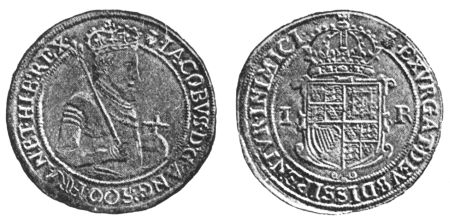
POUND SOVEREIGN OF JAMES I.
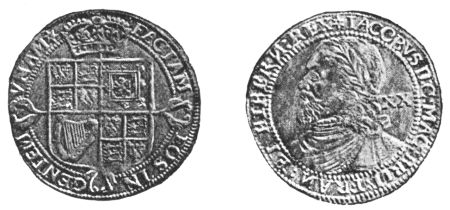
UNIT OR LAUREL OF JAMES I. (GOLD).
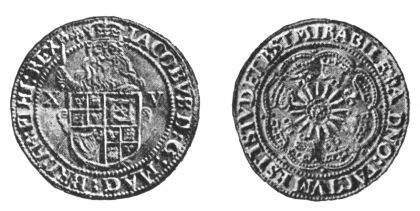
SPUR RIAL OF JAMES I. (GOLD).
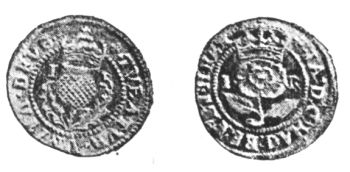
THISTLE CROWN OF JAMES I. (GOLD).
To dismiss for the present the religious controversies which kept the kingdom in a ferment of bitterness, we have a little overstepped the progress of general events. In the spring of 1606 James called together Parliament, for he was in much distress for money. As usual, the Commons had their list of complaints to set off against his demands and as James showed no eagerness to redress no less than sixteen subjects of grievance, the Commons made no haste with the supplies. At length, in the month of May, whilst the question of the subsidy was dragging its slow length along, and Cecil was endeavouring in vain to quicken the motion of the House, by making promises which meant nothing beyond inducing the members to vote, a sudden rumour ran through the court that the king was assassinated at Oaking in Berkshire, where he was hunting along with his favourites, the Earl of Montgomery, Sir John Ramsay, and Sir James Hay. The mode of his death was variously reported. One version was that he had been stabbed with a poisoned knife, and another that he had been shot with a pistol, and a third that he was smothered in his bed. The murderers were differently represented to be the Jesuits, Scotsmen in women's clothes, Frenchmen, and Spaniards. There was great consternation both in the City and the Parliament. The Lords displayed the utmost loyalty; and the Commons suddenly closed their money debate by voting three subsidies and six fifteenths. In the midst of the panic James arrived safe and sound in London, and was received with proportionate enthusiasm. As the sensation went off, many began to suspect that Cecil, and perhaps the king himself, could have explained the origin of the ruse—that it was but a spur to the tardy liberality of the Commons. At all events, James, having obtained his supplies, prorogued Parliament to the 18th of November.
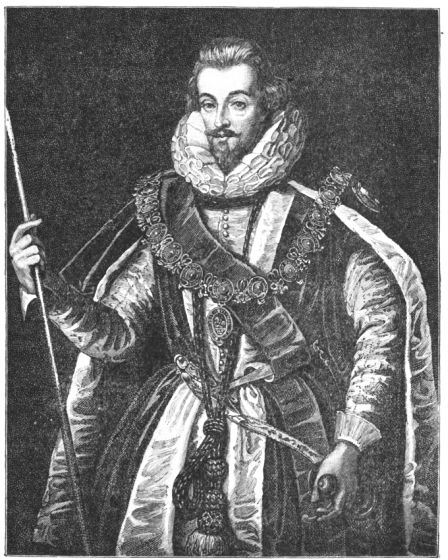
SIR ROBERT CECIL, AFTERWARDS EARL OF SALISBURY. (From the Portrait by Zucchero.)
The great business of Parliament now for several sessions—that is, from 1604 to 1607—was that of discussing James's suggestion for the union of the two kingdoms. This very suggestion, so immediately brought forward, was a glaring proof of James's want of solid judgment. The least reflection might have satisfied the least reflecting mind, that two nations which had for so many ages been inflamed against each other by wars, injustice, mutual cruelties, political jealousies, and the taunts which embittered passions had caused them to fling at each other, would require a long time to reconcile them to the idea of entire amalgamation. The centuries of attempted usurpation on the part of the English, and the determined resistance, even to death, of the Scots, made the latter sensitively apprehensive of the union. They saw in it only the accomplishment of the same end by different means. They were the less disposed to it in consequence of the foolish boastings of James of his absolute power. His high notions of prerogative appeared to have grown wonderfully since his accession to the English throne. He compared himself to a god upon earth, and had already given out his style and title as king of Great Britain. The Scots were, therefore, naturally suspicious of a union which would very largely augment his powers. Still more, his new and excessive leaning towards Episcopacy alarmed the Scots. They saw nothing but its attempted imposition on them in the union of the kingdoms, and they were not inclined thus easily to give up their freedom of conscience which they had fought out at so much cost. On the other hand, James's imprudent bestowal of posts and honours on Scotsmen in England, offended and disgusted the English. They asked whether they were to be overrun by a regular inundation of proud and hungry adventurers from the North. In the Commons the expressions of contempt and aversion to the Scottish race grew to the height of insolence and insult, and were sure to excite the most indignant feeling in that people. Sir Christopher Pigot, the member for Buckinghamshire, especially distinguished himself by the vituperation of Scotsmen. He professed the utmost horror at the idea of union between a rich and fertile country like England, and a sterile and poor one like Scotland; between a people wealthy, frank, and generous, and one at once haughty, beggarly, and penurious. This put the climax to the patience of Scotland, and James declared he could no longer tolerate language which insulted himself as a Scot.
Cecil at the command of the king took up the matter warmly, and the House of Commons, persuaded by him, expelled Pigot, and he was committed to the Tower. Defeated in the Commons, James betook himself to the courts of law. He had proposed to the Commons to pass an Act naturalising all Scots, even those born before his accession to the English throne; but when they rejected this, he obtained a decision from the judges sanctioning the admission of the inhabitants of each kingdom to all the rights of subjects in both. This would in a few years have made the Scots as much subjects of the English Crown as the English themselves, but James was not content with this. He used very angry and impudent language, threatening to leave London and fix his court at York or Berwick; telling his English subjects to remember that he was a king, who had to govern them and to answer for their errors; who was made of flesh and blood like themselves, and might be tempted to do what they would not like.
The Commons resented this language: they sent their Speaker to desire that the king would receive no reports of their proceedings except from themselves, and that they might be permitted to feel that they were at liberty to deliver their opinions in their own House without restraint or fear. James, who was easily alarmed, professed to have no desire to encroach on their liberty of speech, but no sooner did they put him to the test than he renewed his interference. A petition being presented to the House complaining of the oppressions upon the Puritans, and the abuses of the Church, James sent an order to the Speaker to inform the House that they were meddling with what belonged alone to him. The members declared this to be a violation of their privileges, but the Speaker informed them that there were plenty of precedents for such restraint on the House by the Crown. The House on this proposed to appoint a committee to inquire into these precedents, and how far they were founded in constitutional right; but here again, James, fearing he had gone too far, sent them word that although the matter in question properly belonged to him, he should not object to their reading the petition.
But the Crown and the House very soon came into collision on the subject of the powers of the Commons. A petition was presented from the merchants, representing the injuries their ships and commerce received from Spain, particularly on the coasts of South America, the ports of which the Spanish were endeavouring to close against all other nations. The Commons thought it a subject of that national character that they should have the co-operation of the Peers with them, and therefore sent to the Upper House proposing a conference. But the Lords demurred, thinking it a subject which the Commons were scarcely authorised to enter upon. The difficulty, however, was mutually obviated; the Lords agreed to the conference. But it proved only an occasion for the Crown to deliver a lecture to the Commons on their aspiring to deal with subjects too high for them. James was, in fact, contemplating an alliance with Spain, and was by no means disposed to offend its rulers. Cecil, therefore, and Lord Henry Howard, now Earl of Northampton, read the Commons a very plain lecture, instructing them that all matters appertaining to peace or war, and all such topics as led to these results, belonged especially to the Crown; which indeed occasionally consulted the Commons, not out of right or necessity but as a matter of favour and also of policy, when it was advisable to have the sympathy and active support of the representatives of the people. But the declaration of war or concession of peace was the absolute prerogative of the Crown; the business of the Commons was more private and local, such as the furnishing of funds—and when money was wanted, they never failed to hear of it.
The Commons allowed the petition of the merchants to stand over for the time, but out of doors the spirit of dissatisfaction rose high, and the leaning of James towards Spain was narrowly watched and commented upon.
While the Government and the Commons were engaged in this discussion, a serious insurrection called the attention of the Council another way. The lucky courtiers who had obtained amongst them the estates of the gentlemen who had forfeited them for their share in the Gunpowder Plot, whilst dividing and enclosing, like their predecessors who had obtained the estates of the Church, cast greedy eyes on the adjacent common lands, and enclosed as much as they could of them with the rest. The people, deprived of their right of pasturage, rose in resistance, as they had done in the reign of Edward VI. They had the statutes regarding enclosures in their favour, and assembling in numbers from one to five thousand, they broke down the new fences, filled up the ditches, and restored the usurped fields to their ancient state as common. Like the agrarian reformer, Ket of Norfolk, they confined themselves strictly to their legitimate object. They conducted themselves with perfect order, committed no depredations on really private property, nor perpetrated any excesses, to which their numbers might have tempted them. They appeared in great force at Hill Morton, in Warwickshire, an estate of Tresham's, and in their largest force of five thousand at Coleshill. Their leaders, whoever they were, appeared in masks, except one man of the name of Reynolds, who was an enthusiast and set all danger at defiance; declaring that he was sent of God to satisfy men of all degrees, and had, moreover, authority from the king to level all the new fences. He acquired the name of Captain Pouch, from a large pocket which he wore at his side, and in which he boasted that he carried a charm which not only made him invulnerable to sword or bullet, but which would protect them from all harm.
The insurgents broke out about the middle of May, having in vain previously presented their memorials to the Council, the members of which were too much interested in the lands in question to pay any attention to them. At first James and the Court were greatly alarmed, supposing it to be a demonstration of Catholics or Puritans. The guards at Westminster palace were doubled, and orders were issued to the Lord Mayor to watch the movements of the apprentices in the City. A little time, however, revealed the real nature of the rising, and the insurgents were ordered to disperse; but they stood their ground, assuring the magistrates that they were only executing the statutes against enclosures, and were under orders not to violate the law in any manner, nor even to indulge in swearing. The lieutenants then endeavoured to raise the counties, but the yeomanry displayed no desire to interfere in such a cause; and many gentlemen even contended that it was best to concede the matter to the poor, advice which, if followed, would no doubt have ensured speedy quietness without bloodshed. But this did not suit the views of the interested Council, and the Earls of Huntingdon and Exeter and Lord Zouch were sent with a considerable force to quell them. Sir Edward Montague and Sir Anthony Mildmay came upon a number of them busy levelling the enclosures at Newton, another estate forfeited by Tresham. They found them well armed with bills and bows, pikes and stones. The officers commanded them to disperse, but they refused, and after twice reading the Riot Act in vain, a charge was ordered. The trained bands showed no relish for the business; but the regular cavalry, and the servants of Mildmay and Montague, attacked them briskly. The insurgents returned the attack with much bravery, but at the second onset broke and fled. Forty or fifty of them were killed, and a great number wounded. Sir Henry Fookes, who led on the infantry against them, was severely wounded. After this defeat "the levellers," as they were called, were pursued in all directions and everywhere put down and dispersed. Many prisoners were made and a commission, with Sir Edward Coke at its head, was appointed to try them.
James, with a feeling that did him honour, instructed the Commission to use moderation in punishing the prisoners, declaring that the Council had been more to blame than they, for neglecting their petitions. Had they not intercepted them, he pretended to say that they would have received redress from him. He maintained that they had been oppressed and driven to resistance by the rapacity of the gentry and the neglect of ministers. Pouch and some of his associates were condemned and executed as traitors on the 28th of June; and some of the others were hanged as felons because they had not dispersed on the reading of the Riot Act.
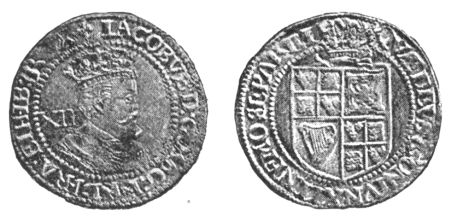
SHILLING OF JAMES I.
The king on the 4th of July prorogued Parliament till November, but having got a considerable amount of money from it, and little other satisfaction, he did not summon it again till February, 1610. Could he have found sufficient funds any other way, it is quite certain that he would never have called it any more. In his suit of Lincoln green, with a little feather in his hat, and a horn by his side instead of a sword, he followed his hounds through the forest, happy as Nimrod himself, so long as the means lasted. But James's Court was altogether on an extravagant scale. Like a youthful heir whose guardians have kept him close, and who makes up for a long abstinence by tenfold profuseness on coming to his estate, James, escaped from the poverty of his Scottish establishment where he had mainly lived on his pension from Elizabeth, now gave rein to extravagance as if nothing could exhaust the affluence of England. He had a most expensive household, and he gave money to his favourites as though he had the wishing-cap of Fortunatus.
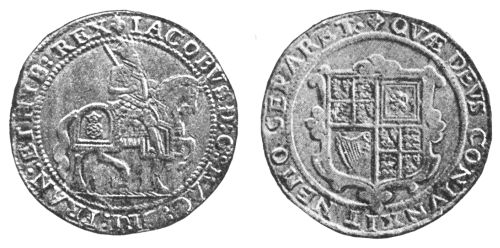
CROWN OF JAMES I.
Not only was his own household lavishly managed, but even those of Henry and Elizabeth, two of his children, consisted of one hundred and forty personages. In 1610, but three years after this period, that of Prince Henry was increased to four hundred and twenty-six individuals, of whom two hundred and ninety-seven were in receipt of salaries, besides a number of workmen employed under Inigo Jones, the architect.
But above all the presents to his favourites would have given the idea that his resources were interminable. At the marriage of Sir Philip Herbert with Lady Susan Vere, he gave him an estate valued at £500 a year. At the marriage of Ramsay, Viscount Haddington, with Lady Elizabeth Ratcliffe, he paid his debts, amounting to £10,000, having already endowed him with an estate of £1,000 per annum; and he presented to the bride a gold cup containing the patent of a grant of lands worth £600 a year. His gifts at different times to Lord Dunbar amounted to £15,262; to the Earl of Mar, to £15,500; and to Viscount Haddington, to £31,000.
This Viscount Haddington was the Sir John Ramsay who stabbed the Earl of Gowrie, at the time of the singular Gowrie conspiracy; and James went on promoting him till he became Earl of Holderness, with many grants of lands, gifts, and pensions. The second in James's regard, in the early part of his reign, was another Scotsman, James Hay, whom he successively created Lord Hay, Viscount Doncaster, and Earl of Carlisle. Clarendon says that this man, in the course of a very licentious career, spent above four hundred thousand pounds and left neither house nor child to be remembered by. James, in England, also chose several English favourites. The first of those was Sir Philip Herbert, brother of the Earl of Pembroke and son of the sister of Sir Philip Sidney. He was created Earl of Montgomery, and was especially agreeable to James because he despised learned men—for James was jealous of all such—and took pleasure only, like his royal master, in dogs and horses. Montgomery was in the ascendant till the king's eye fell on one Robert Carr, destined to a strange history; and the English and Scottish favourites, by their mutual hatred of each other, their quarrels and duels, gave James sufficient trouble. Haddington and Montgomery had an affray in which Montgomery showed the white feather, and James sent Haddington for a short time to the Tower. Douglas, the Master of the Horse, was killed in one of these squabbles; and some years later Lord Sanquhar had an eye thrust out by a fencing master, for which his lordship killed him, and was executed for the deed. Such was the disgraceful condition of the court of the British Solomon.
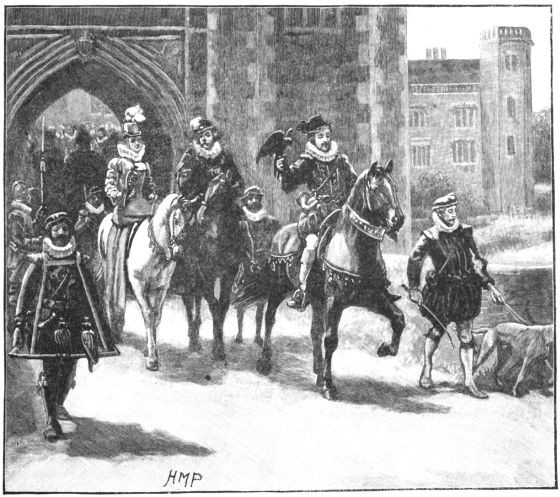
JAMES AND HIS COURTIERS SETTING OUT FOR THE HUNT. (See p. 436.)
During the years 1608 and 1609, negotiations were pending between the United Provinces of the Netherlands and Spain. James, who had a claim on these Provinces for above eight hundred thousand pounds on account of advances and services by Elizabeth, for which he held the towns of Flushing, Brell, and Rammekens, would have been glad to obtain possession of the money. So well was this known, that there were rumours that, as he could not obtain the sum due, he was intending to sell the towns to Philip III. of Spain. The Archduke Albert was still in Flanders, not having abandoned the hope of recovering the revolted States; and Catholics from England were in the habit of volunteering to assist him in undoing what Queen Elizabeth had done there. But much as James was pressed for money, he was scarcely daring enough to aid Spain in its views. The spirit of Protestantism was too strong in England tamely to witness such an anti-Protestant policy; and, in fact, James himself was rather afraid of an attack from Spain, than hoping for a coalition with it. The Earl of Tyrone had fallen under suspicion of fresh rebellion, and had fled to the Spaniards in the Netherlands for security. Cecil apprehensive that Philip might be disposed to attempt his restoration, instructed Sir Charles Cornwallis, at Madrid, to use bold language on the occasion. This appears to have had effect, for Tyrone retired to Italy. But a new danger presented itself in the rumour of negotiations for peace between Holland and Spain. Cecil dreaded a pacification between these Powers, as it would allow Philip more opportunity to turn his attention to Ireland, if so disposed.
The English Government was surprised and mortified to learn that such negotiations were actually proceeding, and that the King of France had been invited to join in them. At length James, who had so deep a stake in the Netherlands, received a formal notice to the same effect, soliciting his co-operation. These negotiations were conducted at the Hague, but it was not till March, 1609, that they were brought to a conclusion. The result was a truce for twelve years, which was, in fact, equivalent to a peace, acknowledging the independence of the Dutch States, after a brave conflict for liberty of forty years. The debt of James, amounting to eight hundred and eighteen thousand pounds, was acknowledged, and engagements entered into for its payment by annual instalments of sixty thousand pounds. But the first payment was not to be made till the end of two years, and James was still to retain the cautionary towns till the whole was discharged.
The postponement of the payment of the debt of Holland was extremely embarrassing to Cecil. On the death of the Earl of Dorset, in 1608, he succeeded to the office of Treasurer, and to the clamorous demands which had been made upon Dorset. His carriage had been stopped in the streets by the servants of the king's household, who were loud in their demands for their long arrears of wages, and the purveyors refused to bring in any more supplies till they were paid their advances. Cecil, on examining the accounts, found James one million three hundred thousand pounds in debt, and exceeding his income at the rate of upwards of eighty thousand pounds per annum. He set to work resolutely to curtail this expenditure and to devise means of raising money. James always claimed an authority paramount to all laws; and Cecil ventured to put in practice the idea of prerogative in raising the necessary funds. He called in rigorously the unpaid remains of the last voted subsidies, and then proceeded to lay on duties and impose monopolies of the most odious nature, without any sanction of Parliament. His predecessor Dorset had set him the example by levying an import duty on currants by letters patent. This illegal demand had been resisted, and Bates, a Turkey merchant, was proceeded against for refusal to pay, in the Court of Exchequer. This court was base enough to decide in favour of this unconstitutional stretch of power, and James was delighted at so auspicious a concession of the justice of his doctrine of prerogative. Cecil pressed on in the path thus opened, and laid on import and export duties on various articles by orders under the Great Seal. He imposed a feudal aid towards the knighting of the Prince Henry, of twenty shillings on each knight's fee; but this produced only twenty-eight thousand pounds. He then extended his duties to almost every species of imported and exported goods, at the rate of five pounds per cent. on the value of the goods, which he calculated would produce three hundred thousand pounds per annum; and he sold to the Dutch a right of fishing on the coasts of England and Scotland. Cecil himself was the farmer of these duties. They were, however, of a character to excite the utmost dissatisfaction; trade fell off under their influence, fewer ships came into the English ports, and there was at length no alternative but to summon a Parliament, which met on the 24th of February, 1610.
The great topics which occupied this Parliament were, of course, the king's want of money and his continual violations of Magna Charta. Cecil, seeing the desperate state of the royal finances, made a bold demand that six hundred thousand pounds should be at once voted to liquidate his debts, and that an annual addition of two hundred thousand pounds should be consented to as a permanent pension, to prevent him from getting into debt again. But Cecil committed a great blunder both in routine and in sound policy, by proposing this money measure to the Lords instead of to the Commons, whose proper business it was. The Commons resented this course, and were more determined than ever in demanding an abandonment of the unconstitutional practice of imposing duties without their consent. They declared that the imprisonment of Bates for opposing this practice, though sanctioned by the Exchequer, was nevertheless illegal. Francis Bacon and Sir John Davis endeavouring to justify the despotic proceeding, only increased the exasperation of the House. It was declared that if the taxing of merchandise by prerogative was permitted, the taxing of their lands would soon follow. James sent them word to desist from such discussions; but the Commons were not to be thus silenced, whereupon James sent for both Houses to Whitehall, and delivered a most blasphemous speech in vindication of his inflated notions of kingly authority. "Kings," said he, "are justly called gods, for they exercise a manner or resemblance of divine power upon earth. For if you will consider the attributes of God, you shall see how they agree in the person of a king. God hath power to create or destroy, to make or unmake, at His pleasure; to give life or send death, to judge all, and to be judged of nor accountable to none; to raise low things, and to make high things low at His pleasure; and to God both body and soul are due. And the like power have kings. They make and unmake their subjects; they have power of raising and casting down, of life and of death; judges over all their subjects, and in all cases, and yet accountable to none but God only. They have power to exalt low things and abase high things, and make of their subjects like men of chess—a pawn to take a bishop or a knight; and to cry up or down any of their subjects as they do their money. And to the king is due both the affection of the soul, and the service of the body of his subjects." To resist the king in any of his acts or impositions, he declared was sedition; for the king was above all law, and laws were, in fact, but granted by kings to the people as a matter of favour.
The Commons would not listen to such insane language. They told the king that in extolling the power of kings, he forgot the existence of Magna Charta, which set eternal and impassable bounds to that power; and they appointed a committee to search for the legality or illegality of all the practices complained of. The Crown lawyers in committee argued that "the reverence of past ages, and the possession of present times," sanctioned the king's doctrine; and that the right of imposing duties had been exercised by the three first Edwards by their own will, and independent of Parliament; and that if it had been interrupted from Richard II. to Mary, yet that princess had reassumed the royal privilege, and that it was continued by Elizabeth. But the Commons replied that in all these cases the monarchs had violated Magna Charta, the Statute de tallagio non concedendo, and twelve other Parliamentary enactments; that no time or practice could establish a right against those great bulwarks of popular liberty. And the Commons therefore demanded that a law should be made during this Session, declaring that all such impositions of duties or taxes, without consent of Parliament, should be pronounced for ever void. And they accordingly passed such a Bill, which, however, was rejected by the more subservient Lords.
James writhed under this plain and direct denial of his assumed authority, and refused to surrender the question. He found in the bishops a body, on the whole, ready to co-operate with him in his attempt to destroy the Constitution; and Bancroft, the Primate, led the way with unblushing baseness. Under his leadership the whole High Church party echoed the king's most absolute dogmas, and claimed for him all the divinity which he professed to possess. The king, according to their creed, being divine, so were the bishops who were appointed by him, and therefore this divine Crown and Church were above all law. The ecclesiastical courts carried this theory into daily practice, and encroached on the temporal courts as pertinaciously as the king did on Parliament. There was a grand struggle between the common and the civil law. The judges, who saw this arrogance of the clergy with jealousy and disgust, began to relax their enmity against the Puritans and to regard them as the natural allies of law against absolutism.
On the other hand, the king and bishops sought out fresh means in support of their doctrine, and one of these was to bring forward Dr. Cowell who, in his "Interpreter, or Law Dictionary," broached unmitigated maxims of despotism. He declared that the king inherited all the powers which had been exercised by the Emperors of Rome; as if the empire of the Romans had never ceased in England, or as if the civil law being still used by the Church, it became in all its forms imperative on the nation. This work was dedicated to Bancroft, and he and the king eulogised it as maintaining all the rampant maxims of absolutism which James had ever uttered. The king, Cowell declared, was "solutus à legibus," "freed from all restraint of laws;" and though he took an oath at his coronation to maintain all the laws unchanged, yet he was at full liberty to quash any laws that he pleased; and, in a word, he contended "that the King of England is an absolute king."
The Commons called upon the Lords to unite with them in punishing this apologist, who, not content with selling his own birthright for a mess of pottage, was endeavouring to sell that of the nation too. The case was so flagrant that the Lords could not decline the challenge. And Bacon, who had shortly before been the advocate of the royal prerogative, now conducted the case for the Commons in the conference against Cowell, who was sent to prison for a time; his book was suppressed by the king's proclamation, poor James himself being obliged to condemn his own champion.
Having triumphed in this particular, the Commons proceeded to much older grievances. They demanded the abolition of that den of injustice and extortion, the Court of High Commission, in which the king exercised that unrestrained despotism which he claimed over the whole kingdom; where men were sentenced and fined at the arbitrary will of the king and its council, without jury or evidence admitted in their defence: but this was an institution so dear to James's heart, that he would not listen to any abatement of its power. They next complained of the growing abuse of substituting royal proclamations for established law, "by reason of which," said the Commons, "there is a general fear conceived and spread amongst your majesty's people, that proclamations will, by degrees, grow up and increase to the strength and nature of laws." To this James simply replied that his proclamations should not exceed the warranty of law. They further complained of the delay of the courts in granting writs of habeas corpus and prohibition, and of the encroachment of the Council of Wales, which extended its jurisdiction over neighbouring counties where it had no real authority; as well as of various monopolies, taxes on public-houses and on sea-coal.
The licenses to public-houses he agreed to revoke, but he demanded a perpetual revenue in lieu of the income thence derived. This the Commons refused, alleging that he had no right to impose that tax in the first instance; and they further demanded that the feudal burthens of tenure by knights' service, wardships, and purveyance, should cease. As to the first, James absolutely refused compliance, on the plea that he would not reduce all his subjects, "rich and poor, noble and base, to hold their lands in the same ignoble manner;" but as to wardships, the marriages of infants and widows, and other odious services, including purveyance, he was willing to barter them for a sum of money. The sum which he demanded was three hundred thousand pounds per annum. The Commons only offered one hundred thousand pounds, but after a long course of haggling, like chapmen in a fair, the king descended to two hundred and twenty thousand pounds, and the Commons rose to one hundred and eighty thousand pounds. Here the matter paused till James moved a dissolution, when the Commons advanced to two hundred thousand pounds, and the king accepted the sum. But here again the king and his advocates had boasted so much of his being above the law, and of his power to quash, of his own will, any statute to which he had consented, that the Commons were cautious in their proceedings, and they had moreover to determine out of what funds this revenue should be raised. These discussions had now driven on the Session to the middle of July, and it was agreed that they should vote one subsidy, and one tenth and fifteenth for the present Session, and defer the final settlement of the other grant till the next.
The interval was utilised by James and his ministers in attempts to corrupt some of the members of the Opposition, and thus to enable him to concede less and obtain more; but the Commons had employed the time in weighing the slippery nature of the man with whom they had to deal. His continual boasts of his superiority to all laws, and of an actually divine power of dispensing with his most solemn obligations, made them doubtful of the possibility of binding him to any terms; and the growing extravagance and rapacity of both king and courtiers deepened their fears.
When they met they were in a far less compliant humour than when they separated. They insisted on seeing the promised reforms before they voted the two hundred thousand pounds. James was growing desperate for money; his coffers were empty, and the officers of the Crown were clamorous for their arrears of salary. He therefore sent for them to Whitehall, and a deputation of about thirty members attended. The king demanded of them whether they thought that he was really in want of money, as his Treasurer and the Chancellor of the Exchequer had informed them? "Whereto," says Winwood, "when Sir Francis Bacon had begun to answer in a more extravagant style than his majesty did delight to hear, he picked out Sir Henry Neville, commanding him to answer according to his conscience. Thereupon Sir Henry Neville did directly answer that he thought his majesty was in want. 'Then,' said the king, 'tell me whether it belongeth to you, that are my subjects, to relieve me or not?' 'To this,' quoth Sir Henry, 'I must answer with a distinction: where your majesty's expense groweth by the commonwealth, we are bound to maintain it, otherwise not.'" Sir Henry reminded the king that in this one Parliament they had already given four subsidies and seven fifteenths, which was more than any Parliament at any time had given, and yet they had no relief of their grievances. James demanded what these grievances were—as though he had not heard them enumerated often enough before—and desired Sir Henry to give him a catalogue of them. Sir Henry adverted to the difficulties of obtaining justice in courts of law, to the usurped jurisdiction in the marches of Wales, and would have gone through the whole list had not Sir Herbert Croft interrupted him.
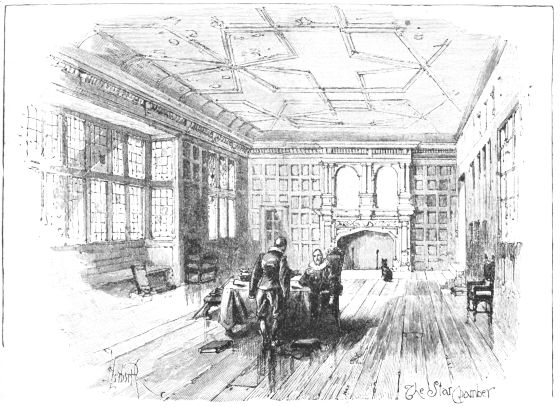
THE STAR CHAMBER.
Finding that nothing was to be drawn from the resolute House, James again prorogued them for nine weeks, in order to try every means of drawing over to him individual members. But these efforts were as abortive as the former: the Commons were determined not to part with their money till they had a guarantee for the redress of their grievances, and James about this time lost his two right-hand men, Bancroft and Cecil. Bancroft, had died in November, 1610, staunch to the last in his exhortations to James not to give up the High Court of Commission; assuring him that though the Lords had thrown out the Bill, the Commons would bring it in again, and that nothing but unflinching firmness would defeat them. Cecil died on the 24th of May, 1612. He was grievously chagrined at the failure of his favourite scheme for setting the king above all his difficulties. In default of that, the old expedient of the sale of Crown lands was resorted to for the raising of money, and privy seals for loans of money were despatched into different counties. Meanwhile James was subsisting on a subsidy of six shillings in the pound granted by the clergy, and both king and ministers were in terror lest the privy seals should be "refused by the desperate hardness of the people." They raised, however, one hundred and eleven thousand pounds.
The end of Cecil has been supposed to have been hastened by these anxieties; but probably he was worn out by the incessant cares which have pulled down other ministers besides him; for in his last moments he said to Sir Walter Cope, "Ease and pleasures quake to hear of death; but my life, full of cares and miseries, desireth to be dissolved." He had sought benefit at Bath, but without effect, and died at Marlborough on his return. Like his father, he had great talents, applied in a cold and ungenerous manner; but with all his faults he was a great minister.
We must now introduce the story of a lady whose fate was very hard—Arabella Stuart. Lady Arabella (born in 1577) was descended from Henry VII.'s eldest daughter Margaret, like James himself, and therefore was to him an object of suspicion. Her proximity to the Crown had drawn upon her the attention of both princes and conspirators at various times. When she was only about ten years of age, Elizabeth used to show her at Court as the person she meant to make her heir. This she did to provoke James, whose pretensions were nearly as odious to her as those of his mother. But in after years Elizabeth treated her with extreme severity. James, indeed, contributed to this, by asking her in marriage for his favourite, Esmé Stuart, Duke of Lennox, who was Arabella's cousin, also of the same royal descent. Elizabeth was extremely chagrined at such a proposal, reprimanded James sharply, forbade the marriage, and imprisoned the unoffending maiden. Again, Raleigh and Cobham were accused on their trial of having designed to depose James and place her on the throne in his stead. Lady Arabella did not wait to be questioned on the subject, but on receiving a letter of such purport from Cobham, immediately sent it to the king, and only laughed at the proposal. Again her name was mentioned in the Gunpowder Plot. James does not seem to have had any fear of her on these occasions. But he was more afraid of aspirants to her hand than of conspirators; and had, no doubt, settled in his mind that she should never marry. Like Elizabeth, he repulsed all offers of the kind, both from subjects and foreign princes, lest from the marriage should issue claimants to his throne. Cecil took care, on the death of Elizabeth, to secure the person of Arabella till James had been proclaimed and had taken possession of the throne. The king himself appeared disposed to act liberally towards her, except in not permitting her to marry. He settled a pension upon her, allowed her apartments in the palace, and she was recognised while the Princess Elizabeth was in her tutelage as first lady of the Court. The year after James's accession, the King of Poland sent an ambassador to demand her in marriage; but even Poland was not distant enough for royal fears. Next came a proposal from Count Maurice, titular Duke of Guelders, but James would not listen to it; and Lady Arabella, who was a clever woman, made it her policy—both under Elizabeth and James—to appear averse from any marriage whatever. She devoted herself to literature, poetry, and even theology, which became fashionable at Court from the predilections of James.
Queen Anne appears to have had a great regard for the Lady Arabella, who was handsome, of a lively and affectionate disposition, and ready to enter into all the taste for masques and pageants which distinguished her royal mistress. She was, in fact, the great ornament of the Court of James; but her attractions were only the more dangerous to her safety, considering her descent. The feeling that she excited increased James's alarm, and she was kept under the close surveillance of Elizabeth Cavendish the Countess of Shrewsbury, who was her aunt. The countess appears to have treated her with much harshness, and James to have paid her salary very badly. On the whole, no situation, with all its splendour, could be more miserable than that of Lady Arabella. No wonder, then, that she sought to escape from it. In her childhood she had been acquainted with Sir William Seymour, the son of Lord Beauchamp. They met again at Court, and their early attachment was renewed and rapidly grew into love. The Lady Arabella was now watched and harassed more than ever by her shrewish guardian Lady Shrewsbury, and matters came to such a pass between them that James was obliged to interfere. He paid up the arrears of her pension to enable her to discharge her debts, and to soothe her made her a present of a cupboard of plate, worth two hundred pounds. The chief cause of Lady Arabella's discontent was supposed to arise from her pressing necessities; but there was a deeper cause—the restraint upon her affections; and it was not long before some officious Court spy conveyed to James the alarming intelligence that there was an engagement of marriage plighted between Seymour and Lady Arabella. Seymour was also descended from Henry VII., and such a marriage in prospect was enough to terrify James beyond conception. He instantly summoned the offenders before his Council, where they were severely snubbed and forbidden to marry without the king's permission. They both promised to abandon the idea, but this was only to disarm suspicion till they could effect their marriage. In July, 1610, it was discovered that they were already wedded, and James issued an immediate order for their arrest. Seymour was committed to the Tower, and Arabella to the keeping of Sir Thomas Parry at Lambeth.
The youthful couple were so much pitied that they did not find it difficult to meet. Seymour bribed his keeper so effectually that he suffered him frequently to go out of the Tower, and he met Lady Arabella in the garden at Lambeth, and even in the house, unknown to Sir Thomas Parry. Meanwhile the friends of the young people were not inactive. They used all the means they could imagine to soften the mind of the king towards them; and the queen, who loved Arabella and received the most eloquent letters from her, praying her to exert her influence in her behalf, did her utmost to procure the liberation of her and her husband. Unfortunately, whispers of their stolen interviews reached James, and he sent instant orders to guard Seymour better, and to remove Lady Arabella to Durham, where she was to be in the keeping of the bishop. When the order reached Lady Arabella, she positively refused to go; but the officers carried her forcibly out in her bed, placed her in a boat, and rowed her up the river. In spite of her resistance, her keepers set forward on their journey; but by the time that they reached Barnet, her agitation of mind had thrown her into a fever, and the doctor declared that nothing but the discontinuance of the journey could save her life. He waited on the king himself and assured him of this. But though James confessed that carrying her away in her bed was enough to make her ill if she had been well, he was peremptory in his commands that she should proceed. To Durham she should go, he said, if he were king. To this the physician replied that the lady would obey if the king required it. "Obedience!" repeated James; "is that required?" But when his first anger was over he relented, and allowed her to remain for a month at Highgate in the house of the Earl of Essex. There she was closely watched; but on the 3rd of June, 1611, the very day that the Bishop of Durham set out northward to prepare for her reception, she effected her escape.
The plan of flight to the Continent had been carefully concerted between herself and her husband in the Tower, through the medium of two of Seymour's friends. It was arranged that Arabella should get away in male attire, and Seymour in the garb of a physician. A French vessel was engaged to lie off Gravesend to receive the fugitives, and carry them to the Continent. All was in readiness, and Arabella, says Winwood, "disguising herselfe by drawing a great pair of French-fashioned hose over her petticoats, putting on a man's doublet, a man-lyke peruque, with long locks over her hair, a black hat, black cloake, russet bootes with red tops, and a rapier by her syde, walked forth between three and four o'clock with Mr. Markham. After they had gone on foot a mile and a halfe to a sorry inne, where Crompton attended with their horses, she grew very sicke and fainte; so as the ostler that held the styrrup said that gentleman would hardly hold out to London. Yet being set on a good gelding a-stryde in an unwonted fashion, the stirring of the horse brought blood enough into her face, and so she rode on towards Blackwall."
Lady Arabella found boats and attendants ready to row her down to Gravesend, where she expected to find her husband. But Seymour had not been quite so expeditious in making his way out of the Tower. He had indeed effected it, and was on his way, but Lady Arabella, on getting on board, found that he had not arrived; and the French captain, aware of the serious nature of his commission, grew afraid, and in spite of Arabella's entreaties dropped down the river towards its mouth. Seymour, on finding that the vessel had sailed without him, engaged the captain of a collier for forty pounds to land him in Flanders.
No sooner was the news of Arabella's flight from Highgate conveyed to Court, than the utmost consternation prevailed. A messenger was despatched to the Tower to order the strictest surveillance of Seymour, but the man brought back the appalling tidings that he also had escaped. The terrors of a new conspiracy seized James and the courtiers. It was soon asserted that it was a design of the King of Spain and the Papists; that the fugitives were to be received in the Netherlands by the Spanish commander, and were to be brought to London at the head of a Catholic host.
Couriers were hurried off in all likely directions to intercept the culprits, and the Thames was astir with ships and boats to discover them on board any vessel there. In spite of this sharp pursuit, the collier put Seymour safe on shore in Flanders; but Lady Arabella was not so fortunate. The French vessel was chased and brought to in mid-channel. After some resistance it was boarded, and the unhappy princess seized, brought back, and secured in the Tower. Meanwhile James had written very angry letters to the archduke of Austria and the authorities of the Netherlands, as well as to the king and queen-regent of France, accusing them roundly of being accessory to the plot, and demanding them to send the fugitives back.
For a time Lady Arabella bore imprisonment better than could have been expected. She declared that she did not mind captivity for herself, so that her husband had escaped. Yet not the less did she appeal to the generosity of James for her liberty, nor relax her efforts to that end through the kind offices of the queen. But all such endeavours were useless: James had had too great a fright to risk anything more. He sent the lady word that as she had eaten of the forbidden fruit, she must now pay the penalty of it. All hope of moving the relentless soul of the royal pedant gradually forsook her, and then her splendidly sensitive mind gave way. She became a pitiable lunatic, and died in her prison on the 27th of September, 1615. James had thrown the Countess of Shrewsbury into the Tower at the same time with the Lady Arabella, on suspicion of being a party to the scheme; but that high-spirited lady refused to give an answer to any interrogatories put to her, notwithstanding menaces of the Star Chamber and heavy fines. On the death of Lady Arabella she was set at liberty.
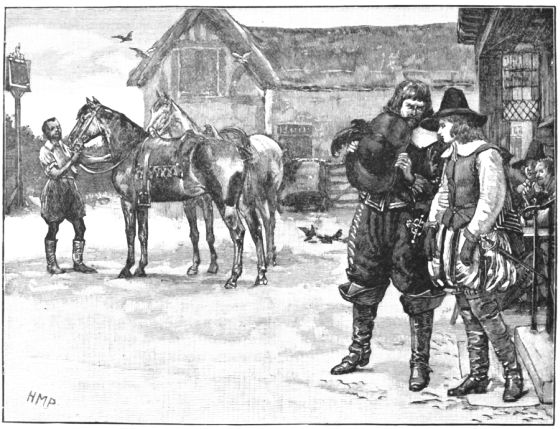
FLIGHT OF THE LADY ARABELLA STUART. (See p. 443.)
In pursuing the fate of this ill-used lady to its close, we have passed over another tragedy, that of the popular but dissipated King Henry IV. of France. Notwithstanding his adoption of Catholicism, from motives of policy, it was believed that his heart was still with the Protestant cause, and the death of John, Duke of Cleves, Juliers, and Berg, which occurred in 1609, gave him an opportunity of serving that interest under the plea of political necessity. The Duke of Cleves had died without issue, and the Emperor of Germany seized it as a fief of the imperial crown. The Electors of Brandenburg and Saxony, and the Duke of Neuburg, also laid claim to it. Jealousy of the already too powerful and ambitious house of Austria combined against it the Protestant princes of Germany and Holland, and they were joined by Henry of France on the same political ground, whilst the King of Spain, the archduke, and other Catholic and kindred princes, supported the claims of Austria. James of England engaged to furnish four thousand infantry, and the King of France the same. The Protestant princes of Germany and Holland were to supply nine thousand foot and two thousand horse, and it was agreed that the Elector of Brandenburg should be acknowledged as the real heir.
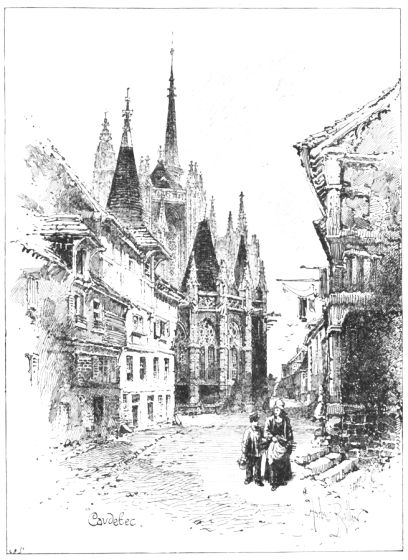
NOTRE DAME, CAUDEBEC.
Meanwhile Henry IV. did not confine himself to his quota of four thousand infantry. The moment appeared to him favourable for extending his own territory and power, and he appeared at the head of a splendid army of thirty thousand men, with a great train of artillery and camp supplies. Rumour was very busy on the appearance of this great force, that Henry was for apostatising a second time, or rather now going back to his original faith; and the priests diligently propagated the belief that he meant to make war on the Pope and restore Protestantism. These representations seem to have excited the brain of a mad young friar, of the name of Francis Ravaillac, who stabbed him in the streets of Paris, three days before his intended departure for the campaign (May 14, 1610). The murderer was put to the torture to force from him the names of his accomplices or instigators; but he persisted to the last in denying that he had any. Three times before had the life of Henry IV. been attacked by assassins: in 1593 by Pierre Barrière, in 1597 by Pierre Ouen, and in 1605 by Jean de l'Isle. Ravaillac succeeded, and suffered the reward of his deed in a terrible death. This horrible tragedy renewed the terror of the Catholics in England, and both the Parliament of England and the Council of Scotland called on James to secure himself by fresh persecution of them. The Scottish Council saw in the French assassins the frogs foretold in the Revelation, to be sent out by the devil against the head of the Church, and prayed the king to protect his precious life by fresh guards while he indulged himself in hunting.
Whilst James was earnestly engaged in suppressing any rival claims to the Crown by persecuting to death the Lady Arabella, he was equally busy in endeavouring to secure a succession in his own family. Though he persecuted the Catholics as a dangerous, sinful, and abominable body, he had no objection whatever to marry his children to Catholic princes, because they were by far the most considerable in Europe. Accordingly he made overtures for the marriage of his son Henry, and his daughter Elizabeth, both to France and Spain. Queen Anne was most bent on the Spanish matches for both son and daughter, and was therefore vehemently suspected of Popery, though her motives were the same as those of her husband—the rank and prestige of the alliance.
Prince Henry was the darling of his mother and of the nation. In appearance, temper, and aspirations the very opposite of his father. All persons, and especially all princes, who die young, are remembered with a peculiar affection; their virtues are exaggerated and live in memory as the roots of brilliant hopes cut off by fate. Time has not allowed the adverse influences of life and of royal power to corrupt them. Had Henry VIII. died young, he would have left a regretted name as a model of chivalric spirit and generous enthusiasm; yet we have no right to infer that Henry Prince of Wales, the eldest son of James, would have developed into such a character as the eighth Henry. He was a handsome, brave, and right-minded youth of eighteen, possessed of none of the timidity or the bookishness of his father, and very fond of all sorts of martial exercises—pitching the bar, handling the pike, riding, and shooting with the bow. Though extremely fond of horses, he was not, like his father, addicted to the chase, revolting from its cruelty. He seemed to have set before him as models Henry V. and the Black Prince; models which might have led him to inflict serious evils on his country had he lived, by the spirit of conquest. Young as he was, he displayed all the tastes of such a hero. He fired off cannon with his own hands, and had new pieces cast on improved models. He conversed with unceasing pleasure with engineers and men who had seen distinguished service, and he imported the finest horses from the Continent that could be procured. In his private character he was serious, modest, and devout. He attended the best preachers, and listened with a quiet sobriety in striking contrast to his father, who was always excited when listening to a preacher and wanting to preach himself. Henry abhorred profanity and swearing, and had a box in each of his houses at Richmond, Nonsuch, and St. James's to receive the fines for swearing from his household, which were rigorously levied, the money being given to the poor.
As these traits became known, the people flocked after the prince in a manner which much piqued his father, who could not help exclaiming—"Will he bury me alive!" The Reformers conceived great hopes of him, and there was a prophecy regarding him in every one's mouth:—
"Henry the Eighth pulled down abbeys and cells, But Henry the Ninth shall pull down bishops and bells."
Had James succeeded in obtaining the Spanish Infanta for Henry, he would have effectually neutralised this popularity. But though Henry did not stubbornly oppose his father's plans, he is said to have declared amongst his own friends that he had made up his mind never to marry a Popish princess, and the Puritans had the firmest faith that he never would.
It was regarded as a good sign that the young prince was extremely averse from his father's favourites, and especially from Carr, who was rapidly rising, and had now been created Viscount Rochester. The queen, who shared this aversion, strengthened him in it with all her influence. But he was not destined to wear the crown of England: he was now attacked with symptoms of premature decay. It was supposed that he had grown too fast for his strength, having reached the stature of six feet at seventeen, and his chivalrous exercises had been too violent and imprudent for such rapid growth. He was accustomed to take his exercises in the greatest heat of summer, to expose himself to all sorts of weather, and to bathe for a long time together after supper. While James was planning marriages for him, the prince was fast hastening out of the world. The Spanish match still lingering, after years of negotiation, James listened to a proposal of Mary de Medici, the widow of Henry IV., and now Queen-Regent of France, for a wedding between Prince Henry and the Princess Christine, the second daughter of France, on the understanding that she should be educated as a Protestant. About the same time James agreed to a marriage between his daughter Elizabeth and the Protestant Elector Palatine. These marriages had been in accordance with the policy of Cecil, who wished to make them the basis of a Protestant alliance against the Catholic Powers. But the first of them was never to take place. In the spring of 1612 the health of Prince Henry began to fail. In the October of that year the Elector Palatine arrived in England to complete his marriage with Elizabeth, who was still only sixteen. Henry roused himself to receive his proposed brother-in-law; he rode to town from Richmond, and most imprudently, in his infirm state of health, engaged in the sports and pastimes of the occasion. On the 24th of October he played a great match at tennis with the Count Henry of Nassau in his shirt. He had been suffering from typhus already, and this brought it to a crisis. He was seized in the night with a violent pain in his head, and an oppressive languor; yet the next day, being Sunday, he would rise and attend two services, one in his own chapel at St. James's, and another at the king's in Whitehall. The text of the preacher at St. James's was remarkable:—"Man, that is born of a woman, is of short continuance and full of trouble." In the afternoon, after dinner, he was compelled to yield to the complaint, and hastened home to bed. By the 29th he was so ill that there was great dismay amongst the people, and this was immensely aggravated by a lunar rainbow, which appeared to span that part of the Palace of St. James's where the sick prince lay. The most fatal auguries were drawn from this phenomenon.
The fever now assumed a putrid form, and was declared by the medical men highly infectious; and his parents and sister were debarred from entering his room. He grew daily worse, was highly delirious, calling for his clothes and his arms, and saying he must be gone. On the 5th of November, the anniversary of the Gunpowder Plot, James was informed that all hope was extinct. Unable to bear his feelings so near the scene of sorrow, the king hastened away to Theobalds; but the queen would only retire to Somerset House, whence she sent continual messengers to inquire after her son's symptoms. The prince had entertained a romantic admiration of Sir Walter Raleigh, declaring that no prince but his father would keep such a bird in a cage, and he had joined with his mother in entreating for his liberty. To Sir Walter the life or death of the prince was life or death to himself. The agonised mother was now seized with a desperate desire to obtain from Raleigh a nostrum which he possessed, and which she had herself formerly taken in a fit of ague. Sir Walter sent it, with the assurance that it would cure any mortal malady except poison. After taking Raleigh's nostrum he seemed to revive for a time, but again became worse, and expired at eight o'clock on Friday night, the 6th of November.
Perhaps a more extraordinary 5th of November was never passed than the one preceding Henry's death. The people were assembled in dense crowds around the palace, eagerly listening for news of the prince's condition, while all around them were the noises—the firing, and the bonfires—of the celebration of the Gunpowder Plot. They were still remaining there the following day, and when the cry of the prince's servants was heard in the palace on beholding him dead, the people groaned and wept in agony. The Catholics, on their part, regarded the death of the first-born of the royal house as a manifest judgment for the persecution of their Church.