Chapter XX · (continued 3)
Reading edition
Pym, after this passage, went one by one through the pleas of Strafford in his reply, and rent away ruthlessly the arguments by which he endeavoured to veil the flagrancy of his actions; but he dwelt for this time more especially on his conduct in Ireland, representing him there as treading on all the rights, privileges, and property of the people in a manner utterly regardless of any constitution or compacts. He then produced as witnesses Sir Pierce Crosby, Sir John Clotworthy, Lord Ranelagh, Lord Mountnorris, and Mr. Barnwell, who had suffered insult, loss of office and honour from the Lord-Lieutenant's overbearing despotism. To this Strafford replied in a long and able speech. The subject of Ireland was resumed the next day, and then from day to day.
After the Managers had gone through some particular charge, and produced their witnesses, the court adjourned for half an hour, when Strafford made his defence and produced his witnesses; the Managers then commented on the evidence, and the court closed for the day. Thus it went on for thirteen days. "All the hasty and proud expressions that he had uttered at any time," says Clarendon, "since he was first made a privy councillor; all the acts of passion or power that he had exercised in Yorkshire, from the time that he was first President there; his engaging himself in projects in Ireland, as the sole making of flax and selling tobacco in that kingdom; his extraordinary proceedings against Lord Mountnorris and the Lord Chancellor Loftus; his assuming a power of judicature at the Council table to determine private interest, and matter of inheritance; some rigorous and extrajudicial determinations in cases of Plantations; some high discourses at the Council table in Ireland; and some casual and light discourses at his own table and at public meetings; and, lastly, some words spoken in secret Council in this kingdom, after the dissolution of the last Parliament, were urged and pressed against him to make good the general charge of an endeavour to overthrow the fundamental government of the kingdom, and to introduce an arbitrary power." "In his defence," continues the same historian, "the earl behaved himself with great show of humility and submission, but yet with such a kind of courage, as would lose no advantage; and, in truth, made his defence with all imaginable dexterity, answering this and evading that with all possible skill and eloquence; and though he knew not till he came to the bar upon what parts of his charge they would proceed against him, or what evidence they would produce, he took very little time to recollect himself, and left nothing unsaid that might make for his own justification."
Though this is the language of the royalist historian, it is borne out by all accounts of this extraordinary trial. Strafford was one of the most eloquent, able, and imposing men of any age. His commanding person, and persuasive and impressive manner, had made his influence paramount wherever he had appeared. He had the faculty vastly developed of making the worse appear the better reason; and never had his splendid talents been so successfully displayed as on this great occasion, when all the ability, the patriotism, and the elocution of the time were arrayed against him. The very weight and vastness of the opposition bearing upon him acted in his favour. There he stood, alone, as it were, against the three kingdoms, dauntless, and unsubdued; laden with growing infirmities, and the deadly hatred of innumerable hosts, yet disdaining to succumb to them; and with a readiness of wit, a promptness of reply, an adroitness of application or of evasion, a keenness of ridicule, a weight of reason, and a rich eloquence, that raised admiration even in those who most loathed him. The sympathies of the ladies were every day more and more enlisted in his cause. They were seen—those of the highest rank—taking notes, discussing the proceedings, and discovering their vivid interest in him by a thousand signs. The courtiers were enraptured; the lords, even the sternest, rapidly relaxed, and at length were almost all on his side. The clergy were unanimous in their plaudits of him, and the Managers saw with dismay a change which threatened their defeat.
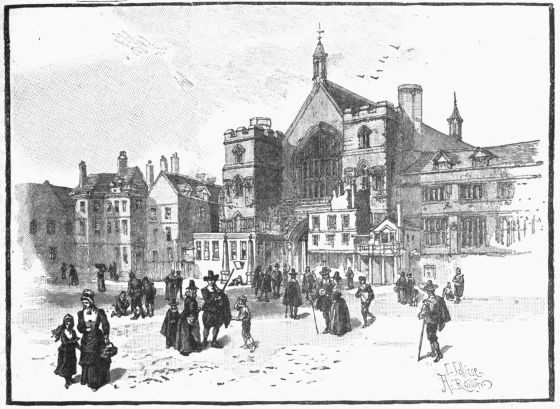
WESTMINSTER HALL AND PALACE YARD, IN THE TIME OF CHARLES I.
Maynard and Glynne, two acute lawyers, were the Managers who chiefly brought forward the accusations, and directed the evidence against him; but they appeared no match for Strafford's intellect and address. They endeavoured to establish a charge of constructive treason, that is, of treason not founded on one clear and palpable act, but on accumulated evidence, the aggregate of many offences; but the prisoner's answer to this was triumphant. They had not his letters, which we have; and though they could point to a long course of arbitrary and unconstitutional conduct, amounting to high misdemeanours, they could not lay their fingers on the damning proofs of his avowed intentions under his own hand, as we now can in the Strafford Papers. But even had they possessed these, it would still have been technically impossible to establish a charge of high treason according to any definition of law, or idea of treason then existing. All the statutes of high treason had heretofore been directed against designs or attempts to injure or remove the king, or any of his family; to subvert the Government, or change the possession of the Crown. That there might be such a thing as treason against the people and their rights had never entered into governing heads.
In vain would Pym or Selden then search Coke upon Littleton, or the statutes at large, for any definition of a treason that would serve them. The statute of 25 Edward III. c. 2 was the great landmark of English history in those matters, and amongst the seven distinct declarations of treasonable offences, they would look in vain for one to fit Wentworth, for most assuredly against none of them had Strafford offended. He was working with the king and his officers; his acts and intentions pointed in a totally different direction. His object was to strengthen the king's government beyond all precedent; to make him, as we now have it under his own hand, the most absolute and independent monarch that ever lived. True, from the reign of Henry IV. to that of Queen Mary, many other species of high treason had been created by the Crown, and especially by Henry VIII. But in none of these reigns, when almost every imaginable or unimaginable thing affecting kingship was made treason, had it ever entered the royal or legal head to conceive of the possibility of treason against the people. Therefore, had all these descriptions of treason been yet existent, none of them would have availed against Strafford, who was most loyal to the king and his government.
The matter was too palpable to be denied, but at this crisis an event occurred which gave fresh hope to the accusers. The younger Sir Henry Vane communicated to Pym a paper which he had discovered in the cabinet of his father, the Secretary of State. The account which he gave of the occurrence, according to Whitelock, was this:—His father being out of town, had sent him the key of his study, desiring him to search for some papers which he wanted. In this search he came upon one paper of such extraordinary contents, that he held himself bound in duty to secure it. The paper was a minute of what had passed in the Privy Council on the morning of the day on which the last Parliament had been dissolved. The question before the Council was offensive or defensive war with the Scots. The king said, "How can I undertake a war without money?" And Strafford was made to reply, "Borrow one hundred thousand pounds of the City. Go rigorously on to levy ship-money. Your majesty having tried the affections of your people, you are absolved and loosed from all rules of government, and may do what power will admit. Having tried all ways, you shall be acquitted before God and man. You have an army in Ireland, which you may employ to reduce this kingdom to obedience, for I am confident the Scots cannot hold out five months." Laud and Cottington declared with similar vehemence that the king was absolved from all law.
Pym, having obtained from young Vane a copy of this paper, on the 10th of April informed the Commons of the fact. After hearing it read, Vane the younger rose and confirmed the relation, excusing himself on the ground that it had appeared his bounden duty to make the matter known, and that Mr. Pym had confirmed him in this opinion. After giving Mr. Pym the copy, he had returned the original paper to its proper place in the cabinet. Sir Henry Vane, the father, here rose, and remarked, with much sign of resentment against his son, that he now saw whence all this mischief came, and that he could give no further particulars of the matter but found himself in an ill condition from its testimony.
On the 12th, charge was made against Strafford in court, who replied that old Vane was his most inveterate enemy; that, as was most probable, if he had delivered this paper to his son, he had been guilty of an unpardonable breach of his oath as a Privy Councillor, to preserve the king's secrets, and was therefore totally unworthy of credit; that he had been strictly examined on what passed at that Council, and at first denied all memory of any such words spoken by him, Strafford, on that occasion; and even on his third examination, after having been shown this paper, he had only recollected he had spoken these words, or some like them; that such words and such counsel were not likely to be soon forgotten; yet, of eight Privy Councillors then present, none of those whose evidence could be obtained could remember any such words, except the Earl of Northumberland, who thought he recollected such words as those—"of being absolved from all rules of government." The Archbishop of Canterbury and Windebank were not present to give their evidence; but the Marquis of Hamilton, Bishop Juxon, and Lord Cottington, could remember no such words. Even had he used the words, it depended much on whether the phrase "this kingdom" meant England or Scotland; that the country under debate was Scotland, and he had demanded of Vane, whether the word used was really "this" or "that." And further, could the authority of this paper be established, it would not establish a charge of treason, for the law demanded the evidence of two witnesses, and this was but the evidence of one.
Pym therefore put in the verified copy of the paper, for the paper itself having been laid on the table of the Committee of Commons, had been purloined, and was never afterwards recovered. That in the possession of Charles was in the handwriting of Digby, which brought him under suspicion. Pym contended that the evidence of the minute itself, and that of Sir Henry Vane, amounted to the required proofs of the law, being two witnesses against the earl. The Lord Steward, Arundel, then called on Strafford to say whether he had any observations to make on this additional proof, and he replied most eloquently:—
"Where has this species of guilt lain so long concealed? Where has this fire been so long buried during so many centuries, that no smoke should appear till it burst out at once, to consume me and my children? Better it were to live under no law at all, than to fancy we have a law on which we can rely, and find at last that this law preceded its promulgation, and try us by maxims unheard of till the moment of the prosecution. If I sail on the Thames, and split my vessel on an anchor, in case there be no buoy to give warning, the party shall pay me damages; but if the anchor be marked out, then is the striking on it at my own peril. But where is the mark set upon this crime? Where the token by which I should discover it?
"It is now full two hundred and forty years since treasons were defined, and so long has it been since any man was touched to this extent upon this crime before myself. We have lived, my lords, happily to ourselves at home; we have lived gloriously abroad in the world; let us be content with what our fathers have left us; let not an ambition carry us to be more learned than they were in these killing and destructive acts. My lords, be pleased to give that regard to the peerage of England, as never to expose yourselves to such moot points, such constructive interpretations of law. If there must be a trial of wits, let the subject matter be of somewhat else than the lives and honours of peers. It will be wisdom for yourselves, for your posterity, and for the whole kingdom, to cast into the fire these bloody and mysterious volumes of constructive and arbitrary treason, as the primitive Christians did their books of curious arts, and betake yourselves to the plain letter of the statute, which tells you where the crime is, and points out the path by which you may avoid it....
"My lords, I have now troubled your lordships a great deal longer than I should have done, were it not for the interest of these pledges which a saint in heaven left me. I should be loth——" here he pointed to his children, and his weeping stopped him. "What I forfeit for myself is nothing, but that my indiscretion should extend to my posterity, I confess, wounds me very deeply. You will be pleased to pardon my importunity. Something I should have said, but I see I shall not be able, and therefore I shall leave it. And now, my lords, I thank God that I have been by His blessing sufficiently instructed in the vanity of all temporary enjoyments, compared to the importance of an eternal duration. And so, my lords, even so with all tranquillity of mind, I submit clearly and freely to your judgment; and whether that righteous doom shall be life or death, I shall repose myself, full of gratitude and confidence, in the arms of the great Author of my existence—'In te Domine confido: non confundar in æternum.'"
What the effect of this address must have been, may be inferred from the observations of Whitelock, the chairman of the Committee which was conducting the prosecution:—"Certainly, never any man acted such a part on such a theatre, with more wisdom, constancy, and eloquence; with greater reason, judgment, and temper; and with a better grace in all his words and actions, than did this great and excellent person, so that he moved the hearts of all his auditors, some few excepted, to remorse and pity."
The Commons were alarmed at the effect of the trial. The production of Vane's paper had been a blow enough to have sunk another man, but the extraordinary eloquence and address of Strafford seemed to have effaced even that; they had little faith in procuring a verdict from the Lords in their present course, and they resolved to change their plan, and proceed against the offender by a Bill of Attainder. They have been accused of adopting the arbitrary measures of Henry VIII. in so doing, and of depriving Strafford of the fair influence of his trial; but we, who enjoy the benefit of their deed, ought not to join in that cry. Strafford was guilty, if ever man was, of the most atrocious attempt that a man can entertain—that of destroying the liberties of his country. The laws had been so framed, from royal bias, as not duly to designate his crime; but not for that, nor for any temporary feeling of pity raised by his admirable defence, did these patriots mean to allow of his escape. But in the House of Commons the Bill of Attainder met with unexpected opposition from one of the most zealous of the Reformers, Lord Digby. He saw, like the rest, that technically they could not condemn Strafford for high treason as the law then stood, and he feared the precedent of condemning men under a show of law that did not exist. It was, in fact, too much imitating the king. It was a real difficulty, which the patriots had not sufficiently foreseen. Instead of charging him with treason, as it was then defined, they should first have remodelled the law, or have charged Strafford with the violation of the national guarantee of Magna Charta, on which there could be no doubt, and for which he was well worthy of death; but it was too late to retrace their steps, and they were obliged to condemn him for the unquestionable crime of treason against the nation, making the act of the Legislature in all its branches an extension of the law. Digby himself did not question his guilt. He said "he believed him still that grand apostate to the commonwealth, who must not expect to be pardoned in this world till he be despatched to the other;" but he pleaded that on the ground of law he should have his life spared. But the Commons knew that while he lived there was no security. On the first occasion the king would pardon and restore him, and all their labour would be thrown away. They sought, therefore, to erect Parliament in so great an emergency into a court of equity as well as of law, believing that what was decreed by both Houses, and had the sanction of the Crown, was and would be a law of itself. They did not, like the Tudors and the Stuarts, seek to condemn him by setting aside the established courts and trial by jury; they gave him the highest court in the realm, and a full trial by his peers, and by their Bill they now called for a verdict.
But that verdict was not obtained without a great struggle. In the Commons it was warmly debated, and it was not till the eleventh day, the 21st of April, that it was carried by a vast majority. Only fifty-four, or, according to Whitelock, fifty-nine members voted against the Bill, and the next morning the names of these were placarded in the streets as "Straffordians," who, to allow a traitor to escape, would betray their country. The Lords, who had been greatly influenced by Strafford's speeches, and his confident exposition of the law, displayed no alacrity to pass the Bill of Attainder through their House; but they soon found themselves exposed to the pressure from without. The nation had made up its mind to the punishment of the man who had advised the king to reduce them to the condition of serfs; and the Lords could not appear anywhere without being pursued by cries of "Justice! justice on the traitor!" Vast crowds surrounded the Parliament House, uttering the same demands, and a petition was carried up from the City, signed by many thousands. The country was terrified by rumours of insurrections and invasions, which were made plausible by the lately discovered plot for marching the army of York on London, and the Court preparations for rescuing and getting away Strafford. There is also clear evidence from the despatches of Rosetti, who was in the confidence of the queen, that the king had ordered the fortifications of Portsmouth to be strengthened; and the command of the fortress was given to Goring, that Charles might have a place of retreat if he was obliged to quit London, and an opening for the landing of troops from France or Holland, whom he might prevail on to come to his assistance.
In carrying up the Bill to the Lords, the Attorney-General, St. John, had endeavoured to get rid of the legal objections to the death of Strafford, by saying that laws were made for the protection of the peaceable and the innocent, not for those who broke all law for the destruction of the people. This was a dangerous doctrine, and did not at all mend the matter; he did not see that the real strength and justification of the case lay in the three branches of the Legislature interpreting the law as extending to the State and Constitution altogether, and by their united act rendering it law.
In the meantime, the anxiety and perplexity of the king became excruciating. He had clearly, by his confident assertions of protection, drawn Strafford into the snare, and if the Lords passed the Bill, how was he, by his own decayed authority, to defend him? He had previously sought the aid of the Earl of Bedford, who was the most influential of the peers, and promised him the disposal of all the great offices of State, on condition that Strafford's life should be spared. Bedford had accepted it, but just at this crisis he fell sick and died. Clarendon says, of his own knowledge, that it was the plan of Bedford to give the king the excise as a settled source of income, and thus extricate him out of all his troubles,—the very thing which was afterwards granted to his son, Charles II. On Bedford's death, Lord Say accepted the same position on the same terms; and it is asserted by Clarendon that it was by his advice that Charles now took a step that proved very fatal. He proceeded to the House of Lords on the 1st of May, whilst the Bill of Attainder was still before it, and calling for the Commons, informed them that having, as they knew, been constantly present at the trial of Strafford, he was perfectly familiar with all that had been advanced on both sides, and that the serious conclusion at which he had arrived was that he was not guilty of treason, and, therefore, in his conscience, he could not condemn him if the Bill were passed and came to him. "It was not," he said, "for him to argue the matter with them; his place was to utter a single decision. But," he continued, "I must tell you three great truths:—First, I never had any intention of bringing over the Irish army into England, nor ever was advised by any one to do so. Second, there never was any debate before me, either in public council or private committee, of the disloyalty or disaffection of my English subjects. Third, I was never counselled by any to alter the least of any of the laws of England, much less alter all the laws."
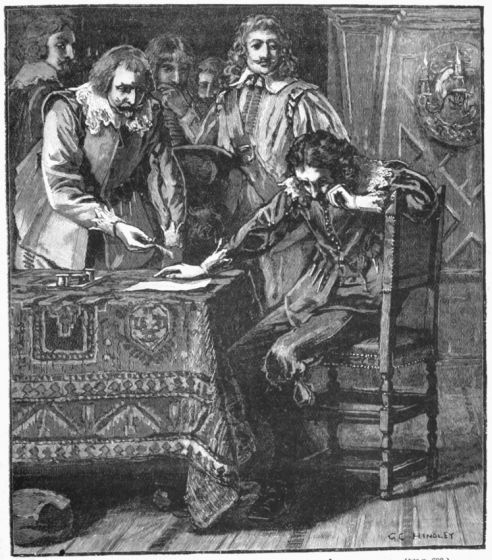
CHARLES SIGNING THE COMMISSION OF ASSENT TO STRAFFORD'S ATTAINDER. (See p. 603.)
After the long breach of the law that the king shall not levy taxes without consent of Parliament; after the long exercise of the arbitrary power of the Star Chamber and the High Commission Court, where Magna Charta was utterly set aside; after the brandings, the lopping off of ears, the slitting of noses, and the fining and imprisonment of the subject at the king's pleasure, these assertions show how utterly regardless of truth this king was. He then admitted that Strafford was guilty of great misdemeanours. "Therefore," he said, "I hope you may find some middle way to satisfy justice and your own fears, and not to press upon my conscience. My lords, I hope you know what a tender thing conscience is. To satisfy my people I would do great matters, but in this of conscience, no fear, no respect whatever, shall ever make me go against it. Certainly, I have not so ill-deserved of the Parliament this time that they should press me on this tender point." He proposed that Strafford should be rendered incapable hereafter of holding any place of trust or honour under the Crown.
But the very declarations which he had made in this address were so untrue, that every one must have felt that as long as Strafford lived there was no security against his return to power. The Commons, however, took up the matter in another manner. On their return to their own House—the king had not recognised their presence by a single observation in the other—they instantly passed a resolution, declaring the king's interference with any bill before either House of Parliament, a most flagrant abuse of their privileges. This was Saturday, and the next day the ministers, Scottish and Puritan, took up the subject in their pulpits, and roused their hearers to a sense of their danger, only to be averted by the death of the arch-traitor. On Monday the population poured out in a vast concourse, and directed their steps towards Westminster. Six thousand infuriated people surrounded the Houses of Parliament, armed with clubs and staves, crying out for justice on the prisoner.
At this moment Pym was haranguing the House of Commons on the discovery of the plot to debauch the army, and informing them, moreover, that there was already a strong body of French troops assembled on the opposite coast, and that it was declared to be their intention to take possession of Jersey and Guernsey, and to land at Portsmouth. This was so far true that Montague, a favourite of the queen's, had been despatched to the French court, a fleet had assembled on the coast of Brittany, and an army in Flanders. Montreuil had endeavoured to convince the popular leaders, through the Earl of Holland, that the army was destined for the war in the Netherlands, and the fleet to protect the coasts of Portugal. Their being so near this country, however, was sufficient to justify the popular suspicion, and the public excitement continued to increase. Montague was advised to seek his safety by flight, and the queen was so terrified that she ordered her carriages to Whitehall to flee to Portsmouth. The Lords, however, prevented this by a remonstrance to the king, and thereby probably saved the queen's life from the enraged mob; for it was now that the disclosures of Colonel Goring of the Army Plot became public.
Pym seized the opportunity of this occurrence to press on the Commons a resolution to the effect that the seaports should be closed, and that the king should command that neither the queen, the prince, nor any person attending upon his majesty, should leave London without the permission of the king, acting on the advice of his Parliament. This was passed, and Pym then called on them to make a solemn Protestation, after the manner of the Scottish Covenant, which should be taken by the whole House, binding them by a vow, in the presence of God, to maintain and defend his majesty's royal person and estate, as well as the power and privileges of Parliament, the lawful rights and liberties of the subject, the peace and union of the three kingdoms against all plots, conspiracies, and evil practices, and that neither hope, fear, nor any other respect, should induce them to relinquish this promise, vow, and protestation. It was instantly signed by the Speaker, and by every member present.
The Commons next addressed a letter to the army in the North, assuring them that, notwithstanding the attempts to corrupt them, Parliament relied on their fidelity, and would take care to furnish their pay. They ordered the forces in Wiltshire and Hampshire to advance nearer to Portsmouth, and those in Kent and Sussex to draw towards Dover, and declared any man advising the introduction of foreign troops to be an enemy to his country. These resolutions they despatched with the Protestation to the Upper House by Denzil Holles, calling on the whole House to subscribe to the Protestation. The next morning, being the 4th of May, the Lords desired a conference with the Commons, and informed them of a message from the king, desiring that the intimidation of the mobs might be withdrawn, that the deliberation of the Parliament might be free; and as the peers proposed to take the Protestation unanimously, Dr. Burgess, a popular preacher, was sent out to inform the people of this, and to desire that they would peaceably withdraw to their own homes. The crowds, on this assurance, melted rapidly away. The Protestation was then sent out to be subscribed by the whole nation, as the Covenant had been in Scotland, and with the intimation that any one declining to adopt it should be looked upon as an enemy to his country. To complete their security, the Commons passed a Bill that Parliament should on no account be dissolved without the consent of both Houses.
The next day, on a false alarm that the House of Commons was in danger, the train-bands, headed by Colonel Mainwaring, marched with beat of drum to Westminster; it proved an unnecessary caution, but one that convinced the peers and the king that any resistance to the Commons, backed by the public, was useless. The very next day the news was circulated in Parliament that six or eight dangerous conspirators had fled, amongst them Jermyn, the queen's favourite, and Percy, both members of the Commons, and that the queen was still bent, if opportunity could be found, of escaping too. On the following day, May 7th, the peers voted by a majority that the fifteenth and nineteenth charges against Strafford were proved, namely, that he had quartered soldiers on the peaceable inhabitants of Ireland contrary to law, and had imposed on his own authority an illegal oath on all Scotsmen living in that country. Thereupon they consulted the judges, who unanimously decided that Strafford deserved to suffer the pains and penalties of treason. The Catholics kept away from the House because they would not take the Protestation, and therefore bore no part in Strafford's condemnation. The Bill was passed by a majority of twenty-six to nineteen. The following morning, May 8th, the Bill of Attainder was read a third time and passed; and, at the same time, the Lords also passed the Bill of the Commons against the dissolution of Parliament.
Charles was now reduced to a pitiable condition. On the one hand, he had solemnly pledged himself, both to Strafford and to Parliament, never to consent to the earl's death; but, on the other hand, the two Houses had pronounced against him, and the public was waiting with impatience for his ratification of the sentence. He had lately seen the ominous assemblage of the people, and the march of the City bands to support Parliament; the Scots still lay in the North, waiting with fierce desire for the fall of their enemy; one signal, and the whole country would be in a blaze. The Bill was passed on Saturday, and perhaps never was a Sunday spent by any man, or any house, in so dreadful a state as that passed by Charles and his family. The only alternative left him was to summon his Privy Council, and submit to them his difficulty. But from them he derived very little comfort. The members in general urged on him the necessity of complying with the demand of both Houses of Parliament, and the manifest desire of the public, who were again loudly declaring that they would have either the head of Strafford or the king's. The bishops strongly urged the same arguments; the terror of the Parliament and the people was upon them.
Williams, the old bishop of Lincoln, who had been treated with stern severity by both Strafford and Laud, told the king, when he talked of his conscience, that there was a public as well as a private conscience; that he had discharged his private conscience by doing all in his power to save the earl, and he might now exercise his public conscience by conceding to the decision of his Parliament; that the question now was not about saving Strafford, but about saving himself, his queen, and family. Juxon, Bishop of London, alone had the courage to tell him boldly not to consent to the shedding of the blood of a man whom in his conscience he felt to be innocent. Ussher of Armagh, Morton of Durham, and another bishop, advised him to be guided by the opinion of the judges. The judges being then asked, repeated their judgment that the case, as put to them by the Lords, amounted to treason. Thus borne down by all parties, Charles reluctantly gave way, and late in the evening, though he would not directly sign his assent to the Bill, he signed a commission to several lords to give the assent. Even in this last act his friends endeavoured to console him with the assurance that "his own hand was not in it." It was a miserable subterfuge, for the deed was equally valid, and he executed it with tears, declaring the condition of Strafford happier than his own.
The day of execution was fixed for Wednesday, the 12th of May, and on Monday, the 10th, the commission to this effect passed the Great Seal. But still Charles could not give up the hope of saving the unhappy man. He sent to the two Houses to inform them that he would instantly disband the Irish army; and the next morning, having appeared to have made a favourable impression on the Commons, who had returned a very flattering message, he sent the Prince of Wales to the Lords with a letter once more imploring them to consult with the Commons, and grant him "the unspeakable contentment" of changing the sentence of the earl to perpetual imprisonment, with a pledge never to interfere in his behalf; and if the earl should ever seek his liberty, especially by any application to himself, his life should be forfeited. If, however, it could not be done with satisfaction to the people, he said "Fiat justitia." In a postscript, stated to have been added at the suggestion of the queen, he appended the fatal words, "If he must die, it were charity to reprieve him till Saturday;" words which seemed to imply that, though he asked, he really did not hope to save him. Nothing, however, could have saved him. The House, after reading the letter twice, and after "sad and serious consideration," sent a deputation to inform him that neither of the requests could be complied with.
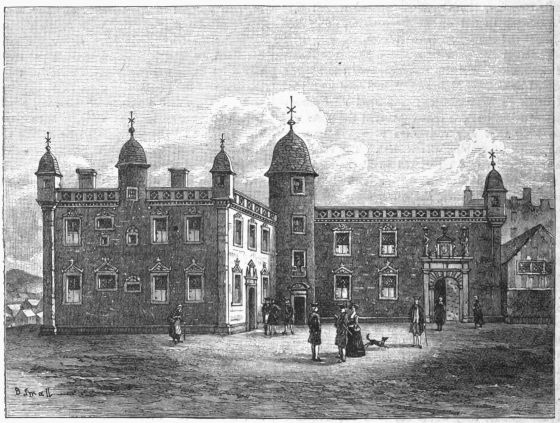
THE OLD PARLIAMENT HOUSE, EDINBURGH.
Strafford, on the previous Tuesday, hearing of the king's extreme agitation and trouble on his account, had sent him a letter which was full of magnanimity. He informed him that the hearing of the king's unwillingness to pass the Bill, on the ground that he did not believe him guilty, and of the excitement of the people against him on that account, had brought him into a great strait; that the ruin of his family on the one side, and fear of injury to the king on the other, had greatly troubled him; that to say that there had not been a great strife in him, would be to say that he was not made of flesh and blood; yet considering that the chief thing was the prosperity of the realm and the king, he had, with a natural sadness, come to the conclusion to desire the king to let matters take their course rather than incur the ill that refusing to sign the Bill might bring on his sacred majesty. Whitelock assures us that the king sent Carleton to him, to inform him that he had been compelled to pass the Bill, and adding that he had been the more reconciled to it by his willingness to die. On hearing this, Strafford started up from his chair, lifted up his eyes to heaven, laid his hand upon his heart, and said, "Put not your trust in princes, nor in the sons of men, for in them there is no salvation."
The night before the day fixed for his execution, Archbishop Ussher visited the prisoner, who begged him to go to his fellow-prisoner, Archbishop Laud, and beg his prayers for him that night, and his blessing when he should go forth in the morning. He had in vain endeavoured to persuade the Lieutenant Balfour to permit him to have an interview with the fallen prelate. In the morning, when led out to the scaffold, on approaching the window of the archbishop's prison, he begged the lieutenant to allow him to make his obeisance towards the prelate's room, though he could not see him himself.
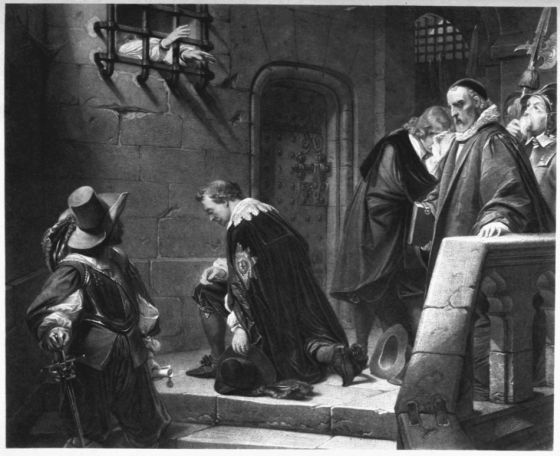
STRAFFORD ON HIS WAY TO EXECUTION.
After the Painting by Paul Delaroche, in the possession of the Duke of Sutherland.
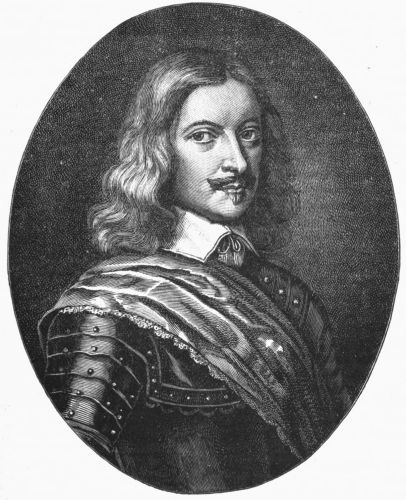
THE MARQUIS OF MONTROSE. (From a contemporary print by Faithorne.)
Laud, however, was on the watch, and putting forth his hands from his window, bestowed his blessing. That was all that his weakness and his emotion permitted. He sank, overcome with his grief, to the floor. Strafford made a profound obeisance, and the procession moved on. But after a few steps the earl turned round again, bowed to the ground once more, saying, "Farewell, my lord! God protect your innocence!" Then proceeding again, he assumed a lofty and dignified air, more even than was usual to him. At the Tower gate the lieutenant requested him to enter a coach, lest the people should wreak their hatred upon him; but he declined, saying, "No, Master lieutenant, I dare look death in the face, and I hope the people, too. Have you a care that I do not escape, and I care not how I die, whether by the executioner, or the madness of the people. If that give them better satisfaction, it is all one to me." He was accompanied to the scaffold by Archbishop Ussher, the Earl of Cleveland, and his brother, Sir George Wentworth, and others of his friends were there to take their leave of him. The crowd assembled to see their great enemy depart was immense, and he made a speech from notes which he had prepared, still protesting his innocence; declaring that so far from wishing to put an end to Parliaments, he had always regarded them, under God, as the best means to make the king and his people happy. His head fell at a single blow, and the astonished people could scarcely believe that they had seen the last of their foe. They retired in quietness, as if overcome by the greatness of the satisfaction; but they testified their joy in the evening by bonfires in the streets (May 12, 1641).
The fall of Strafford carried terror through the Court. Many began to think of flying. Cottington had given up his office of Master of the Wards, and Lord Say and other noblemen of the popular party were introduced into the Ministry. The Marquis of Hertford was made Governor to the Prince, the Earl of Essex Lord Chamberlain, the Earl of Leicester the Lord-lieutenant of Ireland. The king was wholly averse from the new ministers, but hoped to win upon them as he had done upon Strafford, Loudon, and Montrose; and indeed, after their appointment, a bolder and more independent spirit seemed to awaken in the Lords. They threw out several Bills sent up from the Commons, amongst others, one for excluding the bishops from their House. Essex, though a reformer, was by no means hostile to the hierarchy, and always obliged his servants to accompany him to church, and kept a chaplain who was a thorough conformist. The Lords did not object to the bishops and clergy in general being excluded from the Star Chamber, the Privy Council, and the Commissions of the Peace; but they contended that bishops had always formed a part of their body, and that the Commons might next take it into their heads to exclude barons.
The Commons, however, pressed on the Lords Bills for the abolition of the two greatest engines of tyranny in the country, the Star Chamber and the High Commission Court. These, with another for a poll-tax for the maintenance of the armies, the Lords passed; but Charles hesitated. He had given up much this Session: the right of prorogation without consent of Parliament, thus making Parliament perpetual if it pleased; the right to demand tonnage and poundage without the same consent; he had limited the forest laws; granted to the judges their places during good behaviour; and withdrawn the commission for the Presidency of the North as illegal. But to give up the civil and ecclesiastical inquisitions, those ready and terrible torture houses of the Crown, went hard with him. The poll-tax he passed at once, because he thought it would be unpopular, but he refused to sanction the others. The Commons came to a resolution that he should pass all three or none; and the tone of both Parliament and the people was so menacing, that on the 5th of July he gave his consent, and put an end to those un-English abominations.
The Commons having granted the king six subsidies, and tonnage and poundage for the year, he now proposed to proceed to Scotland to hold a Parliament. He was aware that a reaction had taken place there. The Marquis of Montrose had exerted himself to form a party amongst such noblemen and gentlemen as had grown to regard the popular leaders both in Scotland and England as bearing too insolently on the prerogatives of the Crown. He had prevailed on nineteen noblemen to subscribe a bond, pledging themselves "to oppose the particular and indirect practices of a few, and to study all public ends which might tend to the safety of religion, laws, and liberty." They were careful that the language of this bond should not clash openly with that of the Covenant; but the real design did not escape the vigilance of the Committee of Estates. They called on Montrose and his associates to clear themselves, and obtaining the bond, burn it publicly. Notwithstanding this, the confederates opened a secret correspondence with the king, and assured him of their confidence of victory over the Covenanters, if he would honour the Parliament with his presence, confirm his former concessions, and delay the distribution of offices and honours to the end of the session. But this correspondence also was discovered. Walter Stuart, the messenger of Montrose to the king, was seized near Haddington, and the letter of the marquis to the king, with various other suspicious papers, was found concealed in the pommel of his saddle. Montrose, Lord Napier, Sir George Stirling, and Sir Archibald Stuart, were arrested, examined, and sent to the castle of Edinburgh.
These events rendered Charles still more impatient for his northern journey. Not only Traquair, and the other four of his officers who had been excepted from pardon as incendiaries, but these, his new allies, demanded his assistance. By the beginning of August the treaty of pacification was signed by the Scots. They had received an engagement from the English Parliament for the payment of a balance of two hundred and twenty thousand pounds of "the brotherly assistance." Charles had granted an amnesty and an act of oblivion of all that was past, having cost the kingdom about one million one hundred thousand pounds, and both armies were ordered to be disbanded. The Parliament, however, looked on this journey with no friendly eye. Even amongst his own friends, the wily old Bishop of Lincoln, Williams, whom the king, in the absence of Laud, and the loss of Strafford, had taken into favour, and who was soon to be Archbishop of York, advised Charles to keep away from the Scots. He assured him that they would ferret out any secret negotiations that might pass between himself and the royal party, and make the English Commons acquainted with them; and that he would do much better to remain, and employ himself in corrupting and winning over as many as he could of the Parliamentary leaders. The Commons insisted on his appointing a Regency, if he should go, to act during his absence; but he consented only to the naming of a Commission. It was not till the 10th of August that he got permission for his journey, and he was not destined to depart without having another proof of the animus of the House of Commons. On the 4th, Serjeant Wild presented to the Lords a Bill of Impeachment against thirteen of the bishops—Laud's name being put among them—for their recent manufacturing of canons and constitutions contrary to law. Their grant of a benevolence to the king was made an offence under the name of a bribe, and by this means, though they had not been able to exclude all the bishops from the Upper House for ever, they excluded these thirteen for a time.
At length Charles was enabled to set out. He had made the Earl of Holland commander-in-chief of the Forces, much to the disgust of the friends of Essex, who was appointed commander only of those south of the Trent. He was attended in his coach by his nephew, Charles Louis, the nominal Elector Palatine, the Duke of Lennox, now Duke of Richmond, and the Marquis of Hamilton—rather ominous associates. The king had not been gone a week, however, when Holland having quarrelled with the queen, and the king having refused to make a baron at his suggestion, by which he would have got ten thousand pounds, sent a letter to the House of Lords, obscurely intimating some new practices and designs against Parliament. The Lords communicated to the Commons this letter, and the two Houses immediately appointed a commission to proceed to Scotland, ostensibly to procure the ratification of the late treaty, but really to keep watch over the king and his partisans. To this duty were named the Earl of Bedford, Lord Edward Howard, Sir William Almayne, Sir Philip Stapleton, Mr. Hampden, and Nathaniel Fiennes. The king endeavoured to get rid of this unwelcome commission, declaring it needless, and refused to sign the commission when sent to him; but the Parliament still pressing it, he allowed the commissioners to proceed to Scotland to attend him; all of whom did so except the Earl of Bedford.
Charles had set out with the resolve to win over as many of his enemies as possible, and to please the Scots at large, thereby to raise up a counter influence to that at home. At the northern camp, which was not yet broken up, he did all that he could to corrupt the officers, went to dine with old Leslie, the Scottish general, and soon after ennobled him. At Edinburgh he flattered the Covenanters by attending their preachings, and went so far as to appoint Alexander Henderson, the stout champion of the Covenant, his chaplain, appearing to take especial delight in his conversation, and having him constantly about him. He ratified all the acts of the last Session of the Scottish Parliament. As regarded the incendiaries, as they were called—that is, Charles's former ministers—who had been imprisoned for executing his commands, he promised on their release to give their offices to such persons as had pleased the Parliament. He submitted to them a list of forty-two councillors, and nine great officers of State. The Parliament conceded so far as to release all the incendiaries but five, and these were to be referred to a committee for trial, and their sentence to be pronounced by the king. So far, all promised well, but the Covenanters were desirous to have the Earl of Argyll, who had so openly espoused their cause in the General Assembly, appointed to the chief post in the ministry, that of Chancellor; but Charles conferred it on Loudon. Argyll strove for the next, that of Treasurer, a post of great emolument, but Charles gave it to Lord Ormond; but the Parliament would not consent, and the contest for this appointment had gone on ten days, when the feud thus commenced was rent still wider by what is known in Scottish history as the "Incident."
Since Charles had come to Edinburgh, he had continued to keep up his correspondence with the Marquis of Montrose, who was still prisoner in the castle, and who, notwithstanding his known intrigue with the king, had by concert with him kept up a pretence of being a zealous Covenanter. A letter from Montrose, revealing the progress of this correspondence, had been found by some traitorous person about the king, supposed, indeed, to have been taken from his pocket, and had been sent by the Marquis of Hamilton to the Covenanters. Montrose found means to convey to the king his ideas about it, and to warn him especially of the treasonable proceedings and intentions of Hamilton and Argyll. Hamilton, since his having, at Charles's request, assumed the part of a favourer of the Covenanters, had become suspected of being more really of that party than he pretended. The king had grown cool in his manner to him: the letters of Montrose, conveyed through William Murray, a groom of the bed-chamber, urged the king to make away with the traitors Hamilton and Argyll. At this juncture young Lord Kerr sent by the Earl of Crawford a challenge of treason to Hamilton, who appealed to Parliament in his justification, and Kerr was compelled to make an apology. But if we are to believe Hamilton himself, this did not prevent the prosecution of the plot to assassinate or carry them off to some place of concealment. He says, in a letter to his brother, Lord Lanark, that he was sent for suddenly by his brother and Argyll, as he was engaged with some company, desiring him to go to them on matters of the utmost consequence. When he went he was told by them that they had been desired to go to General Leslie, at his house, who informed them of a plot to kill or carry them away. On this being confirmed to Hamilton by Colonel Hurrie and Captain Stuart, the three lost no time in escaping from the city to Hamilton House, at Kinneil; whilst the rumour of the plot spreading, the burghers of Edinburgh had closed their gates, and armed themselves for the defence of the Parliament.
As this was a direct charge of a most black and murderous design on the part of the king, he lost no time, on receiving letters from the fugitive noblemen stating why they had fled, in marching to the Parliament House at the head of five hundred soldiers, to demand an explanation. The Parliament was justly alarmed at this menacing movement, and insisted that a commission should immediately be given to Leslie to guard Parliament with all the city bands, the regiments of foot near at hand, and some troops of horse.
Charles was loud in his complaints of the scandal cast upon him by the needless flight of the three noblemen and the arming of the citizens, and demanded an instant examination before Parliament for his clearance. The Parliament would not consent to a trial before the whole House; but in spite of the king's remonstrances, referred it to a committee, and ordered the immediate arrest of the Earl of Crawford, Colonel Cochrane, William Murray, and others. What the committee discovered is not known, for its proceedings were conducted with the profoundest secrecy; and they finally came to the conclusion that there was nothing which touched the king personally; and yet that the noblemen did not flee without sufficient cause, and were falsely accused by Montrose. Montrose himself, when examined regarding the letter to the king, declared that he meant to accuse nobody in particular; and Crawford, Murray, and the rest, gave confused and disordered answers. All was involved in mystery, and this was no little increased by Hamilton and Argyll returning to Edinburgh in the course of a few weeks, and Hamilton declaring that there was nothing in the affair which reflected any dishonour on the king. Still more to confound all reasoning on the matter, the plotters not only were liberated on bail, but Argyll was placed at the head of the Treasury, was created a marquis, Hamilton a duke, and Leslie an earl, with the title of Leven.
The news of the plot had been despatched with all speed to the Parliament in England, and had created great alarm in London, many being of opinion that a conspiracy was on foot to get rid of all the king's opponents. Parliament, which had adjourned to the 20th of October, had just met again, and the Council sent urgent requests for the return of the king to the capital.
The king, however, appeared in no haste. He remained entertaining all parties in great festivity, distributing the forfeited church lands amongst influential persons, not excepting his covenanting chaplain, Henderson. Honours were as freely bestowed. It was found that Charles had carried the Crown jewels with him: it was now well known that the great collar of rubies was pawned in Holland, and it was believed that Charles was buying up his enemies with others of the jewels, afterwards to be exchanged for money. These unpleasant suspicions were greatly increased by the fact that five companies of foot had, by the king's especial command, been detained at Berwick, notwithstanding the order for disbandment. The Council sent six ships to fetch away the artillery and ammunition from Berwick and Holy Isle, and again represented to Charles the necessity of his presence in London.
His departure, however, was at length determined by startling news out of another quarter, namely, of rebellion in Ireland.