Chapter XVI · (continued 2)
Reading edition
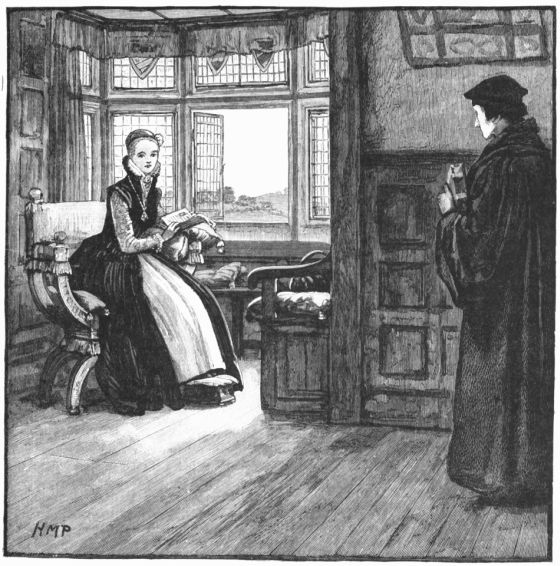
ROGER ASCHAM'S VISIT TO LADY JANE GREY. (See p. 364.)
The list of the prose writers of this period presents no more honourable name than that of the great champion of the Church of England, Richard Hooker (b. 1553, d. 1600), whose composition is as remarkable for its cogent reasoning and elevated style, as Sidney's is for fancy and grace of sentiment. His "Ecclesiastical Polity," in eight books, is regarded as the most able defence of church establishments that ever appeared. From the breadth of its principles it drew the applause of Pope Clement VIII. as well as of the royal pedant, James I. To those who study it as an example of the intellect, learning, and language of the time, it presents itself, even to such as dissent from its conclusions, as a labour most honourable to the country and age which produced it.
A still greater man was yet behind. Bacon (b. 1561, d. 1626) was figuring as the great lawyer, the eloquent advocate and senator; but under the duties of these offices lay hid the master who was to revolutionise philosophy and science; the father of the new world of discovery, and the most marvellous career of social and intellectual advance. To this period he is the sun sending its rays above the horizon, but not yet risen. His speeches, his "Essays Civil and Moral," and "Maxims of Law," already foretold his fame.
A very different writer was John Lyly, the Euphuist (b. 1553, d. 1601). Lyly was a poet and dramatist of repute; but in 1579 he published "Euphues; or, Anatomy of Wit," which was followed, in 1581, by a second part, called "Euphues and his England." In this he invented a style and phraseology of his own, which seized the fancy of the public like a mania, and set the Court, the ladies, the dandies, and dilettanti of the day speaking and writing in a most affected, piebald, and fantastic style. Sir Philip Sidney, in his "Arcadia," ridiculed it, not without being in a considerable degree affected by it himself. Shakespeare, in "Love's Labour's Lost," and Sir Walter Scott, in his Sir Piercie Shafton, in "The Monastery," have made the modern public familiar with it. Yet, after all, probably Lyly was only laughing in his sleeve at the follies of others, and was, as has been asserted, aiming at the purification of the language; for in his dramas his diction is simple enough, considering the taste of the age.
Among the rising writers was also Sir Walter Raleigh; but his literary reputation belongs rather to the age that was coming. On the whole, the period from the reign of Henry VII. to the end of that of Elizabeth was a period more kindred to our own than any which had gone before it. It produced prose writers whose minds still hold communion with and influence those of to-day. Its philosophy had assumed a more practical stamp, and was full of the elements of change and progress. Its poetry, which we have now to consider, reached the very highest pitch of human genius.
The earliest poet who has left any name of note is Stephen Hawes, whose principal work was "The Pastime of Pleasure," which was printed by Wynkyn de Worde in 1517. Hawes was a native of Suffolk, had travelled much, and by his proficiency in French and French literature acquired the favour of Henry VII. Another poem, "The Temple of Glass," has been ascribed to Hawes, but is most probably Lydgate's, who, Hawes tells us, composed such a poem.
Next to Hawes comes Alexander Barclay, the author of numerous works in prose and poetry, as "The Castell of Labour," wherein is "Rychesse, Vertue, and Honour," an allegorical poem, translated from the French; "The Shyp of Foles of the Worlde," translated from Sebastian Brandt's German poem, "Das Narren Schiff;" "Egloges; or, the Miseries of Courts and Courtiers;" a treatise against Skelton the poet; a translation of Livy's "Wars of Jugurtha;" "Life of St. George," &c. &c. The work, however, which has handed down his name to posterity is the "Ship of Fools," which, by interspersing it with original touches on the follies of his countrymen, he made in some degree his own. But the chief merit of the poem in our time is the evidence of the polish which the English language had acquired, and to which Barclay probably contributed, for he had travelled through Germany, Holland, France, and Italy, studying diligently the best authors of those countries. He was successively a prebendary of the college of Ottery St. Mary, a Benedictine monk, Vicar of Great Barlow, in Essex, of Wokey, in Somersetshire, and Rector of All Hallows, London, terminating his life at Croydon. A stanza or two will suffice to show the state of the language at the close of the reign of Henry VII. A man in orders is speaking:—
"Eche is not lettred that nowe is made a lorde, Nor eche a clerke that hath a benefice: They are not all lawyers that plees do recorde, All that are promoted are not fully wise. On such chaunce nowe fortune throwes her dice That, though one knowe but the Yrishe game, Yet would he have a gentleman's name. * * * * * * I am like other clerkes which so frowardly them gyde, That after they are once come unto promotion, They give them to pleasure, their study set aside, Their avarice covering with fained devotion. Yet daily they preache, and have great derision Against the rude lay men, and all for covetise, Though their own conscience be blinded with that vice."
The reign of Henry VIII. was distinguished chiefly by satirists: and it says much for the courage of poets that they were almost the only men in that terrible period who dared open their mouths on the crying sins of Government. Skelton, Heywood, and Roy were men who amused themselves with the follies and vices of their contemporaries. When the sun of poetry rose in a more glowing form in Surrey, the ferocious king, so ready with the headsman's axe, quenched it in blood. John Skelton (b. 1460, d. 1529) was a clergyman, educated at Oxford. Erasmus declared him to be "Britannicarum Literarum Lumen et Decus"—"the light and ornament of Britain." He became Rector of Diss, in Norfolk; but, like Sterne at a later day, Skelton was overflowing with humour and satire rather than sermons, and so fell under the resentment of Nykke, Bishop of Norwich. He lashed with all the wonderful power of his merry muse the licentious ignorance of the monks and friars; and, soaring at higher game, attacked the swollen greatness of Cardinal Wolsey in a strain of the most daring invective. The incensed cardinal endeavoured to lay hold on him, and he would not have escaped scatheless out of his hands, had not the venerable John Islip, Abbot of Westminster, opened the sanctuary to him; and there Skelton lived secure for the remainder of his days, neither stinting his stinging lashes at the cardinal, nor suppressing his overflowing humour, which welled forth in a torrent of the most wild, sparkling, random, and rodomontade character. His amazing command of language, his never-failing and extraordinary rhymes, remind us of one man only, and that of last century—Hood. The airiness and irregularity of his lyrical measures equally suggest a comparison with that most untranslatable Swedish poet, Bellmann.
His friend Thomas Churchyard, in a eulogium on him, enumerates a number of poets of that and preceding times, some of them now little known:—
"Peirs Plowman was full plaine, And Chaucer's spreet was great; Earl Surrey had a goodly veine, Lord Vaux the marke did beat. And Phaer did hit the pricke In things he did translate, And Edwards had a special gift; And divers men of late Have helped our English tongue, That first was base and brute. Oh! shall I leave out Skelton's name?— The blossom of my fruit!"
The "Pithy, Pleasant, and Profitable Works of Maister Skelton, Poet Laureate to Henry VIII.," contain "The Crowne of Laurell," by way of introduction; "The Bouge of the Courte," in which this unique poet laureate attacks the vices of the Court without mercy; "The Duke of Albany," a poem equally severe on the Scots; "Ware the Hawk," a castigation of the clergy; "The Tunning of Eleanor Rumming," a wild rattling string of rhymes on an old ale-wife and her costume; and "Why come ye not to Court?" an unsparing satire on Wolsey. There is no part of the cardinal's history or character that he lets escape. His mean origin, his puffed-up pride, his sensuality, his lordly insolence, his covetousness and cruelties, run on in a strain of loose yet vivid jingle that was calculated to catch the ear of the people. The gentlest word that Skelton has for him is that—
"He regardeth lords No more than potsherds; He is in such elation Of his exaltation Of our sovereign lord That God to record, He ruleth all at will, Without reason or skill, Howbeit they be primordial Of his wretched original And his base progeny, And his greasy genealogy. He came of the sink royal That was cast out of a butcher's stall. But however he was born, Men would have the less scorn If he could consider His birth and room together."
He tells us that the king,
"Of his royal mind, Thought to do a thing That pertaineth to a king— To make up one of nought, And made to him be brought A wretched poor man, With his living wan, With planting leeks, By the days and by the weeks; And of this poor vassal He made a king royal!"
We cannot afford space for the wild riot of Skelton's description of old Eleanor Rumming—
Droupy and drowsy, Scurvy and lousy, Her face all bowsy; Comely crinkled, Wonderfully wrinkled, Like roast pig's ear, Bristled with hair.
But Skelton has shown that he could praise in strains not unworthy the fair and noble, and buoyant with music of their own. Such is his canzonet to
MISTRESS MARGARET HUSSEY.
Merry Margaret As midsummer flower, Gentle as falcon, Or hawk of the tower. With solace and gladness, Mirth and no madness, All good and no badness: So joyously, So maidenly, So womanly, Her demeanour In everything Far, far passing That I can indite, Or suffice to write Of Merry Margaret, As midsummer flower, Gentle as falcon, Or hawk of the tower, etc.
A far more grave and not less vengeful satirist of Wolsey and the clergy was William Roy, the coadjutor of Tyndale in the translation of the Bible. He was originally a friar, but joining the Reformers, he wrote a poem against Wolsey, who had ordered the burning of Tyndale's New Testament. It is called—
"Rede me, and be not wrothe, For I saye no thynge but trothe."
In this work he placed on the title a coat of arms for Wolsey in black and crimson, with a description in verse at the back of the title, of which the following stanza, alluding to the deaths of the Duke of Buckingham (the swan) and the Duke of Norfolk (the white lion), may serve as a specimen:—
"Of the proude Cardinall this is the shelde, Borne up betweene two angels of Sathan. The sixe bloody axes in a bare felde Sheweth the cruelty of the red man, Which hath devoured the beautiful swan, Mortal enemy of the white lion, Carter of York, the vile butcher's sonne."
The burning of Tyndale's New Testament is denounced by Roy in many verses of the bitterest feeling, every stanza repeating his indignation at the unhallowed deed:—
"O miserable monster, most malicious Father of perversitie, patron of hell! O terrible tyrant, to God and man odious, Advocate of antichrist, to Christ rebell; To thee I speak, O caytife cardinall so cruell, Causeles chargynge by thy coursed commandment To burne Godde's worde, the wholly Testament."
Besides these satirists there was John Heywood, in the time of Henry VIII., Edward, and Mary, who wrote "Six Centuries of Epigrams," of a pious nature, a considerable number of plays, and an allegory called "The Spider and the Fly." Of course, he was a favourite with Henry and Mary, and is said to have been more amusing in his conversation than in his books. Heywood has the honour commonly assigned him of being the first author of interludes; the stepping-stones from the old mysteries and moralities to the regular drama. With the Church passed away these grotesque performances called religious; and the drama quickly expanded in all its fair proportions before the eyes of the public. Shakespeare arose, and the dates of the appearance of his plays show us that they were many of them produced before 1603, the close of the reign of Elizabeth. In fact, Shakespeare seems to have retired from the stage in the very year of Elizabeth's death. Before him, however, a number of dramatic writers had appeared; but the greater part of them overlived the termination of Elizabeth's reign, or their works began after that period to take their due rank. Of these dramatic writers some may be noted in passing. Heywood had been preceded by Skelton in the line of interlude, whose strange "Nigromansia" was printed by Wynkyn de Worde as early as 1505. Heywood wrote various interludes, but his chief one was the "4 P's," namely, a Palmer, a Pardoner, a Poticary, and a Pedlar. On the heels of this appeared the first regular comedy, "Gammer Gurton's Needle," written by John Hill, and printed in 1551. Ten years after was acted the first English tragedy, "Gorboduc," written by Thomas Norton and the celebrated poet Thomas Sackville, afterwards Lord Buckhurst and Earl of Dorset. Passing over the "Damon and Pythias" of Richard Edwards, the "Promos and Cassandra" of George Whetstone, which, borrowed from an Italian novel, contains the rude outline of Shakespeare's "Measure for Measure," we come to Robert Greene, who with Kyd, Lyly, Peele, Nash author of "Queen Dido," and Marlowe, constituted a remarkable constellation of genius. Greene's chief plays are "Friar Bacon and the Friar of Bungay," and "A Looking Glasse for London," written in conjunction with his friend Thomas Lodge. He also wrote much poetry. The principal dramas of George Peele are "David and Bethsabe, with the Tragedy of Absolon," written in 1579, which is a real mystery play, and "The Famous Chronicle of Edward I.," "The Old Wives' Tales, a Comedy," &c. Lyly, the Euphuist, wrote nine plays, amongst them "Alexander and Campaspe," "Sappho and Phaon," "Midos," "Gallathea," etc. Lyly was fond of Greek subjects, but he could also enjoy English comedy, as in "Mother Bombie," and others, which are regular comedies, divided into acts and scenes, and interspersed with agreeable songs.
Contemporary with the preceding, as well as with Shakespeare, Marlowe (b. 1564, d. 1593) is the greatest name which precedes that of the supreme dramatist. We can do no more here than name some of his chief tragedies, for Marlowe was essentially a tragedian. These were "Tamburlaine the Great," in two parts, "The Massacre of Paris," "Edward II.," including the fall of Mortimer and Gaveston, "Doctor Faustus," "The Rich Jew of Malta," and "Lust's Dominion; or, the Lascivious Queen." Marlowe was, moreover, a beautiful lyrical poet, as is evident by his charming madrigal "Come live with me and be my love," given in Walton's "Angler." Greene, Peele, Marlowe, Nash, and that whole company were dissipated in their lives, and lived and died in deep poverty. To these we must add, as dramatic poets of this era whom it is essential to a continuous view of the progress of the drama to mention with the rest, Decker; Kyd, author of "Jeronimo" and the "Spanish Tragedy;" Lodge, author of "The Wounds of Civil War," &c.; Gascoine; Chapman, also the celebrated author of the translation of Homer; Jasper Heywood, son of John Heywood; Weston, Marston, &c. So much was the drama now advanced in estimation, that even Elizabeth's Lord Chancellor, Hatton, was in part author of the tragedy of "Tancred and Sigismunda," founded on the story of Boccaccio.
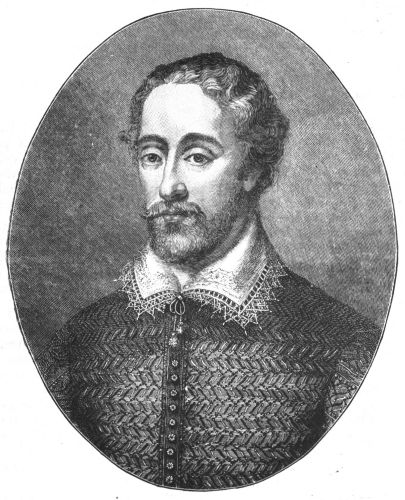
EDMUND SPENSER.
Amongst the lyrical poets, the reign of Henry VIII. presents us with a remarkable trio, who were associated as well by their genius as their position and fate. These were Sir Thomas Wyatt, the early lover of Anne Boleyn, her brother, George Boleyn, afterwards the unfortunate Earl of Rochford, and the equally unfortunate Henry Howard, Earl of Surrey, the last victim of the sanguinary Henry VIII. Surrey was the cousin-german of the Boleyns, Wyatt was their early neighbour and playfellow; together they all figured amongst the most accomplished courtiers: two of them lost their heads, the third only narrowly escaping; and their poetry was printed together in one volume.
Sir Thomas Wyatt (b. 1503, d. 1542, and called the Elder, to distinguish him from his son, who was executed for rebellion in the reign of Queen Mary) was one of the most illustrious men of the Court of Henry VIII. His country-house was Allington Castle, in Kent, and its vicinity to the residence of the Boleyns made him a youthful companion of Anne and her brother and sister. He became attached to Anne, but was obliged to give way to the king, of whose wrath he was in some danger. After that he was long employed abroad in embassies to France, Spain, Italy, and the Netherlands. Incurring the king's displeasure for aiding Cromwell in the promotion of the marriage with Anne of Cleves, he prudently withdrew from Court to his castle in Kent. He had never ceased writing poetry even when engaged in his diplomatic missions, and he now more than ever cultivated the muses. His amatory verses are polished and elegant, but his satires display more vigour, and are remarkable as containing the earliest English version of "The Town and Country Mouse." Besides his poems he has left letters, in which he not only gives us many insights into the state of the Courts where he resided, but various particulars regarding the fate of Anne Boleyn, and some addressed to his son, which place him in a most favourable light as a man and a father. His prose has been greatly admired. A short lyric, which we may give, addressed to Anne Boleyn, when her creation of Marchioness of Pembroke warned him that he saw in her the future queen, clearly informs us that he had been her accepted lover:—
"Forget not yet the tried intent Of such a truth as I have meant; My great travail so gladly spent, Forget not yet. "Forget not yet when first began The weary life ye know; since when The suit, the service none tell can, Forget not yet. "Forget not yet the great assays, The cruel wrongs, the scornful ways, The painful patience and delays, Forget not yet. "Forget not, O! forget not this, How long ago had been and is The love that never meant amiss, Forget not yet. "Forget not now thine own approved, The which so constant hath thee loved, Whose steadfast faith hath never moved, Forget not yet."
His friend George Boleyn was, perhaps, a more spirited poet than himself, and is said to have sung the night before his execution (May 17, 1536) a lyric which had been printed some time, along with the poems of Wyatt, called, "Farewell, my lute," the refrain of which was too strikingly applicable to his situation:—
"Farewell, my lute, this is the last Labour that thou and I shall waste, For ended is that we began; Now is the song both sung and passed; My lute, be still, for I have done."
But the most famous of these was the Earl of Surrey (b. 1516, d. 1547). Like Wyatt, he had travelled in Italy, and formed a high admiration of the great Italian poets, Dante, Ariosto, and Petrarch, on whose model he formed his taste. Like his ancestor, the conqueror of Flodden, he was brave and high-spirited but seems to have had a facility for getting into scrapes, both with his own family and the Government. As a gay courtier, however, he was much admired by the ladies, and still more by people of taste for his poems, which went through four editions in two months, and through seven more in the thirty years after their appearance. They are supposed to have strongly influenced the taste of Spenser and Milton. The theme of his lyrics was the fair Geraldine, but who she was precisely neither critics nor historians have quite determined, though believed to be a lady of the Irish family of Fitzgerald. A single stanza will indicate the spirit with which he proclaimed her beauty:—
"Give place, ye lovers, here before That spent your boasts and brags in vain! My lady's beauty passeth more The best of yours, I dare well say'n, Than doth the sun the candle-light, Or brightest day the darkest night."
But the most important fact in Surrey's poetical history is his introduction of blank verse into the English language, a simple but, in its consequences, most eventful innovation, liberating both the heroic and the dramatic muse from the shackles of rhyme, and leading the way to the magnificent works of Shakespeare and Milton in that free form. There has been much dispute among critics as to whether Surrey invented blank verse, or merely copied it from some other language; but the only wonder seems that some one of our poets had not attempted it before. What so likely as that Surrey, in translating the first and fourth books of the "Æneid," should adopt the blank verse in which the original was written, not exactly the hexameter but a measure more suitable to the English language? All the verse of the ancient Greeks and Romans is of this blank species; and it is extraordinary that men well read in these tongues had so long omitted the experiment; especially as the Italians, the French, and the Spaniards had tried it. Gonsalvo Perez, secretary to Charles V., had translated Homer's "Odyssey" into blank verse; and in 1528 Trissino, in order to root out the terza rima of Dante, had published his "Italia Liberata di Goti"—"Italy delivered from the Goths"—in blank verse. In the reign of Francis I. two of the most popular poets of France, Jodelle and De Baif, wrote poems in this style. Gawin Douglas, Bishop of Dunkeld, had already translated the "Æneid' into Scots metre, and it would seem as if Surrey, in trying his hand on two books of the same poem, had been induced to make the essay of blank verse at the same time. Whatever was the immediate cause, nothing could exceed the success of Surrey's experiment. His verse flows with a stately dignity full of music and strength. We take a specimen from the fourth book of the "Æneid," where Dido, who has vowed never to marry again, perceives her new passion for Æneas, and discloses her pain to her sister:—
"Ne to her lymmes care graunteth quiet rest. The next morrowe with Phœbus' lampe the erthe Alightened clere, and eke the dawning daye, The shadowe danke gan from the pole remove, When all unsownd her sister of like minde, Thus spoke she to: 'O sister An, what dremes Be these that me tormenten, thus afraide? What newcome gest unto our realm ys come? What one of chere? How stowt of harte in arms? Truelie I think, ne vaine ys my beliefe, Of goddishe race some of springe should he seeme. Cowardie noteth harts swarved owt of kinde He driven, lord, with how hard destinie! What battells eke atchieved did he tell! And but my minde was fixt immovablie Never with wight in wedlocke for to joine, Sithe my first love me lefte by deth disseverid, Yf bridal bowndes and bed me lothed not, To this one fawlt perchaunce yeet might I yeld; For I will graunt sith wretched Syche's dethe, My spouse and hawse with brother slaughter stained, This onley man hath made my senses bend, And pricketh forthe the minde that gan to slide: Feelinglie I taste the steppes of mine old flame. But first I wishe the erth me swallow downe, Or with thunder the mighty Lord me send To the pale gostes of hell and darkness depe, Or I thee stayne shamefastness, or the lawes.'"
If we turn to Sackville's "Gorboduc," acted before Queen Elizabeth in 1561, we shall see how thoroughly blank verse had asserted its freedom of the language. Even Greene, in his "Friar Bacon," in 1594, has passages that in their rich and harmonious diction display the wonderful power of blank verse. The true vehicle for the deathless dramas of Shakespeare was established, and already he had taken possession of it with some of his noblest imaginings, for Nash, as early as 1589, alludes to "Hamlet."
But before coming to Shakespeare, we must add another word regarding Sackville (b. 1527, d. 1608). In 1559 he published "The Mirrour for Magistrates." The poetical preface to this work, which he called "The Induction," and the "Complaint of Henry, Duke of Buckingham," displayed the most remarkable powers of poetry, and at once arrested the public attention. The work itself was a mere series of the lives of personages prominent in English history; it is supposed to be an imitation of Lydgate's "Fall of Princes," but is expanded by the loftier genius of the author, while the induction is so illustrated by allegory, as to give rise to the belief that Spenser was indebted to him.
Edmund Spenser, the greatest of our allegoric poets, was born (1553) in East Smithfield, in London, and was educated at Pembroke Hall, Cambridge. He had the good fortune to secure the friendship of the all-powerful Earl of Leicester, of Sir Philip Sidney and Sir Walter Raleigh. By their introduction to Queen Elizabeth, he obtained an annuity of £50 a year; and besides being employed by Leicester on a mission to France, went to Ireland in 1580 with Lord Grey de Wilton. We have already mentioned his "View of the State of Ireland," and for that able work, as well as for other services, he received a grant of the abbey and manor of Enniscorthy in Wexford, which the same year, probably under pressure of necessity, he transferred to a Mr. Lynot. The estate, at the time of Gilbert's survey of Ireland, was worth £8,000 a year. Afterwards Spenser obtained the grant of the castle of Kilcolman, in the county of Cork, part of the estate of the unfortunate Earl of Desmond, with 3,000 acres of land. On this property the poet went to live, and his dear friend Sir Philip Sidney being just then killed at the battle of Zutphen, he wrote his pastoral elegy of "Astrophel" in his honour. He also wrote his great work the "Faerie Queene" there; but in 1597 he was chased by the exasperated Irish from his castle, which was burned over his head, his youngest child perishing in the cradle. He reached London, with his wife and two boys and a girl, and thus broken down by his misfortunes, he sank and died in 1599 at an inn or lodging-house in King Street, Westminster. Ben Jonson says "he died for lake of bread, yet refused twenty pieces sent to him by my Lord of Essex, adding he was sorry he had not time to spend them."
It has been asked how he could die of "lack of bread" with an annuity of £50 a year. The thing is very possible. Burleigh was his life-long enemy. He hated him as the commonplace soul instinctively hates the man of genius, and this hatred was aggravated by his being patronised by Leicester, Essex, and Raleigh, all men whom Burleigh detested. Nothing was, therefore, easier than for Burleigh to withhold the dying poet's pension, or his son Robert Cecil, who now possessed his power, for Burleigh was in his last days, and Cecil inherited all his meanness. Spenser has recorded the malice of Burleigh in various places. In his "Ruins of Time" he says:—
"The rugged foremost that with grave foresight Wields kingdoms' causes and affairs of state, My looser verse, I wot, doth sharply wite For praising love."
And at the close of the sixth book of "The Faerie Queene," he declares there is no hope of escaping "his venomous despite." Spenser's verses in "Mother Hubbard's Tales," describing the miseries of Court dependence, have often been quoted:—
"Full little knowest thou that hast not tryed What hell it is in suing long to byde; To lose good days that might be better spent; To waste long nights in pensive discontent; To speed to-day, to be put back to-morrow; To feed on hope, to pine with fear and sorrow; To have thy prince's grace, yet want her peeres'; To have thy asking, yet wait many years; To fret thy soul with crosses and with cares; To eat thy heart with comfortless despairs; To fawn, to crouch, to wait, to ride, to run, To spend, to give, to want, to be undone."
The minor poems of Spenser beside the "Astrophel," are the "Epithalamium" on his own marriage; four "Hymns to Love and Beauty;" "Sonnets;" "Colin Clout come Home again;" "The Tears of the Muses;" "Mother Hubbard's Tales," which refer to Court characters of the time; "The Ruins of Time;" "Petrarch's Visions," "Bellaye's Visions," &c. In all these there is much beauty and fancy, mingled with much that is far-fetched and fantastic—the inevitable fault of that age. The "Faerie Queene" rises above them all as the cathedral over the lesser churches of a great city. It was written in a stanza which from him has ever since been called the Spenserian, a stanza so capable of every grace, strength, and harmony, that there are few poets who have not essayed it: Thomson's "Castle of Indolence," Beattie's "Minstrel," Mrs. Tighe's "Psyche," Campbell's "Gertrude of Wyoming," and Byron's "Childe Harold's Pilgrimage," have made it the vehicle of many immortal thoughts.
To the modern reader, nevertheless, the "Faerie Queene" would prove a tedious task in a continuous perusal. It is of a fashion and taste so entirely belonging to the age in which it was written—that of courtly tourneys, of parade of knighthood, at least in books, and of fondness of high-flown allegory—that it unavoidably strikes a reader of this more realistic age as visionary, formal in manner, and descriptive not of actual human life, but of an impossible style of existence. It is dedicated to Queen Elizabeth as "The Most High, Mightie, and Magnificent Empresse," and in a letter to Sir Walter Raleigh he explains its plan. Following the example of Ariosto in his "Orlando," he endeavours to exalt worthy knighthood by portraying Prince Arthur before he was king, under the image of a brave knight, perfected in the twelve private moral virtues, as Aristotle hath devised, in which is the purpose of these first twelve books. From the arguments of "Despair" to the "Red-Crosse Knight," we may take a specimen of the "Faerie Queene:"
"'Who travailes by the wearie, wandering way, To come unto his wished home in haste, And meets a flood that doth his passage stay, Is not great grace to help him over past, Or free his feet that in the myre sticke fast? Most envious man that grieves at neighbour's good, And fond, that joyest in the woe thou hast, Why wilt not let him passe, that long hath stood Upon the bancke, yet wilt thyselfe not pas the flood? "'He there does now enjoy eternall rest, And happy ease, which thou dost want and crave, And further from it daily wanderest: What if some little payne the passage have, That makes frayle flesh to feare the bitter wave? Is that not payne well borne, that bringes long ease, And lays the soul to sleepe in quiet grave? Sleepe after toyle, port after stormie seas, Ease after warre, deathe after life, does greatly please.' "The knight much wondered at his suddeine wit, And sayst, 'The terme of life is limited, Ne may a man prolong, nor shorten it; The soldier may not move from watchful steed, Nor leave his stand, until his captaine bid.' 'Who life did limit by Almightie doome,' Quoth he, 'knows best the terms established; And he that points the centenel his roome, Doth license his depart at sound of morning droome. "'Is not his deed, whatever thing is done, In heaven and earth? Did he not all create To die againe? All ends, that was begoune, Their times in his eternall booke of fate Are written sure, and have their certain date. Who, then, can strive with strong necessitie? That holds the world in its still changing state, Or shunne the death ordayned by destinee? When houre of death is come, let none aske whence nor why. "'The longer life, I wote, the greater sin; The greater sin, the greater punishment. All those great battles which thou boasts to win, Through strife, and bloodshed, and avengement, Now praysed, hereafter deare thou shalt repent— For life must life, and blood must blood repay. Is not enough thy evill life forespent? For he that once hath missèd the right way, The further he doth goe, the further he doth stray.'"
The language of Spenser must not be held to be the language of the time; he purposely used an antiquated diction to give a quaint and piquant tone to his romance. A modern critic has denied that the language is thus treated by the poet; but it must be allowed that Sir Philip Sidney, living at the moment, was a competent judge of this fact, and in his "Defence of Poesie" he complains of this very circumstance in the "Faerie Queene."
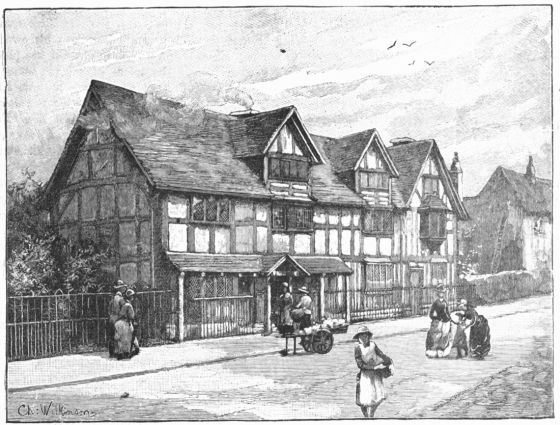
THE HOUSE AT STRATFORD-ON-AVON IN WHICH SHAKESPEARE WAS BORN.
We arrive now at the last name which we intend to introduce in our review of the literature of England at this period, and it is the greatest; perhaps the greatest which has yet diffused its glory over this or any other country. The genius of Shakespeare appears to penetrate into all departments of human knowledge, and his instincts possess a universal accuracy. Whether he describes the beauties of Nature at large, or enters the haunts of busy life, high or low, royal, noble, or plebeian, or sends his all-searching glance into the depths of the human mind, or the strange intricacies of human nature, we are equally astonished at the clearness of his perceptive faculties, and the justness of his conclusions. We shall not here discuss the various guesses, for such to a great degree they are, which have been indulged in by his host of critics and biographers, regarding his little known life. It is sufficient that we know that he was born at Stratford-on-Avon in 1564; that his father was in the Town Council, and a man of property; that William was said to have been apprenticed to a butcher, or that one of his father's trades was that of a butcher; that at the age of nineteen he married Anne Hathaway, who was eight years his senior; that at the age of twenty-two he was driven by increasing poverty, and it is said through a disturbance about poaching in Sir Thomas Lucy's park, to London, where he became connected with the theatre, and so early as 1589 we find that he had written "Hamlet," if no other of his dramas, though none of them seem to have been published till 1597, eight years afterwards. The first of his poems, "Venus and Adonis," was printed in 1593, four years earlier, and the "Rape of Lucrece" in the following year. From that time to 1603, the year of the death of Elizabeth, a great number of his dramas was published, but "King Lear," "Macbeth," "Cymbeline," "The Winter's Tale," the "Tempest," "Troilus and Cressida," "Henry VIII.," "Coriolanus," "Julius Cæsar," and "Antony and Cleopatra," would appear to have been the glorious products of his ten or thirteen years of leisure in his native town. One of the first labours of his retirement seems to have been the collection of his Sonnets, for they were published in 1609.
We mention these facts here merely as historical data; because it will be necessary to notice his plays in the next centennial period of our history, in connection with the drama at large; but we shall confine our notice of Shakespeare on this occasion solely to his poetical character.
The poems of Shakespeare are "Venus and Adonis," "The Rape of Lucrece," "Sonnets," "A Lover's Complaint," and "The Passionate Pilgrim." The poems for the most part, if not altogether—"The Passionate Pilgrim" and some of the sonnets excepted—would appear to have been his earliest productions. He dedicates "Venus and Adonis" to Lord Southampton, and styles it "the first heir of my invention." This poem, "The Rape of Lucrece," and the "Lover's Complaint," bear marks of youthful passion. They burn with a voluptuous fire, yet they are at the same time equally prodigal of a masterly vigour, imagination, and the faculty of entering into and depicting the souls of others. They as clearly herald the great poet of the age, as a morning sun in July announces what will be its intensity at noon. The language, in its purity and eloquence, is so perfect that it might have been written, not in the days of Elizabeth, but in those of Victoria, and presents a singular contrast to that of Spenser. "The Passionate Pilgrim" is an extraordinary production; it has no thread, not even the slightest, of story or connection, and seems to be merely a stringing together of various passages of poetry, which he had struck off at different moments of inspiration, and intended to use in his dramas. Some of them indeed we find there. It opens with a commencement of the legend of "Venus and Adonis," apparently his first rude sketch of the poem he afterwards wrote more to his mind. It then breaks suddenly off with those well-known lines, beginning—
"Crabbed age and youth Cannot live together;"
soon after as suddenly changes into—
"It was a lording's daughter, the fairest one of three;"
as abruptly gives us those charming stanzas opening with—
"Take, oh, take those lips away That so sweetly were forsworn;"
and presents us with a number of disjointed passages which are found in "Love's Labour's Lost."
But the Sonnets are the most interesting, because they give us glimpses into his own life and personal feelings. Many of them are plainly written in the characters of others; some express the sentiments of women towards their lovers, but others are unmistakably the deepest sentiments and feelings of his own life. From these we learn that Shakespeare was not exempt from the dissipations and aberrations incident on a town life at that time, but his true and noble nature led him to abandon the immoral city as early as possible, and retire to his own domestic roof in his own native place. We may select one specimen of these sonnets, which probably was addressed to his wife, and which at once betrays his dislike of his profession of an actor, and his regret over the influence which it had had on his mind, and the stigma which it had cast on his name; for the profession of a player was then so low as to stamp actors as "vagabonds."
"Oh, for my sake do you with Fortune chide, The guilty goddess of my harmful deeds, That did not better for my life provide Than public means which public manners breeds: Thence came it that my name receives a brand, And almost thence my nature is subdued To what it works in, like the dyer's hand. Pity me then, and wish I were renewed; Whilst, like a willing patient, I will drink Potions of eysell[A] 'gainst my strong infection; No bitterness that I will bitter think, Nor double penance to correct correction. Pity me then, dear friend, and I assure ye, Even that your pity is enough to cure me."
But if the great dramatist and inimitable poet shrank with disgust from the profession of acting, because of the estimation in which the actor then was held and the pollutions which surrounded the stage, he held a very different opinion of the vocation of a dramatist. In the peaceful and virtuous retirement of his country residence he still occupied himself with the composition of the noblest dramas of all time; and whilst he was so free from the petty egotism of a small mind that he left scarcely any record of himself, he boldly avowed his assurance of the immortality of his fame:—
"Now with the drops of this most balmy time, My love looks fresh, and Death to me subscribes;[B] Since, spite of him, I'll live in this poor rhyme, While he insults o'er dull and speechless tribes: And thou in this shalt find thy monument, When tyrants' crests and tombs of brass are spent."
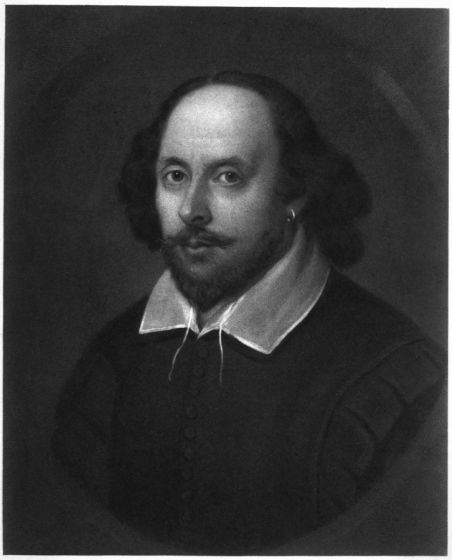
WILLIAM SHAKESPEARE.
From the Painting known as the Chandos Portrait, attributed to Richard Burbage, in the National Portrait Gallery.
We shall have occasion to show that Shakespeare had much to do in shaping and raising the drama out of that chaotic state in which he found it, and the wonder has always been that, with his apparently imperfect education, he could accomplish so much. But there is no education like self-education; this was William Shakespeare's, and his genius was of that brilliant and healthy kind that gave him all the advantages of such a tuition. In history and in society he found the materials of the drama, but the wealth and power of the poet he found in the great school of Nature.
In Scotland the language had remained much more stationary than in England. In this period we find the chief Scottish poets writing in a diction far more unintelligible to the English reader than Chaucer's or Gower's was in the middle of the fourteenth century. Two of the Scots poets of that period—Barbour and King James I.—wrote in English, and, therefore, in a language far in advance of Gawin Douglas, Dunbar, and Sir David Lyndsay in the sixteenth century. One great reason of this probably was the constant strife and enmity between the nations, which made the Scots cling in confirmed nationality to their own language and customs, for the works and merits of the English poets were known and acknowledged. James I. called Chaucer and Gower "his maisters dear." Henryson, a succeeding poet, even wrote a continuation of Chaucer's "Troilus and Cresseide," under the names of the "Testament," and the "Complaint of Cresseide;" and Gawin, or Gavin, Douglas, the famous Bishop of Dunkeld, pronouncing his vernacular tongue barbarous, declared that rather than remain silent through the scarcity of Scottish terms, he would use bastard Latin, French, or English. A still greater and later poet, Dunbar, expresses repeatedly his admiration of "Chawcer of Makars flowir," of "the Monck of Berry," "Lydgate," and "Gowyr." Yet if we use the very language which he did to utter his admiration in, we find no advance towards the polish of these poets:
"O reverend Chawcer, rose of rethouris all, As in our toung the flowir imperiall, That ever raise in Brittane, quha reids richt, Those biers of makars the triumphs ryall, The fresche enamallit termes celestiall; This matter thou couth haif ilumint bricht, Was thou not of our Inglis all the licht; Surmounting every toung terrestiall, As far as Mayis fair morning does midnight. "O morale Gower and Lidgate laureat, Zour suggurat toungs and lipps aureat Bene till our eirs cause of grit delyte."
It is curious that Dunbar calls this English and not Scots. He also enumerates a long list of Scottish poets who were deceased, as Sir Hew of Eglintoun, Etrick, Heriot, Wyntoun, Maister John Clerk, James Afflek, Holland, Barbour, Sir Mungo Dockhart of the Lie, Clerk of Tranent, who wrote the adventures of Sir Gawayn, Sir Gilbert Gray, Blind Harry, and Sandy Traill, Patrick Johnstone, Mersar, Rowll of Aberdeen, and Rowll of Corstorphine, Brown of Dunfermline, Robert Henryson, Sir John the Ross, Stobo, Quinten Schaw, and Walter Kennedy. Of these little is now known, except of Henryson, and that chiefly for his ballad of "Robert and Makyn," given by Bishop Percy in his "Reliques of English Poetry."
Gawin Douglas, third son of the celebrated fifth Earl of Angus, called Bell-the-Cat, was born in 1474. He lived a troubled life in those stormy times, and died a refugee in London, of the Plague, in 1522. He was patronised by Queen Margaret, sister of Henry VIII., and richly deserved it, for his learning, his virtues, and his genius. He was most celebrated in his own time for his translation of Virgil's "Æneid," the first metrical version of any ancient classic in either English or Scots. He also translated Ovid's "De Remedio Amoris." But his original poems, "The Palace of Honour," "King Hart," and his "Comœdiæ Sacræ," or dramatic poems from the Scriptures, are now justly esteemed the real trophies of his genius. "The Palace of Honour" and "King Hart" are allegoric poems, abounding with beautiful descriptions and noble sentiments.
The principal poems of William Dunbar (b. 1465, d. 1530,) are "The Golden Terge," or target; "The Thistle and the Rose," in honour of the marriage of Margaret of England with James IV. of Scotland; "The Fained Friar;" the "Lament of the Death of the Makars," or poets, and a number of other poems, chiefly lyrical, which display versatile genius—comic, satirical, grave, descriptive, and religious—and place him in the first rank of Scotland's poets, notwithstanding the obsolete character of his language; and not the least of his distinctions is the absence of that grossness which disfigured the writings of the poets of those times. A few lines may denote the music of his versification:
"Be merry, man, and tak nocht far in mynd The waivering of this wrechit world of sorrow, To God be humill, and to thy freynd be kynd, And with thy nychtbouris glaidly len and borrow; His chance to-nycht, it may be thyne to-morrow."
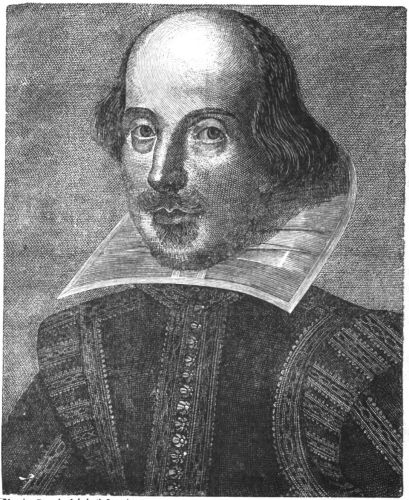
SHAKESPEARE. (From the Portrait by Droeshout in the First Folio.)
The last poet of this period that we must notice is Sir David Lyndsay of the Mount, Lyon King-at-Arms, whom Sir Walter Scott, in "Marmion," has made so familiar to modern readers, predating, however, Sir David's office of Lyon King by seventeen years. Sir David was born about 1490, and is supposed to have died about 1567; so that he lived in the reigns of Henry VII. of England and of Elizabeth, through the whole period of Henry VIII., Edward VI., and Mary. His life was cast in times most eventful, and Sir David, as Lyon-Herald of Scotland, occupied a prominent position in the shaping of those events. At the time of the battle of Flodden in 1513, both Pitscottie and Buchanan assure us that he was with James IV. when the ghost appeared to him in the church at Linlithgow, warning him against the battle. Lyndsay was then only three-and-twenty. He was appointed page to the young king, and continued about him and in his service during the king's life. In his "Complaynt," addressing the king, he says:—
"How as are chapman beres his pack, I bore thy grace upon my back, And sometymes stridlingis on my neck, Dansand with mony bend and beck: The first syllabis that thou did mute, Pa-da-lyn upon the lute; Pa-da-lyn upon the lute; For play, thou leit me never rest, But gyngertoun, thou luffit ay best. And ay quhen thou come from the scule, Then I luffit to play the fule."
Lyndsay went to France on embassies of royal marriage; and after the king's early death, under the Regency, he was again sent to the Low Countries on a mission to the Emperor Charles V. In 1548 he went as Lion-King to Denmark, to King Christian, to seek aid against the English, and afterwards lived to see the great struggle between the old Church and the Reformation, the murder of Cardinal Beaton, the return of Knox, and must have died about the time of the murder of Darnley.
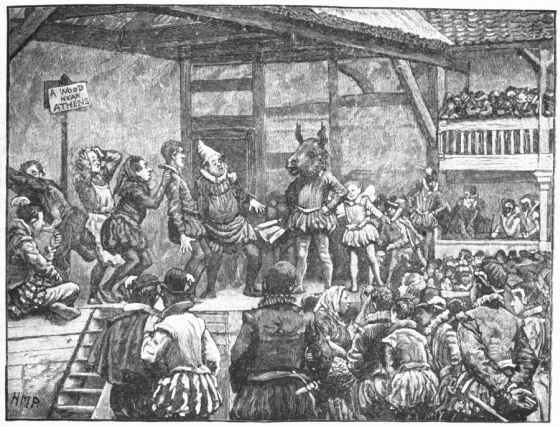
THE ACTING OF ONE OF SHAKESPEARE'S PLAYS IN THE TIME OF QUEEN ELIZABETH.
Sir David, though bred a courtier, was a thorough Reformer; and his poems abound with the most unrestrained exposure of the corruptions of Courts and of the Church. On the flagitious lives of monks, nuns, and clergy, he pours forth the most trenchant satire and denunciation; and in this respect he may be styled the Chaucer of Scotland. His poems are "The Dreme," "The Complaynt," "The Complaynt of Papingo," "The Complaynt of Bagsche," "Ane Pleasant Satyre of the Three Estatis," "The Answer to the King's Flyting," "Kittie's Confession," "The Tragedie of the Cardinal," "The Historie and Testament of Squire Meldrum," "Monarchie," and "The Epistill Nuncupatorie."
"The Dreme" reminds one of the dreams of former poets, of Chaucer, William Langland's, "The Vision of Piers Plowman," and of those of Douglas and Dunbar. Probably "The Golden Terge" of Dunbar suggested this poem, for just as Dunbar goes out, as "the stern of day began to schyne," and lying under a roseir, or arbour of roses, lulled by the songs of birds and the sound of a river, dreams, so does Lyndsay dream, passing, with Dame Remembrance as his guide, through earth, hell, purgatory, heaven, paradise, and "the planets seven," hearing and seeing all the works of God, and the rewards and punishments of the good and the evil. "The Complaynt" describes the degenerate manners of the Court whilst Lyndsay was banished from it, and the grapes were sour. "The Complaynt of the Papingo," or the king's parrot, deals out the same measure to the hierarchy as Lyndsay had given to the State, and in it Cardinal Beaton, the Pope and the clergy in general, are soundly rated. Next comes "The Three Estatis," a morality play in which all kinds of emblematical personages—Rex Humanitas, Sensualitie, Chastitie, &c.—act their parts. Its scope may be inferred from its being declared to be "in commendation of vertew and vituperation of vyce." This is the great work of Lyndsay, and was acted before the king and queen, who sat out nine mortal hours in its performance, in which they successively heard every order in the State—Court, nobility, Church, and people—severely criticised. Lyndsay's play has the merit of preceding both "Gorboduc" and "Gammer Gurton's Needle;" and it certainly possesses the moral of the former and the wit of the latter. "The Answer to the King's Flyting" is a very curious example of what the indulgence of a professional fool at Court led to: it produced not only the jester but the poet laureate. The king condescended to flyte, or jibe, with his jester; the jester in return became the satirist, and the poet laureate healed all wounds by his eulogies. James V. flyted with Lyndsay, and Lyndsay answered with interest. In "Kittie's Confession" Lyndsay ridicules auricular confession. In "The Cardinal" he sings a song of triumph over the fall of Beaton. In the "Legend of Squire Meldrum" the poet dresses up the adventures of a domestic of Lord Lyndsay's of that name in the manner of an ancient romance, and it was extremely popular. It has been declared by critics of note to be the best of Lyndsay's poems, and equal to the most polished pieces of Drayton, who lived a century after him.
We have taken thus much notice of the Lyon King-at-Arms, because nowadays he does not enjoy, perhaps, his due fame in comparison with that of our Chaucer and our early dramatists; yet a perusal of his works is necessary to a real knowledge of the times in which he lived. The reader, however, must be warned that in the search after this knowledge he will have to wade through much filth, and language now astonishing for its naked coarseness. On the other hand, he will occasionally find scientific theories of modern pretension quite familiar to our Lyon-King. For instance, Kirwan in his "Elements of Mineralogy"—a work published in 1794 and marking a considerable advance in knowledge—claimed the geologic discovery that the currents which broke up the hills in Europe came from the south-west, leaving the diluvial slopes declining to the north-east. But hear Lyndsay three hundred years ago:—
"I reid how clerkis dois conclude, Induryng that maist furious flude With quhilk the erth was sa opprest, The wynd blew feorth of the south-west, As may be sene be experience, How, throw the watter's violence, The heich montanis, in every art, Ar bain fornenst the south-west part; As the montanis of Pyreneis, The Alpis, and rochis in the seis; Richt sa the rochis gret and gray Quhilk standis into Norroway. The heichest hillis, in every art, And in Scotland, for the maist part, Throuch weltryng of that furious flude, The craigis of erth war maist denude. Travelling men may considder best The montanis bair nixt the south-west."
The sixteenth century was nearly as distinguished for its Music as its poetry. The reproach which has been cast on England in our own time for not being a musical or music-producing nation did not apply then. On the contrary, we stood at the head of Europe in original musical composition. The monarchs of that age, like their most illustrious predecessors from Alfred downwards, were highly educated in music. Henry VIII. was himself a composer of Church music. It must be recollected that Henry, being but the second son of Henry VII., was originally educated for the Church, whose dignities were then princely; and, as a matter of course, he was made familiar with its music, which occupied so prominent a part in its worship. Erasmus bears testimony to the fact of Henry having composed Offices for the Church—a fact confirmed by Lord Herbert of Cherbury and Bishop Burnet; and Sir John Hawkins in his "History of Music," and Boyce, in his "Cathedral Music of English Masters," have preserved specimens of the Royal composition. Boyce gives a fine anthem of Henry's, "O Lord, the Maker of all things." The king's musical establishment for his chapel consisting of 114 persons cost annually upwards of £2,000, and was continued by Edward. Mary and Elizabeth were equally learned in music, though they do not appear to have patronised it as royally.
Under these circumstances great composers, both of sacred and social music flourished in the sixteenth century. The names of Tye, Marbeck, Tallis, Bird, Farrant, Dowland, Bennet, Wilbye, Ford, &c., stand in superb array as composers of some of our finest Church music, or of madrigals and part songs.
Tye was so much esteemed by Henry VIII., that he was made music preceptor to Edward VI., and was afterwards organist to Elizabeth. He composed both anthems and madrigals; and his motett, "Laudate nomen Domini," is still famous. Marbeck composed the notes to the Preces and Responses, which, with some alterations, are still in use in our cathedrals. He was organist at Windsor, and was very nearly losing his life under the ferocious Henry, being found to be a member of a society for religious reformation. He and his three accomplices were condemned to the stake; but Marbeck was saved by his musical genius, Henry observing, on Marbeck's "Latin Concordance," on which he had been employed, being shown to him, "Poor Marbeck! it would be well for thine accusers if they employed their time no worse." His fellows were burnt without mercy, though no more guilty than himself.
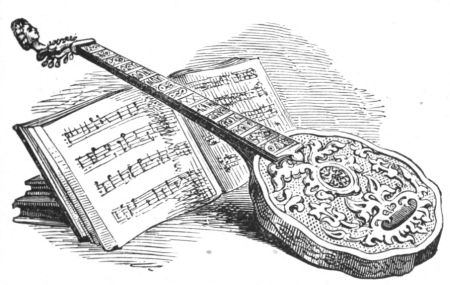
QUEEN ELIZABETH'S CITHER AND MUSIC-BOOK.
Tallis was indebted to Marbeck for the notes just mentioned in his compositions for the Church. His entire service, including prayers, responses, Litany, and nearly all of a musical kind, are preserved in Boyce's collections. They became the most celebrated of any of that remarkable age. In conjunction, also, with his pupil William Bird, he published, in 1575, "Cantiones Sacræ"—perfect of their kind; one of them, "O sacrum convivium," since adapted by Dean Aldrich to the words "I call and cry," still continues to be frequently performed in our cathedrals. The "Cantiones" are also remarkable as having been the first things of the sort protected by a patent for twenty-one years, granted by Elizabeth.
Bird was the author of the splendid canon, "Non nobis, Domine," which has been claimed by composers of Italy, France, and the Netherlands, but, as sufficiently proved, without any ground. The names of Tallis and Bird are of themselves an ample guarantee to the claim of musical genius by this country. Richard Farrant and Dr. Bull—the first a chorister in Edward VI.'s chapel, and the latter organist to Queen Elizabeth—added greatly to the sacred music of the period. Farrant's compositions especially are remarkable for their deep pathos and devotion. His anthem, preserved by Boyce, "Lord, for Thy tender mercy's sake." is unrivalled.
In social music the poetical Surrey stands conspicuous, having set his own sonnets to music. Madrigals and other part songs—since better known as glees—were carried to a brilliant height in this country. The madrigal was originally invented by the Flemings, but glee singing seems to be English, though no doubt derived from the madrigal. Morley's first book of madrigals was published in 1594, Weelkes's in 1597, Wilbye's in 1598, Bennet's in 1599, and soon after Ward's and Orlando Gibbons'. Dowland's and Ford's are more properly glees than madrigals; the former appeared in 1597, and the latter in 1607. Morley, one of the gentlemen of Queen Elizabeth's chapel, appears, like Dowland, to have studied the works of the great composers abroad; and the harmony and science which he evinces are eminent. His canzonets for two voices are especially lively and pleasing. Dowland not only travelled in France, Italy, and Germany, but, at the request of King Christian IV., who saw him in England, he went to reside in Denmark. Fuller declares that he was the rarest musician of the age. In 1598 Wilbye published thirty madrigals, and a second book, applicable to instrumental as well as vocal music, in 1609, amongst which are, "Lady, when I behold the roses sprouting," "As fair as morn," "Down in a valley," &c.; and in 1599 John Bennet published a set of madrigals, including the admirable ones of "O sleep, fond Fancy!" "Flow, O my tears!" Lastly, John Milton, the father of the poet, who also composed several psalm tunes, was a contributor to "The Triumphs of Oriana," a set of madrigals in praise of Queen Elizabeth. Altogether this century was brilliant in both Church and convivial music; and if we are to judge from some specimens to be found in "The Dancing Master" and "Queen Elizabeth's Virginal Book," the popular airs were in many instances of a superior character, among which we may mention Bird's "Carman's Whistle" and the "Newe Northern Ditty of Ladye Green Sleeves."
The change which marked religion and literature in this country extended itself as strikingly into Architecture. We have no longer to record the rise of new Orders of ecclesiastical building, nor to direct the attention of the reader to splendid churches as examples of them. The unity of the Church, which had enabled it to erect such a host of admirable cathedrals and abbeys, was broken up; the wealth which had supplied the material and engaged the skill was dispersed into other hands, and destined not only to produce new orders of society, but new forms of architecture. Churches must give way to palaces and country halls, as full of innovations as the very faith of the country. From this period to our own time the taste for ecclesiastical architecture continued to decline, till the very principles of what is called Gothic architecture were forgotten. The architects, as Wren and Jones, went back to classic models, so little adapted to the spirit of Christian worship that, in spite of the genius expended upon them, they have remained few in number and, from the revival of the knowledge of Anglo-Gothic amongst us, are not likely to increase.
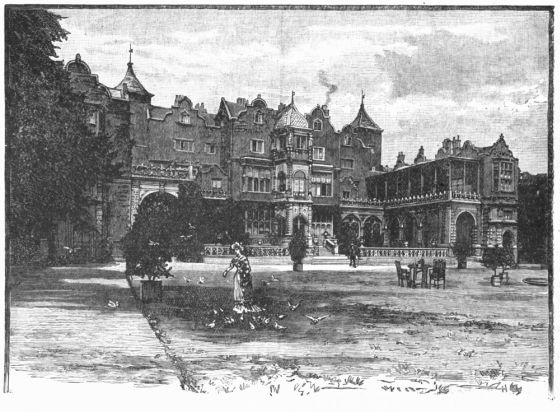
HOLLAND HOUSE, KENSINGTON. (From a Photograph by Bedford, Lemere & Co.)
But it is even a question whether the Gothic style had not reached its full development at the period of the Reformation; for we find in most European countries that the noblest buildings of this kind are for the most part anterior to this epoch. It is at the same time true that the same causes which brought our ecclesiastical architecture to a sudden stand in the sixteenth century strongly affected all Europe, even where Roman Catholicism managed to maintain its ground. Everywhere the conflict was raging—everywhere the rending influence was felt; and the ancient power and wealth of the Church were broken and diminished. In England a few churches might be pointed to of this period, but they exhibit the influence of the age in marks of decline, and to none can we turn as examples to be named with our Westminsters, Yorks, and Winchesters. Bath Abbey was in progress of erection when the Reformation burst forth and arrested its progress. It was not completed till 1616—more than ten years after the death of Elizabeth—and cannot be named as one of our finest erections.
The wealth which was diverted from the Church into the hands of the Crown and the aristocracy, reappeared in palaces and country halls; and a totally new genius displayed itself in these. The old Tudor, so called, which marked the baronial residences even before the Tudors reached the throne, the mixture of castle and manor-house, with its small windows, battlemented roofs, and flanking turrets, began to enlarge and exaggerate most of these features, and to mix with them new elements clearly brought into the country by foreign architects, and in a great measure from Italy. The windows rapidly augmented themselves, till they soon occupied a predominant portion of the towers and fronts; the turrets became surmounted by domes, and by those bulbous domes which were often piled one above another. There was soon seen one tier of pillared or pilastered storey above another, in the Palladian or Paduan fashion. Turrets often gave way to scroll-work parapets; and instead of the house standing as heretofore on a level plain, it was elevated on a terrace, with broad and balustraded flights of steps, and all the adjuncts of fountains, statues, and balustraded esplanades essential to the Italian garden.
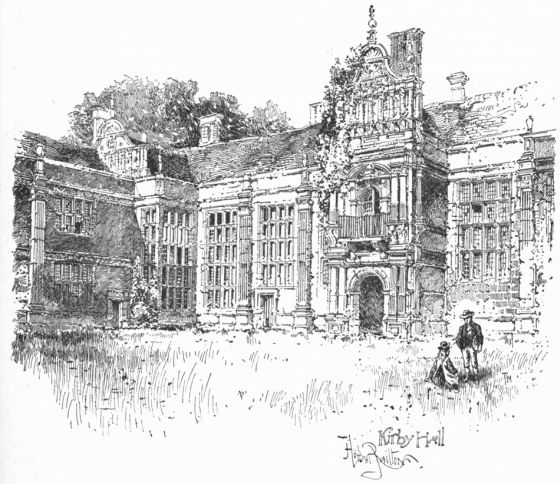
THE GREAT COURT OF KIRBY HALL, NORTHAMPTONSHIRE.
The houses were still built round a court or quadrangle, and adorned with outer and inner gateways, while groined roofs and rich oriels still demonstrated the connecting link of descent from the Gothic. In fact, the architecture of the Tudor period is a singular yet often superb mixture of the Gothic and the Italian, with profusion of ornaments and ingraftment of parts which tell strongly of a more Eastern origin. Nor does it appear that these foreign elements were introduced at the latter portion of this period only—they stand forth conspicuously in the very commencement of it. In the later years of the reign of Elizabeth we can point to noble houses which are more allied to the ancient Tudor, with its small windows and simple towers and roofs, than those of the Henrys VII. and VIII., who in their earlier days had a gorgeous and even fantastic taste for palatial architecture. For example, Hampton Court is far more simple and chaste than Richmond Palace (see p. 341), built by Henry VII., or Nonsuch, built by Henry VIII. In family mansions, Wimbledon House, built in 1588, with its open court, its two terraces, clearly Italian in character, is yet so chaste and simple, with its flat roof, its square slated towers, and mixture of small and large windows, that, compared to Nonsuch, as it has been, you at once see the violent contrast of the fanciful and the grave. Again, in Charlton House, in Kent, with its central entrance of Italian character, with two tiers of engaged columns, its ornamented parapets just verging into scroll-work, its turret windows of medium size, and its turret domes simple, and still plainer chimneys; or in Holland House (see p. 380), built in 1607, without domes, but with ogee-gables; or in Campden House, as it was built in 1612, with roof of plainest character, and pilastered entrance, we mark a far less ornate style than in the days of the Henrys. The whole of this period was one of a mixed style, in which different architects indulged themselves in employing more or less of one or other of the prevailing elements, according to their tastes. What is more strictly called Elizabethan may be seen in such houses as Wollaton or Hardwicke, in which the ample square windows, the square towers superseding the octagon ones of Nonsuch, the absence of the Eastern-looking domes, and the presence of superb scroll-work, give a fine distinctive style.
The Palace of Richmond, as built by Henry VII., with its projecting towers occupied almost entirely with windows, and its roof presenting an immense number of double domes, a smaller one surmounting a lantern placed on the larger domes, had an air more Saracenic than English; but the Palace of Nonsuch, built by Henry VIII., outdid that in the singularity of its style, and was the wonder of its age. It was built round a quadrangle; the front was flanked by octagonal towers which, at the height of the ordinary roof, rose, by a demi-arch expanding over the lower one, into three more storeys, and upon these were lesser towers of two storeys, surmounted by domes and fanes. All the lower storeys were divided into compartments by pilasters and bands, these compartments embellished by figures and groups in bas-relief. The lower part of this palace was of stone, the upper of wood. Hentzner, the German traveller, became quite enthusiastic in describing it as a palace in which everything that architecture could perform seemed to have been accomplished; and says that it was "so encompassed with parks full of deer, delicious gardens, groves ornamented with trellis-work, cabinets of verdure, and walks so embowered by trees, that it seemed to be a place pitched upon by Pleasure herself to dwell in along with Health."
But there were two men in the reign of Henry VIII. who drew him off from this more florid and fanciful style to others of a very different, but equally imposing character, and full of rich detail. These were Wolsey and John of Padua. Wolsey appeared to have an especial fondness for brick-work, and Hampton and the gatehouse of his mansion at Esher remain as proofs of the admirable masonry which he used. In Hampton Court (see p. 121) we go back from the barbaric pomp of Nonsuch to the castellated style; to small windows, pointed archways, castellated turrets and battlements, mingled with rich oriel windows over the entrances, rich groined roofs in the archways, but a very sparing use of the ordinary aid of the bulbous dome. In this and the other buildings of this class, as Hengrave in Suffolk, the richly cross-banded chimneys are a conspicuous ornament. John Thorpe, or John of Padua, who became chief architect to Henry VIII., and afterwards built Somerset House for the Protector, seems to have been unknown in his own country, but originated a modified Italian style here which bears his name, possessing great grace and dignity, and of which Stoneyhurst College in Lancashire, Longleat in Wiltshire, and Kirby Hall in Northamptonshire (built for Sir Christopher Hatton), are fine examples.
In the smaller houses of town and country there continued to be little change. They were chiefly of timber, and displayed much more picturesqueness than they afforded comfort. In towns the different storeys, one over-hanging another till the inhabitants could almost shake hands out of the attic windows across the narrow streets, and their want of internal cleanliness and ventilation, caused the plague periodically to visit them. The Spaniards who accompanied Philip, in Mary's reign, were equally amazed at the good living of the English people and the dirt about their houses. One great improvement about this time was the introduction of chimneys; and in good country-houses the ample space of their staircases, often finely ornamented with balustrade work, diffused a pure atmosphere through them.
In other arts, however, the sixteenth century in England was almost destitute of native talent. In Statuary and Carving the preceding century had made great progress, but the destruction of the churches, and the outcry raised against images and carving on tombs as idolatry and vain-glory, gave a decided check to their development. As for Painting, it had never, except in illumination, flourished much among the English, and now that the Italian and Flemish schools had taken so high a position, it became the fashion of the princes and nobility, not to call forth the skill of natives, but to import foreign art and artists. In the reign of Henry VII. a Holbein, supposed to be the uncle of the great Hans Holbein, visited England, but we know little of his performance here. There is a picture at Hampton Court, called a Mabuse, of the Children of Henry VII.—Prince Arthur, Prince Henry, and the Princess Margaret. As Prince Henry appears to be about seven years old, that would fix the painting of the picture about 1499. But its authenticity is doubtful, as, according to some, Mabuse was born that year. In Castle Howard there is a painting by him of undoubted authority, "The Offering of the Magi," containing thirty principal figures. It is in the highest state of preservation, and Dr. Waagen, who was well acquainted with the productions of this artist in the great galleries of the Continent, pronounced it of the highest excellence. He is said to have painted the children of Henry VIII., but if he did so, the picture has perished. The date of his visit is quite uncertain, and the attribution to him of portraits is at the best no more than conjectural. Mabuse was a very dissipated man, and had fled from Flanders on account of his debts or delinquencies, yet the character of his performances is that of the most patient industry and painstaking. His works done in England could not have been many, as his abode here is supposed to have been only a year. He died in 1532.
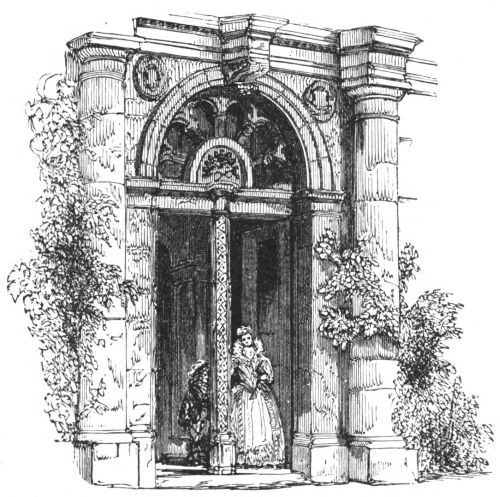
ENTRANCE FROM THE COURTYARD OF BURLEIGH HOUSE, STAMFORD.
Besides Mabuse, the names of several other foreign artists are known as having visited England; but little or nothing is known of the works of Toto del Nunziata, an Italian, or of Corvus, Fleccius, Horrebout or Horneband, or of Cornelius, Flemish artists; but another Fleming was employed, in the early part of the reign of Henry VIII., by Bishop Sherbourne, in painting a series of English kings and bishops in Chichester Cathedral.
Of the celebrated Hans Holbein, the case is better authenticated. He resided in England nearly thirty years, and died in London of the plague in 1543. There is an obscurity about both the time and place of his birth, but the latter appears now to be settled to be Grünstadt, formerly the residence of the Counts of Leiningen-Westerburg. He accompanied his father to Basle, receiving from him instructions in his art. There he became acquainted with Erasmus, who gave him letters to Sir Thomas More. He arrived in England in 1526, and lived and worked in the house of his noble patron, Sir Thomas, for three years. The learned chancellor invited Henry VIII. to see his pictures, who was so much delighted with them, that he took him instantly into his service. It is related of him that while busily engaged with his works for the king, he was so much annoyed and interrupted by a nobleman of the court, that he ordered him to quit his studio, and on his refusing, pushed him downstairs. When the nobleman complained to Henry of this rudeness, Henry bluntly told him that the painter had served him right, and warned him to beware of seeking any revenge. "For," added he, "remember you now have not Holbein to deal with, but me: and I tell you, that of seven peasants I can make as many lords, but I cannot make one Holbein."
The demand of portraits from Holbein by the Court and nobility was so constant and extensive, that he completed comparatively few historical compositions. He has left us various portraits of Henry, and adorned the walls of a saloon at Whitehall with two large paintings representing the triumphs of riches and poverty. He also painted Henry as delivering the charter of the barber-surgeons, and Edward VI. delivering that for the foundation of Bridewell Hospital. The former piece is still at the hall of that guild. Amongst the finest of Holbein's paintings on the Continent is that of "The Burgomaster and his Family" in the gallery at Dresden. There is less of the stiffness of his manner in that than in most of his pieces; but in spirited design, clearness and brilliancy of tone, and perfection of finish, few painters excel Holbein; he wanted only a course of study in the Italian school to have placed him among the greatest masters of any age.
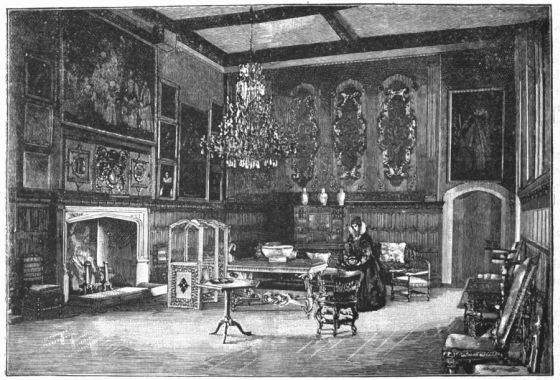
ELIZABETH'S DRAWING-ROOM, PENSHURST PLACE.
(From a Photograph by Carl Norman and Co., Tunbridge Wells.)
In the reign of Mary, Sir Antonio More, a Flemish artist, was the great portrait-painter. In that of Elizabeth, though she was not more liberal to the arts than to literature, yet her personal vanity led her to have her own portrait repeatedly painted, and the artists, chiefly Flemings, were much employed by the nobility in the same department. Some of the foreign artists also executed historical and other pieces. Among these artists may be named Frederic Zuccaro, an Italian portrait-painter; Luke van Heere, who executed a considerable number of orders here, including a series of representations of national costume for the Earl of Lincoln; and Cornelius Vroom, who designed the defeat of the Spanish Armada, for the tapestry which adorned the walls of the House of Lords, and which was destroyed by the fire in 1834. In Elizabeth's reign also two native artists distinguished themselves: Nicolas Hilliard, a miniature-painter; and Isaac Oliver (b. 1556, d. 1617), his pupil, who surpassed his master in portraits, and also produced historical works of merit.
Among the sculptors were Pietro Torregiano, from Florence, who, assisted by a number of Englishmen, executed the bronze monument of Henry VII., and is supposed also to be the author of the tomb of Henry's mother in his chapel. John Hales, who executed the tomb of the Earl of Derby at Ormskirk, was one of Torregiano's English assistants. Benedetto Rovezzano designed the splendid bronze tomb of Henry VIII., which was to have exhibited himself and Jane Seymour, as large as life, in effigy, an equestrian statue, figures of the saints and prophets, the history of St. George, amounting to 133 statues and forty bas-reliefs. This monument of Henry's egotism none of his children or successors respected him enough to complete; and Parliament, in 1646, ordered the portion already executed to be melted down.
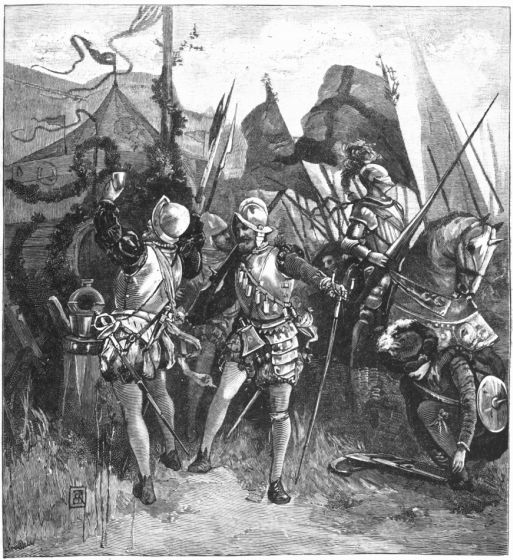
SOLDIERS OF THE TUDOR PERIOD.
In Scotland during this period the arts were still less cultivated. The only monarch who had evinced a taste for their patronage was James V., who improved and adorned the royal palaces, by the aid of French architects, painters, and sculptors whom he procured from France, with which he was connected by marriage and alliance. His chief interest and expenditure were, however, devoted to the palace at Linlithgow, which he left by far the noblest palace of Scotland, and worthy of any country in Europe.
The furniture of noble houses in the sixteenth century was still quaint; but in many instances rich and picturesque. The walls retained their hangings of tapestry, on which glowed hunting-scenes, with their woodlands, dogs, horsemen, and flying stags, or resisting boars, or lions; scenes mythological or historical. In one of the finest preserved houses of that age, Hardwicke, in Derbyshire, the state-room is hung with tapestry representing the story of Ulysses; and above this are figures, rudely executed in plaster, of Diana and her nymphs. The hall is hung with very curious tapestry, of the fifteenth century, representing a boar-hunt and an otter-hunt. The chapel in this house gives a very vivid idea of the furniture of domestic chapels of that age; with its brocaded seats and cushions, and its curious altar-cloth, thirty feet long, hung round the rails of the altar, with figures of saints, under canopies, wrought in needlework. You are greatly struck as you pass along this noble old hall, which has had its internal decorations and furniture carefully retained, with the air of rude abundance, and what looks now to us nakedness and incompleteness, mingled with old baronial state, and rich and precious articles of use and show. There are vast and long passages, simply matted; with huge chests filled with coals, which formerly were filled with wood, and having ample crypts in the walls for chips and firewood. There are none of the modern contrivances to conceal these things; yet the rooms, which were then probably uncarpeted, or only embellished in the centre with a small Turkey carpet bearing the family arms, or perhaps merely with rushes, are still abounding with antique cabinets, massy tables, and high chairs covered with crimson velvet, or ornamental satin. You behold the very furniture used by the Queen of Scots; the very bed, the brocade of which she and her maidens worked with their own fingers. In the entrance hall the old feudal mansion still seems to survive with its huge antlers, its huge escutcheons, and carved arms thrust out of the wall, intended to hold lights. But still more does its picture gallery, extending along the whole front of the house, give you a feeling of the rude and stately grandeur of those times. This gallery is nearly 200 feet long, of remarkable loftiness, and its windows are stupendous, comprising nearly the whole front, rattling and wailing as the wind sweeps along them, whilst the walls are covered with the portraits of the most remarkable personages of that and prior times. You have Henry VIII., Elizabeth, the Queen of Scots, with many of the statesmen and ladies of the age.
In such old houses we find abundance of furniture of the period. The chairs are generally high-backed, richly carved, and stuffed and covered with superb velvet or satin. At Charlcote House, near Stratford-on-Avon, the seat of the Lucys, there are eight fine ebony chairs, inlaid with ivory, two cabinets, and a couch of the same, which were given by Queen Elizabeth to Leicester, and made part of the furniture of Kenilworth. At Penshurst, Kent, the seat of the Sidneys, in the room called Elizabeth's room, remain the chairs which it is said she herself presented, with the rest of the furniture. They are fine, tall, and capacious; the frames are gilt, the drapery is yellow and crimson satin, richly embroidered, and the walls of each end of the room are covered with the same embroidered satin. In the Elizabethan room at Greenwich Court are chairs as well as other articles of that age. In Winchester Cathedral is yet preserved the chair, a present from the Pope, in which Queen Mary was crowned and married.
At Penshurst we have, in the old banqueting-hall, the furniture and style which still prevailed in many houses in Sir Philip Sidney's time: the dogs for the fire in the centre of the room, from which the smoke ascended through a hole in the roof, the rude tables, the raised daïs, and the music gallery, such as Sir Philip Sidney, Spenser, Shakespeare, and Bacon, as well as the Royal Elizabeth, witnessed them. In this house is also preserved a manuscript catalogue of all the furniture of Kenilworth in Leicester's time, a document which throws much light on the whole paraphernalia of a great house and household of that day.
Looking-glasses were now superseding mirrors of polished steel. Sir Samuel Meyrick had a fine specimen of the looking-glass of this age at Goodrich, as well as a German clock, fire-dogs, a napkin-press, and an "arriere-dos" or "rere-dosse," and a small brass fender of that age. He also possessed the box containing the original portraits of Henry VIII. and Anne of Cleves. The clock, like the large one over the entrance at Hampton Court, had the Italian face, with two sets of figures, twelve each, thus running the round of the twenty-four hours, such as Shakespeare alludes to in "Othello:"—
"He'll watch the horologe a double set, If drink rock not his cradle."
Richly carved wardrobes and buffets adorned the Tudor rooms: some of these buffets were of silver and of silver gilt. Engravings of these, as well as of tables with folding tops, round tables with pillar and claw, and many beds of that period may still be seen in old houses, and are represented in engravings in Montfaucon, Shaw, and Willemin. The beds at Hardwicke, the great bed at Ware, a bedstead of the time of Henry VIII. at Lovely Hall, near Blackburn, are good specimens. Forks, though known, were not generally used yet at table, and spoons of silver and gold were made to fold up, and were carried by great people in their pockets for their own use. Spoons of silver—apostle-spoons, having the heads of the twelve apostles on the handles—were not unfrequent, but spoons of horn or wood were more common.
The armour of every period bears a coincident resemblance to the civil costume of the time, and is in this period rather noticeable by its fashion than by any material change of another kind. The breastplate was still globose, as in the reign of Edward IV., but was beautifully fluted in that of Henry VII. In the reign of Henry VIII., the breastplate being still globose, the old fashion revived of an edge down the centre, called a tapul; and in this reign puffed and ribbed armour, in imitation of the slashed dresses of the day, was introduced. In the reign of Elizabeth the breastplate was thickened to resist musket-balls. The helmet in all these reigns assumed the shape of the head, having movable plates at the back to guard the neck, and yet allow free motion to the head. In the reign of Elizabeth the morions were much ornamented by engraving. In the time of Henry VII. the panache which had appeared on the apex of the bassinets of Henry V. was changed for plumes, descending from the back of the helmet almost to the rider's saddle. A new feature in armour also came in with Henry VII., called "lamboys" from the French "lambeaux," being a sort of skirt or petticoat of steel, in imitation of the puckered skirts of cloth or velvet worn at that time, and this fashion, with variations in form, continued through the whole period. In the reign of Henry VIII. the armour altogether became very showy and rich, in keeping with the ostentation of that monarch. A magnificent suit of the armour of Henry is preserved in the Tower, which was presented to him by the Emperor Maximilian, on his marriage with Catherine of Aragon, and is the fellow to a suit of Maximilian's preserved in the Little Belvedere Palace in Vienna. It covers both horse and man, and is richly engraved with legendary subjects, badges, mottoes, and the like. The seal of Henry presents a fine figure of him on horseback, in armour, with his tabard and crowned helmet, and its depending plumes.
The tilting helmet disappeared altogether in the time of Henry VIII., and a coursing-hat was worn instead, with a "mentonnière," or defence for the lower part of the face. In the reign of Mary we learn that the military force of the kingdom consisted of demi-lancers, who supplied the place of the men-at-arms; pikemen, who wore back and breast-plates, with tassets, gauntlets, and steel hats; archers, with steel skull-caps and brigandines; black-billmen or halberdiers, who wore armour called almain rivet and morions; and harquebussiers, similarly appointed. In Elizabeth's reign the armour was seldom worn on the legs and thighs, except in jousting, and not always then.
There were various changes in the shapes of swords and glaives; the battle-axe changed into the halberd in the time of Edward IV., which became general in that of Henry VII. In the reign of Henry VIII. was added the partisan, a kind of pike or spontoon; but the great change was in firearms, the hand-gun making several steps towards its modern termination in the musket and rifle, with detonating caps. The first improvement was to place a cock to the gun-barrel, to hold and apply the match instead of the soldier holding it in his hand. This was called an arc-a-bousa, thence corrupted into the arquebuse, much used by Henry VII. In his son's reign the wheel-lock was invented by the Italians, in which a wheel revolving against a piece of sulphuret of iron ignited the powder in the pan by its sparks. Pistols were also introduced now, and called pistols or dags, according to the shape of the butt-ends; the pistol finishing with a knob, the dag—or tacke—having its butt-end slanting. Pistols at first more resembled carabines in length, and the pocket pistol was of a considerable bulk. Cartridges were first used in pistols, and were carried in a steel case called a patron. In the reign of Elizabeth we hear of carabines, petronels, and dragons. Carabines were a sort of light, Spanish troops, who, probably, used this kind of arm; petronels were so called because their square butt-end was placed against the chest, or "poitrine;" and the dragon received its name from its muzzle being terminated with the head of that fabulous monster, and gave the name of "dragoon" to the soldiers who fought with them. Bandoliers, or leathern cases, each containing a complete charge of powder for a musket, were used till the end of the seventeenth century, when they gave way to the cartridge-box.
With the progress of firearms, it is almost needless to say that the famous art of archery, by which the English had won such fame in the world, was gradually superseded. During the reigns of Henry VII. and Henry VIII., bows were much used in their armies as well as firearms, but it was impossible long to maintain the bow and arrow in the presence of the hand-gun and powder. In vain did Henry VIII. pass severe laws against the disuse of the bow; by the end of his reign it had fallen, for the most part, from the hands of the warrior into that of the sportsman. In vain did Henry forbid the use even of the cross-bow to encourage the practice of archery, and Roger Ascham in his "Toxophilus" endeavour to prolong the date of the bow. By the end of the reign of Elizabeth, the endeavour to protract the existence of archery by statute was abandoned, and its long reign, except as a graceful amusement, was over.
The costumes of this age come down to us depicted by great masters, and are displayed to us in their full effect, at least this much can be said for those of the aristocracy. Looking at these ladies and gentlemen, they appear as little like plain matter-of-fact English people as possible. There is a length and looseness of robes about the men which has more the air of a holiday, gala garb, than the attire of people who had serious affairs to carry through, and you would scarcely credit them to be the ancestors of the present prosaic, buttoned-up, and busy generation. In a MS. called the "Boke of Custome," the chamberlain is commanded to provide against his master's uprising, "a clene sherte and breche, a pettycotte, a doublette, a long cotte, a stomacher, hys hosen, hys socks, and his shoen." And the "Boke of Kervynge," quoted by Strutt, says to the chamberlain, "Warme your soverayne his pettycotte, his doublette, and his stomacher, and then put on his hosen, and then his schone or slyppers, then stryten up his hosen mannerly, and tye them up, then lace his doublette hole by hole." Barclay, in the "Ship of Fools," printed by Pynson in 1508, mentions some who had their necks
"Charged with collars and chaines, In golden withs, their fingers full of rings, Their necks naked almost to the raines, Their sleeves blazing like unto a crane's winges."
Their coats were generally loose and with broad collars, and turned back fronts, with loose hanging sleeves, often slashed, and sometimes without sleeves at all, but the sleeves of their doublets appearing through them, laced tight to the elbow and puffed out above. Hats and caps were of various fashions in the time of Henry VII. There was the square turned-up cap, a round hat something like the present wide-awake, but the more gay and assuming wore large felt hats, or bonnets of velvet, fur, or other materials, with great spreading plumes of party-coloured feathers. They wore the showy hats so much on one side, as to display under them close-fitting caps, often of gold network. Others, again, wore only the small cap, and let the large plumed hat hang on their shoulders.
The hose, when the dress was short enough to show them, were close-fitting, and of gay, often of two different colours; the long-toed shoes had given way to others, with toes called duck-bills, from their shape, being wider in front than they were long. Top-boots were worn for riding. The face was close shaven, except in the case of soldiers or old men, and the hair was suffered to hang long and flowing. The first mention of a collar of the garter occurs in this reign, and a collar is seen on the effigy of Sir George Daubeny, of this date.
In the costume of the ladies the sleeves were as wide as they were in that of the men, and have been imitated in modern times, being called "bishop's sleeves" in London. The gown was cut square in the neck, and they wore stomachers, belts, and buckles, girdles with long pendents in front, and hats and feathers. Others wore caps and cauls of gold net, or embroidery, from beneath which the hair hung down the shoulders half way to the ground. The morning dress was a full, loose, flowing robe, with cape and hood, and the extent and material of it was regulated by Royal ordinance.
Every one is familiar with the costume of the reigns of Henry VIII. and Edward VI. The ordinary costume of bluff Harry was a full-skirted jacket, or doublet, with large sleeves to the wrists; over which was worn a short but equally full cloak or coat, with loose, hanging sleeves, and a broad, rolling collar of fur. Many, however, still wore the doublet sleeves, as in the last reign: tight to the elbow, puffed out about the shoulders, and the coat sleeveless, allowing this to appear. The cap was square or round, and still worn somewhat side-ways, jewelled, and plumed with ostrich feathers. The hose were now often divided into hose and stockings, and the shoes, though sometimes square-toed, yet often resembling the modern shape. The Norman "chausses" were revived under the older name of "trousses," being close hose, fitting exactly to the limbs.
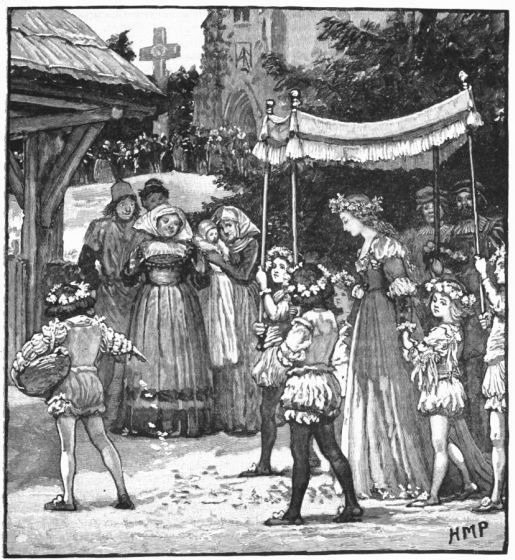
THE WEDDING OF JACK OF NEWBURY: THE BRIDE'S PROCESSION. (See p. 390.)
Henry VIII. was most extravagant in dress, and was followed with so much avidity by his subjects in his ostentation, that in the twenty-fourth year of his reign he was obliged to pass a sumptuary law to restrain them, and the style and quality of dress for every different rank was prescribed—as we may suppose with indifferent success. No person of less degree than a knight was to wear crimson or blue velvet or embroidered apparel, broched or guarded with goldsmith's work, except sons and heirs of knights and barons, who might use crimson velvet, and tinsel in their doublets. Velvet gowns, jackets and coats, furs of martens, &c., chains, bracelets, and collars of gold, were proscribed to all but persons possessing two hundred marks per annum; except the sons and heirs of such persons, who might wear black velvet doublets, coats of black damask, etc.
Henry's own dress was of the most gorgeous kind. He is described at a banquet at Westminster as arrayed in a suit of short garments of blue velvet and crymosine, with long sleeves all cut and lined with cloth of gold, and the outer garments powdered with castles and sheaves of arrows—the badges of Queen Catherine—of fine ducat gold; the upper part of the hose of like fashion, the lower parts of scarlet, powdered with timbrels of fine gold. His bonnet was of damask silver, flat, "woven in the stall," and therefore wrought with gold, and rich feathers on it. When he met Anne of Cleves he had tricked himself out in a frock of velvet embroidered all over with flatted gold of damask, mixed with a profusion of lace; the sleeves and breast being cut and lined with cloth of gold, and tied together with great buttons of diamonds, rubies, and orient pearls. The king was deemed to be the best dressed sovereign in the world, for he put on new clothes every holy day.
Henry ordered his subjects to cut off their long hair; beards and moustaches were now worn at pleasure.
The reigns of Edward and Mary did not vary much in the costume of the men. The dress worn now by the boys of Christ's Hospital (familiarly known as the Bluecoat School), founded by Edward, is very much that which was worn by the London apprentices of that period—blue coats and yellow stockings being also common to the citizens generally. The square-toed shoes were banished by proclamation in the reign of Queen Mary.
The costume of the ladies of the reign of Henry VIII. is extremely familiar, from the numerous portraits of his six wives, engravings of which are in Lodge's "Portraits." With the exception of the bonnet or coif—which, though worn by Catherine of Aragon, came to be called the Anne Boleyn cap—the dress of the ladies of this reign bears a striking resemblance to one of the later Victorian fashions, though differing of course in material. You find the gown fitting close to the bust of the natural length of waist, and cut square at the chest, where it is edged with narrow lace. The sleeves, tight at the shoulder, widened to the elbow, where they hung deep, showing an under-sleeve of fine lawn or lace extending to the wrist, and terminated by lace ruffles. On the neck was generally worn a pearl necklace, with a jewelled cross. The skirts were full, the train long, according to rank. Seven yards of purple cloth of damask gold were allowed for a kirtle for Queen Catherine, in a wardrobe account of the eighth year of Henry's reign. The sleeves of ladies' garments, like those of gentlemen's dresses, could be changed at pleasure, being separate and attached at will. They were extremely rich; and we find in one lady's inventory three pair of purple satin sleeves, one of linen paned with gold over the arms, quilted with black silk, and wrought with flounces between the panes and at the hands; one pair of purple gold tissue damask wire, each sleeve tied with aglets of gold; one pair of crimson satin, four buttons of gold on each sleeve, and in every button nine pearls.