Chapter XVII
Reading edition
THE REIGN OF JAMES I.
The Stuart Dynasty—Hopes and Fears caused by the Accession of James—The King enters England—His Progress to London—Lavish Creation of Peers and Knights—The Royal Entrance into the Metropolis—The Coronation—Popularity of Queen Anne—Ravages of the Plague—The King Receives Foreign Embassies—Rivalry of the Diplomatists of France and Spain—Discontent of Raleigh, Northumberland, and Cobham—Conspiracies against James—"The Main" and "The Bye"—Trials of the Conspirators—The Sentences—Conference with Puritans—Parliament of 1604—Persecution of Catholics and Puritans—Gunpowder Plot—Admission of fresh Members—Delays and Devices—The Letter to Lord Mounteagle—Discovery of the Plot—Flight of the Conspirators—Their Capture and Execution—New Penal Code—James's Correspondence with Bellarmine—Cecil's attempts to get Money—Project of Union between England and Scotland—The King's Collisions with Parliament—Insurrection of the Levellers—Royal Extravagance and Impecuniosity—Fresh Disputes with Parliament and Assertions of the Prerogative—Death of Cecil—Story of Arabella Stuart—Death of Prince Henry.
With the Stuart dynasty begins a new order of things. The direct line of the Tudors ceased in Elizabeth, and the collateral one of the Stuarts introduced the kings of Scotland to the English throne. After all the ages of conflict to unite the two kingdoms under one crown, it was effected, but in the reverse direction to that in which the monarchs of England had striven. They had not mounted the throne of Scotland, but Scotland sent her king to rule over England. With Elizabeth and the Tudors terminated the reign of almost unresisted absolutism; with James commenced that mighty struggle for constitutional liberty which did not cease till it had expelled his dynasty from the throne, and placed on a firm basis the independence of the people.
With great haste various messengers flew to Scotland to announce the demise of Elizabeth; the winner in the race of loyalty, or, in other words, of self-interest, being, as we have seen, Sir Robert Carey, to whom the artifice of his sister, Lady Scrope, had communicated the earliest news of the queen's decease. He reached Edinburgh four days before Sir Charles Percy and Thomas Somerset, who were despatched officially by the Council. Meanwhile, on March 24th, 1603, Cecil assembled thirty-five individuals—members of Council, peers, prelates, and officers of State—at Whitehall, and accompanied by the lord mayor and aldermen, proclaimed James VI. of Scotland James I. of England, first in front of Westminster Palace, and then at the High Cross, in Cheapside.
There were some who were apprehensive that the accession of James might be opposed by the noblemen who had been so active in the death of his mother. But these had taken care to make their peace with the facile James, whose filial affection was not of an intensity to weigh much in the scales with the crown of England. On the contrary, his accession was hailed with apparent enthusiasm by all parties, for all parties believed that they should reap decided advantages from his government. The persecuted Catholics felt certain that the son of the queen of Scots would at least tolerate their religion, as he had many a time privately assured their agents. The Puritans were equally confident that a king who had been educated in the strictest faith of Calvinism, would place them in the ascendant. The Episcopal church—as it deemed, on equally good grounds—rejoiced in the advent of a prince who had protested to its friends that he was heartily sick of a religion which had domineered over both his mother and himself with an iron rigidity. The populace, in the hope of a milder yoke than that of the truculent Tudors, gave vent to their joy in loud acclamations, by bonfires and ringing of bells, while Elizabeth was lying a corpse, scarcely cold, on her bier.
James, who was in his thirty-seventh year, was transported at the prospect of his escape from the poverty and religious restraint of Scotland, to the affluence of so much more extensive an empire, and one impediment alone checked his flight southward—the want of money for the journey. He sent a speedy message to Cecil for the necessary funds, and also added a request for the transmission of the Crown jewels for the adornment of his wife. The money was forwarded, but the jewels were prudently withheld till he reached his future capital. Once in possession of the means of locomotion, James did not conceal his pleasure at escaping from the control of his Presbyterian clergy and the haughty rudeness of his nobles, to an accession of wealth and power which he imagined would make him as absolute as Henry VIII., a condition for which he had an intense yearning.
On the 5th of April James commenced his journey towards London, but however much he rejoiced in the prospect of his new kingdom, he was in no haste to reach the capital. The moment that he set foot in England he seemed to have realised the full luxury of his new sovereignty, and announced to those about him that they had indeed at last arrived at the Land of Promise. At Berwick he fired a piece of ordnance himself in his joy, which seemed for the moment to have raised him above his constitutional timidity; and he then sate down and wrote to Cecil, informing him of his progress, and of his intention to take York and other places on his way. As he intended to enter York and pass through other towns in state, he pressed on the obsequious minister the necessity of forwarding to him coaches, litters, horses, jewels, and all that was requisite for regal dignity, as well as a lord chamberlain; and he forthwith appointed to that office the lord Thomas Howard. He stayed three days at York, and did not reach Newark till the 21st of the month. Cecil had met him at York, and accompanied his progress; and as he rode forward the people crowded around to welcome their new sovereign with the most hearty acclamations. To express his satisfaction to the gentry, he made almost every man of any standing who approached him a knight; so that by the time he reached London he is said to have created two hundred and fifty, and before he had been in England three months, seven hundred knights, a profusion which much diminished the value of the gift.
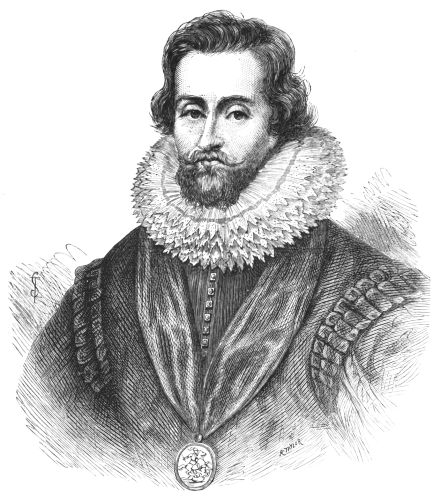
JAMES I.
The truth was that James, who made himself very free and easy in his immediate circle, disliked exposure to the mob, and dealt about his smiles and knighthoods to get rid of his throngers as soon as possible. By the time he had reached Berwick he had knighted three persons; at Widdrington he knighted eleven, at York thirty-one, at Worksop in Nottinghamshire eighteen, at Newark eight, on the road thence to Belvoir Castle four, at Belvoir forty-five. Yet gracious as he was and agreeable as he wanted to make himself, his new subjects did not behold his person and manner without considerable astonishment. His ungainly figure and his equally uncouth dialect no little amazed the stately courtiers of Elizabeth, but nevertheless they paid him the most devoted homage, as the dispenser of all honours and of every good.
At Theobalds Cecil had the opportunity of studying James's character and of ingratiating himself with him. A new Council was formed, and whilst James introduced six of his own countrymen, Cecil recommended six of his partisans to balance them. During his correspondence with James Cecil had managed to fix in the king's mind a deep and ineradicable aversion to the men whom he himself regarded with jealous and hostile feelings—Raleigh, Cobham, and Grey. It was in vain that they paid their court; they were treated with coldness, and Raleigh, instead of receiving the promotion to which he aspired, was even deprived of the valuable office of warden of the Stannaries. Northumberland was equally the object of Cecil's dislike, but Bacon was warmly in his favour, and the king received him graciously.
On the 7th of July James set out for his capital, and at Stamford Hill was met by the lord mayor and aldermen in their scarlet robes, followed by a great crowd, and with these he entered the City, and proceeded to the Charterhouse. He immediately caused a proclamation to be made that all licences and monopolies granted by Elizabeth, and which had excited so much discontent, should be suspended till they had been examined by the Council; that all protections from the Crown to delay the progress of justice in the courts of law should cease, as well as the abuses of purveyance, and the oppressions of saltpetre-makers and officers of the household. From the Charterhouse he proceeded, according to routine, to the Tower, and thence to Greenwich and back to Whitehall, at every step making more knights and creating peers. He had sent for the Earl of Southampton to meet him at York, and he now restored both him and the son of his friend the Earl of Essex to their honours and estates. Mountjoy and three of the Howards were raised to the rank of earls; nine new barons were created, amongst them Cecil, who was made Lord Cecil, and afterwards Viscount Cranbourne, and finally Earl of Salisbury. Buckhurst and Egerton were promoted; and eventually, besides his seven hundred spick-and-span new knights, he added sixty-two fresh members to the peerage. So extravagant was his distribution of honours that a pasquinade was affixed to the door of St. Paul's, offering to teach weak memories the art of recollecting the titles of the nobility.
The coronation took place on the 25th of July. James's wife, Anne of Denmark, was crowned with him. The weather had been intensely hot, but it now set in very rainy. To spoil the pleasure of the people, the plague was raging in the City, and the inhabitants were by proclamation forbidden to enter Westminster. No queen-consort had been crowned since Anne Boleyn, nor had any king and queen been crowned together since Henry VIII. and Catherine of Aragon, and therefore the restriction was the more mortifying. Queen Anne went to the coronation "with her seemly hair down hanging on her princely shoulders, and on her head a coronet of gold. She so mildly saluted her new subjects, that the women, weeping, cried out with one voice, 'God bless the royal queen! Welcome to England, long to live and continue!'"
That week there died in London and the suburbs eight hundred and fifty-seven persons of the plague. On the 5th of August James ordered morning and evening prayers and sermons, with bonfires all night to drive away the pestilence, not forgetting to order that all men should praise God for his Majesty's escape that day three years before, from the Gowrie conspiracy; and on the 10th of August he commanded that a fast, with sermons of repentance, should be held, and repeated every week on Wednesday so long as the plague continued.
James's pride was soon gratified by the flocking in of ambassadors from all the great nations of Europe, soliciting his alliance; and on the first intimation of their approach he appointed Sir Lewis Lewknor master of the ceremonies, to receive and entertain these distinguished persons. This was the first establishment of such an office in England. First arrived, from Holland and the United Provinces, Prince Frederick of Nassau son of the Prince of Orange, attended by the three able diplomatists Valck, Barneveldt, and Brederode. James, with equally high notions of the royal prerogative, had not the sympathy of Elizabeth with the struggles of Protestantism abroad, and therefore regarded the revolted Netherlanders as rebels and traitors, and did not fail amongst his courtiers to pronounce them so; the more particularly as they owed the English crown large sums for past assistance, which they were in no hurry to pay. He, therefore, framed various excuses to defer their audiences till the arrival of the envoy of the King of Spain, Count Aremberg, who was not long in appearing, bringing the agreeable news that the Archduke had liberated all English prisoners, as the subjects of a friendly power. Two days after Aremberg's arrival, Henry IV.'s great minister, the Duke of Sully, reached London. Aremberg was in no condition to negotiate on any positive terms till he received instructions from Spain; and Sully seized time by the forelock, by distributing amongst the courtiers sixty thousand crowns, a considerable part of which found its way into the queen's purse. He prevailed on James to make a treaty with Henry IV., in which he engaged to send money to the States in aid against the Spaniards, and join France in open hostilities should Philip attempt to invade that country. Sully, delighted with his success—for Henry feared nothing more than James's making peace with Spain, and leaving him to assist Holland alone—returned to France. But a little time convinced the French court that nothing in reality had been secured by it, for James had no money to send to Holland had he been really so disposed, which is doubtful, and that he merely temporised with them as he had done with different States before.
Meantime the Court of Spain, notwithstanding the activity of France, was slow in deciding the course of policy to be adopted towards England under the new king. After the decided hostility towards it under Elizabeth, and the signal defeats experienced, pride forbade Philip to solicit a peace, lest it should look like weakness. And, indeed, Spain had never recovered from the severe blow received in the loss of its Armada, and the other ravages of its ports and colonies by the English, added to the loss of a great portion of the Low Countries; and this consciousness made it more tardy in its proceedings. But while engaged in prolonged discussions on this head, two Englishmen arrived at the court of Spain, whose mission was of a nature to bring it to a decision. These were Wright and Fawkes, who were soon to assume a conspicuous position in the strife between the Catholics and Protestants of England. Previous to the death of Elizabeth, Thomas Winter had negotiated with the Spanish Court a plan for the invasion of England, which had been abandoned on her decease. Now, however, the scheme was revived, and these two emissaries were despatched to sound the present disposition of the Court of Madrid. This direct appeal from the conspirators seems to have startled the Spanish Government from its wavering policy. It was not prepared for anything so desperate, and replied that it had no cause of complaint against James, but, on the contrary, regarded him as a friend and ally, and had appointed the Condé de Villa Mediana as ambassador to his Court.
This was decisive, and the way now seemed open towards a more friendly tone between Spain and England; but at the same moment a secret and mysterious correspondence seems to have been going on between Aremberg, the agent of the King of Spain, and a discontented party in England. Northumberland, Cobham, and Raleigh were ill at ease under the disappointment which they had met with in their hopes of favour at James's Court. Northumberland had been to a certain degree graciously received, and even entertained with promises by James; but he felt that while Cecil was so completely in the ascendant there was little hope of a cordial feeling towards him in the monarch's heart. Cobham and Raleigh were undisguisedly in disgrace, and were shunned by the courtiers as fallen men. The three friends, therefore, entered into intrigues with the Court of France through the resident minister Beaumont, and Sully the envoy extraordinary. For a time their suggestions were listened to, but the apparent success of Sully with James put an end to further overtures, and there Northumberland was prudent enough to desist. But Cobham and Raleigh, disappointed of Court favour and burning with resentment against Cecil—whom they felt to be the cause of their disgrace—plotted for the overthrow of the crafty minister.
Sully, the French envoy, had, while in London, done his best to inspire James with distrust of Cecil; and there is little doubt that this was at the suggestion, or with the co-operation of Cobham, Northumberland, and Raleigh. When Northumberland drew back, these two held communication with Aremberg, to whom they offered their services in promoting the objects he sought on behalf of Spain and the Netherlands. Aremberg, who did not know what was going on at the Spanish Court, communicated the proposal to his master, who instructed him to give a favourable answer. What the scheme proposed by Cobham and Raleigh precisely was seems never to have been known, but we may suppose that in return for aid from the Continent, these ambitious men were to attempt the removal of Cecil by some means, and on their succeeding to power, their influence was to be exerted with the king on behalf of Spain.
This was designated by those in the secret as "The Main" conspiracy; but there was also another going on simultaneously, of which these gentlemen are supposed to have been cognisant, but not mixed up with. This was called "The Bye" conspiracy, and was composed of an extraordinary medley of the discontented, the most determined of whom aimed at nothing less than the seizure of the king, and the government of the country in his name, for their own party purposes.
The grand cause of discontent was the disappointment of both Catholics and Puritans in James. Before his coming to the English crown he had held out the most flattering expectations to the Catholics that he would grant them toleration, whilst the Puritans calculated on his Presbyterian education for a decided adhesion to their views. But no sooner did he reach England than he threw himself into the arms of the High Church party, declaring that it was the only religion fit for a king. To the Catholics he declared he would grant no toleration—rather would he fight to the death against it; and he took no pains to conceal his disgust at the Presbyterian clergy amongst whom he had spent his youth. The antagonism of Catholic and Puritan was forgotten in the resentment against this disclosure of the king's disposition. Instantly plans were cogitated to avenge themselves of the royal perfidy, as it was termed, and to secure themselves against the threatened storm. Sir Griffin Markham, a Catholic gentlemen of no great property or influence, concerted with two priests, Watson and Clarke, the means of raising the Catholics against the Government. Watson had been sent into Scotland, to James, on behalf of the Catholics, before the death of Elizabeth, and he indignantly represented that James had given them, through him, the most solemn promises of toleration, which he had now broken. He, therefore, threw himself with the greatest heat into the conspiracy: he drew up an awful oath of secrecy, and he and Clarke travelled far and wide amongst the Catholic families, calling upon them to come forward in the name of their religion and their property.
But their success was trivial; few or none of the Catholics of weight and station would engage in the enterprise. Failing there, Watson turned his attention to the Puritans; and with them he was more successful, by artfully concealing from them the paucity of the Catholics who had joined the conspiracy, and the full extent of his own intentions. Lord Grey de Wilton, who was a leading Puritan, and had his discontent from the same causes as Cobham and Raleigh, was induced by Watson to join the conspiracy, under the impression that a strong Catholic body was engaged in it. He agreed to furnish a troop of a hundred horse, but he was not long in discovering that he had been imposed upon, and advised the conspirators to defer the execution of their design to a more favourable opportunity.
The conspirators proposed to meet during the darkness of night at Greenwich; but the reflection that there were three hundred armed gentlemen within the Palace, made that appear too hazardous; they, therefore, altered their plan, and concluded to seize James as he was hunting at Hanworth, and where he was accustomed to call for refreshment at a gentleman's house. The plan, as communicated by Watson to the conspirators, was to assemble in a numerous body under pretence of presenting a petition to James as he went out hunting, seize the king, and convey him to a place of safety, where they were to extort from him a declaration of liberty of conscience. With the king in their hands, they would then wreak their vengeance on Cecil and Sir George Howe; and it was afterwards charged against them in the indictment, that they meant to make Watson lord chancellor, Brooke, the brother of Cobham—who was a most unprincipled man, and has been suspected of being Cecil's spy and tool on the occasion—lord treasurer, Markham secretary, and Grey earl marshal. Probably this was the scheme devised for them by the accusers, for it appears too wild for belief; but be that as it may, the 24th of June was the day named for the attempt, when the refusal of Lord Grey caused it to be abandoned, and the party separated with much mutual recrimination.
But Watson had already proceeded to a length which led to the revelation of the plot to Cecil. He had endeavoured to engage in it the Society of the Jesuits, and had communicated his plans to a Jesuit of the name of Gerard. The Society not only refused to sanction the conspiracy, but the archpriest went at once and revealed it to Cecil. The crafty minister kept his information close, and resolved to let the conspirators go on till the very day for the execution of their design, so that he might the more summarily convict them; but the failure of their plan left him no further reason for delay, and Anthony Copley, one of the "Bye," was arrested, as a man well known to be of a timid character and likely in his terror to betray his associates. Cecil had probably plenty of intelligence of both the plan and its agitators from others as well as from Gerard, and most probably from Brooke. But with great judgment he neglected no means of making the conspirators furnish evidence against each other, and thus he kept his own sources of knowledge secret. On the heels of Copley's arrest, followed, as a natural consequence, the arrest of Griffin, Markham, the priests Watson and Clarke, and the rest of Copley's associates. Cecil said that the mere fact of Brooke being in the conspiracy made him feel certain that Cobham, Raleigh, and Northumberland were in it. They were therefore apprehended separately; and, by playing on the fears of the fallen Cobham, Cecil speedily made him incriminate Raleigh.
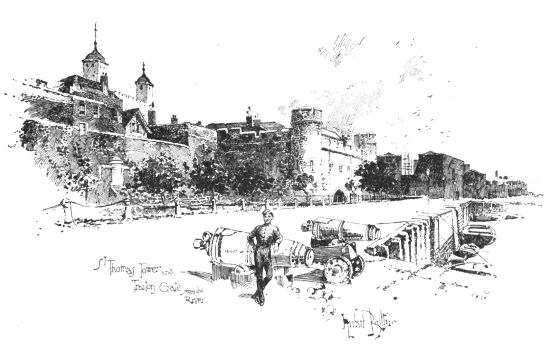
ST. THOMAS'S TOWER AND TRAITORS' GATE, TOWER OF LONDON.
The coronation of the king, which took place on the 25th of July, being his saint's day, the festival of St. James, and the violence of the plague, which caused the king to flee into the country, postponed the trials of the conspirators. The Court, followed by the judges and their suitors, fled from place to place for several months, pursued by the plague; and it was not till November that the trials took place in the castle at Winchester. Another cause had, perhaps still more than the plague, deferred them. Aremberg was deeply implicated, but his intrigues could not be opened up whilst he was in the country, nor could an order be issued directing him to leave, without embarrassing the public relations with Spain. But in October he left, and on the 15th of November the trials of the conspirators commenced. The accomplices of the "Bye"—Brooke, Brookesby, Markham, Copley, Watson, and Clarke, with others—were all condemned on their own confessions, for they had been so managed that they not only accused each other, but made the most ample confessions of their own guilt, as if each thought he should obtain pardon by discovering most. These confessions, which had been carefully compiled, were put in as evidence against them. Sir Edward Parham only was acquitted, for he pleaded that he joined solely to rescue the king from the hands of those who held him in captivity; Cecil threw in his word in his favour, suggesting that the king's dignity consisted as much in freeing the innocent as condemning the guilty. This conduct gave an air of impartiality—of which no one could estimate the effect more fully than the astute Cecil—to the proceedings.
Sir Walter Raleigh was next put upon his trial. His extraordinary ability, and his knowledge of Court secrets, made it too dangerous an attempt to connect him with the "Bye," and arraign him along with the unhappy and weak members of that part of the conspiracy. He was not placed at the bar even along with Cobham, for the only evidence against him which the Court dared to bring forward, was that of Cobham; and they knew too well that in Raleigh's presence, the wavering Cobham would be worse than useless. Already repenting of his accusation of Raleigh in the surprise of his resentment, Cobham had retracted his accusations; and when pressed and cross-questioned by the Council, had so contradicted himself, that to bring him into public would be to render his evidence worthless. True, the Council had the intercepted letters, which had passed between Aremberg and the Spanish authorities, which were sufficiently criminatory of Raleigh and Cobham; but these could not be produced without an exposure of the fact that the correspondence of ambassadors and their principals was not safe in England. Indeed, Coke, who was of course duly instructed in the particulars of this correspondence, having made some too intelligible reference to Aremberg, Cecil compelled him to apologise to the ambassador, and hastened to assure the other ambassadors of foreign courts that Aremberg had no notion of the purpose for which Cobham and Raleigh had solicited money from Spain.
Coke's device was to mix the two plots. He went into the case at length, and what he lacked in proof he endeavoured to supply by abuse. He described in inflated language the intentions of the agitators of the "Bye," and declared that amongst other things, they meant to make proclamation against monopolies, as if that were absolute treason. Raleigh calmly reminded him that he was not charged with the "Bye." "You are not," replied Coke; "but it will be seen that all these treasons, though they consisted of several parts, closed in together like Samson's foxes, which were joined in their tails, though their heads were separated." Raleigh still insisted that the "Bye" was the treason of the priests, and said, "What is the treason of the priest to me?" "I will then come close to you," said Coke. "I will prove you to be the most notorious traitor that ever came to the bar; you are, indeed, upon the 'Main,' but you have followed them upon the 'Bye' in imitation."
Raleigh in reply demanded that his accuser should be brought face to face with him. He demanded it on the authority of the statute law and the law of God, both of which required that this should be done to prove an offence. But Lord Chief Justice Popham told him that the Statutes of Edward VI. to which he appealed, were cancelled by Philip and Mary; that he must take his trial by the common law, as settled by Edward III., under which a trial by jury and written evidence was as valid as a trial by jury and witnesses; and that at most one witness was sufficient. But Raleigh replied that his case was peculiar, and that there was not a single witness against him; for even the man who had borne testimony against him had retracted his assertions. He, therefore, reiterated his demand for the production of Cobham; declaring that if Cobham dared in his presence to reaffirm a single charge, he would submit to his doom, and would not add another word. When this challenge was passed over without any notice, he produced a letter which Cobham had written to him about a fortnight before, in which he said:—"To free myself from the cry of blood, I protest, upon my soul and before God and His angels, I never had conference with you in any treason, nor was ever moved by you to the things I heretofore accused you of; and, for anything I know, you are as innocent and as clear from any treasons against the king as is subject living. And God so deal with me and have mercy on my soul, as this is true."
This appeared a strong avowal, but Cecil was prepared for this, having, no doubt, already seen this letter on its passage; and Coke produced in defeat of it another letter written by Cobham to the Council but the day before. In this letter Cobham stated that Raleigh had twice sent letters to him in the Tower, which had been thrown into his window-sash in an apple, and that in these letters he entreated him to do him right by denying what he had said as to his wishing him to come from the Continent by Jersey, and in other particulars. Cobham replied that he retracted the assertion about Jersey, but went on to state that Raleigh had been the original cause of his ruin, for that he had no dealings with Aremberg but at Sir Walter's instigation. He added that at Aremberg's coming Raleigh was to receive a pension of fifteen hundred pounds a year, for which he was to keep the king of Spain informed of all designs against the Indies, the Netherlands, or Spain; that he (Cobham) also counselled him (Raleigh) not to be overtaken by preachers as Essex was, and that the king would better allow of a constant denial than of the accusation of any one.
During the reading of this letter Raleigh could not conceal his astonishment and confusion. When it was finished, he admitted that there had been some talk of a pension, but mere talk and nothing more. But the fact made a deep impression on the minds of the jury, and the prisoner probably being conscious of it, repeated his demand for the production of Cobham himself. "My lords," he exclaimed, "let Cobham be sent for; I know he is in this very house! I beseech you let him be confronted with me! Let him be here openly charged—upon his soul—upon his allegiance to the king—and if he will then maintain his accusations to my face, I will confess myself guilty!" But no notice was taken of this appeal: Coke still strove to bear him down by the coarsest brow-beating, shouting fiercely, "I will have the last word for the king!" "Nay," retorted Raleigh, "I will have the last word for my life!" "Go to," said the insolent lawyer; "I will lay thee upon thy back for the confidentest traitor that ever came to the bar." Cecil here interposed, telling Coke that he was too impatient and severe; but Coke cried, "I am the king's sworn servant, and must speak. You discourage the king's counsel, my lord, and encourage traitors."
The jury, but with evident reluctance, returned a verdict of guilty. On being asked, in the usual form, whether he had anything to say why judgment should not be pronounced against him, he replied that he was perfectly innocent of the charges of Cobham, but that he submitted himself to the king's mercy, and recommended to the compassion of his majesty his wife and his son of tender years. After the sentence of high treason, with all its disgusting details, had been pronounced, Raleigh asked to speak privately with Cecil, Lord Henry Howard, and the Earls of Suffolk and Devonshire, entreating them that, in consideration of the position which he had held under the crown, his death might not be so ignominious as the strict sentence required. They promised to use their influence, and he was taken back to his quarters.
The charges of complicity which were made against Arabella Stuart, in the indictment against Raleigh, were of a nature which called for denial on her part. She was present at the trial in a gallery; and Charles Howard, Earl of Nottingham, who was sitting by her, arose, and in her name protested, on her salvation, that she had never meddled in any such matters. There appeared, indeed, no disposition at this moment to implicate the Lady Arabella, though her relation to the Crown made her an object of anxiety to James, as we shall soon have occasion to see. Cecil himself acquitted her of any concern in this treason, admitting that though she had received a letter from Cobham, entreating her to countenance it, she only laughed at it and at once sent it to the king. Of the actual extent of Raleigh's participation, and what was his real object, we have no means of judging, for though James was in possession of the letters between the accused parties and Aremberg, they could not, as already stated, be produced.
Cobham and Grey were arraigned before a tribunal of their peers, consisting of eleven earls and nineteen barons. Nothing could be more striking than the cowardice and meanness of Cobham, and the noble dignity of Grey. They were both condemned.
The two priests were first conducted to execution. They suffered all the bloody horrors of the law at Winchester, on the 29th of November. It was surmised that James was glad to be rid of Watson as one of the individuals to whom, before coming to the English throne, he had promised toleration to the Catholics. There was an attempt to prove the non-existence of such a promise, but it was crude and convinced nobody. At the gallows both Watson and Clarke declared that they were convinced they owed their death to their priesthood. They were cut down alive and their bowels torn out—a revolting practice which but too well illustrates the vindictive spirit of the age.
The next execution was that of Brooke. He was simply beheaded, also at Winchester, on the 5th of December. The people expressed great sympathy for him, under a belief that he had first been employed by Cecil in the troubled waters of these conspiracies, and then victimised by him. Markham, Grey, and Cobham were brought to the scaffold, induced to confess, and, after an interval of suspense, reprieved. Raleigh was imprisoned in the Tower of London for many years.
The effect of this conspiracy was to deepen James's suspicion of the Catholics and his dislike of the Puritans. The Catholics, since his coming to the English throne, had conducted themselves with more policy than their robustious rivals, the Puritans. They had claimed, indeed, the fulfilment of his promises whilst merely King of Scotland, to favour them as the staunch friends of his mother and serious sufferers on her account; but they had preferred their claims with a degree of courtesy and moderation to which the brusque Reformers were strangers. The pope, Clement VIII., probably led by the same expectations, had by two breves addressed to the archpriest and provincial of the Jesuits, strictly enjoined the missionaries to confine themselves to their spiritual duties, and on no account to mix themselves up with the agitators for political change. He condemned unequivocally the conduct of Watson and Clarke, and sent a secret envoy to the English Court, expressing his abhorrence of all acts of disloyalty, and offering to withdraw any missionary from the kingdom who was in any way obnoxious to the king and Council. James appeared so far influenced by this moderation, that though he stoutly refused all application for a free exercise of the Catholic worship, and even committed individuals to the Tower who offended in this respect, yet he invited the Catholics to frequent his Court, he conferred knighthood on some of them, and assured them generally that they should not suffer for recusancy so long as they abstained from a breach of the laws as regarded religion, and from all acts of political insubordination.
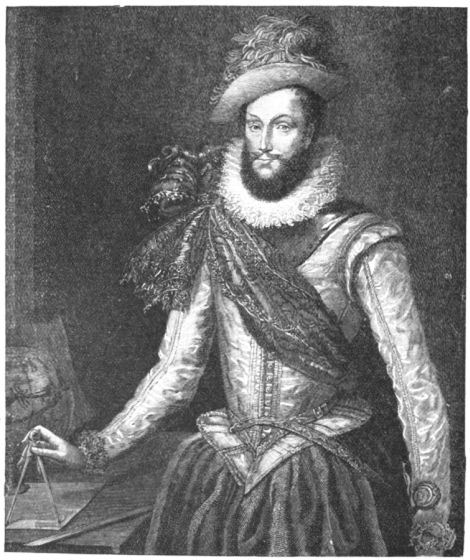
SIR WALTER RALEIGH. (From the Portrait by Zucchero.)
But towards the Puritans he was by no means so courteous. He could never forget that they had kept him in restraint in his infancy and youth; that they had been the defamers and persecutors of his mother; and that to the very hour in which he escaped into the larger field of English power, they had goaded him with their demands and defied his authority. As he drew nearer to the English throne, the charms of the English church increased in his imagination. A church which set up the king as its head was a church as much after James's own heart as after that of Henry VIII. Like that monarch, he dearly loved to shine in polemics, and long before he arrived in England, it required no great shrewdness to perceive where his affections lay.
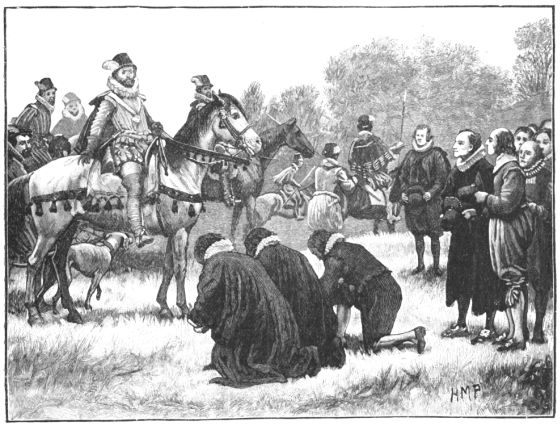
THE DISSENTING DIVINES PRESENTING THEIR PETITION TO JAMES. (See p. 416.)
No sooner was he in England than he spoke his mind roundly as to his real feelings towards the Puritans. He said to the bishops and courtiers: "I will tell you, I have lived amongst this sect of men ever since I was ten years old; but I may say of myself as Christ said of Himself, though I lived amongst them, yet, since I had ability to judge, I was never of them." And this was at least sincere. He had grown more undisguisedly Episcopalian as he saw Elizabeth sinking, and felt his hold on the throne through her own ministers. He had given seats in parliament to a certain number of clergymen, thus making them bishops without the name; but it was in his "Basilicon Doron"—a manual for the instruction of his son, published in 1779—that he had let loose his deep dislike of the Presbyterians. He tells his son to "take heed to such Puritans, very pests in the church and commonwealth, whom no deserts can oblige, neither oaths nor promises bind, breathing nothing but sedition and calumnies, aspiring without measure, ruling without reason, making their own imaginations, without any warrant of the Word, the square of their conscience. I protest," he added, "before the great God, and since I am here upon my testament, it is no place for me to lie in, that you shall never find with any Highland or Border thieves greater ingratitude, and more lies and perjuries than with these fanatic spirits; and suffer not the principal of them to brook your land, if ye list to sit at rest; except you would keep them for trying your patience, as Socrates did an evil wife."
But whilst the royal Solomon thus plainly enunciated his hatred of Puritanism, he was cautious not to let the English bishops too early into his fixed intention to patronise them. He liked to feel himself the undoubted head of that Church, and to see those dignitaries in fear and trembling prostrate at his feet; and it was not till they had sufficiently humbled themselves before him, that he revived their spirits with the declaration of his real sentiments. The Puritans precipitated this avowal, by urging on James a further reform of the Church, and its purgation from ceremonies. In their millenary petition (so called because it was expected it would have a thousand signatures, but in reality it had only about eight hundred) they demanded a conference, in which to settle the form and doctrines of the Church. This, of all things, delighted James. It was the very arena in which to display his theological knowledge; he gladly consented to it, and appointed it to take place at Hampton Court early in January, 1604. On the 14th of that month the first assembly took place; and the bishops, who were first admitted to the royal presence alone, were so alarmed at the prospect of a conference which had been demanded by Dissenters, that they threw themselves on their knees, and earnestly entreated the king not to alter the constitution of the Church, nor to give the Puritans the triumph in the coming debate, lest the Popish recusants should rejoice over and declare them justly punished for their repulsion and persecution of them. Then James condescended to lift the weight of fear from their hearts. He avowed to them that he was a sincere convert to the Church of England, and thanked God "who had brought him to the promised land, to a country where religion was purely professed, and where he sate among grave, reverend, and learned men; not as before, elsewhere, a king without state, without honour, and without order, and braved to his face by beardless boys under the garb of ministers."
The delight of the bishops and dignitaries at this gracious confession may be imagined. They were nearly twenty in number, whilst the Reformers summoned numbered only four—namely, Doctors Reynolds and Sparkes, divinity professors of Oxford, and Doctors Knewstub and Chatterton, of Cambridge. James somewhat cooled the raptures of the Churchmen, by adding that he knew all things were not perfect, and that, as some modifications of the ritual and the ecclesiastical courts were, in his opinion, needed, he had called them together in the first instance, in order that they might settle what concessions should be made to the Puritans. It was necessary to show some compliance; and after the day's discussion it was agreed that some explanatory words should be added in the Book of Common Prayer to the forms of general absolution and of confirmation; that the Chancellor and the Chief Justice should reform the practice of the commissary court; that excommunication should only be inflicted for particularly serious offences; that the bishops should neither confer ordinations nor pronounce censures, without the assistance and concurrence of other eminent divines; that baptism should not be administered by women or by laymen.
These points being determined, on the 16th the four Puritan divines were admitted, and instructed to state their demands. These embraced a general revision of the Book of Common Prayer, the withdrawal of excommunication, of baptism by women, of the use of the ring in marriage, of bowing at the name of Jesus, of confirmation, of the wearing of the cap and surplice, of the reading of the Apocrypha. They further required that pluralities and non-residence should cease, that obligation to subscribe the Thirty-nine Articles be abrogated, as well as the commendatories held by bishops. The bishops defended such parts of the church service and practices as the king had agreed should remain, and the prelates of London and Winchester argued in their behalf long and vehemently. As the Puritan doctors were not thus to be satisfied, and had by much the best of the argument, James himself took up the debate, and conducted it in that royal style which admits of no contradiction. He was now in his true element: theological discussion was his pride and glory, and he believed himself capable of silencing all Christendom. Dr. Reynolds, however, who was the chief speaker, undaunted by his crowned opponent, insisted boldly on various points; but when he came to the demand for the disuse of the Apocrypha in the Church service, James could bear it no longer. He called for a Bible, read a chapter out of Ecclesiasticus, and expounded it according to his own views; then turning to the lords of his Council, he said, "What trow ye makes these men so angry with Ecclesiasticus? By my soul, I think Ecclesiasticus was a bishop, or they would never use him so." The bishops and courtiers applauded the royal wit. James continued to hold forth on all sorts of topics—baptism, confirmation, absolution, which he declared to be apostolical, and a very good ordinance—and assured the anti-episcopal divines that in his opinion, if there were no bishops, there would soon be no king.
When he had tired himself out with talking, Dr. Reynolds again ventured to open his mouth, and inquired how ordinances of the Church agreed with Christian liberty. This was touching James closely: it brought back to his memory the harangues on the same liberty which he had heard from his clergy in Scotland. He declared that he would not argue that point, but answer as kings were wont to do in parliament, "Le roy s'avisera." Without pretending to treat the matter as one of conviction, he treated it as one of authority. He exclaimed, "I will have none of that: I will have one doctrine and one discipline, one religion in substance and in ceremony." He was resolved to be as absolute over every man's conscience and understanding as Henry VIII. had been. "If that is what you be at, then I tell you that a Scottish presbytery agreeth with monarchy as well as God with the Devil. Then shall Jack and Tom and Dick meet, and at their pleasure censure me and my council and all our proceedings. Then Will shall stand up and say, 'It must be thus;' then Dick shall reply and say, 'Nay, marry, but we will have it thus;' and therefore, here I must once more reiterate my former speech, and say, Le roy s'avisera."
It was in vain that Dr. Reynolds, who was reputed one of the most able divines and logicians of the age, attempted to state his views and opinions. The king constantly interrupted him and scoffed at him, treating him in the most insolently overbearing manner, and when he paused, asked him, "Well, doctor, have you anything more to say?" Reynolds, perceiving it useless, replied, "No, please your majesty;" on which James told these brow-beaten divines, that had they disputed no better in college, and he had been moderator, he would have had them all fetched up and flogged for dunces; that if that was all they had to say for themselves, he would make them conform, or hurry them out of the kingdom, or worse. With this scandalous treatment they were dismissed till the 18th, when the Conference met again. The greater part of the day was consumed by the king, the Council, and prelates in inquiring into the abuses of the high commission court, and devising means for checking them. At a late hour the Dissenting delegates were again admitted, not to continue the discussion, but to hear the fixed decision of the king. On hearing it they prayed that a certain time might be allowed before the new regulations were enforced. This was granted, but not strictly kept, for the new Book of Common Prayer was immediately prepared and published by authority.
Thus ended this curious Conference, in a complete triumph for the High Church party. The Reformers complained bitterly of this, but James himself was incapable of feeling the force of public opinion. He was inflated with the idea of his own unrivalled eloquence and ability. He boasted that he had "peppered the Dissenters soundly. They fled me," he said, "from argument to argument like schoolboys." The bishops and ministers of his Council added to his absurd egotism, by actually pouring deluges of the most fulsome adulation upon him. Bancroft, Bishop of London, flung himself on his knees before him, and exclaimed "that his heart melted with joy, and made haste to acknowledge unto Almighty God His singular mercy in giving them such a king, as since Christ's time the like had not been"; and Whitgift, the primate, protested "that his majesty spake by the special assistance of God's spirit." The Lord Chancellor Ellesmere, emulating the sycophants of the Church, said that "the king and the priest had never been so wonderfully united in the same person;" and the peers echoed the plaudits, declaring that his majesty's speeches proceeded from the spirit of God operating on an understanding heart. "I wist not what they mean," wrote Harrington, in "Nugæ Antiquæ"; "but the spirit was rather foul-mouthed."
All parties connected with the Church having thus admitted that the king was acting under the most luminous effusion of the Divine spirit, ought not, therefore, to have murmured when soon afterwards, without waiting for ecclesiastical sanction, he made his own alterations in the Book of Common Prayer, and then issued a proclamation, warning all men neither to attempt nor expect any further alterations in the Church, and commanding all ecclesiastical and civil authorities to enforce the strictest conformity. Whitgift soon after died (1604), and many attributed the acceleration of his death to his mortification at the king's ordering the affairs of the Church by his own will and wisdom, which Whitgift had been one of the first to extol as infallible. Bancroft succeeded him in the primacy, and showed himself a capable instrument of James's bigotry, and ready to enforce whatever cruelty he would attempt.
James spent fully half of his year in hunting, and if any person or party had an urgent matter to prefer, the only opportunity of doing so was by waylaying him in his rides to the forest. The Dissenters, as the time approached for the enforcement of the new canons of the Church, presented a petition to him near Newmarket, praying a prolongation of the time allowed them for conforming. James received them with savage fierceness; told them that it was from such petitions that the rebellion in the Netherlands originated; that his mother and he had been haunted by Puritan devils from their cradles; that he would sooner lose his crown than encourage such malicious spirits; and if he thought his son would tolerate them in his time, he would wish to see him that moment lying in his grave. The Nonconformists complained that he persecuted the disciples whilst he favoured the enemies of the Gospel. This was referring to his reception of Catholics at court, and his promises not to molest them if they abstained from the open prosecution of their worship. But James left them under no mistake on that head. He expressed an equally vehement hatred of Papists; and on the 22nd of February he issued a proclamation enjoining the banishment of all Catholic missionaries. He went to the Star Chamber, framed regulations for the discovery and prosecution of recusants, and issued orders to magistrates to see the penal laws put in force against all persons, of whatever faith, who did not fully conform to the rites and ordinances of the Church. Thus the miseries and oppressions of religious persecution were renewed with all their virulence; and the only consolation for those who refused to conform was that they might persecute one another.
In the midst of this state of things James was compelled to call a Parliament. This assembled on the 19th of March, 1604. It was one of the most remarkable Parliaments in our history, for it came together, on the part of both King and Commons, prepared to contest the great principles of absolutism and constitutional liberty; a contest which never again ceased till the people had triumphed over the Crown, and prescribed for it those limits within which it continues still to exist. The Tudors had made themselves absolute, but rather by acting than talking. They had willed, but had only occasionally boasted of the supremacy of their will. Whenever they had done so, especially in the person of Elizabeth, they received a protest so spirited from Parliament, that they wisely again veiled their pretensions. But James, possessing all their personal vanity and love of unlimited power, had not the policy to keep his pretensions in the background. He obtruded them on the public notice; he vaunted his towering belief of his earthly divinity, declaring that as God killed or made alive, so had He ordained kings to do the same at pleasure. Years before he came to England, he published these imperious and imprudent doctrines in a discourse "On the True Law of Free Monarchies; or, the Reciprogue and Mutual Duty betwixt a Free King and his Natural Subjects." He was, in short, a firm believer in the doctrine of the Divine Right of Kings, which had taken such a firm root in Europe.
In the proclamation calling this Parliament, James took care to set forth the supremacy of his prerogative, and commanded the sheriffs and other officers to make no returns of members but such as were wholly agreeable to his views; there were to be no "persons noted for their superstitious blindness in religion one way, or for their turbulent humour the other." That is, neither Puritans nor Catholics were to be elected. Instructions were sent down to the various counties and boroughs, naming such persons for candidates as were agreeable to the Court. But the Puritans were in no humour to comply with such unconstitutional orders. They were justly filled with resentment at the treatment of their representatives at Hampton Court, and put forward their own men and returned them in great numbers in defiance of the Government. One case led to a direct and vehement collision between the Crown and the House of Commons. Sir John Fortescue, a member of the Privy Council, had been named by the Court as a member for the county of Buckingham. The people of Buckinghamshire, afterwards so conspicuous in the struggles between the Stuarts and Parliament, elected Sir Francis Goodwin. The clerk of the Crown refused to receive the return, and sent it back to the sheriff as contrary to the proclamation; for Goodwin had formerly been outlawed, and James had forbidden the return of outlaws. A second writ was issued, and under it Sir John Fortescue was elected. But the Commons refused to admit him, declaring that as Goodwin's outlawry had been reversed, the proclamation did not apply to him, and that his return was good and should stand.
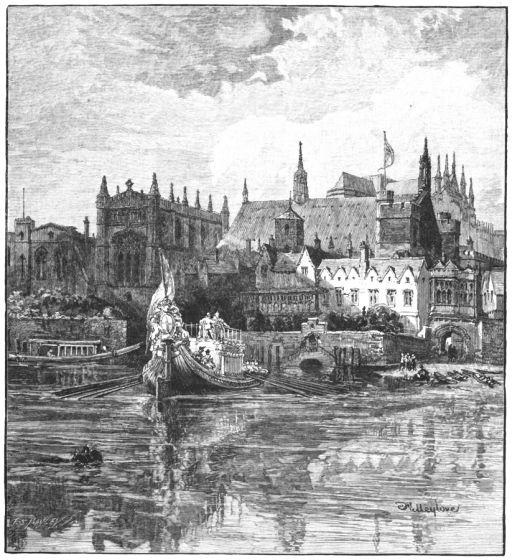
THE OLD PALACE, WESTMINSTER, IN THE TIME OF CHARLES I.
(Showing the Hall, Parliament House, Painted Chamber, and St. Stephen's Chapel.)
The Government, in the name of the Lords, proposed to the Commons that there should be a conference between the two Houses on the subject before any other business was proceeded with; but the Commons, with a clear insight into their privileges, where the constitution and functions of their own body were concerned, replied that it did not consist with the honour of their House to give an account of their proceedings and doings. On this they received a second message, in which they were informed, through Coke, that his majesty being apprised of their objection, conceived that his honour was touched, and desired that there should be some conference between the Houses. On this the Commons sent a deputation of their members, headed by the Speaker, to represent to the king why they could not confer with the Lords on any subject. The king was exceedingly high, and let them know that they held all their privileges by the royal favour; but the members stoutly denied that doctrine, as the House at large had already this session denied it, saying "that new laws could not be instituted, nor imperfect laws reformed, nor inconvenient laws abrogated, by any other power than that of the High Court of Parliament, that is, by the agreement of the Commons, the accord of the Lords, and the assent of the Sovereign; that to him belonged the right either negatively to frustrate, or affirmatively to ratify, but that he could not institute; every bill must pass through the two Houses before it could be submitted to his pleasure."
This was a doctrine that clashed disagreeably with James's absolute notions, and he upbraided the Commons with their presumption. But they stood firmly to their position and, what was extremely humiliating to the new monarch, excused his unconstitutional ideas through ignorance or misinformation of the custom and laws of England; the privileges of their house, they said, were the birthright of Englishmen and could not be surrendered. James claimed that all disputed matters should be referred to his court of chancery; but they claimed to settle all such themselves, as the essential to the government of their estate.
When James found that nothing would induce the Commons to confer with the Lords, he ordered them to confer with the judges, and this command the deputation carried back to the House. But the House, after a warm debate, unanimously refused to refer the question to the judges; they drew up an answer to all the king's arguments, and sent it to the Lords, requesting them to present it to his majesty, and be mediators between them. James, now finding that he could make no impression by express command, sent for the Speaker and endeavoured to coax him over to his views; but that being unsuccessful, he ordered him to deliver to the House his command, "as an absolute king," to confer with the judges. This was a direct challenge to the popular element to try its strength with the royal one—language which was sure to put a high-spirited people on its mettle: the first utterance of that language, which no warning, no experience could teach a Stuart to abandon, till the utterance was quenched in blood.
When the Speaker delivered this command, there fell a profound silence on the House—an augury and foreboding, as it were, of the gigantic struggle which was commencing. At length the ominous silence was broken by a member starting up and exclaiming that "the prince's command was like a thunderbolt; his command over our allegiance," he said, "is like the roaring of a lion! To his command there is no contradiction; but how, or in what manner we should proceed to perform obedience, that will be the question." It was finally agreed to send a deputation to confer with the judges in the presence of the king and Council. At the conference there appeared no better prospect of success, when the king happily proposed that both Goodwin and Fortescue should be set aside, and a new writ issued. The Commons gladly acceded to this proposal. The House was rejoiced at this solution of the difficulty, but out of doors those they represented were far from satisfied, and reproached the House with having yielded the right which they had boldly claimed. But in reality, the Commons had done no such thing, for they proceeded, by their Speaker's warrant, to issue the new writ themselves, and they have ever since exercised the right which they then assumed, of deciding all cases of contested elections.
The king, on his part, was as little satisfied as the people. He laboured under no mistake as to where the victory lay: he felt keenly that he was defeated in his soaring claims of prerogative, and the Commons went on to let him know that they were resolved on an exercise of power still greater. They attacked the monopolies which James had declared by proclamation that he would abolish, but towards which not a step was taken. They complained of the continuance of the feudal grievances of assarts, wardships, aids for royal marriages, and purveyance. The right of guardianship of minors of estate continued a source of vast emolument to the Crown, which received the proceeds of these estates and rendered no account. This was, moreover, a source of equal peculation to the minister for the time being, and Cecil was thought to draw enormous wealth from this abuse; and as for purveyance, it seems to have been as recklessly and insolently pursued as under any of the kings of York or Lancaster. The royal purveyors seized the property of the subject just as they pleased; took horses, carts, carriages, and provisions at will; called out men to labour for the royal pleasure, paying or not as suited them, felling trees, and committing sundry other depredations.
After much debate these grievances were referred to a committee; but as the Lords would have nothing to do with it, the matter was obliged to be dropped. Bacon, who was assiduously climbing into royal favour, played a contemptible part on this occasion in the House. He affected the character of a patriot, and discoursed feelingly of abuses and the sufferings of the people, while in the Council, before the king, he declared that his majesty was the voice of God in man, the good spirit of God in the mouth of man.
The struggle continued between the Crown and the Commons through the whole session. As the Crown would not agree to reform the abuses complained of, the Commons declined to grant the king any money beyond the usual rate of tonnage and poundage. So apprehensive, in fact, was the king of another defeat in the present temper of the House, that he sent a message requesting them not to enter on the business of subsidy, notwithstanding his urgent need of money.
The struggle regarding religious liberty was carried on by the Puritans in the House with equal obstinacy. Convocation sitting at the same time with Parliament occupied itself in framing a new code of ecclesiastical canons. In spite of the resolution of the Conference at Hampton Court, which declared that no excommunication should issue except for very grave offences, these canons—one hundred and forty-one in number—equalled in ecclesiastical despotism anything which had been decreed under Henry VIII. Excommunication was pronounced against all who denied the supremacy of the king or the orthodoxy of the Church; who affirmed the Book of Common Prayer to be superstitious or unlawful, that any one of the Thirty-nine Articles was erroneous, or that the ordinal was opposed to the Word of God. All who should separate from the Established Church, or established conventicles, were equally denounced, and this bigoted code James ratified by letters patent under the Great Seal. But it did not pass without severe comment from the Puritan members of the House, in the midst of which the king prorogued Parliament; and so remained the question of the canon law of England, which in reality was and is a law binding only on the clergy, having received their own sanction and that of their head the king, but not that of the Legislature; for which reason the judges have always held that it binds the clergy who framed, but not the people whose representatives refused it.
No sooner was the canon law promulgated and Parliament prorogued, than Bancroft, the new archbishop, let loose the fury of the Church against nonconformists, whether Catholic or Protestant. All were called on to conform to the new regulations, and no less than three hundred clergymen were forced from their livings. The Catholics, on their part, were equally harassed, fined, and insulted. The legal penalty of twenty pounds a month for recusancy was again enforced, notwithstanding James had promised to overlook this; and it was executed with a new rigour of barbarity, the fines for the whole period during which James had been professing leniency being levied. Thus the sufferers were called on to make thirteen payments at one time, which at once reduced a vast number of families to absolute beggary.
The Puritans did not submit to the outrages perpetrated on them without sturdy resistance and remonstrance. The Catholics, or at least a section of them, proceeded to something more dangerous. Smarting under their renewed persecution, they felt it useless to remonstrate like the Puritans, for both the Church party and Nonconformists were against them. They, therefore, as a body, brooded in silence over their sufferings; but there were amongst the oppressed spirits those who could not thus endure in patience, but planned a desperate revenge. Amongst these was Robert Catesby, the descendant of an ancient Catholic family, seated for centuries at Ashby St. Legers, in Northamptonshire, and also possessing considerable property in Warwickshire. Catesby's father had been a great sufferer for recusancy, having several times been imprisoned, in addition to the plundering of his substance. In his youth, the younger Catesby, who was wild and extravagant, was not disposed to sacrifice his jollity for the maintenance of a persecuted faith. He embraced Protestantism, but in 1598 he returned to his original belief, and, feeling the bitter force of persecution, he became stimulated to an active hatred of the Government. He aided the insurrection of Essex on condition that he should enjoy full religious freedom; and escaping the fate of his leader by the forfeiture of three thousand pounds, he then secretly joined himself to the Spanish party amongst the Catholics, in order to prevent the succession of the Scottish prince. This hope being defeated, and the Catholics not only seeing James prepared to falsify his promises of Catholic indulgence, but all the heads of the Catholic world abroad—the kings of France and Spain, and the Pope himself—seeking the friendship of the king, Catesby conceived the gloomy idea that deliverance could only proceed from the English Catholics themselves. In following out this desperate idea, he gradually evolved a scheme of vengeance and annihilation of all the persecutors of his faith. This was no other than to blow up the king and Parliament with gunpowder.
Catesby first made a confidant in his terrible project of Thomas Winter, the younger brother of Robert Winter, of Huddington, in Worcestershire. Winter was the intimate friend of Catesby, and had been long associated with him in the plans for the relief of the Catholics. He had been a volunteer in the wars of the Netherlands, and then was sent to Madrid as the secret agent of the Spanish party in England, amongst whom his friend Catesby was an active partisan. But familiar as Winter was with the sufferings and projects of the Catholics, this bloody revelation struck him with horror, and he denounced it vehemently as most criminal and inhuman. But Catesby spared no labour to reconcile his mind to the idea; he painted in vivid colours the long, the pitiless, and the unmerited cruelties inflicted on the Catholics. He enumerated the numbers who had been exterminated by the axe and the rope of the executioner; who had perished in their prisons, or who had been reduced from affluence and honour to beggary by the relentless bigotry of the Government. He demanded whence relief was to come, what hope there was left of effectual intercession from abroad, or of resolute resistance from the dispirited Catholics at home. He appealed to him whether God had not given to every man the right to repel force by force, and whether the whole world besides afforded them any other chance.
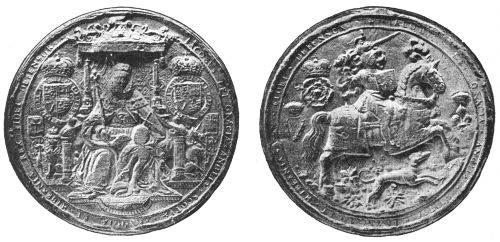
GREAT SEAL OF JAMES I.
Winter was staggered but not convinced, and declared that he would not consent to any such frightful measure until fresh attempts had been made to procure a mitigation of their sufferings by milder means. He, therefore, hastened over to the Netherlands, where the Spanish ambassador, Velasco, had arrived, in order to conclude a peace between England and Spain. At Bergen, near Dunkirk, he had an interview with the ambassador, and urged upon him to demand a clause in the treaty for the protection of the Catholics. He was soon convinced that Velasco, though promising to use his influence for that end, would not risk the completion of the peace by the advocacy of such a stipulation.
Indignant at this apathy, he hastened to Ostend on his return, where he accidentally encountered an old comrade in the Netherland wars, of the name of Guido or Guy Fawkes, a native of Yorkshire, and a man of determined courage, as well as of great experience and address. He had been Winter's companion in his mission to Madrid, and he now solicited him to accompany him to England, and unite his endeavours with other friends for Catholic relief. Winter, it would seem, had now made up his mind to enter into Catesby's plot, but did not let Fawkes into the full secret for some time.
Meanwhile, Catesby had been ardently at work in the prosecution of his idea. He had communicated his plan to Percy and Wright. Thomas Percy was of the Northumberland family, and steward to the earl, and John Wright was brother-in-law to Percy, and reputed to be the best swordsman in England. Percy had joined the Catholics about the same time as Catesby returned to them, and like a zealous proselyte had, during the latter days of Elizabeth, gone to James at Edinburgh and endeavoured to draw from him a promise of favour to the Catholics on his accession. James is reported to have assured Percy that he would at least tolerate the mass in a corner. This James afterwards denied, but his denial can go for very little, for it was perfectly in keeping with his king-craft to promise what served to secure his ends for the time; and almost every monarch in Europe had to make that complaint against him. Percy, on the breaking out of the persecution under James, felt that he had been made the dupe of James's duplicity. He presented a remonstrance to the king, to which no answer was deigned, and Catesby found him in a mood of great resentment against the king, and in a favourable temper for his views. He not only agreed to co-operate but brought in his brother-in-law Wright, who was also a recent proselyte to Catholicism.
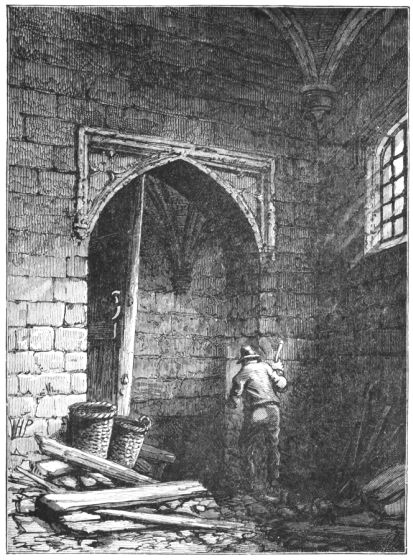
GUY FAWKES'S CELLAR UNDER PARLIAMENT HOUSE.
Percy appears to have been of a very excitable nature: the embryo conspirators assembled at Catesby's lodging, and Percy demanded whether they were merely to talk and never to act. Catesby said that before he would open his plan to them, he must demand from every one an oath of secrecy. This was assented to, and a few days afterwards, as appears by the confession of Winter, the five—that is, Catesby, Winter, Percy, Wright, and Fawkes—"met at a house in the fields beyond St. Clement's Inn, where they did confer and agree upon the plot, and there they took a solemn oath and vows by all their force and power to execute the same, and of secrecy not to reveal it to any of their fellows but of such as should be thought fit persons to enter into that action." When they had all sworn and perfectly understood what was proposed, Catesby led them into an upper chamber of the house, where they received the sacrament from Gerard, the Jesuit missionary, but who, according to Winter's confession, was not let into the secret.
This dreadful oath was taken on the 1st of May, 1604, but the conspirators resolved to wait for the remotest chance of any good arising out of the negotiations between England and Spain. But the treaty was concluded on the 18th of August, without any clause protective of the Catholics. Peace and commercial relations were restored between the two countries, and James was left at liberty to do as he pleased with the cautionary towns if the States did not redeem them. After the ratification of the treaty, the Spanish ambassador solicited in the name of his sovereign the goodwill of James towards his Catholic subjects; but James assured Velasco that however much he might be disposed to such indulgence, he dared not grant it, such was the terror of his Protestant subjects of any return to power of the Catholics. Velasco took his leave, and fresh orders were issued to judges and magistrates to enforce the laws against the Catholics with all rigour. This put an end to the patience of the conspirators, and they protested that it was but a fitting retribution to bury the authors of their oppressions under the ruins of the edifice in which they enacted such diabolical laws.
They now sought for a proper place to commence their operations, and they soon found a house adjoining the Parliament House in the possession of one Ferris, the tenant of Whinyard, the keeper of the king's wardrobe. This Percy hired, in his own name, of Ferris, on pretence that his office of gentleman pensioner compelled him to reside part of the year in the vicinity of the Court. But the conspirators were debarred from immediate operations, by the commissioners appointed by James to consider a scheme for the union of the two kingdoms, taking possession of this house where they sate for several months. Not wholly, however, to lose time, the conspirators hired another house in Lambeth, on the banks of the river, where they stored up wood, gunpowder, and other combustibles, which they could easily remove by night in boats, as occasion served, to their house in Westminster, as soon as it was in their hands. They confided the charge of this house in Lambeth to Thomas Kay, a Catholic gentleman of reduced means, who took the oath and entered into the plot.
On the 11th of December the conspirators obtained possession of their house, when they again swore to be faithful to each other, and they began their preparations by night. Behind the house, in a garden and adjoining the Parliament House, stood an old building. Within this they began to perforate the wall, one keeping watch while the others laboured. The watching was allotted to Fawkes, whose person was unknown, and who assumed the name of Johnson and appeared as the servant of Percy. Three of the others worked whilst the fourth rested. During the day they toiled at undermining the wall, and during the night they buried the rubbish under the earth in the garden. They had laid in a store of eggs, dried meats, and the like, so that no suspicion should be excited in the neighbourhood by their going in and out, or by there being brought in provisions for so many persons. They thus laboured indefatigably for a fortnight, when Fawkes brought them the intelligence that Parliament was prorogued from the 7th of February to the 3rd of October. On this they resolved to suspend their work till after the Christmas holidays, and to retire to their respective residences, agreeing neither to meet in the interim, nor to correspond or send messages to each other regarding the plot.
During their late labours, as they discussed various matters, Catesby, to his dread and mortification, discovered a strong tendency amongst his associates to doubt the lawfulness of their attempt, because innocent people must perish with the guilty, Catholics amid the persecuting Protestants. In vain he employed all his ingenuity in reasoning; he saw the feeling remain, and he endeavoured to secure a plausible argument before their coming together again. He therefore consulted Garnet, the provincial of the Jesuits, on this point. Catesby had accepted a commission as captain in a regiment of cavalry, to be commanded by Sir Charles Percy, in the service of Spain. He now observed to Garnet in a large company that he had no doubt about the justice of the war on the side of Spain, but as he might be called on to make attacks in which the innocent might fall with the guilty, women and children with armed soldiers, could he do that lawfully in the sight of the Almighty? Garnet replied certainly, otherwise an aggressor could always defeat the object of the party invaded by placing innocent persons amongst guilty ones in his ranks. This was enough for Catesby, the principle was admitted; and on the meeting of the conspirators after the recess, he was prepared to banish their scruple by assuring them that it was decided to be groundless by competent ecclesiastical authority.
On the 30th of January, 1605, they resumed their operations. They found the wall through which they had to dig was no less than three yards thick, and composed of huge stones, so that the labour was intense, and the danger of their blows being heard began to alarm them. They had an accession of force to their numbers, the brothers of Wright and Winter, and one John Grant, of Norbrook in Warwickshire, who had married a sister of the Winters. He had suffered much from persecution under Elizabeth, and his house was large and strongly fortified, offering a good depot for horses and ammunition. Besides these, Catesby had admitted Bates, his confidential servant, into the secret, believing he had more than half guessed it, and sent him with arms and ammunition to Grant's house in Worcestershire.
But at this point the operations of the conspirators received a severe check. There arose a difficulty which seemed to be insurmountable; which so disheartened some of the band that they were in favour of abandoning their project altogether—or at least for a time. This formidable obstacle appeared in the shape of ordinary water, which now began to ooze in from the river, and put a stop to all hope of making the passage. Fortune came to their aid, however. Whilst they were in this state of dejection, they were extremely alarmed by a loud noise, which appeared to come from a room just over their heads. Fawkes went to endeavour to learn the cause of it, and returned with the intelligence that it proceeded from the selling of the stock in trade of Bright, a coal merchant, who was evacuating the cellar, which would be in a few days unoccupied. At this joyful news, the mining of the foundation was abandoned; the cellar, which lay directly under the House of Lords, was immediately taken by Fawkes in the name of his pretended master, Percy. In a short time they had removed thirty-six barrels of gunpowder from the house in Lambeth in the darkness of night, and had covered them over in the cellar with faggots and billets of wood. All being prepared, they once more separated till September, a few days before the assembling of Parliament. They dispersed themselves to avoid all suspicion, and Fawkes went over to Flanders to endeavour to procure a supply of military stores, and to win over Sir William Stanley, Captain Owen, and other officers of the regiment in the pay of the archduke. Catesby was an officer of this regiment; most of these officers were Catholics and his personal friends, and he informed them through Fawkes, that things were come to that pass that it was reported that the Catholics were to be utterly exterminated throughout England, and that if they could not defend themselves by peaceable means, they must do it by the sword; and he enjoined them to engage as many of their brethren as possible to aid them in their deliverance. Sir William Stanley was absent in Spain and Owen promised that he would communicate with him; but little effect appears to have been produced by Fawkes's mission, except that of exciting the attention of Cecil, who received repeated intimations from Flanders that the English exiles had some secret enterprise in agitation, though what it was the informants could not discover.
Catesby at home was in constant activity. He had obtained a fresh accomplice in Keyes, an intimate friend of his, who had been stripped of his property and was prepared for the worst, being a man of determined disposition; and he had his eye on others who appeared in a mood for it. At the same time the growing excitement of Catesby endangered the secret. There was a tone and a restlessness about him which attracted the notice of his friends. He still delayed joining his regiment in Flanders, and Garnet, the Jesuit, came to suspect that he was engaged in some plot and warned him against such attempts. This only excited the anger of Catesby, and Garnet wrote to Rome and obtained letters from the Pope and the generals of his Order, strongly enjoining on the Catholics submission to the Government. Catesby, uneasy in his conscience, at length confessed to Garnet the existence of some plot. The Jesuit refused to hear anything of it, but endeavoured to impress on the conspirator the necessity of obedience to the breves from Rome. At length he prevailed on him to promise that nothing should be done till they had sent a messenger to the Pope fully detailing the condition of the Catholics in England, and had received an answer. But Catesby had no intention of deferring his enterprise on such grounds. Fawkes returned to England in September, and they resolved to proceed. A second prorogation of Parliament, however, from October to the 5th of November, disconcerted the conspirators, and induced them to fear that their designs had become known to Government. To ascertain this, if possible, Thomas Winter was deputed to attend in the House of Lords and watch the countenances and behaviour of the commissioners during the ceremony of prorogation. He returned, assuring them that their secret was still safe, for the commissioners walked about and conversed in the utmost unconsciousness of danger on the very surface of the prepared volcano—the six-and-thirty barrels of gunpowder.
These repeated delays, however, ensured the defeat of the plot. All the conspirators except Catesby were now ruined by fines, exactions, and persecutions on account of their faith. They had depended for support for the last twelve months on the assistance of relations and friends. Catesby had purchased the military stores and other requisites: his means were now exhausted, and yet more money must be in hand against the day of explosion if they meant to take full advantage of it. This induced them to extend the number of their accomplices, a perilous proceeding in anything demanding secrecy; and yet Catesby ventured on divulging the scheme to no less than three fresh associates, men of family and fortune. The first was Sir Everard Digby, of Drystoke in Rutlandshire, Gotehurst in Buckinghamshire, and of other large estates. Digby had been left as a boy a ward of Queen Elizabeth's and had been educated at her court as a Protestant. But a little before the death of the queen he embraced the Catholic faith, and thus abandoning the brilliant prospects before him, retired to his estates in the country. At the time of the conspiracy he had a young wife and two children, was only twenty-five himself, and thus had every imaginable earthly good within his reach. Subtle must have been the persuasion which could have induced such a man to risk all this in a desperate enterprise, and bold the spirit of Catesby who could venture to tempt him to do it. It was not effected without difficulty. Digby could not avoid seeing the hazard and doubting the innocence of such a proceeding, but eventually he gave way, and promised to assemble his Catholic friends on the opening of Parliament to hunt with him on Dunsmoor in Warwickshire, and to advance one thousand five hundred pounds.
The next was Ambrose Rookwood of Coldham Hall, Suffolk, the head of an ancient and wealthy family, who had suffered like his neighbours, but was still affluent. He had a fine stud of horses, which made him a very desirable coadjutor, independent of other considerations. He seems to have had as little ambition as he had motive for conspiracy, being, despite his share of persecutions, able to enjoy a quiet life; but his attachment to Catesby was his snare. Like the rest, he at first recoiled from the prospect of so much bloodshed; but Catesby managed to reconcile him to the idea, and he removed his family to Clopton Hall, near Stratford-on-Avon, in order to be near the Catholic rendezvous at Dunsmoor.
The third new accomplice was Sir Francis Tresham. His father, Sir Thomas Tresham, had long been severely handled on account of his religion, in Elizabeth's reign, and his son Francis, who succeeded him, had been engaged in several plots. He was in that of Essex in conjunction with Catesby and Percy, and escaped by a prompt distribution of three thousand pounds amongst the queen's favourites. His chief seat was at Rushton, in Northamptonshire. The selection of Tresham was especially imprudent, for he had the character of being selfish, reserved, and fickle; but he had money, which induced Catesby to trust him. From the moment, however, that he did so, he had no more peace of mind. Terrible fears and suspicions seized him, dreams as terrible haunted him at night. His comrades had no confidence in Tresham, whose character was well known; but the thing was done, and there was no retracing the step which was to bring destruction upon them. Tresham promised a contribution of two thousand pounds, and Percy also engaging to advance four thousand pounds from the rents of the Earl of Northumberland, whose steward he was, the pecuniary provision appeared ample, and they proceeded to organise their plan of operations.
A list of all the peers and commons who were Catholics, or who had opposed the penal statutes and other harsh measures against the Catholics, was made out, and these were at the last moment on the fatal morning to be called away from the House by some urgent message. Guy Fawkes was appointed to fire the train with a slow burning match, which should allow of his escape before the explosion; and a ship was to lie ready in the river to carry him over to Flanders, where he was to publish a manifesto justifying the deed and calling on the Catholic powers for aid. Percy, as a gentleman pensioner, was to enter the palace and secure the person of the young Prince Charles—it seems they were willing to let Prince Henry perish—and on pretence of placing him in security, convey him away to the appointed rendezvous at Dunchurch. Digby, Tresham, Grant, and others, were to hasten to Combe Abbey, and secure the Princess Elizabeth, whom, if the two young princes should not be saved, they were at once to proclaim queen. Catesby was to proclaim the heir-apparent, whoever it was, at Charing Cross; and on reaching Warwickshire a declaration was to be issued abolishing monopolies, purveyance, and wardships. A protector was to be appointed to conduct the Government during the minority of the sovereign.
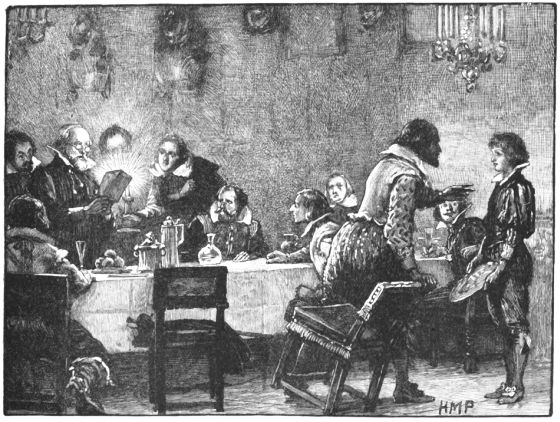
LORD MONTEAGLE AND THE WARNING LETTER ABOUT THE GUNPOWDER PLOT. (See p. 426.)
There were circumstances enough in these regulations to have alarmed all but fanatics in the cause. Messages at the last moment to so many members of the two Houses must have created suspicion, and the endeavour to secure the royal children was full of hazard. But there were greater dangers than these. As the time drew nigh, almost every one had friends amongst the members of Parliament, and they were not contented with the general plan of drawing them away at the critical moment. Each wished to convey a particular warning to his own friends or relatives, which should make their safety certain. Every such warning, however, menaced the discovery of the whole scheme. Tresham was excessively anxious to rescue the Lords Mordaunt and Monteagle, who had married two of his sisters. Percy was equally desirous to save his relative, the Earl of Northumberland; Keyes, the old gentleman who had the custody of the house at Lambeth, was importunate to save Lord Mordaunt, who sheltered and maintained his wife and children after his own ruin; and all were eager to warn the young Earl of Arundel.
Catesby, extremely alarmed by these proposals, declared that means enough were in operation to keep those that they wished to save away; but that rather than endanger the result, he would have all blown up, though they were as dear to him as his own son. He and Fawkes, as the day drew near, retired to a solitary house in Enfield Chase, called White Webbs, where, as they were in consultation with Thomas Winter, Tresham suddenly made his appearance. He appeared excited and embarrassed, and demanded that he should be allowed to put Lord Monteagle, on his guard. When Catesby and his associates protested against it, he advanced reasons for delay, declaring that he should not be prepared with the promised advance of money till he had sold some property. He pleaded that the explosion would be as effectual at the end of the session as at the beginning; that in the meantime the conspirators might live in Flanders, whither his ship should convey them, and where he would supply them with the necessary funds for maintenance. Catesby was confirmed in his fears of Tresham by these proposals, but thought it best to dissemble and appear to acquiesce. Tresham returned to town, and would seem to have warned not only Monteagle but others, most likely including Lord Mordaunt. Digby and others of the conspirators are supposed to have warned their own friends, so that the danger of discovery was hourly increasing. Tresham, in his examination, alleged that his real object at this moment was not to delay but to put an end to the plot, as the only means he could devise to save the lives of all concerned, and to preserve his own life, fortune, and reputation.
The movements of Lord Monteagle warranted the belief that he had received a warning of some kind that there was danger in town, for he removed from his house in London to one which he had at Hoxton, and on the 26th of October, six days before the proposed opening of Parliament, he, much to the surprise of his own family, ordered a good supper to be prepared there. Monteagle had formerly been engaged in the Spanish treason, and had written to Baynham, who was the emissary at Rome, and therefore was probably aware of some plot in agitation, but he had latterly obtained the confidence of the king and was one of the commissioners for the late prorogation.
As he sat at table about seven o'clock in the evening, a page handed to him a letter, which he said he had received from a tall man whose features he could not recognise in the dark. Monteagle opened the letter and seeing that it had neither date nor signature, he handed it to Thomas Ward, a gentleman of his establishment, to read aloud. It was as follows:—"My lord out of the love i beare to some of youer frends i have a caer of your preservacion therefor i would advyse yowe as yowe tender youer lyfe to devyse some exscuse to shift of youer attendance at this parleament for god and man hath concurred to punishe the wickednes of this tyme and think not slightlye of this advertisement but retyere to youre self into youre contri wheare you may expect the event in safeti for thowghe theare be no apparance of anni stir yet i saye they shall receyve a terrible blowe this parleament and yet they shall not seie who hurts them this cowncel is not to be contemned because it may do yowe good and can do yowe no harme for the danger is passed as soon as yowe have burnt the letter and i hope God will give yowe the grace to mak good use of it to whose holy protecion i comend yowe."
The astonishment of the guests at the hearing of this letter may be imagined. Lord Monteagle immediately hastened to town, and laid the letter before Cecil and some of the other ministers, the king being away still at Royston, hunting. Cecil determined that nothing should be done till the king's return. The next morning Ward, who had read the letter publicly at the supper-table, communicated the circumstance to Thomas Winter, and said the letter was in the possession of Cecil. Winter was thunderstruck, but put the best face upon the matter that he could, and pretended to laugh at the whole affair as a hoax on the credulity of Lord Monteagle; but no sooner was Ward gone than he flew to White Webbs and imparted the news to Catesby. Catesby at once attributed the letter to Tresham, and the more so as he had absented himself for several days on the pretence of having business in Northamptonshire. The question was whether he had revealed the particulars of the plot and the names of the conspirators. To ascertain the extent of the mischief and of the guilt of Tresham, he sent him an imperative message to come to White Webbs. Tresham obeyed the summons on the 30th of October, and met Catesby and Winter at this lonely house in Enfield Chase. They had made up their minds if they found him guilty, to shoot him on the spot. They charged him point blank with the discovery of the plot, and kept a searching gaze upon his countenance as he received their declaration. Had he faltered or shown any confusion, his doom would have been instant. But he exhibited the utmost calmness and firmness of expression, protesting most solemnly that he was innocent of the charge.
That Tresham was the writer of the letter, and that he had entered into a confidential understanding with Monteagle for the defeat of the plot, there appears every reason to conclude. His own avowal on the examination that such was his intention is borne out by all the examinations. The delivery of the letter whilst Monteagle was at supper with his friends, if it was done by Tresham, shows an intention that it should thus be made irrevocably public. The instant communication of Lord Monteagle's servant with Winter the conspirator, in order to warn them, confirms the idea that all this was planned between Tresham and Monteagle; but there is no reason to believe that Tresham had betrayed the names of his accomplices.
Catesby and Winter returned with Tresham to town, and Guy Fawkes was despatched to the cellar under the Parliament House to discover whether all was right there. Not a thing or a secret mark was disturbed. They then first told him why they had sent him, on which Fawkes complained of their distrust of his courage, and said he would visit the cellar every day till the 5th of November. Had Cecil not been still more cunning than the conspirators, had he made a stir and an inquisition, the aim of Tresham would have been effected, the conspirators would have escaped, and the plot have been put an end to without any catastrophe. But the artifice of Cecil lulled their suspicions and lured them on to their doom.
On the 31st of October James returned to town, and the letter was laid before him, with the particulars of its delivery. The king was struck by the account, read the letter several times over, and discussed the matter for two hours with his ministers. He boasted to Parliament on its opening, that it was his own bright suggestion that the receiving of the letter sent to Lord Monteagle implied that they were all to be blown up, and that he in consequence ordered the search of the cellars under the Parliament House. But this was a piece of consummate flattery on the part of his ministers, to make it appear the result of his superior sagacity; for we have direct evidence in the circular of the Earl of Salisbury, that the ministers were in possession of the secret, but he observes, "we all thought fit to forbear to impart it to the king until some three or four days before the sessions." In fact, the intelligence that the letter was in the hands of the king, and that the Council was consulting on it, was immediately conveyed to Winter by Monteagle's servant. Upon this Winter waited on Tresham at his house in Lincoln's Inn Walks, where Tresham, in great agitation, assured him that the existence of the mine was known to the ministers; that he knew certainly, but denied any knowledge of the person by whom the discovery had been made. He declared that they were all lost if they did not escape at once. From the moment the affair was known, Tresham had avoided further intercourse with the conspirators, meaning to appear ignorant of their concerns, for which reason he went about openly, and even offered his services to the Council.