Chapter XII · (continued 2)
Reading edition
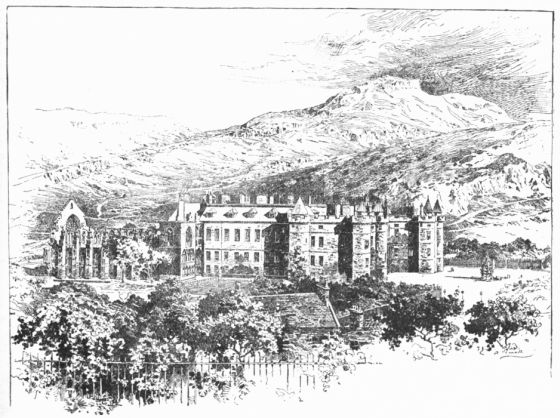
HOLYROOD PALACE, EDINBURGH. (From a photograph by J. Valentine, Dundee.)
Darnley during this time received a warning of his danger from the Earl of Orkney, who, finding opportunity, told him that if he did not get quickly out of that place it would cost him his life. Darnley told this to the queen, who questioned the earl, and he then denied having said so. This was precisely what Morton stated would take place, when on his death-bed, confessing a knowledge of the plot, he was asked why he had not revealed it. He replied, that there was nobody to tell it to; that it was no use telling it to the queen, for he was assured that she was in the plot; and that if he had told Darnley, he was such a fool that he would immediately tell it to the queen. The circumstance, however, startled the conspirators, and determined them to expedite the terrible business. The desired opportunity arrived. The queen agreed to be present on the evening of the 9th of February at the marriage of Sebastiani and Margaret Carwood, two of her servants, which was to be celebrated with a masque. The queen remained with the king the greater part of the day, which was passed in the most apparent cordiality, and Mary declared her intention of remaining all night at Kirk-of-Field. However, she suddenly recollected her promise to attend the marriage, and taking leave of Darnley, kissed him, and taking a ring from her finger placed it on his own. It was now that the hired assassins executed their appointed task. How Darnley and his page were murdered is yet a disputed point. The house was blown up with gunpowder, but the bodies of the king and his page were found in the orchard adjoining the garden wall, the king only in his night-dress, his pelisse lying by his side, and no marks of fire upon the body.
However doubtful may be other matters, there is no question of the presence of Bothwell at the tragedy. He attended the queen from Kirk-of-Field to Holyrood, but about midnight quitted the palace, changed his rich dress, and in disguise joined the murderers, who were waiting for him. About two o'clock two of them entered the house and lit a slow-burning match, the other end of which was placed amongst the powder. They remained some time expecting the catastrophe, till Bothwell grew so impatient that he was with difficulty withheld from entering the house to ascertain whether the match still burnt. This was done by one of the fellows, who looked through a window and perceived the match alight. The explosion soon after took place, and with a concussion which seemed to shake the whole city. Bothwell hurried away and got to bed before a servant rushed in with the news. He then started up with well-acted astonishment, and rushed forth shouting, "Treason! treason!" Huntly, and some others of the conspirators then proceeded to the queen's chamber, and informed her of what had taken place. She seemed petrified with horror, gave herself up to the most violent expression of grief, and, shutting herself up in her chamber, continued as if paralysed by so diabolical a tragedy.
The demands of the outraged people for inquiry were loud. The city was placarded with the names of Bothwell, James Balfour, David Chambers, black John Spens, Signors Francisco, Joseph Rizzio—the brother of David—Bartiani, and John de Bourdeaux, as the leading murderers. The Earl of Lennox, the father of Darnley, called on the queen to bring them to trial; but he demanded in vain. Bothwell, the man whom the whole public denounced, continued the first in favour with the queen. Everything demonstrated the necessity of the queen exerting herself to discover the murderers of her husband. Sir Harry Killigrew arrived from Elizabeth, bearing a message of condolence, but at the same time urging the absolute necessity of the trial of Bothwell. Killigrew found the capital in a most excited state, clamorous for inquiry, and loud in its censures of the queen. At the same time a letter arrived from Bishop Beaton, her ambassador in France, stating in plainest terms that she was publicly accused there of being herself the chief mover in the whole dark business, and telling her that if she did not exert herself to take a rigorous vengeance she had better have lost life and all. Mary promised Killigrew that Bothwell should be brought to strict trial; but as soon as he was gone means were taken to secure Bothwell more completely from any effectual inquiry. The Earl of Mar was induced to give up the possession of the castle of Edinburgh to Bothwell, Morton had his lands and his castle of Tantallon restored to him, and in return supported Bothwell with all his influence. The castle of Blackness, the Inch, and the superiority of Leith, were conferred on Bothwell; and Murray—who neither liked to play the second to the aspiring favourite, nor to run any risk of exposure in those inquiries which must sooner or later ensue—requested permission to visit France.
Mary could not possibly be happy in such circumstances. Whatever might be the state of her conscience, her character was fearfully implicated, and on all sides came calls for inquiry, which she did not seem to have the power or the will to make. The climax to her trouble was put by the queen-mother of France and her uncle, the cardinal, sending her the most cutting message of reproach; calling on her without delay to avenge the death of the king, and to clear her own reputation, or regard them as no longer her friends, but the proclaimers of her utter disgrace. There was no possibility of delaying inquiry any longer, but every means was adopted to make it a mockery. Lennox was forbidden to appear with more than six followers, and his efforts to obtain a postponement were fruitless. In his absence Bothwell was unanimously acquitted.
Rumours now arose that Bothwell was about to divorce his wife, the sister of Huntly—to whom he had been married only six months—and to marry the queen; and in the face of these reports Mary conferred on him the castle and lordship of Dunbar, with extension of his powers as Lord High Admiral. As tidings of the queen's intended marriage grew, Murray, her brother, stole away out of contact with danger or responsibility and retired to France. But, nevertheless, she did not lack warning. Her ambassador at the French Court entreated her, in the most serious manner, to punish her husband's murderers, and not allow the world to use such freedom with her character as it did. She had equally strong letters from her friends in England, which Melville showed to her, and was advised by Maitland of Lethington to get away from Court for fear of Bothwell. Bothwell, however, soon put the matter beyond doubt. He invited the principal nobility to a tavern, kept by one Ainslie, and there he drew out of his pocket a bond expressing his innocence of the murder of Darnley, as established by the bench and the legislature, and his intention to marry the queen, and containing, it is said, her written warrant empowering him to propose the matter to the nobility. The company was composed partly of his friends and accomplices. The rest were taken with confusion, but they had all been deeply drinking, and they found the house surrounded by 200 of Bothwell's hackbutters. Under constraint, eight bishops, nine earls, and seven lords, subscribed the paper.
But the daring ambition of the man now roused even his old accomplices to conspire against him, for the safety of the young prince and Government. Morton, Argyll, Athole, and Kirkaldy of Grange, were at the head of this plot; and they wrote to Bedford the day after the supper at Ainslie's, saying it was high time that his dangerous career was checked, and engaging by Elizabeth's aid to avenge the murder of the king. Kirkaldy, who was the scribe, added that the queen had been heard to say that "she cared not to lose France, England, and her own country for him, and would go with him to the world's end in a white petticoat, before she would leave him."
An anonymous letter, but undoubtedly from some of this party, soon followed, declaring that the queen had concerted with Bothwell the seizure of her person. The correctness of this information was immediately proved. On Monday, the 21st of April, the very day foretold, Mary rode to Stirling to visit her son, where the Earl of Mar, entertaining strong suspicions of her intentions, refused to allow her access to him with more than two attendants, to her great indignation. On her return, as had been foreseen in the letter quoted, Bothwell met her at the head of 1,000 horse, at Almond Bridge, six miles from Edinburgh; and, according to Melville, who was in the queen's train, taking the queen's bridle, he boasted that "he would marry the queen, who could or who would not; yea, whether she would herself or not." He says that Captain Blackadder, one of Bothwell's men, told him that it was with the queen's own consent. Whether this were so or not, has been argued eagerly on both sides, but it is probable from what we have seen, that Mary really was a consenting party. The royal retinue was suffered to continue its journey, with the exception of Melville, Maitland, and Huntly, who were conducted along with the queen to the castle of Dunbar, the recent gift of Mary to Bothwell. The queen seems to have made no loud outcries against her apparently forcible abduction, and the country was so convinced of the sham nature of the affair, that there was no attempt to rescue her.
The divorce of Bothwell from his wife was now hastened, and after detaining the queen five days at the castle of Dunbar, he conducted her to Edinburgh, and led her to the castle, where she was received with a salute of artillery, Bothwell holding her train as she dismounted. The ministers of the Church were ordered to proclaim the banns of marriage between the queen and Bothwell, but they declined; and Craig, the colleague of Knox, who was absent, declared that he had no command from her Majesty, who was held in disgraceful constraint by Bothwell. This brought to him the Justice Clerk with a letter under the queen's own hand, stating that the assertions he had made were false and commanding him to obey. Craig still refused till he had seen the queen herself; and, before the Privy Council, charged Bothwell with murder, rape, and adultery. No punishment followed so daring a charge, and the preacher having done his duty, obeyed the Royal mandate and published the banns, at the same time exclaiming, "I take heaven and earth to witness that I abhor and detest this marriage, as odious and slanderous to the world; and I would exhort the faithful to pray earnestly that a union against all reason and good conscience may yet be overruled by God to the conform of this unhappy realm."
Nothing moved by these public expressions of censure and disgust, the queen appeared, on the 12th of May, at the high court of Edinburgh, and informed the Chancellor, the judges, and the nobility that, though she was at first incensed against the Earl of Bothwell for the forcible detention of her person, she had now quite forgiven him for his subsequent good conduct. That day she created Bothwell Duke of Orkney and Shetland, and with her own hand placed the coronet on his head. On the 15th they were married, at four o'clock in the morning, in the Presence Chamber of Holyrood. The ceremony was performed by the Bishop of Orkney, according to the Protestant form, Craig being present; and afterwards privately, according to the Romish rite.
Very soon circumstances hastened the inevitable insurrection in Scotland. Mary had summoned her nobles to accompany her on an expedition to Liddesdale, but many disobeyed the order. Murray had now arrived in England, and was using all his influence with Elizabeth to make a movement for the expulsion of Bothwell from his usurpation; and even Maitland, who to the last had remained at Court, wearing the air of a staunch supporter of the queen, slipped away and joined the opposition. These were ominous circumstances, and suddenly, while the queen and Bothwell were at Borthwick Castle, about ten miles from Edinburgh, the conspirators made a rapid night march, and morning saw the castle surrounded by nearly 1,000 Borderers, under the command of Hume and other Border chiefs, with whom were Morton, Mar, Lindsay, Kirkaldy, and others of the nobles.
The confederates deemed the queen and Bothwell now safe in their hands, but they were deceived. Bothwell escaped through a postern to Haddington, whence he reached Dunbar; and the queen also eluding them disguised as a man, rode booted and spurred after him. The confederates, disappointed of their grand prize, marched on the capital, forced the gates, and entered, proclaiming that they came to revenge the death of the king, and to rescue the queen from the murderer. There the Earl of Athole and Maitland joined them, and a banner was displayed on which was painted the body of the murdered king lying under a tree, and the young prince kneeling beside it, exclaiming, "Judge and avenge my cause, O Lord!" The people flocked to this exciting standard, and the leaders speedily commanded a strong force.
Mary and Bothwell, meanwhile, summoned the nobles and people around Dunbar, and the Lords Seton, Yester, and Borthwick, appeared in arms, with a body of 2,000 men. Impatient to quell the confederates at once, they marched to Seton, where Mary issued a proclamation, declaring that all the pretences of the confederates were false; that her husband, the duke, was no murderer but had, as they knew, been fully acquitted; she was under no restraint but freely married to Bothwell, by consent and approbation of these very nobles; nor was her son in any danger, unless it were from them, for he was in their hands. Mary advanced and entrenched herself on Carberry Hill, in the old works which the English had thrown up before the battle of Pinkie.
The confederates marched out of Edinburgh and confronted the Royal army, eager for the battle. De Croc, the French ambassador, now attempted to mediate between the two parties, and carried a message to Morton and Glencairn, offering the queen's pardon, on condition that they all returned to their allegiance; but Glencairn replied that they were not come there to seek pardon, but rather to give it those who had sinned; and Morton added, "We are not in arms against our queen, but the Duke of Orkney, the murderer of her husband, and are prepared to yield her our obedience, on condition that she dismisses him from her presence and delivers him up to us."
It was clear that these terms must be complied with or they must fight; and it was soon perceived that the soldiers of the queen's army began to show symptoms of disaffection. Bothwell, therefore, rode forward, and defied any one who dared to accuse him of the king's murder. His challenge was accepted by James Murray of Tullibardine, the baron who was said to have charged Bothwell with the murder, in a placard affixed to the Tolbooth gate. Bothwell declined to enter the lists with Murray, on the plea that he was not his peer, whereupon Lord Lindsay of the Byres offered himself and was accepted, but at the moment of action the queen forbade the fight. By this time the defection in the queen's army became so conspicuous that Mary rode among her men to encourage them, assuring them of victory; but her voice had lost its charm, and the soldiers refused to fight in defence of the alleged murderer of the king. Whilst this was passing, it was observed that Kirkaldy of Grange was wheeling his forces round the hill to turn their flank, and the panic becoming general, the queen and Bothwell found themselves abandoned by all but about sixty gentlemen and the band of hackbutters.
To prevent Kirkaldy from advancing his troops so as to cut off their retreat towards Dunbar, the queen demanded a parley, which was granted. Kirkaldy went forward and assured the queen that they were all prepared to obey her authority, provided she put away the man who stood by her side stained with the blood of the king. The queen promised to acquiesce, and she held a moment's conversation with Bothwell, gave him her hand, and followed Kirkaldy; Bothwell turning his horse's head and riding off to Dunbar. This brutal and unheroic man afterwards became a rover in the North Sea, and died in prison in Denmark in 1578. Mary did not follow Kirkaldy of Grange far till she saw Bothwell out of danger, when she reminded him that she relied on the assurances of the lords, on which Grange, kissing her Majesty's hand, took her horse by the rein, and led her towards the camp. On reaching the lines, the confederate lords received the queen on their knees, and vowed to obey and defend her as loyally as ever the nobility of the realm did her ancestors; but they very soon showed the hollowness of these professions, and the common soldiers assailed her ears with the most opprobrious language.
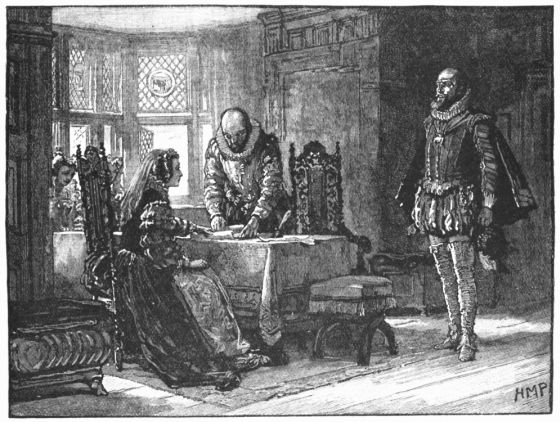
MARY SIGNING THE DEED OF ABDICATION IN LOCHLEVEN CASTLE. (See p. 273.)
The unfortunate but guilty queen at every step learned more plainly her real situation, and the faith which she was to put in these nobles. She was conducted like a captive into Edinburgh, the soldiers constantly waving before her eyes the banner on which was painted the murdered king. The mob was crowding round in thousands, shouting and yelling in execration, and the women heaped on her all the coarsest epithets of adulteress and murderess. On arriving in the city, instead of conducting her to her own palace, the patriot nobles shut her up as a solitary prisoner in the house of the Provost, not even allowing her to have her women to attend her; and in the morning she was greeted by a repetition of the scenes of the previous day—the same hideous banner was hung out opposite her window, and the yells of the mob were furious. Driven to actual delirium by this treatment, she rent the clothes from her person, and almost naked attempted to speak to the raving populace. This shocking spectacle roused the sympathy of the better class of citizens, and they determined on a rescue of the insulted queen, when the watchful nobles removed her to Holyrood. There they held a Council, and concluded to send her prisoner to Lochleven Castle, at Kinross, under the stern guardianship of Lindsay and the savage Ruthven. While there she was persuaded (July 23, 1567), to resign in favour of her baby, and Murray, who was summoned home, became Regent.
The queen, seeing herself destined by Murray to perpetual captivity, resolved to exert every faculty to effect her escape. After several unsuccessful efforts, she succeeded in May, 1568, through the ingenuity of a page called Little Douglas. The news of Mary's escape flew like lightning in every direction; the people, forgetting her crimes in her beauty and her sufferings, gathered to her standard; and she who a few days before was a deserted captive, now beheld herself at the head of 6,000 men. Many of the nobility, and some of those who had sinned deeply against her, now flocked around her. Murray, on the first news of their movement, marched out of Glasgow, and took possession of a small hamlet called Langside, surrounded by gardens and orchards, which occupied each side of a steep narrow lane directly in the way of the queen's army. Instead of avoiding this position, and making their way to Dumbarton by another course, Lord Claud Hamilton charged the troops there posted with his cavalry, 2,000 strong, in perfect confidence of driving them thence; but the hackbutters, who had screened themselves behind walls and trees, poured in on the cavalry a deadly fire which threw them into confusion. Lord Claud cheered them on to renew the charge, and with great valour they pushed forward and drove the enemy before them. But, pursuing them up the steep hill, they suddenly found themselves face to face with Murray's advance, composed of the finest body of Border pikemen, and commanded by Morton, Home, Ker of Cessford, and the barons of the Merse, all fighting on foot at the heads of their divisions.
The battle was unequal, for the troops of Murray were fresh, while those of the queen were out of breath with their up-hill fight. Notwithstanding, the main body of the queen's forces coming up, there was a severe struggle, and the right of the Regent's army began to give way. Grange, who was watching the field from above, quickly brought up reinforcements from the main body, and made so furious a charge on the queen's left as to scatter it into fragments; and Murray, who had waited with the reserve for the decisive moment, rushed forward with so much impetuosity, that the main battle of the queen was broken, and the flight became general (May 13, 1568). Mary, who had surveyed the conflict from the castle of Crookston, on a neighbouring height, about four miles from Paisley, beholding the rout of her army, turned her horse and fled, and never drew bit till she reached the abbey of Dundrennan, in Galloway. She then set sail in a boat, and landed at Workington, in Cumberland. Here she wrote to Elizabeth, expressing her strong confidence that Elizabeth would receive her and protect her against her rebellious subjects. She concluded her letter with these words:—"It is my earnest request that your majesty will send for me as soon as possible, for my condition is pitiable, not to say for a queen, but even for a simple gentlewoman. I have no other dress than that in which I escaped from the field. My first day's ride was sixty miles across the country, and I have not since dared to travel except by night."