Chapter V · (continued 2)
Reading edition
To drain the coffers of the landed aristocracy, Henry's agents brought up against them all the old obsolete feudal charges of wardships, aids, liveries, premier seizins, and scutages. Their estates had long been held under a different tenure, obtained from former monarchs. No matter: all those marked out for legal bleeding were brought into the private inquisition of the king's commissioners, and compelled to pay whatever was demanded, or to suffer worse inconveniences. Even his own friends were not exempted from the ever-watchful eyes and schemes of this money-making king. The law which he had enacted against the practice of "maintenance" was a prolific source of emolument. A striking example of this species of royal sharp practice was given in the case of John de Vere, Earl of Oxford. This nobleman having entertained the king on one occasion for several days magnificently at his castle of Henningham, to do the utmost honour to him at his departure, summoned all his friends and retainers, arrayed in all their livery coats and cognisances, and ranged them in two rows leading from the reception rooms to the royal carriage. Henry's eye was instantly struck with this prodigious display of wealth and of men, and his mind as suddenly leapt to a felicitous conclusion. There was money to be made out of it. The king said: "By my faith, my lord, I thank you for your good cheer, but I may not endure to have my laws thus broken in my sight: my attorney must speak to you." The earl was prosecuted for thus seeking to flatter the vanity of his master, and compelled to gratify Henry's avarice by a fine of 15,000 marks.
Whilst the king himself set so notable an example of extortion, we may be sure that his commissioners, spies, and tools of all sorts were not slack in this abominable business of ferreting out and putting through the cruel torture of their secret courts, the unhappy subjects of every corner of the kingdom who had any substance to prey upon. "The king," says Bacon, "had gotten for his purpose, or beyond his purpose, two instruments, Empson and Dudley, whom the people esteemed as his horse-leeches and shearers: bold men, and careless of fame, and that took toll of their master's grist. Dudley was of a good family, eloquent, and one that could put hateful business into good language. But Empson, that was the son of a sieve-maker, triumphed always upon the deed done, putting off all other respects whatsoever."
The tempestuous weather of January, 1506, which brought to others the disastrous news of vessels wrecked and lives lost, brought to Henry VII. tidings of a most exciting and elating kind. It was no other than that amongst the foreign vessels driven into the port of Weymouth, were some containing the Archduke Philip of Flanders and his wife Joanna, the elder sister of Catherine of Aragon, his daughter-in-law, and daughter of his friend and ally Ferdinand of Spain. The Archduke Philip knew his man; and at their meeting near Calais, in 1500, though he attempted to hold Henry's stirrup, and heaped upon him the titles of his father and protector, he took good care to keep out of his clutches; nothing would induce him to enter the city. But now circumstances were greatly changed; and the archduke and his wife Joanna would be a much more valuable prize. The mother of Joanna, the Queen Isabella of Spain, was dead, and Joanna was, in her own right, Queen of Castile, and Philip, by hers, king. There was a number of things, any one of which Henry would have been only too happy to extort from Philip.
The prince soon found himself received with much magnificence at the castle of Windsor; but he was not suffered to remain long without feeling that he was in the hands of a man who would have his full advantage out of him. The insatiable old miser went to work and propounded his demands, and there was nothing for it but for Philip to comply, if he ever meant to see Spain. First, Henry informed him that he was intending to marry, and that Philip's sister, the dowager-duchess of Savoy, was the woman of his choice. He demanded with her the sum of 300,000 crowns, of which 100,000 should be paid in August—it was already the 10th of March—and the remainder in six years by equal instalments. Besides this, Margaret, the duchess, was in the annual receipt of two dowries; one as the widow of John, Prince of Spain, and the other as widow of Philibert, Duke of Savoy, for she had been twice married already. This income Henry stipulated should be settled upon himself, and the princess was to receive instead an income as queen of England. That meant that Henry would have an income certain, and give her one most uncertain, for at this very time Catherine, the widow of his son Arthur, and betrothed bride of his son Henry, was kept by him in a condition of the most shameful destitution.
Philip consented—for what could he do?—and that point settled, Henry informed Philip that he had also a son, whom he, Henry, proposed to marry to his youngest daughter, Mary. This must have been a still more bitter draught for the poor Spanish monarch than the former. Henry had already made this very proposal, and it had been at once rejected. This son of Philip, the future celebrated Emperor Charles V., was now a child of six years of age, and the little Princess Mary was just three! Philip, however much he might inwardly rebel, and however differently he had planned the destiny of his son, was in the miser's vice, and the thing was done.
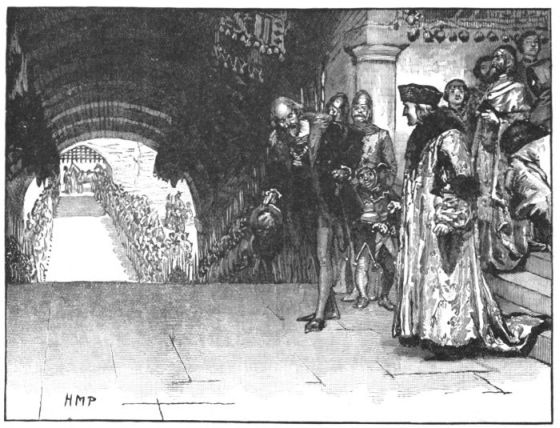
KING HENRY'S DEPARTURE FROM HENNINGHAM CASTLE. (See p. 99.)
Soon there came about fresh complications. Philip of Flanders, or, as he was oftener called, Philip the Fair of Austria, was but an invalid when he set out on his unlucky voyage to Spain. His detention in England during the three most trying months of its trying climate, January, February, and March, added to the vexation of the engagement forced upon him by the relentless Henry, is said to have completely broken his constitution; he sank and died in about six months. No sooner did King Henry hear this news, than, throwing aside all further thoughts of the Duchess of Savoy, he applied for the hand of Joanna, the widow of Philip. With Joanna, Queen of Castile, married to himself, and Charles, her son, the heir of all Spain, the Netherlands, and Austria, married to his daughter Mary, what visions of greatness and empire must have swum before the keen eyes of Henry, and excited his intense passion of acquisitiveness! Ferdinand returned for answer, that the proposal would have been well pleasing to him, but that Queen Joanna, from violent grief for the loss of her husband, was become permanently insane. This answer, which would have been all-sufficient for most men, was treated as a mere trifle by Henry, who replied that he knew the queen, having seen her in England; that her derangement of mind was not the effect of grief, but of the harsh treatment of Philip; that she would soon be all right, and that he was quite ready to marry her. Ferdinand reiterated the certainty of the lady's fixed madness, and Henry rejoined that if he was not allowed to marry her, the king's other daughter, Catherine, should never marry his son.
There is no doubt that, could Henry have secured the hand of Joanna—"the Mad Queen," as she came to be called—he would have broken off the contract between Henry, his son, and Catherine, and kept her and her dower in England nevertheless. But the marriage of Henry VII. with Joanna being an impossibility, Ferdinand promised to send the remaining half of Catherine's dower by instalments, and Henry consented that the marriage of the two young people should take place as soon as the money was paid. Catherine, whose letters to her father had, for the most part, been intercepted and detained by Henry, at length gave up her opposition also to the wedding, declaring, in one of these letters, that it was better for her to marry the prince than remain in the woful condition of destitution and dependence in which her father-in-law kept her. The remainder of the dower, however, was never paid up during Henry's time, and therefore the marriage did not take place till after his death.
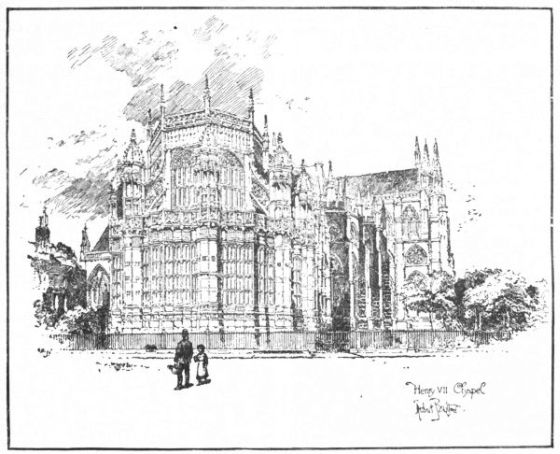
HENRY VII.'S CHAPEL, WESTMINSTER ABBEY.
In the midst of his grasping, his hoarding, and his scheming, the king's end was drawing on, though he was far from an old man. The gout had long visited him with its periodical attacks. He was liable, during the cold and variable weather of spring, to complaints of the chest, which assumed the appearance of consumption, and occasionally reduced him very low. When the sickness was strong upon him he ordered Empson and Dudley to cease their villainies; as he got worse he commanded them even to make restitution to those whom they had pillaged and imprisoned; but as he grew better again, he instructed them that it was only necessary to recompense such as had not been dealt with according to the regular forms of law—so that as these vultures generally tore their victims in a legal fashion, and as they themselves were made the judges of the necessary restitution, very little was done. Henry VII. died at his palace of Richmond on the 21st of April, 1509, in the fifty-fourth year of his age and the twenty-fourth of his reign.