The Third Book, CONTAINING A DESCRIPTION OF PERUANA OR, Southern America.
Reading edition
CHAP. I.
Situation and Form of Southern America.
Having compleated our Description of Mexicana, or Northern America, being that great Peninsula which lies Northward of the Isthmus, or Straight of Darien, together with all the Islands on the North side of the Equinoctial Line, we come now to the Southern Part, otherwise call’d Peruana, from Peru the chief Kingdom thereof, being the other great Peninsula, which lies Southward of the aforesaid Straight: It is generally resembled to the form of a Pyramid revers’d; the Basis whereof, that is to say, the more Southerly parts of it towards Magellanica and the Straights, extend themselves largely both East and West, becoming more sharp and streight towards the North, and those parts by which it is joyn’d to Mexicana: in the whole it is suppos’d to contain a Circuit of seventeen thousand Miles at least, and is water’d with four of the greatest Rivers of the World, besides abundance of lesser Streams, which issuing from the Andes and other Mountains of the Countrey, do run from all Parts both into the North and South Sea, much fertilizing the Countreys through which they pass; the four principal are these following:
The chief Rivers thereof.
1. Orellana, so call’d from the first Discovery thereof by Franciscus de Orellana, otherwise the River of Amazons, from a Generation of warlike Women, who (as the Tradition goes) inhabited certain Countreys lying upon the Banks thereof. This 394riseth in the Province of Peru, and runneth a Course of little less than five thousand Miles, discharging it self at last into the North Sea, through a Channel, as some say, of threescore Leagues broad, and yet with such a violent Current or Stream, that it is said to keep its natural colour and taste almost thirty Miles in the Sea.
2. Orenoque, by some call’d Raliana, from Sir Walter Raleigh, who endeavor’d to discover it, a River of the Province of Guiana, whose Head or Spring is not yet discover’d: It is said to be Navigable a thousand Miles together by the tallest Ships, and no less than two thousand by Pinnaces and smaller Vessels, and dischargeth it self likewise into the North Sea by sixteen several Channels or Mouths, making thereby several Islands; some whereof are said to be of good bigness, and to lie at a distance of a hundred Miles or more one from the other.
3. Maragnon, a River of a yet larger Course than any of the former, being, as ’tis said, no less than six thousand Miles from its Head, which is out of the Andes in Peru, to its Fall, which is likewise into the North Sea about Cape Blanco, by a Channel of seventy Leagues in breadth.
4. Rio de la Plata, otherwise call’d Paraguay, a River of two thousand Miles Course, and falling as the rest into the North Sea, by a Channel of threescore Miles over, and about thirty Degrees Southward of the Line, towards the Straights of Magellane.
The Mountains Andes.
The Andes, or Mountains before mention’d being the most noted, and biggest of all America, and indeed of the whole World, and thought by Cortesius to be the same with Sephar, spoken of in the tenth Chapter of Genesis, run above a thousand Leagues in length from Timama, a Town of New Granada in the Province of Popayan, and are in the narrowest place about twenty Leagues broad; and also of equal heighth with, if not higher than Caucasus it self: the Ascent to them is unpassable, except in very few places, by reason of craggy Precipices, and wild overgrown pathless Woods, serving onely for a shelter to Serpents and other poysonous Animals, which are there so numerous, that a whole Army of one of the Kings of Peru is reported to have been destroy’d by them; and what-ever People there are inhabiting in any of these Woods and Fastnesses, must needs be in the very utmost degree of rude and brutish salvageness.
Some divide Southern America into Peruviana and Brasiliana: Peruviana they subdivide into Terra Firma and Peru; Brasiliana into Brasile and Paraguay: But the most receiv’d and commodious Division is into these particular Provinces following, all of them wealthy and large, viz. 1. Castella Aurea, or Golden Castile, 2. Nova Granada, or The New Kingdom, as they call it. 3. Peru, specially so call’d. 4. Chile. 5. Paraguay. 6. Brasile. 7. Guiana. 8. Lastly Paria, with some lesser Islands adjoyning to all or most of these Provinces, and commonly reckon’d as part of them.

CHAP. II. Castella Aurea, otherwise call’d Terra Firma.
Description of Castella Aurea.
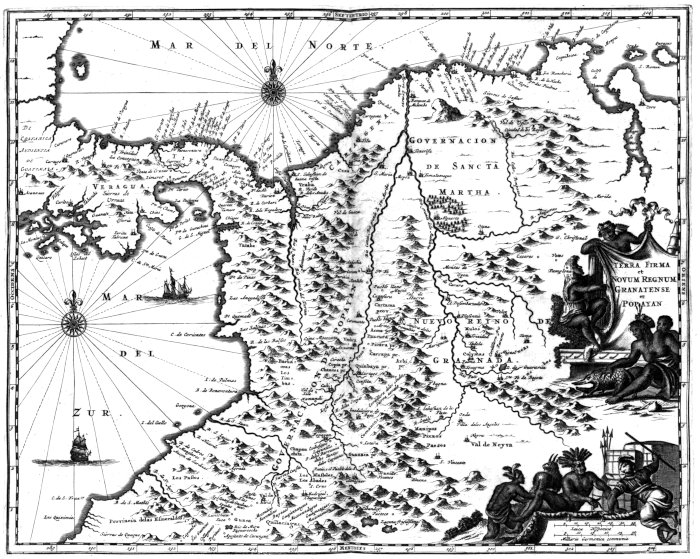
Castella de Oro, as the Spaniards call it, or Golden Castile, taketh up all the rest of the Isthmus, or Straight of Darien, which hath not been yet spoken of, being bounded Eastward, and to the North-East, with the Atlantick Ocean; and on the West with Mare del Zur, and some part of Veragua; Southward it hath the 395new Kingdom of Granada. It is call’d sometimes Terra Firma, because it was one of the first parts of firm Land which the Spaniards touch’d upon, after they had pass’d so many Islands, as seem’d for some time to block up, and bar them from the Continent of America: It is subdivided into these inferior Provinces or Countreys, viz. 1. Panama. 2. Darien. 3. Nova Andaluzia. 4. St. Martha. 5. Lastly, the little Province De la Hacha.
Rivers.
The chief Rivers of the Province of Panama are 1: Chagre, as it was antiently call’d, but afterwards from the great number of Crocodiles that harbor in it, Rio de Lagartos, falling into the North Sea between Nombre de Dios and Porto Bellano. 2. Sardinilla. 3. Sardina. 4. Rio de Colubros, so call’d from the abundance of Snakes breeding thereabouts. 5. Rio de Comagre, which falls into the same Sea. 6. Chepo, famous in times past for its Gold-Sands. 7. Rio de Balsas, whose Banks are shaded with good Timber-Trees. 8. Rio de Congo, which falls into St. Michaels Bay.
Sect. II. Panama.
Description of Panama.
Panama, commonly call’d The District, or Circle of Panama, is bounded Eastward with the Gulf, or Bay of Urraba, by which it is separated from the rest of the Continent of this Southern part of America; on the West it hath Veragua, one of the Provinces of Guatimala; being on both the other sides wash’d with the Sea: It is suppos’d to contain in length from Carthagena and Popayan, to the Confines of Veragua, about eighty or ninety Leagues, in breadth not above threescore in any part; and where it is narrowest, viz. betwixt the City of Panama and Nombre de Dios, if measur’d by a right Line, not above six or seven over from Sea to Sea. It lieth almost under the Equinoctial Line, but a few Degrees Northward of it, and therefore somewhat hot, and by the neighborhood of both Seas subject to a foggy and gross Air, in comparison of some other parts; so that it is not counted generally so healthful a Countrey, especially for Strangers, and in Summer-time.
The antient Division of Panama.
The antient Division of Panama, according to the Lordships of the Casiques that then Govern’d, were these following: Careta, Aila, Comagre, Chiam, Coyba, Chame, Chiru, Nata, Tobre, Trota, Haylia, Burica, and Escotia, where the South Sea with the Spring-Tides flowing over the Plains, at its return being hardned by the Sea, is turn’d into Salt; but as it hath always hapned in all other Countreys of the World, that with the alteration of Government, the Division of the Countrey, and the Names of Places have totally chang’d, so also here the antient Division of Regions and Territories must give place to the Modern.
The Nature and Customs of the antient Inhabitants.
The antient Inhabitants of these Parts were a very warlike People, the Women always accompanying their Husbands in the Wars. They us’d to hang on the tops of their Standards the Bones of their greatest Heroes, thereby to animate their Soldiers. Their Arms consisted of poysonous Arrows, Stone Swords, and Pikes made of the Palm-Trees. They also carried with them the Idol Chiapa, to whom they Offer’d living Children at the beginning of their Wars, and afterwards making Merry with the Flesh, anointed the Image with the Blood: Moreover, if they return’d home Conquerors, they spent several days in all manner of Debaucheries, as Drinking, Singing, Dancing, Cutting their Prisoners Throats, with their Blood also anointing their Image. But if they were conquer’d, then they invented new Offerings to reconcile themselves with their Idol.
Towns and Places of chief note.
The chief Towns and Places which the Spaniards inhabit here, are 1. Panama, 396the chief City of the Province, being also a Bishop’s See, which is Suffragan to the Arch-bishop of Lima, and the ordinary Residence of the Governor and Courts of Justice for these Parts; It is seated likewise upon the South Sea, and so near, that at High-water the Ships are said to Ride even under the Walls. Through this Town the Wealth both of Peru and Spain passeth once every Year; from Spain by Nombre de Dios and Porto Bello, from whence whatsoever Merchandise or other Commodities come from Spain, are Transported to Panama by Land, and from thence by Sea to all the Parts of Peru; and by Panama whatsoever comes from Peru, is sent into Spain: It hath commonly a strong Garrison of Soldiers in it, and is doubtless a Place otherwise well fortifi’d, being of so great importance. From the Haven Pericos three Ways lead to Panama, the first along a Bridge over a River, whose Banks are great Fortifications to the City, the rather because the River is deep, and next to it a Pool over-grown with Weeds. The Way from Nombre de Dios plain and without Woods, is wash’d by the Brook Levendero. The third runs along over a Stone Bridge and Champain Grounds, that extend from the Haven Pericos to the City. Eastward from Panama appear seven Royal Houses on a Rock, wherein the Courts of Judicature are kept. Five hundred Rods into the Sea lies an Island resembling a Half-Moon, and the Haven wherein the Ships when they unlade cast Anchor, there being else not Water enough for laden Barques, and all lie dry, the Tide being out: At the Mouth thereof stands a woodden Sconce. The Places Venta de Cruze, Chagre, Quebrada, and Ballano, are also fortifi’d against any Invasion, where else an Enemy might easily Land: But the strictest Watch is kept at the River Chagre, which Westward below Nombre de Dios falling into the Northern Ocean, brings the Ships up to Venta de Cruze, from whence a Way scarce five Leagues long leads to Panama. The Spanish Commodities consisting most in Meal, Oyl, Biskets, Cloth and Silk, are all brought from Nombre de Dios along the same Way; or else in Winter when they cannot stem the Current of the River Chagre, then they bring their Goods by Land, not without great danger of being taken by the run-away Negro’s, who set upon them out of the Woods with poyson’d Darts and Arrows; and as many Spaniards as they take, so many several ways they put them to death, because they formerly in the time of their Servitude were us’d with all imaginable Cruelties. The Provisions sold here at a reasonable Rate are Maiz, Peruan-Meal, Poultrey, Honey, Cattel, Swine, Oranges, Lemmons, Cabbage, and all manner of Garden Herbs or Plants. Round about the fore-mention’d Royal Houses lie Bulwarks, with a strong Castle on one side. A fair Cathedral denotes the Place to be a Bishop’s See: And the Franciscans, Dominicans, and Monks of the Order De la Merced, inhabit several fair Cloysters here. Two Leagues Westward is the Haven Pericos, which being secur’d from all Winds by three high Isles that lie before it, is the chief Harbor in which the Peruan Plate-Fleet (consisting most in small Barques) comes to an Anchor before they touch at Panama. The Countrey is for the most part Mountainous, and in many places sends forth stinking Damps out of muddy Pools; yet in some places are Savanna Grounds for Cattel to Graze in. The Air would also be more unhealthful, if it were not clear’d by the Winds which blow from the Sea. From July to October there fall continual Rains, mix’d with terrible claps of Thunder. The Inhabitants often recreate themselves in Hunting wild Hogs, with Nets made of the Brambles call’d Nequen or Henachen, and that after a strange manner: for they set on fire the Bushes all about the place where they suppose the Game to lie, which to shun the fire runs into their Nets; so that the same Bushes are both their shelter and destruction, as affording Material to make the Nets wherein they are taken. Besides other Birds the Woods also abound with 397Pheasants and Turtle-Doves; and amongst Beasts, those that carry their Young about them in a Bag, as also wildcats. The Sea abounds with Fish, and produces Crocodiles of a large size, by the Spaniards call’d Lagartos. The Trees are seldom without Leaves, but bear little or no Fruit.
2. Nombre de Dios, which hath broad Streets, high woodden Houses, and a fair Church: It extends from East to West along the Northern Ocean, in the middle of a great Wood on Moorish Ground, having a great Fen on the West; being situate under an unwholsom Climate, it hath occasion’d the death of many People. The Merchants which dwelt here had also Habitations in Panama, (the rest of the Houses being most of them Inns for Strangers) from whence as soon as they had gotten an Estate they went to Spain. The Countrey round about lies under Water in many places. The Oranges, Cassada-Roots, and the like, which grow here, occasion many Distempers to those that eat of them. In the Harbor, which hath on each side a Ridge of Rocks, on which lies decay’d Forts, the Sea is often-times so turbulent, that the Ships are forc’d to Ride at six Anchors apiece. Eastward from the City a fresh-Water River falls into the Haven, on whose Banks stand several Garden-Houses and Orchards. Anno 1595. Sir Francis Drake arriving here, found a Mill beyond the City; not far from which on a Hill stood a Watch-house, of which having made himself Master, he set fire on the Town Nombre de Dios, as also on all the Vessels that were in the Harbor. The original of the Name Nombre de Dios was on this occasion, viz. Diego Niquesa setting Sail with three Ships out of the Haven Carthagena to the Golden Countrey Veragua, was surpris’d by a violent Storm, in which two Ketches, Commanded by Lupus de Olano and Peter Umbria were driven out of sight, whilest he suffer’d shipwrack, and getting ashore, rang’d up and down in a desolate Countrey, where he found no other Food but Roots, till at last he met with Olano; when the Famine began to increase amongst them in such a nature, that being scarce able to carry their Arms, many of them were kill’d by the Inhabitants with poyson’d Arrows, insomuch that of seven hundred there remain’d scarce ninety: Niquesa shipp’d as many of them in a new Vessel which they had made as it could possibly carry, and promis’d to fetch the rest off from Veragua as soon as he had discover’d a Place fit to be inhabited: The first Place he Landed at was Puerto Bello; from whence being necessitated by the Indians who gather’d together to Retreat Aboard, not without the loss of several Men, he set Sail to the Promontory Mormor, beyond which he Anchor’d in a secure Haven; where, as he was going ashore he call’d to his Men, saying, Saltiamo in tierra al Nombre de Dios, that is, Let us Land in the Name of God, and calling up a Fort against the Assaults of the Natives, call’d it Nombre de Dios.
3. St. Philip, or Puerto Bello, so denominated by Christopher Columbus from its Haven lying along the North Sea, wonderful convenient and secure, by reason of the good Ground for Anchoring, and a Creek in the same, defended from all sorts of Winds; and which being surrounded with Woods, hath much over-flow’d Land about it, as also abundance of good Gravel for Ballast; for which and several other Reasons, the famous Architect Baptista Antonelli advis’d the Spanish King, to build this City for a Staple of Trade (in stead of Nombre de Dios, which was found unhealthy) having pitch’d upon an excellent Situation for it, viz. on a Plain at the Foot of a Hill, where there are three fresh Rivulets, meeting with a fruitful and hot Countrey: wherefore his Advice being taken, they first built a Fort at the Mouth of the Haven, put five Guns into the same to defend the new City, and on the Shore a strong Tower with eight Drakes: Moreover, the Rocks along the Shore, and close Woods about the Haven prevent the Landing of an Enemy: But at 398the very time that this City was just begun to be built, Sir Francis Drake having burnt Nombre de Dios, ran into the Haven Puerto Bello, where he found ten Houses, besides the Governors Palace, and a Castle whose Breast-works which the Spaniards had lately rais’d of Timber, Stone, and Earth, were all demolish’d by the English: But the Spaniards have since re-built the same, and fortifi’d the Haven, with two strong Castles, notwithstanding in the Year 1661. it was surpriz’d and taken by the English under the Command of Captain Parker, and the Governor Petro Melendez taken Prisoner.
4. Nata, commonly call’d St. Jago de Nata, situated on the West side of this Province, upon Mare del Zur, or The South Sea, about thirty Leagues distant from Panama, towards the Borders of Veragua.
5. Acla, a Town upon the same Coast, but lying South-East of Nombre de Dios: It was at first onely a Fort built by Peter de Arias, but afterwards grew up into a small City, of which at present there is nothing remaining but the remembrance of the famous Vasquez Nunnez, Beheaded by his Father-in-law Arias.
6. Lastly, La Crux Real, a few Leagues distant from Panama, for the most part inhabited by a sort of Negro’s call’d Simmerones.
Along the North Coast of Panama are two small woody Islands call’d Cattiva and Comagre, lying low in the Water; also the Isle De Pines, which rises high out of the Sea near the Main Land.
The Isles of Pearls.
On the Southern Coast are Isole de las Perlas, or The Isles of Pearls, about twenty five in number, but indeed rather Rocks than Islands, excepting two, viz. Tararequi and Del Rios where in former times the Indians took great store of Pearls, by diving for them to the bottom of the Sea; and they were esteem’d of greater value and excellence than those of Cubagua, and great profit was made of them by the Spaniards, till by their Cruelties exercis’d upon the Natives through excessive greediness, they depopulated the Islands, and lost that altogether of which before they were so insatiable: they are now onely inhabited by a few Moors and other Slaves, who keep Cattel there for their Masters.
Captain Oxenham’s Expedition.
It will not seem amiss to conclude our Description of Panama with a short Account of the English Captain John Oxenham’s Exploits in these Parts: He being incited by the Treasure which Sir Francis Drake fetch’d from hence, resolv’d to Steer for the Northern Coast of Panama, where he hal’d his Ship of a hundred and twenty Tun on Shore, and cover’d the same with Trees, buried his Guns, and march’d with two Field-Pieces and seven Men up into the Countrey, and was by the Indians conducted to a River which falls into the South Sea, where he built a Pinnace of forty five Foot long, and Sailing into the South Sea, Landed on Tararequi, one of the Islands of Pearls; where he soon after took a Peruan Barque with sixty thousand pieces of Gold, store of Wine and Bread, and the day following another which came from Lima, loaden with a hundred thousand Pound in Silver Bars, and some Pearls; with which being enrich’d he return’d to the Main: The Governor of Panama being inform’d of it, put a hundred Soldiers into four Barques, besides a considerable number of Negro Slaves; over which Juan de Ortego having the chief Command, was inform’d at Tararequi what Course the English had steer’d; whereupon he pursu’d them to the River whither they were gone, which falling with three Arms into the Sea, they could not have known which way the English went, unless they had seen some Feathers of Fowls driving in the Mouth of the least Branch, by which they judg’d that they were not far off; therefore Rowing up they found after four days Journey the Pinnace hal’d on Shore, and watch’d by six Men, who were order’d to stand Sentinel, whereof one being shot by the Spaniards, 399the other five fled; whom Ortega pursuing, found half a League from the Shore a Hut made of Boughs, wherein the Booty lay, which he speedily carried to his Barques; but Captain Oxenham inform’d hereof, fell with two hundred Indians upon the Spaniards, who having a Wood on their Backs made such advantage thereof, that eleven English were slain, and seven taken, and had not the rest fled, they had all been either kill’d or taken Prisoners: Those that were taken inform’d Ortega that they had been at difference amongst themselves about dividing the Booty, which was the reason of their staying so long: moreover, they discover’d where and how their Ship lay; all which the Governor of Panama writ to Nombre de Dios; from whence four Sail were immediately sent to find out the Ship and the buried Guns, as also to take all such English as they should find preparing of Boats or Barques, and bring them to Panama; whereupon very many were taken, who were all miserably slain, except a few Youths.
Sect. III. Darien.
Description of Darien.
Darien, which by some Authors not being thought considerable enough to make a distinct Province, is reckon’d one and the same with, or at least part of, Panama, hath on the North the District or Circle of Panama; on the South, the new Kingdom of Granada; Eastward it is bounded with the Gulf of Urraba abovesaid, and some part of the River Darien, which giveth Name to the Province; and to the West, with the South Sea; of a more temperate Air by far than that of Panama, and a Soil so admirably fruitful and lusty, that they say Melons, Cucumbers, and generally all other Fruits of the Garden, are ripe and fit to gather within twenty days or less, after their first sowing, but very much infested by noxious Creatures, as Lyons, Leopards, wild Cats, Crocodiles, Serpents, and Bats, after whose Bitings a Man bleeds to death, unless he washes the Wound well with Sea-water, or stop it with hot Ashes; and no less by the unwholsomness of the Air, which is infested by the many stinking Damps that arise from the muddy Pools. The Inhabitants are sickly, and seeming generally to be troubled with the Yellow Jaundice, never attain to a great Age: they go naked, the Men onely covering their Privities with a Shell or Cotton-Cloth: The Women wear a Cloth which reaches from the Middle down to their Knees, but if Women of Quality, to their Feet.
Sebastian and Antiqua, by whom built.
The Spaniards have many years ago made themselves Masters of this Province of Darien, in which Alphonsus Fogeda built the City Sebastian, which was inhabited till a Spanish Knight call’d Ancisius, Anno 1510. built Antiqua, and made it a Bishop’s See, which by reason of the unwholsomness of the Place was remov’d to Panama, when Vasquez Nunnez discover’d the Southern Ocean, Anno 1590. because Antiqua lay on a low Ground between high Mountains, where the Sun burnt exceedingly, and the Way to the South Sea, being three Leagues from thence, it was very troublesom to convey Merchandise thither.
But a worse Accident befell the Town St. Cruiz, which being built by the Spanish Captain Peter de Arias, was ruin’d by the Indians.
Rivers.
The chief Rivers are 1. Darien, which gives Name both to the Province and the Provincial Town, and falls into the Gulf of Urraba, being a large Arm of the Sea, eight Leagues over at the Mouth thereof. 2. Rio de las Redas, which runs in like manner through the Province of Nova Andaluzia, and falls also into the same Gulf. 400So likewise doth 3. Rio de la Trepadera. 4. Corobaci. 5. Beru, chiefly remarkable upon this Consideration, that some curious Etymologists have endeavor’d to derive the Name of Peru from this River, by the alteration onely of the initial Letter.
Places of chief note.
The chief, and indeed the onely Town of this Tract is Darien, built as aforesaid by Encisus, a Spanish Adventurer, and by him call’d St. Maria Antiqua, and by others The Antique of Darien, being one of the first Towns that were built by the Spaniards on the firm Land; though there are who make mention of two other small Towns or Villages, the one nam’d at least, if not built by the Spaniards, viz. Los Angelos, scarce inhabited at present by any but the Salvages; the other an antient Town of the Natives, call’d Bizu.
Sect. IV. New Andaluzia.
Description of New Andaluzia.
Eastward of Darien and the Gulf of Urraba, lieth the Countrey of New Andaluzia, otherwise call’d Carthagena, from the Name of its principal City: On the East it hath the Countrey call’d St. Martha; on the North, the Main Ocean; and New Granada towards the South. It is for the most part a Mountainous Countrey, and full of Woods, which they say yield abundance of Rozen, Gums, and some very good Balsams; also a sort of Long-pepper, much sharper than that of East-India. But the Plains, by reason of much Rain, to which the Countrey is subject, especially for some times of the year, of but a spewy and cold Soil. The Spaniards at their first coming found it a rich Countrey, not so much from the Nature and Profits of the Soil (though it be said to have some Mines in it, and those of Gold) but by reason of a certain Opinion and Respect, which the Americans of these Parts are generally said to have born towards this Countrey, insomuch that they would be brought and buried there from other Places very remote; and according to the Custom of the Countrey, not without good store of Gold and other Jewels, according to the Quality and Condition of the Person that was buried; of which the Spaniards soon gain’d Intelligence, and in ransacking the Graves and Monuments of the Dead, are suppos’d to have found an infinite Mass of Treasure: but those Mines are long since exhausted.
Nature and Customs of the antient Inhabitants.
The Inhabitants of old suffer’d great prejudice by Tygers and Serpents; yet nevertheless this Countrey was very populous before the Spaniards arrival here; the Natives wore Cotton Aprons before, and Golden Rings about their Arms and Legs, as also Strings of Pearl, and the like. The Women here, as in the rest of these Parts, went with their Husbands into the Wars, and behav’d themselves valiantly, shooting poyson’d Arrows, insomuch that Martin Ambesus took a Maid, Anno 1509. who had kill’d twenty eight Spaniards.
The Countrey Urraba.
To the Province Carthagena belongs also the Countrey Urraba, which is so fruitful, that all kind of Spanish Trees and Seeds grow better here than in Spain: Besides which it hath its own Fruit, as also abundance of Pine and Palm-Trees, whose Leaves serve for Brooms. The Guaiana-Tree bears a sharp kind of Fruit like a Lemmon, the Guaravana a kind of Cittrons, the Mameisa a Fruit not unlike an Orange, but tasting like a Melon, and the Hovos a great Plum.
Their Gardens abound with the Root Batata, whose Leaves send forth several Strings, which over-spreading the Ground fasten in the Earth, and take new Roots; it is yellow without, and whitish within, and bears pale green Flowers, which at last turn to a Cod full of Seed. These Roots roasted in hot Ashes, exceed our European Turnip; and beaten and put in Water till it works over, makes a Drink, with which the Indians Drink and Carouse till they are Drunk.
A strange Beast.
401Moreover, Urraba abounds in Venison, Fish, and all sorts of ravenous Creatures, as Tygers, Lyons, and a particular strange Beast as big as an Ox, having an Elephants Nose, Horses Feet, and hanging Ears.
The Trees likewise swarm with Birds; and especially near Lakes or Pools breed Pheasants and Parrots, of which some are bigger than Capons, others no bigger than Chickens.
The Mountain Abibe.
Against Urraba juts the Mountain Abibe, whose length Westward remains unknown; the breadth thereof in some places is about twenty Leagues; it hath many Ways which cannot be travell’d with Horses. The top of this Mountain is uninhabited; but along the Valleys, which are many and large, dwelt formerly a People that possess’d great Riches in Gold, which they gather’d out of Rivulets that fell Westward from the tops of the Mountains. It Rains here almost all the year long, which makes the Ways very bad for Travellers to pass.
At the Foot of this Mountain, towards the South, lie two small antient Casiquedoms, if we may so call them, formerly inhabited by a valiant People, call’d Tarabe de Zenu, whether chiefly the dead Bodies were brought from all the adjacent Countreys, to be buried in great State, as hath been before intimated.
Towns and Places of principal note.
The Description of Carthagena.
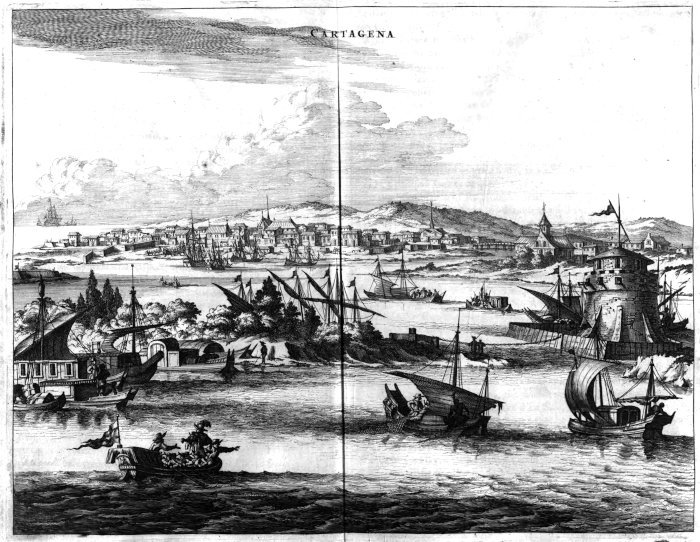
The principal Towns and Places of note are 1. Carthagena, (so call’d either from the resemblance of its Situation with the City Carthagena in the Kingdom of Murcia belonging to Old Spain, or because the first Inhabitants were Citizens of the said City) which was begun to be built Anno 1532. by Peter de Heredia, but fully finished by Georgio Robledo, eight years after the first Foundation thereof was laid. This Episcopal Metropolis is on the North wash’d by the North Sea over a plain shallow Ground; on the Land side the Sea flows through a narrow Bay by the City towards the Lake Canupote, which ebbs and flows equal with the Ocean, and receives and discharges its Water through two Pipes which lie under a long Bridge, joyning Carthagena to the Main Coast. This City boasted long since above five hundred Stone Houses, being divided into twenty six large Streets, whereof four are six hundred and twenty Paces long: behind each House is a Garden; and the Church appears above all the other Buildings: The Dominicans Cloyster is also fairly built; neither is the Franciscans inferior to it, who also possess a second Edifice on the Main Continent over the Bridge. The Custom-house and Court where the Courts for the whole Province of Carthagena are kept, are also stately Structures. The Haven hath two Entrances, the chiefest whereof lies half a League Eastward from the City, and the Western, call’d La Boca, is as far again; both very dangerous, because of the many blind Rocks that lie before them. Anno 1585. when Sir Francis Drake took Carthagena by Storm, the whole was fortifi’d with Sconces, besides two Forts for the better security thereof, whereof one lock’d up the narrow Mouth of the Haven with a strong Chain; not far from which stood an Abbey, Dedicated to the Franciscans, and Wall’d round about; since which they have several Out-works, Forts and Towers, to prevent all foreign Invasions. The City grows wealthy daily by the Peruan Plate-Fleet putting in there before they go to Spain, and especially by the Trade from New Granada along the River Magdalena. The Island before the Haven, antiently call’d Codega, now Carex, inhabited by Fisher-men when the Spaniards Landed there, is now desolate, the remainder of those that were destroy’d by them being fled to wild places from the Spaniards Cruelties; notwithstanding the People hereabouts were valiant enough to Engage with them. But since the Devastation made by Sir Francis Drake, Carthagena hath 402receiv’d a more fatal Blow; for it was scarce fully repair’d, when five French Privateers burnt the City to Ashes: which Mischief was occasion’d by a Spanish Seaman, who being whipt by Command of the Governor, resolving for Revenge, went from Spain to France, and conducted the fore-mention’d Ships to Carthagena, where he reveng’d himself on the Governor; for finding him asleep, he first wak’d him, and after having told him of his causing him to be Whipt, he kill’d him. The Booty which the Spaniards carried from thence at that time amounted to above a hundred and fifty thousand Ducats.
The Balsam of Tolu very famous.
2. Tolu, by the Spaniards now call’d St. Jago, twelve Leagues distant from Carthagena, a Place memorable for the excellent Balsam which is brought from thence, and commonly call’d The Balsam of Tolu; it is gather’d in a Spoonful of black Wax, stuck under the Hole cut in the Bark of a low Pine-Tree, out of which in hot Weather runs a Golden colour’d Gum, very soveraign, and of an excellent smell.
3. St. Crux de Mopox, a neat Town, seated a little above the confluence of the two Rivers, St. Martha and Magdalena, which waters this Province.
4. Baranca de Nolambo, a Place of great Traffick, especially for all Commodities of the new Kingdom of Granada; it standeth upon the Banks of the River Magdalena, and about six Leagues distant from the Sea.
5. Buena Vista, otherwise call’d St. Sebastian de Buena Vista, a Town commodiously seated upon a rising Ground not far from the Gulf of Urraba, or the Sound of Darien, about a League and a half from the Sea.
6. Villa de St. Maria, thirty Leagues Southward of Carthagena.
Rivers of Carthagena.
The Province of Carthagena is stor’d with many Brooks and great Rivers, amongst which the Stream Cauca falls into the River Magdalena, beyond Popayan near Mopox.
The River Zenu, which gives Denomination to the above-mention’d Territory, makes a very convenient Harbor with its Mouth, where much Salt is to be had.
The Daria, which runs between Panama and Carthagena into the Inlet Urraba, gives its Denomination to the foregoing Province, through which it also runs, as hath been already mention’d.
The River which for its greatness is call’d Rio Grande, or Magdalena, (because it was discover’d on the Day Consecrated to that Saint) falls with such force into the Northern Ocean, about twenty three Leagues Eastward from Carthagena, that running two Leagues broad and ten long into the Sea, it retains its freshness of Water; in which there lying many Rocks, makes the same very dangerous for Ships. In the Mouth of the Haven lies an Island, which is divided by the River, the widest and most frequented Channel of which respects St. Martha, where those that carry the Merchandise up this Stream to New Granada, spend two Moneths in Toeing, whenas they come from thence in three Weeks.
Thunder and Lightning rages here many times after a terrible manner from Midnight till Morning. In January there falls also abundance of Rain, which gliding from the Mountains swells the River exceedingly.
403
Sect. V. St. Martha.
Description of St. Martha.
St. Martha, so call’d from the chief City of the Province, is border’d on the West with New Andaluzia; on the East, with Rio de la Hacha; on the North, with the Ocean; and on the South, with New Granada; It is about threescore and ten Leagues in length, and not much less in breadth: It was antiently distributed into several little Seignories, Govern’d by Casiques, or petty Princes, viz. Pozigueica, Betoma, Buritaca, Chimola, inhabited by valiant Men and beautiful Women, and above all the rest, Tairona, (whose People for a long time maintain’d War against the Spaniards) lying at the Foot of the high Mountains Sierras Nevadas, whose snowy Crowns are seen thirty Leagues off at Sea, and run along in a continu’d Ridge through Peru and Chili to the Straights of Magellan.
This Countrey was Discover’d, and part of it Planted, Anno 1524. by Roderic de Bastredas, who afterwards was murder’d in his Sleep by his own People.
The Nature of the Climate, and Commodities of the Countrey.
The Sun shines so exceeding hot near the Sea-coast, that there is no enduring of the same; but up in the Countrey the snowy Mountains occasion great Cold, and in Harvest and October it Rains exceedingly, whereas at other times it is very dry Weather, and the Winds blow generally out of the East or North-East, yet the Land-Breezes coming out of the West bring sometimes Rains with them. From the Mountains, which are stony and barren, fall many Brooks and Rivers, which water divers Plains, the Grass and other Plants of which are often blasted by violent Storms; nevertheless Oranges, Lemmons, Granates, and all sorts of Spanish Garden Fruits grow here in great plenty. The Woods afford likewise Pigeons, Partridges, Venison, and the like; the Rivers all manner of Fish, which are seen to swim in great numbers twenty Yards under the Water, especially in the Haven St. Martha, near which formerly liv’d many Fisher-men, who with Nets made of tough Twigs pleited together, caught such plenty of Fish, that they furnish’d all their Neighbors. The High-ways are made dangerous by Lyons, Tygers, and Bears.
Great plenty of Precious Stones in these Parts.
Peter di Lugo his Treachery to the Natives.
The Welsares Journey.
The Countrey Buritaca affords the Inhabitants Gold; Tairona, excellent Stones against Bleeding and the Gravel, Jasper, Porphyr, and Gold; the Valley Tunia, many rich Emeraulds, which Stones us’d to be in great esteem before America produc’d such great numbers of them. Acosta relates, That a Spaniard desiring to know the Price of an Emerauld, shew’d two to an Italian Jeweller, who valu’d the one at a hundred, the other at three hundred Ducats; but soon after seeing a Chest full of them, said they were scare worth a Ducat apiece; and that the Sute which the Roman Lady wore, being beset with Emeraulds, and valu’d at four hundred thousand Ducats, would not sell now for half so much. This Stone or Jewel exceedingly fortifies the Sight, wherefore the Emperor Nero represented the bloody Encounters of Fencers in an Emerauld. It is also judg’d to be good against the Falling-sickness, wherefore the Indians hang them in their Noses to this day, and adorn their Idols with them; they grow in stony Rocks along Veins, not unlike Crystal, and in time obtain a glittering Greenness; the biggest of them that are found in this Age are most esteem’d of in Genua. The Emerauld Pillar, which as a wonderful Ornament stood in Hercules’s Temple in the City of Tyrus, being very famous amongst the Antients, was without doubt no more than a green Stone; and perhaps of the same Material, was the Pillar erected by the Arabian King Miramamolines, in the Cathedral at Corduba. But the great fame of these Emeraulds incited Gonzalvez Zimenes, 404Governor of St. Martha, to leave his Place and seek for them; to which end he Sail’d up the Rivulet Gayra with two Ketches and forty five Spaniards, who meeting with the Casique Bagotta, got much Gold of him, and afterwards went to the Valley Tessuca; of which Simandoca being Governor, conducted Ximenez twenty three Leagues farther to an Emerauld Rock, from whence he return’d exceedingly enriched; the rumor of which spreading up and down, made several travel thither; amongst whom was Peter di Lugo, Governor of Terra Firma, who sending for Aid from Carthagena, fought his way to Bagotta, who resisted him for some time, till at last being defeated he made Peace with them for a considerable quantity of Gold; which when Peter di Lugo had receiv’d, not regarding his Word, he plunder’d all the Countrey, and having committed all imaginable Cruelties on the Natives, return’d home with an invaluable Mass of Gold and Emeraulds to St. Martha. Not long after the Welsares, German Knights, came from Venezuela, (which City the Emperor Charles the Fifth Morgag’d to them Anno 1518.) and travell’d through the snowy Mountains of St. Martha with Indian Guides, whose Instructions following, they digg’d many Emeraulds out of the Valley Funia; the Inhabitants of which affrighted at the sight of the Strangers, hang’d themselves out of despair, though naturally valiant, and ingenious in working in Tapestry the shapes of Tygers, Lyons, and other Beasts, and painting on the Walls of their Houses variety of Figures of divers colours, covering their Floors with Mats neatly pleited of Rushes. They fed on Fish, Venison, and Mans-flesh, and also on the Roots Agies, tasting like Chesnuts, Yuca, Maiz, Batata, and Cassada.
Chief Cities and Places of note.
The chief Cities and Places of principal note in this Province are 1. St. Martha, which gives Denomination to the whole Province, it stands built at the North Sea, which makes a large and convenient Harbor, being defended from the Winds by high Mountains and two Isles, is a Bishop’s See, and hath a large Cathedral. The Houses built of Canes are cover’d with Palmito-Trees, and some with woodden Shingles. The Haven hath neither Fort nor Castle to defend it, because there is no Trade but with the Indians, which bring Earthen Ware and Cotton Clothes to sell; and because the Spanish Ships seldom come hither, the Place is much gone to decay, and the more, because it is no way defended against any Assault of an Enemy, which the French, and afterwards the English, under the Command of Sir Francis Drake, and the following Year under Captain Anthony Shirley took advantage of, and plunder’d and burnt the City.
2. Teneriff, built on the Banks of the River Magdalena, forty Leagues from St. Martha.
3. Tamalameque, otherwise call’d Villa de las Palmas, twenty Leagues South of Teneriff, lying on a high stony Ground; between which are plain Pastures for Cattel, surrounded with high Woods, as also Pools made by the over-flowing of the Rivers, whose Banks are inhabited by the Indians, who are much addicted to Sleep and Drinking. The Pools before mention’d produce abundance of Fish, as also Crocodiles, and the terrible Manati before describ’d.
4. Ocanna, which hath an Inland Haven.
5. Ramada, formerly call’d New Salamanca, standing at the Foot of the Mountain call’d Sierras Nevadas. This Town is famous for its Copper and Brass Mines.
6. Cividad de los Reyes, which built in the Valley Upari, stands on the Shore of the mighty River Guataporeya, where from the beginning of January till May the Eastern Breezes moderate the Heat, otherwise intolerable: But the continual Rains thereabout occasions the Quartan Ague, and many such like Distempers. The Natives hereabouts, salvage and valiant, would never submit to the Spaniards.
The Tree Xagua.
405The peculiar Plants of this Place are the Tree Xagua, which bears a Fruit like a Raisin, which dry’d and ground yields exceeding good Meal for Bread.
The Root Scorzonera.
The Root Scorzonera, which cures the Bitings of Serpents. The Indians also use the Tail of a Serpent for a Remedy against the same Evil, as they take Tobacco against the Falling-sickness, and snuff the Powder in at their Nostrils, and drink the Juice thereof to cause Loosness.
Chief Rivers.
The chief Rivers of this Province, are 1. Polomino, so call’d from a Spanish Captain, that was drown’d there with his Horse, falling from the Sierras Nevadas.
2. Guatupori, whose Water causes the Bloody-flux and Loosness, which again is cur’d by the same Water drunk with beaten Cinamon. Guatupori reckons many Rivulets, amongst which the Cesar and Budillo are both large, deep, and abounding with Fish.
Near the City Los Reyes are three great Water-pits, triangular between stony Cliffs; nigh which a Tradition goes, That of old there lurk’d a terrible Serpent, which at times devour’d a thousand People; insomuch that none durst dwell thereabouts, till certain Spaniards having the hardiness and curiosity to go seek out this Serpent, heard a great noise in the Pits, but saw nothing like the fore-mention’d Animal.
Here are likewise several Fountains of Pitch and Tar.
Sect. VI. Rio de la Hacha.
Rio de la Hacha.
Rio de la Hacha is the Name of a little Province lying on the North-East of St. Martha, wash’d on all other parts with the Waters of the Main Ocean, or with the Gulf or Bay of Venezuela.
Chief Towns of this Province.
The chief Towns of this Province, are 1. A small Town call’d De la Hacha, which gives Denomination to the said Province, having no convenient Haven, but otherwise seated in a Soil very rich and fertile, not onely of all sorts of Fruits and Plants, especially such as are brought from Spain, but likewise in many Mines of Gold, Gems of a large size and great value, and many excellent Salt-Wiches, as they call them; It is eight Leagues distant from Salamanca aforesaid, and eighteen from Cape Villa, the most Westerly Point or Foreland of the Bay of Venezuela; and with the rest had the hap to be surpris’d and pillag’d by the English with Sir Francis Drake in the Year 1595. who refus’d twenty four thousand Ducats, which the Governor proffer’d him for the Pearls he had taken.
2. Rancheria, six Leagues Eastward of La Hacha, inhabited chiefly by Pearl-Fishers, or such as get their Living for the most part by Fishing for Pearl, which was wont to be good on these Coasts.
3. Tapia, five Leagues from La Hacha, and considerable, for that the adjacent Parts were laid waste by the English, to revenge the perfidiousness of the Governor of Salamanca, refusing to pay the four thousand Ducats he had promis’d, upon Condition of their sparing the Town.
Abibeca the last King of this Province.
The last King of those that Govern’d in any of these Provinces of Terra Firma, was Abibeca, who could not be won to come down from his Palace, which he had on the top of a Tree, till a Spanish Officer, one Francisco de Vanquez began to lay an Ax to the Root thereof.
After Didaco Niquesa, Alphonso Oreda, and Anciso, had made very large Discoveries in these Provinces, Valboa was the first that discover’d the Way to the South-Sea.
406

CHAP. III. New Granada.
First Discovery of New Granada.
The new Kingdom of Granada, as ’tis commonly call’d, was for the most part both discover’d and conquer’d by Gonsalvo Ximenes, about the Year 1536. and with so good success, that in less than a years space, the whole Countrey was quietly setled under the Spaniards Government, and the Captain with his small Company had made shift to gather together such a Mass of Treasure as may seem almost incredible, viz. from the Reguli, or petty Princes of those Countreys, whom he had either destroy’d or made Tributary. But a more particular Relation of Ximenes his Journey take as followeth:
Gustavo Ximenes his Expedition.
Being sent out by Peter Ferdinando de Lugo, to discover the Countreys that lay along the River Magdalena, he travell’d upon the right side of it with great trouble; for not onely the brambly Woods, Moors, and deep Brooks, made the Way exceeding bad to be travell’d, but also the Inhabitants, who fell upon him from their Ambuscades: yet at last he reach’d Tora, which Name he chang’d into Pueblo de los Bracos, because four Rivers unite their Waters there. Here ordering his Brigantines which were come up the River to cast their Anchors, he judg’d it convenient to stay all the Winter, because the swoln Rivers had drown’d the adjacent Countrey. Ximenes observing that the Indians fetch’d Salt from the Sea-side, judg’d that the Countrey was inhabited, and therefore in fair Weather march’d up to the Mountain Opou, behind which he found a Countrey full of Salt-pools, which produc’d Cakes of Salt. And somewhat farther the Province Govern’d by the Casique Bogata, who at first resisting the Spaniards, was soon put to flight, when he heard the noise of the Guns. The Panches divided from Bogata’s Countrey by a small Mountain, also maintaining continual Wars with him, suffer’d the Spaniards unmolested to travel through their Countrey, and the Valley La Trompetta, to a high barren Mountain, on the top of which Ximenes found several Emeraulds; and going from thence fell upon the Casique Tunia, and three days Journey farther, upon the Governors Sagamosa and Diutama; from which three Countreys he carried above a hundred and ninety thousand pieces of fine Gold, fifty five thousand pieces of indifferent Gold, and eighteen hundred Emeraulds; all which the Spaniards left behind with Guards whilest they went back to Bogata whom they found lying dead of his Wounds on a high Hill: But Sagipa, Bogata’s Successor, receiv’d Ximenes with great Civility, to engage his Assistance against his Neighbors the Panches; which he did not refuse him: but afterwards he fell most perfidiously upon the said Sagipa, whom he caus’d to be Executed, because he either could not, or would not discover where those Riches were which Bogata had left behind him. After he had pillag’d the little Region Neyba, and brought into subjection the whole Countrey, he gave it the Name of New Granada, from Granada the place of his Nativity, being the chief City of the Kingdom of Granada in Spain, and built the City Santa Fe; which done, he quitted the Place, upon information that Sebastian de Bevalcazar coming from Popayan, was seeking a Way Northward; and not long after him Nicholas Federman follow’d, each claiming New Granada as their Right, whereas Ximenes alledg’d, That the first Discovery thereof was to be ascribed to him onely: at last Agreeing, they resolv’d that it should be at the King of Spain’s disposal.
The Nature and Custom of the Moxas.
407The antient Inhabitants, nam’d Moxas, divided their Countrey into two chief Principalities, viz. Bogota and Tunica, which before the Spaniards Arrival were each under their particular Casique or Prince. The Men were of a good proportion; the Women also handsomer, and of a fairer Complexion than their Neighbors: Their Habit also consisted of black, white, and divers colour’d Cotton Cloaks, and some also had Bonnets of the same. The temperateness of the Climate makes little difference between Winter and Summer. Their Houses were of Planks, and cover’d with long Rushes. Their chiefest Food was Maiz and Cassave, which first grows on Stalks as large as Canes, containing very large and weighty Spikes or Ears, each Ear generally yielding seven hundred Grains, which are Planted in hot and moist Ground; one Bushel Sow’n, generally produces three hundred. But the Maiz is distinguish’d into a courser or finer sort, which last is call’d Moroche, the Leaves and Canes whereof afford a wholsom Provender for Horses, and the Corn, Bread for the Inhabitants, who make it several ways; for sometimes they boyl it in Water, and at other times parch it in Ashes, or grind it to Meal, which kneading into Dough, they make into Cakes, Biskets, and the like: Moreover, Maiz steep’d in Water, and after being boyl’d and set a working, makes a very strong Liquor. They also use Cassada, which they make of the Root Yuca, which being large and thick, is cut in pieces, grated, and all its Juice, which is deadly poyson, being press’d out, is Bak’d in thin Cakes. There is likewise another sort of Yuca, which hath not so poysonous a Juice, keeping good a long time, and is both wholsom, and of a good taste. The Natives of old liv’d much upon the Roots Yomus, and Cubias, all sorts of Venison, Fowls, and Fish, which the Rivers and Lakes afford in great abundance. Those that are left of the Natives, are a deceitful, crafty, and ingenious sort of People, very apt to learn Art, and to Trade with Salt to Rio Grande, and the Mountain Opou.
Besides Copper and Steel-Mines, this Countrey hath also several of Gold; and the Fields produce all manner of Plants.
The Nature of the Panchas.
The Panchas which remain are yet a salvage People, but their Countrey is an indifferent fertile Soil, though not in all places alike; for those which border upon Tunia fed much heretofore on Pismires, of which some being long, have double Wings, others lesser and without Wings; which last sort being roasted, are accounted a great Dainty, and a speedy Remedy against the Distemper of the Gravel. There are also a sort of venomous Pismires, which stinging a Man, cause a swelling and great itching, and these are call’d Tayoques, whose Stings are cur’d by a Plaister of bruis’d Pismires.
The Bounds and Dimensions of Nova Granada.
The Countrey is bounded on the North with Castella Aurea aforesaid; on the West, with Mare del Zur; on the East, with Venezuela; the Southern parts of it being not well discover’d, by reason of certain huge and unpassable Mountains, which block it up wholly on that side, save onely where a Passage is kept open into the Province of Peru, specially so call’d: It containeth in length about a hundred and thirty Leagues, and not much less in breadth, being for the most part a very healthful Countrey, and abounding in Mines of the best sort of Metal, besides others of Brass and Iron. It is subdivided into these two Provinces, viz. Granada and Popayana.
408
Sect. II. Granada.
Description of Granada.
Granada, specially so call’d, is a Countrey of a very temperate and good Air, as hath been before observ’d, neither subject to over-much Cold, nor to extremity of Heat; which is the more to be admir’d by reason of its nearness to the Line, from which it is distant Northward but a very few Degrees.
Towns of chief note.
The Towns and Places of chief importance are, 1. St. Foy, commonly call’d St. Foy de Bagota, which was the old Name of this Province, and to distinguish it from another St. Foy, in the Countrey of New Mexico above mention’d. It is the Metropolis and Capital City of this Province, an Arch-bishop’s See, and the ordinary Residence of the Governor, built by the above-mention’d Gonsalvo Ximenes upon the Lake call’d Guatavita, and hath been long since inhabited by above six hundred Families of Spaniards.
2. St. Michael, twelve Leagues Northward of St. Foy, and a well Traded Town. The Indians that dwell about this Place being above five thousand, pay great Tribute yearly. Not far from hence lies the Lake Guatavita, where the Inhabitants in former times Offer’d much Gold to their Idols.
Commodities of the Countrey of Tocaima.
3. Tocaima, fourteen Leagues Westward from St. Foy, within a Territory which antiently belong’d to the Panches, who yet possess the worst part of it, lying still wild and unreduc’d: It is situate on the Banks of the great River Pati, which falls into the Rivulet Magdalena. This City, which enjoys the benefit of a wholsom Climate, is surrounded with Mines of Gold, Copper, Silver, and Lead. And besides the Fruits of the Countrey, all Spanish Plants thrive exceedingly after once Planted; and though Sheep will not breed here, yet Kine, Hogs, and Goats increase daily, but are often devour’d by Tygers, Lyons, and Bears. The Woods produce Nut-Trees, Cedars, Guaiacum, or Pock-Wood, and the wonderful Tree Zeyba, whose Leaves fall off every twelve hours, and grow again. The Fowls of this Countrey are many and several. Near the City are sulphurous Fountains, whose Waters cure Scabs and Leprosie. In the Valleys also flow Springs of salt Water, which thrown on Herbs, turns to Rozen and Pitch, and is good to make Boats tight. The tops of the Mountains are continually cover’d with Snow, notwithstanding some of them vomit forth horrible Flames and Ashes, which are blown several Leagues over the Countrey. The vicissitude of the Weather occasions two Summers and two Winters; the first Summer begins in December, and the second in June; the first Winter accordingly begins in March, and the other in October. This alteration of Seasons is not distinguish’d by any change of Heat or Cold, but the continuance of fair Weather during the Summer, and in the Winter, of such terrible Hurricanes, that blow from North to South, or from South to North, with such Thundering and Lightning, as if the end of the World were at hand. The chiefest Trees that grow here are Cedars, and one that bears exceeding great Almonds. The Quaque also bears a pleasant Fruit about the bigness of a Goose-Egg; and the Fig-Tree, Figs as large as Oranges. The Agnapa which grows here is of such a nature, that an European sleeping under it, swells exceedingly, but an Indian bursts. The Bark and Sprigs of the Hobo, which grows high and round, serve against Swellings and Ulcers, and occasion also Loosness. Sugar-Canes grow also here in great abundance, amongst which feed certain Beasts like Hogs, whose Navels grow on their Backs; and large Stags. The Fountains in most places of this Countrey run with salt Water; and sometimes Salt is found between fresh-Water Brooks. The Natives, who are valiant, subtile, and well proportion’d, are since their giving over eating of Mans-flesh much increas’d, and many of them forsaking their Heathenish Idolatry, have embrac’d the Roman-Catholick Religion.
4094. La Palma, built Anno 1572. in a certain Territory, the People whereof were antiently call’d Musi and Colymæ.
5. Trinidad, which is indeed the antient Tudela renew’d, or a City sprung out of the Ruines thereof. This Tudela stood on the Shore of the River Zarbi, which running between high Mountains, makes the Rivulet Turatena, and in the same Territory as La Palma above mention’d, viz. of the Musi & Colymæ, by whom the Spaniards, who had here a Colony, were so exceedingly molested, that they deserted the same, together with their Governor Peter de Orsua: yet not long after the forsaken Place was again re-built by the Name of Trinidad; but that Place proving incommodious, was again abandon’d, and a new Trinidad built, where now it is to be seen on a convenient place Eastward from the high and cold Mountain Paramo. From several rich Gemmaries thereabouts are digg’d store of Emeraulds, Crystal like Diamonds, white Marble, and the Beryl, especially on the Mountains Ytoco and Abipi.
6. Tunia, having a Territory about it, to which it gives Denomination; It lies on a high Hill, from whence the Church and two Cloysters of the Dominican Fryers are seen at a great distance. Here also is kept the greatest Market in New Granada.
7. Pampelona, sixty Leagues distant from St. Foy to the North-East, abounding with Cattel and Gold.
8. Merida, surrounded with Corn-Fields, the farthest Town of this Province North-Eastward towards Venezuela.
9. Belez, which though it suffers great prejudice by a burning a Mountain that vomits Fire and Stones, and also Thunder and Lightning, is the greatest Residence of several Orders of Fryers.
10. Marequita, otherwise call’d St. Sebastian del Oro, which lies under a hot Climate, and hath much Pasture.
11. Ybague, the Habitation chiefly of Dominicans.
12. La Vittoria de los Remedios; and 13. Juan de los Lanos, or St. John of the Plains, seated in a rich Nook of the Countrey, where there are good Silver and Gold-Mines.
The Merchandise that come to these Towns, are brought up the River Magdalena in Canoos of sixty Foot long.
Sect. III. Popayana.
Situation and Description of Popayana.
Popayana, the other part of this new Kingdom, is border’d on the West with part of Granada last spoken of, from which the River St. Martha divides it for the most part: On the North it hath Nova Andaluzia, or Carthagena; on the West, Mare del Zur; and on the South, Quito, or rather some unreduc’d Countreys lying betwixt them both; It extends in length above a hundred Leagues from North to South, but in breadth, betwixt the River and the South Sea, not much above forty or fifty. The Countrey is said to be a little too much subject to Rain, yet not so, but that the fertility of the Soil answers the industry of the Inhabitants in most places very well.
410Sebastian de Bevalcazar, Governor of Quito, marching Anno 1536. with a Company of Spaniards to Otabalo, where the Countrey Popayan begins, was often set upon by the Natives from their Ambuscades, and the many Inconveniences which he suffer’d for want of Provisions, and trouble of travelling over the high Mountains, had necessitated him to return, had he not been resolutely bent to discover the Countrey; to which purpose marching on leisurely, he came into the heart of Popayan, where his wearied People sufficiently resting themselves amidst a fruitful Countrey, where they found pleasant Fruit-Trees, Houses full of Provisions, and fresh Rivers, which glided from the Mountain Andes, and some of the Rivulets also affording Gold, were encourag’d to build several Villages; in which nevertheless they made no Settlement, either because they could not get Gold enough, or else being driven from thence by the valiant Natives.
Cities and Towns of chief note.
The Places of chief note in it, are 1. Popayan, situate on the Banks of a fair River, but not nam’d, and in the midst of a Plain in a place of great Wealth, and enjoying a good Air. The original of the Name Popayan is from the Casique who Govern’d there at the time of the Spaniards first Arrival. It is a Bishop’s See, and the ordinary Residence of the Governor of the Province. The chief Buildings are the Cathedral, and a Monastery of the Fryers De la Merced. The Savanna Grounds towards the North feed many fat Cattel. The Fields produce the best American Maiz. Some of the adjacent Mountains either vomit Smoak, Flames, great Stones, or scalding Water, leaving a Salt behind it. Beyond the City Popayan the great River Magdalena takes its original in the Valley Cali, where several Brooks gliding from the Mountain Andes, inhabited by the Cocunocos, unite their Waters.
2. Antiochia, otherwise call’d St. Fides de Antiochia, on the Borders of New Andaluzia, and about a hundred Leagues from Popayan. In the midst of a small Territory to which it gives Name, in the Valley Nore, between the River Magdalena and Daria, wash’d by Rivulets, whose Sands are Golden, and whose Banks are shaded with all sorts of Fruit-Trees. The Inhabitants white and very rational, sleep in the Night under the open Skye: Their Houses are built a good distance from the Highways; near which the Pastures feed abundance of Sheep. The Pools breed plenty of Fish, and the Mines store of Gold, especially in the Mountain Buritica.
3. Caramanta, seated likewise on the Banks of the River St. Martha, within a little Province also of the same Name; the Inhabitants whereof being valiant and strong go naked, and dwell in little Huts, make white Salt out of a Fountain and a little Lake: they generally go to Antiochia in six hours, which is forty five Leagues, so swift runs the Stream.
4. St. Anne, in the Cantred or Hundred of Anzerma, a Town neatly situate upon the side of an Hill betwixt two Rivers, and in the midst of Plain no less pleasant than fertile: It was so call’d by Bevalcazar, because the Indians of this Place name the Salt Anzer; it is surrounded with Villages and Woods on a high Plain between two Rivers. The Air being exceeding hot, lightens generally every day.
5. The Village Pueblo Llana, which is inhabited by little People, who Trade in Salt, and have also Golden Rivulets. Near this Place is the Valley Aburra, consisting of many fruitful Plains, moistned by several Rivers; the Inhabitants whereof at the Spaniards first coming thither, hang’d themselves, with their Wives and Children.
6. St. Jago de Arma, built in a Wood of Palm-Trees, so nam’d from the Territory in which it standeth, rich and famous for its Mines of Gold, which it is said to have many and very good: The Ground round about being Mountainous, hath several Rivers, the chiefest whereof call’d Di Arma, is dangerous to cross, especially 411in Winter. The unwholsom Air hereabouts occasions many Sicknesses. Amongst other Fruits that grow in this County, is the Pytahaya, which whoe’re eats, voids Urine as red as Blood. Adjacent to it are the little Provinces Paucuran, Pozo, and Picara, which possess Golden Mines: also the Territory Carrapa which hath high and rugged Land, and many Rivulets: likewise the County Quimbaya, which abounds with thick and long Canes, wherewith the Natives build their Houses; in the hollow Bodies of these Canes the wild Bees gather store of Honey; and amongst them breed also exceeding great Lyons, the four-footed Beast Chuca which carries its Young in a Bag, Stags, Rabbets and Guadaquinajes, which being bigger than Hares, are exceeding good Meat. The Mountain Nevada, wonderful high, and smoaking continually, produces the golden Rivers Tacurumbi & De la Cequo. Twenty Leagues or more distant from St. Jago is, 7. Carthago, the chief City of Quimbayaes, and by which the aforesaid Rivers run. The temperate Climate here gives Health and long Life to the Inhabitants, who have several Fountains of salt Water, and the Fruit Caymito, not unlike a Peach, black within, having little Kernels, and a Juice which Dyes so deep, that it can scarce be wash’d off. Horses and Cows they have likewise very plentiful. Carthago it self stands in a pleasant Plain between two Rivulets; the Ways that lead to the same are very dirty, because of the continual Rain which falls there, with Lightning and Thunder. A League beyond the City flows the Stream Consota; near which lies a Lake, out of which Salt is made.
8. The City Cali, the Residence for the Governor and Collector, lying under a hot Climate in a plain Valley at a River, which falling from the Mountain, glides to the Stream Magdalena. Round about the same dwelt antiently several People, viz. the Gorrones, so call’d, because they nam’d a Fish Gorron, the Chancos, Giants, with long Faces and broad Foreheads, the Aarbacoas, Agnales, and Los Timbas, inhabiting among barren Mountains; but most of them were slain by the Spaniards, or destroy’d by one another, few onely escaping to the tops of the Mountains. The Countrey also swarms with wild Beasts, which have also devour’d many of the Inhabitants, both Indians and Spaniards.
9. The Haven Bonaventure, situate in a deep Inlet, about which live some Families which send the Commodities that come from New Spain to Popayan, Cali, and other Places; and though there be a Way along by the River Dagua, convenient for Mules and Horses to travel, yet it is seldom us’d, because the Cattel are so wearied out with the long Journey, that they cannot go through with their Loads; wherefore they employ the Indians to carry their heavy Burthens over the Mountains, which they do for a small Reward.
10. St. Juan de Pasto, giving Denomination to the Countrey about it, and being built on the pleasant Plains of the Valley Atris, is situate in a wholsom Climate, and is moistned by several Fountains and the River Angasmayo, the Boundary of Peru. The Spaniards have several Houses here, and breed store of Cattel, and especially Hogs. They have likewise Sugar-Mills, with which they make abundance of Sugar. The antient Inhabitants were salvage, deform’d, and of little Reason.
11. Timana, giving Denomination to the Countrey about, is plac’d under a hot Climate, yet the Inhabitants live long; they drive a great Trade with Thred spun out of the Herb Pita; and also with Sweet-meats, Fruits Preserv’d with Honey and Sugar, and especially a Kernel not unlike an Almond. In their Gardens they Plant the Herb Cocoa, which they chew constantly for the strengthning of their Hearts. Near Pita is a Mountain with Load-stones; and somewhat farther the Habitations of the valiant Yalcones in the Valley Aquirya, the Paezes, Pixaos, and Manipos, which so molested the Spaniards, that they forc’d them to forsake the Towns Neyra, St. Vincent, and Ville de los Angelos.
41212. Guadalajara de Buga; and 13. Sebastian de la Plata, built on a Plain near the River Guali; the Countrey about which is exceedingly troubled with Earthquakes, and the Inhabitants with their Neighbors the Nineres, who bring the Flesh of their Prisoners to Sale in the publick Shambles.
14. Almague, built on a high Mountain, and lying under a cool Climate, is surrounded with fruitful Fields, which feed store of Cattel, and enrich’d with several Gold-Mines.
15. Juan de Truxillo, which the Indians call Yscance.
16. Madrigall; 17. Chapanchipa; 18. Malaga; and 19. Agreda; the Mountains about which inclose store of Gold.
Between the Promontory De Corrientes and the Island Palmas, are the Rivers Salinas and Balsas, which fall into the Southern Ocean; St. Juan, whose Banks are inhabited by a salvage People which dwell in the tops of the Trees, because the River oftentimes overflows the Countrey. They sowe Pease and Beans, and catch Fish, but buy other Provisions, with Gold.
The Isle Gorgona.
Against the Mouth of this River St. Juan lies the Isle Gorgona, three Leagues in circumference, which is compar’d to Hell, because of the dismal Woods which are upon it, barren Mountains, Millions of Musticho’s, whose Stings are intolerable, and never-ceasing Rain, insomuch that the Sun never shines upon it.
The Isle Del Gallo.
West-South-West from Gorgona lies the round Island Del Gallo, about a League in circumference; it is divided by several Rivers, and round about Planted with Trees, on which the Indians dwell as at the River St. Juan.

CHAP. IV. Peru.
The Description and Division of Peru.
Peru, so call’d, as some think, from the River Beru afore mention’d, in the Southern part of America, was antiently a great and mighty Kingdom, as Mexico in the Northern, and fell under the Power of the Spaniards much after the same manner that the Kingdom of Mexico did, viz. through the Dissentions and Differences amongst the People themselves, as in the History of this considerable part of the New World will be related at large hereafter.
Commodities of the Countrey.
The Fountain Puchio.
Another strange Fountain.
A most wonderful Rock.
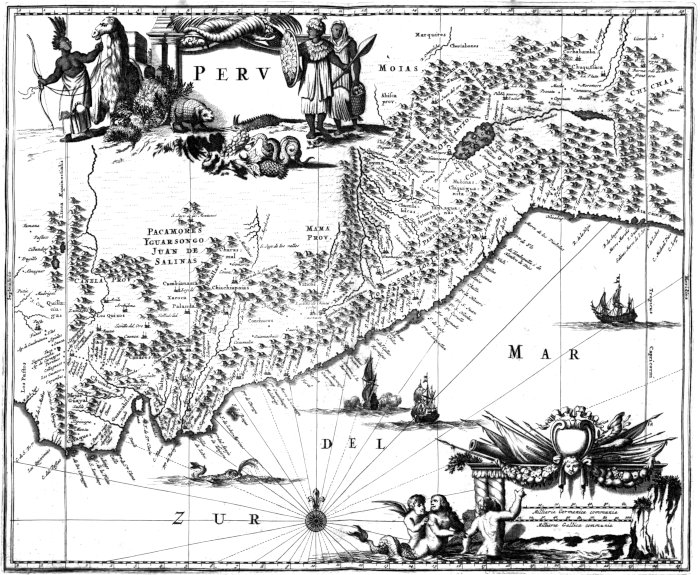
413The Kingdom of the Kings of Cusco, which in some sence, and by some Writers upon occasion, is call’d The Kingdom of Peru, was extended by the last Inca or King, Huayna Capac, from North to South above a thousand Leagues together, comprehending not only a great part of the Province of Chile towards the South, but also the new Kingdom of Granada, and divers other Provinces to the North; but Peru, properly so call’d, containeth little more than half so much, viz. six hundred Leagues in length, and about fifty or threescore in breadth, except onely in some places, as in the Countrey of Chacopoyas, where ’tis thought it may be a hundred Leagues from the Andes to the South Sea: It lieth between the first and fifth Degrees of Southern Latitude, and is bounded on the East and North-East with that vast Ridge of Mountains which they call the Andes; on the West it is wash’d with Mare del Zur; on the North it hath the Countrey of Popayan; and on the South, Chile: It is commonly divided into three parts, which they call The Plains, The Hill-Countrey, and The Andes; the Plains are that part of the Countrey which lie along upon the Sea-Coast, being for the most part a meer Level without any Hills at all. The Sierra, as they call it, or Hill-Countrey, is that part of Peru which is partly mountainous and partly plain, fertile and well inhabited in both. The Andes are so high, rocky, and inaccessible, that they are scarce inhabited at all but by Salvages, save onely upon the skirts of them. The Plains from the Sea-shore to the Hill-Countrey, are for the most part about ten Leagues over or broad, upon which it scarce raineth all the year long. The Hill-Countrey is commonly twenty Leagues in breadth where narrowest; and from September to April hath Rain, the rest of the Year generally being fair Weather; but on the Andes, which take up all the rest of the Countrey of Peru, it raineth almost continually all the year long. In the Hill-Countrey their Summer begins in April, as is said, and ends in September; but in the Plains it begins in October, and ends in May; so that in the space of a day a Man may feel both Summer and Winter; be scorch’d with excessive Heat in the Morning, and yet well nipt with Cold before Night. The Andes generally are cover’d with thick Woods and wild Forrests. The Hill-Countrey is for a great space naked and open; the Plains in many places sandy and dry, and would be much more scorch’d with Heat than they are, but for the neighborhood of the Sea, which affords them many cooling Gales from the South and South-West Winds, whose property, although it be natural in other parts to be tempestuous, to bring Rain and foul Weather, yet here there is nothing but Serenity and fair Sun-shine days all the year long, although these Winds blow almost without ceasing upon the Countrey, and no other at any time, whereas the Sierra, or Hill-Countreys have Wind from every Coast, and such as bringeth all sorts of Weather with it, Rain, Hail, Frost, Snow, great claps of Thunder, &c. The Countrey affordeth not so much Cattel of the breed of Europe as some other Provinces of America; but in stead of Kine and Sheep, the Woods and Pastures are replenish’d with multitudes of the Vicugnes and Pacos, which are of no less Profit and Service. The Pacos here are said to be as big as some young Heifers of two years old, bearing a Fleece like Sheep, and their Flesh no less pleasant than the Mutton of Europe. But the great Wealth of this Countrey lies out of sight in the bowels of the Earth, viz. in those rich and (as they may seem) inexhaustible Mines both of Gold and Silver, which, as ’tis well known, the Countrey of Peru affordeth more than any other Province of America besides. The Sierra opens into large Valleys, amongst the chiefest whereof are Xauxa, Andaguailas, and Yucay, all of them well inhabited and fruitful. Below Cusco the Mountains Andes and those of Sierra run a greater distance than elsewhere one from the other, leaving the great Plain Callao in the middle. Moreover, several sandy Wilds, without Water, Herbs, Trees, or any living Creature, except Birds, extend from Tumbez to Taparaca. From the Valleys flow several Rivers into the Southern Ocean. On the Mountain Pira is a Fountain call’d Puchio, which springs in the Night, but is quite dry in the Day-time. Also near the chief City Quito in the Valley Chilo, is a Fountain whose Waters boyl faster or slower according as any one speaks softer or louder; and when not a word is spoken, it stirs not at all. If any thing exceed this for strangeness, it is a Rock in the Province Concuchos, which is all compos’d of black and white Stones, which are so neatly plac’d by Nature, as if Art had done a Master-piece, in the exact placing of them one between another: but the chiefest thing belonging to it worthy of admiration, is a wonderful power either to heal or hurt; for if the black Stones in this Rock be touch’d by any, they cause immediate Death; whenas the white ones cure all manner of Sicknesses, and being digg’d out, leave a Seed behind them, out of which grow new Stones to fill up the empty place.
414
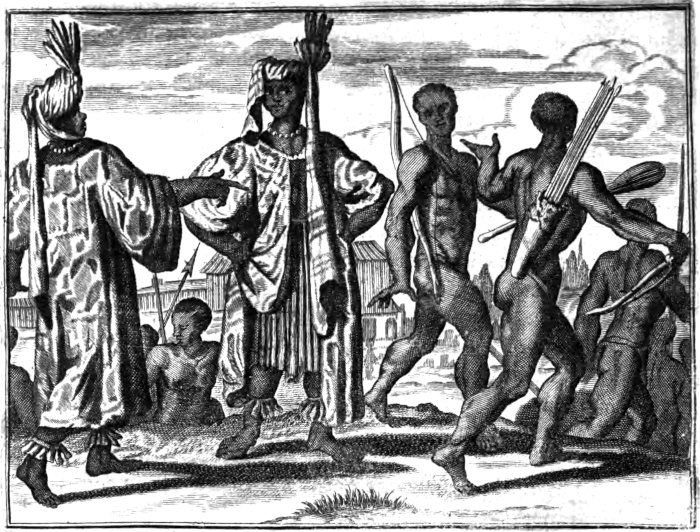
Iuca Garcilasso, Extracted from the Peruvian Kings, tells us concerning Plants, That he saw a Raddish which a Man with both Arms could scarce embrace, and that under the shade of their Leaves, Horses might stand. But of all the Peruan Fruit the Cocoa is the crown, which grows on Trees of a Fathom long in hot and moist Grounds of the Valleys between Andes and Sierra; from whence it is carried to the Sea-Coast in long Baskets by Companies of three or four thousand at a time on the Backs of the Sheep Pacos. Before the Spaniards coming hither none might chew Cocoa without the Governor’s leave: A handful thereof chew’d and suck’d in the Mouth, enables a Man to travel two days without any other Sustenance, and mix’d with burnt Bones or Chalk, it is accounted an excellent Dish; there is such extraordinary plenty of them, that the Inhabitants spend yearly 90000 Baskets of the Leaves in Pottage. The Peruans also esteem Mamayes, a Fruit which grows round, not unlike a Peach, with two Stones, hard Rinds, and a well-rellish’d Pulp within, which dipt in Sugar is a great Dainty; they grow for the most part in the Islands. The Guaiyavas bears a wholsom and delicious Fruit like a large Plumb. The Palto, a Tree with many Boughs, bears a Fruit resembling a Pear, having a hard Rind, and within the Pulp a great Stone. The Fruit which grows on the Annona hath outwardly the same shape, but white within, and hath many black Kernels, which taste very deliciously. The Fruit Andas, so call’d from the desolate Peruan Mountains on which they grow, resemble the fore-mention’d Cocoa, but differ from the East-Indian, because they are full of hard shell’d Almonds, the like whereof grows on the Tree Cachapoyas, which are not inferior to any European Fruits that grow on Trees; in that part of Peru which hath its Name from that Fruit is the best sort, being exceedingly devour’d by Monkies, who plucking the Cachapoya Almonds from their Stalks, throw them on the Ground to break their prickly Shells, that so they may eat the Kernels without hurt. The Mille-Tree, being a sort of Grapes, furnishes with Wine. But the greatest benefit the Inhabitants receive is by their Sheep Pacos and Moromoros, which carry great Loads, and feed on what they find by the Way; their Flesh is good and wholsom, and being either Smoak’d or Salted, keeps good a considerable time; their Wool dress’d affords Cumbi, of which they make fine 415Table-clothes and Tapestry, which on both sides is alike. The chiefest Weavers liv’d formerly at Copachica near the great Lake Titicacu: They Dye their Wool with the Juice of boyl’d Herbs. It seems also strange to consider what Loads the foremention’d Sheep carried, for besides all sorts of Merchandise, they convey’d the Silver from Potosi to Arica, a Way of sixty three Leagues; but in former times they brought it as far again to Arequipa; and though they carried two thousand Bars at a time, amounting to above thirty thousand Ducats, yet they had no other Guard but a few Herdsmen, who driving them slept with them in the Nights under the bare Skie, yet lost none of their Riches, but when the bald Sheep call’d Moromoros, being wearied with their Loads, standing still, stretch’d out their Necks, and looking on their Drivers, on a sudden ran up into the Mountains, by which means the Silver was oft-times lost, if they were not suddenly shot. The woolly Sheep Pacos have also strange Tricks, for they often fall down under their Loads, and cannot be got up again, but must be let alone till they rise of themselves. So soon as one of the Sheep hath gotten the Mange (which the Peruvians call T’ecarache,) they bury them alive to prevent farther Infection.
The Customs and Habits of the antient Natives.
Giants antiently in St. Helena.
The antient Natives, though differing in Language and Customs, yet went all Apparell’d after the same fashion, the Men cover’d themselves with a Shirt, which came down below their Knees, and over that a Cotton Cloak, the Women wore woollen Coats down to their Ancles: Their Head-Ornaments were different according to an inviolable Compact between the Natives of several Provinces; for some were wrought, some plain, some divers colour’d Caps, with two, three, or no Feathers, according to the Custom of the Place: They were generally of a middle Stature; but those that were near the Equinoctial Line lesser. Their Histories make mention also of Gyants, who formerly inhabited the Promontory St. Helena, were each four times bigger than an ordinary Man, and fed not onely on the greatest Sea-Monsters, but devour’d each of them thirty Peruvians at a Meal. The Stone Images of these Gyants are at this day to be seen not far from Puerto Viejo. They likewise kept for a longtime Annual Feast-Days, on which they lamented the loss of the Gyants, which (as they say) was as followeth:
A Youth glittering in glory like the Sun descended from Heaven, and breath’d Fire, which rending the Rocks so terrifi’d the Giants, that they fled into a deep Cave, where they were all kill’d.
Helvius finds the Bones of the Giants.
Cornelius Whitefleet relates, That Helvius, Governor of Puerto Viejo being stirr’d up by the Report of the fore-mention’d Images, caus’d all the Graves to be broke open, in some of which he found Bones, which they suppos’d to be Whale-Bones, had not the Sculls manifested the contrary.
The original of the Kingdom of Peru.
The original of the Ingas.
Concerning the original of the Kingdom of Peru the Natives give this Account of it: That the most antient Inhabitants flock’d together like wild Beasts, without constant Abodes, Customs, Laws, or Governors, which salvageness is still retain’d in many Parts, amongst the Brasilians, Chunches, Chiruguanes, Yscayungus, Piloconens, most of the Floridans, Chinchemecos, and others, which degenerate from all Humanity. In time when some kind of Government began to be observ’d, it was rather Popular than Monarchical; yet generally those that were most powerful, valiant and subtile, bore the greatest sway: Amongst whom the first that five Ages since Commanded over the Inhabitants of the Valley Cusco, was Ingaroca, a subtile and politick Person, who built the Fort Pucora, Eastward near the Foot of the Mountain Andes, that so he might bridle the People which inhabited in those Parts between the Rivers, Moors, and Lakes, where the remainders of the Fort are to be seen at this day: Moreover, he conquer’d all the Countrey along the Southern 416Ocean towards the North and South, giving out that he was extracted from one of the seven Ingas (by which Name the Peruan Kings have been styl’d ever since) which came out of the Cave Pacaritambo, where they were preserv’d against the Deluge (of which the Heathens in America had long since an obscure knowledge,) and restor’d the drowned Families; wherefore every one not onely obey’d, but paid him Tribute, and bound themselves to receive of him the true Religion, which they desir’d he would teach them, as none knowing the same better than he, whom they look’d upon as Extracted from the Ingas. Amongst these Ingas the chiefest was said to be Mangocapa, who, according to their fabulous Tradition, climb’d through the Window Tambo out of the Cave Pacaritambo, and produc’d two Families, viz. Hunan Cusco, and Urin Cusco; from the first whereof Ingaroca affirm’d himself Descended, and having first made himself Master of all the Countreys about Cusco, rais’d the Family Vicaquiquirao, and laid out a great part of his Revenues upon Gold and Silver Utensils, and Ornaments for his Person and House, which he in his last Will charg’d that none of his Successors should inherit, nor dwell in his Palace, but that every one should build a new Habitation for themselves: He also erected divers Golden Idols.
Yaguarguoqu the second Inga.
Viracocha Inga his great Riches.
Some Authors begin this Dynastie of the Kings of Peru in a very different manner, making Mango Capa to be the first thereof, and to have been Succeeded by his Son Chincaroca, which cannot but be the same with this Ingaroca here mention’d. Yaguarguoqu (that is, Crier of Blood, because on a time being Commander, and taken Prisoner, out of vexation and exceeding grief he cried Blood). Succeeding him after his Death, rais’d the Family Aocaillipanaca, and was Succeeded by his eldest Son, the wealthy Viracocha Inga, of whom, when the Spaniards conquer’d Peru, went a Report, that great Riches lay buried in the Earth with him; wherefore Gonzalus Pizarrus tortur’d the Natives after an inhumane manner, to know of them where the Grave of the said Inga was; at last obtaining his Desire, he digg’d for the Body, which he found so well Embalm’d, that it seem’d to live, but no Gold with it; wherefore Pizarrus deceiv’d in his expectation, burnt the Corps; the Ashes whereof the Indians gathering in Urns, worshipp’d, though when he liv’d the Vulgar were much incens’d at him, for taking upon him the Name of Viracocha, who was their supream God and Creator of all things; but he pacifi’d them, saying, That Viracocha appearing to him in a Dream, had commanded him to take that Name upon him.
Yupangui’s Policy to gain an Opinion amongst the People.
Gross superstition.
The fourth Inga, call’d Pachacuto Yupangui succeeded in the Throne after the Death of his eldest Brother, who was slain in a Field-Battel against the Changas, inhabiting the Valley Andaguailas, where the Peruan Army was utterly defeated, few of them onely escaping by flight; among whom was Yupangui, who perswaded the rest to a subtile Design, by alledging, That the Almighty Creator, angry at their Destruction, had reveal’d many Secrets to him, viz. That the Creator in Heaven was call’d Viracocha Pachayachachie; That he resented it very ill; That whereas he formerly made Heaven, Sun, Moon, Stars, and Men, none worshipp’d him for it, but in stead of him they reverenc’d the Sun, Thunder, and the Earth, who had their Beings from him; That he would shew his Power against the victorious Changas by an unexpected Assistance of an invisible Army. This being believ’d of every one, stirr’d up the Peruans far and near, insomuch that in a short time a vast Army being rais’d, presented themselves to Yupangui, who made good use thereof; and also told them that Viracocha had decreed in Heaven, that he Yupangui should be his Vicegerent on Earth; which the Army believing, set the Peruan Crown which they had taken from his Father, on his Head: Thus promoted, he march’d against 417the Changas, whom in a bloody Battel he Conquer’d, and brought them all under his Obedience: Moreover, he made his Soldiers believe, that they were not the Conquerors, but invisible Men, whom Viracocha had sent, and who could be seen by none but himself; and that after the Battel they were turn’d into Stones, which they must seek for. Whereupon they gathering a great number of Stones on the Mountains, Yupangui call’d them Pururancas, and order’d that they should be worshipp’d, and carried with them into the Field whensoe’re they fought another Battel, hoping thereby to stir up his Soldiers to be couragious, who firmly believ’d, that with the visible Stones walk’d invisible Heroes that would certainly assist them. This Imagination wrought so much, that Yupangui’s Army assur’d of Victory with the help of the Stones, went on undauntedly on all Designs, insomuch that being fear’d by all the adjacent People, he forc’d them all to submission. This Yupangui rais’d the Family Yuaupococa, and plac’d a great Golden Image call’d Indyllapa on a Golden Chariot, which since was religiously worshipp’d, and afterwards carried to Caxamalca, for a Ransom of the Peruvian King Attabaliba, whom the Spanish General Pizarrus kept Prisoner, and at last Strangled. The Councellor Polus opening Yupangui’s Grave, found the Body Embalm’d, and no way defaced, but the Eyes cover’d with thin Golden Plates, and on his Head appear’d the Scar of a Stone which had been thrown at him; and though the Body had lain eighty years in the Grave, yet it seem’d rather living than dead, being onely a little grey. This Corps, as also several other Inga’s, the Marquess Camette brought from Cusco to Lima, so to prevent the Peruvians worshipping of them.
The Greatness and Riches of Guayacava.
Yupangui after his Decease was succeeded by Sopa Inga, and he by his Son of the same Name, who rais’d the Family Ayoac Aillo: The last (for nothing worthy of memory was done by either of them,) was succeeded by Guaynacava, a wealthy and valiant young Man, who was no sooner setled on the Throne, but he manag’d all things with great prudence, maintain’d War with several People, and conquer’d the Kingdom of Quito, four hundred Leagues beyond Cusco, whither after his Death his Body was carried, and buried in the famous Temple of the Sun, but his Entrails were buried in Quito not without many bloody Offerings, thousands of his Servants Sacrificing themselves at his Grave willingly, that so they might serve their Prince in the other World. The invaluable Treasures which he left behind him were carefully hid by the Peruvians till the Spaniards conquer’d that Countrey: The pav’d Ways, magnificent Buildings, and strong Castles, testifie as yet the Power of this Inga; wherefore in his life-time he was honor’d as a God. His Mother Mamaoclo liv’d to see above three hundred of her Children’s Children, all Extracted from her Son Guaynacava.
War between Huascar and his Brother Attabaliba.
Huascar burnt alive.
The chief of the Family Tanebamba were Huascar and Attabaliba, Sons to Guaynacava, (both by the Coya, or lawful Queen, however some have deliver’d to the contrary) who falling at variance betwixt themselves, resolv’d to decide the Quarrel by a Field-Battel, in which Attabaliba, being the youngest, was Conqueror. This Civil War was at the heighth when the Spaniards invaded Peru, which they could never have conquer’d, had not the Realm been so divided. During Attabaliba’s Imprisonment by Pizarrus, his two Generals, Quizaniz and Chilicuchima, took the Inga Huascar (formerly call’d Tito Cusi Gualpa, Attabaliba’s Brother) in Cusco, and carrying him to the Valley Sacsahuana, burnt him alive. It is set down as remarkable, that Huascar after his being vanquish’d, made great Offerings to Viracocha, thereby to gain his assistance in his extremity against Attabaliba; when he was inform’d, that a strange People which came from a remote Place over the Seas, had defeated Attabaliba’s Army, and taken him Prisoner: From which News Huascar taking courage, 418call’d the Spaniards Viracochas, and judg’d that they were come from Heaven to his Delivery, and the more, because his Brother had spilt so much Blood already: for Attabaliba had not onely slain the Prince Atoco, which led Huascar’s Army, with three thousand two hundred Men, and drank out of Atoco’s Skull tipt with Gold, but had also pluck’d out the Harts of above a thousand Children, which the Cannarites sent with Palm-Boughs to him, to desire Peace.
Mango Inga Settles in the Mountain Vilcabamba.
After Attabaliba’s and Huascar’s Decease, Mango Inga their Brother drove all the Spaniards out of Cusco, whither they not long after coming with new Forces, necessitated Mango, not without the loss of many Men, to take his flight up into the Mountain Vilcabamba, where he Setling, his Successors Reign to this day, secur’d from any Invasion by the natural strength of the Place. But the Inga Saritopa coming from the fore-mention’d Mountain, submitted himself to the Spaniards, who allow’d him the Valley Yucay to dwell peaceably in; but the rest of the Family of the Inga’s that fell into the Hands of the Spaniards, were all of them kill’d in Cusco, not without great grief of the old Inhabitants, to see so antient and noble a Family, by which they had been Govern’d in great State for three hundred years together, put to death by common Executioners.
Cusco the Residence of the Peruvian Kings.
The City Cusco, which was the Royal Seat of all the Peruvian Kings, was made more splendid than ever before, by Guayanacava, of whom Augustine de Tarrate, describing his Magnificence, relates, That when his Queen was Deliver’d of a Son, who was to succeed in the Throne, Guayanacava kept a great Feast for twenty days together, and on that day when the Child was to be Nam’d, a Golden Chain, each Link of which was as big as a Hand, and contain’d in all seven hundred Foot in length, was carried by twenty Peruvians to the Temple.
The manner of the Succession of their Kings.
The Succession of the Inga’s was after this manner: The Inga’s keeping many Concubines had many Children by them, none of which could lay claim to the Peruvian Crown, but onely the Son begotten on the Coya, or Queen, being generally the Kings own Sister, (whom they accounted lawful for them to Marry, as in antient times did the Egyptian Kings) Inherited the Realm, unless the Inga had a lawful Brother, who Inherited before the Son, though born of a Coya; or if the said Brother had a Son, he obtain’d the deceased Uncles Crown before him, who in apparence was the elder Heir.
The same Succession was also observ’d by other Governors, which the Peruvians call Curaca’s.
Their Burials and disposal of their Treasure.
The Burials of their Kings were perform’d with great solemnity; and the Treasures which they left behind were bestow’d in building of magnificent Guaha’s, which were Temples or religious Houses, where a kind of solemn Worship was to be perform’d, to celebrate the Memory of the Deceased. Some part of the Treasure was also distributed amongst the Inga’s Servants; but the Successor inherited not the least Mite of what his Predecessor had gotten, but was forc’d, according to an antient Law, to build himself a new Palace, and purchas’d anew every thing else belonging to it.
Their Crown.
Their Crown or Diadem was onely a fine red woollen Coif with a Tassel, that hung down over their Foreheads, which other meaner Princes wore hanging on their right Ear.
Their Coronations.
Their Coronations were also kept in great Pomp and State, the Nobility and Priests coming from all parts of the Countrey to Cusco, besides an innumerable multitude of common People.
The Noblemens Presents to the Inga’s consisted chiefly of Gold and Silver Vessels, fine Cloth call’d Cumbi, all sorts of Sea-shells, and stately Plumes of Feathers of inestimable value.
419Thousands of Sheep differing in colour serv’d for Offerings: moreover, the Chief Priest sacrific’d a Child before the Image of Viracocha, on whom with great Reverence he cry’d, O great God Viracocha, we Offer you this Child, that you may keep our Realm in Peace, aid us in time of War, prosper our Inga in all his Undertakings, make him more powerful and greater than any of his Predecessors, and grant him wisdom to Govern this vast Countrey.
Their exact Form of Government.
No People in the World can be more respective, and shew greater Reverence to their Kings, than the Peruvians: for there were never any heard of in this Countrey that ever Rebell’d against their Prince; the reason of which was chiefly, because they always Govern’d with great Justice and Mildness, placing Governors over the respective Countreys and Provinces, according to their several Divisions, greater or lesser, with subordinate Power one under another, so that they Rul’d with great strictness, punishing with Death both Drunkenness and Theft. Moreover, the Ingas observ’d a prudent way in Government, viz. They kept their Subjects continually employ’d: The ordinary sort of Persons of subdu’d Provinces were sent to remote Countreys, and the Governors thereof kept at the Court in Cusco; and Princes Descended of the Royal Blood sent in their Places to Govern the new gotten Dominions: they divided the Inhabitants into Companies, plac’d one to Command over ten, another over a hundred, and a greater Officer over a thousand, and at last a Prefect or Major-General, over ten thousand; every one of which Officers were to bring in an Account every Week to the supream Governor, who was always of the Inga’s Family, what Men dy’d of their number, or how many were born, a present Estimate of every ones Stock, in Cattel or otherwise, and all remarkable Transactions that hapned. On the high Feast-day they were all to appear at Court, and to bring in the Revenues gather’d out of their Substitute Countreys. The main Division of the Countrey was into four grand Provinces, call’d Tahucantinsuyos, according to the four Ways that went from Cusco through the whole Realm, viz. Chinchasuyo towards the North, Coclasuyo towards the South, Andesuyo towards the East, and Condesuyo towards the West. The Collectors were divided into Hanansayos, Upper-Collectors, and Urinsayos, or Under-Collectors. The Quipocomayos, or Accomptants, could cast up exactly with Buttons, not onely what every Province, but also what each Man was to pay, and that according to the ability of the Countrey and Person.