The Second Book, CONTAINING A DESCRIPTION OF NORTHERN AMERICA (continued 4)
Reading edition
Many other Quarrels and Encounters there were in the Infancy of the Plantation between the Indians and the English, wherein it would be endless to recount all the Treacheries and Ambuscades of the Salvages, some of which had prov’d very pernicious to the Planters, had they not been betray’d to Captain Smith by Pocahonta, King Powhatan’s Daughter, who upon all occasions shew’d her self a great Friend to the English, having sav’d the Captain’s Life, when, being her Father’s Prisoner, he was just brought to Execution.
This Lady was afterwards brought into England, Christned by the Name of Rebekah, and Married to one Mr. Rolf, and died at Gravesend in an intended Voyage back to her own Countrey.
Nor did their Cruelties and Treacheries end when the Plantation came to be more setled, for on the two and twentieth of March about the Year 1621. in the time of Sir Francis Wyat’s Government, they generally combin’d to destroy all the English there; and carried on this devilish Design with such dissimulation and dexterity, that in one day they cut off seven hundred Men, Women, and Children, there being at that time not above fifteen hundred in the Countrey.
Since which time, in the Year of our Lord 1643. there hapned another bloody 202Massacre, wherein near five hundred English were in one Night miserably butcher’d by those barbarous and perfidious Salvages: whose Blood the present Governor, Sir William Berkley, nobly and justly reveng’d the Year following, utterly destroying most of them, and taking Prisoner their chief Emperor, Opichancono, who died not long after in Prison.
Having given but a small hint, in its proper place, of the Story of Captain Smith’s Imprisonment by Powhatan, and his deliverance from Death by Pocahonta; we have thought not improper to reserve the Story of it, being very remarkable for a particular Relation, before we conclude our Description of Virginia, since otherwise we should have interrupted the Series of our former Discourse.
The Relation of Captain Smith’s being taken Prisoner by Powhatan, and of his being deliver’d from Death by his Daughter Pocahonta.
The Salvages having drawn from one George Cassen, whither Captain Smith was gone, prosecuting that opportunity, they follow’d him with three hundred Bowe-Men, conducted by the King of Pamaunkee, who in divisions, searching the turnings of the River, found two of his Men by the fire side, whom they shot full of Arrows, and flew. Then finding the Captain, who, as is said, us’d the Salvage that was his Guide as his Shield, (three of them being slain, and others sore gall’d) the rest would not come near him: Thinking thus to have return’d to his Boat, regarding them as he march’d, more than his way, he slipp’d up to the middle in an Osier-Creek, and his Salvage with him, yet durst they not come to him, till being near dead with cold, he threw away his Arms: Then according to their composition, they drew him forth, and led him to the Fire, where his Men were slain; diligently they chaf’d his benumm’d Limbs, he demanding for their Captain, they shew’d him Opechankanough, King of Pamaunkee, to whom he gave a round Ivory double compass Dyal. Much they marvel’d at the playing of the Fly and Needle, which they could see so plainly, and yet not touch it, because of the Glass that cover’d them; but when he demonstrated by that Globe-like Jewel, the roundness of the Earth, and Skies; the Sphere of the Sun, Moon, and Stars, and how the Sun did chase the Night round about the World continually; the greatness of the Land and Sea; the diversity of Nations, variety of Complexions, and how we were to them Antipodes, and many other such like matters, they all stood as amaz’d with admiration: Notwithstanding, within an hour after they ty’d him to a Tree, and as many as could stand about him prepar’d to shoot him; but the King holding up the Compass in his Hand, they all laid down their Bowes and Arrows, and in a triumphant manner led him to Orapaks, where he was after their manner kindly Feasted, and well us’d.
Their order in conducting him was thus; Drawing themselves all in Fyle, the King in the midst had all their Bowes and Swords borne before him. Captain Smith was led after him by three great Salvages, holding him fast by each Arm; and on each side six went in Fyle with their Arrows nocked. But arriving at the Town (which was but onely thirty or forty Hunting Houses made of Mats, which they remove as they please, as we our Tents) all the Women and Children staring and gazing at him, the Souldiers first all in Fyle wheel’d off to the Rear in good Order; on each Flank were Officers, like Serjeants to see them keep their Postures: A good time they continu’d this Exercise, and then cast themselves in a Ring, Dancing in such several Postures, and singing and yelling out such hellish Notes 203and Screeches; being strangely Painted, every one his Quiver of Arrows, and at his Back a Club; on his Arm a Fox or an Otters-skin, or some such matter for his vambrace; their Heads and Shoulders Painted red, with Oyl and Pocones mingled together, which Scarlet-like colour, made an exceeding handsome show; his Bowe in his Hand, and the Skin of a Bird with her Wings abroad dry’d, ty’d on his Head, a piece of Copper, a white Shell, a long Feather, with a small Rattle growing at the Tails of their Snaks ty’d to it, or some such like Toy. All this while Smith and the King stood in the midst, guarded, as before is said, and after three Dances they all departed. Smith they conducted to a long House, where thirty or forty tall Fellows did guard him, and e’re long, more Bread and Venison was brought him than would have serv’d twenty Men, I think his Stomack at that time was not very good; what he left, they put in Baskets and ty’d over his Head. About midnight they set the Meat again before him; all this time none of them would eat a bit with him, till the next Morning they brought him as much more, and then did they eat all the old, and reserv’d the new as they had done the other, which made him think they would feed him for slaughter: Yet in this desperate estate to fend him from the cold, one Maocassater brought him his Gown, in requital of some Beads and Toys Smith had given him at his first arrival in Virginia.
Two days after a man would have slain him (but that the Guard prevented it) for the death of his Son, to whom they conducted him to recover the poor man then breathing his last. Smith told them, that at James-Town he had a Water would do it, if they would let him fetch it, but they would not permit that; but made all the preparations they could to assault James-Town, craving his advice, and for recompence he should have Life, Liberty, Land, and Women. In part of a Tablebook he writ his mind to them at the Fort, what was intended, how they should follow that direction to affright the messengers, and without fail send him such things as he writ for, and an Inventory with them. The difficulty and danger, he told the Salvages, of the Mines, great Guns, and other Engines, exceedingly affrighted them, yet according to his Request they went to James-Town, in as bitter weather as could be of Frost and Snow, and within three days return’d with an Answer.
But when they came to James-Town, seeing Men sally out as he had told them they would, they fled; yet in the night they came again to the same place where he had told them they should receive answer, and such things as he had promis’d them, which they found accordingly, and with which they return’d with no small expedition, to the wonder of them all, supposing that he could either Divine, or the Paper could speak: then they led him to the Youthtanunds, the Mattapanients, the Payankatanks, the Nantaughtacunds, and Onawmanients upon the Rivers of Rapahanock, and Patawomek, through intricate ways, and back again by divers other several Nations, to the Kings Habitation at Pamaunkee, where they entertain’d him with most strange and fearful Conjurations. Not long after, early in the Morning, a great fire was made in a long House, and a Mat spread on each side thereof; on the one they caus’d him to sit, and all the Guard went out of the House, and presently there came skipping in a great grim Fellow, all Painted over with Coal, mingled with Oyl; and many Snakes and Wesels-skins stuff’d with Moss, and all their Tails ty’d together, so as they met on the Crown of his Head in a Tassel; and round about the Tassel was a Coronet of Feathers, the Skins hanging round about his Head, Back, and Shoulders, and in a manner cover’d his Face; with a hellish voice, and a Rattle in his Hand. With most strange gestures and passions he began his Invocation, and environ’d the fire with a Circle of Meal; which 204done, three more such like Devils came rushing in with the like antique Tricks, Painted half black, half red; but all their Eyes were Painted white, and some red strokes like Mutchato’s, along their Cheeks: round about him those Fiends Danc’d a pretty while, and then came in three more as ugly as the rest, with red Eyes, and white strokes over their black Faces; at last they all sate down right against him, three of them on the one hand of the chief Priest, and three on the other; then all with their Rattles began a Song, which ended, the chief Priest laid down five Wheat Corns, then stretching his Arms and Hands with such violence, that he sweat, and his Veins swell’d, he began a short Oration: at the conclusion, they all gave a short groan, and then laid down three Grains more; after that, began their Song again, and then another Oration, ever laying down so many Corns as before, till they had twice incircled the Fire; that done, they took a bunch of little Sticks, prepared for that purpose, continuing still their Devotion, and at the end of every Song and Oration, they laid down a Stick between the Divisions of Corn: till night, neither he nor they did either eat or drink, and then they feasted merrily, with the best Provisions they could make: Three days they us’d this Ceremony, the meaning whereof they told him, was to know if he intended them well, or no. The Circle of Meal signifi’d their Countrey, the Circles of Corn the bounds of the Sea, and the Sticks his Countrey. They imagin’d the World to be flat and round, like a Trencher, and they in the midst. After this they brought him a Bag of Gun-powder, which they carefully preferv’d till the next Spring, to Plant as they did their Corn, because they would be acquainted with the nature of that Seed. Opitchapam, the King’s Brother, invited him to his House, where, with as many Platters of Bread, Fowl, and wild Beasts, as did environ him, he bid him wellcome, but not any of them would eat a bit with him, but put up all the remainder in Baskets. At his return to Opechancanoughs, all the Kings Women, and their Children, flock’d about him for their Parts, as a due by Custom, to be merry with such Fragments.
At last, they brought him to Meronocomoco, where was Powhatan their Emperor. Here more than two hundred of those grim Courtiers stood wondering at him, as he had been a Monster; till Powhatan and his Train had put themselves in their greatest Braveries. Before a Fire, upon a seat like a Bedsted, he sat cover’d with a great Robe, made of Rarowcun-Skins, and all the Tails hanging by. On either hand did sit a young Maid, of sixteen or eighteen years of Age, and along on each side the House, two rows of Men, and behind them as many Women, with all their Heads and Shoulders Painted red; many of their Heads bedeck’d with the white Doun of Birds, but every one with something, and a great Chain of white Beads about their Necks. At his entrance before the Emperor, all the People gave a great shout. The Queen of Appamatuck was appointed to bring him Water to wash his Hands, and another brought him a bunch of Feathers, in stead of a Towel to dry them: Having Feasted him after their barbarous manner as well as they could, a long consultation was held, but in conclusion, two great Stones being brought before Powhatan, as many as could, laid Hands on him, dragg’d him to them, and thereon laid his Head, when being ready with their Clubs, to beat out his Brains, Pocahontas, the Emperors dearest Daughter, seeing no intreaty could prevail, got his Head in her Arms, and laid her own upon his to save him from death; whereat, the Emperor was contented he should live to make him Hatchets, and her Bells, Beads, and Copper; for they thought him a Man of all Occupations like themselves; for the King himself will make his own Robes, Shoes, Bowes, Arrows, Pots, Plant, Hunt, or do any thing as well as the rest.
205Two days after, Powhatan having disguis’d himself in the most fearful manner he could, caus’d Captain Smith to be brought forth to a great House in the Woods, and there upon a Mat by the Fire to be left alone. Not long after, from behind a Mat that divided the House, was made the most doleful noise he ever heard; then Powhatan, more like a Devil than a Man, with about two hundred more as black as himself, came unto him, and told him, That now they were Friends, and presently he should go to James-Town, to send him two great Guns and a Grindstone, for which he would give him the Countrey of Capahowosick, and for ever esteem him as his Son Nantaquoud. So to James-Town with twelve Guides Powhatan sent him. That Night they Quarter’d in the Woods, he still expecting (as he had done all this long time of his Imprisonment) every hour to be put to one Death or other, for all their Feasting: but Almighty God (by his Divine Providence) had mollifi’d the Hearts of those stern Barbarians with compassion. The next Morning betimes they came to the Fort, where Smith having us’d the Salvages with what kindness he could, he shew’d Rawhunt, Powhatan’s trusty Servant, two Demi-Culverins and a Milstone, to carry to Powhatan: they found them somewhat too heavy; but when they saw him Discharge them, they being loaded with Stones, amongst the Boughs of a great Tree loaded with Isickles, the Ice and Branches came so tumbling down, that the poor Salvages ran away half dead with Fear. But at last we regain’d some Conference with them, and gave them some Toys, and sent to Powhatan’s Women and Children such Presents, as gave them in general, full content.
Sect. V. Carolina.
Situation and Description of Carolina.
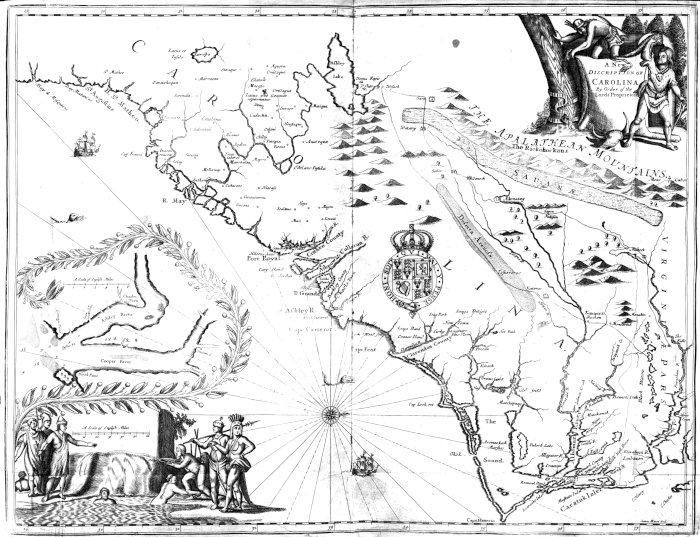
Carolina is that part of Florida which lies between twenty nine and thirty six Degrees and thirty Minutes of Northern Latitude: It is wash’d on the East and South, with the Atlantick Ocean; on the West with Mare Pacificum, or the South Sea; and on the North, bounds on Virginia. A Countrey wherein Nature shews how bountiful she can be without the assistance of Art, the Inhabitants (excepting a little Maiz which their old Men and Women Plant) depending meerly on the natural and spontaneous Growth of the Soil for their Provisions, the Woods furnishing them with store of Fruit and Venison, and the Rivers with plenty of several sorts of wholsom and savory Fish.
This Maintenance, which without forecast or toil they receive from the natural fruitfulness of the Countrey, will, if we consider either the largeness of their Growth, or the duration of their Lives, be thought neither scanty nor unhealthy, their Stature being of a larger size than that of English-men, their Make strong and well proportion’d, a crooked or mis-shapen Person being not to be found in the whole Countrey; and (where the chance of War, which they are almost continually engag’d in one against another in their little Governments, spares any of them) they live to an incredible old age; so that when the English came there, they found some of their Kings, who saw descend from them the sixth Generation.
Productions of the Soil.
The Soil is very rich and fertile, producing naturally Walnuts, Grapes (of which the English who are there Planted have made very good Wine) Apricocks, Bullys, with a multitude of others; besides the Woods also are full of very good Peaches, and all the Season of the Year strew’d all over with Strawberries. Mulberry-Trees are the common growth of the Woods; and to assure you they are the natural Offspring of the Place, and grow to an incredible bigness, one whereof the 206English (who are new Planted at Albemarle Point on Ashley River) made use to fasten the Gate of their Pallisado to, was so large, that all who came from thence say, they never saw any Oak in England bigger, which is but the ordinary size of the Mulberry-Trees of this Countrey, which is so sure an Argument of the richness of the Soil, that the Inhabitants of Virginia enquiring of the Seamen who came from thence, concerning the Quality and Product of the Countrey, when they were inform’d of the large Mulberry-Trees it produc’d, were so well satisfi’d with it, that they made no farther Enquiry. There are also other Trees, as Ash, Poplar, and Bay, with several sorts unknown to us of Europe; but those which make it almost all one general Forrest of large Timber-Trees, are Oak, both red and white, and Cedar. There are also here and there large Groves of Pine-Trees, some a hundred Foot high, which afford a better sort of Mast than are to be had either in Mary-Land or Norway. These larger Trees weaving their luxuriant Branches into a close Shade, suffer no Under-wood to grow between them, either by their Droppings, or else the Heads of Deer which loosening all the tender Shoots, quite destroy it; so that a great part of the Countrey is as it were a vast Forrest of fine Walks, free from the heat of the Sun, or the incumbrance of Shrubs and Bushes, and so clear and open, that a Man may easily ride a Hunting amongst the Trees, yielding a Prospect very pleasant and surpassing. On the Skirts of these Woods grow lesser Trees and Shrubs of several sorts; amongst them are sundry Dying Materials, which how well the Inhabitants know how to make use of, appears in the Deer-Skins that the chief of them wear, which are Painted, or rather Dy’d, with several lively Colours. But amongst their Shrubs, one of most note and use is that whose Leaves make their Casini, a Drink they frequently use, and affirm to be very advantageous for the preservation of Health; which, by the description our English give of the size, colour, and shape of the Leaf, the sort of Tree it grows on, and the taste, colour, and effects of the Drink, which is nothing but the Decoction of the Leaf, seems to be the very same with the East-India TEE, and by those who have seen and tasted both, affirm’d to be no other, and may very probably be a spontaneous and native Plant of this Place, since those who give us an account of it, tell us, that this so much valu’d Leaf grows most plentifully in Nanking, a Province in China under the very same Latitude, and very much agreeing in Soil and Situation with this of Carolina.
What Herbs else the Countrey produces, the English Enquirers (who by minding their Plantations and Settlement there, have been taken off from such unprofitable Actions) give us but little account, onely they say, that those Plats of Ground which have been formerly clear’d off by the Indians for the Planting their Corn, they found thick cover’d with three-leav’d Grass and Dazies, which the fertility of the Soil thrusts forth, whenever the Natives remove their Tillage to some other place, and leave the Earth to its own production; and in other parts they found plenty of Garden Herbs growing wild. The low and Moorish Grounds are for the most part overgrown with Sedge and Reeds, and such other Trash, which usually incumbers rich and uncultivated Lands; those they call Swamsas, which with a little Husbandry would prove very good Meadows. There are also some large and pleasant Savanas, or grassy Plains.
These are a part of the Trees and Plants best known to us, that Nature of her self produces, in a Soil which contrives and nourishes any thing. The English who are now Planted in the most Northern parts of it, at Albemarle, bordering on Virginia, have Apples, Pears, Cherries, Apricocks, Plumbs, and Water-Melons, equalling, and if you will believe the Inhabitants, both in largeness of size and goodness of taste, exceeding any in Europe. And they who are Setled farther South on Ashley 207River, have found that the Oranges, Lemmons, Pomegranates, Limes, Pomecitrons, &c. which they Planted there, have thriven beyond expectation; and there is nothing which they have put into the Earth, that through any defect in the Soil, hath fail’d to prosper.
Commodities of the Countrey.
Besides those things which do serve to satisfie Hunger, or provoke it, the Land doth with great return produce Indigo, Ginger, Tobacco, Cotton, and other Commodities fit to send abroad and furnish foreign Markets; and when a little time shall have brought those kind of Plants to maturity, and given the Inhabitants leisure to furnish themselves with Conveniences for ordering those things aright, the Trials that they have already made of the Soil and its fitness for such Plantations, assure you, that besides Silk, enough to store Europe, and a great many other considerable Commodities, they shall have as great plenty of good Wine and Oyl, as any part of the World.
The Mould is generally black, mellow, and upon handling feels soft, and (to use their Expression who have been there) soapy, and is generally all over the Countrey just like the fine Mould of our well order’d Gardens. Under this black Earth, which is of a good thickness in most places that they have try’d, there lies a Bed of Marle, and in some parts Clay.
Fish and Water-Fowl.
The Rivers are stor’d with plenty of excellent Fish of several sorts, which are taken with great ease in abundance, and are one great part of the Natives Provision, who are never like to want this Recruit, in a Countrey so abounding in large Rivers, there being in that one small Tract between Port Rasal and Cape Carteret, which are not one Degree distant, five or six great Navigable Rivers, that empty themselves into the Sea. These Rivers are also cover’d with Flocks of Ducks and Mallard, whereof millions are seen together, besides Cranes, Herons, Geese, Curlews, and other Water-Fowl, who are so easie to be kill’d, that onely rising at the discharge and noise of a Gun, they instantly light again in the same place, and presently offer a fresh Mark to the Fowler. At the Mouths of the Rivers, and along the Sea-Coast, are Beds of Oysters, which are of a longer Make than those in Europe, but very well tasted, wherein are often found good large Pearls, which though the unskilful Indians by washing the Oysters do commonly discolour, and spoil their lustre, yet ’tis not to be doubted, but if rightly order’d, there will be found many of value, and the Fishing for them turn to some account.
Besides the easie Provisions which the Rivers and Sea afford, their Woods are well stock’d with Deer, Rabbets, Hares, Turtle-Doves, Phesants, Partridges, and an infinite number of Wood-Pigeons and wild Turkies, which are the ordinary Dishes of the Indians, whose House-keeping depends on their Fishing and Hunting, and who have found it no ill way of Living in so fertile a Countrey, to trust themselves without any labor or forecast, to the Supplies which are there provided to their hands, without the continual trouble of Tillage and Husbandry. Besides, these Woods are fill’d with innumerable variety of smaller Birds, as different in their Notes as Kinds.
Temperature of the Climate.
The Temperature of this Province is agreeable to a Countrey, whose Position is on the warmer side of the temperate Zone, but yet the Heat is not so sultry nor offensive, as in Places under the same Latitude in the Old World; to which moderation of Heat, as well as the healthiness of it, the vast Atlantick Ocean, lying to the East and South of it, may perhaps not a little contribute, an instance whereof some think China to be; to which deservedly admir’d Countrey Carolina exactly answers in its Position and Latitude, the trending from North-East to South-West of its Coast, and the lowness of its Shore, and wants nothing but Inhabitants, to 208make it equal, if not excell, in all conveniences of Life, as it doth in richness of Soil, that flourishing Empire. The healthiness of the Air is such, that it is not onely benign and favorable to the home-bred Indians, and Constitutions accustom’d to it, but the English-men who first Planted on Ashley River, though for some other Conveniences they Planted on the side, or almost middle of a Morass, and were encompass’d with a salt Marsh, where the Air, pent up with Woods that surrounded them, had not that freedom it hath in open and cultivated Countreys, yet lost not in a whole years time, of a considerable number, any one Person, of any Disease to be imputed to the Countrey, those few that dy’d in that time sinking under lingring Distempers which they brought with them, and had almost worn them out before they came thither. The Bermudians (who being accustom’d to the pure Air of their own Island, cannot without hazard of their Lives put themselves into any other Place) assur’d of the healthiness of this Place, which is the next Land to them, and under the same Latitude, venture hither. And generally all the English Planting in the West-Indies, are so taken with the Conveniences of this Countrey, which, as some of the most considerable of the English in those Parts say of it, promises all that the Heart of Man can wish, that they send the overplus of their People hither; to which the Inhabitants of Barbados, a skilful and wary sort of Planters, well knowing in all the parts of the West-Indies, have been found to remove the Hands they could spare. As the Summer is not intolerably nor offensively hot, so the Winter is not troublesom nor pinching, but enough to correct the Humors of Mens Bodies, the better to strengthen them, and preserve their Healths, and so far to check the growth of Plants, that by this stop they may put out more regularly, and the Corn and other Fruits the better ripen together, and be ready seasonably at the Harvest, the want whereof in some Countreys hinders the beneficial Growth of several valuable Commodities, the continual Spring all the year long making that their Crops are never ready, their Trees being laden with green and ripe Fruit at the same time, which is to be seen in the Vines growing between the Tropicks, where, though they bear excellent Grapes, yet they cannot make any Wine, whilest the mixture of ripe and sowre Grapes upon the same Branch, renders them unfit for the Press, which from Grapes so blended, though of a good kind, would squeeze out a very crude and useless Liquor. This also is the reason why many Parts where our Wheat will grow very well, do yet lose the benefit of it, whilest the several Ears ripening unequally, never make the Crop fit for the Sickle. But this Countrey hath Winter enough to remove that Inconvenience, and to put such a stop to the Rise of the Sap, and the Budding of Plants, as to make the several kinds of Fruits Bud and Blossom in their distinct Seasons, and keep even pace till they are fit to be gather’d.
Nature, Constitutions, and Manners of the Inhabitants.
To this happy Climate the native Inhabitants are very well suited, a strong, lusty, and well shap’d People, who to their well knit and active Bodies, want not stout and vigorous Minds; they are a People of a good Understanding, well Humor’d, and generally so just and Honest, that they may seem to have no notice of, as their Language hath no word for, Dishonesty and Cheating; and the worst Name they have for ill Men is, that they are not good. They are a stout and valiant People, which appears in the constant Wars they are engag’d in, not out of covetousness, and a desire of usurping others Possessions, or to enrich themselves by the Spoils of their Neighbors, but upon a pitch of Honor, and for the glory of Victory, which is their greatest joy, there being no parts of their Lives wherein they enjoy so much satisfaction, and give themselves so wholly to Jollity, as in their Triumphs after Victory. Valor therefore is the Vertue they most esteem and 209reward, and he which hath behav’d himself well in the Wars, is suffer’d to wear the Badges of Honor, and is advanc’d beyond others with some Marks of his Courage; which amongst some is blacking the Skin below his Eyes with black Lead, in fashion something of an Half-Moon; which Mark of Courage is not suffer’d to be worn by any, but those who by some brave Action, as killing the Enemy’s Leader, &c. hath signaliz’d himself in their Encounters. They are faithful to their Promises, fair and candid in their Dealings, and so far from Dishonesty, that they want even the Seeds of it, viz. Forecast and Covetousness; and he will be very little apt to deceive you to Day, who troubles not himself much about to Morrow, and trusts for the Provisions of the Day to the Day it self; which proceeds not in them for want of Wit, but desire of Content and Quiet, or by the help of their natural Reason they enjoy that Happiness which the Philosophers could not by their Study and Reading attain to, whilest these Men cut off those Desires which Learning could never help the other to Govern; and which if once permitted to run out beyond the present, are capable of no Rest nor Bounds. In their Conversation they are courteous and civil, and in their Visits make Presents to one another; when they meet, their way of Salutation is stroaking on the Shoulders, and sucking in their Breath; and if he be a great Man whom they Salute, they stroak his Thighs too; as civil an Address, as those Patterns of good Breeding, the Hero’s, us’d to their Princes, who in their greatest Courtships, we are told, embrac’d their Knees: After their Salutation they sit down; and it is usual with them to sit still almost a quarter of an hour before they speak, which is not an effect of stupidity or sullenness, but the accustom’d Gravity of their Countrey; for they are in their Tempers a merry, frollick, gay People, and so given to Jollity, that they will Dance whole Nights together, the Women sitting by and Singing, whilest the Men Dance to their Ayrs, which though not like ours, are not harsh or unpleasing, but are something like the Tunes of the Irish: So that if we will not let our selves too fondly admire onely the Customs we have been bred up in, nor think Men are to be valu’d for making Legs after our Mode, or the Clothes they wear, which, the finer and gayer they are, always the more to be suspected of Luxury and Effeminateness; if we will allow but these Men to follow the Garbs of their own Countrey, and think them fine enough in a shape onely to hide their Nakedness before, or a Deer-skin hanging loosely on their Shoulders, and their Women not ill Dress’d in Garments of Moss, and Necklaces of Beads, whilest the Fashion of their Courts require no other Ornaments; if, I say, a long and pleasant Life, without Distemper or Care, be to be valu’d, without the incumbrance of unnecessary Trinkets; if Men are to be esteem’d for Valor, Honesty, Friendship, Humanity and good Nature, though Strangers to the ceremonious Troubles we are accustom’d to, the Natives of Carolina will as little, or perhaps less, deserve the Name of Miserable, or Salvage, as those that give it them. ’Tis true, the French and Spaniards who have Planted amongst them, or with little Armies travell’d their Countrey, have been ill handled by them; but yet the Indians never did them any harm, or treated them otherwise than Friends, till those Europeans by their breach of Faith and several Outrages, had provok’d their just Revenge; and they did nothing but what most virtuous and generous sort of Men are apt to do, to revenge those Affronts, which did not agree with their Tempers tamely to endure. That this did not proceed from treachery and inconstancy in their Natures, is apparent in the contrary Correspondence they have had with the English Setled amongst them, to whom they have been all along very kind, as they were at first very covetous of their Company; for after that some of their King’s Relation had been at 210Barbados, and had seen and admir’d the Temper, Fashions and Strength of the English there, and had been very civilly Treated in that Island, they were so well satisfi’d with them, that at the coming of the English to Settle there, the several little Kingdoms strove with all the Arts and Arguments they could use, each of them to draw the English to Plant in their Dominions, by commending the richness of their Soil, conveniency of their Rivers, the healthiness of their Countrey, the disparagement of their Neighbors, and whatever else they judg’d might allure the English to their Neighborhood. Nor was this onely the first heat of Men fond of Novelties, and as soon weary of them again, but ever since the English first Planted at Albemarle Point, on Ashley River, they have continu’d to do them all manner of friendly Offices, ready on all occasions to supply them with any thing they have observ’d them to want, not making use of our Mens Necessities, as an opportunity to enhance the Price of their Commodities, a sort of fair Dealing we could scarce have promis’d them amongst civiliz’d, well bred, and religious Inhabitants of any part of Europe; and though they are much frighted with our Guns, both small and great, yet like innocent and well-meaning People, they do not at all distrust our Power, but freely, without suspicion, trust themselves, both Men and Women, even their Kings themselves, in our Town, Lodging and Dancing there frequently whole Nights together, upon no other Pledges but the bare confidence of our mutual Friendship; nor do our Men use any greater caution in Conversing with them, stragling up and down, and travelling singly and unarm’d through their Woods for many Miles about, and are so far from receiving any injury or ill treatment from them, that on the contrary they are kindly us’d and Entertain’d, and guided by them in their Way whenever they desire it; and when any of our Men meet them in their Walks, the Indians all stand still till they are gone by, civilly Saluting them as they pass. Nor doth this Assurance of theirs bound it self within their own Homes, they of their own accords venturing themselves aboard our Ships, have gone voluntarily with our Men to Virginia and Barbados. Nor have the English been wanting on their parts in any thing that may preserve this Amity, being very cautious of doing them any injury, bartering with them for those things they receive of them, and buying of them even the waste Land they make no use of.
Besides the simplicity of the Indians Diet, it is very remarkable, that they have a general aversion to those two things which are most acceptable to our Palates, and without which few of us either eat or drink with any delight; for in their Meats they cannot endure the least mixture or rellish of Salt; and for their Drink, they utterly abominate all manner of strong Liquor; to the latter whereof, their large Growth and constant Health, is perhaps not a little owing.
Their manner of Government.
Every little Town is a distinct Principality, Govern’d by an Hereditary King, who in some places is not Son, but Sisters Son to the precedent King, the Succession of the Blood-Royal being continu’d by the safer side. The great Business of those Princes is to lead their Men out against their Enemies in War, or against the Beasts in Hunting; for unless it be to appoint them where to Hunt, or else to Consult about making some Attempt upon their Enemy, he hath but small trouble in the Government of his Subjects, who either through their own Honesty, or the few occasions they have for Controversies in their extempore way of Living, need few Laws, and little Severity to keep them in order; but yet they Govern their People without Contract, and fail not of a ready Obedience to their Commands; so that when some of them have bought things of such of the English, who by the Orders made amongst our selves were not to Traffick with the Indians, they have, upon Complaint made to their Casiques, been restor’d again, though in strict Rules 211of Law they were neither bound by, nor oblig’d to take notice of the Rules which were made onely to Govern our own People, and had at just Prices bought what they carry’d away; such is the Honesty of Men, whose Principles not being corrupted with Learning and Distinction, are contented to follow the Dictates of right Reason, which Nature has sufficiently taught all Men for the well ordering of their Actions, and enjoyment and preservation of humane Society, who do not give themselves up to be amus’d and deceiv’d by insignificant Terms, and minding what is just and right, seek not Evasions in the Niceties and Fallacies of Words.
Carolina granted by Patent to several Noble Persons by His Majesty.
The same is to be said of the first Discovery of this Countrey, as hath been formerly said of Virginia and Florida, of both which it partakes; but as to the present Interest and Propriety, the English, besides all Virginia intirely, have also so much of Florida as makes up this considerable Province of Carolina, which soon after the happy Restauration of His present Majesty King Charles II. from whom it receives Denomination, was granted by Patent to Edward Earl of Clarendon, L. Chancellor of England, George Duke of Albemarle, William Earl of Craven, John Lord Berkley, Anthony Lord Ashley, Sir George Carteret, Vice-Chamberlain of His Majesty’s Houshold, Sir William Berkley, Knight and Baronet, and Sir John Colleton, Knight and Baronet.
Their care for Setling and Improving of this Plantation.
The Lords-Proprietors of this Countrey, for the better Settlement of it according to their Patent granted unto them by His Majesty, and for the enlargement of the King’s Dominions in those parts of America, have been at great Charge to secure this so rich and advantageous a Countrey to the Crown of England, to whom of ancient Right, by the Discovery of Sir Sebastian Cabott in the time of Henry the Seventh, it doth belong, and for its Situation, Fertility, Neighborhood to our other Plantations and several other Conveniences, of too valuable consideration to be negligently lost: By the Care therefore and Endeavors of those Great Men, it hath now two considerable Colonies Planted in it, the one of Albemarle, on the North side, bordering on Virginia, where are some hundreds of English Families remov’d thither from New England, and some of our other Plantations in the West-Indies; and another towards the middle of the Countrey, at Charles-Town, or Ashley-River, a Settlement so hopeful, for the healthiness of the Land, and convenience of access by a large deep Navigable River, and so promising in its very Infancy, that many of the rich Inhabitants of Barbados and Bermudas, who are now crowded up in those flourishing Islands, and many in our other American Plantations, are turning their Eyes and Thoughts this way, and have already remov’d part of their Stock and Servants thither. Nor is it to be doubted, but that many, following the Example of those who went to Albemarle, will be drawn to this better Plantation at Ashley-River, from New-England, where the heat of their Zeal, and the coldness of the Air, doth not agree with every Man’s Constitution; and therefore it is to be thought, that many well temper’d Men, who are not much at ease under such Extreams, will be forward to remove hither.
Fair Terms propos’d to whomsoever shall remove thither.
The Lords-Proprietors, for the comfortable subsistence, and future enrichment of all those who shall this Year 1671. Transport themselves and Servants thither, allow every Man a hundred Acres per Head, for himself, his Wife, Children and Servants, he carries thither, to him and his Heirs for ever, paying onely one Peny an Acre, as a Chief-Rent; which Peny an Acre is not to be paid these nineteen years; and those Servants who go along thither with their Masters, shall each also have a hundred Acres upon the same Terms, when he is out of his Time. But though these Conditions are very advantageous, and the Countrey promises to the Planter Health, Plenty and Riches at a cheap Rate, yet there is one thing that makes this Plantation more valuable than all these, and that is the secure possession of all these 212things with as great certainty as the state of humane Affairs, and the transient things of this Life are capable of, in a well continu’d Form of Government, wherein it is made every Man’s Interest to preserve the Rights of his Neighbor with his own; and those who have the greatest Power, have it limited to the Service of the Countrey, the Good and Welfare whereof whilest they preserve and promote, they cannot miss of their own, the Lords Proprietors having no other aim, than to be the greatest Men in a Countrey where every one may be happy if it be not his own fault, it being almost as uncomfortable, and much more unsafe, to be Lord over, than Companion of a miserable, unhappy, and discontented Society of Men.
With this Design the Lords-Proprietors, who are at great Charge for carrying on this Plantation, have put the framing of a Government into the Hands of one, whose Parts and Experience in Affairs of State are universally agreed on, and who is by all Men allow’d to know what is convenient for the right ordering Men in Society, and setling a Government upon such Foundations, as may be equal, safe, and lasting; and to this hath a Soul large enough to wish well to Mankind, and to desire, that all the People where he hath to do might be happy. My Lord Ashley therefore, by the consent of his Brethren, the rest of the Lords Proprietors, hath drawn up, to their general satisfaction, some fundamental Constitutions, which are since, by their joynt approbation, confirm’d to be the Model and Form of Government in the Province of Carolina; the main Design and Ballance thereof (according to the best of my memory, having had a Copy thereof) in short is as followeth:
The Model drawn up by the Lord Ashley for the Government of Carolina.
1. Every County is to consist of forty square Plots, each containing twelve thousand Acres. Of these square Plots each of the Proprietors is to have one, which is to be call’d a Signiory. Eight of these square Plots are to be divided amongst the three Noble-men of that County, viz. a Landgrave, who is to have four of them; and two Casiques, who are to have each of them two apiece; and these square Plots belonging to the Nobility, are to be call’d Baronies. The other twenty four square Plots, call’d Colonies, are to be the Possession of the People: And this Method is to be observ’d in the Planting and Setting out of the whole Countrey; so that one Fifth of the Land is to be in the Proprietors, one Fifth in the Nobility, and three Fifths in the People.
2. The Signories and Baronies, that is, the hereditary Lands belonging to the Proprietors and Nobility, are all entirely to descend to their Heirs, with the Dignity, without power of alienation, more than for three Lives, or one and twenty years, or two Thirds of their Signiories and Baronies, and the rest to be Demesne.
3. There will be also some Mannors in the Colonies, but none less than three thousand Acres in a Piece, which, like the rest of the Colony Lands, will be alienable, onely with this difference, that it cannot be parcell’d out, but if sold, it must be altogether.
4. There is to be a Biennial Parliament, consisting of the eight Proprietors, the Landgraves and Casiques, and one out of every Precinct, that is the six neighboring Colonies, for the People, chosen by the Freeholders; these are to sit and Vote altogether for the making of Laws, which shall be in force no longer than sixty years after their Enacting, the great mischief of most Governments, by which not onely the People are mightily entangled by multiplicity of Rules and Penalties, and thereby laid open to the Malice and Designs of troublesom Men and cunning Projectors; but, which is far worse, the whole frame of the Government in tract of time comes to be remov’d from its original Foundation, and thereby becomes more weak and tottering.
5. There are eight supream Courts for the dispatch of all publick Affairs; the first consists of the Palatine, who is the eldest of the Proprietors, and hath power to call Parliaments, and dispose of publick Offices. The other seven supream Courts are, 1. The chief Justices for the determining of Controversies of Meum and Tuum, and judging of Criminals. 2. The Chancellors, for passing of Charters, and managing the State Matters of the Province. 3. The High-Constables, for Military Affairs. 4. The Admirals, for Maritime Affairs. 5. The High-Stewards, for Trade. 6. The Treasurers, for the publick Stock; and 7. The Chamberlains, for Ceremonies, Fashions, Marriages, Burials, &c. These are the seven supream Courts, to whom lies the ultimate Appeal in all Causes belonging to them. Each of these Courts consists of one Proprietor, and six other Councellors, whereof two are chosen by the Nobility, and two by the People. All the number of these eight Courts joyn’d together make the Grand Council, which are in the nature of a Council of State, and are entrusted with the management of Affairs of greatest concernment. There is also in every County a Court, and in every Precinct another; from the Precinct Court there lies an Appeal to the County Court, and from the County Court to the Proprietors Court, to which the Matter in question belongs, and there is the last decision and determination thereof, without any farther Appeal. And to keep the People from the Charges and vexation of long Suits, to the enriching of Men cunning in Words, care is taken, that no Cause shall be Try’d more than once in any one Court, and that profess’d Pleaders for Money shall not be allow’d.
Liberty of Conscience is here also allow’d in the greatest latitude, but yet so, that neither Atheists, or Men of no Religion, are permitted; Atheism, Irreligion, and vicious Lives being condemn’d, as disagreeable to humane Nature, inconsistent with Government and Societies, and destructive to all that is useful to, or becoming of Mankind; as on the other hand, rigorous Imposing of, and hot Contentions about the Ceremonies and Circumstances of Religion, is an occasion of perpetual Strife, Faction and Division, keeps Men from sedate and temperate Enquiries after Truth, eats out the great Cement of humane Conversation, Charity, and cannot be found in any one, who hath but modesty enough to think himself less than a Pope, and short of Infallibility.
There is also to be a Register of all Grants and Conveyances of Land, to prevent even the occasions of Controversies and Law-Suits.
There are several other less considerable Particulars in this Government, all contriv’d and design’d for the good and welfare of the People; all which are so well put together, and in such equal proportion ballance each other, that some judicious Men who have seen it, say, it is the best and fairest Frame, for the well-being of those who shall live under it, of any they have seen or read of.
213

CHAP. III. Florida.
Situation and Bounds.
South-West of Virginia lieth the spacious Countrey of Florida, remarkable hitherto rather by the great pains which the Spaniards have taken, and the ill Successes they have met with in the discovery and search of this Province, than by any thing else they have discover’d in it answerable to their desires. On the East it hath the Atlantick Ocean, or Mare del Nordt; on the South, and South-West, the Gulph of Mexico and Mare Virginium; and full West, part of New Gallicia, and some other Countreys, not yet perfectly known.
Ponce’s Expedition.
Water to make old People look young.
This Countrey is also one of those, said to have been first of all discover’d by Sir Sebastian Cabot, at the Charges of the King of England, about the Year 1497. but afterwards more throughly search’d into by John Ponce de Leon, a Spaniard, who in the Year 1512. set Sail with three Ships out of the Haven St. German in Porto Rico, North-West to the Isles Del Veio, Caycos, Yaguna, Amaguyao, Manegua, and Guanahani, first discover’d by Christopher Colonus, and call’d St. Salvador: After that Steer’d North-West by a Coast, which (because of its pleasant prospect) was call’d Florida or (according to the more common Opinion) because it was on Palm-Sunday, which the Spaniards call Pascha de Flores, (or Pascha Florida) that he Landed here: And to find out a Haven he kept sight of the Shore, which appear’d South-West from him. Here the Ships met with so strong a Tide, that notwithstanding they had a fresh Gale of Wind, yet could they not stem it; one of the Ships was driven to Sea out of sight; the other two casting Anchor, which raking, drove toward the Shore; whither, being beckned by the Indians, they immediately went; when no sooner he Landed, but they ran in great Companies to make themselves Masters of the Vessels, kill’d one Spaniard, and wounded two more: the Night approaching put an end to the Fight. From hence Sailing to the River La Cruix for Wood and Water, they were resisted by sixty Natives, which they put to flight with their Guns, and took one Prisoner; after which they erected a Stone Cross. The Promontory, by which glides the strong Current, lies in twenty Degrees North-Latitude, and call’d Cabo de Corrientes, as the Row of Isles, before the Main Land Los Martyres, because the Cliffs at a distance appear like Men standing on Poles. Lastly, after some small Encounters with the Floridans, Ponce return’d home, being onely inform’d falsly by the Indians, that in Florida was a River, and on the Isle Bimini a Fountain, whose Waters made old People young.
Vasquez’s Expedition to Florida.
Habit of a Floridan King.
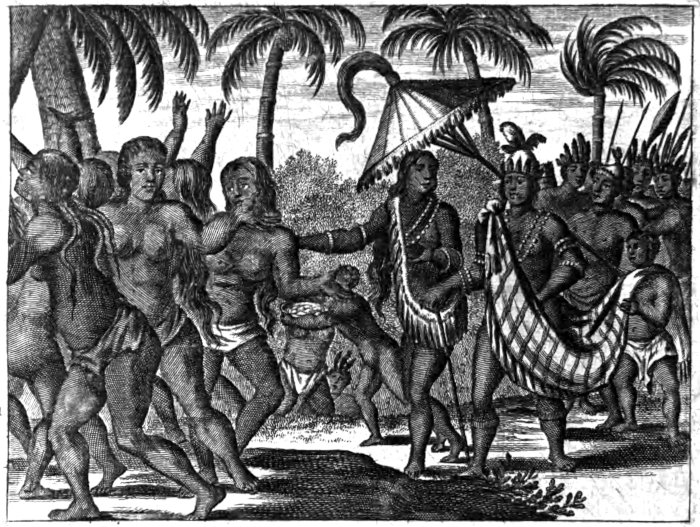
But after this Florida remained not unvisited; for eight years after the foremention’d Voyage, Lucas Vasquez de Aylom weighed Anchor with two Ships from Hispaniola, to fetch Slaves from the adjacent Isles for the Gold-Mines, which Labor the Natives were not able to perform: therefore steering his Course Northwardly, he Sail’d along the Coast of Chicoa and Gualdape, by them call’d Cabo de St. Helena, and Rio Jordan, where the Natives look’d upon the Ships as Sea-Monsters, and seeing Bearded Men in them, fled: the Spaniards pursuing them, overtook one Man and a Woman; who being well Entertain’d, and Clad in Spanish Habits, made the Strangers so acceptable to their Countrey-men, that their King sent fifty Men Aboard of them with Provisions, and to invite the Sea-men to his Dominions. The King sat 214with a great Cloth about him, made fast on his Shoulders, covering his Belly, Breast and Back with the Lappet thereof, and being long, was held up by one of his Servants; over one of his Shoulders hung a String of Pearl that came three times about, and reach’d down to his Thighs; on his Head he wore a Cap full of Ribbonds; his Arms and Legs were also surrounded with a double Chain of Pearl; in his right Hand he held a very rich Staff: But the Queen went almost naked, onely a piece of a wild Beasts Skin hung down before her from her left Shoulder to her mid-Leg, and a double String of Pearl about her Neck hung down between her Breasts, and her Hair Comb’d behind reach’d down to the Calves of her Legs; about her Wrists and Ancles hung also Strings of Pearl.
Treachery of Vasquez.
Indians misused.
On the King’s Command, the Spaniards were permitted to make inspection into the Countrey, in which they were every where courteously Entertain’d, and not without Gold and Silver Presents. Returning Aboard, Vasquez invited the Indians to go with him, under pretence of returning them thanks for the Favours which they had bestowed upon him; but no sooner had he gotten a considerable number in his Ships, but he set Sail, and losing one Ship, arriv’d with the other safe at Hispaniola with a few Indians, for most of them with grief and hunger died at Sea, and those that remain’d alive, liv’d on dead Carrion.
Vasquez defeated by the Floridans.
Some few years after, Vasquez receiving Letters Patent from the Court of Spain for the Government of Florida, fitted out a Ship thither in 1620. which brought a good Return of Gold, Silver, and Pearls; whereupon he himself went not long after, and coming into the River Jordan, lost one of his Ships, which proved not the worst Accident; for Landing two hundred Men, they were all of them either slain or wounded by the Inhabitants; so that Vasquez was forc’d to sound a Retreat: And after that the Spaniards were less willingly drawn to that Coast, and the rather, because the Inhabitants seem’d poor, and had little Gold but what they procur’d from the Otapales and Olugatono’s, sixty Leagues Northward up in the Countrey.
Narvaez his Expedition.
Strange Booty.
He is in great extremity.
Cabeca is Stranded.
His strange Entertainment at Malhado.
Notwithstanding these unsuccessful Expeditions, Pamphilus Narvaez retain’d so much Courage, that obtaining Letters Patents from the Emperor Charles the Fifth, 215he fitted out four Sail and a Brigantine, weigh’d Anchor from Cuba with six hundred Men and eighty Horse, in the Year 1528. On Florida he Landed three hundred Foot and forty two Horse; they found many empty Huts, but in a great House a golden Bell hid amongst the Nets, Chests full of Merchandise, and in each a dead Body cover’d with Beast Skins, and painted; Pieces of Linnen Cloth, and Wedges of Gold, which they had from the remote Countrey Apalache. Narvaez, though against the Opinion of Nunnez Cabeca, march’d up into the Countrey, whilst the Fleet was to stand along the Shore, and travelling fifteen days saw neither House nor Man, onely here and there some Palmito-Trees: Crossing a River on Floats, they were Encountred by two hundred of the Natives; of which the Spaniards, having routed them, took six Prisoners, who furnish’d them plentifully with Indian Wheat. After this they march’d fifteen days farther, without discerning the least foot-step of a Man; but at last they met an Indian Lord with a considerable Train, before whom march’d several Pipers: being told by Narvaez that his Journey was for Apalache, he conducted the Spaniards with a Canoo over a River, and Landing again, walk’d with them to his Village, where he Entertain’d them with great civility. Narvaez, after a long and troublesom Journey, came at last in sight of Apalache, a Village which contained two hundred and forty Straw Houses, built between the Mountains on a Moorish Soyl, full of Nut, Pine, and Savine-Trees, Oaks, Laurel, and short Palmito’s, besides the Trees, which blown down in several places by a strong Wind from between the Hills, and lying cross, cumber the High-ways: There are many deep Pools, and also Bears, Lyons, and other ravenous Creatures, which make the Ways very dangerous. Narvaez falling suddenly on the Village, took the Casique Prisoner, as also store of Wheat, Mortars to pound it, Hides, and Thred-spun Cloaks. Here he rested twenty five days, during which time some of his Men Journey’d farther into the Countrey, yet found none but poor People, troublesom Ways, and an unfruitful Soyl: twice they were set upon by the Natives, who kill’d some of the Horses and Men: They being a very strong People run stark naked, and as swift as a Deer, Diving under Water from the Spaniards Bullets; which not a little amazing Narvaez, he thought it convenient to set upon the Village Aute, lying on the Shore: Nine days he was in a miserable condition before he got any Wheat, Pease, or other Provisions from this Village; the getting whereof cost him very dear, for the Villagers behav’d themselves so valiantly, that they kill’d many Spaniards, and some of their Horses, which since they left the Haven of St. Cruce had travell’d two hundred and eighty Leagues; so that being tir’d and out of heart, they could not carry the Sick and Wounded, who not able to go, fell down dead in the Way: whereupon it was judg’d convenient to make five Barques, in which they made their Shirts serve for Sails, the Horses Tails and Mayns for Ropes, their Skins to hold fresh Water; with which putting out to Sea, they saw no Land in seven days; and running through the Straights of St. Miguell, Steer’d along the Coast of Rio del Palmes; where they suffer’d great Drought, insomuch that some drinking salt Water, died thereof: at last Landing, they were in the Night set upon by a Casique, who having given Narvaez a great Wound in the Face, fled, leaving behind him a Sable Cloak, scented with Amber; three days they rang’d again along the Sea-shore, when the Barque of Nunnez Cabeca being behind, was by Storm driven on the Shore, where a hundred Indians waited to cut them off, but were pacifi’d with some Trifles: Thus being bereav’d of Arms, Provision, and all manner of Necessaries, they found themselves on an Isle, by the Inhabitants call’d Malhado, where they were lodg’d and maintain’d so long as they had any thing left; but Famine grew at last to such a heighth, that they devour’d 216one another, and in a short time of eighty Men there remain’d onely four alive, viz. Nunnez Cabeca, Castillo, Orantes, and Estevanico, who at last by Land reach’d to New Gallicia, and soon after to Mexico, having escap’d a thousand Dangers. Of Pamphilus Narvaez never any tydings being heard, it is suppos’d he was drown’d.
Sottus’s Expedition very remarkable.
Strange dealing of the Cofachiquians.
A Maid Governs the Countrey.
Great Treasure of Pearls.
Great Tempest.
Sottus’s farther Journey very remarkable.
The City Mavilla.
Cruel Fight.
Sottus dies.
Strange Fight.
After this miserable Adventure, the Business of Florida lay dead for eleven years, till Ferdinandus Sottus, chosen Governor of Cuba, obtain’d so much of the Emperor Charles the Fifth, that he ventur’d one Expedition more for Florida: Besides Seamen he carried five hundred Foot, and three hundred and fifty Horse; with which Landing in the Bay Del Espirito Santo, he march’d against the Casique Vitacucho, whom he took Prisoner, with a thousand of the Natives, whom he either put to the Sword, or caus’d them to be torn in pieces by Dogs; and staying all the Winter in Apalache, fortifi’d that place, and furnish’d himself with Provisions; he was inform’d, that thirteen days Journey from thence lay the Kingdom of Cofachiqui, abounding with Gold, Silver, and Pearls, which made every one of the Spaniards very desirous to go thither, notwithstanding the Way was very dangerous; for the valiant Floridans lying in Ambuscade in the Corn-Fields, wounded and kill’d many of them by Shooting from thence. Sottus, so soon as March approached, set forward on his Way. In the poor Province of Achalaqui he found a few young People, and the old most of them blind. From Cofachiqui he was follow’d by four thousand Natives, who carried the Spaniards Luggage, and serv’d them as Guides through Woods and Wildernesses. The seventh day they stopp’d at a great River, whither Sottus sent four Companies to seek out a Passage over, whereof three return’d without any effect, but the fourth, Commanded by Captain Annasio, and a Colonel of a thousand Cofachiquians, came to a Village built along the River; in which they made a miserable Rout, killing all they lighted on, and hanging the Sculls of the Dead by their sides: this done, they march’d back. Sottus at last espying a Village on the other side of the River, beckned to the Natives to come over to him; whereupon six came immediately; who understanding that he desir’d their friendly Assistance and Trade, promis’d to acquaint their Governess, being a young Maiden: who soon after came over to Sottus, and presented him with a String of Pearl: he complain’d to her for Provisions, which she promis’d in part to store him with. Crossing the River he found a brave Countrey, where were Pearls as big as gray Pease, Copper of a golden colour, but no Gold. Out of the Tombs of their Princes the Spanish Officers, with the leave of the fore-mention’d Maid their Governess, got an incredible Treasure in Pearls. In the Village Tolomeco they did the like. But here their Provisions growing scarce, the Army was divided into two Bodies, Balthasar de Gallegos leading one, and Sottus the other; yet the Design of them both was on the Province of Chalaque; whither marching, they were surpris’d by such a violent Storm, that few would have been left to relate their Adventures, had not the Trees bore it off from them; for it not onely Thundred and Lightned as if Heaven and Earth would have met, but also Hail-stones fell down as big as Eggs, which beat down the Boughs of Trees. In the pleasant Valley Xualu, belonging to the Kingdom of Cofachiqui, they rested fifteen days, and then march’d through Countreys of Guaxale, Acostes, and Coza, where above a thousand Indians, adorn’d with Plumes of Feathers and rich Furr Cloaks, came to meet and welcom them, and to desire them from the Casique to stay there all the Winter; but Sottus resolving to go to the Haven Achusi, refus’d the same. After this he view’d Talisse, fortifi’d with woodden and earthen Bulwarks; where the Casique Tascalusa, a Man as big again as an ordinary Spaniard, receiv’d Sottus with great civility, and conducted him to Mavilla, lying in a pleasant place. The City, surrounded with double Pallisado’s, fill’d up with 217Earth between, (where also at eighty Paces distant from one another, stands a Tower to contain eighty Soldiers) hath two Gates, eighty Houses, in every one of which dwell a thousand Men, and a large Market-place in the middle; where whilst the Spaniards were in the midst of their Mirth, they on a sudden heard a great cry of Arms; the first Assault was made by seven thousand, which still increased by fresh Supplies; but the Spaniards at last setting the City on fire, broke through them, and left above eleven thousand slain, either by the Smoak and Flame, or by their Bullets, Swords, Horses Heels and Dogs; the Spaniards also lost eighty three Men and forty three Horses. Thence going to Chicora they were stopt by the Natives before a deep River with high Banks, which at last crossing, not without great trouble and blood-shedding, they Winter’d in the Village Chicora, where the Inhabitants let them rest very quietly for two Moneths; at the end of which, joyning together in the Night, they shot fire into the Straw Roofs, and maintain’d a Fight of two hours long, in which the Spaniards lost forty Men, fifty Horses, and all their Hogs, which were burnt in the Houses. From thence going to Chicacolla they were resisted in most places, and in the Fort Alibamo Engag’d by four thousand Floridans, who waited for their coming; but those were so shrewdly handled, that half of them were slain, and Sottus became Master of the Fort, as also of Chisca, which he Storm’d and took unawares. With no less trouble and danger did he get over the River El Grande, where he discover’d a Village that contain’d above four hundred Houses, and many delightful Fruit-Trees. The Casique Casquin, maintain’d the Spanish Army six days in this place, and taking five thousand of his Subjects, march’d with them to Capaha, which hath a deep and broad Moat on three sides thereof: the fourth was fortifi’d with strong Pallisado’s, through which the Spaniards breaking, made way for Casquin, who put all to the Sword, the Governor onely escaping in a Canoo to a neighboring Isle. The Entrance being thus taken by the Spaniards, Casquin return’d home. After which Sottus concluded a Peace with Capahaes the Governor, and took up his Quarters in the Village Vitangue, where he receiv’d continual Sallies; but taking fifteen Casiques Prisoners, threatned to burn them alive, unless they would procure them some Gold; yet not being able to get any, they had only their Hands cut off and were sent away. Moreover, Sottus help’d the Guachacoya’s, to ruine those of Anilco; which Design prov’d successful, yet not according to Sottus’s desire, for he found not the Gold-Mines which he expected, but spent in this five years Progress the great Treasure which he took out of Atibaliba’s Palace; and the Pearls which he got in Florida, for the Oysters being open’d against the Fire, and the Pearls drill’d through with a hot Iron, lost much of their lustre, neither would his People consent to build a City in the Haven Achusi. In the midst of these Transitions Sottus died of the Bloody-flux, and his Body was Interr’d in the River El Grande. After which his Successor Ludovicus de Alvarado had worse success, for half of the Army being wasted by the excessive heat, the rest resolv’d to desert Florida, utterly despairing to be ever able to resist the valiant Natives. In the Province of Auche they procur’d a Guide, whom, because he mis-led them in their Way, they caus’d to be torn in pieces by their Dogs: after which they march’d without a Guide through such bad Ways, that they lost a hundred of their Men and eighty Horses, besides many Floridans that carried their Luggage: At last coming to the River El Grande they conquer’d two Villages; which fortifying, they took up their Winter Quarters in them. But this being the fourteenth year, in which the River us’d generally to overflow and drown all the adjacent Countreys, on a sudden, to their great amazement, the Wood which they had gather’d for the building of Barques to carry them home, was wash’d away, their Provisions spoil’d, 218and their Habitations drown’d: and to this Inconvenience was added another yet greater; for the Governors round about rais’d all the Forces they could possibly, to revenge themselves on the Spaniards for their great oppression. But Alvarado being inform’d of this Design by the Casique Anilco, caus’d thirty of the Abettors of the Plot to have their Hands cut off. Not long after this the Spaniards set Sail, when a thousand Canoos that came to Engage them lay sixteen days amongst them, killing and wounding several of the Seamen, and sunk a Barque with forty eight Men, and also kill’d many Horses which were yet on the Shore; the Prisoners they took were strappado’d to death, and the Horses shot: yet some of them got safe from Panuco to Mexico.
Expedition of Ahumada and Samano.
These above-mention’d Expeditions to Florida, notwithstanding they fell out unfortunately, nevertheless by the permission of Philip the Second, King of Spain, Peter Ahumada and Julius Samano, with five Dominican Monks, made another Attempt, and Landed with several great Crosses, that thereby they might reduce the Floridans, whose Language they understood not, to their Faith: But they fearing treachery, resisted them, and kill’d the Monks with Clubs, flay’d them, and hung their Skins in their Temples.
The Expedition of Menendez.
Notwithstanding these and many worse Accidents that hapned, yet the Spanish King ventur’d once more, and sent Peter Menendez to Florida; whither he was follow’d by three Jesuits from Rome, viz. Peter Martinius, Joan Roger, and Francis Villaregius: The Master of the Ship in which they went being ignorant where he was, judg’d it convenient to Land; whereupon nine Netherlanders and four Spaniards, amongst which was Martinius, went ashore on Florida, whilst a Storm arising drove the Ship to Cuba; by which means those that were Landed were left in a miserable condition, having no Food but wild Herbs, on which they fed twelve days: so that this Expedition also came to nothing.
Voyage of Ribald and Laudoniere.
At last the French following the foot-steps of the Spaniards, John Ribald and Rene Laudoniere having Sail’d several times to Florida, discover’d several Coasts; but their Men were often set upon by the Spaniards, and cut off.
The Expedition of Dominicus Gurgius.
Valiant Exploit of Gurgius.
Anno 1567. Dominicus Gurgius set Sail thither with three Ships, which carried two hundred Soldiers and eighty Sea-men; with which entring the River Tacatucouru he Landed, and found a Youth call’d Peter du Bre, who escap’d when the Spaniards cruelly massacred the French in the Garrison Carolina; after which du Bre ranging up and down, at last serv’d Saturiona, Governor of Florida; whom deserting, and now meeting with the French his Countrey-men, he brought several Casiques to joyn with them against the Spaniards, whom they drove out of three Forts, which were all by the Command of Gurgius dismanteled.
City Augustine.
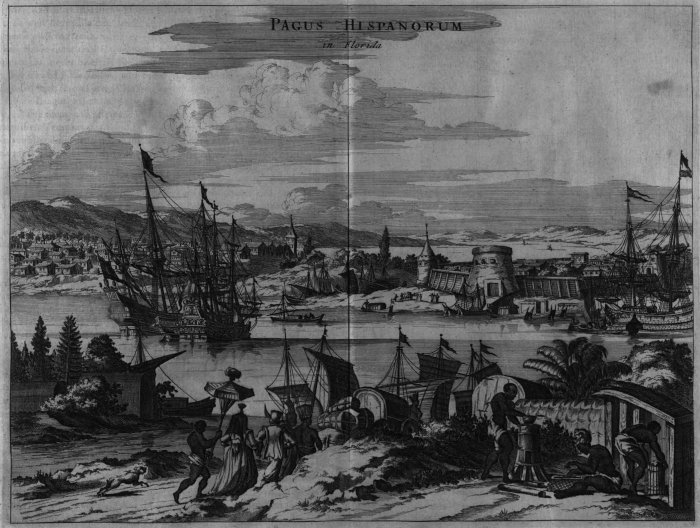
Florida is call’d by the Natives, Irquasa. The Spaniards have built two Forts on the same, the one erected on the Promontory Helena, is Consecrated to the Apostle Matthew. The City and the Fort Augustine lies near the River May. Both City and Fort stand on a Hill, which is pleasant and well set with Trees. Between the Foreland is a deep and wide Channel, which washes the City and Fort; it is eight-square, at each corner there stands a round Tower, in which the Soldiers keep Guard; the Countrey is water’d by two Rivers, which gliding between the Main and the Foreland, are great Safeguards to the Fort. The City is almost square, onely against the Fort it is much closer built than in any other place, and divided into four Streets. The Church stands without of the City, and before it the Augustine Cloyster.
219
Constitution of the Floridans.
Their strange Consultation.
Their Food in time of War.
Their Priests are Sorcerers.
Strange actions.
Cruelty on the conquer’d.
Remarkable Mourning for the Dead.
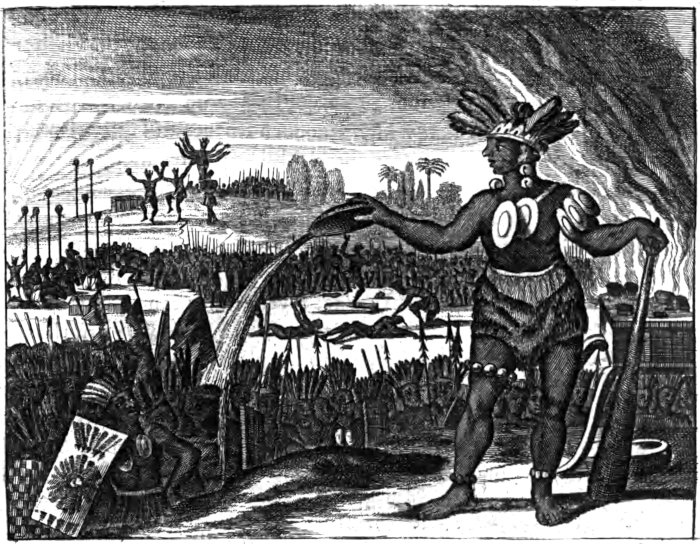
The Inhabitants of Florida are an Olive colour, tall, and without any deformity; their Skins generally painted, and their Bodies naked, onely a Deer’s Skin about their middle, their Hair long and black, hanging down to their Hams, but most of them tie it in a Knot on the top of their Heads; two small Boards cover their Breasts, and six lesser hang on their Arms, two Bells at each Ear, and a Cap on their Head, with a Feather: Their Quivers, which are always full of Arrows, sharpned with Fish Bones, hang by their Sides; In their left-Hand they hold a great Bowe, with which they go to War, the King walking before with a Club. They Consult daily about warlike Affairs in the King’s Palace, where he himself sits on a high Seat; the Grandees salute him first with their Hands lifted over their Head, crying Ha, He, Ya, at which the rest cry Ha, Ha; then every one sits down on a Stool round about the Room. If they have any Business of Consequence to debate, then the King sends for the ancientest Persons and Priests, call’d Jawas; this done, they give a Cup of Cassine (which is a hot Drink made of Herbs) to the King; after which every one drinks in order out of the same Cup. This Liquor occasions Sweat, quenches Thirst, and satisfies the Appetite for twenty four hours. When they March against their Enemies they live on Indian Wheat, Honey, smoak’d Fish, and divers sorts of wild Roots, amongst which they mix Sand and Cinders, to preserve them the longer. No sooner are the two Armies come within sight one of another, but the Kings of both Parties roll their Eyes about in their Heads, mutter something to themselves, and make strange Gestures and Exclamations; which is answer’d by a general Cry of the whole Army: then each King turning himself with great Reverence to the Sun, takes a woodden Platter with Water, which he throws over his Army so far as he is able, and begs of the Sun to grant him, that he may spill his Enemies Blood in like manner; then throws another Dish-full into the Fire, wishing that his Soldiers may thus Offer the Bodies of their Foes to the Flames; then step forth the Priests, who are always skill’d in the Art of Necromancy, and seating themselves on a Shield in the midst of the Army, draw a Circle, in which they make many strange Gestures, not without muttering to themselves, and seemingly say a Prayer of a quarter of an hour long; during which they deport themselves so strangely, that they rather seem to be Devils themselves, than Charmers of the Devil: They turn their Eyes quite round, and their 220Bodies as if without Joynts; at length being wearied they leap out of the Circle, and inform the King of the number and condition of the Enemies Army. Those whom they take Prisoners they flay alive, and drying their Skins at the Fire, tie them to long Poles, and carry them home as Trophies of their Victory, and afterwards set them up in some Field or spacious place, putting both Men and Women to watch them; then comes the Priest with a woodden Image, and utters Execrations against the slain Enemies; at a corner of the Fields kneel three Men, one of which striking with great force on a Stone, gives as many Blows as the Priest pronounces Curses, whilst the other two shake their Calabashes fill’d with Stones, and Sing many strange Songs: No sooner is this ended, but the Women whose Husbands are slain in the Battel, walking to the King, cover their Faces with their Hands, make many strange Gestures, and desire liberty to take what revenge they can, and licence also to Marry at the limited time; all which the King permitting, they return thus comforted home crying. Not long after they go to the place where their Husbands lie buried, where they crop their Hair up to their Ears, and throw it on the Grave, as also the Arms and Drinking-Cups which the Deceased us’d in their life-time; after which they may not Marry before their Hair be grown again to their Shoulders. The same Custom is also observ’d when their King is buried but then also all his Subjects Fast and Howl three days together, stick his Grave full of Arrows, and burn his House and all his Goods.
Floridans differ amongst themselves.
The Floridans differ amongst themselves very much, for those that inhabit the Province Panuca, which borders upon New Spain, are valiant and cruel People, Offering their Prisoners to their Idols, and eating them. The Men pluck up the Hair of their Beards by the Root, make holes through their Nose and Ears, and Marry not till their fortieth Year.
Next to these follow the Realms of Aranaris and Albardaosia, inhabited by a People, which exceed all others in subtilty.
The Natives of Jaquazia run faster than a Deer, and tire not though they travel a whole day.
Hermophrodites.
The best Swimmers are found in Alpachia, Authia, and Someria, where the Women Swim through deep and great Rivers with their Children in their Arms. Here also are many Hermophrodites, which carry all the Luggage when an Army is upon a March.
Their manner of taking Crocodiles.
As also their Deer.
We find mention’d also two other Provinces of note, viz. Colas (which lies near the Point call’d Cape Florida) and Tegista, or Florida properly so call’d, being that long Peninsula, which pointing upon the Isle Cuba, by the Cape Los Martyres, stretcheth it self North and South about a hundred Leagues in length, but not above thirty in breadth where it is largest. In this Province is the Rio de lo Spirito Santo. The Soyl, though it produces Indian Wheat twice a year, yet it is never Dung’d, but when the Corn (which is planted in March and June) is in, they burn the Weeds; the Ashes of which serves them in stead of Soil. The King divides the Corn according to every Mans Family. In the Winter they dwell four Moneths in the Woods, where they build small Huts of Palm-boughs, feed on Venison, smoak’d Fish, and Crocodiles, which have pure white Flesh, and are caught after this manner: On the Shore of the Rivers they build little Houses full of round Holes, in which they place a Watch, who is to give notice to ten or twelve Associates, cover’d all over with Boughs full of little sharp Prickles, which they thrust into the Crocodiles Throat, who with open Mouth comes running at them, and so throwing him on his Back, stick his Belly full of Arrows, and kill him with Clubs. But with more subtilty and art they take their Deer, viz. They hide themselves under 221a Stags Skin, so cunningly, that it seems as if living, which they place near the Rivers where the Deer generally come to drink, when on a sudden they shoot them.
Floridans, though libidinous, yet live long.
Their Priests serve in stead of Chirurgeons, wherefore they always carry a Bag full of Herbs about with them, which are chiefly good against venereal Distempers; for these People are exceeding libidinous; nay, Sodomy and defiling of young Children is accounted no sin: Yet though they are much inclin’d to Women, they attain to a great Age.
Rene Laudoniere Landing not far from the City Augustine, situate on the Banks of the River May, met with the Floridan Governor Saturiona, who conducted him to the French King’s Court of Arms, erected two years before, which Saturiona, as a testimony of his zeal to the French, had Crown’d with Laurel and Flowers. Saturiona had with him also his Son Atoreus, who had begotten divers Children on his Mother; whom his Father after that time no more acknowledging, resign’d her up wholly to him: At which time also his great Grandfather being then living, was above a hundred and fifty years old, and saw his Childrens Children to the fifth Generation.
Their horrid Religion.
The Religion in Florida is abominable, wicked, and cruel: When they return Conquerors from a Battel, the old Women rake off the dry’d Hair from the fore-mention’d Poles, hold it aloft, and thank the Sun for their Victory. But the Offerings of their first-born Sons are terrible, for they knock out their Brains with a Club in the presence of the King. Their annual worshipping of the Sun is also very ridiculous; for filling the Skin of a Stag full of sweet-smelling Herbs, they hang the Horns and Neck with Garlands, and carry it with the noise of their kind of Vocal and Instrumental Musick, to a high Trunk or hollow Body of a Tree, on which they place the stuff’d Stag, with his Head towards the Sun; which done, they falling down, desire that he would please to afford them plenty of all such Fruit as they Offer to him; after which taking their leave, they let the fore-mention’d Skin remain there till the following Year.
The Spaniards since their Defeat in the Fort Carolina, and their Engagement with Sir Francis Drake, Anno 1585. have had little disturbance on Florida.
Drake’s Exploit on Florida.
Drake having burnt and plunder’d Domingo and Carthagena, steer’d along the Coast of Florida, and discover’d a Beacon on the same; whereupon he sent out Spies, who sail’d a League up a River, on whose Banks they saw a Fort, and somewhat higher the Town Augustine, built full of woodden Houses; all which being related to him, he steer’d thither, fir’d his Guns twice against the Fort St. John; which the Spaniards answering onely with one Volley, fled, with their Commander Peter Menendez; when the English prepar’d to Storm, a Prisoner, being a French-man, came in a Boat from them to Drake, and inform’d him that the Spaniards had left the City Augustine and Fort St. John; to which Drake going, found there Pallisado’s of pleited Boughs, cover’d with Earth, and a Chest with two thousand Pound, for the payment of the Soldiers, and fourteen Brass Guns, with which he set Sail from thence.
The Mountains of this Countrey are onely the Apalatei, suppos’d by the Natives to have rich Mines of Gold in them, and which the Spaniards saw, but had not time, nor other accommodation to stay and search them, by reason they were so much wearied and wasted with a long March before they gat thither, and found the People so stout and obstinate thereabouts, that in stead of entertaining them with their Hens and Fowl, as other places had done, they were welcom’d with Blows, and made to return, leaving not a few of their best Soldiers behind.
Rivers there are many, and those very large and commodious, as 1. Rio Secco, 222or The Dry River, so call’d by the Spaniards (as some think) because they could find no Gold in it. 2. Rio Grande, or The Great River. 3. Ligeris. 4. Garunna. 5. Sequana, &c. These last, so nam’d by the French, who, after the Spaniards, for some time had, but never held any long possession of the Countrey. There are also Rio de Flores, Rio de Nieves, and Rio de Spirito Santo, lesser Streams, yet all of them, with the rest, falling at several places into the great Lake of Mexico; and some of them not a little haunted by the Caymans or West-Indian Crocodiles, a Creature, as hath been said before, dangerous both at Sea and Land.
The Natives, who as yet hold Possession and Command of it for the most part, are themselves generally sorted into certain Tribes or great Families; all which are Govern’d severally by Chiefs of their own, whom they call Paracoussi, and by reason thereof are almost continually in Feud and War one with another.
The Towns and Places most known in this Province, are 1. St. Helens, seated on or near unto a Promontory of the same Name, where this Countrey bordereth on Virginia. 2. Fort Charles, or Arx Carolina, built and so nam’d by the French King, but afterwards ruin’d by the Spaniards. 3. Port Royal, a well frequented Haven, at the Mouth of a River which beareth the same Name. More within Land there is, 1. Apalache, an old Town of the Natives, formerly a Place of great resort, but now a poor thing of about forty or fifty Cottages; and yet as poor as it is, Pamphilius Narvaez, as before related, when he search’d the Countrey, found the Natives not willing to part with it: for though he took it from them, it was not without some resistance, and they quickly recover’d it again: and at the 2. nam’d Aute, another old Town of theirs, nine days March from the other, they overtook him, and fell so resolutely upon him, that he left not a few of his best Soldiers dead upon the place, and was content himself to march quietly away with the rest. 3. Ochalis, a Town consisting of about five or six hundred Sheds and Cottages likewise of the Natives. 4. Vittacuche, a Burrough of two hundred Houses.
There is also on the Eastern Shore of this Peninsula, St. Matthews, a Place possess’d and well fortifi’d by the Spaniards; and St. Augustines on the same Shore, but lying somewhat more Southerly than the other, at the Mouth of a River of the same Name, taken and sack’d by Sir Francis Drake in the Year 1585.
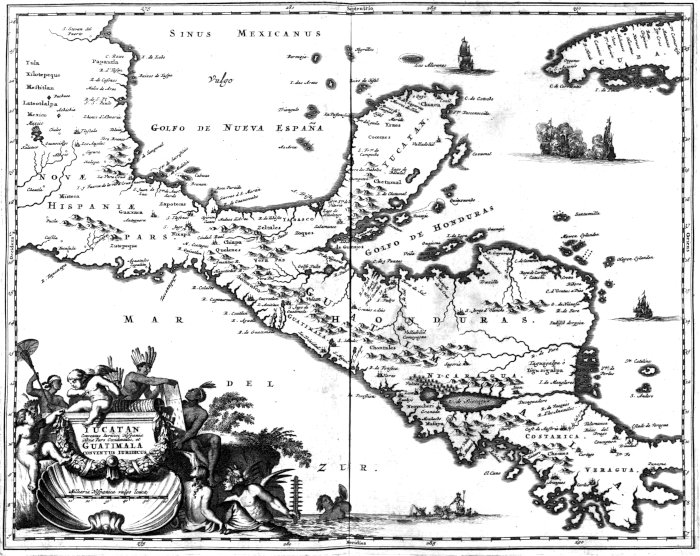
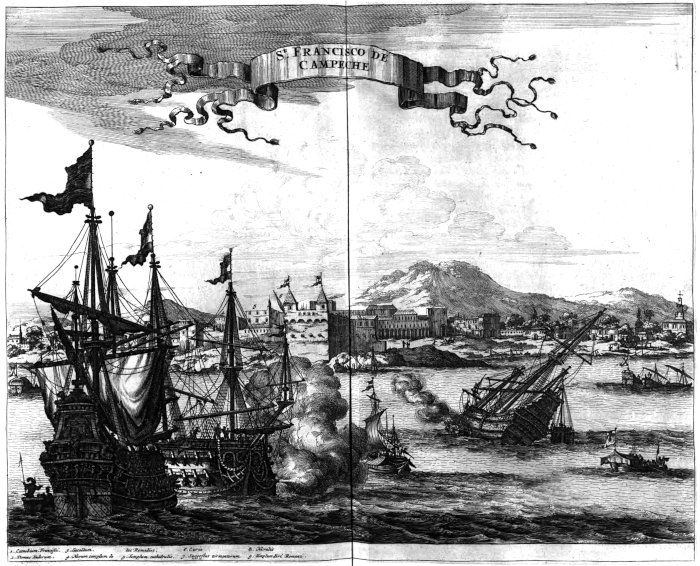
223
Sect. II. Jucatan.
Jucatan is a Peninsula, or half-Island, being encompass’d with the Sea on all sides, save onely to the South-West, where it is joyn’d to Guaxata, its farther and more Easterly Point looking towards Cuba. The knowledge of, when, and by whom this Province was discover’d, is included in that of New Spain, of which some will have it to be a part. The whole Province contains in compass nine hundred Miles or more, and lies between eighteen and twenty two Degrees of Northern Latitude, or thereabouts, the Air somewhat hot, and the Soil not altogether so fertile as some other parts of New Spain are; but in recompence thereof the People are so much the more industrious, living for the most part by Handicraft Trades. Neither is it altogether unstor’d with Corn and divers sorts of Fruits, besides what it hath of Fowl and Beasts, as Geese, Hens, Deer, &c. particularly it yieldeth plenty of Wax and Honey, by reason of its frequent Swarms of Bees. They report some special things of this Province, as namely, that the People of the Countrey us’d generally, and long before the Spaniards came thither, a certain Ceremony of Religion, not much unlike to our Baptism, and which they call’d by a Name that in their Language signifi’d Regeneration, or A Second-Birth; that they observ’d it so diligently, that few or none amongst them omitted to initiate themselves by it, believing, that thereby the Seeds and Ground-work of all Goodness was laid in them, and that they were fortifi’d by it against the assaults and temptations of evil Spirits; that after they were three or four years old, till they came to twelve, they usually thus Wash’d and Baptiz’d themselves; and that none were permitted amongst them to Marry, that were not first initiated after this manner; that they chose likewise a solemn Day upon which to do this; and that the Friends and Relations (especially the Father and Mother) of the Parties to be initiated, as well as the Parties themselves, always Fasted three days before the said Initiation; and that a great many of the Natives had a Tradition, or general Report amongst them, that of ancient time this Province of Jucatan was possess’d and cultivated by a certain People which came thither from the East, after a tedious long wanderring, and many hardships endur’d at Sea, having escap’d the Hands of their Enemies onely through the power of the Deity they worshipp’d; who help’d them, and made them to pass securely, even through the Waves of the Sea. All which, if true, seems not a little to confirm the Report which goeth for currant in the Welsh Chronicles, of one Madoc ap Owen, the Son of Guineth, a Prince of that Countrey, who is said to have fall’n upon a far Countrey this way in his Travels; which he lik’d so well, that having secur’d to his Companions their safe abode there during his absence, he return’d himself into Wales for more Men; and that he transported thither as many as he could carry in ten Barques full fraught. This he is said to have done about the Year of our Lord 1170. but neither he nor any of his Men were ever heard of since; and the success of the Expedition, it seems, little enquir’d after by the Welsh. However, the Relation seems not altogether incredible.
The chief Towns of the Province are, 1. Merida, in the Navel of the Countrey, and the Seat of the Governor, twelve Leagues distant from the Sea on either side. 2. Valladolidt, thirty Leagues distant from Merida. 3. Campeche, a great Town, consisting of about three thousand Houses or more, when first conquer’d by the Spaniards; who found such Monuments of Art and Industry in it, as did clearly argue, that the Place had been once possess’d by some People that were not barbarous. It is now call’d St. Francisco, and was surpriz’d in the Year 1596. by Captain Parker, an English-man, who took the Governor himself and some other Persons of Quality with him, together with a Ship richly laden with Gold and Silver, besides other Commodities of good value. 4. Tabasco, by the Spaniard now call’d Villa de Nuestra Sennora de Victoria, and commonly Victoria onely, in memory, as ’tis thought, of the first great Victory which Cortez obtain’d over these People at the Battel of Potonchan, as hath been said. 5. Cintla. 6. Potonchan. 7. Salamanca.
All along the Coast of this Countrey there lie certain Islands, some within the Bay or Gulph call’d Honduras, pertaining to the next Province, as 1. La Zarza. 2. La Desconescida. 3. Vermeia. 4. Los Negrillos; and some without it, as 1. Zaratan. 2. Pantoia. 3. De Mugeres, or The Island of Women; so nam’d by the Spaniards, who at their first Discovery of these Parts, for a long time together could meet with none but Women. The chief of them is call’d Acusamil, commonly Cozamul, and is fifteen Leagues in length, and about five in breadth, and was as it were the Thorow-fare, or Common Road of the Spaniards, when they first discover’d the Countreys of New Spain: For first here Landed Ferdinando de Corduba; after him John de Grialva, and others; and last of all the fortunate Cortez. It is now call’d St. Crux.
224

CHAP. IV. Guatimala.
Its Situation and Bounds.
Guatimala stretcheth to the Isthmus, or Neck of Land, which, as we said, joineth the Northern and Southern parts of the New World together.
This Countrey is bounded Northward with the Peninsula of Jucatan abovesaid, and part of the Gulph or Bay of Honduras; on the South, with Mare del Zur; on the East and South-East, it hath Castella Aurea; and on the West, New Spain. The length of it lieth upon the Coast of Mare del Zur, and is said to be little less than three hundred Leagues; but the breadth not half so much, and in some places very narrow. It is generally a fertile and good Countrey in all respects, but especially abounding in Cattel and good Pastures; it is subdivided into seven inferior Provinces or Countreys, which are 1. Chiapa. 2. Verapaz. 3. Honduras. 4. Nicaragua. 5. Veragua. 6. Costa Rica; and 7. Guatimala, specially so call’d: all differing in Language and Customs one from another.
The Bishoprick (as it is now call’d) of Chiapa is border’d on the West with New Spain; on the East with Vera Paz; and on the South with Mare del Zur. It is a Countrey much shaded with Woods, and those replenish’d with many fair and goodly Trees, of divers sorts, and of the largest size, as Oaks, Pines, Cedar, Myrtle, and Cypress-Trees, besides others which yield them a good kind of Rozen, precious Gums, &c. also several sorts of Balsom, as white, red, green, and black, not onely pleasant to the Scent, but an excellent Remedy for all manner of green Wounds: the best of it drops out of the cut Bodies of the Trees; and the worst is press’d out of the Wood and Leaves.
Trees and Plants.
There are also proper to this Countrey several other kinds of Trees and Plants, as that whose Fruit tastes like Pepper and Cloves, being of a great heighth; a Tree whose Leaves cure all ulcerated Sores, or the bitings of any poysonous Beast.
There is a sort of Cabbage call’d Ilantas, which grows to the heighth of a Tree, so that Birds make their Nests in them; they are eaten likewise like other common Cabbages.
There is also an Herb with narrow Leaves, which is no sooner touch’d, but it shrinks up to nothing; but at the going away of those which touch it, it obtains its former vigour.
Birds.
Here are likewise Quails, Ducks, Geese, Pheasants, Parrots, Turtle-Doves, Pigeons, and the like, in great abundance.
Amongst the several sorts of Falcons which breed in this Countrey, there is one sort which hath one Foot proper to its kind, the other like that of a Goose; it feeds on Fish along the Rivers.
The Bird Toto-Queztall, which is somewhat smaller than a Pigeon, with green Feathers and a long Tail, is taken onely for its Tail, which when the Indians have pull’d out, they let the Bird fly again, there being a Law amongst them, that whosoever kills one of them, is to suffer death.
The Cranes here are of a dark Gray; the biggest of them have a tuft of Feathers like a Crown upon their Heads.
225
Birds.
The Birds Guacamayes, which are red and blue, are like a Peruan Goose.
Beasts.
Moreover, the Countrey yields brave Horses, Goats, Sheep, Rabbets, and Foxes; also wild Dogs, Leopards, Lyons, and Tygers.
The wild Hogs which breed here have their Navels on their Backs, and have no Tails, they smell exceeding strong, and feed together in great Companies.
The Taquatrin, a certain Beast proper to those Parts, hath a Bag under its Belly, in which it generally carries seven or more young ones, and hath also a bald Tail; it creeps into Houses in the Night to steal Hens.
Here is also a certain Beast (whose Name we find not) about the bigness of a Rabbet, and like a Rat, and carries its young ones on its back whensoe’re it comes abroad.
The Serpents, which are very numerous here, trouble the Inhabitants exceedingly, especially near the Village Ecatepeque, where there are such an abundance on two little Hills, that none dares approach them; some of them are very poysonous, for if touch’d with a Stick, the Poyson runs up the same: and whoever are anointed with the Blood of a dead Serpent, die a lingring Death. John de Laet relates, that the Indians took one which carried thirty young ones, which being a Finger long, crep up and down immediately; and the old one, being above twenty Foot long, serv’d the Natives for Venison.