The Third Book, CONTAINING A DESCRIPTION OF PERUANA OR, Southern America. (continued 3)
Reading edition
16. The City Yaen, situate in the Countrey Chuiquimayo; it is so call’d from a swift River, cross which the Peruvian Women and Children swim, to the great amazement of the Spaniards. They paint their Bodies black with the Juice of the Root Yaguas, and feed for the most part on the stamp’d Plant Yaca. On the other side of the Mountain, which rises on the Banks of Chuquimayo, lies the Countrey Perico, fruitful and well inhabited, against which juts the Golden Countrey Cherinos. Peru hath also several delightful Valleys, amongst which on the North the chiefest are the Tumbez, Solana, Poechos, and Piura, all of them very fertile, full of stately Buildings, and water’d by several Rivers.
17. San Miguel, the first City that was built by the Spaniards in Peru, situate in a sandy and dry Soyl, being extraordinary dusty in Summer, and very slabby in the Winter, because the hard Ground cannot soak up the Rain. The Ingas made a Way through this Valley fifteen Foot broad, between two Walls, and Planted Trees on each side.
Spilbergen’s Attempt upon Payta.
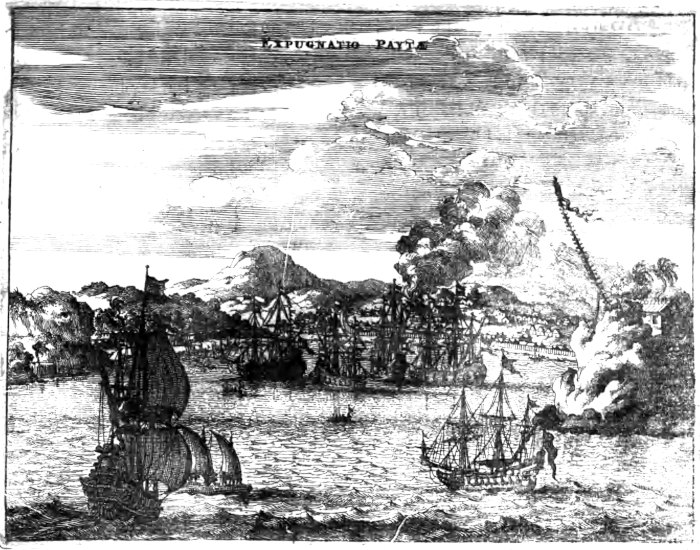
18. Westward from Miguel appears Payta, near a convenient Haven in the South-Sea, which Anno 1547. was burnt by Thomas Candish; since which it had been re-built twenty eight years, when Joris Spilbergen, after a hard Engagement with the Spanish Admiral Rodrigo Mendoza, arriving in the large Haven before Payta, sent eight Sail with three hundred Armed Men up to the City, where finding the Enemy Encamp’d along the Shore, he return’d without any effect; but two of his Frigats, the Eolus and the Morning-Star, running close to Payta, fir’d whole Broad-sides at the same, whilest Captain De Wit took a Peruvian Fisher-man, who had been two Moneths out at Sea, and taken abundance of Fish. The Guns which the Ships fir’d upon the Town struck such a terror into the Citizens, that they fled with Bag and Baggage into the Mountains, and left the City for a Prize to Spilbergen, who setting fire on the same, in few hours burnt down two Churches, a Dominican Cloyster, and several Alms-houses: But had not the Citizens been cowardly, they might 446easily have kept off the Hollanders; for the Vice-Roy Ludovico Velasco inform’d of Spilbergen’s Arrival, had stor’d the Place with Ammunition and Men, whose Courage failing, prov’d successful for the Hollanders, who whilest they Rid here at an Anchor, took a very strange Bird on the Island Lobos, lying before Payta, being two Yards high and three thick, in its Bill, Wings, and Claws resembling an Eagle, and having a large Crest on its Head. Not long after Donna Paula being Governess of Payta, a Lady famous in Peru for her Beauty and obliging Nature, sent Cabbages, Oranges, Cittrons, and other Provisions to the Hollanders, and requested the Releasement of some of the Spaniards taken in the Engagement against Mendoza, but could not obtain her Request from the uncourtly Dutchmen.
Sect. III. Los Quixos.
Description of Los Quixos.
The Province of Los Quixos lieth South, and to the South-East of Quito, being border’d more directly Eastward with a part of the Province of Guiana, call’d by some El Dorada, or The Golden Countrey; on the South it hath Lima and Cusco.
The Canela-Fruit.
This Province is subdivided into several lesser Territories, viz. Canela, Pacomores, and St. Juan de Salinas. Canela is so call’d, because it hath many great Woods, which produce the Fruit Canela in great abundance, the Owners whereof were most inhumanely dealt with by the Spaniards; for Gonsalvo Pizarro supposing to get store of Gold there, found nothing but Trees, bearing a Fruit like Olives, by the Natives call’d Canela, with which they us’d to drive a great Trade, being otherwise poor and simple People, living in Huts, which Pizarro pulling down, caus’d the Inhabitants to be torn in pieces by his Dogs, because they could not furnish him with Gold, nor direct him where it was to be had.
The Granadilla-Apple.
Besides the Canela-Tree, this Countrey also produceth in great plenty the Tree which beareth the Apples Granadilla, exceeding good against burning Feavers; the Leaves are like Ivy, the Blossom resembling the Sun, and the long Leaves speckled with Red and White, open three hours after Sun-rising, and close again before the Evening, just as if Nature took care to preserve the beauty of the Flower.
Towns and Places of chief note.
In this part of the Province the chief are, 1. Baeza, otherwise call’d Quixos, built in the Year 1559. by Ramires de Avila, eighteen Leagues from Cusco.
2. Archidona, twenty Leagues to the South-East of Baeza. 3. Avila. 4. Sevilla del Oro, all of them Spanish Colonies.
The Territories Pacomores and Yguansongo, otherwise call’d The Countrey of Juan de Salinas, are said both to extend above a hundred Leagues in length, and little less in breadth. The Fields afford store of Pasture for Cattel, the Plough’d Lands produce Wheat and all sorts of wholsom Herbs; and in some places are also rich Gold-Mines.
The Governor Layola built four Towns here, viz. 1. Valladolid; 2. Loyola; 3. San Jago de los Montanas; and 4. Caruma.
The Jesuit Acosta relates, That not far from Caruma he found great Stones, some of which were full of Golden Veins, but were hard to be cut from the Rock. Most of the Gold is found in the Sand of several Rivers, the chiefest whereof flow through Quito, New Granada, Valdivia in Chili, and Caravaya in Peru.
On the Point of Quito, the River San Jago falls into the Southern Ocean; the Ground in the Mouth of the River being very uneven, for oftentimes the Ships are 447fast aground at the Stern, and on Head they have above eighty Fathom Water; yet nevertheless the Shoals are no ways dangerous.
South-West from St. Jago lies the spacious Inlet Mattheo, and the Promontory Francisco, known by its Banks and high Grounds, which shew red and white at a great distance.
Not far from hence, exactly under the Equinox, appears Cape Passao, flat and low; between which and Mattheo, the great Rivers Los Quiximes fall into the Sea.
Behind Passao rises the high Mountain Quaque; and more Westerly the Bay Caraques affords a secure Harbor for all manner of Vessels.
Next you come to the Town Puerto Viejo before mention’d, lying behind the Island Laurenso.
Five Leagues off at Sea, before Laurenzo, lies the Island Plata, formerly famous for a Peruvian Temple, in which the Natives Sacrifis’d Sheep, and sometimes Children, and painted the Figures of divers Persons with the Blood; to which they also Offer’d Jewels, Gold, Silver, Wooll, Cotton Shirts, and Cloaks. Francisco Pizarro arriving here, got an invaluable Mass of Treasure; but at present it lying desolate, affords nothing but Brambles and wild Trees.
The next which come in view are the Havens Callo and Zalango, where there are safe Harbors, good Wood and Water.
The Cape of St. Helena makes also a secure Road on the North, and on its Shore hath a Spring, on the top of whose Waters swims a certain Gum, by the Natives call’d Copey, exceeding good to make Ships tight.
The River Tumbez falls into a large Bay, which on its North-East Point near the Main Land, hath the Island Puna, ten Leagues in circumference: The Soyl whereof produces abundance of Maiz, Fuca, and other good Roots, besides great Woods full of fruitful Trees, and Sarsaparilla. The Inhabitants of a brown Complexion, and middle Stature, wear Cotton Cloaks, and Chains of Chaquira and Precious Stones: They drive a great Trade, and formerly maintain’d Wars with the People inhabiting upon the River Tumbez; their great want is fresh Water in the Summer. Thomas Candish Landing here Anno 1587. found a Ship hal’d ashore, and three Villages, in one of which stood a Palace belonging to a Casique, surrounded with Stone Galleries; and near it a large Store-house full of Tar-pots and Hemp to make Cables of: The Village consisted of two hundred Houses, and a fair Church with a Steeple, in which hung several Bells. The Casique Married to a Spanish Woman being fled with the Villagers, Candish took many Oxen, fat Sheep, Pigeons and Ducks, the Bells, and what else was not convey’d aboard, with him, and, afterwards burnt the whole Town; but whilest he was busie in making havock, a thousand Spaniards, and a considerable number of Peruvians fell upon the English on such a sudden, that they kill’d some, and took others Prisoners.
Somewhat farther off at Sea appears the Isle Clara, where those of Puna formerly buried their Dead.
The Inlet into which falls the River Tumbez, whose Shores are well inhabited, ends Westward at the Promontory Blanco; Southward from which lies the Isle Lobos, where there are several Springs full of the same Gum, or Bitumen, a little above mention’d.
Beyond the Point Agua lie the two Isles Lobos Marinos, opposite to a low Coast; they are desolate, and barren of Grass, Trees, and all kind of Herbs, and destitute of fresh Water; but many Pelicans, Penguins, and other strange Birds.
The discovering of these Coasts belonging to the Jurisdiction of Quito, deserves a short Relation:
Bevalcazar overcoming Ruminagua, takes Quito.
He comes to an Agreement with Alvarado.
Pizarro and his Army driven to great Straights.
Orellana cross’d in his Designs, dies for grief.
The miserable Condition of Pizarro’s Men.
Quito very much defac’d by siding with Vela against Gonsalvo Pizarro.
448Whilest Pizarro kept the Inga Attabaliba Prisoner, he sent Captain Bevalcazar to the new Fort St. Miguel, where eighty Horse and a hundred Foot being arriv’d from Panama and Nicaragua, and he being inform’d that there lay a great Treasure in Quito, and that the Canares, the Spaniards Friends, were exceedingly oppress’d by Ruminagua, Attabaliba’s General, immediately march’d thither with the new arriv’d Forces before mention’d, to fetch the Booty, and to assist the Canares; but several things oppos’d him in his Design: for Ruminagua guarded the Way with twelve hundred Indians, digg’d Pits in the same, and filling them with sharp Poles, cover’d them slightly over with Canes and Earth; all which Bevalcazar shunning, went about, fell in upon the Rere of the Enemy, and after a small Resistance conquer’d the City Quito. Mean while Ferdinand Cortesio sent Petro Alvarado from New Spain, who taking Guatimala, receiv’d a Commission from the Spanish Court, to subdue the Northern parts of Peru. Soon after which Garcias Holgua being sent with two Ships to enquire concerning the State of Peru, brought News back, That Francisco Pizarro had gotten an unvaluable Treasure at Caxamalca; which so stirr’d up Alvarado, that he Landed five hundred Men at Puerto Viejo, march’d in great want of Provisions over the Mountains Acabucos, and had he not accidentally found a Pond of sweet Water in a Thicket of Canes, both Men and Horses had all perish’d; at last upon his approaching Quito, the Governor thereof, being Bevalcazar, not enduring to suffer an Equal, drew up all his Men in Battel array; but some Persons interceding between them, they were soon reconcil’d, and Alvarado being bought out with a great sum of Money, deserted Quito; where after Gonsalvo Pizarro, had remain’d a considerable time he march’d Eastward of the Province, which produces abundance of Cinamon; whither he was accompanied by two hundred Spaniards and four thousand Peruvians; against whom the Natives dwelling on the Borders of Los Quixos fought very valiantly, till Night approaching, when they all ran away; after which resting a while, there arose a mighty Tempest of Thunder and Lightning, accompanied with a dreadful Earthquake, which swallow’d above five hundred Houses, whole Woods and Fields, whilest an unknown River burst out of the Earth, and overflow’d all the Countrey, insomuch that Pizarro expected nothing but a speedy Ruine, in regard no Provisions were to be found in all the Countrey: at last getting on the top of the nearest Mountain he lost many of his Men, who were frozen to death with excessive Cold. From thence marching to the County Zumaque, he got plenty of Provision and Cinamon, which grows on great Trees in the Woods; the Leaves thereof resemble the Laurel; the Fruit grows in little Berries; the Root and Bark have a strong odoriferous smell. Thence travelling to the Town Coca, he found a mighty Cataract of Water, falling from a Rock above fifteen hundred Ells high; insomuch that the noise in calm Weather was heard six Leagues off. Pizarro leaving his sick People in Zumaque, went onely with a few Eastward from Coca to the Plain Countrey Guema, full of Moorish Grounds, the Inhabitants whereof went naked: at last he came to the great River Maranon, which falls from the Mountains near Quito, and extends with several windings above eight hundred Leagues in length, and at the Mouth thereof is fifteen Leagues broad, which at that time overflowing all the Countrey, he judg’d it convenient to build a Brigantine, making the Shoes of the dead Horses serve for Iron-work, his Mens Shirts for Sails, and a Gum, which was to be had there, for Tar, and having Lanch’d their Vessel, and put all their Baggage and sick People into the same, they Sail’d close along the Shore, on which Pizarro made his Way through Brambles and Canes, or went over in the Brigantine whensoe’re he espy’d a better Path on the other side; in which manner they were gone two hundred Leagues down the River, with no other Food 449but wild Fruit and Roots; when Captain Franciscus Orellana, was order’d to Sail away before with five Men, and seek out for Provisions, and at every Stream which fell cross-ways out of the Countrey into the great River, he was to leave a Mann’d Boat: but Orellana in few days drove down so far with the swift River, that he saw no likelihood of getting up again in a whole year, neither could he find any Provisions, but fought daily with the Indians, who came stoutly to Board him in little Boats: amongst whom he was inform’d also, that thereabouts liv’d the Amazon Women, that Warr’d continually against their Neighbors; and at last he came into the Northern Ocean. But Orellana Sailing to Spain, obtain’d a Commission to be Governor of the Amazons Countrey, whither he steer’d his Course with five hundred Men in three Ships; but Landing at the Canaries they all ran away from him, which so incens’d Orellana, that he soon after dy’d with Grief. Mean while Pizarro inform’d by a Spaniard whom Orellana had put ashore, that the Brigantine was by the strong Current carried into the Ocean, knew not what to do, his People since their departure from Quito having travell’d above four hundred Leagues, had eaten most of their Horses: Many dy’d by feeding on unwholsom Herbs; others fell down dead for Hunger, or tir’d out with toilsom Travel; their Clothes, rotted by the Rain, hung upon them like Rags, their Shoes were worn out, their Feet full of Blisters, their Bodies sadly mangled with Brambles and Thorns, for no place afforded them a Boat. Pizarro leaving the River Maranon, went another Way, no less troublesom for steep Rocks and inaccessible Mountains. The Valleys through which they went, began now to be strew’d with dead and sick Bodies, who were not able to follow the Army, which march’d very fast, every one judging to be so much nearer his preservation the farther he could get: Those that fainted call’d continually on their Friends for help, but the Horses were grown too weak to carry them: Every one saw nothing but Death before his Eyes; wherefore, though call’d by their dearest and most intimate Friends that lay a dying, they never look’d back, their compassion towards others being turn’d into fear and care of themselves. The Forsaken implor’d their Saints, and besought Pizarro for aid, but finding their Complaints to be in vain, and raging through despair, they wish’d all the rest the same success, and the like Friends, whenever they should be in the like Condition. Pizarro extreamly griev’d and troubled, that he had brought the People into this Misery, sent a few Horsemen before to Quito, to carry the sad News of his deplorable Condition, that they might immediately send Provisions to him; which he receiving when he was within fifty Leagues from the said City Quito, distributed amongst those that were left alive, who being also almost starv’d, eat so greedily, that several of them were chok’d; the remainder were kept a considerable time in Garrison under the Command of Pizarro in Quito. Which City, built in a pleasant place, grew very populous in the Year 1544. there being several Gold-Mines found about the same in that time. But this lasted not long, for Quito siding with the Vice-Roy Blasco Nunnez Vela against Gonsalvo Pizarro, most of the Citizens were destroy’d by him, and their Houses burnt to Ashes. The like Destruction, and upon the same occasion, befel the three Villages in the Province Bracomoros, discover’d by Juan Parzel and Captain Vergara, together with the Countrey Chichiapoios, where Alphonso Alvarado built the Town Levanto, surrounded with deep Caverns, through which, to the great strengthning of the City, flow several Rivers.
Round about Puerto Viejo the Natives dwelt in Trees, whom the Spaniards had much ado to bring under their subjection; for their Countrey being barren and mountainous, was not onely wanting in Provisions to feed an Army, but the Peruvians 450also threw great Stones out of their Huts built in Trees, and likewise Javelins and Pots full of boyling Water, with which they did much mischief to their Enemies that Storm’d them, who at last covering themselves with Boards, cut down the Trees, with which they falling were torn in pieces by the Spanish Dogs.
Sect. IV. Lima.
Situation and Description of the Province of Lima.
Lima, call’d also Los Reyos, hath on the East, Collao, and some part of Cusco; on the North, Los Quixos; and on the South, Charcas. The Countrey extendeth it self in length upon the Coasts of the South Sea two hundred and fifty, some say, full three hundred Leagues in length, viz. from Cape del Aguia Northward, on the Borders of Quito as far as Arequipa towards the South, and runs Eastward to Brasile and Rio de la Palma.
The several Valleys of this Province.
In this Province are several very pleasant Valleys, the first whereof is Motupe, to which a sandy Way leads from St. Miguel de Valverde, between barren Wilds, from whence several Streams falling are immediately drunk up by the Sand; wherefore all Travellers that go that way carry Water and Wine with them in Calabashes for twenty Leagues together, which they Walk or Ride by Night, because of the excessive heat of the Sun.
In the Valley Motupe grow abundance of Trees, which receive nourishment from a River that springs up near the same. Here is also much Cotton.
Not far from hence are the Valleys Xayanca, formerly very populous and full of Palaces: The River which flows through the middle is led in Trenches amongst the neighboring Fields.
The Valley Tuqueme is also very pleasant, and the decay’d Palaces, sufficiently testifie its former splendor.
The next being Cinto, is no way inferior to Tuqueme; and between both lie sandy Hills and barren Rocks, on which grow neither Trees nor Herbs, nor is any living Creature to be found upon them: the Way through which being a whole days Journey, cannot be travell’d without sure Guides.
The Valley Collique, water’d by a River of the same Denomination, and very thick set with Trees, was formerly very populous, but since the Spanish Wars it is become quite desolate; for not onely a considerable number of them were slain by the Spaniards, but also many destroy’d themselves, Wives and Children; of which Peter Martyr, Councellor to the Emperor Charles the Fifth, sets down several terrible Examples, of which two were remarkable above the rest; the first was after this manner:
Two tragical Passages.
The Spanish Captain Olandus Lying with the Daughter of an Indian Casique, question’d when she grew big with Child, Whether she was with Child by him? and that he might know the real truth by Torture, he caus’d her to be ty’d naked to a woodden Spit, and laid to roast against a Fire made of green Wood, so that she died in a most miserable manner; upon which her Father ran in a rage with thirty of his Companions to Olandus’s House, where he kill’d his whole Family, and locking all the Doors about the House, set fire on the same, into which when it was at its greatest heighth, he and his Associates leap’d into the middle thereof.
The second Accident is also very terrible, viz. An Indian Maid being Got with Child by a Spanish Ass-driver, acquainted her Father and Mother with it, withal 451telling them that she was ready to suffer Death for her Offence; and notwithstanding they freely pardoning, and perswading her to the contrary, she eat raw Juca, which when boyl’d is a wholsom Food, but if eaten raw, certain though languishing Death; which she perceiving, ran to the next River, where after having wash’d her self, she broke off from a large Tree a Bough of five Foot long, and making the end thereof very sharp, fell upon the same, and so kill’d her self. Several other Ravish’d Maids taking example hereby, hang’d themselves upon the Boughs of the same Tree.
But to proceed in our Description, next to Collique lies the Valley Zana, of the like bigness, and famous for the City Miraflores.
The next is Pascayamo, which exceeds all the former in fruitfulness, and populousness of Inhabitants, who before they were destroy’d by the Ingas were much fear’d by their Neighbors. This Valley also was adorn’d with several fair Temples, which are now turn’d into Cloysters. Cattel, Hogs, and Goats breed here in very great numbers. The chief Trade of this Place consists in Cotton and Linnen.
The Valley Chacama, in which the Dominican Monks inhabit a brave Cloyster, produces abundance of Sugar.
Four Leagues farther lies the spacious Valley Chimo, so call’d from an old Peruvian Heroe, which affords a pleasant Prospect, by reason of the many Banquetting-houses built there by the Ingas. No place in Peru is able to stand in competition with this for plenty of Provisions, the Ocean and Rivers producing store of Fish, the Countrey affording Cattel and all manner of Fruit. The Cotton which grows here is Shipp’d to the South Sea.
Chanca is a Valley chiefly considerable for the Town Arnedo, which is situate therein, of which more hereafter.
But the Valley Guanape, not far from Chanca, yields the best Peruvian Liquor Chica, and hath a convenient Harbor for Ships.
The Plain Santa being overflow’d in the Winter, is all overgrown for want of Inhabitants, who were all destroy’d by the Spaniards. The Woods hereabouts swarm with a sort of venomous Bug, which exceedingly torments the Traveller.
Spilbergen’s Attempt.
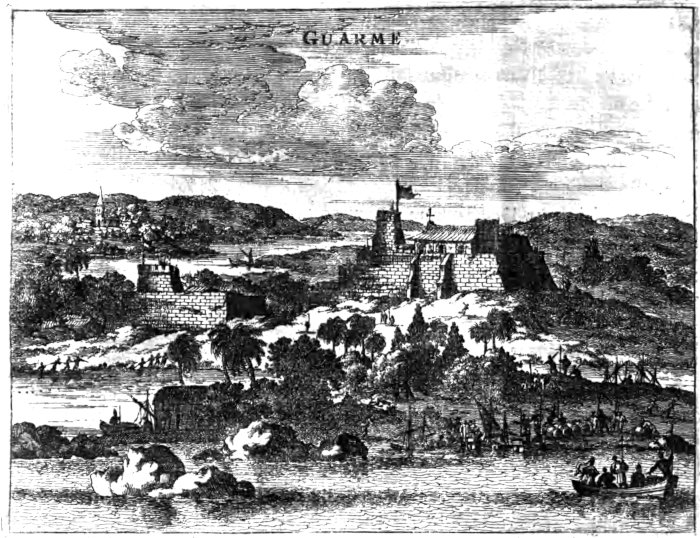
Next follow in order the Valleys Guambaico, very fruitful, and Guarney, abounding with Horses, Hogs, and other Cattel. Joris Spilbergen Landing here Anno 1615. found the Haven secure against all Winds, and between the Shore and the Village Guarmey a Creek, and somewhat farther a fresh-Water Pool; on one side of which stood a decay’d Castle built of square Stone, whereon the Hollanders set the States Flag, and Garrison’d the same to secure those that fetch’d Water out of the foremention’d Pool. In the aforesaid Village stood a Church with a spiry Steeple; behind which rose high Mountains, and at the Foot thereof a great Wood, into which the Inhabitants fled with all their Goods, so that Spilbergen found nothing but a little Meal, a few Hens, Hogs, and Oranges in their Houses, which whilest he was sending Aboard, a small Body of Horse appear’d, but immediately fled into the Woods. The Hollanders staying here seven days, were inform’d, that the Galley Jesu Maria, Commanded by the Admiral Rodrigo Mendoza, and the Santa Anna, by the Vice-Admiral Peter Alvares Piger, were both lost, not one Man being sav’d.
Not far from thence lies the Valley Parmonga, which though it be fruitful and pleasant, yet it is quite desolate; the Walls of a large Castle still appear, as testimonies of its being formerly inhabited; and within the said Walls also are still to be seen the Ruines of spacious Halls and fair Chambers, whose Walls are painted with wild Beasts and Birds: The Spaniards have digg’d all about, and undermin’d 452the same, in hopes to find, together with the several dead Bodies, a Treasure buried. Two Leagues Southward from this Valley Parmonga flows the River, Guayman, by the Spaniards call’d Rio del Falcon, from a Hawk which was seen there. When any store of Rain falls here, a great part of the Dale Barrana lies under Water.
Strange manner of Hunting.
Not far from hence lie the Valleys Gaura and Lima; which last exceeds all others in bigness, and was formerly exceeding populous; but since the Marquess Pizarro built the City Los Reyos here, the Citizens have taken the Lands from the Peruvians. The Mines hereabouts produce Gold and Silver. Amongst other things the Inhabitants highly esteem an Herb bearing yellow Flowers, which in a short time cures a putrifi’d Wound, whereas if laid on sound Flesh it eats the same to the Bone. The Natives heretofore us’d to spend their time in Hunting, and caught their Game after this manner, viz. three or four thousand of them would meet together, and by taking Hands make a Ring of three or four Miles in circumference, and at a certain Note or Tune Sung, or loudly Exclaim’d, they drew nearer and nearer, till at last they were within Shot of the inclosed Game, whatsoever it were.
A vast Treasure found by Ferdinando Pizarro.
The Countrey of Collao hath a low Point, from which a long Cliff runs into the Sea, towards the small Island call’d Isla de Collao: On each side of the Point the Coast runs sloaping in, the one side extending North-West from Collao, to the Cliffs Piscadores; the other South-East to the second Promontory; behind which is a large Bay, where the Valley Pachacama appears, famous for its exceeding fruitfulness, and a stately Temple built by the Ingas, where Ferdinando Pizarro found above nine hundred thousand Ducats, besides what the Soldiers and Commanders took, and what the Priests had hid, which none, though miserably tortur’d, would confess.
Opposite to Pachacama lies the Valley Chilca, where it never Rains, nor any Brook or Spring moistens the dry Soil, which nevertheless produces Maiz and Fruit-Trees. The Natives us’d to dig large and deep Pits, in which they Sow’d and 453Planted, and at every Root laid the Head of a Fish call’d a Sardin, which they caught in Nets on the Sea-shore; wherein nevertheless nothing would have grown, but for the Morning Dews which fell. The Ingas also had curious Banquetting-houses here. In these Parts there grows a sort of Tree call’d Mala, of which Acosta relates a strange Wonder of Nature, very remarkable, viz. That it flourishes and bears Fruit on that side which beholds the South, in that Season when it is Summer on the Mountains; the other which views the Sea, Blossoming and bearing Fruit when it is Summer on the Plains.
The Valley Guarco, spacious and full of Trees, produces especially the pleasant Fruit Guayaves and Guavas, as also the best Wheat in Peru; wherefore it is vended all over the Countrey. Here are also the Ruines of another stately Castle, built by the Ingas, the former lustre whereof is testifi’d by its remaining Walls, which consist of exceeding great Stones, so neatly joyn’d together without Mortar, that it appears like one entire Stone; and by the decay’d Structures of several Halls, much of the curious Painting whereof is yet to be seen; from the Castle a large pair of Stairs led down to the Sea-shore. Two Leagues farther the River Lunagun runs through the fertile Valley of the same Denomination. The fatness of this Soil is chiefly ascrib’d to the Dung of a Fowl call’d Guana, which the Natives fetch in great abundance from the Isles near the Main.
Next follows the Valley Chinca, one of the biggest in all Peru, and before the Spaniards Arrival very populous. In the time of the Ingas it also shew’d a magnificent Temple Dedicated to the Sun, built by Tepaja Jupangue; yet the Inhabitants still remain’d constant in the worshipping of their old Idol Cinciapema. Hither the Ingas sent their conquer’d Princes, who on a certain time were to appear in Cusco. The Dominicans at present possess here a neat Cloyster, from whence leads a plain Road to the Dale Ica, water’d by the River Pisco, which is dry in Summer; wherefore the Natives brought a Ditch from the Mountains, which since the Spaniards destroying the Inhabitants, is choak’d up with Sand.
Next the Valley Nasca comes in view, famous for the Castle Caxamalca, where the Ingas kept all manner of Ammunition for War, besides several Tombs, out of which the Spaniards took great Riches. This Valley is divided into several others, which for the most part produce Sugar-Canes; and through them all runs the Royal High-way, which is Wall’d in on both sides.
Beyond Nasca lie one behind another the Valleys Hacari, Oconna, Camana, and Quilca, all of them affording good Pasture for Cattel, and Fruit, yet are most of them desolate.
The County Los Motilonos, thinly inhabited for want of Provisions, and divided by two Rivers, separates Moyobamba from the Countrey Charasmal.
Southward beyond Caxamalca appear the Countreys Guamachuco, and a little farther Conchucos and Piscobamba, all fruitful and pleasant, and adorn’d with several Structures built by the Ingas.
On the side of Piscobamba the County Guaraz extends it self over barren Mountains, through which the Ingas cut a Royal High-way, and built a strong Castle at the Entrance into the Countrey; the Inhabitants whereof being very laborious, work very diligently in the Gold-Mines.
The Territory Pincos, water’d by a River, and famous for one of the stateliest of the Peruvian Structures, is surrounded by the Countreys Guayalcas, Turama, Bomba, and Conchucos. The Mountains, though dangerous to Travellers by Lyons, great Bears, and other ravenous Beasts, afford abundance of Silver; and the fruitful Soil produces Wheat, Maiz, Grapes, Figs, Oranges, Quinces, Cittrons, Cedars, and; likewise feeds Goats, Horses, and other Cattel.
454The Countrey Viticos, being within the Jurisdiction of Guanuco, lies amongst the Mountains Andes, whether Inga Mango fled, when the Spaniards made themselves Masters of Peru.
Chief Towns and Places of note.
The Towns and Places most observable and important in it belonging to the Spaniards, are 1. Miraflores, as the Spaniards call it, a well seated and wealthy Town in the Valley of Zanu, as above mention’d, five Leagues distant from the Sea, where it hath likewise a good Haven or Port.
2. Truxillo, two or three Leagues distant from the Sea; the Haven whereof is said to be large, but not safe. The Town it self is seated in the Valley Chinco, upon the Banks of a pleasant River, whose Water doth not onely run through several Channels to moisten the Fields, but also to accommodate every House in the City: It hath broad Streets, a great Market-place, four Cloysters, two for the Dominicans, one for the Augustines, and the other for the Franciscans; one great Church, five hundred Houses, and a Palace, inhabited by the King’s Collectors, and many Banquetting-houses about it. The good situation and fruitfulness of the Soil, mov’d the Marquess Francisco Pizarro to build this City here Anno 1533. but the Haven belonging to the same lies open to all manner of Winds, so that the Ships Ride here in great danger.
3. La Parilla, otherwise call’d Santa, fourteen Leagues beyond Truxillo Southward, wash’d by the Southern Ocean, and one side by a fresh-water Stream, which being inclos’d between stony Cliffs, makes a secure Harbor.
4. Arnedo, seated ten Leagues Northward from Lima, amongst the Vineyards of the Valley Chancas; otherwise having no great matter in it remarkable, but a fair Dominican Cloyster.
Prizes taken here by Sir Fran. Drake.
Spilbergen attempts the Place in vain.
5. Lima, by the Spaniards commonly call’d La Cividad de los Reyes, or The City of Kings, so nam’d because Pizarro, who built it, laid the first Stone on Twelfth-day, Anno 1553. which they call The Feast of the Kings: It is seated in the Valley of Lima, (from whence the City is also so denominated) one of the fruitfullest Parts of all Peru, and so neatly built, that all the chief Streets of the City open upon a fair Market-place, or Piazza, of such a large Square, that upon the sides thereof are built, in a stately and convenient manner, the Cathedral, the Palace of the Archbishop, the Vice-Roy’s Palace and Courts of Justice, with the Exchequer or Publick Treasury, the Town-house or place where the City Magistrates meet and hold their Courts, the Publick Armory or Magazine, and a Free-School, wherein are taught by the Jesuits all Arts and Sciences, and also the Indian Language, and divers other fair Buildings of the Nobility and better sort of Citizens. No Countrey under the Heavens affords a more fruitful or pleasanter Place than this; the temperate Climate neither troubling the Inhabitants with excessive Heats or great Colds, nor terrifying them with Thunder or Lightning, but having almost perpetual Sun-shine and fair Weather; onely the three Winter Moneths, wherein there falls a sweet-smelling Dew, which cures the Head-ache; and there die but very few of pestilential Distempers. The Countrey about the City is pleasant without exception. The Pigeons which are kept here in curious Houses built on purpose, flie a thousand in a Flight. The Fields abound also with Cattel. The Orchards and Gardens flourish with all sorts of Trees and Plants, whereof those that are brought hither from Spain grow better than in their natural Countrey. The West side of the City is wash’d by a pure & clear Stream, which stores the Market with great plenty of good Fish, it being distant but a Musquet shot, especially when the Water rises. This River is of great consequence, for it not onely waters the whole Valley of Lima with its several Branches, but also runs under every House in the City, being 455built on Stone Arches; they are onely one Story high, because there is no Wood to be had in the Valley of Lima but what in three years becomes all Woorm-eaten; nevertheless the Houses are very beautiful both within and without; the Walls being very thick and strong, have curious Arbors of green Boughs on the top, in which the Owners shade themselves from the Sun. Most of the Houses built in the high Streets have pleasant Turrets, which face the Market-place, where all sorts of Provisions are brought to Sale, as Oxen, Sheep, Venison, Sugar, Oranges, Cittrons, Grapes, and Wheat, which is ground in Water-Mills built near the River. This City is inhabited by many able Merchants, which often load Ships to Panama, that are valu’d at above two hundred thousand Ducats. To the Arch-bishop’s See of this Place belongs the Bishopricks of Chili, Charcas, Quito, Cusco, Truxillo, Guanuco, Popaian, San Francisco, Panama, Nicaragua, and Rio de la Plata. The City is also adorn’d with two fair Churches, besides the Cathedral, and also other lesser Churches, four stately Cloysters, two Nunneries, and the Jesuits Palace, which is very magnificent. The Haven two Leagues distant from it, and call’d Callao de Lima, is large and secure for Ships. Anno 1579. Sir Francis Drake took twelve Ships from hence, one whereof was laden with Linnen and Silk, besides a great Chest full of Silver: Which Inconvenience to prevent for the future, the Spaniards have built two strong Forts, and fortifi’d them with Brass Guns. Thirty years after Sir Francis Drake’s Exploit, Joris Spilbergen coming to Anchor here, found the Place all inhabited, a Fort well stor’d with Guns, and a strong Castle before the Mouth of the Harbor, from whence they shot Bullets of thirty six Pound weight at the Hollanders, and so shatter’d their Frigat, call’d The Hunter, that she could scarce keep above Water: Fourteen Spanish Merchant-men lying near the Shore, receiv’d little damage, Spilbergen not being able for Shelves to get to them, neither did he judge it convenient to Land, the Vice-Roy having at that time above four thousand Men in Arms, besides several Troops of Horse; wherefore after having fir’d several Guns on the Fort, and against the Church, he set Sail to Guarmey.
6. Cannete, otherwise call’d Guarco, from the Valley wherein it is situate: It was built by the Spaniards out of the Treasure which they found in the Castle afore spoken of in the same Valley.
7. Valverde, situate in a Valley of the same Name, where excellent Fruit may be had for a small Price; it is a well Traded and rich Town, about sixteen Leagues distant from the Sea.
8. Pachacama, situate in a Territory of the same Name, four Leagues Southward of Lima, memorable chiefly for Pizarro’s good fortune here, who is reported to have found in one onely old Temple of the Natives, the quantity of nine hundred thousand Ducats of Gold and Silver, besides what his Soldiers are suppos’d to have seiz’d on, and convey’d away before he came.
9. Castro Verreina, threescore Leagues distant from Lima to the South-East: It lieth in the Valley of Chocolocha, and is a rich Place, by reason of the good Mines of Silver which are about it, and abundance of the best sort of Tobacco.
10. Miguel de la Ribera, in the Valley of Camana. The Inhabitants whereof drive a great Trade in Wine, Figs, and Raisins.
11. The City Arequipa, which extends up towards the Mountains, is built in the Dale Quilca, which runs eleven Leagues from the Sea, under a healthful Climate; but in the Year 1582. it was wholly ruin’d by an Earthquake; the reason whereof is ascrib’d to the wet sulphurous Mountains, which burns continually, and sometimes vomits out Flames and Ashes. The Marquess Pizarro built this City forty six years before the fore-mention’d Earthquake, since which being re-built again, 456soon attain’d to three hundred Houses, besides a Church and Cloyster; and though it be but a small Town, yet it is of a great resort, because the Gold and Silver is brought hither from the Mines Chancos, Porco, and Potosi, and from thence sent down the River Quilca, which washing the City Walls runs into the South Sea to Los Reyos, and from thence to Panama, Nombre de Dios, and New Spain. The Jurisdiction of this City Arequipa extends it self a vast way, viz. over the spacious Valleys between Hacari and Tampaca, and up in the Countrey beyond the County Condesuyo, full of Hamlets and Villages; the Inhabitants whereof heretofore worshipp’d the Sun. By the Way from Arequipa to Collao lie two great Lakes, out of one of which the River Aparima takes its original.
12. Caxamalca, rather a Fort than a Town, in a Territory of the same Denomination, built at the Foot of a Mountain wash’d with two Rivulets, over which lead several Bridges; near which also were formerly a stately Temple Consecrated to the Sun, wonderful Palaces and Baths for the Ingas, besides other magnificent Structures of Noble-men, which were the more famous for Attabaliba’s Imprisonment and Death. The Soil round about may compare with any part of the World for fertility. The Inhabitants are a peaceable ingenious People, and make curious woollen Hangings.
13. St. Juan de la Frontera, built by the Spaniards North-East and by East from Caxamalca in the County Chiachinpoyas, full of Gold-Mines and Cattel; to which belongs not onely Chiachinpoyas, but also the Countreys Guiancas and Cascainga, out of which above twenty thousand Peruvians pay Tribute to the Spanish King. These People especially the Women, are very comely and beautiful; for which reason the Ingas fetch’d their Wives and Concubines from thence. Eastward from Frontera rise the high Mountains Andes, behind which flows the great River Mayobamba by several poor Villages inhabited by a sottish kind of People.
14. San Jago de las Valles, built in an ill place amongst the Shrubs and overflowing Rivers. In this Countrey grows a Tree which bears a juicy Fruit, not unlike an Almond in prickly Rinds, but resembling those which cover a Chesnut, concerning which Physicians have deliver’d their Opinions, That there is not a wholsomer Fruit in the whole World.
15. Leon de Guanuco, which receiv’d that Denomination from its Builder Vacca de Castro, who call’d it Leon, because he was born in the Spanish City Leon, and Guanuco from the stately Palace of the Ingas which was built here: The Houses are built of Free-stone, and cover’d with Thatch. The Citizens of Los Reyos were much against the building of this Town, because several Lands belonging to them were taken away and given to Guanuco, where the temperate Air grants long Life and Health to the Inhabitants. The High-way, in which stand several Store-houses, formerly full of Ammunition, runs through the middle of this Countrey, where in the time of the Ingas dwelt Astronomers, who by looking on the Stars pretended to tell future Events. Here the Women also us’d to be burnt alive with their Husbands.
Sect. V. Cusco.
Situation and Description of Cusco.
Cusco is the far greater part of the Province of Peru, containing generally all the Sierra, or Hill-Countreys, and those parts of the Andes likewise which lie Southward of the little Province or Cantred of Guanuco, being Coasted Westward and to the North-West with Lima; Eastward, with Los Quixos, and some part of Guiana; and on the South, with Charcas; enjoying for the most part a temperate and good Air, neither over-heated with the scorching Sun in the day, nor damp’d with any cold Mists or Dews in the Evening, as some parts of the Plains of Peru are, but well water’d with many fresh Rivers, which make the Valleys and lower Grounds of it good Pasturage, able to maintain great Herds of Cattel. The Woods are especially stor’d with the Coca, whose Leaf is accounted restorative, and with much excellent Venison.
The several Valleys, and other Territories belonging to Collao.
457In this Province also there are some lesser Divisions of Countreys necessary to be describ’d, viz. the cold and barren Countrey Bambon, jutting against Guanuco, inhabited antiently by a valiant People, especially near the Lake Chincacocha, which is ten Leagues in circumference; in the middle of it are several Cliffs and little Isles: And out of this Lake also the famous River De la Plata hath its original, and runs through the Valley Xauxa, receiving by the way the Streams Parcos, Bilcas, Abancay, Apurima, Yucay, and others.
The next Countreys in order towards the South are Tarana, abounding with Wheat, and the eminent Valley Xauxa, surrounded with snowy Mountains. The Inhabitants by a general Name call’d Guancas, were antiently divided into three sorts, viz. the Maracabilca, Laxapalanga, and Xauxa. Here were also several stately Houses built by the Ingas.
Upon this Valley borders the Village Acos near a Moorish place full of Canes; but before you approach the Village you come near a high Plain, where the Ruines of an antient Structure appear; and somewhat farther the Palace Pico: from whence the High-way directs to the Bridge Angoyaca, which leads cross the River Xauxa; near which the Ingas had several magnificent Structures, and Baths of warm Springs. Not far from hence is the Village Picoy; between which and Angoyaca the Arm of the River Xauxa is cut with a Bridge, because in the Winter it glides so swift that they cannot Ferry over it.
From Picoy you go to the Wild, in whose Center stands the antient Castle Pucara, (which in the Peruvian Tongue signifies Invincible Fort) where the Ingas receiv’d their Tribute from the neighboring People that live amongst the snowy Mountains.
The Banks of the great River Vinaque are crown’d with the Ruines of antient Structures, which (as the Natives relate) were built by foreign People; which Assertion of theirs seems to be confirm’d by the form and manner of Building, differing from the Ingas Structures, which us’d to be long and narrow. Moreover, several sweet Streams, abounding with Fish, especially Crabs, glide through the Plain-Countrey out of the Mountains Andes.
Not far from hence appears the Plain Chapas, and the Palaces Pilcas, of which now nothing remains but a heap of Rubbish, which lies in the Center of Peru. A fresh-water River, which gives the fore-mention’d Palaces their Denomination, glides out of Soras, and washes the High-way and stately Temple of the Sun.
The Countrey Soras, exceeding fertile, and stock’d with Gold and Silver Mines, is inhabited by a People which go Cloth’d in woollen Cloth, and for their Valor formerly much esteem’d by the Ingas.
Those that inhabit the Countrey Uramar are call’d Chancas, whose Neighbors possess a long Tract of Land abounding with Cattel and Fruit, but of late are most of them destroy’d by the Spaniards.
The River Abanca, which takes its original in the Mountainous County Parinacocha, washes several Royal Buildings, and at last discharges its Waters into the River Xauxa.
On each side of the great River Apurima are erected two wonderful Stone Pillars, 458over which lies a most artificial Bridge built by the Ingas; from whence the Highway, being cut through hard Rocks, leads up into the Countrey; where the stately Buildings of Limatambo shew themselves; and beyond the Mountain Bilcaconga the Valley Xaquixaguana, inclos’d between high Rocks, comes in view, where the Ingas us’d to recreate themselves in their Banquetting-houses; from whence the Highway, which is Wall’d in on both sides, runs directly through deep Moorish Grounds to Cusco.
Peter Anzurez his Journey.
Eastward from Cusco, behind the Andes, are many large Countreys, which to discover the Spaniards spar’d neither trouble, danger, nor charge: between both they found vast Wildernesses, inaccessible Mountains, and overgrown Countreys; yet at last they opened four ways thither: the first whereof runs through the Valley Paquil to Tono, a Village in the middle of the Mountains; from thence to the River Opotazi, along which it is very troublesom travelling, because of the thick Woods and steep Rocks: lastly to the hot and fruitful Valley Abisca, and so to vast Wildernesses, overgrown with Brambles and Bushes, which prevented any farther Discovery. The second Way runs thirty Leagues farther to the Southward, through the Countreys Sandia, Camata and Caravaya, to Zama. Through this Way, Anno 1538. Peter Anzurez travell’d; setting out from Zama, he found many desolate Mountains, barren Wilds, and close Woods, through which he entred into the County Tacana, and from thence to the River Omapalchas, inhabited on both sides by the Cheriabones and Marquires, who oppos’d him in his crossing over the River; but meeting with nothing but barren Commons, he travell’d up along the River, and view’d the Countreys Moios, Cochabamba, and Chuguiabo, from whence he return’d to Collao, having lost most of his People by Hunger and Hardship. But not long after others went over the Andes to the Countreys which extend themselves East and West, some whereof travell’d through Camata, and others through Cochabamba.
Towns and Places of note.
The principal Towns and Places of Trade in it are, 1. Bombon, situate upon the Lake Chinchacocha, said to be ten Leagues in compass, begirt round about almost with Hills, and having neighborhood with many other lesser, but pleasant Villages.
2. Parcos, once a Palace Royal of the Ingas, seated on the top of a little Hill, encompass’d with other Rocky and higher Mountains on all sides.
3. San Juan de Vittoria, which the Marquess Pizarro built Anno 1539. to secure the Way between Lima and Cusco, from the Assaults of the Peruvians, before he absolutely conquer’d this Kingdom: the Walls are wash’d by a sweet Stream, to the great convenience of the Citizens.
4. Guamanga, a City lying in a pleasant Plain under a healthful Climate, built with Stone-houses cover’d with Tyles; the Owners whereof have great store of Land, which they Sowe with Wheat, and also breed plenty of Cattel. To this City, which is adorn’d with three Churches, five Cloysters, and a large Almshouse, above thirty thousand Peruvians bring annual Tribute. The Mines produce Gold, Silver, Copper, Iron, Lead, Sulphur, and Load-stones; near which grows the poysonous Herb Mio, which kills the Cattel that chance to eat thereof. In the Woods also hereabouts feeds a Beast, whose Piss stinks at a Miles distance. This City is by some deliver’d to be the same with San Juan de la Vittoria above mention’d.
5. Bilcas, another Palace of the Ingas, now a good Town of the Natives, and situate, as is suppos’d, in the very midst of the Countrey of Peru.
6. Guancavelica, a new Town, rais’d from the condition of a very poor Village, to a Place of very great Importance and Traffick, onely by the Mines of Quicksilver, which were first discover’d there in the Year 1566. by Amador Cabrera, through the assistance of a Peruvian nam’d Mavincopa: This Cabrera selling his Interest for a 459hundred and fifty thousand Ducats, Su’d the Buyer, upon pretence that he had sold it above one half under the value: whilest this was depending, Peter Ferdinando de Valasco came from Mexico to Guamanga, to make trial of the cleansing of Silver by Quicksilver, and finding it to succeed according to his expectation, he sent great quantities of it to Arica, and from thence by Land to Potosi. The King of Spain is said to receive from this Mine of Guancavelica, all his Charges defray’d, above a thousand Pound per Annum for his usual fifth part: But the antient Natives regarded not these Mines so much for the Quicksilver as for the Vermilion which is found mix’d with it, wherewith they delighted very much to paint their Bodies: There is great Art now us’d in the separating of the Quicksilver from the Vermilion.
This Town was long since inhabited by two thousand Spaniards at least, and twice as many Natives.
The original of the City Cusco.
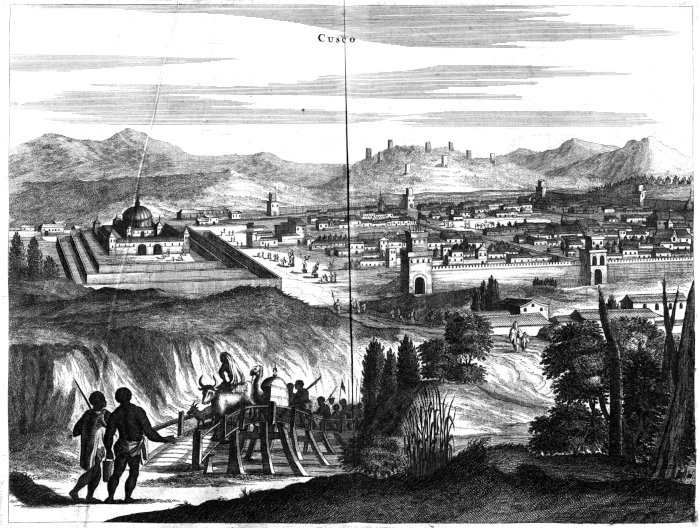
7. Cusco, which is the Metropolis of the Kingdom of Peru, built on a hard Ground, surrounded with Mountains, under a cold, yet wholsom Climate, and wash’d by two Rivers, which on the East side of Cusco parting, one runs direct West, and the other Southward. One part of the City antiently bore the Denomination of Haran-Cusco, and the second, Oren-Cusco, where the chief Nobility and most antient Families dwelt. Concerning the original of this Place, the Peruvians say, That several Ages past there appear’d three Men, call’d Ayrache, Aranca, and Ajarmango, and with them three Women, nam’d Mamacola, Mamacona, and Mamaragua, all of them very richly Cloth’d; that Ayrache had a Precious Stone at the end of a Truncheon, which by holding up he rais’d the Mountains to the Skies, and when he let it fall, levell’d them with the lowest Valleys: Aranca and Ajarmango concluded to build a stately City, and sent for People from remote Countries to inhabit it; with which Design the Natives thereabouts seem’d to be well pleas’d: but before they went to work they judg’d it convenient to destroy Ayrache, whose great Power they envy’d: This being resolv’d upon, they invited him to a deep narrow-mouth’d Cave, that there they might worship the Sun his Father (for so Descended he took upon him to be), he was no sooner entred but the rest shut the Mouth of the Cave with great Stones, hoping so to starve him to death; which Ayrache observing, stood amaz’d a while, till at last he threw off all the Stones, and flew with great and divers colour’d Wings up into the Air, crying aloud, Fear not, Aranca and Ajarmango, though you have design’d to take away my Life, but build a City in this place, and call it Cusco; for in it shall stand the Seat of the Ingas, under whose Jurisdiction extending far and near, many great Nations shall bow. The Temple which the Gods have there design’d shall not onely exceed all other Structures in the World, in Art and Costliness, but be famous for strange Offerings to the Sun. If the Citizens build Altars for me, burn Myrrh, and make Offerings to me, they may certainly expect to vanquish all their Enemies, and increase their Power. According to my Example bore Holes through your Ears, as a sign of Obedience. All which Aranca, Ajarmango, and the fore-mention’d Women promis’d to perform. Whereupon Ayrache gave them a rich Diadem with a Tassel, which was to be the Head-Ornament of the succeeding Ingas; which they had no sooner receiv’d, but Ayrache and Aranca were turn’d into Stones, yet retaining their former shape; which Ajarmango observing, fell straight, together with the three Women, upon building the City Cusco. After the Deluge breaking out of the Hole Tambo, he chang’d his Name of Ajarmango for Mangocapa, that is, Mighty Lord, and made himself, as they say, the first Peruvian King. The City Cusco was divided into four Wards, the East call’d Andosayo, the South Callasayo the North, Chinchasuyo, and the West Condesayo, every one so call’d from the Countreys, to which the Gates of the four Wards are oppos’d.
If any one coming out of another Countrey, setled himself in Cusco, as it hapned 460daily, he was permitted to dwell no where but in that Ward which fronted his native Countrey. The four high Streets, which through these Wards one way fall into the Market-place, being in the middle of the City, are the other way answerable to the four principal High-ways, viz. that which leads to Quito and Pasto, through Chinchasuyo; to Arehuipa, through Condesuyo; to the Mountains Andes, through Andesuyo; and to Chili, through Collasuyo. The two Rivers before mention’d, which part at the East end of the City, are pass’d over with divers Bridges. The narrow Streets are full of Stone Houses, built in good Order. In several places are Vaulted Cellars under Ground, in some of which are buried great Treasures: they had been formerly the Habitations for Necromancers and Soothsayers; for this sort of People were once in great esteem amongst the Inhabitants, who coming from Chili, Pasto, Bocamores, Topona, Bombon, Charcas, Collao, Chiachiapoias, Conchucos, and other Peruvian Countreys, receive great benefit from the fresh Water, and from the Corn-Mills built on the Streets through the City.
The antient Palaces and other stately Structures in Cusco.
The stately Palaces which the Peruvian Nobility have at several times built in Oren-Cusco, being one part of the City, are very wonderful, the Owners whereof were forc’d by the Ingas to appear at Court at Set-times, that so he might prevent all Insurrections: Also he caus’d the Children of the prime Lords to be brought up in Cusco, under pretence that they might learn the Cuscoan Tongue perfectly, in which the Ingas would always be spoken to; whenas their Design was to keep them as Hostages in their own Jurisdictions, that their Fathers might not rebel; by which means it hapned, that in most places of Peru, which amongst the several Tribes and Principalities had several Languages, the Cuscoan Tongue was understood and spoken. But the Spaniards, who are the present Possessors thereof, have alter’d and repair’d most of the ordinary Houses, which are now neatly built of Stone. Above all the old Structures, the Palace of the Ingas, and the Temple of the Sun, are the most magnificent; the Palace lies inclos’d within a square quadruple Wall, each corner whereof is adorn’d and strengthned with a Tower: The Palace it self is built round, and with Arches; but that which chiefly amazes the Beholder, is to see how the Stones, which are so big that forty Horses are not able to stir one of them out of its place, were brought thither by the Labor of the Builders from the neighboring Mountains; for the Peruvians never made use of any laboring Beast, except their Sheep Pacos, not knowing the use of Horses, Camels, Oxen, Elephants, or the like, before the Spaniards coming thither. The Halls within the Palace were Wainscoted with Golden Plates: yet the Inga’s Apparel was not answerable to the rest of his Pomp; for in stead of a Crown they bound their Heads about with a red woollen Sash, with which they almost cover’d their Eyes; at the end of the Sash hung certain Ribbands, which they gave the Governor as occasion offer’d, that by this Sign, as by a Commission, they might exercise their Offices; the sight of which String caus’d such Obedience, that if the Inga had commanded the Inhabitants of a Town or Countrey to murder themselves, none durst deny. The Inga was generally carried by a hundred of his Noble-men, of whom if any one had accidentally chanc’d to stumble, he was immediately put to death. No man durst presume to look him in the Face, or speak to him without a Present.
The Temple Curicanche.
A cruel Battel between two Brothers.
The Temple Curicanche, Dedicated to the Sun, was certainly the most rich and sumptuous that ever the World boasted, it being Govern’d by the Chief Priest Villanoa. The Inga Guainacava spent an invaluable Treasure in the building of this Structure, for he cover’d the Roof and Walls with thick Plates of massie Gold and Silver. At his return home from the Conquest of the Province of Quito, from whence the Inhabitants, according to an antient Custom of the Ingas, were carried to 461one of the remotest Countreys in Peru. But Guainacava enamor’d of a Quitoan Maid, staid a considerable time in the City Quito, and kept a splendid Wedding at the Marriage of his Bride, who bare unto him the famous Attabaliba, whom he lov’d beyond all his other Children, and a little before his death made him King of Quito. But Huascar after Guainacava’s Decease would not suffer his Brother to live in the late conquer’d Kingdom of Quito, but gave him Battel in the Plain of Tomebamba, which lasted three days and three Nights, and after much Blood-shed, Attabaliba being defeated was taken Prisoner, and not long after making his Escape by the help of an antient Woman (whilest Huascar’s Commanders and Soldiers rejoyc’d with Cups full of Chica for their gotten Victory) he made his Subjects in Quito believe, that he being transform’d into a Serpent, crept through a little Hole out of the Prison; and that he had a Promise from Heaven to obtain Conquest over Huascar; which being believ’d, stirr’d up all his Subjects to take up Arms, and valiantly to go and meet the Enemy, whom they not onely defeated, but took Huascar Prisoner.
Zaires the Son of Mango Inga submits to the Spaniards.
Huascar being destroy’d by Attabaliba, and Attabaliba by Pizarro, Mango Inga their youngest Brother took the Government upon him, made continual Sallies upon the Spaniards from inaccessible Mountains, and at his Decease left the remaining part of Peru to his Son Zaires Topa; who seeing no good to be done by force of Arms, submitted himself freely to the King of Spain’s Jurisdiction in the Year 1557. since which the Spaniards have been sole Masters.
There are at this day four great Churches in Cusco: Also the Dominicans, Franciscans, Augustines, and the Monks De la Merced, have each of them stately Cloysters here: but the Jesuits Structure exceeds all the other.
Above forty thousand Peruvians pay annual Tribute to this City. In the Valley about the City feed abundance of Cattel; also Wheat, and all manner of Herbs grow here in great plenty. The Gold and Silver-Mines have not that resort which they had formerly, most of the Workmen being remov’d to Potosi.
Concerning the Service which they perform’d in the fore-mention’d Temple of the Sun, and their superstitious Opinions about their Idol Con, they are much of the same ridiculous nature with what hath been already Discours’d of in other places. Five Leagues Southwardly from Cusco lies the Valley Yucay between high snowy Mountains, under a temperate Climate and pleasant Soil. Not far from hence the Ingas built a most invincible Castle on a Rock, which was surrounded with many cliffy Walls one above another; these Walls were also Carv’d with Images of Lyons, Tygers, and other wild Beasts, which held Lances in their Paws; the top of the Rock was crown’d with a Royal Structure built of Stone, through which ran Golden Veins, joyn’d together with a certain Gum, by some call’d Jews-Lime. To the Province of Condesuyo belong the valiant People Chumbibalcas and Ubinas. In the County Pomatambo they make Carpets of fine Wooll, curiously Painted.
8. The City Francisco de Vittoria, which lies in the rough Valley Vilcabamba, and is inclos’d by the Mountains Andes, belonging to the Jurisdiction of the Province Andésuyo.
9. The Village Juan del Oro, which is the chief Place of the Countrey Caravaya, and so call’d by the Spaniards from the fine Gold which is found there in great abundance.
Havens, Isles, and Points in Peru.
Along the Sea-Coast of Peru belonging to the Jurisdiction of Los Reyos, lie the following Havens, Isles and Points.
South-East from the Promontory Aguya, rises the Isle St. Roque out of the South-Sea, 462surrounded with Rocks, and abounds with Birds of prey; through the midst of it runs a River which divides the Island.
The Haven Malabrigo, ill defended against the Winds, cannot be entred by great Vessels, unless in calm Weather.
Next follow the Harbors Guanape and Santa, where the Ships us’d to furnish themselves with Water out of a fresh River; Casuya and Guarmay, both inhabited by Peruvians.
Near the Mouth of the Road Guara stands a large Salt-pan, the Salt about which is found in great hard Pieces. The Island Collao secures the Haven before Lima.
Behind Cape Guarco lies the Lobos; and not far from hence the Harbor Sangallan, being so commodious that the Spaniards consider’d a long time whether they should build the City Los Reyos here.
The Promontory Nasca affords also good shelter for Ships; and the Haven Hacari yields store of Refreshments. Moreover, the Streams Oconna, Camana, and Quilca discharge their Waters into the Sea.
The Haven Arequipa appears at its Mouth like a little Pool, surrounded with Mountains.
Between Quilca and the River Tamboyalla lies the Isle Nuli; and a little more Southward the Haven Paracca and Pisca; and up in the Countrey the Village Yca, where the most and best Peruvian Wine is to be had.
Sect. VI. Los Charcas.
Situation and Description of Los Charcas.
Los Charcas is the farthest Countrey Southward of the Kingdom of Peru, reaching up as far as Chile, with which on the South it is border’d, having on the North, Lima and Collao; on the West, Mare del Zur; and on the East, some Countreys not yet well discover’d, which lie betwixt it and the Province of Paraguay, or De la Plata. The Countrey is said to be in length about a hundred and fifty Leagues, measuring it directly, or in a right Line from North to South; but measuring it about along the Sea-Coast, much about two hundred: It is not very rich either in Corn or Cattel, although in some parts it wanteth not good Pasturage; but of unparalell’d Wealth, in respect of the Mines of Gold and Silver which are here digg’d, the principal whereof are those of Potosi and Parco.
The Mountains hereabouts are inhabited by the Cavinas, who dwell in Stone Houses. Their Neighbors the Canches are a subtile, good natur’d, and painful People, breed many Sheep, sowe Corn, and catch plenty of Fish out of the Rivers. Next comes in view the cold Countrey Conas. On the right side towards the Southern Ocean, the great Wilderness Parinacocha extends it self a vast way; the Mountains round about are continually cover’d with Snow, and the Dales have many deep Moors.
Potosi.
Principal Towns and Places of note.
463Chief Towns and Places of note in this part of Peru are, 1. Plata, otherwise call’d Chuquisaca, the Countrey whose Metropolis it is, situate under a temperate Climate, in a fruitful Soil for the production of all manner of Plants, and especially Wheat, Barley, and Grapes. In this City the High Court of Judicature of Los Charcas is kept, being a principal part of Peru, and inhabited by the richest Spaniards in the whole Kingdom, having gotten an incredible deal of Treasure out of the neighboring Silver-Mines, which from the time of the Ingas, or Kings of Peru, to its Discovery by the Spaniards, held out and continu’d so rich, that ’tis thought Pizarro, if Reason could have rul’d him, might here onely have rais’d himself a Rent of two hundred thousand Ducats per Annum; but his desire and hopes, first to find more at Potosi, and afterwards his ambition and greediness to have and command all, carried him to violent Courses, which proved his Ruine, as hath been said. The Town is conveniently seated in a fruitful Soil, honor’d with the Residence of the Governor of the Province, and with a Bishops See, said to be the richest of Peru, viz. of fourscore thousand Ducats per Annum. The Cathedral and divers Cloysters give also a great lustre to the City. The antient Inhabitants of this Countrey, especially about those parts where now this City stands, were the Charcas and Charanques, both valiant People, who by Command of the Ingas fetch’d invaluable Treasures out of the neighboring Mines of Porco, where a thousand Men were continually kept at work. In La Plata were reckon’d long since, besides Spaniards, above sixty thousand Peruvians which pay annual Tribute.
2. Oropesa, a place of good Metal, as a man may perceive by the Name; It lieth in the rich and pleasant Valley Cochobamba, twenty Leagues distant from La Plata.
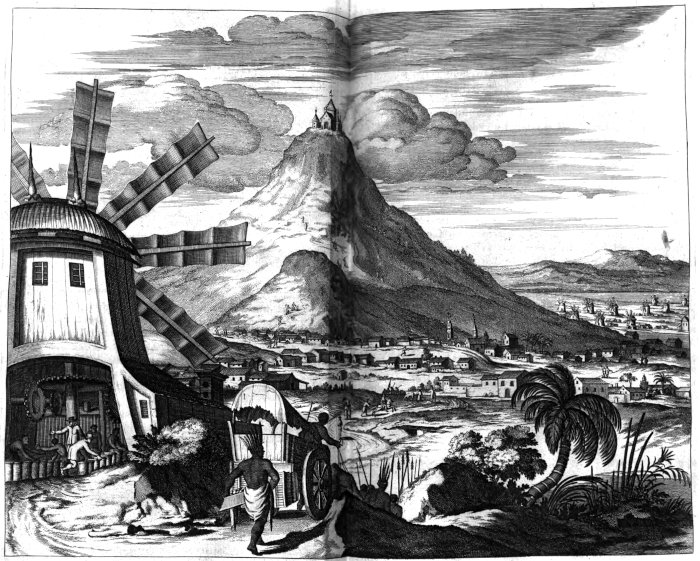
3. Potosi, eighteen Leagues Westward from La Plata, by the Spaniards call’d The Imperial City, built at the Foot of a Mountain bearing the same Denomination, on a barren Soil under a cold Climate, though but twenty one Degrees to the Southward of the Equinoctial Line: the Cold proceeds from the high Lands, which lie bare to the bleak and sharp Winds call’d Tomohavi, which blow every year very fiercely from May till September. But though the barren Countrey produces no Fruit, yet no place in Peru hath greater plenty of all Provisions and Dainties than this, the Markets being always full of Fruit, Salt-Meat, Maiz, Papas, Wheat, Sugar, Sweet-meats, and all things that are requisite for the subsistence of Man-kind, which are brought thither from all parts for the Silver, which is there in such plenty. As to what concerns the famous Mountain Potosi in the Countrey of Charcas, it is of an Ash colour, and rises above the adjacent Mountains in the form of a Sugar-Loaf; on the top of it stands a Chappel, to which leads a craggy Path, which with a little care may be rid up with a Horse; the heighth thereof is a thousand six hundred and twenty four Rods, or a quarter of a League: at the Foot thereof appears the Mine call’d Guaina Potosi, that is, The young Potosi; near which the City Potosi stands, being two Leagues in circumference, and is adorn’d with a Church and Cloyster for the Dominicans, and exceedingly resorted to by Traders.
In the time when the Ingas Govern’d Peru, the Silver-Mines at Porco were very famous; but it was not till after the arrival of the Spaniards that Silver was found in Guaina Potosi, and by degrees the Silver Veins which lay hid in the great Potosi; the manner of which Discovery was as followeth:
The occasion of the first Discovery of the Mines in Potosi.
A Peruvian call’d Gualpa, who work’d in the Mines at Porco, going a Hunting, it chanc’d that the Game ran up the steep Mountain of Potosi, which prevented his pursuing of it any farther; but the Mountain being overgrown with Trees, he got hold from one Bough to another to help himself up, and at last taking hold of the Bramble call’d Quinua, he pull’d the same out of the Ground, and finding it heavy, look’d upon it, and espy’d a great lump of Silver hanging at the Root of it; whereupon viewing the Hole, he discover’d a rich Silver Vein; of which taking some pieces home, and melting them, he found that it was the best Silver that ever he had known; wherefore he privately got a greater quantity, and by degrees grew extraordinary rich: but though he carried his Design never so close, yet he was at last suspected, and especially by his Neighbor Guanca, born in the Valley Xauxa, who was the more jealous of him, because he sold greater Bars of Silver than any were cast at Porco; whereupon he resolv’d to speak to him, and 464getting out the Secret, it came to this Agreement between them, That they should both be Partners and share the Booty; Gualpa was to keep the Vein, since call’d The Rich Vein, and Guanca was to have another, at present nam’d Diego Centeno: but they agreed not long; for Guanca finding much labor upon his Vein, by reason of the hardness, and that he could get no share in what Gualpa got, acquainted his Spanish Master Vilaroel with it, who rested not till he had found out the truth thereof; for which Vilaroel obtain’d (according to the Custom of Porco) several Rods to work for himself, onely paying the King one fifth part of what he got, and so remain’d Owner of the Mine Centeno.
The Mine Potosi, when discover’d.
This Discovery of the rich Mine Potosi is said to have hapned on the twenty fourth of April, Anno 1545. Soon after which they found the Silver Vein Del Estanno, which though it was very rich, was difficult to be digg’d, because of its hardness. The first Vein which Gualpa search’d after stood upright from the bottom of the Mine, and contain’d above three hundred Foot in length, and thirteen in breadth, and continuing good for two hundred Foot in depth, after which the Silver begins to lessen.
The Peruvians relate, That the Ingas first began to dig in Potosi, but gave it over because the Workmen heard a terrible Voice, saying, Leave off doing what you are about; the Treasures which lie hid here, are reserv’d for a People out of foreign Countreys.
These Mines produce yearly for the King’s fifth part, forty thousand Pieces of Silver, each valu’d at thirteen Ryals, each Ryal being four Shillings, besides what he is defrauded of, which is perhaps half as much more.
The Mines of Potosi exceed all other, because the Diggers never meet with any Water, notwithstanding they work above two hundred Fathom under Ground, whereas the other Silver Mines suffer great damage by the Water; which was also the reason why the Spaniards left off digging of Silver in Porco, because they were not onely forc’d to cut through hard Rocks, but ran greater danger, or at least bestow’d extraordinary labor to get out the Water which broke in upon them.
Four Silver Veins, with their several Divisions.
The four Silver Veins of Potosi, viz. The Rich, Centeno, Del Estanno, and Mendieta, lie on the East-side of the Mountain, and extend North and South. The great Veins produce lesser, not unlike the Body of a Tree, from which shoot forth several degrees of Boughs. Each Vein is divided into several parts, possess’d by several Owners; the least part is open’d four Rods, and the biggest eighty; for none are permitted by the Law to open a bigger Hole. In the time of the Jesuit Joseph de Acosta, an Eye-witness, who Anno 1587. went from Peru to Spain, the Rich Vein was reckon’d to contain eighty seven Mines, of which some were digg’d two hundred Fathom deep. The Spaniards judge that at the Root of the Rich Vein is an incredible Treasure, though Experience hath hitherto taught us, that the Silver lessens in price and quantity the deeper they dig in the Ground.
The Socabonos or Trenches, with the manner of Mining.
For the more easie working in the Mines, the Spaniards have digg’d Trenches (which they call Socabonos) at the Foot of the Mountain towards the West, cross through the Mountain to the Mine, each of them being eight Foot broad and a Fathom deep, and lock’d up with Gates, through which the Silver is carried out, whereof the Owner of the Socabon receives a fifth part. The Socabon which leads to the Rich Vein, was begun Anno 1556. and finish’d in twenty nine years, extends it self two hundred and fifty Rods in length. The Miners work by Candle-light both Day and Night by turns; those that work in the Day, sleep in the Night, and those that work in the Night, sleep in the Day. The Oar, which is as hard as a Stone, is cut out with Pick-axes, beaten in pieces with an Iron Crow, and carried upon their Backs on Ladders made of Leather: Each Ladder hath three Fastnings 465about the thickness of a Cable, stretch’d out by Sticks, so that one goes up on one side, whilest another comes down on the other. Each Ladder being ten Fathom long, is pitch’d upon its several Floor on which the Laborers rest before they go up higher, for they make divers Floors according to the depth of the Mine. The Laborers carry the Oar in Bags fastned before on their Breasts, and falling back over their Shoulders three and three together, the foremost whereof ties a lighted Candle to his Thumb, and thus they help themselves with both Hands. It is a wonderful thing to consider, how the Peruvians are able to scramble up and down continually a hundred and fifty Fathom: But besides many other Inconveniences, the Mines often fall in, or at least great pieces, which bury all the Diggers. The Mines also, being excessive cold, occasion to those that are not us’d to them, a Vertigo in the Head, and Vomiting. The Silver runs for the most part between two Rocks, as it were, in a long Channel, of which one side is as hard as Flint, and the other much softer. This Silver is of different value; the best, call’d Cacilla or Tacana, resembles Amber in colour; the worser sort is blackish, and sometimes of an Ash-colour. The pieces of Oar are carry’d on the Backs of the Sheep Pacos to the Mill, where being ground to Powder, they are put into Furnaces to melt; of which there were once above six thousand on the top of Potosi; but since the Quicksilver was found to cleanse the same, not a third part remains pure.
In former times the Mines at Porco, two Leagues from the little Lake Aulagas, produc’d those vast Treasures gather’d by the Ingas, which afterwards for the most part fell into the Spaniards Hands.
Port-Towns, Rivers, and Havens of Los Charcas.
As concerning the Sea-Coast of Los Charcas, it lies as followeth: Southerly from the River Tambopalla puts forth a three-pointed Rock into the Ocean, and makes the Haven De Ylo, into which falls a fresh River. Next follow the round Hill Morro de los Diabolos, and the Inlet before the Town Arica, secur’d from all except a Westerly Wind, where the Silver that comes from Potosi is Shipp’d for Lima. Since the English Admiral Sir Francis Drake took three Barks out of this Inlet it is fortifi’d with a Castle, which is stor’d with Brass Guns.
Nine Leagues Southward the Pissaqua falls into the Ocean; and next you come to the little Village Hicahic, situate on a high and barren Tract of Land; as also the Haven Terrapaca, which by an Inland is made very secure.
Not far from hence appears the Foot of Piqua, where the Coast begins to rise very high; the Head of Tacama, the Stream Lottoya, otherwise call’d De Loa, whose Banks are inhabited by poor People; the River Montelo, the Promontory Morro Moreno, beyond whose utmost Point opens a Bay, secur’d from all Winds by an Island. The Inhabitants here feed on raw Fish.
Next the River Claru comes in view, which is taken for a Boundary between Peru and Chili.
Eastward up into the Countrey you come to Santa Cruiz, built at the Foot of a Mountain in a Plain near a Brook, which rushing forth from a Rock glides through the City to a Lake full of delicious Fish. The Houses of Stone, are cover’d with Palm-Tree Leaves; and besides the Church there is also a Cloyster, inhabited by the Monks De la Merced. In former times the Peruvian Houses were built of Clay, and were often destroy’d by their Neighbors the Cheriguanacs and Titanes, who made Feasts with as many as they took of them. The People about this Place are meek and poor spirited, and speak besides four Languages, the Diagnitan Tongue, common amongst all of them. Before the Arrival of the Spaniards they went Cloth’d in Ostritches Feathers, but since taught to weave Cotton, they now make their Apparel of the same, and upon the account of Barter, drive a great Trade in it: 466They Dye their Cotton with the boyl’d Roots and Leaves of a little Tree.
Eastward beyond Santa Cruiz lies the Countrey Paicanos, eminent for the great Calabashes which grow there, exceeding good to keep both wet and dry Meats in.
The Countrey receives a vicissitude of excessive Cold and intolerable Heat; the hard Winters taking beginning in May, and continuing till the beginning of August. In the middle of our Summer a South-wind blows seven Weeks together here, to the great prejudice of all Plants, which are during that time often wash’d away by continual Rains. About Christmas they Sowe, and gather in their Harvest in March. During the rainy Season the Ways cannot be travell’d, being all overflow’d by the Rivers; neither doth the Palm-Wood, which is four days Journey in length, permit any access to the said City Santa Cruiz, because the conflux of Waters makes it a Moor all over; besides which, the Tygers, Bears, and Serpents, make the Ways dangerous, especially at that time.
Through this Countrey the Spanish Captain Nusco de Chavas travell’d, when he discover’d the Taguamacis, a numerous People, which dwell along the great River De la Plata.
The Countrey about Santa Cruiz produces all manner of Fruit, but few Trees, because of the want of Rain; but Corn, Maiz, Wine, Granadillas, Luiumas, and Tucumay, as also the Plant Hachalindi, in the Latine Tongue call’d Mirabile Peruanum, grow here in great abundance; which last shoots up to the bigness of a pretty large Body, full of Juice, and of a yellowish colour, out of which shoot knotty Boughs, and about each Knot two Leaves resembling the Herb Nightshade; the Flowers which hang at the ends of the Boughs are long, and pleasant to the Eye, by reason of their mixture of Purple, White, and Yellow, and also of a sweet smell. It is a strange Secret in Nature, that this Flower opens at Midnight, if any Light come near the same: The Root also is accounted an effectual Medicine against the Dropsie.
Sect. VII. Collao.
Situation and Description of Collao.
Collao lieth Southward of those Countries, which go under the general Name of the Province of Cusco, having on the West, Lima; on the South, Charcas; but Eastward, and to the North-East, it is shut up by a Ridge of Mountains, running in one Body or continu’d Tract from the Confines of Collao, as far as the City of Cusco, where they divide. The Countrey is generally plain, commodiously water’d in all Parts with fresh Rivers, and consequently affording rich Pasturage and good Herds of Cattel.
Chief Towns and Places of note.
The chief Towns and Places of note are, 1. Chuquinga, a great Town, and held to be naturally almost impregnable, as being environ’d round about either with deep unfordable Waters, or with Mountains unpassable, and having one onely Cawsey leading to it, reported to be for two or three Leagues together no broader than to permit one single Person to march conveniently upon it.
2. The City Pucara, which was formerly well inhabited, but at present nothing remains of it, except the ruin’d Walls of great Houses, and large Images of Stone.
3. Ayavire, by the Spaniards call’d Las Sepulturas, being a Place especially enobled by the stately Monuments of the Peruvian Nobility which were found there.
4. Hatuncolla, the Metropolis or chief Town of this Province, seated upon the Banks of the River Caravaya, whose Streams are very much fam’d for Gold.
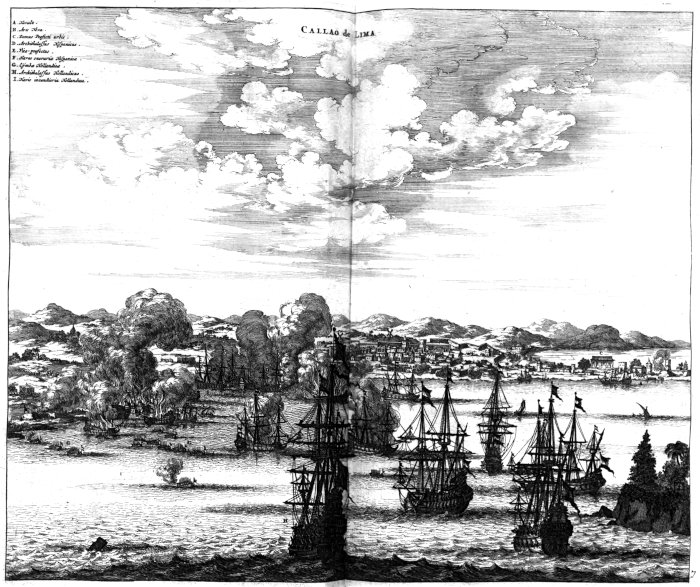
467The River Caravaya, which glides from the Andes Eastward to the City Juan del Oro, produces much fine Gold, but not without the loss of many People, which are kill’d by the unwholsom Air and Damps that arise here.
The Lake Titicaca.
The Lake Titicaca, which washes the Countrey Collao on the North, the Province of Omasuy on the East, Chaquito on the West, and Chuquiabo on the South, is one of the greatest Lakes of America, being eighty Leagues in circumference, and in several places as many Fathom deep; wherefore it is exceeding rough in windy Weather. Into this Lake ten great Rivers discharge their Waters, which run away again through a narrow, but very deep Channel, in which the Stream runs so strong, that no Boats are able to abide in it.
5. Chinquita, a Colony of Spaniards upon the Banks of Titicaca, having many small Islands in it of a good and fruitful Soil, abounding in Fish and variety of Sea-Fowl; it is suppos’d to be fourscore Leagues distant likewise from the South Sea, having onely one Estuary or Mouth, which is something strait, but of such a deep Water and violent Stream, that (as Acosta testifieth of it) it is not possible to build a Bridge of Stone or Timber over it; but the Natives in stead thereof have laid a Bridge of Straw upon it, which serves as well, viz. so many great Bundles of Straw, Sedge, or such like matter, well and surely made up and fastned together, as will reach from one side or Bank of the Estuary to another; at which likewise having made them sure, they cast some good quantity of more Straw and Sedge upon them, and have a Bridge very convenient, upon which they both securely pass themselves, and also drive Cattel, and do other necessary Business. The Water is neither bitter nor brackish, yet is not drinkable because of its muddiness. Several Islands that lie in the Lake serv’d formerly for Store-houses of the chiefest Goods, which the People thereabouts living near the High-way would not trust in their Villages.
The Plant Totara.
Here grows a certain Broom-Plant call’d Totara, good for many uses, and is also wholsom Food both for Man and Beast; moreover, they cover their Houses with the same, burn it on their Hearths, and make Boats. The Uros, a salvage People, made Floats of Totara, which they ty’d together, and built Villages on the same, which drove to and again, according as the Wind blew.
The Lake also breeds abundance of Fish, and especially two sorts, viz. Suches, which are very pleasing to the Palate, but unwholsom; and the Bogas, which though less, and full of Bones, are a much better Food. There likewise breed plenty of Fowls about the same, especially wild Geese and Ducks.
When the Peruvians intend to Entertain any Person, they go to catching of Fowls (by them call’d Chaco) after this manner: They make a Circle with the Floats nam’d Balsas, and Rowing close to one another, take up the inclos’d Fowl with their Hands.
Moreover, the fore-mention’d Channel, through which the Lake Titicaca discharges its Water, ends in a little Lake call’d Aulagas, likewise full of desolate Isles, but hath no visible place into which to empty its Water, therefore it must needs, according to the course of Nature, fall under Ground, where it commixes with a Stream whose original is unknown, though it be seen to fall into the South Sea.
The Town is a Place of extraordinary Wealth and Trading, and so considerable, that the Governor thereof is always nam’d by the King of Spain himself, and his Place estimated at fifty thousand Ducats per Annum.
6. Tiaguanaco, at the Estuary, or Mouth of the Lake, memorable onely for the Ruines of certain great and stupendious Buildings which antiently have stood there, some of the Stones whereof are said to have been of thirty Foot length 468apiece, fifteen Foot broad, and six or seven Foot thick. There were likewise found the Statues of certain Men excellently Carv’d and Wrought, of a Gigantick stature or bigness, and likewise veiled in foreign and strange Habits, not at all us’d, nor ever known to have been us’d by the Peruvians themselves, or by any other of the Natives of America.
7. Nuestra Sennora de la Paz, or Our Lady of Peace, otherwise call’d Pueblo Nuevo: It is but a small Town, yet pleasantly seated upon the Banks of a River in a fair and fruitful Plain, full of Springs, Fruit-Trees, Savanas, and Fields of Maiz, having Mountains on either side: It lieth almost in the middle of the Province Chuquinabo, fourteen Leagues distant from Cusco, and as many from Potosi. The Province Chuquinabo it self (which in the Peruvian Tongue signifies Inheritance of Gold) hath many rich Gold-Mines, good Salt-pits, and a temperate Climate, except from the beginning of December till March, in which time the continual Rains cause Feavers and Agues. The Inhabitants being very poor People, us’d to go naked in the Summer Season.
8. Copavana, two and twenty Leagues beyond Lopoz: It is onely inhabited by Peruvians; amongst whom an Image of the Virgin Mary, long since erected there, hath been ever in great veneration, especially by reason of a Tradition of a great Miracle there perform’d: for the Spaniards affirm, That Johannes Anachoreta going a Journey of several Weeks from home, plac’d a lighted Candle before the Image, which during the time of his absence did not at all diminish.
A strange Earthquake at Angoanga.
An Accident which fell out in this Countrey is very remarkable, viz. The Ground of an old Village call’d Angoanga, then inhabited by eminent Necromancers, began on a sudden to swell, and the Earth to run like a broken Wave two Leagues, overwhelming the Houses in Sand, and filling up a neighboring Lake.
The like in Herefordshire in England.
Eight years before this terrible Earthquake here, there hapned in the County of Hereford in England almost the same kind of prodigious Motion: for not far from the Town Ledborough, arose Marcely Hill to an exceeding heighth, and moving along bury’d all whate’re it met with, after which manner it continu’d for the space of three days, to the great terror of all that beheld it.
9. Chilane; 10. Acos; 11. Pomata, and some others, all of them good Towns, but not so considerable as those other.
Roads and High-ways made by the Ingas.
Concerning the Roads or High-ways, it may well be said, That none of the seven Wonders of the World can compare with any one of them; neither was the Way that Appius Claudius made from Rome to Brundusium, upon the repairing of which the Emperors Julius and Augustus spent great sums of Money, fit to stand in competition with the Roads made by the Ingas in Peru: for who cannot but admire at the consideration of so many Valleys fill’d with Mountains, the hardest Rocks cut asunder, Moors damm’d up, great Stone Bridges laid over swift gliding Streams, and through vast Wildernesses a Way made of twenty Foot broad, inclos’d in high Walls, extending from Quito to Chilo, a thousand Leagues, and at the end of every ten Leagues brave Houses or Magazines, stor’d with Bowes, Arrows, Halberds, Axes, Clubs, Clothes, and Provision for twenty or thirty thousand Men. Some relate, that Guainacava, when he return’d Victor from the conquer’d Countrey Quito, suffer’d great Inconveniences on the pathless Mountains, and thereupon Commanded his Subjects to make the fore-mention’d Way. But it is more probable, that this Master-piece was not the work of one Inga, especially since besides the Way from Chili to Quito there leads another through the Mountains over the Plains from Cusco to Quito, forty Foot broad, and five hundred Leagues long, inclos’d within two Walls.
The manner of the Peruvian Registers.
469The Peruvians relate from the testimony of the Quipos, much more concerning these High-Ways, and other Buildings on them, made by Guainacava. These Quipos are Rowls of divers colour’d Strings, full of all manner of Knots, which serve in stead of Characters to keep their Chronicles; in which were employ’d the Quipo-Camayos, who being in the nature of our Secretaries, Registred all Transactions, performing the same with the several Strings and Buttons, with which they gave Obligations, Discharges, and the like: but besides the Quipos they also us’d Rings full of little Stones for the same purpose; and knew with Maiz-Seed how to cast up an Account as well as the best Arithmetician with Figures.
Their Account of Time hung on the twelve Pillars Succanga, erected on a Mountain beyond Cusco by the Inga Pachacuma, that is, The Regulator of the Year, to shew the Course of the Sun, and according to that their appointed Feast-days, times of Sowing and Harvest: Their Year begins in December.
The present State of Peru under the Spanish Government.
The Spanish Government in the Kingdom of Peru is setled at present in great tranquility and splendor. The Vice-Roy, who keeps a splendid Court in Lima, otherwise call’d Los Reyos, Commands over Chili and Terra Firma, and never comes abroad without a Guard of forty Halberdeers: when he travels by Land he is accompanied by the Arch-bishop, and guarded by his forty Halberdeers, a hundred Pike-men, and fifty Musquetteers. His Reign is generally not above six or eight years, during which time he receives forty thousand Ducats per Annum out of the King’s Exchequer.
The present flourishing Condition of the City Los Reyos.
The City Los Reyos hath been of late years very much enlarg’d and brought to a most flourishing Condition, being exceeding populous, and extending four Miles in length, and half as much in breadth: In the biggest Market-place is the City Hall and the Exchange, where all things are brought to be sold. Of the other three Markets, two have their Denominations from St. Anne and St. Jacob; the fourth is call’d El Santo de los Cavallos, because nothing but Mules, Asses, and Horses are sold there. The chief Church is Consecrated to St. John the Evangelist; the other Three to Marcellus, Sebastian, and Anna. The Franciscans inhabit three Cloysters; the Dominicans, Augustines, and Monks De la Merced, each of them two, besides two costly Structures for the Jesuits. Other Orders have also five Cloysters here, viz. the Creation, Conception, the Holy Trinity, St. Joseph, and St. Clara; the three first have each of them a Church built hard by the several Cloysters, Dedicated to the Santas Virgines del Montserratto, Del Prado, and De Loretto. Each Cloyster contains above two hundred and fifty either Monks or Nuns. Here are also four large Hospitals, the chiefest whereof call’d Andrias, hath seldom less than four hundred Sick, which are kept and cur’d on Charity. The second is for Peruvians onely, call’d The Hospital of St. Anna. The third, built in honor of the Apostle St. Peter, is for poor old Clergy-men. The fourth, nam’d The House of Love, is for sick Women. Besides these there stands another Structure near the Walls of the City, Consecrated to Lazarus, where those that have the Leprosie are cur’d. The House call’d The Holy-Ghost, receives all sick and wounded Sea-men. The King maintains twenty four Students at his own Charge in the Royal Colledge, and the Arch-bishop as many in the Colledge call’d St. Toronius; but in the Colledge of St. Martin reside above six hundred, which are brought up in all manner of Arts and Sciences. Two hundred Students are also taught in the high School, where they chuse a new Governor every year. Here also is kept the King’s Treasure, and the Court of Inquisition. The River which washes the City Walls runs so exceeding swift, that not long since it carried away a new Stone Bridge with nine great Arches.
Miracles reported to have been done by Ramirez.
The Dominican Monks were the first that Landed on Peru, the first which came 470thither with Francisco Pizarro being Vincent de Valle Verde, who was follow’d by Sancio Martino, Martino de Esquivele, Dominico de Sancto Thoma, Pedro Ulloa, Alphonso de Montenegro, Reynaldo Pedraza, and many others, who were stirr’d up by the report of the Peruvian Riches; amongst whom were four Franciscans, viz. Pedro Portuguese, Jodoco de los Angelos, De la Cruiz, and De Sant Anna, who were soon after follow’d by twelve Monks of the Augustine Order. Anno 1552. Landed also at Los Reyos, Colonel Andreas Salazar, accompanied with Antonio Lozano, Juan de Sancto Petro, Hieronymo Melendez, Didaco Palamino, Pedro de Espeda, Andreas Ortega, Juan Canto, Juan Chamorro, Francisco de Treyas, Juan Ramirez, and Balthazar Melgarego. Salazar soon after his Arrival sent the Priest Juan Ramirez, and Balthazar Melganego to Guamachuco, where he Baptiz’d and Instructed the Inhabitants in great numbers. Afterwards travelling to Moyabamba, he got a great esteem amongst those Idolaters, and (as it goes for currant amongst them) wrought many Miracles, amongst which this is reported for one: He being inform’d by an old Peruvian, that his Daughter nam’d Curi had hid several Idols; enquiring after it, he tax’d her with what her Father had told him; which she denying, and being rebuk’d by Ramirez, is said to have become immediately dumb, to have foam’d at the Mouth, at last falling down dead like a second Saphira in the presence of many, which caus’d many to forsake their Idolatry. But the Necromancers endeavor’d by all means possible to raise a disesteem on Ramirez, and with the assistance of their Master the Devil, so wrought their Inchantments, that the Tygers came in great Herds out of the Wildernesses to Moyabamba, and devour’d not onely Men, Women and Children in the Highways, but also tore them out of their Houses, yet did not the least hurt to any Spaniard; whereupon Ramirez valiantly went with a Company of his Proselytes to a Herd of Tygers, which when he approached held the Cross to them, which it seems so affrighted the Devil-Tygers, that they climb’d up the Trees. They farther relate (if you will believe them) to make the Miracle the greater, That Ramirez call’d to the Multitude, saying, Go and revenge the Deaths of your devour’d Parents, Children and Relations; whereupon he throwing a Stone, and all the rest following his Example, the Tygers leap’d out of the Trees, stood still, and suffer’d themselves to be kill’d like Lambs. Six years after the fore-mention’d twelve Augustine Monks follow’d eleven others, who set Sail out of the Spanish Haven St. Lucar, and arriving at Peru went to the Village Tauca, where they broke the Image of the Goddess Huarella, being as it were the Peruvian Venus, or Patroness of amorous Delights, reported to have given Responses from the Wood in which she was worshipp’d. They also destroy’d the Idol Chanca in the Countrey Conchucos, which being worshipp’d by the Indians in the shape of a Man, had yearly a fair Maid, aged fourteen years, given to him in Marriage, a solemn Wedding being kept, and several Sheep kill’d.