The Second Book, CONTAINING A DESCRIPTION OF NORTHERN AMERICA (continued 6)
Reading edition
Izcoalts success against the Tapanecas.
Izcoalt was no sooner Crown’d, but he made great preparation for a War, though against every ones Opinion, because of the Populousness of the Tapunecans; yet it was concluded on, that they should request Peace, and a place to inhabit on the main Continent, that so they might remove from the Isles: This Request they thought could not be deny’d them in Azcapuzalco, provided the Mexicans brought their Gods thither, and wholly conform’d themselves to the manners of the Tapunecans, for otherwise they could expect nothing but utter Ruine: Yet though every one else imbrac’d the Proposal, Tlacaellel, the King’s Nephew, stiffly oppos’d it, alleging, that it did not agree with the Mexicans quality, to make so mean and slavish a Proffer; and that they had best consider, first if there were no other means to be found: and that he would willingly venture his Life in going to Azcapuzalco, as a Spie, to pry into their whole Designs and Intentions, which was perform’d accordingly; and soon after returning, he brought information, that the Tapunecans were making great preparations for War, and made no mention at all of Peace; which news struck a general fear into all Peoples Hearts; many desiring that they might save themselves by flight; but Izcoalt putting fresh courage into them, made an agreement with the People, that if he was beaten by the Tapunecans, they should eat him up; but if he prov’d Conqueror, they should all be at his Command; to which all consenting, they boldly march’d with their King to the City Azcapuzalco. The Front of the Army consisting of the prime Nobility, was led by Tlacaellel, and the Rear Izcoalt brought up, who was also to give the sign on a Drum, when they should fall upon the Enemies; who having ten Men to the Mexicans one, suddenly Sally’d out of the Gates, where they were so briskly entertain’d by Tlacaellel, that in a confus’d manner they soon ran back into the City, whither the Conqueror pursuing them, got within the Gates, where he put all to the Sword which he could meet with; some fled to a steep neighboring Mountain, whither being also follow’d, they threw down their Arms, and begg’d Quarter, to serve the Mexicans as Slaves, which was granted them, whilst Izcoalt found an unvaluable Mass of Treasure in Azcapuzalco, and distributed the Conquer’d Countrey amongst those who had behav’d themselves best.
This Conquest made the neighboring People jealous of the Mexicans, whose Success and growing Power they dreaded.
The Cuyoacans utterly subdu’d by Tlacaellel.
The Towns Tacuba and Cuyoacan, though they had Governors of their own, yet were subject to the Tapunecans, whose General advising those of Azcapuzalco to try another Encounter, they took up Arms again; but before it came to a Battel, the Cuyoacans play’d a subtile trick with the Mexicans, for inviting them to an Idolatrous Feast, after they had Eat, Drunk, and Danc’d, they forc’d them to put on Womens Apparel, to their no small disgrace and ignomy; which remain’d not unreveng’d, for the Mexicans made a Poysonous Fume in the Gates of Cuyoacan, which made Women with Child to Miscarry, and many to fall dangerously sick; yet lastly, both Parties march’d into the Fields, where whilst Izcoalt was elsewhere ingag’d, Tlacaellel marching about, came upon the backs of the Cuyoacans with such eagerness, that they fled to a strong Temple, which soon after was set on fire by Tlacaellel, who pursu’d the Enemy ten Leagues.
253This Conquest stir’d up the Suchimilcos, the first Family of the Navatlaca’s, to stop the proceedings of the Mexicans, that they might not, as they had already done to others, fall upon them; to which purpose they thought to surprize the Conquering Army; but Tlacaellel who led the Van, march’d in good Order to meet the Suchimilcos, fell resolutely upon their whole Army, and after a short conflict, put them to flight, and took the City Suchimilco for Izcoalt, who being Crown’d King there, Commanded the Conquer’d to make a direct Road betwixt Suchimilco and Mexico, of four Leagues long, both, that a Trade might the easier be drove between these two Cities, and to keep them the better in awe: Notwithstanding these examples, Cuytlavacan, a City built at the Lake Laguna, trusting to the abundance of Boats, which the Citizens knew how to use with great dexterity, daily molested Mexico with them by Water, whereupon Izcoalt resolv’d to send his Victorious Army thither, but Tlacaellel opposing the same, promis’d to subdue the Rebelling City with a considerable number of Boys, which had skill in the managing of a Canoo, which being permitted him, he accordingly made himself Master of Cuytlavacan, from whence the Boys brought a great Booty, and divers Prisoners, whom they sent as an Offering to Vitzlipultzli.
Tezcuco submits to the Mexicans.
These unheard of Victories being spread far and near, mov’d Tezcuco after several Skirmishes and Conflicts with Tlacaellel, to submit to the Mexican King, who chose the Governor thereof for his Prime Councellor. Izcoalt Deceasing, after having Reign’d twelve years, his Son Muteczuma was chosen his Successor; the Election and Coronation being perform’d after the following manner.
Coronation of Muteczuma.
The new King mantled in Tygers Skins, was led into the chief Temple before a Hearth, on which burnt Fire both Night and Day; not far from which stood the Throne, where sitting down, he Offer’d Blood, which was taken from his Cheeks, Ears, and Legs; after which, an Orator Congratulated him, in the name of the Nobility; which done, they ended the Solemnity in a great Dinner, Fire-Works, and Dancing: At the same time it was establish’d, that all Future Coronations should be kept with an Offering of Provisions, fetch’d by the King out of the Enemies Countrey: wherefore Muteczuma going to the Countrey Chalco, took several of the Natives, whose reaking Hearts he Offer’d to Viztlipuztli: Which done, the Coronation follow’d, to which an innumerable company of People came flocking from all the neighboring Provinces: Those which were Tributaries, brought Presents with them, before which the Heralds carry’d the Coats of Arms belonging to the Nobility of Mexico, in a good order.
Muteczuma’s Brother taken Prisoner by those of Chalco.
An example of great Fidelity.
Soon after the King’s Coronation, he march’d and fell upon Chalco, the Inhabitants of which defended themselves very Valiantly, took Muteczuma’s Brother, among several other Prisoners; to whom the Conquerors proffer’d the Government; which at first he refus’d, but at last accepted of on this condition, that a high Mast should be erected with a Scaffold on the top, which made every one suppose, that Muteczuma’s Brother did in that manner aim at a high Election, but he at the appointed time, getting on the top of the Mast, call’d with a loud voice, and spake to the taken Mexicans which were there present to this effect: Chalco seeks to set me on the Throne, the Heavens will not permit it; learn by me rather to die, than to live and be guilty of Treason to your Countrey: which he had no sooner said, but with some Flowers which he held in his Hand, threw himself down from the Scaffold, which so inrag’d the Chalcoans, that they immediately slew all the other Mexicans that were there present; which not long after was reveng’d by Muteczuma, who not onely subdu’d Chalco, but several other Provinces, leaving onely Tlascala unattempted, that the Mexicans might have a neighboring Enemy to fetch Prisoners 254from for their Offerings, and also by Skirmishing with them, train up their Youth in Martial Discipline.
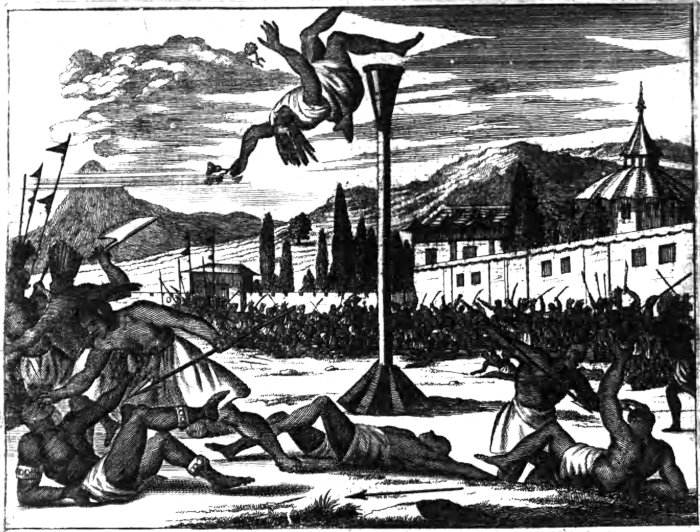
Thus his Predecessors and he, having Conquer’d divers Provinces, insomuch that he was now become absolute Emperor over a vast Tract of Land, he resolv’d to settle the same in good order; to which purpose he erected Courts of Judicature, with good Laws; built a stately Palace and Temple; ordain’d several Customs to be observ’d in Religion; which done, and having Reign’d twenty eight years, he Deceasing, left Ticocic for his Successor.
Description of the Temple Cu.
The foremention’d Temple was call’d Cu, being built of Stone, in form like a Serpent, of an exceeding bigness, in the middle thereof there was a spacious open place, and round about it Habitations, two Stories high, the lowermost for the Inferior Priests, and the uppermost for the High Priests; in this place also above ten thousand People Danc’d in a Circle, on all high Feasts; four great Gates fac’d the like number of broad Streets, each two Leagues long: On the outmost Gate stood large Images, the Front of black Stones, Painted between each Lay with red and yellow Colours, no less Beautiful than Artificial: On each corner of the Temple were plac’d two Marble Statues of Indians, sitting with their Arms stretch’d out, and holding a Candle, and on their Heads Plumes of Feathers: Thirty high steps led up to a round place, set about with Deaths-Heads, which was a Stage appointed for the slaughter of those, whose Hearts were to be Offer’d to the Diabolical gods, and whose Heads, their Bodies being eaten, were brought back to the Priests, who hung them under the Stage, where every Head hanging till it dropp’d off, the vacant place was immediately supply’d with a fresh Head. At the end of the Stage stood two Chappels, cover’d like a Cardinal’s-Cap, in one of which sate the Image of Tiztlputzli, and in the other Tlaloc, to which led a hundred and twenty Stone steps.
But besides this stately Temple Cu, Mexico boasted nine more, standing not far asunder in a large Plain, all adorn’d with curious Imagery, and set out with large Pillars, each being Dedicated to a peculiar Idol, and built with magnificent Apartments, 255for the Priests to lodge in; the chiefest of them Dedicated to an Idol call’d Tezeatlipuca, or Lord of the Humble. This Temple was ascended to by eighty steps, and had before it a spacious Court; within a low and broad Gate appear’d a high Vail, which open’d into a spacious square Hall, hung with Tapestry, at the end whereof stood large Images, and beyond which were several Rooms, in which Assemblies met, Scholars were taught, Judges sate, and Priests Resided.
Tlacaellel resigns the Kingdoms to Ticocic.
Axayacan chosen King.
But to return again to Muteczuma, his Funeral was no sooner finish’d, but the four Prime Councellors were attended by the Commissioners of Tezcuco and Tacuba, in order to the Election of a new King: Tlacaellel being the chief amongst the Dukes, was by a general Vote Saluted King, as being most worthy thereof, for his special Services shown in behalf of the Empire of Mexico: But he humbly refusing the same, was desir’d to Nominate another, whereupon he making choice of Ticocic, Muteczuma’s eldest Son; the Council immediately bor’d a hole through his Nose, and hung an Emrauld in the same. But before he receiv’d the Crown, he was forc’d, according to the Custom, to fetch in some of his Enemies for an Offering, which though he perform’d, yet he lost more Mexicans than he took Prisoners, not without sufficient testimony of Cowardise; which being ill resented by the People, he was Poyson’d in the fourth year of his Reign, and succeeded by his Brother Axayaca, by the appointment of Tlacaellel; who having attain’d to a great Age, and left the Charge of his Children to the new King, departed this Life, to the great sorrow and grief of the whole Empire; by the States whereof he was Bury’d with great Solemnity.
His Victory against the Teguantepecks.
In the mean time, Axayaca went with a considerable Army to the remote Province Teguantepek, to fetch Prisoners to be Offer’d at his Coronation; and marching before alone, Challeng’d his Antagonist, the King, to a single Combat, which he refus’d, and chose rather to fall upon Axayaca with all his Forces; whereupon, the Mexicans cunningly feign’d flight, ambuscaded themselves till the Enemies pursuing them, gave them their desir’d advantage, for rushing out of their Ambuscade, they set upon the Teguantepecks, so disorder’d, that they easily put them to flight, and had the pursuit of them as far as Guatulco, a noted Haven upon the South-Sea; from whence Axayaca returning Victor, receiv’d a Crown for a Reward; yet notwithstanding these Proofs of his Valor, the Lord of Tlatellulco Challeng’d him; whereupon he sent Agents thither, with proffers, that since the Citizens of Tlatellulco were of one Blood with the Mexicans, whom they deserted upon the dividing of the Wards and Towns, just before the Election of the first King Acamapixtli, they should, if they pleas’d, be receiv’d anew into fellowship and alliance with the Mexicans, acknowledging one and the same King for their Supreme Head and Governor: But the Ambassadors being scorn’d and laugh’d at for their proffers, returning, related the same to Axayaca, who immediately marching thither to take revenge, sent part of his Army to fall on the Enemy by Water; whilst himself falling upon them by Land, put the Lord of Tlatellulco, with his whole Army, to flight, which was so closely pursu’d, that they forc’d their way into the City with them, put the Governor to Death, and laid the Town in Ashes; those which went by Water, having had no less success.
Autzol succeeds him.
Axayaca, after eleven years Reign, Deceasing, bequeath’d his Crown to Autzol, who sought to promote his Election by ingaging with the mighty Province Quaxutatlan, whose Inhabitants, though but a little before, they had been so bold as to demand Tribute of the Mexicans, yet terrifi’d at the approach of Autzol’s Army, fled over an Arm of the Sea, where they had been secure, had not Autzol invented a 256floating Isle of Planks, by which he got over his whole Army; upon which the amaz’d Quaxututlans immediately submitted themselves to the Mexicans, who pursuing their Victory, extended their Dominions to Guatimala, over a Tract of three hundred Leagues.
Autzol’s Generosity and Magnificence.
The new King having now subdu’d all his Enemies, and made himself glorious by his Victories, was also ambitious to be as much extoll’d for his Generosity and Magnificence; to which purpose he distributed all the Wealth which was brought unto him from the neighboring Countreys, amongst the Poor and the Nobility; to the first he gave Clothes and Provisions; to the last, Plumes of Feathers and Arms. Moreover he caus’d all mean Houses to be pull’d down and new ones to be built in their places. Lastly, he consulted how to bring fresh Water into Mexico, which was plac’d in a brackish Soil: Upon this Design he was so bent, that when one of his Sages disswaded him from it, alledging, That the Water would drown the City, he, in stead of following his Advice, banish’d him his Presence, and upon his flying to Cuyaocun, caus’d him to be fetch’d from thence and Executed. Then prosecuting his Design, he cut the Ditch before Cuyaocun, by which means great store of fresh Water came flowing into the Lake Laguna, which the Priests welcom’d with strange Ceremonies; for some perfum’d the Water, others Offer’d Quails Blood, whilst others play’d on several Musical Instruments, with many other Ceremonies, which are at large describ’d in the ancient Mexican Chronicles, kept in the Vatican Library at Rome. But the Prophecy of the Executed Sorcerer was in a manner fulfill’d; for the Water overwhelm’d a great part of Mexico, and divided the City into Isles: But to prevent farther Mischief, Autzoll caus’d Banks to be rais’d, and Channels digg’d; and not long after, in the eleventh Year of his Reign, he deceas’d: After which the Mexican Kingdom tended towards its period, as the ensuing Story will declare.
Amongst the Mexican Nobility, Mutexuma, a melancholy Man, yet very prudent, who resided in a stately Apartment near the great Temple Cu, that there he might the better converse with Viztlipuztli, was elected King; which he no sooner heard, but fled from hence: but being found out, he was against his will led to the Grand Assembly, and from thence to the holy Hearth, where for an Offering he drew Blood out of his Cheeks, Ears, and Legs; and, according to an ancient Custom, the Council of State boring a Hole in his Nose, hung an Emerauld in the same; after which the Lord of Tescuco saluted him with a Speech; which (since it is mention’d by Joseph d’ Acosta, together with several other Speeches of Congratulation to their Kings, which were taught to Schollars, to make them expert in their Language) it will not be amiss to be annexed here, that of many this one may serve for a pattern of the Mexicans Eloquence, which is as followeth:
The Lord of Tescuco his Speech to Muteczuma.
“The great happiness, most noble Muteczuma, which is befall’n this Realm by your Election, may easily be conjectur’d from the general joy, none besides your self being able to undergo an Office, in the management whereof so much Prudence is requir’d: It is a most certain testimony that God loves Mexico, that he hath given its Inhabitants understanding to make such a Choice. Who can doubt, but that you who have expatiated through the Heavens, and convers’d with Viztlipuztli, may easily Govern us Mortals on Earth? Who can despair, but that the Vertue inclos’d within your Breast, will extend to the Widows and Orphans? Therefore rejoyce, O Mexico; the Heavens have granted us a Prince without Vice; Merciful, and not a Violator of the Laws; Affable, not despising common Conversation. And you, O King, let not this great Preferment 257occasion any alteration in your so long known Vertues: The Crown breeds care for the publick good; the troubles thereof must extend over the whole Realm, and every one in the Realm.”
Preparation for the Coronation of Muteczuma.
His Grandeur.
The ruine of the Mexican Empire prognosticated.
Muteczuma having heard out the Speech, would willingly have answer’d the same, but could not utter a word for Tears, which gush’d from his Eyes. Before he went out to fetch Prisoners for Offerings at his Coronation, he first setled his Houshold Affairs. And whereas till this time the Kings had been serv’d in their Palaces by ordinary Citizens, he took Knights, and the chiefest of the Nobility, intending thereby to make a distinction between the Nobility and the common People, and add more Majesty to the Royal Dignity. This done, Muteczuma marching against a certain rebellious Province, fetch’d a considerable number of People to be Offer’d to Viztupuztli. At his Return the Coronation-Day was appointed, against which thousands of People came to Mexico; even their very Enemies of Tlascala, Mechoacan, and Tepeaca, which were never conquer’d by the Mexicans, flock’d thither in great numbers. All those Countreys which were under Tribute bringing unvaluable Treasures, came in vast Multitudes, which so throng’d the City, that the very tops of the Houses were fill’d with Spectators, no King in Mexico ever going to the Throne in such splendor; nor was ever any King so much fear’d by his Subjects, none of the common People daring to look in his Face; neither did he ever set Foot on the Ground, but was always carried in a Chair on the Shoulders of his prime Nobility; he never wore a Suit of Clothes but once, nor ever us’d a Cup or Dish after it was once foul’d; he strictly maintain’d the Laws which he had made, and often went himself in a Disguise, to make a strict enquiry after all Affairs whatsoever; by which means the Mexican Power was now arriv’d to the highest top: but, as other Realms, grown top-heavy with good Fortune, turn at last topsie-turvy, just such a Misfortune befell Mexico; but not without several fore-running signs of its destruction: for in the City Cholola their God Quezalcoalt inform’d them, that a strange People were coming to take possession of the Mexican Dominions; and their Soothsayers prognosticated the same, for which Muteczuma committed them all to Prison, and doubtless had put them all to death, had not they escap’d with the help of the Master of their diabolical Art; and though they escap’d themselves, yet their Wives and Children were all put to death upon the King’s Command: Soon after which appear’d a mighty Comet, or blazing Star for a whole year together; the great Temple Cu was set on Fire, and burnt to the Ground none knew how; the Water which was thrown on the same to quench it, burnt like Brimstone; in the Skie appear’d three fiery Heads at noon-day, and out of a long Tail shot Sparks on the Earth; the Laguna, between Mexico and Texcuco, began to swell into a Tide, which turn’d some Houses topsie-turvy; a shrill Voice was heard in the Night crying on the Water, Children, your ruine is at hand; whither shall I carry you that you may not be lost?
A miraculous story of a Bird.
No less strange is what d’ Acosta relates of a Bird presented to Muteczuma, not unlike a Crane, which the Fishermen had taken on the Laguna; on the shining Forehead of which there appear’d the resemblance of two Armies Engag’d, and one defeated by the other, and that whilst the Sages, call’d to interpret the meaning hereof, sat in Consultation, the Bird vanish’d.
Another of a Country-man.
Moreover, there goes a Tradition, That a Countrey-man being at his Labor, was taken up by an Eagle, and carried through the Air into a gloomy Cave, where a Man lay fast asleep snoaring, when on a sudden he heard a Voice afar off, saying, Do you know that Man? whereupon the Countrey-man taking special notice of the 258dormant Man, knew him, by the Royal Apparel, to be Mutexuma; after which the Voice was heard again, saying, How soundly doth he sleep: the time is coming which provides Punishments for many Crimes; burn the Snoarer with the Torch which he holds in his Hands, he will feel no pain: Not long after he being inform’d hereof, and looking on his Thigh, found the same burnt, to his no small amazement.
News of the arrival of the Spanish Fleet.
Having now possess’d the Throne fourteen years, he receiv’d news of a Fleet, and therewith a Draught of the Men and Vessels painted on Cloth. This startling him, he immediately advis’d with his Council, who judg’d it convenient to secure the Coast along the Southern Ocean with strong Watches; yet nevertheless Ferdinand Cortesius Landed with five hundred Foot and sixty Horse, took the City Potanchanum, march’d through the Countrey Sicuchimalar to Tascalleca, where they had a sharp Conflict, in which the Spaniards were in great danger; and had not they had six Field-Pieces with them, which did as much affright as hurt the Indians, they had without doubt been cut off there. In Chiurutecal they were in as much danger; for certainly the Spanish Army had been set upon in the Night, had not a Woman inform’d them of it.
Muteczuma committed to Prison by Cortesius.
Mean while Muteczuma consulted with his Sorcerers to destroy Cortesius by Charms, who then was marching through Chalco, whereupon a considerable number of Sorcerers went thither to the top of a high Mountain, where, as they were beginning their Incantations and Charms, their Idol Tezcalipuca appear’d to them; and in an angry manner told them, That Muteczuma should lose his Crown and Life; and to confirm his words, he shew’d them a dreadful spectacle; for looking about, they saw the City in a light flame. This being told to Muteczuma, he resolv’d to make himself as secure as he could, and went to meet Cortesius with costly Presents, delivering him the Crown in the presence of all his Council; to which purpose he took one Marina, experienc’d in the Castilian Tongue, with him for his Interpreter; all things then seeming to end in Friendship. But they continu’d not long in that state; for Cortesius, whose whole Design was to bring Mexico under the Spaniards Subjection, not long after accus’d Muteczuma, that Coalcopoca had on his Commands storm’d the new Spanish City Vera Crux, which he could no way excuse; and notwithstanding Muteczuma deliver’d him Coalcopoca, with fifteen of his Nobles Prisoners, who were all burnt with green Wood; yet he was committed Prisoner, to the great discontent of the Mexicans, who said, “That they were now come to a fine pass, to be thus fool’d by a few Strangers, who had imprison’d their King, trampled upon their ancient Images, endeavor’d to murther them all, and in despite of them brought their mortal Enemies, the Tascaltecans and Guazuzingans, into Mexico.”
Cortesius marches against Velasquez’s Party.
About this time there were certain Ships come to Vera Crux, which was a new Port-Town of this Countrey, that the Spaniards had built since their coming thither, and had Landed near upon a thousand Men; which was an Accident that had like to have spoil’d the Design of Cortesius and all his Company at Mexico, these Men being sent by James Velasquez; Governor of Cuba, expressly against Cortesius and his Men, upon pretence that they had acted not conformably to the Commission which they had receiv’d from him, and gave him no account of their proceedings; which in a great measure was true: for it must be confess’d, that Cortesius and his Men finding themselves to have fall’n upon an Adventure that was certainly rich and good, and having got such footing and interest in the Countrey already, by their Success and Victories, and chiefly by their Confederacy with so many of the Natives and People of the Countrey, revolted to them, did almost at first, by a general consent, renounce their Commission, and dependency upon Velasquez, and 259profess’d to act immediately from and for the King of Spain. What pretences they had for such a Resolution, seemingly at least irregular, is not so well known. Whatever they were, they proceed in it, and the whole Company (excepting onely some few, who yet went along with the rest) chuse Cortesius anew for their Commander in chief, and appoint likewise by common consent, all other Officers of Justice, both Civil and Military, among themselves: and to give the better colour at Court to their Proceedings, they send Portocorrero and Monteio, two of their Principals, into Spain, with a rich and noble Present to the Emperor, both to make report of the State of the Countrey, and to procure immediate Commission from his Majesty, to proceed; after which they advance towards Mexico, as hath been said. Velasquez, being at Cuba, and understanding their Proceedings, labor’d to intercept both their Messengers and Present, but could not; and therefore sent Pamphilius Narvaez with eleven Ships, and about nine hundred or a thousand Men to apprehend Cortesius, and oppose his Proceedings. This hapned about the time that the Differences were but newly calm’d betwixt the Spaniards and the People of Mexico; and though it oblig’d Cortesius to leave the City in a wavering and unsetled condition, yet he took such order, that Muteczuma still remain’d under the Guard of the Spaniards as before, assisted with thousands of their Friends of Tlascalla, and he himself taking the rest, and some few Spaniards along with him, with undaunted courage and resolution marches against Narvaez: and such was his good fortune, that not onely Narvaez became his Prisoner without much blood-shed, but likewise all his Men joyn’d with him in his Design, through the favour of the Chancery or supream Court of St. Domingo, and by the procurement of the Licentiat Vasquez de Ayllon, a Judge of it, who was sent with Narvaez to accommodate the Differences. With this Recruit Cortesius marches back again to Mexico; but at his coming finds things in a very bad condition; for the Citizens, gather’d together under the Command of one Quicuxtemoc, had recourse to Arms, and for three days and three Nights vex’d the Spaniards with continual Stormings, notwithstanding what-ever Commands they had to the contrary from their imprison’d King, who at last, looking out of a Window, endeavoring to appease them, was hurt with a Stone, of which he soon after died, as they say, who would not have the Spaniards thought to have murder’d him, as the Mexicans say they did, with divers other Noble-men, and some of his Children, the very Night they fled. However it were, not long after his Death, out of extream necessity, and chiefly for want of Victuals, the Spaniards were forc’d to leave the City in the night-time, and with the loss of four hundred and fifty of their Men, who were either slain or taken Prisoners at the passing of a Draw-bridge, the rest making a heavy Retreat to their Friends at Tlascalla. There is standing at this day in Mexico, upon the place where so many of them were kill’d, a certain Hermitage, which they call Los Martyres, or The Hermitage of the Martyrs, though but improperly, if upon that occasion, as one of their own Writers confesses, though he alledges no other reason.
Mexico taken by the Spaniards.
This Retreat of the Spaniards out of Mexico hapned to be upon the tenth of July after mid-night, in the Year 1520. which the Spaniards at Mexico call The Doleful Night. Nevertheless the undaunted Cortesius being got, though with much difficulty and trouble, by reason of the pursuit of the Mexicans for a good part of the Way, to his sure Friends of Tlascalla, neither lost his Courage, nor gave over his Resolution of yet gaining Mexico, especially the way being now laid open, and sufficient occasion given by the Death of Muteczuma, and the provocations of the Mexicans themselves, to make himself absolute and sole Lord of the Place: wherefore having sent for, and procur’d a competent Supply of fresh Soldiers from 260Santo Domingo, or Hispaniola, Almeria, Cuba, and other places, being in all nine hundred Foot, eight hundred Horse, and seventeen Pieces of Ordnance; he joyns himself with the Auxiliary Forces of Tlascalla, which were no less than a hundred thousand Men, Arm’d with Bowes and Arrows: and with this Army marches again towards Mexico, and Besieges it both by Land and Water, viz. with the help of thirteen Brigantines or Galliots, which he had built upon the Lake, and six thousand Canoos, or little Boats, which his Friends and Confederates had procur’d him. By which means, and by his Army on Land, in a short time he cut off all Provision from the City, and after a Siege of full three Months or more, and a most stout and obstinate resistance made by the People within, in which they are said to have lost above a hundred thousand Men, beside those which perish’d by Famine, Sickness, or otherwise, he took it by Storm upon Tuesday the thirteenth of August 1521. Sackt it first, and then burnt it to the Ground; yet afterwards he caus’d it to be Re-built again, far more Beautiful than at first it was; as in due place we shall further see. They speak not of above fifty Spaniards slain during the whole Siege, six Horses, and not many Tlascaltecans.
Cortez advanc’d to Honors.
In this manner, and with so little Charges to the Conqueror, there fell to the Crown of Spain the richest and goodliest Kingdom (one of them) of the whole World, viz. the Kingdom of Mexico, which the Conquerors presently nam’d New Spain; and in reference to which name, the Catholick King hath ever since stil’d himself in the plural number Hispaniarum Rex, or King of both Spains; and all by the Valor, Prudence, admirable Resolution, and happy Conduct of Cortez; who was at first but a private Adventurer in the American Plantations and Discoveries, though otherwise a Gentleman of a good Family in Spain, born at Medellin in the Country of Estramedura. The Emperor Charles the Fifth, who was also then King of Spain, for his great Services, endow’d him deservedly with many great and rich Territories in the Provinces of Tlascalla, Mechoacan, and other parts thereabouts, made him Marquess of the Valley, viz. of Guaxata, (which is his chief Title) a rich and flourishing Province of that Countrey, Captain General, or Commander in Chief, of all the Military Forces of New-Spain, and General Discoverer of all the Maritime parts and Coasts of America towards the South-Sea, assigning him in propriety the twelfth part of whatsoever should be discover’d, to him and his Heirs for ever; but deny’d him the Government of Mexico out of reason of State, though ’tis said, he much desir’d it.
The grand Haven Acapulco.
Among the famous Havens which lie along the South Sea, and Northern Ocean the chiefest is Acapulco before-mention’d, whither all Merchandize is sent to be transported to China, which is above two thousand Leagues distant from thence; in which Voyage they generally spend fourteen Months; four Sail, each of eight hundred Tun, appointed for this Trade; generally two of them set Sail to China in March, and returning in Summer, have no sooner drop’d their Anchors, but the other two set out from Acapulco, from whence the way by Land to Mexico, is seventy two Leagues over steep Mountains, dangerous Rocks, and several Rivers; the chiefest whereof are, first, Del Papagayo, or De las Balsas, which runs exceeding strong, which the Indians cross on bundles of Canes ty’d upon Callabashes: Next San Francisco, which though the biggest, yet hath many shallow places to wade over. The Mustichoes are no small Plagues to those that travel this way, for their Poysonous Stings are the occasions of many Ulcerated Wounds, and oft-times Death it self.
In this way lies also the Countrey del Valle, from which Ferdinand Cortesius receiv’d the Title of Earl.
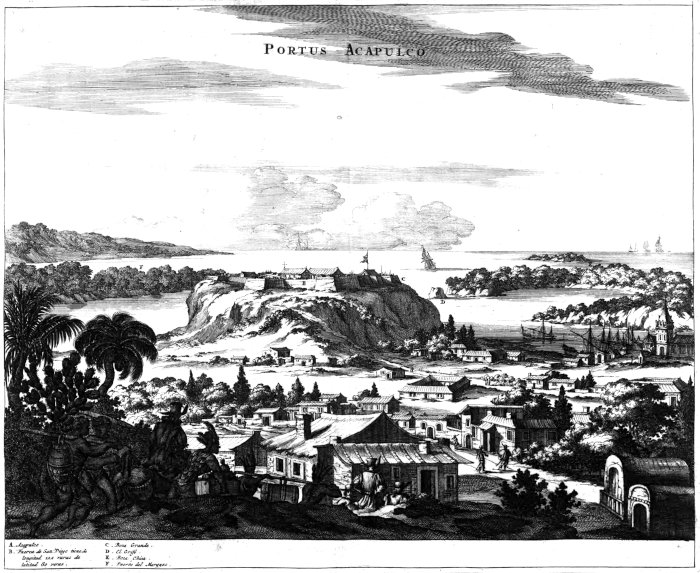
261The Mouth of the Haven Acapulco gapes a full League North and South, and within exceeding large, hath a nook call’d Boca Grande, where the Ships Ride safe at an Anchor: More Easterly appears a Land Inlet, (by the Spaniards call’d Puerto del Marques) secur’d against all Winds; near which is the City of San Diego, to which belongs a Fort, with six Bulwarks, lying on a Promontory; the main of the City is one large Street, consisting of fair and stately Houses, and leading directly to the Haven; the Church which is of an oblong square, hath a high Steeple in the middle.
Spilbergen’s Expedition.
A Dutch Admiral, one Joris Spilbergen, after he had done the Spaniards all the mischief he could along the South Sea, ran with five Sail under the Fort Acapulco, which fir’d ten Guns at him; whereupon, the Dutch Admiral Manning a Boat, with a white Flag, they agreed upon a Cessation, and the Spaniards went aboard of the Admiral, to whom Pedro Alvares, and Francisco Menendus, having been a considerable time in Holland, and speaking the Language of that Countrey very perfect, promis’d that all his Demands should be satisfi’d; yet Spilbergen was suspicious that the Spaniards had a design upon him, wherefore he came and lay close under the Castle with his five Sail, and made ready his Guns: But this suspicion was soon clear’d, when Alvares and Menendus proffer’d to stay as Hostages, till the Governor of the Town sent the Admiral thirty Oxen, fifty Sheep, some hundreds of Poultry, Coals, Oranges, Cittrons, and the like fresh Provisions; as also Wood and Water; during which time, the Prisoners being set at liberty, several Persons of Quality came to visit the Admiral, amongst whom was Captain Castilio, one that had serv’d twenty years in the Low-Countrey Wars; and Melchior Hernando, Nephew to the Vice-Roy of New-Spain, who desirous to see the Ships that durst set twice upon Rodrigo de Mendose, Admiral of the King of Spain’s mighty Fleet, stood amaz’d that such little Frigats durst Ingage with so many great Spanish Ships; and carry’d the Admiral’s Son to the Governor of the City, call’d Georgius Perro, who civilly entertain’d him: Eight days Spilbergen spent here at Acapulco, admiring the courteous Entertainment of the Spaniards, and the more, because that having News but eight Moneths before of the Dutch Fleet setting out, they had in that short time made all things ready for resistance, the Fort having seventeen Brass Guns, and four hundred Soldiers, besides many Noblemen and Reformades, whereas at other times there us’d not to be above forty Men, and four Guns in the same.
Sect. II. Mechoacan.
Bounds and Description of Mechoacan.
The next Province of New Spain is the Bishoprick of Mechoacan, which hath on the North-East, Panuco; on the East, Mexicana, properly so call’d; on the South part, Tlascalla; on the West, the Main Ocean, or Mare del Zur; and last of all, more directly Northward, Xalisco, which is a Province of New Gallicia: The Name signifieth in the American Language, as much as A Fish Countrey; and so it is, having many fair Lakes and Rivers in it, abundantly well stor’d with Fish. The Countrey so exceedingly pleasant and healthful, that ’tis usual for sick Persons of other Provinces to come hither to recover their health, only by the benefit of a good Air. The Soil so abundantly fertile of all sorts of Grain, that of four measures of Seed, it hath been often observ’d, they have reap’d the next Harvest, more than so many hundred measures of the same Grain. Very well Wooded; and by reason of its many Rivers and fresh Springs, equally rich in good Pasture: 262and besides great plenty of Medicinal Herbs and Plants, it affordeth good store of Amber nigh the Sea Coasts, Mulberry-trees, and consequently Silks; much Honey, Wax, and divers other Commodities, both for necessity and pleasure. The People of the Countrey are generally tall, of a strong active Body, and a good Wit, especially in comparison of other Natives; not unskilful in divers curious Manufactures, the most excellent Feather-Pictures, afore-mention’d, being said to be found in this Province. They seem more generally inclin’d to the Humors and Customs of the Spaniards, than any other Americans; and receiv’d the Preaching of Christian Religion, when time was, with much willingness; so that the Countrey is now entirely Christian, and divided into several Parishes.
Languages belonging to the Mechoacans.
The Languages which are spoken in Mechoacan are several, as the Otomian, Chihcimian, and the Mexicans, which is common through all New Spain, and the Tarascan, a neat and brief Language, which properly belongs to this Countrey.
Tygers.
The Lions and Wilde Dogs of this Countrey devour great numbers of Cattel yearly, yet the greatest mischiefs happen from the Tygers, which often fetch People out of their Houses, notwithstanding the Doors are lock’d, for they break in thorow the Walls and Roofs, with much eagerness and strength: Of the greatness whereof, Jacob Bontius tells us this story, That the Governor Peter Carpentier set a Trap without the Walls of Batavia, of great Timber, Pleited with Iron, Baiting it with a Goat; which taking effect, the Tyger that was caught therein, impatient of such close Imprisonment, rent the Timber, and getting out, left the Goat untouch’d.
Hugo Linschot relates, That the Tygers in the West-Indies hurt no Spaniards, exercising their cruelty onely on Indians; and that finding a Black and a White Man sleeping together, they devour the Black and not the White: How far these assertions deserve to be credited, may appear by an evident contradiction of the first, for it is well known, many Spaniards in the West-Indies have been eaten by the Tygers.
General Fedreman marching in this Countrey at the Head of his Army, was assaulted by a Tyger, which in despight of them all killing a Spaniard, and three Indians, escap’d from them; no Trees serve for a refuge against their fury, for they climb up to the top thereof, and fetch down their Prey; their Claws are so exceeding Venomous, that whoever is scratch’d with the same, is never to be cur’d; there is no Beast but they will venture upon, wherefore they lie in the Bushes, from whence they rush out upon them; but this disadvantage they have, that most other Beasts are too nimble Footed for them, for they are a very heavy Creature, whatever hath been deliver’d by the Ancients concerning the Tygers swiftness.
As to the difference which they make in Humane Flesh, it is thus far true: That they find more sweetness in Womens Breasts than other parts, and chose a Black Man before a White: Concerning the first, France gives a sufficient testimony, when two Tygers, in the time of King Lewis the Twelfth, breaking loose, left a great number of Women lying Breastless in the Road. The second is confirm’d by John Johnston’s Relation of a strange accident that happen’d in Bengale, viz. A Moor dreaming that a Tyger fetch’d him out of the Ship, hid himself the next Night between Decks, of which the Master asking the reason, was inform’d concerning his Dream, which prov’d prophetick, for about Mid-night a Tyger leapt into the Ship, and devouring the Moor, went away without touching any one of the Hollanders, of which there were thirty: But a Sea-man walking on the shore escap’d more wonderfully, for a Tyger setting upon him behind, and a Crocodile before, he leaping from betwixt them, discover’d to the Tyger the Crocodile, to whom the Tyger directly running, and ingaging with the Crocodile, 263spar’d the Sea-mans life: Notwithstanding the cruelty and mischief of these Tygers, the Indians are led by their sottish Superstition to worship them; because, as they say, the Devil often appears to them in that shape.
Squerrils.
Besides the Tygers, the Inhabitants of Mechaocan are exceedingly molested with Squerrils, which not only carry much Fruit into their Holes, but also under-mine the Houses, so that they often sink or fall on one side, the mischief being the worse, because they increase daily. Most of them bear four young at a time, which on the third day run about for Prey, and can scarce be taken, because of their exceeding swiftness, leaping a great distance from one Tree to another; their Tails serve them on divers occasions; for leaping they use it like a Wing, and at their crossing over a River, for a Sail; in tempestuous Weather, they stop their holes therewith, to keep out the Wind.
Several kinds of them.
There are six several sorts of these Squerrils; the first call’d Tlilic, cover themselves with their Tails; the second Quapatchli, is as big again, and can never be made tame; the third Techallotl, with a bald Tail and great Eyes; the fourth Talmototly, hath a thick Head, and a Tail full of black and white streaks; the fifth Quimitchpatlan, hath a little Head and long Legs, and leaping from one Tree to another, seems to flie; the last sort call’d Yztactechalotl, is whitish.
Foxes.
The Foxes do also great mischief here, their Urine smells so horribly, that forty days after, none are able to abide near the place where they have urin’d, and on whatsoever Stuff or Cloth a drop thereof chanceth to light, the stink can never be wash’d away.
The Bird Auras.
Here breeds also a sort of Birds, call’d Auras, which are not unlike Moore-Hens; they flie exceeding high in the Air, feed on nought but stinking Carrion, which they scent at a great distance; they have a hairy Head and Neck, and ugly Face: Some of the Fowls of this Countrey stay here all the year long, others go away, and return at certain times.
Ingenuity of the Natives.
The Natives, since the Spaniards coming thither, have gotten their Habits and Language, learn’d all sorts of Trades; their Tables, Chests, and Cupboards made of Brasile-Wood, are no way inferior to the best that are made in Europe. Painting is also in great esteem amongst them: They make handsom Clothes, Shooes, and strange Copper Locks. They have a peculiar Art in Tilling their Ground: They teach the Spanish Dogs several tricks, but not feeding them well, they cause them to run from them, and turn wilde, whence they are call’d Cimarrones, because they do much hurt to the Cattel.
The Inhabitants, when a Feaver or Ague is upon them at the highest, leap into cold Water: against other Sicknesses they use Herbs, whose soveraign Power Experience hath long since taught them.
Since the Spaniards made Mechoacan a Bishoprick, they have built ninety four Schools, fifty Churches, several Hospitals and Cloysters, inhabited by Franciscan and Augustin Monks.
There are said to be in this Bishoprick a hundred and fifty Towns or Burroughs (besides many scatter’d Villages) most of which have Free-Schools erected in them, for the Training up of Youth in the Christian Religion, good Literature and Arts; and few of them without an Hospital for the Sick: of which Towns the principal are as followeth:
Principal Towns.
1. Zinzoutza, the Seat of the ancient Kings of Mechoacan. 2. Pascuar, a City forty seven Leagues distant from Mexico, once a Bishop’s See. 3. Valladolid, the Metropolis or chief City of the Province, since the Episcopal Chair was remov’d from Pascuar thither. It lieth upon a great Lake, equal almost for bigness to that of 264Mexico, and is about seven Leagues distant from Pascuar, towards the East. 4. St. Michaels, a good Town, forty Leagues Westward of Mexico, and in the Way to the Zacatecas, but lying in a Road that is somewhat dangerous, being not a little infested with Salvages on both sides of it. 5. St. Philips. 6. La Conception de Salaya, seventeen Leagues distant from Valladolid, and a convenient Stage for Travellers, being indeed, with the two last mention’d, built chiefly for the defence and securing of the Countrey against the Salvages. 7. Guaxanata, a Town on the Borders of Panuco, where there are very rich Mynes of Silver. 8. Leon, another Town likewise of very rich Mynes, twenty four Leagues distant from Valladolid, and threescore from Mexico. 9. Zamorra. 10. Villa de los Lagos, and others.
Towards the Sea there is 1. Acatlan, but two Miles distant from the Sea-Coast, and a small Town, yet by reason of a safe and very good Harbor which it hath for Shipping, a Place of no little Trading. 2. Natividad, another well known and convenient Haven upon Mare del Zur, pertaining to this Province, and from whence they usually set Sail for the Philippine Islands. 3. St. Jago de buena Speranza, so call’d by the Spaniards, perhaps from the abundance of good Pearls they found upon this Coast. 4. Colyma. 5. Zacatula, and some others.
This Province, as we said, was at first a distinct Kingdom of it self, yet subordinate and Tributary to that of Mexico; the King whereof nam’d Tamgaiva, or Bimbicha, (as Laet reporteth) at the first coming of the Spaniards thither, after the Conquest of Mexico, voluntarily submitted himself to them, and was Baptiz’d. Nevertheless afterwards, upon a pretence of I know not what Treason intended by him against them, and which the Spanish Writers themselves professedly think to have been feigned, by command of Nunnez de Gusman, President of the Chancery of Mexico, he was most inhumanely burnt alive, and his Kingdom seiz’d upon by the Spaniards.
Sect. III. Tlascalla.
Situation and Description of Tlascalla.
The Bishoprick of Tlascalla, formerly call’d Tlascalteca, Tlaxcala, and Tlascalan, is a Province of New Spain, which extendeth it self entirely from one Sea to another, viz. from the Atlantick to Mare del Zur, with which it is bounded on the East and West Parts, lying otherwise, and for the most part betwixt the Provinces of Mexicana, last spoken of, and that of Guaxata, which followeth, containing in length from one Sea to the other, not much less than an hundred Leagues, and in some places fourscore in breadth; but towards the South Sea growing much narrower. It is a Countrey exceedingly plentiful both in Corn and Cattel, full of rich Pasturage, and so plentifully stor’d with Maiz, Wheat, and other Grain, that it is accounted as it were the Granary of America; besides Deer, all manner of Venison, and great store of Fowl. There is likewise Copperess, Allom, Silver-Mynes, Manna, Anime, and Liquid Amber, with a sweet smelling Gum which drops out of a Tree. The Rivers feed no Fish, because they fall with exceeding force from the Mountains; onely near Topoyanco, is a deep Lake of fresh Water, inhabited round about by Indians, enjoying the pleasure and profit of the many Cumbeba-Trees, which yield Cochinele, producing yearly above two hundred thousand Duckets worth of that Commodity. In this Lake swim black Hedge-hogs, whose Flesh is good and wholsom to eat.
The ancient State of the Tlascallans.
The People of this Countrey, when the Spaniards came first amongst them, liv’d in the form of a Common-wealth, or Free-State, refusing to be subject to the King of 265Mexico, with whom they had almost continual War; and upon that account, as hath been said, assisted Cortesius in the Conquest of the Kingdom, without whose help ’tis most certain he had never been able to do any thing. They enjoy therefore many special Priviledges and Immunities more than other Americans do. They pay no Tribute, but onely a handful of Wheat yearly for every Person, by way of acknowledgment, otherwise living, under the Protection of the Spaniards, wholly in the Form of their ancient Government. In former times they were great Man-eaters, and not onely eat the Flesh of their Enemies, but also of one another, insomuch that Man’s-flesh hung in publick to be sold.
River Zahuatl.
The River Zahuatl, which rushes out of the Mountain Xicoleucalt, oftentimes overflows all the Countrey near it, and washes away divers Houses. Zahuatl signifies Scabby Water, because all those, especially Children, that wash in the same, are sure to be Scabby. On its Banks the Spaniards have built many Houses, the fashion whereof is now also imitated by the Indians of this Province, who formerly built quite after another manner; for they made low Houses of Earth, Wood and Stone, with large and strange Chambers; some a Stones-cast one from another, others close together, had narrow crooked Streets that ran betwixt them.
Tlascallans Language.
In this Province are two sorts of Languages spoken, viz. the Mexican, and that of the Ottomons, who formerly deserting Mexico, chose the Tlascallans for their Protectors: They are a toilsom and painful People.
To the Northward of Tlascalla are Mountains, which all the year long, except three Moneths, are cover’d with Mist; and the Woods on the tops of them are a great shelter to Lyons, Tygers, Wolves, and wild Dogs, call’d Adives, and other wild Beasts, which do much hurt to the small Cattel. Here are also many Serpents and Adders.
The whole Province is said to contain two hundred good Towns and Burroughs, and more than one thousand Villages, all of them exceedingly populous, and suppos’d to contain in the whole above a Million and half of Natives, besides Spaniards, who have some few Colonies in the Countrey for securing of it.
Towns and Villages.
The chief Towns of the Province are 1. Tlascalla it self, which denominates the whole Countrey as the Metropolis, and where the Bishop’s See was at first, till in the Year 1550. it was remov’d to Puebla de los Angelos. It is a fair Town, and commodiously seated in the midst of a large and fertile Champain of threescore Miles in compass. It consisteth of four large and beautiful Streets or Quarters, and in the midst of them where they all meet, hath a Piazza, or Market-place, equal to that of Mexico, and able to receive twenty or thirty thousand Persons conveniently, to Buy and Sell in it; and whose Shambles seldom shew less than fifteen thousand Sheep, four thousand Oxen, and two thousand Hogs.
2. Puebla de los Angelos, or The City of Angels, a Town built by Sebastian Ramirez, a Church-man, and he that was the first President, or chief Governor of Mexico, under the Crown of Castile. It was built in the Year 1531. almost in the Road-way from Vera Crux to Mexico, and seated in a very delicate and fertile Countrey, and of a good Air. It is a Bishop’s See, and valu’d at twenty thousand Ducats of yearly Rent, the City it self suppos’d to contain about fifteen hundred Families; where there is abundance of excellent Cloth made, and for fineness not yielding to the best of Spain. Its chief Edifices are, the Cathedral and four stately Cloysters, belonging to the Dominicans, Franciscans, Augustines, and Capuchins; as also a Free-School for five hundred Indian Children, endow’d by Ramirez with a yearly Revenue.
3. Zempoallan, seated upon a River of the same Name.
4. Napalaca, in the Valley Ocumba, ows its original to an Indian call’d Juan, who 266at first had onely one House, and a Herd of Hogs there, till upon his invitation, all the neighboring People came from the tops of the Hills; insomuch, that in a short time, the place was Peopled by thousands of Families.
5. Guaxacingo, all hitherto great and ancient Towns of the Natives.
6. Segura de la Frontera, a Spanish Town, built by Cortez presently upon the Conquest of Mexico, for the securing of the Confines, as the Name importeth.
7. Vera Crux, a Town built by Cortez and his Companions, at their first Landing, and where afterwards, by a Stratagem, and out of a resolution either to Conquer or Die in the Countrey, he caus’d all his Ships to be burnt, that his Soldiers might not so much as think of returning back from whence they came. The Town was at first built five or six Leagues up within Land; but the place being found not to be so healthful, the Inhabitants in a short time deserted it, and seated themselves upon a Bay of the Sea, right over against St. John D’ Ullua.
8. Medellin, another Spanish Town, built likewise by Cortez, in memory of his own Birth-place, which was Medellin, a small Town of Estramadura, a Province of Spain, but was afterwards destroy’d by some Spanish Commanders, out of malice to Cortez.
Lastly, St. John D’ Ullua, a noted, and the most usual Port to all this Province, and likewise to the City of Mexico it self, from the North Sea: but of difficult entrance, especially to such as are not well acquainted with the Passage, or want Guides, by reason of certain Rocks and Quicksands, wherewith the Mouth of the Haven is said to be bar’d; but within, the station is more safe. It hath likewise two strong Bulwarks or Forts rais’d, on either side of the Entrance one, to defend the Passage; besides a strong Castle, built since Captain John Hawkins surpris’d twelve Ships richly Laden within the Haven, and thirteen others that arriv’d with a new Vice-Roy from Spain, valu’d at near sixty Tun of Gold, of which he might easily have made Prize, had he not trusted to the Vice-Roys Promise, to give him all satisfaction he should require, by which being deceiv’d, he lost all his Fleet but two Ships.
Great increase of Crocodiles.
Between Tlascala and Los Angelos are the Fountains, out of which the River hath its Original, which gliding by Machaocan and Zacatula, falls into the South Sea: This River is so exceeding full of Crocodiles, that they have made several places which formerly were Inhabited on its Banks, utterly desolate; for the Females laying generally Eggs as big as those of a Goose, increase prodigiously; and were it not that the Indian Mice, call’d Ichneumones, destroy’d them, they would grow still to greater numbers: But this Animal creeping in at the Crocodiles Mouth, eats his way out of the Belly again; Water-Serpents, Hawks, Buffeloes, and especially Tygers, are also their mortal Enemies, for they throwing the Crocodiles on their Backs, rend open their Bellies: They are more desirous of Mans flesh here than in any other place, because the River of Tlascala hath but small store of Fish; in the day time they lie cover’d in the Mud, from whence they rush forth, and set upon those that happen to pass by them; they pursue the Canoos in the Water, and strike down the Rowers with their Tails.
Burning Mountain Popatepeck.
Eight Leagues beyond Tlascala, appears the Mountain Popatepeck, which for ten years ceas’d smoaking, till Anno 1540. it broke forth in such a manner, that the Countrey all about was terrifi’d therewith; for it vomited not onely a black Smoak, but also horrible Flames, which sometimes being blow’d downward, burnt the Corn in the Fields, and the Ashes thereof flying as far as Guaxocingo and Chulula, burnt a great deal of the Town to the Ground; every one endeavor’d by flight to secure themselves, with intention never to return thither again; but the 267Flame and Smoak abating, Captain Diego de Ordas went up to view the place, whence the Fire was cast forth; which curiosity and presumption of his, had like to have cost him his Life, for the sulphury Smoak breaking forth on a sudden, had almost stifled him.
Rivers of Mexicana.
Moreover, the Bishoprick of Tlascala, is on the North Coast wash’d by the River Papoloava, since call’d Alvarado, from a Spanish Commander, who first Steer’d his Course thither: The next Stream nam’d Banderas, is so call’d, because the Natives held white Clothes on Poles, to invite the Spaniards ashore. The third is Almeria, on which, Cortesius, a year after the taking of Mexico, built the Town Medellin, as aforemention’d.
Along the Tlascallan shore, wash’d by the Northern Ocean, lie the Isles Blanca, Verde, and Sacrificios: The first receiv’d its denomination from White Land, the other from Green Trees; and the third, because Joan de Greyalve, who first Discover’d New Spain, Landing on this Island, found a Bloody Altar there, with Sacrific’d People with open’d Brests, chopt off Arms and Legs.
The River Almeria falling into the Ocean opposite to the Sacrificios, the Spanish Ships came often to an Anchor there; but in these latter times, they have forsaken the same, because the Northern Winds us’d to blow very hard against the shore, and spoil’d many Vessels: But Henry Hawks gives this reason, That a dreadful apparition of Spirits frighted the Spaniards from thence.
The Province Tepeaca.
In the Bishoprick Tlascala, is also compriz’d the Province Tepeaca, whose Metropolis was built by Cortez, when with great Loss he was sent from Almeria. The Soil thereabouts is barren and stony; the Water which they have in the City, is brought in Pipes from a River which flows out of the Mountains into the Market place. The plain Countrey hath many good Pastures. The Inhabitants thereof speak four sorts of Languages; of which, the commonest is the Mexican; others use the Popolucan or Otoman Tongues.
Alyoxuan.
The Village Alyoxucan appears afar off on a high Mountain, on whose top is a Lake of a hundred and fifty Fathom in circumference; the Water whereof is very cold, and of a bluish Colour, and neither Ebbs nor Flows, to which the Villagers climb along a narrow Path.
Not far from thence, in the Plain, are two other very deep Lakes: The first call’d Tlacae, is a League in circumference, and breeds delicate white Fish, not above a Fingers length: The second nam’d Alchichican, about the same bigness, which in stormy Weather is very turbulent.
Strange sort of Bird.
Amongst the Fowls of this Countrey, the most noted is a little Summer Bird, with a long crooked Tail, speckled Feathers; feeds on nothing but Flowers and the Dew; about Harvest time, when the Rain ceases, it hangs fast with its Bill on a Tree, and as soon as the first Rain falls, it revives again.
In this Countrey Tepeaca are five Villages, in each of which is a Franciscan Cloyster and convenient Hospital.
In this Countrey they gather the Water in the time of the Rainy Moneths, in a digg’d Pool, which every Morning produces little Toads with long Tails, which in few days fall off; but these little ones growing to be great, make a most dreadful noise in the Night: From October till March, not one drop of Rain falls in this Countrey; during which time, the Northern Winds make a dry and wholsome Air, yet oftentimes a tempestuous Sea, to the loss of many Ships.
Farther up into the Countrey, between Vera Crux and Los Angelos, lies the Village Rinconanda; and also Xalapa and Perota built of Straw Houses in the middle of a Wood of Cedar and Pine-Trees, inhabited by the Spaniards, for the accommodating 268of Travellers: To which purpose there are likewise Inns built near the Spring Fuente de Otzumba, which gushes out of a high Rock.
Not far from hence is the Populous Village Chetula, where a small number of Spaniards dwell amongst thousands of Indians, who chiefly make use of Mules to carry their Loads.
Sect. IV. Guaxata.
Situation and Description of Guaxata.
Between Los Angelos and Guatemala, lies the Bishoprick of Antiquera or Guaxata largely taken; it hath on the North, the Bay of Mexico; on the South, Mare del Zur; on the East, Jucatan and Chiapa which is one of the Provinces of Guatimala; on the West, Tlascalla.
Division.
The Countrey extendeth it self upon the South Sea about an hundred Leagues in length, but from the Sea to the Borders of Tlascalla, one hundred and twenty; Eastward not above half so much; having a good Air, and a Soil no less fruitful, especially in Mulberry-Trees, and abundance of Silks, which the Countrey affordeth, more than any other Province of America besides; nor is it less rich in Mines of Gold and Silver, there being scarce a River in the whole Countrey, but the Sands of it are said to be Tinctur’d more or less with that yellow Metal; also Crystal and Copperess. It yieldeth likewise great plenty of Cassia and Cochinele, two rich Commodities; and the People generally, if they would take pains, might be the wealthiest, ’tis thought, of any other in America: But whether it be through any voluntary contempt of Riches, or through any natural sloathfulness, as yet they seem to Pine in the midst of plenty, living, for the most part of them, little better than from Hand to Mouth; nevertheless, exceeding liberal of what they have, especially to such as bear the Habit of Religion, and attend the service of their Souls; maintaining in a plentiful and good manner, as ’tis said, no less than one hundred and twenty Convents of Religious Men, of several Orders, in this onely Province; besides Hospitals, Schools for the training up of Youth, and other places of publick Charity; it is said also to have three hundred and fifty Villages, and near as many brave Countrey Houses. It is subdivided into many particular Provinces; which, because they are many and but small, in comparison of some other, we may call Wapentakes, or Hundreds, rather than Provinces: The principal whereof are these that follow, viz. 1. Misteca. 2. Tutepecque. 3. Zapoteca. 4. Guazacoalco. 5. Gueztaxatla: and 6. the Valley of Guaxata, from whence Cortez, after the Conquest of Mexico, had his Title given him by the Emperor, Marquess of the Valley. It is the richest and most pleasant part of the whole Province, extended in a continu’d Tract together, full sixteen Leagues or more, lying about fourscore Southward of Mexico, and wanting neither Mines of Gold and Silver, nor any other of the prime and best Commodities of the New-World.
Languages.
In this Countrey they speak thirteen sorts of Languages, of which the Mexican is most us’d.
Poisonous Herb.
Amongst the Plants which grow here, is an exceeding Poysonous Herb, which kills those whosoe’re pluck it, though a long time after, that is to say, if it be of a Years growth, it kills not before the Years end; if a Moneth old, at the Moneths end; if a Day, on the same.
This Countrey formerly suffer’d also many inconveniencies by Earthquakes, but of late they are somewhat abated, which the Spaniards ascribe to Martialis, Protector of the Cathedral at Antequera.
269Misteca is divided into Alta and Baxa, both of which have Rivers and Brooks that afford Gold, whither the Indian Women taking Provisions, go for several days, and gather Gold in Troughs, which they exchange at the Spanish Markets for Provisions.
Strange Cave.
Not far from the Village Cuertlavaca, lies a high Mountain, remarkable for a strange Cave, whose Entrance is very narrow, at the end whereof appears a square Place of fifty Foot; upon one side whereof stand Pits with Steps; near which begins a crooked Way of a League long; at the end of which is a spacious Place with a Fountain of good Water; from the Foot of which flows a small Brook: But because none have made any farther discovery of this Cave, the other parts of it remain yet unknown.
On the top of St. Antonio, the Indians live with their Families in Caves between the Rocks.
Not far from hence appear two Mountains, whose tops, though they lie at a great distance from one another, at the bottom they are so near, that a Man may step from one to the other.
The six Rocks Pennoles, formerly Garrison’d by the Kings of Mexico, have Gold, Lead-Mynes, and a Root which is us’d in stead of Soap.
In the Village Totomachiapo, is a Cave of half a Mile long, at the end whereof the Water prevents a farther discovery.
The Rocky Countrey Zapotecas formerly bred very salvage Inhabitants, Mantled in Furrs, but now Civiliz’d, clad after the common manner.
Americans, whether Extracted from the ten Tribes of Israel.
The People spread over Guaxacualco, Yluta, and Cueztxatla, observe Circumcision, according to an ancient Custom; from whence some have in vain sought for a testimony, that these Americans should be originally extracted from the scatter’d Tribes of Israel; but the Tartars more immediately, who at last crossing the Straits of Anian, furnish’d the desolate Countrey of America with Inhabitants: But this Opinion is without any probability of truth; for it will never follow from their Circumcision, that the Tartars, the greatest People on Earth, must owe their original to a few Israelites, Prisoners, since that Ceremony was never thought on by them till they embrac’d the Mahumetan Religion. And though they had been Circumcis’d before Mahomet’s time, this would be no testimony that they were extracted from the Israelites: for how many People embrac’d Circumcision, which were never extracted from Abraham’s Seed? It is affirm’d by Diodorus Siculus, that the Cholchians; by Philo Judæus, the Egyptians; by Herodotus, the Moors; by Strabo, the Troglodytes; by Cyprian, the Phœnicians and Arabians Circumcis’d themselves from all Antiquity, which is to this day observ’d by some of them. It also plainly appears by the Prophet Jeremiah, that the Egyptians, Edomites, Ammonites, Moabites, and Ishmaelites, had the same Custom anciently amongst them.
Towns and chief Villages of Guaxaca.
The Towns of principal note inhabited by the Spaniards in this Province, are 1. Antequera, in the Valley aforesaid, a stately City, and beautifi’d with a fair Cathedral Church, built with Pillars of the finest Marble, of great heighth and bigness. The River which glides by the Walls, springing out of the Ground, runs to the Mountain Coatlan. Not far from thence lies the Village Herrera, which boasts four hundred Spanish Families, though some say that the greatest part of them are Indians, who pay the Spaniards Cotton Cloaks and Nuts for Tribute.
2. Illephonso de los Zapotecas, lies on a Mountain belonging to the Mixes, anciently a salvage, strong, and long-bearded People, who speak a gross Language, and in former times went naked, onely a white Deer-skin, Tann’d in Man’s Brains, about their Middle. They maintain’d continual War against the Zapoteca’s, and could 270never have been subdu’d by the Spaniards, had it not been for their Dogs, which kept them in such awe, that thirty Spanish Soldiers ventur’d to live in Illephonso amongst thirty thousand Mixes, who now drive a Trade in Cotton, Maize, and Gold.
3. San Jago de Nexapa appears at a great distance on a high Mountain, where also twenty Soldiers with their Dogs were wont to awe the cruel Natives.
4. The last Place, built by Gonzales de Sandovall, Anno 1522. is Villa del Espiritu Santo, Commands fifty Indian Villages, which with great difficulty were brought to submit to the Spaniards.
The River Aquivicolco affords a convenient Harbor, the Mouth thereof being a hundred and ninety Paces broad.
Upon the Southern Ocean is the Haven Guatulco, where the Ships that Sail to Honduras and Peru take in their Lading. The Custom-house belonging to this Place was first plunder’d by Sir Francis Drake, and nine years after burnt by Candish.
The River Ometipu, which springing out of the Mountain Cacatepec, falls into Tepoanteque, abounds with divers sorts of good Fish, especially Cra-Fish. There are also reckon’d of the Natives of this Province, no less than fifteen thousand Persons that pay Tribute to the Spaniards, besides Women and Children, and also a great number of Spaniards.
Sect. V. Panuco.
Bounds and Description of Panuco.
Panuco is the most Northerly Province of New Spain, by some call’d Guasteca, bounded on the East with the Gulf of Mexico; on the West with Uxitipa, a Countrey of New Gallicia; on the North with some undiscover’d Countreys of Florida, from which it is divided by the River of Palms; on the South with Mechoacan and Mexicana. It is call’d Panuco, from a River of that Name, which turning from the Mountains Tepecsuan in New Gallicia, and dividing New Biscay from the Province of Zacatecas, passeth through the midst of this Countrey also, and at last empties it self into the Gulf.
This Countrey is reckon’d to be about fifty Leagues in length, and not much less in breadth; of a fruitful Soil, having some Mynes of Gold in it, and once very populous till the Spaniards, about the Year 1522. dispeopled it by their insatiable cruelty.
Conquest of it difficult.
Before Ferdinand Cortesius, Francis de Garay attempted to Conquer this Province, but after much pains to no purpose, he return’d with but a small remnant of those he carried with him; and though Cortesius subdu’d the Countreys Ayotetextetlatan and Chila, yet it was not without many considerable Losses; for the Inhabitants being valiant and cruel, not fearing the Spanish Bullets, ran in amongst them, and made great slaughter, and (according to an old Custom in New Spain) drank their Blood.
Barbarous Customs of the People.
These People, on their Festival Days call’d Raeaxipo Veliztli, which signifies A Flaying of Slaves, us’d to pull off the Skins of a certain number of Slaves, with which they walkt about begging Alms from Hut to Hut, and whosoever deny’d them, was sure of a Blow in the Face with the bloody Skin; of which so long as there was but one Lappet remaining, they went a Begging; and whatsoever they got, was employ’d in Uses and Necessaries belonging to their Idolatry. On the foremention’d Days they also us’d other barbarous Customs, amongst which this was 271one: The Priest challenging the Slave which was to be Offer’d, to Fight for his Life, he had one of his Feet ty’d to a great round Stone, and having a Sword to offend, and a Shield to defend himself, Encountred with the Priest, who was Arm’d after the same manner, whom if he conquer’d, he not onely preferv’d his Life, but gain’d the Name of a valiant Man.
Strange usage of Prisoners.
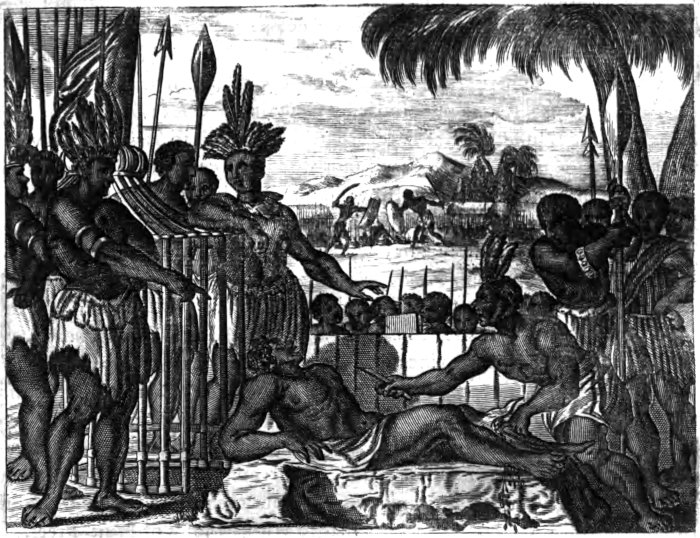
They also dealt strangely with Persons that were yearly to be Offer’d to their Idols: for after having wash’d them, they put on them the Clothes of the Idol, and gave them the same Name, every one honouring them as a God; were permitted to walk up and down, but guarded by twelve Men, that they might not escape; for then the chiefest of the Guard was to supply the others place: Moreover, they resided in the chiefest Apartments of the Temple, eat of the best, were serv’d like Princes, and attended through the Towns by Persons of the greatest Quality, who led them through the Streets; where they no sooner play’d on a little Pipe, but all People came running to them, fell at their Feet and worship’d them: In the Night they lock’d them up in a Cage, secur’d with Iron Bars, and at the appointed time flay’d them alive.
Towns and Villages.
The chief Towns now remaining, and inhabited by the Spaniards, are 1. St. Lewis de Tampice, a Colony of Spaniards situate on the Northern Bank of the River Panuco, at the very Mouth of it; where it hath a very large Haven, but so barr’d with Sands, that no Ship of any great Burden can enter or abide in it with safety; and yet the River otherwise so deep, that Vessels of five hundred Tun, might Sail up threescore Leagues at least within Land, and thereby visit the rich Mynes of Zatatecas on the one side of it, and of New Biscay on the other, at pleasure, and without fear of much opposition.
2. St. Stevan del Puerto, on the South side of the same River, eight Leagues distant from the Sea, or Gulf of Mexico, at present the Metropolis or chief Town of the Province, built by Cortesius in the place where stood old Panuco, which was likewise the Metropolis, or Head Town of the Natives, before the Spaniards burnt and destroy’d it.
2723. St. Jago de las Valles, which is a Fronteer Place, and enjoyeth certain special Immunities, and some fair Possessions also for defence of the Countrey against the Salvages. It is twenty five Leagues distant from St. Stevan del Puerto, lying in an open or Champain Countrey, and is fenc’d about with a Wall of Earth.
Miles Philips his Voyage.
Miles Philips, an Englishman, put ashore by Captain John Hawkins, in the Bay of New Spain, Anno 1568., suffer’d great hardship before he came to Panuco, from whence returning, he made mention of a City lying along a River of the same denomination, (which is there not above two Bowe shoots-broad,) in a pleasant Countrey, containing two hundred Spanish Families, beside the antient Inhabitants and Negro’s, which all drive a great Trade in Salt, which is made in Pans Westward from the River: Philips travelling from Panuco to Mexico, saw by the way the Villages Nohete, by the Spaniards call’d Santa Maria, and a Cloyster of white Monks: Next he view’d Mestitlan, where some grey Monks had a House, and the Town Puchuen.
Chilton’s Journal.
Another account of this Province is taken from a Journal kept by John Chilton, four years after Philips’s Voyage; he having a Spaniard for his Convoy, left Mexico to find out Panuco; in three days time they reach’d the City Mestitlan, where he observ’d, that twelve Spanish Families liv’d amongst thirty thousand Indians. The City built on a high Mountain, full of Woods, is surrounded with Villages, through which run many brave Springs; and the Air about them is no less wholsom than the Ground fruitful; the High-ways are shaded with all sorts of Fruit-Trees.
The Village Clanchinoltepec, four times more Populous than Mestitlan, belongs to a Spanish Nobleman, who built a Cloyster there for nine Augustin Monks, of which Order there also reside twelve in the City Guaxutla.
Moreover, they travel’d over the plain Countrey Guastecan, to the Village Tancuylabo, inhabited by a tall People, with blue Painted Bodies, and Pleited Hair, hanging down to their Knees, going stark naked, but never without a Bowe and Arrow. They esteem nothing more than Salt, as being the onely Cure against certain Worms that grow between their Lips. From hence they travel’d to Tampice, in which Journey they spent nine days; and coming thither, were inform’d, that of forty Christians which dwelt in the same, the Indians had slain twelve, whilst they were gathering of Salt. From hence they came to Panuco, then in a manner deserted, because of the Indians oppressing the Spaniards, of which, at that time, there were but ten, and one Priest. Chilton falling sick here, resolv’d nevertheless to change that unwholsom Air and barren place for a better; to which purpose, getting a Horse, he took an Indian behind him for his Guide, but loosing his way in a thick Wood, happen’d amongst a Company of wild People, which dwelt in Straw Huts, twenty of them immediately surrounding him, brought him some clear sweet Water to drink, out of a Gilt Venice Glass, which having drunk, two naked Men led him into the high-way; which ended at the Gate of the Wall’d City Santo Jago de las Valles, inhabited by twenty five Spanish Families, who inform’d Chilton of the great danger which he had been in, for the People which gave him the Water were Man-eaters, who not long since, had burnt an Augustine Cloyster, built on a Mountain, had taken away, and eat the People, of which they had in all likelyhood gotten the Venice Glass; and had they not observ’d Chilton to be sickly, he had without doubt been eaten by them, and his Skin, with some of his Hair, (that being a great Ornament amongst them) been hung about their middle.
During Chilton’s stay in St. Jago, Frans de Page came thither with forty Soldiers from the Vice-Roy Henry Manriques, and took five hundred Indians, good Bowe Men out of the Neighboring Villages, Tanehipa and Tameclipa, with which he design’d to go to the Silver Mines at Zacatecas: Chilton joyning with this Company, came to the 273great River De las Palmas, which separates New Spain from Florida, where they spent three days in vain, seeking to find a passage over; wherefore they at last took pieces of Timber, which joyning together, and standing upon, they were Tow’d over by Swimming Indians; being gotten on the other side, they March’d over steep Mountains, and thick Wildernesses, and came at last to Zacatecas, on whose Silver Mines, the richest in all America, work’d above three hundred Spaniards daily.
Sect. VI. Tabasco.
Bounds and Description of Tabasco.
The last Countrey belonging to New Spain is Tabasco, bounded on the North by the Northern Ocean, and on the East with Jucatan; and however some account it a distinct Province, yet others make no mention of it, letting it pass for that part of Jucatan which lies about the City Tabasco, from which it seems to be denominated: The Ground level and without Mountains, hath many great Woods of Cedar-Trees, Brasile, and others. Here are also many good Indian Fruits, as the Manmeyes, Zapotes, Aguacates, and Guajabos. For three Moneths they have continually dry Weather, the rest of the year being for the most part rainy; which vicissitude of Moisture and Heat makes the Countrey exceeding fruitful, insomuch that they have three or four Harvests of Maiz in a year.
Vines, Figs, Lemmons, Oranges, Rice, Barley, and all sorts of Garden-Herbs grow here also in great plenty.
The Pools, Brooks and Lakes, abound likewise with all manner of Fish: and for Sea-Fish, besides the Tortugas, and Yguanras, the Manate, or Sea-Cow, is of principal note.
The Fish Manate.
This Fish is terrible to behold, having a Head like an Ox, little Eyes, two Feet near the Head in stead of Fins, two round Holes in stead of Ears, round bones like Balls in its Brains, a short Tail, and bristly Skin: The Females have two Dugs, with which they suckle their Young.
Birds.
Peacocks, Pheasants, Parrots, Quales, Hens, Pigeons, with several sorts of Birds altogether unknown to the Europeans, are here in great abundance.
Beasts.
The Woods also abound with Tygers and Lyons, which do no little hurt to the Inhabitants, Wild Hogs, Deer, and Rabbets, are likewise here in great plenty; and Turtles of an exceeding bigness: Likewise Apes, Polecats, and Squerrils, which do very much hurt to the Fruit-Trees, especially the Cacao. The Musticho’s are a great annoyance to the People, and disturb their rest at Night.
Languages of the Natives.
Since the Spaniards have conquer’d Tabasco, they have forc’d the Inhabitants to observe their Laws and Customs. They speak three sorts of Languages, amongst which that most us’d, call’d Chontal, is copious of Words. The second, Zoques, is spoken on the Mountains which divide Chiapa and Tabasco. The Mexican Tongue was first brought thither by the Garrisons which Muteczuma plac’d there in the Forts Zimatlan and Xicalango, and is the most spoken, in regard it hath not onely its Accents, but is also of great use, partly because it is understood in most places of America, and partly because the Priests have made Songs in that Tongue, with which the Tabascans are much delighted.
The chief City Nostra Sennora de la Vittoria, already mention’d in Jucatan, was so call’d by Ferdinand Cortesius, from the great Victory which he obtain’d over the Indians when he march’d first towards Mexico.
Thus far of the Description of the several Parts and Divisions of New Spain, differing 274in Customs and Languages, though most of them have some affinity with the Mexicans, who by force of Arms had made a way to the supream Empire. All of them acknowledge a Creator, but have no Name to express the Word God. But besides the Creator of the World they have made to themselves Gods of many other Creatures; amongst which are the Sun, Moon, Stars, and the Manes of the Deceased, the care of whose Burial they committed to the Priests, which was sometimes in the Fields, sometimes in their Houses; others carried their dead Bodies to the Mountains, some buried them in Temples; and as they either burnt or buried the Body, so they buried or burnt their Clothes and Riches with them, especially of Persons of Quality, whilst those that accompanied the Corps sung a mournful Song; after which they Feasted. The Heirs of Noble-men that had been at the Funeral put themselves all into Mourning. A Person, after he is dead, is stretch’d out upon the Floor, where he lies till all his Friends come to Present and Complement him, as if living: But at the death of an eminent Person they not onely bring him Presents, but proffer him his Slaves, Steward, Butlers, Dwarfs, and Houshold Priest, (all which a Lord must keep) that they may serve him in the other World. The Priests which perform’d the Funeral Ceremonies, walk’d before the Corps with the Image of the Idol which the Deceased had appropriated to himself, (for every Lord, according to the greatness of his Quality, bore the Name and Apparel of some Idol or another;) other Priests beat on Drums, play’d on Pipes and singing Dirges, perfum’d the Way with Myrrh, whilest the Servants and Relations made a doleful cry; a Herauld also carried the Coat of Arms and Trophies of the Deceased, artificially painted on Cloth; at last they pyl’d sweet Wood about the Corps, which being lighted, and the Body burnt to Ashes, a Priest in a frightful Dress, Vizarded with a gaping Mouth, long Teeth, and fiery Eyes, came on a sudden, and with a long Stick stirr’d the Ashes about, and gathering it in an Urn, buried the same with the fore-mention’d things.
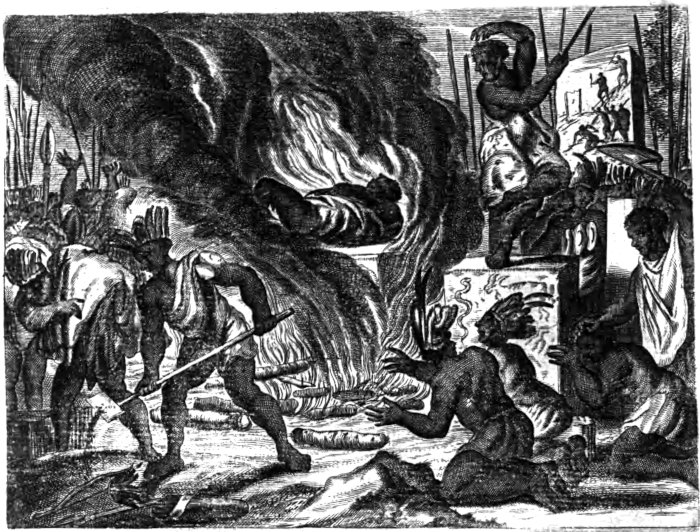
The Idols in New Spain are represented in terrible Figures, to which they Offer humane Sacrifices.
275The Priests, divided into higher or lower Orders, acknowledge a supream Head, which they call Papas. Each Idol had a peculiar sort of Priests: Those that serv’d Viztlipuzli, obtain’d their Places by Inheritance; but others were chose by the Commonalty, unless they had been bred Priests from their Infancy.
Cloysters dedicated to the ancient Mexican Religion.
The Mexican Cloysters in the time of Heathenism were generally built in the chiefest Temples, in a great Piazza, or square Court, where for the most part two Monastical Houses stood one against another, the one inhabited by a Fraternity of Recluses, and the other by a Sisterhood; which last being Maids of twelve or thirteen years of age, call’d The Penitential Daughters, swept the Temple, prepar’d Meat for the Idols and Priests, which was plentifully supply’d from the Alms and Offerings that were daily brought in to the Priests, consisting of little Cakes made like Hands and Feet, besides other strange Meats, which being set before the Idols, was soon after taken away again, and eaten up by the Priests: They were under a Governess, who employ’d them in making Embroideries to adorn the Temple; and sometimes rose up with the Priests at Mid-night, and play’d on Pipes, perfum’d the Temple, and scourg’d themselves till the Blood ran down their Backs, besmearing their Faces therewith, and leaving it on a whole year; then going into a large Chamber, where a Cistern stood for that purpose, they wash’d it off again; after which, if they committed the least uncleanness, they were put to a most miserable Death; which was judg’d upon seeing a Rat run through the Nuns Chamber, or a Batt flying by it, or finding any piece of Cloth gnaw’n by a Mouse or Rat; for they suppose that the fore-mention’d Creatures dare not come into a hallow’d place, unless defil’d. In this recluse manner they were onely confin’d to live a year, which being expir’d, they had free leave to Marry.
The House opposite to the Nuns in the same square place of the Temple, was inhabited by Youths of eighteen and twenty years of age, whose Heads were shaven like Monks, and pleited Tufts hung from the Crown down to their Backs; they liv’d also mean and chaste, kept the Priests Clothes and Perfuming-Vessels, carried Wood for Offerings, and kept always burning Lamps before Viztlipuztli’s Altar. Amongst them were also Boys of a less Age, whose Office was to gather Flowers and Herbs to strow the Temple with, to sharpen the Priests Lances, which they Let themselves Blood with every Night in the Legs, and carry them Water. These Youths, Cloth’d in Nets, fell on their Faces on the Ground when they met with a Woman, and went four and four, or six and six together to beg Alms, and by turns watch’d the fore-mention’d Fire; in the Morning they drew Blood out of their Thighs, with which they anointed their Temples down to their Ears, and when the Blood look’d black, wash’d it off again in a consecrated Bath, which their strict and severe Life endur’d a whole Year.
Mexican Religion abhorr’d by the neighboring People.
The particular Religion of the Mexicans, compos’d of cruel slaughters and butcheries of Men, reign’d a long time against the minds of the other Indians that were under their Dominion, every one beginning more to abhor the cruel flaying of living People, and tearing out the Hearts of Men for Offerings; and the rather, because they were forc’d to fetch them out of their Enemies Countrey with the hazard of their own Lives, insomuch that they were ready long before to have embrac’d another Doctrine, if any other Teacher had but appear’d amongst them; which was the chief reason why they so easily receiv’d the Roman Religion: for when Cortesius had conquer’d the City Mexico, the Mechoacan Agents entreated him to send them Teachers to prescribe them Laws, according to which they might live, because their Idolatry, which had long oppress’d them, was not to be suffer’d any longer, because of the Cruelties which were requir’d of them in the performance thereof.
Their Processions.
276Their Processions were stately, and after this manner: The chiefest Nuns raising a Paste of Bledoi-Seed and parched Maiz, kneaded it with Honey, of which they made an Idol resembling their Deity Viztipuztli, across whose Nose and Forehead they drew a blue Stroke; his Head they adorn’d with a Plume of Feathers, and in the left Hand plac’d a round Box, in the right a crooked Staff like a Serpent, and Wings behind on his Shoulders; at the appointed Feast-day the Nuns meet before Sun-rising, in new white Apparel, with Garlands of Maiz about their Heads and Necks, which hung down below the left Shoulder, their Faces painted with several colours, about their Arms hung Parrots Feathers from their Elbows down to their Hands: Thus adorn’d, they carried the kneaded Idol to a Court, where the Youths that inhabited a Cloyster in the same Temple, fetching the Idols blue Throne, with great Reverence set it down at the lower Step of the Temple, at which the People threw Dust on their Heads; which was no sooner done, but the Boys ran with all speed to the Mountain Chapultepec, a League from Mexico, whither the Multitude following them in manner of Procession, made all short Prayers and Offerings there; from thence hastening into the Champain Fields Atlacuavaya, they perform’d the like Service as before; which done, they went to the Village Cuyoacan, a League farther; from whence they came back in all haste with their Idol into Mexico: Wherefore this Processioning for its expedition was call’d Ipaina Viztliputli. The Idol being brought into the Temple, was by four Cords made fast to his Throne, hoised up to the Cieling with the noise of Drums and Trumpets, whilst the fore-mention’d Youths strow’d the Temple both within and without full of Roses; after which the Nuns gave the Boys the resemblances of Bones made of the same Dough with the Idol, with which they were to cover the Floor of the Chappel; then appear’d the Temple-Priests, with Scarfs about their Bodies, Garlands on their Heads, and Strings with Flowers about their Necks, each going in order according to his quality to the place where the Bones lay; which being Consecrated with Songs and Dances, were religiously worshipp’d for Bones of the Idol; after which six of the Priests went down to the Stone Quauxicalli, on which the Prisoners lying upon their Backs, had their Hearts pull’d out; which being finish’d, the Maids and Boys before-mention’d went to meet one another, Dancing to the sound of Pipes, Drums and Songs; which their nearest Relations answering, Danc’d round about them, whither the whole City and Countrey People all about came flocking in great numbers.
During this high Feast none, upon great Penalties, durst eat any other Food but the Cakes made of the same Dough of which the Idol was made; neither were they permitted, though Children, to drink till the Afternoon.
Lastly, the Priest climb’d up to a Chappel strow’d with Roses, in which the Idol sitting, they disrob’d him, broke his holy Arms and Legs into little pieces, which they distributed amongst the common People, who receiv’d them with great Reverence, and with tears in their Eyes, imagining they eat the Body of their God; for which honour every one paid a tenth part of the Charge which had been spent in this high Feast. Then a Priest admonish’d them how they should lead their Lives, since they were united with their God; which ended, they all went to their several Habitations in a wonderful good order from the Temple.
Ancient Attire of the Mexicans.
Concerning the Mexicans Apparel, it is a sufficient testimony, that they are no way of the same original with the several barbarous Nations, that run up and down naked in New Spain: for the Inhabitants of Mexico went antiently Cloth’d in Cotton: On their Heads they wore a high Plume of red Feathers; about their Necks, over their Shoulders, Breast and Back, a kind of large Thorax of Feathers 277curiously pleited; each Arm adorn’d with Armlets, and their Middles girt with broad white Girdles full of red Streaks; in stead of Garters they wore Laces of Feathers, as also a little above their Ancles. Their Priests besmear’d all their Bodies, especially the Head, with an Ointment, whose special vertue was to make their Hair grow exceeding long, which they braided with broad Cotton Strings; they also smutch’d themselves with a kind of blacking Stuff; when they went to make Offerings to their Idol in Caves, Woods, or on high Mountains, they bedawb’d themselves with an Ointment made of Spiders, Salamanders, Adders, Scorpions and Toads, which the Temple-Boys caught for them in great abundance. This Ointment they made with many Circumstances; for having roasted the fore-mention’d Vermine on the Hearth of the perpetual Fire before Viztlipuztli’s Altar, and stamp’d the same in a Mortar with Tobacco, living Scorpions, the Seed Ololuchqui, (to which they ascrib’d a power of representing Visions) hairy Worms, and Soot, they kneaded all together, put the Ointment in Pots, and plac’d it before the Idol, thenceforth reputing it a sanctifi’d Medicine, that would prove good against all manner of Diseases; wherefore the Priests being always sent for to the Sick in stead of Doctors, perfum’d the Patient, shav’d his Hair, hung Snakes Bones about his Neck, and order’d him at a certain Hour to bathe himself, and in the Night to watch before a Fire-hearth, and to eat no Bread but what had been Offer’d to their Idol. Moreover, the said Ointment is thought to have another power, viz. to make those that anointed themselves with the same, valiant and strong; which the common People believ’d, because the Priests would go through Woods and Wildernesses that abounded with ravenous Beasts.
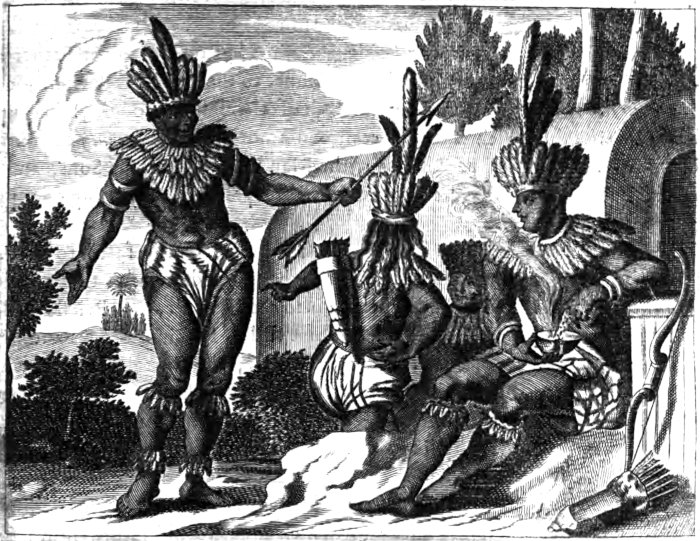
These Heathens also seem’d to have something of Circumcision and Baptism; for they not onely cut off a piece of the Infant’s Ears and privy Members, which they Offer’d to their Idols, but also wash’d them as soon as they came into the World, putting into their Hands such Tools as were of use in their Fathers Profession.
Their Nuptial Solemnities.
Their Marriages also were celebrated with great solemnity: The Priest having ask’d the Bride and Bridegroom, If they would joyn together in Matrimony? if 278they both consented, he ty’d the Brides Scarf, and Bridegrooms Coat together, and so accompanying them home, led them nine times about the Fire-hearth: If the Bride had no Impediments, then the Bridegroom made Presents to her Father and Mother, Offerings to the Gods, and a brave Dinner to the nearest Relations; after which an Inventory was drawn of what each of them had brought, that upon their being Divorc’d, (which was very common amongst the Mexicans) each might have his share; and if they had Children, the Man was to keep the Sons, and the Woman the Daughters; nor were they permitted, on pain of death, being once parted, to joyn together again.
The Feast Texcoalt.
On the ninteenth of May they kept the Feast Texcoalt, Consecrated to the Idol Tezcatlipuca, before whom they Offer’d a Slave, which was done after this manner: Towards the Evening the Multitude coming into the Temple, the Priests pulling off the Idols old, put on new Apparel, hung him full of Precious Stones and Armlets, set Plumes of Feathers on his Head; which done, the Curtains behind which he stood, were drawn, and a Priest Cloth’d exactly like the Idol coming forth, turn’d himself round, blow’d a kind of Trumpet towards the four Winds, and ate Earth, which all the People imitated: whereof those which had committed any hainous Offence, Offer’d Incense to the Idol, and weeping, begg’d forgiveness of their Sins. Those that were Soldiers besought him to grant them store of Prisoners, and strength to conquer their Enemies; for which they would return him thanks with Offer’d Prisoners.
This Feast of Texcoalt lasting ten days, ended on the twenty ninth of May with peculiar Ceremonies; for in the Morning a company of Priests, black all over, carried on their Shoulders a large Chair of State richly adorn’d; in which sat their Idol Tezcatlipuca, and Priests with long pleited Hair, and Clad in the same Apparel with the Idol, which they set down at the Foot of a pair of Stairs which led up to a Chappel; whither the attendant Youths and Virgins came and spread Carpets before it, and green Boughs of Manghey; after which two Priests carried the Idol into a spacious Court in the Temple, several others walking before, each with a perfuming Vessel; when they threw their Perfumes on the Consecrated Hearth, they held their Hands towards the Idol, desiring him that he would send their Prayers to Heaven: Next follow’d the Multitude, who scourg’d themselves till the Blood ran down from their Backs. So soon as the Procession was ended, the represented Tezcatlipuca was hoised up to the Cieling, and abundance of Flowers strow’d before the Altar; which done, every one went home to Dinner, whilst the Youths and Virgins adorn’d the Idol, and plac’d Meat before him: Lastly, the Votaresses came two and two with Baskets of Bread, and Dishes of Meat: their Governess in a white Sur-Coat over a red Vest, with Wings on her Shoulders, and broad Girts, at which hung Calabashes fill’d with holy Reliques and Flowers: Moreover, she conducted the Votaresses to the Steps of the Altar on which the Idol sat; where having eaten Bread they came back, and the Temple-Servants went in their places, and carried the Meat which stood on the Altar to the Priests Cells, who by that time were to have Fasted five days: this done, the People came all to the Temple again, to be present at the end of the Feast: then a Slave, who had represented the Idol a whole year, appear’d, to whom everyone having shew’d Reverence, the chief Priest cutting open his Breast, tore the Slave’s Heart reaking out of his Body, and shew’d it to the Sun; then the Consecrated Youths and Maids made a great noise with Drumming, Singing and Dancing about the Body till Sun-set; after which the Virgins going up to the upper Chappel, plac’d Bread and Fruit, made up like dead Mens Bones and Heads, before the Idol, 279where, after it had stood a little while, the Servants went up and fetch’d it down, whilst the Youths and Maids went to their several Cloysters.