The Third Book, CONTAINING A DESCRIPTION OF PERUANA OR, Southern America. (continued 2)
Reading edition
Their stately Structures.
Many were the stately Temples, invincible Castles, magnificent Palaces, and other wonderful Structures built by the Ingas, the chiefest whereof stood in Cusco, Tiaguanaco, and Tambo; the Builders whereof were sent for by turns out of the adjacent Countreys, from which they brought exceeding great Stones, most of them thirty eight Foot long, eighteen broad, and six thick, which were so neatly joyn’d together with Mortar or Iron-work, that a whole Edifice seem’d to be one entire Stone. Their Bridges that led cross the Rivers were made of Flags and Rushes, fastned to each Shore with great Ropes. The like Bridge lay cross the deep Mouth of the Lake Chicuito, on which great Bundles of the Rushes Toto being ty’d together, and cover’d with Straw, so strengthen’d the Bridge, that great Loads were safely carried over the same.
The great Riches of the Ingas.
No Prince ever possess’d so much Riches and Splendor as an Inga of Peru, each Countrey presenting him with what was most esteem’d amongst them; the Chiches bringing Sweet-woods; the Lucanas, strong Sedan-Carriers; the Chumbibilcas, brave Dancers; and so accordingly every Countrey provided him with what they best esteem’d, besides the usual Tributes which they paid.
Those which digg’d the Gold and Silver out of the Mines, had Meat, Drink, 420and Clothing from the Inga, though at other times he enjoy’d the Labors of his Subjects for nothing.
Their several sorts of Tribute from conquer’d Countreys.
When at any time he conquer’d a Countrey by force of Arms, he made them pay from three several sorts of Tribute; the first was bestow’d in religious Offices. Each Guaca or Chappel receiv’d also a Revenue from the late conquer’d Countreys, the Fruit of which serv’d for Offerings to their chief God Pachayachachu, the Sun, their Thunderer Chuquilla, and to the Souls of the Deceased, and for Food for the Priests. The Religion through the whole Realm agreed with that which was observ’d in Cusco. But the second Tribute fell to the Inga’s Family, or Relation and Soldiers. Those who Till’d the Inga’s Ground, Sung before him in Festival Clothes. That which could not be spent in the Court was laid up in Store-houses for ten years together, against a scarcity should happen. Aged People, Widows, and such as were decrepid, paid no Tribute. The third part was for the Poor, which had every Year a piece of Ground allow’d them to make use of as they pleas’d. In unfruitful Years they receiv’d an Allowance out of the Store-houses before mention’d.
Their Provision for the Poor.
So likewise the Pasture, Meadows, and Arable Land was order’d for three several Uses, one third for religious Uses, a second for the Inga’s, and the last for the Poor. The Sheep being shorn on a certain Day, yielded the Poor a certain quantity of Wooll to make them Clothes. As soon as any Beast grew Mangy (which the Peruvians call’d Carache) they burnt them alive, so to prevent the spreading of it farther. Those that belong’d to the Inga’s Family, wore all Clothes made of the finest Wooll, and the coursest, call’d Tabasca, was distributed among the Vulgar.
Their Industry.
Besides this good Order of Government, it is wonderful to observe the Peruvians manner of Living, each learning from their Infancy not onely a Trade, but all things which they accounted necessary in House-keeping, as Weaving, Tilling of Land, building of Houses, and making of Tools requisite for both; so that they never made use of one another on any Account. Moreover, Master Artists, who work’d more for Pleasure than Gain, dwelt apart, being Silver-smiths, Painters, Musicians, and Dancers.
Their Habits.
Their Habits were heretofore of one fashion through the whole Realm, onely the Covering of their Heads were several, by which the People of one Countrey were distinguish’d from the other, according to an inviolable Law made many Ages since; some therefore wore thin Caps, others broad Pleits, others little Hats, others round Bonnets, others woven Caps, and the like.
Their Post-Stages.
Their Post-Stages, call’d Chasquis, were little Houses, each standing a League and a half from one another, wherein dwelt certain Officers, who with extraordinary speed convey’d the Inga’s Letters from one Chasquis to the other; after which manner in two days time they convey’d a Letter a hundred Leagues. But since the Spaniards conquer’d this Countrey, that Convenience was lost, till the tenth Peruvian Vice-Roy Martin Enriques re-establish’d the same; for he allow’d a Sallary to those Posts, that they might with speed convey all Letters and Packets from one to the other, being distant, according to his Establishment, four Leagues.
Their severe Laws against Malefactors.
Lastly, the Ingas maintain’d strict Laws in criminal Affairs; for as they did not neglect to encourage noble Atchievements (for whoe’re had done a valiant Act in the Wars, was made Governor of a Countrey, or had a certain quantity of Land given him, or Married one of the Inga’s Family;) so likewise they severely punish’d all Malefactors: for Murderers, Thieves, and Adulterers suffer’d Death without Mercy; yet they allow’d store of Concubines, and it was free for any one to Lie with his Neighbor’s Concubine, but Death to have to do with any Man’s lawful Wife, who were serv’d by the Concubines.
Their Marriages.
421When a Bridegroom Betrothed himself to his Bride, he gave her (and put them on himself) a pair of Shoes call’d Ajota, not unlike those of a grey Fryer, which were lin’d with Cotton if she were a Maid, but with Leaves if a Widow, who nevertheless being generally younger than the Man, was to Mourn a whole year in Black for her deceased Husband; till the expiration of which time she was not to Marry another. Governors of Provinces and other Officers of State receiv’d their Wives from the Ingas, who enquiring out the beautifullest and most accomplish’d Virgins they could hear of, put the Ajota on their Feet, and gave them to such Persons as they most fancied; after which if they committed Adultery they were certainly put to death. The Marrying of Brothers and Sisters was also forbid, till the Inga Topa Yupangui, Father to Guaynacava broke that Law, by Marrying his own Sister Mamoello, and made an Order that the Ingas onely should have that liberty; nay, when he lay on his Death-bed, he strictly charg’d his Son Guaynacava to take his own Sister Goya Cuissilmay to Wife; and this incestuous Marriage produc’d Huascar and Attabaliba, (though some say Attabaliba was begotten on a Concubine) in whose time the Peruvian Kingdom went to ruine. Guaynacava also permitted the common People to Marry their Sisters of the Fathers side, but not of the Mothers.
Their manner of living.
The Peruvian Houses were antiently for the most part light and small; and for their Table they made but little preparation, satisfying themselves with a little Beer made of Rice, Bread bak’d of Maiz, dry’d Flesh, Fish, and Roots.
In their Wars they us’d Slings, Darts, Arrows, Lances, Pikes, Halberds, Pole-Axes, and Shields.
Their Funerals.
Their Funerals were also solemnly kept, especially those of Persons of Quality, the Corps was carried out on a brave Chair, from which he was put into the Ground, with two of his Concubines whom he best affected, and also three Servants, Gold and Silver Vessels, Maiz, and the Liquor Chica, which the nearest Relation spurted into his Mouth through a Cane; all which they did that the Deceased might make use thereof in the other World. But before the Funeral the Relations Mourn’d over the Corps several days, and after the Body was Interr’d, they plac’d the Picture of the Deceased upon the Grave: but the meaner sort of People had the Tools belonging to their Trade; and Soldiers their Arms plac’d on the same.
Their Religion.
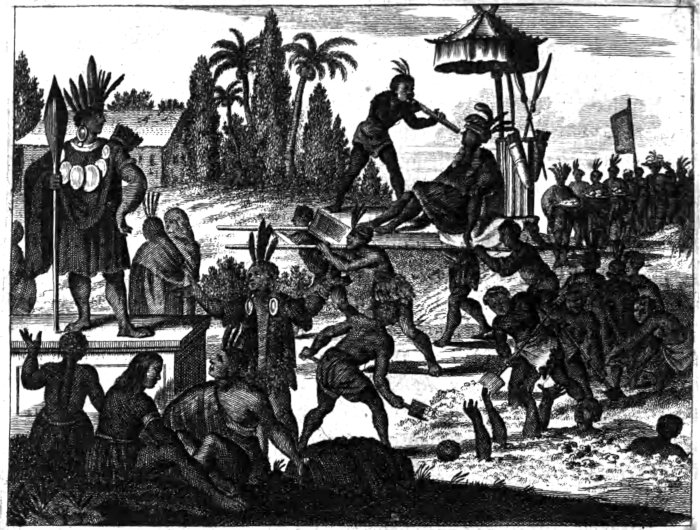
In their Religion they had various Fancies; their prime God Viracocha bore several Denominations, and amongst others he was call’d Pacachame, or Pachayachachick, by which he was signifi’d to be the Creator of Heaven and Earth; as also Usapu, that is, Wonderful. In honor to this Pacachama stood formerly a magnificent Temple about four Leagues from Lima, where the Ruines still manifest its former glory, it being the Place where the Devil answer’d the Priests, who stood with their Backs towards the Image of Pacochame, bowing their Heads to the Ground, and showing many antick Tricks. The second Temple stood near Cusco, in which the Inga’s had plac’d the Images of all the Gods and Goddesses that were worshipp’d in Peru; and before each Image stood an Altar: the chiefest of them, call’d Puachao, consisting of massie Gold, was Dedicated to the Sun, on whose Forehead the Sun was Engraven on a Plate, which afterwards fell into the Hands of the Spanish Captain Mancius Sierra de Lequizamo; but because he lost the same one Night at Gaming, this Proverb was rais’d upon it, Lequizamo lost the Sun before it rose, because he got the Plate on which the Sun was Engraven in the Afternoon, and lost the same in the Night: The Temple it self, built of great Stones, curiously joyn’d together in Mosaick Work, and within link’d with Golden Plates of a Finger thick, stood full of Golden Chappels and Altars; round about it were several Galleries, into which 422the Priests and Priestesses Chambers open’d. Near the River Ticiquaque a third Temple, Consecrated to the Sun.
The various Idolatry of the Peruvians.
This kind of Idolatry was common to the Peruvians, with several other Nations of the antient Heathens, as hath been before observ’d, which made them mock at the Spaniards when they told them of a Crucifi’d Saviour, saying they had a splendid God, who appear’d to them in glory every Morning. In the third Temple near the River Taciquaque in Peru, which exceeded the other two, they worshipp’d Thunder by the Name of Chuquilla, Catuilla, and Intillapa, which the Peruvians believ’d to be a Man that Commanded the Air, and who being Arm’d with a Club and Sling, throws down Rain, Hail, and Snow from the Clouds, and shooting Bullets through the lower Region, causes Thunder and Lightning: They worshipp’d him after the same manner as they did Viracocha and the Sun, with holding up of a thing like a Glove, and sometimes Offering, especially in Cusco, living Children: Also they ador’d the Earth of which they made the Goddess Bathamama; also Mamacocha, the God of the Sea. The Rainbowe, which the Ingas carried between two Serpents for their Arms, was also religiously worshipp’d. Amongst the Stars they imagin’d Colca, by us call’d Aries, or the Ram, as chief; yet held several others of peculiar Denomination, in veneration, of which they crav’d such things as they wanted. The Shepherds ador’d the Star Nereuchilla or Capricorn, whom they judge to Rule over the Beasts. Others worshipp’d Machacuay which the European Astronomers call the Serpent, as commanding Serpents and Dragons, that they might receive no hurt from them. Tygers, Lyons, and Bears, were Rul’d by the Star Chuquichinchag; wherefore those who would walk free from those ravenous Beasts, lifted up folded Hands to the Constellations representing the same. They believ’d that there was no Creature living on Earth, whole Likeness the Heavens could not afford; and that those which were on Earth were under the influence of those in Heaven: from hence proceeded the Names of the Stars Chacana, Topatatca, Mamana, Mirma, and others. They likewise attributed a kind of Divinity to Fountains, Rivers, Rocks, Mountains, some kinds of Herbs, Roots, and especially the Papas, 423of a strange shape, and had a veneration for all manner of Creatures that were of an unusual form. When they travel’d they strew’d Shoes, Plumes of Feathers, and Cocoa in all cross Ways and tops of Hills, by them call’d Apachitas; and if they want the fore-mention’d things, then they throw a Stone for an Offering, from whence it proceeds, that in all cross Ways, and on the tops of Hills, lie heaps of Stones, which are accounted holy.
The like fond veneration of Stones the Saracens are said antiently to have had, upon a Tradition, That Abraham had enjoy’d Agar upon a Stone, and that according to Euthymius and Libanius, he ty’d his Cammel to a Stone when he went to Offer his Son Isaac.
The Images of their deceased Ingas, which they call’d Guaoiqui, were had in great honor, and carried with them to the Wars, and up and down in Processionings, and call’d upon for fruitful Seasons.
The Peruvians believ’d the Immortality of the Soul.
The Immortality of the Soul, the giving of Punishments to the Wicked, and of Rewards to those that do well, was generally believ’d amongst the Peruvians, but not the Resurrection of the Dead. Many suffer’d themselves to be buried with their Friends, that they might accompany them to the other World. When the Inga Guaynacava was buried, above a thousand of his Courtiers Sung several Songs, kept a great Feast, and went with great joy to be buried with him, that so they might serve their King on the other side of the Mountains. They Offer’d likewise a great number of Children, and with their Blood cross’d their Faces from one Ear to another: But this barbarous Offering was never us’d but at the Death of prime Persons of Quality; for the meaner sort of People set onely Meat on the Graves, and gave the Dead two Sutes of Apparel, put Money in their Mouthes and Hands; for they believ’d that the Souls ranging up and down from place to place, suffer’d many inconveniences.
Their Oracle.
Their Nunneries.
Their Offerings.
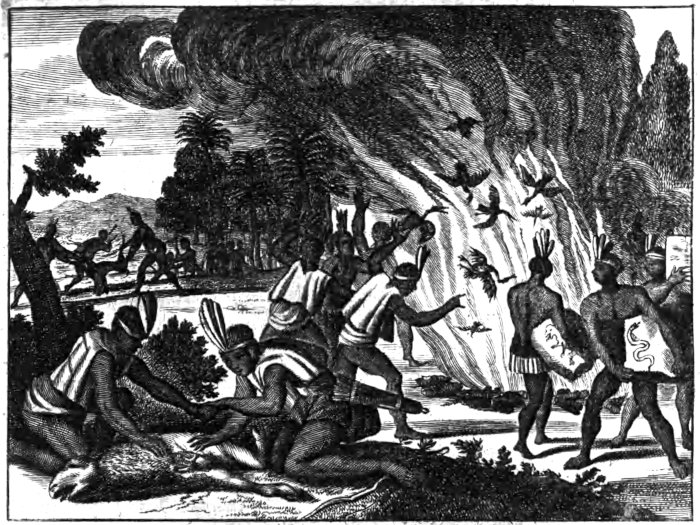
The Peruvian Images consisted generally of Gold, Silver, Stone, or Wood, all of them strangely deform’d: Some of them were said to give Responces like the Oracle at Delphos and Dodona, chiefly in the Temple Pacachama, whose greatness is sufficiently manifest by the Ruines of its Walls beyond Lima, where Franciscus Pizarrus got an invaluable Treasure. Each Peruvian Province had a Temple, besides which, in the Cities, Villages, and Hamlets, were Chappels of Ease, into which the Priests went at Night with their Backs towards the Idol, bended Heads and Bodies; in which posture they requested to know future Events, and were many times answer’d (if we may believe their Reports) in a terrible Voice. The great Temple at Cusco, wherein the Ingas had plac’d all the Peruvian Idols, is now turn’d into a Dominican Cloyster. In each Province of Peru was also a Nunnery (if we may so term it) or Habitation of devoted Virgins, call’d Allaguau, i.e. A House of the Choicest, over which Was plac’d a Governor nam’d Appopanaca, to whom none durst deny their Daughters; some of which were styl’d Wives of the Sun, and others Servant-Maids to the same: The Wives Cloth’d in Embroyder’d Coats, adorn’d the Temple, whilest the Maids kept clean the Walls and Floor. When they attain’d to fourteen Years of Age, some were chosen out from the rest, and oblig’d to perpetual Virginity and solitude of Life in their Chappels; which sacred Obligation if they broke by suffering any to Lie with them, they were buried alive after the manner of the Vestal Virgins, the Ceremony whereof is related by Plutarch: Others were oblig’d to make daily Offerings; others to make peculiar Sacrifices for the Inga’s Health, and happy Events in War; many also were employ’d in the Court Service to wait upon the Inga’s Wife or Concubines; and those being absolv’d from their Vow, were oft-times Married to Courtiers. These Nunneries were Endow’d with great Revenues 424from the Chacaras, or Church-Lands. Their Offerings were (for sometimes they Offer’d to their Idols the highly esteem’d Herb Cocoa, Maiz, several colour’d Plumes, Sea-Monsters, Gold and Silver Images of Beasts, fine Clothes call’d Cumbi, Sweet-wood, and Tallow to burn) either to have success in their Journeys, Trades, or for the preservation of Health, or to obtain a plentiful Harvest. But their usual Offerings were Cuces, a sort of Toads, which were eaten by the Peruvians. When they were to do any Business of consequence, then Persons of Quality kill’d their Sheep Pacos, not without strange observation of the colour and number of them, as also of the time; all which things well consider’d, they cook the Sheep and laid it cross their right Arm, turn’d the Face thereof towards the Sun, and mutter’d several words to themselves according to the colour; for if it was spotted grey, they spoke to Chuquilla, or Thunder; if white and short Fleec’d, to the Sun; if well Fleec’d, to Viracocha. In Cusco they Offer’d daily a short-fleec’d Sheep to the Sun in this manner: Making a great Fire call’d Vibbacaronca, the Priests threw the Sheep and four Baskets of Cocoa into it. Their Sacrifices Cozocovicca and Sapovicca, to obtain Conquests, were also very strange: for they gather’d out of Puna (which is a desolate place) several sorts of Brambles and Bushes nam’d Ganilli, which being all set on fire, they went about the Fire with round Stones in their Hands, on which were painted Serpents, Lyons, Toads, and Tygers, crying, Usachum, grant us Conquest, together with this Prayer, Destroy, O Creator, the power of our Enemies Gods; which said, several starv’d Sheep were brought out, which for that reason they call’d Urca; whose Hearts having torn out they began their Prayers afresh, saying, Mighty Viracocha, thus do thou pull out the Hearts of our Enemies. For the prosperity of the Ingas they kill’d in an open Field black Dogs, by them call’d Appurucos, whose Flesh was eaten with many Ceremonies by People appointed for that purpose. They made Offerings also to the Fountains, Rivers, Brooks, and Sea-shells, under pretence that those Shells were Daughters of the Ocean, and the Ocean the Father of Streams and Springs; when they had Sow’n their Fields, their Priests, chose to that Office, went from House to House to gather such Offerings as every one was pleas’d to give; which they laid at the Banks of several Sluces, at the time when the Water began to rise there, thinking by that Oblation to keep them from over-flowing their Lands, and washing away their Seed. In all places where two Rivers joyn’d together they wash’d themselves, having first bedaub’d themselves all over with stamp’d Maiz, and afterwards look’d upon themselves as well purg’d from Sin; which power they ascrib’d to their Baths. To strangle Children between four and ten years of Age was never us’d, unless upon the Inga’s being sick, or when he receiv’d the Royal Tassel, that from the death of the Children he might receive Health, or Reign prosperously. The fore-mention’d Nuns that were chose to attend on the King’s, were also strangled when the Inga was sick; nay, sometimes a Father would Offer his Son to Viracocha, on the Sun-Priest’s suggestion, That by his Son’s death he would recover from his Sickness, Praying to the foremention’d Deity, that they would be pleas’d to save the sick Father, because the Son had with his Death paid for his Fathers.
This kind of Cruelty the Devil seem’d to prompt the Heathens to, by making use of Abraham’s Example, who prepar’d his Son Isaac for a Sacrifice on Mount Moria; and that it was a Practice amongst the antient Ammonites and Moabites, and other Heathens (by which even the Children of Israel were apt to be seduc’d) appears from the Scripture it self: the Ceremonies of which bruitish Customs, with the seven Brazen Chambers of Moloch, may be seen describ’d by Rabbi Solomon.
Their High Feasts.
The high Feast Capacrayne, which the Peruvians kept in the first Moneth Rayme, 425agreeing with our December, deserves serious observation: for as long as the Feast lasted, no Stranger was suffer’d to Lodge in Cusco, whither they all flock’d again after the Feast was over, to receive Cakes made by the Mamaconas (an Order of Nuns) of Maiz and the warm Blood of a white Ram, and were distributed by certain Priests (Extracted from the Royal Family Iluqui Yupangui) who carrying them up and down in Golden Dishes, gave every one of a Company one, saying at the delivery of it, If you do not Reverence the Sun and Inga, this Food will witness against you to your Ruine; but if you worship them, then their Bodies will by this Pledge be united to yours: after which those that had eaten of the Cakes promis’d Obedience, and thank’d the Sun and Inga for their Food.
Their Manner of Confessions.
Their Penances.
The Esteem of their Soothsayers.
At the fore-mention’d Chasquis a course was taken to carry all that desir’d, to every Temple through the whole Kingdom of Peru, where the Inhabitants receiv’d them with great Reverence, having before confess’d all their sins to their Yaburies, or Father-Confessors, who being chosen to that Office with a great deal of Ceremony, impos’d greater or lesser Penances, according to the sins of the Penitent: those that were suspected to have conceal’d any of their sins, were put to cast Lots, or had the Entrails of the Beasts which they had kill’d to that purpose consulted about them, and thereby were discover’d if they had conceal’d any of their sins; which whenever it hapned, the Priests falling upon the false Penitents, thump’d them with a Stone on their Backs so long, till they had confess’d all their Faults, which the Priest was not to reveal on pain of Death, but to make Expiatory Offerings. The sins about which they were Examin’d, were chiefly Theft, Murder, Adultery, preparing of Poyson, or sleighting their Inga or Gods; for each of which Transgressions they had several kinds of Punishments. When the Inga fell sick, all People in general were forc’d to come and make Confession of their sins; also every one went to his Confessor when he was in trouble, or expected some Misfortune to befall him: The Inga himself Confess’d his sins to none but the Sun, which he desir’d to relate to Viracocha, and to beg pardon of him for the same; which done, he bath’d himself in a running Stream, and cry’d, I have made my sins known to thee, O Sun; do thou, 426O River, wash away mine Iniquities, and discharge them into the Sea, that they may never be more laid to my charge: which custom of Bathing, call’d Opacuna, was also us’d by all other Penitents. A Father losing his Son by Death, was censur’d for a great Sinner, wherefore he could not be permitted to be Confess’d before he had been whipp’d with Nettles by a certain ill-look’d Officer appointed for that end; after which their Fathers Ychuris enjoyn’d such Penances as they thought fit; some were order’d to last several days; others to pay rich Garments, Silver, Gold, or the like; others receiv’d a certain number of Blows; some were condemn’d to live on the Mountains, excluded from the society of all Men. If their Sorcerers at any time foretold a Fathers Death, then he immediately Sacrifis’d his Son, that with his Death he might buy his own Life. No People were more respected than their Soothsayers, as Men that could discover private Thefts, Accidents that hapned in remote Countreys, and also future Events, and so far their Credit amongst the Vulgar carried them, that they undertook to tell the Spaniards when their Countrey-men should be Conquerors, and when defeated in the War they maintain’d against the Netherlanders. There were also cunning Women, who making themselves dead Drunk with Chica, with which they mix’d the Herb Viloa, and afterwards coming to themselves again, answer’d all the Questions that were proposed to them.
Their monthly Feasts.
The Peruvians kept two sorts of Feasts, the first at certain times, the others on special occasions; the set-Feasts were kept Monethly; on the first Moneth Rayme, agreeing with our last Moneth December, as aforesaid, they kept the great Feast Capacrayme, on which they brought Multitudes of Sheep and Lambs for Burnt-offerings, besides Silver and Gold. Not far from the Fire stood three Carv’d Images of the Sun, and three others representing Thunder; and this was generally the Day of the Installation of the young Inga’s, which was after this manner: The chief Priest boring a Hole through his Ear, cover’d the upper part of his Body with the holy Cloth Guaras, whilest the inferior Priests whipt him with knotted Cords, and painted his Face with the Blood. During these Ceremonies no Stranger was suffer’d to remain in Cusco, but after the Feast was ended they all return’d, and as before, receiv’d Cakes bak’d of Maiz and Blood, as a testimony that they lov’d and honor’d the Inga.
427
Their Harvest Ceremonies.
Their Feast Ytri.
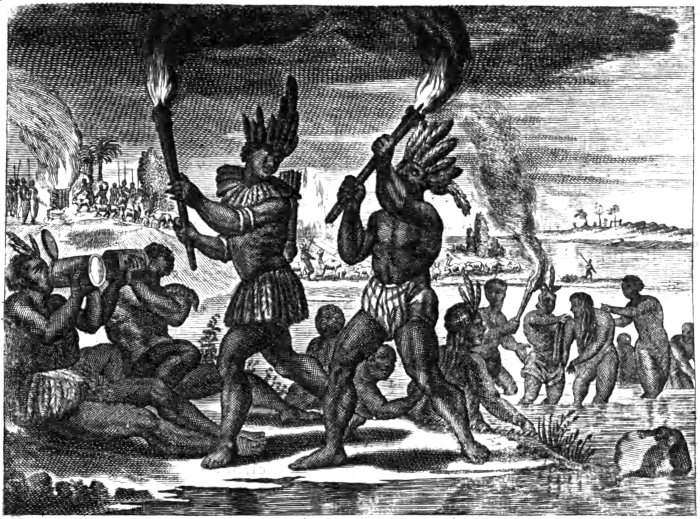
The three Images of the Sun before-mention’d they call’d Apointi, Churiunti, and Intiquaoqui, that is, Father-Sun, Son-Sun, and Brother-Sun. In like manner they nam’d the three Images of Thunder, Chuquilla, Catuilla, and Intillapa; from which Acosta judges that the Devil had obscurely taught the Peruvians the Mysteries of the holy Sacrament and Trinity, (that their glory might be eclips’d by Idolatrous Errors) especially the last, which seems plainly to be signifi’d by the Peruvian Deity Tangatanga, whom they affirm’d to be One in Three, and Three in One. And that other Nations also had a glimpse of the same may be collected from Philip Cluverius, who endeavors to demonstrate, that the antient Germans and Gauls obscurely ador’d the Trinity in the midst of their Heathenism, under the notion of Sun, Moon, and Fire, the Sun signifying the Father, the Moon the Son, and the Fire the Holy-Ghost; to confirm which he makes use of Cæsar’s Testimony, viz. They onely esteem those Gods whom they see, and those that assist them, viz. the Sun, Vulcan, and the Moon; for they have never heard any thing concerning any other Gods. Diodorus Siculus seems also to ascribe a glimpse of this Mystery to the Egyptians, when he says, That the antientest People in Egypt, when they view’d the World, and were amaz’d at all things on the Earth, they judg’d that two Gods Govern’d them all, viz. the Sun and Moon, by whom all things flourish’d and encreas’d; to whom they added a third, namely Fire, to which they attributed a Divinity, as conducing much to the increase and growth of all things. The Moon, which was also call’d Juno, they judg’d to be the Offspring of God, (for Son and Daughter were promiscuously taken) who, according to Homer, Marrying with Jupiter, brought forth Vulcan, which might haply be to them a Type or Figure of the Holy-Ghost, proceeding from the Father and Son: Vulcan was by her plac’d a President over the Fire, by which the Heathens seem’d to imitate the fiery Power of the Holy-Ghost, purifying and cleansing all things: and this cleansing Power was aim’d at by Romulus, when, according to Dionysius Halicarnassensis, he commanded his Soldiers to leap through a Fire made before his Tent, that so they might be purifi’d from all their Crimes. But it may be thought strange, that the Peruvians, Germans, or Egyptians, lost in a Wood of gross Idolatry, could have any apprehension, though never so obscure, of the holy Trinity, when as the most nice and curious Greek and Roman Wits have made such gross mistakes concerning God. But to return again to the Peruvians: They kept their second Feast in the second Moneth Camay, on which they threw the Ashes of their Offerings into the River, and follow’d them on the Shore for the space of five Leagues, praying the River to carry the Ashes to the Sea, where Viracocha would receive them. In the third and fourth Moneths they kill’d a hundred and ten black spotted and grey Sheep. In the beginning of May (by the Peruvians call’d Hatuncuzqui) they gather’d in their Maiz, and kept the Feast Aymorai; after which they return’d home Singing from their Fields, call’d Chacra, and carried a great heap of Maiz with them, nam’d Perua, wrapping it up in rich Garments; three Nights they continu’d their Ceremonies, imploring the Perua to preserve their Harvest of Maiz from any damage that might chance to come to it, and also to let that grow prosperously which they should Plant next. Lastly, their Sorcerers consulted whether the Perua could last till the next year? to which if they were answer’d No, they carried it into the Fields, and burning it, made a new Perua, which when they knew to be sufficient to last good a year, they carried it to the Granary in great triumph. In the seventh Moneth Ancayacuzqui, they kept the Feast call’d Intraymi, with a hundred Sheep, in honor of the Sun. They also made several Images of the Wood Quimia, which they put in rich 428Habits, strew’d the Ways with Flowers, Danc’d a strange Dance nam’d Cayo, Singing several Songs. Persons of Quality put Golden Plates about their Knees, as the common People painted them with divers Colours. In the eighth Moneth Chahua they kept the high Feast Huarqui, on which they Offer’d a hundred grey Sheep; the like number, but of a Chesnut colour, they Offer’d the following Moneth Yupaquis, besides a thousand Cuies, that the Air, Water, or Sun, might not spoil their Plants. Their Feast Situa they kept on the tenth Moneth Coyaraymi after this manner: They gather’d all together on the first day before the Moon rose, which no sooner appear’d, but they made a terrible noise, beat one another with lighted Torches, then wash’d the Dirt from their Bodies, and made themselves Drunk for four Days together. The eleventh Moneth Armaraimi, was nam’d Punchaiquis, from the Feast they kept therein, on which (besides the usual Offerings of eight hundred Sheep) they ty’d a black Sheep to a Post without Meat, till such time as there fell store of Dew. Their Feast call’d Raymicantara Raiquis, was kept in the last Moneth Ayamara, on which their Youth were bor’d through the Ears. Amongst the high Feasts which were kept on great occasions, the chiefest was Ytri, against which they all made new Clothes after a peculiar fashion, wearing their Cloaks muffled about their Heads; in which manner they walked leisurely a whole Day and a Night; during which time none durst either Eat or Drink, or open his Eyes: But after this serious Processioning follow’d four days of extravagancy, as Drinking, Dancing, and the like. In their Dances, which were to the sound of Drums, Pipes, and Horns, they imitated all manner of Trades by strange motions of their Bodies, besides divers other Frolicks and May-games which they us’d at such times of Mirth and Festivity: But since the Spaniards conquer’d Peru, all these Heathenish Customs have been laid aside.
The Destruction of the old Empire of Peru foretold.
As to the Prognostications and Fore-runners of the destruction of the old Empire of Peru, it is reported, that Guaynacava, Father of the last King Attabaliba, lying on his Death-bed in Quito, said to his Princes, This Realm, at present rais’d to the highest top of Eminency, is hastning towards its Ruine; and though our Kingdom remain as yet free from foreign Invasion, the Countreys round about are already conquer’d and in Slavery: The Gods have call’d strange People from unknown Regions, who by degrees will reach us also. With me, who am the twelfth Inga, dies the Dominion of the mighty Peru. A People of other Fashions and Religion will subvert our Religion, Laws and Government, and bring us under subjection to them. There were also Signs and Prodigies that portended the Dissolution of this Empire; amongst the rest a great Eruption in the Province of Tacinga, which rending the Earth asunder vomited up Flames of Fire; nor was it long e’re they were fulfill’d, for whilest the Peruvians were making of Offerings to Viracocha for the delivery of their imprison’d King Huascar, News was brought to Cusco of Attabaliba’s being taken; the Particulars whereof, with other Matters touching the Conquest of this Kingdom by the Spaniards, and how they pillag’d the Countrey, murder’d the Inhabitants, and enrich’d themselves with their inestimable Treasures, shall in order be related.
By whom Peru was first discover’d to the Spaniards.
Great Difficulties in the Discovery of Peru.
Pizarro made Governor of Peru.
Pizarro taking Attabaliba Prisoner, puts a vast Ransom upon him.
Huascar burnt by Order of his Brother Attabaliba.
Attabaliba put to death by the Spaniards.
Attabaliba strangled by Almagro’s Order.
The antient Splendor of the Peruvian Ingas.
Quisquis, Attabaliba’s General, stabb’d and cut in pieces.
Mango Inga releas’d out of Prison, sets upon the Spaniards, and is at last put to flight.
Several Parties of the Peruvians set upon the Spaniards and overthrow them.
They are beaten by Alvarado.
The first that gave the Spaniards notice of Peru, was an Indian Prince call’d Panguinaco, who having been taken Prisoner, inform’d Vasquez Nunnez of the abundance or Gold and Silver which was to be had there, who resolv’d to venture through a thousand Dangers into the South Sea. After which Francisco Pizarro, Ferdinand de Lugue, and Diego de Almagro, consulted upon this great Design, Anno 1525. Pizarrus being order’d to Sail before with a Ship carrying a hundred and fourteen Men, and Almagro to follow with a Vessel carrying seventy Men, whilest De Lugue staid to manage the Affairs at home. Fifty Leagues Southward from Panama, Pizarrus found a 429small Neck of Land nam’d Peru, from which it is most probable that great Kingdom afterwards receiv’d its Denomination, though many deduce it from the River Beru, as before mention’d: Thence Sailing to the main Continent of Peru, and Landing, he lost several of his Men, and being himself desperately wounded, return’d with ill success, whilest Almagro missing of him, Landed afterwards in the same place, and also lost several of his Men, and one of his own Eyes: yet not long after they renew’d their Design, carrying with them in two Ships and three Boats, three hundred stout Men, which all suffer’d extream Hunger, and had they not happily gotten some Sea-Crabs, they had without doubt all of them perish’d: at last Landing on the Coast of Catamez, they were Encountred by a People whose Faces were hung full of Golden Nails, and daily lost more and more of their Men; upon which ill Successes the new American Vice-Roy forbad the farther discovery of Peru, and call’d home the remaining part from the Island Gallo, so that Pizarro kept with him but twelve Men, with whom he went to the desolate Isle Gorgona, where he liv’d on Sea-Snails, till he receiv’d Provisions from Panama; after which they spent two years in making farther Discoveries upon the Coasts of Peru: During which time he visited the Queen Capullana, and discover’d a mighty Palace, where three of the twelve Men were kill’d, whose Memory deserves to live for ever, because the World owes to their unheard-of Valor the Discovery of the mighty Kingdom of Peru; but there are onely left Recorded the Names of those nine Worthies who surviv’d that Exploit, which were these following, Nicholas de Rivera, Peter de Candia, Juan Torre, Alonzo Briseni, Christophero Peralca, Alonzo de Truxillo, Francisco Cuellar, Alonzo Molina, and the Pilot Bartholomeo Ruyz: With these nine Pizarro Landed on the Isle Puna, inhabited by a valiant People, who us’d Bowes, Darts, Silver Knives, and Pikes tipt with Gold: From thence he steer’d his Course unto the Haven Tumbez, where Peter de Candia Landing, was met by forty thousand of the Inhabitants, who conducted him to the Temple of the Sun, built by the Inga Guaynacava, and adorn’d in the in-side with Golden Plates. Not long after which Pizarro was by an Order from the Spanish Court made Governor of Peru, to the great discontent of Almagro; which Difference being decided, Pizarro set out again with two hundred and fifty Foot, besides Horse, with which he Landed a hundred Leagues lower than before, where he got a great Mass of Gold and some Emeraulds of the Casique, all which he sent to Panama, thereby to stir up the People to come to Peru to his assistance; where those that were at present on the Place, besides other great Hardships which they suffer’d, were miserably plagued with Ulcers in their Faces; yet they prosecuted their Conquest as well as they could with what small Power was left them, and had newly taken Puerto Viejo when Captain Bevalcazar and Juan Florez brought fresh Supplies of Men and Horse; with which Recruit Pizarro conquer’d the Valley of Tumbez; from whence they Sail’d over to the Island Punas, where the friendly Entertainment they met with at first, turn’d soon after into a bloody Battel: for the Spaniards not forbearing to prie into every House, and committing many Outrages, were set upon by the Natives, whom having at last subdu’d, and being again supply’d with new Forces by Ferdinando Sotto from Nicaragua, they return’d to Tumbez, where the Countrey was all in Arms upon the Report of the Spaniards Cruelties committed on the Island Puna, insomuch that they Offer’d all those whom they took alive to their Gods, and slew as many as they could conveniently meet with. Pizarro having stay’d about twenty days, went with his Brothers Juan and Gonsalves, the Captains Sotto and Bevalcazar, and fifty Horse over the River Ambato about Mid-night, through a thorny Way betwixt Mountains, and about Break-of-day fell upon the Tumbezan Army, and having setled things pretty 430well in those Parts, he built the City St. Michael in the Countrey Tangazara, along the River De la Chira, where he was Complemented by two Agents from Cusco, who desiring Aid in Huascar’s Name against his Brother Attabaliba, receiv’d for Answer, That he was going to Caxamalca, as indeed he was, to find Attabaliba there; whose Commands that he should not approach prov’d all in vain: for Pizarro, under pretence of Complementing him in his Catholick Majesty’s Name, was no sooner admitted to his Presence, but he took him Prisoner, and set for a Ransom upon him as much Gold as a Room of fifty four Foot long and nine Foot broad was able to contain, as high as he could just reach with his Hand held up: But the Gold coming slower than was expected, Pizarro was much incens’d thereat, whom Attabaliba endeavoring to pacifie, alledg’d, That it could not possibly come sooner, because the Way between Caxamalca and Cusco, from whence the Gold was to be fetch’d, was at a great distance: The truth whereof Pizarro resolving to try, sent Sotto and Peter del Baro to Cusco in Chairs, carried by Peruvians exceeding swift of Foot, and who if they tir’d were successively reliev’d by others that attended, without so much as setting down the Chair; being got about half way, they met with Attabaliba’s Captain Cilucuchuma, he having taken Huascar Prisoner, who requested Sotto and Baro that they would be pleas’d to deliver him out of the Hands of his blood-thirsty Brother, for which kindness he would pay three times as much Gold as Attabaliba had promis’d, who was not able to give any thing else but the Golden Plates which were in the Temple of the Sun in Cusco; whereas Huascar had all the Treasure that was left by Guaynacava; which indeed was true, for Huascar had caus’d it privately to be buried, and put to death those that did it, that so he might keep the place conceal’d where it lay; insomuch that none could ever find it out to this day, though the Spaniards have tortur’d the Indians with all imaginable cruelty, to make them discover the place. But Attabaliba inform’d by Pizarro of Huascar’s Imprisonment, seem’d to be exceeding sorry, and said, I am much troubled at the News of my Captain’s laying violent Hands on my Brother Huascar, whom I acknowledge my eldest Brother, and both of the same Father and Mother; but I suppose he has no design to kill him, but onely keeps him Prisoner, to bring him to grant me peaceably to enjoy the Kingdom of Quito, of late brought under subjection of the Peruvian Crown. Pizarro not observing Attabaliba’s subtilty (who design’d nothing but Huascar’s Death, out of fear that the Spaniards upon his liberal promises to them, might promote him to the Throne) comforted him as well as he could: whereupon Attabaliba supposing that Pizarro would be little concern’d at the killing of his Brother Huascar, gave speedy Order that he should be burnt alive, which accordingly was put into execution; but before he was brought to the Fire, he foretold his Brother Attabaliba’s cruel death. During which time Almagro came with fresh Supplies from Panama, eager to have a share of the fore-mention’d Ransom, which at last was paid with overplus; for by daily bringing in of Baskets of Gold, the Chamber was fill’d up to the very top; but though Attabaliba had more than perform’d his Promise, yet Sentence of Death was pronounc’d against him presently after he had been Baptiz’d: the Reasons of which wicked and rash Condemnation were two; first the false Accusation of a Peruvian Interpreter call’d Philippillo, who desir’d his Death, that then he might with the more freedom enjoy one of his Wives; for Attabaliba mistrusting the same, had complain’d thereof to Pizarro, saying, That his Imprisonment was not so grievous to him, as the thoughts of the Adultery, acted against the strict Laws of his Countrey; the Defiler of an Inga’s Bed being not onely to be burnt with the Adulterers, but also the whole Families of them, to the least Infant, their Houses to be rac’d to the Ground, and their Land sow’n with Salt, as for ever curs’d. The second 431cause of Attabaliba’s Death is laid on Almagro, who came to Peru with new Forces, and who fearing that none of the Gold which Attabaliba had the delivery of, would fall to his share, as not having been in the Battel where Attabaliba was taken, therefore order’d him to be suddenly Strangled, that so the Booty might be equally divided. Not long after Pizarro conquering Cusco, got no less Treasure than at Caxamalca. Here the Reign of the Peruvian Inga’s ceased, with which before no Kings that ever Govern’d in the World were able to compare in Riches and Glory. Their Palaces were round about adorn’d with Golden Images; and they never ate but out of Golden Vessels, spitting in the Hands of beautiful young Women of Noble Extract, were worshipp’d like Gods both whilest living and when dead, all their Subjects being their Slaves, and they the sole Lords of the whole Realm. In the interim Bevalcazar march’d from the new City St. Michael, with a hundred and twenty Foot and eighty Horse, to assist the Cannares against one of Attabaliba’s Generals, who having spoil’d the Ways by digging Pits, and covering them over with Bushes, resisted them in several places: then marching to Quito he burnt the City, after having kill’d a hundred of the Natives, because they laughed at the Spaniards Arrival. Afterwards joyning with Almagro, he went back to Cusco, whither on the Way he had News of Quisquis, Attabaliba’s General, and of his Brother Guaypalcon, who making use of a Rock, threw down great Stones, by the Peruvians call’d Galgas, which in their Fall hitting others, brought down a great number with them, by which means he not onely defended the Place for the present, but kill’d fourteen Spaniards; nevertheless distrusting his ability to keep it, he retreated to a steep Mountain about Midnight, at the Foot whereof a Passage led over a deep River, where he burnt all his Luggage that he could not carry with him; also above fifteen thousand Sheep and four thousand Prisoners, became wholly at the Discretion of Almagro, who leaving there Captain Martin Astete, order’d him to build the Town Truxillo: In the mean time Quisquis was put to flight by Pizarro, and went to Quito, where he lost many People, that were kill’d by Bevalcazar’s Guard; yet those that were remaining chose rather to Fight to the last, than flye through Wildernesses, and there be starv’d to death; which Quisquis contradicting, was Stabb’d by his Captain Guappalau, and immediately after cut to pieces. As soon as these Stirs were quieted, Pizarro began to build the City Los Reyos, near a convenient Haven of the Southern Ocean, whilest Almagro marching to Chili with two Troops of Horse, and five hundred Foot, return’d without doing any thing remarkable, except his taking the Interpreter Philippillo, (whom he caus’d to be cut into four pieces) and his maintaining several Battels against the Chileses, clad in Sea-Wolves Skins. In this Journey he lost several of his Men on the Snowy Mountains. About this time a Ship fitted out by Gabriel Carvajal, Bishop of Placentia, Sailing through the Straights of Magellan, ran into the Haven Los Reyos, out of which the first Rats swam ashore that ever were in Peru, by which the Countrey since suffering much damage, the Inhabitants call’d them Ococha, that is, Sinful Creatures. Now all things on the Spaniards side were tending to a quiet possession, when a new Accident arose, which had like to have spoil’d all, for Mango Inga, Attabaliba’s Brother, being releas’d out of Prison by Juan Pizarro, obtain’d leave to go to Yucaya, to fetch the famous Golden Image Machys, representing his Father Guaynacava: but he having now gotten his Liberty slew all the Spaniards which work’d in the Gold-Mines, took the Castle of Cusco by Storm, as also the City, after a Siege of eight Moneths; which nevertheless was by Francisco Pizarro soon re-taken, and Mango forc’d to flye into the Mountains Andes, after he had kill’d several of Almagro’s Men; soon after Almagro about Midnight getting over the Walls, and taking Ferdinando and Gonsalvo Pizarro, and 432Alphonso Alvarado Prisoners, condemn’d them all three to die, caus’d himself to be proclaim’d Governor, and gave the Royal Tassel to Paulo Inga, whilest Gonsalvo and Alvarado breaking Prison, inform’d Francisco Pizarro thereof (who then had obtain’d the Title of Marquess, and for an Inheritance, the Province Attabillos;) he was exceedingly troubled for his Brother Ferdinand, whose Enlargement he thought would be best procur’d by making Peace with Almagro and the sooner, because the Peruvians began to rebel against the Spaniards in most places, slew divers Companies of them; amongst whom Diego Pizarro was set upon in a narrow Path call’d Laucesta Parcos, and amongst the Mountains lost seventy Horsemen; and Gonsalvo de Tapico sav’d not one of eighty Horse. Also the Peruvians set upon three hundred Troopers, Commanded by the Generals of the Horse, Morgoveio and Gaeti, in a narrow Path, and rowl’d down great Stones from the tops of the Mountains both before and behind them, so killing both Horse and Man before they could put themselves into a posture of Defence, insomuch that none escap’d with Life but two Troopers. Francisco de Godoy, sent out of Los Reyos with forty five Horse, upon Discoveries, return’d also with great loss, being pursu’d twenty Leagues by the Peruvians; against whom Peter de Lerma being sent out with sixty Horse, fought a whole day with them, and though few of his Men were kill’d, yet many were wounded, and several taken: The victorious Peruvians retreating to the top of a sandy Mountain in the Night, Offer’d the Spaniards they had taken Prisoners, as a testimony of thanks, to Viracocha, and afterwards stood drawn up near the City Los Reyos by the General Tyzopangui. The Marquess thus beset round, sent for Aid from New Spain and Truxillo, and also for Alphonso Alvarado to come back, who had been sent to discover the Countrey Chachepoyos, and being gotten into a Desart, would without doubt have perish’d for want of Water, had not some Horsemen riding somewhat out of the Way, found Pits with fresh Water: notwithstanding which, five hundred Inacona’s (for so the Spaniards call’d the Peruvian Slaves) died for Thirst. He was afterwards supply’d by Gomez Tordoya with two hundred Men, by the help of whom, though encompass’d by the Inhabitants near the Bridge Lamucacha, where began a fierce Battel, Alvarado was in the end Conqueror.
Civil War between Pizarro and Almagro.
The Marquess Francisco Pizarro murdered.
His Original and the manner of his Rising.
Whilest the Spaniards found so much to do with the Peruvians, yet they could not forbear more and more Clashing amongst themselves, the Marquess commanding that Almagro should surrender and leave the City Cusco; but he refusing to obey, fortifi’d himself on the top of the Mountain Gaytara, stopt the Ways by cutting down the Trees: but Ferdinando Pizarro getting up to the top along a private Way, made such a confusion amongst them with Bolt-shot, that Almagro, who was sick at that time, was forc’d to flye; which being told Pizarro, he pursu’d him, and had doubtless utterly defeated him at that bout, had not his Men, benumm’d with marching in the deep Snow, been taken with a Distemper which made them as if they had been all Sea-sick, (for such is the property of the Mountain Guaytara) insomuch that they could scarce carry their Arms: Whereupon Almagro was advis’d to oppose his Pursuers, and that he need not doubt of the Victory; but he either following his own Dictates, or being counter-advis’d, fortifi’d himself in Cusco, whither Ferdinand and Gonsalvo Pizarro march’d against him. Rodrigo de Orgonnes Commanded Almagro’s Army, who being sick, lay on the Walls of the City to see the Battel fought. The Peruvians, who on each side were in the Spanish Service, march’d in the Front: on the twenty sixth of April, Anno 1538. the Fight began, in which the Almagrians did much mischief with Cross-bar shot amongst the Pizarrians; yet Almagro’s Horse retreated first, being under the Command of Peter Valdivia; soon after which the rest of his Army, their Courage also failing, fled to the City; 433into which, as soon as Orgones being shot in the Head and slain, the Conqueror rush’d after them, and took Almagro Prisoner: yet notwithstanding this prosperous beginning, he soon found himself in a great strait, since those which remain’d alive of Almagro’s Party refus’d to serve Pizarro, and murmur’d against him in all places, resolving to take Almagro from him by force, besides that Pizarro’s Soldiers grumbled that they were not paid sufficiently for the many hazards which they had run: wherefore to compose these Troubles as well as possibly he could, he banish’d all whom he thought to be of the opposite Party, sent away the chief of his own mutinous Soldiers with Captain Peter de Candia, to discover new Countreys, put Almagro to death, and march’d to Callao; where being straitned for want of Provision, he made no stay, but got his Army with much ado to Cusco. Gonsalves Pizarro was likewise so set upon by the Natives, that he lost a considerable number of Men: In short, the Pizarrans were defeated in all places, and at length the Marquess, though forewarn’d by his Secretary Antonio Picado, was murder’d in his own House in the City of Lima, otherwise call’d De los Reyos, by a Bastard-Son of Almagro, nam’d Diego, in the Year 1541; his Body dragg’d to the Church-yard, lay there to every ones view and derision, till John de Barbara buried the same. His Father Gonsalvo Pizarro, sir-nam’d The tall Citizen of Truxillo, Commanding a Company of Foot in Navarre, had two lawful Sons, viz. Ferdinand, who was murder’d in the Spanish Castle Motta, and John that was slain in Cusco, when Mango Inga conquer’d the City, the other two, Gonsalvo and Francisco, being both Bastards; the last of which is said to have been expos’d by his Mother in the Church Porch, and kept alive for several days by sucking of a Sow, till his Father afore-mention’d finding him, and acknowledging him for his Son, put him out to Nurse, and when he was grown up set him to keep Swine; which course of Life he soon left, and following Alphonsus de Ojeda, Balboa, and Pedro de Avita in their Expeditions, he quickly grew rich, and at last came to that heighth of Honor and Command we have heard. Francisco Martino de Alcantara was also his Brother by the Mothers side onely. He was a Man who despis’d all Dangers and Hardships, was so well experienc’d in Martial Affairs, that he might well stand in competition with many of the antient Heroes. In Los Reyos he built two very artificial Water-Mills, a Dominican Cloyster, and another for the Monks De la Merced, and likewise a stately Palace for himself: He was both meek and affable; and though he bore the greatest Command in the Emperor’s Name over the mighty Kingdom of Peru, and got more Riches than ever any of the Roman, Persian, Grecian, or Assyrian Monarchs possess’d, yet he went in the same plain kind of Apparel in the heighth of his Grandeur, as when he was but in a low Condition; about his Neck he commonly ty’d a Linnen Hankerchiff, with which he us’d to wipe the Sweat from his Face: in peaceable Intervals he spent whole days in playing at Bowls, without any distinction of Persons, chusing often to play rather with a Sea-man or common Soldier, than a phantastick Gallant: He visited the meanest Citizens, and many times us’d to eat with poor People, to whom he was upon all occasions very noble and liberal; All his Designs he carried on by the strength of meer natural Parts: for he was so very illiterate, that he could neither Write nor Read; his Edicts were Sign’d with his two Marks, betwixt which his Secretary writ Francisco Pizarro; he is said to have had a Son which died young by Attabaliba’s Sister, who came afterwards to be call’d Donna Angelina; he died in a very unfortunate time, for upon his good success the Spanish Power had grounded their whole Designs, thinking with the Peruvian Treasures, as the Sinews of War, to have erected a fifth Monarchy to succeed the fourth of the Romans.
Almagro utterly defeated by Vacca de Castro.
Deliver’d up Prisoner by Salazar, and Beheaded.
Pizarro’s Murderer, though aiming at the Supream Power, he had a considerable 434Party to countenance and aid him, yet he found resistance in many places, not without the loss of many Men on both sides. In which Juncture the Learned Vacca de Castro Landed in Peru, with a Commission from the Emperor to settle the divided Kingdom of Peru in Peace and Quiet; but the young Almagro mad to see his Ambition thus cross’d, gave Battel to Castro in the Plain of Chupas; the Dispute was long and resolute on both sides, and the Night coming on made the Fight the more terrible, in which the Victory inclin’d to Castro; however the Almagrians stood to it stoutly for a great while, and that chiefly through the valor of the Captains Balboa and Christopher Losa, who breaking in amongst the Castreans, hack’d and hew’d down all they came near, till at last they were forc’d to betake themselves to flight, and had not many of them exchang’d their white Scarfs with the red of the slain Castreans, scarce any of them had escap’d from being kill’d in the pursuit, and most of them that did escape were slain the next Morning by the Peruvians. Rodrigo Salazar, Almagro’s Deputy, deliver’d up his Lord to Castro, who condemn’d him to death, whereupon he was immediately Beheaded with a Sword. This Battel hapned on the twenty sixth of September Anno 1542. when it Froze so hard the following Night, that most of those that were left wounded upon the place, were frozen to death. Thus Castro began his Government with Blood, and made it his first Business to make a Discovery by several of his Captains, whom he sent for that purpose, of the Countreys lying Eastward from Peru, lying upon the great River De la Plata, and the River Marannon, where in most places they met onely with salvage People, and for the most part Man-eaters; and in one place where they Landed, a great Fish resembling a Dog came ashore and kill’d several Arm’d Soldiers. A year and a half Castro had liv’d in Cusco, when at the arrival of the Vice-Roy Blascus Nunnez Vela, all things were turn’d topsie-turvy, he being sent thither by the Emperor Charles the Fifth, accompanied by four Councellors, Diego Sepada, Lison Tejada, Juan Alvarez, and Peter Ortiz, to curb the Spaniards Villanies and Outrages committed against the Peruvians, entred Tumbez, Anno 1544. where he immediately publish’d the Emperor’s Edicts, which were to this effect:
The Emperor’s Proclamation in behalf of the Indians.
All Peruvians are to be releas’d from Slavery; no Spaniard shall the least oppress them, nor make use of their Service without rewarding them for the same, nor take any Provisions of them without paying for it.
Ill resented by the Spaniards.
Pizarro marches against the Vice-Roy Vela.
Vela clashing with the Commissioners, is seiz’d upon.
Being Shipt for Spain, is brought back by Alvaradez.
Is put to flight and pursu’d by Pizarro.
The Vice-Roy slain by Carvayales.
Pizarro’s Luxury, and Tyranny.
Vela Nunnez and La Torre Plotting against Pizarro, are taken and Executed.
This Proclamation was like to put the Spaniards into an uproar: for at that time a Peruvian Lord was forc’d to allow every Foot-Soldier three Slaves, and a Horseman five, besides Hens, Rabbets, Eggs, the Wine Azun, and other Provisions, for nothing. The general Complaints were, Is this the Reward for our Service which we have shewn to the Emperor? Is not this mighty Kingdom of Peru by our Blood and Labor joyn’d to the Imperial Crown? Our Shoulders are grown sore under our Arms, our Bodies made useless with Wounds, and our Limbs lame’d with Bruises. Who shall maintain our Wives and Children, if the Peruvians, who according to the Law of Arms are become our Slaves, should not be forc’d to fish for Pearls in the Sea, and dig us Silver out of the Mines, and do us other Service for to maintain us? But Vela being deaf to these Complaints, resolv’d that the Emperor’s Commands should be fulfill’d, and that those that spake against them should lose their Lives: and that he might terrifie the generality with the punishment of a few, he caus’d Fryer Peter of the Order of the Virgin Mary to be Executed in Truxillo, Castro to be committed to Prison at Lima, because he had put Almagro to death without Examination, and shut the Gates of Cusco when his Agent came before the same. But do what he could, the Spaniards generally making Head, utterly refus’d to obey the Emperor’s Edicts, and chose Gonsalvo Pizarro for their General, who rais’d five hundred Men in compleat Arms in Cusco, from whence he 435march’d directly with them to Los Reyos, under pretence to deliver a Petition there to the Vice-Roy’s Council, about deferring to put the new Edicts in force till the Emperor was better inform’d of the present Condition of the Peruvian State; twenty great Field-pieces being also order’d to follow Pizarro’s Army, were carried by the Peruvians over craggy Mountains; to each Gun without the Carriage were order’d three hundred Men, of whom twelve at a time carried it in their turns a hundred Paces a piece; though several eminent Persons considering the weightiness of the Affair, forsook Pizarro’s Party, and went privately to the Vice-Roy, as on the other side, many deserting the Vice-Roy joyn’d with Pizarro, who being not a little supply’d by Peter Puelles Governor of Guanaca, took several of those that had deserted him Prisoners, and put them all to death, whilest the Vice-Roy made what Preparations possibly he could, Hanging many innocent Persons onely on suspicion of holding Correspondency with Pizarro, insomuch that there was no end of Murdering on both sides. But Vela clashing with his Councellors, because they would not consent that he should ruine Los Reyos, resolv’d to do it without them; and to that end to remove the Emperor’s Seal, Staple of Trade, and Courts Judicature to Truxillo, and to spoil the Countrey all about; which as he was about to put in Execution, they privately got Captain Martin Robles, and Vela’s Lifeguard, consisting of a hundred Men, on their side, whilest the common People mutinying broke into the Palace, took Vela and carried him to the chief Church in Los Reyos, where the four Councellors were assembled, who order’d that the Prisoner should be Shipt and sent away to Spain, when Alvares Cueto lying in the Harbor with ten Sail, threatned to fall upon the Inhabitants if they would not release the Vice-Roy: whereupon the Councellors well provided with Guns, rais’d several Batteries against his Ships, so that Cueto finding himself too weak, set four of his Vessels on fire, and Sail’d with the rest to the Haven Guavara; where being set upon by Diego Garzias, he was forc’d to deliver the remaining part of his Fleet up to the Councellors, who sent Vela away with the same, under the Command of Didaco Alvaradez. But Pizarro, who till this time had pretended that he sought nothing else but Vela’s Departure, march’d close to the Walls of Los Reyos with twelve hundred Men, Hang’d three Citizens upon a Tree, requir’d the Councellors to grant him Letters Patents, by which he might be acknowledg’d for the Supream Governor of Peru, which if they refus’d, he threatned to put all that were in the City to the Sword; and upon Consultation it was judg’d convenient to grant his Demands, the rather, because they had not above fifty fighting Men in the City. Mean while Didaco Alvaradez making an Agreement with the Vice-Roy, they return’d back with their Ships, and Landed in the Haven Mouth of the River Tumbez, rais’d what Forces they could possibly thereabouts, but were forc’d to retire from thence to Quito, (at the same time that the Councellor Tejada, being sent by Pizarro to the Emperor, came to an Anchor there) where they were courteously Entertain’d; as also in St. Michael, where they got daily more and more Assistants; of which Pizarro being inform’d, went thither with five hundred Men, and forcing the Vice-Roy to flye from thence, pursu’d him above thirty Leagues, Hanging up all those whom he could take of his Party. After many Rencounters and Hardships suffer’d by both Parties, Pizarro exceedingly wearied, return’d to Quito, where he minded nothing but all manner of Debaucheries, not in the least regarding the Vice-Roy’s Designs, which it concern’d him to have narrowly look’d into, for he having got five hundred Men on his side, resolv’d to venture a Battel. It was towards Evening when the two Parties had sight of one another: Pizarro having not onely more Men, but also better Exercis’d in Arms than the Vice-Roy, 436who being sensible thereof, went silently about Midnight from his Station along a narrow by Path, so to fall behind upon the Rere of the Enemy, who mistrusted nothing, by reason the Vice-Roy’s Dogs kept a continual Barking in his old Station, and the Peruvian Sentinels were heard calling to one another, and making great Fires all the Night long; but because the Way was over-grown, and farther about than it was suppos’d, the Vice-Roy finding the Night too far spent, went back to Quito, out of which he Sallied as soon as he had sight of Pizarro’s Forces; against whom, being clad in a white Riding Coat, through the Slits of which appear’d a Cloth of Tissue Doublet, he came Riding on a Bay Gelding in the Head of his Party; with which breaking in amongst the Enemies Ranks, he made a considerable slaughter amongst them, till Hernand Tores coming near him, gave him a Blow on the Head with a Battel-Ax, that fell’d him to the Ground, which the Lawyer Carvayales seeing, ran immediately, out of desire to revenge his Brother’s Death, whom the Vice-Roy had murder’d, and chopp’d off his Head. Thus Pizarro being absolute Master of the Field, began to shew his tyranny upon the Prisoners, some he took away by Poyson, others he Executed with the Sword and Halter, others he banish’d to the remote Countrey Chili, and spent his time in all manner of Vice in Quito; where, amongst other leud Actions, making Love to another Man’s Wife, he hir’d one Vincent Paul to murder her Husband, which said Vincent was afterwards Hang’d at Valladolid in Spain. The Adulteress also was afterwards Got with Child by her own Father, and both of them put to death for Incest and murdering of their Child. Pizarro being receiv’d as King in Los Reyos, grew every day more proud than other, insomuch that his Friends themselves began to hate and envy him, and wanted onely a convenient opportunity to rid themselves of this high-minded Tyrant. A strange Accident, among others, had done him great hurt, had it not been timely discover’d, viz. Joan de la Torre, a Soldier formerly belonging to the Vice-Roy, found accidentally a Grave in the Valley Hica (which by the Peruvians had been worshipp’d above two Ages before) and in it so much Offer’d Gold and Silver as amounted to above eighty thousand Crowns in Gold, besides many Emeraulds and Turcoises, all which Treasure he was puzled how to carry away and possess securely, partly fearing the Emperor’s Displeasure, if he should arrive thus rich in Spain, the rather because he had sided with Pizarro, and also knowing it was impossible to convey it on Ship-board without one or others knowledge; at last, after many Contrivances, he judg’d it convenient to put the Money in a small Vessel, and Sail with the same to Nicaragua, there to raise Men to oppose Pizarro in those Parts, that so he might re-gain the Emperor’s Favor. This Undertaking seem’d to be threatned by many Dangers, he not having a sufficient Spirit to Command, or at least Experience to officiate the Place of a Captain. In the mean time Vela Nunnez, Brother to the slain Vice-Roy, taken in the Battel at Quito, had so much priviledge allow’d him from Pizarro, that he went a Hunting, and other such Exercises, distant from the Camp, who meeting with La Torre, took him in his arms, and embrac’d him with great joy, which so wrought upon La Torre, that he discover’d the Secret of his discover’d Treasure, took an Oath of him that he would be faithful to him, and take Revenge of Pizarro for all the Injuries receiv’d from him; but before, according to their Agreement, they could set Sail from thence, their Plot being discover’d, both Nunnez and Torre were Executed, and their Riches fell into the Hands of Pizarro.
Peter Gasca sent to settle Affairs in Peru.
Whilest the Peruvian Affairs were in this confusion and disorder, Peter Gasca, impower’d by the Emperor Charles the Fifth, arriving there, endeavor’d to settle all things in Peace and Quiet, and sent by Peter Hernandes, besides the Emperor’s Letter, 437another which he writ himself to Pizarro, the Contents of which were to this purpose:
Gasca’s Letter to Pizarro.
The Peruvian Soyl hath drunk up the Spanish Blood long enough, and the ruin’d Realm gapes for Rest: The Emperor proffers Pardon for all past Crimes, Repeals the new Laws which the Vice-Roy Vela, during his Government, enjoyn’d the Spaniards to observe. If Pizarro aims at the general Welfare, he may easily see that Arms must first be laid aside, which he now depends on in vain, all his Associates being ready to forsake him, because no Soldier can take up Arms against the Emperor, without being guilty of high Treason.
Pizarro’s Designs against him.
His Party generally fall off to Gasca.
Cusco taken by Centeno.
Pizarro confounded with this Letter, call’d a Council of War, who differ’d very much from one another in their Votes, some judging that it would be best privately to destroy Gasca, others were for an open Engagement, but most thought of another way, viz. to get his Person into their custody, and keep him under a strong Guard on the Island Puna, under pretence that the Peruvian Princes were sent for to come and acknowledge him as supream Governor, which because the Cities lay so remote one from another, could not be done in less than two years. Mean while an Embassy was to be sent to the Court at Madrid, which should enjoyn Gasca to remain in Panama, and not offer to come to Peru till such time as the Emperor commanded the same a second time at the return of the Agents. But Hieronimus Loaisa, chief Bishop of Los Reyos, Thomas Martin, Provincial of the Dominicans, Gomes Solis, Pizarro’s Steward, Laurence Aldana, who were design’d for this Embassy to the Emperor Charles, never went their Journey, but staid in Panama with Gasca, who had also gain’d to his Party Peter Alfonso Ainoiosa, who Commanded Pizarro’s Fleet: Aldana likewise inform’d him of all Pizarro’s private Councels; whereupon Gasca sent privately for Aid to Mexico, Guatimala, Nicaragua, and St. Domingo, and dispatch’d four Ships with three hundred Men, Commanded by Aldana, from the Haven Panama, with Order to Land about Midnight against the City Los Reyos, and so fall unawares on Pizarro. Aldana accordingly falling into the Bay of Malabrige, was reliev’d and supply’d with Provisions by Diego Mora, Governor of Truxillo: On the other side, the Field-Marshal Carvayales being sent for by Pizarro, made a pompous Entrance, with the firing of Guns and Bonfires, into Los Reyos, where all Persons that seem’d to have the least inclination for Gasca, were either stabb’d or poyson’d. In the room of Mora, Pizarro sent the Lawyer Garcias Leon to be Governor of Truxillo, but he being taken by Aldana’s Fleet, joyn’d with Gasca; and thus all things began to conspire the ruine of Pizarro, yet he despair’d not, but being inform’d of the approach of the Ships, caus’d the Drums to be beaten in Los Reyos, forc’d every one that was able to bear Arms, on pain of death to serve him, made several experienc’d Soldiers, Commanders over his Horse and Foot, to whom he gave as much Money as they requir’d, to maintain those whom they had rais’d, and who were to be rais’d, by which means he got a thousand Men in Arms; to which number, according to an Order sent to Cusco, Plata, Arequipa, Lima, Guanuco, and other neighboring Places, new Forces were expected to joyn; but Savedra, Governor of Guanuco, deserting the City, left Pizarro and joyn’d with Mora, who secur’d the Province of Caxamalca for Gasca. Thus Pizarro began to be daily more and more forsaken. Since the destruction of the Vice-Roy Vela, Captain Diego Centeni had hid himself out of fear of Pizarro a whole year, in a Cave under Ground, but now inform’d of Gasca’s Arrival, came forth, and getting forty Men and some Horses together, which also belong’d formerly to the Vice-Roy, resolv’d, though meanly Arm’d, to go upon a bold Design, viz. to take the City Cusco; of which 438Antonio de Robles, a Man hated and despis’d for his mean Extract and little Wit, had the chief Command, there being therein a Garrison of five hundred Soldiers, besides the Citizens, who were likewise in Arms: Being inform’d of Centeno’s approach, he sent out Francisco Aguierre as a Spye to discover the Enemy; but he joyning with Centeno, advis’d him to march along a By-way, and towards Night to draw up about Cusco, which accordingly he did, and forcing open the Gates, rush’d in with his Horse against the Enemy, who were drawn up in the Market-place, and breaking through their Ranks trampled whole Companies under foot; after which he fell in upon Robles, who having forgotten to give his Men the Word, caus’d a great distraction; for the Men blinded by the darkness of the Night, knew not Friend from Foe, insomuch that Robles’s Party did one another more mischief than Centeno did; who being thus become Master of the City, caus’d Robles to be Beheaded the next day, and distributed a hundred thousand Ducats amongst his Soldiers, and then march’d with a hundred Men to the City Plata, to bring Mendoza, Governor of the same, under the Emperor’s subjection; in which his Design he likewise prov’d successful, being supply’d with a hundred and thirty Foot, which Lucas Martin, had fetch’d from Arequipa for the Service of Pizarro, whom since he had deserted and joyn’d with Gasca’s Party. Mean while the Fleet under the Command of Aldana arriv’d in the Haven before Los Reyos, to the great terror and amazement of the whole City; from whence Pizarro marching, Encamp’d himself with five hundred and fifty Men, so to prevent their Landing, swearing that he would spare none whoe’re fell into his Hands, and sent Order to Peter Martin, whom he had left in the City, immediately to Hang up those which would not follow the Army, or who return’d from thence home; to which purpose Martin went from place to place with an Executioner, and thinking him not quick enough in his Work, stabb’d many Citizens himself: And strict Order was given by Pizarro that all Runaways should be punish’d with Death; notwithstanding all which many of his nearest Friends daily forsook him, taking advantage of the darkness of the Night; nay, the Soldiers themselves would at Noon-day ride away from him, crying aloud, Long live the Emperor, and let the Tyrant Pizarro die: Wherefore he judg’d it most convenient to remove to the Countrey Nasca: During his Journey thither, whole Troops left him, insomuch that he scarce kept a hundred and fifty Men, and those he fear’d every Minute would fall upon him and Murder him.
Los Reyos declares for the Emperor.
Pizarro utterly defeated, surrenders himself into Gasca’s Power.
Carvayales and Pizarro both put to death by Gasca.
With Pizarro’s departure, the whole Scene of Affairs was chang’d in Los Reyos; for there the Imperial Standard was erected, the City Cryer read the Letters of Pardon which Gasca had brought with him from Spain in the corner of every Street. Juan Palimino Landing with fifty Men, receiv’d all those that had deserted Pizarro, whilest Gasca set Sail from Panama with five hundred Men, with whom Landing at Truxillo, he Encamp’d himself in the Valley Xauxa, whither great multitudes flock’d from all places out of malice to Pizarro, who in a short time had destroy’d above five hundred Gentlemen. But Pizarro having quitted Los Reyos, he possess’d the City Arequipa, which he found quite desolate, but meeting afterwards with the Forces Commanded by Juan Acosta, of which one half were also run away, joyn’d with them, and march’d against Centeno, who lay along the Lake Titicaca, with whom he Engag’d in the Plain Guarina: Ludovico Ribera Landing, Centeno’s Party fir’d their Guns before the Pizarrians were within shot of him, of which Carvayales making speedy use, drew up his Pieces close before the Enemy, and made an exceeding slaughter amongst them, killing above a hundred and fifty Men in the first Onset; the Horse amaz’d at the sudden destruction of the Foot, fled, leaving the remaining Foot-Soldiers open to the Enemy, who was gotten behind them with his Musquetteers, 439and with his Horse before, whilest six Peruvians carried away Centeno out of the Fight, he lying sick on a Chair. Pizarro thus become Victor, kill’d all he met with; of which Gasca being inform’d, resolving upon a private and sudden Revenge, caus’d all Necessaries for War to be made ready, and march’d with a thousand and nine hundred Men out of the Valley of Xauxa to Cusco, where by the Way he was supply’d with the Forces, which the experienc’d Colonel Peter Valdivia had brought from Chili; with which coming to Andagua, he took up his Quarters there for some time, because the mild Winter had with continual Rains made the Ways so dirty, that there was no travelling, and had rotted their Tents and Maiz, and also occasion’d the Bloody-flux amongst the Soldiers. In March, Gasca broke up with his Camp to cross the River Apurima, which he found very troublesom, because Pizarro had broke down all the Bridges: But Gasca caus’d Wood and other Materials to be carried to several places, that the Enemy should not certainly know his Intentions, and at last march’d over deep snowy Mountains to Cotabamba, where suddenly he made a Bridge, over which march’d four hundred Foot, but the Horse suffer’d most damage; for sixty Horses loaden with Arms going to wade over, were carried down by the Stream against sharp Rocks, by which they were desperately gor’d in their sides, and many of them kill’d outright. Pizarro inform’d of the Enemies whole Proceedings by his Spyes, sent Acosta thither with two hundred Musquetteers, to fall upon those that were come over, whom he finding too many, durst not venture to Engage with them. Mean while Gasca’s whole Army getting over on the other side of the River Apurima, march’d up a high Hill, whilest Pizarro Encamp’d himself five Leagues from Cusco, in a Plain call’d Saguisagrana, the Entrance into his Camp being fortifi’d with six Field-Pieces, each side by a River and several Mountains, and the Rere by a deep dry Moat: Gasca stood upon a Hill and view’d the Enemy’s whole Forces lying in the Valley, and being oppress’d with excessive Heat, whilest his Men were so exceedingly pinch’d with Cold in the Night, that they were scarce able to hold their Arms, according to the strange property of the Peruvian Climate; for the tops of Hills generally Freeze, whilest the Valleys about a League from thence are parch’d with Heat: At Break-of-day Gasca descended the Hill; his Horse being divided into two Wings, were Commanded, the left by Juan Savedra, and the right by Balthazar Castro; Mendoza led some Dragoons, Valdivia guarded the Guns, and Gasca himself march’d in the Front of the Musquetteers. On the other side, Pizarro plac’d the Peruvians on his right Wing, Cepeda and Acosta Commanded the Horse, Carvayales and La Torre the Foot, Sebastian Vergara and Peter Soria guarded the Field-Pieces: But the Battel was scarce begun, when Cepedo and a great part of the Horse deserting Pizarro went to joyn with Gasca, and immediately after the right Wing of the Musquetteers; at the same time Centeno and Mendoza fir’d amongst Pizarro’s main Body, of which some ran away to Cusco, others with their Colours to Gasca’s Army. Pizarro seeing himself thus forsaken, cry’d out, Since all are fled to the Imperial Standard, I will also betake my self thither, where perhaps I may find Mercy: Whereupon Acosta answer’d, Let us rather fall in amongst the thickest of the Enemy, and die valiantly: To which Pizarro reply’d, No, now I have lost Honor and Goods, I must take care for my Soul, that that may not be lost also; which said, he lighted from his Horse, Caparison’d in Silver, and deliver’d himself and his Sword into the Hands of the Serjeant Villavicenzo, who found him Habited in curious Armor, a Golden Helmet with a stately Plume of Feathers, and a Corslet incircl’d with Emeraulds about his Neck: Gasca seeing him brought before him in this manner, said thus unto him, Have you not order’d your Business well, to waste so much of the Emperor’s Treasure, and shed so much Blood, and all to confirm your self in your unlawful 440Usurpation of Peru? To which Pizarro answer’d, saying, I have spent my own Estate in the Service of the Spanish Crown, and might lawfully take upon me the Government of Peru, having with the loss of my Brother’s Life, and the hazard of my own, discover’d the same. Carvayales escaping out of the Fight, had hid himself in a Thicket of Canes, but being discover’d by his own People, was by them brought before Gasca, who the next day after the Battel caus’d him to be Quarter’d alive, and Pizarro’s Head to be cut off in Prison; the other Prisoners were most of them kill’d in cold Blood. Gasca thus become absolute Master of Peru, found an incredible Treasure left by Pizarro, of which he gave to every common Soldier above six thousand Ducats; and with this his victorious Army march’d to Cusco, where he employ’d his Executioners afresh, in Hanging, Drawing, and the like; some that were stigmatiz’d and condemn’d to the Galleys, accounted themselves happy that they had escap’d so. Gasca, though Victor, perceiv’d no small Troubles to threaten him, having twenty five hundred Men in Arms, of which every one for their faithful Service judg’d that they deserv’d some Office or other, there being then above a hundred and fifty to dispose of, Pizarro having Executed the chiefest Officers, and those that bore any Command under him being either fled or kill’d in the last Fight: but the small number of Officers that were wanting, was not to be compar’d to all those that gap’d for Commissions. The Revenues, which yearly amounted to eleven hundred thousand Ducats, went most of it away amongst the Officers, the common Soldiers getting onely a small Snip out of it; wherefore many began to murmur, and were upon the point of Mutinying, if Cianca, the Judge of criminal Causes, taking the chief of them, had not punish’d them in such a manner, that all the rest being terrifi’d, gave over their Complaints. After Gasca had spent above nine hundred thousand Ducats in the War against Pizarro; all which Money he took up upon Interest, which, after having setled the Kingdom in Quietness, he paid for the most part with the Goods taken from the Rebels. Next he made a Law concerning the Peruvians paying of Tribute, which before the Spaniards forc’d from them whensoe’re and howsoe’re they pleas’d, with the greatest Tortures imaginable.
Peru Governed by Vice-Roys.
Gasca having again erected in Los Reyos the high Court of Judicature, in which sat the Imperial Judges, return’d home with an unvaluable Mass of Treasure for Charles the Fifth, and left the Peruvian Government to the Judge Cianca; since which time Peru hath been Govern’d by Vice-Roys, the first whereof, who succeeded Cianca, was Antonio Mendoza, and after him successively Andreas Hurtado Mendoza, Diego Valasco, Lopez Garcias de Castro, Francisco de Toledo, Martin Enriques, Garcias Mendoza, Ludovico Velasco, and Juan Pacheco, under whom the Peruvian Kingdom hath enjoy’d Peace and Quiet, to the considerable enriching of the Spanish Inhabitants.
Thus much of the antient Transactions in Peru, it will now be requisite to give you a brief Account of the several Provinces in this mighty Kingdom.
Division of Peru.
The Countrey is generally divided into three Juridicial Resorts, as they call them, or Courts of Appeal, which are Quito, Lima, and Charcas; but the particular Provinces, as they are commonly observ’d by Geographers, are said to be six, viz. 1. Quito. 2. Los Quixos. 3. Lima. 4. Cusco. 5. Charcas. and 6. Collao.
441
Sect. II. Quito.
Situation and Description of Quito.
The first Province of Peru towards the North is Quito, or the new Kingdom of Granada, with which on that side it is bounded, having on the West, Mare del Zur; on the South, Lima; and on the East, Los Quixos. It lieth in a manner right under the Line, and is said to be seventy two Leagues in length, and in some places about twenty five in breadth.
The Winter begins here in October, and continues till March, in which fall mighty Showers, and on the Mountains abundance of Snow, but all the Summer long the Sun is seldom darkned with a Cloud. Many of the Inhabitants die of a Giddiness in the Head about the beginning and end of Summer. The POX also destroys many of the Natives; with which Disease they are often born, and give it to the Spaniards, who are not able to abstain from the Indian Women; they use Sassaparilla and the Wood Guaiacum to cure themselves with.
Here grow also many poysonous Herbs, which the Peruvians make use of to poyson one another.
The Fruit Quaba.
In the farthest parts of Quito grows the salt and cooling Fruit Quaba, two Handfuls long, cover’d with a grey Rind, and within full of white Pulp and hard Kernels.
The Tree Guaiaba.
The Tree Guaiaba hath a pale smooth Bark, thick Boughs, hard and glittering Leaves, Flowers consisting of five Leaves, not unlike a Peacock’s Plume, long Apples, woolly without, and within full of a pale red Pulp and eatable Stones; the Root, which spreads it self very much, is sweet, and when boyl’d cures the Bloody-flux. This Tree grows in most places, especially in low Grounds, the more because the Kernels which the Birds picking out let fall on the Ground, spring up in new Trees.
The Spanish Fruits, as Peaches, Cittrons, Figs, Pomegranates, Pears, Quinces, and Oranges, grow also here in great abundance, but when ripe are subject to rot.
Moreover, the Fields abound with Wheat, Barley, and Maiz; the Pastures afford plenty of Grass for Oxen, Horses and Sheep, which bring forth Lambs twice in fourteen Moneths.
The Ocean and Rivers store of Fish; the Stream Barbara us’d formerly to produce Gold also.
In moist Grounds the Inhabitants find abundance of Salt-petre, the best that is for the making of Gun-powder.
The Inns Tambos.
For the Accommodation of Travellers, Inns call’d Tambos, are built near the High-ways, exactly five Leagues distant one from another, where all sorts of Provisions are sold at a set Price.
The Nature of the People.
The Natives antiently went Cloth’d in a Frock without Sleeves, as wide on the top as at the bottom, and pleited their long Hair. They are strong, well proportion’d in Body, and subtile enough to learn any Art, but treacherous, inconstant, and inclin’d to Drunkenness: They were very hard also to be brought to receive the Roman Religion, so that most of them would not suffer themselves to be Baptiz’d till they lay a dying: They also drove a great Trade in Cotton, Wooll, and Cloth.
Between Pasto and Quito are several Villages, and the famous High-way, by the Ingas cut through the Wildernesses and Mountains, the Wall of an old Castle, and the wonderful Stone-Bridge Lumichaca, which Nature hath made over the swift 442River Guaca; it consists of a hard Cliff, at the Foot whereof is a great Arch, through which the Water runs with exceeding force.
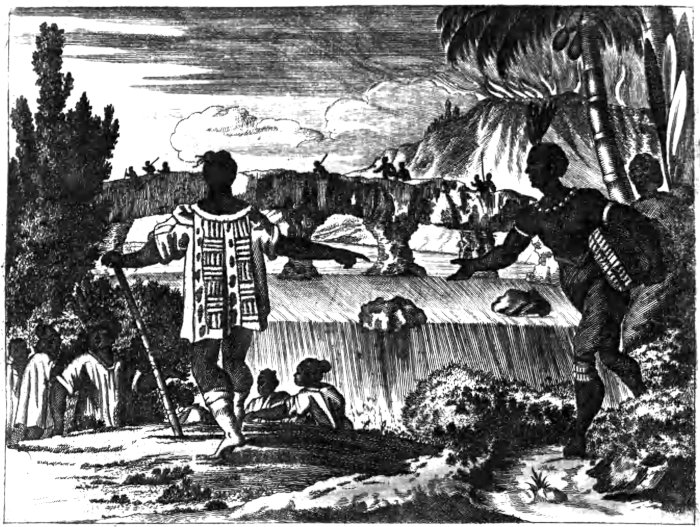
This Tract of Land produces Maiz, and abundance of Mortuanos, a Fruit resembling Damask Prunes, which eaten in excess cause Drunkenness and Faintness.
The Lake Yaguarcocha, signifying Bloody-Water, because the Inga Guayanacava kill’d and drown’d twenty thousand there.
Towns and Places of chief note.
The chief Towns and Places of Note are, 1. Caranguez, antiently a Royal City, where stood a sumptuous and stately Palace of the Kings of Peru, now almost deserted. The Palace, built of Stone in a little Plain, without either Mortar or Iron-work, manifests its former glory by its Ruines.
2. The Royal Castle of Atabalo, or Ottavallis, in the building of which the Ingas spar’d no Cost nor Charges; and indeed it is a Structure no way inferior to any of the antient Roman Edifices. Between this Castle and Cochequi, a stately House, lies a cold snowy Mountain. Moreover, the Spaniards have several Habitations along the Way to Quito, and especially in the Valley Annaquito, where the Vice-Roy Vela lost the Battel fought against Gonsalvo Pizarro.
3. Quito, commonly call’d St. Francisco de Quito. There stood formerly here certain Palaces, built by the Ingas, but the City was re-built by the Spaniards at the Foot of a certain Ridge of Mountains, which it hath on the North and North-West side of it, and are said by Laet, to cross the whole Countrey of Peru quite over from the South to the North Sea: It was soon after the Building inhabited by five hundred Families of Spaniards at least, besides Natives, and well fortifi’d, and might be thought a Town very well seated in all respects, but for the neighborhood of a Vulcan, which at times annoyeth it very much, as namely in the Year 1560. when it vomited out such abundance of flaming Cinders and other sulphureous Matter, that had it not been for a Shower of Rain unexpectedly falling, would have much damnifi’d, if not destroy’d the Place. The Natives about Quito are more Moraliz’d than other Peruvians. The Valleys which are warm’d by the Sun produce all manner of Fruit-Trees and large Vineyards; and the Root Papas, not unlike Apples. 443The Quimla, which is of a Mans heighth, hath little Seeds, of which a pleasant Liquor is boyl’d. From Quito the High-way leads to Cusco, along which at every four Leagues distance stands a brave Palace; and from Cusco to Chili, being in all above a thousand Leagues long. The City, built on a sandy Soyl, is divided in the middle by a Moat, over which lead several Bridges: the Streets are large and streight, and full of handsom Houses, and at the ends of the four chief Streets four Market-places. Besides the Cathedral, are two other Churches, Dedicated to the Saints Sebastian and Blasius. The Cloysters of the Franciscans and Dominicans are also no small Ornament to the City. Besides other stately Structures, are the Residences of the Receivers of the Kings Revenues, to which the Peruvians that live about the City, being computed no less than fifty thousand in number, pay Tribute; and to keep them in subjection, the City Quito is always well stor’d with all manner of Ammunition and Instruments of War. The chiefest Trade here consists in Sheep, Goats, and other Cattel, Cotton-Clothes, Cloth, Flax, Hats, Cordage, Sugar and Salt; which Salt, being grey and bitter, springs out of a Fountain in the Countrey Mira. The Oyl, Wine, and Drugs which are us’d here, are fetch’d from the South Sea up the River Ambato, and from thence with Carts into the City.
4. Thomebamba, famous for a Royal Palace, built there by some of the Ingas; It lies Southward from Quito in the Province of Canares, where two Rivers commix their Waters, near a Plain abounding with Venison. There yet remain considerable Ruines of this Palace, in which one may discern the vast Dimensions of divers Rooms, in some of which Arms were kept, and in others Provisions and Clothes; of which kind of Buildings or Magazines the Ingas had erected above a thousand in Peru, especially along the High-way, that they might have their Ammunition ready in all places if need should require. On the left side of Thomebamba appear’d the famous Temple of the Sun, whose Gates were not onely curiously Painted, but also Inlay’d with Emeraulds. Both the Palace and Temple, adorn’d with Gold and costly Images of great Touch-stone and Jasper, contain’d within their Walls an unvaluable Treasure. These magnificent Structures are at this day fall’n quite to decay. The People of this Countrey, who wear long Hair, pleited on the top of their Heads like a Coronet, go Cloth’d in Cotton Coats and Buskins of Hair-cloth. The Women, indifferent fair, and great admirers of the Spaniards, Plough, Sowe, and gather in the Harvest, whilest the Men stay at home, Spinning, Weaving, and doing of other Female-Offices. Anno 1544. they discover’d Mines here, which produc’d as much Gold as Earth.
5. Tacunga, where was formerly another stately Palace, about fifteen Leagues from Cusco, not far from the Mountain which some years since vomited Ashes and Stones into the adjacent Fields. Hereabouts was formerly a Cloyster, inhabited by the Nuns call’d Namaconas, the Ruines whereof are yet to be seen, with several Houses of Stone, but cover’d with Thatch. The Natives in this Place are of a brown Complexion, and of a very affable Nature.
6. Mulambato; 7. Mocha; 8. Rhiobamba, three small Villages, but each of them credited with a stately Palace. Opposite to Rhiobamba lies the Province Chumbo, from which a troublesom Way leads to Guaynacapa over the River Chongo.
9. St. Jago de Puerto Viejo, giving Denomination to the Territory about it, which produces abundance of Potatoe Roots, Maiz, Juca, three sorts of Guayavas, Cerezillas, and the Tree Tunas, which bears wild Figs. The Spanish Fruits grow here likewise in great plenty. The fore-mention’d Beasts like Hogs, whose Navels grow on their Backs, are also very common here. The Woods abound with Deer and all sorts of Fowls, amongst which one resembling a Goose, and call’d Xuta; and another 444nam’d Maca, somewhat lesser than a Cock, and which feeding about the House, may be reckon’d amongst the Poultrey of this Countrey. The Sea along the Coast affords them abundance of Bonito’s, which eaten in some Seasons cause Agues. The People along the Sea-Coast are generally troubled with Pimples and Sores in their Faces, especially on their Foreheads and Noses, few of them living long, by reason of the unhealthfulness of the Place through excessive Moisture, for the Rain continues eight Moneths together.
10. Manta, lying upon the Southern Ocean, the chief of the Villages, formerly possess’d by the Caranes, betwixt the Promontory Passao and the River Dable. These People are said to this day to carve and cut their Faces from their Ears to their Chins; about their Necks and Arms they wear Chains of Gold and little red Corals, call’d Chaquina, highly esteem’d by the Peruvians. This Town was formerly famous for a great Emerauld, which was religiously worshipp’d there.
11. Guayaquil, otherwise call’d Culata, built at a deep Inlet of the Sea, near the River Anebato, which with great swiftness falls down from the Mountains Quito, is surrounded with a fertile Soyl; and in the hollow Trees is found plenty of Honey. The Water of the fore-mention’d River, being of great vertue in curing the Morbus Gallicus, hath great resort of People from all places; who likewise gather the Sarsaparilla that grows along the Banks. The Bridge which the Inga Guaynacava began to lay cross this River, is also very remarkable, but he dying, it was left unfinish’d. The Guancabilcas were heretofore under the Jurisdiction of this City Guayaquil.
12. Castro, so call’d from a strong Fort built there by a Spanish Captain, and situate in the Valley Vili, not far from Guayaquil.
13. The City Loxa, built in the Countrey of the Paltas, a People that went naked, between two Arms of the River Catamayo under a wholsom Climate, near the High-way that leads to Cusco in the Valley Curibamba, where no poysonous Beast was ever found. The Soil bears abundance of Oaks, Hazles, Ash, Willow, and Cedar-Trees; Maiz, Barley, and Wheat. Not far from the City springs a hot and sulphurous Fountain, which cures all sorts of Sores and Wounds. The Countrey hereabouts is likewise stor’d with Fowls, Venison, Cattel, and Fish. Moreover, the City receives no small lustre from two Dominican, and one Franciscan Cloyster. Eastward from which lie desolate Mountains, whose tops are continually cover’d with Snow. Not far from hence were formerly two noble Palaces, Piedras and Tamboblanco, besides several Villages.
14. Cuenca, wherein are also large Structures for the Monks and Priests: The Countrey about the same hath rich Mines of Gold, Silver, Quicksilver, Copper, Iron, and Sulphur.
15. Zamora, Eastward from the cold Mountains Andes, built in a Marshy Soyl, where the Inhabitants are never visited with Pestilential Distempers, and use no other Physick for such Sicknesses as they are troubled with, than Tobacco, and the Herb Aquacolla. But there is a certain Nut that grows hereabouts, which occasions sudden death, if eaten raw, but being boyl’d, is a wholsom Food. The Mines afford great pieces of Gold, of which one weighing eighteen Pound, was presented to Philip the Second, King of Spain. The briny Springs produce good Salt. Three Rivers falling from the Mountains, are noted for their Golden Sands, and also afford delicious Fish. The Bees being here void of Stings, furnish the Inhabitants with plenty of Honey. The Tygers and little Lyons devour many of the Sheep Pacos, Goats, Hogs, and other Cattel, and sometimes the Natives themselves. The City it self is neatly built with Woodden and Stone Houses, and adorn’d with a Church and Dominican Cloyster, besides a stately Palace, the Residence for the King’s 445Receiver. The Natives about this Place are a stupid and barbarous People, which before the Spaniards coming thither, would for a small trifle kill one another.