The Third Book, CONTAINING A DESCRIPTION OF PERUANA OR, Southern America. (continued 5)
Reading edition
Opposite to the Abrolhos on the Main Coast, a plain Countrey extends it self thirty Leagues in length, inhabited by the Ouetacates, a cruel People, who continually either destroy one another, or else make sad slaughters amongst their Neighbors.
The County Porto Seguro belongs to the Spanish Duke of Avero, but is very much decay’d.
The Beast Capybara.
The Rivers Moucuripe, Caruvelas, and Lucuru, breed abundance of Water-Hogs call’d Capybara, which have short Feet, Bristles and Ears, a thick Body and Head, with a bearded Snout, besides two Tusks, and twenty four lesser Teeth in each Jaw, but no Tail; they feed on Grass and Bushes in whole Herds on the Shore, and make a terrible noise; and though they cannot run fast, yet they dive and swim extraordinary quick.
The Tapiirete.
The Tapiirete also resembles a Hog, especially in its Head and Feet, but is as big as a Heifer of six Moneths old, hath a Snout hanging over its under Lip, a Mouth full of Teeth, and on its Skin short and dark colour’d Hair. This Beast is very libidinous, and in the Nights spoils the Fruit-Trees, especially the Sugar-Canes, but in the Day-time it sleeps in Thickets. The Flesh of a young Tapiirete tastes like Beef.
Lastly, the Inhabitants of Porto Seguro are plentifully supply’d with Rabbets, and the more, because there being divers sorts of them, (some say five) they are taken in great abundance, either in Traps, Snairs, or Gins, or by discovering their Holes; for the Hunters stopping the entrance of them, dig a Hole directly over the place where the Coneys lodge, and so kill them with long Pike-staves in the Ground.
Five sorts of Rabbets in Brasile.
Of these five sorts of Rabbets in Brasile, the chiefest, call’d Paca, hath a thick Head, little Ears, their fore-Feet bigger than their hind-Feet, short, hard, and brown Hair, speckled grey on the Sides, but no Tail: The Flesh of this sort of Rabbets is very delicate.
The second sort is the Tupesi, which being like a Hare amongst us, may as well be accounted of that kind.
The Aguti resembles our Rabbets, onely it hath harsh brown Hair, round Ears, bald Feet, gruntles like a Hog, hath two Toes more on their hind-Legs than on the foremost.
The Cavia Cobaya, though less than the European Rabbets, excell them in soft and divers-colour’d Hair, distinguish’d by white, red, and black Spots; their Head and Teeth resemble those of a Rat, but it hath no Tail: No Rabbets can be made tamer than these, and if carry’d to any remote Countrey, breed as well there as in Brasile.
The last of all is the Aparea, which differs little in running from a Hare, as also in respect of the Head and Beard, harbors more in rent Cliffs than in sandy Ground.
The Tree Tucum.
The Soil of Porto Seguro bears two sorts of Palm-Trees, viz. the Tucum and Airi; the Tucum hath small Boughs full of prickly Leaves, and a fruit not unlike the Damask Prune, hanging in Clusters of three or four hundred together; and being excellent Food to fatten Hogs and Apes; also when press’d yielding a clear Oyl, which is highly esteem’d: the Fruit when ripe grows black without, and within hath a white Kernel: of the Leaves the Brasilians spin fine and strong Thred.
501
The Airi grows much higher than the Tucum, and hath also longer Leaves, a Body full of sharp Thorns, and a round Fruit full of white and oylie Pulp, but not eatable; the Wood hard, heavy and black, sinks in the Water, and the Brasilians make their Clubs of the same.
The Bird Cocoi.
Along the Rivers flie the Birds Cocoi, resembling Herons, though in beauty they far exceed them; they have but little Flesh, long sharp Bills, of a yellowish green colour, and curious Crests of Feathers on their Heads, which fall back over their Necks; their Flesh when young is delicate.
Sect. VI. Los Isleos.
Situation and Description of Los Isleos.
Next Porto Seguro borders the Countrey Los Isleos, so call’d from its chief Town, which consists of a hundred and fifty Houses, (or perhaps by this time many more) eight Sugar-Mills, a Cloyster for the Jesuits, and a Church. The Inhabitants live by Tillage, and Transporting of Provisions in little Barks to Pernambuco.
Seven Leagues farther in the Countrey, beyond the Town of Isleos, lies a nameless Lake three Leagues long, as many broad, and above ten Fathom deep, and full of the Fish Manati, which are very large and well tasted, besides abundance of Crocodiles; and in windy Weather the Water is as rough as if it were in the Ocean. Out of this Lake flows a River by a Passage so narrow, that a Boat can scarce pass through the same.
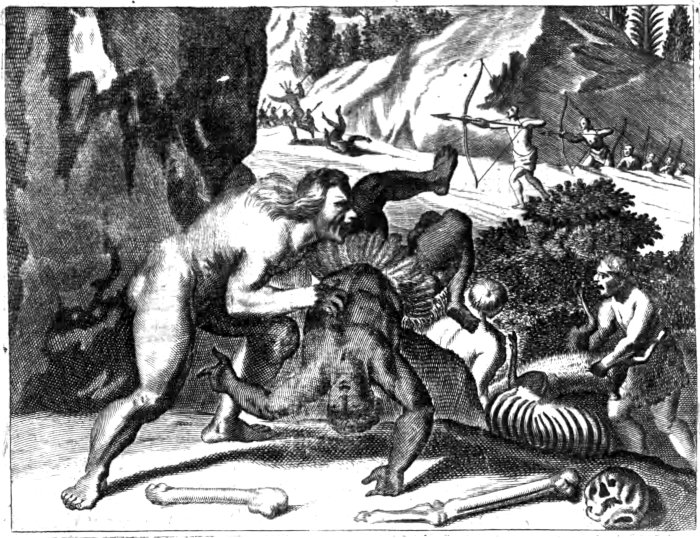
Round about this River live the Guaymures, the most salvage People of all America; they are of a Gigantick size, have white Skins, carry exceeding great Bowes and Arrows, live without Houses like Beasts, devour Mans-flesh like Tygers, never Fight in Companies or Armies, but watch to surprize a single Man or Beast; they also eat their own Children, and possess’d formerly all the Land from the River 502St. Francisco to the Promontory Frio; but beaten from thence by the Tupinambas and Tupinachias, they went to the County Los Isleos, which they Invaded in such a manner, that the Portuguese were not onely forc’d to leave several Sugar-Mills, but also the whole Countrey.
Sect. VII. Bahia de Todos los Sanctos.
Situation and Description of Todos los Sanctos.
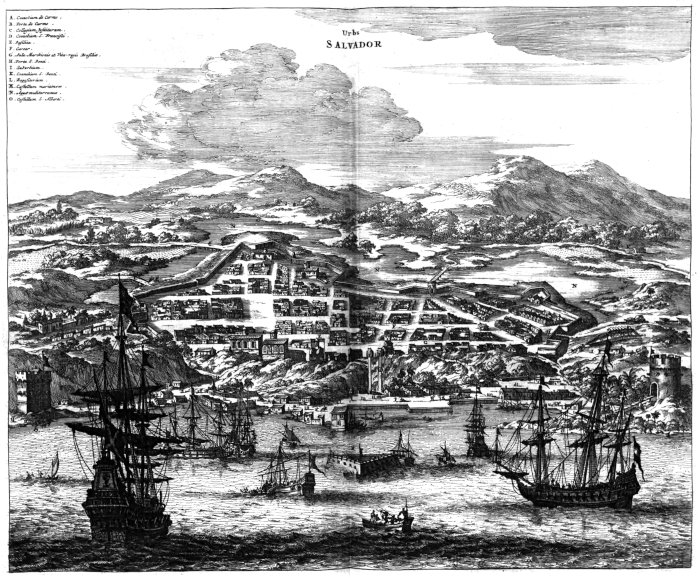
Next to Isleos borders Bahia de Todos los Sanctos, belonging to the Portuguese. The Inlet which borrows its Denomination from all the Saints, gives Name to this eminent County. The Bay great and wide, and in the middle from twelve to eighteen Fathom deep, lies in thirteen Degrees Southward of the Equinoctial Line. The Coast rises white along the Sea side. The Current according to the course of the Sun runs six Moneths towards the South, and as many towards the North. The opening of the Inlet is on the South, but it flows up Northerly, and contains two Leagues and a half in breadth; several fresh Rivers discharge their Waters into the same: The utmost and biggest Island Taperica breaks off the Waves which come rowling in from the Ocean. Those that Sail into the same must have the Island on their left Hand, and the Main Coast on their right, which is known by a Promontory, on which the Fort Antonio, and the old City Villa Veja are built, near a little Bay with a Foreland on the North, from which the Main Coast circling like a Half-Moon ends near the Point Tapagipe, which juts out from Bahia Todos los Sanctos. The Castle Tapesiepe stands on the utmost Point, where the Countrey winding towards the East makes the Inlet larger, from whence a narrow Channel runs up into the Countrey, and there makes a Lake which extends North and South: from the Mouth of the Lake the Coast reaches Northward to the River Pitanga, which comes gliding out of the East, and in its Passage receives several Streams, on whose Banks stand divers Sugar-Mills. From Pitanga the Coast extends a League Northward, then Westerly with a crooked Elbow, in whose circumference lie two nameless Isles close under the Shore; this Elbow ends in a blunt Point, about half a League from which lies the Island Mare, a League long, in the Mouth of the River Pitanga. To the Northward from hence a River disembogues in the said Inlet. More Southerly appears Monks-Isle, from whence the Coast extends it self Northerly, where several Islands appear at an exact distance from the Coast; the first beyond the fore-mention’d blunt Point, is Birapebiara; the next, which lies closer to the Shore, Porto Madero; next comes in view a long Island in the Mouth of a River, from whence the Countrey extends Westward, and fronts the Island De Fuentes, as doth also the River Tambaria, which comes out of the North, but empties it self with a crooked Arm near the rest; from hence the Coast with two little Bays runs North-West to the Stream Geresipe, in whose Mouth, which is pretty large, appear three Isles on a row, the utmost whereof is call’d Caraibe, the middlemost Pycca, the innermost hath no Name, but divides the River into two Channels; from hence the Coast bends with several Inlets, into which fall divers Rivulets towards the South, from the River Cachoera, full of little Isles, opposite to which stand several Sugar-Mills. Against Cachoera appears the Island Meve, and more Southerly Taperica, between the sharp Point Tapagipe and the Castle Antonio. Near the fore-mention’d the City St. Salvador was built by Thomas de Sosa, who weighing Anchor from Lisbon, Anno 1549. Landed safely near Villa Veja, and about half a League from thence pitch’d upon a Hill, and took order forthwith for the erecting of his new City there, giving to each of his Followers a place to build on: the Jesuits chose the large Plain where at present stands the Church Consecrated to the Virgin Mary; the Names of the said Jesuits were Juan Azpilcueta, Antonio Pireo, Leonardo Nonnio, Didaco Jacobeo, Vincentio Roderigo, and Emanuel Nobrega; whilest the common People set themselves to the building of Dwelling-houses: But when John the Third, King of Portugal, sent a Priest thither to Teach in the new Church of Maria, the fore-mention’d Jesuits remov’d from thence to a high Hill, which they call’d The Mountain Calvarien, whither divers Brasilians came flocking, and pitch’d their Tents about the Cloyster, admiring their strange Neighbors.
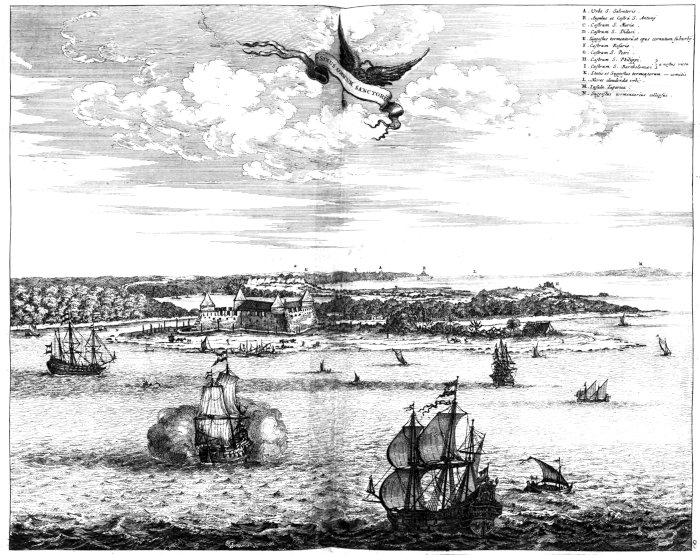
503When Sosa Landed on the fore-mention’d Shore, the Portuguese had but little footing on America; for their Plantations at Isleos, St. Vincent, Pernambuco, Villa Veja, Itamaraca, and Porto Seguro, discover’d by Pedro Alvares Capralis, Anno 1500. were run all to ruine.
Beside the City St. Salvador and the decay’d Town Villa Veja, the City Paripe lies three Leagues farther into the Countrey, consisting of three thousand Families, and eighteen Sugar-Mills: The Countrey about the same produces plenty of Cotton.
The Island Taperica, which is pretty large, hath a fertile Soil for the production of Tobacco, and Grass to fatten Cattel: The Inhabitants boyl much Train-Oyl of the Whales, which come ashore there in considerable numbers.
Twelve Leagues Southward from St. Salvador appears the Village Cacocheira, formerly belonging to a rich Portuguese, who took great pains in reforming the salvage People Guaymures to a civil Life; but seeing he profited but little, he caus’d great Companies of them to be remov’d to Taperica, that they might do less mischief, where the unusual and unwholsom Air kill’d them all in a short time.
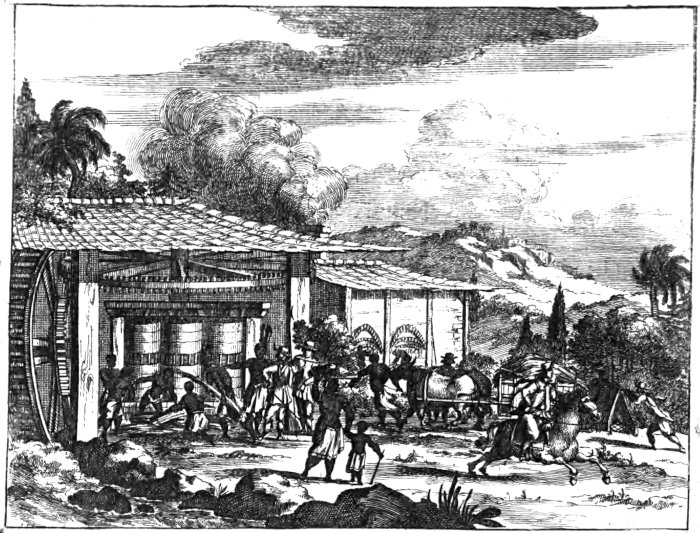
The Lordship Bahia hath abundance of Sugar-Mills, which are either turn’d by the Water, or drawn by Oxen.
504
The manner of Planting Sugar-Canes.
The Worm Guirapeacopa.
The manner of making Sugar in the Sugar-Mills.
The Sugar-Canes, by the Brasilians call’d Viba or Tacomaree, grow better in a clayie and fat Soil, over which the Rivers flowing leave their Mud, than on High-lands, Hills, or Mountains; they are Planted after this manner: They first plough their Fields, weed them, and make Holes at an exact distance one from the other, into which they plant their Canes in such a manner, that the tops touch one another. The Holes before mention’d require more Earth to fill them in Summer than in Winter, that the violent Heat of the Sun may not dry up the Root, and that the Rain may the freelier come at them to moisten them, for the more moisture they have, the better they grow; they attain to their full ripeness in ten, or at most in twelve Moneths; February and March being the two last Winter Moneths, are accounted the best to Plant in, because the Earth softned by Rains, suffers the Root to shoot forth the better. The ripe Canes being cut off, are left in the Field till the following Year; during which time new Canes growing, are often ground in the Mill with the old ones; but if they stand two years, then the sweet Liquor dries up, and the Cane withers. The young Plants carefully planted in good Ground may last forty, nay fifty years; but in a barren Soil they set new every five years. Sometimes in great Droughts and extraordinary hot Seasons, the Canes are scorcht to nothing, which being burnt in the Winter, the Ashes serve to Dung the Ground; and so in like manner when the Water, overflowing the Fields, drowns the young Plants. In moist Grounds the black-wing’d Worm, call’d Guirapeacopa, (by the Portuguese nam’d Pao de Galeuba) gnaws the Roots in such a manner, that the Canes die; and sometimes it happens also that the Weeds choak the young Plants; wherefore the Ground is to be weeded four times a year, till such time as the Canes are strong enough to bear against the Weeds: they cut off the ripe Canes at the lowermost Joynt, and, all the Leaves being first pull’d off, tie them up in Bundles, and bring them to the Mills, which consist of three great Iron Bars, between which the Canes are squeez’d. The Water-Mills are turn’d by the force of the Water, which in great Gutters led from high Mountains falls with exceeding force into Pools made for that purpose; after which manner, though they wind the Canes much faster, yet they get not so much Sugar as when they grind them in the Mills turn’d by Cattel: The places through which the Juice runs must be cleans’d twice in twenty four hours; the Canes put in behind between the first Bar, are turn’d into the second, and thence into the third, which successively squeezes out all the remaining Juice: The Canes thus press’d, serve for Fewel to burn; but they constantly keep such a great Fire both Night and Day, that besides those press’d Canes, they burn forty Fathom of Wood in twenty four hours, insomuch that whole Woods are consum’d in a short time: The Liquor, nam’d Caldo, runs along woodden Gutters into great Kettles, in which it is boyl’d, but if it happen to be over-boyl’d they put Water amongst it, whereby it becomes excellent Food for Horses; then they put the Liquor into a second Kettle, where it is boyl’d afresh, and also scumm’d; and for the better cleansing of it, Lime-Juyce and other things are put amongst it; then they strein it through Clothes, and give the Dross which remains in the same to the Slaves, which work for half a year together Night and Day like Horses. The Dross mix’d with Water makes also good Wine. Out of the great Kettles, by the Portuguese call’d Caldero de Mellar, the Caldo runs into the lesser nam’d Tachas, where it is boyl’d a third time, and continually stirr’d till it comes to be thick like a Syrrup, and at last to the consistence of Sugar: It may be accounted amongst the Mysteries of Nature, that while the Sugar boyls in the Tachas, which are the little Kettles, they must drop Oyl amongst the Liquor, which if they should do whilest it is in the great Kettel, the Liquor would not turn to the consistence of Sugar; as on the contrary, if they should put their Lye into the little Kettles as they do into the great, the Liquor would be quite spoil’d. In their Boyling-houses stand several hundreds of Earthen Pots one by another on Planks full of Holes; which Pots they cover with moist clay, and after fourteen days knocking it out of the Pots, they separate the brown Sugar from the white, both which are laid to dry in the Sun, and put into Chests.
505
Sect. VIII. Pernambuco.
Description of Pernambuco.
Northward from Bahia de Todos los Sanctos lies Pernambuco, which extends along the Coast above seventy Leagues, between the River St. Francisco and the Countrey of Hamaraca.
Pernambuco, which signifies Hells-Mouth, is on the East wash’d by the Northern Ocean; in which grows a Weed much like an Oaken Leaf, and so thick, that unless it be cut to make their Way, impedes the Sailing of Ships.
Several sorts of Fish.
The Sea is also very full of Fish, which in calm Weather are visible sixty Fathom deep, and are taken in greater abundance than they are able to spend; for they no sooner let down a Bait, cover’d with Feathers and Tallow, but the Fish immediately swallowing the same, are taken.
Here are in the first place abundance of Hays, a Fish so rank and oylie, that they are not eatable, but their Brains are accounted good against the Stone.
There are also hereabouts a sort of flying Fish like Herrings, but not so big; they have Wings like Bats, which carry them above Water whilest they are wet; they swim in shoals, and are chased by all other Fishes, which endeavoring to escape by flight out of the Water, they become a prey to the Sea-pies.
The Sea-Breams are as well tasted as the flying Fish; the Mariners cover them in Salt, or stuff them within full of Salt and Pepper, and so hang them to dry in the Sun.
Pernambuco it self lying in five Degrees Southward from the Equinox, produces abundance of Brasile Wood and Sugar-Canes, which last is no proper Brasilian Plant, for the first Plants thereof were by the Portuguese first transplanted thither from the Canary Islands.
First Discovery.
This Countrey was first discover’d by Americus Vesputius, who being sent thither by Emanuel, King of Portugal, to discover the Coast between the Promontory before Olinda and the Island Itamaraca, and finding a split Rock and some Brasilian Huts, Landed, and ask’d the Denomination of the Coast, which he was inform’d was call’d Pernambuco, which he found full of steep Mountains, inaccessible Woods, and in some places Plains and pleasant Valleys; but the chiefest thing he could find to lade his Ship with, was Brasile Wood; but being inform’d that the Soil would bear Sugar-Canes, he caus’d Canary Sugar-Plants to be Set there.
Chief Towns and Places of note.
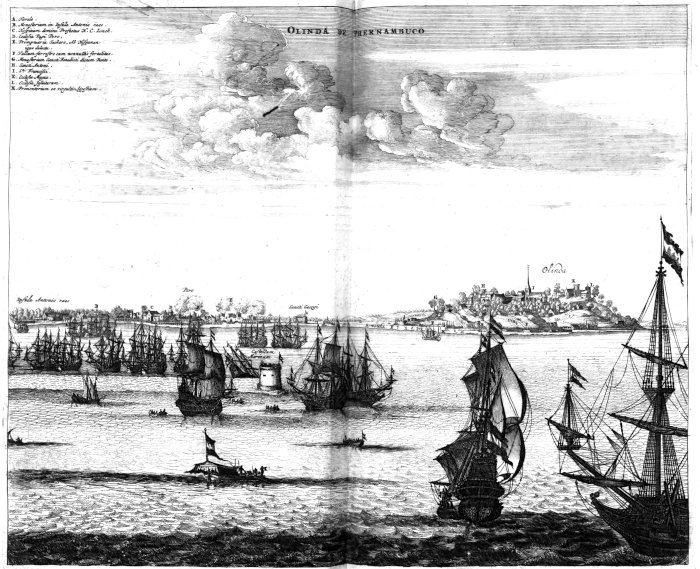
Olinda, formerly the chief City of Pernambuco, had (according to Lopez) above three thousand Houses and seventy Sugar-Mills: It is built on several Hills, which on the North-side are steep and overgrown with Brambles; betwixt which in many places grow Orange-Trees. John Newhof, who arriv’d at Olinda Anno 1642. found a few Netherlanders and Spaniards there, who dwelt in the ruin’d Houses. The Land-side of the City is strengthned by Hills overgrown with Brambles and Thorns, and towards the Sea-side with Earthen Walls, fortifi’d by fourteen Bulwarks and a Stone Castle, able to withstand a considerable force: The Out-works towards the South were maintain’d by Jews, who from the fore-mention’d Hills 506could see not onely a great way into the Ocean, but also the River Biberibi, which hath a Stone Bridge leading to the City, and Northerly and Westward the Way lies through great Woods and Forrests. Olinda it self is divided into twenty seven large Streets, besides lesser Lanes and several Avenues, and five chief Churches, viz. Misericordia, Nostra Sennora del Emparo, and Nostra Sennora de Guadalupe, San Salvador, and San Pedro, besides two others of lesser note. On the highest Hill stands the Jesuits Cloyster, built square and high, and surrounded with Walls, on which Sebastian King of Portugal, by the perswasion of his Uncle Cardinal Henry, spent a great sum of Money, and endow’d it with annual Revenues, Anno 1571. The Capuchins also built a stately Cloyster towards the East. The Franciscans moreover inhabited a magnificent Building, near which stood the Governors Palace. The Carmelites had also a stately Edifice, whose former lustre still appears by the Ruines, where now Cattel graze; from the Hills about which may be exactly discern’d Reciffa, the Promontory of St. Augustine, and the Castle before the Road of Reciffa: Along the Shore stood the Dominican Cloyster, and in the upper part of the City the Minster, Consecrated to St. Bento, exceeding strong both by Nature and Art; near which stood Conceptio de nostra Sennora. The Fort Juan de Albuquerque stood on the South-side, from whence a Way leads you along the Shore to Reciffa, where hard by the Potter’s House stood a Beacon. But since Olinda fell into the hands of the Netherland East-India Company, they built a strong Fortress on the North near the Sea-side, where formerly a great Trade was driven with Sugar, insomuch that forty Ships have been fraighted in a day therewith from Olinda, and still as much more remain’d in the Store-houses. The Sugar cannot be made without the help of African Slaves, and that in great numbers; for Angola alone provided fifteen thousand four hundred and thirty Moors for the Sugar-Mills about Olinda.
The Expedition of Loncque.
Olinda taken by the Hollanders.
The Fort St. George taken.
In the Years 1601, 1602, and 1623. there was sent to surprize this City Henrick Loncque, who a little before with Peter Peterszoon Hein took the Spanish Plate-Fleet, and brought it away from Matanca. In the middle of June, Anno 1629. Loncque weighed Anchor from the Goerean Road, and between great Canary and Teneriff he was Engag’d (having but eight Sail) with forty Spanish Ships, Commanded by Frederick de Toledo, fought his way through the midst of them, and near St. Vincent (the rest of his Fleet being come up to him, which in all made up twenty seven) he stay’d for a farther promis’d Supply of Ships to assist him, and the longer, because the Men rais’d by the Netherland West-India Company were taken into the States Service, to oppose the Spanish and Imperial Forces, who at that time had gain’d some advantage upon them: But not long after Hartogen-bosch being taken by the Hollanders, the rest of the expected Fleet, with the promis’d Aid, arriv’d at St. Vincent; from whence Loncque, after four Moneths stay, set Sail with these additional Forces, his Fleet then consisting of fifty Sail of Ships, which carry’d above seven thousand Soldiers, besides Seamen; but he was forc’d to lie a considerable time under the Line, being either becalm’d or beaten back by contrary Winds, insomuch that many of his Men perish’d, or were disabled with the Scurvey: At last his Fleet being come to an Anchor upon the Coast of Pernambuco, the first that Landed about two Leagues Northward of Olinda, was Colonel Diederik van Waerdenberg, who by Day-break divided his Men into three Divisions, the Forlorn-Hope consisting of nine hundred and thirty four Men, march’d towards Olinda along the Shore, led by Adolf van der Eltz; the second being a thousand and forty nine, by Stein Callenfels; the third, consisting of nine hundred and sixty five, was led by Fouke Honx: thus drawn out, and marching on, they met with no resistance till they came to the River Dolce, where eight hundred Portuguese Charg’d on them from behind a new Sconce; 507but Waerdenberg wading up to the Middle through the River with two Field-Pieces, the Enemy left his Works and ran into the Wood; the Forlorn-Hope approaching the City, march’d up towards the right side, up a Way through the Woods, Scal’d the Walls, near which the Jesuits Cloyster stood, over which he got after some resistance. The second Party march’d in a narrow Path along the Shore, and broke into the City between the Franciscans and Jesuits Cloyster, towards the Cathedral Salvador, from whence they discharg’d several Guns, as also from the Castle, which they had taken, whilest Fouke Honx Storm’d the Battlements towards the South; but Stein Callenfels and Eltz being already Masters of Olinda, the Defendants surrendred all. Mean while the Colonel’s Skiff brought five hundred Men more ashore, with which he march’d without any hinderance into the City, where the Conquerors, faint with excessive Heat and want of Water, found but little Booty, because the Inhabitants having notice of the Hollanders coming, had convey’d all their Goods and Wealth to Reciffa, which the Governor Matthias Albuquerque (Brother to the Lord Duarte Albuquerque, to whom Pernambuco properly belong’d) burnt with all the Store-houses, partly out of revenge to the Inhabitants, who fled contrary to his Commands, and partly because he would not enrich the Hollanders. The Portuguese Captain, Correa de Castel Blanco, in his Letter to the King of Spain, values the loss at twenty hundred thousand Ducats. But still the Portuguese had possession of several Forts about the Countrey, whereof the most considerable was St. George, whither Stein Callenfels march’d in the Night with six hundred Men, but his Ladders being too short, and the Hand-Granado’s not easily taking fire, he was forc’d to Retreat; whereupon judging it most convenient to besiege the Castle, he digg’d Trenches about the same; nor was it long ere the Besieged desir’d Quarter, which being granted, they march’d from thence with ninety Men. The Water Castle surrendring in like manner, they found fifteen Brass Guns therein; and in that of St. George four thousand pound of Gun-powder, and twenty four Iron Guns.
When the Netherland Forces Landed on Pernambuco, the Portuguese inhabited eleven Towns, the chiefest whereof being Olinda, was generally Garrison’d by four Companies of Armed Citizens, each containing a hundred Men and three Companies of Soldiers: Amongst the Citizens were two hundred Merchants, some of whom were judg’d to be worth fifty thousand Crusados.
Southward from Olinda, between the River Biberibe and the Ocean, was a narrow Cawsey, at the end of which lay the populous Village Reciffa, where the Ships lade and unlade. About the middle of the Cliff, being a League long, is the Anchoring place for great Ships, call’d Pozo. At the end of the fore-mention’d Cawsey against Pozo, appear’d a round Tower of Fre-stone.
The memorable Exploits of the English under Captain James Lancaster.
The Journal kept by the English Fleet that came hither under the Command of Captain James Lancaster, Anno 1595. makes mention of a Fort which lay at the Mouth of the Haven before Reciffa, which the English valiantly Storm’d, notwithstanding six hundred Men and seven Brass Guns might easily have made it invincible: But they conquering the same, march’d up to Olinda, took the Suburb, consisting of a hundred Houses, without any resistance, as also a great Booty, and the greater, because the Goods of a rich Carak which had some few days before suffer’d Shipwrack, were kept there; they also took fifteen laden Ships, and for thirty days kept the whole Countrey about Olinda restless with continual Alarms. Since this Invasion the Portuguese built a third Fort on Reciffa, so that the Ships must pass in between two Forts, where the Channel is also full of Rocks, and consequently the more dangerous.
From Reciffa the Goods are sent in Barques or Lighters to Olinda, between which 508and St. Salvador run the two great Rivers Francisco and Real, the first whereof retains its freshness twenty Leagues into the Ocean.
Along the River Popitinga stand many Sugar-Mills; and five Leagues farther Northward beyond Olinda the Portuguese inhabit these Villages, viz. Garasu, Reciffa, Moribeca, Antonio de Cabo, Miguel de Poyuca, Gonsalvo de Una, Povacon de Porto Calvo, Alagoa del Nort, and Alagoa del Zur, besides other Brasilian Hamlets, and above seventy Sugar-Mills.
The nature of the Soil in Pernambuco.
The County of Pernambuco hath for the most part a good Soil, several Plains, low Hills, and fruitful Valleys, abounding with fair Canes, which also grow on the Mountains Masurepe, Zebaatan, Poyuca, and Moribeque.
The Wilds of El Gran Matto, afford the best Wood, with which they drive the greatest Trade in the Village Laurenzo. Whilest Matthias Albuquerque Intrench’d himself a League and a half Westward from Olinda, by the Sugar-Mills belonging to Francisco Montero, with a hundred Portuguese, and three times as many Armed Brasilians, Loncque finding that he could not long keep the City Olinda against the Enemy, caus’d the same to be pull’d down and burnt.
Sergippo del Rey.
Between the Rivers Francisco and Real, lies the Town Sergippo del Rey, up in the Countrey near a small Rivulet, which at Spring-Tydes hath fourteen Foot Water. The Woods round about feed wild Cattel, and the Mountains contain Mines of Gold and Silver.
The first Plantation in Brasile was in the Island Itamaraca, three Leagues long and two broad, but extends its Jurisdiction along the Main Coast, from which it is separated by a narrow River, which runs betwixt both thirty five Leagues. The Countrey is eminent for twenty Sugar-Mills, and abundance of Brasile Wood.
Villa de Conception.
The chief Town of this Island is call’d Villa de Conception near the Sea, which round about the Island is full of Rocks. The French settling themselves here at first, were driven from thence by the Portuguese. The Town it self, built on a Rock, hath a strong Castle on the one side, erected near a shrubby Moor; to the Northward of which Stein Callenfels found a little Isle, scarce a Musquet-shot long, which at High-water is overflown, and being full of small Trees makes a Receptacle for Sea-Fowl, which flock thither about six a Clock in the Evening to Roost on the Boughs, from which, when once setled to take their repose, they will not stir till six of the Clock the next Morning, though you discharge Guns at them all Night; but since Stein Callenfels cut down the Wood to make Pallisado’s for the new Fort against the Town Conception, they were never seen afterwards.
Sect. IX. Parayba.
Description of Parayba.
Northward from Itamaraca borders the County of Parayba, whence the French Ships carry’d yearly several Ladings of Brasile Wood, till Anno 1585. the Portuguese General Martin Leytam drove them from all places, since when they never recover’d any part thereof.
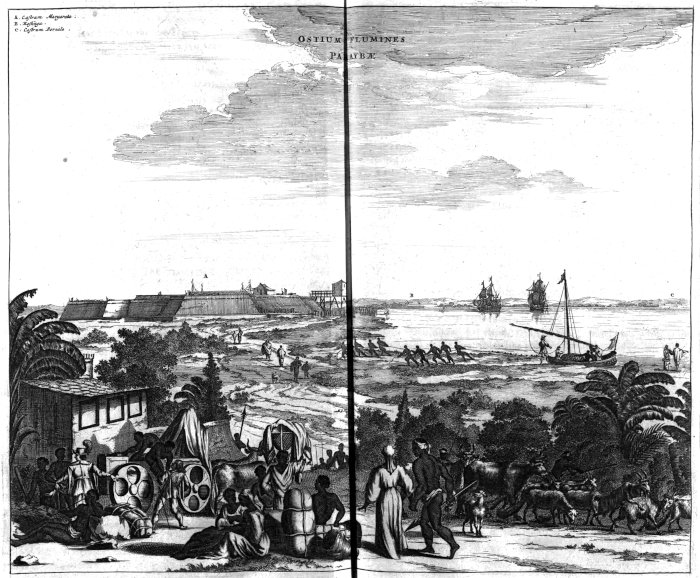
509This Territory of Parayba borrows its Denomination from the chief Town, lying five Leagues from the North Sea near the River Parayba, which in the Summer Season hath but little Water, but in the Winter Season increases to that heighth, that it oftentimes on a sudden overflowing the Countrey sweeps away both People, Cattel, and Houses. The City it self, though small, yet hath several fair Buildings, amongst which three Churches and as many Cloysters, inhabited by Franciscans, Carmelites, and Benedictins, are none of the meanest. The Countrey thereabouts indifferently fruitful, hath twenty Sugar-Mills. The Mountain Cupaguao, formerly very populous with Natives, being exceeding fertile, produces all manner of Fruit; at present it lies desolate, the Brasilians being all destroy’d by the Portuguese. These Mountains produce also curious green Stones, which the Inhabitants wore in their Lips for an Ornament, and which also cures the Griping of the Guts, by being laid upon the Belly.
The Silver-Mine Copaoba.
The French under the Command of Captain Dourmigas, discover’d ninety years ago the Silver-Mine Copaoba, and for considerable time carry’d Silver and Brasile Wood from hence, till the Portuguese made themselves absolute Masters.
Moreover, on the North-side of Parayba, the Salvages call’d Petiguars inhabit sixteen Villages.
Strange Birds.
Amongst the Birds of prey which breed here, are the Ouyaourassou, twice as big as a Crane, with curious Feathers, and so bold and strong, that it devours not onely Sheep, but Deer and Men.
The Bird Mayton is no way inferior in beauty to the Peacock, his whole Body being cover’d with white and black Feathers; on his Head grows a Tuft; the Flesh is also very pleasant to the taste.
The Toucan, another Bird, resembles a Turtle-Dove in all parts, except the Bill and Breast; for the Belly is ten Inches long and three broad, the Breast of an Orange colour, mix’d with Crimson Spots; the remaining part is white, the Back red, and the Tail and Wings Coal-black.
The Plant Yarammacarou.
The Plant call’d Yarammacarou deserves also a peculiar observation, viz. It is thicker than a Man’s Thigh, grows twelve Foot high, with three Branches of equal length and thickness, which you may easily break; it is green without, white within, and without Leaves, leaving red Blossoms streak’d with blue, from whence grows a Fruit about the bigness of an Apple, crimson without and white within, and tasting like a Mulberry.
The Guara-tereba, with other strange Fish.
The River Parayba produces amongst many other Fishes the Guara-tereba, which hath a thick Body, flat Head, crooked Back, split Tail, and triangular Scales, which laid in the Sun, shine like polish’d Gold.
The Sea also hereabouts affords a strange Fish with a very long and thin Tail, the Females whereof Lay every day Eggs like Hens: they are full of poysonous Prickles, and divided into several sorts, amongst which the chiefest are accounted the Naainari and Jabebara.
Description of the Sea Coast of Brasile.
The Sea-Coast of Brasile from St. Vincent to Spirito Santo appears as followeth: Strange Tree. Before the Coast of St. Vincent lie the four little Isles Queimadas, and on one side the Alcatraces and Busios; East North-East from which bears the Island Sebastian: Before the Inlet Ubatuba lies the Isle Dos Porcos, close under a high Shore, where the Haven runs far up in the Countrey. Fourteen Leagues farther the Island Grande, stor’d with fresh Water, with Fish-ponds, Woods, and two good Havens. Before the Road of Garatuba appear several broken Isles, the chiefest whereof is Morambaya. The Ships Sailing along the Brasilian Coast view next the Mouth of the wide River Jenero, without fear of Rocks or Shoals. Moreover, a sandy Ground extends from the Western Point to Cape Frio, which rises out of the Sea like a Rock, with white Streaks, and crack’d on the top, between both which the high Island before Frio makes a safe Harbor. Nine Leagues beyond Frio to the Northward, St. Salvador opens a large Bay, hemm’d in on the South by divers nameless Isles. Lastly, the several Salt-pans along this Coast are very remarkable, as also the Promontory 510St.Thoma and Parayba, the Inlets Manangea and Itapemeri, and the River Guarapari, famous for the Mountain Pero Cam towards the North, and Guapel to the South. The Island Salvago, round and mountainous, lies before the Mouth of the River Guarapari, where the Main Coast grows uneven and Hilly. On the North-East Point of Spirito Santo a long ridge of Rocks appears above the Sea; and near the Inlet rises three black Hills on the South, and two Leagues up in the Countrey the broken Mountain Mestre Alvaro, which extends along the Sea-Coast. The River Des Reyos Magos encompasses three Mountains severally, and makes three Isles. The Coast on each side of the River Dolce is very plain and even, but Cricare hath a mixture of high and low Lands. In the Mouth of the River Maranipe lies a great company of white Shelves near together, appearing afar off as if all one. Parairepe is remarkable by the high Trees growing on it. The Mouth of the River Caruvelas lies full of Sand-plats. Near the Beacon Tauhaen rises a red Cliff from which a sandy Point reaches to the River Curubabo. Before Porto Seguro lie several dangerous Rocks in the Sea, to the Southward of which rises the High-land Cape Pasqual. Not far from hence Santa Cruiz a good Haven for small Vessels, from whence the Coast extends North North-East, and South South-West, to Rio Grande, where the Shoals call’d Baxos de St. Antonio, making a dangerous Entry, force the Ships for the most part to keep three Leagues from the Shore. Beyond the Arm of Rio Grande appear three high Mountains cover’d with Trees; from whence to Ilheos is a safe Passage free from Shelves. Eight Leagues farther, the River Dos Contas runs between two broken Cliffs into the Sea: in the Mouth of it rises a Rock resembling a high Island. Between Ilheos and Contas the Coast rises also, but falls low again in a Bay, where white Sugar-Mills, formerly belonging to Lucas Giraldes, are seen at a great distance. The Countrey on each side of the River Camanu is plain; the Stream it self hath a wide Mouth, and respects with its Northern Shore the Isle Cayepa, dangerous for the many Shelves which are about the same. The River Tinhare is known by the Mountain Morro de Santo Paulo, which rises like a Galley on the Southern Shore. Twelve Leagues farther opens the Bay of Todos los Sanctos, on whose Eastern Point stands the Castle Antonio, and before the Northern Shore the Island Topoam, to the East and South-East low and strong. The River Das Pedras falls with a wide Mouth into the Ocean. Next you pass by the Streams Tapicuru, Real Vasabaris and Francisco, known by a low Promontory. The Rivers Miguel, Antonio, Camaragili, Porto Calvo, Formoso, and Serinhaem, disembogue also into the Sea. Next the Stream Das Pedras rises the Promontory St. Augustine, all overgrown with Bushes and Brambles. Five Leagues Southward lies the small Isle Alexo. The Coast from St. Augustine to Pernambuco extends North and by East, and South and by West. The Island Tamaraca lies in the Mouth of the Stream Gajana; and fifteen Leagues farther appears Parayba; between which two the Shelf Pedra Furada extends three Leagues along the Coast, and another from the Shore of the Promontory Blanco, where the Road Porto de Franeses affords Seamen secure Anchorage for Shipping. Next to Parayba follow the Havens Treicaon, Pipa, and Basios, the Stream Siara and Maragnan, which washes the Western part of Brasile, and is taken for the Boundary between the Spanish Indies and the Portuguese, according to the Division by Pope Alexander the Sixth, Anno 1502. Lastly, there belongs to Brasile the Island Fernando de Noronho, in three Degrees of Southern Latitude. The Capuchin, Claude de Abbeville, going thither, found the same to be six Leagues in circumference, and extraordinary fruitful; besides good fresh Water, Pease, Beans, Maiz, Potato’s, Melons, Cotton, Cattel, wild Goats, and all sorts of Poultrey, which this Island affords; but it chiefly abounds with great variety of a sort of Birds which suffer themselves 511to be caught with the Hand. There grows likewise a nameless Tree, not unlike the Laurel, being of a strange Nature, for who e’re touches the Leaves, and afterwards rubs his Eyes, loses his Sight for four hours, with exceeding pain; which pain nevertheless another Tree growing in the same Island cures immediately. The French, who Landed on Noronho Anno 1613. found a Portuguese there, with eighteen Brasilians, Men, Women, and Children, banish’d thither from Pernambuco, whom Baptizing, they carry’d to Maragnan. Near Noronho lies the Isle De Feu.
Sect. X. Maragnan.
Situation.
Maragnan, forty five Leagues in circumference, lies in two Degrees of Southern Latitude, and a considerable distance from the Bay, which appears between the Rivers Aperegha and Comajamu.
The Eastern Entrance into this Bay hath before the Promontory Arbres Secs, the Isle St. Anna, by the Brasilians call’d Upaonmiri.
Opposite to Maragnan, about half way from the said Inlet, fall three Rivers into the Sea, the most Easterly call’d Mounin, hath a Mouth a Mile wide, and discharges its Water into the Sea; the middlemost Taboucourou, is five hundred Leagues long, and ends with two Mouths, half a League distant one from the other; the most Westerly, call’d Miary, is about six Leagues broad, so falling into the Sea.
The Stream Maracou falls into the Pinare, and thus united they joyn both with the Miary, which runs exceeding swift into the Sea.
Between the Capes Arbres Secs and De la Tortue, the Coast lies full of sandy Banks, some of which extend a League into the Ocean.
On the other side of the Promontory Tapoytapere near Maragnan, towards the River of Amazones, lie so many Isles along the Sea-shore, that no Ship is able to approach the same, because the Spaces between the Isles are overgrown with Trees call’d Apparituriers, whose Boughs shooting down and rooting in the Sea, produce other Trees, which grow so close together, that they seem one entire Tree with many Branches. Besides this Inconvenience there is abundance of drift Sand when the Wind sits from the Shore, which oftentimes swallows the Ships which lie upon the same.
Beyond Maragnan lie two Roads, the first between the Promontory Arbres and the Isle St. Anna, but dangerous; the other, discover’d some years since, reaches to the Fort of Maragnan, and is as dangerous as the first.
This Island hath twenty seven Villages, by the Natives call’d Oc or Tave, each Village consisting of four Houses made of great Stakes, and cover’d with Palm-tree Leaves against the Rain, each House being thirty Foot broad, and from two hundred to five hundred Paces long, according to the greater or lesser number of Inhabitants. The first Village, opposite to St. Anna, is call’d Timbohu; the second, well known for two eminent Fishing-places, is Itapara; but the two biggest are Juniparan and Eussaouap, each having about five or six hundred Inhabitants.
This Island of Maragnan lies under a temperate Climate, being seldom troubled with excessive Colds, Droughts, pestilential Vapors, Wind, Hail, or Thunder, only it Lightens Morning and Evening in serene Weather. When the Sun returns from the Tropick of Capricorn to the North, then it Rains for six Weeks together; but when he declines from Cancer towards the Southern Solstice, the Trade-Wind, or 512Eastern Breezes rise at seven of the Clock in the Morning, but grow fainter towards Sun-setting.
Fruitful Soil and rich Coast of Maragnan.
The Soil of Maragnan is exceeding fruitful, producing abundance of Brasile Wood, Sugar, Cotton, the red Colour Roucou, Tobacco, Balsam not inferior to the Arabian, Pepper, and all manner of Fruits. On the Coast is often found excellent Amber-greece and Jasper Stones, which the Inhabitants wore in their Lips. In some places along the Sea-shore appear Rocks of red and white Stone Diaphanous, like Crystal, which (some say) are as hard as Diamonds, and call’d Allencon. The Woods produce Timber, and the Shore Stones and Shells, of which they make Mortar. There are also several pleasant Fields and Hills, whose Feet are wash’d by delightful Brooks, along which they pass in Canoos from one Village to another. The Woods consist most of Palm-Trees, amongst which breed all sorts of Fowls and Beasts.
Fruit-Trees.
The chiefest of the Fruit-Trees which grow here is the Accayou, which being much bigger than our Pomewaters, hath Leaves not unlike those of an Oak: and also a Nut resembling a Sheeps Kidney, cover’d with a hard Shell, which incloses an oylie Pith. Out of these the Islanders press a very wholsom and pleasant Liquor; as also out of the Pacoeira and Bannanas, both excellent Plants, which will grow in any Ground. This Plant they pluck up by the Roots wild as soon as it hath put forth three Leaves; which Leaves being rowl’d up hard together like a Twig, are again Set, and then sprout up each with ten green Leaves, which when mov’d by the Wind, rattle like Parchment, and tear very easily: the Stalk is an Inch thick, from which spread several lesser Branches; under the Leaves hang yellowish Flowers of a pleasant smell, at whose Stalks are lesser Leaves resembling little Scoups, full of Juice, in taste like Honey, and in colour like the White of an Egg: after the Flower follows the Fruit, very like a Cucumber, onely they are three square, and have a hardish Shell, which incloses a well tasted and wholsom Pulp, which commonly grows in Clusters. This Plant, when the Fruit is ripe, is pluck’d up, from whence another springs up immediately, which bears the like Fruit the next year; so that this Plant lives as it were by propagation continually.
The Bannanas bear Leaves of a Fathom long and two Foot broad; the Fruit is very like that of the Pacoeira.
The Mangaa is very like the Apricock both in taste and form.
The Tree Jaracaha hath a spread Crown, leaves like those of a Fig-Tree, yellow Flowers, and Pears with Shells, and full of Kernels.
The Ouaieroua is an exceeding sweet-smelling Tree, bears a Fruit much bigger than the greatest Melons.
The Junipap, which is much taller, hath Apples, which whilest they are green are best, yielding a Juice which Dyes Coal-black, and therefore is us’d by the Natives to paint their Bodies with: The Apples when ripe are yellow within and without, very well tasted, and melting in the Mouth.
Besides these fore-mention’d Fruit-Trees there are several others that grow on this Island, amongst which is the Vua-pirup, eminent for its Blossom, which is yellow, blue, and red, and bears delicate Apples, which ripen best in the rainy Season.
Lastly, the Pekey, which three Men cannot Fathom, bears a Fruit of two handfuls bigness, having a hard thick Shell, and within four Kidney-like Kernels, each concealing a prickly Stone, which hurts the Mouths of unwary Eaters.
The Plant Carouata hath Leaves an Ell long, and two Inches broad; they are 513very thick and thistly from the middle, and about two Foot from the Ground grows an exceeding pleasant Fruit, yellow without and within, three square, a Finger long, and hanging oftentimes sixty in a Cluster.
Vua, a sort of Melons, green without, and within full of white Pulp and black Kernels, and hath a pleasant Juice, dissolves to Water, if cut in the middle, sweeter than Sugar, and very refreshing.
Manioch, a thick Root of the Plant Manicup, Leav’d like a Fig-Tree; being ground to Meal, it serves in stead of Bread.
Besides these already mention’d, there are several other Plants, the most usual are the great flat Beans call’d Commanda-ouassou, and the long Pease Commanda-miry.
Strange Birds.
Here are variety of Birds of several sorts, especially of Parrots, which flye in great Companies, most beautiful to the Eye, and very docible to speak, and also good for Food.
The Partridges Nanbououassou, in bigness no way inferior to a Capon, have blue Feathers, and also Lay blue Eggs.
The Ourou, resembling a Partridge, hath a Combe like a Cock, but mix’d with three Colours, viz. red, black, and white.
The Bats, nam’d Andheura, have a mournful Note in the Night, often biting those they find asleep, and suck their Blood so hard that it can hardly be stopt.
The Ostriches here call’d Yandou, being as tall as a middle-siz’d Man, cannot flye, but run as swift as a Greyhound.
Their Fowl call’d Falian, with long Bills and Cranes Legs, flies very low, but runs so swift that a Horse can scarce overtake them.
Strange sorts of Fish.
The Ocean about Maragnan produces abundance of all sorts of Fish, and amongst others the Pyraon, six Foot long, thicker than a Barrel, and cover’d with black Scales of a hand-breadth.
The Fish Camouroupouy differs not much from the Pyraon, onely in having fewer Scales.
The Ougry, four Foot long, hath a broad Head, and two sharp Fins on the Back, which wound terribly. This Fish also swimming in the River, smells of Musk whilest it stays therein.
The like length hath also the Camboury Ouassou, whose Hog-like Head, and yellow scal’d Tail, makes it seem like a Monster.
The Yauebouyre is a Foot in thickness, in length two Fathom, and a Fathom in breadth, and hath a Tail of half a Fathom long, out of the middle of which flicks a sharp and great Bone, which makes such dangerous Wounds, that if any part of a Man’s Body be touch’d therewith, it must be cut off.
The Narinnary, which is much lesser, wounds with its Sting very dangerously.
The flat Fish Acaraiou hath the length of a Foot, a green Head, thick Scales, a yellow Back, and white Belly.
The Araououa hath a hard Skin, is eight times bigger than the Acaraiou and hath a three-pointed Sword, with which it kills other Fish.
Another sort of Sword-fish is the Panapans, whose Sword is a Foot less than that of the Araououa.
The Picamo and Caramourou resemble the Pilchard, and are taken in great abundance near the Rocks.
The Rivers and Brooks on Maragnan are also very full of Fish, amongst which the Pourake, four Foot long, full of green, blue, red and white Specks and Streaks, the Skin so hard that no Sword can penetrate it; wherefore it regards not a blow, but if it moves, it causes such a pain on the Arm of him that strikes, that he falls down on the Ground.
514The Caurimata, which is very like a Carp, is the most delicious Fish that ever was tasted.
The Pyrain, without Scales, colour’d red and yellow, hath sharp Teeth, which cut sloapingly; as also the Opean, Tarehure, Paraty, and Jerou.
The red Crabs Oussa, with hairy Legs, breed about the Roots of the fore-mention’d Trees that grow in the Water.
The white Crabs Aouara-oussa carry the Amber-greece, cast on the Shores to their Holes.
They have also good Mussles, and well rellish’d Oysters sticking on the Boughs of the said Trees.
During the rainy Season there are generally standing Pools, in which yearly breed many Fishes, which are taken up by the Inhabitants when the Pools begin to dry.
Divers kinds of strange Beasts.
Moreover, this Island feeds abundance of four-footed Beasts, amongst which their wild Deer, Rabbets and Hares, differ little from the European. They have also wild Swine call’d Taiassou, who seem to have Navels on their Backs, which cast a sweet Musky smell; besides another sort of Swine, not inferior to the former, but of a stranger shape, being Mouth’d like a Hare, with two long Tusks in their upper Jaws, and two beneath; their Ears like a Mans; the foremost Feet white, and hoof’d like an Ass; the hindermost part of their Body like a Bear, and full of Bristles, half white and half black, three handfuls long: when they creep in their Holes their staring Bristles fall; they keep much amongst Brambles, feed on Apples and Roots; In the Winter Season they Stye themselves up in their Holes.
Here are also Pismire-eaters, call’d Tamandua, with a Boars Head, Dogs Ears, sharp Snout, Horses Hair, and Ox Feet.
The Tapiyre-ete differ little from wild Cows, onely they have shorter Legs and Tails, and wanting Horns, are Arm’d in stead thereof with Teeth; in their Heads are often found a Stone like the Bezoar Stone.
Several sorts of Armadillo’s here differ much in form each from the other.
The wild Cats Margaia are caught for their curious Skin.
The Foxes Janovare, and Leopards Sovassovaran, both curiously mark’d, are very ravenous.
Here is also a deform’d slow creeping Beast call’d Ai, whose Head is like a Mans, and cover’d with rough and grey Hair, on each Foot three Claws close together, and at least a Finger long, sharp Teeth, a smooth high black Nose, little drowsie Eyes, no Ears, a Tail small above and broad at the bottom, long Ash-colour’d Hair over all the Body; and being about the bigness of a Fox, it climbs slowly up the Trees, and comes not down before it hath eaten off all the Leaves; it feeds also on Earth, and sometimes sits on a high Bough without Meat twenty days together; it goes so softly, that it will hardly clear fifty Paces in twenty four hours.
On this Island are likewise all sorts of Apes and Monkies, amongst which is one most remarkable, call’d The Zimme Cayon, hairy all over, with a long white Beard, an old Mans Face, bald Ears, black Eyes and long Tail, which they wind about a Bough, and so hanging, swing themselves from one Tree to another; they are very fierce as well as subtile, for being wounded with an Arrow, they set upon their Enemy without the least fear; when they climb up the Trees, they carry their Mouths and Hands full of Stones to throw at Travellers; and if any one of them chance to be wounded, all the rest that are near come to help him, and stop the Wound with Leaves, and the like; the young ones hang upon the Backs of their Dams, who run very swift with them, and leap from one Tree to another.
515
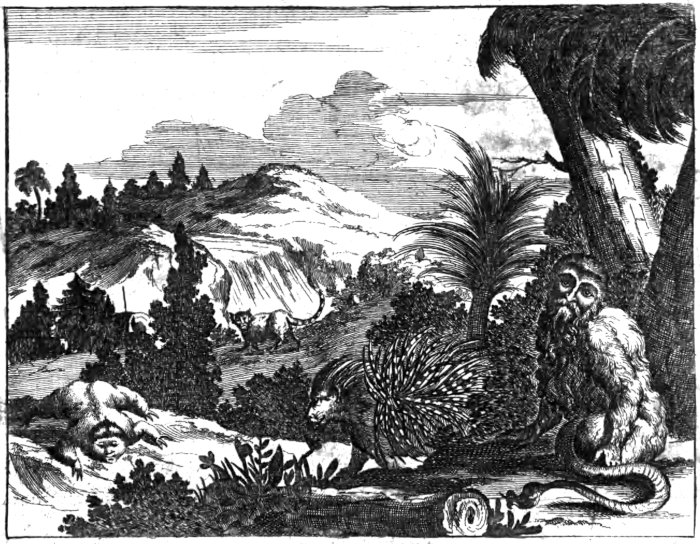
Juan Ardenois relates, That the Coyons play at certain Games with the Natives for Money, and spend what they win in publick Houses.
Joseph de Acosta tells us, That one of these kind of Creatures being sent to a Tavern for Wine, would not part with his Money before his Pot was fill’d, which he defended from the Boys that offer’d to take it from him, by throwing Stones at them; and though it lov’d Wine very well, yet brought it always home without tasting.
It is no less wonderful what Peter Martyr relates of one of these Creatures, viz. That observing one ready to fire a Gun at him, before he could discharge, it leap’d from the Tree and snatch’d up a Child, which he held as a Buckler before him.
The Sagovin.
The Sagovin resembles a Lyon in the fore-part of the Body, with shaggy Hair; they are exceeding dainty and tender, yet so stubborn and sullen, that they take pet at the least affront, and often pine themselves away and die with hunger.
The Boyete, and other sorts of Serpents.
The Serpent Boy-ete, two Fathoms long, without Legs, having a bright speckled Skin and four sharp Teeth, wounds also mortally with its Tail; but is the less dangerous, because at the end of the Tail grows a Bladder, which moving rattles as if there were Pease in it, which gives notice to the Traveller, though unwary, by which means he makes his escape.
The other Serpents call’d Jouboy, Tara-gouyboy, and Tarehuboy, serve the Natives for a great Delicacy; as also the great Toads or Frogs, call’d Tourourou.
They have also a sort of Flies call’d Ton, which exceedingly molest them, against which their chiefest Medicine is Palm-tree Oyl, and the Roucou, with which they colour their Skins.
The Natives of this Island of Maragnan, driven out of the pleasant Countrey Cayete by the Portuguese, are a sort of the Toupinambas, who Setled here about a hundred and fifty years ago. The time of their first coming hither us’d formerly to be solemniz’d with the great Feast call’d Caoven; but because a Woman boldly set upon a Commander in his Cups, there arose a great Tumult amongst them, and ever since the Island hath been divided, one Party calling the other Tobaiares, that is, 516We are Enemies: They are so inveterate against one another, that who e’re they take Prisoners they unmercifully devour: Both are of a middle Stature, have flat Noses, which the Midwives make at the Birth of the Child, they are generally a strong People, and many of them living a hundred years, without being grey, bald, or sick; they live temperate, and under a wholsom Climate: Some of their Women bear Children (as they say) till they are eighty years of age, which being born white, turn to be of a Tawny colour, by being anointed with Suet call’d Roucon, and Oyl; otherwise they are well proportion’d. The Men pluck out all the Hair of their Foreheads, but suffer it to hang pretty long over their Ears, and behind. The Women let their Hair hang down to their Middle, and wear woodden Ear-rings, but the Men hang green Beads in their Lips, and thrust little Bones through their Noses. They go all stark naked, their Legs are colour’d black with the Juice of the Herb Junipap, and upon the other parts of their Body appear Figures of several Representations. Those that will manifest their Valor, and be accounted hardy, gash their Bodies all over with Wounds, which they heal in such a manner, that the Scars may more plainly appear. They never come to their usual Feasts, but dress’d up in various colour’d Feathers; upon the Crown of their Heads they wear Caps stuck with Plumes, which they call Acangoap, or Coronets, call’d Acangerar; about their Necks, the Necklaces Aiouacava; over their Shoulders, the Mantles Assoyave; their Garters they call Tabacoura, at which they hang hollow Nutshells full of little Stones, which gingle and rattle as they go, and about their Arms Armlets call’d Mapouyh-couaychovare; all which are curiously checker’d with various colour’d Feathers.
The Maragnans live not much up in the Countrey, but rather on the Sea-Coast, because of their Fishing, removing every sixth year, calling the Village where they Settle, by the former Name.
They take every Man as many Wives as he pleaseth, but the Women must stick each to one Man, unless she be Divorc’d from him, which often happens upon small occasions.
Their Cotton Hammocks call’d Yu, on which they sleep, hang between two Stakes, in which they lie.
Singular Friends and Relations Feast one another daily; but they are cruel and revengeful against their neighboring Enemies, whom, when they take any of them, they fatten, kill, and eat. The least affront done them, or injurious word spoken to them, or against their Predecessors, makes them take up Arms, which consist of Bowes and Arrows, which they call Ouyrapar and Oune.
Here the French have built the Fort St. Lovis on an Island, from whence Westward may be seen the Cape Tapouytapere, which at High-water seems like an Island, and lies four Leagues from thence; at Low-water they can walk over the Sands from the same to the Main Land.
This fruitful Countrey hath twenty populous Villages.
Westward lies Comma, which gives Denomination to the chief Village, the River, and the rest of that Countrey, wherein are sixteen more handsom Villages, better built, and more populous than Maragnan or Tapouytapere.
Concerning the building of the fore-mention’d Fort on Maragnan, it hapned as followeth:
The occasion of building the Fort Maragnan.
A Colony of French sent over into the Island of Maragnan.
Driven out by the Portuguese.
517The French Captain Riffaut, upon the Advice of Ouyrapive, who bore a great sway amongst his Maragnan Subjects, fitted out three Ships; but because of a Contention between the Sea-men, and the loss of his chiefest Vessel, he was forc’d to Sail to France, and leave some of his Men on Maragnan, under the Command of a young Gentleman call’d De Vaux, who carry’d himself so discreetly amongst the Islanders, that they promis’d to embrace the Christian Religion, if new Supplies came from France to assist them against their Enemies; of which De Vaux advis’d the French King Henry the Fourth, who approv’d of it, and sent Monsieur De la Ravardiere to Maragnan, to make a farther Enquiry into the whole Matter, where he spent six Moneths; after which returning he found the King murder’d, wherefore the Business lay dead for a while; but at length Ravardiere took with him the Lord Rosilly, and the Baron of Sansi, desiring some Capuchins of the Queen-Mother, for the promulgating of the Christian Religion in Maragnan; which being granted, they set Sail with three Ships Anno 1612. with which arriving safely there, and Landing, he built next the chiefest Haven the Fort St. Lewis on a Hill, by whose foot two Rivers glide into the Ocean. After which this new Plantation went on for a considerable time, till the Portuguese overpowering them, drove them out of this their new Field, making themselves absolute Masters of the Fort, and also of the great Mountain Ibouyapap, four Leagues high, plain on the top, twenty four Leagues long, and little less in breadth. No Champain under the Sun is more pleasant and fruitful than this; for in some places it is shaded with Trees, in others hath brave Pastures, lies under a wholsom Climate, and abounds with fresh Springs, from whence are deriv’d store of Brooks, and Rivulets full of Fish.
Sect. XI. The Lordships Tamarica, Rio Grande, Siara, and Para.
Description of the Lordship of Tamarica.
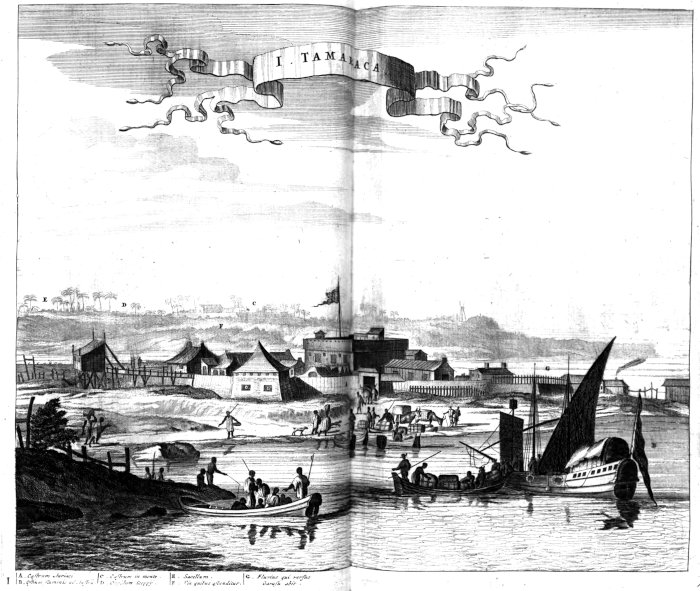
The Præfecture of Tamarica, not above three Leagues in length and two in breadth, so call’d from a little Island lying before it, and part of its Precinct, is counted the first, that is, the most ancient Lordship of Brasile, having otherwise nothing in it that is very considerable, save onely a good Haven or Port, with a Castle for the Security or Command of it, held to be impregnable, and so found by the Dutch, who under Peter Heyn and Stein Callenfels in vain attempted the taking of it, as shall be mention’d hereafter more particularly, but made it useless to the Portuguese, by making a Bulwark at the Mouth of the Haven, and so blocking it up.
This Capatania yielded formerly a Rent of thirty thousand Ducats to the Earls of Montesanto, whose Right it was.
Description of the Lordship of Rio Grande.
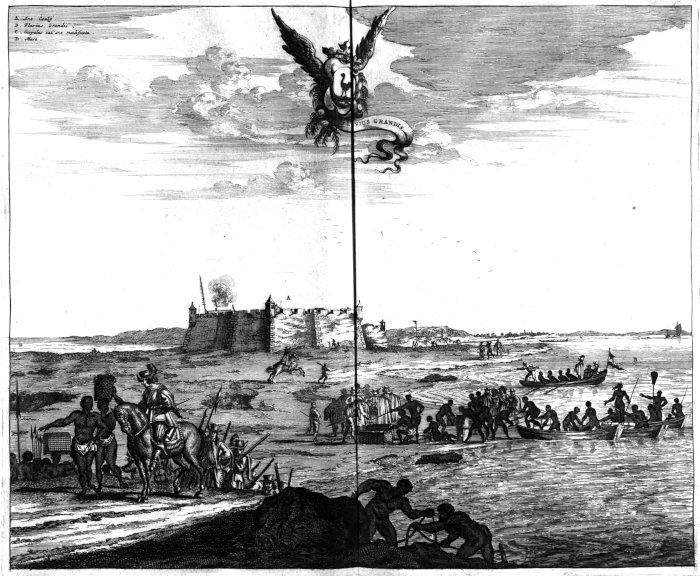
The Præfecture of Rio Grande, a small Precinct, so denominated, as lying on the South-side of that great River which the Portuguese call Rio Grande, and the Natives Potingi, where it falls into the Sea, was once possess’d by the French about the Year 1597. who were outed by the Portuguese, and the Place fortifi’d both against them and the Salvages, (of whom they slew and took Prisoners very great numbers) with a Castle, which the Dutch in the Year 1631. found an impregnable piece, and too hard for them to take.
Description of the Lordship of Siara.
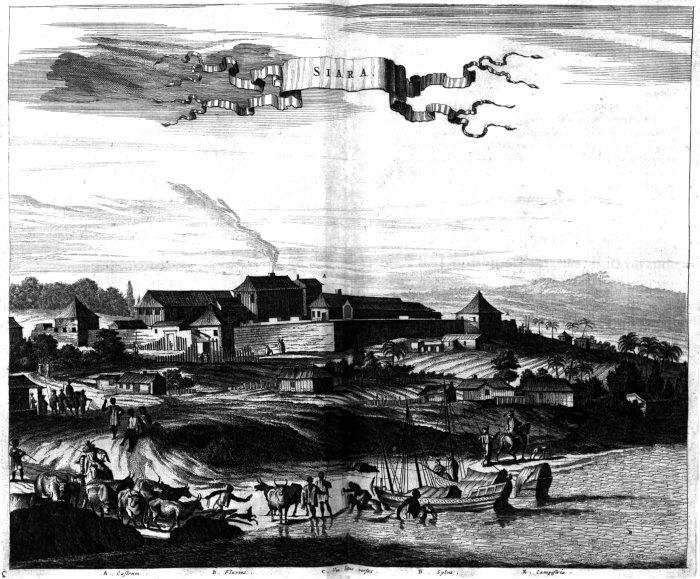
The Præfecture of Siara, so denominated from the Haven; it hath long been in the possession of the Portuguese, but they have therein no Towns of note, onely a Castle, and some few Houses for those that attend the gathering of Cotton-Wool, and Manuring of the Sugar-Canes, which are here in great abundance, also the Countrey is said to afford some Crystal and other Precious Stones.
Description of the Lordship of Para.
518
Lastly, the Præfecture of Para is the most Northerly part of Brasile, bordering upon Guiana, so call’d from the River Para, which runneth through the midst of it, upon which, in a convenient place, and upon rais’d Ground, the Portuguese have built a very strong Castle, well Wall’d on all sides, save onely towards the River, where it is planted with Ordnance: It is built in a quadrangular form, and hath at least three hundred Persons of the Portuguese Nation (besides the Garrison Soldiers) belonging to it, who have all Employment enough about the Cotton-Wool, Sugar-Canes, and Tobacco, which the Countrey is said to afford in great plenty.
A Relation of the Proceedings of the Netherland West-India Company in Brasile to the Year 1658.
The chief Disturbers of the Portuguese in the possession of the Countrey of Brasile, were the United Netherlanders; for they having had good success with their first Fleet, under the Command of John Molenaer, John Dignumszoon, John Schelinger, Simon Mau, and the Merchants Cornelis Woodman, Gerard Beveningen, and Heinier van Hel, Anno 1595. in the East-Indies, where they got such footing, that they took whole Kingdoms, to the great enriching of the Eastern World, where they spread their Trade over the whole Countrey, were thereupon emboldned to venture also to the West, that thereby they might cut off the Sinews of the King of Spain’s Wars, he being continually supply’d with Treasures from America.
A West-India Company erected by the United States.
St. Salvador set upon by the Dutch under Peterszoon and Willekens.
St. Salvador taken by the Dutch.
The grand Promoters of this Design were the Company of Merchants, who hitherto had Traded to Guinee; and the rather, because Guinee brought them but little Profit. But to set upon the Spanish Power, was a Business of no small Consequence; nevertheless they undertaking it, obtain’d Letters Patents from the States of the United Netherlands, Anno 1621. for erecting of a West-India Company, in which it was declar’d, That none without the said Companies leave should drive any Trade to Africa from the Northern Tropick, to the Cape Bonne Esperance; nor to America from Terre-Neuf to the Straights of Magellan, or Le Maire; nor in the South Sea to Anian; which if any attempted, they should forfeit Ship and Goods; besides several other Priviledges and Immunities granted towards the promoting and establishing of the said Company. After a long Consultation which way to steer their Course, it was concluded upon in the Council for the Affairs of the Company, to Invade St. Salvador in the Inlet Todos los Sanctos, whether they sent twenty Men of War and three Ketches, Commanded by Jacob Willekens, and Peter Peterszoon Hein; the Land Forces being under the Command of Colonel John van Dorth. In the beginning of the Year 1624. the Fleet set Sail out of the Texel and the Maes, and in five Moneths arriv’d at St. Salvador. As soon as the Portugueses discover’d the Dutch Fleet, they shot without ceasing from the Fort Philippo with three Brass Guns, as also from the Castle Tapagipe, with four Demi-Canons, but chiefly from the Battlement rais’d threesquare out of the Water before St. Salvador, from whence they play’d at them with twelve great Guns, whilest the Vice-Admiral ran within Musquet-shot of the said Battlement with three Ships, and found fifteen Portuguese Vessels lying near the Shore not far from the Castle Philippo, where there began a sharp Conflict, to the no small advantage of Peter Hein; who thereupon ventur’d with three Boats to Board the fifteen Ships: which resolute Attempt of the Dutch Seamen so amaz’d the Portuguese, that they set their biggest Ships on Fire, and fled ashore: Those Ships that escap’d, being in all ten, the Hollanders took and brought them to the Fleet. This flight of the Portuguese encouraging Peter Hein, he went with fourteen Boats, each Mann’d with two hundred Arm’d Men upon the very Mouths of the Cannons to the fore-mention’d Battlement and took the same, notwithstanding the Stone Wall rose eight Foot out of the Water, and above a hundred Portuguese defended it, whilest the Admiral Willekens sent twelve hundred Soldiers, and two hundred and forty Seamen ashore with Field-Pieces. The Forlorn-Hope consisted of sixty Musquetteers, led by Captain Helmond, who was seconded by Lieutenant La Main, all the Seamen following with Spades and Pick-axes; the Reserve was brought up by Captain Kyf, Ysenach, and William Schouten; thus drawn out, they were led towards the City by the Guides Dirk Colver and Dirk de Ruiter, along a narrow Way, which the Portuguese might have guarded with a few Men, had they not been all struck with a pannick fear, and making use of the dark Night, fled into the Woods. The Dutch found in the City an incredible Booty, because the Governor Diego Mendoza de Furtado had forbid the carrying away of any Goods, that so the Citizens might be the easier perswaded to defend the City; which they might well have done, had they not been surpris’d with the suddenness of the Action; for when Willekens Anchor’d here, there were above sixteen hundred Soldiers, besides a considerable number of Arm’d Citizens in St. Salvador; besides, in the Forts about the City on the Walls lay twenty three Brass, and twenty six Iron Guns.
519This Victory was scarce obtain’d, when Colonel Dorth, who had lost the Fleet at Point Vincent, arriv’d here after all was done, and caus’d Edicts to be publish’d, in which the fled Citizens were promis’d greater Priviledges under the Netherlanders Protection, than ever they had under the King of Spain. Whereupon a few Portuguese return’d to the City; but the greatest part of them, and those the most considerable, were partly kept back by Command of the Bishop Teixera, who laid the fault concerning the loss of the City on the Governor Furtado, and partly because they judg’d the Netherlanders unable to defend them against the Spanish Power.
About the same time several rich laden Vessels arriv’d there from Lisbon, Janeiro, Spirito Santo, Angola and other Places, all ignorant of the Conquest of St. Salvador.
Col. Dorth kill’d by an Ambuscade.
Whilest Dorth and Willekens were ordering all things within the City, the outstaying Portuguese at last taking courage, Storm’d the City from Midnight till the next day in the Afternoon, but fearing they should be set upon behind unawares, Retreated; after which Dorth thinking he had been free from all fear of Enemies, and with a small Guard riding out of the City to take a view of the adjacent Countrey, was scarce got a Bowe-shot from the Walls, when a great Body of Brasilians rush’d forth unexpectedly from an Ambuscade, and wounded him so mortally, that he fell dead from his Horse, and had his Head suddenly chopt off, and his Body mangled very terribly.
Allart Schouten being chosen Governor in Dorth’s stead, took no care to fortifie the City; and after his Decease his Brother William Schouten succeeding him, regarded it less, so that all things went to ruine, every one striving onely to enrich themselves. Amongst other Booties, they took the rich laden Vessel which Francisco de Sarmiento, Governor of Chili, brought to St. Salvador, with fifty eight thousand Guilders, and a much greater sum of Gold and Pearls, all which was imbezled away.
Description of St. Salvador.
This City St. Salvador, built by Thomas de Sosa along the Sea-side, runs up broad at the Suburb Carmo, hath four Market-places, into the biggest whereof, being of a long square, run nine Streets, the chief of which being very broad, hath many stately Houses. The second Market-place is of like form, onely it winds a little towards the Right, and at the Entrance stands a strong Prison. The Cloyster St. Francis, inhabited by Jesuits, stands in a Park near the Wall by which the Moat runs. Towards 520the Sea-side they have a second Structure, much statelier than the Franciscan Cloyster. Near the Prison stands the Armory, and somewhat farther the great Church, which Anno 1624. was not quite finish’d. The Church dedicated to the Virgin Mary appears with a high Spire near the Gate Bento, without which the great Cloyster Bento is built; but the chief Church is St. Salvador. On the utmost Point towards the South-West of the City lies the Fort Antonio, between which and the City stands a very neat Pleasure-house, belonging to the Bishop. Besides Antonio there are four other considerable Forts, viz. Diego, St. Maria, De Gracia, and Vittoria. About half way between Vittoria and the Cloyster Bento, stands the Castle with four Bulwarks; but on the North-side the City is guarded by the Forts St. Peter, Philippo, and Tapecipe.
A great Fleet set out by the King of Spain for the recovery of St. Salvador.
The Spanish King seeming exceedingly concern’d at the loss of so eminent a Place, fitted out a great Fleet for the recovery of what had been taken from him; but the Netherland West-India Company having notice of it, put themselves into a posture of Defence, and in a short time made ready eighteen Men of War and seven Ketches, Mann’d with a thousand six hundred and ninety Seamen, and a thousand three hundred and fifty Land-Soldiers, John Dirkszoon Lam being Admiral: But news coming day after day of the extraordinary Preparations in Spain, it was judg’d convenient to strengthen the Fleet with fourteen Ships and two Ketches more, carrying a thousand four hundred and thirty Seamen, and five hundred eighty Soldiers, under the Command of General Boudewyn Henrickszoon, and Admiral Andries Veron. Moreover, the West-India Company fitted out a third Fleet, consisting of four Frigats and three Ketches, Commanded by Henry Kat, with Orders to Cruise along the Spanish Coast.
In the beginning of the Year 1625. Frederick de Toledo weighed Anchor from Cales with one and thirty Gallions, four Pinnaces, three Tartans, and a Carvel, all carrying seventy five hundred Men. The Soldiers were divided into three Regiments, Commanded by the Colonels Pedro Osorio, Juan Orellana, and the Marquess De Torreclusa.
St. Salvador re-taken by the Spaniards from the Hollanders.
Near St. Jago at the African Cape Verde, Toledo joyn’d with the Portuguese Fleet, consisting of twenty one Gallions and fourteen Carvels and Barques, Mann’d with four thousand Seamen, two Regiments of Soldiers, Commanded by Antonio Nunnez Barreio, and Francisco de Almeida; but the chief Commander of this Fleet was Emanuel Meneses. Which great Fleet being arriv’d at St. Salvador, Toledo himself Landed at the Fort Antonio, leaving the Command of the Fleet to Juan Fajardo: The first thing he did, was to set upon the Cloyster Bento; which having gain’d, he left Serjeant Troppani with two Regiments in the same, whilest he went and Storm’d the Carmelites Minster, and at last took it; but in the mean time four hundred Hollanders Sallying out, made a furious Onset upon the two Regiments, who had possession of the Cloyster Bento, where the Spaniards sustain’d considerable damage; for besides the wounding of three Captains, and the loss of a great number of Soldiers, there were slain the Commanders Emanuel Aquitara, Alonso de Gana, Pedro San Stevan, Diego Espinosa, and Colonel Pedro Osorio; But Toledo no whit dismay’d hereat, but taking fresh courage, brought twenty nine Demi-Culverins ashore, which fir’d so vehemently out of the Carmelites and Bento’s Cloysters, on the seventeen Dutch Ships that lay near the Shore, that several of them were sunk, and others shatter’d beyond hopes of ever being repair’d. After this the Spanish Army was divided into three several Parties, which continually fir’d on the City from three new rais’d Works; the chiefest Party, which was in the Carmelites Minster, had twenty three Brass Guns; the second, plac’d on the great Wall of the Cloyster Bento, fir’d Night and Day with eight Demy-Cannons on the City, in which all things were in a confusion, 521whilest the Governor William Schouten went unconcern’d from one Tavern to another railing at the Soldiers, who thereupon mutinying and deposing him, chose Serjeant Hans Ernst Kyf in his room, who, as he was calling a Council of War, receiv’d a Summons from Toledo to deliver up the City; at which Kyf being much surpris’d, sent a Drummer with a Letter to Toledo, desiring him to grant the Besieged three Weeks time to repair and make fit their batter’d Vessels to carry them back for Holland; and also that they might, according to Martial Custom, march out with lighted Matches, flying Colours, Bullets in their Mouths, and with Bag and Baggage. To which Toledo return’d Answer, That he was now in his own Countrey, and had gotten possession of four Fortifications about St. Salvador, on which he had planted thirty seven Cannons, and therefore saw no such necessity to grant the Besieged (who could not possibly expect any fresh Supplies) such advantageous and bold Demands; and onely promis’d them their Lives should be at his discretion. Yet at last William Stoop, Hugh Antoniszoon, and Francis du Chesne being sent to the Carmelites Cloyster, agreed with Toledo on these Conditions: That the Hollanders should surrender St. Salvador in the Condition it was then in, march out unarm’d, but with Baggage, and have a free Passage with Provisions and all things necessary allow’d them for their Transportation for Holland. Whereupon on the first of May the City was deliver’d up to the Spaniards in such disorder, that some of them had taken possession of the Gate Bento, before those on the other side of the City knew of any Agreement that was made between Toledo and Colonel Kyf. And thus the Place which had a whole year been under the Jurisdiction of the Netherlanders, fell again under the possession of the Spanish Crown, onely through the indiscreet management of the Commanders; for otherwise it was sufficiently strong, and well stor’d with Ammunition and Men, being able to make out two thousand. Moreover, the Ketch De Haes, was set out before from the Holland Fleet, and brought news of the Forces that were sent from the Netherland Havens to their assistance: But the Ships under Admiral Lam, as also those under Boudewyn Henriczoon, were stay’d a considerable time in their Harbors by contrary Winds, and at last reaching the Line were becalm’d, and through the excessive heat of the Climate many Men lost by raging and mortal Distempers, insomuch that they reach’d not the Bay Todos los Sanctos before the twenty sixth of May, on which they saw the Spanish Flag streaming from the Walls of St. Salvador, and fifty great Ships riding at an Anchor near the Shore.
The City Porto Rico surpriz’d by Henrickszoon.
Capt. Uzeel slain.
The Netherland Fleet, divided into four Squadrons, consisted of thirty four Sail, amongst which Lam carry’d the Flag on the Main-top, the Vice-Admiral Adrian Cheszoon on the Fore-top, the Rere-Admiral Andries Veron on the Main-mast, and the Commander of the fourth Squadron on the Mizne-top: All of them seeing the Spaniards absolute Masters, judg’d it most convenient to put to Sea; but standing a pretty while to the South, they found that the strong Current drove them to the Shelves on the West-side of the Inlet; wherefore Tacking about, they made towards the Enemy, who at first seem’d to meet them with twenty eight great Ships, but returning towards the City, the Hollanders also stood to Sea again, Steering Southerly, though without making much advantage in their Way, the Sea going very hollow, and the strong Current setting them towards the Shore, by which means they were in no small danger before the River Francisco, where many of the Men dy’d for want of fresh Provisions, and the number of the Sick increas’d daily, insomuch that some of the Ships were like to perish for want of Men to guide them: It was also judg’d dangerous to lie longer with such a great Fleet near a Lea-Shore, therefore they put into the Inlet Trayciaon, which lies a League to the Northward of the River Monguapigape, from whence a ridge of Rocks extends to Trayciaon, and being 522overflow’d at High-water, hath three Openings or Entrances, two for great Ships, and one, the most Northern, for small Vessels to pass through: The Sea also breaking against this Cliff never molests the Ships whatever Winds blow. The Countrey is overgrown with Brambles, and hath a Lake two Leagues long, and a quarter broad, on the opposite Shore of which stood a Village, inhabited by Portugueses and Brasilians; but the Portugueses flying from thence left the Brasilians in absolute possession: The Hollanders going thither found thirty Chests of Sugar in one Hut; after which the Admiral Lam caus’d his sick Men to be brought ashore, whilest the Captains Boshuisen, Swart, Dyke, Stapels, and Uzeel, march’d up into the Countrey, where they got plenty of Oranges and Cattel. In the mean time the Ketch Vosken, Mann’d with thirty six Seamen, Cruising along the Sea-Coast of Brasile, took three Ships, one out of the Inlet Todos los Sanctos, laden with Sugar and Tobacco, another with the same Merchandise from Pernambuco, and the third laden with Wines from Madera. On the first of August the Fleet set Sail again, to the great sorrow of the Brasilians, who out of hopes of being protected by them against the Portuguese, had joyn’d their Forces with theirs; but now being forsaken, they expected nothing but utter Ruine; which to escape, many of them desir’d to be admitted to go along with the Fleet, which had been granted them, had not the Hollanders wanted Provisions for themselves. The Fleet getting off at Sea, the Admiral Veron ran with twelve Sail to the Coast of Africa; and Boudewyn Henrickszoon kept eighteen Ships under his Command, the rest returning home with Admiral Lam: and thus the Fleet left the unfortunate Haven Trayciaon, where above seven hundred Dutch Seamen were bury’d. Boudewyn Henrickszoon refreshing at Cape St. Vincent, steer’d Westerly, when a Storm (which in twenty four hours blew from all Points of the Compass) surprising him, broke his Main-mast, separated the whole Fleet, and sunk the Flushing Frigat; at last getting beyond the Isle Virgin Gorda, the Fleet meeting again, got to Juan de Porto Rico about the latter end of September; into whose Haven Henrickszoon Sail’d with great courage, notwithstanding the narrow Mouth thereof was guarded by a strong Fort full of Brass Guns, which fir’d very fiercely upon him, who on the other side was not idle in discharging his Guns on the Fort; and had not the shallow Water before the City prevented his Landing that day, he had gotten a far greater Booty than afterwards he met with; for the Inhabitants had, during the Low-water, remov’d all their best Goods: but the next Morning before Sun-rising, the Admiral Landed with eight hundred Men, march’d into the City without any resistance, pitch’d the States Flag on the Governor’s House, guarded all Avenues, unhoop’d all the Wine-Casks which he found there, for fear his Men should make themselves Drunk therewith, and so neglect their Duty, fir’d from the Land-side towards the Castle with three Brass Guns, gain’d the Redoubt, built for the security of the Bridge, which unites the small Isle on which Porto Rico is built with the great, rais’d a Platform, from whence he fir’d Day and Night with six Cannons, guarded by Captain Thyene, whilest the Commander Uzeel kept Watch near the Fort; but his Men being most of them sick, he could not do any great Exploits, especially since the Spaniards Sallying out, as they did daily, kill’d many of the Hollanders, and amongst them Captain Uzeel, after he had shot down two Turrets from the Castle, which damage the Enemy repair’d by taking several of the Hollanders Boats; by which means they could not prevent fresh Supplies from going to the Castle; the Besiegers in the mean time beginning daily to be in greater want for Ammunition and Provisions: whereupon Henrickszoon judg’d it convenient to sound a Retreat, after he had set the Ships belonging to the City Porto Rico on fire in four places. In which Retreat he receiv’d so many 523farewel Shots from the Fort, that they were forc’d to go to the Leeward to stop their Leaks, and leave one of their Ships to the Enemy, in lieu whereof the West-Capel Frigat took a Barque with four Brass Guns, in the little Haven Sierra Gorda; from whence the Fleet ran into the Western Bay of the Island Porto Rico, where whilest they repair’d and took in fresh Provisions, Henrickszoon sent the Ships Hester and Jonas richly laden for Holland; the remaining part of the Fleet meeting with strong contrary Tydes at Porto Rico, were necessitated to put into the Inlet Francisco, where they made several Marches up into the Countrey, to the loss of many of their Men, which were kill’d by the Spaniards, lying in Ambuscade amongst the Brambles that grew along by the Ways.
The Fort of Margarita taken by Henrickszoon.
Henrickszoon dying, is succeeded by Adrian Cheszoon.
In the middle of January, Anno 1626. Henrickszoon Sailing about the North of Porto Rico, steer’d to Dominico, and from thence along the Isles Martinigo, Luzia, and the Promontory De tres Puntas, towards the Island Margarita, where Landing, and Storming the Castle on the Land-side with fifteen Men, he gain’d the first Breastworks; but the Spaniards stopping up the Way along which they were to return, they had without doubt been all slain, had not the Captains Stapel and Estienne come to their assistance; for the Spaniards seeing them climbing up the Bulwarks, betook them to their Heels, after they had kill’d nine of the fore-mention’d fifteen, amongst whom were the Captains Urk and Molkman: of those that leap’d over into the Ditch most part escap’d; those few that were taken inform’d the Hollanders, That the Way towards the Village, inhabited by Spaniards, was every where stopt up with Barricado’s, through which none were able to pass. Henrickszoon thus become Master of the Fort, sent the Booty which he had gotten there, together with three Brass, and five Iron Guns, aboard of his Ship, blew up the Fort, burnt all the Houses, and ran into the Haven Muchina, to which he gave the Denomination of Port Maurice; where, besides a great number of dry’d Fish, he took forty Tun of Salt out of one Salt-pit. After this he taking in fresh Provisions at St. Fe, discover’d Aves, a low Isle full of high Trees, took above two hundred Sheep, and abundance of red Wood on Bonaire, and before the Coast a Spanish Frigat richly laden, made Inspections into the Havens of Hispaniola and Jamaica; from whence he fell back on the Coast of Porto Rico, about the Island Mona, where discovering four Spanish Ships, he took three of them, and burnt the fourth; he also got abundance of Tortoises and Crocodiles on the great Caiman, and took a new Ship between the little sandy Isles Caios, as also before Cuba a Barque, which inform’d him, That the Fleet from the Honduras, as also that from New Spain, was daily expected at Havana: Thence Sailing into the Haven Cabannas, he took a new Vessel of a hundred Tun, and abundance of Timber and Carpenters Tools on the Shore; he Landed also with seven hundred Men on the East-side of the Haven, from whence he march’d along a narrow Path a League up into the Countrey, where he found a running Stream, Pastures full of Cattel, and a Village, the Inhabitants whereof being warn’d by the Barking of their Dogs, fled, and left all manner of fresh Provisions to the Hollanders, viz. above two thousand Oranges, abundance of Lemmons, Bananas, Hogs, Calves, and Bacon; all which having sent aboard, they burnt the Village: After this they took a Spanish Barque before Havana, as also a Ship laden with Timber, another Barque with Poultry, Cochenile, Money, and Haberdashery Ware, one Vessel with live Tortoises, and another, full of Salt, dry’d Fish, and some Merchandise. While the Fleet was thus Cruising up and down before Havana, the Admiral Henrickszoon dy’d; a Man of most approv’d Valor, and of great Conduct: After which Adrian Cheszoon carry’d the Flag; but the Men mutinying about the dividing of the Provisions, which began to grow very scarce, all things fell into great disorder; the 524Seamen rebell’d against their Commanders, saying, That they had been out long enough, and that they would not stay waiting any longer for the Fleet from New Spain or Honduras: Wherefore steering Home, they all arriv’d safe at the Texel and other places in Holland.
In our foregoing Relation we have given you an Account of the Fleet which came to assist the City of St. Salvador, divided into two Squadrons; eighteen Sail Boudewyn Henrickszoon kept under his Command, and twelve Sail remain’d in the Admiral Veron’s Squadron, who Sail’d to the Inlet Serre Leona, where he found the Admiral John Dirkszoon Lam with three Ships, which had lay’n there above two Moneths, by reason of the Sickness amongst the Seamen.
A strange kind of Baboon.
Frambore, King of this Place, granted Lam and Veron free liberty to Hunt, and to gather as many Oranges and Lemmons as they pleas’d, with which the Seamen were so refresh’d, that they set Sail again, and amongst many other things carry’d a Baboon with them from Sierra Leona, which so exactly resembled a Man, that it was wonderful to behold, having a Body, Hands, Eyes, Ears, Feet, and Actions like a Man, smoak’d Tobacco amongst the Seamen, made a noise like a Child when beaten. The Inhabitants of Sierra Leona, where these Monsters run in great Companies through the Woods, believe that the Souls of the Deceased reside in them.
John de Laet, in his annual Journal of the Transactions of the West-India Company, affirms, That he saw a Female of these monstrous Creatures, which usually had her monethly Flowers.
The Hollanders ill success before the Castle Del Mine.
The Fleet, as is before mention’d, Sailing from Sierra Leona, came to an Anchor at Commany, and Landed twelve hundred Men at Poquena, besides a hundred and fifty Negro’s; which Regiment Andries Veron and Arend Jacobszoon carry’d to the Castle Del Mine, whither they before sent a Company, Commanded by Hans Gryf, to prevent the Sallies of the Enemy. The Hollanders tir’d and thirsty, Encamp’d themselves near the Fort, and whilest some of the Men were seeking for Water, others smoaking Tobacco, and lying without their Arms and in disorder on the Ground, and the Commanders were taking a view of the Fort from a neighboring Hill, two hundred Negro’s fell upon the scatter’d Army with great rage and fury, and so much the greater, in regard the Portuguese had promis’d them great sums of Money for every Hollander they kill’d: never any Army was in such a distraction, they being dispers’d and kill’d like so many Sheep, the Admiral Veron and all the Officers slain, and in a short time four hundred and forty Men cut off; and had not Captain Arend Jacobszoon been in League with the Inhabitants of Commany, whither the routed Regiments fled, not one Man had escap’d that bloody Slaughter: Nor was it to much purpose to Besiege the Castle Del Mine, because the Bullets hitting against the Walls of the Castle, built all of Rock-stones, did no Execution. But the four Ships inform’d of this miserable destruction, fell down to Commany, to fetch those that were left alive, and return’d home with the other eleven.
During the unfortunate Expedition of this Fleet, the West-India Company fitted out nine great Ships and five Ketches in the beginning of the Year 1626. under the Command of Peter Peterszoon Hein, to Cruise for the Spanish Ships that were expected from New Spain and Honduras.
The Fox Frigat being sent before to inform Henrickszoon of Heyn’s coming, reach’d about the latter end of May beyond the Isles Dominico, Guadalupa, Mevis, St. Christophers, and by Santa Crux; there not finding a Harbor on the South-side, because of the Rocks, she Sail’d from Mona over to the Main Coast, where seven Leagues Westward of Carakess, he discover’d a high broken Land, whose Mountains seem’d to reach to the Clouds; from thence she steer’d to the Promontory Caldera, the Isles 525Margareta and Coche, on which last he took abundance of Goats, not without the loss of forty six Men, kill’d by the Spaniards and Indians.
Mean while the Admiral Peter Heyn, in the beginning of June, Sail’d to the Southward of Barbados, an Island pretty mountainous, as hath been formerly mention’d, and full of Woods, and by Martinino, whose Hills are very high and overgrown with Trees. Here Peter Heyn could get nothing else but sweet Water, and a Fruit resembling a green Grape, which grew on a round Leav’d Tree, whose Juice cur’d the Scurvey. Sailing from hence, and Landing on Guadalupa, he found a Canoo seven Fathom long and one broad, and cut out of one Tree. The Inhabitants, a well timber’d People, went stark naked, and desir’d to be excus’d, that they could not furnish the Hollanders with more Provisions, because the French and English, Inhabitants of St. Christophers, had pillag’d them.
Success of the Dutch against the Portuguese Fleet.
Near Mona the Fox Frigat joyn’d with the Fleet, with information, that he could hear no tydings of Henrickszoon; wherefore Peter Heyn judg’d it convenient to Sail along the South-Coast of Hispaniola with a separated Fleet, which was to joyn again near the great Caiman. Near Cape de Corientes the Dutch took a Spanish Ship laden with Sarsaparilla; after that another with Salt and Fish, and on the Shelves before Coche before the Promontory Antonio, a Fly-boat with Tallow and Hides, and at the same places two Vessels more with Ballast, the Men whereof inform’d him, that the Fleet from New Spain had about a Moneth before weigh’d Anchor from the Haven Juan de Ulva, and set Sail to Havana, so that without doubt they were arrived there; wherefore Peter Heyn steer’d towards Tortugos, in hopes, if he could, to overtake some of the heavy Sailers. Before the Promontory De Florida he discover’d seven Sail, and coming up nearer, above thirty, which, had Henrickszoon been united with Peter Heyn, had without doubt fallen into the hands of the Netherlanders; but it being judg’d a madness to set upon so great a Fleet with so small a number of Ships, they Sail’d away undisturb’d. Peter Heyn steer’d his Course along Florida, where he met three Canoos with strange Men in them, who came aboard of him, their Bodies being naked, were painted with several colours, onely Mats of Rushes about their Middle, and on their Backs long Tassels hanging down: their Merchandise consisted of a sort of Gum of little value. The Netherlanders in this Place took also a Vessel with Sina Leaves, and some pounds of Ambergreece: but the Scurvey increasing daily amongst them, they Tack’d about, and ran to an Anchor at Sierra Leona, where they stay’d till the latter end of January 1627. and then set Sail to Brasile, and overtook a Vessel from Madera laden with a hundred and fifty Pipes of Wine, and other rich Goods, and ran into the Inlet Todos los Sanctos with undaunted courage, not regarding the Guns that were fir’d from the Fort and Battlements of the City St. Salvador, near which lay thirty Sail of Ships, to which he making up, steer’d between the Portuguese Admiral and Rere-Admiral, whom sinking, he forc’d the Admiral to surrender, whilest the Hollandia and Gelria Frigats fell upon the rest, which were forsaken by the Seamen, who leap’d over-board; then several Mann’d Boats of the Hollanders (notwithstanding the Enemy’s continual firing) went and fetch’d off twenty two Sail of the Portuguese Vessels; all which they did in three hours time, onely with the loss of fifty Men, besides some that were wounded, amongst whom was the Admiral, being shot with a Bullet through the Arm, and wounded in the Legs with a Splinter; his Ship also was, with the Gelria Frigat, driven with the Spring-Tide on a Bank, whence, after the Gelria had receiv’d above sixty Shot from the Enemy, they both got off at last; but the Admiral’s Frigat being shot in a manner to a Wreck, was set on fire, which Misfortune ended not there, for the Orange-tree Frigat blew up, with sixty Men, fourteen whereof, though miserably 526scorch’d, had their Lives sav’d. Soon after which the Admiral sent into Holland the Ship St. Peter, the Hoop, Nostra Sennora de la Vittoria, and the Black-Lyon, which besides their Lading of Hides, Silver, Gold, and Precious Stones, were most of them full of Sugar; which safely arriving, did not a little encourage the West-India Company. After this Heyn took two Ships with Slaves from Angola, which because the Governor of St. Salvador would not redeem, were put ashore on Taperica. On the last of March he set Sail from the Inlet Todos los Sanctos, pass’d by Morro Pablo, and on Easter Eve with a strong Gale by the Abrolhos: before the Highland between Cape Frio and the River De Jenero, he discover’d two Sail, one whereof being laden with Sugar was taken, but the other escap’d in the Night; then Sailing on to the meandring Stream Spirito Sancto, he digg’d Pits on some of the River-Isles to get fresh Water, because it was not safe to Land on the Continent on each side, because the Inhabitants shot frequent showers of Arrows from the Thickets, in which they lay ambuscaded. Moreover the Town Spirito Sancto sent off several Fire-ships at the time of Flood, but they being easily quench’d did no harm. Here also a Vessel laden at Lisbon with Wines and Piece-Goods, was taken by Heyn, who setting Sail again divided the Fleet into three Squadrons, the Vice-Admiral Cornelis Oole keeping three Ships to Cruise withal before the River La Plata, Henrick Best had one Frigat, a Ketch, and a Carvel, to guard the Mouth of the Stream Jenero, whilest the Admiral himself Sail’d with four Frigats, three Ketches, and a Barque, towards the Inlet Todos los Sanctos, where two Ships riding near the Shore by the Fort Tapecipe, were by him set on fire. Also taking a Barque he was inform’d, that six laden Vessels lay in the River Tapecipe, whither he sending some Boats to explore the truth, they found a great Ship without Men in the Mouth of the Stream, and half a League farther six Portuguese Vessels lying near the Shore; bringing back news thereof to the Admiral, he went aboard of the Fox Ketch the next Morning, and taking two Ketches and several Boats with him, Sail’d up the River, and perceiv’d that the fore-mention’d six Ships were gotten up higher, and were Mann’d with a hundred and fifty Soldiers, Commanded by Captain Padilha; the Portuguese Admiral lying in Ambuscade, no sooner perceiv’d the Netherlanders Boats, but he let flie a whole Volley of small Shot at them, insomuch that it made them Retreat, and their whole Design had been fruitless, had not Heyn animated his Men to board the Vice-Admiral; which encouragement prov’d so successful that they master’d the same, killing all those that fell into their hands; which so amaz’d the two Vessels that lay by, that all the Men swam ashore, and left their rich Lading to the disposal of the Hollanders, besides which the vanquish’d Party lost above a hundred and fifty Men, and the Conquerors but fifteen. Somewhat farther up lay three Ships more, but the River being dry there at Low-water, and so narrow that the Trees on each Shore could touch one another, Heyn judg’d it convenient to prosecute the Design no farther, but to return with the three fore-mention’d Prizes, which he did not without great difficulty; for the Portuguese had rais’d Battlements on each side of the Mouth of the River Tapecipe, and stopt the same with a sunk Vessel, which Heyn himself set on fire at Low-water, and return’d untouch’d through thick Volleys of Shot, which flew about his Ears to the Fleet, leaving the three Ships to be fetcht off afterwards; to which end he commanded that they should hang some of the taken Hides about the Fox Ketch’s Pinnace, the Carvel and Boats, that so the Men which were in them might stand secure from the small Shot, and the rather, because the Ships could not be got out of the shallow and narrow River but by Toeing. Mean while the Governor of St. Salvador lay with a considerable number of Citizens and Soldiers behind the fore-mention’d Battlements, not doubting but to 527take revenge for the Losses sustain’d by Heyn; who nevertheless coming down thither Toed out the three Prize-ships with Boats hung about with Hides, firing into the Enemies Battlements with his great Guns, which he had put aboard of the Fox Ketch. About the middle of June he took in the Prize-goods in view of the City St. Salvador, where seven Netherland Ships from several places lay at an Anchor. Setting Sail from hence on the fourteenth of July, and reaching Noronho, known by a Mountain which appears like a Steeple, he met with Cornelis Oole’s Fleet, (who had been Cruising before La Plata) with whom he arriv’d safe in the Texel, having in their Way thither from Noronho taken a Prize, laden with Sugar, Tobacco, and Brasile Wood.