The Second Book, CONTAINING A DESCRIPTION OF NORTHERN AMERICA (continued 10)
Reading edition
Their Cleanliness may appear by this, that when they go to ease Nature, they make a Hole in the Ground with a Stick, and after they have done, stop it up again, burying their Excrement that it may not be seen.
Round about their Huts feed many Hens and Turkies, which they breed not so much for their own use, as to exchange for Iron.
They remove their Habitations very often, either out of fear of being haunted by the Ghost of some deceased Person, or to avoid some Smell which they find noisom and offensive, or because their Hut hath been set on fire by Lightning.
Their Houshold Affairs and Diet.
The Women are always employ’d to keep their Families in good order, to prepare Venison and Fish for the Mens Tables, to spin Cotton, Comb their Husbands, and paint them Red. The Men spend their time in the Wars, Hunting or Fishing. They have also learn’d of the Europeans to burn Train-Oyl in Lamps in the Night, when as before they burnt Twigs of a gummy Shrub before mention’d, which for that reason the Hollanders call’d Candle-Wood. Each hath a little Stool, and a Table call’d Mantoutou, on which he eats his Meat when he pleases, having no set-Meals. The broad Banana-Leaves serve them for Napkins and Table-clothes. Their chiefest Dainty is Crabs roasted in the Shell with the Juice of Lemmon and Pyman. At great Feasts they dress their Meat with the Fat of their Enemies, being the Arovages. Their usual Drink is Mabby, made of Potato’s, which refreshes, and is good against the Phlegm; also another Liquor call’d Oko made of steep’d Cassadar, and is like Beer in taste, strength, and colour. They also by making an incision into the Palm-Trees, tap a Liquor from the same in Calabashes, like White-wine. They use little of the Drink Couscou, because it swells the Body, notwithstanding it is pleasing to the Palate; But the Liquor which is most esteem’d amongst them, is the Wine made of the Sugar-Canes, which are squeez’d in Mills made for that purpose, and then boyl’d in great Kettles. During the dressing of their Meat (which being done leisurely, is sometimes half a day before it is ready), they Sing, and Dance to the Time, which one keeps with a Calabash fill’d full of little Stones, in 359which they believe the greatest happiness they shall enjoy in the other World consists: But the Caribbeeans never Dance more antique than when they meet in the Carbet, which is a publick House of Entertainment; whether the Women carry a Drink made of Cassave, which makes Drunk as soon as Wine: The Men bring Fish and Hedge-hogs; all of them painted with Roucou, and adorn’d with Plumes of Feathers, commit all manner of Debaucheries. At other times they also keep Feast-days, which is either when they are preferr’d to some Office, or Place of Honor, or when they have defeated their Enemies, or when they mourn for the Death of one of their nearest Relations.
Their Beasts.
Their Boats, which they call Periaquo’s, are made of single hollow Trees, full of Benches, and painted with several strange Shapes, and are able each to carry fifty or sixty Men.
Their Musical Instruments.
Their Musical Instruments in which they take most delight, are Drums, Strings of Silk-grass stretcht upon Calabashes, and Flutes made of the Bones of their Enemies.
Their watchfulness against Enemies.
Their Entertainment of Friends.
They keep Watches on high Hills, to descry the Ships off at Sea, and no sooner have they espy’d one, but they immediately give notice to one another; whereupon those that are most valiant put off to Sea in their Canoos and know by the Languages to distinguish between a Spaniard, French-man, English-man and Hollander. If they find that ’tis an Enemy who Lands on their Coasts, they guard all their Avenues, lie in Ambuscades, and gather together in by-ways, and where they see any advantage they shoot thousands of Arrows; which done, they fall in amongst them with great Clubs: but if they chance to be defeated, then they lurk behind Bramble-bushes, or climb up inaccessible Mountains, or else, if near the Sea, they save themselves by Diving and Swimming under Water above two hundred Paces before they appear again; and if a Party of them chance to meet together afterwards, they venture a second Engagement; But if those that come on their Coasts are Friends, they Swim, or go in their Boats to meet them, climb up their Ships, and carry the Sea-men on their Shoulders ashore, where the Casique in the Name of the whole Island bids them welcome, and conducts them to the Carbet, where an antient Man salutes the old Men, and a Youth the young Men; after which asking their Names, the Couban calls himself by that Name ever after; and desires the Strangers to accept of his Name; during which their changing of Names they use many Ceremonies of Friendship: this done, they proffer them Cotton Hammocks to rest themselves in, and pleasant Fruit to eat, till they have prepar’d other Meat; which is no sooner Ready, but a little Table is set before every one of them, and a Dish of Meat consisting of boyl’d Hedge-hogs, boyl’d Crabs, and Pot-herbs; which if the Guests do not eat heartily, or drink up all the Liquor which they give them, they take it as a great Affront; but if they eat and drink heartily, they take it kindly, and shew great sorrow at their departure.
Their Offices of Government have been usually three; the meanest belong’d to the Tiouboulihauthe, whose Place was to Govern over the Carbet, a House where Strangers were Entertain’d, Matters of War disputed of, and publick Feasts kept. Tiouboutonti Commanded the Canoos in the time of War, that is, under the Nahalene, who Commanded the whole Fleet: But the chiefest Officer of all was the Ouboutou; to which degree of Honor none attain’d, unless he had kill’d several Arovages, or at least a Governor.
When the Caribbeeans drew all their Forces out of the Islands to a Battel, then they chose one out of the Ouboutou, who during their March Commanded the Army as General, which his Office ended with the War, and extended no farther than his own Island.
Their warlike Consultations.
360Their warlike Consultations were no less observable for the Ouboutou appointed a Day, on which the Islanders met at a Feast in the Carbet, whither they accordingly came all at the time appointed, and having Eat and Drunk, and Danc’d a considerable time, an ancient Woman with tears in her Eyes, and mournful Countenance enter’d the Carbet, and desir’d Audience; which being granted her, and every one silent, she began to relate the Damages which from antient times the Arovages did to the Caribbeeans; and that in the last Engagement so many valiant Men were slain, and afterwards devour’d by them; therefore it would be a shame not to take Revenge, which being seconded by the Ouboutu, put Valor into the Hearts of all that were present: Whereupon the following day Messengers were sent to the other Islands to acquaint them with their Intentions, that they might prepare their Clubs, make sharp and poyson their Arrows, String their Bowes, prepare Provisions, and fit out their Canoos: They poyson’d their Arrows with the Juice of Manchenillo’s, which made the least Wound mortal. Their Provisions and Arms they laid up in their Canoos, so to preserve their Periaguo’s (which are Boats that can carry fifty Men), if they should chance to over-set, which often happen’d, though they were soon turn’d up again. They went from one Island to another, where they not onely stor’d themselves with fresh Provisions, but increas’d their Fleet with new Assistants; with which approaching the Main, they hal’d their Boats ashore in the Evening, and driving four Stakes into the Ground under the Trees, made fast their Hammocks to the same, in which they slept till Mid-night, and then fell on their Enemies, but if discover’d by them, they retreated to their Boats and return’d home; but if they were not discover’d, they fell upon the Huts of the Arovages; who resisting, they shot Arrows with burning Cotton into them, and so setting them on fire, forc’d the Arovages to venture a Battel in the open Field; where having spent all their Arrows, they Engag’d one another with great Clubs, with which at one Blow they broke either Arms or Legs, or knock’d out their Brains. If the Caribbeeans chanc’d to be defeated, then those that remain’d of their Party made a lamentable noise, howling for those that were kill’d, and mix’d their Tears with the Blood of their slain Friends, whom not without the greatest danger they fetch’d from amongst their Enemies, and carried them aboard their Boats: But returning Victors, the were wont to insult over their Prisoners with all the bitter Taunts imaginable, and then taking advantage of those sharp Upbraidings which their cruel usage extorted from them, to put them to death with most inhumane Tortures, and then to Feast themselves upon their mangled Bodies, all claiming a Right to their several Prisoners, as to so many Beasts appointed to the Slaughter; But of late Ages they have contented themselves to dispatch them speedily with their Clubs, and so assign them to their Shambles.
Their Enmity to the Spaniard.
As the Arovages had been formerly, so the Spaniards at length became the Object of the Caribbeeans irreconcileable Hatred, insomuch that oft-times being Invaded by them, they gave them such rough Entertainment, that they were glad to save themselves by flight; for the Caribbeeans not regarding their Guns, press’d upon them, and many times took Vessels richly laden from them, till of late years that a Peace hath been concluded between them; wherein nevertheless those of the Caribbeeans refuse to be concern’d, that inhabit St. Dominico and St. Vincent, who cannot to this day forget the cruel Outrages committed by the Spaniards.
Their Marriages.
To come to their Marriages, they were allow’d as many Wives as they pleas’d to have, insomuch that their Governors were in esteem according to the number of their Wives; nor were degrees of Consanguinity so regarded, but that an Uncle might take his Neece; whom he no sooner had carried to his House, but the Marriage 361was finish’d. They seldom Divorc’d their Wives after they had bore them Children, but otherwise the Man would break the Bond of Matrimony when he pleas’d. A young Man that had no Relation might court a Stranger, and if her Parents allow’d of it, the Match was made. One that had behav’d himself valiantly against the Arovages was sure of several good Matches, for he was refus’d by none whom he Courted; and the abundance of Wives was the greatest testimony of their Valor. Each Wife had a peculiar Dwelling, so to prevent all Dissentions: So soon as one of them was with Child, her Husband Lay not with her till after Delivery. If any Woman committed Adultery, her Husband was permitted to knock out her Brains, or rip open her Belly; which done, he acquainted her Father with the Deed, who return’d him thanks for the same. Murderers were either burnt or cut in pieces. Children were born here with little trouble, for the Women were no sooner Deliver’d, but they carried the Infant to wash at the next Brook; which done they return’d home to their Houshold Labor, whilest the Man on the contrary kept his Bed, and ate nothing but a piece of Cassava Bread, which he hollow’d out in the middle, and left the edges till the Feast, which was kept at the Naming of the Child: Moreover, he fed on all manner of Dainties for a whole year after. But this Custom was observ’d onely at the Birth of the first Son, at which time they scratch’d the Father’s Shoulder with a sharp Curry-combe, at which if he flinch’d not, it was accounted a good Omen of the Childs future Valor. At fifteen days old they made Holes in the Childs Ears, Lips, and Nostrils, through which they put a String for the tying on of what-ever Ornamentals. With the like Ceremonies the Child receiv’d a Name, taken from his Predecessors, Trees, Fishes, or some remarkable Passages during the Mothers bearing of the Infant in her Womb, or of the Father’s Lying-in: But this Name was chang’d so soon as they went to War, or kill’d a Commander of the Arovages, whose Name they exchang’d for their own: After which the Mothers took special care in bringing them up, and at six Moneths the Children were able to run alone: When they attain’d to the age of two years, they cut off their Hair, at a great Feast made for that purpose; from which time forward they exercis’d them in Shooting with Bowes and Arrows; to which purpose they hung up pieces of Meat for them to shoot at, which they must either hit down, or Fast.
Initiation of Soldiers.
Their Ceremonies to make Soldiers were very strange, viz. The Father conducted his Son to the Carbet, where he told him the Duties of a Soldier, beat him with a Bird of prey, call’d Mans-fenis, till he had bruis’d the Head of the Bird, and scratch’d his whole Body all over with a Curry-combe till the Blood came, and then put Lemmon Juice into the Wounds, afterwards put him in a Hammock, and hung him up for several days without giving him any Meat; all which Torments and Trials if he endur’d with patience, then he was accounted a good and approved Soldier.
Of their Priests.
Few bred up their Children to be Boyez or Priests; yet those that were brought up to it, abstain’d from certain Food from their Infancy, and before they could be receiv’d into the Order of Priesthood, they were forc’d to draw Blood from every part of their Bodies.
Great age of the Caribbeeans.
The Caribbeeans attain to an exceeding great Age: Charles de Rotchfort witnesseth, That in his time there liv’d Men who remembred the first Arrival of the Spaniards under the Command of Christopher Columbus, which consider’d, they could not be less than each of them a hundred and sixty years old. Many Women also were found there, who bare Children after they were eighty years of age: yet nevertheless they are not free from Sicknesses and Distempers, which cannot justly be attributed to the 362Climate, that being extraordinary healthful, but to their ill Diet. Besides the troublesom Disease call’d Pyans, which makes their Bodies swell full of great Knobs, they have been much troubled with pestilential Sores, occasion’d by the eating of Crabs, and poysonous Tortoises, Lamantins, and Hedg-hogs. Against which Evils they wanted not Medicines, consisting of Herbs, Roots, Gums, and Oyl. The bitter Bark of the Chipiou-Tree, steep’d in Water, and mix’d with Lanbys, hath a soveraign operation. The like vertue is in the Juyce of the Myby-Tree, which they us’d to take inwardly: and for outward Means, they us’d a Salve made of burnt Cane-ashes, temper’d with a Water press’d out of a certain Tree. To draw the Matter out of the Sores, they us’d the Juice of Junipa. Letting Blood was never customary amongst them, but to cut and scratch the sore part was to them in stead of Phlebotomy. But if all the fore-mention’d Medicines would not help them, they fled for aid to the Boyez, who immediately order’d the Hut wherein the Patient lay to be made clean, the Table call’d Matoutou to be over-spread with Cassave, Ouycou, and Garden Fruits, for an Offering to the evil Spirit Maboya, and as many Stools to be plac’d about the same as there were People to be present at the Ceremony; and after that all the Fire and Candles were put out, the Boye enter’d into the Hut about Midnight with a Lighted Roll of Tobacco, then muttering some words to himself, stamp’d with his left Foot, and blew the Smoak of the Tobacco up into the Air, which done, and tearing the Tobacco in pieces, he threw the same over the Hut, and call’d up his Spirit, who shaking the Roof of the House, made a terrible noise; then the Boye drew near to the Patient, suck’d his Sores, and anointed them with the Juice of Junipa; after which if the sick Person recover’d, he made a great Feast, and an Offering to the aforesaid Spirit: But if the Distemper were mortal, then the Boye inform’d the Patient’s Relations, That his Spirit had compassion upon the Sick, and was resolv’d to carry him above the Stars, to accompany the other Gods which reside there.
Thus much in general of the Inhabitants of the Isles that lie before Northern America; it will next be requisite to give you an Account of them in particular.
The number of the Caribbee Islands.
Their several Names.
There are generally reckon’d of these Islands twenty eight by Name, though there are many more in number; for besides that there are a multitude of small obscure Islands that are not nam’d, there are of the more considerable sometimes two or three that go under one Name; the twenty eight are these following: Anegada, Sombrero, Las Virgines, Anguilla, Saba, St. Crux, St. Martin, St. Bartholomew, Barbouthos or Barboude, Rotonda, Nevis, Eustathius, Antego, Montserrat, Guadalupe, Deseado, Marigalanta, Todos Sanctos, De Aves, Dominico, Martinego, St. Lucia, Barbados, St. Vincent, Bekia, Granada, Tabago, St. Christopher.
Sect. II. Anegada and Sombrero.
Situation of Anegada and Sombreros.
Towards the North-East of Porto Rico, at eighteen Degrees and thirteen Minutes, The Mansfeny. lies Anegada, seven Leagues long, surrounded with Shoals and The Colibry. Banks, as also the neighboring Sombrero, being in the same Latitude with the other, and so call’d by the Spaniard, because it appears like a Hat: Both of them being uninhabited, harbor abundance of Birds, amongst which is the Mansfeny, a little Eagle, and the remarkable Colibry, whose Body being a little bigger than a Wren, is adorn’d with divers colour’d Feathers, resembling a Rain-bowe; about its Neck is a Carbuncle red Circle; the Belly and ends of the Feathers are of a 363Golden colour, the Sides of an Emerauld green, the Bill and Legs black like polish’d Ebony, the Eyes glittering like Diamonds, on the Head a curious green tuft of Feathers: the Cocks far exceed the Hens in beauty; they flie swifter than any Bird whatsoever, and the fluttering of their Wings makes a noise like a Whirlwind: they live upon the Juice of Flowers, and especially of Cotton-Flowers; they smell like Amber, and build their Nests amongst the thick Leaves of a little Bough, where they cannot easily be found; the Nest it self open towards the South, is curiously made of the fine Fibres of the Plant Pite, surrounded with pieces of Bark, and within fill’d with Cotton, douny Feathers, and Silk; the Eggs oval, are somewhat bigger than an ordinary Pearl.
Painted Crabs.
In the Moneth of May that sort of Crabs call’d Painted Crabs (for some have Violet-colour’d Shells, others yellow, full of purple Specks, and others tawny, with red Streaks) come creeping down the Hills in good order, eat up all the Herbs and Plants, and go four times one after another into the Water to wash themselves, which done they return to the Woods; but the Females at a set-time betake themselves to the Sea, in which they Lay their Eggs, which afterwards being cast on the sandy Shore, and warm’d by the Beams of the Sun, produce young Crabs in a short time, which no sooner come out of the Shell, but creep towards the Woods, when grown somewhat bigger they climb up the Rocks, where the old ones keep in vast multitudes, and stop up the Entrance of their Holes in such a manner, that they cannot be found out, whilest they cast off their Shell, creeping out backward through an opening at the Tail scarce discernable; thus for a certain time they lie bare, and stript of their Shells, being onely cover’d with a thin Skin, which growing harder and harder, becomes at last a firm Shell like the former.
These Crabs are a wholsom Meat, unless they feed under the Mancheneel-Trees, which commonly are poysonous.
Sect. III. Las Virgines.
Situation of Las Virgines.
Near Sombrero, at eighteen Degrees, lie also the two Isles Las Virgines, surrounded by ten others (and flat Shelves), without Trees or fresh Water; but the Sea thereabouts abounds with Fish, and chiefly with the Perroket, which hath Scales like a Carp, but greenish; the Eyes surrounded with Silver Circles shine very bright; in stead of Teeth they have strong Jaw-bones, wherewith they Grind all manner of Shell-fish, which are their Prey. These Fish have an excellent Rellish, and weigh generally twenty Pound.
The Fish Dorade.
Here is likewise great plenty of the Dorade, which is a very large Fish, and about five Foot long, full of little Scales, with a prickly Back, two Fins at the parting of the Head, and as many under the Belly. This Fish swimming very swift, oftentimes follows the Ships that Sail that way.
Sect. IV. Anguilla.
Situation of Anguilla.
Southward at eighteen Degrees and twenty Minutes, on this side of the Line, appears Anguilla, inhabited by the English, containing ten Leagues in length; It makes a pleasant Prospect, because of the many Junipa-Trees which grow 364upon the same, whose Boughs bend towards the Ground; the Leaves are not unlike those of an Oak; the Flowers both in smell and shape come near the Narcissus; the Wood firm and grey, may be neatly Plan’d; the Tree bears fresh Leaves every Moneth, and a Fruit like Apples, which generally crack in their fall from the Tree, because of their thin Shell, as hath been already describ’d.
Oculiem a sort of Vine
The Oculiem, or Vine, makes the Shore also very pleasant; the Leaf round and thick, hath a mixture of Red and Green; the Bark incloseth a Violet-colour’d Wood; the Boughs whereof are loaded with Violet Grapes, which in stead of Kernels contain hard Stones.
Sect. V. Saba.
Situation of Saba.
Westward from Anguilla, at seventeen Degrees and thirty five Minutes, lies Saba, which shews at a great distance like a Rock. The Inhabitants of St. Eustathius going thither, found a pleasant Valley, able to maintain many Families.
The Sea about this Island is so clear, that a Stone may be seen lying on the bottom of it.
The Fish Bonito.
Amongst many other sorts of Fish, the Bonito is the most remarkable, which is thick and fleshy, two Foot long, with a dark green Back, and white Belly without Scales; It devours greedily all manner of Carrion.
Sect. VI. St. Crux.
Situation and first Plantation of St. Crux.
North of St. Christophers, in eighteen Degrees and some Minutes, lies St. Crux, which the Caribbeeans who were beaten by the Apalachites, first inhabiting, call’d Ayay, where Columbus found great opposition, for the Women themselves shot poysonous Arrows at the Spaniards; and before the Islanders submitted to them, they took many Spanish Ships, burnt their Villages, and flay’d many of the Spaniards alive. The Soil, though Hilly, is rich and fruitful.
The English Landing here Anno 1587. found a standing Pool, whose Water made swell the Faces of those who wash’d themselves with the same before Sun-rising, in such a manner, that they were not able to see for several days after; but they at last found a Fountain of wholsom Water.
The several Changes of Dominion in this Island.
Since the Spaniards destroy’d the Inhabitants of this Island, it lay desolate for a considerable time, notwithstanding it hath fourteen Leagues in length, and little less in breadth, till at last the English and Hollanders took possession of the same, each in a peculiar place; but not agreeing together, the English fell upon the Hollanders, and made themselves Masters of the Island in 1649. and not long after they were serv’d in the same kind; for the Spaniard judging them to be weakned by the Hollanders removing from the Island, set Sail thither from Porto Rico, burnt all the Houses, slew the Inhabitants, and brought St. Crux again under the Spanish Government. Mean while the Lord Poincy fitted out two Sail of French Ships, to drive the Spaniards from St. Crux, and succeeded in his Enterprize; for the Spaniards immediately fled to their Ships, left at liberty some Holland Prisoners whom they had taken, and the Island in possession of the French; who straightway sent Captain Auger thither as Governor, who design’d to build a Fort to secure the Harbor, but died before the same was finish’d. Poincy succeeding him, made an end of the Fort, and stor’d the Island with Ammunition and Provision. The Cross-Church built there by the Order, and at the Cost of a Company of Flushing in Holland, was deliver’d also to the French.
Fruit-Trees.
365The Trees which grow here are of four beneficial kinds, serving for four several uses; some yield Fruits of a pleasant taste, and wholsom to eat; some excellent Medicines; others Timber for Building; and others Stuff to Dye with.
Granates, Oranges, Lemmons, and Citrons, grow better here than in any place of the World.
The Papaye.
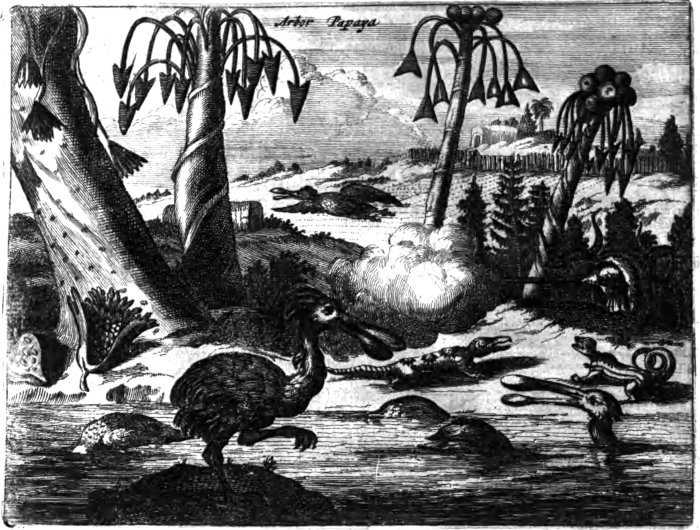
But the Papaye-Tree is particularly worthy of our Description; It grows twenty Foot high, without Boughs, thick and streight, hollow and spungy within, bears three-corner’d Leaves hanging on long Stalks, hollow in the middle, and of a Fingers thickness; on the top round about the Body of the Tree, grow a sort of Fruit like Quinces.
This sort of Papaye-Tree grows on most of the Caribbee Islands; but the second sort call’d Mamoa, is to be found no where but on St. Crux; it hath more Leaves than the first, and a yellow Bark with green Streaks, within full of round and sharp biting Grains; the Blossoms thereof yield a sweet smell; every Moneth the Tree produces new Fruit, not unlike a Womans Breast (whence it hath its Denomination as before observ’d,) and rellishing incomparably well.
Sect. VII. St. Martin.
Situation of St. Martin.
Not far from St. Crux, at eighteen Degrees and sixteen Minutes, lies St. Martin, which hath seven Leagues in length and five in breadth, and is famous for many excellent Salt-Mines; to preserve which, the Spaniards built a City and Fort there.
The Dutch Land there.
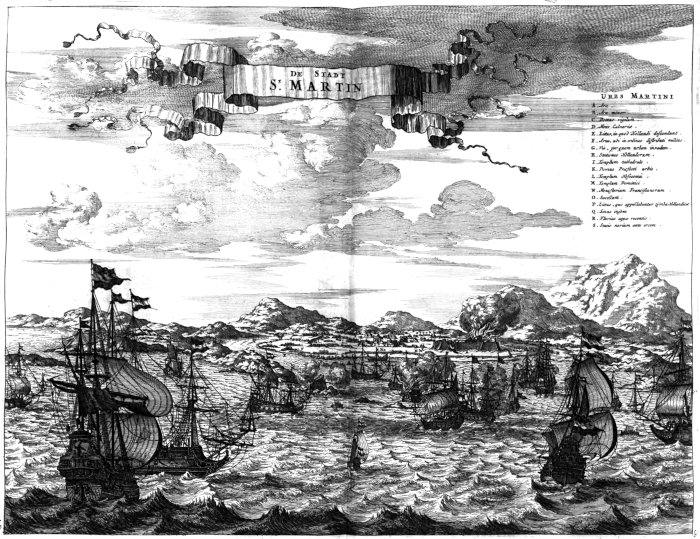
Adrian Peter and Martyn Thyszoon, sent with eleven Sail of Ships from the Texel by the West-India Company, to Cruse for the Spanish Plate-Fleet before the Flemmish Isles, finding their labor lost, Steer’d to the Inlet of Todos los Sanctos; where finding no Enemies Ships, they Sail’d along the Coast of Pernambuck, and from thence (meeting with no Prize) to the Caribbee Islands; and Landing on Granada, receiv’d some damage from the Inhabitants: thence going to Blanca, they got above a thousand Goats, and ten thousand Lemmons from Hispaniola; near Cuba they were surpris’d with continual Thunder, Showers, and Storms, which forc’d them to stand to and again off the Island a considerable time, where they thought to wait for the Spanish Ships that came from Nombre de Dios; but being defeated of their aim, by reason that Fleet was re-inforc’d with a considerable Supply, they set Sail Anno 1629. towards the City and Fort of St. Martin, where coming to an Anchor they found the Place in this condition: On the right side of the City glides a fresh-Water River, with many meandring Streams from the Mountains; on the left side the Ocean makes a great Opening or Bay, which for a little space growing narrower, becomes at last an Inland Lake; from the Countrey opposite to the City on the other side of the fore-mention’d Inlet, runs a Ridge of Hills toward the Sea; on the utmost Point thereof stands a square Fort, defended from the force of the Water with great Stones, pyl’d up at the Foot thereof, cover’d like a House, having on the top of it a Watch-tower, and not far from it a Chappel; moreover, the Mountain 366Calvaria, rises on each side and behind the City, with high Precipices; not far from the Mouth of the River appears a strong Castle with several Bulwarks, and thereon great Guns; along the Inlet is a fair Market-place; in the middle of the City stands a Church Consecrated to Dominicus, near which there is a large Hospital, which fronts the Sea; the Cathedral stands at the farther end of the City, and on the declivity of a Mountain a fair Chappel; near the great Fort the Governor hath a pretty Palace; nor are the Franciscan Cloysters much inferior to any of the other Structures of this City, which taken altogether bears a good Form, by reason of the uniformity of the Streets.
The Island possess’d by the Dutch.
But Anno 1648. the Spaniard totally deserted this Island, which Michael Adriaenszoon Ruiter hearing of, brought several People from St. Eustathius, and took possession of it in the Name of the States of the United Netherlands: Yet they enjoy’d not long the entire Propriety, for the Spaniards again went and claim’d those Places which were theirs upon the first gaining of the Island; which the Hollanders allowing them, they liv’d peaceably and quietly together, each having their own Churches, Store-houses, Land, and Negro’s. The Dutch Plantation was maintain’d by the Zealand Lords, Lamsen and Van Ree.
There are divers Pools of salt Water in this Island, which afford the Inhabitants store of Fish, and especially Tortoises.
The Woods produce wild Hogs, Pigeons, Turtle-Doves, and Parraquito’s resembling a Parrot, and which though much smaller, are more apt to be taught.
Flammans.
Near the Salt-pools also breed Birds call’d Flammans, not unlike a Jack-daw, onely differing in Feathers, for they are first white, next ash-colour’d, and at last turn red; they seldom flye or sit alone, but for the most part in great Flocks in open places, and Moorish Grounds; when some of them seek for their Food under Water, one of them stands Centinel, and on the least noise or appearance of a Man, gives notice by Chirping to the rest, who hereupon immediately flee away; those that shoot them lie commonly hid under an Ox Hide.
American Swallows.
About the same Pools breed likewise the American Swallows, with crooked Bills, Feet like Ducks, black Bodies, white Bellies, and long Tails.
367
Sect. VIII. St. Bartholomew.
Situation and Description of St. Bartholomew.
Near St. Martin, at sixteen Degrees, lies the Island St. Bartholomew, which being about five Leagues in circumference, is surrounded with Rocks, and was first Planted by De Poincy: It makes a delightful Prospect, because of the many Trees which grow on the same; amongst which the most noted are Soap-Trees, whose Wood makes the Water Lather, and washes as well as Soap; but they are of two sorts, for in some this soapy Quality is contain’d in a round yellow Fruit, not unlike a Plumb; in others a white soft Root supplies the office.
The Canopia-Tree.
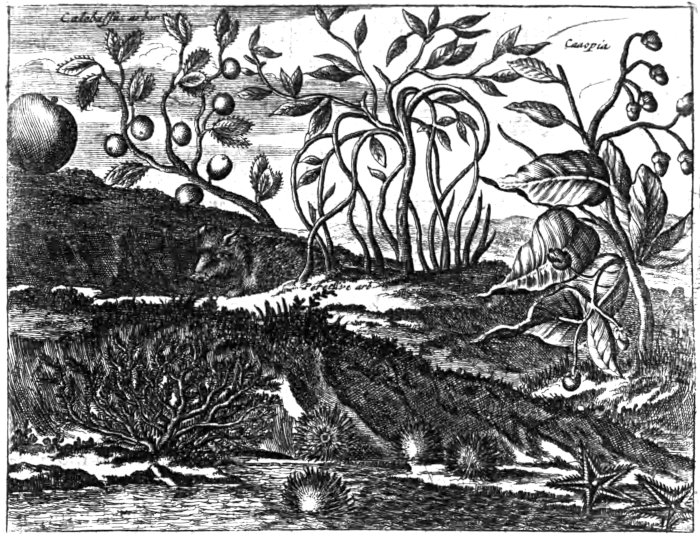
The little Tree Canopia, out of whose Bark drops a Gum, grows also very pleasant, the Body being divided into several Branches; the Leaves are discolour’d, being underneath of a dark Green, and of a brighter at the top; the Flower consists of five Leaves, and closes at last into a kind of Cherry, full of yellow Juice, and white Pulp; it blossoms generally in October and December, and bears ripe Berries the two following Moneths: a Fire being made about the Tree causeth the Bark to crack, whereby it yields abundance of Gum, chiefly us’d in Medicine for its opening and loosening Quality.
The Paretuve-Tree.
Likewise the Paretuve-Tree, which grows along by the Sea-side and by Pools, is sufficiently remarkable, for the Boughs thereof grow downwards, twin’d and pleited together so thick, that in time of War they serve for Bulwarks, and are the Recesses of wild Swine.
The Calabash-Tree.
Moreover, on this Island, as on all the other hereabouts, grow Calabash-Trees, which have thick Boughs and oval Leaves joyn’d one to another, and bear every Moneth fresh Flowers and Fruit, grey Flowers, mark’d with green Streaks and black Spots, and Fruit with hard Shells, full of juicy Meat and flat Seeds, which being taken out serve for Boxes, Cups, or little Dishes.
Sea-Star.
368Along the Shore is also found a sort of Fish call’d the Sea-Star, which is a yellowish Fish, whose hard Skin full of little Knobs shoot forth five Darts or Beams; in stormy Weather they fasten themselves to the Rocks.
Sea-Apple.
No less wonderful is the Fish call’d the Sea-Apple, whose brown Skin is full of Prickles, which when the Fish dies fall off, nothing remaining but a white Shell, curiously embroider’d with little Holes.
On the Banks, and near the Rocks, grow also Sea-Trees, whose thickest Boughs putting forth still lesser and lesser Branches, are pleited together very wonderfully, and being all glaz’d as it were with Salt-petre, seem greyish.
Sect. IX. Barboude.
Situation of Barbouthos.
Barbouthos, which some call Barboude, others Barbada, being five Leagues in length, lies at seventeen Degrees and thirty Minutes, and North-East from Monserrat, in a shallow Sea.
English molested by the Caribbeeans.
Here the English Planting, have from their first Arrival been much molested by the Caribbeeans of Dominico, who for a great while us’d twice a year to Invade them in the Night, killing and destroying whom and whatsoe’re they met with, onely Women and Children, with some other Booty, they carried to Dominico.
Sect. X. Rotonda.
Situation of Rotonda.
The Isle Rotonda, which is much lesser, hath receiv’d that Denomination from its round Form, for it rises in the middle into a Hill, which at a distance appears like a Steeple; It lies at seventeen Degrees and ten Minutes. The Sea about the same being very deep, makes a good coming to the Island with Ships.
Sect. XI. Nevis.
Situation of Nevis.
In sight of Rotonda, at seventeen Degrees and nineteen Minutes, lies Nevis, which hath six Leagues in circumference. Out of the middle of the Island rises a Mountain all over wooddy; round about which the English, who Setled there Anno 1628. have their Plantations, and have increased from a small number to above three thousand, and make a good Advantage of their Sugar, Ginger, Cotton, and Tobacco, which they Plant there.
Good Government of the English there.
They are Govern’d by a peculiar Governor and a Council, who punish Thieves, and all manner of Deboshes very severely.
There are also three Churches, which on the Sabbath-Day are all throng’d with People, who resort thither for the Worship and Service of God.
The Harbor call’d Bath-Bay, and the Store-house built about the same, are secured by a great Fort full of great Guns.
Several Springs on this Island afford the Inhabitants good Water. Here is also a Mineral Spring, a place to Bathe in, which hath been found to cure the same Distempers which the Waters at Bourbon have done.
The Pistick-Nut.
369Moreover, this Island abounds with the Pistacie or Pistick-Nuts, which grow on small Trees, with soft long Leaves, round at bottom, and ending in three Points: These Trees being commonly full of thick Boughs, serve commodiously for Hedges; the Wood and Leaves sweat a milky Juice, dropping out of the same with the Rain; the yellow Flowers which grow on the same are like glittering Stars, and the taste of the Nuts like a Hazle; but if the Skin which covers the Kernel be not pull’d off before they are eaten, they purge to Death.
The Musticho.
But the great Profit which Nevis receives by Nature is attended with some Inconveniences, which trouble this and all the other Islands: amongst many may be reckon’d the Musticho’s, a sort of little Bugs, whose poysonous Sting causes such intolerable Itching, that those who are stung by them cannot forbear to scratch themselves till the Blood comes, by which their Sores festering, prove often very dangerous.
The Muringoins.
Also the Muringoins, who are so much the less dangerous, because they make always a great noise before they sting.
Wasps likewise are here very troublesom, but their Stings are cur’d with Rue, as the Stings of Scorpions are with the Juice press’d out of the same Animal.
Wood-Lice.
The Wood-Lice, which are here in great abundance, have a soft and white Body, onely the Head, which is mark’d with a black Speck; their Mouthes are so very hard, that in two hours time they eat through thick Chests. And no less damage do the Banettos.
Chigos.
But the Chigos are a kind of small Fleas, that breed in Dust, Ashes, and the like, and are of all the most pernicious; they first get in under the Nails of the Toes, and from thence run over all the Body, but especially the bottoms of the Feet, where they first occasion an Itching, and then eat Holes through the Skin; they make Blisters as big as Pease in the Flesh, wherein a swarm of young ones breeding, cause Ulcers and rotten Flesh, which must be eaten away with Aqua-fortis and burnt Allom.
Sect. XII. Eustathius.
Situation of Eustathius.
Eustathius, which is rather a Mountain, rising out of the Ocean like a Sugar-Loaf, than an Island, lies at seventeen Degrees and forty Minutes: It hath scarce five Leagues in circumference, yet receiv’d some while since a Colony of above sixteen hundred People, sent thither from the States of the United Netherlands, under the Command of the Lords Lampsen and Ree. Besides the natural Strength of the Place, whereby a few are able to keep off a great number, it is fortifi’d with a strong Fort, which Commands the Harbor. The Inhabitants are very industrious, and make great profit of the Tobacco which they Plant.
In the midst of this Island is a Mountain over-grown with Trees, which seems to end in a Point, and hath about it a pleasant Plain.
The abundance of Fowls, Hogs and Goats, afford the Inhabitants store of Provisions; for their Store-houses are never so empty, but that they can supply their Neighbors Wants.
The want of fresh-water Brooks they supply with Rain-water, which they preserve in Cisterns.
Terrible Hurricanes.
Though the Air of the Island be wholsom, and the Soil fruitful, yet it is subject to many great Inconveniences; for besides the terrible Thunder-claps and Earthquakes, 370that rend the Ground, the Inhabitants are exceedingly troubled in August, and September with the Winds, which in twenty four hours blow from all Points of the Compass with such mighty Gusts, as if they would turn all things into their first Chaos. The Caribbeeans call these Tempests Hurricanes, which formerly us’d to happen but once in seven years, but of late every two years, and sometimes twice in a year. What damage these Winds cause is scarce to be express’d; the Sea raising its turbulent Waves up to the Skyes, casts the Ships on the Shore, which though in Harbor, are certain to be wrack’d, whilest the Land seems to labor under a general Ruine, whole Woods being rooted up by the same, or at least bereav’d of Boughs and Leaves; the Corn is beaten down, the Plants blasted, Houses turn’d topsie-turvy, Mountains rent asunder, and sometimes pieces of Rocks blown into the Sea. Before the Hurricanes there are several fore-runners, which give notice of their sudden approach, viz. the Sea on a sudden is so calm, that the least motion is not perceiv’d; the Birds flye from the Mountains into the Valleys, where they lay themselves flat on the Ground; and the Rain which falls is bitter and salt.
Charles de Rochfort observ’d, that in his time some Ships laden with Tobacco being lost in a Hurricane before St. Christophers, soon after the Tempest ceased, thousands of Fishes were seen swimming with their Bellies upwards, intoxicated no doubt with the Tobacco.
Sect. XIII. Antego.
Situation of Antego.
Between Nevis and Montserrat, at sixteen Degrees and eleven Minutes, lies Antego, being seven Leagues long, and about six broad; It is dangerous to come at with great Ships, because of the many Rocks which lie before it, and remain’d the longer uninhabited, because of the want of fresh Water; yet at last the English taking possession of it, digg’d Pits, and made Troughs to catch and preserve Rain-water in, so that it is now inhabited by at least eight hundred People, who live on Plants, Venison, and Fish.
The Sword-Fish.
Upon the Sea-shore appears often-times the Sword-fish, which hath no Scales, but a grey Skin, and white Belly, rough like a Fyle, a flat Head, two Fins on each side, two on the Back, and one in stead of a Tail, with which it makes a swift motion: the Sword of it is a long Bone, arm’d on each side with twenty seven white and strong Teeth. This Fish striving to be Chief of the Sea, Encounters with all other Fishes whatsoever, even with the Whale himself, whose Belly he often rends open; near his Eyes are two Nostrils, out of which he blows the Water he drinks into the Air.
Sect. XIV. Montserrat.
Description of Montserrat.
Montserrat, lying just at the seventeenth Degree, is so call’d from a Spanish Hill beyond Barcellona, whose shape this Island represents off at Sea; It is about three Leagues in length, and almost as much in breadth, and is very Mountainous, except a little towards the East, and as much Westward.
The English have a Church here, lin’d in the in-side with Cedar, which this Island produces in great abundance.
The Acajou-Tree.
371Also the Acajou-Tree, which grows an exceeding heighth, with mighty Boughs, under which many judge it very wholsom to sleep: But there are two sorts of the Acajou-Tree, the one differing from the other in tallness of Body and Colour; of which the most esteem’d is the red and sweet-smelling, which is not subject to any decay; for that which is white, and yields Gum when cut, is of a less value.
The Acomas-Tree.
The Acomas is also no way inferior in bigness to the Acajou, which bears long swarthy Leaves, and yellow Fruit not unlike a Plumb; but because of their extraordinary bitterness they are not eatable, onely the wild Pigeons at a certain time of the year feed on them, after which their Flesh becomes bitter also; from the Bark when cut, runs a milky Juice.
The Cypress-Tree.
The Cypress-Trees when plan’d, yield a pleasant Marble colour to the Eye, and a delightful fragrance to the Scent.
The Iron-Tree.
The Iron-Tree, with sharp-pointed Leaves, crack’d near the Stalk, blossoms in March and September; after the Violet Blossoms follow a black kind of Fruit like a Cherry, being an excellent Food for Birds; the Wood whilst flourishing is red, but cut down changes its colour, yet is so hard that it never decays.
The Musk-Herb.
Moreover the Musk-Herb yields a sweet smell, and grows like Brambles without Thorns; between long dusky Leaves hang yellow Flowers, which afterwards become Cods full of Seeds, that smell exactly like Musk.
Sect. XV. Guadalupe.
Situation of Guadalupe.
Guadalupe, or Gardelupe, formerly call’d Carricueira, lying at about sixteen Degrees, and containing sixty Leagues in circumference (for it is the biggest and noblest of the Caribbee Islands,) is divided in two by a narrow Channel; wherefore one part is call’d Grand-Terre, and the other properly Guadalupe; whose Eastern Point, nam’d Cabes-Terre, and its Western, call’d Basse-Terre, are both inhabited by the French.
Mountains.
Several high Mountains, especially towards the Center, start up from very low Grounds, with their barren Crowns towards the Skye, some whereof are overgrown with Trees.
At the Feet of some of the Mountains are large Plains, water’d by sweet Streams which formerly invited the Spanish Fleets thither to water.
There is also a sulphurous Mountain, which smoaking continually gives the taste of Sulphur to the Streams which flow about the same.
This Island boasts likewise several boyling Springs which cure the Dropsie, and all other Distempers proceeding from Colds.
Strange Fish.
Towards each of the two fore-mention’d Points, are large Gulphs that produce abundance of Tortoises, and all manner of Fish, and amongst others one sort not known by Name, which is generally about four Foot long, having a sharp and big Head, with glittering Eyes, a Back streak’d with blue and green, and a Belly half white and half red, eight yellow Fins, and a broad Tail, with which it swims exceeding swift.
The Shark.
Near the Shore swim the Sharks, an ugly Sea Monster, which bites a Man asunder in the Middle at once; their Head is hard and prickly, their flat Mouthes opening discover three rows of Teeth.
The Pilot-Fish.
After this Fish swims generally the Pilot-Fish, or Rambos, which is so curiously speckled, that Nature seems herein to excell what-ever can be represented by the 372artificial Pencil and move either swifter or slower, according as the Shark leads. The Brain of this Fish is judg’d exceeding good against the Gravel and Stone.
The discovery of Guadalupe.
Guadalupe was first discover’d in the Year of our Lord 1635. by the French, under the Command of the Lords Du Plessis and De Olive, and after them one of the Captains of St. Christophers: Since which the Champain Ground being Till’d and Manur’d, brings forth in great plenty, Rice, Maiz, Manicock, and Potato’s.
Father Raymond Breton got possession of the fruitfullest part of the Island for the Reformed Jacobines, or White-Fryers, and since the present Governor Monsieur De Howell sent also for the Jesuits and Carmelites, to build Cloysters in a new City, which lies in Basse-Terre, and which is also built full of Store-houses and Dwelling-houses two Stories high.
The Castle, which lies near the City, hath four Bulwarks, with great Guns.
The next neighboring Mountain is also crown’d with a Garrison’d Fort.
The Moubane-Tree.
The Countrey hereabouts bears Moubane-Trees, which produce yellow oval Plumbs with great Stones, wherewith the Hogs are exceedingly fatned.
The Corbary.
The Corbary, which grows higher than the Moubane, hath a hard shelly Fruit, in which lies a douny Pulp of a Saffron colour: The Gum which drops out of the Tree is hardned by the Sun, and becomes very clear, wherefore the Caribbeeans make use of it for Arm-rings, and other Ornaments.
Sect. XVI. Deseado.
Situation of Deseado.
Ten Leagues to the North-West of Guadalupe, and at sixteen Degrees and ten Minutes, appears Deseado, or Desirado, like a Galley, of which the North-East end hath a low Point; to the Northward lie Sand-Hills full of red Veins: It was so call’d by Christopher Columbus in his second Voyage, from obtaining of his Desire, it being the first of the Caribbees which he discover’d, as St. Salvador the first Land in all America.
The Guano.
The Soil is wholly barren, and destitute of Trees, and breeds the amphibious Creatures call’d Guano’s, which in stead of Fins to swim withal, have four Feet; the biggest of them are fifteen Inches long; their Skin full of little Scales shines like Silver, and in the Night they make a loud and shrill noise from the Holes in the Rocks.
The Frigates.
On this desolate Island are an innumerable company of Fowls, call’d Frigates, which have a Body like a Duck, but larger Wings, and flye swifter; so soon as they perceive a Fish in the Water, they falling upon the same, catch them in their Claws, and especially devour abundance of flying Fish.
The Fauves.
But the Fauves, which are much leaner, are no way so swift; they resemble a Moor-Hen, have Feet like Ducks, Bills like a Snipe, and in rainy Nights rest on the Ships in stead of Rocks, so that many times they become an easie prey to the Mariners.
Sect. XVII. Marigalante.
Situation of Marigalante.
Not far from hence, at fifteen Degrees and forty Minutes, appears Marigalante, like a Wood in the Water.
On the South-East side, about half a League from the Shore, lie black 373full of white Specks. Westerly the Shore is very plain, whither the Governor Monsieur De Howell sent some People from that Island, of which twenty were kill’d by the Caribbeeans, who had Gardens and Fish-ponds thereon: Not long after which Howell built a Fort here, and Garrison’d the same with French-men.
The Woods afford a delightful sight to the Eye, as also the Cinamon-Trees, whose Leaves never wither, a sweet smell to the Nose.
The Fish Lamantin.
The Ocean hereabouts produces plenty of Lamantins, which are dry’d like Haberdine. This Fish grows eighteen Foot long and seven thick; the Head thereof is like a Cows, with little Eyes, and a thick brown Skin, rough and speckled in some places, and hath two little Feet in stead of Fins; it feeds on Weeds, which grow on the Rocks and Banks; the Females bring two young ones at a time, which suck for some days; their Flesh palatable and wholsom, is streak’d with Fat, which when melted never putrifies; they are oftner taken in the Mouthes of Rivers than in the Ocean.
The Sea-Devils.
About this Isle, as well as the rest of the Caribbees, are Fishes call’d Sea-Devils, four Foot long, and proportionably thick, their Skins rough, their Heads flat, their Backs arm’d with Prickles, little black Eyes, wide Mouthes full of Teeth, and two Tusks that slick out of the same, four Fins, a long slit Tail, with which they swim exceeding swift, above their Eyes slick broad sharp Horns turn’d towards the Back; the Flesh is deadly poyson.
The Becune.
The Becune, which is eight Foot long, falls upon a Fish like a mad Dog, biting great pieces of the Flesh out of the Body, which occasions present Death; its Flesh is likewise poyson.
Sect. XVIII. Todos Sanctos.
Situation of Todos Sanctos.
Southward from Guadalupe, and at the same Latitude with Marigalante, lie four Curious sorts of Shells. desolate Isles, call’d Todos Sanctos, and on their Shores a sort of Shell-fish call’d Lambis, from the resemblance of a Tongue; the Shells whereof the Indians Sound in stead of Horns when they give an Alarm; as also another sort call’d Porcelenes, of which the most esteem’d are without of a Carnation, and within of a Silver, or Skye-colour mix’d with Golden Beams. The next are the Black, mix’d with a pale Blue, and little Veins. But the most remarkable Shells are those, whose Back Nature hath mark’d in such a manner with Musical Notes, that one might almost express a Tune by them.
Mother-of-Pearl Oysters.
Moreover, it would amaze the Beholder, to see the Mother-of-Pearl Oyster moving at the Foot of a Rock; for at the Rising of the Sun they appear above the Water, and gape for the Dew, of which they have no sooner receiv’d a Drop, but they close their Shells, and fall to the Ground again.
Sect. XIX. De Aves.
Situation of De Aves.
Westward from Todos Sanctos, at fifteen Degrees and forty five Minutes, lies the Isle De Aves.
Aigrettos.
Besides Ducks, Pluvers, Moor-hens, Geese, and the like Fowls (that suffer themselves to be catch’d by the Hands of Men, which are very strange 374to them) there are here also many rare sorts of Birds, as the white Birds call’d Aigrettos, which are somewhat bigger than Crows, with red Bills and Feet, and curious Plumes on their Heads; they often flye a great way off at Sea.
Craw-fowl.
The large Bird call’d The Craw-fowl, which feeds on Fish, hath a thick Head, a long flat Bill, hollow Eyes, and a short Neck, under which hangs the Maw, big enough to contain a Pail full of Water: On the Trees along the Sea-side they watch for Fish which swim near the top of the Water, and by their attentiveness on their Prey, are easily shot themselves.
Arras.
Here is likewise the Bird Arras, of the bigness of a Pheasant, but more resembling a Parraquito: their long Tail consists of divers colour’d Feathers, some have shining skye-colour’d Heads, Backs, and Necks, their Bellies and Wings of a pale Yellow; they are so stout, or rather so simple, that if they are not hit with the first Shot, they will stay for a second: They also learn to talk, but not so distinctly as the Canides, which are no way inferior in beauty to the Arras, nay exceed them very much: Monsieur du Montell above mention’d, seeing one at Corassao, describes it after this manner:
Description of the Canides.
“It deserves to be numbred (saith he) amongst the most beautiful Birds in the World: I took so particular notice of it, having had of them in my Hands many times, that I have the Idea’s of it still fresh in my Memory. Under the Belly, Wings, and Neck, it was of a waving Aurora-colour, the Back, and one half of the Wings, of a very bright Skye-colour, the Tail and greater Feathers of the Wings were mix’d with a sparkling Carnation, diversifi’d with a Skye-colour, as upon the Back a Grass-green and shining Black, which very much added to the Gold and Azure of the other Plumage: But the most beautiful part was the Head, cover’d with a Murrey Doun, checquer’d with Green, Yellow, and a pale Blue, which reach’d down wavingly to the Back: The Eye-lids were white, and the Apple of the Eye yellow and red as a Ruby Set in Gold: It had upon the Head a certain Tuft or Cap of Feathers of a Vermilion Red, sparkling like a lighted Coal, which was encompass’d by several other lesser Feathers of a Pearl-colour.
“If it were recommendable for all these extraordinary Ornaments, it was much more for its Familiarity and Innocency; for though it had a crooked Beak, and that the Claws with which it held its Meat and brought it to its Beak, were so sharp as to take away whatsoever it fastned upon, yet was it so tame as to play with little Children and never hurt them; and when one took him into his Hand, he so contracted his Claws, that the sharpness of them could not be felt: He had this Quality of a Dog, That he would Lick with his short and thick Tongue those who made much of him and gave him something he lik’d, put his Head to their Cheeks to Kiss and Caress them, and expressing his Acknowledgments by a thousand pretty Insinuations, he would suffer himself to be put into what posture one would, and took a certain pleasure in diverting those he thought his Friends: But as he was mild and tractable to those who were kind to him, so was he mischievous and irreconcileable to such as had injur’d him, and he could distinguish them from others, and make them feel the sharpness of his Beak and Claws.
“He pratled in the Dutch, Spanish, and Indian Languages, and in the last he sung Airs as a natural Indian: He also imitated the Cries of all sorts of Poultrey and other Creatures about the House; he call’d all his Friends by their Names and Sirnames, flew to them as soon as he saw them, especially when he was hungry; if they had been absent, and that he had not seen them a long time, he express’d 375his joy at their return by certain merry Notes; when he had sported himself till they were weary of him, he went away, and perch’d himself on the top of the House, and there he talk’d, sung, and play’d a thousand tricks, laying his Feathers in order, and dressing and cleaning himself with his Beak. He was easily kept; for not onely the Bread commonly us’d in that Island, but all the Fruits and Roots growing there, were his ordinary Food; and when he had more given him than he needed, he carefully laid up the remainder under the Leaves wherewith the House was cover’d, and took it when he had need. In a word, I never saw a more loving or more amiable Bird; ’twas a Present for any Prince, if he could have been brought over the Sea. This Bird had been brought from the Caribbee Islands to Monsieur Rodenborck, then Governor of the Fort and Dutch Colony, which is in the Island of Corassao.”
Sect. XX. Dominico.
Situation of Dominico.
At fifteen Degrees and thirteen Minutes, lies the Island Dominico, so call’d because it was discover’d on a Sunday, about thirty Leagues long, and not much less in breadth, and diversifi’d with high Mountains, and exceeding deep Valleys; of which the Caribbeeans that dwell there relate, That formerly in one of the deepest of them, a huge and monstrous Serpent had an Army of Serpents to defend an invaluable Carbuncle which he had in his Head; which being cover’d with a thin Skin, was onely discernable when he drank or play’d, for then the lustre thereof lightned the whole Valley.
When first the French approach’d this Coast with their Ships, the Islanders going Aboard in their Canoos, barter’d Provisions for Coral, Crystal, and other Trifles.
The Manchenile Tree.
On this Isle also grows the famous Manchenile-Tree, which bears long Leaves, and sweet smelling Fruit, streak’d red, and tasting like a Hazle-Nut, but bringing a deadly Sleep upon those that eat of it; it seldom rots though it fall into the Sea, or any fresh Rivers, but is crusted over with a Shell resembling Salt-petre, and poysons the Water in such a manner, that all the Fish dying, are seen floating upon it; in the Trunk and Boughs thereof is a milky Juice, which dropping upon the Body, causes it to break out in Scabs, and if it chances to touch the Eyes, it takes away the Sight for nine days: and not less hurtful is the Moisture which drops from the Tree.
The Caribbeeans dip their Arrows in this poysonous Juice, against which Nature hath provided an excellent Medicine, being as followeth:
A Medicine against the poison of the Manchenile.
There are amongst the other Reptiles of America a sort of Snails, which creep into the Legs of dead Crabs, to keep themselves from the Weather; when taken they make a noise, and being laid before the Fire they come forth; the Water squeez’d out of them, or the Oyl drawn from them by the Sun, cures the Parts poyson’d by the Manchenile-Tree.
376
Sect. XXI. Martinico.
Situation of Martinico.
Opposite to Dominico lies Martinico, by the Indians nam’d Matunina, which lying at fourteen Degrees and thirty Scruples, is forty five Leagues in circumference; It appears at a distance like three Mountains, the highest whereof resembles a Hat, and is seen in all parts of the Island, which, on the North where three Rocks deny access for Landing, seems to be divided into three Isles.
The Caribbeeans have been forc’d, after many bloody Battels, to surrender up this Island to the French: But before they were well setled, the Caribbeeans marching over exceeding high Mountains, deep Concavities, and thick Woods, fell upon them with all the Rage imaginable: the Reasons of which some attribute to Du Parquet, who in prejudice of the Martinican Caribbeeans, sent French-men over to Granada and Alouzia: others suppose, that they took up Arms to revenge the Death of their Countrey-men on St. Vincent, who were destroy’d by the French with poyson’d Brandy. But the French furnish’d with new Supplies, took sufficient Revenge; for they drove the Caribbeeans out of their Houses, and chac’d them into Woods and Deserts.
The Hills that are over-grown with Trees, are Receptacles for wild Beasts, especially Hogs and Serpents. The other Hills are Till’d and Sow’n, though not without great trouble.
The Tobacco which grows on the steep Ascents much exceeds that which grows in the Valleys, or in the Tracts of Land shaded with Trees.
The Island divided into five Wards.
Since the French, Anno 1635. (being sent from St. Christophers by the Lord Desnambuc) Setled themselves on this Island, under the Command of his Deputy Du Pont, they divided it into five Wards, separated from that part of the Isle which was inhabited by the antient Natives: Each Ward hath a Church, or at least a Chappel, Armory, Store-houses, and Dwelling-houses, like an intire Village.
The first Ward is call’d Pyloot, from a Caribbeean Captain, who was very familiar with Du Parquet, and inform’d him of his Peoples Designs.
The second, nam’d Capot, is wash’d by a River of the same Denomination, and hath many fruitful Plains.
The third retains the Caribbeean Name, being Carbet, signifying a Publick Structure, to which they us’d to resort to Feast, or hold Councils of War; not far from which the Governor dwelt in a Stone House: Near the Harbor stood also an Armory in a Valley, water’d by a fresh River which falls out of the Mountains, shaded with Trees and Gardens full of Rarities: But since the Governor gave this and many other fair Buildings to the Jesuits, he remov’d to the fourth Ward, call’d St. Peter, where he built a Castle, and furnish’d the same with Brass and Iron Guns to defend the Harbor.
A Stones-throw from the Governor’s House lies the Jesuits Cloyster, on the Banks of a pleasant Stream, built very artificially of Marble and Free-stone, and having a pleasant Prospect over the River, and adjacent Gardens, beautifi’d with the choicest of Flowers, Fruits, and Trees; and also a Vineyard, out of which they press a considerable quantity of Wine.
The last Ward, call’d Preacheur, extends East and West, some parts whereof swell into high Mountains, at the Feet whereof stand fair Structures; others sink into low Valleys or Savannas.
The Mahot-Tree.
377Between the French Settlements and the Caribbeeans, runs an Arm of the Sea, along whose Shores grows abundance of the Mahot-Tree, which is full of Boughs from the top down to the Ground. The Bark of this Tree serves in stead of Ropes, and is also us’d to tie up Tobacco; the Wood it self is durable, and good for Building, wherefore most of the Houses built on Hills are of this Timber.
The best Harbor for Ships is between the Wards Carbet and St. Peter, defended from the Winds by high Hills.
The Diamond.
Not far from the Inlet of the Salt-pits, appears about half a League off at Sea, a Rock call’d The Diamond, being a Receptacle for an innumerable multitude of Birds, and especially wild Pigeons.
Besides the Streams that in the rainy Seasons run through the Dales and Savana’s, there are ten Rivers, which falling from the Mountains, glide through the Valleys into the Sea. Sometimes they swell in such a manner, that over-flowing their Banks, they wash down the Trees and Houses; which Inconvenience hath taught the French to build their Houses on Hills or rising Grounds.
The good Situation of this Island hath invited many Families thither.
Sect. XXII. St. Lucia.
Situation of St. Lucia.
St. Lucia (by the French, Alouzie) is so call’d because it was discover’d on the thirteenth of December, Dedicated in the Kalendar to the Virgin Martyr Lucia, who was burnt at Syracuse: It lies Southerly from Dominico at thirteen Degrees and forty Minutes, and is ken’d at a great distance by two fiery Mountains; the most Easterly of which is higher than the other.
At the Feet of these two Mountains lie pleasant Valleys, shadow’d by close Woods, and moistned by clear Springs; near which heretofore a small number of Caribbeeans dwelling, maintain’d themselves with Fishing; they went stark naked, and painted their Bodies with red Oker, and drew a Vermilion Stroke from their Ears to their Noses.
An English Ship sent to Guinee to supply the Plantations there, Landed sixty six mutinous Persons here, who were all kill’d by the Inhabitants; but when Henry Jacobson Lucifer putting into the Bay of Lucia to Water there, Anno 1627. Landed to discover the Island, he found neither Man nor House, nor any thing but a barren Soil; yet notwithstanding Du Parquet sent his Deputy Rosselan with a Colony to Plant in this Island.
Sect. XXIII. Barbados.
Situation of Barbados.
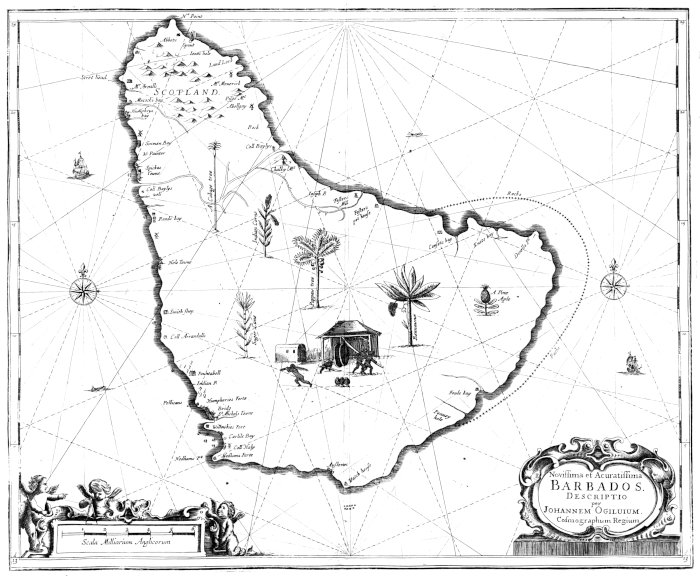
The Island Barbados, which was Planted by the English, Anno 1627. lies between thirteen and fourteen Degrees, and hath twenty five Leagues in circumference, and somewhat more in length than breadth, and is supply’d with a fresh-Water River, and several Pools. The Ground being fruitful in the producing of Tobacco, Cotton, Ginger, and especially Sugar, invited many People to Settle there, insomuch that in a short time it could shew twenty thousand Inhabitants besides Negro Slaves.
The Trees which grow on this Island, are not onely delightful, but profitable; 378amongst which the Roucou is one, with sharp Leaves, white Carnation Flowers like Stars, which hang by Clusters at the end of the Boughs, and after a while turn to a Cod full of vermilion Kernels: The Juice dry’d in the Sun and kneaded into Balls, is of a great value. Of the Bark of this Tree they make strong Ropes; and the Root is very wholsom, and of a pleasant taste.
The Fly Cayouyou.
Moreover, amongst the Insects that breed here, there are a sort of Flyes worthy of a short Description; the Caribbeeans call them Cayouyou, being about the bigness of a Beetle; they have two strong Wings, and under them thinner, which they never spread abroad but when they flye, and then they carry such a lustre in them, that they give as much Light in the Night as a lighted Candle, (their Eyes also at the same time glittering like Fire) making no noise when they flye; they feed on the Juice of Flowers, and are so smooth, that they are very apt to slip through ones Fingers, and when they find themselves to be taken, they hide their glittering Wings under the other.
The Indians tie these Flies to their Hands and Feet, so to have the benefit of their Light in the Night; and anoint their Bodies all over (at certain Solemnities wherein Candles are forbidden) with the Juice squeez’d out of them, which causes them to shine like a Flame of Fire: They catch them with a piece of Wood which they move in the Air, whereupon the Flyes going to sit, are taken with a Hat; but their Light vanishes if they are kill’d.
But as to what may farther be added concerning this Island, being one of the chief of our Plantations, we cannot better satisfie the curiosity of those who desire a true Information of all things that concern that Place, than by inserting verbatim a Letter from an intelligent Person who hath been long resident there, viz. Colonel Robert Rich, of no older Date than May 31. 1670. by which the present State and Condition of the Island, the Buildings and other Improvements made there by the Planters since they first possess’d it, in what Commodities of the Growth of the Countrey their chief Trade consists, their Strength, Militia, Government, and flourishing Commerce, and what-ever else is material to be imparted, may be clearly understood.
Colonel Rich his Description of the Barbados.
SIR,
I have lately seen your Proposal concerning an English Atlas, and having read Dr. Heylin’s Book of the Chorography and History of the whole World, his third Edition Corrected and Enlarged, Printed Anno 1666. I find him very short and erroneous in his Description of the Caribbee Islands, especially of this Island of Barbados, wherein I have been an Inhabitant more than eleven years. He saith,
1. The Island is seventeen or eighteen Miles in compass.
2. On the South ’tis furnish’d with a large and commodious Harbor.
3. The chief Commodities are Tobacco, and a kind of course Sugar, call’d Barbados Sugar, which must be quickly spent, or ’twill melt to nothing.
4. That this Island is worth all the Plantations made by the English, and yet that we hold it at the Courtesie of the Spaniard, without whose Leave and Liking, not of Force to hold it.
This Description of Dr. Heylin’s, in it self very false, is also much to the Dishonor of the English Nation, which makes me presume to trouble you with my own Observations, wherein having onely aim’d at the Truth, you shall not have cause to doubt of being misguided.
This Island of Barbados is seated in thirteen Degrees and twenty Minutes, length twenty two Miles, and in breadth fourteen and an half; It is naturally fortifi’d with Rocks and Shoals on the North and East side of it, where no Ship may safely Anchor, onely two or three places 379small Boats may go out and in to Fish. On the South-East and Westerly part, it is all along a Road when Ships may Ride at Anchor, but more especially in four chief Places, Roads and Bays thereof.
The principal Road or Bay is call’d Carlisle Bay, and lieth on the South-West part of the Island near its Center, and is a good Road, where five hundred Ships of any Burthen may Ride safely from all but South and Westerly Winds, which seldom in these Parts happen, they generally blowing Easterly, whence it is that we call the East parts Windward, and the West parts Leeward. Here lies also the chief Town for Trade, call’d formerly the Bridge-Town, but now St. Michaels, and having two Forts, answering each other, and a Platform between, which Commands the Road, and Defends the Town; the first and chiefest Fort is call’d Charles Fort, standing on Nedhams Point, lying out in the Sea to Windward of the Bay and Town, so that an Enemy keeping out of Command of this Fort, cannot (probably) come to do the Ships or the Town injury, for that they must come full in or against the Wind. This Fort is built strong with Stone and Lime; the Platform joyns to the Windward part of the Town; also the other Fort joyns to the Leeward part of the Town, all which are well fortifi’d and stor’d with great Guns. The Town consists of several Streets and Lanes, being about thirty Chain in length, and fifteen in breadth, and hath many fair and large Buildings, whereof the most are of Stone and Lime.
The second Road and Town is lately call’d Charles-Town, situate on Oysters-Bay, and lies about two Leagues to Windward of St. Michaels, having also two Forts and one Platform; the two Forts stand the one to Windward, and the other to Leeward of the Town and Road, and the Platform in the middle, all well furnish’d with great Guns. And although this Town be not a Place of much Resort for Shipping, yet here are many considerable Store-houses for Trade, wherein Monethly are kept the Court of Common-Pleas for that Precinct, and Weekly Markets.
The third Road and Town is lately call’d St. James’s, formerly the Hall, and is about two Leagues to the Leeward of St. Michaels, hath one very large Platform, and is otherwise well fortifi’d with Breast-works; and although few Ships come to Ride here, yet in this Town is maintain’d a great Trade with the Inhabitants adjacent; here also is kept Monethly the Court of Common-Pleas for this Precinct.
The fourth Road and Town is lately call’d Little Bristol, but formerly Sprights-Bay, which lieth about four Leagues to Leeward of St. Michaels, and hath two Forts well built, and strongly fortifi’d. To this Place come many Ships, especially from the City of Bristol, the which here Ride, unload and re-load, it being the next greatest Place of Repute to St. Michaels in the whole Island.
This Island is divided into eleven Parishes, and hath in it fourteen Churches and Chappels, and being subdivided into divers Plantations, small and great, hath Sugar-works accordingly, with fair and large Buildings made of Stone and Brick, the which generally are pleasant Habitations, and delightfully situated, most having pleasant Prospects to the Sea and Land.
The Inhabitants of this Island are English, Scotch, and Irish, and some, but very few of the Dutch and French Nation, who formerly liv’d here a time of Servitude, and now dwell as Free-men, some by their Trades, and others on Plantations; also some few Jews live here and Trade as Merchants, they having obtain’d Licence from His Majesty so to do; besides Mulatto’s and Negro’s which are here kept, and accounted for Slaves, the number of which some years since, upon search, were found to be sixty thousand Persons, viz. forty thousand Whites, and twenty thousand Blacks.
The standing Militia of this Island that are in readiness to meet together on all occasions, and which at other times are often and well Disciplin’d, consist of two Regiments of Horse, and five Regiments of Foot, wherein several Companies have near two hundred in a Company, and in some Troops more than a hundred Horse in a Troop; by all which you may easily apprehend how little of truth there is in that Saying, That we hold this Island at the Courtesie of the Spaniards, when those few English in Jamaica give the Spaniards such work to defend themselves.
380The Growth and Manufacture of this Island and parts adjacent, is Sugars of all sorts, viz. Muscovado, Clay’d, and Refin’d; (I suppose I have seen here as good Sugar made as any is in the World) Gingers, Indico, and Cotton-wool; also Tobacco, Logwood, Fustick, green and yellow, and Lignum-vitæ: Of these four last heretofore much, but now no quantities to be had in this Island, onely to the Leeward great store. The first four mention’d Commodities receive prejudice to their Product by abundance of Rains or Droughts not happening their proper Seasons: also violent Winds lodge the Sugar-Canes, whereby the quantity and goodness is lessned. The chief time for Expectation is from January to September, when comes in the wet Season, that makes the Roads not Cartable, and usually puts an end to Making and Transportation of them. We have two Crops of Corn in a year, Planted usually when the Rains first come in, in May and November, which is gather’d in about October, and in March and April following. Wines of all sorts are here Imported, but of Portuguese and French the greatest quantities, viz. of Madera, upwards of fifteen hundred Tun yearly; of Spanish, upward of two hundred Tun; of French-Wines, upward of seven hundred Tun; besides Brandy and English Spirits; but of these latter now no great quantities Imported or spent, by reason of the general use of the Spirit of Sugar-Cane, call’d Rum, which the meaner sort, as Servants and Slaves, do not onely drink in great abundance, but much also is hence Transported into Virginia, Bermudas, and New-England. Here is also Imported great store of Provisions of all sorts, viz. Beef, Pork, Fish, &c. from Ireland, New-England, Virginia, Bermudas, New-found Land, &c. also Pease, Flour, Butter, Cheese, and Bisquet; likewise Timber, Boards, Pipe and Hogshead, Staves, &c. also Negro-Slaves from Guinee, and live Cattel, as Bulls, Cows, Asinego’s, and Horses, from the Cape de Verd Island, New-England; and from England, Servants, and all other Commodities for Plantations, and for Apparel; of all which great quantities are hither brought and sold.
The Shipping that comes to Trade to this Island belongs generally to England; some few Vessels are here built, and pass to and fro to the Leeward Islands; and some belong to New-England, Bermudas, &c. The number of Vessels which come hither to Trade in one year is found upon search to be about two hundred of all sorts, (some years more, some less) as Ketches, Sloops, Barques, &c. containing in Burthen fifteen thousand and five hundred and five Tun, according as they were here Entred, which is at the least a third part less than their true Burthen, by reason every Ship pays one pound of Powder per Tun, the means ordain’d by this Country for storing the Magazine; the greatest part of which Ships re-load with Sugars for England, and many go for New-England, Bermudas, Virginia, Tangier, &c. not always full loaden with this Countreys Growth. The usual Rate for Tunnage from hence to London, is from 4 l. to 5 l. per Tun; sometime when Ships are very plentiful, it is at 3 l. and less, and at other times when scarce, from 6 l. to 7 l. in the late War with the Dutch, it was at 10. 11. and 12 l. per Tun.
The Government is Constituted by the Laws of England, and Laws not repugnant to them, onely some particular Laws are here made, proper for this Place, by the Governor (or Deputy) and his Council, (which usually are from seven to twelve in number) and an Assembly that consists of twenty two Persons, chosen by the Free-holders, two out of every Parish.
Sect. XXIV. St. Vincent.
Situation of St. Vincent.
The Island of St. Vincent, South-West from St. Lucia, and having sixteen Degrees of North-Latitude, was so call’d by the Spaniards, as having discover’d it on that Saint’s Day, being the fifth of April: It is accounted eight Leagues long and six broad, and rises round about with high Grounds and several Mountains, which are seen at a great distance.
381This Island hath a very fruitful Soil, and for the bigness of it hath been long since well peopled with Caribbeeans before the arrival of the Spaniards, possessing here several Villages, to whom they are still sworn Enemies, but Truck’d with the Hollanders for Provisions, Horns, Axes, Knives, and other Trifles. At the West and South sides are convenient Bays to lie at Anchor and take Water in.
The Fruit Momen.
The Inhabitants highly esteem the Momen, growing to the bigness of an Apple-Tree; the Fruit which it bears resembles a green Cucumber, and is of a pleasant Juice, the Skin always green and prickly; the Seed which is in the same about the bigness of a French Bean, is generally black, and streak’d with Golden-colour’d Veins.
The Granadilla.
Here is also that Plant mention’d elsewhere, by the Spaniard call’d Granadilla, by the Dutch Rhang-Apple, and La Fleur de la Passion by the French; and it is so call’d, as being fancied to represent the thorny Crown of our Saviour, together with the Cross, Nails, Hammer and Pillar; the Plant runs along the Ground, unless it meet with a Pole by which it runs up.
Sect. XXV. Bekia.
Situation of Bekia.
Not far from St. Vincent lies the Island Bekia, which reckons twelves Leagues in circumference, and lies at twelve Degrees and twelve Scruples of Northern Latitude: It hath a secure Harbor against all Winds; but because it is without fresh Water, it is onely frequented by the Caribbeeans that dwell on St. Vincent, who come hither to Fish, and visit certain little Gardens which they have there for their pleasure.
The Soil produces store of Water-melons, whose red juicy Pulp yields, when squeez’d, a great quantity of sweet Liquor, which is very refreshing, and good to create an Appetite; their white Flowers, notch’d at the end of the leaves, afford a delightful smell.
Anno 1633. Captain John Johnson Van Hoorn putting in to Bekia to catch Tortoises, found a fine Inlet on the West, and Eastward a Ridge of Rocks, Cotton growing wild in the Fields, and upon the Shore a kind of Snails call’d Burgun, under whose first Shell appear’d another of a Silver colour with black Specks.
Sect. XXVI. Granada.
Situation of Granada.
Granada, lying at twelve Degrees and sixteen Scruples, like a Half-moon, from the North to the South, is full of Woods. Towards the South-West runs a fresh River into the Sea. The Shore very low affords good Anchorage at twelve Leagues distance. The Current grows exceeding strong here, and the Water also ebbs and flows in a few hours. Dirick Simonszoon Witgeest Sailing from Tabago, was amaz’d to see with what force the Current drove him to Granada.
The French possess it.
Hither Du Parquet at his own Charge sent three hundred Men from Martinico, who scuffled with the Inhabitants six Moneths before they could possess the same in Peace; and scarce had they obtain’d it at last, but by telling them that the French Assistance would be very advantageous unto them against the Arovages.
The Duke Seryllac in Paris inform’d of the Fertility of this Island, bought it 382of Du Parquet for a considerable Sum of Money: And indeed Granada is none of the meanest of the Caribbees, the Soil producing very good both Fruit and Timber-Trees, amongst which is the Latine-Tree, of a tall Body, but ordinary thickness, and in stead of Boughs, hang Leaves like Fans in long Stalks, which being ty’d together, serve for Roofs of Houses.
There is also the Tree Cocoa, which yet grows not so high here as in other parts of the West-Indies.
Sect. XXVII. Tabago.
Situation of Tabago.
The next which comes in view is Tabago, (so call’d, as some think, from the quantity of that Drug there Planted) eight Leagues long and four broad, lying in the eleventh Degree and sixteen Minutes of Northern Latitude, and hath many high Mountains full of Wood, out of which glide eighteen Streams, which watering the Plains fall into the Sea.
Captain Vitgeest coming to an Anchor here, found a convenient Inlet on the East, and fresh Water to fill his Casks. Half a League from the Shore rise five Rocks, through which he Sail’d with his Ships. Within the Cliff opens a Bay, into which runs a River well stor’d with Fish. More Westerly lies a larger Inlet, which receives two delightful Streams. From the Western Promontory runs also a Cliff Northward into the Sea.
This Island is easily known by high Coasts which rise on the East side, and so grows lower by degrees. It is likewise made pleasant by many Walks of Trees.
The Sea produces abundance of those sorts of Fish which are common amongst us, besides Tortoises, that lay their Eggs in the Sand.
Cra-fish.
The Cra-fish thereabouts are not much unlike Lobsters, have white and well tasted Flesh, but hard to digest; they catch them in the Night on sandy Shelves with lighted Torches.
Crabs.
The Crabs get their Food very wonderfully here; for when they observe the Mussles or Oysters to Gape for fresh Air, they put Stones between their Shells, so that they not being able to shut them, they pull out the Fish with their Claws.
The Woods feed an innumerable company of Beasts somewhat resembling Hogs, (whose Navels are on their Backs) Opassums, Javaris’s, and Tatows, as also the Agoutys’s and Musk-Rats.
Agoutys.
The Agoutys’s are of a dark brown colour, and have little Tails, two Teeth in their upper, and as many in their lower Jaw; they make a noise as if they spoke, crying Couye; if hunted by Dogs, they run into hollow Trees, out of which they are routed by Smoak.
Musk-Rats.
The great Musk-Rats are as big as a Rabbet, and like them live in Holes made in the Ground, but resemble an European Rat, onely their Skins are black, except one part of their Bellies which are white; they smell so strong of Musk, that it overcomes those that carry them.
Serpents.
Amongst the Brambles breed also Serpents of a green colour, two yards long, and an Inch thick, feeding on Locusts and Birds, which they take in their Nests, but do no hurt to Mankind.
The Sassafras Tree.
But Tobago boasts chiefly of the Sassafras-Tree, which resembles the Pine-Tree, hath a firm and streight Body, and on the top Boughs spread like a Crown, the Bark of a dark colour and smooth, and smelling very sweet; the Leaves thin, notch’d, 383and of a deep Green, have also a delicate smell; the thinnest Roots appear above the Ground, and are exceeding good to cure green Wounds, stoppings and shortness of Breath occasion’d by Colds.
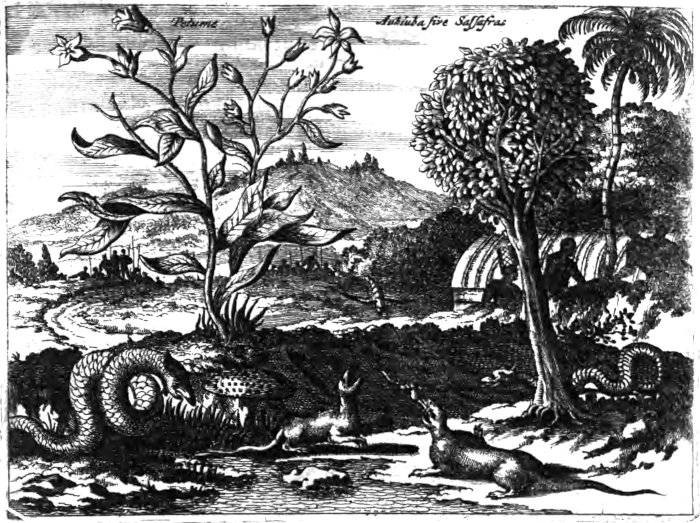
The Tobacco, by the Caribbeeans call’d Y-ouli, Planted among the Fruit-Trees, grows very plentifully here; it shoots up from a stringy Root, bitter of taste, with a thick Stalk, which shoots out Boughs with great Leaves, woolly underneath, and bears a kind of Violet Flower, which when dry’d, are succeeded by little Cods full of black Seed; and to prevent the over-growing of it, they cut off the top of the main Stalk.
The Bird Colibry.
The Bird Colibry, which is exceeding beautiful, makes his Nest under the Tobacco-Leaves.
A company of Townsmen of Walcheren, having a Grant from the States of the United Provinces, sent a Colony to Tabago; but they being scarce two hundred in all, were for the most part destroy’d by the Caribbeeans; the rest weak or sickly, fearing the same Entertainment, sought to save themselves; so that the Island has not formerly been frequented but by the French from Martinico, and Guadalupe, who for some time came over onely to catch Turtles and Lamantins there.
The Caribbeeans also either in their March against, or Return from the Arovages, Landed here for necessary Provisions; But of late the Lord Lampsen hath Setled a Plantation in this desolate Island.
Sect. XXVIII. St. Christophers.
Situation of St. Christophers Island.
St. Christophers, a pretty distance from Tobago, receiv’d its Denomination from Christopher Columbus, invited thereto by the shape of a great Mountain, having as it were another lesser on one of its Shoulders, being fancy’d to represent the Figure of the suppos’d Giant Christopher, who is reported to have carry’d our 384Saviour in the appearance of a little Child on his Shoulders through a deep Sea.
This Island lying seventeen Degrees and twenty five Minutes Northward of the Equinoctial Line, hath twenty five Leagues in circumference.
The Soil light and sandy, refuses not the production of divers sorts of Fruits common amongst us.
In the middle of the Island rises a high Mountain, out of which run fresh Streams, that sometimes swell so high with sudden Rains, that they drown all the Countrey near them.
The Division of the Island into several Wards.
This Island being jointly the Plantation of both English and French, was divided into four Wards, two whereof have been long since in possession of the French, and the other two in possession of the English, strangely divided one from another; for the English in one Ward cannot go to the other without troubling the French; and so on the contrary: the English have more Rivers and People, the French more plain Land, fitter for Cultivation, and Forts furnish’d with Guns and Soldiers. At the Entrances of the Paths which lead into the several Wards stand Watch-houses, where Sentinels, or Watch-men stand daily in their turns.
In a Bay of the Sea they found a brave Salt-pit, from whence a sandy Cliff runs so far into the Ocean, a that some have swum from the end thereof over to the Island Nevis.
A Silver Mine hath been long since discover’d on this Island, in which the English and French claim equal Interest, but neither Party make any benefit of it for want of Miners.
The high Mountains, the Springs of boyling sulphurous Water, and brambly Woods, hinder all passage through the middle of the Island: The Ground runs more and more sloaping to the Sea-side, and is divided into several High-ways, along which stand convenient Houses, cover’d with red or glaz’d Slate, shaded with Trees, and environ’d with pleasant Gardens, to which there is a delightful Prospect from the Fields, of the green Tobacco-Leaves, the yellow Sugar-Canes, Ginger, and Potato’s.
Basse-Terre the chief Town belonging to the French.
Besides the scatter’d Buildings, the French have built a compleat Town near the convenientest Harbor of their Quarter, call’d Basse-Terre, where the Merchants dwell in fair Houses built of Brick and Free-stone; whither all sorts of People bring their Commodities, and Truck their European Goods for such as St. Christophers produceth. All manner of Trades and Handicrafts live also in this Town, and a Court of Judicature is kept every Week. The Church built of Free-stone, is cover’d with the aforesaid red Slate, and was formerly Govern’d by the Capuchins; but they being dismiss’d Anno 1646. the Government was given to the Jesuits and Carmelites; who also built themselves other stately Edifices: but the Jesuit Henrick du Vivier was the first who bore the chiefest Command over all.
The Sick that have not sufficient Means to maintain them, have an Hospital appointed, where all Necessaries are provided for them; and to which is added a School for the bringing up of poor Children.
Description of the Castle.
But the chiefest Structure is the Castle, on the building whereof the Lord Poincy spar’d no Cost; it is built half a French Mile from the Sea at the Foot of a high Mountain, shadowed with great Trees. In the Way thither stand the Houses of the prime Officers; and a long Walk of Orange and Lemmon-Trees leads to a large Court before the Front of the Castle it self, which is built square with Bricks and Free-stone three Stories high; and the Entrance into it is ascended by a large pair of Stairs; near the Gate which opens to the West, stand great Stone Cisterns, into which they receive the Water through Pipes laid under Ground; the Chambers 385and Halls are very lightsom and high, and the Walls of them adorn’d with Cedar; a flat Terrace on the top yields a pleasant Prospect all over the Countrey; the Windows in the Front look open not onely upon the Orange Walk, but also upon several delightful Plantations of Sugar-Canes and Ginger.
Westward appear several Mountains, whose high Heads are invested with ever-flourishing Trees; and between the Palace and those Mountains a very large and stately Garden, full of all manner of Flowers and other delightful Plants, as well those commonly known amongst us, as those peculiar to that part of the World; in the middle thereof stands a Fountain, deriving its Source from the Foot of a neighboring Hill.
The Winds which blow from the Hills, and especially those cool Blasts daily coming out of the East, so tempers the hot Climate, that it becomes very tolerable.
When any News arrives here of the French Conquests in Europe, they sound the Trumpets on the top of the Castle, and the Standards and Ensigns formerly taken by the Governor in the Field, are hung out of the Windows.
On one side of the Castle stands a Chappel, and somewhat farther on a rising Plain, a row of Houses, inhabited by certain Retainers to the Governor, and is call’d Angola. The Offices and Lodgings for the Governor’s Servants are built of Brick, about the Castle, which is fortifi’d with five Sconces, whereon are planted several Guns.
The Governor keeps nine hundred Slaves, and a hundred French-men, to work in his three Sugar-Mills, to till his Ground, and for his Houshold-Service.
Several French Gentlemen have also built many fair Houses here; amongst which the chiefest are those on which Poucy, Treval, Benevent, Girand, Auber, de la Roziere, de St. Andant, de l’ Esperance, and de la Loche spent great sums of Money.
The English also are not much inferior to them in their Counties.
The English Plantations in this Island.
Their Churches are five in all; first on the Point of the Palm-Tree stands a fair Church; a second near the great Road, below the English Governor’s House; a third at the Sandy Point; which are all well built, and large enough for a considerable Congregation; the other two at the Inlet Cayoune are short of the three first. The Ministers thereof receiv’d formerly their Benefices from the Bishop of Canterbury, in Cromwell’s time from the Tryers, as they were call’d; but of late, since the King’s Restauration, from the Bishop of Canterbury again.
The best Houses belonging to the English were built by Mr. Warner, Mr. Rich, Mr. Evrard, and Col. Geffreyson all successively Governors of the Place.
Their success at their first Landing.
It was in the Year 1625. that the English and French jointly (Desnambuc Commanding the French, and Thomas Warner the English) Landed on this Island of St. Christophers, at a certain time when the Caribbeeans, perswaded by their Boyez to destroy all Strangers, were ready up in Arms, but they met with such Entertainment, that they soon lost their Courage, and yielded possession to the Assailants: Not long after which Desnambuc and Warner went (the one to Paris, and the other to London) to inform their Kings of the Condition of St. Christophers, and to raise a Company which might promote the Planting of it: Both attain’d their Desires, and had fresh Assistance given them; for both Kings favor’d the Design, in regard of the good Conditions that were propos’d to those that should go Undertakers thither: And to prevent all Contentions between the English and French, they made Boundaries on each side; but Hunting, Harbors, Fishing, Mines, Trees for Wainscoting, and the like, were to remain in common; and each was to assist the other. The English Plantation increased daily more than the French; having constant Supplies from the 386Company in London; when as on the contrary, the Merchants at Paris grew weary, being desirous first to have a Return for what they had already spent, though the Countrey was not yet Manur’d: wherefore Desnambuc going thither himself, made the Company understand that they could not possibly expect to receive a Return, unless the Countrey were Planted with Tobacco, Indigo, Ginger, and Sugar, which requir’d both Time and People. But whilst the Business seem’d to go on prosperously, a great Accident hapned which threw down the Work to nothing: for the Spanish King set out a Fleet within the fore-mention’d Year, of one and thirty Gallions, three Galeasses, and four Pinnaces, with seventy five hundred Men, under the Command of Frederick de Toledo, Emanuel de Mineses, and John Fajardo, from Cadiz, when before the Island St. Jago there lay at the same time twenty two Portuguese Galleys, fourteen Carvils, carrying four thousand Men, Commanded by Antonio Nunnez Barreio, and Francisco de Almeida, who joyning with the Spaniards, took the City St. Salvador, and went about wholly to chase out of the Caribbee Isles all the English and French: in which Attempt nine English Ships lying before Nevis, were all taken by Toledo, who Sail’d within Cannon-shot of St. Christophers, Commanded at that time by the French Captain Rossey, the Forts cast up by the English and French not being stor’d with Provisions nor Ammunition, and consequently no way able to endure a Siege, and the less, because the Works were not quite finish’d; nevertheless Desnambuc immediately drew up his Soldiers to the Low-land, where he lay Intrench’d along the Coast, to prevent the Enemies Landing; but Rossey suffer’d the Spaniards to Land without the least Resistance: whereupon young Du Parquet Sallying out of the Sconces, fell valiantly upon the first Company, but being forsaken by his Men, was run down by the Multitude and kill’d: In the mean time all their Sloops full of Men Landed, insomuch that Rossey fearing to be surrounded, left his Trench and went up into the High-lands, whereby the Spaniards became Masters of the Fort, but did not pursue their Victory, as suspecting that the French might lie in Ambuscade in the next Wood; and indeed they suspected not in vain, for the French having undermin’d their Forts, had laid Gun-powder in some of the Cellars, which firing, blew up very many of the Spaniards, whilst Desnambuc Embarquing himself, sav’d those which were not slain by the Enemy’s Sword. Mean while the English relying on the League between the King of England and the Spaniard, made no Resistance, (notwithstanding they were inform’d that Frederick Toledo had quite ruin’d the French Plantation, and put them all to the Sword) but sent Agents to Toledo, to put him in mind of the League between Spain and England, which he not taking notice of, alledg’d, That Pope Alexander the Sixth, when a Controversie arose concerning the new Discoveries in the East and West, between the Crowns of Castile and Portugal, had determin’d that Castile had sole Right to the Western World, and therefore that St. Christophers, being a part of the Western World, according to the Pope’s Gift, belong’d to his Master Philip; and insisting upon that Allegation, he commanded them to quit their Right to the Place; to which purpose he restor’d them six of the nine Ships taken at Nevis, on Condition that they should immediately set Sail for England, onely those whom the six Vessels were not able to carry, were permitted to stay on the Island till the next opportunity: After which Toledo weighing Anchor, was scarce out of sight, when the English began to take new Courage, and gathering together to repair their ruin’d Works as well as possibly they could with what Forces they had left; for besides those who went for England in the six Ships, being near two thousand, the Spanish Admiral took six hundred choice English, which he distributed amongst his Fleet; whilest Desambuc suffer’d a great deal of hardship, not onely through ill Weather at Sea, but also for 387want of Provisions; Having during this time been on the Islands St. Martin, Montserrat, and Antego, thinking to have possess’d himself of some or other of them in stead of St. Christophers, but not finding such a fruitful Soil, and convenient Situation, as what he had been forc’d to forsake, he was not forward to fix there, but rather judg’d it convenient to enquire concerning the Condition of St. Christophers, and at last being inform’d by a Ketch, that the Enemy was gone to Havana, and the English were busie in Tilling their Lands, he return’d to his old Station; where nevertheless their Endeavors to repair what was ruin’d, had been in vain, by reason of the scarcity of Provisions, and want of other Necessaries, had not in their greatest extremity some Netherland Vessels arriving there, furnish’d them with Provisions, Clothes, and other Necessaries, on bare promises of payment: But not long after growing rich with Tobacco, Sugars, Ginger, and Indigo, they made Satisfaction to all their Creditors, and at last attain’d to the Condition before mention’d.