AN ACCURATE DESCRIPTION OF AMERICA. (continued 2)
Reading edition
Gen. 9. v. 25, 26, 27.
Gen. 10. v. 15.
Last Testimonies of the Americans Extract from the Phenicians.
Is contradicted.
Franc. Burman. in Gen. 25. 30.
Phenicians deriv’d from Esau.
Our last and chiefest Testimony is Moses, who says thus in Genesis, Cursed be Canaan, a Servant of Servants shall he be unto his Brethren. Moreover he said, Blessed be the Lord God of Shem, and Canaan shall be his Servant: God shall inlarge Japhet, and he shall dwell in the Tents of Shem; and Canaan shall be his Servant. And in the next Chapter, Canaan begat Sidon. These Scriptures are explain’d as a Testimony of the Americans Extract from the Phenicians, which they ground on these following Reasons: The Phenicians are Canaan’s Successors from Sidon, who gave name to their chief City. Tubal the Issue of Japhet, whose Tents God promis’d to enlarge, and that Canaan should be his Servant, planted Spain. 27The Phenicians, descendants from Sydon, (say they) Peopled America; the Spaniards sprung from Tubal, of Japhet, have subjected the Americans, descended from Sydon, of Canaan; wherein is fulfill’d that Prophecy of Moses, That Canaan should be Servant to Japhet; but it seems a great mistake, so to derive the Phenicians from Canaan, for they are Extracted from Shem, Heber, Abraham, and Esau, sirnam’d Edom, from his saying, Adom, Adom, when he ask’d of Jacob, That Red, That Red, because he knew not how to call the prepared Pottage by its proper Name; And Edom setling himself on Mount Seir, a part of the Stony Arabia, and on the Coast of the Red-Sea, gave denomination to it, because that Sea was much frequented and Navigated by his Successors. The Greeks call it Erythreum, from Erythros, who is the same with Esau, and likewise signifies Red. Hereto is added, That Phænix and Erythros have the same signification in the Greek; So then, these Idumeans taking the name of Phenicians, from the great Phœnix, spread themselves far and near under mighty Kings, by Navigation in the Red-Sea, and from thence Planted several Coasts and Islands, removing at last to Syria.
Gen. 36. 39.
Com. in Jer. l. 4. c. 25.
In Ps. 136. Voss. Orig. Idol. l. 1. c. 31.
Punick Tongue.
Hebrew.
The seventh King of Edom, Moses reckoneth to be Baal-hanan, which name, by transposing the Syllables, the famous Carthaginian General Hannibal bare. Moreover, it may easily be demonstrated, that the Phenicians Extracted from Heber, have formerly spoke Hebrew, and since Arabick; for they dwelt before their removing, in the Stony-Arabia. St. Jerom saith, the Punick Tongue agrees for the most part with the Hebrew: And St. Austin tells us, that many, nay, most of the Carthaginian words are Hebrew. Elisa, Dido, the first Foundress of Carthage proves this, for Elisa or Elissah, with the Hebrews, denotes A Lamb of my God; and Dido, A Lover. But who can find the least likeness, between the Hebrew or Arabick Tongue with the Americans? Lastly, Since the Phenicians acknowledge Esau for a Father, what then concerns the Americans, the curse of Canaan, since they are no more Extracted from Canaan, than the Phenicians? Thus much concerning the Phenicians.
If the Americans were deriv’d from the Jews, or the ten Tribes of Israel.
Is contradicted.
Some would derive the Americans from the Jews; others, from the ten Tribes of Israel, carry’d into captivity. The ground of which Opinions is, That the Jews and Israelites were scatter’d amongst all Nations; therefore they conclude, that America was also Peopled by them, the rather, because the antient Jews and Americans were of one Complexion, and went a like Habited, both going without Shooes, onely wearing Sandals, and an upper Coat over a shorter Linnen Vest. Both are humble, quick of apprehension, and obliging, yet Valiant: But it is certain, they cannot be like the Jews, because the Americans change their Habit, according as they live in cold or hot Countreys, and go not in the least like one another.
Father Immanuel relates, That he saw a Brasilian, not onely stoutly make his party good against three Portugal Soldiers, but had it not been by meer chance, worsted them.
Lastly, What Ceremonies of Religious Rites are observ’d by the Americans, which are used in Judaism? The Jews indeed have transplanted their Circumcision amongst divers Eastern People, and have they onely forgot the first Ceremony and signal Badge of their Religion in America, which yet not onely they, but those Mahumetans and other Sectaries punctually observe?
Jews distribution.
1 Pet. 1. 1. Scaliger in Notes ad N. T.
Joh. 7. 35.
L. de Idolo. vanitate.
This makes evident their scatterings about the Face of the Earth, but will not bring them to reach America. The Sacred Text sets forth a two-fold description of the Jews; The one before the Birth of our Saviour, when they 28liv’d as strangers in Pontus, Galatia, Cappadocia, Asia, and Bythinia. Jerusalem was their Metropolis, although others had their chief residence in Babylon, and Alexandria; for there was an Asiatick and a European dispersion; those of Asia had Babylon for their chief City, and us’d in their Synagogues the Chaldean Translation of the Bible. The Europeans kept their Seat at Alexandria, where they had a Temple like that of Jerusalem; and whilst they employ’d themselves in the Greek Version of the Holy Scripture, by the seventy two Interpreters, under Ptolomeus Philadelphus, they were call’d Wandering Greeks: Therefore, certainly the Americans are not deriv’d from these Jews, and with as little reason from those, which by Titus Vespasian, after the destruction of Jerusalem were driven into several Countreys, for they were never permitted (that I may borrow the words of St. Cyprian) to set forward one step, though but as Pilgrims, towards their Native Countrey, but strictly forbidden not to assemble or meet together in any considerable number, which would have been necessary, if they intended to Plant a new World.
2 Reg. 17. 5.
4 Esd. 13. 40, 41, 42, 43, 44, 45, 46.
A small seeming Testimony is added, being taken out of the fourth Book of Esdras, that the ten Tribes of Israel that were carry’d away by Salmanassar with their King Hosea to Nahalah, Habor, the River Gozan, and the Cities of the Medes, might be acknowledged for the first Planters of America: Concerning which, Esdras saith thus, The ten Tribes brought over into another Countrey, consulted that they should forsake the multitude of the Heathens, and travel to a remoter Countrey, where no Generation of Mankind had ever liv’d before, there they would maintain their Laws, which they had not observ’d in their Countrey: Whereupon they went thither thorow the narrow entrances of the River Euphrates, for the Almighty stopt the Vains of the River, till they were past over; for thorow the Countrey was a way of a year and halfs Journey: wherefore that Tract of Land is call’d Assareth, then they liv’d there till the last time.
But since these Books of Esdras were not Written by a Prophet, either in the Hebrew Tongue, or allow’d by the Jews to be the Word of God, or any where taken notice of in the New Testament; wherefore then is Assareth more America than any other remoter Countrey?
L. 5. in Ezek. & l. 6. in Jerom.
4 Esd. 6. 49, 50. & 14. 21. & 4. 41.
St. Hierom (who certainly had a peculiar knowledge of the condition of the ten Tribes of Israel, because he liv’d in Asia, and held Correspondence with the Jews, that he might perfectly learn the Hebrew Tongue,) relates, “That the ten Tribes (St. Hierome liv’d about the Year four hundred, under the Emperor Theodosius) underwent great slavery in the Cities of Medes and Persians; so that this strange Voyage to Assareth, which must have happen’d long before St. Hierom’s time, may be Recorded amongst the other Legends of the Rabbies, concerning their Behemoth and Leviathan, who lock’d up the Souls of those that sleighted their Laws, in Caves under ground, as Esdras.”
Antient condition of the Persians.
Melchior Soiterus de Reb. Turc.
And how little opportunity the Israelites had to remove since his time, may appear by the horrible Destruction that was made for several Ages together in Persia and Media; for although the Persians became Masters again of the Realm, Conquer’d by Alexander the Great, whilst Alexander’s Successors invaded one another, yet they were continually in War, either against the Romans, or else the Indians, and other Eastern People; nay, the Saracens wrested the Scepter out of their hand, though but for a small time; for soon after, breaking out into Factions amongst themselves, Muchumet Subictigenes, Imbrael’s Son, establish’d his Throne on their Ruines, and incourag’d by such success, Arm’d himself against the Indians, and made use of the Turks assistance, with which he subdu’d the Babylonian Arabians: After which, the Turks, not without great 29slaughter see the Persian Crown on their Head, which, immediately totter’d by bloudy Commotions; for Tangrolipix being King of Persia, clashing with his Brother Cutlumuses, made Persia swim in the Blood of a Civil-War, till at last Zengis Chan brought from Tartary so great an Army, Anno 1200. that none durst stay to make opposition; for the Turks forsook Persia after a Conquest of six Ages, and made their own way for new Quarters into Carmania, Phrygia, and Bithynia, whence they made such incursions on the Greek Empire, that at last they became sole Masters thereof. Who cannot but easily judge by this, how little opportunity the ten Tribes had, to be assembled together from remote Countreys, and to go long Journeys through untrack’d ways, and full of Enemies, to travel to America?
Mora’s opinion concerning the Americans Extract.
Immanuel de Moraes, who had gotten peculiar knowledge of the Americans by his long Conversation with them, judgeth that they are not deriv’d from one People, but from the Carthaginians and Jews, and that at several times, and places, they Landed in this New World; for the Carthaginians Sailing thither, found the Soyl so fertile, that many forsook their Native Countrey to dwell there: Whereupon, it was forbidden upon pain of Death, to send no more thither, lest if Carthage should be invaded by a foraign Enemy, it should want People for a Home-defence: From this occasion it happen’d, that those that were already Transported, became rude, and of a Salvage Disposition, and spreading their Families, planted the desolate Countreys in a ranging manner, without acknowledging any Supreme Head or Governor.
Thus being scatter’d up and down, every one invented to himself a new Language, which should neither agree with the Carthaginians, or any other: But this Opinion is before at large contradicted.
Customs and Constitutions of the Brasilians are several.
Moreover, Moraes endeavors to shew, that the Brasilians are of a Hebrew Extract, because that according to the example of the Jews, they might not Marry, but in their own Tribes; they also call their Unkles, Fathers, and their Aunts, Mothers; both mourn for the Dead a Moneth together, and wear long Garments down to their Ankles. But these Arguments seem to us of small consequence, for indeed the Brasilians differ in their Marriages from the Jews, for they not onely Marry in their own Tribes, but frequently commix with their Sisters, and Daughters, or other their nearest Relations. Moreover, the Jews call’d them Fathers, from whose Loyns they sprang many Ages before, as well as their Unkles, which the Americans do not.
The Mourning for the Dead hath been an old Custom, and is not observ’d by many People, but the time of a Moneth was not setled amongst them, but was observ’d after a more unusual manner, seventy days, as in the Fields of Moab for Moses, and elsewhere for the Patriarch Jacob. Lastly, all people know, that the Romans and Persians girt themselves about with long Clothes. Besides, the Jews were strictly bound to observe Circumcision, without which they were not accounted Jews, which the Brasilians use not, as neither their Language or Letters. How is it possible, that in America they should at once have forgotten their Extract, Laws, Circumcision, Language, and other Ceremonies, when the rest of them observ’d nothing more strictly in all parts of the Earth?
Grotius is of opinion that the Americans belong’d to Norway.
The Learned Hugo Grotius, in his Enquiry after the original of the Americans, brings them with many Circumstances to belong to Panama, situate opposite to the Northern Parts of Norway, because something of their Languages agrees, and the Way thither easie and nearest to be found: for first they travell’d from Norway 30to Ysland, over which the Norwegians Rul’d above a thousand years since; so from Ysland through Friezland to Groenland, and from thence to Estotiland, being a part of the Main Continent of America.
This Opinion is largely contradicted.
From Friezland some Fishers went thither (as he says) two Centuries before the Spaniards touch’d that Shore; which John de Laet contradicts. And indeed what Reasons can be given, Why the Americans of the Straights, between Panama and Nombre de Dios, lying Northerly, should have another original than those that live to the South, seeing the same Straights are neither divided by Mountains nor Rivers; and the Spaniards found no alteration in the Customs and Languages betwixt them that liv’d above or below these Straights. And who will believe that Norway, which was but indifferently peopled, could afford such numerous Colonies as could plant the Northern America, which far exceeds the South, and chiefly, when the great Islands that lie near the East and West, are added to it? Moreover it is certain, (if the Yslander Angrim Jonas is to be credited) that some Families fled out of Norway from their enraged King to Ysland in the Year 874. which at that time was but meanly inhabited.
Isaac Pontanus de Reb. Danicis.
Forty years before, Lewis the Just put the Yslanders under the protection of Pope Gregory the fourth, who gave the Government of the Ysland Church to Ansgar Archbishop of Hamburgh. But how comes it that there is not the least spark of Christianity found amongst the Northern Americans, if they are deriv’d from the Ysland Christians? and why did the Yslanders remove to colder Countreys than Groenland and Friezland, or their own native Soil, and for the most part not inhabited?
Concerning Groenland and Friezland, it is known by our English Navigators, that they are joyn’d together, and both to the Northern America; but not without vast Bays and Inlets, which betwixt Groenland and America are obstructed with floating Castles of Ice; so that the Passage is very dangerous. And full as troublesom, if not altogether impossible, would the Journey be by Land, because the Earth lies so thick cover’d with Ice and Snow, especially the Valleys, that no Traveller is able to get through.
The Voyage of two Zeno’s.
Relatio Marc. Zenonis.
Moreover, that which Grotius says farther of the Fishers which first discover’d Estotiland, is grounded on the Relation of the Venetian Knights, Nicholas and Marcus Zeno, two Brothers. Anno 1380. Nicholas Zeno suffer’d Shipwrack on the Friezland Coast; Marcus inform’d thereof, steer’d his Course thither; fourteen years they spent before they came to Estotiland: at last they return’d again to Friezland, where Nicholas died: But Marcus returning home publish’d his Journal, wherein he relates, That Estotiland is above a thousand Leagues distant from Friezland, and was discover’d by Friezland Fisher-men that were driven thither by Storm. But he hath set down many things that have little resemblance of truth, according to what is since found by credible Navigators; and therefore we cannot depend on Zeno’s Discovery.
The American Tongue is nothing like the Norwegian.
John de Laet accounts it a great mistake in Grotius, that as a testimony of the Americans original out of Norway, he compares their Languages. He reckons up some Places to be Northward of Panama, which end their words with the syllable Lan instead of Land, because the Spaniards have left out the Letter D at the end thereof. It is certain, that in the Northern America lie Cimatlan, Coatlan, Guescolan, Artlan, Quaxutatlan, Icatlan, Tapatlan, Cinacatlan, Tenuchitlan, Comitlan, Metzitlan, Guatitlan, Necotitlan, Curcatatlan. Besides, that most of these Names are not of Countreys, but of Towns and Villages, and therefore no ways fitting to have the termination of Land: and it is well known that many 31American words end with Lan, which signifie nothing less than Land: for the Mexicans say Puertatitlan, which signifies At the Gate below; Ochachitlantzitlan, Yet lower; Tenoxtitlan, (this City is also call’d from her Founder Mexis, Mexico) that is, Rests on a Rock. Moreover, it may not without reason seem strange to any, that the Northern Americans have remembred but three Cities out of all the Teutonick Tongue, viz. Lan in stead Land.
Groenland when discovered.
Serm. 3. Antiq. Danic.
Concerning Groenland, through which the Norwegians are thought to have travell’d to America, Lysander witnesseth, That it was accidentally discover’d by one Eric Rauder, Anno 987, and planted thirteen years after.
Olaus, King of Norway, plac’d two Bishops over the new Inhabitants, as Substitutes to the Archbishop of Dronthen. For four Ages they Sail’d frequently to Groenland; but since their King was impoverish’d by War, they left off that Trade.
We find not in any Author, that the Norwegians which liv’d along the Sea-shore, ever went to seek a Way over the inaccessible Snowy Mountains of Groenland, to this our New World.
Besides, Grotius stands for the Norwegians as Planters, upon testimony of the Mexicans themselves, who told the Spaniards, That their Ancestors which planted there came from the North, first setling themselves on Estotiland, where to this day there are not improbable proofs by several remarks, that they were a Norwegian Colony.
The opinion concerning the City Norumbega in America.
In the American City Norumbega, live a People that speak the same Language, and observe the same Customs with the Mexicans.
In this by-Corner are found also some Alavards, or Longobards, or Lombards, as they say. Now the Spaniards call that New Mexico because last discover’d, though indeed the old, cramm’d with People eight hundred years since: for the Mexicans of New Mexico do not lie so far Northerly, as to the North-west: for this Mexico lies in sight of California, which is believ’d to border on Tartary, or at least separated from it by a narrow Channel. But Norumbega (if ever such a Place was) must, according to the West-Indian Records, have been situate where a part of New France lies, now planted by the English: between which and New Mexico lies an almost unmeasurable vast Tract of Land. Mean while here is not the least sign of this City Norumbega to be found: neither do the Inhabitants dwell in Cities, but live in Tents, or moveable Villages, which change their Names as oft as their Governors. Moreover, the Norwegians could not get to this Norumbega by Land through Ysland and Groenland to Estotiland, because of the vast Bays, and great Midland-Sea, discover’d by the English in their North-western Discoveries; so that leaving Estotiland, it was altogether impossible for them to come to Norumbega.
Chichimecen.
Hereto may be added what the Mexicans say of themselves, who acknowledge, That travelling from the North, they did not find an un-inhabited Countrey before them, but were forc’d to make their Way by a long and bloody War with the Chichimecen, a salvage People, that knew neither Laws or Religion.
The People also dwelling opposite to California, differ from the Customs of the Mexicans, being divided into several People of contrary Constitutions, and as different Languages.
Customs and Constitutions of the Mexicans.
Grotius scrues up his Arguments from the likeness of the American Speech and Customs with the Norwegian: for (says he) there is little difference between Pagod and by-God, or like God; Guaira and Waeijer, that is, A Fan; Ilama and Lam, 32in English, Lamb; Peko and Beke, a Brook or Rivulet. Both Customs and Constitutions have also great resemblance. The Mexicans relate, that their Predecessors onely follow’d Hunting; that they divided and reckon’d the Time, not by Days, but by Nights, and wash’d their Children as soon as they were born in cold Water.
They are so much inclin’d to Gaming, that they venture their Liberty at it. Every one is satisfi’d with one Wife, except some of the Nobility, which oftentimes have more. They throw up high Banks in several places to damm out the Sea; believe the Immortality of the Soul; every one eats at a peculiar Table; most of them go naked, onely cover their Pudenda with a Cloth; some Sacrifice and eat Mans-flesh: all which, according to Tacitus, Pliny, Lucan, and other Roman Writers, was observ’d by the antient Germans; from whom those that inhabit between the Norwegian Mountains were extracted.
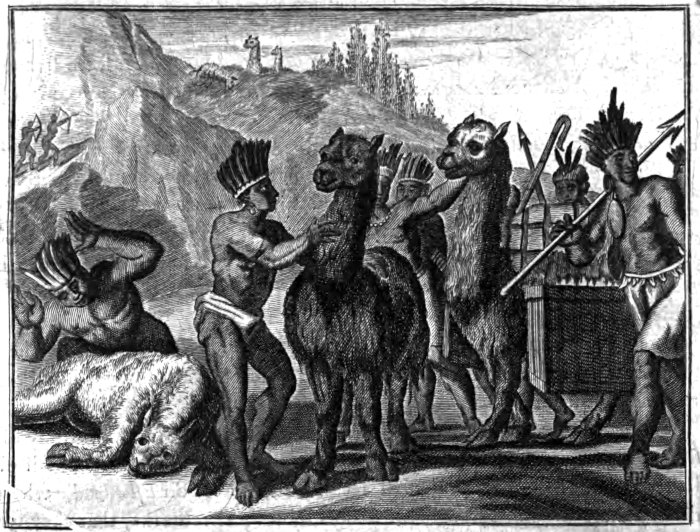
These Allegations, to make the Norwegians to be the Parents of the Northern Americans, John de Laet thus contradicts: “It no ways follows that one People take original from the other, because here and there are several words found, that have the same signification and found in divers Countreys; much less when they must either add, change, or diminish several Letters. Moreover, there is no small mistake in the compar’d words: for Pagod is not us’d all over America; the East-Indians about the River Indus, call their Idol-Temples Pagod, or Pagode, the word Guaira is no where us’d in America, but by the Peruvians, and with them not signifying a Fan, but a little Oven; neither is Ilama a Lamb, (for before the coming of the Spaniards thither, neither Sheep nor Lambs were ever seen in Peru) but a Wool-bearing Beast, thus describ’d by Joseph de Acosta:
A description of the strange Beast Ilama in Peru.
“Ilama (says he) a four-footed Creature, furnishes its Master with Meat and Clothing, and supplies the office of a Beast for Burthens, and at no charge for Hay nor Provender, well satisfi’d with what he finds in the Ways or Mountains. But the Ilama’s are of two sorts, either woolly, or shorthair’d: 33the first go by the Name Pacos, the other Moromoro, being not much less than a Calf, with a long Neck like a Camel, but of several colours; for some are white, some black, and others speckled, having an odd Look, especially when they are ty’d, and stand still without any motion, staring with goggle-eyes on their Owners: Sometimes in a moody humor, upon a sudden taking a freak, they run up to the top of almost inaccessible Mountains, where both the frantick Beast and his Burthen are lost. The Pacos sometimes likewise takes sudden Pets, and fustian Fits, often doing the forward Supersalt, tumbling over and over with their Goods, and will not be rais’d, their moodiness continuing, with beating, nay though they cut them to pieces: but the best way is to sit down by them, and wait some hours till their humor being spent they rise again of their own accords. These Beasts are much inclin’d to a Disease call’d Carashe or the Mange, of which they generally die: and because the Disease is very catching, they straight bury the infected alive, so the better to preserve the rest.”
Grotius also mistakes, when he compares the Mexican Peke with the Dutch Beke; for though many Mexican Places, Mountains, and Rivers, terminate in Peke, yet it signifies not a Brook or Rivulet, for that they call Atlauhtli.
De Orig. Gentium Americ.
John de Laet tells also, That with great diligence he found a Mexican Dictionary, Printed by the Spaniards in Mexico, to find if there were any words in it which agreed with any of those European Languages that he understood, but found not one.
It is the same case with the Customs and Constitutions between the Norwegians and Northern Americans: for what concerns Hunting, how many People have formerly liv’d by it? The antient Germans, and to this day the Tartars make it their whole business, excelling in that Art all other Nations. Besides, that the more serious sort of the Mexicans many Ages since scorn’d to derive themselves from a Hunting Ancestry, but affirm that they found the Chichimecen in those Countreys, who were great Venators.
Customs of the Americans.
Their Clothing.
The accounting of Time by the Nights, extracted from the Hebrews, is observ’d by divers Eastern People: and although the Germans dipt and wash’d their children in cold Rivers, or Brooks, so soon as they were born, yet the Mexicans never did it, but the Mother lays the Child on the fourth day after its Birth, in an open place of the House, in the middle whereof stands a Pot full of Water cover’d with Broom, in which they wash the Infant. Neither are the Americans so much addicted to the Vice of Gaming as other Nations, so that Grotius taxeth them too severely as to that point: as on the contrary, he too much clears them of Polygamy, whereas the Mexicans Marry as many Wives as they please, or are able to maintain. Father Martyn Perez relates the same of the Cinaloans, and other Americans; as also Quarterius of the Natives in Nova Francia, which lie nearest to Norway. And what need the Americans have the Germans their Teachers, to make Dams and Banks against Floods, since Nature and Necessity it self instructs it? and where are any People so ignorant, as to ascribe the same event to Men and Beasts after death? ’Tis true, their manner of eating in America is several, because the People do not much converse together: but they did not go naked; for the Spaniards found them not onely neatly Habited, but had a proper Name for every thing they wore. The Virginians us’d long Shirts; the Floridans Skins of wild Beasts; and towards the North they cover’d themselves from Head to Foot in hairy and undress’d Hydes. The sacrificing of Men was in former Ages spreading far and near 34over the World, and how far it was practis’d here, hath been already declar’d at large. Lastly, all the Americans are not guilty of eating of Man’s-flesh, but that salvageness is confin’d to the Southern America.
Thus much we have said, to prove that the Norwegians had no hand in planting the Northern America, we shall now proceed to enquire who planted the Southern Parts, from the Straights between Panama and Nombre de Dios, to the Straights of Magellan.
The Peruvians, possessing a large Tract of Land along the Coast of the South-Sea, Grotius would thus derive from China:
Relation of Mancocapacus.
“The Peruvians, being of a subtile Wit, and quick of Apprehension, argue sufficiently that they are not extracted from the more Northern Americans, but rather from the Chineses, which the several Wrecks of Chinese Ships found on these Coasts sufficiently evidence: and no wonder, if curiosity or accident brought the Chineses expert Navigators to this Countrey, separated onely by one Sea from them. To this we may add their Rites of Religion; for both worship the Sun, and call their King the Son of the Sun; they write no Letters but make Characters downwards. Mancocapacus was a Chinese of strange Policy; who being inform’d that his Countrey-men inhabited fruitful Countreys on the other side of the South-Sea, but without Laws or Government, Sail’d over thither, and gather’d the scatter’d Multitudes in a Body, and establish’d an hereditary Kingdom after the Chinese manner, to him and his Successors.”
The Americans are not extracted from China.
To which John de Laet answers thus: “Though the Peruvians exceed the other Americans in Policy, and at the arrival of the Spaniards liv’d in a handsom Order of Government, yet they can no ways be compar’d to the sharp-witted, and noble-spirited Chineses; nay, there are in no Place of Peru found such Artificers as those of China, that bear the praise of all the World; no where such manner of Buildings or Cities, nor the least likeness of the Chinese Curiosities. As concerning the Wrecks found in Peru, I find no credible Author that gives an account thereof: for certainly the Chineses could much easier, and a nearer way have come through the Atlantick Sea to the Coasts of America, lying to the East of Peru, than steer along the vast, and much greater South Sea, and endure the horrible Storms and vast Waves, which the European Ships are scarce able to endure, much less the Chinese Vessels, which are not so good. The Spaniards which Sail yearly from Acupulco to the Philippines are sensible of the great danger which they endure, chiefly by the great gusts of Wind near California. Besides, the Peruvians before the arrival of the Spaniards, were utterly ignorant of great Ships, and the use of Sails. How could they at once have forgotten that Art, which they brought with them thither, Moreover, it is easier to Sail from Peru to China, than from China to Peru, because the Winds under the Equinoctial Line commonly blow Easterly. And it is the greater wonder, that the Chinese Jonks accidentally by Storm should be driven to Peru, because they were never stor’d with Provisions but for a short Voyage, whereas this ask’d nine Moneths. But if any one will suppose, that they purposely directed their Course thither, how came the Chineses to Sail just to Peru, and not to New Spain, which is much closer to China? why were there no Merchandises of the Chineses found in Peru, since they went thither for Trade? how came they to neglect that Navigation they had once found? Nor is their Sun-worship (which was formerly practis’d in most Parts of the World) of 35any validity to derive them from China? But the contrary is most apparent, for the Peruvians worship for their chief God, Viracocha, that is, God Almighty, or The Creator of all things.
“The Chineses, if Confutius an eye-witness may be credited, are divided into three Sects of Religion: The first follow the Learn’d Trigantius, and acknowledge a King of the Heavens, which must onely be serv’d as the Chineses sole Governor; to which purpose, two Temples are built in the Royal Cities Nankin and Pekin, one Consecrate to Heaven, and the other to the Earth. The second Sect hath the name of Sciequia, and serve the Idol Omyto. The third nam’d Lanzu, imploy themselves in Magick and Exorcisms, Conjuring up, and laying Evil-Spirits, whose horrid representations, when they have stuck upon the Walls, they make an artificial and dreadful noise, as if Hell were broke loose, and the House full of Devils; sometimes also force the Evil-Spirits to enter into Images, from whence they receive no impertinent answers to their questions: Therefore, who will compare this Superstition of the Peruvians worshipping of the Sun, to the Chinese Religion, which do no such things?
Embassy to the Cham, l. 2. c. 2.
“The Peruvians call’d their King, A Lord of the Realm, and not The Son of the Sun, as in China: Though the Mexicans otherwise worship the Sun, and in their manner of adulation, styl’d Hernando Cortez, their Conqueror, Son of the Sun: As to what concerns the manner of writing, it is very well known, that the Chineses words are all Monosyllables, so that they have as many Letters as Words, which they joyn so together, that they reckon eighty thousand, but with ten thousand they are able to express themselves in most matters. These Characters are contain’d in their Halpien or Dictionary. The antient Chineses us’d seventeen several sorts of Characters in their writing, some consisting of Serpents, that by several Wreathes and contortious Windings, signify’d several things; others, of all sorts of agrestick Tools belonging to Husbandry; some Characters of the Feathers of the Bird Fum-hoar; others of Oysters and Worms, or of Roots, of Herbs, or Birds Claws, or of Turtles, or of Herbs and Birds Feathers mingled, or of Planets, and such like; but what manner of Writing or Hieroglyphick of theirs resembles those, who by their own testimony know neither Pen, Paper, Ink, nor any manner of Writing, but reckon the antiquity of time by strung Beads, which was observ’d many ages since among several Nations.”
Original of the Americans very obscure.
What we may believe concerning them.
The Americans are derived from several people.
Hitherto we have discover’d the several Opinions concerning the Original of the Americans, or first Plantation of America, from all which, having receiv’d no clear or demonstrative satisfaction, we must open our way to a further scrutiny: But first, we must needs confess, that contradiction is not difficult; but it is something of Work, when we have beaten down a well-fortifi’d Opinion, to set up somewhat in stead thereof, to stand a permanent and undeniable truth, which will be the harder, in regard the Inhabitants of this new World have no old Chronologies concerning their Antiquities, and first settling there; yet if we cannot go so far absolutely to assert, yet some probabilities, grounded (as we suppose) upon better reasons, may give more satisfaction; for none will deny, but that the Generations of Mankind being strangely multiply’d after the Flood, they then living five times our Ages, and Wars not beginning till the known part of the Earth was over-stock’d, justling for Territories, and some thrust quite out, at last found America; which spreading it self to a vast extent, and now found almost every where well inhabited, may be guess’d, 36that it was not onely Planted from the first, but several times replenish’d since by various Nations; Why may not several Planters, and at several times make room for their Colonies, incroaching one upon another, either by force or compact; as the French themselves upon the Gauls, the Normans upon them, the Goths among the Spaniards, and the Saxons among the Brittains, and the Normans again upon them?
Several people may easily Sail over thither, the Azores or the Canary Isles lye so, that they are ready (as if design’d) for Transportation to America; from whence Acosta made a Voyage in fifteen days. Also Pliny gives us an account, that these Islands lay uninhabited in his time; yet is it well known, that after Pliny’s time, Ruins of Buildings were found there, signifying, they had been formerly Planted; and why might not those ancient Inhabitants Sail thence to the neighboring America?
Marian. de Reb. Hisp. l. 1. c. 18.
Tercera lying half way between Spain and America, was frequented by Navigators before the Birth of our Savior; and it seems as easie to Sail from thence to America, as from the Main Land of Spain thither: Add this, that necessity forc’d the Spaniards to look about them from other Countreys, for since they lost their Victorious Champion Baucius Gapetus, they were every where beaten, being tired out by the Phenician Forces, and that oppression over, suffer’d as much under the Roman Yoke: Wherefore it seems not strange, if a considerable number remov’d from thence, that they might live some where else in quiet; for which purpose they wanted no conveniencies to Rig and set forth stout and sufficient Vessels, able to live in those Seas, having had long experience from the Phenician Voyagers, whose Fleets Sail’d daily to and again in several Expeditions, from Cadiz and Gibraltar towards these Western Countreys: Nay, Hanno himself their first Navigator that way, who gives an account of the Gorgons, or the Isles of Cape Verd, a good part of the way to America.
English famous Sea-men.
Barat-anac, or, Tinland, the Phenician name, and Brittania the Greek name of Brittain.
And though Brittain, Ireland, and the Brittish Orcades lay further from America, yet something may be said particularly to prove, That many Ages since, Expeditions had been made from thence to the New World; and that the Inhabitants of these our Isles, in former Ages, were peculiarly famous for their skill in Navigation; insomuch, that the Cretans and Phenicians emulous of their skill, and jealous of their danger, made several Attacques and Invasions upon these Isles, which is the more probable, many remarks of the Phenician and Greek Language, remaining in the denominations of the Countrey: Of which, take first this account:
Old Voyage of Madok to America; for which see Vet. Hist. Brit.
Anno 1170. When Owen Guyneth, Prince of Wales, having Raign’d long and happily in his setled Dominions, dying, left several Sons, who quarrelling, their elder Brother, as not contented with their shares of the Principality, nor to be under him, having gotten no mean Interests and Claims to the whole by their struglings, so weakned one another, that they open’d a way to the loosing of all.
David Powel in Historia Cambriæ.
Amongst these Brothers, Madok, a Prince of a milder disposition, weary of such unnatural Dissentions, threw up his share, better contented to seek new Fortunes abroad; whereupon there were many soon perswaded to venture their lives with him, where ever he would please to Transport: So Rigging a small Fleet, he Sail’d Westward, far beyond Ireland, where at last he discover’d an unknown and un-inhabited Countrey, but wondrous pleasant, the Air being temperate, and the Soyl most fertile: Glad of this good success (as the Story says) he returning, spreading the Fame of this his New-Found-Land, 37which they might exchange for a barren Soyl, hatter’d and harass’d with an endless Civil-War.
No small number flock’d to these Summons, as a most acceptable Undertaking; so that soon after he was able to send forth ten good Ships, Freighted only with Men, Women, and Children, and all other Materials fit for a new Plantation; which not long after Landed in Acuzamil, a Countrey in the North of America, as Francis Lopez de Gomara believes, because there he onely found some remaining Tracks of Christianity, a People that worshipp’d the Cross, but knew no reason why or wherefore they ador’d that sign of our Redemption. Now, some will say, that this Worship of the Cross is no argument to prove, that the Brittish Christians first Planted in the North of America; but what will not time and change of place do, where Transplanted People keep no Records, so they forget not onely Religion, Laws, and Customs, but who they were, and from whence they came, Oblivion first mutilating, and at last swallowing up all; of which, take this one late president.
Strange occasion of De la Roche.
Anno 1598. The Duke De La Roche obtain’d leave of the French King, to transport a Colony of Volunteers to New France; in his way he Landed fifty Men on the Island De Sable, to rest his Passengers, and that he might the better, and with more ease explore the Countrey, and when resolv’d where to settle, then to fetch them off; who accordingly, as design’d, soon after, returning thither, was met with so violent a Storm, that not being able to Weather the Isle of Sable, where he left his People, he lost his whole Expedition, and was driven back to a French Harbor, where no sooner arriv’d, he was so highly charg’d, that he was cast into Prison, when those he had left neglected upon the Isle, were not once so much as thought of; in this interim, they never expecting to hear more of their Captain, liv’d in a wild and miserable condition, feeding upon Fish, and sometimes wild Swine, without Bread, Drink, or Salt.
When the Baron of Leri went with Letters Patents, to be Governor of Nova Francia, and by stress of Weather in his Voyage, was forc’d to put in at Sable, where he found the remainder of La Roches People, who being from fifty reduced to twelve, having clad themselves in Sea-Wolves Skins, they had not onely lost their former French Civilities, but forgot in a manner their Religion, much of their Language, and what they were, being as if Metamorphos’d into bestial Salvages.
If some did not come accidentally to America.
And although we have already controverted the improbability of Peopling America, either by accident of Storm, or set purpose; yet it may be possible that so it might happen, for as the several vertues of Plants, Herbs, Precious-Stones, and Minerals, though strangely occult, and so altogether unknown, that what could never be found by Art, meer chance hath brought to light, and their wondrous qualities, some casual accident hath made apparent; so strange and remote Countreys never to be found in our Charts, or Maps, nor Registred in any Story, Seamen bound to their intended Harbors, have stumbled on by chance, either Hood-wink’d by blind Mists, or forc’d upon by pertinatious Weather; of which America may be her own witness, for how was Columbus stirr’d up, but by incitations of the Journals of a Sea-Captain, dying in his House, driven on the American Islands by foul Weather.
America was Peopled presently after the Flood.
Giants in America.
Conjurati fratres, Virg. Georg.
The Flood acknowledg’d there.
Although from the foremention’d places, and after the same manner, America might be furnish’d with Inhabitants; so it also gives us a more certain assurance, that the Planting of America was not onely soon after the Flood, but that they came also thither by Land: And how strangely would it be against 38the Majesty and Wisdom of Divine Providence, to leave half the Universal Globe, a World fully supply’d with all sorts of Creatures, fit for Food and Service, Plants, Herbs, and the richest Minerals, like a House new built, and well furnish’d, without a Master or any Inhabitant, viz. Man, who being of Celestial Extract, should be able to acknowledge and glorifie the Creator, by admiring the Creature in his great Works: Besides, the confus’d Notions and Fables of Giants, Perpetrators of all manner of Crimes, and wallowing in all kind of sensual Debaucheries, are always remembred among the Antiquities of the Americans, and that they had some slender hints of antient Truth, not onely of the Giants before the Flood, but of those that soon after the rank fatness of the Earth, produc’d and fed to that pitch of Arrogance, that the covenanting Brethren defi’d God, fortifying themselves to fight him by the advantage of that their long congested Pile, Babel, which in a short time was transverted by the Heathen Poets into their Gigantomachia, heaping Hills on Hills, like the American Traditions: From which we may conjecture, that they came thither in the time of Noah; for why may not any believe, when Noah liv’d three hundred years after he Landed on Mount Ararat, that he took care to People the World? And who will make him ignorant of this New World, who living five hundred years before, might not improbably by his own industry and the help of the former long-liv’d Patriarchs, been well able to make a general Survey of the Old; and he could better furnish America, it being nearer Mount Ararat, than supply Italy, Spain, Germany, or any Northern Territories in Europe, so that America might be known to the first people after the Flood, nay, inhabited by them, though since that, the knowledge was lost.
Pliny complaining of the Supine negligence, and stupendious sloth which reign’d then and long before as he had observ’d, among all people, and in every place, who were so far from making inquiry after discoveries of Lands for new Plantations, that they lost the old, when they had begun to settle, though under the greatest serenity of Peace; The Sea by that means lying open beyond what any juncture of former times could be proud of.
Canary Islands, by whom discover’d.
Hesperian Gardens, what they signifie.
Yet the Fortunate, or Canary Islands were in the first ages after Noah, frequented with Vessels, which in later times were altogether neglected, till Guillaum Betancourt, a Gentleman of Picardye, brought them again to be taken notice of by a fresh Trade. The Fable of the Hesperian Gardens, and the Dragon that kept the Golden Fruit, with constant Vigils, is nothing but an allusion to the Sea, which with Serpentine Embraces, not onely secur’d these scatter’d Isles, but swallow’d up several Adventurers that too hardy made their unhappy approaches for discovery.
Another Allegation for the Planting of America by Land, both whose sides are wash’d on the East and West, by the South and Atlantick Ocean, may be thus probably made out: The Atlantick rowls over with almost Fathomless Waters, three thousand Leagues of Ground; the South-Sea not much less, which well may be, being indeed but one continu’d Sea, encompassing, till meeting there, the Universal Ball; whence springs a more likelyhood, that America might be Planted from the Southern parts, from the Straights of Magellan, and Le-Mayr.
Relatio de Terra Australe.
The Description of the unknown South.
Peter Fernandes de Quir relates, That he and a Commander, Lodowick Paes le Torres saw a part of the South Countrey, and in it innumerable Inhabitants, Whites, Blacks, Sallows, with long, black, curl’d, Woolly, and yellow Hair. They know no Walls or Fortresses for Defence, Laws or Kings, but are divided 39into Tribes: They use indeed Bows, Arrows, Clubs, and a kind of Spears: Their Houses are cover’d with Palm-Tree-Leaves; their Housholdstuff consists onely of a few Earthen Pots, and such Trinkets; yet they have some little skill in Weaving, and though they go naked, pride themselves in Neck-Laces and Bracelets, made of Mother of Pearl: But these for their Complexions and Constitution of Body, Customs, and manners, are rather deriv’d from the Americans, than they from them, and therefore we must seek for their Original from the North; from which are but two ways, one from Ysland and Groenland, which Grotius endeavors to prove, but contradicted; the other out of Tartary, which certainly was the first Nursery, from whence the Americans were Transplanted.
Description of Tartary.
Tartary or Tattary, so call’d from the River Tatter, which runs thorow the Countrey Mongul into the Northern Ocean, covers a great part of the Terrestrial Globe; the lesser Tartary makes out a considerable part of Europe; the greater is Asia.
This great Tartary, which is a thousand Leagues long, and six hundred broad, reckons five chief Provinces, viz. the wild Tartary, inhabited by Herdsmen; Sagatai, of which the Metropolis is Samarcand, famous for the mighty Tamerlane; next Turkestan; then Kitai, which the great Cham Commands; and lastly, Old Tartary, according to Andreas Cæsariensis, the habitation of Gog and Magog.
Now we must enquire from what Tartars the Americans are Extracted:
Thrian l. 67.
If the Israelites were Tartars.
Mornæus, Postellus, Genebrardus, Poterus, and others are of opinion, That the Tartars, which about the year 1228. under the Command of Zingis Cham overspread the Earth like a deluge, were the Successors of the ten Tribes of Israel, which were carry’d into captivity to Assyria by Salmanazar. The name Tartary, or rather Tattaria, seems to be some testimony thereof, because it signifies in the Syrian or Hebrew Tongue, Remnants or Remainders, as seemingly, because these Tartarians were remainders of the foremention’d Tribes; nay, the Northern Tartary Herdsmen preserve to this day the Names Dan, Zabulon, and Naphthali: Wherefore we need not to admire, why so many Jews are found in Russia, Sarmatia, and Liefland; nay, the nearer to Tartary, the more Jews there are.
Circumcision hath a long time been observ’d among them, before Mahomet brought in his new Law; it seems, that Mahomet order’d the Circumcision and other Laws, according to Moses, to be observ’d by the Northern people, because that in his time, they began to Rebel, that so they might the better be kept in awe by their new Religion.
Pand. Hist. Turcica.
Joannes Leonclavius relates, That in Liefland near Riga, he heard the wilde Natives call’d Letti, not without great admiration, go crying along the High-Ways and Fields, with a doleful voice, Jeru, Jeru, Masco lou: It is believ’d that they mourn for Jerusalem and Damascus; but by their long continuance in the vast Wildernesses, they have forgot their Religion and Laws, and what else might enable to tell us who they were. Several learned Authors question this removal of the Israelites out of Assyria to Tartary, though to our Judgement their Arguments are too weak, to take from them of the footing they have gotten there; yet nevertheless, the Israelites are not to be taken for the Planters of America, for why else is not Judaisme as well found in America as in Tartary. But it is already shewn, that America was inhabited long before the dispersion of the Israelites.
Americans are not deriv’d from Africa nor Europe.
But Asia, and chiefly out of Tartary.
Now to shut up all, it is evident, that the first Planters of America were not Europeans from the dissimilitude of the People, both in their Complexions, Language 40and Persons; nor Africans, because that in all the far-spreading Countrey of America, not one Negro is to be found, except a few near the River Martha, in the little Territory Quarequa, which must by Storm be drove thither from the Guinny Coast: So that Asia, the Mother of all People, onely remains to be Implanter of our America, whose Western Coast, opposite to Asia, is more inhabited than to the East, where it respects Europe.
Tartary is not parted from America by the Straights of Anian.
Moreover, Armenia, out of which, by Noah’s Progeny, the whole Earth was re-peopled, borders on Scythia, now call’d Tartary, and Tartary faces America, separated onely by the Straights of Anian; though some are of opinion, that out of the South into the Frozen Sea, there is no passage thorow these Straights, else (as we have already prov’d the contrary) how came all those Voracious and Poysonous Beasts into America, if it be clearly separated from Asia by Sea?
It deserves here to be related, what happen’d to Henry Cornelison Schaep, and William Byleveld, Sailing from Batavia to discover the Tartarick River Polysange, but were taken and carry’d Prisoners to the Japan Court at Jedo; being Commanded there by Order of the Councel to give an account of a Japan Map or Card, which was laid before them, and contain’d the Provinces of Japan, Amboina, the Molucca Islands, Manilha, the South-Sea, Borneo, Celebes, Malacca, Tartary, Formosa, Corea, and the vast and Mountainous Countrey or Desart of Jesso, separated from Japan by the Straights of Sungar; though toward the North, it joyns to Japan in the Province of Ochio; and beginning in forty seven degrees, run North-East towards America, but they could not possible find the Straights of Anian; but on the contrary, the Promontory of Tartary, viz. the Province Kataya or Katui lay in the same parallel with the Northern America.
Ennead 9. l. 6. Testimonies that the Americans are Tartars.
Hereto may be added, that Asia hath no Territory any where, which may more easily with numerous Colonies supply America than this part of Tartary, as well for the vastness of the Countrey, to which no other can compare, as for the increasing of the Inhabitants: Who doth not admire, that according to Michalon Lithouwer, there is scarce a City in Tartary that boasted less than a thousand Temples? and to see Canguista first King of Tartary, about the Year 1200. in Arms; and his Successor Hoccata following his Fathers bloody Footsteps, whilst he prepar’d his Sons with three vast Armies? The eldest Son, Jachis, March’d Westward with thirty thousand Horse; Batho drew with as great an Army towards the North; Tagladais being the youngest fell into the Moores Countrey above Egypt. Hoccata himself March’d victoriously into the North America, subdu’d great part of the Persian Kingdom, and beat the Turks, led by the General Goniata with a great Army, Anno 1241. as Jacob Planensis and Benedictus Sarmata, two Monks, sent by Pope Innocent to Hoccata, witness: The great number of the Tartars or Scythians, may appear by the several people, spread far and near over Tartary; Pliny reckons some of them, viz. Auchetes, Neuri, Geloni, Thussagetes, Budini, Basilides, Agathyrsi, Nomades, Anthropophagi, Hyperborei, Arimphei, Cimmerij, Cicianthi, Georgi, Sacores, and others: What number would the Inhabitants make up that live in America, in Teneneuf, Virginia, Florida, New Spain, Guadalaiara, Guatemala, Terra firma, New Granada, Peru, Chili, Rio de la Plata, Brasil, Guaiana, New Andaluzai?
It will be worth our time, to compare the likeness between the Scythians and Northern Americans; both of them are differenc’d with special Marks of a more than ordinary and natural distance between the Eyes, which much alters the whole Air of the Face, and the plumpness and swelling of their Cheeks summits 41above the Cheek-bone; most of these are of a middle stature, having downy Hair upon their Chin, like the Callow Feathers of an unfledg’d Bird. Lastly, as the Tartars, they differ amongst themselves in their Customs, yet in several things they agree one with another, according as they are govern’d by others, and yet other Princes, some powerful, and some weaker, according as every ones power be more or less. The Inhabitants of Lucaja bear so great a respect, and stand so much in awe of their Governor, that if commanded to leap from a Rock, and break their Necks, they instantly obey.
The same is observ’d by the Tartars; the first King Canguista Commanded the seven Princes of his Realm to Murder their Sons with their own Hands, which they all readily perform’d.
Constitutions of the Tartars and Americans agree.
In Popaina they live to this day like some Tartars, without Laws or Law-givers, who change their places by turns, from the great increase of the Tartars, the Americans no ways differ.
Bartholomeus de las Casas writ to Charles the Fifth, That the Spaniards in few years, onely on the Islands Cuba, Hispaniola, Naco, Hondures, in Venezuela and New Spain, destroy’d above 2600000. Men, besides the slaughter that was made in Peru, Brasil, Rio de la Plata and other places, which far exceed the foremention’d numbers.
Polygamy is still in use, both among the Tartars and Americans; both acknowledge the Immortality of the Soul, both like Cannibals, Eating and Sacrificing Mans flesh. How famous amongst the Antients was the Altar of Diana in Taurica Chersonesus, where several Men were daily Sacrificed? How delicate, according to Sabellicus, did the Tartars account their Dishes, Sauc’d and serv’d with humane Gore?
Geogr. l. 11 q. 7.
Strabo relates, That the antient People account it an honourable Death to be chop’d in pieces, and their flesh serv’d up in Commons. Those that die by Age, a natural death, are despis’d like Malefactors, and as a punishment according to their Demerits, left in the open Fields, a prey to Birds and Beasts; some delight in that loathsome gorging themselves with Mens flesh, others on the contrary, not onely detest humane, but all manner of flesh: And just so the Americans are distinguish’d, for although the Caribes, Brasilians, the Inhabitants of New Spain, New Granada, St. Martha, and others, Sacrifice and eat Men, yet as many abhor and detest that odious Diet and abominable Custom.
Giles Flesher Queen Elisabeths Agent in Muscow relates, That Anno 1588. Kinach Morsey, Grandson to the Governor of the Chrim Tartars, made his entrance there with a Retinue of three hundred Noblemen, and two Ladies, of which one was the Widow of his deceased Brother. The great Prince inform’d of their coming, sent him two slaughter’d Horses, whose sides and Hanches they feasted on, as we on Fallow Deer.
Devil-worship in Americ.
Most of the Tartars use no manner of Letters or Characters; in the Voyage made into Persia, they first learn’d to make Letters; just so it is in America; their bemoaning of the dead ends in one Moneth, both by the Tartars and Americans; with a Person of Quality, the Tartars bury a live Servant; the same Custom is observ’d by some of the Americans; and so much do they agree in a salvage and rude life, that Merchandizing and Mechanicks are little regarded. Ayson the American acknowledges the Tartars for a rude People in their Religion, Habits, and Dwellings, and yet in all these the Americans differ but very little. Lastly, How common is it amongst them to worship the Devil? Along the River Sagadahoc, the Inhabitants are every new Moon miserably tormented by 42an Evil Spirit call’d Tanto. In the Temples in Virginia remain yet the horrible Images of the Devils Oka and Menetto. Not a House in Mexico, but hath a peculiar Chappel, set apart for this their suppos’d holy, but damnable Adoration of the Devil. Others in Virginia believe, That there is a great and supreme Deity, which is Everlasting, and for ever. The Tartars also are of the like perswasion.
Tartarian Horses.
But this Opinion Grotius hath laid a strong and dangerous Battery against, that America could not be Peopled by the Tartars, because the Americans before the Spaniards coming thither, had never seen any Horses; whereas the Tartars use no Beast more, either in Peace or War, nor can less want: For the Tartarian Forces do not only consist in Horse; but the Wealth of this Countrey is reckon’d up in the numerous Breeds of Horses, and several Studs of Mares. Some of the Nobless keep a thousand Horse; none, though never so poor, but keep two or three; and Beggars there mounted crave Alms and Charity of the People. When they remove their Habitations, their Horses carry their Provisions and Tents: If Provisions grow short, they eat Mares Milk, high gusted with Garlick, which satisfies Hunger and Thirst; and the red Liquor which they tap warm from their Veins, serves them to help Digestion, and heighten their Humor, instead of the Blood of the Grape, our sweet Wine. The swiftest Rivers, though raging and precipitated with Land-floods, they dare adventure swimming their Horses over, hanging naked by their Manes, and guiding them by a slipp’d Rein whither they please: To their Tails they tie their Saddles, and other Necessaries, bound up in Rushes. When a Person of Quality prepares to cross any River, they tie two Horses Tail to Tail, and athwart both their Backs fasten a Mat pleited of Rushes, to sit on. When they are stopp’d at any broad River, or standing Lake, they kill and flea their worst Horses; then turning the Skins inside out, and well Liquoring, they stretch them open with the Ribs, which stand like the Bayles of a Tilted Wherry, and thus furnish’d, serves them for a Boat to carry eight Persons. When they take the Field, going to War, not any but musters three Horses; which makes their Armies, when drawn out in Campain, shew much bigger than indeed they are: And though many of them are kill’d in the Wars, or slain for Food, yet the European Tartars pay yearly forty thousand Horses to the Russians; from whence Grotius thus argues, “If America joyns to Tartary, then the Horses which run wild at Grass might easily have found America themselves, seeking to improve their Pasture, and have gone from one Countrey into the other, as it appears, that since the Spaniards transported Horses to America, they are dispers’d over the highest Mountains, out of one Province into the other: Or if the Straights of Anian run between both, the Tartars never were Navigators; and suppose they had been, they would not have cross’d without Horses, without which they knew not how to subsist.” To which we only say thus, That although Tartary now, and in former times, abounded in Horse, yet must we grant, that it hath been always so? or that the ancient Scythians, who we avouch first planted America, had such frequent use of them as the Tartars now. This may be controverted, for that these Scythians planting there in the Non-age of Time, presently after the Flood, the use of Horses was unknown, which the Ancient Poets testifie by their Fiction of Centaurs, who when first seen, the Horse and Rider were taken for one Creature. The like mistake the Mexicans had, when they saw the mounted Spaniards, a thousand running away from one Cavalier.
43As to their coming thither of themselves, it may easily be confuted: Who knows not, that there is no Countrey a continu’d Pasture, but luxurious Vales separated with inaccessible Mountains, Lakes, and vast Wildernesses. But David Ingram relates, “That he saw some Horses in the Northern America, which the Mexicans, and other Conquests of the Spaniards never heard of:” Whereupon we may conclude, and we suppose without all peradventure, That the Americans have absolutely their Original from Tartary, which bordering Armenia, where Noah’s Ark first rested, hath a convenient way, though beyond the Artick Circle, through a temperate Climate betwixt Heat and Cold, to Cathay, in the same Parallel with the neighboring America.

CHAP. III. First Discoverers of America. Christopher Colonus his Expedition.
Pet Bizari Res Genoan. lib. 16.
Christopher Colonus, generally (though by mistake) call’d Columbus, was Lib. 11. Hist. Georg. born in Arbizolo, a Village in the Dominion of Genoa, near Savona; his Christoph. Colonus’s Birth. Father liv’d by Fishing in the Midland-Sea: So that Sebastian Schroter, and others besides him, are mistaken, saying, Colonus was born in the City Cucureum, and descended of the Noble Family Pilistrelli: For Peter Bezarus, Colonus his Countrey-man, gives unquestionable Proofs of his mean Extract; and amongst other things, That the Common-wealth of Genoa refus’d to receive the great Legacy which Colonus left them in his Will, because they fondly thought it a derogation to their Honor, being so great a Republick, to take any thing of Bequest from a Fishers Son: Yet his Majesty of Castile thought otherwise, not onely enriching him with Wealth, and a fair Revenue for his Discovery of the West-Indies; but also, though of a low derivation, rais’d him to great Honor, Ennobling him the first of his Family with Dignities, Titles, and Escutcheon, which rank’d him in place among his Prime Nobility.
His Life.
Strange Accident. Hist. Peru.
Makes his Address at Genoa.
To the Portuguese,
English,
And Castilian King, concerning a New World.
Sails from Cadiz to discover New Countreys.
His People rebel.
Discovers Hispaniola.
Trades with the Natives.
Colonus, whom we shall henceforth call Columbus, spent his Youth near the Sea, where he was busie exploring the Winds, considering their Natures, and the Quarters whence they rose, especially with the setting of the Current from the Atlantick to the Mediterrane. The Western Winds, which often, as well as the Levant, blow several days together from the great Ocean, much amusing him, hinted at last some Notions, that there might be another World, and new Places to be discover’d, beyond the setting of the Sun; and that the Ne plus ultra should not be, if he could help it, the commanding Terminary of the Earth that way. He also spent much time, being of a solid Judgment, in the Emendations of Charts and Maps, then very much improvable: And the Portuguese, who at that time had got the start in Navigation from all other People, being then busie to find a way by the South of Africa to the East-Indies, not contented to go by hearsay, he went himself in Person a Voyage with them. Soon after Columbus settled himself in the Island Madera, where an Accident hapned, which Francis Lopez de Gomesa relates thus: “The Master of a Ship, whose Name and Countrey lies buried in Oblivion (though some would have him to be of Spain, some an Andalusian or Biscayner, and others a Portuguese) Trading the Canaries and Flemmish-Isles, was surpris’d by a hideous Tempest 44from the East, which hurried him nolens volens through dreadful Waves, where at last he found himself ingag’d upon a Western Coast, altogether unknown. The Storm ceasing, without making further Discoveries, he pick’d his way homeward, at last Landing in the Haven of Madera: All his Crew but three and himself, with hardship, want, and the long Voyage having perish’d, himself dangerously sick, was carried into Columbus his House; where lying on his Death-Bed, he bequeath’d to Columbus his Maps, Journals, and other Observations of this his unfortunate Voyage.” Columbus being by these Papers more confirm’d than ever in his Opinion of a New World in the West, declar’d what he verily believ’d, to the States of Genoa; but they look’d upon him as a vain and idle Fellow; yet Columbus full of his great Project, thus slighted and scornfully rejected, sate not so down, but address’d himself to the King of Portugal, where they wearied him, spending long time with dilatory Answers, to no effect; the Opinion of a whole Court of expert Navigators having cast his Declaration out, as a Chimera or meer Fancy. Soon after Columbus sending his Brother into England, to move the Business to King Henry the Seventh, he being taken Prisoner by the way, and lying long er’e his Release, came too late to the English Court, prevented by the News of Christopher’s return with Success from his intended Voyage: For mean while Ferdinando and Isabella King of Castile, having finish’d his Wars with the Moors, had furnish’d him out for the Expedition; which he effected by the favor of Alfonso Mendotio and Alfonso Quintavilia, both great Ministers of State under Ferdinand and Isabel, and obtain’d so much at last, that he was sent with a hundred and twenty Souldiers, besides Sea-men, in two Ships, and one Pinnace. Thus supplied, he set Sail from Cadiz upon the Kings account the fourth of August, Anno 1492. and first reach’d the Canary-Islands, and from thence steering South-West, the Wind in thirty three days scarce varying one Point: But though the Weather blew so constant, yet the Sea-men chang’d their Minds, and Storm’d quite contrary, crying, That Columbus was guilty of all their Deaths: For (said they, after they had lost sight of the Canaries so many days, nothing appearing but Sea and Sky) Who can hope for any Success or happy conclusion of so desperate a Voyage, so rashly undertaken, and found now so full of eminent danger? Yet Columbus bore bravely up, and weather’d all their Exclamations, although they threatned no less than his Murder: At last Articling, they came to this Agreement, That if after sailing forwards three days more, no Land were discover’d, they should return: But about two a Clock the next Night, Columbus saw a glimmering like Fire in the Sky, and in the Morning found himself close aboard a most pleasant Coast, where Landing with twelve Men, he erected a Cross cut out of a Tree. Thence he sail’d over to Cuba, where the Sea was so rough, that he was forc’d to stand off, fearing Rocks and Shallow Water. Soon after he got to the Northward of the Island Haytin, which he call’d Hispaniola: Here his best Ship was bulged upon a Rock, on which they had all perish’d, had it not been flat on the top, so that the Soldiers and the whole Crew of Sea-men were sav’d by the two Vessels. The Inhabitants stark naked, seeing these Strangers, fled to the Woods; but the Spaniards overtaking a Woman, they entertain’d her with Sweet-meats and Spanish Wine, and putting her on a white Shirt, sent her again to the rest of the Natives, where return’d, she told what good Entertainment she had had to her Companions; whereupon divers of the Islanders came aboard of the Spaniards, in Boats made of one piece of Wood, where they barter’d Gold for Beads, pieces of Glass, Knives, Shells, 45and other Trifles. The King of Guaccanarillo gave testimony of peculiar inclination to the Spaniards, helping them to Fish up the remaining Goods of the Wreck, and inform’d them, That some Rivers flowing from the tops of high Mountains, wash’d down the Gold amongst the Sand: notwithstanding a strange Prophecy had been told to these Islanders, namely, That Bearded Men out of remote Countries should destroy their Goods, take their Land, and massacre their Children. He also told them what made them fly, and betake them to their Heels at the arrival of the Spaniards, because they were oftentimes surpris’d by the Cannibals, who snatch’d up all they could lay hold on: Their Boys and Striplings they gelded, cooping and cramming them up, as we our Capons, for Feasts: The young and well-grown Men they chopp’d to pieces, salted, and Barrel’d up: Young Women they preserv’d for breed, and old ones they made Slaves. These Cannibals were so terrible to the Inhabitants of Haytin, that a thousand of them durst not venture to engage against ten, but would run every way, dispers’d like Flocks of Sheep before the Wolf.
Lastly, Their King permitted the Spaniards to build a Lodge or Hovel, wherein thirty or forty of them might shelter; but indeed so taking possession in right of the King of Spain.
Returns to Spain.
Is highly honor’d.
Goes with seventeen Sail a second time to Hispaniola.
Mean while Columbus return’d in safety to Spain, and was receiv’d with great joy, King Ferdinand making him Admiral of the Sea, and sending his Brother Bartholomew Governor to Haytin, now call’d Hispaniola. The Gold, Parrots, Mastick, Aloes, the strange Bread Jucca, whose extracted Juyce is rank Poyson, but the Body makes good Meal, which kneaded and bak’d, yields a fine Manchet and wholesom Food, they look’d upon with great delight and admiration; but two of the Natives being naked, with Gold Rings through their Noses and Ears, Ornaments with them of high esteem, and signifying their no mean Quality, the People old and young came in Throngs to wonder at, never weary of gazing upon them. But the King, encourag’d by this Success, took no dilatory Course, but suddenly, and before any could expect, built fourteen stout Carvels, and three Frigats, and as soon mann’d them with twelve hundred Soldiers, besides a great number of Artificers of all sorts, with their Wives and Children, freighting them with Horses, Swine, Goats, Cattel for Breed, all sorts of European Corn to sow, Fruit-Trees and Vines to plant, and some Priests to instruct and convert the Natives to their Religion.
The Barbadoes, St. Christophers, &c.
The Huts of the Cannibals.
The second of September, Anno 1493. they set sail from Cadiz, and Anchor’d before Ferreo, the last and furthest of the Canary-Islands, where they could get no Water, but what dropp’d from the Dew hanging on Trees into Troughs. After that, Columbus came on the one and twentieth day amongst the Caribby-Islands, where he dropp’d Anchor before one, which he call’d Dominico; but finding it desolate, set sail further, and discover’d several other Coasts, where he likewise found nothing but very great Porcupines or Hedg-hogs, and sweet-smelling Trees. Steering forward, he found the Coasts of the Cannibals, which inhabited along the Shore in little Huts or Hovels, built round of Wood, and stak’d about on the out-side with long Poles, like Palisado’s: They have also Posts within, which are shorter, pleited and fastned together with Cotton, or long Roots of Trees, plyant like our Osiars, over which they hang Cloths painted with horrible Figures and strange Representations: The Roofs rise like our Canopy’d Tents, highest in the middle, cover’d with Palm-Tree Leaves to keep off the Rain: At the Entrances hang two Hairy Images on Poles, not for Religion sake, but Ornament: Their Bed-steads being high 46from the Ground, are fill’d with a kind of Straw; and in long Hovels fitted for that purpose they store their Sugar.
Island Guadalupe.
Columbus landing here, found all the Cannibals fled; but their Houses full of Stone Vessels, Cruises, Pans, and Pots, boyling with Mens Flesh, Parrots, and Wild-foul; the Hanches and Sides of young Men, on Spits roasting at the Fire, with the Splinters of whose broken Bones they headed their Arrows. This Island by the Inhabitants call’d Carucueria, Columbus chang’d to Guadalupe, because the Mountains rise up with their tops not unlike Estremadura in Spain, famous there for the wonderful Representation of our Lady, as that of the Lady of Loretto in Italy. Thirty Women which he had taken from the neighboring Isles, he sent with Presents to the fled Canibals, which the next day returning, made a great appearance near the Shore; but when they had gaz’d a while upon the Spaniards, looking stedfastly on one another, they suddenly ran back again, sheltring themselves in the Covert of the Woods. Columbus thinking it not worth his while to expect their return, seeing their barbarous Life, burnt and destroy’d all their Boats, and spoiling whatever he could, sail’d to Matanino.
Strange Women in Matanino.
The releas’d Women in Guadalupe, that came back again, inform’d the Spaniards, That Matanino was an Isle onely inhabited by Women, which at accustom’d times row’d over to these Cannibals, where a while they drove a Trade and Commerce of Love, the Product of which, if Girls, they kept; but the Boys they sent over to their Fathers. They live in Caves, the Mouths and Entrances of which they maintain and stoutly make good with their Bowe, shooting Arrows as thick as Hail at the approach of Men, after their impregnating by the Cannibals.
Remarkable Passage of Columbus.
Salvageness of the Indians.
From hence the Fleet pass’d by several other fruitful Islands, Columbus giving them the Names of Montseratto, Rodondo, St. Martin, Santa Cruz, formerly by the Inhabitants call’d Ayaya. On this last Island he landed thirty Men, who took four Women, which held out their Hands before them, as if Petitioners that begg’d Quarter, or praying, and then conceal’d themselves in Ambuscade, the better to surprize more; when by chance they spied an Indian Canoo at Sea, with eight Men, and as many Women; whereupon those in Ambuscade made a Signal to the next Ship, which immediately sent off some Boats well Mann’d; but before they drew near them, or expected an On-set, one of the Spaniards was kill’d, and another wounded with their Arrows; amongst whom a Woman, to whom all the rest shew’d greatest Respect and Reverence, aim’d very exactly. Their barbed Shafts were poyson’d; whereupon the Spaniards enrag’d, stemm’d the Canoo, and oversetting, row’d quite over; which little or nothing avail’d; for they all swam, and though separated, shot their Arrows at them, as if the Boat had been a But. At last the Indians got upon a blind Rock, cover’d with Shole Water, which gave them fresh Courage; but the Spaniards having more aid sent them from the Fleet, took them all Prisoners; but the Queens Son being wounded in the Scuffle, and dying soon after, was thrown overboard. The Prisoners being brought before Columbus, foam’d at the Mouth for raging madness; and being afterwards carried to Castile, so retain’d their fierce and salvage Nature, that they scar’d away and frighted the safe Beholders.
Columbus comes to Hispaniola.
Finds the Spaniards slain.
His Discourse with the King Guaccanarillo.
Strange gathering of Gold.
Decas 1. De Orba Novo.
Mean while the Spanish Fleet proceeded on their Voyage, between several Islands, to Hispaniola, of which some appear desolate and barren, others green and Woody; the small Vessels sailing close under the Shore, and the great ones 47standing further off at Sea, which was very turbulent, and beat exceedingly against the Shole Rocks. The Island Burichema, Columbus call’d St. Johns, to which belong’d some of the Women sent forth in Guadalupe, who inform’d them, That Burichema was well inhabited by a kind and hospitable People, who when the Cannibals landed there fought them, and if Conquerors, were so much exasperated with their inhumane Barbarisms, that they seiz’d on them like Mastiffs open-mouth’d, and tore them piece-meal with their Teeth; yet themselves abhorring the Custom of eating Mens Flesh. Here the Spaniards found onely a large House, surrounded with twelve lesser ones, all deserted; for the Inhabitants with their King Chiasichio were then retir’d into the cool and more sheltring Woods, from the mid-day Heat. All this the Indians told him, which he brought back with him from Spain. Coming to an Anchor at Hispaniola, he sent one of the Indians ashore, that he might tell what brave things he had seen in the Spanish Court; but the remaining three took the advantage of the following Night, and leaping over-board, swam to Shore. But this Accident he not much regarded, trusting to have a sufficient Account from his eight and thirty Spaniards which he had left in the Fort upon the Island; and the more, because King Guaccanarillo’s brother, in sign of Friendship, had presented him with two Golden Images: But all these Conjectures fail’d him, so that hearing nothing, he landed, where he found the Spanish Garrison utterly destroy’d, and the Royal Fort burnt down to the Ground, and lying in a heap of Ashes. Then they fired several Guns, to give notice, that if any of them had conceal’d themselves, and lay sculking in the Woods, or otherwise, they should discover themselves, and come to the succour of their Friends: But all in vain, for none came; for as they were afterwards inform’d, the Inhabitants had slain them, because of their insupportable behavior, insolently committing Robberies, Rapes, and Murders: Hereupon he sent Messengers to the King Guaccanarillo, to inquire why they had fired his Fort, and what they had done with his Men, who brought him this Return, That over that mighty Island were many Princes, of which two being provok’d by the reports of the Strangers that were entertain’d in the Island, came marching upon them, each with their Armies; but that he endeavor’d what he could, and came with a Power to assist the Strangers; yet all he got for his Kindness, was a Wound in his Leg, which had been so sore and troublesom, that forc’d him to keep his Bed, and no less than seven Concubines to attend him, and dress the Wound: But he told his Tale so ill, and feign’d his Lameness worse, that Sibilius, one of the Messengers sent by Columbus, lifting up the Coverlet, saw that he ail’d nothing, which soon confirm’d his doubt, that he was confederated with the rest, and alike guilty of the Slaughter. At last Guaccanarillo being desir’d, came in Person to Columbus, in whose presence he held a long Discourse with an Indian Woman, which they had brought from the Island of Santa Cruz, there Christned by the Name of Catharine: At length Guaccanarillo was dismiss’d, and the Night following this Catharine, with seven more of the Indian Women, leap’d over-board, and swom almost a League to Shore, so going thence directly to their King Guaccanarillo. This Accident gave more suspicion to Columbus, who thereupon sent three hundred Men, commanded by Melchior, Hoieda, and Gorvalano, to march through the Island three several ways, and with special Commission to secure as their Prisoner Guaccanarillo. Melchior discover’d a wide River, full of Reaches and winding Bays, gliding between high Hills cover’d with Woods, resounding with the ecchoing noises of harmonious 48Birds, and disemboguing his Waters, enlarg’d by two other Rivers, into the Sea, so making a convenient Harbor for Ships. Here a hundred of the Islanders, well Arm’d after their manner, met them, crying aloud, We are no Cannibals, but Taynos, that is, a People more civil than they are cruel. The Spaniards making Signs of Peace, the Taynos approach’d, and joyn’d their Forces in a friendly manner. Near the place of this Meeting appear’d a House built in an Oval fashion, being thirty two Paces in the Circumference, the Roof curiously pleited of divers colour’d Rushes, round about which stood thirty lesser Dwellings. Mean while, in his March Hoieda discover’d a River that descended from a high Mountain, where the Inhabitants gather’d much Gold after this manner: They dig a Hole about two Foot deep; then taking up their left Hand full of Sand, with their right Hand they cull out the precious Ingots, which little accounting of, as they gather’d, they dealt away to the Spaniards. Most of the Pieces were as big as Pease, yet some so large, that they weigh’d nine Ounces. Peter Martyr, Councellor to the Emperor Charles, tells us, That he hath seen of them in the Spanish Court, that were brought over thither by Columbus. Moreover, Hoieda was inform’d here, That this Gold-River took its Original in the Province belonging to Cacicus Caunaboa, signifying, The King of the Golden Palace.
Columbus builds a City.
Strange fruitfulness there.
Mean time Columbus selected a piece of Ground on a rising Hill, on the North part of the Isle, where he intended to build a City, because close by the Hill on one side rises a Mountain, pregnant with Stone and Chalk; on the other, a Plain, so exceeding fruitful and pleasant, that the Sun scarce shines upon a more delightful and fertile Soil, which they found afterwards by experience. Here Melons are set and ripe in thirty six days; Corn, in two Months; twice a Year the Trees and Plants bring forth their several Products; the Vines come to maturity, and are loaden with Clusters of Grapes, in two Years, and Sugar-Canes grow as thick as a Mans Arm in fifteen days. On this pleasant Soil, accommodated with a convenient Haven, Columbus afterwards built the City Isabella, fortified with Walls and Trenches against all Invasions, over which he made his Brother Bartholomew Columbus first Governor.
Mean while the Admiral Columbus himself march’d up into the Countrey with three hundred Men, in quest of the Gold Mines. Seventy two Leagues the Valley Cibava lies distant from Isabella, to which Columbus pass’d over swift Currents and high Mountains, where he built a Fort, which he call’d St. Thomas; and exchang’d with the Inhabitants Toys and Trifles, for Pieces and Ingots of Gold, which the Inhabitants, as before-mention’d, found in the Sand of their Rivers: And besides, they inform’d him, That about half a days Journey further, greater Quantities of Gold were to be found, in a browner colour’d Soil: Whereupon Luxanus, one of his Officers, was sent with a sufficient Party thither, who march’d through a delightful way, cool with shady Boughs, and pleasant with the prospect of spacious Meadows, where they mow’d Grass for their Horses, which in four days time grew up again higher than our tallest Wheat.
Goes to Sea to discover new Countreys.
Mean time Columbus being return’d with great Riches to his new City Isabella, went soon after by Sea, with three Vessels, to discover new Countreys more remote; which his Design fell out also successfully; for he fell first upon Jamaica, where he found more stout Opposition than elsewhere, by the Natives, at his Landing; but finding themselves over-power’d, they came to Agreement, and accepting an amicable Composure, presently struck up a 49Peace. From thence putting to Sea, he next discover’d Cuba, which sailing round about, he found also to be an Island; where Landing in a convenient Harbor, on each fenc’d with a high and jutting Rock, he espied two little Hovels, wherein was abundance of Fish, besides two great Snakes or Serpents, each having eight Feet, spitted, and ready to be laid to the Fire to be roasted; but neither Man, Woman, nor Child to be seen, they being gone with part of the Fish they had dress’d, into the adjacent Woods; whither the Spaniards following, saw hanging by small Strings, on the Branches of Trees, abundance of Snakes, some of which had their Mouths tied together, others their Tongue and Teeth pull’d out. Hence marching on, a little beyond they saw a Company of the Natives, which they judg’d to be about seventy Men, covering the top or summit of a Hill, to whom the Spaniards made Signs, and to entice them near, shew’d several of their gawdy Trifles; but in vain, till at last one adventur’d, descending from the Hill, to whom one of the Natives (who in the first Voyage that the Admiral made, was taken from the Island Guanabaini near Cuba, carried to Spain, and there Christned) call’d aloud, telling him they need not fear, they should have no harm done them; which said, they came down all together, and inform’d them, That they were sent by their King to catch Fish for another King, which was with him at Dinner; and if they had not eaten the Serpents, they gave them many thanks; for they were provided for the second Course, and very scarce to be got, being a greater Dainty than any Fish.
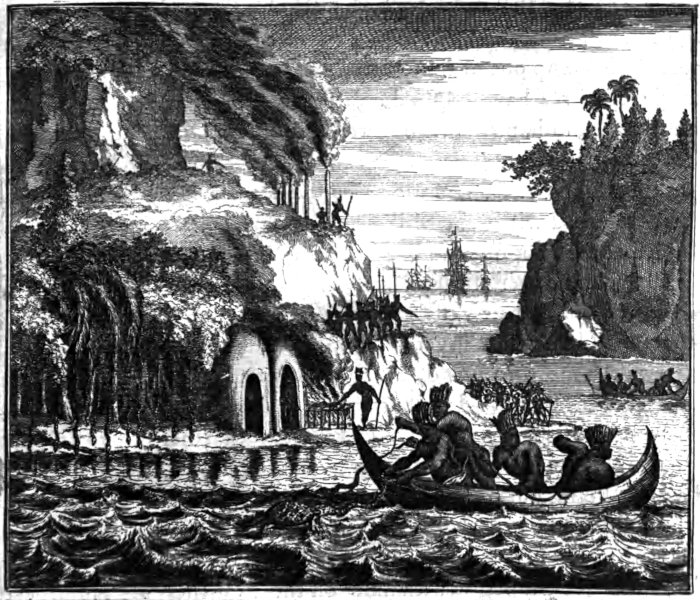
Discovers not without great Accidents, several New Countreys.
Columbus from hence proceeding on further Westward, discover’d a fruitful Coast, verging the Mouth of a River, whose Water runs boyling hot into the Sea. Somewhat further he saw very strange Fishes, especially the Guaican, not unlike an Eel, but with an extraordinary great Head, over which hangs a Skin like a Bag. This Fish is the Natives Fisher; for having a Line or handsom Cord fastned about him, so soon as a Turtel, or any other of his Prey, comes above Water, they give him Line; whereupon the Guaican, like an Arrow 50out of a Bowe, shoots towards the other Fish, and then gathering the Mouth of the Bag on his Head like a Purse-net holds them so fast, that he lets not loose till hal’d up out of the Water.
Here the Spaniards having Din’d on delicate Fish, went on still Westward, and came to an uninhabited Isle, but well stor’d with Geese, Pelicans, and ugly Dogs that could not bark. Here they came amongst so many Shoals, that the Keels of their Ships raked upon the Ground almost forty Leagues together, the Water thick and white like Milk. Lastly, they came again into deep Water, and Landed at the Foot of a high Mountain, on the Island Cuba; where they found two Springs of very sweet Water. A Musqueteer going into the Woods whilst the rest fill’d their Vessels with Water and cut Wood, he spied a tall Man in a Coat like a white Fryer’s Frock; behind whom came two more, and soon after thirty more follow’d, all alike Habited: the Musqueteer running away, they beckned him to stay, but he march’d off; and informing Columbus of his Adventure, he sent a Party well Arm’d to see farther into the Countrey; but they neither saw nor heard any Men, onely found on the other side of the Wood a great Plain, but so overgrown with deep Grass, that it was impossible to get through: The next day he sent out twenty five more, which found nothing else than the Prints of the Steps of great Beasts and Lyons, and also abundance of large Grapes, which hung on the Branches of Vines, clasping about the Bodies of the great Trees.
Hence Columbus again putting to Sea, and Sailing Westerly, found a Shore overflow’d with Water, and abounding with Pearl-Mussles, and after that the whole Countrey full of Mountains, whose tops smoaked. By this time the Fleet was much damnified by the Shole-water; where, as we mention’d before, they often struck, and their Keels rak’d upon the Ground; so that having sprung several Leaks, and their Provisions growing mouldy with the Damp, they were forc’d to return; and Tacking about they ran against Turtles, which lay as thick in the Sea as if they had been sow’n.
Columbus now on his return home, and Landing once more on Cuba, found an antient Man stark naked, who speaking to him (Didacus interpreted, the Language in some part agreeing with that of Hispaniola) to this effect:
You have to all admiration come to see this Countrey from another World, my advice to you is, That you hurt none; for the Souls of evil-doers go to dark places: But on the contrary, they shall enjoy the heighth of all Pleasures that are Friends to Peace.
Columbus reply’d, That he came a Scourge for the cruel Cannibals, but a Shield to protect the quiet and well-meaning Indians.
Great disturbance in Hispaniola.
After this, returning to Hispaniola, much contrary to his expectation, he found all things which he had setled there turn’d topsie-turvy: for first the Governors at Isabella jangled, and were at private contentions amongst themselves, and the Benedictine Monk Boilus and Peter Margarites were return’d to Spain; there to make their complaints at Court: and besides, the Spaniards had dealt very inhumanely with the Natives, by their frequent Rapes, Thefts, and Murders; wherefore the Indians, not unjustly incens’d, destroy’d all the Spaniards they found stragling in any part without the Lines of their Fortification. Caunaboa also lay about the Fort St. Thomas, and closely besieged Hoieda; but receiving intelligence of Columbus’s arrival, he broke up his Siege, and march’d from thence, but soon after was taken Prisoner by the Spaniards. Mean while upon Design (a Plot none of the wisest) the Natives of Hispaniola had neither Till’d or Sow’d the Ground, or us’d Agriculture the year before, contriving 51by want of Provisions (not considering themselves) to starve out the Spaniards; but the mischief fell upon the Contrivers: for so great a Famine hapned, that spreading over the whole Countrey, in a few Moneths fifty thousand were starv’d to death; but the Spaniards made a saving, though hard shift with their own store, then, though too late, the Islanders repented of their folly, for they saw the Spaniards making an advantage of their misery, not onely built more Houses in their City Isabella, but prepar’d their Weather-beaten Vessels, with which Sailing to the Gold Mountains of Cipangi on the Hill, whence sprung several Fountains, they rais’d the Castle of the Conception. Great benefit they reap’d by this Fort, to which they carry’d daily abundance of Amber, Brimstone, mix’d Ore of Silver and Gold, and Brazile-wood, besides great store of Gold: and they might have gotten ten times more, had they not been so much inclin’d to slothfulness, and minding other vain pleasures: yet notwithstanding all, the Fleet carry’d that year above one thousand two hundred pound weight of Gold to Spain.
Spaniards tyrannise there.
In the mean while the Natives complain’d to Columbus of the Spanish Soldiers, which under pretence to seek for Gold, committed many insufferable Outrages; therefore they desir’d that they might be retain’d in their Forts, and not straggle so much abroad, and they would willingly bring them every three Moneths a certain weight of Cotton, Amber, Brazile-wood, and Gold, more than equivalent to what they snatch’d; but Columbus (whose Soldiers, notwithstanding his severity, and using Martial Law upon some of them for their Crimes, and proud with their success) yet prevail’d at last, that they consented thereto; but the Inhabitants never perform’d their promise, who being almost famish’d, had much to do to preserve themselves alive, spending their time in picking Sallads.
Their Conquest.
Whilst the Business remain’d in this ill posture, or rather confusion, Cibanus, Brother to the imprison’d Caunaboa, rais’d an Army of five thousand Men: the Spaniards, divided into five Companies, march’d to meet him; and their Enemies being naked, and having no other Arms than Bowes, Arrows, and Clubs, after some little resistance, were soon dissipated and put to flight, but overtaken by the Spanish Horse, many of them were taken Prisoners, and others forc’d to skulk and hide themselves on the tops of Mountains.
Horible Tempest.
A remarkable passage concerning Bartholomew Columbus.
Brave reception of a King in Hispaniola.
Shortly after this Battel hapned a Huricane, mix’d with Thunder-claps, renting great pieces from the Rocks, and the Wind blowing out of the East, threw down Houses and Trees, some of which were carry’d a vast heighth into the Air; three Ships that rode in the Harbor, broke their new Cables, and split against the Rocks. The Spaniards expected nought else, but that with this excessive Tempest the Day of Judgment was at hand. And on the other side, the Islanders ascribed this raging of Heavens to the Spaniards wickedness. This Storm past, and the Air setled, Columbus gave order for the building of two new Ships there, with which in March, Anno 1495. he return’d to Spain; where in Medina del Campo he gave an account at the Court about the discover’d Countreys; where also Sentence was pass’d on several Spaniards, and chiefly concerning the Benedictine Monk Boilus, who out of meer malice pass’d by him at Mass with the Host, while he gave it to others, without any distinction. Then he gave a further account, that his Brother Bartholomew had found, sixty Leagues beyond Isabella, several deep Pits, the uppermost Ground of which Sifted, produced abundance of Gold. Moreover, that he had built the Castle Aurea there in three Moneths time with little trouble: but because Provisions 52grew scarce there, he found himself necessitated to remove, but left ten Men in the Garrison, and had sent three hundred of the Islanders with their Governors to Spain. He also built the Castle Dominico, on the South-side of Hispaniola; from whence he had travell’d into the Countrey to the River Naiba: where, upon this Shore the King Beuchio Anacauchoa Encamp’d himself against the Naibans, to bring them, besides several other People, under his subjection. That Bartholomew demanded Tribute of Anacauchoa, which he immediately promis’d to pay, and disbanded his Forces, conducting Bartholomew above thirty Leagues on his Way, along a Path on both sides sown with Hemp, and planted with Cotton-Trees, to his Palace Xaraqua, in the West of Hispaniola, where he was received in great state: Thirty of the Kings Wives walk’d before, carrying in their Hands Boughs of Palm-trees, and both Sung and Danc’d very strangely; behind these came a considerable number of naked Virgins, very handsom; at last Bartholomew entring the Palace with the King, found a Table furnish’d with all manner of Dainties, and a very courteous Entertainment. The next day walking forth to a large Plain, and looking about he saw two Parties that deeply engag’d in Fight behind a Hill, with great slaughter on both sides, and had not he desir’d that they might be parted, there had been much more Blood shed. After he had been several days friendly entertain’d, he return’d to the Forts Isabella, Sperancia, Catharina, St. Jago, Turrita, Conception, and Dominico; where he found above three hundred Spaniards starv’d of hunger, besides many that were sick.
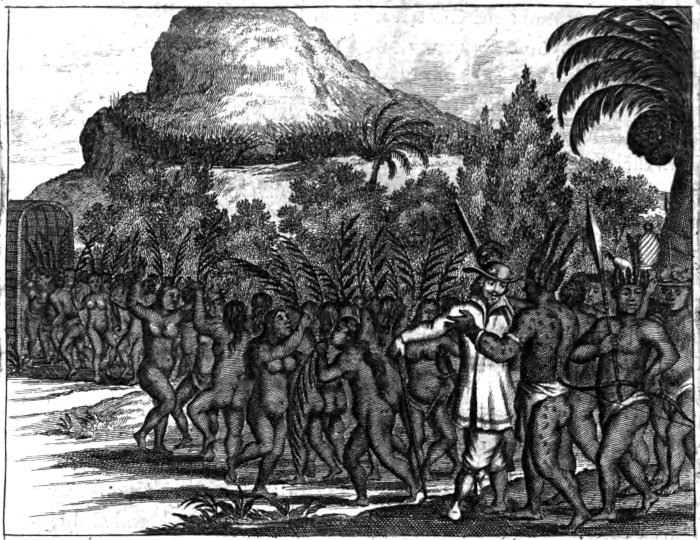
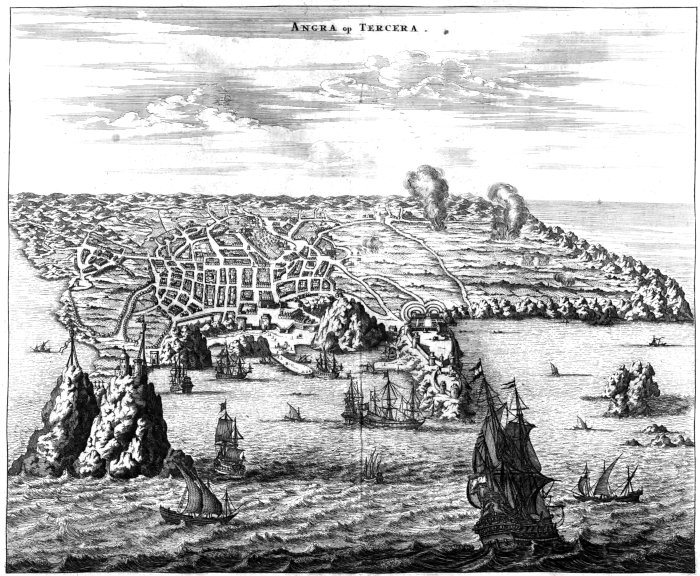
53At that time Guarionexius having been oppress’d by the Spaniards, and a long time watching for an opportunity, now thinking he had found it, rais’d an Army of fifteen thousand Men, with which he was resolv’d to try his fortune against Columbus; who privately receiving intelligence thereof, fell upon him so on a sudden and unexpectedly, that he spoil’d his Design, and took all his Commanders Prisoners: But to oblige the Inhabitants, who begg’d for their King, Columbus set him at liberty, advising him to be careful of raising a War against him any more. But he not being able to endure the oppressions of Roldanus Ximenez, a Spanish Commander, fled to the wild Ciquano’s, descended from the Canibals, and living on steep Mountains: Of these he desir’d aid against the Spaniards, and obtain’d not onely their Promise, but some Men; with which he robb’d and pillag’d the Countrey round about, and what Spaniards he met with he kill’d, and with his Men did eat, as if a Venison Feast. Mean while Ximenez made himself Leader of seventy Rebels, which like raging blood-hounds fell upon the Natives after a terrible manner.
Columbus Sails the third time to Hispaniola.
Description of the City Angra.
Whilst all things were thus in disorder at Hispaniola, the Admiral Christopher Columbus set Sail a third time with eight Ships from the Haven Barrameda, in the Year 1498. To shun the French Pyrates, which watched for the Indian Treasures, he directed his Course to Madera, a fruitful Island of Corn, Wine, Sugar, Wax, and Cattel, desolate till Anno 1420. Here coming to an Anchor, he sent six Ships away to Hispaniola, which himself afterwards followed with the remaining two, steering by the Flemish Islands, or Acores, first so call’d from the Flemings, the first Planters: Here he dropt Anchor before the City Angra on the Isle Tercera, which is sixteen Leagues in circumference, and very Mountainous; the tops whereof are like Spires, and abound with Grapes: the Plain Countrey produces great store of Corn, but it will not keep above twelve Moneths. The Ground is oftentimes terribly shaken by Earthquakes, and between several sulphurous Places, both Flames and Smoak ascend up to the Sky. Near the City Angra is a Fountain which turns Wood into Stone. The Winds in this Place blow so fierce and strong, that they not onely beat down Houses, but wear out Iron, and all manner of Stone-work. In Angra the chief Commander of all the Flemish Isles hath his Residence. The City, surrounded by steep Rocks, lies towards the Sea like a Crescent, or Half-Moon; for at both ends thereof the Mountains extend with deep Points into the Ocean. The uppermost part towards the West stands likewise fortifi’d by a high Rock, as also by another on the East: on both are continual Watches kept; whereof those on the first can discover Ships fifteen Leagues off at Sea, coming either from the East or West-Indies; and on the other, all those that come from Europe: When they see above fifteen Sail, they put out the Kings great Flag upon the top of all the Rock.