The Second Book, CONTAINING A DESCRIPTION OF NORTHERN AMERICA (continued 5)
Reading edition
Amongst other Beasts is also the Teuthlacokauhqui, or Fortress of the Serpents; it hath a Head like an Adder, thick Belly, glittering Scales, a black Back, sprinkled with white Crosses; at its Tail there grows yearly a Bone, with which it makes a noise when it stirs; its poysonous Teeth destroy those which are bit therewith in twenty four Hours, unless the part which is wounded be held in the Earth so long till the pain be over. Notwithstanding the noise, terrible aspect, and gestures of this Animal, the Indian Hunters make nothing to take the same by the Tail, and wrap it up in Linnen, and carrying it home make it tame. It is able to live a whole Year without either Meat or Drink; its Head when cut off grows to the bigness of a Man’s Thigh in ten days time.
226No less resolute are the Indians in taking the Ibitobaca, which is an Ell long, of a crimson Colour, full of black and white Specks, the Bones whereof they wear about their Necks in stead of Chains.
The Serpent Iquanna.
The Iquanna is a Serpent which doth no manner of hurt, though terrible to look upon to those which know it not, having a Bag under its Chin, a glittering Comb on its Head, and on its Back sharp Bones, which stand like a Saw, and a long Tail: It lays fifty Eggs at a time as big as Acorns, of a very good taste, and fit to eat when boyl’d: It also lives both in the Water and on the Land.
Baboons.
Here are also many Baboons, which are big and heavy, with ugly Heads, short Legs like a Man, and Tails standing upwards; they eat all sorts of Fruit, but chiefly covet after Wine and Bread; and are so lascivious, that they often set upon Women: The Females generally bring forth two, one Male, and the other Female. There is also another sort, whose Skins, being red, are full of little Spots.
The ancient Inhabitants of Chiapa (divided into the Chiapaneca’s, the Zeques, the Zeltates, and the Quelenes) are very Civil and Witty, also skilful in Painting, Singing, Breaking of Horses, and many other Trades.
Towns and Villages of Note.
The Places of more principal note in this Countrey, inhabited by the Spaniards, are 1. Ciudad Real, pleasantly seated in the midst of a round Vale or Plain, and almost encompass’d with Hills representing the form of an Amphitheatre; also at the Foot of one which stands in the midst of the rest, the City is built. It is a City specially Priviledg’d by the King of Spain, having a Court of Justice, Cathedral, and Dominican Cloyster; of a pure and temperate Air, and the Countrey round about plentifully abounding both in Corn and Fruit, onely somewhat too cold to produce Lemmons and Oranges; but for Pears, Apples, Peaches, Quinces, Cherries, and the like, they grow here in great abundance.
2. Chiapa, which giveth Name to the Valley aforesaid; It is a Bishop’s See, and famous, if but for one of its Prelates, viz. Bartholomeo de las Casas, of the Order of Predicants, who was Bishop of this City, and his Memory justly precious amongst the poor Americans at this day, for his Charity towards them, and for the stout and zealous opposition which he made against the Spaniards cruel and inhumane dealings with the Natives at the beginning of their Conquests: by which at last, notwithstanding much difficulty and resistance made by interested Persons of the other Side, he procur’d them liberty, and an Edict from the Emperor in favor of them; whereby they were declar’d to be a Free People, and not Slaves, and the Spaniards forbidden to use them any longer as such, or to force them to any kind of Labour against their wills, or otherwise than by agreement with them, which Liberty they enjoy to this day; and though the Spaniards are said to give them very small Wages in some places, and for their Work in their Sugar-Mills (which is no small Labor) not above five Reyals, or Two shillings six pence a Week, for the Maintenance of themselves, their Wives and Children, yet by reason it is with Consent, and in a Countrey where all things are plentiful and cheap, their Condition is much better than it was, and the favor which that good Bishop did them, never to be forgotten. It is at present a great and populous City, and lieth almost in the mid-way betwixt the Cities of Mexico and Guatimala.
3. St. Bartholomews, in the Countrey of the Quelenes.
4. Tecpatlan, the chief of twenty five Villages, said to belong to the Zoques. Here the Dominicans have another Cloyster.
The Zeltates possess a fruitful Countrey, have thirteen Villages planted with Trees that yield Cochenile, being under a Common-wealth Government.
227The chief Place of the Quelenes is Copanavatzla, where there is good Cheese, and store of brave Cattel: The River Chiepa gliding through the midst thereof, loseth it self in the Northern Ocean. In this part of the Country are Beasts not unlike Apes, with long Tails, which they wind about the Legs of those whom they find swimming and so pull them under Water; wherefore they that go to Swim take Axes along with them, to cut off their Tails.
The Water of the River Blanco is clear and wholsom, running for the most part through Rocky Grounds, which nevertheless are overspread with Trees.
In the highest Ground of Chiapa, a League and a half from the City Reall, spring clear Fountains, whose Water ebbs and flows every six hours.
Near the Village call’d Afixa is one which runs three years together, though in the driest Season, and is dry three years, though it Rain never so much.
Not far from the Village Cinacatan is another Spring, whose Water cures several Sicknesses, but kills all Birds and Beasts which drink of the same.
Here are likewise divers Baths.
The Rivers which run out of the Valley Chiapa, fall into two great Pits.
Near the Village Bartholomew, in the Province Quelenes, is a strange Cavern, out of which by the throwing of a stone into the same, are heard mighty noises like claps of Thunder.
Not far from the Village Chicomucolo, appears a Cavern, in which is a great Plain on one side, and a standing Lake, whose Water is like Sand, on the other.
The Spaniards, if they wanted not Slaves, might dig good store of Gold, Silver, Copper, Lead, Tin, and Quicksilver, out of the Mynes on the Mountain Ecatepeck, which is in nine Leagues compass: The Wind blows so strong after Sun-rising, that no Man is able to travel for it, but in the Night.
Sect. II. Vera Paz.
Situation and Bounds.
Vera Paz, or The Countrey of True Peace, was so nam’d by the Spaniards, as they say, because it was never conquer’d by the Sword, but reduc’d to Obedience onely by the Preaching of the Dominican Fryers. It is bounded on the West and South-West with Chiapa; on the East with some part of Guatimala and Honduras; and on the North with Jucatan. It contains about thirty Leagues in length, and almost as much in breadth, being a woody and mountainous Countrey for the most part, yet well distinguish’d with Valleys and lower Ground. It is much subject to Rain, which ’tis said to have for nine Moneths of the Year almost continually; by reason whereof the Countrey, being otherwise hot, is much annoy’d with a kind of Mosquit, or great sort of Gnats, which spoil the Fruit very much, and are otherwise not a little trouble to the People. Moreover, there happen oftentimes terrible Earthquakes and Storms, with Thunder and Lightning.
Commodities of the Countrey.
The chief Commodities of this Countrey, are a kind of Amber, which some call Liquid Amber, which drops from divers of their Trees, and is said to be a Commodity very precious, and of much use; Mastick, Sanguis Draconis, Gum Anime, Sarsaparilla, China-Wood, and divers other Medicinal Drugs, which it affordeth in great plenty. The Woods afford a sweet smell, and the Trees in the same grow a wonderful heighth.
The Canes which grow here, being a hundred Foot long, and proportionably thick, serve for Timber.
228There is also a hard Wood call’d Iron-Wood, either from its hardness or colour, or both, which never rots.
The abundance of Flowers which grow here afford nutriment to innumerable swarms of Bees, which are about the bigness of small Flies. Their Honey, which is somewhat tart, they hide in the Roots of Trees, or in the Earth. Another sort, which is made by the Wasps, bereaves those that taste of their Senses.
Beasts.
The noted’st Beast in this Countrey is the Danta, which resembles a Mule, hath no Horns, but Ash-colour’d long Hair, short Neck, hanging Ears, thin Legs, with three Claws before and two behind, long Head, narrow Forehead, little Eyes, a Nose hanging over its Mouth, little Tail, sharp Teeth, and a Skin which is six Fingers thick, and scarce penetrable by any Weapon. This Beast is taken in Traps, Holes, or else with Dogs, which he often kills when hunted towards the Water. They say that this Beast taught Men first to Let-blood; for if it be too full of Blood, it pricks it self against a sharp Cane, and stops up the Orifice again very carefully. The Flesh thereof is good Meat, as also that of the Ross-Lyons, which in the day-time sleep on a high Tree, where they are shot by the Indians.
The Tygers are much more dangerous to be taken; yet the Indians Hunting them, eat them in stead of Beef; and also through all New Spain.
The Bears, which make the Ways very dangerous to travel, have black frizled Hair, broad Tails, Feet like Mens Hands: but since the Indians have made use of Guns, which they learn’d from the Spaniards, they have much lessen’d the number both of Bears and Tygers.
There are likewise many Leopards, Apes, and wild Goats (whose Skins serve the Natives for Drums) Hogs, and Armadillo’s.
Amongst their Fowls, are Eagles and Parrots.
The Countrey is so well stor’d with Water, that in three Leagues space are above thirty Rivulets, and as many Fountains.
Medicinal Plants.
On the Mountains grow great quantities of Sarsaparilla, Mechoacan, and the China-Root, which being yellowish hath several Saffron-colour’d Knobs on the top. The Sarsaparilla grows with many Stalks, creeping along over the Ground; the Body thereof is tough and full of Prickles, the Leaves broad and sharp at the ends, and are of a bluish colour on one side, and green on the other, and bear Clusters of Flowers, which close like Buds, and are first green, next vermilion-red, and lastly blackish: within are two hard Stones, which inclose a white Kernel, by the Indians call’d Juapecanga.
The Bay Golfo Dulce, which pours its muddy Water into the Sea, feeds the great Fish Monati, and a great number of Crocodiles.
Several Rivers abounding with Fish fall also into the same, having their Banks set all along with Trees, in whose Boughs, joyn’d together on the top, those sort of Birds make their Nests which prey on Fish.
The Women in this place are much shorter Liv’d than the Men, so that there are often thirty Widowers to one Widow. Women with Child are Deliver’d by themselves in the High-way; and from thence they go to the next River to wash themselves and the Child.
Places of note.
As for any Towns or Places of much Traffick or Note, inhabited by the Spaniards, we find not any nam’d, save onely St. Augustines; near unto which there is said to be a Cave and Fountain within Ground, which converts the Water that falleth into it out of several lesser Springs, into a kind of Alabaster or Stone, perfectly white, and fashions it likewise into Pillars, Statues, and other artificial Forms of very curious Workmanship, as Laet reporteth.
229
Sect. III. Honduras.
Situation and Bounds.
Honduras hath on the South, Guatimala abovesaid; on the West, a certain Bay, or Arm of the Sea, which they call Golfo Dulce, from the abundance of fresh Waters which run into it from all Parts; on the North and North-East, the Atlantick Ocean; and somewhat to the South-East, Nicaragua. It contains in length, viz. from East to West, Coasting along upon the Sea, about a hundred and fifty Leagues, and in breadth eighty. The Countrey is rich both in Corn and Pasturage, being said to be very much advantag’d that way by the constant overflowings of the Rivers, which are very many, about Michaelmass-time, and which the People order so well, that they water their Gardens, and exceedingly fertilize the whole Champain, or lower part of the Grounds by them.
The fruitful Valleys of this Countrey were anciently very well inhabited, till vast multitudes of the Natives were destroy’d by the Spaniards Cruelties, of which the Bishop Bartholomeo de las Casas, in his Letter to the Emperor Charles the Fifth, gives this Relation:
Cruelties of the Spaniards.
“The young Children (saith he) they murder’d, beating out their Brains against the Stones; the Kings and Princes of the Countrey they either scorch’d to death, or threw them to the Dogs to be torn in pieces; the poor People they drove into their Houses, and then set them on fire; those that remain’d were condemn’d to the greatest slavery imaginable, being us’d in stead of Mules and Horses, and having greater Burdens laid upon them than they were able to carry, insomuch that thousands of them fell down dead under them; some out of despair running into the Woods were famish’d, after they had kill’d and eat their Wives and Children for Hunger. In this one Province onely they massacred above twenty hundred thousand Men, and amongst others, Persons of Quality, which had civilly Entertain’d them: nay, they tortur’d the poor innocent Natives all the ways they could possibly invent, onely to know of them where their Gold lay; particularly Diego de Valasco spar’d none that ever fell into his hands; insomuch that in a Moneths time above ten thousand were slain by him: He hang’d thirteen Noble-men, to twelve of whom he gave the Denomination of The twelve Apostles; and the chiefest of them he call’d in a derision, Jesus Christ. Some they suffer’d to starve to death, with their Heads compress’d between the cloven Barks of wild Vines; some also they buried alive, and leaving onely their Heads to appear above Ground, bowl’d Iron Bullets at them, and forc’d them to eat one another; besides infinite other hellish Cruelties, too horrid and dreadful to be recounted.”
Commodities of the Countrey.
This Countrey produces much Maiz, Wheat, Honey, and great Calabashes, from whence the first Discoverers call’d that Sea Golfo de las Ybueras, because they met with abundance of Calabashes, floating on the Water, which at Santo Domingo bear the Name of Ybueras.
This Countrey is water’d by three Rivers, the first Chamalucom, which glides by the City San Pedro; the second Ulva, inhabited on both Shores; the third Haguaro, the Grounds adjacent to which would prove very fruitful, were the Inhabitants not too lazy. In stead of a Plough they use a long Pole, with two crooked Staves at the end, one bent downwards and the other upwards, with which they cut and turn the Earth. The Natives feed on several Roots, Flesh, and Vermine.
230At their Feast they make themselves Drunk with a Drink made of Honey, Noble-men heretofore onely drinking the Liquor of Cacao; of late it is common, and made by all People, though never so mean. They speak several Languages, the chiefest whereof is that of the Chontales, a salvage People. They divide their Year, call’d Joalar, that is, Passing, into eighteen Moneths, and each Moneth into twenty Days. They formerly measur’d the Year by the Nights, and began the Year forty days sooner than the Europeans.
New Valladolid.
The Towns in this Province are 1. New Vallodolid, by the Indians nam’d Comayagua, lying in a pleasant Valley under a temperate Climate. The Cattel brought hither from Spain increase exceedingly. The Silver-Mynes are also so well stor’d, that they keep the Melting-house in the Town always employ’d.
The Governor of this Place hath his Residence next to the Treasury-Chamber.
Anno 1588. the Bishop’s See was translated hither from Truxillo: Nineteen years before which Francisco de Monteio sent his Lieutenant Alphonso de Cacenes thither, to build a Village half way between the Southern and Northern Ocean; who accordingly erected the Town Santa Maria de Camoyagua, near a River Navigable for Canoos, which disembogues in Puerto de Cavallos. The remaining part of the Way to the Haven Fonseca being passable for Carrs (which was a means to prevent many Inconveniences which us’d to happen to Travellers on the Way between Panama and Nombre de Dios) the Spanish King was so much concern’d at the first proposal hereof, that he sent the famous Surveyor Baptista Antonello thither, and he rather, because he received information, that the new Way, along which they carried the Merchandise from Peru, Mexico, and other Countreys along the South Sea, lay very pleasantly, by reason of the brave Vineyards, Corn-Fields, Fruit-Trees, Pastures, Streams abounding with Fish, Herds of Deer, and Cony-Warrens; yet Antonello meeting with many troubles, would not undertake the Business.
New Valladolid is adorn’d with a great Church, a Cloyster, belonging to the Monks De la Merced, and handsom Streets.
Gratias a Dios.
2. Thirty Leagues Westward from this City lies another call’d Gratias a Dios, begun by Captain Gabriel de Royas, Anno 1530. that so he might be near the Gold-Mines: But because the Natives kept the new Inhabitants in continual alarm, and daily Storm’d the unfinished Fortifications, Royas was necessitated to leave off building any farther, the rather, because none came to his assistance from the neighboring Garrison.
Six years after Gonzales de Alvarado undertook this Work, and built the City on a Rocky Mountain; which, though otherwise barren, produc’d lusty Horses and strong Mules.
St. Pedro.
3. San Pedro, though lying under a hot and unwholsom Climate, us’d formerly to be a brave City of Trade; but it is gone much to decay since Golfo Dolce hath been discover’d, because from that Bay the Commodities are carried in Barques up into the Countrey.
Juan de Puerto de Cavallos.
4. The Village Juan de Puerto de Cavallos, inhabited by Factors and Moors: It receiv’d that Denomination, because not far from it several Horses were forc’d to be thrown over-board in a Storm. Though it be but ill fortifi’d, yet it hath an exceeding large Haven. Captain Christopher Newport arriving here Anno 1591. found two hundred Houses, and in them a considerable Booty left, notwithstanding four Ships richly laden had lately set Sail from thence.
Six years after Newport, Capt. Ant. Sherly re-took the Place, and leaving the Haven open for Pyrats, Alphonsus Coriado judg’d it convenient to remove the Trading Place to Amatique; he built the Village Thomas de Castilla, and fortifi’d the same against all manner of Assaults.
231Behind Cavallos lies the Valley Naco, which is exceeding fruitful, being situate between high Mountains, where formerly was found plenty of Silver.
Truxillo.
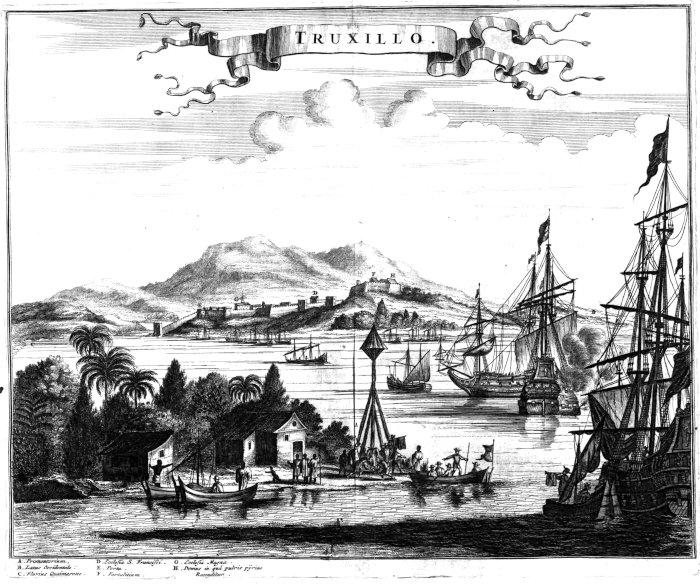
5. Eastward from Cavallos appears the famous City Truxillo, near a large Bay; secur’d from all Storms by two Cliffs, full of Trees; the Mouth of the Haven call’d Joan Gil, is above two Leagues broad, and receives two Rivers, one from each side of the City: The Stream Quaimarotte flows Eastward, and the River Antonio Westward, both abounding in Fish. The Countrey round about produces abundance of all sorts of Provisions, and chiefly abounds in Grapes, which are gather’d twice a year: Eight days after August they cut their Vines, which afford them ripe Grapes again in October; they have two Harvests of Corn; also Lemons and Oranges are very plentiful: The Cattel brought hither from Spain are exceedingly increas’d to an incredible number.
Truxillo it self lying on a steep Mountain, is defended on that side which respects the Sea, with a thick Wall of six Foot high; between which and the Haven are many brambly Bushes, which prevent the access to the Wall, onely a narrow and steep way leading up to the City, which hath a strong Gate, guarded with two Brass Guns, and sufficiently Fortifi’d to oppose an Enemy. The Eastern Cliff, which bends before the Haven is call’d Punta la Rye, on which stands a House with a high Beacon: Beyond the Wall Eastward, near the Haven, is a Ship-yard, before which stands a large Woodden Cross: The Castle in which the City Store is kept, joyns to the Wall, near unto which, within the Town appears St. Francis Church; but the Cathedral call’d Eglesia Major, is seen above all other Buildings: The Houses cover’d with Palmito-Leaves, have Walls of Pleited Bushes, Plaister’d over within and without: Behind the City, where it lies open, are exceeding high Mountains.
Attempts upon this place by the English and Dutch.
Anno 1576. the English falling on this strong Place, carry’d a rich Booty from thence; after which, Capt. Anth. Sherly and Capt. Will. Parker ventur’d once more on the same, but being discover’d by the Centinel, were forc’d to Retreat, not without a considerable loss: When not long after, Captain John Van Hoorn a Hollander, attempting the same, had much better success; for he Weighing Anchor for Pernambuc, with four Frigats, three Ketches, and a Sloop, set Sail to Truxillo, where arriving, lay close before the City with his four Frigats, which fired very fiercely on the Town; the Inhabitants of which not being idle, kill’d three Men in one Ship, forc’d her to fall farther off from the Castle: Whilst the Ketches and Sloop went about a Gun shot Westward beyond the City, towards the River Antonio, where they Landed two hundred and fifty Soldiers, which march’d with all speed up the Hill, where the Castle lay which they Scal’d at Noon-day; the Besieged being provided with seven Guns, shot, and threw Stones continually amongst them, yet were forc’d to Retreat from the Dutch Hand-granado’s: During the storm, the Admiral himself Landed, but before he came out of the Boat, the foremention’d Soldiers had made themselves Masters of the Fort, with the loss of onely eight Men, and were busie Pillaging all places they came at, and carrying their gotten Booty to a Watch-house near the Castle on the Shore; when on a sudden a Fire happen’d in the East part of Truxillo, which increas’d in such a manner, that in few hours two third parts of the City lay in Ashes; every one then had enough to do to save themselves, yet for all the haste they made, several Hollanders were kill’d at the blowing up of the Magazine, and most of the Booty lost by the Fire; insomuch that they carry’d but two hundred thirty nine Skins, six Bales of Indigo, eight hundred and twenty Pounds of Sarsaparilla, seven Brass, and three Iron Guns, four Clocks, and some few trifles with them; having before made an 232agreement for twenty Pound of Silver, with the Governor Joan de Miranda, who inform’d them, that they had not the least knowledge of the Hollanders Fleet, till the Evening, when the Beacon on Punta La Rye was fir’d: Moreover, that the City was inhabited by two hundred Spaniards, and as many more Mulatoes and Moors; and that the Trade thereof was much gone to decay, because there had been no Gallies there in two years before.
Twenty seven Leagues from this City lies the Village Jorgo de Olancho, where four thousand Spaniards force Tribute from sixteen thousand Indians, who possess much Gold.
Sect. IV. Nicaragua.
Situation and bounds.
Nicaragua is a County of this Province, border’d Northward with Honduras; on the East, with the Atlantick Ocean, and part of Veragua; on the South, with Mare del Zur; and on the West, with Guatimala, being call’d by Diego Lopez de Salzado, The New Kingdom of Leon, and comprizing several little Territories, as Nicoya, Nequecheri, Mabyth, Deria, Masaya, Mandigua, Cacoloaque, Cepeoco, Los Micos, Madira, and the Contales. It hath few Rivers in it, the want whereof is supply’d by the benefit of a great Lake, in the midst of the Countrey, call’d by the Spaniards, Laguna de Nicaragua, containing, as is suppos’d, above one hundred Leagues in compass. It empties it self by the Port of St. Juan into the Atlantick or North-Sea, but reacheth as far as the South or Mare del Zur, at least within a very few Leagues; and from whence some Spanish Captains are said to have made a passage, though with much difficulty, into the Lake, and from thence to the North-Sea. It is abundantly well stor’d with good Fish, but withal much haunted with Crocodiles; and the Countrey about it so plentiful in all things, especially Cattel, Cotten-Wool, Sugars, and all kind of Fruits: Amongst which, the chiefest is the Zeiba, which is of so great a thickness, that fifteen Men holding Hand in Hand, can scarce encompass the same. The Callabashes ripen here in fourteen days time: The Sea along the Coast, breeds Whales and other Sea-Monsters, which are often seen above Water.
Nature of the Inhabitants.
The Inhabitants of this Countrey, (except the Chontales, which live on the Mountains, and maintain their old Salvage Customs) have for the most part learnt the Spanish Tongue and Manners, and exercise themselves in all sorts of Arts and Siences, especially in Working of Silver, making of Clothes, Wax-Work, and the like: From the Mountains they gather Balsom, Liquid-Amber, Turpentine: They also drive a great Trade in Cotton, Skins, and several sorts of Provisions, to Panama, and Nombre de Dios.
The Lake Laguna de Nicaragua, which hath a hundred and seventeen Leagues in Circumference, and round about inhabited, is by three Leagues of Land separated from the South-Sea; and discharges its Waters into the River Desaguadero, which falls into the Northern Ocean. Alphonsus Calera, and Diego Machuca de Zuaso, were the first that Sail’d out of the foremention’d Lake into the Sea, not without many dangers, by reason of the great Water-falls, call’d Rondales, which fall into the River Desaguadero, and forc’d them often times to draw their Barques over the Land.
Cities.
The chief City is, 1. Leon, which is surrounded with Woods, and lies close by the Lake; hath a great Church, five Cloysters belonging to the Monks, de la Mercede, several Houses for the King’s Officers, and a hundred and twenty thousand Families 233of Indians which pay Tribute. Three Leagues beyond Leon appears a high spiry Mountain, from whose top, both Morning and Evening, rises a mighty smoke, and sometimes casts out great sulphurous Stones over the neighboring Fields, and on a sudden mighty Flames. A Dominican Monk, in hopes to get some melted Gold out of its burning Mouth, went up the same with four of his Fraternity, and carry’d an Iron Chain and a Kettle, which were no sooner let down into the hole, but they were immediately melted; yet not so discourag’d, they resolv’d to venture a second time with stronger Materials, which nevertheless had the same, or rather worse event; for the Fire flew out in such a manner, that the Dominicans sadly scorch’d, had enough to do to escape with Life, since which none durst presume to approach the same.
But besides the Episcopal City Leon, Erected by Franciscus Fernandez, 2. Granada acknowledges the same Builder, and lying also on the shore of Laguna de Nicaragua, is adorn’d with a Castle, Church, and several Sugar-Mills: Not far from it lie the small Lakes Masaya and Lindiri; the first which is inclos’d between exceeding high Mountains, covers the Foot of the burning Mountain Masaya; the other falls into Laguna de Nicaragua, near which is the smoky Mountain Munbacho, surrounded with Fruit-Trees.
3. & 4. The Towns Jean, and Neuva Segovia, which are not far from thence, are of little consequence.
5. Realeio, this is, as it were, the Chattam of America, being a place on the South-Sea, where the King of Spain hath all his Ships built that are made of American Timber, and inhabited by few or none but Shipwrights, Mariners, and Men of that kind of Profession.
6. & 7. Nicoya, Avarines.
8. Cartago, forty Leagues distant from Nicoya, and lying almost in the midst of the Isthmus, or Streight of Darien, equally distant both from the North and South Sea; on both which it is said likewise to have a convenient Port or Haven for Shipping.
Strange manner of Dancing.
The Spaniards, when first they Landed here, call’d this Countrey Mahomets Paradise, because of its exceeding Fruitfulness. The Cacao which they use here in stead of Money, is not unlike the Stone of an Almond. The Inhabitants, in stead of using a Steel and Flint to strike Fire withal, rub two pieces of Wood together so long, till one of them is kindled; and burn the Boughs of Pine-Trees in stead of Candles. Amongst the several Languages which they speak, the Mexican is the chiefest: Amongst their Recreations, Dancing is principal, which is perform’d after a very strange manner, for they meet sometimes two or three thousand together, according to the bigness of the Province, in a spacious Field, which is made clean before for that purpose: He that leads the Dance goes backward, and with many strange Gestures, turns himself about, which the rest, following four and four together in a row, imitate, whilst their Tambores beat on hollow Instruments, and sing Songs, which are first answer’d by the Ring-leader of the Dance, and then seconded by the whole Company, each of them waving a Fan or a Callabash, and being all adorn’d with Plumes of Feathers on their Heads, and Strings with Shells about their Arms and Legs; they also act several antick Tricks, the one, the blind Man, the other, the Cripple, one feigns himself to be deaf, the other makes a wry Mouth, one cries, and another laughs, whilest others drink healths in Chocolate, which continues till Midnight.
The Fish Manati.
A King of this Countrey in former times us’d to feed the Fish Manati with Bread, in the Lake Guainabo, where it would appear at its being call’d Matto, Matto, which 234signifies Noble-minded, and oftentimes carry eight or ten Boys on its Back from one side of the Lake to the other; but being shot by a Spaniard with an Arrow, never appear’d again.
There is likewise a black Beast in this Countrey call’d Cascu, resembling in some things a Hog; it hath a hard Skin, little Eyes, open Ears, cloven Feet, short Nose, and makes such a terrible noise, that it affrights those which hear it.
No less strange and wonderful is the Fox-Ape, which hath two Bellies one under another; in the lowermost of which it carries its Young, which are never brought into the World till they are able to shift for their own Food. It hath the Body of a Fox, Feet like a Man’s Hands, and Ears like a Batt.
It will not be amiss before we conclude with this Province, to give you a Relation of the Discourse which hapned Anno 1527. between the Spanish Commander Francisco de Monteio and the Nicaraguan Casique Alquinotex, who being a hundred and ten years old, told him, “That before the Spaniards arrival there, great numbers of his Soldiers perish’d after a strange manner; for after having vomited abundance of Worms, they fell down dead on a sudden: those that escap’d the Contagion differing amongst themselves, made two Parties, which twice Engaging with one another, each of them lost above a hundred and fifty thousand Men. Yet both these Plagues were no ways to be compar’d to the Slaughter which the Spaniards had made amongst them.”
About the same time an Italian, call’d Hieronymo Bonzo, Lodging with a Nicaraguan Noble-man that understood the Spanish Tongue, was thus set upon by him: What do not (Oh Christ) the Christians do! they no sooner get their Foot into an Indian’s Hut, but they commandingly call for Maiz, Honey, Winter-Clothes, Gold, Silver, and a Woman to cool their lustful desires: Certainly there is nothing more vicious on Earth. To which Bonzo gave him this Answer: The wicked Spaniards commit oftentimes unseemly things. The Indian again suddenly retorted, saying, Where are any such Men to be found as good Spaniards? I have never known any but wicked Villains. To which Bonzo said, Why have you made place for them on Nicaragua? Which was thus reply’d to by the Noble-man: “All People round about took Oath on the first News of the Christians arrival, to hazard all, and fight to the last Man, before they would be under the insupportable Yoke, with which they had heard other Countreys were oppress’d with by them. To which purpose they made ready Bowes, Arrows, Lances, Stones, Clubs, and other Weapons of War: But when it came to the trial, the Spanish Horse, of which they had never seen the like, struck such a terror into the Indians, that they fled, and sent two Agents to Monteio to desire Peace; but their Design was onely to gain time, that they might gather new Forces, to venture a second Encounter; which prov’d as fatal to them as the first. Then desiring Peace once more, they gather’d all that were able to bear Arms, and swore one to another not to stir a Foot; and withal made a Law, That whosoever did shrink should be kill’d immediately: But the Women being inform’d hereof, begg’d that they might rather suffer under the Spanish Yoke, than be torn in pieces by their Dogs, or kill’d by their Bullets and Swords, alledging, that they were not able to resist the Spaniards; and entreated them, that if they were resolv’d to go on with their first Design, they would first send their Wives and Children to the other World, that so they might not fall into the hands of the merciless and bloody Christians: Whereupon most Voices judg’d it convenient to make use of the Opportunity, and to submit to Monteio. But his cruel dealings made some to contradict that Determination, for which they paid dearly; for not onely they, but their little Infants, were put to the most cruel 235Deaths imaginable; which made many of them also to lay violent hands on themselves.”
Sect. V. Costarica.
Bounds and Nature of the Countrey.
Costarica borders on the East with Veragua; on the South and East, with the Sea; and on the North, with Nicaragua. The Countrey it self is barren and mountainous; whose Inhabitants were valiant enough to Encounter with the Spanish Forces, being unwilling to lose their former Priviledges.
This Coast was discover’d full by Christopher Columbus, who Anno 1502. Sailing up the Rivers Belen and Veragua with Barques, took much Gold out of the Mynes Urira, but chiefly from between the Roots of Trees which were grown together.
Sect. VI. Veragua.
Bounds and Nature of the Country.
Veragua is bounded on the West with Costarica; on the East it hath the District, or Countrey of Panama, being otherwise wash’d on all sides by the Sea. It hath its Name from a River of great note in this Tract, by which it was first discover’d. The Countrey is for the most part mountainous, and the Soil outwardly barren, but recompencing all defects with the abundance of its more inward Wealth, that is to say, in the richness of its Mynes, of which it is said to afford many, and so inexhaustibly rich and good, that the Spaniards here know no end of their Wealth; although by the stoutness and untameableness of the Natives, it was a long time, and they met with many difficulties, before they could make themselves Masters of the Treasure.
Its chief Towns.
The chief Towns they have here are 1. La Conception, lying at the Mouth of a River so nam’d, and the Seat of the Governor.
2. La Trinidad, upon the Banks of the same River likewise, but down towards Port Beleno, and about six Leagues Eastward of Conception.
3. St. Foy, twelve Leagues more to the South, where the Spaniards melt their Gold, and cast it into Bars or Ingots.
4. Carlos, a Town they have upon the Coast of Mare del Zur.
5. Philippina, another on the West of Carlos; both of these seated upon a large capacious Bay; before which there lie certain little Islands, to the number of thirty or more, which the Spaniards are said to have wholly dispeopled long since, by forcing the Natives over into the Continent to work in the Mynes, as usually they did before the Emperor’s Prohibition: but now they use Slaves or Negro’s, which they buy for that purpose from Guinee and other Parts.
Sect. VII. Guatimala, properly so call’d.
Bounds of the Country.
Guatimala, specially so call’d, hath on the West the River Xicalapa, which divides it from Vera Paz; on the East it is bounded with the Countrey of Nicaragua; on the North, with Honduras; and on the South, with Mare del Zur.
236This Countrey was conquer’d by Peter de Alvarado, Anno 1525. It is, by reason of its neighborhood with Vera Paz, not altogether clear of Mountains, but otherwise well water’d with Rivers, and enrich’d with fair and fruitful Valleys, which afford not onely good Pasturage, and many great Herds of Cattel, but likewise good store of Wheat, Maiz, and other Fruits of the Earth. Great plenty of Cotton-Wool is generally both here and in the other Provinces, viz. Vera Paz, Chiapa, &c. some Medicinal Woods likewise, and Liquors, and absolutely the best Sulphur in America. The People are generally tractable and well dispos’d, both in point of Religion and civil Government.
Towns of note.
The Towns of chief note are 1. Guatimala, now call’d St. Jago de Guatimala since the re-building thereof; for about the Year 1586. it was almost buried in Ashes, which one of the neighboring Mountains, for the space of six Moneths together, continually belch’d out in such fearful quantities, that many People were slain, the old City deserted, and a new one built in another place. The day before this sad Accident hapned, the neighboring Mountains were observ’d to shiver, and a great noise was heard from under Ground; which amazing the Indians, the news thereof was carried to the Bishop, Franciscus Moroquin, who narrowly enquiring into the Causes of these Accidents, and what they might portend, found that a sad Event would suddenly follow, as accordingly it did; for about midnight on the eighth of August, Anno 1541. such a mighty store of Rain fell, as if the Clouds had been all dissolv’d into Water, which came rowling from the Rocky Mountains with such violence, that it wash’d down great Stones, which carried on by the strength of the Water against the Houses, beat them down; and none could have seen how they were ruin’d, had not the mighty flashes of Lightning, follow’d by terrible claps of Thunder, lighted the Night. Some instantly deserting this miserable place, fled up into the Countrey, and there built a new Guatimala (as above-mention’d) sur-nam’d St. Jago, three Leagues farther towards the East, in a Valley through which flow two Rivers, between two Vulcans, or smoaking Mountains, which sometimes vomit forth terrible Flames, mix’d with dreadful Thunder-claps, Ashes, and great Stones, insomuch that the Ground all about it, which is exceeding fruitful, seems to move. There are many of these Vulcans in several parts of America, as namely at Arequipa in the Kingdom of Peru, at Puebla de los Angelos, in the Province of Tlascalla abovesaid, a Mountain of so great heighth, that they are fain to go little less than thirty Leagues turning and winding before they can reach the top of it, and others in several other places. They are generally Mountains of great heighth, and running sharp upwards, but at the top containing some quantity of plain and level Ground; in the midst whereof is a Pit or Hole, out of which abundance of Smoak and fiery Sparkles are vomited almost continually, and so deep, that they are suppos’d for the most part to reach to the very bottom of the Mountain. Some of these Vulcans cast forth neither Fire nor Smoak, yet are clearly seen to burn at the bottom with a quick Fire, and which is so extreamly hot, that it instantly melteth Iron, or any other Metal that is cast into it, as by experience hath been found: for some conceiving that the Matter which maintains these Fires within the Bowels of the Earth so long together, can be nothing else but melted Gold, have endeavor’d several times to extract and draw it forth in certain Vessels of Iron and Brass, which they have caus’d to be let down into the bottom of the Vulcan or Pit, by long Iron Chains made on purpose: but, as we said, the extream heat and force of the Fire below always melted them before they could be drawn up again, and by that means hath rendred all such Attempts frustrate. In this Town, now call’d St. Jago, reside above six hundred Spanish Commanders, 237and more than twenty five thousand Indians which pay Tribute. They have also a brave Church and two Cloysters, one belonging to the Dominicans, and another to the Order La Merced, and likewise a noble Hospital. Not far from thence is a place call’d Yzaleos, where there are Orchards of Cacoa two Leagues in square, each of them producing yearly as much as fifty thousand Men are able to carry. They reckon the Cacao by Contels, which is the number of four hundred; by Xequipiles, of eight thousand; and by Carga’s, of twenty four thousand. In this County is a Mountain, whose top smoaking continually consumes by degrees, and oftentimes covers the neighboring Countrey with Ashes. The Water which flows from the same differs very much, for some of it is wholsom and fit to drink; some foul and stinking, and some turns Wood, if laid in the same, to Stone. Here is also the Beast whose Head is highly esteem’d for the Bezoar-Stone, which it carries in the same. Here is likewise a little Bear, which in stead of a Mouth, hath a long Nose with a round Hole in it, and a hollow Tongue, with which it sucks Honey, and disturbs the Nests of Pismires. The Women in this Place make curious Earthen Ware, colour’d either red or black with the Mud of two several Brooks. The Indians call’d the boyling Fountains in this County Hell, because they bubble up a Bowes-shot high, and make the River Caliente, which, notwithstanding it hath pass’d half a League through a wide Channel, retains its exceeding heat. Not far from it lies a Stone, which having a Crack in the middle, sends forth a thick Damp, and against bad Weather a thundering noise. On the Mountains grow exceeding large Trees, especially Oak. Here Pismires which are of an extraordinary bigness, are brought to Market amongst other Provisions.
2. St. Salvador, forty Leagues distant from Guatimala Eastward, and seated upon the River Guacapa, and having about it a small Territory, which by some is accounted a distinct Countrey or Province.
3. Acaputla, a Town of the Natives, situated at the Mouth of the River, and being as it were, the Port-Town to St. Salvador.
4. Trinidad, a Town of great resort, being the greatest Empory and Place of Traffick for all sorts of Commodities, betwixt the People of New Spain and those of Peru.
5. St. Michaels, two or three Leagues distant from the Bay Fonseca, upon the South Sea.
6. Xeres de la Frontera, on the Confines of this Province, towards the Borders of Nicaragua, besides several Villages which we shall have occasion to mention.
In the middle of a Lake within this Territory is an Island, on which the Indians had a Tradition, That a Man no sooner set his Foot but he died immediately: Which Opinion of theirs was chang’d when the Spaniards went thither in Boat-fulls and return’d safe again, with Relation that they had seen a large Stone Image, resembling a Woman; before which lay the Ashes and Bones of slain People.
Round about the Village Guaymoco grow great Balsom-Trees, which afford Timber of fifty five Foot long. From this Village leads a Way to the City Salvador, near which the fore-mention’d River Guachapa runs with so many windings, that the Traveller is forc’d to cross the same several times before he can come to the Foot of a Mountain which formerly cast out terrible Flames; but now the combustible Matter being consum’d, there appears onely a great Hole on the top, with Ashes in a large compass round about it. At the Foot of the same are two Pits, one of which smoaks continually in such a manner, that it stifles all those that approach it; yet the Mountain is well overspread with Cedars and Pine-Trees.
Three Leagues farther lies the Village Nixapa; and not far from thence the 238Hill Elmal Pais, which consists of great Stones and Ashes, wonderfully mixt together: No less wonderful is a Brook which flows in the Night till Morning, and then sinks into the Ground: And in the Countrey Choluteca is another, which hides it self at Noon, and appears again towards Night. The Cavern which formerly produc’d Fire and Smoke, now affords good Water to the Village Curcatan, and City Salvador: Near the Village Yztepegve are five Springs, which cast up Allom and Sulphur. The Natives Chontales which speak several Languages, flock to the Village Mimilla, to make Offerings; not far from hence are two Pits, one of which is full of boyling Water, and the other as cold as Ice: Moreover, Cocori lies near a high Mountain, on the top of which is a very turbulent Lake.
Havens.
The chiefest Haven of this Countrey, which lies along the South-Sea, is Bahia de Fonseca, Discover’d by Gonsalves Davila, Anno 1522. and so nam’d from Joan Rodrigas de Fonseca, Bishop of Burgos; In the middle thereof appears the Island Petronella, with nine others, of which four are inhabited by Indians.
The good conveniency of the Haven Fonseca, induc’d some of the Spaniards to make a new Passage from the side of the Southern Ocean, to the Northern, viz. from Panama to Nombre de Dios, designing it to reach from the said Haven Fonseca, unto Puerto de Carellos, which are distant one from the other forty five Leagues; most of it good way, except some over-grown Mountains, which might be made passable with little trouble; to which purpose they built the Town Buena Esperanca, yet nevertheless the Work remain’d unprosecuted.
There are moreover reckon’d as appertaining to Guatimala, the small Provinces Soconusco, Suchitepec, and Chilulteca, the chief of them being Soconusco, to which belongs the Town of Gevetlan, where the Spanish Governor hath his Residence; the rest seem to be onely small Territories about Towns of the same Name, in like manner as St. Salvador, and St. Miguel before-mention’d.

CHAP. V. The Kingdom of Mexico, or New-Spain.
Bounds of New-Spain.
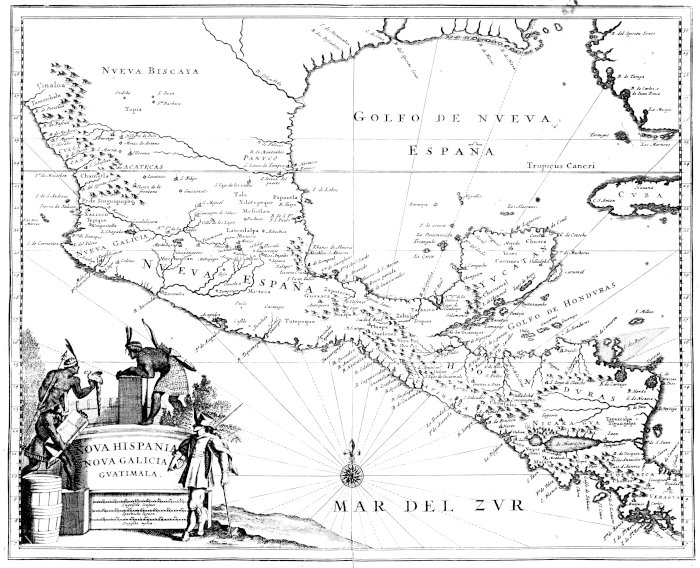
New Spain, the chiefest part of the Northern America, reckons in length from the East-Point of Yucatan, to the place where Mechoacon juts against Guadalajara three hundred and sixty Leagues; and in breadth from the Northern parts of Panucos, to the Southern Ocean, a hundred and eighty Leagues; besides a great part which lies to the Northward, behind inaccessable Mountains and Wildernesses; inhabited by the Tepecuaenes, Guachucules, Cacatequas, Tecaxquines, and others; and was, before the Spaniards Conquer’d and Dismember’d it, much larger than now it is; for as much as it comprehended the whole Province of New-Gallicia, and reach’d from the furthest Point of the Peninsula of Jucatan Southward as far as New-Biscay, and the Confines of California Northward; containing in length seven hundred Leagues and more, and about half as much in breadth: But since the Conquest by Hernando Cortez and his Followers, the whole Countrey of New-Gallicia is taken from it, and made a distinct Government or Audiencia, as the Spaniards call it, of it self.
The Original.
239The Natives of the Countrey are of the Race of the Chichimecæ, a Salvage and Wilde sort of People, of the Province of New-Gallicia, especially in the Parts of New-Biscay, living in Forests and in deep Caves under Ground; whose Posterity do still at this day much trouble and annoy the Countrey thereabouts; notwithstanding all the endeavors of the Spaniards, and the Garrisons which they keep in those parts on purpose to destroy them. About five hundred years ago, or more, according to the account of the Mexican Annals, divers Hoards, as they are call’d, of these Chichimecæ, weary, it seems, of their Woods and subterraneous dwellings, issu’d out into the more open Air, and fell down in huge multitudes into these Southerly parts of America, which are now call’d Mexico and New-Spain; not all at once, but at several times, and under several names, viz. of the Suchimilci, Chalcæ, Tepanecæ, Tlascaltecæ, and others, who subduing or driving out the People they found in those parts, Seated themselves in their room: And though at first every Nation or Company of them, as they came, seiz’d upon some Province apart by themselves, and held it, as it were, in Soveraignty to themselves, without acknowledgement of any dependance or subjection to their Neighbors, or those that were there before them; yet in Tract of time, and by fortune of the Wars, which they made one upon another, they fell under the Government of one King, viz. the King of Mexico, which was the chief City of the Province.
The state of the Mexican Kingdom before the Spaniards arrival.
This Kingdom, at the time that the Spaniards first Discover’d the Countrey, was Govern’d by a Prince, nam’d Motezuma; one, who by his Valor and good success in the Wars, had in a few years of his Reign, before the Spaniards came thither, subdu’d the better part of a hundred Cities and great Towns to his Dominion; and held in actual submission to his Government, and Tributary to him, no less than thirty several Casiques or petty Princes; every one of which paid him Tribute, and were able upon occasion to bring into the Field an hundred thousand Men: He is said to have been, for his Person, a wise and good Prince, just, affable, and tender of his Subjects good: but by reason of some heavy exactions, which his own power, and the Practise of his Ancestors before him, gave him the confidence to Impose upon the Conquer’d People, a great part of his Subjects liv’d but unwillingly under his Obedience, and rather by constraint than otherwise: being also further exasperated against him by one barbarous Custom, which the Mexicans frequently us’d, viz. the Sacrificing of Men. Their manner was, whensoever they had any solemn occasion of doing Honor to their Devil-god Vitzilopuchtli, as they call him, to send out an Army of Men from Mexico, into some of the subdu’d Provinces, (in case they had no Enemies nearer Hand) and to fetch in as many Men as they thought good, to be Sacrific’d; whose flesh likewise afterwards they did eat in a solemn Banquet. This being a business of their Satanical Religion, and Motezuma a Prince extremely Superstitious and Devoted to the Service of his gods, it is said, that he Sacrific’d commonly, one year with another, twenty thousand Men, and some years, upon extraordinary occasions, not less than fifty thousand: So great and grievous a Tyranny, by the just Judgement and Permission of Almighty God, for their great and unnatural sins, did the Enemy of Mankind exercise upon them. He was likewise much given to Women, but it was onely to such as were counted his Wives; of which he is said to have had no less than a hundred and fifty with Child by him at one time.
The bounds of the Mexican Kingdom.
Riches of Mexico.
The Bounds of this Kingdom at present are thus; on the East it hath a large Arm of the Sea, which they call The Bay of New-Spain, or The Gulf of Mexico; On the West, it hath some parts of New-Gallicia, and Mare del Zur; on the North, the rest of New-Gallicia, and part of Florida; and on the South, Mare del Zur again, and 240part of Guatimala. It extendeth it self in length from Jucatan South-East, to the Borders of New Gallicia Northward, above eight hundred Italian Miles, and in breadth, from Panuco to the South Sea, about half so much. It lieth wholly under the Torrid Zone: nor is it a Countrey generally so mountainous or high seated, as some others of America are but for the most part level or low; yet is it so fann’d, (for three parts at least of four, by the cooling Blasts of the Sea, and the Heats otherwise so moderated with frequent Rains, which it hath constantly three Moneths in the Year, viz. June, July, and August) that the Air is rendred thereby exceeding temperate, and the Climate not unhealthful, especially to temperate Bodies, and such as are never so little us’d to it. A goodly Countrey it is, of inexhaustible Wealth and Riches, whether we regard the Mynes of Gold, Silver, Brass, Iron, &c. of all which it hath many, and very good; or the Fruits of the Earth, abundance of Cattel, plenty of Corn and Grain, of which they have two Harvests; or any other Commodities and Endowments of Nature, which serve for the enriching of the World. Amongst other things, it affords Cassia, the Fruit whereof is a thing well known, and much commended by the Apothecaries for its use in Physick, especially in Purgations, and removing of all Obstructions of Phlegm, Choler, &c. Such store of Balm, Amber, all sorts of Gums and precious Liquors, as no Countrey in the World is better furnish’d with excellent Perfumes and Physick, than the Kingdom of New Spain.
Tunas-Tree.
Among the many other sorts of Trees which this Countrey produces, the most remarkable is their Tunas, of which, there being five kinds, one is call’d Cumbeba, from whence proceeds that admirable Tincture, commonly known by the Name of Cochinele, which is thus made: On the top of this Tree is found a Worm, which hath the bigness and shape of a great Louse, which so increases, that in one years time a hundred Trees shall be stock’d from the seed of one of these Animals. The Worm it self being white, after the Skin is carefully pull’d off, put in cold Water or Ashes, and so dry’d, becomes Cochinele. The best sort of it is to be had in Tlascala, and that in so great a quantity, that no less than five or six hundred Arrobes of Spanish Measure (each Arrobe is as much as five English Bushels) is yearly Transported thence. The other sort, which grows on the Mountains, and that which is not so carefully gather’d, call’d Chichimecas, Dyes not so well as the right Cochinele. The Tunas also bears a Fruit long and whitish, with a smooth Shell, and full of little Seeds like Figs: The red, which are inferior in taste to the white, colours the Urine red.
Pine-Apples.
The Pine-Apples which grow here differ from the Spanish, for the Pulp is not inclos’d in a Shell: They have a pleasant smell, and a Pulp, which if eaten much of, causes an Appetite, it being of a tartish taste; they keep good a long time when Salted.
Fruit Cacao.
But much more beneficial is the Cacao, with which Fruit New Spain drives a great Trade; nay, serves for Coin’d Money. When they deliver a Parcel of Cacao, they tell them by five, thirty, and a hundred. Their Charity to the Poor never exceeds above one Cacao-Nut. The chief reason for which this Fruit is so highly esteem’d, is for the Chocolate, which is made of the same, without which the Inhabitants (being so us’d to it) are not able to live, notwithstanding it causes Phlegm and Vomiting to those that are strangers thereto. When the English Commander Thomas Candish coming into the Haven Guatulco, burnt two hundred thousand Tun of Cacao, it prov’d no small loss to all New Spain, the Provinces Guatimala and Nicaragua not producing so much in a whole year. The Trees on which this Fruit grows are divided into four sorts, differing in bigness and shape: all of them are very tender, 241for they will not onely grow in no place but on their usual Ground, but cannot endure the cold Nights Storms, or excesses of Heat; wherefore the Cacao-Trees which grow out of the Fruit that falls off, come to no perfection, except in shady and warm Valleys; which is also the reason why the Planters of New Spain plant the great Leafy Tree Cacaoquanthly (that is, The Mother of the Cacao’s) near the Cacao-Tree, that it may the better grow under the Shadow thereof; in which manner whole Woods are planted: In the second year it bears Fruit, which is first ripe in January, and again in the midst of Summer. Amongst the four sorts the chiefest is Quathuitl, of an indifferent heighth, and full of sharp-pointed Leaves, which are fast to the Boughs without Stalks, and bears a great Flower of a yellowish colour, which falling off, leaves long, tough, and hairy Threds behind them, out of which grows the Cacavently, a Fruit which is oval, heavy like a Melon, of a Saffron-colour, of a fat and thick Juice, a bitterish, yet pleasant taste, and very cooling; being dry’d in the Sun it is thereby made fit to keep; it is likewise highly esteem’d, because the Chocolate is made of the same. Before the Spaniards made themselves Masters of Mexico, no other Drink was esteem’d but that of the Cacao; none caring for Wine, notwithstanding the Soil produces Vines every where in great abundance of it self. But besides the Quathuil, New Spain hath three other sorts of Cacao-Trees, viz. Mecanal, pleasant to behold for its heighth, large Leaves and Fruit; the next is the Xochucaual, which is less than the former; and lastly the least sort, which is call’d Halcacahual. The Fruit of these four sorts of Trees, though differing in shape, yet is all one in power and operation.
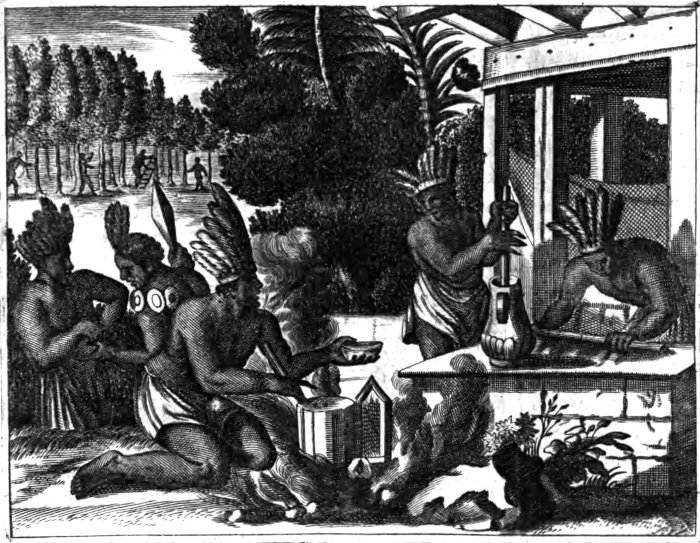
The Spaniards to make Chocolate mix Maiz (by the Mexicans call’d Tlaolli) either whole or Ground, or boyl’d before with Chalk. Moreover, they put the red Kernels also in the Drink, which grow in the Fruit of the Achiote-Tree. Of the Kernels, which are dry and cooling, boyl’d in Water, and stirr’d till it comes to a Pap, they make Cakes, which mix’d with the Chocolate, gives it a cleansing power, and takes away all tastes that cause vomiting.
The Pepper Mecaxochite, which grows creeping along the Earth, with long and 242fragrant Leaves, round Stalks, hairy Roots, and three long Cods which shoot upwards. This Pepper tempers the over-cooling property of the Chocolate. Lastly, it consists also of Xochinacatlis, Tlilxochitle, and the Rozenish Gum, Holli. The Xocinacatli is a Tree with small Leaves, and great Flowers hanging on long Stalks that bend downwards, within of a purple, and without of a dark-green colour, of a sweet smell, and resembling an Ear; and this Flower also gives a pleasant taste and wholsom operation to the Chocolate. The Tlilxochitle runs up to the tops of Trees like Ivy; the Flowers, of a darkish brown colour, cleanse the Nerves, strengthen the Brain, and take away the rawness of the Stomach. The Holli drops out of the Holquabuytle, a smooth barky Tree full of Moisture, which at first appearance is white, then yellowish, and lastly black, which kneaded into round Balls and Roasted, is a remedy against a Loosness and soreness of the Bowels.
Nature of the People.
The Natives of the Countrey are very ingenious in divers mechanical Arts, especially in making of Feather-Pictures, a piece of Curiosity wherein they are held to be incomparably, or rather inimitably excellent; and so industrious at it, that although the Americans generally are not a People over-much addicted to any kind of Labor or Study, yet at this they will sit a whole day together, without either Meat or Drink, onely out of a natural affection they have to the Work, and a desire to be excellent in it; The Countrey indeed affords them great variety of Birds and other Fowl, of most rare and exquisite Colours, which is a great advantage to their Skill, and helps much to the accomplishment of their Work. They Paint likewise very curiously upon their Cottons; and are held to be generally the best Goldsmiths in the World; of most perfect skill in the purging and refining of all sorts of Metals, but especially of Gold and Silver: And yet in other things so strangely stupid and ignorant, that when the Spaniards first appeared amongst them, not a few of them (as ’tis reported) took the Horse and Man both for one Creature; and when the Horse Neighed, they would enquire very seriously what he said.
Lakes of New-Spain.
There are likewise many fair Lakes in this Province, but the principal are those of Chapala and Mexico: the former of which is in the more Northern parts of the Kingdom, towards the Borders of New Gallicia, and is chiefly famous for the abundance of good Salt that is yearly made and Transported thence. The other of Mexico is one of the largest and goodliest in the World, of circular form (as some say) little less than nine hundred Miles in compass, environ’d with the main Land, the Peninsula, or Cape of Florida, Jucatan, and the Island Cuba, having two onely Passages in and out, and both of them well fortifi’d: the one betwixt the Point of Jucatan and the Isle Cuba, where the Tyde violently enters; and the other betwixt the said Island and the Cape of Florida, where it goeth as violently out: upon which Gulf the King of Spain hath always some good Ships in readiness for all occasions; and by them, ’tis suppos’d, he doth more assure his Estates in those parts of America, than by all the Garrisons besides.
The whole Kingdom of Mexico, or New Spain, is subdivided into these Inferior Provinces:
The several Provinces.
1. The Arch-bishoprick of Mexico. 2. The Bishoprick, Mechoacon. 3. Los Angelos, or Tlascale. 4. Guaxaca. 5. The Lordship Panuco: And 6. the Province Tabasco.
Mexico, the chief Province of New-Spain, so denominated from Mexico the chief City, not only of the Province, but of all America; lying between Tlascale and Mechoacan, extends in length from North to South, a hundred and seventeen Leagues; and in breadth along the Southern Ocean, seventeen, but up in the Countrey, fifty four Leagues: In which circumference lie to the North-East, Lateotlalpa, Mextitlan, Xilotepeque, and Panuco; Westward, Matalzingo, and Cultepeque; Eastward, Tuzcoco; South-East, Chalco; Southward, Suchimilco, Tlaluc, Coyxca, and Acapulco.
Bounds of Mexicana.
243It is bounded on the East, with the Gulf of Mexico; on the West, with Mechoacan; on the North, with Panuco, and some parts of New-Gallicia; and on the South, with Tlascalla.
Nature of the Countrey.
This Countrey is both large and rich, containing not much less than one hundred and thirty Leagues, both in length and breadth; and if it yields any thing to Peru in the plenty of Gold and Silver, ’tis certain it much excels it in many other Commodities; as namely, in all sorts of Fruits, abundance of Cattel, plenty of Corn and Grain; in all which, the advantage this Countrey hath, not only of Peru, but of all the other Provinces of America beside, is well known: Not to speak any thing of the great plenty and variety of good Fish, which both the Rivers and Lakes of this Countrey afford, which is very great; insomuch, that the very Tribute of the one Lake of Mexico is said to yield an Income of above twenty thousand Crowns yearly, one with another.
The People of the Countrey are generally Industrious and Active, especially since the Spaniards came among them; rich Merchants, if they apply themselves to it; and they say likewise good Soldiers, when they are train’d and imploy’d that way.
Chief Towns of Mexicana.
The chief Towns and places of the Province are, 1. Mexico, both anciently and at present, the Metropolis and Capital City; being the Seat of an Archbishop, and the ordinary Residence of the Vice-Roy, and chief Governors of New-Spain.
Description of the City Mexico.
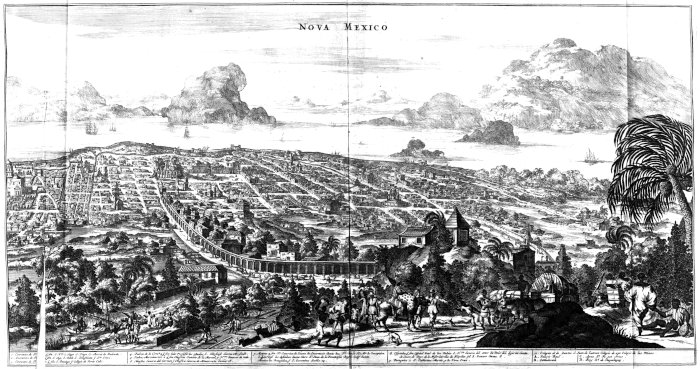
This City, by the Indians was formerly call’d Tenustatan, lies in nineteen Degrees and a half to the Northward of the Equinoctial-Line, rais’d out of a brackish Lake, full of muddy Water; whose circumference along the Mountains is seventy Leagues: This Lake swarms continually with Boats, which carry the People to and again from one inhabited Island to another; four Stone-bridges, no less costly than artificial, with Arches and Gates in several places, lead from the City to the Main Continent.
The fresh Water which they have in the City Mexico, is led into the same through Pipes that lie in the bottom of the Lake; but none are to enjoy the benefit thereof, before they have paid a certain Sum of Money to the King’s Collectors.
Moreover, the City divided into Islands, contains above sixty thousand Houses, which being built on several Isles, have large Bridges, which reach from one to another; some that lie in the middle of the Lake, they approach in little Boats; round about the Lake, especially where the way leads from the Continent into the City, lie several Suburbs, all inclos’d with Walls; between which stand strong Towers, cover’d on the top: To keep off the force of the Water, the Tenustatans have with great labor and charge, made a Bank through the Lake, half way along the City: But the Lake Laguna, from whose bottom Mexico is rais’d, is divided in two parts, the Sweet Lake, which is higher than the Salt, falls in to the same through Sluces, with Bridges built on the Bank that leads from the City to the main Land: The Salt-Lake, which hath brackish and bitter Water, ebbs and flows according as the Wind blows; no Fish is able to live in the same, because the Water which in the sight of Mexico falls into the same out of the Mountains, hath a sulphury Ground: All along the shore, much Salt is made, with which the Citizens drive a great Trade: There are continually above a hundred thousand Boats (by the Indians call’d Acales, and by the Spaniards, Canoos) going off and on from one shore to another: The fresh Water Lake, which is bigger than the salt, and feeds small Fishes, hath above fifty 244Suburbs about the same, of which, some boast five thousand, and others ten thousand Houses: Nay, the Suburb Tescuco, in former times was no way inferior to Mexico in bigness; since the Spaniards have been Masters of this City, they stopt up many Moats, to inlarge their narrow Streets.
Besides three publick Markets, every open place affords all sorts of Provisions daily; the Indians call the Markets Tianguystly, and the Spaniards, Tianguez; the first and chiefest stands in Tatelulco, adorn’d with Galleries on three sides; in the middle of this Square, which is accounted the biggest in the World, stands next to the place of Execution, a stately Fountain; the Tents which are every Week pitch’d up here for Trade, amount to above thirty thousand. The second Market call’d St. John’s, is in Mexico, and swarms continually with People. The third is call’d Hipolito, from the Guardian-Saint of the City, whither every Wednesday and Thursday comes such a multitude of People, that this spacious Market is too little for them; for the sale of every Commodity, a peculiar corner is allotted; but great Packs are left to be dispos’d of in Boats, which lie near the shore.
At the four corners of the City, at present call’d St. John, St. Maria la Rotonda, St. Pablo, and St. Sebastian, are above four thousand Spanish Families, and thirty thousand Indians, besides what inhabit Tatelulco, now St. Jago.
The Temperature of the Air.
The Air in this place is very strange; in the day time, the Sky is generally Serene; the North Wind against the Evening brings Rain, of which the Mountain Tepeaquilla lying a little League beyond the City, gives certain Testimonies; for when a black Cloud appears on the top thereof, it is certain to be blown from thence over Mexico with Rain: After a moist Evening follows a Star-light Night, and a pleasant Morning: From September till May, it is generally dry Weather here, but if it chances to Rain, the Rain is attended with a Storm, which occasions a sulphurous Fogg, very unwholsom, and so dark, that one Man cannot discern another, and causes a pain through all the Limbs, nay sometimes Death it self; wherefore, whensoe’re it approaches, every one keeps close in his House, or goes into the Countrey.
Moreover, it is worthy of observation, how strangely this City is alter’d since its being Conquer’d by the Spaniards, and especially when Anno 1629. it was overflow’d by a mighty Deluge; which alteration by Barnabe Cabo, in a Letter to the Jesuite Hernande Leon, is thus set forth:
Barnabe Cabo, his Description of Mexico.
Mexico overflow’d.
Mexico, says he, lying in a Valley between high Mountains, hath seventy Leagues in circumference: The Valley being Oval, is for the most part interspers’d with Lakes, which the Indians, and after them the Spaniards have digg’d, only the Lake which washes Mexico is natural; and to stop the Water-falls, there are Banks and Sluces every where: The Flood before Mexicalcingo flows a Fathom and a half higher than before Mexico. The four other Lakes to the Northward have much more Water than the Mexicalcingo, of which, some have scarce four, others but three Leagues in circumference; when as Mexicalcingo’s Lake reckons fifteen, and Mexico’s sixteen. On the breaking of the Banks, Mexico hath often suffer’d great damage, wherefore the Vice-Roy de Valesco took special care to make a vent for the Water through the lowest Mountains; whereupon the Countrey being Survey’d, the Northern Coast near the Village Gueguenoca, was found to be the most convenient. But about the manner of letting the Water out, the Surveyors could no ways agree; most of them were of opinion to dig Channels, into which the Lakes might discharge their Waters; others, thought best to make a Gutter under Ground, which last Valesco put in hand with unhappy success, because the Laborers who under-min’d the Ground, were choak’d with the falling in of the Sand, 245or stifled with the sulphurous Vapors rising out of the Earth: Nevertheless, they gave not over the Work, though they began it quite another way, for a French-Man, call’d Henry Martin, advis’d to deepen the River Quaiotitlan, which falls into the Laguna, and by that means make it a Bay, into which the Laguna might pour her over-charg’d Waters: Which design, though contradicted by the Jesuit John Sanchez, was put in practice; by which means the Water fell in a short time so much, that they could walk dry to the Cliff El Ponnel, lying a League from the City; wherefore they continually labour’d on this Work, till such time Conde de Getues came over for Vice-Roy, who judg’d the Charge to be unnecessary, nay Commanded the Ditches to be broken down, which stopt the Water along the Silver Mines of Pachuca, that he might see exactly how much it would over-flow Mexico: After which the Flood rose yearly higher and higher; till at last, Anno 1629. a mighty Rain falling, swole the Laguna in such a manner, that it over-whelm’d all Mexico, wash’d down the Houses, all Merchandizes which could not endure the Water, were spoil’d, and had not they had innumerable Boats to help them, thousands of People might have perish’d in this Deluge: But at last, Henry Martin restor’d again the fore-mention’d Channel to its former Perfection, and brought the Flood which fell down out of the Mountains within the Banks of the River.
Stately Palaces.
Quantitlan digg’d also a Channel of eight thousand Fathom long, and made an Arch’d Sewer under Ground of the same length, which Sewer hath at every two hundred Fathoms distance, Vent-holes, and a hole of sixty Fathom deep, and by this means, diverting abundance of Water, they dry’d Mexico in a short time: When the Banks and Streets began no sooner to appear, but they fell to work to raise the Ground, and to lay Bridges, and also to build more Boats. The Citizens likewise found it convenient to make another deep Sewer for the carrying away of more Water, notwithstanding it requir’d twenty years labor. The River, which in a manner runs through the middle of the City, is curb’d by a Wall; a crooked Bridge, with many Arches, and of a long extent, leads to the City, in which stand many brave Palaces, with pleasant Walks of Trees about them; the Cloysters of several Orders of Fryers, appear with high Spires and Turrets, above all other Buildings.
And Monasteries.
The Franciscans have here four very sumptuous Buildings: The first, Consecrated to St. Francis, stands in the uppermost part of Mexico, within a large square Court, and on each a pleasant Walk of Trees: The Cloyster it self is very high, and trebble Wall’d, with Towers and Galleries about it: In the middle of the City stands another Tower’d-Cloyster, call’d St. Jago. The third lies a little distance from it, which being built long, hath a stately Turret, and is call’d Maria de Rodonda. The fourth, not far from the first, but much smaller, is nam’d San Diego; these belong to the Franciscans. The Augustin Monks are also no way inferior to the Franciscans, for magnificent Structures, with spacious Halls, high Towers, and rich Balconies: The first is denominated from St. Augustine, just behind which appears San Pabla, less stately than the rest. St. Sebastian, near the Laguna, is built in manner like a Church, whose Tower ends like a Pyramid. The Cloyster San Cruz, belonging also to the Augustines, built square, stands near the Market, in the middle of which stands a stately Fountain: The Court within inviron’d with thick Walls, amazes the beholders by the pleasantness of its situation.
Moreover, the Dominicans inhabit two brave Cloysters; the chiefest Dedicated to St. Dominic, is eight square; to which is adjoyning a pretty large Church, with a Steeple: The second, which stands on one side of St. Jago, and consists of three several Structures, is call’d Collegio de Porta Cœli. Opposite to St. Jago, near the great 246Market the Jesuits have a stately Colledge, or High-School, where many are brought up in the Latin and Greek Tongues, whence it is call’d, Casa Professa Les Estudios.
There is also another Habitation of Religious Men, call’d Illefonse Sanna Noviciad, which for State, may vie with any Royal Palace.
Cloysters belonging to the Monks of La Merced.
The Monks of La Merced dwell in two Cloysters, both Consecrated to the Virgin Mary, yet Sirnam’d Montseratte, and Carmel: The first lying not far from the River, is a mean Structure, in comparison to the last; the uppermost Tower of whose Temple appears above all other Buildings, in the upper part of Mexico near the Cloyster of St. Francis.
Womens Cloysters.
The Women have also fourteen Cloysters here, the chiefest whereof is Dedicated to Catharine of Siena; but much more splendid is that of Santa Teresa, built like an Imperial Palace; famous for its stately Gardens, and round Fountain, which continually spouts Water. The rest, which we shall onely name, are La Encarnacio, Santa Ines, Jesus-Maria, Laurenso, Las Des-calcas, Santa Clara, Juan de la Penitentia, Regina Cœli, Santa Monica, las Rocogidas, Jeronymo, and Conceptione; besides the Almshouses, Real de los Indios, and Nostra Senora del Amor: There are likewise eight Hospitals, viz. de Dios, del Spiritu Santo, Juan de Doys, de la Misericordia, de san Hippolito, and de san Lazaro. The three chief Churches bear the Name of Catharine, Martin, and Vera Cruz; and the Clergy-men thereto belonging, enjoy many stately Palaces, amongst which are Juan de Lateran, de Christo, and las Nivas.
The Vice-Roy’s Palace and Arch-bishop’s Seat.
The Residence of the Vice-Roy which lies near the Dominican Cloyster, Porto Cœli, is so sumptuous a Structure, that it may stand in competition with any of those Edifices which were so much cry’d up by the Ancients; nevertheless, it is not to be compar’d to the Arch-bishop’s Seat, built round like a Theatre, whose Luster expresses the Quality of him that inhabits the same, he being Governor of the Bishopricks of Fascala, Guaxaca, Mechaocan, New Galicia, Chiapa, Yucatan, Guatimala, Verapaz, and the Philippinas. This marvellous Structure was begun by Ferdinand Cortesius, but was finish’d by Sebastian Ramires de Fuenleal; and not much inferior thereunto is the Casa de Cabildo Alameda.
The gallantry of Mexico at this day.
At present, Mexico is thought to be one of the richest Cities of the World, abounding (if reports be true) in all kind of voluptuous gallantry and bravery, even to excess: It is suppos’d to contain about six or seven Miles in compass, and to consist of above an hundred thousand Houses or Families, whereof not the tenth part Spaniards, but those that are, all Gentlemen, at least as to their garb and manner of living; for they live most splendidly in all respects, both for Diet and Apparel.
For the first, we have spoken so much already of the general plenty of all things in the Kingdom of New-Spain, that pertain to this part of pleasure, that it is not to be doubted: And for the second this may be some instance, viz. that it is no extraordinary matter to see an Hat-band or Role all of Diamonds, in some ordinary Gentlemans Hat; and of Pearl among the common Citizens and Tradesmen. The Coaches (which most Gentlemen keep) almost cover’d with Gold and Silver, richly beset with Precious Stones, and within ordinarily lin’d with Cloth of Gold, or the best China Silk that can be gotten; of which Coaches, in time of year, at the Alameda, as they call it, which is, as it were, The Hide-Park of Mexico, and a place made of purpose for recreation and delight, a Man shall observe not seldom, above a thousand or two thousand Coaches, full of Ladies and Gallants coming thither onely to take the Air, and their Pleasure, both the one and the other attended with a numerous Train of Servants and Mulattoes of both Sexes. In la Plateria, which is 247but onely one Street in Mexico, nigh to the Vice-Roy’s Palace, in less than half an hours space: with the turn of an Eye, you may see Millions of Wealth in Gold, Silver, and Precious Stones, in the Goldsmiths and Jewellers Shops thereabouts. In a word, there is nothing hinders Mexico from being the most absolute City in the World for delight and bravery, but onely two Inconveniences to which it is subject: The one is the danger of the Lake, with the Infalls whereof it may seem to be almost continually threatned, and in the Year 1629. did actually suffer a very great calamity, the Waters breaking through the Banks, and drowning a great part of the City, with the destruction of much People, and the loss of all their Goods intirely, through the avarice (as is suppos’d) of the Vice-Roy that then was, and some other of the King’s Officers, who diverted the Money that should have been employ’d for the fortifying and repairing of the Banks, to their own proper uses: The other is from the nature of the Soil and Ground it self on which it standeth; which is found to have a tincture of Sal Nitre in it, somewhat strong; and the Winds partly from the Lake it self, and partly from the Hills about it, raising the Dust of this Earth constantly every Evening, for many Moneths of the Year together, so violently, that the Air is even darkned therewith for some time: The Inhabitants are much annoy’d by it, and made subject to divers Hypocondriacal Pains and Infirmities, and sometimes kill’d with it, especially such as either cannot, or care not much to avoid it.
The City lieth about sixty Leagues, or a hundred and fifty Miles distant from the Atlantick or North Sea, from whence by the Port of St. John d’Ullua, or Vera Crux, (which are the usual Landing-places) there is a fair and easie March to Mexico, by the Cities of Xalabar, Perotta, Puebla de los Angelos, and Tlascalla, all of them open and unfortifi’d Places, (as likewise Mexico it self) and the Countrey round about very rich and well accommodated with all things.
City Chulula.
The next City of note in ancient times was Chulula, which being built in a fruitful Plain, had above twenty thousand Dwelling-houses, and as many more Banquetting-houses. The number of the Temples and Turrets were equal with that of the days in the Year: The Government thereof belong’d to a Mayor and six Aldermen, and one chief Priest; for they never went upon the least Design before they had been at their Devotion; in which the Priest’s Office was onely to perfume the Idols four times in twenty four hours, viz. in the Morning, at Noon, after Sun-set, and at Midnight; at which times none durst be absent, but they us’d also a cruel Exercise on themselves, and one much more cruel on others, for on usual Feast-days they abstain’d from Meat, Drink, and Sleep, scourg’d their Bodies with knotted Cords after a miserable manner, evacuated their Seed, that so they might curb all fleshly Desires, and met every Night in a spacious place, where sitting down they wounded themselves with Lances in their Legs and Arms, so long till the Blood gush’d out of the same; which gathering in a Cup, they anointed their Temples therewith, and dipt the Lances in the same, and then hung them up before the Temple in Bundles of Straw. Of these were a great number, and the more, because they never us’d their Lances but once. But on these Days, which were Consecrated to the Idol Tezcatlipuca, every one besides the Priests wore a new Rope made of the Hemp Mangey, of a Fathom long, and a thick Knot at the end, with which they beat themselves so miserably on their Backs, as if they intended to have broken them: After which the Priests stay’d five days in the Temple, in which they us’d the like cruelty, eating scarce once in twenty four hours.
Their Prisoners they us’d after a most horrid manner, viz. in their Temples stood a round Stage of Stone; to the top of which they ascended by a Square Scaffold, 248supported by twenty eight Pillars; behind which appear’d thousands of Mens Heads, and amongst them the Prisoners that were to be Offer’d sat stark naked, and guarded by several Armed Men; three Foot from the Steps which led up to the top of the Scaffold, stood a pyramidical Stone, (by the Indians call’d Quauxicalli) and behind it two round Chappels, cover’d on the top like Mitres, each had four Holes in a large Gate, in which sat a horrid Representation, worshipp’d by six Priests call’d Chackalmua, whereof one call’d Papas, or Topilzin, whose Office was to pluck out the Hearts of the Prisoners, being in greatest esteem, wore a red Mantle about his Body, not unlike a long Coat, with broad Fringe, which trail’d after him upon the Ground, and also a Crown of green and yellow Plumes on his Head; his Ears and under Lip were likewise adorn’d with Precious Stones: The other five appear’d in like manner with their Hands and Faces painted red, but having Leathern Fascia’s about their Heads, and white Coats stitch’d with Black on their Bodies, they might easily be distinguish’d from the Topilzin; who on a sudden ran down the Stairs to the Prisoners, and shew’d each of them an Image, (saying, This is your God) made of Bledo Paste, Maiz and Honey, green Beads for Eyes, and Grains of Maiz for Teeth: whereupon the Prisoners were led up, and laid with their Backs on the sharp Stone Quauxicalli; then the five Priests took hold of their Leggs, Arms and Head, put woodden Collars about the Sufferer’s Necks, whilst the Topilzin shew’d Reverence to the Idol; which done, with a sharp Stone he cut open the Breasts of the Prisoners, who in a deplorable condition lay on the pyramidical Stone, and pulling their Hearts out of their Bodies, shew’d the same reeking to the Sun, and at last threw them toward the Idol, and the dead Bodies down the Stairs, where some appointed for that purpose carried the same away; but every one taking his own Prisoner, and roasting and boyling him, serv’d him up to his Friends as a great Dainty.
This kind of Murdering was not onely us’d amongst the Mexicans, but also by all the other neighboring Indians, and especially in the City Chulula, which (as we have said before) signifies The Sanctity of all the Gods: for in this Town six thousand Children were yearly Offer’d.
The Citizens hereof us’d to drive a great Trade, especially in Cochinele.
Their Habits were several; for Persons of Note wore Cotton Coats, about the Edges of which hung Feathers and pieces of Cony-skins: the meaner sort went in Nequons, or a sort of Linnen Coats made of the hairy Leaves of the Tree Maguey.
3. The City Tezuco, full of handsom Streets and fair Houses, is built near the salt Mexican Lake, yet hath no want of fresh Water, with which it is supply’d by Gutters from the Mountains under Ground, according to Anthony Herrera, it twice exceedeth in bigness the famous City Sivill in Spain.
4. Quitlavaca, by the Spaniards call’d Venezuela, (because it is, like Venice, surrounded with Water, and divided into several Isles,) boasted formerly above two thousand Families: From the Town a Cawsey of twenty Foot broad, and half a League long, leads through the Lake to the Main Continent.
5. Yztacpalapa, a very populous Place, and lying part of it in the salt Lake, and partly on the Main Land; where several fresh-water Pools afford store of Fish, two Leagues distant from Mexico, to which leads a broad Way; in the middle of which stands a Fountain, surrounded with high Trees, which produces excellent Water.
6. Mexicaltzingo, situate upon the Lake Laguna, a Town consisting of four thousand stately Houses.
7. Cayocan, in a fruitful Plain, containing six thousand, being but a League and 249a half from Yztacpalapa: to which the neighboring Village Houcilopucho was not much inferior.
These three Places, before they were subdu’d by the Spaniards, boasted many brave Temples and high Towers, whose lustre appear’d at a great distance, but now being turn’d into Cloysters, they are inhabited by Monks and Nuns.
The Salt made here of Earth, though not white, and onely fit to make Pickle of, is Transported to many Places.
Towns and pleasant Villages about Mexico.
About Mexico there are also several Villages, the chiefest of which are 1. Mastitlan, a Town pleasantly seated upon the top of an huge Mountain, in the midst of most delicate Groves and shady Woods, and reckon’d to contain no less than thirty thousand Inhabitants in all, dwelling either in the City, or upon the sides of the Mountain.
2. Antepecque; this is a Town belonging to the Marquess de Valle, who is of the Posterity of Cortez, and said to be seated in the most delicious place of all New Spain.
3. Acapulco, a Town seated upon the South-Sea, or Mare del Zur, yet belonging to this Province. It is a haven-Town, and one of the most frequented upon the South-Sea, situate upon a large and capacious Bay of about a League broad at the Entrance, and affording many convenient Stations and Docks for Shipping. At the bottom of the Bay Westward lieth the Town, with a strong Castle very opportunely built, both for the command and security of the Port, well wall’d and fortifi’d with Bulwarks, and having a constant Garrison of four hundred Soldiers in it, or thereabouts. The reason whereof, I suppose, may be chiefly this, viz. that from this Port there is the greatest Traffick and Entercourse held betwixt the East and West-Indies, together with the Philippine Islands.
Silver Mynes.
The Countrey hath many rich Mynes of Silver in it, and some of Gold; the chief of which are by Herera reported to be these, viz. 1. Those of Puchuca, fourteen Leagues distant from Mexico. 2. Of Tasco. 3. Talpuiana. 4. Cultepeque. 5. Zacualpa. 6. Zupanguo, and divers others.
The rest of the Villages are Guatitlan, Tenyauca, Escapusalco, Tacuba, and Suchimilco.
Strange Fountain.
The neighboring Province Xilotepeck, which is exceeding fruitful, is also famous for two Fountains, whereof one near the Village Queretaro produces boyling Water, which when cool’d, is a wholsom Drink for Cattel: The other for four years is full of Water, and for four years after it is empty; in great rainy Seasons it is quite dry, and in droughty Weather it overflows.
Between the Villages Queretaro and San Juan, is a Plain which extends it self seven Leagues in breadth, and seven in length, besides two Leagues farther beyond Quartero, where a hundred thousand Head of Cattel, and ten thousand Horses, find plentiful Pasture.
The wonderful Mountain Nevada.
The Mountain Nevada, near the City De los Angelos, deserves no small admiration; for it begins at thirty Leagues end to rise exceeding high, and being flat on the top, hath a wide gaping Mouth, whose bottom is fathomless; from which at Sun-rising and setting rises a Smoak up directly towards the Skie, but immediately after spreading like a Plume of Feathers, it is dispers’d by the Wind, and no more seen till it appears in a dusky Cloud. With the Smoak are also Ashes vomited up; yet the Mountain is very pleasantly planted with lofty Cypress, Cedar, Oak, and Pine-Trees. The neighboring Fields abound likewise with Wheat, Cotton, and Maiz. There seldom appears any Rain here.
At the Foot of this Mountain lies the Village Tepecco, famous for the Crystal 250and Allom gotten there. The Village Ocotlan is also maintain’d by the same: But Tuculala by Gold-Mines, and fruitful Lands, which are twice a year shaken by Earthquakes; wherefore the Inhabitants live not in Stone Houses, but in little Straw Huts.
South-Eastward from Nerada is excellent Sugar to be had, and on the Mountain it self the famous Gum Anime, which drops out of a Tree call’d Jetaiba, which is always green, with hard white Wood, a pale yellow speckled Bark, three long soft Leaves hanging one over another on one Stalk, and the Fruit on the middle of the Body. After the rainy Season is past in October, then they cut a Hole in the Body of the Tree, out of which the Gum drops: it hath a pleasant smell, and is exceeding good against the Head-ache occasion’d by Colds.
Not far from hence appears the Valleys Matalzingo and Atzompam, which have excellent Pastures, in which Diego Nunnez de Camargo bred forty thousand Sheep out of two in ten years time.
And these are the chiefest Towns, Villages, and Countreys, which surround the famous City Mexico.
The first Foundation of the City of Mexico.
Concerning the erecting of this City, the Indians relate thus: That the seventh Family of the Navatlaca’s, Extracted out of the Countrey Aztlan, rang’d up and down not without thousands of Inconveniences, from one Countrey to another, according to the Information which their Sages had given their Spirit Viztliputli, till at last some of the Priests straying from the Army, or rather Multitude, got into a Wilderness, full of Brambles and Thorns, and came at length to a Place where was a Spring of clear Water, in which the Fishes glitter’d like Silver; where taking up their repose that Night, their Spirit inform’d the oldest of them in a Dream, that they should find thereabouts a Tunal Tree (whose Leaves grow out of one another) under which, on a Stone, lay the Heart of the famous Sorcerer Copil: This Tunal Tree should be discover’d by a Crane on the top of it, which in one Foot should hold a Bird, and in the other a Bough of the Tree, near which they were to build a City: The old Priest waking, and relating his Dream, every one endeavor’d to find out the fore-mention’d Tree; at last they found it, by discovering on the top a Crane, with spread-out Wings looking up towards the Sun, and holding in his Claws a small Bird, invested with curious Feathers: Whereupon they with all speed built a Chappel of Turf and Clods of Earth, and cover’d the same with Canes, to keep their Idol from the Weather, resolving, so soon as they could, to build him a better Temple.
The Lake on whose Isles they setled, abounded with Fish and Fowls, which they exchang’d with the neighboring People for Stone and Mortar for the building of a Temple for Viztliputzli, and a new City; to which they made a Cawsey in the Lake Laguna, and divided it into four great Wards or Divisions, and subdivided them again into lesser; over which they plac’d peculiar Idols, and order’d a Crane like that which they had seen on the Tunal Tree to be their City Arms. The dividing of the Wards occasion’d great dislike amongst the Grandees, judging those to whose lot they fell, not to be worthy of them; wherefore deserting the same, and travelling along the Lake Laguna, they setled themselves at last in a sandy Soil, which they call’d Tlattellulco, and entertain’d a bitter hatred against their Countrey-men who kept the four Wards of the new Tenustitan, doing them all the mischief they could; wherefore the Assaulted were necessitated to chuse a King, that they might be the better able to oppose their Enemies: But that they might not raise a Discontent amongst themselves about electing a Governor, they judg’d it fittest to take a Foreigner; amongst whom they found none so capable of so great an Office as 251Acamapixtli, Grand-son to the King of Culhuacan, whereupon sending Ambassadors thither, they obtain’d their desires.
The new King was no sooner Crown’d, but he settled all things in order with great Prudence, insomuch, that Mexico grew daily to be more famous and fear’d: But this sudden growth rais’d a jealousie amongst the Neighbors, who dreaded their growing Power and Valor.
Proceedings between the Tapuneca’s and Mexicans.
The Tapunecans who were also a valiant People, being the nearest to them, and having Azcapuzalco for their chief City, made it their main design, utterly to root out the Mexicans, before they grew to be more Populous and Potent; notwithstanding they had hitherto receiv’d Tribute from them, for delivering the Lake Laguna to them, which was a quantity of Timber and Plants; yet they demanded not only more Tribute than formerly, but also in such a manner, as was thought impossible to have been perform’d, which was, that those Plants which were formerly brought to them, as growing on the Land, should be set in the Water, so as to come floating to them, as they grew, to Ascapuzalco, which if they did not pay, they should expect to be all put to the Sword. The Mexicans much amaz’d hereat, and not knowing how to produce the demanded Plants, Viztliputzli inform’d the oldest Priest, that the demands might be satisfi’d; and commanded him to throw Earth on the Water, and to Sow Seed on the same, which at the usual time produc’d Maiz, Azi, Chias, Tomates, and the like, with which the Tapunecans being satisfi’d, demand next a Goose, and a Hen which laid Eggs, out of which the young ones should appear, when on the floating Clods of Earth, the Nests came opposite to Azcapuzalco, which by the advice of Viztliputzli, they perform’d fifty years one after another. Mean while, Acamapixtli (who had inlarg’d Mexico with Streets, Palaces, Temples, and Markets) dying, would not name any one to succeed him, but left the choice of the Election to the Commonalty, who Crown’d his Son Vitzilovitli, and Marry’d him to the King of Tapunecans Daughter, that by that means they might gain his friendship, and be eas’d of their strange Annual Tribute: Whereupon Ayauchigual, the King of Tapunecans Daughter being Marry’d to Vitzilovitli, was within twelve Moneths deliver’d of a Son, which the Grand-father call’d Chimalpopoca, which signifies A Gun which gives Smoke, and afterwards was satisfi’d with two Geese, and some Fish yearly from the Mexicans, onely as an Acknowledgment that they inhabited his Countrey. Chimalpopoca loosing his Parents, in his tenth year was Crown’d King, with a Bowe and Arrows in his left Hand, and a Woodden Sword in the right: Soon after he oblig’d his Mothers Father to be kind to the Mexicans, for they being in great want for fresh Water, he had leave by Channels to bring the same out of the Mountain Chapultepec, a League distant from Mexico; to which purpose they made a Pipe of Planks, and hollow Trees joyn’d together with Clay, quite through the Lake; but this Pipe not being teight and durable, and the fresh Water by that means mixing with the Salt, they sent Agents to Azcapuzalco, to request Stones, Mortar, and Work-men to make a substantial Sewer: This message was ill resented by the Council of Azcapuzalco; What, (said they) do the Mexicans think, shall a rambling company of people, which on Charity live in anothers Countrey, Command those that Govern them to be their Servants? This grudge went so far, that at last they took a Resolution without the King’s knowledge, (for he was suspected, because of his Grand-chil’d Chimalpopoca) to forbid all manner of Trade with the Mexicans; nay, to endeavor utterly to root them out; yet some judg’d, that they ought to spare Chimalpopoca, while others on the contrary said, That he ought to be destroy’d, because his Father being a Mexican, he would to the utmost of his Power defend his People; which last being approv’d of, so troubled the King of the Tapunecans, 252that he dy’d of grief; for the Design being soon after put into execution, and the Tapuneca’s breaking in the Night into Chimalpopoca’s Palace, Murder’d him; which Murder made the Mexicans thirst for revenge; whereupon, setting themselves wholly against the Tapunecans, they enter’d into a League with Vezcuco, and Culhuacan, and chose Izcoalt, for his great Valor, for their King; notwithstanding Acamapixtli had begotten him on a Slave.