The Third Book, CONTAINING A DESCRIPTION OF PERUANA OR, Southern America. (continued 7)
Reading edition
Stackhower also setting Sail when Arcisseusky left the Castle Ceulen, intending to meet him again at an appointed time before Conayou, was kept back by contrary Winds.
After this Arcisseusky set Sail to Mongoangape, where Rowing up the River, he took a Ketch with two hundred Chests of Sugar, as also a Carvel and a Boat, and Landed where the River bends about a Mountain, which so affrighted the Portuguese, that they quitted Antonio Marino’s Sugar-Mills. Soon after the Fleet took a Barque with Wine, and return’d to Reciffa.
Mean while Schuppe was not idle, for going up the River Camarigibi, he burnt divers Houses, as also on each side of the River Alagoa; where he also took four rich Sugar-Mills, whilest many Vessels from the United Netherlands brought several Ships into the Haven of Pernambuco, which they had taken on the Coast of Brasile.
The Fort Santa Margareta attempted by the Hollanders.
About the latter end of November 1634. thirty two Sail, divided into two Squadrons (the first carrying in one and twenty Ships, a thousand nine hundred forty and five Soldiers, the second on eleven Ketches, four hundred and nine) under the Command of Schuppe, Arcisseusky, Carpentier, and Stackhower, weigh’d Anchor to go to Parayba; where Schuppe Landing first with six hundred Men, fell upon the Enemy in such a manner, that he put them to flight, and forc’d them to leave a great part of their Arms, Hats and Coats behind; and it wanted little but the Governor Antonio d’ Albuquerque had been taken in the pursuit: Mean while the rest of the Hollanders Landed, and Casper Ley march’d along a Cart-Road with three Companies directly to the Fort Santa Margareta, and Encamp’d himself behind a Hill, about a Musquet-shot from the Walls of the Fort: Schuppe going along the Shore, found divers forsaken Works, and Intrench’d along the River on the East-side of the Castle. Arcisseusky march’d on the Right-hand along the Sea-shore in view of the Portuguese in Garrison. In the River lay an Isle, on which was built the Castle Restinga, which could receive constant Aid from the Castle Margareta on the Main.
The Fort Margareta taken by Schuppe.
The Fort Antonio taken by Lichthart.
Lichthart going in between the Island and the Castle Margareta with six well Mann’d Boats, took two Barques and a Boat behind the Island, and march’d through a Wood to Restringa; where he found that the Fort separated from the Island, was surrounded with Water, wherefore he withdrew into the Wood till 552the Water was fall’n down, and then Storm’d the Fort Restringa, and notwithstanding the Portuguese fir’d continually upon him with two Brass Guns, he soon became Master of it, and cut off all those whom he found had born Arms; whilest Schuppe fir’d upon the Fort Margareta from a Platform, and also threw Granado’s into the same. Arcisseusky likewise approach’d nearer and nearer with his Trenches, on which the Portuguese discharged many Guns; but after the Breastworks were most of them spoil’d, the Governor, Simon de Albuquerque, surrendred the Fort to Schuppe, who permitted a hundred and fifty Men that were in Garrison there, to go to their several Dwellings up in the Countrey, the rest were Transported to other places, on promise that they would not bear Arms against the West-India Company during the space of six Moneths. In the Castle the Hollanders found six Brass Demi-Culverins and fifteen Drakes, besides other Ammunition, with which the Victors pursu’d their Conquest, putting themselves in a posture to go up a Creek which runs two Leagues along a River to Parayba, and to fall upon that City, when two French Renegado’s coming from the Northern Fort Antonio brought information, That that Fort was guarded but by a few Men, and had but little Gun-powder, and if the Hollanders would but once make a shew of Storming the same, it would soon be deliver’d to them, though for its Situation it is invincible; but Schuppe suppos’d that there might be a Plot in this Information, and the rather, because he heard that the Duke of Bagnola was coming thither with six hundred Men; nevertheless, to be better assur’d thereof, he sent a Drummer to demand Antonio: The Governor thereof, call’d Magaglianes desir’d three days time to consider, which was utterly deny’d him, and he had onely leave to carry away the King’s Standard, and his Request granted, That the Hollanders should make a shew of Storming the Castle, that it might not be said he had surrendred such a Fortress without a Gun being fir’d; after which Lichthart went into the Castle, wondring at such a Victory; for the Fort, on which no Charges had been spar’d, lay upon an inaccessible place, and had five Brass Culverins and nineteen Iron Guns.
The City Parayba deserted by Bagnola.
The Hollanders encourag’d by their good Success, went the same Night up the River Parayba to the Creek Tambia Grande; where Landing, they found all the Works empty, three Iron Guns lying dismounted on the Ground, the City Parayba without People, and the Guns about the same either made useless, or sunk in the Haven. A Hamburgher that had liv’d a considerable time in Parayba, otherwise call’d Philippea, inform’d the Hollanders, That Bagnola seeing no means to defend Parayba, was gone to Goyana with two Companies, one of Italians, and the other Spaniards, who were march’d into the Woods, after they had burnt three Ships, and two Store-houses full of Sugar, in which there were consum’d near upon three hundred Chests.
Before this Design upon Parayba was undertaken, the West-India Company sent out four Vessels under the Command of John Walbeek, to the Isle Curacao; the Situation of which John Otzon knew exactly, having been a long time a Prisoner there: Walbeek getting through a narrow Mouth between several Rocks into a convenient Harbor before Curacao, Landed seventy five Musquetteers who were Encountred by seventy Brasilians Arm’d with Clubs, which the Spaniards had animated to fight, by making them half Drunk. The Hollanders having march’d all over the Island, burnt the Village Maria, and at last agreed with the Governor Alonso Lopes de Morla to leave the Isle.
Schuppe chang’d the Name of Parayba, or Nossa Sennora das Nieves, or Philippea, into Frederick-Stadt, in honor to the Prince of Orange, nam’d Frederick Henrick.
Parayba, or Henrick-stadt describ’d.
This City hath two great Market-places, twelve Streets, and a large Franciscan 553Cloyster, built near a Lake, and inclos’d within a Wall by a broad Bay, which the River Parayba makes before the City; the Countrey about which is mountainous: In other places, especially along the River, lie many fruitful Plains, abounding in some places with the Grain Mandihoca, which is ground to Meal, Potato’s, Lemmons, Cabbages, Cucumbers, Bananas, Cocoa-Nuts, Ginger, Araba, very delicious when Preserv’d with Sugar, and Cacious, somewhat like Chesnuts, of which the Natives make an intoxicating Liquor.
Whilest all things were put in good order at Parayba, Colonel Picard march’d with eight Companies to the House Validaris, if possible, there to take the Governor Antonio Albuquerque Prisoner; but he being forsaken by all the Brasilians (who came back with Picard and their Commander, the Jesuit Emanuel de Morais) absconded himself; not long before which a Proclamation had been publish’d in the Name of the States of the United Netherlands and the West-India Company, promising great Civilities and Advantages to all the Inhabitants of Parayba, whether Natives or others, that would come in and submit to their Government.
This Invitation was so well receiv’d, that many who were kept back so long as Albuquerque appear’d, as soon as they heard of his obscuring himself, came in to the Hollanders, as Duarte Gomes, and several eminent Portugueses, with a considerable number of indifferent quality; as also the Inhabitants of the Province of Rio Grande came to Frederick-Stadt, to claim the benefit of the Proclamation.
Rebellino forced to flye from place to place.
Arcisseusky and Stackhower marching to Goyana with seven hundred and fifty Men, took up their Quarters in the Village Capivaribi, lying at a River of the same Name; where all the Inhabitants of Goyana being fully satisfi’d with the Hollanders Proposals, own’d their Government, and fell off from the King of Spain. But the Spanish Captain Rebellino, animated by the Jesuits in the Village Mosuick, got three hundred Soldiers together, besides a considerable company of Brasilians, Commanded by Camaron, and burnt all the Sugar-Canes and Brasile Wood in Goyana; whither Arcisseusky marching, soon put them to flight, and burnt the Village Mosuick, with the Church and Jesuits Cloyster, from whence the Enemy ran to the strange Mountain Miritbi, which in the rainy Season, especially when great Showers fall, makes a noise like claps of Thunder, or like great Guns. The same Wonder is observ’d of the Mountain Pasayra, in a Wood behind Girgolio Barro’s Sugar-Mills; the mystery whereof we leave to Philosophers to enquire into. Arcisseusky follow’d Rebellino, who had ambuscado’d himself about half a League from Mosuick; from whence he being also driven, his Men began more and more to desert him, whilest Schuppe with a considerable number of Men came to Arcisseusky; Encamping themselves about Musarope, they sent eighty Musquetteers, Commanded by Lieutenant Metting, to an adjacent Wood, where Rebellino Quartering, Engag’d with Metting, till Schuppe coming to his assistance, he fled to Nazaretta. After which the Countrey thereabouts enjoy’d the happiness of Peace.
The Castle Real taken by Arcisseusky.
Arcisseusky staying to settle all things in good order in Parayba, took up his Quarters near the Castle Real, about a Cannon-shot from the River Afogados, and a League and a half from the Hollanders Fort so call’d; yet his Design was not to lay close Siege to the same, but to prevent all manner of Aid from coming to it, the rather, because he was inform’d, that there were not above sixty six hundred Cans of Meal, and sixty five Head of Cattel in the Fort, for three hundred Portuguese and seven hundred Brasilians; to which purpose he built several Redoubts, Batteries and Platforms: after he had lay’n before it three Moneths it was surrendred upon these following Articles, viz. “That the Besieged should march out with lighted Matches, Bullets in their Mouths, flying Colours, and with Bag and Baggage, 554and be Transported either to Tercera or Madera.” The Church Ornaments they had also leave to carry away with them, but the Guns and other Ammunition were to remain in the Fort. Hereupon the Governor Andreas Marini march’d out with five hundred choice Soldiers, besides a hundred and fifty which he had out of the Countrey; and two hundred Families that dwelt about Real, ransom’d their Goods for 5000 l. In the Fort the Hollanders found fifteen Brass, and five Iron Guns.
Mean while Lichthart set Sail with six Ships and five little Ketches, carrying five Companies; with which Landing on Barra Grande, he march’d two Leagues along the Shore to the Church of St. Bento, built on a high Hill, round about which he Encamp’d himself, and fortifi’d the same with Pallisado’s.
Hither the Inhabitants of Porto Calvo came in great numbers to take the Oath of Allegiance to the West-India Company.
Bagnola routed by Lichthart.
Lichthart assisted by Captain Cornelis Exel’s Company, march’d directly to Porto Calvo, notwithstanding he had but three hundred and twenty seven Men, with which he went along a troublesom Way, up Hill and down Hill, and coming near Porto Calvo, was inform’d by a Portuguese, That the Duke Bagnola possess’d a Church there full of Port-holes, with two hundred choice Men, besides a Company newly arriv’d there from Serinhain; and that he had a strong Fortification near the River; nevertheless Lichthart marching towards him, discover’d his Forces rank’d on a steep Mountain, whither he running with his Men, forc’d Bagnola to quit the Church, as also those that lay in Ambuscade near the High-way, whilest eighty Brasilians, some Portugueses, and a Company of Neopolitans, thought to have fall’n upon the Barques of the Hollanders, but seeing the States Flag upon the Church, and Bagnola routed, they soon Retreated. This Victory cost the Hollanders but seven Men, besides eighteen wounded; for which the Portuguese lost many more.
The Inhabitants of Camarigibi, Antonio, and about Porto Calvo, accepting of the Articles propos’d in Parayba, took the Oath of Allegiance to the Hollanders.
In the interim after Arcisseusky had taken the Fort Real, and given Command thereof to Verdoes, he set forth with ten Companies and three hundred Brasilians, to joyn with Schuppe, who Besieg’d the Fort Nazaretta near the Promontory St. Augustine; but the Governor Albuquerque fearing he should be surpris’d, fled from thence with three hundred Men, and left Peter Correa de Gamba, and Lewis Barbalho Bizerra in his stead. But Schuppe approach’d so near with his Trenches and Granado’s, that Correa inform’d of Arcisseusky’s coming, surrendred the Castle upon advantageous Articles.
Porto Calvo surpris’d by Albuquerque.
After this Success Schuppe march’d along the Shore, and Arcisseusky up into the Countrey, both with intention to fall upon the Enemy in Serinhain. Arcisseusky marching along a troublesom Way, came to Miguel de Poyaca with six Companies, where the Councellor Schotte had fortifi’d a Church; and somewhat farther he met with a brave Franciscan Cloyster, where he was inform’d, that the Governor Albuquerque had again surpris’d the Fort Porto Calvo; which prov’d too true; for Schuppe hastening to his assistance through Serinhain, Una, and Barro, staid at Furicoso, a League from Porto Calvo, for Arcisseusky, who was coming thither with seven Companies over the deep and crooked Stream Serinhain; and before Villa Foamosa, a pleasant Village, in which stood an old Jesuits Cloyster and a little Church, both their Forces joyn’d together, making up seventeen Companies of Foot, and one Troop of Horse; but they came too late: for after a long and stout Assault, and no less Resistance from the Besieged, the Place was surrendred to Albuquerque, who caus’d Domingo Calabar to be Quarter’d; a Man not inferior for Strength and Activity to that Milo Crotoniates, so famous amongst the ancient Grecians: Amongst other proofs of his Strength it is related, that he took a Stag running full speed by the Horns, and turning its Neck, pull’d the Tongue out of its Mouth. The reason why Albuquerque caus’d him to be put to that death, was because he had once joyn’d with the Hollanders, and done the Portuguese much hurt. But Schuppe and Arcisseusky marching to Porto Calvo, to Engage with Albuquerque, who was eight hundred Portuguese and a thousand Brasilians strong, found the Place ruin’d, and about a hundred Hollanders unbury’d, and Albuquerque march’d away, driving the Inhabitants about Porto Calvo before him, with three hundred Prisoners: The Hollanders following him, built a Fort at Praipuera, to prevent the Portuguese from returning to Porto Calvo. Schuppe also demanded three Companies more to supply the places of the sick and slain Men, as also those who were so miserably plagued by the Bicios, that they were not able to go. These Bicios are little Animals, which creeping in at the Pores, cause an insufferable pain. Schuppe’s Request was the sooner granted, because the Councel at Reciffa judg’d it convenient to pull down the Forts Real and Nazaretta, being already much decay’d and unserviceable, and that those who were in Garrison in them, should Encamp in the Fields. Schuppe had long before this time fall’n upon the Enemy in the Afogados, but that he wanted Provisions, and little Vessels, which were requir’d for that Expedition. But marching up into the Countrey, he left the Command to Arcisseusky, who much forwarded the building of the Fort on Paripuera.
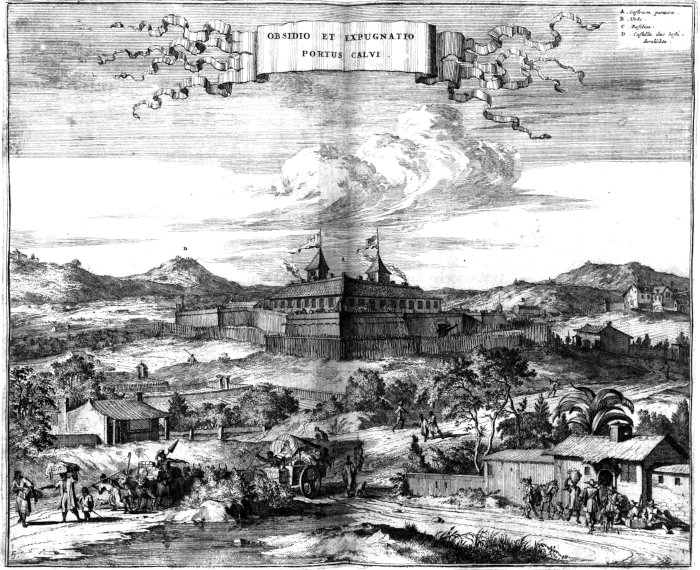
A great Fleet of Spaniards appears before Reciffa.
555The Year 1635. being almost expir’d, one Morning about Day-break thirty two Sail were seen to Steer directly towards Reciffa; two Ships of an extraordinary bigness were follow’d by nine Gallions, and these by the rest of the Fleet, consisting of Pinks, Carvels, and Barques; all which approaching, were known to be Spaniards, which struck no small amazement to the Inhabitants of Reciffa, most of their Ships being Cruising abroad before the Coast of Brasile and their Men a great distance off in the Field; onely five Ships fitted for an Engagement being at Anchor, and five more deeply laden: Mean while the Spanish Admiral approach’d within a Cannon-shot of the Fame Ketch, discharg’d one Gun, and stood off to Sea again, being inform’d that Real and Nazaretta were taken by the Hollanders. On the other side, all the Places in their possession had notice of this Fleet, which Lichthart follow’d with six Ships and two Ketches, carrying two Companies of Soldiers, besides Seamen, and keeping just within sight of them, saw them at last come to an Anchor before Paripuera (where a part of the Dutch Forces lay under the Command of Arcisseusky,) and make preparation to Land their Men: Whereupon Lichthart Landed also, with the Councellor Carpentier, and joyning with Arcisseusky, took up a valiant Resolution, to Sail close up to the Spanish Fleet with his eight Ships, whilest Arcisseusky march’d in the Night with six hundred Men to Jaragoa, to prevent the Enemy’s Landing; but having a Portuguese for his Guide, was led a wrong Way; wherefore returning, he secur’d the Way to Paripuera, whilest the Portuguese Inhabitants, contrary to their Oath, refused to carry or bring Provisions to the Dutch Forces, and joyning together combin’d with the Spanish Seamen, and kill’d all the Hollanders which they could meet either on the High-ways, or in their Houses, making use of the Negro’s to carry the Spaniards what Intelligence they could give them of the Hollanders Proceedings: Wherefore they thought it the best way to be rid of such Villains, to destroy them all that dwelt in the Countrey between Paripuera and Porto Calvo, and for the space of ten Leagues burnt all their Sugar-Canes in the Fields, their Mills and Houses. Arcisseusky caus’d Edicts to be put upon every Church Door, That all the Inhabitants should remove from Porto Calvo, where the Dutch Army was to Encamp, to keep them from the Spanish Oppression.
556That Summer having been so dry, that no man ever remembred the like, had dry’d up all the Morasses, so that the Spaniards marching over them and high Mountains, got a back Way into the Countrey. In the mean time John Walbeck made a Fort with five Bulwarks on the Island Curacao, near the Haven Santa Cruz.
Houte-been taken by Dunkirkers.
Houte-been also ran with two Ketches, the Otter and Brack, to Anchor before Curacao, and from thence to the Haven St. Jago de Cuba, where the Watch made no Alarm, because he carry’d Burgundy Colours, by which also several others, both Portuguese and Spaniards were deceiv’d. Not long after he burnt one Barque with Tortoises, sunk another, and set a third a Drift; after which having refresh’d at Jamaica, he Engag’d with several Spanish Men of War and took them, besides a great number of Prizes, in one of which he found such abundance of Copper, Indigo, Money, Canaster, Tobacco, and Piece-Goods, that the two Ketches were not able to load the same; but at last Steering for Holland, he was set upon by seven Dunkirkers, Commanded by Colaert, and after long and stout resistance was taken.
Captain Abraham Roosendael setting Sail from the Texel, met with a Frigat carrying forty six Chests full of Ryals of Eight, being in number eighty six thousand, design’d to pay the Forces at Porto Rico; besides a quantity of Plate, which amounted to a considerable sum of Money; with all which he arriv’d safe in his desired Port.
Arcisseusky fortifi’d himself along the crooked River Paripuera, full of Crocodiles, which hurt none, unless provok’d. This River runs five Leagues to the Northward of Punta de Jaragoa, where the Spanish Forces Landed.
Southward from Jaragoa lie the Alagoas del Nort and Zul, distinguish’d by a high Tract of Land; where the Spanish General Lewis Rochas Borgia left his Guns and a thousand Men, under the Command of the Duke Bagnola, whilest with three times as many more he went to Porto Calvo to be there before the time which the Hollanders had in their Edicts set the Inhabitants for their removal.
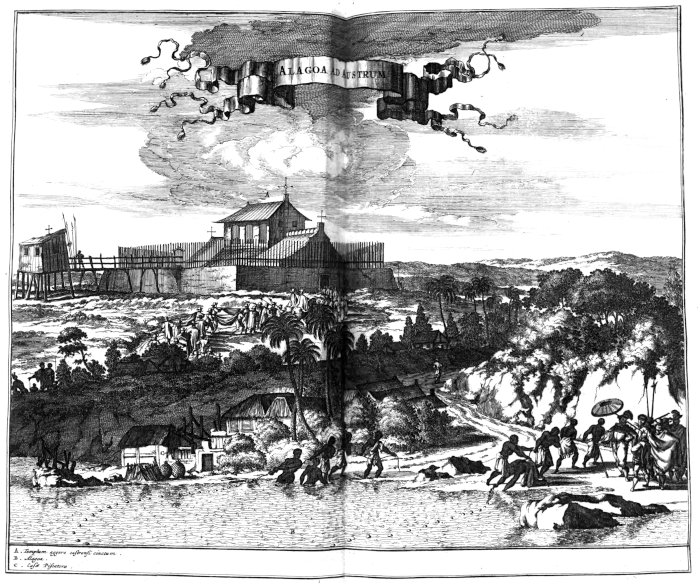
Borgia’s Army defeated by Arcisseusky and himself slain.
557Arcisseusky had by this time built on the North part of the Mouth of Paripuera a Redoubt like a Castle, out of the middle whereof rose a woodden Tower, fill’d with Earth, and secur’d by a Half-Moon; on one side whereof he lay Encamp’d with fifteen Companies. On the South side of the River stood also two strong Forts. Arcisseusky having not the least thought that Borgia would come over the Mountains, and through inaccessible Woods and Morasses, a back Way into Porto Calvo, receiv’d news on the thirteenth of January 1636. by a Renegade Negro, that the Spanish Army, consisting of three thousand Men, were come to Rodrigo de Barros his Sugar-Mills, about five Leagues from Paripuera, and was suddenly expected to fall upon Colonel Schuppe in Porto Calvo; whereupon Arcisseusky immediately set forth with twelve hundred Men and two Field-pieces, burnt all the Houses, Sugar-Mills and Canes he could meet with. Mean while Borgia (upon whose Approach Schuppe had left Porto Calvo) observing by the Smoak in the Countrey, that Arcisseusky had put his Edicts in Execution, leaving a considerable Garrison in Porto Calvo, went to meet Arcisseusky with the choicest Men. Arcisseusky being got between Camarigibi and Porto Calvo, without having any notice of the Enemy’s being so near, and his Forlorn being unawares Engag’d, and running back in great disorder, drew up his Men into a posture of Defence about a Musquet-shot from the Enemy; but the darkness of the Night made a great confusion in both Armies, being as it were mingled pell-mell one with another. Arcisseusky was much inferior in number to the Spaniards, but considering it was impossible to march back, in regard the Enemy was as well behind them as before, and that thousands of Brasilians lay watching for them in the Woods, in case they should be dispers’d, he saw there was no way but to stand to the hazard of Battel. About Day-break both Armies stood an hour looking upon one another; the place where they stood being surrounded with Woods and deep Valleys. Borgia drew out his Men on a Hill, overgrown with Bushes. Arcisseusky had drawn out his Men on somewhat a lower Ground. Borgia at last sent some of his Musquetteers down the Hill, who fir’d with a full Volley upon the Dutch, whilest Arcisseusky onely discharg’d a Field-piece at a Tree, under which Borgia stood to take a view of the Hollanders Forces; upon the firing of which Gun Borgia began to come down the Hill with all his Army, against whom Arcisseusky drew out his first and second Division, whilest Captain Vanden Brande led his Companies within two Pikes length from the Enemy, before he discharg’d, which was no sooner done, but contrary to Order they broke into the left Wing of Borgia’s Army, and put his Musquetteers to flight, who were soon follow’d by the whole Spanish Army, some running into the Woods, others into the Morasses, but most of them along the narrow Way which leads to Porto Calvo. Among the Slain was Borgia himself, who was Descended from the greatest Families of the Dukes of Lerma and Borgia; he was about forty eight years of Age, and had serv’d the Spanish King a considerable time in the Netherlands. This Victory cost the Hollanders about forty Men, besides as many more wounded. Amongst the Spanish Prisoners was a Neapolitan Gentleman, call’d Hector de la Calce, who upon Examination inform’d the Hollanders, That with the last Spanish Fleet there Landed two thousand four hundred Men in Alagoa, with twenty Brass Field-pieces, abundance of Wheelbarrows, Spades and Pick-axes, which cost in Portugal eight hundred thousand Crusado’s; with which great warlike Preparations Borgia made no doubt to have got fast footing in the Countrey, and to have cut off all manner of Assistance from the Hollanders; That the Spanish King rais’d a great many Men both in Spain, Italy, and Germany, that with the first opportunity he might fit out a Fleet, which was to be conducted by four thousand two hundred Seamen, to whom the Castilians were to add eight thousand five hundred Soldiers and two hundred Seamen, and the Portuguese the like number, to serve ashore, and to drive all Strangers out of Brasile; That this Design had long since been put in Execution, had not the Albuquerquers continually deceiv’d the King of Spain, under pretence that Brasile was in no danger; That Albuquerque would be forc’d to resign up the Interest which he had in Brasile, for which the King would give him a Dukedom in Portugal in exchange.
Schuppe and Arcisseusky judging it no way convenient to fall upon the Enemy in Porto Calvo, Garrison’d Paripuera with four hundred Men, under the Command of the Captains Day and Philip Andrews, whom they furnish’d with Provisions for five Moneths, and left Order to defend the Countrey against the Incursions of the Enemy; which done, they went aboard with eleven hundred Men, and took in two Companies of Brasilians at Barra Grande; with whom Landing behind the Isle Alexio, they came to Serinhain before Day-light, and found all the Inhabitants fled into the Woods, fearing they would take Revenge on them for murdering of their Sick which they had left there. They were no sooner Encamp’d here, but they receiv’d Information from John Talibon, that the Spanish Army intended to Besiege the Redoubt in Barra Grande, which therefore, as lying on an ill place, and not able to resist long, they flighted: After which being furnish’d with Provisions out of some Ketches Commanded by the Admiral Lichthart, they return’d, with Intentions to take up their Quarters in Serinhain during the Winter Season, whilest the Enemy lay in Cockau, on one side of Una and Serinhain, and kept private Correspondence with some of the Portuguese that had taken the Oath of Allegiance to the Hollanders; but Arcisseusky fell so fiercely upon them, that they all fled to Porto Calvo, and 558took three Monks Prisoners, who had been the chief Authors of this private Correspondence.
Soon after twenty eight Ships arriving at Reciffa, brought fresh Supplies of Men thither from the Maes and Zealand, with Ammunition and Provisions, which was much wanted; also two Councellors, Henrick Schild and Paulus Serooskerken.
This Fleet was scarce got in, when in the Evening news was brought, that eight hundred Spaniards were broke in through Poyuca, and had taken John Paez Baretto’s Sugar-Mill, and destroy’d all they came at; but that the Hollanders defending the Church with great Valor, obtain’d Quarter upon the surrendring of it.
The Spaniards under Rebellino routed by Stackhower and Litchthart.
This raging Army, led by Colonel Rebellino and Madurera, march’d to Laurenzo and Massiapi, whither there resorted daily more Men to them, which put the Council at Reciffa to a great Dilemma, foreseeing, that if they should send for Schuppe from Serinhain, the Enemy from Una and Porto Calvo would hem him in, neither had they sufficient Forces to withstand Rebellino; therefore it was judg’d convenient to send to Arcisseusky to joyn with Schuppe’s Army, that they might both unawares fall upon the Enemy. In the interim a hundred and twenty Tapuyans, sent by Janduy, came to Reciffa, with information that Janduy was coming himself, with several other neighboring Kings, to their Assistance. Schuppe, according to the Councels Order, march’d in the Night through the Sugar-Mills of Rio Formoso, rested the next day in the Valley Orekinda, and guarded all the Avenues: Whilest he went about to Storm the Village Una, Mansveld was to Engage with a hundred Spaniards on one side of Iletta’s Sugar-Mills, and Arcisseusky was to fall upon the Village; whither marching early in the Morning, they saw onely a few of the Inhabitants, the Enemy being gone with his Forces over to Manbucava, nor could they pass any farther, finding the River too deep to wade through: But it had like to have gone worse with Stackhower and Litchthart, who with Maulpas making twelve hundred Men, were surpris’d by Rebellino, rushing forth of an Ambuscade near Laurenzo, where Maulpas receiving a Wound dy’d of the same. This rough Entertainment at first much daunted the Hollanders; but regaining their Courage, they press’d upon the Spanish Army in such a manner, that Rebellino being wounded in his Shoulder, fled in great disorder through the Sugar-Fields to Porto Calvo, and of fifteen hundred Men sav’d not above four hundred, the rest being either kill’d, or scatter’d up and down the Countrey; twelve taken Hollanders were also released by this means. The Portuguese Design on Paripuera also succeeded not much better.
Cameron put to flight by Arcisseusky.
Arcisseusky receiving Letters of Advice from the Councellor Serooskerken, that Camaron lay Encamp’d with fifteen hundred Men about the Fortress Capavaribi in Goyana, and that the Besieged could not hold out above four days longer, and that the Enemy had also taken two Barques full of Provisions and Ammunition, sent thither to relieve the Besieged, march’d with excessive toyl through uncouth and intricate Ways, which were rendred unpassable by the great Rains that had lately fall’n, and came about an hour after Sun-set to Capavaribi; from whence Camaron being fled two hours before, had left Ammunition in three Carriages, secur’d from small Shot by thick Planks, which were drawn close under the Walls; also a Burgundian Flag, two Field-pieces, and two Barques which he had taken with Provisions. The Enemy fled to Tapiserica, and from thence to Terra Nova. Whilest Arcisseusky view’d the Works, and his Men stood in good order, great numbers of Brasilians Sally’d out of the Redoubt, took the Provisions which Camaron had left, spread themselves up in the Countrey, robb’d the Portuguese Houses, and kill’d the People. As soon as Arcisseusky had put all things in good order, he left the Brasilians in Goyana under the Command of the Councellor Eyssens, and pursu’d the fled 559Enemy, notwithstanding there fell great Showers of Rain, rested a little in the deserted Village Tapiserica, formerly inhabited by three thousand People, who possess’d several fair Structures, brave Walks, a large Jesuits Cloyster, and a Church. The sweet Water and pleasant Pastures invited the Hollanders to stay here a Night. The next Morning marching forward to Terra Firma, they saw a strong Fortification newly rais’d, but without People, and heard the Enemy’s Sentinels fire; whereupon Arcisseusky appointing part of the Army to follow at a distance, march’d before with the rest, and being fir’d upon from an Ambuscade by Camaron’s Party, he order’d Captain Talibon to press in upon the Ambuscade; but because it was perform’d in great disorder, he fell in himself on the right-hand of the Enemy, whilest Lichthart’s second Division stood still; which so affrighted the Enemy, that without making the least resistance he fled into the Woods, leaving many dead behind him. The next day Captain Bohart’s Party tracking the flying Enemy, fell in amongst them, and gave them a total Rout.
Arcisseusky resolv’d to stay some time in Terra Firma to wait for Camaron, but he not appearing, he laid waste the Countrey thereabouts.
Eyssens: slain in a great Fight with Rebellino.
Rebellino and Lewis de Sosa falling upon the Councellor Eyssens, Governor of Parayba, routed him, and set fire on the Sugar-Mills belonging to Emanuel Pirez, which forc’d them with their Swords in their Hands to break through Flame and Smoak upon the Enemy, who kill’d nine of them upon the Spot (amongst whom Eyssens and his Secretary) the rest being either taken or fled.
Rebellino put to flight by Arcisseusky.
Immediately after Arcisseusky being inform’d by two Prisoners, that the Spanish Forces Commanded by Sosa, Dias, and Rebellino, were all joyn’d together in the Wood Antonio, where Camaron was also expected, he march’d away presently with half his Army, and as soon as the Captains Metting and Tourlon, whom he commanded to follow him the next day, were come up to him, he fell upon the Enemy, who lay on a Hill, at whose Foot was a deep Valley, through which he climb’d to the top; which valorous Attempt so amaz’d the Spaniards, that without firing a Gun they fled into the Wood: After which Metting and Tourlon went back to Laurenzo; and Arcisseusky destroy’d the Rossas, of which the Farinha is made, that so by scarcity of Provisions he might prevent the Enemy from so often joyning together in Parties: In the mean time ten Ships from Holland arriv’d with fresh Forces, Ammunition, Provisions, and two taken Prizes, at Reciffa.
Several Prizes taken by Houte-been after his Releasement.
An unlucky Accident.
Houte-been being releas’d from his Imprisonment in Dunkirk, set Sail from Holland with three Ships, and took ten Iron Guns out of one Ship, and several Pipes of Wine out of another before Matanca; after that a Tartan from Havana, two Frigats with Meal, one full of Wood with two Guns, two Barques carrying Bananas, a rich laden Pink, two Ships with Hides, and one with Sugar. Near the Island Baru he heard several great Guns shoot off, whereupon making thither, he found the Zealand Privateer Martman Engag’d with a Ketch carrying ten Brass and six Iron Guns, which was run ashore; whereupon Houte-been went to his assistance with a well Mann’d Boat; which the Spaniards seeing, set fire on their Ketch and fled; but the Flame having onely hurt the Stern, fifty Men were order’d to get her afloat, who having begun to unlade the Tobacco, and to take out the Brass Guns, the Gun-Room took fire, and blew up both Men and Goods; of which twenty four being sadly hurt, dy’d, the rest escaping miraculously. Not long after Houte-been took a Ship with Hides, fraighted the Alcmaer Pink with his Prizes for the Texel, ran close by Carthagena, and kept a considerable time in sight of the Plate-Fleet, of which he carry’d one of the heaviest Sailers away with him; Being thus enrich’d, he return’d home.
Grave Maurice sent by the United States to govern Brasile.
560Whilest Businesses were carry’d on after this manner both by Land and Sea in Brasile, the West-India Company resolv’d to send some Person of Quality thither as President or supream Governor; and after no long Consultation who should be the Person, Grave Maurice of Nassaw was pitch’d upon, as being not only eminent for his Noble Alliance by Marriage to Emperors and Kings, but also for his excellent skill in Martial Affairs, the proofs whereof were known to all Men, as his marching to the Paltz against Spinola, his being in the great Siege of Grol, Hertogen-Bosch, Maestricht, Venlo, Rhynberk, and Schenkenschans, at all which he receiv’d great Honor; all which consider’d, they made him chief Governor of Brasile, giving him a Commission Sign’d by the States of the United Netherlands and West-India Company, to Govern with absolute Power, as well in Civil as Martial Affairs, to the best advantage of that State. At first they resolv’d to send a Fleet of thirty two Sail thither, but they afterwards reduc’d that number to twelve, which they Mann’d with two thousand seven hundred Men. Grave Maurice set Sail on the twenty fifth of October 1636. onely with four Sail, whereof the Admiral Ship call’d The Zutfen, carry’d but three hundred and fifty Men: about the Sorlings they met with blustering Weather, insomuch that the Fleet was forc’d to put in at Falmouth, and after forty days stay there, weigh’d Anchor, and Steer’d for Cape Verd, and refresh’d at the Isle of May, famous for Salt-pans, and inhabited by a few Negro’s, and banish’d Portugueses.
He is joyfully receiv’d at Reciffa.
On the twenty third of January 1637. Grave Maurice arriving at Reciffa, was by every one receiv’d with great joy; as also Adriaen vander Dussen: and soon after Matthias van Ceulen, Servaes Carpentier, and John Gysseling, were chosen to be of his Privy Council; whose first Work was exactly to know their Forces, which were either Inhabitants that were to guard Towns and Fortresses, or Soldiers that march’d into the Field, two thousand six hundred whereof were appointed to defend Reciffa, the Afogados, the Promontory St. Augustine, Tamarica, and Parayba: the greatest Party, which lay in the Field, consisted of two thousand nine hundred Men, and another lesser Party of six hundred; which last flying Regiment was to be continually employ’d to make work for the Enemy. They also took an Account of what Provision and Ammunition they had in store, and found that there was want of both, especially of Match. Next he enquir’d after the Enemy’s Condition and Power.
He marches against the Portugueses.
Povacon taken by the Hollanders.
From Porto Calvo the Portuguese made continual Sallies out into the Countrey, which they spoil’d and pillag’d, insomuch that the Brasilians being oppress’d by them, deserted their Villages, and came for refuge to the Hollanders. The Garrison in Serinhain was also much too weak to withstand the Incursions of the Enemy, the rather, because the Portuguese came along private, and to the Hollanders unknown Ways. All which Grave Maurice considering, caus’d a Fast-day to be proclaim’d, on which they desir’d Gods assistance in the carrying on of their Designs. After which he march’d with the Army to Serinhain, from thence cross the River Una to Barra Grande, and thence to meet with Bagnola, who though he was four thousand Men strong, besides Negro’s and Brasilians, had stopt up all the Ways with fell’d Trees, and fortifi’d others. On a Mountain, a League from Porto Calvo, Bagnola kept his Station. At the foot of the Mountain flow’d a Brook, whose Shore was overgrown with Rice and young Trees, before which lay a high Bank; opposite to which Grave Maurice Encamp’d himself towards the Evening, with intentions to fall upon him the next Morning, notwithstanding his Army consisted not of above fifteen hundred Men, of which there were six hundred Brasilians. Grave Maurice’s Guard marching before were follow’d by Schuppe and Arcisseusky, and they by Lichthart, 561whose Men were all Seamen; all of them firing their Guns amaz’d the Enemy, whilest two Companies of Brasilians, and three of Hollanders crept through the overgrown part on the right-hand of the Mountain, and as many more on the left, fell unawares upon him; but Maurice’s Guard Engaging with a thousand Portugueses, ran through the Water up against the Works with such undaunted Courage, that Bagnola Retreated, leaving four hundred Men slain, besides three Brass Guns, and a great number of Prisoners; those which escap’d fled to Porto Calvo: But Bagnola fearing to be Besieged there, left Povacon, which Castle, built on one side of Porto Calvo, lies twenty five Leagues from Reciffa, on a Plain, partly surrounded with Mountains and Pastures. The River Porto Calvo runs so crooked, that it almost surrounds the Castle and Town. The Countrey hereabouts is full of Pools. Two Forts, each built on a Hill near Povacon, Bagnola had caus’d to be undermin’d and fill’d up with Gun-powder; but they taking fire, were blown up before the Hollanders came thither, who found them smoaking, and lying like a heap of Rubbish. Maurice marching forward, Besieg’d Povacon; and Encamping himself below the Hill where one of the Forts had stood, he rais’d a Redoubt, and with a Trench approach’d the Moat. Whilest Schuppe lay along the Town from the Church, Lichthart made a Battery to the North, and somewhat farther Arcisseusky another; then firing from four Batteries on Povacon, the Besieged answer’d them again from their Walls, and on the thirteenth day the Governor Michael Giberton surrendred the Castle upon honorable Articles: for those in Garrison being Italians, Portugueses, and Castilians, to the number of five hundred, besides the Wounded and Sick, were to be Transported to Tercera. Maurice entring the Castle, took two and twenty Brass, and five Iron Guns, four Mortar-pieces, a great many Bullets, Matches, Gun-powder, and other Ammunition, this being the King of Spain’s Magazine.
Near Moribeca, and before St. Laurenzo, the Enemy receiv’d a shrew’d Repulse by the flying Regiment, led by Stackhower; but Lieutenant Helmich obtain’d special Honor herein.
Grave Maurice after these Exploits took Shipping in Barra Grande, at a great Inlet near Porto Calvo, and Landed again at the Promontory Sergoa, from whence he pursu’d the Enemy to the River Francisco; the Inhabitants about which desir’d, and obtain’d free Conduct. Bagnola lay on the other side of the River Francisco, in the Town Openeda; wherefore Schuppe, who was sent to the Afogados to be near the Enemy, was afterwards commanded to go to Openeda to secure Grave Maurice’s Passage over thither; but he coming thither after him, Maurice cross’d to the Shore on which Openeda lay with Boats, and got great Booty; and the more, because the Natives had not secur’d any thing, Bagnola assuring them that the Castle Povacon could endure at least a Siege of four Moneths.
Openeda belong’d properly to the Lord Melchior Albes. Near the Town rose a stonie Rock out of the deep River Francisco, eighty Foot high; from which Rock there jutted out like Redoubts five Points, and it was call’d Maurice Castle. Along the Shore of the fore-mention’d Stream lay several very pleasant Isles. Bagnola escaping privately from hence, was follow’d by his Men kneeling on floating pieces of Timber, which with Sticks they Row’d over to the Northern Shore, notwithstanding the Stream glides so swift, and is so broad, that a six-pound Bullet cannot be shot over the same; at the Mouth thereof Maurice built another Castle. A League from his Camp seven hundred Tapuyans (a great salvage and strong People, whose Language the Portuguese, Brasilians, and Tapuyans that belong’d to Jandui, could not understand) had Ambuscado’d themselves, and with signs and motions of their Bodies 562they gave the Hollanders to understand, that they would kill the Portuguese if they offer’d to cross the Rivers.
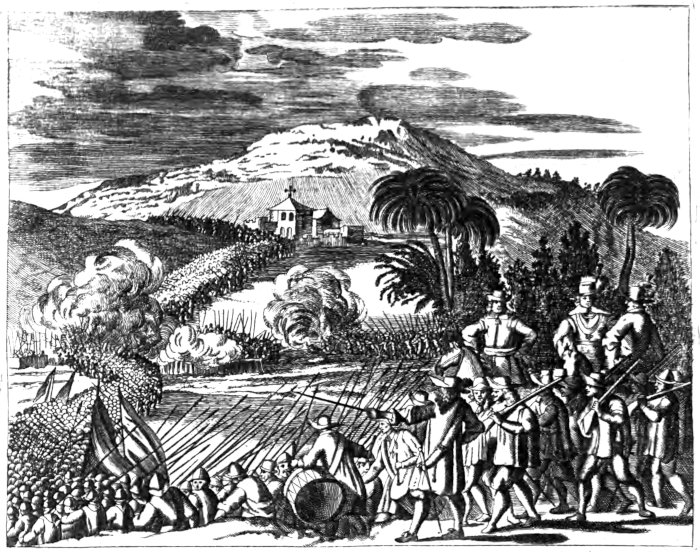
Maurice advising Prince Frederick Henrick of his Transactions, desir’d that he would send over Planters thither, whether they were banish’d Germans or Vagabonds, out of their Houses of Correction; for without them the fruitful Countrey of Brasile would render but a slender Account to the West-India Company, nor be able to prevent the Invasions of the Spaniards.
Grave Maurice begins his Government with the making of good Laws.
The fruitfulness of this Tract of Land was not inferior to any Countrey in the whole World, Cattel grazing up and down in Herds of five, six, and seven thousand. Moreover, Maurice advis’d them about the scarcity of Provisions, without which they were not able to maintain War. He also setled the Traders in a good Order, dividing all those free People which bore no Offices, into four Companies, under Captains, Ensigns, and Lieutenants. The Customs and Tributes were Farm’d, Marriages were order’d to be perform’d by the Netherland Priests, the Jews had leave not to Watch on their Sabbath, all manner of Debosheries were strictly forbid from being acted on the Lords-Day, and Punishments ordain’d for Drunkards and other Deboshees; several Schools were also erected for Youth, and for the instruction of the Brasilians in the Christian Religion; and lastly, it was permitted to any that would, to build in the ruin’d City Olinda, or else to repair those Houses that were fall’n to ruine.
Some of the Portugueses fill’d Maurice his Ears with a Report of the Silver-Mines at Couhaou, Copaou, Terra Nova, and about Cape St. Augustine; but he not regarding them, plac’d Sheriffs over the Villages, and Overseers over the Alms-houses and Hospitals, issuing out Orders also for the delivering of the Provisions, which being very scarce, every Man had a certain Allowance, that so it might last the longer; but when in this Distribution the meaner sort began to be scanted, the Peoples Complaints were such, that an Insurrection was like to ensue, if not carefully and speedily prevented: whereupon the decay’d and deserted Sugar-Mills of the Portugueses were put to Sale, and sold some for three, others for six and seven thousand 563Pound, insomuch that the West-India Company got above 200000 l. for them all. Soon after they fortifi’d their Castles and other strong Holds, and broke down those that were judg’d useless. The Brasilians obtain’d liberty also to inhabit their Villages and till their Land, that they might make Provision for themselves, and not oppress the Planters that liv’d near them. The Portuguese that had submitted themselves to the Government of the Hollanders, had free leave granted them to exercise the Roman-Catholick Religion, onely they were not to send for any Priests from St. Salvador, which if they did, they should be dealt with as Plotters of Murders and Treasons; they had liberty also to re-build their Houses in Olinda, paying Tribute with the Hollanders: Moreover, they were promis’d that they should live free from all Oppressions of the Hollanders. There was also order taken about paying the tenth part of the Sugar and Farinha. The Income also of Fishing and Fowling, amounted to a considerable sum of Money. And to prevent deceit in Trade, Measures and Weights were made according to those of Amsterdam. For the Converting of Pagans, Jews, and Roman Catholicks, able Teachers were sent into the Countrey to promulgate the Gospel.
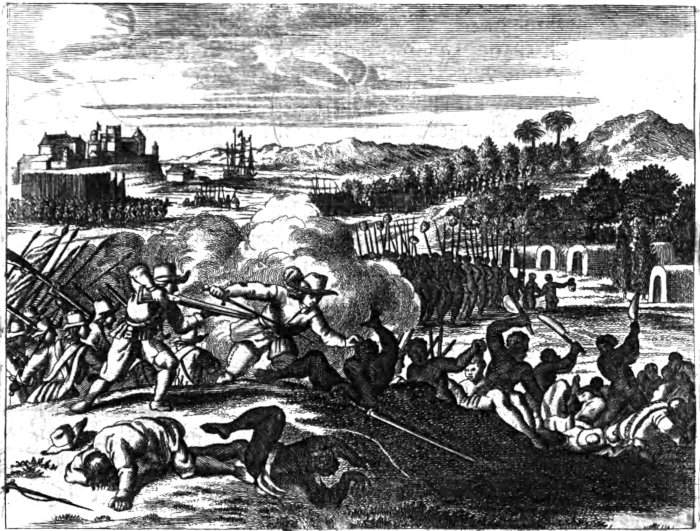
About this time there went a Report, as if the West-India Company were inclin’d to remove their Seat from Reciffa to the Island Tamarica; but Maurice advising them that it would not be so convenient for them, they chang’d their Resolution.
Isleos taken by Lichthart.
Whilest Lichthart Cruis’d a considerable time before the Haven Todos los Sanctos, he Crain’d his Ship in the Bay of Camaniu, took the Town Isleos, with a hundred and fifty Men. In the Town, which is built on a Promontory, he took but little Booty, and sav’d the Houses, which were built most of Stone, as also the four Churches and Jesuits Cloyster, and return’d to Reciffa.
Colonel Latan slain.
About this time the invincible Castle Mina, afterwards call’d St. Joris, was taken by the Hollanders, upon the Advice of Nicholas van Yperen, Commander of Guinee, who sent word to Grave Maurice, that the said Castle might easily be conquer’d, if any Forces could be sent him from Reciffa: Whereupon Maurice immediately 564sent John Coin thither with nine Ships, which set Sail on the twenty fifth of June, Anno 1637. who in the Road Commendo joining with Yperen, soon after he was set down before it, and was preparing to Storm, had it surrendred to him upon Terms no less advantageous to the Hollanders, than dishonorable to the Besieged, yet not without the loss of many Men; for in their March thither they were fiercely set upon by the Negro’s inhabiting the Village near the Castle; in which Conflict Colonel Latan amongst others was slain. The Fort might very well have endur’d a longer Siege, it being surrounded with double Moats, each twenty five Foot deep, and high Bulwarks, which could not be undermin’d because of the Rocky Ground on which they were built; and to make it yet more stronger, Coin after he had taken it rais’d a Fort on the Hill, from whence he had fir’d on the Castle, in which he found thirty Brass Demi-Culverins; and leaving Walraeven Malburg as Governor, he return’d to Reciffa.
During these Proceedings of the Dutch in Guinee, the Duke of Bagnola ransack’d the Countrey about Seregippa del Rey; Maurice not able to go himself, having had a Feaver three Moneths, sent Schuppe and Gyseling with two thousand three hundred Soldiers, four hundred Brasilians, and two hundred and fifty Seamen, whilest Lichthart Steer’d to Todos los Sanctos, that so he might draw the Enemy down to the Sea-Coast. Bagnola flying to Terra Gracia d’ Avila, Schuppe demolish’d the Town Seregippa, the Sugar-Mills, and all manner of Fruit-Trees, and march’d with incredible speed to the Stream Francisco; where Encamping on the Southern Shore, he drove three thousand Head of Cattel before him, that so he might starve the Enemy.
The Brasilians offer their assistance to the Dutch for the taking the Fort Siara.
In the interim the Brasilians in Siara desir’d Aid against the Portuguese, offering, That if the Hollanders could conquer the Fort there, they would soon destroy all the Portuguese; that the Charges of the Siege might easily be made good, the Countrey producing abundance of Amber-greece, Crystal, Cotton, Pearls, Salt, and other Merchandise. In confirmation of this their Resolution, the Brasilians left two eminent Persons Children of Siara in Reciffa: Whereupon George Garstman being sent thither, was no sooner Landed, but he made his Arrival known to the Brasilian Governor Algodoi; who came to meet him with two hundred Men, bearing white Flags in token of Peace: Thus assisted, he set upon Siara, which is a square Fort, built at the foot of a Hill, hath within its Walls six Houses, two Redoubts full of Port-holes, one on the North, and the other on the South, jutting half way out from the Wall; as also two Gates, secur’d with large Portcullises: without the Fort appears the Governor’s House, about which were several Huts for Portugueses.
This Lordship, already spoken of, is reckon’d amongst the Northern parts of Brasile, and hath onely twelve Leagues in circumference. The Haven before the Castle, which the River Hacu makes, is of little consequence: The Ground in some places rises with high Mountains, in others, especially on one side, it is overgrown with Wood: hath also several brave Pastures, especially along the River.
The Fort taken by Garstman.
Garstman approaching the Castle Siara, found little resistance, so that he took it with small expence of Blood, most of the Portuguese being taken Prisoners, a few onely escaping by flight.
After this Grave Maurice took great care of the Civil Affairs, building a Guild-Hall at his own Cost and Charge; sent all manner of Minerals, digg’d out of the Brasilian Mines, to the Netherlands; laid great Penalties on those that stole the Custom of Goods, and punish’d with Death Murders, Robberies, and such like Capital Offences, besides several wholsom Laws relating both to the Civil and Ecclesiastical Government; and as soon as he was recover’d from his tedious Sickness, he march’d up into the Countrey to the Rivers Grande and Parayba, to take care to 565furnish the Forts with Provision and Ammunition. Near the Castle Ceulen he was receiv’d by the Tapuyan Agents, and Presented by them with Bowes, Arrows, and brave Ostrich Feathers, us’d by them when they go to the Wars: in return for which they receiv’d Linnen Shirts, Knives, Shells, Bugles, Fishhooks, and Nails. Maurice caus’d a deeper and wider Moat to be digg’d about the decay’d Castle Cabo Dello, rais’d the Works, and call’d it by the Name of his Sister Margareta; he also pull’d down the Fort Antonio, keeping onely a Tower to defend the High-way. Restringa was likewise strengthned with Pallisado’s, and the Cloyster near the Town Parayba fortifi’d against an Assault, and Elias Harkmans made Governor of the same.
Whilest these things were transacted on the Land, Captain Schuppe at Sea Engaging alone between Todos los Sanctos and Terre Garcie d’ Avila with three Spanish Ships, drove one of them aground, and brought another away with him to Reciffa. The Letters found in the taken Vessel made mention, that in the River of Lisbon lay ten Galleys, and twenty more before Cales, to which were to joyn thirty Pinks; which Fleet some suppos’d was coming for Brasile; others, that it was onely a Plot of the King of Spain to get Money from his Subjects, according to the Custom of several other Princes.
Hereupon Maurice wrote to the West-India Company, that they would Rig out a Fleet with all possible speed, which might fall upon the fore-mention’d Spanish Fleet, and fetch those Sugars which lay ready in Brasile to be Laden.
About the same time a Party of the Portugueses crossing the River Francisco, came to the Stream Miguel, whither Picard marching, put them all to flight.
Grave Maurice sets forth with a Fleet for the re-taking of St. Salvador.
Grave Maurice is forc’d to leave the Siege of St. Salvador.
Grave Maurice having a Design on St. Salvador, the Portuguese Metropolis in Brasile, formerly taken by Peter Hein and Jacob Willekens, and not long after lost by the faint-heartedness of William Schouten and Hans Kyf, though in all likelihood not strong enough to undertake so weighty a Design, yet considering if he should stay longer, the Season would not permit him, therefore he went aboard, hoping that he should receive some Aid from the Netherlands; his Army consisted of three thousand four hundred Netherlanders, and a thousand Brasilians. He had the greater hopes of Victory, because he receiv’d information from St. Salvador, that the Soldiers in Garrison there mutiny’d for want of Pay, and that the Governor and Duke of Bagnola were at difference concerning the management of the War. But before he set Sail he had secur’d all Places against any Invasion, and got ready twenty two Sail, furnish’d with Ammunition and Provision, with which on the eighteenth of August Anno 1638. he weigh’d Anchor, and met with six Ships at Sea, which he took, and arriv’d on the sixth day following before the Mouth of the Inlet Todos los Sanctos, which he could not enter by reason of contrary Winds, but Cruis’d up and down before the River Vermelho and the Isle Tapoam; whereupon the Governor of St. Salvador and Bagnola drew the Portuguese Forces down thither to prevent his Landing: About Noon the Wind coming about fair for the Hollanders, brought Maurice within Shot of the Ships, Forts, Walls and Batteries of the City St. Salvador, so that he thundred with his Cannon against them, and Landed on a Promontory near the Sconce Bartholomew, without the least resistance, in a convenient place about a League and a half from the City; where Encamping himself, he was inform’d by the Prisoners which he had taken, that about half a League farther was a narrow Bank, border’d with Morasses, so that none could pass along the same but at Low-water, and then onely at a certain time. Tourlon being sent before with three hundred Musquetteers to discover the Place, found the Way not onely as the Prisoners had inform’d, but also fortifi’d by the Enemy; against whom Maurice drew out his Men, ordering Captain John vander Mast in the mean time to run with ten 566Sail directly upon the City, and to drop his Anchors just without shot of it. Having beaten the Enemy from his Works, he broke through all the Paths, Hedges and Banks, till at last he came and Intrench’d himself near the Out-works of the City, by which his Army was secur’d from any Assaults from the Sea-side. Colonel Brand also with little trouble took the Fort Philippo, built on the Shore, and fortifi’d with five Guns. The next day Maurice Storming the Castle Philippo, soon became Master of it, notwithstanding it was well Garrison’d, and had thirteen Brass Demi-Culverins. The taking of this Castle afforded the Besiegers a free Passage to their Fleet. They also rais’d two Batteries, from one of which they shot night and day with seven great Guns, and from the other with the like number of Field-pieces, on the Castle Rosario, which the Portuguese forsook; but going about to take a Horn-work on the top of the Carmelites Cloyster, he lost many Men in the Attempt, and amongst the rest the Captains Howin, Echbrecht, Boward, Hollinger, and the Engineer Berchem; and in the end, after many bold and resolute Attaques, what with the strength of the Place, both for number of Defendants, and well fortifi’dness thereof, and what with the want of his expected Supplies, and lastly the sickliness of his Army, by reason of the extraordinary Rains that fell, to the loss of many Officers of note as well as common Soldiers, besides what were slain by the Enemy, he made as honorable a Retreat as he could, so that this Expedition prov’d altogether unsuccessful.
Mean while the Provincial States of Holland and Zealand differ’d about allowing of a free Trade to Brasile, and sending of Colonies thither: Whereupon Grave Maurice writing to them his Opinion, demonstrated with good Reasons, that a free Trade, and fresh Colonies, would be much to the Companies advantage; which was approv’d of by the States of the United Netherlands and West-India Company, who onely engross’d the Trade of Negro’s and Brasile Wood; and on the Imported and Exported Goods they put a certain Custom.
Houte-been Engages the Spanish Fleet.
The West-India Company considering what Treasure Peter Hein had brought from Matanca to Holland, they resolv’d to venture another Expedition thither; and to that purpose set out fourteen Sail under the Command of Cornelis Houte-been, who weigh’d Anchor out of the Texel on the fourteenth of August Anno 1638. and arriv’d safe at Reciffa; where Houte-been having spent some days in Consulting with Grave Maurice, went aboard again, and at his entring into the Ship, bruis’d his Leg between the Boat and the sides thereof, which some superstitious Persons look’d upon as very ominous; but this Wound was not so great as to keep him back from whatsoever Service came in his way: for discovering the Spanish Fleet from Terra Firma near Cuba, before the Rocky Isle Organes, which consisted of eight great Gallions, and six lesser Ships, whose Lading was valu’d at two hundred Tun of Gold, and Commanded by Carel Dievaro, he clapt the Admiral aboard, threw in his Grapling-Irons, and made him self fast, with a Resolution either to take him or die, whilest the Dutch Vice-Admiral Abraham Michaelzoon Roosendael boarded the Spanish Vice-Admiral, and the Rere-Admiral John vander Mast the Enemy’s Rere-Admiral; and doubtless, had not the Vice-Admiral and Rere-Admiral been slain, together with Verdoost, Captain of the Orange-Tree, and other eminent Officers, and those that surviv’d fail’d in their Duty to him for want of Courage, he had given them a signal Overthrow; but whilest with much ado he had prevail’d with his Captains to renew the Combat (having been forc’d by the coming on of the Spanish Vice and Rere-Admirals to quit his hold) and was preparing for a second Onset, the Sea began to be rough, and the Enemy was gotten to the Windward. Some few days after being inform’d, that the Spanish Fleet lay before the Flats of Cuba 567and the Rocky Organes, Steer’d thither, resolving to venture once more; but when he came there, the Spaniards were gone; whereupon he sent some of his Ships to Brasile, others to Cruise before Cuba, whilest he himself went for the Netherlands.
Whilest this Expedition fell out so unfortunately, Cameron, General of the Brasilians, sent three Agents to Grave Maurice, desiring to enter into League with the West-India Company, upon some Differences that were risen between him and the Duke of Bagnola. Grave Maurice seeming much inclin’d to his Offer, treated the Agents very nobly; who not long after, oblig’d by his Civility, inform’d him, that Cameron, an inconstant Man, had made Peace again with Bagnola. But that which chiefly obstructed Grave Maurice’s Designs, was the want of Provisions, Ammunition and Men, notwithstanding his continual Complaints to the Company.
About the beginning of the Year 1639. the Spanish Fleet, consisting of twenty eight Sail, most of them Gallions, appear’d in sight of Reciffa, but Steer’d Southwardly; Grave Maurice hereupon sent out the best Sailers to follow them, and see whither they were bound, or if they intended to Land, whilest himself march’d along to Porto Calvo; but inform’d that they were gone into the Inlet Todos los Sanctos, he return’d to Reciffa, after he had stor’d the Forts Porto Calvo, Una, Serinhain, and that at the Promontory St. Augustine, with all Necessaries.
Arcisseusky Impeaches Grave Maurice and his Council.
Is sent back into Holland.
About the same time Arcisseusky arriving from Holland with a Commission to be General over the Forces there, imparted to some Friends the Copy of a Letter that he intended to send to the Amsterdam Burgomaster Albert Coenraedszoon vander Burgh, containing many Accusations against Grave Maurice and his Council; of which he being inform’d, call’d a general Assembly, to whom he makes a large Speech, wherein he declar’d how faithful a Servant he had been to the States of the United Netherlands for the space of twenty years, complain’d of the malice of Arcisseusky in wrongfully aspersing him, both in the aforesaid Letter and otherwise, answer’d particularly to every thing which was laid to his Charge, (as he did afterwards in a Letter also from himself to Vander Burgh) and lastly made it his peremptory Request, that he might return home, and leave Arcisseusky in Power, or that Arcisseusky might be sent home, and he remain undisturb’d in his Government; and so withdrew, leaving them to their own Consultations. It exceedingly perplex’d them, and took up a long Debate what Judgment to give in this Matter, which before they concluded on, they propos’d several Expedients of Reconciliation between them; but seeing it was all in vain, they unanimously judg’d it convenient, that Arcisseusky should return; who not long after accordingly weigh’d Anchor from Parayba for Holland.
Several Judgments concerning him.
Arcisseusky arriving in Holland, appear’d unexpectedly before the States of the United Netherlands and West-India Company, where several Judgments were pass’d upon him; some said he deserv’d severe punishment, for his misbehavior to Grave Maurice; others seem’d to have compassion of him, because he had done so many noble Exploits; most laid the blame on the Company, who rashly sent him with a Commission as Chief over the Militia, not without impairing Grave Maurice’s Power; but these Discourses fell amongst those who were not call’d to give their Opinion of this Case.
Coin sent Field-Marshal in his stead.
John Coin was chosen Field-Marshal in Arcisseusky’s stead, whilest the Councellors Matthias Ceulen, Adrian vander Dussen, John Guiseling, and Servaes Carpentier, were ready to come for Holland, and on the twenty ninth of October 1639. they set Sail from Parayba, Vander Dussen bringing with him an exact Relation of the Condition of Brasile, so far as concerns the West-India Company, which being material, we shall reserve it for a more fit place.
It being fear’d that the Spanish Fleet in the Harbor of Todos los Sanctos might 568undertake some Design or other against the Hollanders, Grave Maurice kept a watchful Eye upon them, repair’d all decay’d Forts, rais’d new Forces, sent out some Vessels to watch the Fleet, and prohibited the Transporting of Provisions, animated the Brasilian Commanders to fight against the Portuguese, and forc’d the Owners of Sugar-Mills to Plant store of Mandihoka, that so his Provisions might last the longer.
A Party of the Enemy, consisting of about twelve hundred Men, having pass’d the River Francisco, was soon after oppos’d by Colonel Donker.
A Spanish Fleet lies before St. Salvador.
The Spanish Fleet having lay’n a whole Year before St. Salvador (because they had lost near three thousand Men, who on the Coast of Africa dy’d of several Distempers, and therefore waited for a fresh Supply) set Sail on the ninteenth of November Anno 1639. with eighty seven Sail, carrying sixteen thousand Men, of which thirty seven were great Gallions. Ferdinand Mascarenhas, Duke of Torre, being chief Admiral, carry’d the Flag and sixty Brass Guns in the Ship Domingo; the Portuguese Admiral, Roderigo Lobo, carry’d fifty two Guns in the Gallion Bernardo; of all which, with the number of the Enemy’s Forces, Grave Maurice was inform’d by a Letter taken out of a Pink laden with Sugar; and also that the Spaniards were in great hopes of the Portuguese deserting the West-India Company, with whom they were forc’d to joyn; that this great Fleet was order’d to Cruise two years before the Coast of Brasile, and to Land divers Men under the Command of Bagnola, Francisco de Moro, Antonio Roderigo, Nunno de Mello, Jacob Pirezio, Francisco Pezam, and Lopes Barbalio; all which made Maurice write continually for Aid, “Which the West-India Company must send speedily, unless they were resolv’d to lose what they had gotten in Brasile, as also the People, who had hitherto defended the same with the loss of their Lives and Fortunes.”
A Negro that serv’d a Spanish Captain, call’d Henrick Dias, being taken, inform’d the Hollanders, That the Spanish Fleet was much weakned by a poysonous Air on the Coast of Africa; and that they had left a considerable number of their Men in the Hospital at St. Salvador; that the Admiral was resolv’d with divided Forces to burn all Places he came at, and to receive the Negro’s, Mamolucks, Mulatto’s, and Brasilians, under his Jurisdiction. But Grave Maurice gave little credit to this Relation, because the Spaniard doubted not in the least, but that he should take Brasile from the Netherlanders with his fore-mention’d Forces, why then should he ruine what he hop’d to possess? None knew whither the Spanish Fleet intended to go; for setting Sail under the Command of Antonio Oquendo, under pretence of falling upon the Netherlands, they Steer’d their Course to Brasile, and at last from the Inlet Todos los Sanctos to Goyana; but four days before they weigh’d Anchor, William Corneliszoon Loos, who had some time been Cruising before the said Inlet, came back to Reciffa with thirteen Sail of Ships, which wanted all manner of Necessaries.
Corneliszoon Loos with his small Power sets out to Engage the great Spanish Fleet.
Admiral Loos slain.
Huigens chaseth the Spanish Fleet.
Alderick’s valiant Exploit.
The West-India Company had now been in a mean Condition, had there not happily arriv’d first eight, next two, and at last nine Ships from the Texel, the Maes, and Zealand, with Provisions, and a Supply of Men; which Maurice had no sooner taken out, and unladen the Ships, but he fitted them for an Engagement, and made up the number of forty one Sail, who yet were not to be compar’d to the Spaniards, whose smallest Vessels carry’d more Men and Guns than the biggest of the Hollanders, which in all had but two thousand one hundred and ninety six Men, and one Ship with another under twenty Iron Guns: With this small Power the Admiral William Corneliszoon Loos went to meet the Enemy, and before the River Michael took four Spanish Ships, which carry’d Ammunition and Provisions for the Army, which Lopes Barbalio commanded ashore. On the twelfth of January, Anno 1640. 569he descry’d the Spanish Fleet between Itamaraca and Goyana; not far from which Mascarenhas thought to Land seven thousand Men at Paomorello; and they were already gotten into little Vessels when the Hollanders Fleet made towards them, and about three a Clock in the Afternoon began a bloody Engagement for four hours, in which Loos Engaging with the Spanish Admiral and four Gallions, was kill’d in the middle of the Fight, which ended in the Evening. Jacob Huigens carrying the Flag the next day in sight of the Promontory Blanco, chearing up his Men, went to renew the Fight with Mascarenhas, and with a few small Ships Engag’d several great ones, of which they had an advantage onely in their nimble turning and winding. In this Engagement Huigens lost the Ship call’d The Sun, which sunk with Colonel Mortimer and forty four Men, thirty four being sav’d in the Boat. The Hollanders Loss was the less, because the Spanish great Gallions fir’d over Huigens’s Ships, which fir’d in the midst of the Spaniards Vessels. Huigens not being tir’d with two days Engagements, fell upon them a third time before Parayba, and firing at the Spanish and Portuguese Admirals, pursu’d their Fleet to the Northermost Coast of Brasile, where by a strong Current they were driven Westerly; and the Swan, Commanded by Jacob Alderick, losing her Main-mast, was cut off from the Fleet by twelve Gallions; and three hundred Spaniards were already Masters of the Deck, when Alderick breaking from the Enemy, drove towards the Shore, and either kill’d the Spaniards that were in his Ship, or forc’d them to leap overboard, whilest Antonio Cunha de Andrada, not knowing that Alderick was aground, making up to him, ran also aground, which occasion’d a new Fight, and at last Andrada was made to surrender his Gallion, and with it three thousand Pound of coin’d and uncoin’d Silver, besides other rich Goods, and two hundred and thirty Men, who were all sent Prisoners to Reciffa.
The Spanish Fleet again put to flight by Huigens.
January the seventeenth Huigens ventur’d a fourth Engagement between Rio Grande and Conyaou, where approaching the Spanish Fleet, a sudden Calm prevented him from coming within shot of them, till against the Evening the Wind began to rise, but the Night approaching, it was not judg’d worth while to Engage for so few hours, therefore they referr’d the bloody work till the next day; when about Daybreak Huigens ran through the midst of the Enemy’s Fleet, and fir’d so fiercely on Mascarenhas, that he Tacking about, stood away right before the Wind, and not being able to get beyond the Shelves Baxios de Rochas, nor to get Water on the Coast, because the Hollanders Ketches guarded the same, he Sail’d into the Offin towards the Line with a South-East Wind. After which Huigens lay eight days before Rio Grande to refresh and rest himself, and on the first of February he arriv’d at Reciffa, where Maurice caus’d a Thanksgiving Day to be kept for this wonderful Victory, whilest the Enemy was exceedingly abash’d.
Several Disadvantages occurr’d towards the overthrow of the Spanish Fleet; for first it was much weakned by the Disease which rag’d in the same on the Coast of Africa, insomuch that it lay still a whole year in Todos los Sanctos to gather fresh Forces, whilest Maurice put himself in a posture of Defence: Secondly, they lay becalm’d, and met with contrary Winds for several Moneths, whenas the Voyage between St. Salvador and Pernambuco is commonly not above twelve days; which tedious Passage occasion’d also a Distemper and faint-heartedness amongst the Spaniards, whilest divers Ships arriv’d at Reciffa from the Netherlands, without which it had been impossible to have Engag’d with the Enemy, in regard till then all manner of Ammunition and Provisions were wanting. Huigens also had continually the advantage or benefit of the Wind, and lost in the Engagement but two Ships, a hundred and twenty four Men, besides twelve wounded: Moreover, but twelve 570Ships onely of the Dutch Engag’d with this great Spanish Fleet, the rest never coming within shot; wherefore the two Commanders, John Coopman Ryk, and Peter Jacob, were condemn’d to be Beheaded; Cornelis Johnszoon and Peter Dirkszoon had their Swords broke over their Heads by the common Hangman; Cornelis Lucifer, Dirk Eger, and Jacob Clavor, were banish’d; and others came off by paying great Fines: but the Spanish Fleet lost in the four Engagements twenty Ships, and some thousands of Men, the Joseph alone having four hundred slain in her. Lastly, anchoring near the Island Margareta, the Portuguese Admiral Cosmo de Couto, and the Captain-General Francisco Pimentello, falling out, the Spaniards Steer’d to Tercera, and from thence to Cales, where there Landed but few Men, most of them dying of Hunger and Thirst in their Return home: Four Gallions, with two Pinks, got into the Spanish Harbors, the rest being either stranded before New Spain, sunk, or return’d to the Inlet Todos los Sanctos.
Cameron’s Forces and Barbalio’s put to flight by Coin.
Portugueses Plot against the Netherlanders discover’d.
Before the foremention’d Fleet weigh’d Anchor from St. Salvador, two thousand Portugueses, besides Tapuyans and other Brasilians, march’d under the Command of Cameron, Vidal, and Barbalio, with divided Forces into the Countrey, partly to get Provision, and partly to do what mischief they could to the Hollanders, far and near: their Orders were to joyn in the Village St. Laurence, seven Leagues beyond Paomarello, that there they might make way for the Seamen to Land, if the Netherland Forces should chance to guard the Sea-Coast thereabouts, and to joyn with them as soon as they were Landed. But Grave Maurice encourag’d by his late Victory at Sea, immediately sent the Field-Marshal Coin against Cameron, who dividing his Army into small Companies, had distributed them through the Woods; in which Coin follow’d his Example, and with divided Forces pursu’d Cameron’s Army, and overtook his Captain Tak and two hundred Men at Poyuca, (whereof Lopes Barbalio was Governor) who fled, notwithstanding he Commanded six hundred Men. Soon after which the Muster-master Mansveld met him near the Village St. Laurence, Engag’d him, and putting him to flight, found several Papers of Concern that he had left behind, and amongst others a Letter, in which Barbalio was commanded to spare neither Brasilians nor Netherlanders alive, but to kill all, without regard either to their Age or Quality, except the Portuguese. Moreover, Andries Vidal urg’d the Owners of the Sugar-Mills in the Netherlanders Brasile, immediately to take up Arms, to regain their ancient Freedom, as soon as Mascarenhas appear’d with the Spanish Fleet on the Coast of Brasile: Thus Vidal, by Letters and private Conferences, prevail’d so much, that most of the Portuguese were ready against their Oaths to root out the Netherlanders: The sign when they should be ready, was the burning of some Sugar-Mills, Vidal imagining thereby to have drawn the Netherlanders from the Sea-side, and so made the Sea-Coast free for the Spaniards to Land securely in. But the Garrison under Coin along the Sea-shore near Alexis, not ignorant of the Enemy’s Plot, kept their Stations, and suffer’d the Mills to burn. The like did Craey at the Promontory of St. Augustine, Picard at Paomarello, Captain Day at Cantolaria, and Donker on Goyana; Hoogstraet kept Guard up in the Countrey; Tourlon also sent out by Maurice against Francisco Sosa and Henrick Dias, who had pillag’d all the Countrey about the River Conajou, fell upon them in such a manner, that he destroy’d eighty seven of them, and wounded a considerable number more of them, made the rest flie to St. Salvador.
Two Moneths before the Spanish Fleet set Sail from Todos los Sanctos, three thousand Tapuyans came to Rio Grande with their Wives and Children, from an unknown Countrey remote from the Sea. Grave Maurice requested their King John de Wy, that he would please to keep Watch along the Sea-Coast, and prevent the Landing of 571the Spanish Seamen: Whereupon De Wy sent his Son to the Castle Ceulen, making solemn Protestations, that he was ready to lose his Life and Fortune for the Netherlanders, in helping them to drive the Portuguese out of Brasile. Maurice also joyn’d two thousand Brasilians, and Colonel Garstman with sixty Netherlanders, to the Tapuyans, that so he might train them up in Martial Discipline, whilest the Tapuyans Wives and Children were plac’d on the Island Tamarica.
About the beginning of the Year 1640. Houte-been and Lichthart brought a considerable Fleet from the Netherlands to an Anchor at Reciffa, where a Consultation was held, whither these Ships might be sent to do most Service: every one had an Eye on St. Salvador, not long since Storm’d in vain; but Maurice judg’d that they had not Forces enough to undertake so grand a Design, but thought it would be better to Land some fresh Forces near St. Salvador, that there they might burn the Sugar-Mills, and destroy all things they could find, in revenge of what the Enemy had done at Parayba. Whereupon Tourlon and Lichthart set Sail with twenty Ships, Mann’d with two thousand five hundred Men, to the Inlet Todos los Sanctos, where they burnt all the Portuguese Sugar-Mills, Houses and Villages; neither did their Swords spare any alive but Women and Infants: The Cattel which they found they carry’d aboard of their Ships, and burnt all other Provisions.
Capt. Brand taken Prisoner.
Coin unsuccessfully Storms Spirito Sancto.
In the mean time Houte-been and Coin fell upon Porto Franco, where they ruin’d all things, to no other end, but that the Enemy might call home his Forces out of the Netherlanders Brasile, to defend the Province Todos los Sanctos. But Captain Brand going up too far into the Countrey with his Army, was suddenly set upon, had a hundred of his Men slain on the Spot, and was himself taken Prisoner, together with many more. Also the Storming of the Town Spirito Sancto by Coin prov’d unsuccessful, because he led an undisciplin’d Company, and wanted little Vessels to Land in on a sudden; for the Enemy having had timely notice, immediately rais’d a Sconce about the Town, and with five Brass Guns fir’d stoutly on him, who endeavor’d to climb up the Hill, but was forc’d to sound a Retreat, his Men failing in their Courage; yet at last breaking into the Town, he set some of the Houses on fire, which being built of Stone, resisted the Flame; so burning onely four hundred and fifty Chests of Sugar, he left sixty Men kill’d, and brought back eighty wounded. Lichthart in the mean time made great havock about St. Salvador.
Woods of Brasile set on fire by Peter Vist.
In this Conjuncture the West-India Company suffer’d much by Robberies and Spoils committed up and down the Countrey, by the setting their Woods of Brasile on fire by a company of Negro’s, the chief Ring-leader of whom was one call’d Peter Vist, who from Caves and almost inaccessible Ways came forth in the Night, and set fire on whatsoever places he came to, notwithstanding a hundred Negro’s of his crew were soon after caught, which he at several times had by force taken out of their Masters Sugars-Mills; which Grave Maurice prevented as much as possible, by keeping Soldiers up and down in Arms. He also us’d the Portuguese very civilly, who though they promis’d Obedience, because they liv’d under the Jurisdiction of the West-India Company, yet were ready on all occasions to shew the contrary; wherefore Grave Maurice sending for the chief of them to Reciffa from Pernambuco, Itamaraca, and Parayba, told them before the Privy Council, that they might easily see how vainly they expected that the Spanish Crown should take Brasile from the Netherlanders; that formerly they depended on the Spanish Fleet Commanded by Mascarenhas, but that being destroy’d by a small Force, that hope was lost; therefore if henceforward they would Trade on their own Accounts, they might be assur’d they should not suffer in the least, either in their Goods, Religion, or Persons.
Hector de Calce taken Prisoner.
572The Neopolitan Field-Marshal Hector de la Calce, setting Sail from the Haven Todos los Sanctos with an old Ship carrying six hundred Men, was forc’d to run aground in the Haven of Parayba, where he and the chief Commanders were taken Prisoners, whilest the Common Soldiers by reason of the scarcity of Provisions, were set at liberty.
Houte-been and Lichthart weigh’d Anchor with twenty four Ships, carrying two thousand Soldiers and seven hundred Seamen to Havana, to Cruise for the Plate-Fleet, but the Spanish Ships keeping within their Harbors, and their own being dispers’d and scatter’d by ill Weather, their Voyage prov’d in vain.
Not long after Grave Maurice sent some Ships under Lichtharts Command to Cruise before the River Januarius, and others for the same purpose to Angola; but he effected little, for he onely took two Ships, one whereof being laden with Wine, was sold for 9400 l. Sterl.
The news of the Portuguese Crowning the Duke of Bragancia, and casting off the Castilian Yoke, which very much chang’d the face of Affairs in Brasile, was about this time brought over by the Jesuit Francisco Vilhent, and the Under-Field-Marshal Peter Corera de Gama, who were by Bragancia sent to St. Salvador, not onely to bring the tidings of the Portugueses Revolt, but also to take the Oath of Allegiance from Montalvan to the new King, which he made no scruple of; so that from thenceforth all but the Castilian and Neopolitan Soldiers, cast off their Obedience to the Crown of Spain. Whereupon Montalvan desir’d Grave Maurice to allow a Cessation of Arms, till such time as they might both receive information what Tristan Mendoza, in the new King of Portugal’s Name, had Treated with the States of the United Netherlands about; and to make the Request seem the fairer, several Dutch Prisoners were set at liberty, and the Companies with which Paulo Acunhas was marching to Pernambuco, were call’d back.
Grave Maurice desir’d by the States and West-India Company to continue in his Government of Brasile.
Grave Maurice desiring in his Letters to be releas’d from his Employment in Brasile, receiv’d for Answer from the States, “That it would be very disadvantageous for the States for him to come home, now he throughly understood the Intreagues of the New World, in which he might do much good, especially since the Portuguese being revolted, would in all probability assist them in destroying the King of Castile’s Forces; therefore it was now the most proper time to prepare for Action.”
To this Request of the States was added that of the West-India Company, who also sent earnest Letters to the same purpose; which made Maurice defer his Return, and prepare himself for some grand Undertaking: And first he joyn’d the Province of Seregippe Del Rey to the Netherland Brasile, built a Fort and Armory in the same, and built a Wall about the Town; which Work was the more follow’d, because Seregippe, which border’d upon the Province of Todos los Sanctos, fed abundance of Cattel, and gave great hopes of Silver-Mines.
Loando taken by Houte-been.
Grave Maurice likewise observing what great Profit proceeded from the Angolan Negro’s, and that the Spanish Sugar-Mills could not work without them, undertook to ingross that Trade wholly into the West-India Companies hands; to which purpose Loando St. Paulo being judg’d a fit Place for a Factory, Houte-been was sent thither with twenty Ships, Mann’d with nine hundred Seamen, two thousand Land-Soldiers, and two hundred Brasilians: the Land-Men were Commanded by Hinderson, who arriving with the Fleet on the twenty fourth of August 1640. before Loando St. Paulo, ran in between the Enemy’s Castles, St. Crux, Bento, Sibylla, Vincent, Velho, and against five Batteries along the Water side, all full of Guns, and fir’d so vehemently upon the Enemy, that being forc’d to leave his Works, he made room 573for Hinderson to Land; who immediately march’d to the Town, which Peter Cæsar Meneses defended with nine hundred Portugueses, and some thousands of Negro’s, who stood the first Onset; but Hinderson falling upon them again, so affrighted them, that they fled; which Meneses perceiving, soon follow’d, and left him Master of the City, in which he found onely a few drunken Soldiers, decrepid old People, twenty nine Brass Guns, besides several Iron ones, and great plenty of Provisions and Ammunition. Mean while Houte-been took thirty Ships hal’d near the Shore.
Description of the City.
This City is built on a Hill, and hath several fair Buildings and Cloysters, amongst which the Jesuits and Capuchins are the best. Along the Sea-shore at the foot of the Mountain, stands also a long Row of Houses, near which Hinderson immediately cast up Bulwarks against any Assault, and likewise two Sconces, the biggest whereof is on the utmost Point of Loando near the Fort Sibylla.
Meneses in vain Expostulates.
Twelve companies being left here in Garrison, quite contrary to Meneses his expectation, who thinking that the Netherlanders came onely for Booty, and not to take or keep the City by force of Arms, made his Complaints therefore by Letters to Houte-been, alledging, That there was Peace made between the King of Portugal and the United Netherlands, and that the former Acts of Hostility were chang’d to friendly Correspondencies. But Houte-been answer’d, “That he knew not of any such Agreement between Portugal and the Netherlands; and if he had known it, how should he be sure whether Meneses held with the Castilians or Portugueses? If Meneses knew of this Agreement, and was of the Portuguese Party, why did he receive those as Enemies, whom he must acknowledge as Friends? His Complaints were now too late, since the Hollanders had obtain’d the Victory with the loss of their Blood.”
Meneses therefore seeing no hopes to regain Loando, either by Complaints or Force, desir’d eight days Cessation of Arms, that in that time he might fit himself to go from thence to another Place; which the Netherlanders in Garrison would not hearken to, but commanded him to march away immediately sixteen Leagues from Loando.
Great Profit of the Negro-Trade.
Mean while the Angolan Princes joyning with the Netherlanders fell upon the Portuguese where-e’re they met them. Moreover, several Citizens return’d to Loando, and proffer’d half their Negro’s, if they might but have liberty to be Transported to St. Salvador with the other half; but it was judg’d more convenient to keep them, and by fair means also to invite the rest, because it appear’d by the Angolan Accounts, that the profit of the Negro-Trade amounted yearly to sixty six Tuns of Gold, the Charges of the Garrison, and fitting out of the Ships being deducted from it. The Spanish King had yearly above fifteen thousand Negro’s from hence to employ in his American Mines.
The Isle of St. Thomas taken by Houte-been.
Great Mortality among the Dutch on the Island St. Thomas, by reason of the unwholsomness of the Place.
Houte-been Sailing over from Loando to the Isle of St. Thomas, Landed some of his Men over against the Sugar-Mills of St. Juna, and ran with his Fleet to an Anchor near a square Castle, with intention to use no Hostility, unless provok’d; which the Portuguese did by firing their Guns, and were answer’d by Houte-been, one of whose Ships call’d the Enchuisen was blown up; those that Landed also met with some resistance from divers Negro’s; yet at last they gain’d the Fort, in which they found six Guns, and soon after march’d into the Town Pavaosa, where the Inhabitants had left nothing but empty Houses; the great Castle they were forc’d to let alone, because the Scaling-Ladders would not reach to the top of the Walls, which were twenty eight foot high: But Houte-been coming ashore, rais’d a Battery behind the Church, from whence he fir’d with six Demi-Cannons, and threw sixty five Granado’s amongst the Besieged, twenty whereof burst with such violence, that all 574things about them were beaten to pieces; and those in Garrison march’d out, notwithstanding they might easily have endur’d a long Siege, having twenty Brass, and sixteen Iron Guns, besides all manner of Ammunition. Houte-been thus become Master of all things on the Island of St. Thomas, sent for the fled Portugueses into the City on reasonable Proffers, embrac’d by many of the Inhabitants and Negro’s. But whilest Houte-been put all things in good order here, the Countrey Disease began to rage amongst the Seamen, for those who but a little before climb’d up the Walls couragiously, grew faint, and fell down in a Swoon; those who fought valiantly against their Enemies, were now put into their Graves; in short, of a thousand Men, a hundred were scarce left in health, the rest being departed, or lying Bedrid: the unwholsom Air without any difference infected both great and small; for the Commanders Mastmaker, Valett, Dammert, Claudius, Teer, Tack, and the chief in this Expedition, Houte-been, were all taken off, and Interr’d in the chief Church of Pavoasa, after the finishing of so much bloody Work. Most complain’d of intolerable Head-ache, even to Distraction, others also of horrible Gripings; and all those who were afflicted either of these two ways, most certainly dy’d in four days time. The occasion of this deadly Distemper was by divers, according to their different Judgments, imputed to several Accidents; but doubtless it was chiefly to be ascrib’d to the poysonous Damps or Fogs, which often rise in this Island, at which times every one us’d to keep close in their Huts or Houses; which the Netherlanders being ignorant of, neglected.
The first Colony sent thither by John the Third, King of Portugal.
The Portuguese that dwelt on this Island inform’d the Netherlanders, that few liv’d above fifty years there, yet notwithstanding the great Gain tempted them to tarry, several of them having two or three hundred Negro’s that work’d in the Sugar-Mills; that John the Third, King of Portugal, sent a Colony thither above two hundred years before, whom though the unwholsom Air destroy’d, yet the Place was not left desolate; for he sent new Inhabitants, who first Setled in Guinee, next in Angola, and lastly on the Island St. Thomas, that so they might be the better us’d to the Air; that the said King sold all those Jews for Slaves that refus’d to embrace the Roman Religion, and caus’d their Children to be Baptiz’d, from whom (coming thither in great numbers) most of the present Inhabitants were descended.
Twice a year, viz. in March and September, the Sun is in the Zenith here, being right perpendicular, and by that means makes no Shadow at Noon; but the Heat is somewhat mollifi’d in these two Moneths by the Rains which fall, and in the Summer by a West, or South Wind; for there never blow neither East nor Northerly Winds.
The Description of the Island.
The white People that dwell here have commonly a Feaver every eighth day; first they grow chill, next cold, and at last very hot, which lasts onely two hours. They commonly Let Blood four times a year to prevent this Distemper. The Negro’s generally attain to a great Age, many times to above a hundred years. The Island bears the Name of St. Thomas from the Saint on whose Day the Portuguese discover’d the same. From the middle of it rises a Hill, overgrown with Trees, and cover’d on the top with Snow, which dropping down into certain Brooks, runs through the Woods, and moistens the Cane-Fields. The Ground it self is tough, and Ash-colour’d; in it breed blue Crabs like Moles, which hurt all manner of Roots and Plants. The City of Pavaosa is the Metropolis of the Island, and a Bishop’s See; it lies near a clear and pleasant Brook, and is flank’d on one side with Hills, fruitful in the production of Sugar-Canes, but partakes of the unwholsom Air of the Island, which therefore can scarce be defended by Netherlanders, because they being unaccustom’d to the Climate, generally die: Wherefore Grave Maurice 575advis’d the States to people this Place with Malefactors, who might either live here to the Publick good, or die with less Disgrace than in a Prison.
The City St. Lodowick taken by Coin.
Towards the latter end of the Year 1641. Lichthart and Coin weigh’d Anchor with eight great, and six lesser Ships, and Sail’d to the Island of Maragnon; where Coin Landing near the City St. Lodowick, march’d immediately to the Fort, wash’d on both sides with one River, which there divides it self into two Branches: the Governor of it being too weak to hold out a Storming, sent two eminent Persons to Coin, with Proffers that they would surrender on reasonable Articles: whereupon Coin granted them their Lives, and free possession of their Goods, and gave leave to the Soldiers to stay in the City St. Lodowick, provided they had no Arms, till Orders came from Grave Maurice and his Council at Reciffa. The Hollanders entring the Fort found fifty five great Guns, abundance of all manner of Provisions, and left six hundred Men in Garrison. But the new King of Portugal complain’d by his Agent Mendoza to the States of the United Netherlands, concerning the Transactions of the West-India Company, who had taken the Loando, and the Isles St. Thomas and Maragnan, from him. But he was answer’d, That those Places were taken either before the ten years Peace was concluded with the Portuguese, or before the King approv’d of it, or at least before it was publish’d.
Grave Maurice finding that he could not prevail by fair means with the Portuguese in Brasile, sought to do something by force of Arms, because the welfare of the West-India Company depended solely upon the fortune of War; his Design lay towards the South Sea, whither the Ships might the easier Sail from Brasile through the Straights of Magellan or Le Maire, because in the Summer there blow for the most part Northern Winds along the Coast of America. There were likewise many good Conveniences in the Southern Ocean, not onely to surprize the rich Manilha Traders but also to meet with the Peruvian Plate-Fleet; besides which, Enquiries might be made with little Charges, if any Place were fit to Settle on for Trade in the unknown South Land.
A great Deluge in Brasile.
This Year 1641. was not onely remarkable for the Portugueses revolting from the Spaniards, but also for a great Deluge, which did much hurt in Brasile; for the Rains fell so exceeding hard without ceasing, that the swoln Rivers every where overflow’d their Banks and Dams; the Plants were either wash’d away, or were eaten up by little Worms, which bred as soon as the Water began to fall. Besides this Plague, the Small-pox also rag’d amongst the People, of which many dy’d, and others lay lingring a great while. The Sugar-Mills likewise stood still for want of Negro’s, which the Distemper had for the most part destroy’d, and the Sugar-Canes rotted in the Ground.
A Peace agreed on between the States of Holland and the King of Portugal.
Man while Grave Maurice receiv’d news of the Agreement between the King of Portugal and the States of the United Netherlands, according to which every one was to keep what they had gotten by the War; Trading was free for all; against all the Castles and Fortresses in America, under the King of Spain’s Dominion, Hostility was to be acted alike by both; the Countrey which lay between the utmost Borders of the Portuguese and Netherlanders, were to be divided, that each might know their just Limits; all manner of Trade to the Spanish America was forbidden to both; each Owner was to remain in possession of the Goods which he had on the Day when this ten years Peace was proclaim’d.
Tolner gives the West-India Company an Account of the state of Affairs in Brasile.
Grave Maurice seeing he could not get the States Consent to return home, sent his Secretary Tolner to Holland, to inform the West-India Company of the Condition of Brasile, and to request such things as were wanting there: Tolner accordingly arriving in Holland, acquainted them with the Extent of their Dominions in Brasile, 576which reach’d from Maragnan to the River Real; with the necessity of keeping the Soldiery undisbanded, in regard the Portuguese were ready to take all advantages, notwithstanding the Articles of Agreement; with the discontent of their own Men, and their readiness to mutiny upon the report that they were to be Disbanded; with the great Inconveniences of altering the Government of the West-India Company; with the number of Soldiers wherewith every Place belonging to the Company was at that present furnish’d, which amounted in all to near five thousand Men; and with the impossibility of keeping those Places, unless a speedy Supply of Men and Provisions were sent.