The Second Book, CONTAINING A DESCRIPTION OF NORTHERN AMERICA (continued 3)
Reading edition
Pretty Birds.
Moreover, New York breeds a strange Bird about a Thumb long, full of glistering Feathers; it lives by sucking of Flowers like a Bee, and is so tender, that it immediately dies if water be spirted upon it; the Carcase being dry’d, is kept for a Rarity.
Turkies.
But this Countrey abounds chiefly in Turkies, whose plenty deserves no less admiration than their bulk, and the delicious taste of their Flesh, for they go feeding forty or fifty in a flock, and weigh sometime forty or fifty pound apiece; the Natives either shoot them, or take them with a Bait stuck on an Angle: In March and Harvest the Waters swarm with Geese, Teal, Snites, Ducks, and Pelicans, besides many strange sorts of Fowls not known in Europe.
Fish.
The Rivers and Lakes produce Sturgeon, Salmon, Carps, Pearch, Barbils, all sorts of Eels, and many other Fish which are taken near Water-falls: The Sea affords Crabs with and without Shells, Sea-cocks, and Horses, Cod, Whiting, Ling, Herrings, Mackrel, Flounders, Tar-buts, Tortels, and Oysters, of which some are a Foot long, and have Pearl, but are a little brownish.
Rattle-Snake.
Amongst the Poysonous Creatures which infest New York, the chiefest and most dangerous is the Rattle-Snake, whose description we have already had at large in New England.
Constitution of the Inhabitants.
Their Diet.
The Inhabitants have their Hair black as Jet, harsh like Horse-hair; they are broad Shoulder’d, small Wasted, brown Ey’d, their Teeth exceeding white; with Water they chiefly quench their Thirst: Their general Food is Flesh, Fish, and Indian Wheat, which stamp’d, is boyl’d to a Pap, by them call’d Sappaen: They observe no set time to Eat, but when they have an Appetite their Meals begin. Beavers Tails are amongst them accounted a great Dainty: When they go to Hunt, they live several days on parch’d Corn, which they carry in little Bags ty’d about their middle; a little of that said Corn thrown into Water swells exceedingly.
Hudson’s adventures remarkable.
Henry Hudson relates, That Sailing in the River Montains, in forty Degrees, he saw the Indians make strange Gestures in their Dancing and Singing; he observ’d farther, that they carry’d Darts pointed with sharp Stones, Sodder’d to the Wood; that they slept under the Sky on Mats or Leaves; took much Tobacco, and very strong; and that though courteous and friendly, they were very Thieves. He Sailing thirty Leagues further, went in his Boat to an old Indian Commander of forty Men and seventeen Women, who conducted him to the Shore, where they all dwelt in one House, artificially built of the Barks of Oak-trees; round about it lay above three Ships load of Corn, and Indian Beans to dry, besides the Plants which grew in the Fields. No sooner had Hudson enter’d the House, but he was receiv’d on two Mats spread on the ground; and two Men immediately were sent out to shoot Venison or Fowls; and instantly returning, brought two Pigeons; a fat Dog, whom they nimbly flea’d with shells, was also laid down to the fire: 176They also made other Preparations for Hudsons Entertainment, but not willing to venture himself amongst them, that Night, tasted not of it, notwithstanding the Indians breaking their Darts, threw them into the fire, that thereby they might drive away all fears and jealousies from him.
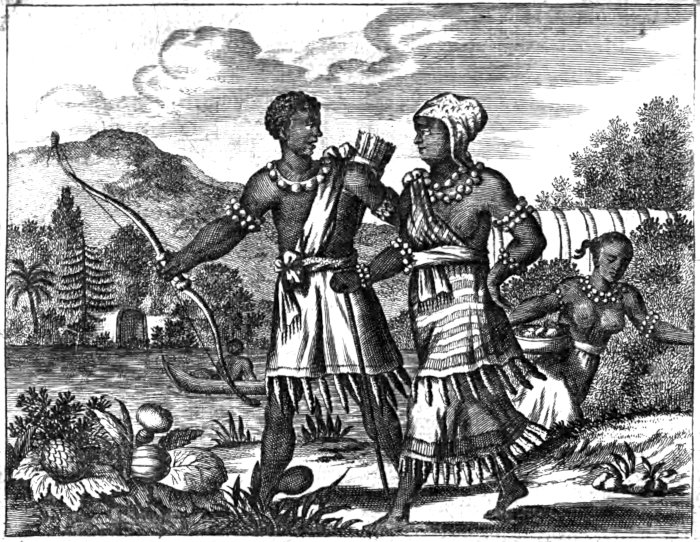
New Netherlanders Apparel.
The Habits of the Natives, especially of the Men, are few; the Women go more neat than the Men; and though the Winter pinches them with excessive cold, yet they go naked till their thirteenth year: Both Men and Women wear a Girdle of Whale-fins and Sea-shells; the Men put a piece of Cloth, half an Ell long, and three quarters broad, between their Legs, so that a square piece hangs behind below his Back, and another before over his Belly. The Women wear a Coat which comes half way down their Legs, so curiously wrought with Sea-shells, that one Coat sometimes costs thirty Pounds. Moreover, their Bodies are cover’d with Deer-skins, the lappets or ends of which hang full of Points; a large Skin button’d on the right Shoulder, and ty’d about the middle, serves for an upper Garment, and in the Night for a Blanket: Both Men and Women go for the most part bare-headed; the Women tie their Hair behind in a tuft, over which they wear a square Cap wrought with Sea-shells, with which they adorn their Foreheads, and also wear the same about their Neck and Hands, and some also about their middle. Before the Hollanders were Planted here, they wore Shoes and Stockings of Buffelo’s-skins; some likewise made Shoes of Wheaten-straw, but of late they come nearer to our Fashions: The Men Paint their Faces with several Colours; the Women only put here and there a black Spot; both of them are very reserv’d.
Their houses.
Remove.
Their Houses are most of them built of one fashion, onely differing in length; all of them agree in breadth of twenty Foot: They build after this manner, they set Peel’d Boughs of Nut-Trees in the ground, according to the bigness of the place which they intend to build, then joyning the tops of the Boughs together, they cover the Walls and top with the Bark of Cypress, Ashen, and Chest-nut-Trees, which are laid one upon another, the smallest side being turn’d inwards: according to the bigness of the Houses, several Families, to the number of fifteen 177dwell together, every one having his Apartment. Their Fortifications are most of them built on steep Hills, near Rivers; the access to them is onely at one place, they are built after this manner: They set great Poles in the Ground, with Oaken Pallisadoes on each side, cross-ways one amongst another; between the crosses they set other Trees, to strengthen the Work: Within this inclos’d they generally build twenty or thirty Houses, of which some are a hundred and eighty Foot long, and some less, all of them full of People: In the Summer they pitch Tents along by the River side to Fish; against Winter they remove into the Woods, to be near their Game of Hunting, and also Fuel.
Many Wives.
Marriages.
Whoring permitted.
Strange Marrying.
Child-bearing Womens strange actions.
Funerals.
Mourning over the dead remarkable.
To take many Women is not customary here, only amongst Military Officers, who Marry three or four Wives, which so well agree, that there is never any difference betwixt them; those that are not of Age, never Marry but with the consent and advice of their Parents: Widows and unmarry’d Men follow their own opinion and choice; only they take Cognizance of their Estates and Extraction: The Bridegroom always presents the Bride; for the least offence, the Man after having soundly beaten his Wife, turns her out of Doors, and Marries another, insomuch, that some of them have every year a new Wife: On breach of Marriage, the Children follow the Mother, from whom they account their Generation: They account Adultery, if committed under the bare Canopy of Heaven, a great Sin: Whoring is Licenc’d to single Women, if they receive Money for it, and no Man scruples to Marry them; nay, those that are Marry’d, boast how many they have enjoy’d before their Marriage: She that is inclin’d to Marry, covers her whole body, and sets her self wrapt up in the middle of the way, where a Batchelor passing by sees her, and makes up the Match blindfold: When impregnated, they take great care that their Fruit receives no hindrance nor prejudice: When the time of their Delivery approaches, (which they know exactly) they go to a Melancholly place in the Woods, though in the coldest Weather, where they raise up a Hut of Mats, and bring the Child into the World without any help or Company, wash the Child in cold Water, and wrap it up in Mats; then a few days after going home, they bring up the Infant with great care, none putting them out to Nurse: So long as a Woman gives suck, or is quick with Child, she will not admit of Copulation; one who hath the Flowers, never comes abroad: In time of sickness they faithfully assist one another: When any die, the nearest Relations shut their Eyes; and after having watch’d them some days, they are Interr’d after this manner: The Corps is plac’d sitting with a Stone under its Head, near it they set a Pot, Kettle, Dish, Spoons, Money, and Provisions to use in the other World; then they pile Wood round about it, and cover it over with Planks, on which throwing Earth and Stones, they set Pallisadoes, and make the Grave like a House, to which they shew Veneration, wherefore they account it a great piece of villany to deface any thing of it: The Men make no shew of sorrow over the Dead, but the Women mourn exceedingly, and carry themselves very strangely, beating their Breasts, scratching their Faces, and calling night and day on the name of the Deceas’d: The Mothers make great Lamentation at the Death of their Children, especially Sons, for they shave off the Hair of their Heads, which at the Funeral is burnt in the presence of all their Relations; which is also perform’d by the Women when their Husbands die; besides, they black all their Faces, and putting on a Hart-skin Shirt, mourn a whole year, notwithstanding they liv’d very contentiously together.
Conjurers.
On some occasions they go a Worshipping of the Devil, to a certain place where the Sorcerers shew strange Feats of Activity, tumbling over and over, beating 178themselves, and not without great noise leaping in and about a great Fire: at last they make a great Cry all together; upon which (as they say) the Devil appears to them in the shape either of a tame or wild Beast: the first signifies bad, and the other good fortune; both inform them of future Events, though darkly; and if the business fall out contrary, they affirm that they have not rightly understood the Devil’s meaning. Moreover they bewitch some in such a manner, that they foam at the Mouth, throw themselves into the Fire, and beat themselves severely; and so soon as they whisper in the Ear of those whom they have bewitch’d, they immediately recover their former health.
Language of the New Netherlanders.
The Language of this Countrey is very various, yet it is divided into onely four principal Tongues, as the Manhattans, Wappanoo, Siavanoo, and Minqua’s, which are very difficult for Strangers to learn, because they are spoken without any Grounds or Rules.
Money.
Their Money is made of the innermost Shells of a certain Shell-fish, cast up twice a year by the Sea: These Shells they grind smooth, and make a Hole in the middle, cutting them of an exact bigness, and so put them on Strings, which then serve in stead of Gold, Silver, and Copper Coin.
Vices and Vertues.
Strange Stoves.
Now to say something of the Vices and Vertues of the Inhabitants. They are in the first place very slovenly and nasty, stubborn, covetous, revengeful, and much addicted to filching and stealing. Some appear reserv’d, using few words, which they utter after serious consideration, and remember a long time. Their Understandings being improv’d by the Hollanders, they are quick of apprehension, to distinguish good from bad: they will not endure any Oppression, but are very patient of Heat, Cold, Hunger and Thirst. They have a strange way of using Stoves, which are set in the Ground and cover’d with Earth, into which they go through a little Door. A sick Person coming into the same, sets himself down, and places hot Stones round about him; which done, and having sweat a considerable time, he leaps into cold Water, by which he finds ease of all his Distempers.
Arms.
Remarkable actions of some Prisoners.
Laws.
Council-Assembly.
Though these People know no great distinction between Man and Man, as other Nations, yet they have noble and ignoble Families amongst them; superior and inferior Offices, which they enjoy by Inheritance; but sometimes the Martial Offices are bestowed according to the Valour of the Persons: Their Generals seldom give their Enemies a Field-Battel, by drawing or dividing their Men into Regiments or Companies, but make it their whole Design to defeat their Enemies by sudden Sallies from Ambuscado’s; for they never stand out a close Fight, unless compell’d to it, but if encompass’d round, they fight to the last Man. When any danger threatens, the Women and Children are convey’d to a secure place. Their Arms formerly were Bowes and Arrows, and Battel-axes, but now they use Musquets, which they have learn’d to handle with great dexterity. Their square Shields cover all their Bodies and Shoulders. About their Heads they tie a Snakes Skin, in the middle of which sticks either a Fox’s or Bear’s Tail. They cannot be known by their Faces, they are all over so besmear’d with Paint of divers colours. They seldom give Quarter to their Enemies, except Women and Children, which the Conquerors use as their own, that by that means they may increase and strengthen themselves: and if any Prisoner is not kill’d presently after the Battel, but falls into the Hands of one whose Relations have formerly been slain by his Party, he is Roasted three days by degrees before he gives up the Ghost. It deserves no small admiration, that the Sufferer during the whole time of his Torture, Sings till he breathes his last. They have few or no Punishments for any Offence, committing few Crimes which are by them accounted Capital. If any one steal, 179and the Goods be found in his custody, the Governor of the place where he resides commands him onely to restore the same to the Owner. If any one murther or kill the other, the Relations of the slain, if they can take the Malefactor in twenty four hours, may without Examination or delay put him to death also; but that time being once expir’d, the Revenger is liable to be kill’d in the same time by his Relations whom he slew. All Obligations have their power and vertue from certain Presents deliver’d upon the making of a Contract, which is done thus: They dry as many Sticks as they have Articles, which if they agree upon, every Man on the concluding of the Discourse lays a Present before the others Feet. Sometimes they hang up the Presents, because they are often three days in Consultation before they resolve; after which if the Presents be taken down, it is a certain sign of their Agreement; but if not, they proceed no farther, unless the Articles and Presents are alter’d. On Businesses of consequence the Commonalty repair to their Governor’s House, there to hear and enquire what the Nobility there assembled have concluded or resolv’d on; at which the best Orator standing up, tells them their Intentions. It happens sometimes that a turbulent Person making a Mutiny, and refusing to hearken to reason, is immediately beheaded by one of the Nobility; in contradiction of which none dare presume to speak the least word.
Religion.
Diabolical Worship.
Their ridiculous Opinion of God.
As also of the Creation.
There are scarce any steps of Religion found amongst these People, onely they suppose the Moon to have great influence on Plants. The Sun, which over-looks all things, is call’d to witness whene’re they Swear. They bear great respect, and stand much in fear of Satan, because they are often plagued by him when they go a Hunting or Fishing: wherefore the first of what they take is burnt in honor of him, that he to whom they ascribe all wickedness might not hurt them. When they feel pain in any part of their Body, they say that the Devil sits in the same. They acknowledge that there resides a God above the Stars, but troubles not himself with what the Devil doth on Earth, because he continually recreates himself with a most beautiful Goddess, whose original is unknown: She on a certain time (say they) descended from Heaven into the Water, (for before the Creation all things were Water) into which she had instantly sunk, had not the Earth arose under her Feet, which grew immediately to such a bigness, that there appear’d a World of Earth, which produc’d all sorts of Herbs and Trees; whilst the Goddess taking to her self a Hart, Bear, and Wolf, and Conceiving by them, she was not long after deliver’d of several Beasts at one time: and from thence proceeded not onely the diversity of Beasts, but also Men, of which some are black, white, or sallow; in nature fearful like a Hart, or cruel and valiant like a Bear, or deceitful like Wolves: after this the Mother of all things ascended up to Heaven again, and sported there with the Supream Lord, whom they say they know not, because they never saw him: wherefore they shall have less to answer for than Christians, which pretend to know him to be the Punisher of things both good and bad, which are daily committed by them: and for this ridiculous Opinion they can hardly be brought to embrace the Christian Faith.
Of the Immortality of the Soul.
Concerning the Souls of the Deceased, they believe, that those which have been good in their life-time, live Southward in a temperate Countrey, where they enjoy all manner of pleasure and delight; when as the Wicked wander up and down in a miserable Condition. The Eccho which resounds from the Cries of wild Beasts in the Night, they suppose to be the Spirits of Souls transmigrated into wicked Bodies.
Their Canticas, or Dancing.
At their Canticas, or Dancing-Matches, where all Persons that come are freely Entertain’d, it being a Festival time. Their Custom is when they Dance, for the 180Spectators to have short Sticks in their Hands, and to knock the Ground and Sing altogether, whilst they that Dance sometimes act Warlike postures, and then they come in painted for War with their Faces black and red, or some all black, some all red, with some streaks of white under their Eyes, and so jump and leap up and down without any order, uttering many Expressions of their intended Valour. For other Dances they onely shew what antick Tricks their ignorance will lead them to, wringing of their Bodies and Faces after a strange manner, sometimes jumping into the Fire, sometimes catching up a Firebrand, and biting off a live Coal, with many such tricks, that will affright rather than please an English-man to look upon them, resembling rather a company of infernal Furies than Men.
Their sitting in Council.
When their King or Sachem sits in Council, he hath a Company of Arm’d Men to guard his Person, great respect being shewn him by the People, which is principally manifested by their silence. After he hath declared the cause of their Convention, he demands their Opinion, ordering who shall begin: The Person order’d to speak, after he hath declar’d his mind, tells them he hath done: no Man ever interrupting any Person in his Speech, nor offering to speak, though he make never so many long stops, till he says he hath no more to say. The Council having all declar’d their Opinions, the King after some pause gives the definitive Sentence, which is commonly seconded with a shout from the People, every one seeming to applaud and manifest their Assent to what is determin’d.
If any Person be condemn’d to die, which is seldom, unless for Murther or Incest, the King himself goes out in Person (for you must understand they have no Prisons, and the guilty Person flies into the Woods) where they go in quest of him, and having found him, the King shoots first, though at never such a distance, and then happy is the Man that can shoot him down; for he that hath the fortune to be Executioner, is for his pains made some Captain, or other Military Officer.
They grease their Bodies and Hair very often, and paint their Faces with several Colours, as black, white, red, yellow, blue, &c. which they take great pride in, every one being painted in a several manner.
Within two Leagues of New York lieth Staten-Island, it bears from New York West something Southerly: It is about twenty Miles long, and four or five broad, most of it very good Land, full of Timber, and producing all such Commodities as Long-Island doth, besides Tin and store of Iron Oar; and the Calamine Stone is said likewise to be found there: There is but one Town upon it, consisting of English and French, but it is capable of entertaining more Inhabitants.
Betwixt this and Long-Island is a large Bay, which is the coming in for all Ships and Vessels out of the Sea.
On the North-side of this Island After-skull River puts into the Main Land, on the West-side whereof there are two or three Towns, but on the East-side but one. There are very great Marshes or Meadows on both sides of it, excellent good Land, and good convenience for the setling of several Towns. There grows black Walnut and Locust, as there doth in Virginia, with mighty, tall, streight Timber, as good as any in the North of America: It produceth any Commodity which Long-Island doth.
Hudson’s River runs by New York Northward into the Countrey, towards the Head of which is seated New Albany, a Place of great Trade with the Indians, betwixt which and New York, being above a hundred Miles, is as good Corn-Land as the World affords, enough to entertain hundreds of Families, which in the time of the Dutch Government of these Parts could not be setled by reason of the Indians, excepting 181one Place, call’d The Sopers, which was kept by a Garrison, but since the Reducement of these Parts under His Majesties Obedience, and a Patent granted to his Royal Highness the Duke of York, which is about six years, by the care and diligence of the Honorable Collonel Nichols, sent thither as Deputy to his Highness, such a League of Peace was made, and Friendship concluded betwixt that Colony and the Indians, that they have not resisted or disturb’d any Christians there, in the setling or peaceable possessing of any Lands within that Government, but every Man hath sat under his own Vine, and hath peaceably reap’d and enjoy’d the Fruits of their own Labors, which God continue.
Raritan-River.
Westward of After-skull River before mention’d, about eighteen or twenty Miles, runs in Raritan River Northward into the Countrey some scores of Miles; both sides of which River are adorn’d with spacious Meadows, enough to feed thousands of Cattel: The Wood-Land is very good for Corn, and stor’d with wild Beasts, as Deer, Elks, and an innumerable multitude of Fowl, as in other parts of the Countrey. This River is thought very capable for the erecting of several Towns and Villages on each side of it, no place in the North of America having better convenience for the maintaining of all sorts of Cattel for Winter and Summer Food.
Upon this River is no Town setled, onely one at the Mouth of it; but next to it, Westward, is a Place call’d Newasons; where are two or three Towns and Villages setled upon the Sea-side, but none betwixt that and Delaware-Bay, which is about sixty Miles, all which is a rich Champain Countrey, free from Stones, and indifferent level, having store of excellent good Timber, and very well water’d, having Brooks or Rivers ordinarily, one or more in every Miles travel. This Countrey is peopled onely with wild Beasts, as Deer, Elks, Bears, and other Creatures, so that in a whole days Journey you shall meet with no Inhabitants except a few Indians. It is also full of stately Oaks, whose broad-branch’d tops serve for no other use, but to keep off the Suns heat from the wild Beasts of the Wilderness, where is Grass as high as a Man’s Middle, which serves for no other end, except to maintain the Elks and Deer, who never devour a hundredth part of it, than to be burnt every Spring to make way for new. How many poor People in the World would think themselves happy, had they an Acre or two of Land, whilst here is hundreds, nay thousands of Acres that would invite Inhabitants.
Delaware-Bay.
Delaware-Bay, the Mouth of the River, lieth about the mid way betwixt New York and the Capes of Virginia.
The best Commodities for any to carry with them to this Countrey is Clothing, the Countrey being full of all sorts of Cattel, which they may furnish themselves withal at an easie Rate, for any sort of English Goods, as likewise Instruments for Husbandry and Building, with Nails, Hinges, Glass, and the like. They get a Livelihood principally by Corn and Cattel, which will there fetch them any Commodities: Likewise they Sowe store of Flax, which they make every one Cloth of for their own wearing; as also Woollen Cloth, and Linsey-woolsey; and had they more Tradesmen amongst them, they would in a little time live without the help of any other Countrey for their Clothing; for Tradesmen there are none but live happily there, as Carpenters, Blacksmiths, Masons, Taylors, Weavers, Shoemakers, Tanners, Brickmakers, and so any other Trade: Them that have no Trade betake themselves to Husbandry, get Land of their own, and live exceeding well.
We shall conclude our Discourse of this Countrey with a notable Character given thereof by a late Writer, as to the great advantage of happy living in all respects, for whosoever shall be pleas’d to betake himself thither to live.
The Character of a happy Countrey.
182“If there be any terrestrial happiness (saith he) to be had by any People, especially of an inferior rank, it must certainly be here. Here any one may furnish himself with Land, and live Rent-free, yea, with such a quantity of Land, that he may weary himself with walking over his Fields of Corn, and all sorts of Grain, and let his Stock amount to some hundreds; he needs not fear there want of Pasture in the Summer, or Fodder in the Winter, the Woods affording sufficient supply, where you have Grass as high as a Man’s Knees, nay, as high as his Waste, interlac’d with Pea-Vines, and other Weeds that Cattel much delight in, as much as a Man can pass through: And these Woods also every Mile or half-Mile are furnish’d with fresh Ponds, Brooks, or Rivers, where all sorts of Cattel, during the heat of the day, do quench their thirst, and cool themselves. These Brooks and Rivers being inviron’d of each side with several sorts of Trees and Grape-Vines, Arbor-like interchanging places, and crossing these Rivers, do shade and shelter them from the scorching beams of the Sun. Such as by their utmost Labors can scarcely get a Living, may here procure Inheritances of Lands and Possessions, stock themselves with all sorts of Cattel, enjoy the benefit of them whilst they live, and leave them to their Children when they die. Here you need not trouble the Shambles for Meat, nor Bakers and Brewers for Beer and Bread, nor run to a Linnen-Draper for a supply, every one making their own Linnen, and a great part of their woollen Cloth for their ordinary wearing. And how prodigal (if I may so say) hath Nature been to furnish this Countrey with all sorts of wild Beasts and Fowl, which every one hath an interest in, and may Hunt at his pleasure; where, besides the pleasure in Hunting, he may furnish his House with excellent fat Venison, Turkies, Geese, Heath-hens, Cranes, Swans, Ducks, Pigeons, and the like; and wearied with that, he may go a Fishing, where the Rivers are so furnish’d, that he may supply himself with Fish before he can leave off the Recreation. Here one may travel by Land upon the same Continent hundreds of Miles, and pass through Towns and Villages, and never hear the least complaint for want, nor hear any ask him for a Farthing. Here one may lodge in the Fields and Woods, travel from one end of the Countrey to another, with as much security as if he were lock’d within his own Chamber: And if one chance to meet with an Indian Town, they shall give him the best Entertainment they have, and upon his desire direct him on his Way. But that which adds happiness to all the rest, is the healthfulness of the Place, where many People in twenty years time never know what Sickness is; where they look upon it as a great Mortality, if two or three die out of a Town in a years time. Besides the sweetness of the Air, the Countrey it self sends forth such a fragrant smell, that it may be perceiv’d at Sea before they can make the Land: No evil Fog or Vapor doth any sooner appear, but a North-West or Westerly Wind immediately dissolves it, and drives it away. Moreover, you shall scarce see a House, but the South-side is begirt with Hives of Bees, which increase after an incredible manner: So that if there be any terrestrial Canaan, ’tis surely here, where the Land floweth with Milk and Honey.”
183
A NEW DESCRIPTION OF MARY-LAND.
SECT. III.
Before We proceed to the Description of this Countrey, it will be first requisite to relate the true occasion and means, whereby this part of America came to be erected into a Province, and call’d Mary-land.
The situation.
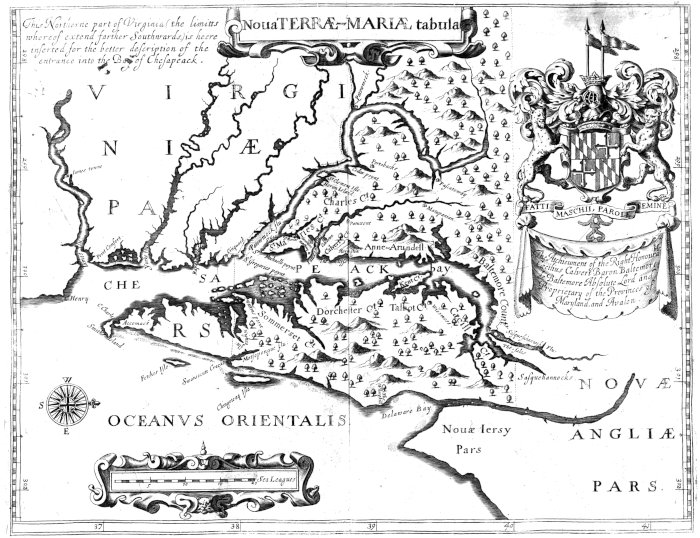
In the Year of our Lord 1631. George Lord Baltemore obtain’d of King Charles the First, of Great Brittain, &c. a Grant of that part of America, (first discover’d by the English) which lies between the Degrees of thirty seven and fifty Minutes, or thereabouts, and forty of Northerly Latitude; which is bounded on the South by Virginia; on the North, by New England, and New Jersey, part of New York, lying on the East side of Delaware Bay; on the East, by the Ocean; and on the West, by that part of the Continent which lies in the Longitude of the first Fountains of the River call’d Patomeck.
In pursuance of this Grant to his said Lordship, a Bill was prepar’d, and brought to His Majesty to Sign, who first ask’d his Lordship, what he should call it, there being a Blank in the Bill designedly left for the Name, which his Lordship intended should have been Crescentia; but his Lordship leaving it to His Majesty to give it a Name, the King propos’d to have it call’d Terra-Mariæ, in English, Mary-land, in honor of his Queen, whose Name was Mary; which was concluded on, and inserted into the Bill, which the King then Sign’d; and thereby the said Tract of Land was erected into a Province by that Name.
His Lordship somewhat delaying the speedy passing of it under the Great Seal of England, dy’d in the interim, before the said Patent was perfected; whereupon a 184Patent of the said Province was shortly afterwards pass’d to his Son and Heir, (who was Christen’d by the Name of Cœcil, but afterwards confirm’d by the Name of Cœcilius,) the now Lord Baltemore, under the Great Seal of England, bearing Date June 20. 1632. in the eighth Year of His said Majesties Reign, with all Royal Jurisdictions and Prerogatives, both Military and Civil in the said Province, as Power to Enact Laws, Power of pardoning all manner of Offences, Power to confer Honors, &c. to be held of His said Majesty, His Heirs and Successors, Kings of England in common Soccage, as of His Majesties Honor of Windsor in the County of Berks in England; yielding and paying yearly for the same to His Majesty and to His Heirs and Successors for ever, two Indian Arrows of those parts, at the Castle of Windsor aforesaid, on Tuesday in Easter Week, and the fifth part of all Gold and Silver Oar, which shall happen to be found in the said Province.
The Bounds.
“By the said Patent is Granted to his Lordship, his Heirs and Assigns, all that part of a Peninsula, lying in the parts of America, between the Ocean on the East, and the Bay of Chesapeack on the West; and divided from the other part thereof by a right Line drawn from the Promontory, or Cape of Land call’d Watkin’s-Point, situate in the aforesaid Bay, near the River of Wigcho on the West, unto the main Ocean on the East, and between that bound on the South, unto that part of Delaware Bay on the North, which lies under the fortieth Degree of Northerly Latitude from the Equinoctial, where New England ends; and all that Tract of Land between the bounds aforesaid, that is to say, passing from the aforesaid Bay call’d Delaware Bay, in a right Line by the Degree aforesaid, unto the true Meridian of the first Fountains of the River of Patomeck; and from thence stretching towards the South, unto the furthest Bank of the said River, and following the West and South side thereof, unto a certain place call’d Cinquack, near the Mouth of the said River, where it falls into the Bay of Chesapeack, and from thence by a streight Line unto the aforesaid Promontory, or place call’d Watkin’s-Point, which lies in thirty seven Degrees and fifty Minutes, or thereabouts, of Northern Latitude.”
Title.
By this Patent his Lordship and his Heirs and Assigns are Created the true and absolute Lords and Proprietaries of the said Province, saving the Allegiance and Soveraign Dominion due to His Majesty, His Heirs, and Successors; so that he hath thereby a Soveraignty Granted to him and his Heirs, dependant upon the Soveraignty of the Crown of England.
The first Seating.
His Lordship, in the Year 1633. sent his second Brother Mr. Leonard Calvert, and his third Brother Mr. George Calvert, with divers other Gentlemen of Quality, and Servants to the number of two hundred Persons at least, to settle a Plantation there; who set Sail from the Cowes in the Isle of Wight in England, on Novemb. 22. in the same Year; having made some stay by the way, at the Barbadoes and St. Christophers in America, they arriv’d at Point Comfort in Virginia, on February 24. following; from whence shortly after they Sail’d up the Bay of Chesapeack, and Patomeck River. And having review’d the Country, and given Names to several places, they pitch’d upon a Town of the Indians for their first Seat, call’d Yoacomaco, (now Saint Maries) which the then Governor Mr. Leonard Calvert, freely Purchas’d of the Natives there, for the Lord Proprietaries use, with Commodities brought from England.
That which facilitated the Treaty and Purchase of the said place from the Indians, was a resolution which those Indians had then before taken, to remove higher into the Countrey where it was more Populous, for fear of the Sansquehanocks, (another, and more Warlike People of the Indians, who were their too near Neighbors, 185and inhabit between the Bays of Chesapeack and Delaware) there being then actual Wars between them, insomuch, that many of them were gone thither before the English arriv’d: And it hath been the general practice of his Lordship, and those who were employ’d by him in the Planting of the said Province, rather to purchase the Natives Interest, (who will agree for the same at easie rates) than to take from them by force, that which they seem to call their Right and Inheritance, to the end all Disputes might be remov’d touching the forcible Incroachment upon others, against the Laws of Nature or Nations.
The number of Inhabitants.
Thus this Province at the vast Charges, and by the unweary’d Industry and endeavor of the present Lord Baltemore, the now absolute Lord and Proprietary of the same was at first Planted, and hath since been supply’d with People and other Necessaries, so effectually, that in this present Year 1671. the number of English there amounts to fifteen or twenty thousand Inhabitants, for whose Encouragement there is a Fundamental Law establish’d there by his Lordship, whereby Liberty of Conscience is allow’d to all that Profess to believe in Jesus Christ; so that no Man who is a Christian is in danger of being disturb’d for his Religion; and all Persons being satisfi’d touching his Lordships Right, as Granted by his Superior Soveraign, the King of Great Brittain, and possess’d by the consent and agreement of the first Indian Owners, every Person who repaireth thither, intending to become an Inhabitant, finds himself secure, as well in the quiet enjoyment of his Property, as of his Conscience.
Mr. Charles Calvert, his Lordships onely Son and Heir, was in the Year 1661. sent thither by his Lordship to Govern this Province and People, who hath hitherto continu’d that Charge of his Lordships Lieutenant there, to the general satisfaction and encouragement of all Persons under his Government, or otherwise concern’d in the Province.
The precedent Discourse having given you a short Description of this Province from its Infancy to this day, together with an account of his Lordships Patent and Right, by which he holds the same; we will here speak something of the Nature of the Countrey in general, and of the Commodities that are either naturally afforded there, or may be procur’d by Industry.
The Climate is very healthful, and agreeable with English Constitutions; but New-comers have most of them heretofore had the first year of their Planting there in July and August, a Sickness, which is call’d there A Seasoning, but is indeed no other than an Ague, with cold and hot Fits, whereof many heretofore us’d to die for want of good Medicines, and accommodations of Diet and Lodging, and by drinking too much Wine and Strong-waters; though many, even in those times, who were more temperate, and that were better accommodated, never had any Seasonings at all; but of late years, since the Countrey hath been more open’d by the cutting down of the Woods, and that there is more plenty of English Diet, there are very few die of those Agues, and many have no Seasonings at all, especially those that live in the higher parts of the Country, and not near to the Marshes and Salt-water.
In Summer, the heats are equal to those of Spain, but qualifi’d daily about Noon, at that time of the Year, either with some gentle Breezes, or small Showres of Rain: In Winter there is Frost and Snow, and sometimes it is extremely cold, insomuch, that the Rivers and the Northerly part of the Bay of Chesapeack are Frozen, but it seldom lasts long; and some Winters are so warm, that People have gone in half Shirts and Drawers only at Christmas: But in the Spring and Autumn, (viz.) in March, April, and May, September, October, and November, there is generally 186most pleasant temperate Weather: The Winds there are variable, from the South comes Heat, Gusts, and Thunder; from the North or North-West, cold Weather; and in Winter, Frost and Snow; from the East and South-East, Rain.
The Soyl is very fertile, and furnish’d with many pleasant and commodious Rivers, Creeks, and Harbors.
The Country is generally plain and even, and yet distinguish’d with some pretty small Hills and Risings, with variety of Springs and Rivulets: The Woods are for the most part free from Underwood, so that a Man may Travel or Hunt for his Recreation.
The ordinary entrance by Sea into this Country is between two Capes, distant each from the other about seven or eight Leagues; the South Cape is call’d Cape Henry; the North, Cape Charles; within the Capes you enter into a fair Bay, Navigable for at least two hundred Miles, and is call’d Chesapeack Bay, stretching it self Northerly through the heart of the Countrey, which adds much to its Fame and Value: Into this Bay fall many stately Rivers, the chief whereof is Patomeck, which is Navigable for at least a hundred and forty Miles: The next Northward, is Patuxent, at its entrance distant from the other about twenty Miles, a River yielding great Profit as well as Pleasure to the Inhabitants; and by reason of the Islands and other places of advantage that may Command it, both fit for Habitation and Defence: Passing hence to the Head of the Bay, you meet with several pleasant and commodious Rivers, which for brevity we here omit to give any particular account of: On the Eastern Shore are several commodious Rivers, Harbors, Creeks, and Islands; to the Northward whereof you enter into another fair Bay, call’d Delaware Bay; wide at its entrance about eight Leagues, and into which falls a very fair Navigable River.
The natural Commodities of the Countrey.
This Countrey yields the Inhabitants many excellent things for Physick and Chyrurgery; they have several Herbs and Roots which are great Preservatives against Poyson, as Snake-Root, which presently cures the bitings of the Rattle-Snake, which are very Venomous, and are bred in the Countrey; others that cure all manner of Wounds; they have Saxafras, Sarsaparilla, Gums and Balsoms, which Experience (the Mother of Art) hath taught them the perfect use of.
An Indian seeing one of the English much troubled with the Tooth-ach, fetch’d a Root out of a Tree, which apply’d to the Tooth, gave ease immediately to the Party; other Roots they have fit for Dyers, wherewith the Indians Paint themselves as Pacoone (a deep red,) &c.
The Timber of these parts is good and useful for Building of Houses and Ships, the white Oak for Pipe-staves, the red for Wainscot; there is likewise black Wall-Nut, Cedar, Pine, and Cypress, Chest-nut, Elme, Ash, and Popelar, all which are for Building and Husbandry: Fruit-trees, as Mulberries, Persimons, with several kind of Plumbs, and Vines in great abundance.
Of Strawberries there is plenty, which are ripe in April, Mulberries in May, Rasberries in June, and the Maracok, which is something like a Lemon, is ripe in August. In Spring time there are several sorts of Herbs, as Corn-sallet, Violets, Sorrel, Purslane, and others which are of great use to the English there.
In the upper parts of the Countrey are Buffeloes, Elks, Tygers, Bears, Wolves, and great store of Deer; as also Beavers, Foxes, Otters, Flying-Squirils, Racoons, and many other sorts of Beasts.
Of Birds, there is the Eagle, Goshawk, Falcon, Lanner, Sparrow-hawk, and Marlin; also wild Turkies in great abundance, whereof many weigh fifty Pounds in weight and upwards, and of Partridge great plenty: There are likewise sundry 187sorts of singing Birds, whereof one is call’d a Mock-Bird, because it imitates all other Birds; some are red, which sing like Nightingales, but much louder; others black and yellow, which last sort excels more in Beauty than tune, and is by the English there call’d the Baltemore-Bird, because the Colours of his Lordships Coat of Arms are black and yellow: Others there are that resemble most of the Birds in England, but not of the same kind, for which we have no names: In Winter there are great plenty of Swans, Cranes, Geese, Herons, Duck, Teal, Widgeons, Brants, and Pidgeons, with other sorts, whereof there are none in England.
The Sea, the Bays of Chesapeack and Delaware, and generally all the Rivers, do abound with Fish of several sorts; as Whales, Sturgeon, Thorn-back, Grampuses, Porpuses, Mullets, Trouts, Soules, Plaice, Mackrel, Perch, Eels, Roach, Shadd, Herrings, Crabs, Oysters, Cockles, Mussels, &c. but above all these, the Fish whereof there are none in England, as Drums, Sheeps-head, Cat-fish, &c. are best, except Sturgeon, which are there found in great abundance, not inferior to any in Europe for largeness and goodness.
The Minerals may in time prove of very great consequence, though no rich Mines are yet discover’d there; but there is Oar of several sorts, viz. of Tin, Iron, and Copper, whereof several trials have been made by curious Persons there with good success.
The Soyl is generally very rich, the Mould in many places black and rank, insomuch, that it is necessary to Plant it first with Indian Corn, Tobacco, or Hemp, before it is fit for English Grain; under that is found good Loam, whereof has been made as good Brick as any in Europe: There are store of Marsh-grounds for Meadows; great plenty of Marle, both blue and white; excellent Clay for Pots and Tiles: To conclude, there is nothing that can be reasonably expected, in a place lying in the same Latitude with this, but what is either there found naturally, or may be procur’d by Industry, as Oranges, Lemons, and Olives, &c.
Commodities which are, or may be procur’d by industry.
We need not here mention Indian Corn, (call’d Mayz) Pease and Beans of several sorts, being the peculiar products Planted by the Indians of that part of America.
All sorts of English Grain are now common there, and yield a great encrease; as Wheat, Rye, Barley, Oats, Pease, Beans, &c. good Beer of Wheat or Barley Malt, after the English Mode, is made, even in the meanest Families there; Some drink Beer of Indian Corn, others of the Stalks thereof, or of the Chipps of the Pockykerry-Tree, all which make a sort of fresh and pleasant Drink; but the general Diet of the Country is now English, as most agreeable to their Constitutions.
There are few able Planters there at present, but what are plentifully supply’d with all sorts of Summer and Winter Fruits; as also of Roots and Herbs, of all sorts out of their Gardens and Orchards, which they have Planted for their Profit as well as Pleasure: They have Pears, Apples, Plumbs, Peaches, &c. in great abundance, and as good as those of Italy; so are their Mellons, Pumpions, Apricocks, Cherries, Figgs, Pomegranates, &c. In fine, there is scarce any Fruit or Root that grows in England, France, Spain, or Italy, but hath been try’d there, and prospers well.
You may have there also Hemp, Flax, Pitch, and Tar, with little labor; the Soyl is apt for Hops, Rape-seed, Annice-seed, Woad, Madder, Saffron, &c. there may be had Silk-worms, the Country being stor’d with Mulberry-trees, and the superfluity of the Wood will produce Pot-ashes.
There is a great quantity of Syder made there at present, and as good as in any other Countrey; good Perry and Quince-drink is there likewise made in great plenty: The Ground doth naturally bring forth Vines in great quantities, the quality 188whereof being something corrected by Industry, (as there have been several trials thereof already made there) may no doubt produce good Wine, to the great encouragement and advantage of the Undertakers.
Brave Ships may be built there with little charge, Clab-board, Wainscot, Pipe-staves, and Masts for Ships, the Woods will afford plentifully; some small Vessels have been already built there: In fine, Beef, Furrs, Hides, Butter, Cheese, Pork, and Bacon, to Transport to other Countreys, are no small Commodities, which by Industry, are, and may be had there in great plenty, the English being already plentifully stock’d with all sorts of Cattel and Horses; and were there no other Staple-Commodities to be hop’d for, but Silk and Linnen (the materials of which apparently will grow there) it were sufficient to enrich the Inhabitants.
But the general Trade of Mary-land at present depends chiefly upon Tobacco, it being the Planters greatest concern and study to store himself betimes with that Commodity, wherewith he buys and sells, and after which Standard all other Commodities receive their Price there; they have of late vented such quantities of that and other Commodities, that a hundred Sail of Ships from England, Barbadoes, and other English Plantations, have been usually known to Trade thither in one Year; insomuch, that by Custom and Excize paid in England for Tobacco and other Commodities Imported from thence, Mary-land alone at this present, hath by his Lordships vast Expence, Industry, and Hazard for many years, without any charge to the Crown, improv’d His Majesties, the King of Englands Revenues, to the value of Forty thousand Pounds Sterl. per annum at least.
The general way of Traffick and Commerce there is chiefly by Barter, or Exchange of one Commodity for another; yet there wants not, besides English and other foraign Coyns, some of his Lordships own Coyn, as Groats, Sixpences, and Shillings, which his Lordship at his own Charge caus’d to be Coyn’d and dispers’d throughout that Province; ’tis equal in fineness of Silver to English Sterling, being of the same Standard, but of somewhat less weight, and hath on the one side his Lordships Coat of Arms stamp’d, with this Motto circumscrib’d, Crescite & Multiplicamini, and on the other side his Lordships Effigies, circumscrib’d thus, Cæcilius Dominus Terræ-Mariæ, &c.
The Government.
The Order of Government and settled Laws of this Province, is by the Prudence and endeavor of the present Lord Proprietary, brought to great Perfection; and as his Dominion there is absolute (as may appear by the Charter aforemention’d) so all Patents, Warrants, Writs, Licenses, Actions Criminal, &c. Issue forth there in his Name: Wars, Peace, Courts, Offices, &c. all in his Name made, held, and appointed.
Laws are there Enacted by him, with the advice and consent of the General Assembly, which consists of two Estates, namely, the first is made up by the Chancellor, Secretary, and others of his Lordships Privy-Council, and such Lords of Mannors, and others as shall be call’d by particular Writs for that purpose, to be Issu’d by his Lordship: The second Estate consists of the Deputies and Delegates of the respective Counties of the said Province, elected and chosen by the free voice and approbation of the Free-men of the laid respective Counties.
The Names of the Governor and Council in this present Year 1671. are as followeth, Mr. Charles Calvert, his Lordships Son and Heir, Governor; Mr. Philip Calvert, his Lordships Brother, Chancellor; Sir William Talbot Baronet, his Lordships Nephew, Secretary; Mr. William Calvert, his Lordships Nephew, Muster-Master-General; Mr. Jerome White, Surveyor-General; Mr. Baker Brooke, his Lordships Nephew; Mr. Edward Lloyd, Mr. Henry Coursey, Mr. Thomas Trueman, Major Edward Fits-Herbert, Samuel Chew Esq.
189His Lordship, or his Lieutenant there for the time being, upon due occasion, Convenes, Prorogues, and Dissolves this Assembly; but whatsoever is by his Lordships Lieutenant there, with the consent of both the said Estates Enacted, is there of the same Force and Nature as an Act of Parliament is in England, until his Lordship declares his dis-assent; but such Laws as his Lordship doth assent unto, are not afterwards to be Alter’d or Repeal’d but by his Lordship, with the consent of both the said Estates.
Their chief Court of Judicature is held at St. Maries Quarterly every Year, to which all Persons concern’d resort for Justice, and is call’d The Provincial Court, whereof the Governor and Council are Judges: To the Court there doth belong several sworn Attorneys, who constantly are present there, and act both as Barristers and Attorneys; there are likewise chief Clerks, Bayliffs, and other Officers, which duly attend the Court in their respective places.
The Province is divided at present, so far as it is inhabited by English, into Counties, whereof there be ten, viz. St. Maries, Charles, Calvert, Anne Arandel, and Baltemore Counties, which first five lie on the West side of the Bay of Chesapeack; on the Eastern side whereof, commonly call’d The Eastern-Shore, lies Sommerset, Dorchester, Talbot, Cæcil, and Kent Counties, which last is an Island lying near the Eastern-shore of the said Bay.
Besides the Provincial Court aforenam’d, there are other inferior Courts, appointed to be held in every one of the Counties six times in the year, for the dispatch of all Causes, not relating to Life or Member, and not exceeding the value of three thousand weight of Tobacco; the decision of all other Causes being reserv’d to the Provincial or higher Court before-mention’d, and there lies Appeals from the County-Courts, to the Provincial Court.
There are Sheriffs, Justices of the Peace, and other Officers appointed by the Lord and Proprietary, or his Lordships Lieutenant for the time being, in the said respective Counties; and without four Justices, of which one to be of the Quorum, none of the said respective County-Courts can be held; any of his Lordships Privy Council may sit as Judge, in any of the said County-Courts, by vertue of his place.
These Courts are appointed to be held at convenient Houses in the said Counties, which commonly are not far distant from some Inn, or other House of Entertainment, for accommodation of Strangers; one of the said six County Courts in each County is held for settling of Widows and Orphans Estates.
There are Foundations laid of Towns, more or less in each County, according to his Lordships Proclamation, to that effect Issu’d forth in the year 1668. In Calvert County, about the River of Patuxent, and the adjacent Cliffs, are the Bounds of three Towns laid out, one over against Point Patience, call’d Harvy Town, another in Battel-Creek, call’d Calverton, and a third upon the Cliffs, call’d Herrington, and Houses already built in them, all uniform, and pleasant with Streets, and Keys on the Water side. In the County of St. Maries, on the East side of St. Georges River, is the principal and original Seat of this Province, where the general Assembly, and Provincial Courts are held, and is call’d St. Maries, being erected into a City by that Name, where divers Houses are already built: The Governor hath a House there call’d St. John’s; the Chancellor Mr. Philip Calvert, his Lordships Brother, hath another, and in this place is built and kept the Secretaries Office, where all the Records are kept, all Process, Grants, for Lands, Probates of Wills, Letters of Administration are issu’d out: the Plat of a Fort and Prison is lately laid there, upon a point of Land, term’d Windmil-Point, from a Windmil which formerly stood there, 190the situation is proper, for that it commands the breadth of the said River of Saint Georges; so that when it is finish’d, all Shipping may safely Ride before the Town, without the least fear of any sudden Assault, or Attempt of Pirats or other Enemy whatsoever. This City has formerly been the usual place of abode for his Lordships Lieutenants, and their Retinue; but of late years the present Governor, Mr. Charles Calvert, hath built himself a fair House of Brick and Timber, with all Out-houses, and other Offices thereto belonging, at a place call’d Mattapany, near the River of Patuxent before-mention’d, where he and his Family reside, being a pleasant, healthful, and commodious Seat, about eight Miles by Land distant from St. Maries.
Of the Indians in Mary-land.
The Indians in Mary-land are a People generally of streight, able, and well proportion’d Bodies, something exceeding the ordinary pitch of the English, their Complexion Swarthy, their Hair naturally long and black, without Curle, which generally they cut after some strange Fantastical Mode; nay, sometimes they Dye it with red and other preposterous Colours: They Liquor their Skins with Bears Grease, and other Oyls, which renders them more tawny, and less apt to receive injury from the Weather: They are subtile from their Infancy, and prone to learn any thing their Fancy inclines them to, in other things slothful.
There are as many distinct Nations among them as there are Indian Towns, (which are like Countrey-Villages in England, but not so good Houses) dispers’d throughout the Province: Each Town hath its King (by them term’d Werowance) and every forty or fifty Miles distance differs much from its Neighbors in Speech and Disposition: The Sasquahanocks, though but few in number, yet much exceed the rest in Valor, and Fidelity to the English; the rest being generally of a more Treacherous Spirit, and not so stout, and the number of the English do already exceed all the Indians in the Province.
The Werowance is assisted by Councellors, call’d Wisoes, who are commonly of the same Family, and are chosen at the pleasure of the Werowance: They have Captains in time of War which they term Cockorooses.
Most of their Governments are Monarchical, (except the Sasquahanocks, which is a Re-publick) but for succession they have a peculiar Custom, that the Issue of the Males never succeed, but the Issue-Male of the Female succeed in Government, as the surer side: They all submit to, and are protected by the Lord Proprietaries Government; and in case of any Assault or Murder, committed on any English, the Party offending is try’d by the Laws of the Province; and in case of any new Election of King or Emperor among them, they present the Person so Elected to the Governor for the time being, who as he sees cause, either alters or confirms their Choice.
In the Year 1663. at the Indians Request, the present Governor Mr. Charles Calvert, and some others of his Lordships Privy-Council there, went to Pascatoway, in this Province, to be present at the Election of a new Emperor for that Nation: They presented a Youth nam’d Nattawasso, and humbly Requested to have him confirm’d Emperor of Pascatoway, by the Name of Wahocasso; which after some charge given them in general, to be good and faithful Subjects to him, the Governor accordingly did, and receiv’d him into his Protection.
They pay great Respect and Obedience to their Kings and Superiors, whose Commands they immediately Execute, though with an apparent hazard of their Lives.
The Mens chief employment is Hunting, and the Wars, in both which they commonly use Bowes and Arrows; some of late have Guns and other Weapons, by a private Trade with some English Neighboring Plantations: They are excellent 191Marks-men, it being the onely thing they breed their Youth to: The Women Plant and look after the Corn, make their Bread, and dress what Provisions their Husbands bring home. Their way of Marriage is by agreement with the Womens Parents or Friends, who for a certain Sum of their Money, or other Goods, deliver her to the Man at a day appointed, which is commonly spent in jollity.
Their Money.
There are two sorts of Indian Money, Wampompeage and Roanoack, these serve among them as Gold and Silver do in Europe, both are made of Fish-shells, which they string like Beads; Wampompeage is the largest Bead, sixty whereof countervails an Arms length of Roanoack, which is valued at six Pence Sterling; with this they purchase Commodities of the English, as Trading-Cloth, &c. of which they make themselves Mantles, which is something shaggy, and is call’d Dutch Duffels; this is their Winter Habit; in Summer they onely wear a narrow slip of the same to cover those parts, which natural modesty teaches them to conceal; the better sort have Stockings made thereof, and pieces of Deer-Skin, stitch’d together about their Feet in stead of Shooes: The Womens Apparel is the same, but those of the best Quality among them bedeck themselves with Wampompeage or Roanoack, or some other toy.
Manner of habitation.
Their Houses are rais’d about the height of a large Arbor, and cover’d with Barks of Trees very tite, in the middle whereof is the Fire-place, they lie generally upon Mats of their own making, plac’d round the Fire, a Woodden-bowl or two, an Earthen Pot, and a Mortar and Pestle, is their chiefest Houshold-stuff; he that hath his Bowe and Arrows, or Gun, a Hatchet, and a Canoo, (a term they use for Boats) is in their minds rarely well provided for; each House contains a distinct Family, each Family hath its peculiar Field about the Town, where they Plant their Corn, and other sorts of Grain afore-mention’d.
Civility to the English.
They are courteous to the English, if they chance to see any of them coming towards their Houses, they immediately meet him half-way, conduct him in, and bid him welcome with the best Cates they have: The English giving them in like manner civil Entertainment, according to their Quality.
The Werowance of Patuxent having been Treated for some days at St. Maries, by the then Governor, Mr. Leonard Calvert, his Lordships Brother, at his first coming thither to settle that Colony, took his leave of him with this Expression, I love the English so well, that if they should go about to kill me, if I had so much breath as to speak, I would Command my People not to revenge my death; for I know they would not do such a thing, except it were through my own default.
In Affairs of concern, they are very considerate, and use few words in declaring their intentions; for at Mr. Leonard Calverts first arrival there, the Werowance of Pascatoway being ask’d by him, Whether he would be content, that the English should sit down in his Countrey? return’d this answer, That he would not bid him go, neither would he bid him stay, but that he might use his own discretion. These were their expressions to the Governor at his first entrance into Mary-land, whom then they were jealous of, whether he might prove a Friend or a Neighbor, but by his discreet Demeanor towards them at first, and friendly usage of them afterwards, they are now become, not only civil, but serviceable to the English there upon all occasions.
The Indians of the Eastern shore are most numerous, and were formerly very refractory, whom Mr. Leonard Calvert some few years after his first settling the Colony, was forc’d to reduce, and of late the Emperor of Nanticoke, and his Men were deservedly defeated by the present Governor, Mr. Charles Calvert, who reduc’d him about the year 1668. which has since tam’d the ruder sort of the neighboring Indians, who now by experience, find it better to submit and be protected by the Lord 192Proprietaries Government, than to make any vain attempt against his Power.
These People live under no Law, but that of Nature and Reason, which notwithstanding leads them to the acknowledgement of a Deity, whom they own to be the Giver of all good things, wherewith their Life is maintain’d, and to him they Sacrifice the first Fruits of the Earth, and of that which they acquire by Hunting and Fishing: The Sacrifice is perform’d by their Priests, who are commonly ancient Men, and profess themselves Conjurers; they first make a Speech to their God, then burn part, and eat and distribute the rest among them that are present; until this Ceremony be ended, they will not touch one bit thereof; they hold the Immortality of the Soul, and that there is a place of Joy, and another of Torment after Death, prepar’d for every one according to their Merits.
They bury their Dead with strange expressions of Sorrow (the better sort upon a Scaffold, erected for that end) whom they leave cover’d with Mats, and return when his flesh is consum’d to Interr his Bones; the common sort are committed to the Earth without that Ceremony; but they never omit to bury some part of their Wealth, Arms, and Houshold-stuff with the Corps.
Sect. IV. Virginia.
Situation of Virginia.
The most Southerly part of Virginia (for all that Tract of Land, reaching First Discovery. from Norumbega to Florida, and containing New-England, New-York, Mary-land, and this part we are now about to Treat of, was by Sir Walter Rawleigh term’d Virginia, in Honor of our Virgin-Queen Elizabeth) lies between Mary-land, which it hath on the North, and Carolina, which it hath on the South, from thirty six, to near thirty eight Degrees of Northern Latitude; and with the rest of those Countries which were comprehended under the same Denomination, was by the Encouragement, and at the Expence of the said Sir Walter Rawleigh, first Discover’d (as some say) by Captain Francis Drake, for his many notable and bold Exploits, afterwards Knighted by the Queen: But upon examination we find little reason to ascribe the first Discovery thereof to Sir Francis Drake, whose chief performances, from the time he first made himself Eminent at Sea, were against the Spaniards, and for the most part in the Spanish-Indies; as his taking of Nombre de Dios, and Vinta Cruz, with an infinite mass of Treasure; his taking of Santo Domingo in Hispaniola, and of Carthagena in Castella Anna; and that which seems to have given occasion of attributing to him the first Discovery of these parts, was his touching upon the North part of the Isle of California, where being nobly Entertain’d by Hioh, a King of that Countrey, and having a Surrendry thereof made to him, in behalf of the Queen of England, he upon a Pillar erected, Inscrib’d the Arms of England, with the Queens Name and his own, and call’d the place Nova Albion: Certain indeed it is, that Sir Walter Rawleigh was the first Promoter of this Discovery; for, after Mr. Martin Forbisher had been sent by Queen Elizabeth to search for the North-West Passage, which was in the year 1576. and for which he also was by the Queen advanc’d to Knight-hood, and nobly rewarded; and Sir Humphrey Gilbert obtaining the Queens Letters Patents, for attempting a Plantation, had reach’d New-found-land (though perishing in his return) he upon these Relations and Inducements undertook by others (for his employments would not permit him to go in Person) to gain Discoveries to the Southward; and accordingly in the year of our Lord 1584. obtain’d a Commission from the Queen, to discover and Plant new Lands in America, not actually possess’d by any Christians, who, with the assistance of Sir Richard Greenvil, and others, provided two small Barques, under the Command of Captain Philip Amidas, and Captain Arthur Barlow, who setting Sail the 27. of April, fell the 2d of July following with the Coast of Florida, and made Discovery of the Isle of Wokokon, Roanoack, and the Continent of Wingandacoa, which they left; and arriving in England about the midst of September following, Her Majesty upon the relation of their Discoveries, was pleas’d to call this Countrey Virginia.
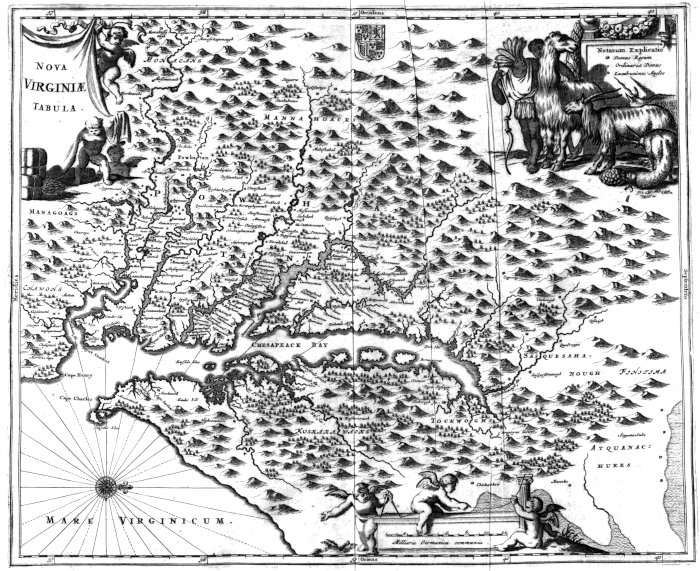
193April 9. 1585. Sir Richard Greenvil, with seven Sail, and several Gentlemen, left Plymouth; and on May 26. Anchor’d at Wokokon, but made their first Seat at Roanoack on August 17. following, which lies in thirty six Degrees of Northerly Latitude, or thereabouts, where they continu’d till June 1586. during which time they made several Discoveries in the Continent and adjacent Islands; and being endanger’d by the treachery of the Salvages, return’d for England, and Landed at Portsmouth on July 27. following.
Sir Walter Rawleigh and his Associates, in the year 1586. sent a Ship to relieve that Colony, which had deserted the Countrey some while before, and were all return’d for England as is before-mention’d.
Some few days after they were gone, Sir Richard Greenvil, with three Ships, arriv’d at the Plantation at Roanoack, which he found deserted, and leaving fifty Men thereto keep Possession of that Countrey, return’d for England.
The year following, Mr. John White, with three Ships, came to search for the fifty English at Roanoack, but found them not, they having been set upon by the Natives, and dispers’d so, as no News could be heard of them, and in their room left a hundred and fifty more to continue that Plantation.
In August 1589. Mr. John White went thither again, to search for the last Colony which he had left there; but not finding them, return’d for England in Septemb. 6. 1590.
This ill Success made all further Discoveries to be laid aside, till Captain Gosnol on March 26. 1602. set Sail from Dartmouth, and on May 11. following, made Land at a place, where some Biscaners, as he guess’d by the Natives information, had formerly fish’d, being about the Latitude of forty eight Degrees Northerly Latitude; from hence putting to Sea, he made Discovery of an Island which he call’d Marthas Vineyard, and shortly after of Elizabeth’s Isle, and so return’d for England, June 18. following.
In the Year 1603. the City of Bristol rais’d a Stock, and furnish’d out two Barques for Discovery, under the Command of Captain Martin Pring, who about June 7. fell with the North of Virginia in the three and fortieth Degree, found plenty of good Fish, nam’d a place Whitson-Bay, and so return’d.
In the Year 1605. the Right Honorable Thomas Arundel the first, Baron of Warder, and Count of the Roman Empire, set out Captain George Waymouth, with twenty nine Sea-men, and necessary Provisions, to make what Discoveries he could; who by contrary Winds, fell Northward about one and forty Degrees and twenty Minutes of Northerly Latitude, where they found plenty of good Fish; and Sailing further, discover’d an Island, where they nam’d a Harbor, Pentecost-Harbor; and on July 18. following, came back for England.
In the Year 1606. by the sollicitation of Captain Gosnol, and several Gentlemen, a Commission was granted by King James of Great Brittain, &c. for establishing a Council, to direct those new Discoveries; Captain Newport (a well practic’d Marriner) was intrusted with the Transportation of the Adventurers in two Ships, 194and a Pinace, who on Decemb. 19. 1606. set Sail from Black-wall, and were by Storm, contrary to expectation, cast upon the first Land, which they call’d Cape Henry, at the Mouth of the Bay of Chesapeack, lying in thirty seven Degrees, or thereabouts, of Northerly Latitude: Here their Orders were open’d and read, and eight declar’d of the Council, and impower’d to chose a President for a year, who with the Council should Govern that Colony: Till May 13. they sought a place to Plant in, Mr. Winkfield was chose the first President, who caus’d a Fort to be rais’d at Powhatan, now call’d James-Town: In June following, Captain Newport return’d for England, leaving a hundred Men behind him; since which time they have been sufficiently supply’d from England, and by the indefatigable Industry and Courage of Captain John Smith, (one of the Council at that time, and afterward President of the Colony) they made several Discoveries on the Eastern shore, and up to the Head of the Bay of Chesapeack, and of the principal Rivers which fall into the said Bay.
Virginia being thus Discover’d and Planted, King James by his Letters Patent bearing Date April 10. in the fourth year of his Reign, 1607. Granted Licence to Sir Thomas Gates, Sir George Summers, and others, to divide themselves into two several Colonies, for the more speedy Planting of that Countrey, then call’d Virginia, between the Degrees of thirty four and forty five of North Latitude, that is to say, taken in that large extent, mention’d in the beginning: The first Colony to be undertaken by certain Knights, Gentlemen, and Merchants, in, and about the City of London: The second to be undertaken, and advanc’d by certain Knights, Gentlemen, and Merchants, and their Associates, in, or about the City of Bristol, Exon, Plymouth, and other parts.
At the first Colonies Request, in the seventh year of the same King, a second Patent was Granted to several Noblemen and Gentlemen, (including Sir Thomas Gates, and some of his former Fellow-Patentees) bearing Date May 23. 1610. whereby they were made a Corporation, and Body Politique, and stil’d, The Treasurer, and Company of Adventurers and Planters of the City of London, for the first Colony of Virginia: And by this Patent, there was Granted to them, their Successors and Assigns, two hundred Miles to the Southward, from a Cape of Land in Virginia, call’d Point Comfort; and two hundred Miles to the Northward of the said Cape, along the Sea-shore, and into the Land from Sea to Sea.
And on March 12. 1612. the said King, in the ninth year of his Reign, Grants them a third Patent, of all Islands lying in the Sea, within two hundred Miles of the Shore of that Tract of Land on the Continent, granted to them by the said former Patent, Jac. 7.
In the Year 1615. Captain Smith procur’d by his Interest at Court, and the King’s Favor, a Recommendation from His Majesty, and divers of the Nobility, to all Cities and Corporations, to Adventure in a standing Lottery, which was erected for the benefit of this Plantation, which was contriv’d in such a manner, that of 100000. Pounds which was to be put in, 50000. onely, or one half was to return to the Adventurers, according as the Prizes fell out; and the other half to be dispos’d of for the Promotion of the Affairs of Virginia, in which, though it were three years before it was fully accomplish’d, he had in the end no bad Success.
In the eighteenth Year of the said King’s Reign, at the Request of the second Colony, a Patent was Granted to several Noblemen and Gentlemen, of all that Tract of Land lying in the parts of America, between the Degrees of forty and forty eight of Northerly Latitude, and into the Land from Sea to Sea, which was call’d by the Patent New England in America: For the better Government whereof, 195one Body-Politick and Corporate was thereby appointed and ordain’d in Plymouth, consisting of the said Noblemen, Gentlemen, and others, to the number of forty Persons, by the Name of The Council establish’d at Plymouth in the County of Devon, for the Planting, Ruling, Ordering, and Governing of New England in America.
The Patent of Virginia made void.
The Miscarriages and Misdemeanors of the aforesaid Corporation for the first Colony of Virginia, were so many and so great, that His said Majesty was forc’d, in or about October 1623. to direct a Quo Warranto, for the calling in of that former Patent, which in Trinity Term following was legally Evinc’d, Condemn’d, and made Void, by Judgment in the Court of the then Kings-Bench; as also all other Patents, by which the said Corporation claim’d any Interest in Virginia. Thus this Corporation of the first Colony of Virginia was dissolv’d, and that Plantation hath been since Govern’d and Dispos’d of by Persons Constituted and Impower’d for that purpose from time to time, by immediate Commissions from the Kings of England.
The Patent of Mary-land granted to the Lord Baltemore.
In the Year of our Lord 1631. the Right Honorable George Lord Baltemore obtain’d a Grant of King Charles the First of Great Britain, &c. of part of that Land to the Northward, which is now call’d Mary-land; but this Patent of Mary-land was not perfected till 1632. as you may understand more fully by the precedent Discourse of Mary-land, which by express words in the said Patent is separated from, and thereby declar’d not to be reputed for the future, any part of Virginia.
The Patent Carolina granted to several Noble Persons.
And in the fifteenth Year of the Reign of King Charles the Second of Great Britain, &c. on March 24. 1663. Edward Earl of Clarendon, then High-Chancellor of England, George Duke of Albemarle, William, now Earl of Craven, John Lord Berkley, Anthony Lord Ashley, Sir George Carterett Knight and Baronet, Sir William Berkley Knight, and Sir John Colleton Knight and Baronet, obtain’d a Patent from His Majesty, of the Province of Carolina, which lies to the Southward of Virginia, in which is included some part of that Land which formerly belong’d to the said dissolv’d Company of Virginia. So that Virginia at present extendeth it self onely, and is situated between thirty six and thirty seven Degrees and fifty Minutes, or thereabouts, of Northern Latitude, and is bounded on the North, by Mary-land; on the South, by Carolina; on the East, by the Ocean; and on the West, by the South-Seas.
Rivers of Virginia.
The Entrance by Sea into this Countrey is the same with that of Mary-land, between Cape Henry and Cape Charles, plac’d on each side of the Mouth of the Bay of Chesapeak; on the West side whereof you first meet with a pleasant and commodious River call’d James-River, about three Miles wide at its Entrance, and Navigable a hundred and fifty.
Fourteen Miles from this River Northward lies York-River, which is Navigable sixty or seventy Miles, but with Ketches and small Barques thirty or forty Miles farther.
Passing hence to the North you discover a third stately River, call’d Rappahanock, which is Navigable about a hundred and thirty Miles—from whence following the Shore to the North you enter into Patomeck-River, which is already describ’d in the precedent Discourse of Mary-land, to which Province this River belongs, whose Southerly Bank gives Bounds to that part of Virginia and Mary-land.
To these Rivers many other Inland Branches and Rivulets are reduc’d, the chief of which are hereafter specifi’d.
Nature of the Countrey.
The Countrey is generally even, the Soil fruitful, the Climate healthful, and agreeable with English Constitutions, especially since the increase of Inhabitants, and accommodation of good Diet and Lodging, which the first Planters found great want of heretofore. For many years, till of late, most New-comers had the 196first Year in July and August, a Disease which is call’d A Seasoning, whereof many died, like to what is mention’d before in the Description of Mary-land, though more mortal and common than in Mary-land, because Virginia is a lower Countrey, and somewhat hotter, insomuch that formerly divers ill of that Distemper have come purposely from Virginia to Mary-land, to recover their Health; but now, since the Countrey is more open and clear from Wood, few die of it, and many have no Seasonings at all.
This Countrey affordeth generally all such Roots, Herbs, Gums, and Balsoms, as are express’d before in the Relation of Mary-land.
Trees
All sorts of Trees for Building and Husbandry, Fruit-Trees, Vines, &c. are found in both Countreys, equal in goodness and quantity, onely in such things as require more Sun, and that may be produc’d by Industry, there may be some little difference, because Virginia is somewhat more to the Southward of Mary-land, as in Vines, Oranges, Lemmons, Olives, Silk, &c.
Silk-Grass.
There is a Plant grows naturally in this Countrey, and in Mary-land, call’d Silk-Grass, which will make a fine Stuff with a silky Gloss, and better Cordage than Hemp or Flax, both for strength and durance.
Fruits peculiar to Virginia.
The wild Beasts, Birds, and Fish, are much the same also in this Countrey as are before describ’d in the precedent Description of Mary-land: Nevertheless we shall think it proper not to omit some Fruits, Plants, Beasts, &c. mention’d by the most authentick Describers of New England, as peculiar to that Countrey. The Fruits are, their Putchamines, which are a kind of Damsons; Messamines, a kind of Grapes; Chechinquamins, a sort of Fruit resembling a Chesnut; Rawcomens, a Fruit resembling a Goose-berry; Macoquer, a kind of Apple; Mettaquesunnauks, a sort of Fruit resembling Indian Figs; Morococks, resembling a Straw-berry, besides a Berry which they call Ocoughtanamnis, somewhat like to Capers.
Roots.
Their peculiar Roots are Tockawaugh, good to eat; Wichsacan, of great vertue in healing of Wounds; Pocones, good to asswage Swellings and Aches; Musquaspen, wherewith they Paint their Targets and Mats. Also they have in great request a Pulse call’d Assentamen, and the Plant Mattouna, of which they make Bread.
Beasts.
Their peculiar Beasts are, the Aroughena, resembling a Badger; the Assapanick or Flying-Squerril; Opassum, a certain Beast having a Bag under her Belly, wherein she carrieth and suckleth her Young; Mussascus, which smelling strong of Musk, resembleth a Water-Rat; Utchunquois, a kind of wild Cat.
Their peculiar Fish are Stingrais.
Rivulets.
On the West side of the Bay of Chesapeak, between Cape Henry and the Southerly Bank of the River of Patomeck, are three fair Navigable Rivers, as is before mention’d, into which the other small Rivulets fall, which here we will give some account of, as also of the Indian, or antient Names by which these three principal Rivers were formerly known. The first whereof is Powhatan (now call’d James-River) according to the Name of a large and considerable Territory that lieth upon it. The Rivers that fall into this Southward, are Apamatuck; Eastward, Quiyonycohanuc, Nansamund, and Chesapeak; and Northward, Chickamahania.
The second Navigable River is Pamaunkee, by the English now term’d York-River. The Rivulet that falls into this is Poyankatanck.
The third (which is before describ’d, and usually known by the Name of Rappahanoc) was formerly term’d Toppahanoc.
This we thought fit here to insert, to the end no colour of mistake might remain to after Ages concerning the derivation or original change of such proper Names, especially being Places of great advantage to the Colony.
Several People of the ancient natives of Virginia.
197The chiefest of those Tribes or Divisions of People among the Indians, that were by Name known to the English at their first arrival, were upon the River Pouhatan the Kecoughtans, the Paspaheges, (on whose Land is seated James-Town) the Weanocks, the Arrohatocks, the Appametocks, the Nansamunds, the Chesapeacks, &c. On the River Pamaunkee, are the Youngtanunds, the Mattapaments, &c. On the River Toppahanoc, the Manahoacks, the Moraghtacunds, and the Cuttatawomens. On the River Patawomek, the Wighcocomocans, the Onawmanients, and the Moyanances. On the River Pawtuxunt, the Acquintacsuacs, the Pawtuxunts, and the Matapunients. On the River Bolus, the Sasquesahanoes: Southward from the Bay, the Chawonocks, the Mangoacks, the Monacans, the Mannahocks, the Masawomeks, the Atquanahucks, and the Kuscarawaocks, besides a number not material to be nam’d, as having had little of Transaction that we hear of with the Planters.
Number of Inhabitants.
The number of English Inhabitants in this Country are in this present Year 1671. about thirty or forty thousand, who are plentifully stock’d with all sorts of tame Cattel, as Cows, Sheep, Horses, Swine, &c. and all sorts of English Grain; great store of brave Orchards for Fruit, whereof they make great quantities of Cyder and Perry.
They have been much oblig’d by that worthy Gentleman Mr. Edward Digges, Son of Sir Dudley Digges, who was Master of the Rolls, and a Privy Councellor to King Charles the First, of Great Britain, &c. For the said Mr. Digges at his great Charge and Industry, hath very much advanc’d the making of Silk in this Countrey, for which purpose he hath sent for several Persons out of Armenia to teach them that Art, and how to wind it off the Cods of the Silk-worms; and hath made at his own Plantation in this Colony for some years last past, considerable quantities of Silk, which is found to be as good Silk as any is in the World, which hath encourag’d divers others to prosecute that Work.
The Commodities of Virginia.
Though this Countrey be capable of producing many other good Commodities, yet the Planters have hitherto imploy’d themselves for the most part in Planting of Tobacco, as they do in Mary-Land; whereof there are two sorts, one which is call’d Sweet-scented, and the other call’d Oranoack, or Bright and Large, which is much more in quantity, but of lesser price than the former; and the Plantations upon York River are esteem’d to produce the best of that sort of Sweet-scented: There is so much of this Commodity Planted in Virginia, and Imported from thence into England, that the Custom and Excise paid in England for it, yields the King about fifty or threescore thousand Pounds Sterling, per annum: With this Commodity the Planters buy of the Ships that come thither for it (which are above a hundred Sail yearly from England, and other English Plantations) all Necessaries of Clothing, and other Utensils of Houshold-stuff, &c. which they want, though they make some Shoes, and Linnen and Woollen Cloth in some Parts of Virginia, of the growth and Manufacture of the Countrey; and if they would Plant less Tobacco (as it is probable they will e’re long find it convenient for them to do, it being now grown a Drug 198of very low value, by reason of the vast quantities planted of it) they might in time provide themselves all Necessaries of Livelyhood, and produce richer and more Staple-Commodities for their Advantage.
Their usual way of Trafique in buying and selling is by exchange of one Commodity for another; and Tobacco is the general Standard, by which all other Commodities receive their value; but they have some English and foreign Coyns, which serve them upon many occasions.
The Government is by a Governor and Council, Appointed and Authoriz’d from time to time by immediate Commission from the King of Great Brittain: And Laws are made by the Governor, with the consent of a General Assembly, which consists of two Houses, an Upper and a Lower; the first consists of the Council, and the latter of the Burgesses chosen by the Freemen of the Countrey; and Laws so made are in Force till His Majesty thinks fit to alter them.
The chief Court of Judicature is call’d The Quarter-Court, because it is held every quarter of a Year, where all Causes Criminal and Civil are heard and determin’d, and the Judges of this Court are the Governor and Council: The present Governor in this Year 1671. is Sir William Berkley, who was made Governor by King Charles the First, of Great Brittain, &c. in the Year 1640. And those of the Council are Sir Henry Chichesly, who is one of the greatest and most considerable Planters there, and Mr. Edward Diggs before-mention’d, Mr. Thomas Ludwel Secretary, Major-General Robert Smith, and divers other worthy Gentlemen.
That Part of the Country where the English are Planted, is divided into nineteen Counties, viz. Northampton-County in Acomack, on the Eastern shore; and on the Western shore, Corotuck, Lower-Norfolk, Nansemund, Isle of Wight, Surry, Warwick, Henerico, James, Charles, York, New-Kent, Glocester, Middlesex, Lancaster, Northumberland, Westmoreland, Rappahanock, and Harford-Counties.
In every one of these Counties there are inferior County-Courts kept every Month; these take no Cognizance of Causes relating to Life or Member, or exceeding a certain limited Value, such being refer’d to the Quarter-Courts only, to which likewise there lie Appeals from their Inferior Courts.
There are Sheriffs, Justices of the Peace, and other Officers in every respective County, appointed by the Governor, for the Administration of Justice, who sit there according to his Order, and whereof these County-Courts are chiefly compos’d.
There are few Towns as yet erected in this Colony; the Principal Seat of the English there, is at a Place call’d James-City, in Honor of King James of Great Brittain, &c. This is situated in a Peninsula, on the North-side of James River, and has in it many fair Brick and other good Houses: In this place are held the Quarter-Courts, General Assemblies, the Secretaries Office, and all other Affairs and greatest Concerns of the Colony are here dispatch’d. On the same side, nearer the Mouth of this River, stands Elizabeth-City, containing also several good Houses of Brick and Timber.
199Sir William Berkley, the present Governor resides at a place somewhat distant from James-City, call’d Green-spring, a fair Brick House, which he himself caus’d to be Built.
The other Towns of Note belonging to the English, are only Henricopolis, or Henry’s-Town (so nam’d from Prince Henry then living, built in a very convenient place, more within Land, about eighty Miles distant from James-City) and Dale’s-Gift, so nam’d from Sir Thomas Dale Deputy-Governor of the Countrey, about the Year 1610.
The Indians of Virginia far exceed those of Mary-land, in Treachery and Cruelty to the English there, as will appear by this following Relation of their Proceedings towards them, since the first Seating of that Colony, wherein nevertheless, the Civility of some particular Persons at their first Landing is not to be omitted.
Transactions between the English and the Natives.
Upon the first arrival of Captain Amidas and Captain Barlow in Wingandacoa, now Virginia, they were accosted by Granganimeo (the King’s Brother of that Countrey) who, attended with a Train of forty or fifty Men, came in a very civil manner to Treat about a Commerce of Trade and Traffique, which immediately began between them, and several Barters were made: Granganimeo, who was very just of his word, and always kept his promis’d Day of meeting, fancying most a Pewter Dish, gave twenty Deer-skins for it, and boring a Hole therein, hung it about his Neck for a Breast-plate; afterwards he, with his whole Company, and his Wife and Children, frequently and familiarly did eat and drink aboard the English Ships, the King himself call’d Wingina, lying sick at his chief Town, six days Journy off, of a dangerous Wound which he had receiv’d from a neighboring King his mortal Enemy. Some of the English going to Land upon the Isle of Roanoack, were met by Granganimeo’s Wife, who, her Husband being absent, commanded her Servants some to draw their Boat ashore, some to carry them on their Backs to Land, others to carry their Oars into the House for fear of stealing; and having caus’d a great Fire to be made to warm them, and to dry those that had been wet in their Voiage, she afterwards entertain’d them with a plentiful Feast or Banquet after that Country fashion; and when they took alarm at the coming of two or three of her Men with Bows and Arrows, she caus’d the Bows to be broken, and the Men to be beaten out of the House, besides several other demonstrations of extraordinary civility; and when not withstanding all this they could not be perswaded to Lodg any where but in their Boat, she us’d all means imaginable to make them quit their Jealousy, and accept of a Lodging in the House.
In the Year 1585. a Company that went over with Sir Richard Greenvil, burnt the Town of Aquascogoc, for a Silver Cup that was stoln by some of the Indians, took Prisoner Menatonon, King of Chawonoc, who gave Relation of a King about three days Journy off, who possess’d an Island rich in Pearl, which was taken in a deep Water that inviron’d it. Going towards the Countrey of the Mangoacks (among whom in the Province of Chaunis Temaotan, they heard of a Mine of strange Copper call’d Wassador, with Skiko, the King of Chawonock’s Son, and 200Manteo, a faithful Salvage, for their Guide) they were treacherously dealt with by Wingina, alias Pemissapan (for so, his Brother Granganimeo being lately dead, he had alter’d his Name) who endeavor’d to stir up a Confederacy of the Chawonocks, Moratocks, and Mangoacks against them; yet by the urgent perswasions of Ensenore his Father, the truest Friend the English had, after the death of Granganimeo, and seeing them safe return’d from their Journey, wherein he thought they had all perish’d, and especially upon Menatonon’s sending Messengers to them with Pearl, and Okisco King of Weopomeock, to yield himself Vassal to the Queen of England, his Hatred was somewhat cool’d; but Ensenore deceasing soon after, he return’d to his old treacherous Practices again, and in the end, while he was contriving Mischief against the Planters, he himself was shot, taken Prisoner, and beheaded.
After the Company left upon Virginia by Sir Richard Greenvil, (for he himself was return’d) tir’d out with hunger, hardship, and the many extremities they were at last reduc’d to, had deserted the Place, and obtain’d passage for England, through the civility of Sir Francis Drake, pitying their distress, fifty Men more were Landed upon Roanoack-Isle, by the same Person, who how they were surpris’d and destroy’d by the Natives, was discover’d at large to the Supply that was sent over in the Year 1587. by Mr. White.
A small Party under Captain Smith going down the River to Keconghean, were very fiercely assaulted by sixty or seventy Indians, but their Musquet-shot did such Execution amongst them, that they fled into the Woods and left behind them the Image of their God, which had been carry’d before them as their Standard, and not long after sent one of their Queiongcasocks to offer Peace, and to redeem their Okee; which Smith granting, on condition six onely of them would come unarm’d and load his Boat with Provisions; and promising more over to become their Friend, and furnish them with Beads, Copper, and Hatchets: They accepted the Condition, and brought him Venison, Turkies, wild Fowl, Bread, and what else they had, Singing and Dancing in sign of Friendship till they departed.
In his next Voyage for the discovery of the Head of Chickamahania River, he was, through the neglect of his Sea-men who were sent to watch the Booty, taken Prisoner; in which condition he was kept a whole Month: then being releas’d, he got Provisions for the People in James-Town; which had they not timely receiv’d, they had all abandon’d the Place, and return’d to England.
King Powhatan.
James-Town burnt.
While Affairs stood thus in a mean condition, Captain Newport arriving there with a Ship and sixty Men to strengthen the Plantations, he went to Weromocomoco, where King Powhatan kept his Court, and found him sitting on a Bed of Mats, and an Embroider’d Leather Cushion, Cloth’d in Deer-skins; at his Feet sat a young Maiden, and on each side of the House twenty Concubines; his Head and Shoulders painted red, and a Chain of white Beads about his Neck. Newport to oblige him, gave him an English Youth; for which he receiv’d Powhatans Friend Mamontak; with whom returning, he found a sad accident, 201for the Fire had not onely burnt the Houses of the new Planters, but also the Pallisado’s about James-Town, made for a Defence against the Enemies Assaults, and most of their Store; which was so much the worse, because it hapned in the Winter, and indeed had prov’d very fatal, had not a Ship, which was suppos’d to be lost, happily arriv’d there with a considerable quantity of Provisions.
Smith’s Voyage.
His remarkable Exploits.
Whilst the Town was rebuilding, Smith set Sail in an open Barque with fourteen Men, and discover’d two Isles before Point Charles, to which he gave his Name; then ran into the Inlet Chesapeack, in the midst of which lay several Islands, by the Sea-men call’d Russels. Before the River Wighcomoco they found a disturbed Sea, and more Northerly a Bay with fresh and hot Water, and at last he met with two Virginians, which conducted the English along a Creek to Onawmoment, where some hundreds of them lay in Ambuscade, according to Powhatan’s appointment, to cut off Smith; who leaping forth on a sudden appear’d like Devils, all painted; but the Bullets flying about made them all run away. Smith, whose Design was onely to discover the Countrey, and the Silver Mine of Patawomeck, ten Leagues up into the Countrey, found the Metal to be of little value, so that he return’d with little Success, being newly cur’d of a poysonous Wound in the Arm, which was given him by a Fish not unlike a Shark, whilst he lay aground near Toppahanock.
A while after being inform’d of Powhatan’s Design to destroy the English, (though he had been lately Presented by Newport with a Silver Basin, a rich Chair, Bed, and Furniture belonging to it, with other things of value) he, to prevent him, chose forty eight out of two hundred Men which were Garrison’d in James-Town, then going to Werowocomoco, Landed with much trouble, the River being frozen above half a Mile from the Shore.
A German Soldier amongst Smith’s Company giving private notice to Powhatan of the Design of the English, made his Escape by flight: But Smith going on to Pamaunke, found King Opechancangough with seven hundred Men in Arms, threatning a fierce Battel; but Smith making directly up to him, set his Pistol on his Breast, and forc’d him to lay down his Arms. Powhatan by this time provided with Swords and Musquets by two Dutch-men, also began to bestir himself afresh; but his Intentions being too soon known, he was again quieted, and forc’d a second time to send Smith a String of Pearl; after which a Peace was concluded between all the Natives and the English.