An Appendix,
Reading edition
CONTAINING
Partly a farther prosecution of the Descriptions of some Provinces already treated of in the foregoing Book, partly an Account of some other Discoveries than what have hitherto been deliver’d in any Description of the NEW WORLD.
CHAP. I. Rio de la Plata.
The River De la Plata, by the Natives call’d Paranaguazu, is next to the River of the Amazones, the greatest in the World, and falls into the Northern Ocean between the Capes Antonio and Maria, lying thirty Leagues one from another: It receives from East and West divers Rivers as far as the Lake Xarays, lying three hundred Leagues up in the Countrey from the Mouth of La Plata. Also into the fore-mention’d Lake fall several Streams, which spring out of the Peruvian Mountains Andes.
The first that Sail’d into this great River, Anno 1515. to an Island lying in the middle of it, was John Dias de Solis, who rashly going ashore, was kill’d and eaten, together with several Portugueses.
Sebastian Gabottus his Expedition.
Eleven years after this Accident, Sebastian Gabottus set Sail from Spain to go to the Spicy Islands through the Straights of Magellan, but was forc’d, for want of Provisions, and the unwillingness of his Seamen, to put into the River La Plata; in which being advanc’d thirty Leagues, he Anchor’d near an Island, which he call’d St. Gabriel: from whence going seven farther, he discover’d a Stream which fell into La Plata. This River he call’d St. Salvador, and cast up a Fort at the Mouth of it, where an Inlet afforded a convenient Harbor for Shipping; he found the River La Plata to be generally ten Leagues broad, and full of Isles; and to the Westward of it, the River Zaracaranna, inhabited on the South side by a subtil People call’d Diagnitas. At the place where Zaracaranna disembogues into La Plata he built a Castle, and calling the same Castello di Santo Spirito, went up farther, leaving on the West side the People Tenbues, Mequaretas, Mepenes, and Aigais; to the Eastward, the Quiloacas and Santana, and struck up out of the River La Plata, North-East into 631the Stream Parana, in which he had gone, two hundred Leagues, and pass’d by many Isles, when he went out of the same into the Stream Paraguay; where being set upon by the Countrey People, who were busie in Tilling the Ground, he lost so many of his Men, that he was forc’d, without any farther Exploit, to return with the Portuguese Pilot, Diego Garcia, who Sailing up the same River, had met with Gabottus in Paria; and because both had gotten some Silver, they call’d the River, from that Metal, De la Plata. The farther Discovery whereof lay neglected nine years after, when Peter Mendoza Sailing with eleven Ships, carrying eight hundred Men, to the Island Gabriel, built the Fort Buenos Ayres, on the South side of it, where many People dying of Hunger, little was done.
Alvares Cabeca not long after following Mendoza’s footsteps, discover’d and peopled the Province Rio de la Plata. The Mouth of the River La Plata Laurence Bikker describes thus:
Laurence Bikker’s Description of Rio de la Plata.
“Beyond the Cape Santa Maria (saith he) lies the flat Island Castilhos, having scarce a Tree upon it; but on the North side a Rock, not unlike a decay’d Castle; to the Southward of which appear two other Cliffs; directly before the Mouth lies the stonie Island De Lobos, on which nothing is to be found but Sea-Wolves; towards the East a stonie Bank runs a good way into the River, known by the breaking of the Water upon the same.”
The Promontory Maria is low and barren, but within the same the Land rises high before the Isles Flores and Maldonado, which last hath a good sandy Shore, Harbor, and fresh Water between the Rocks; but Flores rising with two Hills, produces nothing but Brambles.
The Stream Solis also discharges its Waters in La Plata, near the Place where the Mountain Seredo lies.
The left Shore of La Plata begins at the Promontory Antonio, and is cut through by the Rivers Ortis and Los Sanctos, where the Town Buenos Ayres is built on a smooth Shore.
Martin del Barco’s Description of the same.
Martin del Barco proceeding in the Description of La Plata, saith that it is dangerous by reason of the many Shelves that are in the same. The Isles in the River are as followeth: those that bear the Name of St. Gabriel are five in number; Garcia Isle is full of Trees, and for its fertility was peopled by Peter de Mendoza, and afterwards by Juan Ortiz Carate: But less fruitful are the Isles De Lazaro, where the River Vrayg unites with La Plata, being before fill’d with the Waters of Salvador, which receives the black Stream Negro, which gliding slowly from Morasses, is very full of Fish. Moreover, La Plata hath eleven Arms, each very deep and full of Isles, inhabited by the Guaranins.
About a hundred Leagues farther the Cherandies have setled themselves on pleasant Isles, lying not far from the City St. Fe, built on the Point which makes the River Bermeio, where it falls into La Plata.
Farther up lies the Province Ana, partly well inhabited for its fertility, and partly overflow’d.
Next appears the Rock Pennapobre, and not far from the Town Guayra, La Plata falls very high from the Rocks.
The several People of this Countrey.
But as concerning the Natives of this Countrey, it is inhabited by divers sorts of People, differing from one another both in Customs and Language. On the South side of the fore-mention’d River, from the Promontory Antonio to Buenos Ayres, dwell the Quirandies, a stout, but cruel People, who with the Flesh of many a Spaniard oftentimes keep a merry Feast. Farther into the Countrey run the Juries and Diagnitas. Along La Plata lie also scatter’d the Tenbues, a civil People, who live 632by Fishing. Near the River Paraguay the Ameguaes observe the same manner of Life; But the Carioes keep Cattel, and Till their Lands. A hundred Leagues farther dwell the Payaguaes; and yet farther into the Countrey the Chames and Carcares possess much Gold and Silver, with which Juan d’ Ayola having enrich’d himself here, was destroy’d with all his Men by the Chames, Anno 1541.
Nunnez Cabeca his Journey.
Alvarez Nunnez Cabeca came from Spain to be Governor here, but was not able, by reason of contrary Winds and Tydes to reach La Plata; wherefore Landing at the River Itabucu, and spending nine days in cutting a Way through thick Brambles, he came to the Jurisdiction of Armiriri, and a days Journey farther to Cipoyay; and not long after to Tocanguazu, where the Guaranies, who are the Natives, have two Harvests every year of Maiz and Cassavi, and breed and keep Geese, Hens and Parrots in their Houses: They are Man-eaters, and very revengeful. Cabeca having given this Countrey the Name of Vera, he proceeded on his Journey over the Rivers Ignazu, Tibagi, and Taquari, on whose Shore appears the Village Abangobi, and somewhat farther Tocanguzir. The Countrey hereabouts is very fruitful, and hath many delightful Plains, pleasant Rivers, and Woods; but beyond appear Hills, Mountains, deep Morasses, dangerous Cane-Fields, Receptacles for wild Beasts, and great Wildernesses. Cabeca having pass’d through them all, came into the fruitful Countrey of the Guaranies, who are a wild People, and possess many large Fields of Maiz and Potato’s, also several Silver Mines. From hence travelling Westwardly over the River Piqueri, he spent eighteen days before he came to the Stream Ignazu, which falls into the Parana, and at last came to the River Paraguay; along whose Shore he found a People of a gigantick Stature, call’d The Agazes, who regarded no manner of Husbandry, but went out continually a robbing in their Canoos. These People, as Martin del Barco relates, were not long after all destroy’d by the Spaniards.
Not far from the Agazes dwell the Guaycurues, a valiant People; and somewhat farther the Cacoves, whose Countrey produces Gold and Silver; and yet farther in the Countrey reside the Guaxarapos, who remove yearly to the Paraguay to Fish there when the Water is low; for in the beginning of January the River swells so exceedingly, that the Countrey about it being overflow’d, is cover’d with above six Fathom Water. The Paraguay discharges its Waters into the great Lake Xarayes, full of Islands.
Amongst other Rivers that spring out of the Mountains Andes, the Ignazu, along whose Shore the People Xacoaes, Xaquesses, and Chanesses dwell, falls also into the foremention’d Lake. Somewhat farther lies a great piece of drown’d Land, beyond which the Xarayes have convenient Habitations, plant Maiz, and spin Cotton: Their Countrey borders a great Wilderness, which ends about the Province Tapuaguazu, the Inhabitants whereof, call’d Tarapecocies, are furnish’d with plenty of all sorts of Provisions. The Payzunoes, dwelling on one side of them, are not well known as yet.
Beyond the Town Assumption dwell the Mayaes, in the Way to Peru, and border at the Tamacoaes, both which possess Silver-Mines.
Between Buenos Ayres and Corduba lies the Plain-Countrey Despoplado, ninety Leagues long, without Trees or Houses, but is most Pasture-Ground, which feed many thousands of wild Horses. From hence glide the Streams Luchan, Los Arrechivos, Arreca, Zaracaranna, and others, into La Plata. It is very dangerous for a small Company to travel through this Countrey, because the ranging Furies spare none alive they meet with.
Moreover, the River Grande flows with a wide Mouth into the Sea, and spreads 633it self within against the Countrey Patos. Also the Rivers Tamandabug, Ararungo, and the Lake Alagoa, disembogue into the Ocean.
North-East beyond Alagoa lie the Islands Catharina and Gale; and in the Bay Tojuqua appear several Isles.
The Streams Tajahu and Ytabuca spring out of high Mountains, inhabited by the People Anniriri and Cipopoy.
Lastly, the Countrey wash’d by the Stream Ararapira, produces all sorts of Provisions.

CHAP. II. Chili.
The Cammel-Sheep.
There are in this Countrey both tame and wild Sheep; the tame ones are call’d Cammel-Sheep, being cover’d with long fine Wool, having Necks four Foot long, their fore Feet cloven into four parts, their hindermost into two, their Mouths very wide, which they open at those that vex them, and make such a stink, that no body is able to abide near them; when tir’d, they fall under their Burdens, and will not rise, though beaten never no much: Their Flesh is tough like that of Horses. The wild Mountain-Sheep are red, and have soft glossy Wool, which makes a Stuff like that of a Chamlet: These Sheep run swifter than a Horse; the Chileses lead them by a Rope put through their Ears.
The Grain Teca.
This Countrey of Chili not onely produces Wheat, Barley, Maiz, and all manner of Fruit, but also the Teca, which growing half a Yard high, is not unlike Barley; the Grain thereof being dry’d in the Sun, is thresh’d, and parch’d in hot Sand, then ground on a square flat Stone with a round Rowler. This Meal, which is both exceeding wholsom and very nourishing (for a small Measure thereof sufficeth a Man a whole Week,) serves also both for Meat and Drink: for being infus’d in a greater quantity of Water, it becomes a pleasant Drink, and kneaded with a lesser proportion, it is made into Cakes or Loaves.
The Fruit Unni.
The Fruit Unni, by the Spaniards call’d Murtilla, is like a little red Grape, and hath a tart taste. The Wine press’d out of this Fruit is clear to the Eye, pleasing to the Palate, and good for the Stomach, never causing any Head-ache: It also makes good Vinegar.
But the chiefest Benefit of Chili is the rich Gold-Mines. The Countrey for the most part lies desolate, occasion’d by the continual Wars which the valiant People Arauco maintain’d against the Spaniards after such a manner, that in no place of America they met with such resistance, or sustain’d such Losses. They speak an elegant Language, according to the testimony of Elias Herkmans, who having committed to Writing all the most significant Words thereof which were taught him by the Chileses, it will not be altogether amiss to set down some of them, which are these following:
634
A View of the Chilesian Language.
Tepanto, A Year.
Tien, A Moneth, or the Moon.
Toninco, A Week.
Ante, The Day, or Sun.
Paun, The Night.
Tabuyo, The Evening.
Eppoun, The Morning.
Rangiante, Noon.
Eppoe, The next Day after to Morrow.
Vya, Yesterday.
Putey, The Day before Yesterday.
Buchiante, To Day.
Mintay, Now.
Weytiva, At that time.
Wantarulei, In the Morning betimes.
Biliante, Always.
Chumel, When.
Chemchuem, Also.
Hueno, The Heavens.
Quereb, The Air or Wind.
Tomo, The Clouds.
Wangelen, The Stars.
Pillan, Thunder.
Gualio, Lightning.
Puta que quereb, A Storm.
Maoni, Rain.
Piren, Snow.
Veaquumao, Dew.
Pillingei, Ice.
Quetal, Fire.
Ko, Water.
Tue, The Earth.
Mappo, The Land.
Pele, Clay.
Cura, Stone.
Maviel, Wood.
Aluven, Timber.
Millia, Gold.
Lien, Silver.
Paila, Brass.
Titi, Tin.
Pavillue, Iron.
Quatal-cura, A Pebble-stone.
Chadi, Salt.
Lyl, A Rock.
Milla-mappen, A Golden Vein.
Aliquen, A Tree.
Cahu, Herbs.
Nebo, Nuts.
Pino, Grass.
Cayron, Hay.
Wento, A Man.
Domo, A Wife.
Quiduugen, A Youth.
Yecho, A Maiden.
Penien, A Boy.
Domo-penien, A Girl.
Chou, A Father.
Nenque, A Mother.
Cheche, A Grandfather.
Domo-cheche, A Grandmother.
Wenco, Mothers Brother.
Mama, Mothers Sister.
Pelchuchan, A Stepfather.
Caulla, A Stepmother.
Botum, A Son.
Neaque, A Daughter.
Penu, A Brother.
Lamoen, A Sister.
Guempo, A Father-in-law.
Vilca, A Mother-in-law.
Choupa, A Son-in-law.
Weuro-pencho, A Kinsman.
Buytha, An old Man.
Cude, An old Woman.
Cunewa, An Hospital Child.
Peneinboe, A Guardian.
Apo-curaca, A Governor.
Curaca, A Lord.
Apo, A supream Commander.
Nentoque, A Ruler.
Ulmen, A Person of Quality.
Pulmen, A Gentleman.
Machi, A Chirurgeon.
Cona, A Soldier.
Retave-caman, A Smith.
Guito-wok, A Weaver.
Challo-acaman, A Fisher-man.
Nilla-caboe, A Merchant.
Turnitave, A Dyer.
Chumpiro-caman, A Cap-maker.
Tultunca-caman, A Drummer.
Inchetaniweni, A Servant.
635Voerquin, A Messenger.
Langamcheboe, A Murderer.
Chiquiboe, A Thief.
Illuiboe, A Beggar.
Alvee, The Devil.
Ruca, A House.
Ullin, A Door.
Chaquana, A pair of Stairs.
Pylca, A Wall.
Wana-ruca, The Roof.
Pithe-ruca, A Hut.
Colcura, A Cupboard.
Cawyto, A Bedstead.
Depotuarica, A Prison.
Weltelve, A Gibbet.
Pengal, A Grave.
Lonquen, The Sea.
Leva, The River.
Buta-wampo, A Ship.
Aliwen, A Mast.
Mou, Ropes.
Dolio, A Canoo.
Wampo, A Boat.
Vela, Sails.
Wyta, An Oar.
Tubquen, Ashes.
Cuju, A dead Coal.
Ale, The Flame.
Aypel, A burning Coal.
Wietum, Smoak.
Catila, a Candle.
Wyno, A Knife.
Witi, A Spoon.
Guidi, A Pot.
Lepoboruwe, A Tooth-picker.
Pavilla-lonco, An Helmet.
Waiqui, A Pike.
Pylqui, A Dart.
Pulque-tuboi, A Bowe.
Tultunca, A Trumpet.
Mecane, An Iron Club.
Cachal, An Awl.
Wita, A Spade.
Juisue, A Sieve.
Chilca, A Letter.
Charavilla, A pair of Breeches.
Icha, A Woman’s Garment.
Domo-ruida, A Coat.
Couchon, A Bag.
Pino-chompiro, A Straw Cap.
Congi, Food.
Cobque, Bread.
Nul-cobque, The Crumb.
Liquangue, Light.
Dumingei, Darkness.
Quemeiquen, Dainties.
Medda, Pap.
Core, Broth.
Ilon, Flesh.
Cuichalon, Mutton.
Wara-ilon, Beef.
Chuchi-ilon, Pork.
Chuchi-chain, A Gammon of Bacon.
Chaditues-ilon, Salt.
Caucan, Roast-meat.
Avaun, Boyl’d-meat.
Puytscha, The Guts.
Curam, An Egg.
Quecuram, The Yolk of an Egg.
Lycuram, The White of an Egg.
Iwyn, Butter.
Ylu, Milk.
Puuloo, Drink,
Vino, Wine.
Chiche, Beer.
Cutan, Pain or Sickness.
Aren-cutan, A Feaver.
Towongen, The Head.
Cancocultano, The Head-ache.
Veno-aren, Scabs.
Albungien, A Wound.
Molbuen, Blood.
Touma, A blind Man.
Cawinto, A Meal.
Colchou, The Small-pox.
Wocubu, A wild Beast.
Pangy, A Lyon.
Naguel, A Tyger.
Cuchy, A Swine.
Michun, A Calf.
Dewe, A Mouse.
Waren, A Rat.
Twe-dewe, A Mole.
Tewa, A Dog.
Pulpeo, A Fox.
Guetaltuange, A Hare.
Noquen, A She-bear.
Lame, A Sea-Dog.
Lemo-cuchi, A wild Swine.
Chumam, A Bear.
636Puedo, A Sea-Goat.
Quelen, A Tail.
Chiliweki, A Sheep.
Zuneu, a Bird.
Lyppe, A Plume.
Mepoiinem, A Wing.
Dani-inem, A Nest.
Achawal, a Hen.
Alchahawal, a Cock.
Pylken, A Duck.
Jeca, A Raven.
Guereo, A Magpye.
Cogo, A Cuckow.
Nullyn, A Bee.
Pulli, A Flye.
Vulgumusky, The King of Bees.
Petar, A Louse.
Perem, A Flea.
Piro, A Worm.
Vilo, A Serpent.
Bylcum, A Hedghog.
Ponono, A Toad.
Challua, A Fish.
Cawel, A Dolphin.
Iene, A Whale.
Vouqui, A Grigg.
Vilochalva, An Eel.
Chadituel-chalva, Salt-fish.
Anquen-chalva, Dry’d-fish.
Quinpilon, Oysters.
Chapes, Mussles.
Coinow, A Crab.
Quichiquinchio, a Falcon.
Manco, A Crane.
Choroi, A Parrot.
Pilo, Dead.
Hilca, A one-ey’d Person.
Topilgen, To squint.
Topil, Lame.
Poo, A Bough.
Kempomamel, Dry Wood.
Bopemamel, Wither’d Wood.
Nobue, An Acorn.
Nido-iwas, A Vineyard.
Nidu, A Pole.
Vanguen, Strawberries.
Couchow, Black-berries.
Litue, Toad-stools.
Pilun-proque, Plantain.
Calicai, Clover-grass.
Curi, Stinking Nettles.
Pragyn, Flowers.
Manen, Seed.
Methen, Meal.
Chiquelen, To gather.
Gueli-vanca, Coral.
Kispi, Glass.
Cudi, A Milstone.
Pel, Mud or Dirt.
Tassaquido, A Treasure.
Guengu, A Marriage-Portion.
Deren-culyn, A Debt.
Culyn, A Reward.
Willawyn, Single-money.
Guyn, One.
Eppo, Two.
Quila, Three.
Meli, Four.
Quechu, Five.
Cuyn, Six.
Regli, Seven.
Pura, Eight.
Culla, Nine.
Maripataco, A hundred.
Marama, A thousand.
Guiltui, A Kernel.
Tapel, Leaves.
Nil, The Bark.
Pelli, The Smell.
Oaliel, The Body.
Lai-calel, A dead Corps.
Ven, Flesh.
Molvin, Blood.
Boro, A Leg.
Telqui, The Skin.
Vel, The Sinews.
Ven-molvin, A Vein.
Congo, The Head.
Tol, The Forehead.
Lenglen, The Scull.
Lonco, The Hair.
Teren-lonco, Grey.
Lolo, The Brain.
Angen, The Face.
Taun, The Jaws.
Ne, The Eyes.
Tacune, The Members.
Denen, The Eye-brows.
Ju, The Nose.
Peloju, The Nostrils.
637Merum, Snot.
Pilum, The Ears.
Oun, A Mouth.
Adem, Sweat.
Quewen, The Tongue.
Melbue, The Lips.
Boru, The Teeth.
Ilga, The Gums.
Bida-bida, The Roof of the Mouth.
Cain, Spittle.
Mewe, The Throat.
Neen, The Breath.
Quette, The Chin.
Paion, The Beard.
Pel, The Neck.
Lipan, The Shoulders.
Puilpa, An Arm.
Cue, A Hand.
Mancue, The Right-hand.
Melecoe, The Left-hand.
Puley-cue, The Palm of the Hand.
Changel-cue, The Fingers.
Buta-changel, The Thumb.
Wili, The Nails.
Zevo, The Breast.
Moju, The Nipples.
Pue, The Belly.
Weddo, The Navel.
Cadi, The Ribs.
Buri, The Back.
Anca, The Sides.
Quichio, The Buttocks.
Penem, A Man’s Genital Parts.
Metu, A Womans.
Chan, The Thighs.
Lucu, The Knees.
Metunthoy, The Knee-Bone.
Hemum, The Calves.
Kamon, The Feet.
Pinque, The Heart.
Mocun, The Lungs.
Que, The Maw.
Curique, The Liver.
Vaca, The Milt.
Quelche, The Guts.
Villin, The Bladder.
Momay, To Stink.
Pelengsley, A Spider.
Inche, I.
Tubei, He.
Eimi, You.
Inchen, We.
Tecengen-eimen, You People.
Liengen, Those People.
Emma, So.
Muh, No.
Pichumei, Hard by.
Averlugei, Far.
Taymen, Against.
Woecun, Without.
Compay, Within.
Pulon, Below.
Wono, Above.
Buri, Behind.
Junengen, Before.
Quelleb, Near.
Munai, Enough.
Alengei, Too much.
Munalai, Too little.
Chemibla, Wherefore.
Venibla, Therefore.
Vei-mai, Let it be so.
Wei, These.
Temunei, Fair.
Woranei, Ugly.
Newonei, Strong.
Leptungei, Swift.
Chouwo, Lazie.
Alilonconei, Very wise.
Wentannei, Valiant.
Queunei, Proud.
Culenei, Rich.
Cunewal, Poor.
Toucou, Foolish.
Molgei, Naked.
Ilungei, Clothed.
Queten, Narrow.
Anqueu, Dry.
Prequin, Bountiful.
Buta, Great.
Pichi, Little.
Montingei, Fat.
Toutau, Lean.
Pettun, Colour’d.
Queli, Red.
Calbu, Blue.
Carel, Green.
Choot, Yellow.
Curi, Black.
Lye, White.
638Nilla-caju, To change.
Illawyn, Giving.
Tuignei, To be merry.
Umatum, Sleeping.
Limen, To wake out of Sleep.
Bemgne, To Build.
Playn, To find.
Vangen-lyn, To lose.
Necul, To run.
Amon, To go.
Utalegen, To stand.
Jucheleyn, To lie down.
Tecanen, To dance.
Padenatum, To fall.
Utalenen, To rise.
Avinge, To sit.
Dimgne, To speak.
Temelenge, To be silent.
Puronge, To Sing.
Pylcunge, To call.
Quipay, To come.
Ien, To eat.
Butum, To drink.
Mepai, To go to Stool.
Willam, To Urine.
Cudepain, To play.
Locatum, To scold.
Mecowyn, To carry.
Chuquin, To steal.
Guallulueno, To restore.
Pelteney, To pay.
Lay, To die.
Rengalgei, To be buried.
Quedau capay, Working.
Intunge millo, To dig for Gold.
Nilla-teubyn, To sell.
Nilla-vin, To buy.
Quimli wi tami piel, I cannot understand you.
Chu pipaimi, What do you?
Champaila, Nothing.
Juei pingeimi, What is your Name?
Juan pingen, I am call’d John.
Cheo ruaimi, Whither do you go?
Moppo muruam, I go into the Countrey.
Cheo tui mi, From whence came you?
Miro comotoun, I came from home.
Chumel quipai, tuai mi, When shall you come?
Chumel pratuai mi, When shall you go?
Ale prungi tamruca, Is your Habitation far from hence?
Picherungei, It is hard by.
Aleprungei, It is farther.
Inchi quiparum camappumu, I intend to go into another Countrey.
Chemnibla qui parui cammappumu, Why will you go into another Countrey?
Merelya tiva mappumu, Here is no Provision.
Aleibelay twachi tipanto, benebliaale geniep ayn, The year hath been unfruitful, and therefore we want.
Cheo mappungen tamichau, In what Province dwells your Father?
Alu ei ei, The Devil hath fetch’d him away.
At eimi ruaju inchio, Will you keep him company?
Ailan, No, I will not.
Bien, I will.
Chuben quecken neieimi tania, Have you any thing to give us to eat?
Cancan achawal, Yes, I have roasted Hens.
Mu wy, How many?
Munalei enchintavia, There will be enough for us.
Chuben putuayn, Where shall we Drink?
Aile Mangunmeinis, I thank you.
Chuben domo trivo, What Woman is this?
Inchi tan curi, It is my Wife.
Ni nave, My Daughter.
Ni domo, My Concubine.
Alei teminigei vei domo, It is a handsomWoman.
Qua pangnei, Come hither.
Amotunge, Run away.
Umatuayn, Let us go to Bed.
Utajuca, Let us rise.
Wira cuchai compay tan mappumu, The Spaniards are fall’n into this Countrey.
Quipa waicha laimi, Shall we Fight together?
Waiquenagelan, I have no Arms.
Ima en pea in Waiqui, Follow me, and I will get Arms.
Ali teum inche, I am contented.
639
The Seamen who went under Hendrick Brewer’s Command, Anno 1643. from Brasile to Chili, brought the fore-mention’d Vocabulary along with them.
Chili is look’d upon as no way inferior to any Countrey in America, enjoying a wholsom Air, fruitful Soil, and abundance of Inhabitants, who often furnish Peru with Provisions; which are the speedier convey’d thither, because the South-Winds always blow along the Coast.
The Peruvian Vice-Roy keeps a Deputy to Govern here. It hath two Bishopricks, viz. St. Jago and L’ Imperial.
The Nature, Customs, and Manners of the Chileses.
Some of the Chileses are under the Spaniards Jurisdiction, and live in Huts; others being wilder, defend their Freedom with the Sword. They have great Heads and flat Noses: The Men continually pull out the Hair on their Faces and Privities with Shells, which they carry about their Necks for that purpose, having beforehand rubb’d the Hair with warm Ashes; the Hair of their Heads hanging downwards is cut close as far as their Ears, the rest growing long, is ty’d with the Ribbon Tariwelonco, to which Persons of Quality fix Silver Plates and Turkoises: Some also cover their Heads with the Skins of Weazels, or the like Beasts, putting the Head over their Foreheads, and the Tail down their Neck; which kind of Covering they call Maniewelonco: Others wear Caps made after some strange manner or other.
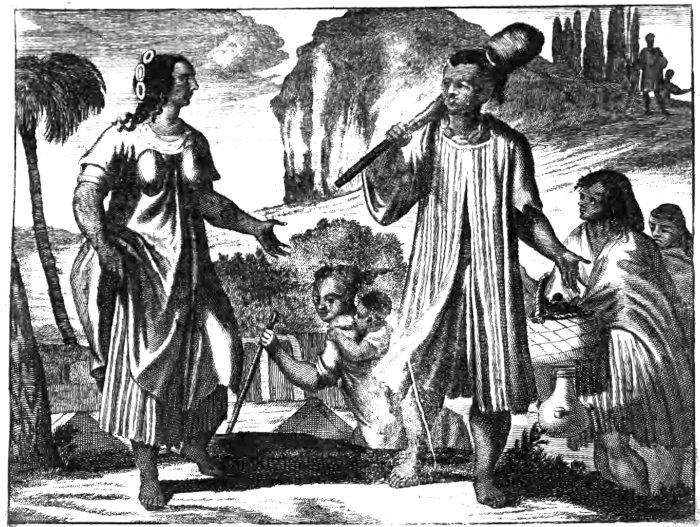
The Chileses are not the tallest, but strong and well set, betwixt a white and sallow colour: Those that are in the Spaniards Service, wear long Hair, by which they are distinguish’d from the shorn Ucais, who do the Spaniards all the mischief imaginable. The Women are for the most part low of stature, but of a strong Constitution, they go bare-headed, letting their Hair hang loose over their Shoulders, except when they are indispos’d, and then they tie it up: But those that dwell about Castro wear Locks like our English Ladies. In Coquimbo and Loquimbo they go after the same manner as the Peruvian Women: All of them have thick black Hair.
Their Apparel, though mean, is neat: The Men wear wide Breeches girt about their Wastes, and a piece of woollen Cloth, three Yards long and two broad, which 640having a Hole in the middle, they put over their Heads, and so let it hang on their Shoulders, leaving their Arms and Legs bare; but on Festival Days they wear curious embroider’d Stockings. The Women likewise cover themselves with the same piece of Cloth, but after another manner, tying it first about their Middle, then let it down to the Ground, pinn’d before with Silver or Golden Pins; their Heads, Breasts and Legs are uncover’d; the Cloth it self is strip’d with red, white, blue, and yellow, and fring’d at the edges. For an Example of their quick and easie Labor, Hendrick Brewer relates, That a Woman being Deliver’d in his Ship, within an hour after walk’d up and down the Deck, and gave the Child suck. Some of them have such great Breasts, that throwing them over their Shoulders they suckle their Children, being ty’d at their Backs.
Their Huts being low, are made of Straw, Canes, and Boughs, and not built for one single Family; for often thirty, fifty, a hundred, or a hundred and twenty dwell under one Roof, and have a Governor, by them call’d Caruca.
Their Housholdstuff is little and mean, viz. two or three Cans to keep their Liquor Chica in, Horn Cups, a Stone whereon they grind their Corn, and one or two woodden Stools: The chiefest of them also use Sheep-skins, which they spread on the Ground before their Guests. They live without care, for they neither Sowe nor Plant any more than will serve them a Year.
Their Riches consist in Cattel, of which they have no great plenty.
About the beginning of October a whole Town meets together to Plough and to Sowe, which the Men perform in two days time, the rest of the Work being left to the care of the Women; for the Men never meddle with Reaping or Harvest.
They eat and drink from Morning to Evening, when they do not travel, for then they eat at set-times. Their Liquor is made of Barley-Meal, or Wheat boyl’d in Water. On Festival Days they drink Chica, Brew’d of Maiz chew’d by the Teeth of old Women. They likewise make a Liquor of the Fruit Unni, which tastes like Madera Wine.
Their Marriages.
Every Man Marries as many Wives as he can buy and maintain, for Maids and Widows must be sold by the Parents, who set not a Price upon them according to their Beauty or Quality, but their skill in managing Houshold Affairs. Their Marriages are perform’d after a strange manner: A Son having no Inheritance, lives on the Charity of his nearest Relations, who Present him, one with a Hog, another with a Cow, a third with a Sheep, and a fourth with somewhat else: thus enrich’d, he goes to his Mistresses Father, and hangs some Turkoises and Plates of Silver about his Neck, and acquainting him with what Estate he can make his Wife, he agrees as well as he can with his intended Father-in-law, to whom he gives ten, fifty, or a hundred Sheep, Oxen, Cows, Hogs, Horses, Poultrey, a Coat, and some Vessels full of Chica; which done, the Father leads his Daughter to the Bridegroom’s House, where he is Entertain’d with Meat, but finds the Drink at his own Cost. Some days after the Celebration of the Wedding, the nearest Relations come to congratulate the young Marry’d Woman, and at Dinner sing an Epithalamium to their Nuptial Deity Maruapeante, all of them sitting on the Ground on Sheep-skins. The Allies often take away a Woman from her Husband, especially when he misuses her; and if a Man kill his Wife, her Death is reveng’d by her Relations. Persons of Quality build a Hut for every one of their Wives, sending word to her whom they have a mind to enjoy: They respect one above the rest, who are in a manner but Slavesses, being forc’d to do all the Drudgery. The Men are exceeding jealous and chollerick, cruelly beating their Wives, if they chance but to look on another Man; and if they take them in the Act of Adultery, they immediately 641kill them; yet for all this they are not Chaste, but very Libidinous. As soon as a Woman is Deliver’d of a Child, she washes her self and the Child in cold Water; then kills a Lamb call’d Chiluraque, makes a Feast; at which she her self eats and drinks freely amongst the rest, and the next day goes about her usual Employment.
The Spaniards tell us, that their Women, if they continue long in this Countrey, are more and more hardned by the Air, and are as little concern’d at the Birth of a Child as the Natives.
A Widow hath free leave to Marry again, provided she hath given to her Children part of what she hath; but if she Marry not, but return to her Parents, then she is highly esteem’d of.
Both Men and Women wash themselves in the Rivers in the coldest Weather.
Their Religion, and manner of burying their Dead.
They adore chiefly their Deity Pillan, and the Devil, who doth them much hurt. They acknowledge no Resurrection, accounting long Life in this World the greatest Good; wherefore when any one dies, the Friends and Relations make a doleful Cry, and suffer the dead Body to lie three, nay, four Moneths before they bury them, stuffing them full of strong smelling Herbs, to keep them from putrifying: Three days before their Interrment the nearest Allies meet, kill a Sheep, make Merry, and throw the Body into a Hole near the Hut in which the Deceased dwelt, putting also a piece of the slain Sheep, and a Jug full of the Liquor Chica, into the Grave.
Concerning their Idol Pillan, to whom with strange Gestures they Sing divers Songs, they believe that he is a Spirit of the Air, and Governs all things on Earth. Some suppose him to be Thunder, and therefore they worship him in a most particular manner when they hear it Thunder; for then they stick an Arrow and Stone Ax into the Ground, and take Arms into their Hands, putting themselves into a posture as if they should suddenly be set upon by a mighty Enemy, and look’d upon it heretofore as a fore-running of the Spaniards approach, whose Cruelties they exceedingly dreaded.
They call all their Hero’s Pillans, and ascribe Divine powers to them.
They take very much strong Tobacco, the Smoak whereof puffing in the Air with strange Gestures, they cry, Receive this, O Pillan.
Their cruel usage of Prisoners.
When they return home Conquerors from any Victory, they put a Stone Ax into the Ground, and standing Arm’d round about the same, Drink exceedingly, and sing a Song in honor of Pillan. They use their Prisoners very cruelly, for forcing them to Dance and make Merry amongst them, they on a sudden cleave their Heads with an Ax, pull their Hearts out of their Bodies, and bite the same with their Teeth. After the same manner they punish their Robbers and Traitors; but those that have good store of Chica to Present the Governors with, escape the Execution: Yet this cannot buy off Sorcerers or Witches, who are without mercy burnt alive, with all they enjoy’d.
They have no Priests, nor any that pretend to any religious Function; onely those that can Sing the Pawary well, are in great esteem amongst them.
Their second Deity Maruapeante (they say) informs them in a Dream when they must Marry; but he doth not do them this kindness before they have made themselves Drunk, and sung Sonnets to his praise.
The manner of chusing the Nentoque.
This Countrey is Govern’d by prime Persons, call’d Ulmen, or peculiar Lords, call’d Curacen. The Ulmens and Curacens Command twenty five, sometimes fifty, a hundred Families: Their Power consists in calling all the People together, and consulting with them about State-Affairs, which they dare not do with any particular 642Person, nor Levy any Tax without extraordinary occasion. They are bound to march in the Front of their Subjects against an Enemy, and are under a Governor-General call’d Apocurace, or under a Nentoque. Other lesser Offices are dispos’d of by the Curaces, or Pulmenes; but their Netonques are chosen after this manner, viz. When that honorable Place is vacant, then whoever aims at it, computes with himself whether his Means will extend so far as to treat the Curaces and Pulmenes with a noble Treat; which if he is able to do, then he sends for them to an appointed place, whither they all go Arm’d, and whilest they are eating and drinking, he that desires the Place begins to tell them of his noble Extract, valiant Exploits, Riches, and eminent Relations, and therefore desires the Place of the deceased Nentoque: then the Curace rising, the intended Nentoque hangs a Chain of Turkoises, or Cockle-shells about his Neck; whereupon the Curace moves the rest to the Election, without any Articles, the new Nentoque onely promising to Govern all things for the best advantage and benefit of the common State: which done, the Curace takes the Chain of Turkoises, and distributes them amongst the primest Persons of Quality, and so they end the Day in Drinking, Dancing and Singing.
After the same manner they chuse an Apocurace or prime Governor; which of late the Uca’s, that they may enjoy the more Priviledge themselves, have not elected.
Their Arms.
The Chileses Arms consist of Lances as long again as the Europeans, made sharp at the Points. They all use Clubs plated with Iron, and Spanish Swords. The Pulches, who dwell behind the high Mountains Cordilbra, use poyson’d Arrows, make Helmets and Breastplates of Ox-hides, which neither Sword nor Arrow can enter: they all know how to manage a Horse, and the use of a Lance, but are very much afraid of Musquets or Fire-locks.
Because they can neither write nor read, the Governor by a faithful Messenger sends to his inferior Officers such Commands as he judges may tend to the most advantage of the Publick both in Peace and War. This Messenger carries an Arrow with a Ribbon, as a Sign of his Employment; the Arrow is held in the Right-hand, and if he who receives it will answer the Message, then he sends back the same Arrow with another; but if he judges it convenient to acquaint any other Curaces and Pulmenes with the same Message, then he sends one of his own Servants to them with the same Arrow.
A particular Account of Chili.
As touching the Climate and Production of Chili, this Account is given by an Eye-witness: “The Winter Season (saith he) is so tempestuous, that sometimes the Trees are not onely blown up by the Roots, but the Earth it self is rent asunder; some Valleys being fill’d with Snow, swell the Rivers exceedingly when it melts, which overflowing part of the Countrey, makes the same very fruitful. It is also extream cold here, because such sharp Winds blow from the Mountains, that they pierce through the Skin and Flesh of a Man: and indeed these Winds would make the whole Countrey desolate, were not the Mountains overgrown with great Oaken Trees, against which the Wind breaks. Moreover, the Valleys produce Coals, which serve the Inhabitants for Fewel. The Winter bereaves the Trees of Leaves; but not those which grow in the Wildernesses. In March the Fields are full of innumerable sorts of sweet-smelling Flowers; out of some whereof are boyl’d the Angel-Water, so call’d for its smell and wholsom taste. The Grass grows in November and December as high as our standing Corn. Turnips, Mint, Clover, and Mustard-seed, grow naturally for several Leagues together. Likewise excellent Physical Herbs grow here, whose power and operation their Doctors, call’d Maci, keep from the Spaniards. These Maci are in great 643esteem, not onely amongst the Chileses, but also the Spaniards, for their great skill in Physick. Amongst these Herbs the chiefest is call’d Quincia-mali which grows but half a hands-breadth above the Ground, and spreads into several Stalks like a Nosegay; and on each Stalk is a Saffron-colour’d Flower. This Herb pull’d Up with the Root, and boyl’d, and the Decoction given to any one that is bruis’d within, works most wonderfully, for it draws out the putrifi’d Blood, though sunk never so deep in the Wound. Moreover the Juice of Culen is also very healing, if us’d for an Ointment, or pour’d on any Wound. This Herb, by the Spaniards call’d Albaciga, hath sweet-smelling Leaves, and a tall Body. In some places also grows an Herb, not unlike Grass, which boyl’d in Water, immediately cures the Feaver and Spleen, and cleanses the Blood. There are likewise Medicines here, which dissolving the Stone in the Bladder or Kidneys, cause it to be urin’d forth. The Plant Luce, which grows out of rented Rocks which are often overflow’d by the Sea, makes a sort of well tasted Bread.”
The Wilderness Atacama, which makes a Boundary betwixt Peru and Chili, extends Northward ninety Leagues, is dry and barren in Summer, and in the Winter exceeding cold, and cover’d with Snow. No Provision is to be found upon it, except a few wild Sheep, call’d Guanacos. About the middle thereof the Brook La Sal rising in the Eastern Mountains, flows Westward through a deep Valley to the Southern Ocean.
Troublesom Passage from Peru to Chili.
The Water of the fore-mention’d Brook put into any Vessel, immediately turns to Salt, and all along the Shore lie greater or lesser pieces of Salt; so that the Way from Peru to Chili through Atacama is very troublesom: but that which leads thither over the snowy Mountains Andes, is much worse, because it is farther about, and threatens the Traveller with Destruction, if he observe not the right Season of the Year; for in the Winter there blows such a cold Wind on these Mountains, that a Man, being suddenly benumm’d, falls down dead on the Ground, and grows stiff against all putrefaction. Joseph de Acosta tells us, that Bodies have been found there as firm and sound, as if they had been living, which had some years before breath’d their last on the said Mountains.
The Valley Copayapo.
But Diego Almagro, who first discover’d Chili, Anno 1536. went thither with two Companies of Horse, and five hundred Foot, through the Countreys Charcas, Chicas, Xuxayes, and Chaquana, and having pass’d over a craggy Soil and the snowy Mountains Andes, he entred into the first Chilean Valley Capayapo, having lost no small number of Men and Horses with Hardship and Cold; the inconvenience therefore of both the fore-mention’d Ways between Peru and Chili, forc’d Travellers to go along the Shore wash’d by the Southern Ocean. Copayapo bears that Denomination from the Turkoises which a Mountain produces there in great abundance. The Valley it self is the fruitfullest of all Chili; for in no place the Maiz grows better, and in greater abundance than here, the Ears being half a Yard long, and the Stalks the length of a Lance; each Grain that is Sow’n, yields at least three hundred in Harvest. All Spanish Fruits grow better here than in Spain.
Through the midst of Copayapo runs a River of the same Denomination, and twenty Leagues in length from the Andes, and at its Mouth hath a convenient Harbor before the South Sea.
The South part of Copayapo borders the Valley Guasco, which is less fruitful than the first, but hath a convenient Haven, into which falls a fresh River, penn’d in by Sluces for the watering of the Cane-Fields. Moreover, there are plenty of Partridges; also wild Sheep and grey Squirrel-skins are of a great value. To the Southward flow also the Rivers Maypo, Chacha Pool, Loro, and Moule.
644Beyond these Streams Eastward, the Promouca’s dwell near the Mountains Andes.
In the Valley Chili, which gives Denomination to the whole Countrey, were formerly the famous Gold-Mines Quillatas, from whence Valdivia, Anno 1544. carry’d an invaluable Treasure. The South Sea makes here a large and convenient Harbor for all manner of Vessels, built two Leagues below the City Serena, at a little River, which so moistens the low Countrey, that it produces all manner of Plants. It rains here not above three times a year.
From the Entertainment which Sir Francis Drake met withal here, may sufficiently be conjectur’d the Power of Serena; for when the English Landed here for Water, they were driven away not without great loss by three hundred Castilian Horse, and two hundred Foot that Sally’d out of the City. The Mines, though they inclose much Gold, yet they produce but little, because the Spaniards, according to the testimony of a Chilean Pilot, whom Oliver Van Noort took Prisoner, destroy’d all the ancient Inhabitants that should have help’d them to dig the Gold.
The City St. Jago, lying near the Stream Topocalma, receives great benefit by the Haven Valparayso, which makes the fore-mention’d River, because in that Haven all Goods that come from Lima are unladen, and the Goods shipp’d aboard. The Countrey about the same produces plenty of Wines, Apples, Corn, and all sorts of Cattel, and especially Horses in such abundance, that thousands of them run wild.
In Valparayso Sir Francis Drake took a Ship from Valdivia, laden with two thousand five hundred Bars of fine Gold. But the Netherland Admiral, Joris Spilbergen, had not such good success, who Sailing thither with five Ships, Anno 1615. discover’d a Spanish Ship in the Harbor; where sending his Boats well Mann’d to fetch off a Vessel that lay hal’d on the Shore, they found it burning, and thereupon Steer’d their Course into a little Inlet full of Rocks, which serv’d the Spaniards in stead of Breast-works; for lying behind them, they fir’d continually on the Hollanders; yet Spilbergen Landing with two hundred Men, met a considerable number of Spanish Soldiers, and Horses drawn out on the Shore, from whom they soon fled.
Before the City La Conception lies the Island Quiriquyna, whose Straw Huts Spilbergen laid in Ashes.
At the time when Oliver Van Noort came to an Anchor here, the Governor Franciscus de Quinones Commanded seven hundred Spanish Soldiers to reduce the revolted Chileses.
Four Leagues from Conception lie the rich Gold-Mines Quilacoya, which formerly produc’d great Riches.
Over against the Valley Arauco, which rises out of the Sea, lies the Island Maria, in a large Inlet made by the force of the Waves.
Here grows abundance of Wheat and Barley. The Rivers also afford plenty of Fish, amongst which there is one call’d The Lake-Spider, in whose Eyes are to be seen little Specks, which would exceed Pearl, if they were but hard enough.
Two Spaniards Command forty Natives on Maria, and keep them in such slavery, that they may neither eat Apples, Pears, Grapes, Poultrey, or Sheep, though they are there in great abundance.
Elias Herkmans was once in probability to have taken possession of this Island for the Netherland State, had he not been prevented by an extraordinary occasion.
Between the Towns Conception and Imperial lie the Provinces Arauco, Tucapel, and Puren, inhabited by a valiant People, that often alarm the Spaniards. In each Province Valdivia built a Fort in the Year 1551. eight Leagues distant from one another. He also discover’d the rich Gold-Mines De Ongol, and built the Fort Confines there.
Valdivia taken Prisoner and cruelly put to death by the Indians.
The Natives hereabouts being exceedingly opprest by the Spaniards, fell upon 645the Fort in Puren, where those in the Garrison, unable to defend themselves, went to Tucapel and from thence to Arauco, to Settle there. Valdivia marching with three hundred Men to the Castle in Tucapel, was so fiercely assaulted at the River Leto, that all his Men were kill’d, and he himself being taken Prisoner, had melted Gold pour’d down his Throat: One Boy onely escaping, brought the news to those in Garrison in the Fort Arauco, who fled to La Conception, as those from Puren to Imperial. Not long after the Lieutenant Francisco de Villagra went with a hundred and sixty Soldier’s to Raquetta, a Promontory against the South Sea in Arauco, to take Revenge for the Death of his General Valdivia; but he also had like to have follow’d the same fate, for he left ninety six Men behind him, and with much ado recover’d La Conception: By which means the victorious Chileses came to be so much fear’d, that the Spaniards forsook the Towns Rica, St. Jago, and Confines, and fortifi’d themselves strongly in Imperial.
Description of Arauco.
Concerning Arauco, it is a small County, twenty Leagues long and seven broad. The Inhabitants thereof are strangely valiant; those that inhabit the Mountains are call’d Pulches, and are generally of a duller Spirit than those that dwell in the Valleys; all of them use long Pikes, Halberds, Bowes and Arrows, Helmets, and Breastplates of Deer-skins, in the Wars; they know when to close and open their Ranks, and stand in good order according to Martial Discipline, which makes the Spanish King receive little benefit from Arauco, though it is full of rich Mines, because those in Garrison being five hundred in number, dare not come out of their Fort.
To Arauco belongs the Island La Mocha, low on the North side, and rocky on the South; against which the Ocean breaks its Billows: in the middle of it rises a split Mountain, out of whose Gap flows a fresh Brook; the fruitful Soyl produces abundance of Pumpcons, Maiz, Potato’s, and all manner of delicious Fruit, as also Oxen, Sheep, and other Cattel, which go grazing up and down in great Herds; the Village that is upon it boasts about fifty Huts, built long of Straw, with a Door in the middle, and round like an Arch on the top.
Van Noon’s and Spilbergen’s Entertainment in Mocha.
Sir Francis Drake and Candish were formerly somewhat roughly Entertain’d here by the Inhabitants: but they shew’d themselves somewhat more civil to the Dutch Admirals, Oliver Van Noort and Joris Spilbergen: The first coming to an Anchor here Anno 1600. put one John Claeszoon (Condemn’d for some great Crime to be Landed on some strange Place) ashore on La Mocha, with a few Trifles; for which being kindly Entertain’d, the Seamen resolv’d to go ashore the next day, who were likewise civilly Treated. The Governor of Mocha coming aboard, Lodg’d a Night in the Ship, and afterwards conducted the Admiral through the Village, but forbad the Seamen from entring any of the Huts; out of which the Women upon the hearing of a sudden noise, came running out, and kneel’d down on the Ground in three Parties, whilest an old Matron came forth with a Pitcher full of Chica, and gave each of the Netherlanders a Cup full to drink, sitting on Blocks in the Fields.
A Man Marries as many Wives here as he can maintain. They all live peaceably one with another, and go Cloth’d with a pair of Breeches, and Frock without Sleeves. The Women tie their Hair in Braids about their Heads, but the Men let it hang down carelesly.
Fifteen years after Spilbergen Landing here with four well Mann’d Boats, found the Shore full of People, who had brought all manner of Provisions to barter against Axes and Knives. The Islanders going aboard, wondred to see the Soldiers drawn out in order, and much more when a Gun was fir’d: They furnish’d the Hollanders with a hundred Sheep, amongst which was one with an extraordinary long Neck, and Legs, Hair, Mouth, and Back like a Cammel.
646The Netherland Admiral, Hendrick Brewer, coming to an Anchor on the Coast of Guadalanquen, Anno 1643. was inform’d by the Chileses, that about four years before they had burnt Baldivia, murder’d the Spaniards that were in Garrison, and pour’d melted Gold down the Governor’s Throat and into his Ears, and made a Drinking-Cup of his Scull, and Trumpets of his Shin-bones. Brewer also found some Ruines of the City, which formerly boasted four hundred and fifty Houses, and was not yet so utterly defac’d, but that the two Markets and cross Streets were plainly to be seen, and the Walls gave sufficient testimony of its ancient lustre. The Countrey round about produces Wheat and Barley; neither are there any Mines to be found that produce finer Gold than those which are hereabouts. In the Mouth of the River which runs to Baldivia, lies a small Isle, the Men whereof are gross and fat, and spend their time in Drinking and Dancing, whilest the Women do all the Work.
About the City Osorno, though lying under a cold Climate, is a Soil full of Gold-Mines, where above two thousand Chileses are under the subjection of the Spaniards.
Since Teunis Swarte-Teun conquer’d and ruin’d this Place with small Forces under Spilbergen’s Command, it hath not yet repair’d its Losses: The Ruines of great Buildings are sufficient testimonies of its former splendor.
On the utmost Point of the Island, on which Osorno is built, lies the Village Carel-Mappo, burnt by H. Brewer, An. 1643. for he Landing sixty six Men here, under the Command of the Ensign Blauewenhaen, they Engag’d with ninety Spaniards who betook themselves to the Woods, leaving six Men and fifteen Horses behind them.
Description of the Sea-Coast of Chili.
The Sea-Coast of Chile lies as followeth: It begins on the North with the Valley Copayapo, runs Southerly to the Haven Coquimba, and makes the large Inlet Atongayo; the convenient Harbor Quintero, at the Mouth of the River Concagua, is also to the Southward.
Next Quintero follow the Havens Valparaysa, Topocalma, and Penco, known by several Mountains cover’d with Snow.
The Stream Labapi disembogues also in the Bay Arauco, where the Sea washing over the Shore, makes good Salt.
On the Shore of the River Lebo, Garcias Mendoza built the Town Canete, which not long after was deserted, by reason of the Wars with the Chileses.
From the Haven Carnero a Channel runs to the City Confines: also the River Cauten makes a convenient Harbor before the City Imperial.
Next appear the Streams Tolten, Queule, Valdivia, Chabin and Bueno; and near the Promontory Gallego, Chili ends to the South.
The Province Tucuman.
Eastward up into the Countrey lies the great Province Tucuman, inhabited by three sorts of People, viz. Juries, Diagnitas, and Tucumans, from whom the Countrey receives its Denomination, and juts Northward against the Chicas, belonging to the rich Plate-Countrey Potosi, Eastward towards the Province La Plata, and Westward towards the South Sea.
The Ground about the City St. Jago del Estero, formerly call’d Vares, being the Bishop’s See, and Residence of the Governors, is brackish and sandy. The Citizens are most of them Weavers; the Natives go Cloth’d, and are of an affable Temper and Disposition.
The River Estera yearly overflows the Countrey, which being dung’d with Mud, produces abundance of Maiz, Barley, Wheat, and all manner of Fruits.
The Stream Salado runs the same Course as the Estera, from the West to the East through a Plain-Countrey, but hath brackish Water, and abundance of Fish. Between 647both these Rivers the Inhabitants get plenty of Honey, Wax, Cotton, and Cochenile. Cattel also increases in abundance, as likewise Deer, and other Venison; and for Fowl, Partridges, Pigeons, and the like; but the Tygers and Lyons do much mischief to the Inhabitants. Their chief Commodities for Trade and Merchandise are Cloth, Cotton and Salt.
Garcias Mendoza built the Towns Neuva Londres in the Province Calchaqui, and Gorduba in the Territory of the Juries, but they were both of them soon deserted.
Behind Peru and La Plata the Plains Omaguaza extend themselves along the Rivers Paraguay and Bermeio, under a temperate Climate, where the Inhabitants go Clothed, and keep abundance of Cattel.
Productions of the Countrey, and Nature of the People.
In most places hereabouts breed wonderful large Baboons, with long Tails and Beards; which being wounded, pull the Arrows out of the Wound, and throw back the same with a grim Countenance at those that shoot them.
The Serpents are likewise so big here, that they swallow whole Deer.
The Rivers breed horrid Crocodiles, and the Woods, Lyons and Tygers.
The Inhabitants differ both in their Customs and Language: the generality of them are continually Drunk. They keep yearly a great Feast, to reconcile the Souls of their Predecessors to them; to which purpose they bring as many roasted Ostriches as they have Souls to Offer to; then Drink three days after, and on the last they carry the Head of a fair Virgin (who freely offers her self to be kill’d) about the Town, making a sad and lamentable noise for the space of an hour; at the end of which they all begin to laugh, and oftentimes fall a killing one another: which Custom is most observ’d amongst the Matarani.
The Abipones go naked in Summer, and in the Winter Clothe themselves with Furrs; they Paint their whole Bodies with Spots like the Tygers, Carve their Bodies all over, making Cut-work of their Skins, into which they stick Ostriches Feathers, as also through their Nostrils, Lips, and Ears, and account Baldness the greatest Beauty. They honor those for their Gods, who patiently endure unsufferable Tortures. The Women hang their Faces and Breasts full of Pearls: They never bring up above two Children, for they kill all above that number.
The Planies range up and down without Habitations under the open Skie.
The Giants Tobae speak a curious Language, but are very salvage and cruel. Anno 1571. Erouaca, a prime Man amongst them, devour’d his own Sister, Wife, Mother, and Children. When they design to go a Journey, they roast their Sons and Daughters, to serve them for Provisions in stead of other Flesh; and their Sick are upon the least Complaint bury’d alive.
The Caaguiaares, who dwell in Huts in great Woods, feed on Woorms, Mice, Apes, Tygers, and wild Honey; most of them are bunch-back’d, and go clad with the Skins of wild Beasts.
648

CHAP. III. Magellanica.
Several Voyages to Magellanica.
Northward against Chili and Rio de la Plata juts the Countrey, which from Ferdinand Magaglianus is wrongly call’d Magellanica; to which several Voyages have been made by sundry People from the North-Sea to the Southern Ocean, divers Steering still new Courses: for some follow’d the Straights of Magellan; others Sail’d more or less South-West: By which means Le Mair open’d a new Passage between Mauritius and the States-Island; and H. Brewer, a Way below the States-Island; yet all Steer’d their Course Westerly, so that none of them return’d the same Way, except Elias Herkmans and Capt. Ladrillero, the last of whom coming from Chili to go to the North-Sea, met with such Storms, that he was forc’d to Tack about, and stand back again to Chili, as Herkmans did from Chili to Brasile.
Pedro Sarmiento’s Expedition.
Anno 1579. Peter Sarmiento weigh’d Anchor with two Ships, and Sailing from Callao de Lima through the Straights of Magellan to Spain, ran by the Isles Felix and Amber, discover’d in one Inlet eighty five Isles, most of them desolate, sounded all the Havens, found abundance of Oysters with Pearls in them, call’d an Inlet Francisco, and a Mountain on the right-hand, Punta de la Gente Rubra, because the Inhabitants thereof painted their Bodies red, found the Havens Misericordia and Candelaria, and the Island Sataynes, where five of the Natives gave him an Account of Sir Francis Drake, for whom he Cruis’d, and had sight of a snowy Mountain, whose top vomited Fire. On the Promontory Ana he erected a woodden Cross, and laid a Writing under the same, wherein he advertis’d all Persons to take notice, that Pope Alexander the Sixth had freely given the King of Spain all the Countreys thereabouts. Not long after he Steer’d through the Straights of Magellan along the Coast of Brasile, to Spain.
The Sea-Coast from Chili to Magellanica.
Concerning the Sea-Coast, which extends from Chili to Magellanica, it is as followeth: Next to the Promontory Felis lie Cypriaen, Clara, Cabo de las Islas, the Island Socora, the Haven Domingo, the Point Gallego, the Road Stevan, the Cape Andres, and Ochavario, and the Valley Nuestra Sennora, between two Hills. Along the Southern Ocean lie Abra de San Guillen, Punta del Gada, Los Reyes, Innocentes, Augustine, Roia, Catalina, Amaro, and Victoriano; before which the three Isles call’d The Sorlings, are seen in the Mouth of the Straights against the South Sea.
Magaglianus Steering hither, Winter’d within the Straights in an Inlet call’d St. Julian, stay’d two Moneths before the Mouth of the River Santa Cruiz, where he took abundance of Fish, and from thence ran along the Shore to the Promontory Las Virgines, which receiv’d that Denomination, because it was discover’d on the Day Consecrated to St. Ursula and her eleven thousand Virgins: Going a League up into the Countrey, he found a Hut, in which above two hundred dead Bodies were bury’d after a strange manner, and on the Shore a great Whale, driven on the Sands by a Storm. He nam’d the Countrey to the Southward, Terra del Fuego, because from the Promontory Severino in the Night he espy’d several Fires. He was exceedingly delighted with the pleasant Coasts on each side of the Straights, which were the more pleasant, by reason of several Hills overgrown with sweet-smelling Trees, whose tops lay cover’d with Snow.
The Expedition of Garcias Loaysa, Alcazova, and others.
649Magaglianus was follow’d, Anno 1525. by Garcias Loaysa, who Sailing into the Straights near the Promontory Virgines, endur’d great Colds; in the Haven St. George he found store of green Cinamon: The People he reported to be of so monstrous a stature, that they might well be accounted Giants; some of whom went naked, others wore a Net of Feathers made fast about their Wastes, and others a loose Garment all over their Bodies. Loaysa gave this Countrey, inhabited by Giants, the Denomination of Terra del Patagoni. He judg’d the Straights of Magellan to be a hundred and ten Spanish Miles long between the two Promontories, Virgines at the North Sea, and Deseado at the Southern Ocean. Within lie three Inlets, which have seven Leagues in breadth.
Simon Alcazova Sailing hither nine years after Loaysa, shunn’d the Land on the left-side of the Straights, because it lay most under Water, and was forc’d by his Men to return to the Haven Leones, where he and all his Seamen were put to death.
Not long after the Bishop of Placentia fitted out three Sail, which entring the Straights, Anno 1540. lost their Admiral; the Vice-Admiral Wintering at the Inlet Las Zorras, (so call’d, because they took many Foxes on a Champain Countrey without Trees) return’d to Spain without any farther success: the third Ship with much ado arriv’d also at Arequipa.
The Voyages of Hawkins, Drake, and Candish.
The English Captain, Richard Hawkins, also Sailing hither, found the Land on the South side of the Straights, most broken, and in some places a few Huts.
Anno 1578. Sir Francis Drake Sailing hither along the Coast of Brasile, Landing on an Island in the Mouth of the Straights, kill’d above three thousand Birds. Sailing from hence he was miserably toss’d in the South Sea, and discover’d about the middle of the Straights, that the Current out of the Southern and Northern Ocean met at the place where a great Bay bends Southwardly: To three Isles he gave the Name of Elizabeth, Bartholomew, and George, and drove three Weeks without making any Sail, in snowy, misty, and rainy Weather, falling amongst dangerous Rocks, and at last Anchor’d in the Haven Health, which he so call’d, because his sick and wearied Men being refresh’d there, he set Sail from thence and return’d home.
Captain Thomas Candish following Sir Francis Drake eight years after, found near a Creek within the City Philip-stadt, built there by the Spaniards, to secure the Passage out of the Northern to the Southern Ocean for themselves; to which purpose they held four hundred Men in Garrison in the said City, which lying near a pleasant Wood, was defended by four Bulwarks, each fortifi’d with a Brass Gun: But the Spaniards not being able to endure the Cold, nor get in their Harvest, which was continually spoil’d by the Natives, were so pinch’d with Hunger, that after three years stay many of them dy’d in their Houses, which caus’d a filthy Stink, and consequently a vile Distemper, not unlike the Small-pox; at last twenty three of them, amongst whom were two Women, judg’d it convenient to bury their great Guns, and march away with their Musquets; a whole Year they travell’d in great want, feeding on the Leaves of Trees, wild Roots, and Fowls which they now and then kill’d; at last they resolv’d to travel by Land to Rio de la Plata, but never any news was heard what became of them, onely one Spaniard, call’d Ferdinand, being stray’d from the rest, was taken by Candish, to whom he gave the foremention’d Relation. Candish entring Philip-stadt, found a Gibbet, on which hung a Malefactor in Chains, a Church, the Houses full of famish’d Bodies, and four Brass Guns, which he digg’d out of the Ground. From hence he ran to a fresh-water River (which disembogues into the Straights,) whose Banks are inhabited by cruel Cannibals, and the Countrey all about plain Pasture Grounds, whereas most 650part of the Shore in the Straights is very mountainous. Candish Landing, found Spanish Knives and Stilletto’s amongst the Man-eaters, and lay a whole Moneth at Anchor in the western Mouth of Magellanica, by reason of great Storms, feeding on Mussles, Cockles, and Fowl; and from thence Sail’d about the World, returning home at last with a Booty of twenty Tun of Gold.
Anno 1599. Simon de Cordes Commanding five Netherland Vessels, entring the Straights of Magellan, found in the green Bay, Mussles of a Span long, abundance of Ducks and Geese, and a great many Trees not unlike Laurel, they being onely bigger, and had a sharp biting Shell. The Wind blew exceeding hard here over the Rocks, insomuch that they were sometimes driven from four Anchors.
The Bird Pinguyn.
A few Moneths after Oliver van Noord follow’d Cordes, and Anchor’d near the Pinguyn Isles, the biggest whereof is call’d Castemme, and the least Talke; the Inhabitants thereof dwell in Caverns under Ground, and feed on the Birds Pinguyns, of whose Skins they make Mantles. These Birds weigh generally fifteen or sixteen Pound, have black Backs, white Bellies, very thick Skins, long Bills like Ravens, short thick Necks, two plum’d Fins in stead of Wings, black Feet like a Goose, and delicate Flesh, notwithstanding they feed on Fish, after which they swim very swift with the fore-mention’d Fins, which hang down on each side along their Bodies when they walk upright on the Shore; they sit generally four together in their Holes, made after such a manner, that a Man which knows not of them, may ere he be aware, sink up to the Knees in the same, and be bitten terribly by the Legs. Cordes his Seamen got in two hours time above nine hundred of these Birds, whilest he discover’d the salvage People Enoo, which inhabit the Countrey Cossi, and are divided into the Families Kemenetes, Kennekas, and Caraike; the first inhabited the Territory Carray; the second Caramay; and the third, Morine: all of them Paint their Cheeks and Forehead. Farther into the Countrey dwell the Trimenes, a gigantick sort of People, eleven Foot high, who maintain continual Wars with their Neighbors.
Great Discoveries of the Netherlanders about the Magellan Straights.
Moreover, Noord discover’d several Inlets full of Ice and fresh Water in the Straights of Magellan, whither the United Netherlands have since sent the Admirals William Schouten, Joris Spilbergen, and Jaques le Heremite. The common opinion, that the Countrey on the South side of Magellan is of the Main Continent, Experience hath manifested; for Schouten found the same, Anno 1616. who Sailing from Porto Desire, left the Straights of Magellan on the right-hand, and Sail’d Southerly through whitish Water, and in fifty four Degrees discover’d a Channel eight Leagues broad, through which ran a strong Current. The Coast rose with high Mountains, whose tops were cover’d with Snow. The utmost Point was call’d Mauritius, from the Prince of Orange; the broken Coast on the other side, The States-Island; and the Straights it self, Le Maire, upon the Request of the Merchant Jacob Le Maire, whose Father Isaac was chief owner of the two Ships of which Schouten was Commander, who found so many Whales here, that he could scarce Steer clear of them, they swimming by hundreds in a Shoal. The Sea-pies, much bigger than Swans, suffer’d themselves to be caught by the Hands of the Sea-men. Moreover he call’d the barren grey Rocks, and others lesser, lying North-East from the Promontory Hoorn, Barnevields Isles. Sailing beyond the Point Hoorn, he was toss’d by the vast Billows that came rowling out of the West.
It was no sooner nois’d abroad, that the Netherlanders had found the Straights Le Maire, but the Spanish King Philip immediately sent two Carvels thither, under the Command of Garcias de Nodal, who took an exact Account of the Heads, Roads, and Inlets belonging to the fore-mention’d Straights, and return’d without performing any other Exploits.
651
Diego Flores his unsuccessful Voyage to the Straights of Magellan.
Diego Flores Steer’d four years before Candish to the Straights of Magellan with twenty three Sail of Ships, Mann’d with three thousand five hundred Seamen, besides five hundred old Netherland Soldiers, with which he unhappily weigh’d Anchor from Cales; for before he got out of sight of the Spanish Coast, he lost five of his Ships and eight hundred Men; yet prosecuting his Voyage, he stay’d during the Winter Season on the Coast of Brasile and was surpris’d by so vehement a Storm, near the Island Catalina, that a company of Women, sent under the Charge of Peter Sarmiento to Settle in the Straights of Magellan, were all cast away, with the greatest part of the Ammunition and Provisions. The English Admiral Fenton took three Ships of this Fleet from Flores, two were cast away in the River La Plata, and one ran back to Spain, whilest Flores came into the Straights of Magellan on the last day of March, at which time the whole Countrey lay cover’d with Snow; wherefore seeing no hopes of finding out any place to Settle Sarmiento upon, he stood back with eight Sail to Brasile, and in his Return burnt three French Ships, took two more, and Sail’d home. But his Lieutenant Diego Ribera, and the Governor Peter Sarmiento, Landed the Year after Flores his departure, with four hundred Men, thirty Women, and Provisions for eight Moneths, in the Straights of Magellan; from whence Ribera Sail’d back, whilest Sarmiento built on the North side of the Mouth of the Straights, the Town Nombre de Jesus; and fifty Leagues farther in the narrowest place, Philip-stadt, with four Bulwarks; the Inhabitants of which (as is before related) were destroy’d by Famine.
Description of Terra del Fuego.
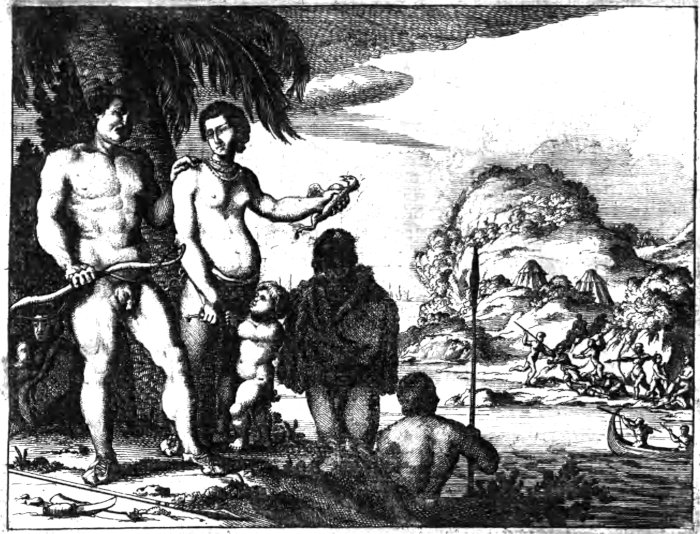
Terra del Fuego, already mention’d, opposite to the Countrey of the Patagones, lying the South between the Straights of Magellan, is a broken Countrey, with high Mountains full of Trees, and wash’d by pleasant Rivulets: four Foot deep in the Ground it begins to be all Rocky. The Air is troubled with exceeding great Winds out of the West. The Inhabitants are pale Countenanc’d, but Paint their Bodies with divers Colours; they have long, thick, and black Hair, and very sharp Teeth; the Men go stark naked; the Women cover their secret Parts with a piece of Leather, and wear Strings full of Shells about their Necks; some also Mantle 652themselves with the Skins of wild Beasts, which affords but little warmth against the Cold that is here in Winter. Their Huts consist of Trees, and are made round at bottom, and sharp on the top like a Tent, having onely a Hole for the Smoak to go out at; they are digg’d three Foot deep into the Ground, and also heap’d round with Earth; within the Huts nothing is to be found but Baskets with Fishing Utensils and Stone Hooks. Their offensive Arms the Men always carry about with them, because they always maintain Wars with their Neighbors. They handle a Quarter-staff very dexterously, are good Slingers and Bowemen; they also use Lances with sharp Stone Points. Moreover they make Boats of the Bark of Trees, which they first cut out into a Form, then sewing it together, bow the same after the manner of a Boat, which rises before and behind, and being fifteen or sixteen Foot long, can carry eight Men, going exceeding swift. These People are not onely beastial in their Practices, but also Murderers.
Lastly, besides the Straights of Le Maire, Henrick Brewer hath found a new Passage to the Eastward above the States-Island, out of the Northern Ocean to the South Sea.

CHAP. IV. The unknown South-Land.
The unknown South-Land extends with several Points to the Southern Ocean, which have been more seen than discover’d by divers Nations.
Opposite to the East-India Island Gilolo, lies Terra des Papous, to which Jacob Le Maire gave the Denomination of New Guinee.
The English Commander, Richard Hawkins, Sailing to the Southward behind Papou, found the Inhabitants black like Negro’s: round about appear several Isles and convenient Harbors. Herrera places here on the East, the Countrey Agnanda, the Road St. Jago, the Island Los Crespos, the Haven Andreas, the River Virginum, and the little Isle La Vellena, before the Mouth of the Stream Augustine. Next you meet Easterly with the Rivers St. Peter and St. Paul, the Havens Hieronymus, the Isles Punta Salida, Abrigo, Malagente, and Maure de Dios, inhabited by white People.
Discoveries in Terra Australis incognita.
The first that discover’d New Guinee, Anno 1529. was Alvares de Savedra, who, as also several others besides him, suppos’d that some of the Islands Solomons border New Guinee.
Eighteen of the many Solomon Isles exceed the rest, of which some are three hundred Leagues in circumference, some two hundred, others one hundred, and some fifty: All that are inhabited have a fruitful Soil, producing all manner of Provisions, particularly Hogs and Poultrey. The Natives differ very much one from another, for some are black, others white or tawny.
The fore-mention’d Hawkins in his Voyage towards the Straights of Magellan, supposing it by estimation to be fifty Leagues from the Main Coast of America, discover’d forty Degrees to the Southward of the Equinoctial Line, with a Westerly Wind, the unknown South-Land; which he found to consist of low Land, and to be inhabited, by reason of the many Fires which he saw ashore in the Night.
The Spanish Commander, Peter Fernandes de Quiro, and the Admiral Lodowick Paes de Torres, have made a farther Discovery of this Countrey; for Landing on the 653South-Land, they met with several People, some whereof were brown, others white, and others sallow; some had long and lank, others short and curl’d Hair: They acknowledg’d no King or supream Governor, nor were Govern’d by any Laws, neither had they any Wall’d Towns or Forts; but being divided amongst themselves, they continually Encountred one another with Darts, Clubs, and Staves. Their Houses built of Wood, were cover’d with the Leaves of Palm-Trees. Their Housholdstuff consisted in Earthen Dishes, Pots, Ropes, Fish-nets, Flutes, Drums, and varnish’d Spoons. Their Gardens were neatly kept. Near their Temples were Burying-places. They Row’d very swift in little Boats. Their Bread, well tasted, was made of long thick Roots, either roasted or boyl’d.
Fertility, Plenty, and Riches of the Countrey.
Here also grow sorts of Platano’s, great abundance of Almonds, Oranges, Citrons, thick Sugar-Canes, Palm-Trees, which yield Wine, Cocoa’s, and Obos, in taste not much unlike Quinces; but the greatest benefit which they receive, is from the Cocoa Nuts, the Pulp whereof is delicious Meat and Drink; the outermost Shells whereof serve for Cups or Dishes, the inner for Ropes and Cordage; of the Leaves they make Sails and Mats, and cover their Houses with the same; of the Body, Oars, Clubs, Pikes, and Props for their Houses.
Besides several sorts of Pot-herbs, here grow very high Coleworts and Bledo’s.
The Countrey also abounds with Pigeons, Partridges, Ducks, Goats, Hogs, and other ordinary Cattel and Fowls.
The Rivers afford them Souls, Salmon, Thornback, Sea-Cocks, Eels, Gurnets, and several other unknown Fishes, very delicate and wholsom.
This Countrey also produces Nutmegs, Mastick, Peppers, Ginger, Cinamon, Gold, Silver, Pearls, Silk, Sugar, Anniseed, Honey, Wax, Ebony-wood, Turpentine, Lime-pits, and Marble.
Philips-Bay bends twenty Leagues into the Countrey, hath a safe Harbor, and excellent Ground, consisting of black Sand. Two great Rivers discharge their Waters into the said Bay, round about which are pleasant Woods, full of Quails, Parrakito’s, Parrots, Nightingales, and Bulfinches, which Sing very sweetly. The Blossoms, especially of Orange-Trees, and the Herb Alvaca, yield an odoriferous smell. The wholsom Air adds vigor to aged People.
Abel Tasman’s Expedition to Terra Australis Incognita.
The Southlander’s desperate Attempt upon Tasman’s Ships.
Fernandes de Quir delivering the fore-mention’d Account to Philip the Second, King of Spain, mov’d him to Plant the unknown South-Land, and the rather, because he had not found any snowy Mountains, drown’d Land, Crocodiles, Muschito’s, or any hurtful Creature, yet was not regarded; so that no Spaniard hath since that time set Foot on the unknown South-Land. But the East-India Company undertaking the Design with great eagerness, sent thither two Ships, viz. the Hemskerk and Sea-Cock, under the Command of Abel Tasman, to make a farther Discovery of the said South-Land: Anno 1642. on the twelfth of August, they weigh’d Anchor from Batavia, Sail’d through the Straights of Sunda to Maurice-Island, where they Anchor’d in the North-West Haven before the Castle Frederick-Henrick, on the fifth of September in the fore-mention’d Year. On the eighth of Octob. Tasman stood over to the South-Land, near which he was surpris’d by a violent Storm; afterwards, on the twenty fifth of November, he discover’d a barren Shore, against which the Sea beat very furiously; and Steering along this Coast, he found a convenient Inlet, but was forc’d by the hard Weather to stand off to Sea again; yet not long after approaching the Shore, he saw great hollow Trees, and round about them abundance of Mussle-shells, and from the Wood heard a shrill noise of People Singing: Going to the same place again, he put the Orange Flag on a Pole, Carv’d with the East-India Companies Arms, and call’d the Inlet Frederick-Henrick, 654the whole Coast, Anthony van Diemen. Sailing from thence Eastward, he on the eighteenth of December discovered a convenient Haven, where sending his Sloop to discover the Shore, he came back in the Evening, being follow’d by a Boat, which approach’d nearer and nearer, but Night coming upon him, he could not well discern what they were that pursu’d him, but heard the cry of hoarse Voices, and a shrill noise like that of a Trumpet, which the Netherland Seamen answer’d by hollowing, and blowing on their Trumpets, and at last firing a Gun, the Southlanders made a hideous noise, and blowing their Horns, return’d ashore. Tasman hereupon call’d his Watch, laid Hangers, Pikes, and Musquets ready Charg’d, upon the Decks. The next day the Southlanders came in several Boats, two and two ty’d together, and cover’d with Planks, towards the Ships; the Gunner of the Hemskerk going with six Men in a Boat to help mount some Guns in the Sea-Cock, were betwixt both Ships set upon by the Southlanders, who approacht with a hideous noise, kill’d four of the Hollanders with long Poles, and forc’d the other three to save themselves by swimming; which they had no sooner done, but they Row’d with incredible swiftness towards the Shore, insomuch that they were out of the reach of their Guns before they could make ready to fire at them. Tasman finding that there was no good to be done here, since he hazarded the Lives of his Seamen against a company of wild People, he set Sail, but was follow’d by divers Boats, at which he fir’d his After-Guns with pieces of Iron and Stones, which killing some of them, made the rest return. In the midst of the Boats, which were ty’d two and two together, sat the Commander, who encourag’d the Rowers; they all us’d Clubs without Points.
These People were gross of Body, undaunted, strong, and of a tawny colour; the Hair of their Heads stroak’d up round, was ty’d up on their Crown, on which stuck a stiff white Feather; about their Necks hung a square Plate; they wore in stead of Cloaks, square pieces of Cloth, made fast before on their Breasts.
Tasman, by reason of his rough Entertainment call’d this Harbor, Murderers-Bay, and afterwards Sail’d along the Shore till the fifth of January 1643. on which Day he dropt Anchor near a little Rocky Island, from which fell two Streams, with a great noise into the Sea. The Inhabitants, a strong People, beckned to the Seamen to come on Shore; some lean’d on thick Clubs, others Fenc’d one with another. Tasman sending his Sloop ashore for Water with two Drakes, return’d without any, not being able to Land, by reason of the hollow Sea near the Shore; wherefore Sailing from thence he discover’d two low Isles, which were full of Woods of very tall Trees; from the biggest whereof came a little Boat, sharp before and behind, in which three sallow Men, sitting behind one another, Row’d with great swiftness towards the Hemskerk; whereupon Tasman commanded all his Men to go under the Hatches, that the three Southlanders might not be afraid to come aboard; he also threw a piece of Linnen out of his Cabbin Window, which one of them, leaping into the Sea, took up, and as a sign of thankfulness, laid the same on his Head, and being hereby emboldned, they came nearer the Rudder, where they took up a Knife, ty’d to a piece of Wood, out of the Water, and return’d the Seamen a Fishhook of Mother-of-Pearl, ty’d to a Cotton Line. Approaching the Shore, they saw abundance of People running along, with two little Flags on Sticks. Some of the Natives came in their Boats close up with Tasman’s Ship; and one more bold than the rest entring the same, was found to be a tall Man with a broad black Beard, and green Leaves about his Neck, who sat down on the Deck with his Legs under him, and bow’d down his Head oftentimes very low: Tasman returning his Civility, took him by the Hand to Treat him in his Cabbin, but a 655Dog which was in the Ship Barking, he grew fearful, and went into his Boat again. Several other Southlanders swam aboard, and others brought Pisang and Clappes in their Boats. Against the Evening a great Vessel, surrounded with lesser Boats, came Rowing towards the Hemskerk, the Men making a great noise; the Seamen fearing some Design, ran all to their Arms, but were convinc’d of their Friendship by the Gifts they Presented them with from the Governor of the Island. The next day a strange Boat came near the Sea-Cock, viz. two Sloops, which being ty’d together, and cover’d with Boards, carry’d several Men, Commanded by a Captain, by them call’d Orangkay: On the midst of the Boards which cover’d the two Boats, stood a Hut made of Rushes, and cover’d over with Pisang Leaves; the Sails being made of Mats, caus’d it to Sail very swiftly. Round about this Sloop Row’d lesser Boats, out of which loud Acclamations were heard, every one crying out, Hael, Hael: during which noise, those Southlanders which were already come aboard, sat still on the Decks, which made Tasman think that their King himself was coming to give him a Visit, which accordingly fell out, for he came and Presented him with several Hogs, Poultrey, Clappes and Pisang, all cover’d with white Cloths.
Interview between Tasman and the Southlander King.
This Southlandish King was Habited in a Suit, the Stuff whereof resembled Chinese Paper, doubled and pasted together, and was attended by a great Train of Men, Women, and Children, all of them as black as a Coal; some of them swam after, and others follow’d him in Boats.
These Southlanders barter’d their Clothes and Necklaces, which consisted of Mother-of-Pearl and white Cockles, and Fishhooks made also of Mother-of-Pearl, against Nails, Knives, and the like Trifles.
Tasman caus’d a Shirt, Breeches, Doublet, and Hat, to be put on an old Orangkay; who being thus Cloth’d, stood a considerable time admiring of himself, and was also much wonder’d at by his Subjects; but going into the Countrey, he came back without his Clothes.
Another Orangkay being Presented with a Rummer of Wine, pour’d out the Wine, and setting the Rummer on his Head, went away with great joy.
Some of the Governors view’d the Ships, not onely above, but also below the Decks, and being brought to the Guns, they desir’d to know the use of them; whereupon one being Discharg’d, it so affrighted them, that had they not been held, they had all leap’d overboard.
Provisions were daily brought by the Southlanders to the Hollanders in great Vessels, surrounded by many lesser; still as they put their Oars into the Water, they made a hideous noise.
Tasman bringing some empty Vessels upon the Deck, thereby to make them understand that he wanted fresh Water, the Orangkays pointed to the Shore; whither they went with two Boats, which return’d without Water, the Inhabitants themselves being forc’d to dig Pits to get the same.
Mean while other Southlanders coming aboard, the Pilot and Boatswain’s Boy blow’d on their Trumpets, another play’d on a Flute, and a fourth on a Violin, whilst some of the Seamen Dancing, so amaz’d the Natives, that they stood like senseless Creature, gaping with open Mouth upon them.
Tasman looking into a Grammar which contain’d the Language of the Solomons Isles, found that many words which were us’d by these People, had a great similitude with those of that Language.
Besides these Men, there came likewise a great many Women aboard, all of them extraordinary tall, especially two, who might justly be stil’d Giantesses; 656one whereof had Mustacho’s; both ran, and embracing the Chirurgeon Henrick Haelbos, desir’d carnal Copulation with him, and seem’d to quarrel one with another about him: Others confidently put their Hands into the Hollanders Breeches, their Husbands giving consent thereunto: All of them had thick, curl’d, black Hair, which they colour’d red, and comb’d with ten little round Sticks ty’d together on the top, and left wide like Teeth at the bottom; yet some of them let their Hair hang down in long braided Locks; they shave their upper Lips, but keep a square Beard on their Chin; yet amongst the old People there were some whose Cheeks were overgrown with Hair: Their manner of shaving is with the Teeth of certain Fish made fast to a Stick; they all went bare-headed, except some few, who ty’d a square piece of Stuff, wrought of Leaves or Feathers, above their Eyes against the Sun; the upper parts of their Bodies were all naked, but about their Middle some wore a Girdle, others a Mat of Clappes Leaves, others a Cloth not unlike Chinese Paper, about the lower parts of their Bodies. The Womens Apparel differ’d little from the Mens, excepting that their Aprons reach’d farther down, viz. to their Knees. They barter’d their Clothes against Nails. Some of the Orangkays, being Entertain’d in the Cabbin, wonder’d to see a Bullet that was Discharg’d from the Quarter deck, fall into the Water at so great a distance. They wore about their Necks Mother-of-Pearl, white Cockles, sweet-smelling Flowers, green Leaves, or the Nails which they had gotten of the Hollanders: Some of the aged Women wanted both their little Fingers, and the young ones the upper Joints of them, which the old Men also wanted: Haelbos pointing at the Stump, ask’d the reason of it, but one of them laying his Hand under his Chin, made strange Signs, out of which he could apprehend nothing.
On the twenty third of January, a second time Tasman went ashore for Water, carrying Spades and Pick-axes with him, to dig Pits with. Two of the Hollanders Boats going close together, in each of which were three Southlanders, Tasman call’d to his Rowers to pull stoutly; which the Southlanders in Tasman’s Boat observing to tend to their Rowing the swifter, laugh’d and hooted at their Countrey-men that were in the Sea-Cocks Boat, when they chanc’d to get beyond them. Tasman in his going ashore discover’d several Isles at a distance, was kindly Entertain’d, and towards the Evening carry’d by four Men through the Water, on a Mat made fast betwixt two Poles, to his Sloop, whither they also brought nine Hogs, and fresh Water digg’d out of Pits.
Tasman being got about the Point of the Island, saw the Hemskerk under Sail; wherefore Rowing aboard the Sea-Cock, he was inform’d that she had slipt her Anchor; whereupon following her, he got sight of another green Island the next day, along the Shore whereof ran several People with Sticks, on which hung white Cloths: some of them came aboard, and brought with them what Provisions the Island afforded. The Inhabitants barter’d Clappes, Pisang, Fowls, Hogs, Mother-of-Pearl Fish-hooks, Stone Axes, little Stools, great Clubs, with a black Point as long as a Man’s Arm, and hooked, against Trifles. The Hollanders were also stor’d here with fresh Water. The People both in Language, Habit, and Customs, were very like those of the first Island, but were not altogether so courteous. One of the Southlanders stealing a Half-pike out of the Boat was forc’d by his Companions to restore the same.
The fore-mention’d Haelbos relates, That going ashore with some Soldiers, he saw their Houses, which he found to be built after a strange manner, viz. some of them were round like Towers, Wider at top than at bottom, and without any Holes for Air, but all built close of Canes, which were stuck in the Ground; other 657Huts were cover’d with a long Roof of Pisang or Clappes Leaves, resting on Posts; under which kind of Building Haelbos shelter’d himself against a mighty Shower of Rain, found divers young Men and Women sitting on Mats, and an old Woman, blind through Age, lying by them on the Ground, and Fanning her self with Pisang Leaves: The Men going away, signifi’d thereby a kind of Invitation to the Hollanders to go to the Women, who not receiving the Entertainment they expected, rose altogether on a sudden, and Singing, Danc’d about the Hollanders. The Men had on their Shoulders and Breasts, Scars of half an Inch deep, and an Inch long; upon some of which, being fresh and bleeding, the Flyes sat. They eat after a strange manner, for stripping off the outmost Rinds of the Clappes with their Teeth, and breaking the hard Shell against their Elbows, they pull out the Kernel, and eat the same. Whatever Flesh-meat they eat, they never throughly boyl or roast it, but make it onely just warm. They sleep on the Ground upon Mats, and lay their Heads on a little woodden Cricket with four Feet. They take great pride in their Hair, and those that have not long Hair of their own, use Perukes.
Tasman steering his Course towards the high Coast that lay before this Island, was follow’d by several small Vessels from the adjacent Shore, of which some carry’d a Bough of Clappes or Pisang, with white Veins at the ends; but seeing the Ships Sail from them, they threw the same overboard. Tasman standing Westerly, discover’d three Isles, near the last whereof the Sea broke exceedingly, which the Hollanders not without great danger had approached in the Night: after which they discover’d to Leeward of them, a high Coast, which extended it self a great way, but the Sea went so rough, that they durst not venture near the Land; besides, the Sea went very high on a Bank, first ten, then five, three and a half, and again ten, fourteen, and seven Fathom deep; and oftentimes a Man might see the Ground, insomuch that they kept out the Boats belonging to the Hemskerk, which was in most danger, to carry them aboard of the Sea-Cock, if the first should chance to split. Lastly, getting over the Bank, they saw very high Land to Windward, and many hilly Isles to Leeward; the Sea also was full of blind Rocks and Shelves, so that they were in danger every hour, and the rather, because the Wind blew hard every day; yet at last losing sight of Land, they steer’d their Course Westerly in five Degrees Southward of the Line, towards New Guinee. On the two and twentieth of March they discover’d low Land full of Woods of tall Trees, surrounded with a company of Isles, against some of which the Sea brake with great violence, insomuch that they were again in great danger, especially when they were got amongst eighteen Isles, between which the Water being shallow, and the Current running very strongly, drove the Ships towards the Shore: Whilest they were Tacking to and again to get beyond the Shelves, a little Vessel, carrying a great Weathercock on her Star-board, came from the Shore, Row’d by seven Men, who sat on Boards which lay over the same; they were of a brown Complexion, onely girt about with a hairy Girdle, made fast on the top of their Heads; under their Feet they also wore something in stead of Shoes, about their Necks hung Flowers, and their Bodies were Painted black: Among the seven, one who was very fat, and whose Head was adorn’d with two Feathers, stood up and proffer’d the Seamen two Clappes, in return whereof Tasman gave them a Box of Nails and a piece of Sail-cloth, which sinking under Water, an aged Man div’d for the same, and bringing it up, gave it to his six Companions, who made no shew of thankfulness. Their Arms consisted in Bowes and Arrows. Their Clappes they call’d Anieuw, as the other Islanders had done.
658Sailing from hence, they discover’d two low Islands full of Trees; and three Leagues from them, on their Star-board, a high Coast, and on the other side a great Island, whither they drove with a small Gale; approaching the same, two very small Boats came towards the Hemskerk; the biggest of the two carry’d six Men, and the least three, all of them very deform’d; they went stark naked, onely their Yards were ty’d up with a String on their Bellies, and about their Arms hung Chains of Mother-of-Pearl; they were Coal-black, onely red about the Mouth, which redness was occasion’d by the chewing of Pisang; in their Hair stuck woodden Combs, and on their Foreheads green Leaves; but in each Boat was one who had a bruised Reed made fast in his Neck like a Plume; the biggest Vessel was Painted with strange Shapes of Men and Beasts; they us’d red Bowes and Arrows, and having call’d to the Seamen, they Row’d back again to the Shore; which Tasman left a Stern of him, and ran between the Main Coast (by all suppos’d to be New Guinee) and several great Islands, that lay scatter’d along before the Main Coast; from whence came four small Boats, adorn’d with Imagery like Serpents, but kept without Gun-shot from the Ships; at last one leaping overboard, swam to the smallest Boat, out of which one swam back in his stead to the other, and afterwards came to the Hemskerks side; he was a black Man, wore Leaves before his Privities, and Armlets about his Elbows; through the Gristle of his Nose stuck a white Bone Bodkin, sharp at the ends, and of a Fingers length, and about his Neck a String full of Cockle-shells.
Tasman Sailing on along the Main Coast, met with eighteen Boats more, the Rowers whereof laid their Oars upon their Heads, and not without strange Gestures call’d aloud, and invited the Hollanders to come ashore: On the Sterns and Heads of these Boats were likewise divers Shapes Painted, upon a white Ground; in some were two, and in others three, four, and five Men; eight of them going into the Hollanders Boats, were made Drunk with Arrack. These Southlanders went stark naked, some onely covering their secret Parts with Leaves; their Skins were black, onely on their Foreheads they drew a red Stroke, which reach’d to their Ears; their brown curl’d Hair was by some colour’d grey, by some red, some let it hang loose over their Sholdiers, others ty’d the same in a Tuft on their Crown, cover’d with a Cap of Pisang Leaves, others wore their Hair scarce two Fingers long, and through the Gristle of their Nose, a piece of Cane or Quill, and a broad Beard without Mustacho’s; they had nothing to barter but large Snail-shells, on which they made a strange noise; and whatsoe’re they receiv’d, they first smell’d on it like Dogs: they fancy’d not Nails, as all the other Southlanders had done. Their manner of Fishing was thus: They ty’d several half Clappes-shells, made fast like a Chain, to a long Reed, shook the same to and again on the Water, to gather the Fish together. In the Boats lay Planks of an oval fashion, which by Ropes ty’d in the middle they held before them in stead of Shields. When these Southlanders went from the Ships, one of them threatned to beat the Seamen, shaking his great Club at them; whereupon they all Row’d with great speed to the Shore, whilest one in every Boat knockt with a Staff against the sides, just as if they had beat an Alarm. Amongst them one had barter’d for an old Doublet, with which he shew’d many antick Tricks, putting it on the wrong way, sometimes on his Head, then his Feet into the two Arm-holes, and anon the Button-holes behind on his Back.
The Ships Sailing from hence, ran along a broken Coast, and on the twelfth of April were so terribly shaken by an Earthquake, which lasted an hour and a half, that they seem’d shivering to pieces in the Water, as if they had ran against a 659Rock, notwithstanding they could not fathom Ground with their longest Line. Somewhat farther they discover’d a burning Mountain on an Island, between which and the Main (on which stood also a very high Mountain) they steering their Course, came into a white Water, mov’d by a strong River from the Continent; and coming to an Anchor before the Island Jamna, they saw the Isles Moa and Arimoa before them. The Jamneans calling New Guinee by the Name of Belah, inform’d the Hollanders, that they Warr’d continually with the Inhabitants thereof. These People being also Coal-black, some of them had loose curl’d Hair, hanging down over their Shoulders in long Braids, and others had onely two thick Locks, which cover’d their Ears; all of them wore four Feathers on their Heads: the Men pull’d out their Beards, and hung a great Bone Ring through their Ears, at which also hung a Shell like a Spur; most of them had red Roses ty’d about their Heads, and a Necklace of Hogs Teeth about their Necks; under their Navels they wore Girdles, a handful and a half broad, and about their Wastes Strings full of Shells, or Sea-Cockles, to which a small Lappet was ty’d, and hung down before their Privities; but because it was but two Fingers broad, and mov’d to an again by the Wind, their Nakedness appear’d to those that took notice thereof; through the Gristle of their Noses they wore a Hogs Tooth, or the Splinter of a Cane. Upon the Stern of their small Boats was the Shape of a little Lyon. One of these Islanders imitated the Hollanders when they spoke, endeavoring to repeat their words after them, and therefore was call’d Parrot.