The Second Book, CONTAINING A DESCRIPTION OF NORTHERN AMERICA (continued 11)
Reading edition
In the late War between Us and the Dutch, the French taking advantage of our Engagement, endeavor’d to destroy our Plantations there, and to make themselves Masters of the whole Island; but the Matter being at last brought to some Agreement, Sir Charles Wheeler hath been very lately sent over thither by His Majesty to re-settle Affairs there, and order the Capitulations between the French and English.

CHAP. XIX. The Islands Sotavento, and the Isle Trinidado.
In the Division we found to be made of the Islands that lie between Florida and New Spain, and Southern America, the last are the Isles of Sotavento, which are reckon’d to be these three, Margareta, Cubagua, and Tabago, but the last is by most accounted, and hath been mention’d amongst the Caribbees.
Situation of Margareta.
Margareta, so call’d from the abundance of Pearls (of which the Spanish Appellation comes near the Latine Margaritæ) found there by the Spaniards at their first Discovery, lies about the twelfth Degree of Northern Latitude over against the Main Land of Cumana, from which it is distant about seven Leagues: It is accounted sixteen Leagues long, and half as much in breadth, and was discover’d by Columbus in his third Voyage in the Year of our Lord 1498. and was at first in great reputation, in regard of the rich Pearl-fishing upon its Coasts, wherein the Spaniards (more favorable it seems to the Natives of this Place than usual, because of their readiness to discover their Treasures) employ’d Negro’s, brought from the Coast of Guinee, whom by severe Punishments inflicted, they forc’d to such excessive Labor, that many of them, though excellent Divers, were drown’d, others either devour’d, or lam’d by the ravenous great Fish thereabouts, and by destroying the very Seed through their insatiable greediness after Pearl, brought the Trade of Pearl-fishing in a short time to a very small Account, in respect of what it might have been, had it been well husbanded. Nor hath this Island of late Years been much frequented, only in the Year 1601. Captain Parker with a Fleet of English put on Shore here, and took as many Prisoners as he had five hundred pounds of Pearl for the Ransom of, and at his coming away took a Ship he met from off the Coast of Angola, with three hundred and seventy Negro’s aboard her, who were going to be sold for Slaves.
The Soil is not unfruitful, bringing forth several sorts of Fruit, and store of 388Maiz, and probably if improv’d, would as well bear Wheat, and other usual kinds of Grain; but there is great want of Water, which the Inhabitants are troubled to fetch from the neighboring Continent.
Towns and Places of chief note.
The Places of chief note, are 1. Monpater, a Fort built by the Spaniards in a Nook of the Island, lying Eastward to secure the Pearl-fishing Trade, and to defend the Town where the Governor resides, as also the Treasurer of the King of Spain’s Customs of Pearl, which have been formerly valu’d at 50000 l. yearly.
2. El valle de Santa Lucia, two Leagues from this Town, and as much from the Sea, a Spanish Colony.
3. Macanao, the onely noted Place belonging to the Natives.
Sect. II. Cubagua.
Situation of Cubagua.
Cubagua lies South-West of Margarita, about the eleventh Degree of North-Latitude, a League or thereabouts distant from Margarita, and six Leagues from the nearest Continent, and about three Leagues in circumference. This is also a very great Place for Pearl-fishing, the benefit whereof hath been so considerable, that the King of Spain’s Fifths are said to have amounted some years to fifteen thousand Ducats; but otherwise of a poor and barren Soil, not onely destitute of Water, but of Fruit, Grain, Herbage, and all manner of Cattel and eatable Beasts, except a few lean Coneys; nevertheless, in respect of the Pearl-fishing Trade, the Spaniards have Planted here a Colony, which they call’d New Cadiz, having plenty of Provisions brought them from the adjoining Coasts, and soon after their first Planting grew in a short time so powerful, that they became Masters of one of the best Ports of those Seas, call’d Maracapana Venezuela; but upon an Alarm of the Salvages of Cumana, for a while deserted the Island, and betook themselves to Hispaniola; from whence nevertheless being remanded back with fresh Supplies, under the Command of James de Castellon, they soon re-instated themselves in their former Plantation, and made it more strong and flourishing than before; in which state they remain’d as long as the Pearl-fishing Trade continu’d, but that decaying, the splendor also of this Colony declin’d: so that at present the onely thing which makes the Place remarkable, is a Fountain on the East part of the Island, not far from the Sea, yielding a liquid bituminous Water, of singular use in Medicine, and sometimes found floating on the Sea at two or three Leagues distance.
The Island Coche.
About four Leagues distant from Cubagua there is an Island call’d Coche, about three Miles in compass; It was discover’d in the Year 1529. and was formerly little less considerable for Pearl-fishing than the other two.
Sect. III. Trinidado.
Situation of Trinidado.
The Island of Trinidado was first discover’d by Columbus, Anno 1447. in his third Voyage, and by him so call’d, as some guess, from its three Points or Promontories; but that seems not so probable, in regard it is otherwise call’d La Trinidad, or Insula Sanctæ Trinitatis, and therefore is likely to have been denominated upon a religious Account: It lieth nine Degrees or thereabouts distant from the Line, at the Mouth of the River Orenoque, and is separated from the Coast 389of Paria, over against which it lies by a Straight that is three Miles over, and which for the dangerousness of passing it, Columbus, the first Discoverer of it, call’d Bocca del Draco; the length thereof from the most Southern Angle call’d Punta del Andrada, to the North-East, call’d Punta del Galera, is reckon’d twenty five Leagues, (those that reckon fifty, may be suppos’d to mistake Leagues for Miles) and the breadth about eighteen.
Chief Commodities of the Island.
The Air of this Place is so impure, that it is accounted the unwholsomest Island of all the Indies; nevertheless the Soil is not unfertile, as bringing forth Sugar-Canes, Cotton, Maize, Tobacco of the best kind, with other Commodities of the general growth of the West-Indies, besides store of good Fruit and Cattel; and one part of the Island call’d Terra de Bea, produceth great plenty of Pitch, but not of the best kind; and there have been discover’d several Veins of Gold and other Metals.
The Natives, some say, were antiently call’d Cairi, or Carai, and were distinguish’d into several Clans or Tribes, each under the Government of a Casique, or petty Prince; but most of them dreading the Spaniards Cruelty, deserted the Island, and Setled themselves in Guiana; and at present both this Place, Guiana, and El Dorado, have of Custom one and the same Governor, whose Place of Residence here is St. Josephs, the chief, if not onely Town of the Island; it stands Southward upon the Carone. Here most of that Tobacco is made, which is sold amongst us for Spanish. In the Year 1595. Sir Walter Raleigh possess’d himself of it, being then but a petty Village of about forty Houses, and took Prisoner the then Governor Antonio Berreo, who, in all probability, to ingratiate himself with him, gave him some light towards the discovery of Guiana.
Tabago.
On the North-East of Trinidado, and not above eight Miles distant from it, lies the Island of Tabago, which hath been already treated of, as one of the Caribbees, though some will have it one of the Sotavento; it is otherwise call’d New Walcheren, from a Town of that Name in Zealand, from whence a Colony of Netherlanders was sent to Plant it.
Virgin Gorda.
Amongst others of the small obscure Islands hereabouts, is Virgin Gorda, which is sometimes reckon’d amongst the Caribbee Islands; but since there is nothing considerable to be spoken of it, it is sufficient that it hath been mention’d, though not punctually in its proper place.

CHAP. XX. California.
California how distinguish’d.
Having before made mention of California, as it is by some taken for that large portion of Northern America which lies most Southward, and also utmost West of all that is known of the New World, and having treated of those several Provinces which are generally reckon’d to be comprehended in it, (excepting California strictly taken, as it is generally granted to be an Island) viz. Quivira, Cibola, and Nova Albion, lying on the Continent (though there want not those who make Nova Albion onely the North part of California) we shall close up our Discourse of these Islands that lie Northward of the Equinoctial Line with the aforesaid California, specially so call’d, which was by many thought and describ’d to be but a Peninsula, or half Island, by reason that the Bay which divides it from Quivira 390and New Gallicia, towards the North runneth much narrower than it doth Southerly, which made them think, that somewhere or other at the North it was joyn’d to the Main Land of America; But later Discoveries, as hath been said, have found it to be a perfect Island, and altogether separate from the Continent: for about the Year 1620. some Adventurers beating upon those Coasts Northward, accidentally, and before they were aware, fell upon a Straight, the Waters whereof ran with such a Torrent and violent Course, that they brought them into Mar Vermiglio, whether they would or no, and before they knew it, and by that means discover’d that California was an Island, and that the Waters which were observ’d to fall so violently into that Sea towards the North, were not the Waters of any River emptying it self into the Bay from the Main Land, as was formerly thought, but the Waters of the North-West Sea it self, violently breaking into the Bay, and dividing it wholly from the Continent: It lieth North and South, extending it self in a vast length, full twenty Degrees of Latitude, viz. from twenty two to forty two; but the breadth nothing answerable: The most Northern Point of it is call’d Cape Blanche; that to the South, Cape St. Lucas, memorable for that rich and gallant Prize which Captain Cavendish, in the Year 1587. being then in his Voyage about the World, took from the Spaniards near to this Place. As for the Island it self, it is at present little, if at all inhabited by the Spaniards; whether it be that they want Men to furnish new Plantations, or that they find no matter of invitation and encouragement from the Countrey, or perhaps that the access thither be not so easie: for ’tis reported to be wonderfully well peopled by the Natives, and that there were found onely upon the Coasts and along the Shore of Mar Vermiglio, twenty or twenty three Nations, all of different Languages; though from the particular Narrations that have been made of the Voyages of several eminent Persons into these Parts, it appears that the Spaniards have taken great pains in the discovery thereof, and also from the several Spanish Names of Places, that they have had Plantations here formerly, however neglected at present.
The Customs and Manners of the Natives.
The Countrey is abundantly well stor’d with Fish and Fowl, as appears partly by the Natives, who take a huge pride in making themselves gay with the Bones of the one, with which they load their Ears, and sometimes their Noses also; and with the Feathers of the other, which ordinary People wear onely sticking about their Wastes; but Great Persons, and such as will be fine indeed, beset their Heads strangely with them, and have commonly one Bunch of them bigger than ordinary hanging down behind them like a Tail.
Having no knowledge of the true God, they worship what the Devil will have them, that is, the Sun, attributing to it onely the increase of their Plants, healthful Seasons, and most of the other good things they enjoy, or are sensible of.
Their Government.
Their Government is said to be onely Oeconomical, each Father ordering the Affairs of his Family apart, without subjection to any other Superior; yet so well manag’d, that they live in good Peace one with another; not without many good Laws and Customs, viz. That they allow but one Wife to one Man; That they punish Adultery with Death; That they suffer not Maids to talk or converse with Men till they be Married; That Widows may not Marry till they have Mourn’d at least one half year for their Husbands deceased; and divers others of like nature, which perhaps, if the truth were known, do more properly belong to the Natives of Utopia, or New Atlantis, than to these of California.
Places of note.
The Places therein, as yet observ’d, are onely upon the Sea-coasts, 1. The Capes of St. Clara and St. Lucas, the one at the South-East end of the Island, looking towards New Gallicia, the other at the South-West, looking into the Sea, and towards Asia.
391
2. St. Cruce, so nam’d from its being first discover’d on Holy-Rood-Day, being a large and convenient Haven, not far from Cape St. Clara.
3. Cabo de las Playas, so call’d from a company of little bare Hillocks appearing from the Sea, and is more within the Bay.
4. Cabo Baxo, so term’d, as lying towards the bottom of the Gulf.
5. St. Andrews, another convenient Haven upon an Island of the same Name.
6. St. Thomas, an Island at the Mouth of the Gulf or Bay, of about twenty five Leagues in compass, rising Southerly with an high mountainous Point, under which is a convenient Road for Shipping, and twenty five Fathoms of Water.
On the other side of the Island, towards the Main Sea, there is 1. St. Abad, a good Haven, and almost surrounded with a pleasant and fruitful Countrey.
2. Cape Trinidado, a noted Promontory.
3. Cape de Cedras, so call’d (together with a small Island near it) from the store of Cedars growing thereabouts.
4. Enganno. 5. Puebla de las Canoas, so nam’d from the abundance of those little Boats which the Americans generally use, and do call Canoos, whereof perhaps some store are made there.
6. Cabo de Galera, from its resemblance to a Rat.
It is believ’d there are many more Promontories and Bays on both sides of this Island, besides Rivers and Islets, yet not nam’d, and altogether unknown. Moreover Dr. Heylin hath well observ’d, that those above-mention’d are the Names onely of Places, and not of Towns and Villages, though doubtless there must needs have been some scatter’d Houses, built formerly by the Spaniards in so many Expeditions.
Cortez the first Discoverer of these Parts.
The first Discoverer of these Parts was Ferdinando Cortez, who having in the Year 1534. set out two Ships to that purpose from St. Jago, a Haven of New Spain, and not finding the Success answerable to his Expectation, went next Year himself in Person, and pass’d a good way up the Gulf, but for want of Provisions was forc’d to return without having done any thing to the purpose.
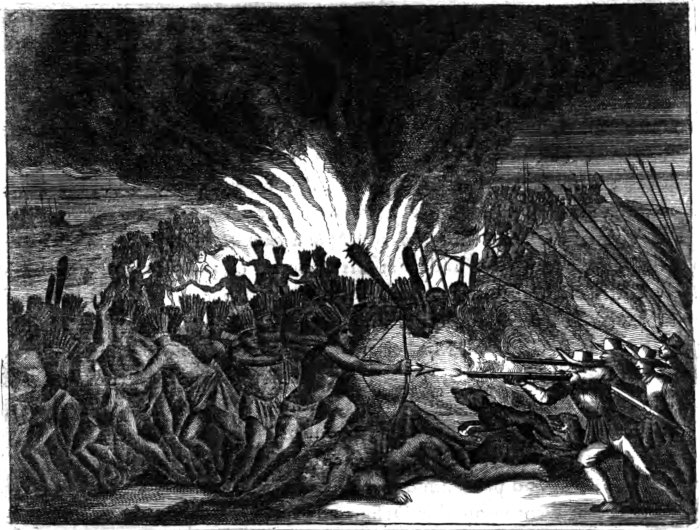
In 1539. one Francisco, a Companion of Cortez in the former Expedition, Set out 392upon his own Charges, and having Coasted all about, both upon the Eastern and Western Shores, he at last Landed, but not without notable opposition from the Natives, who with much clamour, and many antique Gestures set upon his Men so furiously with Stones and Arrows, that they had met with a shrew’d Repulse, had it not been for the Valor of their Auxiliaries, the Mastiff Dogs, which it seems they us’d to carry along with them in those kind of Voyages; but at last he got footing so far, that he took possession in the Name of the King of Spain with the usual Formalities; and following the Example of Columbus set up a Cross in the Place for a Memorial and Testimony of his having been there.
Marco de Nisa his Relation of these Parts.
Much about the same time Marco de Nisa a Franciscan, undertaking a Voyage into these Parts, reported Wonders at his Return, of the plenty of golden Mines, stately Cities, set out with magnificent Buildings, the very Gates whereof were enrich’d with Turquoises, and other Precious Stones, and whose meanest Inhabitants went glittering in Gold and Mother of Pearl, and of the flourishing Condition of the Kingdoms of Acu, Tonteac, and Marata; whereupon the Governor of New Gallicia was sent by the then Vice-Roy of Mexico, with great hopes of bringing back a Confirmation of these Reports; but whether out of spite to be deceiv’d in his Expectation, or having real cause so to do, he represented all things as mean and despicable, as the Fryer had proclaim’d them rich and glorious.
De Alarcon his Voyage.
The next that went upon this Design was Ferdinando de Alarcon, who is reported to have Sail’d many Leagues up a River call’d Buena Guia, and there to have receiv’d Homage of Naguacatus, one of the Heads of the Californian Tribes.
Cabrillo his Expedition.
One more Attempt was made in the Year 1642. by Roderico Cabrillo, who discover’d the Island of St. Luke, and another call’d The Island of Possession; and this was the last we hear of that thought it worth while to go an Undertaker to these Coasts, and ever since all Undertakings hither have been so wholly laid aside, that what-ever was once discover’d in these Parts, seems rather to be lost and forgotten, than any way improv’d.
As for Nova Albion, whereas many determine it to be onely the utmost Northern part of California, though it doth not absolutely appear to be so from the Relation of Sir Francis Drake’s Discovery of it, we judge it agreeable to Method and Decorum not wholly to omit the mention of it in this place, though it hath been already spoken of, and the aforesaid Relation deliver’d at large amongst the rest of those Provinces of largely-taken California, which were taken for granted to be upon the Continent.
Drakes Account of the Countrey.
Drake and his Company brought home this Description of the Countrey and its Inhabitants, viz. That the Countrey was exceedingly well stor’d with Deer, Grazing up and down the Hills by thousands in a company; That the Men generally went naked all over, the Women using onely a piece of a Mat, or some such thing instead an Apron; That their Houses were built onely of Turf and Osier, yet so wrought together, that they serv’d very well to keep out the Cold; in the midst of it was their Hearth where they made their Fire, and lay all round about it together upon several Beds of Bull-Rushes. What their Towns Were, or whither they had any, is altogether unknown.
393