The Third Book, CONTAINING A DESCRIPTION OF PERUANA OR, Southern America. (continued 8)
Reading edition
Grave Maurice receiv’d a Letter from Mascarenhas, wherein he made great complaint of the Netherlanders Actions on Loando, St. Thomas, and Maragnan, during the time of the Treaty, and us’d many Arguments for the delivering back of the Places then taken; but Maurice took little notice of the said Letter, being busie about setling all Affairs in this quiet Juncture of time: He freed all new Planters from the paying of Tenths for seven years, sold several Fields to be Cultivated, repair’d all decay’d Forts, kept the Catholicks in strict awe, ordain’d good Orders for Schools, Alms-houses, and payment of Money, and gave particularly Liberty to the Portuguese both in Spiritual and Temporal Affairs.
The Fort Calvaria taken by the Maragnans and others.
In the mean time sad news was brought, viz. That the Maragnans, assisted by the Portugueses and Brasilians, had taken the Fort of Calvaria near the River Tapicuru, destroy’d all those that were in Garrison, and Storm’d the City Lodowick: Whereupon Hinderson was dispatch’d thither immediately with three hundred Netherlanders, and two hundred Brasilians from Siara; which the Enemy hearing, though there were seven hundred Portugueses, and three thousand Brasilians, left the Island Maragnan, and went over to the Main Continent.
The occasion of this Plot was imputed to the fault of the sottish Governor of St. Lodowick, and his Secretary William Negenton, who by their Folly and Misgovernment provok’d the Natives to Rebellion.
Grave Maurice his Design upon Buenos Aires diverted by Pirez his taking of Pavaosa.
In the interim Grave Maurice had a Design upon the City Buenos Aires in the Southern parts of Brasile, near the River La Plata, where a Way leads by Land to Peru; and whither the Silver and Negro’s were often brought, especially when any Ships were suspected to block up the Channel of Panama.
Whilest Maurice was preparing for this Expedition, news was brought that two Ships had Landed their Men on the Island St. Thomas, under the Command of Laurence Pirez, who had driven the Netherland Garrison out of Pavaosa, and Besieg’d the Fort, out of which many for want of Water ran to the Enemy; and it was fear’d that the same Misfortune would suddenly befall the City Loando and Seregippe del Rey; which prevented Henrick Borer’s Expedition to Chili, and Lichthart’s to Buenos Aires, and so alarm’d Grave Maurice, that he thought it expedient to give speedy notice thereof, to warn the Netherlanders on Angola, that they should keep strict Watches, and beware of the treacherous Portuguese, who affirm’d, That it was lawful for them during the ten years Peace, to re-take those Places which had been taken from them during the Treaty of Peace in the Hague.
Description of the Palmares.
These Proceedings forc’d Grave Maurice to Disarm most of them; and because the Negro’s did much mischief from the Palmares, especially to the Husbandmen in the Alagoas, Maurice gave order to destroy their Habitations. The Palmares were two Villages, built along the River Gungohuby under close Woods, six Leagues Northwardly from Parayba: The Inhabitants of them, being then about six thousand in number, were most of them fled Negro’s, who gathering together in a Head, destroy’d all the Countrey thereabouts: They dwelt in Huts of Boughs and Straw 577interwoven; behind which were Gardens and Orchards of Palm-Trees, and conform’d to the Religion and Government of the Portuguese.
Grave Maurice countersollicited by Agents from the king of Congo and Duke of Sonho.
Whilest three hundred Musquetteers, a hundred Mameluks, and seven hundred Brasilians were fitting to go to the Palmares, there arriv’d Agents at Reciffa from the King of Congo, who brought as a Present to Grave Maurice, two hundred Negro’s, a Golden Collar and Pot, besides many Negro’s for the West-India Company. These Agents desir’d Aid against the Duke of Sonho, who treacherously Plotted to drive the King out of Congo; which Plot was discover’d by scatter’d Letters, Sign’d by the Governors and Bishop at Loando, a little before Loando was taken by the Hollanders. Maurice courteously Entertaining the Agents, proffer’d himself to be a Mediator to decide the Difference, and gave them a long Velvet Coat Lac’d with Gold and Silver Lace, a Silk Coat and Scarf, and a Beaver Hat with a Golden Edging.
Not long after there came Agents from Sonho, to beseech Grave Maurice that he would not assist the King of Congo; one of whom went to the Hague, and was follow’d by two from the King of Congo, who open’d their Letters before the Prince of Orange.
The Agents from Congo, what kind of Men.
The two Agents from Congo were strong and black Men, very active, and having grim Countenances; they Danc’d after a strange manner; and showing the Picture of their King sitting in great State, acted the Postures in which his Nobles and other Subjects shew’d him Reverence: their Strength was such, that they were able with ease to carry each of them two hundred thirty five Pound weight: their Ornamentals consisted of Elephants Tails.
Meneses surpris’d by Niewland after they were come to terms of Agreement.
Alvares de la Benho his Complaint to Grave Maurice of his Country-men.
In Loando the Governor for the Dutch, nam’d Cornelis Niewland, and the Portuguese Governor Peter Cæsar de Meneses, came to this Agreement, That since the ten years Peace was concluded on between the Portuguese and Netherlanders, Meneses should possess the Countrey wash’d by the River Bengo, and call in the ancient Natives to live and Trade as formerly; all which was faithfully perform’d: nay, Meneses furnish’d Niewland with as much Meal as he requir’d, towards the maintaining of a thousand Negro’s, whom he had bought; and the Hollanders and Portugueses began now to be every day more and more friendly and familiar with each other, when on a sudden Niewland not onely remembring what was done lately on the Islands Maragnan and St. Thomas, but also stirr’d up by other later Actions, which gave him occasion of jealousie, sent two hundred Musquetteers in the Night from Loando, to take the Governor Meneses, with some others, who he fear’d might make an Insurrection. The Soldiers accordingly about Day-break fell unawares upon the sleeping Portugueses, kill’d forty of them, and carry’d Meneses and many other Persons of Quality away Prisoners, together with a Booty valu’d at above ten thousand Ducats, and sent a hundred and sixty Portugueses in an old leaky Vessel to St. Salvador; but they being toss’d to and again at Sea for a considerable time, eight of them dy’d, the rest almost starv’d, Landed on Pernambuco; where Simon Alvares de la Benho being amaz’d to see his Countrey-men thus hardly dealt with, complain’d of Niewland, Mols, and Cross, who were the chief of Loando, that they had broke the Laws, and the sworn Articles of Peace; urging that it would be very unjust that the poor Portugueses should not have Satisfaction for the Wrong which they had sustain’d, as also for the loss of their Goods. To which Grave Maurice answer’d, “That Loando belong’d to the West-India Company, and that for his part he had nothing to do with that City, but that if the States were acquainted therewith, they would without doubt be highly concern’d at it.”
Christopher Santches, a free Negro, gave information of the sad Condition of the Island St. Thomas, viz. That the greatest part of the Hollanders that had been left 578upon that Island being dead, Pirez hereupon with the King’s Consent fitted out two Ships, and setting Sail from Lisbon about the beginning of July 1642. first refus’d to pay the usual Custom at the Island St. Thomas, afterwards fell upon the Hollanders, whom he Besieg’d in the Castle, and against the Law of Arms poyson’d all the Waters.
To prevent the future Inconveniences that were likely to arise from a Famine which about this time afflicted the whole Countrey of Brasile, Grave Maurice judg’d it convenient to sell the Lands in the Alagoas to new Planters; to which purpose Henrick Moucheron was chosen Overseer, to take care that all the Fields about Porto Calvo, and along the River Francisco, as also in the Alagoas, should be Sow’n with Bread-Corn.
Grave Maurice takes his leave of the several Governors in Brasile.
Grave Maurice obtaining leave at last to go home, took Leave by Letters of the Governors of Serinhain, Porto Calvo, Iguarazua, Itamaraca, Parayba, Rio Grande, and in Person of the Council at Reciffa, who all thank’d him for his prudent Government, manifesting their hearty sorrow for his departure, Which without doubt would produce many Inconveniences. But though the Council of the West-India Company had order’d him to return home about the beginning of March 1643. yet he went not so soon, because he was to reduce the number of Militia to eighteen Companies, and also to settle the Revenues, and dispose of Offices, in which he found much trouble; wherefore before his departure he wrote to the States of the United Netherlands, assuring them how impossible it was to defend Brasile, which extended some hundreds of Leagues, with so small a number of Men, since the Portuguese cover’d inward malice under a feigned shew of kindness, and at the same time watch’d all opportunities to drive the Netherlanders from their Plantations, being very much exasperated by the priviledge of Religion granted to the Jews, whilest their Monks and Jesuits were banish’d. Moreover, in regard they ow’d the West-India Company above fifty nine Tuns of Gold, they sought to cancel that Obligation, by making themselves Masters of whatsoever their Creditors had in Brasile, so that there was no way but to keep them under by force of Arms.
He leaves the Government and returns home.
After Grave Maurice had sent this Letter to Holland, he left the Government of Brasile to the chief Council, the Militia to Henrick Hoes, Captain of his Life-guard, with Directions for Governing after his departure. Having setled all things in good order, he went from Maurice-stadt through Paratibi and Iguarazu to Parayba; where Janduy sent him three of his Sons, with twenty Tapuyans, desiring him not to go away; two of them with several Carapates and Waypebarans, (a People who made themselves Masters of the great Palmares) and five other Brasilians went aboard with him on the twentieth of May 1644.
The Fleet, consisting of thirteen Ships, and Mann’d with fourteen hundred Men of all sorts, was laden with so many Merchandizes as were valu’d at twenty six Tuns of Gold; with which Grave Maurice arriving at the Texel, Landed at the Helder, and gave an Account of his Government in Brasile, and of the then present state of that part of it which belong’d to the West-India Company.
Ill management of Affairs after Maurice his departure.
Viera’s Treachery.
After Grave Maurice’s departure, Hamel, Bassi, and Bullestraet, bore the chief Command in Brasile: The Charges made by the War were mitigated, and the number of the Soldiers in Garrison reduc’d to sixteen hundred; some Forts lay without a Man in them, whilest the King of Portugal watch’d for such an opportunity; for he seem’d to be as much concern’d for that Countrey, as for his Kingdom of Portugal, and the rather, because his Predecessor Sebastian receiv’d above forty hundred thousand Ducats yearly out of the same, besides the Presents and other Gains made by the Portuguese; wherefore he gave order to the Governor of St. Salvador to be 579very vigilant, and assur’d him, that in a short time he would send him both Men and Provisions. A Mulatto call’d John Fernandes Viera, did not a little assist the Portuguese in their Design; for he having liv’d a considerable time in a Councellors House in Reciffa, had narrowly observ’d all Passages, and insinuated himself into several Statesmens Affairs, by Presenting them now and then with some Rarities, insomuch that he came in time to Farm the Rents which the West-India Company receiv’d from the Sugar-Mills; but at length being discontented because the Council would not make any abatement upon the same, when he complain’d that he lost by Farming the fore-mention’d Tax, he held private Correspondence with Andreas Vidal, that when a convenient opportunity presented it self for the Portuguese to fall on the Hollanders, he might be assisting; to which end he had gotten several Arms and Ammunition together.
In this Plot a Jew nam’d Moses Accoignes, living in Viera’s House, a League from Reciffa, to keep him from Arrests, was perswaded to joyn, which he seemingly promis’d to do; but went away by Day-break, and discover’d the Design to the Privy-Council, who being rock’d asleep by the Portugueses fair Pretences, gave no credit to the Relation.
A Plot against the Netherlanders to be carry’d on by a Wedding.
The Plot discover’d by some of the Conspirators.
For the better carrying on of this Design, Cavalcantelca, Provost-Marshal in Maurice-stadt made a great Wedding for his Daughter in Viera’s House, to which the chiefest Persons of Quality, both of the Portuguese, and also all the Privy-Councellors and Military Officers belonging to the West-India Company were invited: and the Plot was so contriv’d, that whilest they were all at Dinner, the Portuguese were suddenly to fall upon the Netherlanders and kill them, both Servants and Masters; this done, some were to go to Reciffa or Maurice-stadt, with news that the Wedding People were coming; whereupon part were to press into the City, others to keep the Gates, till all their Forces were come thither, which then might easily secure and seize upon the Magazine: some Barques also under pretence of loading Sugar, were in the mean time to set upon the Haven and Fort near the Shore. All things were accordingly prepar’d for the Wedding, nothing being wanting that could be purchas’d with Money, and near the Forts of Rio Grande and Parayba were Stage-plays to be Acted in publick, it being concluded that the Soldiers in Garrison would certainly be there to see them; the Actors being privately Arm’d with Pistols and Ponyards. And to oblige one another the more for the carrying on of this bloody Design, Viera had caus’d the chief Conspirators to take an Oath before the high Altar. The twenty fourth of June 1645. was the Day on which this Tragedy was to be acted; but a few days before two Portugueses and five Jews, who had been sworn Confederates, their Consciences checking them for so villanous an Undertaking, made an ingenuous Discovery of the Plot. The Councellor Moucheron was also inform’d, that the Portuguese Colonel Camaron and Diez were coming with great Forces from St. Salvador.
Viera flies into the Wood.
The Council when they might easily have apprehended Viera, sent for him by a Jew call’d Abraham Coing, under pretence of Treating about some Business concerning the West-India Company; he promis’d to come in the Evening, but suspecting he was betray’d, fled into the Woods, and gave speedy notice to all his Accomplices, who follow’d him in great numbers. The Soldiers sent to search Viera’s House, found none but old Men and Children.
The Councellor Van Houten went immediately with seven Sugar-Vessels to Parayba, fortifi’d the Forts Margareta, Restringa, and Antonio, and made room for the Brasilians that had remov’d thither from their Villages, in the Houses deserted by the Portuguese in Frederick-stadt. On the other side, Amador da Rouge, one of the Conspirators, 580went with a Company from Poiouca through the Countrey, kill’d seven Dutch Seamen, with three Jews, and erected Gibbets, on which he threatned to hang all those who did not take up Arms for the King of Portugal. Colonel Hous inform’d hereof march’d with five hundred Men to Poiuca to meet the Portuguese, who were scatter’d up and down the neighboring Woods. He also publish’d an Edict, in which every one was Licens’d to return to their Habitations, with promise of pardon for their Rebellion, if they would take the Oath of Allegiance anew, onely Viera, Cavalcantelca, and Da Rouge, were excluded, and nine thousand Guilders promis’d to those that brought them dead or alive, which made two hundred Inhabitants in Reciffa march into the Countrey under the Command of Captain Blar, to find the fore-mention’d Traitors; and at last joyning with Hous, they pursu’d the fled Portuguese.
Hoogenstraet sent to Treat with Antonio Silva, is privately tempted by him to deliver up the Fort St. Augustine.
In the mean time the Council sent the Captains Vander Voort and Hoogenstraet, to Antonio Silva, Governor of St. Salvador, to acquaint him with the treacherous Insurrection of the Portuguese, and of Camaron and Diez coming from St. Salvador to their assistance, urging, that these treacherous Proceedings and breach of Oath, could not but redound to the dishonor of the Crown of Portugal. Whereto Silva answer’d, “That Camaron and Diez were not under any Obligation of Oath, but that he would check the Insurrection in Pernambuco, and take care that the Authors thereof should make Satisfaction to the West-India Company.” Notwithstanding which fair Pretences, he so wrought with Hoogenstraet, that after a private Conference between them it was agreed, that for a certain sum of Money he should surrender him the Promontory of St. Augustine, of which he was Governor; but at his Return to Reciffa being made chief Commander of the Castle there, and being jealous what might follow his private Treating with Silva, he declar’d to the Council, that Silva had desir’d him to surrender the Fort St. Augustine, which he had granted, for no other end, but to catch the false Portuguese in their own Nets, and to trapan all such as should be sent to take possession of it; and that if the Council had any suspicion of him, they might make use of his Service in some other place.
About this time a hundred and fifty Tapuyans, led by a German Soldier call Jacob Rabbi, Sallying out of their Woods, fell upon the great Village Conyahou, under the Jurisdiction of Rio Grande, broke into the Church, murder’d all the Portuguese, and eating their raw Flesh, demolish’d the Place.
Hous also unfortunately Storm’d the Mountain Santantan, where the Enemy lay Intrench’d, being forc’d to Retreat with the loss of above a hundred Men, amongst whom was Captain Lo.
Grave Maurice his stately Palace demolish’d.
The Privy Council caus’d a part of Maurice-stadt to be pull’d down, as also the stately Palace Freyburgh, for which the Jews proffer’d Grave Maurice 6000 l. together with the stately Garden, which were thought to exceed the famous Gardens in Thessalia; but on the other side they kept Men at work Night and Day in repairing the decay’d Castle at Reciffa.
Bonavides appears with a great Fleet before Reciffa, but pretends Friendship.
About the same time the Admiral Salvador Correo de Bonavides, brought thirty four great Sail of Ships to an Anchor before Reciffa, the Gallion which he Commanded carrying sixty Brass Guns. The Admiral Lichthart ran to meet him with five Vessels, and sent him word, that if he fell down to Leeward, since he was got to the Windward, he should soon find, that five Ships durst Engage with a Fleet six times as strong. Whereupon Bonavides sent two Messengers to Lichthart to tell him, that he came as a Friend to damp the Portuguese Insurrection in Pernambuco; to which purpose he had already Landed some Companies at Tamandera. Lichthart sending the two Messengers to the Council at Reciffa, they sent two of their own Members to Bonavides, desiring to know of him what call’d him thither with so great a Fleet, and without giving the least notice, contrary to the concluded Peace of ten years?
581
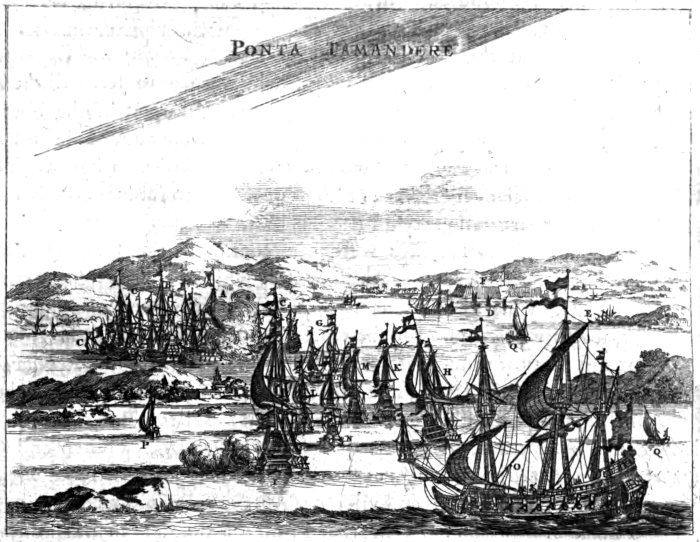
The Names of the Ships both of the Dutch and Portuguese Fleet. A. The Portuguese Admiral. B. Their Vice-Admiral. C. The rest of their Ships. D. Three of their Barques. E. Three Carvels, which lay to watch in the Bay. F. The Enemy’s Battery. G. The Utrecht, being the Dutch Admiral. H. The Ter Veer. I. The Zealand Vice-Admiral. K. The Over-Ysel. L. Salt-Land Pink. M. The Golden Deer Frigat. N O. The Leyden Pink, and Unicorn Frigat. P Q. A Dogger and three Netherland Barques.
Whilest the two Commissioners went with the fore-mention’d Orders to the Portuguese Fleet, a Netherland Vessel endeavor’d, notwithstanding the Wind was contrary, to get out to Lichthart’s assistance; which Bonavides observing, stood away Northerly before the Wind: but Lichthart overtook a Ketch belonging to the Portuguese Fleet.
Serinhain taken by Vidal and others.
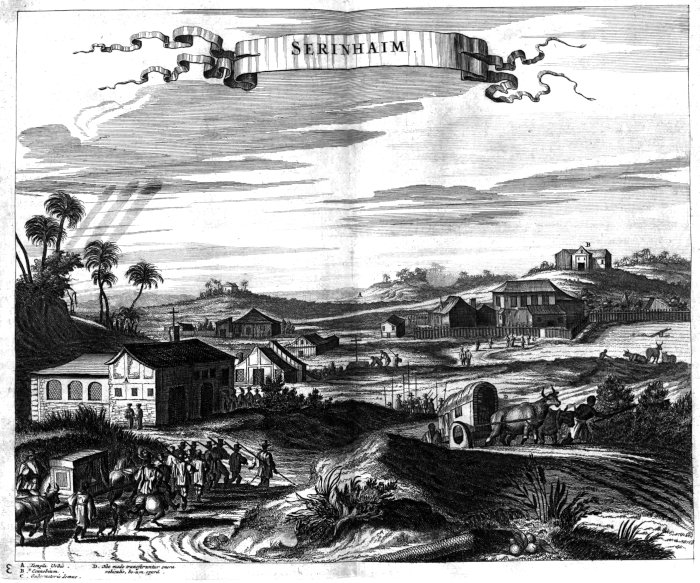
Mean while the Portuguese upon Land being two thousand strong, under the Command of Vidal, Diez, Camaron, and Acoignes, Storm’d the Fort Serinhain, where the French Captain Montagne could make but little resistance, not having above forty Men, and being unprovided of Ammunition and Provision; yet he resisted nine days, and at last got two Barques to convey him to Reciffa.
Soon after this the Portuguese Fleet falling out amongst themselves, Bonavides Steer’d back for Lisbon with a few Ships, the rest coming to an Anchor again near Reciffa; where the Seamen whom Lichthart had taken inform’d him, that their Fleet came the first time to Reciffa for no other end, but to stir up the Portuguese by 582their Presence to take up Arms, according to a private Contract, having to that purpose Landed twelve hundred Men at Tamandera, besides the Army led by Camaron and Diez from St. Salvador to Pernambuco.
Colonel Hous about this time being sent for back to Reciffa, and staying with five hundred Men for Captain Blaek’s coming, who was sent to fetch all the Portuguese Women within three Leagues about Reciffa, was set upon in the Night by Vidal with two thousand Portugueses; the Brasilians, who were above half his Forces, flying into the Woods, leaving onely two hundred Netherlanders to fight with Vidal, by whom being so much over-power’d, they were forc’d to submit to his mercy, and suffer themselves to be all carry’d Prisoners to St. Salvador.
By this time at Reciffa all things were in a confusion, the Pits digg’d about Maurice-stadt afforded nothing but brackish Water, which occasion’d Sickness.
The Fort St. Augustine treacherously surrendered by Hoogenstraet to the Portuguese.
Vidal encourag’d by his Victory, march’d to St. Augustine, where without doubt he had stopt, if Hoogenstraet, who had the chief Command of the Fort, had not been Disloyal; for this Traitor thought it not enough to surrender this invincible Fort to the Enemy, but also bereav’d Reciffa of Provisions and Ammunition, which he did very subtilly, sending earnestly thither for Souldiers, Bullets, Powder and Shot, in lieu whereof he sent thither two Barques full of old Men, Women and Children, that so he might deprive Reciffa of stout Men, and supply their room with unable People. For this treacherous and villanous Act the Portuguese were to give him 1800 l. and make him a Colonel: Moreover, all the Soldiers in Garrison, consisting of three hundred Men, receiv’d 3 l. a Man, and were sent to joyn with a Regiment of six hundred and fifty Men, over which Hoogenstraet was made chief Commander.
Lichthart gains a noble Victory over the Portuguese Fleet.
The day before this eminent Castle was to be deliver’d up to the Enemy, Admiral Lichthart obtain’d a brave Victory at Sea; for the Portuguese Fleet (consisting of seventeen Sail, the rest being gone with Bonavides to Portugal) anchoring before Tamandera, were valiantly set upon by Lichthart, who Engag’d with them on the ninth of September 1645. with the Utrecht, being the Admiral Ship, the Zealand, Ter Veer, Over-Ysel, the Pinks Salt-Land and Leyden, a Dogger and three Barques. In the Hole of the Haven Tamandera three Portuguese Carvels kept Watch, and near a Battery full of Guns lay three Barques, and the other Ships a little farther nigh the Shore. The Enemy at first shot very fiercely from the Battery, whilest the Ships drove to the Shore, and the Men leaping overboard swam ashore, onely the Admiral Jeronymo Serao de Payva made some resistance, but at last surrendred up his Ship, the Netherlanders in their Barques killing above seven hundred Portugueses in the Water. Lichthart burnt the whole Fleet, except the Admiral and Vice-Admiral, which he carry’d to Reciffa.
But this Victory was not comparable to the Loss which the East-India Company sustain’d by the selling of the Promontory of St. Augustine, and the taking of the Forts Porto Calvo and Rio Francisco; to the last whereof the Barques coming too late to carry the Soldiers off, they were all made Prisoners by the Portuguese, as also the Planters, in all to the number of five hundred.
Bouilloux put to Death by the Governor of Parayba.
Vidal marching to Tamarica, Storm’d Schuppen-stadt, but found such resistance from George Garstman (who supply’d the Prisoner Hous his Place) that he lost three hundred Men: After which he endeavor’d by means of Fernandes Bouilloux, to purchase the Fort Margareta for 1500 l. Sterl. of the Governor of Parayba, who immediately without any farther Examination, caus’d Bouilloux that proffer’d the Money to be put to death.
A Dutch Sergeant in Olinda dealt very treacherously; for he sold the Fort to a 583Portuguese Ensign for 100 l. and also most basely betray’d all his Soldiers Lives to the merciless Enemy.
The distressed Condition of Reciffa.
By these means Reciffa was round about in jeopardy, as also within; for the great Thirst of the Inhabitants under a scorching Climate, augmented by the Hollanders salt Meat, could not be quench’d with brackish Water, for fresh was not to be had; Famine also increas’d daily, insomuch that the Poor threatned to fall upon the Rich, which made the Magistrates go Arm’d from House to House, to enquire what Store every one had, which being writ down was carry’d away and put into the Store-houses, where each receiv’d alike share, without respect of Persons. Fewel also grew very scarce, which made many eat their Meat raw, or half dress’d. In the interim every one that was able, was forc’d to work at the Forts of Reciffa, which were beaten down by the Rains; and the Soldiers continually alarm’d by the Enemy, were forc’d to be Night and Day up in Arms. The People dy’d more and more daily, when two Fly-Boats arriv’d there with Provisions, and News, that a Fleet was coming to their assistance.
The Captains Rhynbag and Montagne went in the Night, each with a Company, to fall upon the Enemy, who being two thousand five hundred strong, drove them back, and pursu’d them within shot of the Afogados, where forty Portugueses were kill’d.
About the same time a Terra Neuf Sailor, laden with the dry’d Fish Bocraillo, came to Reciffa.
In Parayba three hundred Netherlanders Sallying out of the Forts, fell so valiantly upon nine hundred Portugueses, that they forc’d them to flye, not without a considerable loss. After which a Party of Brasilians surpris’d eighty Portugueses, as they were at Mass in Andreas Diez de la Figuereda’s Sugar-Mills, where they spar’d none but Figuereda’s Daughter, whose Beauty so charm’d them, that they comforted her mourning for her Father’s Death, and deliver’d her undefil’d to the Governor of Parayba.
The barbarous Cruelty of Vidal.
Vidal raging for madness because now and then some of his Prisoners escap’d, caus’d several of them to be cruelly murder’d, tying some of them Back to Back, and then cutting them in pieces; others he threw with Stones ty’d about their Necks into the Rivers; others he ty’d by their Privities, and hung them upon Trees; and also knock’d out the Brains of others.
The Soldiers at Reciffa mutiny for want of Provision.
In Reciffa the Soldiers, consisting of divers Nations, began likewise to mutiny, crying, They should be all starv’d; and saying, They had better be slain in the Field fighting against the Enemy, than die of Hunger in the City. They also complain’d, The Commissioners themselves betray Brasile; and threatned by force to fetch the Provisions out of the publick Stores, saying, They had long enough endur’d Thirst and Hunger.
A new Fleet sent by the States to Brasile.
The Dutch Fleet set out for Brasile.
These Transactions in Brasile were very ill resented in Holland, the common People in the Hague being ready to pull down the Portuguese Ambassador’s House, in revenge of the Cruelties exercis’d upon the Netherlanders in Brasile, had they not been hindred by the Prudence of Prince Henrick. The Ambassador pretending to be ignorant of the fore-mention’d Passages, proffer’d to make what Satisfaction the West-India Company should require. But the States not satisfi’d with Excuses, when the Actions plainly manifested what their Intentions were, Complain’d to the French King of the unthankful and malicious Dealings of the Portuguese Crown; and meeting but with small Redress, they prepar’d to right themselves by force of Arms, and to that end rais’d several Regiments of Land-Soldiers, besides Seamen, to send to Brasile. The Fleet design’d thither, consisting of twenty two Sail, after it had been frozen up before Flushing three Moneths, set Sail at last in the beginning 584of February, Anno 1646. with the Lord Schonenburgh, a Member of the States, the Councellor Goch, and Treasurer Beaumond, Men very well experienc’d in Governing of Countreys: To these were added the eminent Merchants of Amsterdam, Haeks and Trovire, to keep the West-India Companies Accounts, and Le Heremiet for their Secretary. Sigismond Schuppe bore the chief Command over the Militia, and the Admiral Bankert over the Fleet, which suffer’d the greatest hardship imaginable; for being driven by tempestuous Winds into the Downs, two of them driving from their Anchors were cast away on the Flats. The Fleet getting out again, was once more forc’d by a Storm to put in at the Isle of Wight; from whence by reason of continual Gusts they could not stir in nine Weeks time. During this tedious waiting for a fair Wind, the Brasile Frigat, valu’d at 20000 l. was split in pieces against a Rock of the Island, and of three hundred Men thirty onely were sav’d. A Pink, which came in two Moneths from Reciffa, brought also sad tydings to the Fleet, viz. That the Town was in such a Condition, that without doubt the Fleet would come too late to their assistance: whereupon they making the more haste, endeavor’d, not without great trouble, to weigh Anchor again, whilest the Wind rose higher and higher, and the Waves going very hollow, drove the Ships down towards Portland Coast, full of Rocks, to which they were so near, that they saw a Scotchman split in pieces against them; and had not the Wind come about, and abated of its fury, the Fleet had undoubtedly perish’d. No sooner was this Danger past, but another succeeded; for the Soldiers in the Admirals Ship complaining of the small allowance they had of Cheese, Brandy, and Tobacco, had made themselves Masters of the Store-room, and threatned to kill the Lords Goch and Beaumond; but they, assisted with Men from the other Ships, who came in at the Cabbin Windows, so order’d the Mutineers, that they ask’d forgiveness, which for many Reasons was granted, onely they were distributed by seven in a Ship throughout the whole Fleet. After a great Contest between Goch and Beaumond about carrying the Flag, which could not be decided, Goch was left by the rest of the Fleet, who Steer’d another Course, and getting near the Line, lay becalm’d six days; in which time he lost very many of his Men by a strange kind of Scorbute which rag’d amongst them; at last Sailing along the Promontory of St. Augustine, he came to an Anchor before Reciffa, which he found in the greatest Exigency imaginable, insomuch that it was resolv’d upon, the next day to surrender the Place up to the Portuguese, on promise of Quarter onely: which Resolution none oppos’d more than the Jews; for the Portuguese swore that they would burn them alive, if ever they became Masters of Reciffa, which made them resolve to die with the Sword in their Hands, and sell their Lives at a dear rate. Six Weeks after Gochs Arrival, the remaining part of the Fleet, escaping many dreadful Storms, in which, besides the two that were lost in the Downs, they lost five Ships and five hundred Men, arriv’d also at Reciffa; where the Commissioners appointed Officers to distribute to every one their certain allowance of Victuals. The prime Councellor Schonenburgh also decided the Difference between Beaumond and Goch, as also between Haeks and Trovire, about their Places in the Assembly, viz. that they should sit above one another by Turns. The old Governors, Hamel, Bassi, and Bullestraet, were blam’d by every one for the decay of Brasile; and being sent to Holland, were receiv’d with frowning Looks, and rail’d against in Pamphlets as faithless Persons, who sought nothing but their own advantage, and were threatned to be call’d to an Account. It was also laid to their charge, that they had not given a true Account of the State and Condition of Brasile; that the State was much more decay’d than they had made known, by which means the present Power prov’d too weak to do any thing to the Enemy.
Garstman Fin’d and Disgrac’d upon King Dary’s Complaint.
585Amongst other Misfortunes which befell the West-India Company, the Revolt of the Tapuyans and other Brasilians was not the least, which hapned upon the occasion of Garstman’s putting to Death of Jacob Rabbi, a German, and indeed their chief Ringleader in all Robberies and Villanies; but Dary their then King alledging that Rabbi was wrongfully Executed by Garstman, and that his Tryal belong’d to him as King, prosecuted Garstman so vigorously, that he and his Ensign Jacob Boulan, his Accessory in the Fact, had their Goods and Salary confiscated, and they themselves were sent home in disgrace.
The Portuguese Invitation prevails above the Netherlanders.
Mean while the Council seeing that there was not much good to be done by force of Arms, endeavor’d by mild ways to invite the revolted Portugueses, who were all promis’d Pardon for their Insurrection in an Edict which was publish’d in all places, onely Viera, Almado, De Rouche, Antonio Calvantelca, and Hoogenstraet, for whom great sums of Money were offer’d, were excepted. The Portuguese on the contrary publish’d, That they would receive all those Netherlanders into favor that would come over to them, and pay the Debts which they ow’d to the West-India Company, and also Transport them whither they pleas’d. These Promises, written in English, Dutch, French, and Portuguese, and hung every where on the Boughs of Trees, and other publick Places, operated much more than the Privy-Councils Edicts; for in stead of one Portuguese that came to them, several ran to the Portuguese from Reciffa, notwithstanding a strict Guard was kept to prevent them, besides the great mortality amongst the Soldiers and Inhabitants through several raging Distempers, and want of fresh Provisions: Which general Calamity, it seems, very much cow’d the Spirits of those that were left; for in a Sally meeting with five hundred Portugueses, notwithstanding they were equal in number, yet they made a shameful Retreat; yea, though Schuppe came with eight hundred Men to their assistance, yet he could not prevail with them to face about either by fair means or foul, for with his own hand he Ran-through an Ensign, Sergeant, and two Soldiers, who ran away first. Yet notwithstanding this base and cowardly Retreat, it was resolv’d on to set upon Olinda and the Promontory St. Augustine; and at the same time Hinderson was sent to make himself Master of Rio Francisco with fifteen hundred Men, and to harrase all the Countrey thereabouts with Fire and Sword, that so he might force the Portuguese to leave Reciffa.
Revolt of the Tapuyans.
Though John Dary, King of the Tapuyans, seem’d well enough contented with the punishment of Garstman, yet a great Party of his Subjects were not satisfi’d, but went and joyn’d with the Portuguese, because Garstman had not been deliver’d to them in Siara, where they kill’d all the Netherlanders they could meet with, and sent Presents to their King Dary, if possible, to oblige him to joyn with the Portuguese: But he reply’d, That he had more reason to punish them for their ill usage of the Inhabitants in Siara, than to have any thing to do with the Portuguese.
The Council inform’d hereof, sent the Interpreter Ralph Baron, who had a long time Convers’d with the Tapuyans, with a Present of Axes, Knives, Looking-glasses, Shirts, Combs, and the like Trifles, to King Dary, desiring him to continue his former kindness towards the Hollanders; which Dary promis’d, provided he might receive Assistance from Reciffa against those whom he had made his Enemies for the Netherlanders sake; which Baron promis’d should be done as soon as the fresh Forces which were daily expected from the Texel, Maes, and Zealand, came to Brasile.
The Fort of Rio Grande taken by Hinderson.
Capt. Montagne overpower’d by the Enemy, and slain.
Hinderson Landing at Rio Grande, took the Fort without firing a Gun, the Portuguese at his first coming flying into the Woods. He found here abundance of Cattel; for no place in the World breeds more than this, several Husbandmen having fifteen thousand Head of Beasts, of which many were taken to supply the want of Provisions 586at Reciffa. As soon as he had taken the Fort, he caus’d it to be pull’d down to the Ground, because it stood in an inconvenient place, and immediately rais’d another, which was much better to be defended, by reason of the rising Ground; but he could neither bring that Work, nor any other Design to any perfection, because of the treachery of his Soldiers, who being most of them Roman-Catholicks, were so inclin’d to the Portuguese Interest, that they daily more and more deserted the Companies Service, and gave Intelligence to the Enemy of their Transactions. Amongst others, an Antwerper was apprehended for an Intelligencer, and being Hang’d on a Gibbet, fell three times one after another on his Feet, the Halter breaking like a burnt Thred, which gave him so many times of respit and opportunity of supplicating for Life; but his Crime was too hainous to admit of Pardon. Mean while the fled Portugueses being supply’d with fresh Supplies from all Places, especially from St. Salvador, to the number of twelve hundred Men, they kill’d the Out-watches, consisting of twenty Men: The next Sentinel being warn’d by the noise, alarm’d the new Fort, which was scarce finish’d, because a mighty Shower of Rain had wash’d away the Walls. Hinderson being wounded in the Leg, sent Captain Montagne against the Enemy, of whose Power he was sensible; yet going to the place where the Watch that was kill’d had kept their Station, he met with two hundred Portugueses, divided into three Companies, and drawn out for Battel, who running away were pursu’d by Montagne, till coming up to their Regiment, which consisted in all of a thousand Men, divided into five Companies, they fell on all sides upon Montagne, who fighting valiantly, was overpower’d and kill’d, with three hundred of his Men, and almost as many more taken Prisoners; amongst whom was the Minister Astette, four hundred onely escaping into the Fort, where Hinderson stay’d expecting the event of Montagne’s Exploits.
This Defeat spoil’d Schuppe’s Design, who by his marching to Rio Francisco thought to draw the Enemy from Reciffa; but now being forc’d to think of some other way, he thought it convenient to invade St. Salvador by Sea, as the Enemy had done Reciffa by Land. Wherefore Hinderson receiv’d order to stay with six hundred Men (being all that were left of fifteen hundred,) on Rio Grande, whither a Barque with Provisions being sent, was taken, and the Men in cool Blood kill’d by the Portuguese.
Schuppe’s Victory on the Island Taperica.
Lichthart’s Death.
At the same time it was given out, that Schuppe was going with the Admiral Bankert to Hinderson’s assistance; and to delude the Portuguese the more, Schuppe went with two thousand five hundred Men to Rio Francisco, where he lay some days at an Anchor; upon which the Governor of St. Salvador sending several Companies thither, Schuppe Sail’d with all speed to St. Salvador, and Landing on the Island Taperica, four Leagues in circumference, he got a rich Booty, and spar’d none whome’re he met with, insomuch that two thousand were destroy’d, some by the Sword upon the place, others by their haste to get over to St. Salvador; for most of the Vessels being too full, sunk with them. Amongst the Prisoners that were taken and sent to Reciffa, were two Monks, who were design’d the same Entertainment as the Minister Astette should receive in St. Salvador; whereupon they immediately wrote to their Fraternity, to take care that Astette should not be burnt alive, as the Portuguese had threatned, because they were to expect the same usage: whereupon Astette was set at liberty, and had leave to walk up and down the Streets of St. Salvador. Schuppe fortifi’d himself on Taperica, near an Inlet under the new Works, and together with Lichthart watch’d for all Portuguese Vessels: But Lichthart dying here, was carry’d to Reciffa, and there bury’d. On the other side, the Governor of St. Salvador sent fifteen hundred Men in the Night to the other side of Taperica, 587where with all speed they Intrench’d themselves, and Sally’d daily out of their Works upon Schuppe, so that many Men were lost on both sides; but Schuppe was in the worst Condition, in regard his Soldiers ran over in great numbers to St. Salvador, where they were well Entertain’d; of which he advertis’d the Privy-Council, who were the less able to give him Redress, as having the same cause of Complaint.
A pitiful Example of a young Soldiers Execution.
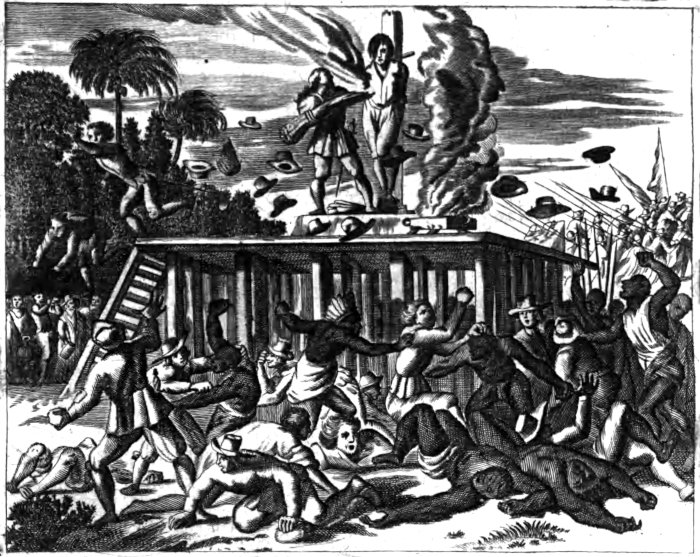
Amongst others there hapned a sad Accident of a young Soldier, scarce sixteen years old, and born at Roan, who having robb’d his Father’s Cash, went in a Ship to Holland; where he lavishly spending the Money, was forc’d at last to List himself in the West-India Companies Service, and coming with the fore-mention’d Fleet to Reciffa, endeavor’d with two Companies to run to the Portuguese; but overtaken, was Try’d for the Fact, and Condemn’d to be Hang’d, for none of his Excuses which he made, of going over the River onely to fetch some Oranges and Lemmons to refresh himself, would save him, nor his protesting that he had no intention of going to the Enemy, nor the Promise that his Father should release him for ten thousand Crowns, nor his Minority, which ought chiefly to have been consider’d, but that Necessity stopt the Ears of the Compassionate; so that his Execution drew pity from the Beholders a few Weeks after.
A notable Passage of a Portuguese, Executed for Treason.
A very astonishing Passage hapned at Reciffa upon another Sentence of Death pronounc’d against a Portuguese, who after the publication of the Act of Pardon came to Reciffa, and there hir’d a Seaman for two hundred Crowns, to carry a Letter, made up in a Leaden Box, to the Governor of the Promontory of St. Augustine, with order that if he was set upon any where, he should throw the Box into the Water. The Letter written in strange Characters, contain’d a Declaration of the small number of Men in Reciffa, most of the Netherlanders Forces lying on the Island Taperica, so that if Reciffa were Storm’d along the Bank, and from Maurice-stadt, it might easily be taken. This Letter being intercepted, the Portuguese was taken and Condemn’d, and as he was carrying to the Place of Execution cry’d aloud, You People take delight in my Death, but you shall be interrupted; and indeed it hapned accordingly: 588for when the Executioner began to scorch the half-strangled Criminal with Straw, there sprung up a strange Spirit of Contention amongst the Spectators, who began to justle and strike one another; and soon after a Whirlwind rose in the midst of the Market-place, which in a moment caus’d them all to stagger like drunken People, their Hats and Caps were blown up into the Air, the whole multitude tumbling confusedly on the Ground, the Arm’d Soldiers flying to the next Houses, and the Executioner falling down in a Trance from the Scaffold: A full quarter of an hour this Confusion had lasted, when the People came to themselves again, and the Hangman return’d to his Business, cutting off the Portuguese’s Nose, Ears, Privy-Members, and tearing out his Heart, which he threw to two Dogs, who devour’d the same; then dividing the Body into Quarters, which were set up at the four Corners of the City for an Example.
The same Punishment receiv’d a Mulatto, who endeavor’d to fire two of the Hollanders best Ships in the Haven.
Notwithstanding these Punishments, the Soldiers ran away daily; the blame whereof might justly be laid on the Magistrates, who took no notice of the Soldiers just Complaints of their Officers, cheating them of a third part of their Provision, and inflicting severe Punishments upon them as Mutineers, when they had real cause of Complaint.
Schuppe was at the same time shrewdly put to it for want of Men, who either dy’d of the then reigning Disease, or ran away to the Enemy; so that he was forced to leave the Island Taperica, and inclose himself within his new rais’d Sconce.
Admiral Bankert gains a great Victory over the Portuguese Fleet.
The Admiral Bankert had better success; for Cruising up and down before the Inlet Todos los Sanctos, after the taking and sinking of several Ships as they came in his way, he at last set upon the Portuguese Fleet, consisting of seven great Ships, of which one got to St. Salvador, another was sunk, and the other five were taken, being valu’d at twenty Tuns of Gold, or 200000 l. Sterl. In this Engagement were kill’d above four hundred Portugueses, besides two hundred and fifty who were taken Prisoners, and sent Shackled to Reciffa. Amongst them was the new Vice-Roy of Brasile, the Admiral, Vice-Admiral, three Monks, and several other Persons of note.
Marshal Hous arrives at Reciffa with a fresh Supply.
This Victory began to give some Breath to Reciffa, when at the same time Marshal Hous arriv’d there with seven Ships, Mann’d with five hundred Soldiers. This Hous on the seventeenth of August, Anno 1645. had been taken Prisoner at the Engenho having fought so long till all his Powder was spent, so that he was forc’d to surrender himself upon promise of Quarter to Vidal, who after he had taken an Oath upon the Bible, to spare the Lives of all the Hollanders and Brasilians fell upon the Brasilians and slew them, being a hundred in all, in Cold-blood, who yet sold their Lives at no easie rate. Being carry’d Prisoner, together with Captain Bristow, Listry, Wildschut, Blar, and two hundred more, by Viera to Casa de Prugar, he was thence sent to Portugal, where being releas’d, he brought News to the States of the mean Condition of the West-India Company, and that all things must needs be lost, if they did not speedily take the Business into Consideration: Whereupon he was furnish’d with a Supply of Ships and Men, with which he set Sail for Brasile; where being arriv’d, most part of the Soldiers he brought with him were Transported to Taperica, to assist Schuppe; who as soon as they came to him, march’d into the Countrey; where being set upon by a thousand Portugueses, he lost sixty Men.
Soon after Hoogenstraet receiving Orders from the Governor of St. Salvador, who was inform’d by some Prisoners, that Schuppe had not above twelve hundred fighting Men, to fall upon him with three thousand, made a furious Assault upon the 589Sconce in two places, and Storming the same for two hours together, lost four hundred Men, which made him draw off a little before Day-break.
In the interim nine Privateers, fitted out by several Merchants of Holland and Zealand, came to Cruise up and down before the Coast of Brasile; which the States the rather allow’d of, because the West-India Company was not able to send any more Supplies thither: Nor was it long ere they took five Portuguese Prizes, and afterwards (joyning with Bankert) four more laden full of Sugar, in the Haven Todos los Sanctos, where they threw a hundred and twenty Portuguese, and fifty revolted Hollanders overboard.
The Council of Reciffa send over Messengers to represent the sad condition of the Place.
Bankert’s Death and Character.
Reciffa being at that time reduc’d to very great straits, earnestly implor’d Aid from the States, but to little purpose, by reason of the Differences amongst themselves, which hapned upon this occasion: The Spanish King by his Agent in the Hague made Overtures of Peace, and proffer’d to fall upon the Portuguese in Brasile: to which Proposition, whenas the rest of the States seem’d inclinable, those of Zealand would no ways hearken, being resolv’d to have nothing to do with Spain. The news of this Dissention exceedingly perplex’d the Council at Reciffa, especially when to that news was added, that Bankert, the onely terror to the Enemy at Sea, was Commanded home by the States of Zealand, which yet the General States strictly forbad. Whereupon they thought fit to send one of their Assembly to the Hague, to make the States acquainted with the miserable Condition of Brasile, and to Expostulate with them for their insensibility of their Condition, and to let them understand, that ten thousand Men would not restore Brasile to its former Condition: Every one strove to be the Messenger of these sad tydings, but especially their President Schonenbergh wish’d it might be his lot to leave the unhappy Countrey of Brasile; but because his departure would not have been without great murmuring of the People, Haeks was sent in his stead. Together with him went Hinderson (who was in no esteem since the Destruction on Rio Grande;) they both Embarqu’d on Bankert’s Ship and five others, which in stead of being laden with rich Commodities, and ballasted with Sugar, as heretofore, were fraught with discontented Seamen, decrepid and sick Soldiers, unserviceable Jews, poor Travellers, Portuguese Prisoners, and onely ten Weeks Provisions; whereas all other Vessels at their Return from Brasile us’d to have Provision for three Moneths, which at this time could not be spar’d. The Council also made Orders what Persons should go with the fore-mention’d Ships, viz. None but those whose Names were written in the Lists which had stuck six Weeks at every Church Door, that by that means no Creditor might suffer by his Debtors going away, nor any Criminal escape his deserved punishment. Bankert had scarce been a Week at Sea, when he dy’d of the Palsie: he was a Man, who for his valiant Exploits was from a Fore-mast Man preferred to be Captain; which Office he perform’d with great Prudence and Valor; but that which first made him most eminently taken notice of, was his Engaging with thirteen Dunkirkers, of which he sunk three, and being boarded by three more, and fir’d at by the rest, he refus’d to surrender his Ship on promise of Quarter, but plac’d his eldest Son with a lighted Match in the Powder-room, commanding him on pain of Death to blow up the Ship with the three Dunkirkers as soon as he gave the Word; which valorous Resolution so amaz’d the Enemy, that they let him go. He also behav’d himself bravely in the Downs against the Spanish Admiral Oquendo. His two Sons that were present when he gave up the Ghost, would not have his Body thrown overboard, notwithstanding it stunk so intolerably, that all the Provisions in the Ship were tainted by it; therefore taking out his Entrails, they Salted the Body, wrapt it up in four Sail-cloths, and nailing the same up in a pitchy 590Chest, bury’d it under the Ballast. Mean while the Fleet approaching the Flemmish Isles, was surpris’d by a terrible Storm, in which the Vice-Admiral’s old Ship split asunder, but most of the People were sav’d. Between Calice and Dover they met with eight Ostenders, against whom they made themselves ready to Fight; but they, according to the King of Spain’s Order, instead of Hostility shew’d them Friendship. All their Provisions were spent, when they happily Anchor’d before Flushing, where Bankert’s Body was Interr’d with great Solemnity.
Overtures of Peace from the Portuguese refus’d by the Netherlands.
In the interim the United Netherlands had fitted out another Fleet to assist Reciffa, the West-India Company having first demanded of the King of Portugal two hundred and eighty Tuns of Gold, to the value of which they affirm’d themselves to have been damag’d by the Insurrection of the Portuguese. On the other side, the King of Portugal was in a quandary about the Business of Brasile; for first, he had no other thoughts but that Brasile would have fall’n into his hands within the space of three Moneths, because the Plot there was so subtilly laid; neither did he think the States would have concern’d themselves with the West-India Companies Business, which now it was manifest they did. Besides this, there was a third Inconvenience, viz. that the Spanish Crown endeavor’d to conclude a Peace with the United Netherlands; wherefore that he might put a stop to the sending of the Fleet to Brasile, he dealt with the French Ambassador to make very advantageous Proffers in his behalf, viz. That he would surrender all the conquer’d Places, and make good all the Damages that had been sustain’d thereby. The Fleet appointed to go to Brasile was hereupon stopt, till the States had Consulted about an Answer on the fore-mention’d Propositions; but when Haeks brought news of the falshood of the Portuguese, the Scale was immediately turn’d, insomuch that the Portuguese Ambassador went in danger of his Life, till the Mutineers were put into Custody. Moreover the Fleet was order’d to Sail with all speed possible to Reciffa, with promise that another Fleet should soon follow with six thousand Men; but the many disconsolate tydings that had been brought of late, of the hardships and sufferings of those that went before, through the unwholsomness of the Climate, the want of Provisions, the Strength and Cruelty of the Enemy, made the Seamen and Soldiers very unwilling to go so fatal a Voyage, insomuch that as many as could, made their escape: yet at last, on the last day of December, Anno 1647. the Fleet set Sail under the Command of Corneliszoon de Wit; some Weeks before which Schuppe was forc’d to desert the Island Taperica, to go and aid Reciffa, which the Portuguese from a rais’d Battery on the other side of the River Biberibi shot at so incessantly, that none were safe either in their Houses or in the Streets.
Mean while the Portuguese Agent, Francisco de Sousa Continho, proffer’d the States to go to Brasile himself, and cause to be restor’d all those Places which had been taken from the West-India Company, particularly the City St. Salvador and Tercera, besides Reparation for all other Damages.
Grave Maurice his high Demands.
At the same time Grave Maurice was Treated with to go to Brasile again, but his Demands were so high, that it came to nothing; for he requir’d 4000 l. yearly to spend at his Table, and 5000 l. besides during his Life; also 2000 l. to set him out, and twelve thousand Men to Besiege St. Salvador, which was always guarded by four thousand, and thirty Carvels lay ready before Lisbon to carry four thousand more thither.
Angola and Loando taken by the Portuguese.
All things went very ill on the Hollanders side at this present; for besides that the fore-mention’d Fleet had not its wish’d success, most of the Men being destroy’d by the immoderate Heat of the Climate, Angola and Loando were also taken by the Portuguese.
591These Misfortunes made the West-India Company begin to be very forward to come to a Treaty with the Portuguese Agent, who before seem’d rather to court them, having offer’d to Engage for the restoration of whatever they possess’d at that time, when the ten years Peace was concluded; but when they came to insist upon that Point, he answer’d, That he must expect new Orders from Lisbon concerning Loando, because the taking of that Place caus’d an alteration in the state of Affairs. But the States no way satisfi’d with Delays, that were like to prove both hurtful and disgraceful, resolv’d to put into Execution what they had before agreed upon, viz. The East-India Company was impower’d to make Prize of all Portuguese Ships towards the payment of the fifteen Tuns of Gold ordain’d for the West-India Company, to help them against the Portuguese Oppression. The West-India Company also receiv’d Commissions to Cruise for Portuguese Vessels before Brasile.
Schuppe and Coche miserably defeated as they were Besieging Gararapes.
On the seventeenth of February, Anno 1649. three thousand Soldiers that came over in the fore-mention’d Fleet, besides two hundred Negro’s, and as many Seamen, marching to Besiege Gararapes under the Command of Schuppe and Coche, were so furiously set upon by the Sallying Enemy, that they were forc’d to break up the Siege in great disorder, whilest the Portuguese being in number two thousand five hundred, fell upon the Rere; and though the Dutch Officers us’d all the care they could possible to bring their Men to face about, yet they were not able to keep them from running away; in which flight great slaughter of them was made by the Portuguese Horse, consisting of a hundred and thirty, Arm’d with Lances, insomuch that in the flight and the pursuit, a thousand Netherlanders were slain, and nineteen Ensigns or Colours were left behind as Trophies for the Portuguese; the chief of the Slain were Colonel Brink and Houteryve.
The Zealanders were much concern’d at the improsperous Affairs of Brasile, in regard a fifth part of the West-India Companies Stock belong’d to Middleburg, Flushing, and Veer, insomuch that the Complaints of Widows and Orphans that shar’d in the common loss, mov’d the States to fit out six great Ships, and as many Ketches, Mann’d with two thousand eight hundred Men, for Brasile, where all things ran to ruine, the Grandees both of the Council, Army, and Fleet, being at variance, and impeaching one another.
The rest of the Provinces, especially Friesland, being less inclin’d to the West-India Company, were somewhat colder in the pursuit of this Business; nevertheless, upon a fresh Letter of Complaint from Walter Schonenbergh, President of the Brasilian Council, they held a Consultation together, how to raise Moneys for the fitting out of twenty Ships and five Ketches for the Relief of Brasile.
De Wit releas’d from Prison, justifies his Return.
The Admiral De Wit returning home, was, upon the accusation of the Council in Brasile, and the General, Sigismond Schuppe, made Prisoner in the Hague; and together with him the other five Captains that went with him were Committed by the Admiralty, for returning without the Consent of the Council; but they were soon releas’d by the Magistrates of Amsterdam, who upon the Admiralties refusing to deliver them, commanded their Provost-Marshal to break open their Prison Doors. De Wit after his Releasement justifi’d what he had done before a full Assembly of the States, and alledg’d that it was according to the Orders he receiv’d when he undertook this Expedition.
The Portuguese Agent, Sousa Macede, obtaining Audience of the States, told them how ready the King his Master had been to come to a perfect Agreement of Peace with them, but that their own Acts of Hostility had been the occasion of the breach of that Treaty of Peace that had been concluded on; that the Robberies and Insolencies committed by those Portugueses under their Jurisdiction, was not any way 592authoris’d or countenanc’d by him; lastly, he offer’d them free Trade to Brasile eighty Tun of Gold to the West-India Company, 800000 l. to the Orphans and Widows in Zealand, and payment of all private Debts. But making no mention of restoring the Places in Brasile, he seem’d to mock the States; who resented it so much, that they would admit of no farther Conference with him.
Schuppe, Haeks, and Schonenbergh declare the Reasons of the loss of Reciffa.
Mean while the West-India Companies Business in Brasile went daily more and more to ruine, insomuch that in the Year 1654. they lost all their Forts and Places of Strength and Habitation, and amongst them Reciffa, the chief Residence of the Council of Brasile, who returning home, brought nothing but a doleful Relation of their unfortunate Proceedings. Schuppe, Haeks, and Schonenbergh, made each of them a long Oration, setting forth the sad Condition of the Place, and the Miseries they had endur’d a long time before they left it; also excusing their total quitting thereof to the Enemy by the great want of Provisions and other Supplies, which they so often had written for in vain, at least receiv’d short of what their Necessities requir’d, and by the Clamours of the Soldiers, who were ready upon all occasions to Mutiny or Revolt, as appear’d by their crying out upon the discovery of a Fleet of Portuguese upon the Coast, Behold our Deliverers from the Netherlanders Tyranny; lastly, by the growing Power of their Enemies, which they could not have resisted, though they themselves had been much stronger than they were.
They are try’d at a Council of War.
But the West-India Company sensibly touch’d at the thoughts of their Losses, were not satisfi’d with the Relation of Schonenbergh, Haeks, and Schuppe, but requir’d a Journal of every days Transactions, or Testimonies to confirm the truth of their Relation: They also demanded an Account of the Condition of the Store-houses when Reciffa was surrendred, and fell upon them with several Interrogatories, viz. Why the Fort Afogados was forsaken? Why the Garrisons were not drawn in from the North to Reciffa? Why they did not keep footing on the Land, and guard those Places they had left when Reciffa was lost? Why they made such ado for want of Provisions and Ammunition to dishearten the People? Why the Money proffer’d by several Citizens was not taken? Why they did not burn the Enemy’s Fleet, since, according to the opinion of several, it might easily have been done? How they could testifie the Sedition of the Soldiers, since none of their Commanders complain’d of it? Whether they us’d any Means to encourage the Besieged? Who did, and who did not consent to the Surrender? Whether no better Terms could have been made? In fine, they prevail’d with the States to secure Schonenbergh, Haeks, and Schuppe, in their Houses, and on the ninth of September, Anno 1654. brought them before a Council of War in the Hague, where the chief things objected against them were, That the Portuguese had gotten by the Conquest of Reciffa, above two hundred Brass Guns, most of them Demi-Culverins, and four hundred Iron Guns, valu’d together at ten hundred thousand Rixdollars; That the Store-houses were sufficiently stock’d with Provision and Ammunition; That they took care to secure their own Goods, but left what belong’d to the West-India Company as a Prey to the Enemy.
Their Pleas.
Schuppe condemn’d at a Council of War to lose his Salary.
Schuppe on his part alledg’d, that he could do nothing of himself, as being under the Command of the Brasilian Council. Haeks and Schonenbergh pleaded the want of Men, by reason of the many that daily dropt from them, either by Death or Defection, to the Enemy, and those that remain’d, unsafe to be trusted, as consisting of so many different Nations, also their being block’d up at the Sea by the Portuguese Fleet, the great want of Ammunition, especially Instruments of Fortification; lastly, the head-strong Resolutions of the Soldiers, to deliver up the Place, whatever their Officers should determine to the contrary; notwithstanding which, 593to shew that it was not quitted upon disadvantageous terms, they produc’d the Articles of Agreement upon which it was surrendred to Francisco, Governor of Pernambuco. In conclusion, the Council of War pass’d their Sentence on Schuppe, viz. That he should lose all the Sallary that was due to him from the West-India Company since the twenty sixth of January 1654. when he Sign’d the Agreement with Baretto for the delivering up of Reciffa.
Thus the Portuguese recover’d full and absolute possession of Brasile, yet not without fear of an afterclap of War; wherefore the Portuguese Agent, upon condition of an absolute Peace to be concluded, proffer’d the States General in the Hague, Satisfaction for the Damages which the West-India Company had sustain’d in Brasile, eighty Tun of Gold, a free Trade to Brasile, and payment of the Debts due to them from several Portugueses in Brasile; but told them, that to surrender them any Places there, was not in the power of the Portuguese Crown. On the other side, the Spaniard proffer’d to assist them in the total Conquest of Brasile, and to restore them those Places they formerly possess’d, as soon as they had subdu’d the Portuguese; to which the Zealanders began to hearken, who being great Losers by the Portugueses Treachery, wish’d for nothing more than Revenge; but Holland having a great Trade to Portugal, was more inclin’d to Peace: Whereupon His Majesty of great Britain proffer’d himself to be Mediator between the Portuguese Crown and the United Netherlands; and accordingly on the sixth of August, Anno 1661. a Peace was concluded with Portugal on these Terms:
Articles of Peace between Portugal and the United Netherlands.
I. That Portugal was to pay to the United Netherlands eighty Tun of Gold, either in ready Money, Sugar, Tobacco, or Salt, or deduct the same out of the Customs payable in the Portuguese Harbors.
II. That the Guns on Reciffa were to be restor’d to the West-India Company.
III. That the Salt-Trade at St. Uves and other Places under the Portuguese Jurisdiction, whether in Africa or Brasile, should be granted to the Netherlands, paying the Customs as the Portuguese do themselves.
IV. That the conquer’d Places gotten on both sides, should remain in the hands of the present Possessors.
V. That the King of Portugal should not lay an Embargo on any Netherland Vessel, on any pretence whatsoever, though they should carry all manner of Ammunition to his Enemies, provided it were not out of any of the Portuguese Havens.
VI. That no Netherlander should ever be call’d before any Judge about any Difference in Religion, but should have freedom thereof granted him, either in his House or Ship, and also a convenient Burying-place.
VII. That if any Difference should chance to arise between Portugal and the Netherlands, they should not extend it to prejudice the Trade, but every Merchant should be free to call in his Debts, and send Ships without hinderance.
VIII. That this present Agreement should not be broken by any Misdemeanors acted by any Subjects, either in the East or West-Indies, who were to be punish’d by their lawful Judges.
IX. That the Havens belonging to both Parties were to be free for either Men of War or Merchant-Men.
X. That the Netherlanders Trading in Portugal, might go Arm’d, take Houses and Store-houses.
XI. That the Goods laden in an Enemy’s Ship might be declar’d free Prize.
XII. That the Portuguese in Brasile should pay their Debts which they ow’d to the West-India Company, or any other Person or Persons; to which purpose three appointed Commissioners were to Sit at Lisbon, to hear and determine the Causes that should be brought before them, and 594without the usual Circumstances, pass their Sentence, which was to be Executed by a higher Power.
A few days after this Agreement was concluded, the Portuguese Ambassador, Henrico Sousa Tovares, went for Lisbon, where he arriv’d on the last day of September.
The States of Groningen and others, disapprove the Peace with Portugal, and condemn Schulenbergh.
Not onely Guelderland and Zealand, were much dissatisfi’d with this Agreement, but also Groningen accus’d their Deputy Schulenbergh, that contrary to Orders he had been too forward in concluding the Peace with Portugal, and that he had consented to that which the States of Groningen had not permitted him; for they resolv’d to make Peace on no other account, but that Portugal should pay the eighty Tun of Gold in ready Money, and that in a short time; whenas on the contrary, he had allow’d of the payment in Merchandise, and that in a long time. Wherefore the States of Groningen (who for this Fact and several Accusations brought against Schulenbergh, condemn’d him to be Beheaded, which Sentence had been Executed upon him, had he not made his Escape) together with those of Omeland, and others, who disapprov’d of the Peace concluded with Portugal, drew up many Reasons why they dissented, and look’d upon it as both dishonorable and disadvantageous; however, the Articles being Sign’d, and the States General, taking into consideration how impossible a Work it would have been to have gone about to renew a War with the Portuguese in Brasile, being at that time in firm possession of all, and that for the Interest of a few, in respect of the whole Common-wealth, they were forc’d to rest satisfi’d, and together with the West-India Company, to sit down with the loss of those Places in Brasile, which had cost so much Blood and Treasure to gain.
The West-India Companies Memorial deliver’d in to the States.
Nevertheless the West-India Company put in a Memorial at the Hague, of all that had been done them from time to time, wherein they themselves had been great Sufferers, and the Common-wealth very much advantag’d, as namely, That at first they put in a Stock of seventy four Tun of Gold, sent out divers Fleets under the Admirals Willekens, John Dirkszoon Lam, Boudewyn, Henrickszoon, Peter Hein, Adrian Pater, Henrick Lonk, Dirk Uitgeest, Peter Ita, Loos, Cornelis Houte-been, Lichthart, Bankert, and others, at several times, which had much weakned the Spanish Power, to the great advantage of the United Netherlands, because the Spaniard was not onely forc’d to disperce his Power to defend America, but also lost great Riches on the Coast thereof, which being the Sinews of his War, prevented him from oppressing that State; That to their loss they suffer’d their Forces to stop the Enemy, when he broke into the Veluwe, at that time when the United Netherlands seem’d to hang by a silken Thred; That it would probably have been the ruine of Holland, if the mighty Spanish Fleet which Engag’d with Martin Tromp in the Downs, had been assisted by sixty six Sail, which La Torre was forc’d to send to the Coast of Brasile, against the West-India Company; That this Companies Concern was so great a Nursery of Mariners in the Year 1629. that they had above a hundred Ships at Sea, and fifteen thousand Men in their Service; which the United Netherlands considering, and judging that Charge too great for the Company to maintain, had resolv’d to contribute a certain Sum towards it yearly, which had not yet been paid; which made them take up Money upon Interest, and put in a Supply of thirty Tun of Gold for the payment of the same; That the Expedition of Henrick Brewer to Chili had put them very much behind-hand, because the Enemy having notice of it, secur’d himself, yet was often terrifi’d with it; for Brewer having found out a Way to go from Reciffa to the Province of Chili in two Moneths, and accordingly to do great mischief to the Spanish Power, whose Riches lay bare all along the South Sea; this and 595many other things forc’d to make that honorable Peace with the Netherlands, concluded on in Munster, Anno 1648.; That their Losses, computed and deliver’d in to the States General, amounted to sixty six Tun of Gold, and forty three thousand two hundred and ninety Guilders, which forc’d them to take up Money to pay Interest for what they had before, yet that they still kept fifty great Ships at Sea, and were resolv’d to prosecute their Trade with fresh vigor, as soon as Satisfaction should be given from the Portuguese Crown, as was promis’d them in the Articles of Agreement, and they could obtain of their Lordships, to have their Patent prolong’d for a considerable time; That they were still indebted to those Orphans and Widows who furnish’d them with Money to set out their Forces, which in the first twelve years did the Spaniard so much hurt, that the Damage is reckon’d to amount to one thousand one hundred and eighty Tun of Gold.
These things being taken into consideration by the States General, they granted the Company their Request, and gave them a new Patent, by virtue of which they now Trade to Africa and the Caribbee-Islands, since they were forc’d to quit all they had possess’d in Brasile.
Sect. XII. The Journey of Rodulphus Baron, with the Description of the Customs and Manners of the Tapuyans.
Rodulphus Baron, to make a Discovery of the Countrey, upon the Encouragement of Grave Maurice, who allow’d him to that purpose a yearly Revenue, undertook a remarkable Journey, accompany’d with three Tapuyans; who going out of the Village Caneri without any store of Provisions, left the Mountains Cupaeva on the right-hand, and went seventy Leagues into the Countrey, without meeting with any People, onely he found one Mountain of Fossile Glass; from whence he went Southward to the Villages of the Waripebares and Caripati, who having courteously Entertain’d him, appointed certain Persons to accompany him from one Village to another, with Orders to Complement Grave Maurice, who sent them home with several Gifts.
The Waripebares and Caripati inhabit fourteen Villages on the Mountains which Bound Brasile Westward, live by Hunting and Fishing, eat wild Honey and all manner of Fruit, and maintain continual Wars against a mighty People which inhabit the Western Plains.
The Customs and Manners of the Tapuyans.
As for the Tapuyans, they range up and down between the Rivers Grande, Quoauguho, Ocioro, Upameoma, and Voiroguo, without having any setled Abodes; they are a strong People, stern of Countenance, and black Hair’d: In stead of Circumcising their Children, they cut them, which is done after this manner: The Priests stand on a row, Dancing and Singing, whilest one of them swings the Child round about his Head before all the Multitude, and then runs away with it; at last returning, sets it in his Lap, whilest another Priest cutting a Hole in the Ears and Lips thereof, puts little Bones into the same, and the Mother cries and howls after a terrible manner. At these Ceremonies, which end with Dancing and Singing, their King is always present.
The Virgins are kept by their Parents till the Mothers perceive them to have their Monethly Courses, which they immediately reveal to the Priests, who acquaint the King therewith, before whom the Maid, being Painted red, is brought; whom having smoak’d with Tobacco, he throws an Arrow at a Garland, which 596she wears on her Head, and if he chances to hit it, he gives her his Benediction, by licking certain parts of her Body, from which she hopes to receive long Life.
So soon as a Woman is gotten with Child by her Husband, she lies no more with him, but he is permitted to enjoy his other Wives, whose number is either more or less, according to every ones pleasure. The Women after Delivery eat their After-birth.
Adultery is free for Men, but if Women be taken in the Act, they are immediately put to Death.
After they have done Soweing and Planting, the King calls all his People and Subjects together, and appears to them hung round with Garlands; and all of them have their Bodies Painted and stuck full of divers colour’d Feathers.
Strange kind of Prognostication.
The Priests when they go about to foretel future Events, either Sing or Pipe, and at the same time hold up their Heads towards the Skie, and stand gazing, as if they saw some strange Vision in the Air; on some of their Backs hangs a Bundle of Ostriches Feathers; some throw Feathers in the Air, to see which way the Wind blows. When the Waters overflowing Brasile did much harm, Anno 1641. the Priests being Consulted, brought forth the King’s Calabash, in which lay their sacred Stones call’d Cohuterak and Titscheyouh, and began to Dance and Sing; next six Priests were plac’d in a row, which were to Prognosticate: whereupon the first taking up a Stone, said, The Netherlanders have given Battel to those in St. Salvador, but are now about an Agreement: The second held up a Blossom of Indian Wheat, and foretold that there would be plenty of that Grain: The third holding a white Pebble-stone, promis’d store of Milk: The fourth grasp’d a Stone like Bread, telling them that the Countrey should produce much Bread: The fifth holding up a Bowe and Arrow hung full of Feathers, cry’d aloud, This is a Gift of the Angels, Birds shall flie thicker than these Feathers hang together: The sixth, having a lump of Wax, foretold that there would be plenty of Honey made by the Bees that year.
They worship the Constellation Ursa Minor.
597They observe a very strange way of Purging; for with a Stick they thrust sharp Leaves down their Throats into their Stomach, which they turn so long till they vomit Blood.
Their manner of Wrestling.
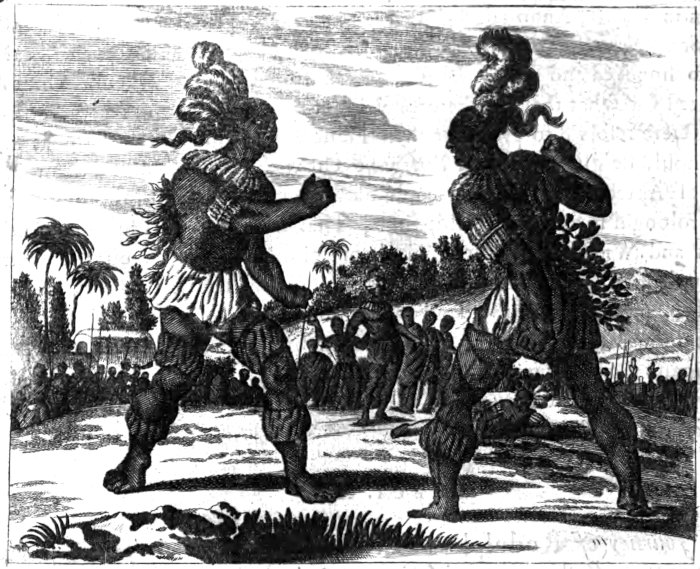
In the Summer they have a general Meeting for Wrestling, and other Exercises, which lasts three days. The Wrestlers are strangely attir’d; for they are all over their Bodies beset with divers sorts of Feathers, and in stead of Boots or Buskins, wear the Barks of Trees about their Legs; their Hair besmear’d with Honey, and ty’d in a Tuft, hangs down behind; on their Crowns they wear a Plume of Feathers, about their Necks a Band or Gorget of Feathers; at their Arms they tie the Wings of the Birds Kohitub, and on their Backs a green Bough; their whole Bodies Painted with divers Colours, and their Hair all Red: Thus accoutred, they Engage one with another, and if there be an old Grudge between them, then they Fight in earnest, and often kill one another: The Victor with strange Actions upbraids the Vanquish’d with Cowardise, and ever after enjoys his Wife and Children.
They eat the Serpent Manuah, being four Yards long, and on the Tail having a Horn, which with a push it thrusts into Man or Beast, as it lights, then winds it self about the Body, and sucks till it hath suck’d the last drop of Blood.
Here are also Serpents which are so poysonous, that the least Wound receiv’d by them is mortal, unless the part bitten be either immediately cut out, or off.
The Priests cut the deceased Bodies into pieces, which are roasted by old Women; the Bones are taken out, and at the next publick Feast are stamp’d, mix’d with Water, and Drank: But the Bodies of Noblemen are to be eaten by none but Persons of that Rank.
Their manner of Crowning their Kings.
They also Crown their Kings after a strange manner, viz. The Priests, who are beset with Feathers, anoint him with sweet-smelling Oyl, or Balsam, and put a Crown of divers colour’d Feathers on his Head, after which they all fall a Singing and Dancing; but if any one happen to speak a word of the deceased King, they all begin to howl and cry. The Kings Authority consists more in Advising than Commanding.
Their Opinions concerning the Soul.
They believe that the Souls of those who die a natural Death are immortal; but those that are kill’d by their Enemies, devour’d by ravenous Beasts, or poyson’d, are totally extinguish’d both Soul and Body for ever. They say likewise that Hell is Westward near a dark Pool, where the Devil Examines every Soul how they liv’d on Earth, and what Death they dy’d; the Good are Ferry’d over to a delightful Valley, where there is plenty of Fish, Honey, and Flesh; but the Wicked are miserably tormented.
The Natives live peaceably amongst themselves, their Law being for those that have not, to ask, and for those that have, to give.
They never Travel in the Night for fear of Serpents and other ravenous Beasts, neither do they go any whither till the Sun has dry’d up the Dew.
King Janduy his subtile Plot.
King Janduy before-mention’d, being above a hundred years of age, desir’d the Prince of Juckers fair Daughter to Wife, but being deny’d, contriv’d a subtil Plot, viz. he invited Jucker, with his Courtiers, to a Wresting; whither he coming with his whole Train, was earnestly minding the Sport, when a considerable number of Janduy’s Women falling upon Jucker’s Men, destroy’d a great many of them, and got the desir’d Maid for Janduy, who at that time had fourteen Wives and sixty Children, but had formerly enjoy’d fifty Wives and Concubines.
Their Arms.
Not onely amongst the Tapuyans, but generally amongst the rest of the Brasilians, their Arms are great Clubs call’d Tacapes; also sharp Darts, and strong Bowes 598call’d Orapares, with Shields, which are made of the Skin of a Beast call’d Tapiroussous.
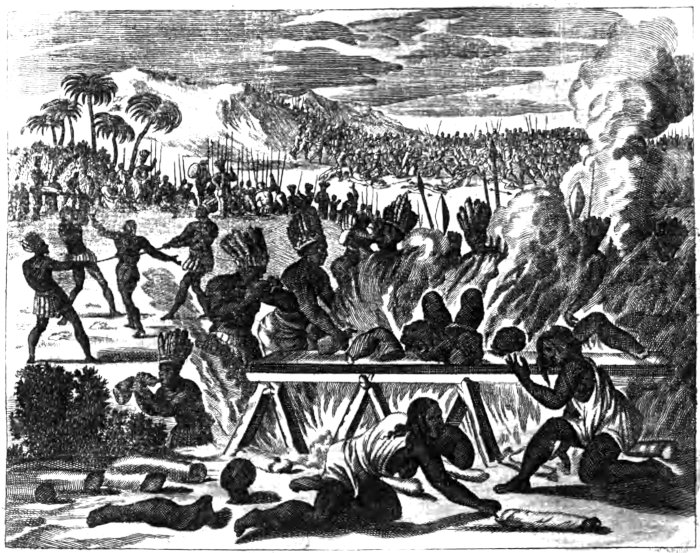
The Women wear long Chains of Snail-shells, which hang down over their Shoulders; their Faces are Painted with divers colour’d Rings, surrounded with Specks; their Necks and Arms they adorn with Necklaces and Armlets of little Bones: They carry their Husbands Provisions in time of War.
Their Army they order by blowing on the Horn Inubia; others play on Mens Bones kill’d a little before: for going by Water they use Boats made of the Barks of Trees, each whereof being able to carry fifty Men, go exceeding swift: The strongest Men always march before, and as many as they take, whether Men, Women, or Children, they are all kill’d and roasted in their Boucans.
Their manner of Fighting.
Their Villages consist of Houses of eighty, ninety, or a hundred Paces long; those that lie near the Enemy are fenc’d with Walls and Pallisado’s against any Attempt. Their Field-Battels are very terrible; for as soon as they get sight of one another, they howl like Wolves; which Tone they raise as they approach nearer and nearer, and with their Horns and Pipes make also a mighty sound; then shaking their former Enemies Teeth (which they wear about their Necks) at one another, they cry, That they shall immediately fall into each others hands for Food: whereupon they throw their Darts at one another, which are adorn’d with all sorts of Feathers, and if any one be wounded, he pulls out the Dart, and bites the same like a mad Dog; next falling to their Clubs, they knock one anothers Brains out: which manner of Fighting lasts commonly some hours before the one or other Party leave the Field. All their Prisoners they fatten, and eat them at a Merry-meeting; at which when they have Danc’d seven hours together, three Men lead the Prisoner, ty’d with a Rope made of the Bark of a Tree call’d Juira, through their Village, whilest the Prisoner looking to and again, saith in a scornful manner thus unto them, You, do ye hear? I have eaten your Fathers: and to others, I have roasted your Brother; your Nephew also tasted very well; my Death will be sufficiently reveng’d: Having carry’d him about for some time, they put the Rope so strait about his Middle, 599that he can neither stir one way nor other; then they give him Stones in his Hands, and lay others at his Feet, saying, Now take Revenge for your Death before you die: then he immediately throws at those who are nearest him; and when Stones are wanting, he throws with Earth: at last comes the Executioner, adorn’d with Feathers, with a black Club in his Hand, and asks, Have not you at several times eaten of our Relations? to which the Prisoner undauntedly answers, Pa che tan tan, ajouca, atoupave, that is, Yes, I am he that have eaten several of your People, and laying his Hands upon his Head, cries out, O how valiantly did I behave my self therein! The Executioner replies, And therefore shall you be kill’d by me, and serve for Food for these Spectators: Then the Prisoner answers again, What care I, since I know my Death will be reveng’d: which said, his Brains are dash’d out, and falling on the Ground, he is carry’d away by his Wife (for the Conqueror commonly betroths his Sister or Daughter to the Prisoner,) who seemingly bemoans the Body, of which she hath the first Cut when it is Dress’d; then the old Women put the Corps into scalding Water, in which they let it lie till the Skin comes off; then the Owner of the Prisoner quartering the Body, distributes it amongst the Guests; the pieces laid on their Gridirons call’d Boucans, are turn’d by the old Women, who lick up the Dripping, desiring the By-standers to bring more such Food, and with the Blood anoint the Childrens Faces; the Meat being broyl’d every one takes a piece, and eats it up to the Bones, which are kept as Trophies.
Brasilians molested by an evil Spirit.
The Brasilians do not onely thus plague one another, but they are likewise tormented by an evil Spirit, which they call Aygnan and Caagerrel, if credit may be given to John Leerius a Burgundian, who relates, that he hath often seen them sweat out of fear; and striking their Hands upon their Thighs, cry out, Mair autourassap, acequerey, Aygnan atoupave, that is, O my Fool, my Companion, I fear the Devil above all Evils.
Diseases peculiar to Brasile.
Amongst several Diseases to which Brasile is subject, there is one call’d Pians, as malignant as the French POX, proceeding from libinousness, the whole Body being full of Carbuncles, each about the bigness of a Man’s Thumb.
Strangers in Brasile are also much troubled with a Giddiness, occasion’d by the extream Cold in the Night; as also with sore Eyes, which they get by going abroad before Sun-rising, or after Sun-setting.
The Palsie is also very common there, taking People so suddenly, that falling down stiff on the Ground, they are often in danger of losing their Breath.
Besides these there are several other Distempers that very much infest Brasile, as the Bloody-flux, Dropsie, Rising of the Gall, Worms, Meazles, and St. Anthony’s Fire.
Brasilians success in curing of several Distempers by their knowledge in Herbs.
The aged Brasilians have for the most part great skill in Herbs, which they gather in the Woods, and apply them to the Sick both inwardly and outwardly; and chiefly they know how to expel Poyson. None can perswade them against the Medicines which they have learn’d from their Predecessors; nay, they will rather chuse to lose their Lives than use any other: and indeed they do not always succeed amiss, but often manifest that they understand the Vertue of Herbs better than our European Physicians. The Learned Guilielmus Piso relates, That he hath seen several times in the Army which Grave Maurice sent against the Portuguese in Brasile, that the Brasilians in a short time cur’d those Wounds with fresh Gums and healing Herbs, which the Netherland Chirurgeons judging past Cure, presently advis’d the cutting off either the Arm or Leg of the wounded Person. Piso adds moreover, That he himself us’d some of Hippocrates’s and Galen’s Prescriptions in Wine, for the curing of Cancers and Swellings, which the Brasilians have made well onely with the Juice of Tobacco. They also in a moment recover’d a Person given over by all European 600Physicians, with the Juice of the Root call’d Jaborandi: Wherefore he always desir’d their Company when he went to visit sick or wounded Men.
Their manner of curing the Sick, and bewailing the Dead.
The Distempers in America differ much from the European, not onely in the Signs of any Distemper, but also in the Cure; for when a Distemper cannot be cur’d by the prescribed Medicines, a Father or Mother sends for the Neighbors, to know if they can find any means to cure the Disease: Which Custom was anciently observ’d amongst the Greeks. They also strictly observe a Rule in their Diet, and take care to keep the Patient out of the Sun in the Day, and cold Winds in the Night: However, if their Fathers and Mothers be sick, nevertheless they leave not off their usual Dancing and Singing; but if the sick Person die, especially a Father, they lament and cry over the Corps like Wolves, calling to one another with a quavering Voice, and uttering these Expressions, The strong Man is deceas’d, who carry’d so many Prisoners for a brave Dinner to his House. Oh what a quick Hunter and subtil Fisher hath Death bereav’d us of! we shall see him no more till our Souls are carry’d beyond the high Mountains, where our valiant Predecessors Dance in Rings. The Women make the greatest noise, and in the midst of their howling embrace one another, which lasts six hours, and then they put the Body upright into a Grave made like a Hogshead, hanging about it divers colour’d Feathers, and other things in which the Deceased delighted most when living; upon the Grave the nearest Relations place Dishes of Meat, both Flesh and Fish, and the Liquor Cauou-in, that their evil Spirit call’d Aygnan, may be reconcil’d by these Offerings, and not carry away the Body; but when they remove from thence they cover the Grave with the Herb Pindo. This Custom is not observ’d by all Brasilians, for some eat up their deceased Relations.
Sect. XIII. Grave Maurice his Account of Brasile, so far as it concern’d the West-India Company.
Brasile, so far as it concerns the West-India Company, extends from the River Real, which divides Seregippa and the Lordship of St. Salvador, to Maragnan: Seregippa it self reaches along the Sea-Coast thirty two Leagues, and was first brought under the King of Spain’s Jurisdiction by Christovan de Barros Cardoso, who being order’d by the King of Spain to Plant this new Countrey, invited many People from St. Salvador, who built four Sugar-Mills, and a Town consisting of a hundred Houses, and four hundred Sheds for Cattel; but the Town being destroy’d, hath nothing left but Heaps of Rubbish; and the Cattel either fell into the Netherlanders hands, or were devour’d by Tygers; the Inhabitants fled back to St. Salvador: Many troubles have prevented the re-building of it.
The fertility of Pernambuco.
Pernambuco may for its fruitfulness stand in competition with any Place in the World, except in those parts where the Soil is sandy and stonie. The Fields feed abundance of excellent Cattel; the Woods, Deer and Fowl; the Ocean and Rivers, all manner of good Fish. It is inhabited but eight Leagues into the Countrey, because the nearer the Sea, the more convenient it is for Importing and Exporting of Goods; neither could the Portuguese, by reason of their small number, spread themselves farther, as also in regard they found great resistance from the Brasilians. The Negro’s that work in the Sugar-Mills between the River Grande and Francisco, amount to four thousand. The Cape Verde, Mina, Angola, Ardra, and Calabaria, generally provide three thousand in a year, to supply the number of the Sick, or those that run away.
601
Sect. XIV. The Councellor Dussen’s Relation of so much of Brasile as concerns the West-India Company.
That part of Brasile which the West-India Company have subdu’d by force of Arms on the Continent of America, is divided into six Counties, viz. Seregippa, Pernambuco, Itamarica, Parayba, Rio Grande, and Siara.
The Expedition undertaken by Gysseling and Schuppe made Seregippa desolate, the Inhabitants whereof remov’d to the Coast Todos los Sanctos.
Also Siara, which the Portuguese formerly possess’d, was thinly inhabited, and had a mean Fortress there, whither some few Brasilians came now and then to the Netherlanders assistance.
Pernambuco, lying between the Rivers Francisco and Tamarica, excells the other Countrey in fruitfulness and pleasantness. The Brasilians compare it to a hollow Rock, under which fresh Water flows.
Havens of Pernambuco.
Moreover, Pernambuco hath several Havens, viz. the outermost Road before Reciffa, which being in the open Sea, is somewhat dangerous, but the innermost is secure against all Storms; also at the Promontory St. Augustine, where the Mouth of the Haven is narrow and dangerous, by reason of the Rocks and shallow Grounds; the Island Alexio is very fit to Crain Ships in; Barra Grande hath a large and safe Inlet, convenient for all manner of Vessels, yet it is inferior to Cororipa; lastly, the Havens Jaragoa and Franco are very eminent.
Rivers.
Amongst the Rivers, the chief are Jangades, Serinhain, Formosa, Porto Calvo, Camarigibi, Antonio, Michael, and Francisco.
Pernambuco also is divided into six Jurisdictions; the first and most ancient is Igarazu; the second and biggest, Olinda; the third, Serinhain; the fourth, Porto Calvo; the fifth, the Alagoas; and the sixth, Rio Francisco, which is the Boundary of Pernambuco on the South.
Towns of Pernambuco.
Pernambuco also boasts five Towns, viz. Garasu, Olinda, Maurice-stadt, to which also belongs Reciffa, Bella Pojuca, and Formosa. The Villages Moribeca, St. Laurence, Antonio, Amaro, and others are also not inferior to little Towns.
The Countrey is for the most part Hilly, but is exceeding fruitful in the Valleys, and near the Rivers, especially in Sugar-Canes.
Here are also a hundred and twenty Sugar-Mills, of which a great number stand still for want of Negro’s.
Next Pernambuco lies Tamarica, which hath onely one Haven, one City, and twenty three Sugar-Mills, of which thirty are onely employ’d. This Island produces excellent Grapes and Melons, yet is for the most part barren, by reason of the Pismires.
The Countrey Parayba hath its Denomination from the River which washeth it, being deep, and without any Rocks or Sands; on the Banks thereof stand twenty Sugar-Mills, two of which are still standing.
In the Lordship of Rio Grande stands the Town Puntael, whose Buildings were ruin’d in the Wars; after which the Inhabitants had leave to build them another City on a fruitful Soil.
The Countrey hereabouts us’d formerly to be very full of Cattel, but was not onely bereav’d thereof by the Hollanders and Portuguese, but also for the most part made desolate.
602The River which washes the Castle Ceulen, affords a convenient and safe Harbor for all sorts of Vessels.
This Lordship of Rio Grande boasts onely two Sugar-Mills, of which one is decay’d; so that in all those Parts in Brasile which belong to the West-India Company, are a hundred and sixty Sugar-Mills constantly employ’d, besides forty six which are about repairing. It is scarce to be reckon’d how much Sugar they make yearly, in regard, through the alterations of the annual Seasons, as also the more or less fruitful Fields, they produce one year, and in one place, more than in another.
The Inhabitants are of two sorts, viz. free People, and Slaves; the Slaves are African Negro’s, and the others, Netherlanders, Portugueses, or Brasilians; which last came in of their own accords, or else were absolv’d from their Oaths, and acquitted from their Martial Offices; yet are ready to venture their Lives and Estates, and to Serve either on Foot or Horseback for their Freedom against their Enemies. Those that went from the Netherlands to Brasile on their own Accounts, drive a Trade, or Serve the Traders, or else keep Inns, and follow Handicraft Faculties; some of which, when grown rich, buy Parts in Sugar-Mills; others live on Tilling: by all which several sorts of People Reciffa is very well inhabited, and full of Houses, which yield great Rents, and are held at high Prices: wherefore Grave Maurice thought good to mark out pieces of Ground on the Isle Antonio Vaes, which were sold for a considerable Sum of Money, insomuch that in a short time a new City call’d Maurice-stadt was built on the same, and inclos’d within strong Bulwarks; yea, notwithstanding the Rumor of a great Spanish Fleet in some measure abated the Courage of the Builders, yet the City was extended down to the Fort Frederick Henrick, and a brave Bridge laid over the Stream Biberibi, cross which they go from Reciffa to Antonio Vaes, where no People were in greater esteem than Handicraftsmen, who could get their ten or twelve Shillings a day. The Labor which is requir’d in the Sugar-Mills, no Men are able to undergo but the Negro’s. Of the Portuguese some have liv’d here a considerable time; others lately came hither, being most of them Jews, of whom there live a great many at Reciffa, and are very diligent in promoting of Trade: They possess several Sugar-Mills, and are kept very much under; their whole study and contrivance is for Gain; they conceal their Hatred against the Christians, as also their Covetousness, yet are mortal Enemies to the Hollanders. The Brasilians, who are the ancient Inhabitants, live apart from other People in their Villages, consisting of long Straw Huts, forty or fifty of them under one Roof sleeping on woven Hammocks; they esteem no Houshold-stuff but Nets and Calabashes, using the first to fish with, and the other to drink out of; about their Huts they plant Mandihoka and Brasile Trees; when they are not employ’d in the Wars, they spend most of their time in Hunting, but many in Idleness; they esteem wild Fruits better than those which are Planted; they Drink night and day, making their Liquor of the chew’d Root Mandihoka, or the Apples Tajovis; they esteem nothing so much as strong Drink, and to wear Linnen next their Skins; they would not value Money, could they but get Brandy and Spanish Wine without it; if they are not promis’d a Reward, they will not work. Each Village, nay House, hath its peculiar Governor; but besides him there is a Hollander, who stirs up the Idle to work, and takes care that the Owners of the Sugar-Mills do them no injury: They never suffer themselves to be Hir’d for above twenty days, at the end whereof they demand their Wages; they are commonly employ’d to chop Wood to boyl the Sugar with; but by reason of the scarcity of Negros, they are often made use of for other Business, which to avoid they hide themselves; as also when they are to go to Fight; they are hard to be kept in Ranks, for they will 603run out of their own Fyle into another on the least occasion; but if they put their Enemy to flight, they pursue him, and spare none alive. They little regard the Christian Religion, yet some of them have learn’d the Lord’s-Prayer and the Creed of the Roman Priests. The Minister Davil having learn’d the Brasilian Tongue, Converted very many of them, and Baptiz’d them in their Villages.