AN ACCURATE DESCRIPTION OF AMERICA. (continued 3)
Reading edition
This City of Angra is divided into several Streets: the Governor and Archbishop live each in a stately Palace; five handsom Churches are no small ornament to it; the Sea before it abounds with Fish, but are not to be taken in December, by reason of the turbulent Waves.
Christopher Columbus having refresh’d at Angra, Sail’d along the African Coast between the Hesperides: under the Equinoctial he was so miserably tormented by the Heat, that his Vessels seem’d to burn, the Hoops sprung from the Casks, so that the Water run about the Hold; and they could expect nothing but death from the insufferable Heat, and want of Water: eight days they had endur’d this hardship, when they met with a fresh Gale out of the South-East, so that they made great Way towards the West. On the last of July he discover’d three high Mountains; and approaching near the Shore, he smelt as in a Posie, all the sweet breathings of fragrant Flowers commix’d, and at last saw a convenient Haven; where going ashore he found cultivated Grounds, and steps of Beasts, but not a Man appear’d: the next day they spy’d a Boat with twenty young Men come rowing from the Shore into the Ocean. The Admiral hal’d them in vain to come aboard, for they made the greater hast ashore, 54still looking about continually with great admiration on the Ships: whereupon he commanded them to beat their Drums, and sound their Trumpets, that they might by that means entice them aboard; but they rather taking it as a sign of War, made themselves ready for resistance: mean while the Spaniards overtook the Indian Boat, into which they threw a Hat, and other trifles; the Islanders amaz’d thereat, made signs to them to row ashore; but soon after they fled.
Abundance of Pearl.
Columbus proceeding on his Journey came to Paria, where he found a Fishers Pink loaden with Oysters; which opening and taking out the Meat, were found full of Pearls, which because of their abundance were not regarded there; for a broken Dish and a rusty Knife, the Spaniards had four long Strings of Pearl.
Columbus is in great danger.
From thence anchoring in the River of Cumana, several naked Men came aboard, adorn’d with Golden Armlets, and Strings of Pearl, These inform’d him, that they gather’d their Gold from the Mountains and Rivers, and caught their Pearl-oysters in the adjacent Seas. Some of the Spaniards were nobly entertain’d by the King and his Son, who leading them into their Palace, placed them on Benches of Ebony-wood, curiously wrought, and on a sudden several Servants came in with variety of Dainties, and well-tasted Wine. But because Provisions grew scarce amongst the Sea-men, and their Meat tainted, Columbus thought it convenient to leave the Pearl-trade till some better opportunity. Then setting forward, the farther he went, the shallower he found the Sea, insomuch that his Ship scarce had Water enough to swim. This inconvenience was followed by a second; for the Sea being full of Weeds and Grass, scarce suffer’d any Passage. A River thirty Yards deep, and twenty Leagues broad, came rushing out betwixt two Shores into this Sea with such force, that the Waves went high like Mountains, which made Columbus judge himself in the greatest danger imaginable, and withall Tack about; so that he came on the eight and twentieth of August Anno 1498. to an Anchor before Hispaniola, where all things were still in a sad confusion, as we before related.
Roldanus Ximenes opposes Columbus.
Strange Indians.
Roldanus Ximenes refus’d to follow Christopher Columbus’s, order and writ Letters to the King of Spain, in which he exceedingly aspersed both the Admiral Columbus and his Brother; who were not backward in giving an account quite contrary by their Letters, of the horrid Villanies perpetrated by this Ximenes, and desir’d aid, that so great an Offender might receive condign punishment. Mean while the Ciquano’s came marching down with six thousand Men, which Bartholomew went to meet with eighty Foot and some few Horse: The Indians which he was to encounter with, rather seeming like Furies than Men, for all of them were daub’d over with black smuts on their bare Skins from Head to Foot, and their hard Hair pleited in terrible, not in Lovelocks, hung playing, or dangling over their Shoulders. When the Spaniards in their March drawing up to a River where it was best fordable, had no sooner left the Bank, and taken the Water, endeavoring to wade over, but the Salvages rush’d forth out of the Woods, and let flye a showre of Arrows, that had they not been provided with Shields and Targets, to keep off such a deadly Storm, so thick they flew, and so well aim’d, most of them had perish’d there: but having recover’d the opposite Bank, the Enemy play’d all hid, and in a thought shelter’d themselves under the protection of the Woods; where the Conqueror pursuing, found the Service very difficult and dangerous, for their Armes, especially their Shields, stopping and intangling them as in a Net, among the shrubby 55and twining Branches; which they passing, rigled themselves, and made their way, like questing Spaniels following their Game, and still gawling them with their Arrows: whereupon they left their vain pursuit, marching another way to intercept Mayobanexius, who with eight thousand Ciquano’s were then coming down against them; which prov’d a harder task than was expected: for e’re he could reduce him and his stubborn Party, he spent three Moneths in the Service.
Sect. III.
Hath very bad success in his fourth Expedition.
But the great and worthy Service of these two excellent Brothers deserving Fights with Poresius. rather Statues and Trophies of everlasting Honor, Monuments never to be Dies. demolish’d, in their due praise, who had found out after so many baffled Ages, a new World, richer, and not much less than the old, by the aspersing calumniations of one malicious Person, lost his whole Interest and Credit in the Spanish Court, quite out of favour with his Prince, who by his insinuations had hinted so much the matter of Gain among the Courtiers, that every one studied no less than to get a Commission, and so going a Commander to the Indies, make up his Mouth, and become suddenly rich. First Francisco Bombadilla prevailing, was sent with full Commission to succeed Columbus in Hispaniola; where no sooner Landing, but he exercis’d the extremity of his Authority, and seizing the Admiral and his Brother, fetter’d their Hands and Feet, and put them aboard on two several Ships for Spain: where no sooner arriv’d, but the King, not altogether forgetting former Services, commanded them to be unmanacled, and waited on, not as Prisoners, with a civil Retinue to his Court; where they were well entertain’d three years. But they being active Persons, weary of so long repose, got a second Grant to make farther discoveries, and set forth the ninth of May, Anno 1504. with four Sail well appointed from Cadiz, and had a fair Passage from thence to Hispaniola, where begun the Storm, for Bombadilla, who had by the Kings Commission so evil treated Columbus and his Brother, as aforemention’d, would not suffer him, though reconciled to the King, so much as to Land, and there refresh themselves and their Men; so he was forc’d to steer on to the Islands Guamixa and Veragua, where a Huricane, or sudden stress of Weather sunk two of his Vessels; the other two standing off to Sea escap’d bilging, but so shatter’d and leaky, having also shipp’d abundance of Water, they were resolv’d to put in at Jamaica; where weary with the long Voyage, and hatter’d with the Tempest, many of his Sea-men, spent with sickness, after their Landing, died. To these his sufferings from Wind and Weather, and his Enemies abroad, a greater and intestine mischief hapned: Francisco Poresio, one of his chief Commanders, absolutely rebell’d, and deserting him, with another Party of his Sea-men went into Hispaniola: which the Islanders observing, resolv’d to famish him, keeping from him both Water and all other Provisions; which had not Columbus stav’d off by a handsom Invention, they had compleated their Design, which was this: He told them that he was the offspring of the Moon, and if they refus’d to supply his want, the Moon, in vindication of her Son, would famish them, by spoiling what e’re they had planted or sow’d; and that this would prove true they should know by a sign, that on such a Night, she rising in her full glory, should first look red, and afterwards by degrees lose a great part of her light; which indeed so hapned, being Ecclips’d, as he could well prognosticate; and after that, they being ignorant of the cause, suppli’d him with all Necessaries. 56But Poresio, not able to endure the Sea with his small Boats, resolv’d to surprize one of the Ships that lay before Jamaica; but Columbus so much prevented him, that meeting him in his return, after a hot dispute made him his Prisoner. But thus ended not his misfortunes; for the Vessels which he fought in soon after sunk, and no ship to be found in Jamaica to transport him thence. Lastly, he agreed with some Indian Fishermen, to carry Didaco Mendoza to St. Dominica, that there he might hire two Vessels to carry him back to Spain: which Design taking effect, he arrived there in safety: where after he had refresh’d himself at the Spanish Court, after his so long and unfortunate a Voyage he fell sick, and died on the eighth of May 1506.
Mean while, the Affairs of Hispaniola grew more out of order: for Bombadilla joyning with Ximenes, resolv’d to hoard up a huge Treasure of Gold, though with the infinite oppression of the Natives: of which King Ferdinand having intelligence, sent Nicholas Olanda thither with thirty Sail; who being nominated Vice-Roy, anchor’d in forty days before Hispaniola. No sooner arriv’d, but Bombadilla and Ximenes fled, leaving their vast Treasure, amounting to ten hundred thousand Ducats; which guarded with four hundred Spaniards in twenty four Ships was sent to Spain: but so it hapned, that they were all swallowed up in the main Ocean, none knowing to this day in what Latitude they were lost.
Sect. IV. Pietro Alponso Nigno his Voyage.
Description of Curiana.
Pietro Nigno, encourag’d by some of those that had been with Columbus at the Isles of Pearl, Rigg’d out a Ship at his own charge, with special order in his Commission, that he should not touch on any Coast within fifty Leagues of any Place Columbus had formerly discover’d. But he little observ’d his Orders, and what he was commanded; for Sailing into the Haven Curiana, he barter’d Shells, Needles, Glass, and such like Trifles, for abundance of Pearls, which the Islanders brought aboard, for he himself having but thirty Men, durst not venture ashore. Twenty days this bartering Trade continued, Orient Pearls for Toys; but finding at last, that they were a civil and hospitable People, he Landed, where they entertain’d him in Hovels built of Wood, and cover’d with Palm-Leaves; before their Doors lay great Hills of Oyster-shells, the Fish being eaten, and the Pearls us’d for an ornament; Conies, Hares, Pheasants, Pigeons, Geese, Ducks, Deer, and wild Swine, are their usual Food; and their Bread is made of the Roots of Trees. Moreover, Curiana abounds with thick and shady Woods, which resound in the night with the cries and roarings of wild Beasts: but though they are terrible fierce and voracious, yet the Natives stoutly venture in amongst the thickest of them, arm’d onely with Bowes and Arrows. The Inhabitants are of Complexion tawny, their Hair long and curl’d; their Teeth they keep white with an Herb, which they continually hold betwixt their Lips. The Women perform their business of Husbandry, Ploughing and Sowing. The Men are Soldiers, following the business of War: but in Peace their Exercises are Hunting and Dancing. They keep annual Fairs, where from all Parts of the Countrey they bring their Commodities to buy and barter. They have their Gold from Cauchieta, six days Sail Westward from Curiana.
57Thither Nigno next directed his course, and came to an Anchor there on the first of October, Anno 1500. The Inhabitants entred aboard without the least shiness, or fear of danger, and brought with them to barter, Gold, Civet-Cats, Parrots, and Cotton.
These People, though so civil, are extreamly jealous of their Wives: for when a Spaniard made address to one of them, and coming something close, her Husband stept in suddenly between, and seem’d to forbid the Banns. But coasting onward along the Shore from thence to another Isle, he found Natives far more wild and salvage: for two thousand in a Body well Arm’d, stood ready to intercept their Landing; wherefore he thought it his safest course to Tack about, and return to Curiana whence he came.
Nigno Fights with the Cannibals.
In his Way not far from thence, he fell amongst eighteen of the Cannibals Boats, which according to their custom had been a Man-stealing, and now were so hardy, that setting upon the Spanish Ship, they suddenly clapt him aboard with their Canoos on all sides; but being beaten back by the terror of their Guns, they soon retir’d: yet the Spaniards took one of the Boats with two Men, all the rest saving themselves by swimming. One of the two Men lay bound Hand and Foot, who told them, that he was to have been kill’d the next day and eaten, as he saw his Companions, with whose Flesh they banquetting kept a jovial Feast. Nigno unbinding the Prisoner, gave him leave to do what he pleas’d with the taken Cannibal, who falling upon him, cudgel’d and whipp’d him to death.
Strange Salt.
Then Nigno in his Way to Curiana touch’d upon the Coast of Paria, where he found a strange kind of Salt, which the Sea in tempestuous Weather casts on the Shore, which afterwards hardens by the Sun. This Salt must be taken up before any Rain fall, else it melts and soaks away into the Ground; yet sometimes grows so hard as a Stone, insomuch that they make Pots and other Vessels of it; which the Parians barter for foreign Commodities.
Strange Corps.
Nigno not making here any stay, return’d a second time to Curiana, where he spent twenty days in pleasant Pastimes, being Lodg’d in a Noble-mans House, at whose Door was fix’d a Cannibals Head, as a Trophy of his Victory. He saw there also the dead Bodies of divers eminent Persons set drying at a Fire, so hardned to be set amongst their Idols.
Nigno put in Prison.
Cruel dealings in Curiana.
At length Nigno set Sail homewards, and carried with him an invaluable Treasure in Pearls to Spain: but by the way fell out with his Sea-men, because he kept most of the Purchase to himself, and would not give them their shares, nay more than that, kept back the fifth part from the King; whereupon being complain’d of by Ferdinando de Vega, Governor of Gallicia, he was put in Prison, and at last sent to the Court, where the Pearls were declared free Prize, because Nigno had barter’d for them at Curiana, contrary to the Kings Orders, not to touch at any Coast, within fifty Leagues of what Columbus had discover’d. But since he had no way regarded those Commands to preserve that Pearl-Trade, King Ferdinand sent Governors to Curiana, who in his Name should look after, and employ Men for the catching the Pearl-Oysters. These, accompanied with a considerable number of Soldiers, besides six Monks, forc’d the Inhabitants to furnish them with abundance of Pearl: which oppression grew to such a heighth, that one Morning a great Party of them conspiring together, fell suddenly upon them, most of them being massacred: after they had a while insultingly triumphed over the dead Bodies, and finish’d, as they thought, their good work (feasting on their Flesh at a joyful 58Banquet) those few that escap’d Sail’d to the Island Dominic, the Governor of which Didacus Columbus, Son to the famous Christopher, being incens’d, immediately sent Captain Ocampo with three hundred Men to Curiana; where in his first fury, without distinction of Sex or Age, he slew all he met with. But because they themselves could not follow the rich Oyster-catching, he spar’d some for that purpose, whom he commanded to build twenty five little Houses, or Hovels, on the Shore, which he call’d New Toledo. After this they went on afresh in their Pearl-fishing.
Sect. V. The Voyage of Vincent Agnes Pinzon.
The first of December, Anno 1499. Vincent Pinzon set Sail with four Vessels out of the Haven Palos: he had been Commander of a Ship under Columbus in his first Expedition, by which means he got great experience in Navigation. When he came a little beyond the Hesperides, he was surpris’d by a great Storm, which in three days drove him before a plain Coast; where Landing, he found nothing but the Footsteps of Men; and in the night he saw great Fires, such as are generally made in Camps; about day-break twenty Spaniards march’d thither, whom thirty two Men, arm’d with Bowes and Arrows, made ready to encounter; but as they approached, the Spaniards proffer’d them Peace, but they refused all Composition; yet having faced one another a while, they retreated without fighting.
Pinzon’s strange Fight.
A remarkable Beast.
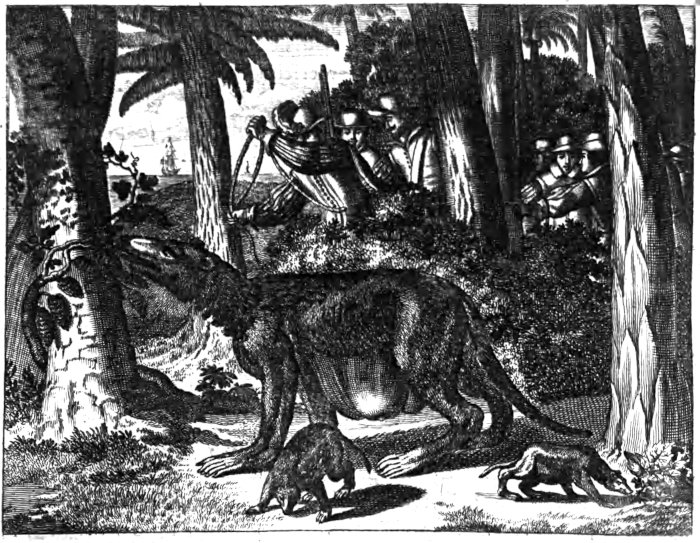
After this Pinzon discover’d a wide, but shallow River; where Landing, on a Hill he met a great company of Americans: He, to invite them to Trade, threw them a Shell; in return for which they cast him a lump of Gold; which when the Spaniard went to take up they all fell upon him; and indeed he could not have defended himself long, had not some of his Company quickly 59come in to his speedy rescue, which occasion’d a bloody Conflict, wherein several Spaniards were wounded, eight kill’d, and one of their small Boats sunk; for the Americans fought so valiantly, that they pursu’d the Spanish Ships into the Sea. Pinzon being at last freed of these Assailants, got into a fresh-water Sea, caus’d by the confluence of many Rivers falling in there: from hence he got sight of the Parian Coast, and with admiration beheld a Tree which sixteen Men could not compass: Between these Trees he saw as strange a Monster, the foremost part resembling a Fox, the hinder a Monkey, the Feet were like a Mans, with Ears like an Owl; under whose Belly hung a great Bag, in which it carry’d the Young, which they drop not, nor forsake till they can feed themselves. Pinzon caught one of them with three Young, which died in the Voyage, but the Dam he presented alive in Granada to the King.
Great Storm.
This Captain having Sail’d six hundred Leagues along the Parian Coast, in a great Tempest two of his Carvils in his view were overset, their Keels turn’d upward; the third driven from her Anchor, and the fourth so shaken, and full of Leaks, that ready to sink they ran her ashore to save their lives; and though he escaped himself the danger of drowning, then being ashore, yet he was no ways freed from far greater inconveniences; for he saw nothing but death either for want of Provisions, or barbarousness of the Inhabitants: whereupon they resolv’d to free themselves of their miseries by self-slaughter, killing one another; but some better advised to spend their Lives like Christians upon the unbelieving Salvages: Whilst they were in this desperate condition, the Storm ceased, and Providence presented their safety, the Ship driving in before the Wind; at which every one taking fresh courage, they mended the two shatter’d Ships as well as they could; wherein venturing to Sea, and setting Sail, they came on the last of September, Anno 1500. into the Spanish Haven Palos.
60
Sect. VI. The Expedition of Americus Vesputius.
Americus Vesputius a Florentine, Commanded four Ships, fitted out at King Ferdinand’s Charge, set Sail the twentieth of May, Anno 1497. and refreshing at the Canaries, from thence he steer’d to Paria; where he so much gain’d upon the Inhabitants, that for Pins, Bells, Looking-glasses, and other Trifles, they daily brought aboard in Barter great store of Gold, the best of Merchandise.
The manner of the Inhabitants in Paria.
Their strange Customs.
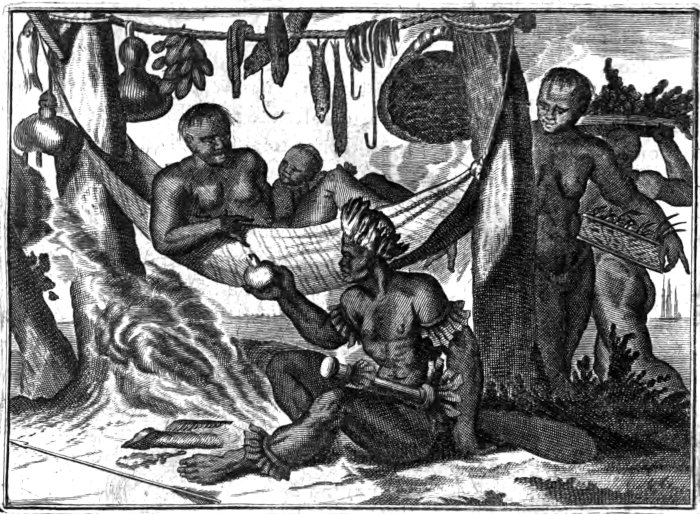
These People, both Men and Women go stark naked, not so much as covering their Pudenda; their Complexion swarthy; they shave off all their Hair, onely some Women leave a Tuft on their Heads. From their Faces, being broad and flat, one may judge them to be deriv’d from Tartary; they much exceed the Europeans in Running and Swimming, insomuch that the Women oftentimes without any Boats, or floating pieces of Timber, venture two or three Leagues into the Sea; they have so great skill in Shooting, that they exceed almost all other Nations, having Arrows headed with sharp Fish-bones; they also use Lances and Clubs. The Women follow the Men in the Wars, and serve in stead of Horses to carry Ammunition and other Necessaries; to which Labor they are so us’d, that they will bear on their Shoulders forty, nay fifty Leagues together, such Luggage, as three Spaniards are scarce able to lift from the Ground. They acknowledge no Commander or Superior either in Wars or Government; they keep up old Feuds, fighting with an inveterate hatred against their Neighbors, upon antient scores and revenges, still kept in memory of their Relations slain in former Battels, and also still creating fresh animosities upon their Losses in later Engagements. Their Language is smooth and pleasing, being spoken with a kind of lisping, and absolutely different from the neighboring Nations. When they eat they sit upon the Ground, and sleeping lie in Hammocks, each end whereof being fastned to a Post; underneath they kindle a Fire; over them they hang Fish-nets and Hooks, Fish-baskets and Calabashes. When they have occasion to ease Nature by evacuation, they retire into some private Place; but the Women think it no immodesty to make Water, even in the presence of strange Men. They observe not single Matrimony; for every Man takes as many Women as he pleases, under bonds of Wedlock such and so sleight, that he turns them off at his pleasure: and Women take the same liberty in casheering their Husbands when not pleasing them. They bring forth Children with little or no pain, and wash them in a River so soon as born; which done they return to their usual work and business. When they are incens’d against their Husbands, they revenge themselves by poysoning their Children. Their Houses are built in the fashion of a House-clock, with a Roof rais’d from the Wall upon four Pillars like the Bell, and cover’d with Palm-Leaves; some of which are so big, that they afford room for six hundred Men: every seventh or eighth year they remove, because (as they say) the Air is oftentimes infected by Mens Breaths, by their long continuance in one place. Their Riches consist in Feathers of divers colours, Strings of Fish-bones intermingled with green and white Beads, with which they adorn their Heads, Arms, Legs, Ears, and Cheeks: Gold and Pearls they make little account of; and as to Trade and Commerce 61with other People, they know not what belongs to it. Their greatest Friendship consists in prostituting their Daughters or Wives to one another. Their Dead they bury in moist Grounds, and put with them both Meat and Drink into the Graves: When any Person grows very weak by lingring Sickness, they carry the Diseased into a neighboring Wood, where they lay him in a Silk Hammock, tied between two Trees; then dancing the whole day about him, at night they set Bread and Water enough by him to last four days, and then departing look no more after him, who thus neglected seldom escape: but if so it happen that one recover, all his Relations for the future honour him as a god. When any one falls into a Fever, his Friends immediately bathe him in cold Water, and afterwards set him before a great Fire, then drive him before them till he falls down almost breathless, and at last put him to Bed. They neither Let blood in the Arms nor Feet, but in their Sides and Calves of their Legs. Sometime they fast four days together, which they suppose a great means to preserve their Health. Their Bread consists of a sort of Fruit call’d Jucha, Chambi, or Igname. Lastly, no Lyon devours his Prey with more voracious eagerness, than they their taken Enemies.
A very strange Village built on Poles.
Strange Fight.
Vesputius being fully inform’d concerning the Situation of Paria, weighed Anchor, and on the sixth day after entred a convenient Harbor, where going ashore, he found twenty Houses built in the middle of a Lake on great Posts: every House had a Draw-bridge, over which they pass’d from one to the other. So soon as the Inhabitants set eye on the Spaniards, they immediately drew up their Bridges: yet some of them in twelve little Canoos came towards the Spanish Ships, but amaz’d to see their Looms so big, durst not, though hal’d with signs, to come aboard, but hasted away to a high Mountain; yet seem’d to signifie that they would return, as indeed they did, bringing sixteen Maids along with them, of which they put four into a Spanish Boat, themselves in the interim rowing between the Ships from one to another, shewing all tokens of friendship, when on a sudden a Company of old Women came running to the Shore, and tearing the Hair from their Heads, made a terrible noise and exclamation, expressing the greatest sorrow they could possible: whereupon the four Indian Maids suddenly leap’d over-board, and the Men shot abundance of Arrows out of their Boats at the Ships; nay, some of them swimming under Water, endeavor’d to sink the Cock-boats which were made fast behind their Ships. Upon this sudden Onset the Spaniards making use of their Guns, quickly lessen’d the number of the Assailants, insomuch that they fled to the Shore; yet five of them being overtaken, were carry’d Prisoners aboard.
Vesputius observing these their misdemeaning Carriages, judg’d it no way convenient to stay any longer among such barbarous and deceitful Salvages: but having weighed Anchor, and Sail’d eighty Leagues along the Coast, he ran into another convenient Haven, whose Shore swarm’d with People, which on a sudden running away, hid themselves in a neighboring Wood.
Serpents strangely prepar’d for Food.
Here the Spaniards Landing were amazed, when in their Huts they saw Snakes and Serpents roasting before a Fire, whereof one had Wings, and another whose Mouth was tied together with a Rope, stared with open eyes in a frightful manner.
Here they left several Trifles to entice the fled Natives to correspond with them. And this their Design prov’d successful; for the next day the Americans came aboard without the least fear, and offer’d to shew their hospitable kindness to the Spaniards, if they pleas’d to travel three days Journey with them up 62into the Countrey, telling them, they had onely rais’d those few Huts by the Sea-side for a small time whilst they Fish’d in those Parts.
The remarkable reception of twenty three Spaniards.
About twenty of the Spaniards well Arm’d resolv’d to undertake the Journey; and travelling over Hills, Dales, and Rivers, they came at last into a Village consisting of nine of the foremention’d Houses, but mightily peopled, where they were in a wonderful manner received by their glad welcomes, by Dancing, Singing, Hunting, and other joyful Acclamations, presenting their Wives and Daughters, as the chiefest part of their hospitality, to caress the Strangers at their pleasure. The news was no sooner spread, but the adjacent Villages came in throngs to gaze upon, and salute the Strangers, inviting them also to their Towns. The Spaniards taking it in good part, spent nine days among them, highly treated with all manner of jollities, but especially at their choice with the varieties of Venus: from thence then returning to their Fleet, accompanied with thousands of the Natives, every one carrying Presents to the Admiral Vesputius; of whom as many as they could at once receive, they entertaining aboard, then dismiss’d them, and admitted others; but the Guns going off, they suddenly leap’d from the Decks, and div’d like Ducks under Water: But afterwards being inform’d, that such thunder-claps were sent them from Heaven to destroy their Enemies, they were somewhat better satisfi’d, and call’d the Spaniards, Charabi, that is, Wise Men.
A cruel Fight with the Cannibals.
This Island lying in the Mexican Bay, in twenty Degrees of Northern Latitude, Vesputius left on his Starboard, and Sail’d along a Meandring Coast (which he always kept in sight) eight hundred and sixty Leagues, and at last entred a Haven, the like whereof he had not seen before. Here he spent a Moneth in repairing his Ships, to which the Inhabitants freely gave their assistance; and among other things complain’d, that a salvage People came yearly thither from an Island about a hundred Leagues distant, who fell upon them with horrible rage, and whomsoever they took they eat, but first inflicted all manner of tortures upon them, sparing none, but together murthering aged People and sucking Infants; wherefore they crav’d assistance to be reveng’d, which if the Spaniards would grant, they would follow the Fleet with their Boats. Vesputius promis’d his aid to destroy such a blood-thirsty People; and to assure them that he would perform his Word, he order’d seven of them to go in Canoos before and shew them the Way. On the seventh day they came to an Anchor before the Island Hy, where the Shore was guarded with naked Men, whose Bodies being strong and brawny, were painted, and their Arms, Legs, and Head, adorn’d with divers colour’d Plumes, having not onely offensive Weapons, as Bowes, Arrows, and Launces, but also defensive, huge Targets, and square Shields. So soon as they judg’d the approaching Spaniards to be within reach, they shot a great flight of Arrows at them; but Vesputius lying close along the Shore with his Ships, fir’d upon them with Chain-shot, which did great execution: yet notwithstanding about forty Spaniards leaping ashore out of their Boats, found themselves in no small danger; for the Cannibals upon the sound of Horns flocking together, so press’d upon them that they were forc’d to lay aside their Guns, and fall to Blows, and had not timely assistance come to them, they had undoubtedly been all slain: two hours the Victory was doubtful on whose side it would fall; yet at last the Cannibals quitting the Field, left the Spaniards Victors; who the next day pursu’d their gotten Victory with such success, that they drove their Enemies before them, burnt their Villages and Boats, and carry’d two hundred and two and twenty 63of them Prisoners to Spain, where they safely arriv’d the 15. of November, Anno 1498.
Vesputius Second Expedition.
This good success so encourag’d Vesputius, that having stay’d scarce seven Moneths ashore, he obtaining the Command over six Ships, with which he set Sail from Cadiz, and touching upon the Canaries, Steer’d from thence Southerly; and having Sail’d five hundred Leagues, he discover’d a Countrey overflow’d and made Marishy by great Rivers, and abounding with Trees, but saw no sign of any Inhabitants; yet not long after, coming before an Island, he took a Boat with two Prisoners, newly guelt, and sent as a Present to feast the Cannibals, which refus’d to Treat on any other account whatsoever; wherefore he Sail’d eighty Leagues forward along the Shore of an unknown Island, where he Barter’d for some Gold, and got five hundred Pearls for one single Shell; these Pearls the Inhabitants said were not found there, but taken from their Neighboring Enemies, which liv’d Westward, and had abundance of them.
Strange constitution of a salvage people.
Nothing worthy of remark happen’d in this Voyage, onely the strange constitutions of a wild People, living on a barren Isle, deserve to be mention’d.
About their Necks hung two hollow Vessels, the one full of white stamp’d Worts, and Herbs; and the other, full of Grass, which they greedily cram’d into their Mouths, feeding like Cattel; then a Stick wetted with Spittle, they put into the bruis’d Herbs, taking upon the end of it, as upon the point of a Knife, some of the bruis’d to their Mouths, which (as if chawing the Cud) turning therein, then taking out again, and strowing more of the same Herbs out of the Vessel upon it, swallow’d it down. No fresh Water was to be had amongst them, but what they gather’d from the Dew in great Leaves: Neither had they any Houses, but dwelt under great Trees, and fed on dry’d Fish.
Strange adventure of nine Spaniards, meeting with great Giants.
The next remark in this Voyage, was the discovery of an Island not far from the former, where he found the Footsteps of a Gigantick People, upon which nine Spaniards went a League to search the Countrey, where they saw five great Huts, standing in a spacious Valley, and in them two old, and three young Women, each of them being twice as tall as an ordinary Man: The old ones invited the Spaniards to eat, who when they were sat down, consulting how they might take and carry one of these Giantesses to Spain, there to shew her for Money, thirty six Giants came in to them, (never did the Sun shine on a more terrible People) which so amaz’d the Spaniards, that their Hair seem’d to stand an end at the fear thereof: Every Giant was arm’d with a Bow and Arrows, and a Club: They wondering at the nine strangers, stood talking very earnestly one to another, which gave the Spaniards time to think of making their escape; some judg’d it convenient to discharge their Guns upon them, and in the Smoke to run away; others thought, that it would be better to take a milder course, which they all agreed on; and taking their leave, went out of the Hut, but were follow’d by the Giants, who kept a Stones cast behind them, and went faster or slower, as the Spaniards slacken’d or mended their pace; who at last getting to the Shore, and from thence into their Boats, they suddenly put off; but the Giants then pursu’d them with eager speed, all of them leaping into the Water, and Swimming, shot abundance of Arrows after them; but frighted by the Thunder of two great Guns that were discharged from the Ships, return’d ashore, and fled into the neighboring Hills.
Description of the Pearl-Oysters.
Vesputius third Expedition.
64Vesputius at last began to consider of returning home, his Provisions beginning to grow scarce, and his Sea-men faint, having continu’d in the Equinoctial heats a whole year; wherefore he directed his course towards Spain, in his Voyage, driving along the Coast an advantagious Trade, by bartering Shells and Glass for Pearls. The Inhabitants presented him with Oysters, of which some inclos’d one hundred and thirty Pearls; when they attain to their full growth, they fall out of the Shells themselves, but those that stick, decay. So upon the tenth of November, the Fleet came safe to an Anchor before Cadiz. After which, Vesputius retired to Sevil, with intent to settle himself there, but he had not long repos’d, when Emanuel King of Portugal sent for him to Lisbon, and gave him the Command of three Ships, to discover new Countreys; between the Canaries and Africa, they pass’d thorow so many Fishes (not unlike a Bream) that in an hours time they loaded their Boats with them; this Fish hath a round thin Scale, sharp Teeth, Stones in their Brains or Foreheads, a sharp pointed Heart, a Bladder full of Wind, red Tail and Fins, feeds on Sea Weeds, Gurnets and Oysters, and is of a delicious Taste.
Cruel deed of some Indian Women.
From thence, five degrees Southward of the Equinox, he found a naked People on the top of a high Rock, that beckon’d the Spaniards to come towards them; upon which, two of them resolv’d to venture thither, having order not to stay at the most above five days: The first incounter they had was of some Women, who offer’d their bodies to prostitution; but a Youth, as if affrighted with some sudden danger, came running amongst them, whom, whilst they stood gazing upon, and wondering at, an old Woman with a great Club, running down the Hill overtook, and knock’d him down dead upon the ground; which done, the Women that were making Court to the Spaniards, took him by the Heels, and dragg’d up the Hill, where soon after they saw him chop’d in pieces, Broyl’d, and eaten: They also made signs to the Spaniards, that they would devour them also in the same manner. The Shore was crouded with Men, which showr’d upon them several flights of Arrows; wherefore they thought it best to Weigh Anchor, so taking Aboard their two Men, and having Sail’d 150. Leagues, they got sight of the Coast of Brasile, along which he Sail’d Southerly to fifty two Degrees, where three Brasilians came Aboard of their own accord, and were easily perswaded to go with him to Portugal; but the Weather growing very bad, and the Cold intollerable, the Storms swelling the Waves into the bigness of Mountains, Vesputius left the Coast des Patagones, and the Streights, afterwards call’d Magellan, behind him, burnt one of his Ships before Cape Sierra Leona, and brought two safe to Lisbon.
Vesputius fourth Expedition.
Sea-Spiders, and Dragons.
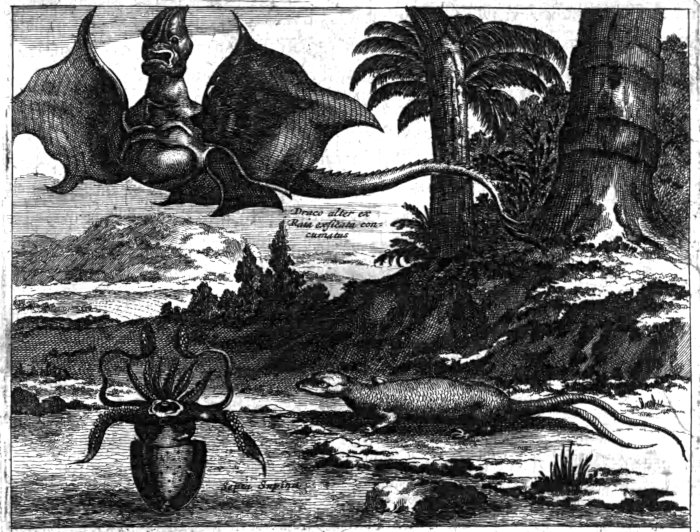
His fourth Expedition happen’d, May 10. Anno 1503. at which time he Steer’d directly with six Sail to Sierra Leona, and approaching the Coast, could not come to an Anchor, because of the strong eddying Currents: Three Degrees beyond the Equinox appear’d a rising Island, two Leagues long, and one broad, destitute of Inhabitants; his best Ship being six hundred Tun, split here against a Rock, and nothing of her was saved, but the Sea-men: But Vesputius Rowing ashore with a Boat, found a convenient Haven, with abundance of sweet Water, high Trees, Sea-Spiders, and horrible Dragons, which have a sharp Head, round fiery Eyes, and wide Mouths, Wings not unlike a Bats, a speckled Breast, curl’d Tail, blew Back, and two Bags like a drawn Satchel Triangular, were under their Bellies: No less strange are the Sea-Spiders, by their hard Feet, long upper Teeth, two long Sheers or Pinchers, and double Belly; between the Head and the Belly lies a black Skin, with 65which they darken the Water; when any one goes to take them in the night, they make a great shadow; they feed on Fish, the Female lays little white Eggs, not unlike ordinary Hail-stones.
Vesputius having left this desolate Isle, three hundred Leagues a Stern, enter’d a Haven, to which he gave the name of St. Abdy, where he stay’d two Months, expecting the return of those which he had sent into the Countrey; but seeing it in vain to wait any longer, he proceeded on his Journey, and Sailing in between the Abrelhos, in the River Curubabo, he built a strong Fort, Garrison’d it with twenty four Men, twelve pieces of Ordnance, and Provisions for six Moneths: Five Moneths Vesputius had spent in the building this Castle; when he return’d home with one Ship, laden with Brasill Wood, where approaching Lisbon, beyond all expectation, the Inhabitants of the City ran to Congratulate his happy return. And from this Americus Vesputius, the New World is to this day call’d America.
Sect. VII. The Expedition of Alphonso, Fogeda, Diego Nicuesa, Ancisus, and Roderick Colmenares.
Wonderful Tree on Codego.
Americus Vesputius was scarce fitted out in Lisbon, when Fogeda set Sail with three hundred Men from Beata, the chiefest Haven of Hispaniola, to the Island Codego, inhabited by Naked People, but of comely Personage, and withal expert and most excellent Archers: Here he found a very strange Tree, which bears a Fruit not unpleasing to the Palate, yet deadly Poyson, and besides, whoever chances to sleep under their shadow, loose both their understanding and Eye-sight, and never attain to their former Sences, except they take some Opiates, as dangerous, and so by long sleep, recover.
Fogedo’s cruelty and destruction.
Famine.
Strange accident.
Ancisus escapes great danger.
Colmenares Expedition.
His strange reception.
Here Fogeda set upon a poor Village near the Sea-side, where without mercy 66he put them all to the Sword, except a few Youths which were onely saved, that they might inform Fogeda, what was become of the slain and taken Spaniards; Who told him, that according to their Custom, they had Roasted the dead, and also their living Prisoners, and feasted on their Flesh. Here having burnt the Houses, and sifting the Ashes, Nicuesa found some Gold. But now they began to be distress’d for Provisions; for prevention of which, Nicuesa had given order to Ancisus, Marshal in Hispaniola, that he should follow with a Ship of Victual, for the Army to Codega. But he being kept back by inconveniencies, most of the Spaniards were famish’d, so that the three hundred Men which Codega brought from Hispaniola, were reduced to sixty. And he was already under-Sail to Hispaniola, when Ancisus Anchor’d in the Haven of Codegoos, and sent some Men ashore to mend his Boat, and fetch fresh Water, which whilst they were doing, the Natives came flocking about them: Three days they fac’d one another, using no Hostility, when at last a Spaniard that understood the Codegan Tongue, adventuring to fetch Water, he was immediately encompassed; when speaking to them, and informing them in their own Language, That he was none of Fogedas or Nicuesas People, which not long since had committed so great slaughter, they left him, and the rather, because he told them, that Ancisus would take revenge on them, if they did any wrong to him. Thus quieted, they brought all sorts of Provisions Aboard. Mean while, Ancisus Sail’d to the Main Continent Uraba, where in the Mouth of a Haven he ran his Vessel aground, which was bilg’d; the Sea-men taking some Arms along with them, sav’d their lives by swimming ashore; where, their first sustenance they found was store of Peaches and Cherries, which was a great refreshment in those hot Countreys, but yet had undoubtedly been starv’d, but that in searching the Wood for Fruits, they found Wild-Swine, which preserv’d their lives; yet they were not free from apparent danger, having to deal with a Salvage People, into whose hands they were so unfortunately cast by Shipwrack; however Ancisus set a good face on the business, marching with a hundred Men up into the Countrey, where some of the Urabanners from an ambuscade unawares, with their Arrows wounded several of his Men, hereupon they retreated to the Shore of the River Daria, whither also they had brought the small Boats, sav’d from the Wreck; where whilst they were in consultation how to return to Hispaniola, the Inhabitants having muster’d themselves, and making a Body of five hundred Men, set upon them, who after a sharp Conflict, made them retreat, and at last to flie, whom Ancisus pursuing, found in a Thicket of Canes or Reeds a great Treasure of Gold. Mean while, Nicuesa Sail’d to the plentiful Golden Countrey Veragua with three Ships, of which he lost two, the one Commanded by Lupus de Olana, and the other by Peter Umbria Olana, which was stranded in the River Veragua, which gives name to the whole Island, but he built a new Carvil, whereas that of Lupus Olana was bilg’d among the Rocks. Little better success had Nicuesa, whose Ship over-turning with a Tempest, he with a few of his Men made land upon Veragua, where he rang’d up and down in a miserable condition, on a barren, and in a manner desolate Shore seventy days: All that time, finding no other Food than Wild Roots, who wandring up and down, at last met with Olana, a little before cast away on the same Isle, whom he secur’d, because he presum’d to usurp the Title, and be prime Commander of that Countrey. Upon which, the Spaniards being divided, some for Ancisus, some for Olana, the difference more and more encreasing, would not be reconcil’d, till the Famine over-powering, master’d both, so that not being 67able to handle their Arms, the Salvages flew them at their pleasure, by this means in a short time, of seven hundred eighty five, remain’d scarce ninety; yet did not all this misery work any thing upon the ambitious humor of Vasques Nunnez, who rebelling against Ancisus, split that small remainder of Men, and with the help of those he had drawn over to his Party, made himself Governor of Uraba, not possible to be long enjoy’d without speedy supply, which soon after they receiv’d; for Colmenares Sailing from Hispaniola with Provisions, arriv’d there the 15. of October, Anno 1510. having been toss’d twenty three days at Sea; then making into the River Gaira, to furnish himself with fresh Water, he lost forty seven Men; for whilst they were filling their Casks, seven hundred of the Salvages came down upon them, and with their Poyson’d Arrows wounded and kill’d most of them. Colmenares came in a good time to the remainder under Ancisus Command, being in danger of death for want of Provisions, and finding the factions that were among them about Superiority, he thought it fit, consulting with some of the chiefest of them, to find out Nicuesa, who was indeed the Governor that had the Grant from the King: This agreed, Colmenares went to search, and at last lighted upon him, building a Fortress against the assaults of the Enemies on the Promontory. Mormor, he was glad to find him, but griev’d to see the misery and hardship they endur’d, most of his Men being kill’d, partly by the excessive Heats, partly by Famine, and partly by the cruelty of the Natives, so that he had onely sixty remaining, and those many of them also sick and weak.
Colmenares having deliver’d his Message, Nicuesa broke up his Quarters, and sleighting the Fort, went with him, but both himself and his Men were oppos’d from Landing by Nunnez; wherefore Nicuesa was necessitated to Steer for Hispaniola; whom, or what became of him was never known.
Nunnez having thus quitted himself of Nicuesa, and now, more than ever, wanting Provision, he resolv’d to take out his own Commission at large, and setting up for himself, make no discrimination of Persons, Spaniards, or Natives, but to make out his Fortune.
And first, he fell upon Careta King of Coita, whom he took Prisoner, Plundering him of all his Treasure and Provisions; yet this sufficed not long, for soon after, King Poncha invading Careta, Nunnez took hold of that opportunity, and pretending to assist Careta, being well recruited with his Forces, set upon Poncha, who immediately fled, and left all to the spoil of his Enemies.
Remarkable Pallace of King Comogrus.
This News so amaz’d Comogrus, another King, that he proffer’d Peace; whereupon Nunnez going thither, was nobly entertain’d in his Palace, being one hundred and fifty Paces long, and eighty broad, the Floors Pav’d with Stone, and the Roofs Vaulted, his Cellars were stor’d with Wine, made of the Root Jucca, Ages, and Mais; the Privy-Chamber was hung round with dead bodies, Mummy’d artificially with Lent Fires, and were the Corpses of Comogrus Ancestors, and others of the Royal Blood, and nearest Relations, of whom some dy’d at least four hundred years before; each of these fasten’d by Cordage made of Reeds, were Habited in Cotton, richly adorn’d with Pearls and Gold. Mean while, a Hurricane happening, terrible with Thunder and Lightning, and hideous Gusts, swell’d and so enrag’d the Sea, that breaking its bounds, over-running, drown’d the whole Champain; thus the hopes of a fruitful Harvest being utterly lost, they suffer’d under a great Famine.
Nunnez Exploits.
The Spaniards which Encamp’d near the River Daria, on Uraba, perceiving this, and knowing they had no manner of supply from Hispaniola, and having 68already Pillag’d the Neighboring Kings, that they had nothing left. Nunnez marching thirty Leagues up the River, Plunder’d the Village, of which Daibaiba was King, where he found an unvaluable quantity of Gold, but little or no Provision. Here were many Flitter Mice, or Bats, bigger than Turtle Doves, whose biting was mortal, unless immediately wash’d with Salt Water, according to the information of the Prisoners.
Now as Nunnez Uraba Pillag’d towards the South, so did Colmenares, setting up also for himself, make prize of all, to the East with sixty Men, Rowing against the Stream up the River Daria, above twelve Leagues, where he found in several Villages and Hamlets, and at King Turvi’s Palace, abundance, both of Provision and Gold; from thence he March’d to the mighty Province Abenamchei, which though making some resistance, at last they subdu’d.
A strange Pallace built on Trees.
Turning the low Land into a Sea.
A Plot on the Spaniards, strangely discover’d.
And the neighboring King Abibeiba narrowly escap’d the like fortune, whose Pallace was built on the tops of Trees, Plash’d, and Pleited together, Timber Beams lying athwart; necessity forcing them to choose such high Habitations, partly to avoid the Inundations of Rivers, swoln above their bounds by sudden and almost assiduous Showres from the Mountains; and partly, to be free from the excursions of sculking Robbers; also being better able to defend themselves in these Castles in the Air, and also secur’d by their heighth from their Shot, being above the reach of their Indian Arrows: The bodies of the Trees downwards, upon which the Houses are built, are generally twenty four Fathom thick, so that they cannot easily be cut down, nor fired; but Colmenares against these, as they suppos’d, impregnable Forts, having made a Gallery with several great Hurdles, set his Men to work under that safeguard, with Axes on the Tree whereon Abibeiba’s House stood, who seeing his imminent danger, wondring at this new manner of Storming, came down, promising to furnish him with Gold out of the neighboring Mountains, notwithstanding it would be with the danger of his Life; because the Cannibals generally kill those that adventur’d to dig in the Mines: To this promise, Colmenares hearken’d, and having set him at liberty, for the performance, he in stead thereof, on the contrary, stirr’d up, and joyn’d with all the Conquer’d Kings, to destroy him and his Men: Nor were they slack to have executed their design, five thousand of them being already drawn together at the Village Tirichi, the appointed place of Rendezvous, and so privately carry’d, that undoubtedly it had been effected, if not happily discover’d by this accident.
Nunnez, amongst his other Slavesses, had one exceeding beautiful, on which he was much Enamour’d, and she likewise seem’d to bear as great an affection towards him, which she manifested, by declaring the secret to Nunnez which her Brother had imparted to her, being an intended general Massacre the night following, that so she might the better make her escape the day before; yet so much she prefer’d the safety of her Lover, before the liberty of her Native Countrey, that she discover’d the Plot. Nunnez not sleeping on this advice, on a sudden set so fiercely upon the Conspirators, that he utterly broke their design; yet the Feuds and Contests for Superiority still continu’d amongst them, which look’d with so bad a Face to the ruine of all, that news thereof arriving in Spain, it was judg’d fit to send for Colmenares, and John Quicedo to the Court, there to render an account of all their Transactions, Both going Aboard a small Vessel, were by Storm driven on the Coast of Cuba, where they were inform’d from a Prisoner, that Valdivia and Zamudio, driven ashore by Shipwrack, and not able to defend themselves, were surpriz’d by 69the Natives, kill’d and eaten; that Fogeda driven up and down along the Coast, had lost most of his People by hunger, and other hardship, and himself with much ado getting to Hispaniola, dy’d as soon as Landed of the Wound which he receiv’d by a Poysonous Arrow, near the River Daria.
Ancisus Voyage.
A Temple dedicated to the Virgin Mary on the Island Cuba.
But much happier was Ancisus, who soon after Fogeda coming to Cuba, found a King, who suffer’d himself to be Christen’d, and call’d Commendator; and building a Church, Consecrated it to the Virgin Mary; in it he erected an Image of Clay, resembling a Woman, which he clothed in a Cotton Garment; round about were plac’d Pots with Meat and Water, according to their old Idolatrous fashion, otherwise, they believ’d their Idols would devour the Souls of the Dead, and this, though Christians, they did not forget.
Nay further, when he went to War, he carry’d the Image of the Virgin Mary with him in the Front of his Army, often saying, Ave Maria; and this was the end of that Voyage: But afterwards Ancisus complain’d against Vascus Nunnez in the Spanish Court, where he receiv’d a Sentence very prejudicial to him. Colmenares and Quicedo had also Audience there, whereupon matters being settled, a firm Government was establish’d in Uraba.
Sect. VIII. Peter Arias his Expedition, and remarkable Passages of Vascus Nunnez.
Nicuesa suffers hunger.
Peter Arias Knight, accompany’d with his Wife, Elizabeth Boadilla, set Sail Anno 1514. but surpriz’d by a violent Storm, lost two Ships, and return’d to Spain, yet not long after began his Voyage afresh, notwithstanding he had lately had such bad success, and heard of the great hardship which Nicuesa suffer’d, having not onely kept himself alive a considerable time by feeding on flesh of Dogs, and other such like Creatures; a great Frog being sold in Veragua for a lump of Gold.
Dogs us’d in the Wars.
Sodomy horribly punish’d.
Nunnez first discovers the South Sea.
Is in great danger on the South-Sea.
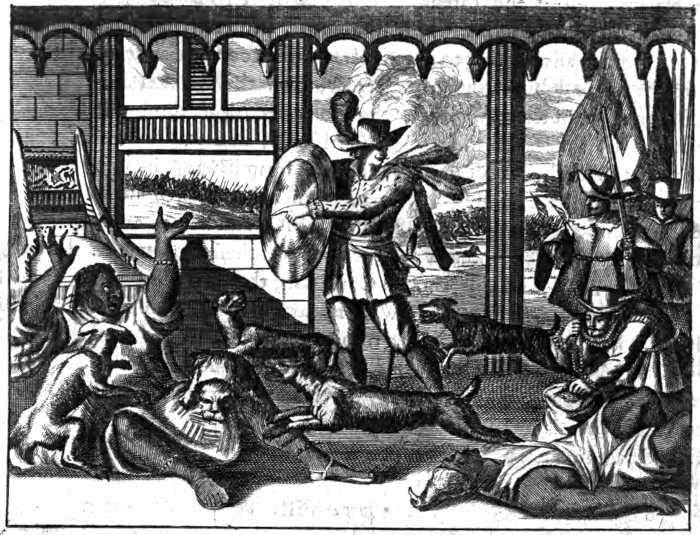
But Vaschus Nunnez inform’d of Arias arrival, the chief Governor of Uraba, afterwards call’d New Andaluzia, minding to inrich himself before he should depose him, and hearing that several Gold Mines lay Southward from Uraba, march’d thither with a hundred and ninety Men, thorow great Rivers, Thickets, and Woods full of Wild Beasts, deep Vallies, and broad Rivers, not without many hazards and difficulties. In the Mountainous Territory Quarequan, the Inhabitants ingag’d him valiantly, with Bows, Arrows, Clubs, Woodden Swords, Pikes and Launces, but frighted with the meer report of their Musquets, like flocks of wild Fowl, dissipated and fled, but not so fast, but that six hundred of them fell by the hands of the Spaniards, or were worry’d by their Dogs, train’d up on purpose for the American Wars. Soon after, coming into the Palace, there sate his Brother dress’d up in Womens Apparel, whom the King kept to abuse, as if a Concubine, whereof Nunnez being inform’d, in detestation of Sodomy, set the Dogs upon him, who suddenly tore him in pieces. Amongst the slain were found several Negroes, which suffering Shipwrack had been cast on the American Shore, and maintain’d a continual War with the Quaraquanen, so that it seem’d the Blacks which were found dead amongst them were their Slaves: Yet Nunnez was forc’d to leave a considerable number of his Men here, who being half starv’d, and quite tired out, were not able to follow him; but with the remaining party he march’d on, and at last came to the high Mountains, from whence he saw the great South-Sea, and going thither, 70was met by King Chiapes, leading an Army of thirty thousand Men, which great Body stood not long to make resistance, being terrifi’d with the Vollyes of Shot, whose Report the ecchoing Valleys presented to their Ears, double and trebble: And that which most amaz’d and disanimated them in the rout, were the Dogs, who fiercely pursu’d and seiz’d the flyers, tearing away great morsels of Flesh. After the Battel, the Conqueror proffer’d Peace, which was agreed on, upon the delivery of several great Presents of Gold. After that, Chiapes the King, accompany’d with Nunnez the Spanish Commander, and March’d with him over a broad River to Coquera, where at first some Forces made resistance, but were routed; whereupon, they also suddenly struck up a Peace, upon conditions, that the Prince, nam’d also Coquera, should return him a great quantity of Gold. Here he found a handsome Bay running up in crooked Reaches, above sixty Leagues, which Nunnez call’d St. Michael, being sprinkled with Islands, and treacherous with hidden Rocks. There Nunnez, (though disswaded by Chiapes, because he knew the South-Sea at that time being the three last Moneths of the Year, was exceeding turbulent, that no Vessel could hardly live in it, yet) ventur’d with nine Indian Boats, and eighty Men from the Shore into the Offin; where, notwithstanding the high rolling of the Waves, he got to an uninhabited Island, on which, being necessitated to stay a night, the Tide flow’d so much, according to the property of the South-Sea, that the highest Ground thereon, lay almost cover’d with Water, every one of the Spaniards having enough to do to save themselves from being wash’d away. Day approaching, discover’d a second inconveniency, for the Indian Canoos either were extremely Leaky, or else so shatter’d, that they were unfit for service; yet notwithstanding all this, they ventur’d to return, rather choosing to be devour’d in the Waves, than die of that hunger, whose misery they had sufficiently tasted, during the small time they had been out. Not long after, Nunnez Conquer’d the King Tamaccus in a Field Battel, who thereupon purchas’d his Peace with great Presents of Gold and Pearl. He also shew’d the Spaniards an Island, whose spiring tops were seen from the Main Land, which so abounded in Pearls, that in no place were either more or fairer to be found: But the King who liv’d on it was exceeding powerful.
Manner of Fishing for Pearls.
71Nunnez immediately resolv’d to Sail thither, notwithstanding it was the middle of October, when the South-East Winds make such a turbulent and hollow Sea, as many times wash’d away Trees and pieces of Rocks: Besides, the Weather was more terrible, by continual Lightning and great Thunder-Claps; the Nights very cold, the Days exceeding hot; yet all these difficulties could not prevail, for Nunnez would not stay to expect fairer Weather, but went on, and coming thither, he saw how the Indians Fish for Pearls, which was Diving for Oysters; but the Weather being rough and foul, they durst not venture for the best which lay far from the Shore.
Nunnez returns.
But Nunnez leaving his sick and weary’d Men with Chiapes, March’d quite another way back than he came; and crossing a great River, was receiv’d by Prince Teaocha, who furnish’d him with Gold, Pearls, Provisions, and Guides, which carry’d his Luggage and Goods.
Pacra a tyrannous King, his horrible death.
Pacra, a great Oppressor of all his Neighbors, hearing of the approach of Nunnez, fled, but terrifi’d with threats, return’d with three other Princes, which were all so Deform’d, that more horrible Monsters were never seen, scarce any part about them resembling those of a Man: The Guides which Teaocha had provided for the Spaniard desir’d that he might be put to Death, for the Cruelties which he had long committed; whose Request being granted, he with the other three Princes, were given as a Breakfast to the Spanish Doggs. Mean while, the Spaniards were in danger to have perish’d for want of Water; yet at last, in a Thicket of Brambles, they found a small Brook, but none of the Indians durst venture to go to it, for fear of Tygers, and other Wild Beasts; relating, That the Tygers took many people in the nights out of their Huts, if they were not careful in making fast their Doors.
Strange relations of a Tyger.
John Ledesma had himself eaten part of a Tyger, which for six Moneths together, had every night feasted on Mans flesh, or Beasts, which they caught in this manner: In the Path along which he pass’d, coming out of his Den to seek for Prey, a deep Pit was digg’d, and cover’d very sleightly on the top, into which the Tyger fell; yet though taken, so fiercely withstood the Pikes, Darts, and Stones thrown at him, that every one was amaz’d to see the fury of the Beast. After that they sought for the Female, but found onely two young ones without a Dam, which taking along with them, they put Iron Collars about their Necks, intending to carry them to Spain; but seeing no likelyhood of breeding them up, they brought them back again, purposing to fetch them away when grown somewhat older, and accordingly coming afterwards to look for them, they found the Den empty, so that it was supposed they had been devour’d by their Dam.
Nunnez further Journey into the Countrey, very remarkable.
In the Province of Bononiama, the Spaniards inrich’d themselves with Chains, and Breast-Plates of Gold, which in great plenty hung on the Walls in every House: At the River Comogrus, they discharg’d Teaocha’s Guides, and made use of Cotog and Ciuriza, two Governors of a barren Tract of Land, full of Hills and Mountains, which they left on their right Hand, and wandred three days over a Morasse, in which they often sunk to their Knees.
In all these Travels, Victual was so scarce that they were much weaken’d by their wants; and though they took fresh courage when they got footing on King Buchebua’s Jurisdiction, yet they found nothing but empty Huts; and the 72like in the Countrey of Chiorisus, both having a little before been pillag’d by their more powerful neighboring Enemies. But although they could not furnish Nunnez with Provisions, they presented him with weighty Ingots of Gold: but this rich Metal not able to purchase the least morsel of Bread, drove them into a great strait; and indeed they had without doubt been all famished, had not Pocchorosa, another King, fed them forty days together with stamp’d Roots. Thus refresh’d, and instigated by Pocchorosa, they broke by night in Tubunama’s Palace, and took him Prisoner with eighty Concubines, who fearing to be put to death, gave an incredible Treasure of Gold to purchase his Ransom.
Nunnez thus enriched came at last to his People which he had left on the River Daria, where two Ships sent from Hispaniola rode at an Anchor.
Peter Arias his Voyage, and Fight in the Haven St. Martha.
Whilst things were thus carry’d in America, Peter Arias Sail’d with fifteen Ships, Mann’d with fifteen hundred Men, to New Andalusia, by the Islands Martinina, Guadalupe, and Galanta, all in America: a considerable time he Sail’d through the Sea overgrown with Weeds. Afterwards anchoring in the Haven St. Martha, he receiv’d a great repulse from the Natives, who no ways daunted at the bigness of the Ships, waded up to their Breasts in the Sea, and shot many great flights of poisonous Arrows at the Spaniards, or whom two being wounded immediately died. Arias sending some of his Men ashore, they found many Boats lying full of Nets, made of tough Weeds, and Ropes pleited of Rushes.
In the Haven St. Martha, being three Leagues wide, are abundance of Fish, which may be seen under Water twenty Fathom deep.
But now the Spaniards that were ashore breaking into the Houses, and taking Women and Children Prisoners, the Americans prepar’d for another Fight, which at the beginning was very fierce; but at last they were forc’d to quit the Field.
Strange Houses and Houshold-stuff.
Their Houses and Furniture in them are worthy of observation: their Cielings being cover’d with Shells strung on small Thred, which make a pleasing noise, when mov’d by the least breath of Wind. The Walls are hung with fine Stuffs, woven full of Imagery, as Cranes, Lyons, Tygers, and some Figures of Men; the Floors are cover’d with parti-colour’d Mats, made of Sea-Reeds, and several tough Roots; and their Carpets beset with Pearl add also a great beauty to their Rooms.
In the Valleys the Spaniards found several precious Jems, as Saphires, Jasper, Emeralds, and great pieces of Amber, and in some Huts, Baskets, and Chests full of dry’d Locusts, and Crabs.
Here also grows the Root Yuca, as also on several other West-Indian Coasts, of which they make their best Bread, and is call’d in Hispaniola and Angola, Yuca; by the Brasilians, Mandiba and Mandihoka; by the Mexicans, Quauhcamotli: it grows with a thick or midling Body, according to the fruitfulness or barrenness of the Soil; the Leaves are like those of a Tulip, and have small Flowers and Seed, but no ways useful; the Root, not unlike Horse-Raddish, hath a milky Juice, which swells it exceedingly; the Sprigs, which in the eighth and tenth Moneth shoot out of the Root, serve for new Plants; and if at any time it happen, that either by a moist Season, or by Worms, or Pismires, the Plant is spoil’d, then it occasions such an inconvenience amongst the Inhabitants, that half of them in that year die of Famine.
What use the Americans make of the Root Mandihoka.
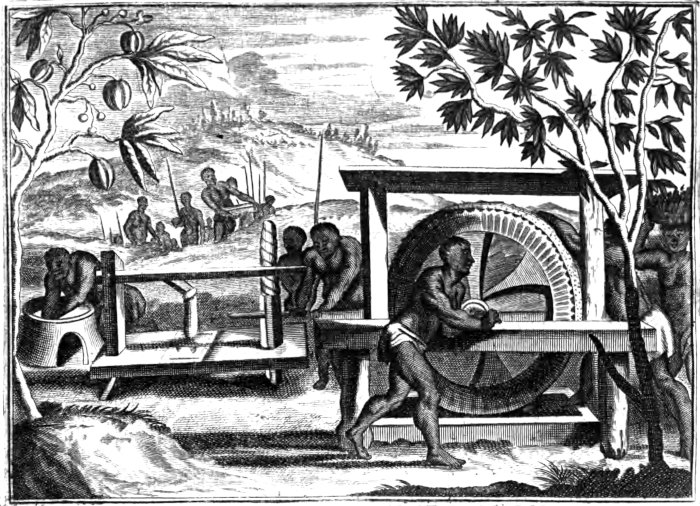
The Leaves of the Mandihoka serve them for Sallads. Out of the Root, 73which they lay soaking five days in Water, they make Meal, which the Portuguese call Farina fresca, but the Americans, Vipeba. Moreover, Mandihoka serves them to make Bread, which they bake over the Fire; and mix’d with Water, Pepper, and the Flour Nhambi, makes an excellent Pudding, by them call’d Mingaude Carima, no less pleasing to the taste than wholsom Food: and with Orange-Flour, Water, and Sugar, it makes that excellent Julep Tipioca. The Powder of Mandihoka put into a Wound, cures very speedily. It is very pleasant to see the Americans eat this Bread; for they toss it by handfuls at a pretty distance from their Mouthes without letting fall the least Crum. Lastly, it requires great art and trouble to make the Mandihoka fit for Bread: first they must peel off the Shell, then put into a Mill turn’d by two Indians it falls, being Ground, into a square Trough. The Juice proceeding from it is mortal, if eaten when raw, but wholsom if boil’d: the Meal they put in a Press, and when all the moisture is drawn from it, they strow it in an Oven to dry. But the wild Mandihoka, by those that live on the Sea-shore call’d Cuacu Mandiiba, and up in the Countrey, Cuquacucuremia, differs both in shape and goodness from the first.
Arias’s Exploits in New Andalusia.
But to return to our matter: Arias coming to an Anchor in the River Daria, was cheerfully receiv’d by Nunnez; his first Business which he undertook was the building of three Forts, to secure the Passages to the South Sea; to which purpose Joannes Aiora received the Command over four hundred Workmen. Moreover, Arias took great dislike in the Place call’d Maria Antiqua, which the Spaniards were forc’d by necessity first to Plant in: it lay in a deep Valley between high Mountains, so that it not onely wanted the benefit of the rising and setting of the Sun, but when in or near the Meridian, it shin’d down upon them, and scorch’d all their Plants, and the tepifi’d Morassy Grounds about the same infected the Air, and the Water which they took up to wash their Houses, immediately bred Frogs, the River Daria overflow’d the Grounds with his muddy Water three Leagues distance from the Sea; the Passage thither 74also was very troublesom, because of the uneven Ways; and besides, the Tygers and Lyons devour’d many People and Cattel.
A strange Accident.
The first Night that Arias lay in Maria Antiqua, the House wherein his Chirurgion Lodg’d was fir’d with Lightning, who running out with his Wife, being both scorched by the Flames, saw a very great Crocodile, which snatching up his Dog ran away with him towards the River.
Remarkable Trees.
The neighboring Territory Coiba produced Trees, whose Timber us’d for Shipping never breeds Worms, because of its acerbity; whereas on the contrary, all other Vessels in that Countrey are very subject to that inconvenience. Here also grow those famous Plague-Trees, whose very Leaves, if but falling upon one, are like Gods Arrows, mortal, and immediately kill, unless the Place whereon they light be straightway anointed with fasting Spittle: and the Coibensers say, that they know another poysonous Wood, which they use to destroy their Enemies withall.
Remarkable Journey of Moralis to the South Sea.
Whilst Arias was consulting about the beforemention’d Affairs, he sent several Comanders to divers Places, to take a survey, and give him an account of their Return of all their Discoveries. Amongst others Gasper Moralis was order’d to march towards the South Sea, to confirm the Peace which Nunnez had begun with the Kings Chiapes and Tumaccus; and chiefly to go to the Pearl-Island with sixty Men, which Nunnez was forc’d to leave, being stress’d by tempestuous Weather. Chiapes and Tumaccus were according to their promise, to prepare an Army ready for his assistance against his coming; which indeed they perform’d, so that they wanted nothing but Vessels, for the biggest of theirs could not carry above three or four Men; yet they undertaking their Enterprise, Landed seventy Men on the Island; upon which the Inhabitants under their Kings Conduct ran to meet the new Landed Forces, and crying out aloud Guazzavara, Guazzavara, they ran in amongst the Musqueteers with their woodden Swords; but the report of the Guns, mix’d with Fire, Smoak, and Bullets, soon amaz’d them: the King flying, thought by alarm to raise all the Islanders; but they being inform’d, that no People whatsoever could withstand the fire-spitting People, made Articles of agreement with Moralis, and Condition’d to deliver a hundred pound weight of the choicest Pearls to the use of the King of Castile; and as a testimony of his Friendship he was Christen’d Peter Arias, from the Governors Name of New Andalusia.
Strange Pearl.
How great the Treasure was which Moralis brought from the Pearl Island may appear by one of the Pearls, for which Pope Leo the tenth gave forty four thousand Ducats to a Venetian Merchant.
Solisius his miserable end.
Amongst the Commanders which were sent out by Arias, was also Johannes Solisius, who Sailing six hundred Leagues Southerly, along the Coast of the Caribbies, beyond Cape St. Augustine, he found the Inhabitants of Pernambuck to be no less cruel than subtile; for being invited ashore, he with some of his Men Row’d thither, where no sooner Landing, but were all kill’d and eaten in the sight of the other Sea-men aboard; at which being amaz’d they weighed Anchor, and Sail’d away, Freighted onely with Brasile Wood, to Cadiz.
Also in an unhappy hour did Johannes Pontæus put some of his Laundresses ashore on the Island Guadalupa, to wash some Linnen for him; for the Islanders coming on a sudden out of the Woods surpriz’d them, and forthwith killing without mercy, cut them in pieces, and carbonadoing, eat their broil’d Flesh hot from the Coals, while Gonsalus Badajocius Sail’d with eighty Men 75Westerly, and having gone sixty Leagues he went ashore, and spent some days in vain, to Court the Americans to a friendly correspondency; which whilst he was doing, he was recruited with fifty Men from Daria, Commanded by Lodowick Mercado: so both agreed together to travel over the Mountains to the South Sea.
Strange Slaves.
Great Booty.
The Governor Juana, whose Jurisdictions abound in Gold, flying with most part of his Treasure, was never heard of, onely they took some of his Slaves, whose Faces were strangely Carv’d with sharp Fish-bones, the Wounds fill’d with red and black Powder, which so discolour’d the Flesh that it could never be got out. After that they travell’d through the Wilderness five days together, being onely met by some Indians carrying Maiz, who signifi’d to them, that King Periguete liv’d along the Sea-shore, and up into the Countrey the blind Totonoga; of both which they got an unvaluable Treasure of Gold. Amongst other Pieces of that rich Metal was one which weighed two pound.
Taracura rais’d in this Expedition eighteen thousand weight of Gold: and little less did they take out of the Territories belonging to the Princes Pananome, Tabor, Cheru, and Scoria: The Prisoners serv’d them in stead of Horses, they not being able to carry all the Gold themselves, the meanest Soldier having above three thousand Pounds Sterling for his share.
Destruction of the Spaniards.
They were now got to Panza’s Kingdom, not without leaving sad remarks, of their avarice and cruelties. When Pariza surrounding this Party thus loaden with Gold, Charged so fiercely, that at the first Assault seventy of them were slain; those few that escap’d brought the tidings of their sad misfortune to Peter Arias. Amongst those that escaping return’d, was Franciscus Delapuente, whose observations concerning catching Parrots and wild Fowl, we will briefly relate, the digression being but short.
A strange way to catch Parrots.
The Indian where the Parrots are most frequent climbs into a Tree, and chattering like them, with his Voice imitating their Notes, allures his fellow-prater to draw near, and suffer him to take them in his Hands. But more belongs to the taking of wild Fowl, as Geese, Ducks, Swans, and the like: From the bottom of their standing Pools and Lakes in that Countrey grow Weeds, which spreading upon the Water ripen, and rotting breed Water-Flies, Spiders, and Frogs, upon which the Fowls feed. Near these Pools in the Gardens grow Cabbages as high as Trees, which often dropping into the Water serve the Birds both for Nests and Food: but the skilful Fowler finds it his best way to take one of these Cabbages, and making it hollow in the middle, claps it on his Head like a Helmet, then going into the Water up to his Chin, and passing softly along in such manner, that nothing is seen but the floating Cabbage, and coming near the Birds, he takes them one after another by the Legs, and puts them into a Bag ty’d about his middle for that purpose.
Strange Bird Toucan.
But what is more worthy observation is the American Bird Toucan Xochitenachate, having a fleshy Bill, like a Mouth full of Teeth, which continually opens and shuts to draw Breath, having no Nostrils; the Back, Neck, and Wings, are black, the Breast yellow like Gold, the Belly and end of the Tail of a Vermillion colour.
Evacuated Pepper.
This Bird Toucan feeds for the most part on Pepper, which tarries not long with them, but muted almost as soon as swallowed: which Pepper thus evacuated the Natives value above their common, because the unpleasing sharp acidity, or biting quality is thereby much mitigated.
But to return: Whilst the Expeditions under the Command of Peter Arias had such bad success, Arias himself and Vaschus Nunnez hapned to clash: Nunnez, 76who since his discovery of the South Sea was held in some repute at the Spanish Court, had built four Ships on the Shore of the same Ocean, to make farther inspections along the Coasts thereof: but being commanded to come to Arias the Governor, he was committed to Prison, and accused of high Treason, as if he had intentions to settle himself in Peru, and absolutely to have left Daria: all which though he disown’d, and utterly deni’d with great protestations when brought to a Trial, and no witness to affirm the contrary, yet was by Arias’s special Order Beheaded.
Not long after which Lupus Sosa, Governor of the Canary Islands, was sent to succeed Arias in New Andalusia.
Sect. IX. The Expeditions of Francisco Fernandez, Lupus Caizedus, Christophero Morantes, Bernardo Igniguez, and Juan Grisalva.
Original of the Name Jucatan.
Fernandez, Caizedus, and Morantes, antient Planters in Cuba, obtain’d a Licence from the Governor Diego Velasques, to Rig out three Ships with a hundred and ten Men to discover new Lands. Velasques thought fit to add one more to their number upon the Kings account; which Trust he committed to Igniguez: all of them consulted with the experienc’d Navigator Antonio Alamines. Six days the Fleet had been at Sea, when they discover’d Land, which by a mistake was call’d Jucatan, because the Inhabitants being ask’d what was the Name of the Coast, answer’d Jucatan; which, as the Spaniards were afterwards inform’d, signifi’d, We understand you not.
Stately City.
Upon the Shore they found a City, whose Stone Buildings, with stately Fronts and high Turrets, shew’d most magnificently. Fernandez call’d this City for its wonderful bigness, Cairo, from the Egyptian Metropolis, famous through the World.
Campechium a City.
Remarkable Images, and strange Stage.
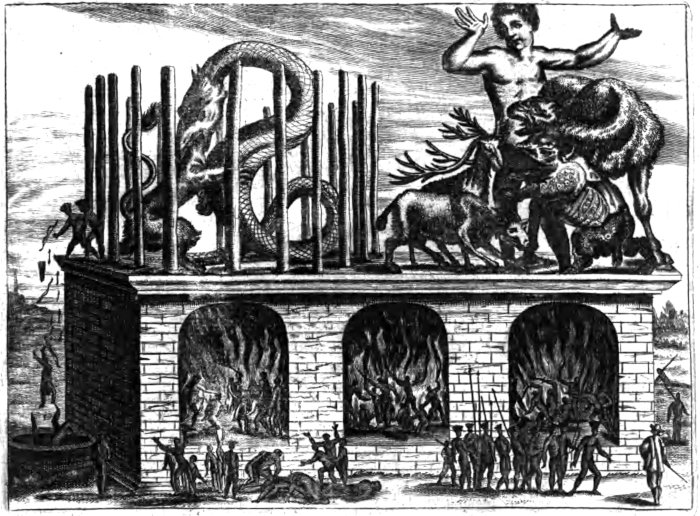
The Spaniards coming to Land were courteously receiv’d, and conducted into the City; the neatness of whose Market-places, and exactness of their Streets, they beheld with admiration; as also the costly Stuff Garments both of Men and Women: but their wonder increas’d when they beheld very artificial Crosses, concerning which upon inquiry they related, That a Man more glorious than the Sun, being busie in erecting the Crosses, died. But these People, though so courteous and civil at first, seem’d in few days to be weary of their company; which the Spaniards observing sounded a Retreat, and Sailing Westerly, proceeded on their intended Design, and soon after anchor’d before Campechium; the King of which conducted Fernandez and Morantes, with some others, into the City, consisting of three thousand Houses. In his Palace they were entertain’d with all manner of Fowl roasted: After which refreshment they survey’d the City; in which, amongst other curious Buildings, was a high, but square Theatre of Marble, on which stood the Image of a Man, on all corners assaulted by four wild Beasts, which were of a no less strange than horrible shape. Not far from this Image they saw a Serpent fashion’d up of Chalk and little Stones, whose coyl’d up Tail was forty seven Foot long, and of a proportionable thickness. This Serpent, sprinkled with Mens Blood yet warm, seem’d to prey upon a Marble Lyon: both these were inclos’d with a Stone Rail, within which Malefactors were daily executed. Bloody Bows and Arrows broke in small pieces lay between the Bones and dead Bodies. Igniguez 77call’d the King Lazarus, because he discover’d his Countrey on St. Lazarus’s Day.
Moscobo a City.
Spaniards slain.
Mighty Island Cosumella.
Making no long stay here, they return’d to their Ship, and weighing Anchor Sail’d fifty Leagues more Westerly, the Fleet got sight of Moscobo, in the Territory Aguanil, whose King assaulted the Spaniards with so much fury, that two and twenty of them were slain, and scarce one escap’d which was not wounded: wherefore they return’d with bad success to Cuba. Yet Velasques no ways discourag’d thereat, not long after fitted out four Vessels, Manning them with three hundred Men under the Command of Juan Grisalva and Alamines; who having Sail’d seventy Leagues, discover’d the fruitful Island Cosumella; along whose Shore stood fair Stone Edifices, intermix’d with Temples, whose Steeples appear’d above the Houses. Grisalva being led up into one of these Steeples by a Priest, saw at a distance off at Sea the Territory Jucatan: and in the Place where they were, there were spacious Halls, full of Marble and Stone Images of deformed Men and Beasts, which with a murmuring noise, and burning of incense they religiously worship. The Spaniards call’d this Island Sancta Cruz.
Spaniards fight with the Campechiums.
Sailing from hence they directed their Course to Campechium, where the year before they had been so civilly treated; where arriving, and without any fear coming ashore, they found the Campechiums quite of another humor than they were the former year, telling them, They would not suffer any Strangers to be amongst them; and placing a burning Torch between theirs and the Spanish Forces, threatned, That if they did not depart in quiet, they would force them: which accordingly they endeavor’d, making a fierce Onset upon the Spaniards; who being now come under their Battlements, when they saw their advantage, pour’d what they had kept as a reserve, whole Volleys of small Shot amongst them; which struck so much terror, that they all ran away, shifting for themselves, and crowding into the City.
The Spaniards found afterwards Jucatan to be but a Peninsula, and came before 78a River which fell with so strong a Current into the Mexican Sea, that it retain’d its sweetness for the space of two Leagues.
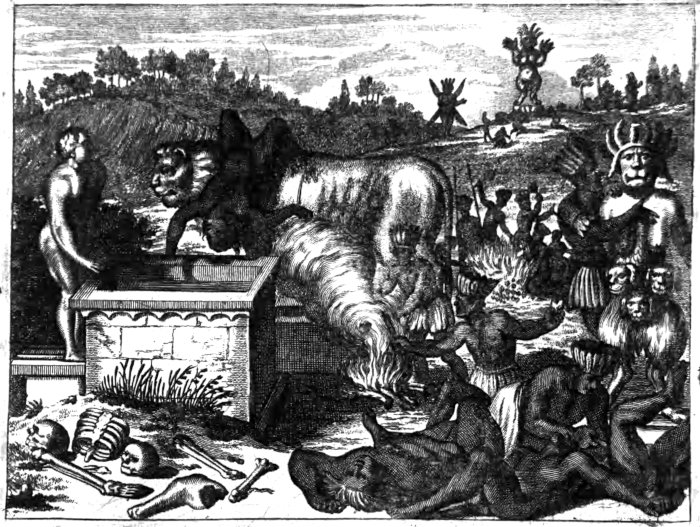
Strange passages on Tabasco.
This River, flowing out of the Province Tabasco, was call’d Grisalva: upon whose Banks stood above six thousand Americans; and in the Water appear’d a hundred Boats with Armed Men, which Row’d aboard the Spanish Ships. The Interpreters of Cuba, whose Language agrees for the most part with the Tabascers, prevail’d so much, that the King himself came to the chief Commander Grisalva, and bartering with him, gave him as much Gold as his Iron Helmet, Breastplate, and other Armor weighed.
Sacrifice Island.
Soon after they Landed on the Island of Sacrifice, so call’d from the horrid Sacrifices which the Inhabitants made daily.
Exceeding horrible Sacrifices.
Amongst other strange Images, there flood a great Lyon of Marble, seeming almost decollated with a great gash; into which Wound they pour’d humane Blood warm, which was receiv’d into a Stone Trough set for that purpose underneath; then the Figure of a Man Carv’d in Alabaster, bowing forward, as if looking into the Trough upon the Blood. Those which were sacrificed were Prisoners taken on the neighboring Coasts, whom bringing before their Idols, they ripping open make no farther inspection, but onely to whip out the Heart; with which having smear’d the Lips of their Idols, they throw it into the Fire: the Heads and Corps they let lie unburi’d; whose fleshy parts, especially their Cheeks, they feast upon.
Maiden-Island.
The next Island is inhabited by Women; to which Annually their Neighbors go, pretending merry kindness, but upon amorous inclinations: and Plough and Till their Ground, and Weed their Gardens.
Pontenchianum a City.
The chief City of Tabasco is Pontenchianum, and contains above fifteen hundred Houses, all built of Stone hardned with baking after their manner; which in some Places, besides their Turrets and Temples, yield a pleasant Prospect at a great distance. Fourteen eminent Towns more did the Spaniards also see in Tabasco.
Strange making of Obligations.
79When in conversing with them they observ’d their strange manner of Sealing their Bargains and Contracts one with another, they were amaz’d, for not using Wax, they usually Seal’d their Compacts with their own Blood, commonly drawn with a Stone Knife, either from their Tongue, Hand, or Arms.
Their Priests live single, and if found to be Unchast, are punisht with Death. An Adulteress is sold for a Slave: Unmarry’d People may not frequently converse with Marry’d: Thirty five days in the year makes their Lent, in which they abstain not onely from Flesh, but Fish also, feeding onely upon Roots and Herbs. In this place the Spaniards were receiv’d in great state, Canopy’d with green Palm-Tree-Branches, and in like manner conducted aboard again, not without many Presents, viz. the Effigies of a Man curiously wrought in Gold, wherewith they return’d to Cuba.
Sect. IXa. The Expedition of Ferdinand Magaglian, commonly call’d Magellane.
Bishop Casis sad effect concerning the Pearl catching.
The Bishop Bartholomew de Casis, living a considerable time in Hispaniola, in the City Dominico, being inform’d of the abundance of Pearls which were caught before Cubagua, and the unsupportable cruelty of the Spaniards there under Ocampus, us’d against the Inhabitants, went to Spain, with a design to obtain of the Emperor Charles the Fifth, the Government over Cumana and Cubagua, under pretence, to draw the ignorant Natives from their Idolatry, to Christianity; which his request was especially promoted by William of Nassaw, the Emperors prime Favorite; so that having his Letters Patents granted to that purpose, he took Ship, and arriv’d with three hundred Spanish Gentlemen of Quality in Cumana: And that they might have the greater respect shown to them there, they had each a Red Cross given them, such as the Knights of Calatrava generally wear. Yet little did Ocampus, the old Governor of Cumana, regard either them or their Authority; for in stead of receiving and submitting, he kept the Bishop de Casis out by force of Arms; who then made complaint to the Vice-Roy of the West-Indies in Hispaniola, and in the mean time, put his Cargo into a new Store-house.
But whilst he made his Addresses, Ocampus having sufficiently inrich’d himself departed, which incourag’d the Cumaners, who already were incens’d, and weary of their former sufferings, to venture on a design, whereby they might revenge themselves of the Spaniards, which their undertaking prov’d so successful, that very few escap’d the Massacre: Of which, de Casis being inform’d, and much discontented thereat, betook himself to a Dominican Cloyster in Hispaniola.
Cruelty of Castellio in Cumana.
Yet not long after, the Cumaners paid dear for that slaughter, for one Castellio, though not without several Engagements, with various success, lasting forty days together, having at last utterly vanquish’d them, put to an ignominious Death, Hanging up seventy of their Princes, and to them of meaner quality, shewing as little mercy.
Lampagnano discontented.
As little success had Lodowick Lampagnano, sent out by some Spanish Merchants, with Letters Patents from the Emperor to Fish for Pearl, before the same Cubagua; to which purpose he carry’d peculiar Nets and other necessaries with him. But the Cubaguan Spaniards unanimously withstood him; so that not being able to effect his design, overpower’d with a Melancholly Distemper that broke his Heart, he dy’d.
Magellanus Expedition, how it happen’d.
80In the interim, while these scarce considerable Voyages turn’d to so small account, Ferdinand Magaglianus (for so Peter Martyr calls him, and not Magellanus, which herein deserves to be credited, because they were intimately acquainted, and great friendship between them,) undertook to Sail round about the World; the occasion of which we will here relate at large:
This Magaglianus, or Magellanus, a Gentleman of Portugal, having perform’d things of great importance for his King, in Africa, although with no less trouble than Charge, desir’d an addition of half a Ducket a Moneth added to his Annual Pension; an inconsiderable Sum to make a Request for, yet though so little, was as niggardly deny’d: Whereupon, highly incensed, he study’d no little revenge; to which effect, soon after an opportunity was presented, by means of Franciscus Serranus, who writ from Ternata to him, that he should speedily come thither, which he soon after did upon this account:
Strange Giant.
Pope Alexander the Sixth, having fixt Terminaries between the Kings of Castile and Portugal, both busie at that time in discovering new Countreys, Order’d, That Castile should possess all the Coasts lying to the West of the chief Meridian, and Portugal to the East: By vertue of this partition, the rich Spicy Molucca Islands fell absolutely to the Portuguese: Now Magellanus perswaded Charles the Fifth, that they might be Sail’d to with a Westerly Course, and therefore belong’d to Castile; Which advice, Charles the Fifth considering, and approving, Rigg’d out five Ships, with which Magellanus set Sail from Sevil, the tenth of August, Anno 1519. five Moneths he ply’d up and down the Coast inhabited by the Patagones, where he found none but one single Person, or rather a Monster, a Giant ten Foot high, who coming Aboard his Ship, devour’d a great Hamper full of Biskets, and at one Draught drunk up nine Pottels of Water. He also saw several Trees which had been Hew’n with Axes, and Crosses made on the tops of them. Whilst he lay in that Harbor, which was call’d St. Julian, he Cashier’d his Vice-Admiral, John Carthagena, with his Father Confessor, and sparing their lives, set them ashore, and there left them to seek their Fortunes, though they had Conspir’d to Murther him.
Straights of Magellan, how found.
Magellanus from thence Sailing afterwards Southerly along America, to forty two Degrees Southern Latitude, was engag’d with the eddyings of a very strong Current, which driving one of the Ships into a Bay, split against a blind Rock, but the Men being sav’d in their Boat, were driven farther and farther into a Channel, between high and Snowy Mountains; whereupon he immediately judg’d (as the famous Negromancer Roderick Talerus had often told him) that there was the Passage, through which the Northern Ocean flow’d into the Southern; wherefore he resolutely adventur’d to Sail into those Sraights, which in some places narrow, and in others broad, is an hundred and twenty Leagues long, and full of small Isles and dangerous Rocks. Whilst he still Sail’d on, the Ship call’d Antonio, Tacking about, return’d to Cadiz.
But Magellanus enter’d the great South-Sea with three Sail, on the 25. of October, where the Sea-men suffer’d extremely by excessive Heat, Drought, and Famine, three Moneths and twenty Days, without sight of Land: And now, their Shooes, and the Leather which cover’d their Shields, began also to grow scarce (which before had been counted a Dainty) when they discover’d two Islands lying two hundred Leagues distance one from another, yet both Desolate and Barren, wherefore they were call’d the Unfortunate Isles: After that, they came amongst a great number of Islands, whose Inhabitants were much 81inclin’d to Thievery; for which cause they Denominated them Ladrones, the chiefest Island call’d Borneo, hath two hundred fifty four Leagues in Circumference, whereon a Tree grows, whose Leaves when faln off, seem to be alive and creep like Worms. The King of this Island entertain’d the Spaniards very courteously, two Elephants bringing his Presents to them on the Shore, out of a City consisting of twenty thousand Houses.
Magellanus slain.
Spaniards murdered.
An end of the Voyage about the world.
Near Borneo are two lesser Islands, call’d, Zubo and Matan; The King of Zubo freely submitted himself to the Spaniards, and Magellanus leaving his Fleet at Anchor in the Haven, went with his own and other Indian Boats, and attended with some of the Zubensers to Matan, where setting a Village on Fire, he carry’d great Riches from thence: This not satisfying, he resolv’d within eight days to set upon the Royal Head-City; but the King in his own Defence, Encountering with Magellanus, slew him, and seven Spaniards more, besides twenty two dangerously wounded; those which escap’d by flight, got to Zubo, where being invited to Dinner by the King, they were all of them (in stead of a second Course) Murther’d at Table. The occasion of this was out of Revenge, because the Spaniards had fall’n too foul upon their Women and Maids, Devirginating, and forcing them to their Pleasure, than which rudeness nothing was among them more Detestable. The Sea-men weakned by these Misfortunes, were necessitated to burn their third Ship, call’d, St. Jago; but Sailing to the Molucco Islands with the other two, they Freighted them both with Cloves; with which the Ship Trinitas Sail’d to New-Spain through the South-Sea, and the Victoria, Commanded by John Sebastian de Lano went the same way which the Portuguese us’d, and so to St. Lucar de Barrameda, near Sivile, where he came to Anchor with his Ship and eighteen Men.
Sect. X. Ferdinando Cortez his Voyage.
Sottus cruelty.
Although several Expeditions of the Spaniards to America prov’d very unsuccessful at the first, yet they still undertook them afresh, and with renewing Courage: Ferdinando Sottus, though he Landed five hundred Men in Florida, yet brought no Treasure from thence, onely he cut off the Hands of fifteen Princes, because they would not discover their Mines of Gold.
Miserable end of Narvaez.
Yet far worse success had Pamphilus Narvaez, who lost both his Fleet and Men, saving onely ten out of six hundred, in the River Palma, and they also afterwards dy’d there, or eat one another to satisfie their raging Hunger.
Cortez his Voyage.
Remarkable delivery.
But much better was the fortune of Ferdinando Cortez, Sailing from Spain to America, in the Year 1519. who having the Command given him over ten stout Ships, and three Frigats with five hundred Foot, and an additional Force of sixteen Horse, rais’d by the new Spanish Inhabitants on Cuba; with which Forces Landing on the Island Cozumella, he prohibited Humane Sacrifice to their Idols, and Erected a Cross with the Image of the Virgin Mary, in one of their Temples, and releas’d Hieronimus Aquilaris, after a seven years Slavery, having suffer’d Shipwrack with Valdivia; at which time some that sav’d themselves in the Boat, were by the Current in thirty days driven to Jucatan, in which time seven dy’d of Hunger; the rest going ashore, were no sooner Landed, but Sacrific’d by the Natives to their Gods or Zemes. Among the six that remain’d, yet left alive, and to be offer’d after the same manner the next day, was this Aquilaris, who with his Companions, breaking Prison, in the following night fled 82to a Neighboring Prince their Enemy, and one that maintain’d a continual War against these Cannibals.
Strange Battel.
Potanchanum, a City.
Colvacan Books, of what fashion, as also their Temples.
Here Cortez sent Articles of Peace to Taxmarus the King of the Countrey, but he sleighting his proffer, came down upon him into the Field with forty thousand Men, drawn from the City Potanchanum, which contain’d above twenty thousand Houses, all built of Stone: And indeed the Spaniards had here seen their last day, had not Cortez drawn by a seeming advantage the Enemies under his Canon, and sent his small Party of Horse to attend the motion of the Rear; when so soon as they had fir’d their Canon, making great Execution, the Front routed, and the Rear terrifi’d with the noise and smoke of the Guns, they also broke, being at the same instant Charg’d with the Horse, which were so terrible to them that never saw Horses, nor such Service on Horseback before, that in a short time the whole Body of so great an Army was utterly dissipated, and the triumphing Conquerors took possession of the empty City Potanchanum, where Solacing, they staid a whole Moneth. Then from hence they Sail’d to Colvaca, where, upon the request of the Natives, they settled a Colony. Amongst the Presents which were there given to the Spaniards, were some of their own Volumes, Books, whose Leaves were made of the innermost Rind of a Tree, and a kind of Paste, made of their Meal, glew’d together; the Characters stood at some distance one after another, rang’d like our Christ-Cross Row, or A, B, C.
Here Cortez was amaz’d to behold their stately Temples, the Floors whereof were cover’d with Embroyder’d Tapestry, beset with Precious Stones, to which great multitudes flock’d, being very zealous to perform their Devotions.
When their Seed is put into the Ground, or come to its full growth, they offer young Children to their Zemez, richly Cloth’d, having been fatten’d some Weeks before: When they want Children they kill their Slaves, and in default of them, they pacifie them with Dogs.