The Second Book, CONTAINING A DESCRIPTION OF NORTHERN AMERICA (continued 2)
Reading edition
The nature of the ancient Inhabitants.
As touching the Nature of the ancient Inhabitants, they are to be consider’d according to their several Shires or Divisions; those that inhabit to the East and North-East bore the name of Churchers and Tarrenteens; those in the Southern parts were call’d Pequods, and Narragansets; those Westward, Connectacuts and Mowhacks; to the North-West, of whom were the Aberginians.
The nature of the Mowhacks.
The Mowhacks were ever accounted a cruel bloudy People, which were wont to come down upon their poor Neighbors, with more than bruitish Savageness, spoiling their Corn, burning their Houses, slaying Men, ravishing Women, yea very Canibals they were, sometimes eating on a Man one part after another before his Face, and while yet living; insomuch, that the very Name of a Mowhack would strike the Heart of a poor Aberginian dead, till they had the English on their sides to succor them; for these inhumane Homicides confess that they dare not meddle with a white Fac’d Man, accompany’d with his hot-mouth’d Weapon.
These Indians are a People of tall Stature, long grim Visages, slender Wasted, and having exceeding great Arms and Thighs, wherein they say their strength lieth; which is such, that one of them hath been known to kill a Dog with a fillip of his Finger, and afterwards to have flead and sod him, and eat him to his Dinner. They are so hardy, that they can eat such things as would make other Indians sick to look upon; being destitute of Fish and Flesh, they suffice Hunger and maintain Nature with the use of Vegetatives; but that which they most hunt after, is the flesh of Man: Their custom is, if they get a stranger near their Habitations, not to Butcher him immediately, but keep him in as good plight as they can, feeding him with the best Victuals they have.
These Indians are more desperate in Wars than the other Indians, which proceeds not only from the fierceness of their Natures, but also in that they know themselves to be better Arm’d and Weapon’d; all of them wearing Sea Horse Skins and Barks of Trees, made by their Art as impenetrable, it is thought, as Steel, wearing Head-Pieces of the same, under which they March securely and undantedly, running, and fiercely crying out, Hadree Hadree succomee succomee, We come to suck your Blood, not fearing the feather’d shafts of the strong-arm’d Bow-men, but like unruly headstrong Stallions, beat them down with their right-hand Tamahawks, and left-hand Javelins, being all the Weapons which they use, counting Bowes a cowardly fight. Tamahawks are Staves of two Foot and a half long, with knobs at one end as round and big as a Foot ball; a Javelin is a short Spear, headed with sharp Sea-Horse Teeth; one blow or thrust with these sharp Weapons, will not need a second to hasten death from a Mowhacks arm.
The nature of the Indians inhabiting Eastward.
The Tarrenteens saving that they eat not Mans flesh, are little less Salvage and cruel than these Cannibals; our Indians do fear them as their deadly Enemies, for so many of them as they meet, they kill. Take these Indians in their own proper and natural disposition, and they are reported to be wise, lofty-spirited, constant in friendship to one another, true in their promise, and more industrious than many others.
The nature of the Pequods and Narragansets.
151The Pequants are a stately Warlike People, just and equal in their dealings; not treacherous either to their Country-men, or English, to whom (except in time of War) they were not any ways uncivil. Their next Neighbors the Narragansets, are the most numerous People in those Parts, the most rich also, and the most industrious; being the Store-house of all such kind of wild Merchandize as is amongst them. These Men are the most curious Minters of their Wampompeage and Mowhakes, which they form out of the inmost Wreaths of Periwinkle-shells. The Northern, Eastern, and Western Indians fetch all their Coyn from these Southern Mint-Masters. From hence they have most of their curious Pendants and Bracelets, from hence they have their great Stone Pipes, which will hold a quarter of an Ounce of Tobacco, which they make with Steel Drills and other Instruments; such is their Ingenuity and dexterity, that they can imitate the English Mold so accurately, that were it not for matter and colour, it were hard to distinguish them; they make them of green, and sometimes of black Stone; they are much desir’d of our English Tobacconists, for their rarity, strength, handsomness, and coolness. Hence likewise our Indians had their Pots, wherein they us’d to seeth their Victuals before they knew the use of Brass. Since the English came, they have employ’d most of their time in catching of Beavers, Otters, and Musquashes, which they bring down into the Bay, returning back loaden with English Commodities, of which they make double profit, by selling them to more remote Indians, who are ignorant at what cheap rates they obtain them, in comparison of what they make them pay, so making their Neighbors ignorance their enrichment: They were never known to be desirous to take in hand any Martial Enterprize, or expose themselves to the uncertain events of War; wherefore the Pequants call them Women-like Men, resting secure under the conceit of their popularity, and seeking rather to grow rich by industry, than famous by deeds of Chivalry.
The nature and complexion of the Aberginians.
Most of these Northward Indians are between five and six Foot high, straight Body’d, strongly compos’d, smooth Skin’d, merry Countenanc’d, of Complexion more swarthy than the Spaniards, black Hair’d, high Foreheaded, black Ey’d, out-Nos’d, broad Shoulder’d, brawny Arm’d, long and slender Handed, out Breasted, small Wasted, lank Belly’d, well Thigh’d, flat Kneed, with handsome grown Legs, and small Feet: In a word, take them when the Blood skips in their Veins, when the Flesh is on their Backs, and Marrow in their Bones, when they frolick in their antique Deportments and Indian Postures, they are more amiable to behold (though onely in Adam’s Livery) than many a trim Gallant in the newest Mode; and though their Houses are but mean, their Lodging as homely, Commons scant, their Drink Water, and Nature their best Clothing, yet they still are healthful and lusty. Their smooth Skins proceed from the often anointing of their Bodies with the Oyl of Fishes, and the fat of Eagles, with the grease of Rackoons, which they hold in Summer the best Antidote to keep their Skin from blistering with the scorching Sun; it is their best Armor against the Musketoes, and the surest abrasour of the hairy Excrement, and stops the Pores of their Bodies against the nipping Winters cold. Their black Hair is natural, yet is brought to a more Jetty colour by Oyling, Dying, and daily dressing; sometimes they wear it very long, hanging down in a loose dishevel’d Womanish manner, otherwise ty’d up hard and short like a Horse Tail, bound close with a Fillet, which they say makes it grow the faster; they are not a little Phantastical in this particular; their Boys being not permitted to wear their Hair long till sixteen years of Age, and then they must come to it by degrees; some being cut with a long foretop, a long lock on the Crown, one of each side of his Head, the rest of his Hair being cut even with the Scalp; the 152young Men and Soldiers wear their Hair long on the one side, the other being cut short like a Screw; other cuts they have as their Fancy leads them, which would torture the Wits of the most exact Barber to imitate. But though they are thus proud of the Hair of their Head, you cannot wooe them to wear it on their Chins, where it no sooner grows, but it is stubb’d up by the roots, for they count it as an unuseful, cumbersome, and opprobrious excrement, insomuch as they call him an English Mans Bastard that hath but the appearance of a Beard.
The Apparel, Ornaments, Paintings, and other artificial Deckings of the Indians.
The Cloathing of the Indians is only a pair of Indian Breeches to cover their secret Parts, which is but a piece of Cloth a yard and a half long, but between their Groins, ty’d with a Snakes Skin about their middles, one end hanging down with a flap before, the other like a tail behind. In the Winter time, the more Aged of them wear Leather Drawers, in form like Irish Trouses, fasten’d under their Girdle with Buttons: They wear Shooes likewise of their own making, cut out of a Mooses Hide; many of them wear Skins about them, in form of an Irish Mantle, and of these some are Bears Skins, Mooses Skins, and Beaver Skins sew’d together, others Otter Skins, and Rackoon Skins; most of them in the Winter having his deep Furr’d Cat Skin, like a large Muff, which he shifts to that Arm which lieth most expos’d to the Wind. Although they are poor, yet is there in them the sparks of natural Pride, which appears in their longing desire after many kind of Ornaments, wearing Pendants in their Ears, in form of Birds, Beasts, and Fishes, Carv’d out of Bone, Shells, and Stone, with long Bracelets of their curious wrought Wampompeage and Mowhackees, which they put about their Necks and Loins; these they count a rare kind of Decking; many of the better sort bearing upon their Cheeks certain Pourtraitures of Beasts, as Bears, Deers, Mooses, Wolves, &c. some of Fowls, as of Eagles, Hawks, &c. which is not a superficial Painting, but a certain Incision, or else a raising of their Skin by a small sharp Instrument, under which they convey a certain kind of black unchangeable Ink, which makes the desir’d form apparent and permanent. Others have certain round Impressions down the outside of their Arms and Breasts, in form of Mullets or Spur-rowels, which they imprint by searing Irons: Whether these be Foils to illustrate their unparallel’d Beauty (as they deem it) or Arms to blazon their antique Gentility, cannot easily be determin’d: But a Segamore with a Humbird in his Ear for a Pendant, a black Hawk on his Head for his Plume, Mowhackees for his Gold Chain, good store of Wampompeage begirting his Loins, his Bowe in his Hand, his Quiver at his Back, with six naked Indian Lacquies at his Heels for his Guard, thinks himself little Inferior to the great Cham.
Their Diet, Cookery, Meal-times, and Hospitality at their Kettles.
In Winter time they have all manner of Fowls and Beasts of the Land and Water, Pond-fish, with Cathaires and other Roots, Indian Beans and Clamms; in the Summer they have all manner of Sea-fish, with all sorts of Berries. For the ordering of their Victuals, they Boil or Roast them, having large Kettles which they Traded for with the French long since, and do still buy of the English as their need requires, before they had substantial Earthen Pots of their own making. Their Spits are no other than cloven Sticks, sharpen’d at one end to thrust into the ground; into these cloven Sticks they thrust the Flesh or Fish they would have Roasted, behemming a round fire with a dozen of Spits at a time, turning them as they see occasion. They seldom or never make Bread of their Indian Corn, but seethe it whole like Beans, eating three or four Corns with a mouthful of Fish or Flesh, sometimes eating Meat first, and Corns after, filling the Chinks with their Broth. In Summer, when their Corn is spent, Sqoutersquashes is their best Bread, a Fruit like a young Pumpion: But as all are fellows at Foot-ball, so they all meet Friends at the Kettle, 153saving their Wives, that Dance a Spaniel-like attendance at their Backs for their Fragments. If their occasions cause them to Travel, the best of their Victuals for their Journey is Nocake, (as they call it) which is nothing but Indian Corn parch’d in the hot Ashes; the Ashes being sifted from it, it is afterwards beaten to Powder, and put into a long Leathern Bag, truss’d at their Back like a Knapsack, out of which they take thrice three Spoonfuls a day, dividing it into three Meals. If it be Winter, and Snow be on the ground, they can eat when they please, making use of Snow for their Drink; in Summer, they must stay till they meet with a Spring or Brook; with this strange viaticum they will travel four or five days together. They keep no Set-Meals, their Store being spent, they champ on the Bit, till they meet with fresh Supplies, either from their own endeavors, or their Wives industry, who trudge to the Clam-banks when all other means fail. Though they are sometimes scanted, yet are they as free as Emperors, both to their Countrey-men and English, be he stranger, or near acquaintance; counting it a great discourtesie, not to eat of their high-conceited Delicates.
Of their hardiness.
Their hardiness is much to be admir’d, no ordinary pains making them so much as alter their countenance; beat them, whip them, punch them, if they put on a resolution, they will not winch for it; whether it be their benumm’d insensibleness of smart, or their hardy resolutions, is hard to resolve; It might be a Perillus his Bull, or the Rack might force an out-cry from them, but a Turkish drubbing would not move them, the unexpected approach of a mortal Wound by a Bullet, Arrow, or Sword, striking no more terror, nor causing no more exclamation in them, than if it had been a shot into the body of a Tree; such Wounds as would be sudden death to an English Man, would be nothing to them; whether it be, that by their rare skill in the use of Vegetatives, or by Diabolical Charms, they cure them; nevertheless, the very name and thoughts of death is so hideous to them, or any thing that presents it so terrible, that a hundred of them will run from two or three arm’d with Guns. In the Night they need not to be feared, for they will not budge from their own Dwellings, for fear of their Abamacho (the Devil) whom they much fear, specially in evil enterprizes, they will rather lie by an English fire than go a quarter of a Mile in the dark to their own Dwellings; but they are well freed from this Scare-crow since the coming of the English, and less care for his delusions.
Of their Kings, Government, and Subjects obedience.
Now for the matter of Government amongst them; it is the custom of their Kings to inherit, the Son always taking the Kingdom after his Fathers death. If there be no Son, then the Queen rules; if no Queen, the next to the Blood-Royal; who comes in otherwise, is but counted an usurping Intruder, if his fair carriage bear him not out the better, they will soon Unscepter him. Some say the chief Powahe is next in Dignity and Authority to the King, and when he dies, Marries the Squasachem, or Queen.
The Kings have no Laws to Command by, nor have they any annual Revenues; yet commonly are they so either fear’d or beloved, that half their Subjects estate is at their Service, and their Persons at his Command, by which Command he is better known than by any thing else; for though he hath no Kingly Robes to make him glorious in the view of his Subjects, nor daily Guards to succor his Person, nor Court-like attendance, nor sumptuous Palaces; yet do they yield all submissive subjection to him, accounting him their Soveraign; going at his Command, and coming at his Beck, not so much as expostulating the cause, though it be in matters thwarting their wills; he being accounted a disloyal Subject that will not effect what his Prince Commands. Whosoever is known to Plot Treason, or to lay 154violent hands on his lawful King, is presently Executed. Once a Year he takes his Progress, accompanied with a dozen of his best Subjects, to view his Countrey, to recreate himself, and establish good Orders. When he enters into any of their Houses, without any more Complement, he is desir’d to sit down on the Ground, (for they use neither Stools nor Cushions) and after a little respite all that are present come in, and sit down by him, one of his Seniors pronouncing an Oration gratulatory to his Majesty for love, and the many good things they enjoy under his peaceful Government. A King of large Dominions hath his Vice-Roys, or inferior Kings under him, to agitate his State Affairs, and keep his Subjects in good Decorum. Other Officers there are, but how to distinguish them by Name is something difficult. For their Laws, as their Vices come short of many other Nations, so they have not so many Laws, though they are not without some, which they inflict upon notorious Malefactors, as Traitors to their Prince, inhumane Murtherers, and, some say, Adulterers: for Theft, as they have nothing to steal worth the Life of a Man, therefore they have no Law to Execute for Trivials, a Subject being more precious in the Eye of his Prince, than, where Men are so scarce, to be cast away upon so sleight a matter. A Malefactor having deserv’d Death, and being apprehended, is brought before the King, and some other of the wisest Men, where they enquire out the original of the thing, after proceeding by aggravation of Circumstances he is found Guilty, and Cast by the Jury of their strict Inquisition, he is Condemn’d and Executed in the following manner: The Executioner comes in, who blind-folds the Party, sets him in the publick view, and Brains him with a Tamahauke, or Club; which done, his Friends bury him.
Of their Marriages.
Now to speak something of their Marriages, the Kings and the Powwows, or great Doctors, may have two or three Wives, but seldom use it, Men of ordinary Rank having but one; which disproves the report, that they had eight or ten Wives apiece. When a Man hath a desire to Marry, he first gets the good will of the Maid or Widow, after, the consent of her Friends for her part; and for himself, if he be at his own disposing, and if the King will, the Match is made, her Dowry of Wampompeage paid, the Sagamore or King (who for every Marriage hath a Fathom of Wampompeage, which is about the value of seven or eight shillings) joyns their Hands, never to part till Death, unless she prove a Whore, for which they may put away their Wives.
Of their Worship, Invocations, and Conjurations.
As it is natural to all Mortals to worship something, so do these People, but exactly to describe to whom their Worship is chiefly bent, is very difficult: They acknowledge especially two, Ketan, some say Tantum, their good God, and Hobamocco, some say Squantum, their evil God; to Ketan they Sacrifice (as the ancient Heathens did to Ceres) after their Garners be full with a good Crop. They likewise Invocate this God for fair Weather, for Rain in time of Drought, and for the recovery of their Sick; but if they do not hear them, then they verrifie the old Verse, Flectere si nequeo Superos Acheronta movebo, their Powwows betaking themselves to their Exorcismes and Necromantick Charms, by which they bring to pass strange things, if we may believe the Indians, who report of one Pissacannaw, that he could make the Water burn, the Rocks move, the Trees dance, and metamorphose himself into a flaming Man. In Winter, when there is no green Leaves to be got, he would out of the Ashes of an old Leaf, calcin’d and put into the Water, produce a new green Leaf: And of a dead Snakes Skin, a living Snake, both to be seen, felt and heard. The manner of their action in their Conjuration is thus: The Parties that are sick or lame being brought before them, the Powwow sitting down, the rest of the Indians giving attentive audience to his Imprecations and Invocations, 155and after the violent expression of many a hideous bellowing and groaning he makes a stop, and then all the Auditors with one voice utter a short Canto; which done, the Powwow still proceeds in his Invocations, sometimes roaring like a Bear, other times groaning like a dying Horse, foaming at the Mouth like a chased Boar, smiting on his naked Brest and Thighs with such violence, as if he were mad: Thus will he continue sometimes half a day, spending his Lungs, sweating out his Fat, and tormenting his Body in this diabolical Worship. Sometimes the Devil, for requital of their Worship, recovers the Party, to nuzzle them up in their devillish Religion. But since the English (upon whom, and in whose presence it is said the Powwows could never work their Witchcrafts) frequented those Parts, they daily fall from his Colours, relinquishing their former Fopperies, and acknowledge the Power of the English-man’s God, as they call him. And it is reported of them, that at the very first they were so tractable to the Christian Religion, that they would say King James was good, and his God good, but their Tanto nought, though of their two Gods he was accounted the good one.
Of their Wars.
They use no other Weapons in War than Bowes and Arrows, saving that their Captains have long Spears, on which, if they return Conquerors, they carry the Heads of their chief Enemies that they slay in the Wars, it being the Custom to cut off their Heads, Hands and Feet, to bear home to their Wives and Children, as true tokens of their renowned Victory. When they go to their Wars, it is their Custom to paint their Faces with diversity of Colours, some being all black as Jet, some red, some half red and half black, some black and white, others spotted with divers kinds of Colours, being all disguis’d to their Enemies, to make them more terrible to their Foes, putting on likewise their rich Jewels, Pendents, and Wampompeage, to put them in mind that they Fight not onely for their Children, Wives and Lives, but likewise for their Goods, Lands and Liberties. Being thus Arm’d with this Warlike Paint, the antique Warriors make towards their Enemies in a disorder’d manner, without any Soldier-like Marching, or Warlike Postures, being deaf to any word of Command, ignorant of falling off or on, of doubling Ranks or Files, but let flie their winged Shaftsmen without either fear or wit: Their Artillery being spent, he that hath no Arms to Fight, finds Legs to run away.
Their Games and Sports of Activity.
They have two sorts of Games, one call’d Puim, the other Hubbub, not much unlike Cards and Dice, being no other than Lottery. Puim is fifty or sixty small Bents of a Foot long, which they divide to the number of their Gamesters, shuffling them first between the Palms of their Hands; he that hath more than his Fellow, is so much the forwarder in his Game: Many other Whimsies be in this Game, which would be too long to commit to Paper. He that is a noted Gamester hath a Hole in his Ear, wherein he carries his Puims in defiance of his Antagonists. Hubbub is five small Bones in a small smooth Tray; the Bones be like a Die, but something flatter, black on the one side and white on the other, which they place on the Ground, against which violently thumping the Platter, the Bones mount, changing colours with the windy whisking of their Hands to and fro; which action in that sport they much use, smiting themselves on the Breast and Thighs, crying out Hub, Hub, Hub; they may be heard play at this Game a quarter of a Mile off: The Bones being all black or white make a double Game; if three of one colour, and two of another, then they afford but a single Game; four of a colour, and one differing, is nothing; so long as the Man wins he keeps the Tray, but if he loose the next Man takes it. They are so bewitch’d with these two Games, that they will lose sometimes all they have; Beaver, Moose-skins, Kettles, Wampompeage, Mowhacks, Hatchets, Knives, all is confiscate by these two Games. For their Sports of 156action they have commonly but three or four, as Football, Shooting, Running, and Swimming; when they play Countrey against Countrey, there are rich Goals, all behung with Wampompeage, Mowhacks, Beaver Skins, and black Otter Skins: Their Goals are a Mile long plac’d on the Sands, which are as even as a Board; their Ball is no bigger than a Hand-ball, which sometimes they mount in the Air with their naked Feet, sometimes it is sway’d by the multitude, sometime also it is two days before they get a Goal, then they mark the Ground they win, and begin there the next day. Before they come to this Sport they paint themselves, even as when they go to War, in policy to prevent future mischief, because no man should know him that mov’d his patience, or accidentally hurt his Person, taking away the occasion of studying revenge. Before they begin, their Arms are put off, and hung upon some neighboring Tree, after which they make a long scrowl on the Sand, over which they shake Hands, and with loving Hearts scuffle for Victory. While the Men Play, the Boys Pipe, and the Women Dance and Sing Trophies of their Husbands Conquests; all being done, a Feast summons their departure.
Such is their dexterity in Shooting, that they can hit a running Hind, or flying Pigeon, without a standing pause or left-ey’d blinking; they draw their Arrows between their Fingers and the Thumb, their Bowes are quick, but not very strong, not killing at above six or seven score distance: Shooting at one another, they have a trick with swift conveyance to shun the Arrow; this they do to make them expert against time of War. They are train’d up to their Bowes even from their Childhood; for little Boys with Bowes made of little Sticks, and Arrows made of great Bents; will hit down a piece of Tobacco-pipe every time a good way off. As these Indians are good Marks-men, so are they well experienc’d where the very Life of every Creature lieth, and know where to smite him to make him die presently. Their Swimming is not after our English fashion, of spread Arms and Legs, which they hold too tiresom, but like Dogs, their Arms before them, cutting through the Liquids with their right Shoulder: In this manner they will Swim very swift and far, either in rough or smooth Waters, sometimes for their ease lying as still as a Log; sometimes they will play the Dive-doppers, and come up in unexpected places.
Of their Huntings.
For their Hunting, it is to be noted, that they have no swift-footed Greyhounds to let slip at the sight of the Deer, no deep-mouth’d Hounds, or scenting Beagles, to find out their desired Prey; themselves are all this, who in that time of the year when the Deer comes down, having certain Hunting-houses in such places where they know the Deer doth usually frequent, in which they keep their Rendezvouz, their Snares, and all their Accoutrements for that Employment: when they get sight of a Deer, Moose, or Bear, they study how to get the Wind of him, and approaching within shot, stab their Mark quite through, if the Bones hinder not. The chief thing they Hunt after is Deer, Mooses and Bears: It grieves them more to see an English-man take one Deer, than a thousand Acres of Land. They Hunt likewise after Wolves, wild Cats, Rackoons, Otters, Beavers, and Musquashes, Trading both their Skins and Flesh to the English. Beside this Artillery they have other devices to kill their Game, as sometimes Hedges, a Mile or two Miles long, being a Mile wide at one end, and made narrower and narrower by degrees, leaving onely a Gap of six Foot long; over against which in the day-time they lie lurking, to shoot the Deer which come through that narrow passage; so many as come within the circumference of that Hedge, seldom return back to leap over, unless they be forc’d by the chasing of some ravenous Wolf, or sight of some accidental Passenger: In the Night, at the Gap of this Hedge, they set Deer-traps, 157which are Springes made of young Trees, and smooth wrought Cords, so strong, that it will toss a Horse if he be caught in it.
Of their Fishings.
In the Trade of Fishing they are very expert, being experienc’d in the knowledge of all Baits for several Fishes, and divers Seasons; being not ignorant likewise of the removal of Fishes, knowing when to Fish in Rivers, and when at Rocks, when in Bays, and when at Seas: Since the English came they are furnish’d with English Hooks and Lines, for before they made them of Hemp, being more curiously wrought, of stronger Materials than ours, and hook’d with Bone-Hooks; but laziness drives them to buy, more than profit or commendations wins them to make of their own. They make likewise very strong Sturgeon-nets, with which they catch Sturgeons of twelve, fourteen, and sixteen, and some eighteen Foot long in the day-time, and in the night-time they betake themselves to their Birchen Canoos, in which they carry a forty-fathom Line, with a sharp-bearded Dart fastned at the end thereof; then lighting a Torch made of Birchen Rinds, they wave it to and again by their Canoo side, which the Sturgeon much delighted with, comes to them tumbling and playing, turning up his white Belly, into which they thrust their Lance, his Back being impenetrable; which done, they hale to the Shore their strugling Prize. They have often recourse into the Rocks whereupon the Sea beats, in warm Weather, to look out for sleepy Seals, whose Oyl they much esteem, using it for divers things. In Summer they Fish any where, but in Winter in the fresh Water onely, and Ponds; in frosty Weather they cut round Holes in the Ice, about which they will sit like so many Apes with their naked Breeches upon the cold Ice, catching of Pikes, Pearches, Breams, and other sorts of fresh-Water Fish.
Of their Arts and Manufactures.
Their Arts and Manufactures are divers, as first their dressing of all manner of Skins, which they do by scraping and rubbing, afterwards painting them with antique Embroiderings in unchangeable Colours; sometimes they take off the Hair, especially if it be not kill’d in season. Their Bowes they make of a handsom shape, strung commonly with the Sinews of Mooses; their Arrows of young Elder, feather’d with Feathers of Eagles Wings and Tails, headed with Brass in shape of a Heart or Triangle, fastned in a slender piece of Wood six or eight Inches long, which is fram’d to put loose in the pithy Elder, afterwards bound fast for riving: Their Arrows are made in this manner, because it might shake from his Head, and be left behind for their finding, and the Pile onely remain to gaul the wounded Beast. Their Cordage is so even, soft, and smooth, that it looks more like Silk than Hemp. Their Sturgeon Nets are not deep, nor above thirty or forty Foot long, which in ebbing low Waters they stake fast to the Ground where they are sure the Sturgeon will come, never looking more at it till the next low Water. Their Canoos are made either of Pine-trees, which before they were acquainted with English Tools, they burn’d hollow, scraping them smooth with Clam-shells and Oyster-shells, cutting their out-sides with Stone Hatchets. These Boats are not above a Foot and a half, or two Foot wide, and twenty Foot long. Their other Canoos be made of thin Birch Rinds, close Ribb’d, and on the in-side with broad thin Hoops, like the Hoops of a Tub; these are made very light, a Man may carry one of them a Mile, being made purposely to carry from River to River, and from Bay to Bay, to shorten Land-passages. In these cockling Fly-boats, wherein an English-man can scarce sit without a fearful tottering, they will venture to Sea, when an English Shallop dare not bear a Knot of Sail, scudding over the over-grown Waves as fast as a wind-driven Ship, being driven by their Paddles, being much like Battle-doors; if a cross Wave (which is seldom) turn her Keel up-side down, they by swimming free her, and scramble into her again.
Of their Language.
158Their Language, is onely peculiar to themselves, not inclining to any of the more refined Tongues. Some have thought they might be of the dispersed Jews, because some of their words are near unto the Hebrew; but by the same rule they may conclude them to be some of the gleanings of all Nations, because they have words which sound after the Greek, Latine, French, and other Tongues. Their Language is hard to learn, few of the English being able to speak any of it, or capable of the right pronunciation, which is the chief grace of their Tongue: They pronounce much after the Diphthongs, excluding L and R which in our English Tongue they pronounce with as much difficulty, as most of the Dutch do T and H, calling a Lobster a Nobstann. Every Countrey doth something differ in their Speech, even as our Northern People do from the Southern, and Western from them; especially the Tarrentine, whose Tongue runs so much upon R that they wharle much in pronunciation. When any Ships come near the Shore, they demand whether they are King Charles’s Torries, with such a rumbling sound, as if one were beating on an unbrac’d Drum. In serious Discourse our Southern Indians use seldom any short Colloquies, but speak their minds at large, without any interjected Discourses from any, the rest giving diligent audience to his utterance; which done, some or other returns him as long an Answer: They love not to speak multa, sed multum; seldom are their words and their deeds strangers. According to the matter of their discourse, so are their acting Gestures in their Expressions.
Of their Deaths, Burials and Mourning.
The Indians are of lusty and healthful Bodies, not experimentally knowing those Diseases which are incident to other Countreys, as Feavers, Pleurisies, Calentures, Agues, Consumptions, Convulsions, Apoplexies, Dropsies, Gouts, Pox, Measles, or the like, but spin out the thred of their Days to a fair length, numbering sixty, eighty, some a hundred years: But when any one lies a dying, the doleful cries, and throbbing sighs of the Friends and Relations, express unspeakable sorrow; and when the Party is dead and laid in the Ground, they not onely weep and howl for a good space over the Grave, but also keep Annual Solemnities of Mourning, rubbing their Faces with black Lead all about the Eye-brows, and part of their Cheeks; yet do they hold the Immortality of the Soul, in which their Indian Faith jumps much with the Turkish Alchoran, dreaming of a certain Paradise, or South-West Elysium, wherein they shall everlastingly abide, solacing themselves in odoriferous Gardens, fruitful Corn-fields, green Meadows, bathing their tawny Hides in the cool Streams of pleasant Rivers, and sheltering themselves from Heat and Cold in the sumptuous Palaces fram’d by Nature, concluding, that neither care nor pain shall molest them, but that Natures bounty will administer all things with a voluntary contribution from the Store-house of their Elysium; at the Portal whereof, they say, lies a great Dog, whose churlish snarlings deny admission to unworthy Intruders: wherefore it is their custom to bury with them their Bowes and Arrows, and good store of their Wampompeage and Mowhacks, the one to affright that affronting Cerberus, the other to purchase more immense Prerogatives in their Paradise. For their Enemies and loose Livers, whom they account unworthy of this imaginary Happiness, they say that they pass to the infernal Dwellings of Abamocho, to be tortur’d according to the Fictions of the ancient Heathen.
Dispositions, Employments, Usage by their Husbands, Apparel, and Modesty of the Women.
The drudgery of all laborious sorts of Work, and the management of all domestick Affairs, lies wholly upon the Indian Women, who are made meer Slaves by their Husbands; they build the Houses, sowe and reap the Corn, provide Lobsters for their Husbands to bait their Hooks when they go a Fishing for Basse or Cod; and for these Lobsters they are many times forc’d to dive in the extreamest Weather, then lug home a great weight of them upon their Backs, as also all the Fish 159which their Husbands catch for pleasure, from the places where they were caught: They dress all the Meat, serve it up to their Husbands, and waiting till they have fill’d their Bellies, are glad of their leavings. In Summer they gather Flags, of which they make Mats for Houses, and Hemp and Rushes, with Dying Stuff, of which they make curious Baskets, with intermixed Colours and Pourtraictures of antique Imagery. These Baskets are of all sizes from a Quart to a Quarter, in which they carry their Luggage. In Winter they are their Husbands Caterers, trudging to the Clam-banks for their Belly-timber, and their Porters to lug it home. They likewise sew their Husbands Shoes, and weave Coats of Turky Feathers, besides all their ordinary Houshold drudgery which daily lies upon them, insomuch that a great Belly hinders no business, nor doth a Child-birth take much time, but the young Infant being greas’d and footed, wrapp’d in a Beavers Skin, bound with his Feet up to his Bum, upon a Board two Foot long and one Foot broad, and his Face expos’d to all nipping Weather, this little Pappouse travels about with his bare-footed Mother to paddle in the Icy Clam-banks, after three or four days of Age have confirm’d her recovery. For their Carriage, it is very civil, Smiles being the greatest grace of their Mirth. Their Musick is Lullabies in Rocking their Children, who generally are as quiet as if they had neither Spleen or Lungs. Their Voices are generally both sweet and well order’d, so far as pure Nature teacheth them. Their Modesty drives them to wear more Clothes than the Men, having always a Coat of Cloth or Skins, wrapp’d like a Blanket about their Loyns, reaching down to their Hams, which they never put off in Company.
Towns built by the English in New England.
There are to be reckon’d up forty five chief Towns, besides what others there may be of less note, built or made habitable by the English since their first arrival in New England, till about the Year 1650.
St. Georges Fort.
First, St. Georges Fort, where the first Plantation was setled, at the Mouth of the River Sagadebock, in a kind of Peninsula, or half Island.
New Plymouth.
The second, New Plymouth, seated no less commodiously upon a large Bay, call’d by the Natives Pautuxed; where they first setled that went over out of dissatisfaction to the Church-Government of England.
Salem.
The third, Salem, call’d by the Indians, Mahumbeak; which stands on the middle of a Neck of Land very pleasantly, having a South River on the one side, and a North River on the other side. This Town seems to have been built in the Year 1628. by a part of that Company, who, being sent over by the Merchant-Adventurers, setled themselves in this Cape.
Charles-town.
The fourth Mashawmut, or Charles-town, situate on a Neck of Land on the Northside of the River Charles. The form of this Town, in the Frontispiece of it, resembleth the Head, Neck, and Shoulders of a Man; through the right Shoulder whereof runs the Navigable River Mistick, which by its near approach to Charles River in one place, makes the chief part of the Town a Peninsula: It consists of a hundred and fifty Dwelling-houses, many of them beautifi’d with pleasant Gardens and Orchards: Near the Water-side is a large Market-place, forth of which issue two fair Streets; and in it stands a large and well built Church.
Dorchester.
The fifth, Matapan, or Dorchester, a Fronteer Town, standing over against the Island near the Sea-side: It is water’d with two small Rivers, and is built in the form of a Serpent turning its Head Northward; it hath Orchards and Gardens full of Fruit-trees.
Boston.
The sixth is Boston, anciently Accomonticus, the Center and Metropolis of the rest, built in the form of a Heart, and fortifi’d with two Hills on the Front-part thereof, the one having great store of Artillery mounted thereon, the other having 160a strong Battery, built of whole Timber, and fill’d with Earth: At the Descent of the Hill lies a large Cave or Bay, on which the chief part of this Town is built, over-topp’d with a third Hill, all three like over-topping Towers, keeping a constant Watch to foresee the approach of foreign Dangers. The chiefest part of this City-like Town is crowded upon the Sea Banks, and wharf’d out with great Industry and Cost, the Edifices large and beautiful, whose continual enlargement presageth some sumptuous City.
Roxbury.
The seventh, Roxbury, situated between Boston and Dorchester, water’d with cool and pleasant Springs issuing from the Rocky Hills, and with small Freshets watering the Valleys of this fertile Town: The form of it resembleth a Wedge double pointed, entring between the two above-mention’d Towns; and in the room of those Swamps, or tearing Bushes which were there before, they have now goodly Fruit-trees, fruitful Fields and Gardens.
Lynne.
The eighth is Lynne, or (according to the Indian Name, Saugus) situated between Salem and Charles-town, near a River, whose strong Freshet at the end of Winter fills all her Banks, and with a violent Torrent vents it self into the Sea. This Town is almost square, consisting many years ago of above a hundred Dwelling-houses, having also an Iron Mill in constant use. The Church being on a level Land, undefended from the North-West Wind, is made with Steps descending into the Earth.
Water-town.
The ninth is call’d Water-town, anciently Pigsgusset, situated upon one of the Branches of Charles-River, water’d with many pleasant Springs and small Rivulets, running like Veins throughout her Body. This Town began by occasion of Sir Richard Saltingstall, who arriving with store of Cattel and Servants, Winter’d in these Parts.
New-town.
Harverd Colledge.
In the Year 1633. there was erected between Charles-town and Water-town, a Place call’d New-town, and by the Indians, Amongcangen, since nam’d Cambridge, being the tenth in order: It is in form like a List of Broad-cloth, reaching to the most Southerly part of Merrimeck River; it hath comely and well order’d Streets, and two fair Colledges; the first call’d Harverd Colledge, from Mr. John Harverd, who at his Death gave a thousand Pounds to it; to the other Mr. John Harnes was the chief Benefactor. This Town was appointed to be the Seat of the Government, but it continu’d not long.
Ipswich.
The eleventh call’d Ipswich, or Sawacatuc by the Indians, is situated on a fair and delightful River, issuing forth from a very pleasant Pond, and afterwards breaking its Course through a hideous Swamp of large extent; it lies in the Sagamoreship, or Earldom of Aggawan, now by the English call’d Essex.
Newbury.
Twelve Miles from Ipswich, near upon the Streams of Merrimeck River, is situated the twelfth, call’d Newbury.
Hartford.
The People of New-town, or Cambridge, upon their removal of the Plantation of Canectico, passing up the River, built a Town, which they call’d Hartford, the thirteenth in number, divers others coming in the room of those that departed from Cambridge.
Concord.
The fourteenth, seated upon a fair fresh River (whose Rivulets are fill’d with fresh Marsh, and her Streams with Fish, it being a Branch of that large River of Merrimeck Allwives) is built in the Inland Countrey, and call’d Concord: It consisted at first of above fifty Families: Their Buildings are for the most part conveniently plac’d on one streight Stream under a Sunny Bank, in a low Level. The People that first set forth to build this Town, sustain’d great hardship and misery, by reason of the uncouth Ways, and extremity of the Weather, it being the first Inland Town that was built.
Hingham.
161South-East of Charles-River, upon the Sea-Coast, is situated the fifteenth Town Hingham; the form whereof is somewhat intricate to describe, by reason of the Seawasting Crooks, where it beats upon a moultring Shore; yet in some places the Streets are compleat: It consisted at first of about sixty Families.
Dukesbury, or Sandwich.
The sixteenth is in Plymouth Government, situate upon the Sea-Coast, first nam’d Dukes-bury, afterwards Sandwich.
Newhaven.
About the year 1617. a new Supply coming over into these Parts, and not finding in the Mattachusets Government any commodious place to settle in, they after much search took up a place somewhat more Southerly, near the Shalles of Capecod, where they found a commodious Harbor for Shipping, and a fit place to erect a Town in, which they built in a short time, with very fair Houses and compleat Streets; and shortly after several others: Amongst which they erected a new Government, which from their first Fronteer Town, being the seventeenth, was call’d Newhaven.
Dedham.
The eighteenth is in the Government of the Mattachusets, and call’d Dedham, being an Inland Town, situate about ten Miles from Boston in the County of Suffolk, well water’d with many pleasant Streams, and abounding with Gardens and Fruit-Trees: It consisted at first of about a hundred Families, being generally given to Husbandry.
Weymouth.
The nineteenth being also in this Government is call’d Weymouth, batter’d on the East with the Sea Waves; on the South-West Rocks and Swamps make it delightful to the Deer, as the ploughable Meadow-Lands to the Inhabitants.
About the Year 1638. Printing was brought over into New England.
Rowly.
About six Miles from Ipswich, North-Eastward, was erected another Town call’d Rowly, being the twentieth.
Hampton.
About the Year 1639. began the one and twentieth Town Hampton, in the County of Norfolk, to be built: It is situate near the Sea-Coast, not far from the River of Merrimeck: The great store of salt Marsh did entice the People to set down their Habitations there.
Salisbury.
Not far from this Town of Hampton, was erected the two and twentieth, call’d Salisbury, seated upon the broad swift Torrent of Merrimeck-River: It lieth on the Northern side, over against the Town of Newbury, the River between them being about half a Mile broad, but hath an Island in the midst thereof, which makes it the more easily passable. The situation of this Town is very pleasant, the Skirts thereof abounding in fair and goodly Meadows, with good store of stately Timber in many places upon the Uplands.
Long-Island, Southampton.
About the Year 1640. by a fresh Supply of People that setled in Long-Island, was there erected the twenty third Town, call’d Southampton; by the Indians, Agawom.
Sudbury.
The same Year also the Town of Sudbury, being the twenty fourth, began to be built in the Inland Countrey: It is furnish’d with great store of fresh Marsh, but lying very low, it is much endammag’d with Land-floods.
Braintree.
About this time there was built at Mount Wollestone, by some old Planters and certain Farmers of the great Town of Boston, a Town nam’d Braintree, being the twenty fifth, within the Mattachusets Government: It is well peopled, and hath great store of Land in Tillage.
Gloucester.
In the Year 1641. Mr. Richard Blindman coming from Green Harbour, a Place in Plymouth Patent, with some few People of his acquaintance, setled in Cape Anne, where they built the twenty sixth Town, and nam’d it Gloucester.
Dover.
There is also situate upon Puscataque River, to the North-East of Boston, a Town call’d Dover, being the twenty seventh, the People by voluntary resignation being under the Mattachusets Government.
Wooburn.
162In the Year 1642. was erected the eight and twentieth Town, call’d Wooburn.
Reading.
In the Year 1644. Reading the nine and twentieth Town was built, being in the Government of the Mattachusets; it is well water’d and situated about a great Pond, having two Mills, a Saw-Mill, and a Corn-Mill, which stand upon two several Streams.
Wenham.
A little after was built the thirtieth Town in this Colony, call’d Wenham, situate between Salem and Ipswich; it is very well water’d, as most Inland Towns are, and the People live altogether on Husbandry.
Spring-field.
About the Year 1645. one Mr. Pinchin, having out of desire to improve his Estate by Trading with the Indians, setled himself in a place very remote from any of the Towns of the Mattachusets Colony, yet under their Government, and great store of People still resorting to him, they at last erected a Town upon the River Canectico, calling it Spring-field, being the one and thirtieth Town; it is very fitly seated for a Beaver Trade with the Indians, in regard it is situate upon this large Navigable River, and upon some Rivulets of the same.
Haverhill.
In the Year 1648. was founded the Town of Haverhill, being the two and thirtieth, about a Mile or two from the place where the River of Merrimeck receives into it self the River Shawshin, which is one of her three chief Heads.
Malden.
Not long after, the Town of Malden, being the three and thirtieth Town, was built by certain People that came out of Charles-Town; these two Towns being sever’d the one from the other by the large River of Mistick.
The rest we shall onely name, as 34. Berwick, alias Chawun. 35 Oxford, alias Sagoquas. Falmouth, alias Totam. 36. Bristol. 37. Hull, alias Passataquack. 38. Dartmouth, alias Bohanna. 39. Norwich, alias Segocket. 40. Taunton, alias Cohannet. 41. Greens-Harbour. 42. Yarmouth. 43. Northam, alias Pascataqua. 44. Exeter. 45. Weymouth.
The chief Rivers of New England are, Pascataway, Sagadahoc, Pemmaquid, Agamentico, Merrimeck, Tachobacco, Mistick, Narraganset, Mishuwin, Connectacut, Newichwavoch, Kynebequy.
The present state of the Natives.
The Indian Natives are now become so weak in number, and in some measure reduc’d to a dread of the growth of the English, that of late years they have not practis’d any thing against them, or at least, not justifi’d them by numbers in open Hostility, willing rather to purchase their Peace and buy off Injuries committed by them at the Price of their Lands and Possessions.
And although care and expence hath been many years apply’d to the Conversion of Indians to the Faith, however inclinable they seem’d at first to the imbracing thereof, not then so well discerning the insincerity of its Professors; yet there are so few of late who do imbrace it or persevere in it (wanting a good Foundation for instruction in Moral Honesty, and perhaps the example of it in those that undertake to instruct them in Religion;) that Christianity to them seems a Chimera, Religion a design to draw them from the libidinous Pleasures of a lazy Life; however, some there are who make Profession of Christianity, and some who are educated in the Schools of New Cambridge, to entitle them to Preach the Gospel in their own Language.
One great hindrance to the Propagation of the Faith amongst those Heathens, is the diversity of their Languages; for it is commonly known, that the Natives themselves do not understand one another, if their Habitations are but at forty Miles distance.
Church-Government among the English.
Their Church-Government and Discipline is Congregational and Independent, yet in some places more rigid than others, for in many Towns there yet remains some leaven of Presbytery, from which Sects our Independency had its Original; insomuch, 163that one of the most remarkable Opposers of Episcopal Government, Doctor Bastwick (who, spoil’d so much Paper in railing at the Church Government of England, and crying up Liberty of Conscience) finding the Apostacy of his own Brethren of Boston from their first Principles, and his, generally prevail over them, even to the denying that liberty to others, which they seem’d only to aim at, did write a large and vehement Dehortatory Epistle to them from their New Lights or Paths, saying, That according to their present Tenents, they could not pretend to be, or other than a Christian Synagogue.
Their Civil Government and Laws.
Their Laws and Methods of Government are wholly of their own framing, each Colony for themselves, makes an Annual choice of Governor, Deputy Governor, and a certain number of Assistants, by the plurality of Suffrages collected from their several Towns, the Electors are only Free-men and Church-Members; for he that is not a Member of their Church, can neither chuse, nor be chosen a Magistrate, nor have his Children Baptiz’d; besides the loss of many other Priviledges, and liable moreover to frequent, if not constant Mulcts for absenting themselves from Divine Worship (so call’d) in their Meeting-houses.
Since the transmitting of the Patent in New England, the Election is not by Voices, nor erection of Hands as formerly, but by Papers, thus:
The general Court-electory sitting, where are present in the Church, or Meeting-house at Boston, the old Governor, Deputy, and all the Magistrates, and two Deputies or Burgesses for every Town, or at least one; all the Freemen are bid to come in at one Door, and bring their Votes in Paper for the new Governor, and deliver them down upon the Table, before the Court, and so pass forth at another Door; those that are absent, send their Votes by Proxies. All being deliver’d in, the Votes are counted, and according to the major part, the old Governor pronounceth, That such an one is chosen Governor for the year ensuing. Then the Freemen, in like manner, bring their Votes for the Deputy Governor, who being also chosen, the Governor propoundeth the Assistants one after another. New Assistants are, of late, put in nomination, by an Order of general Court, beforehand to be consider’d of: If a Freeman give in a Blank, that rejects the Man nam’d; if the Freeman makes any mark with a Pen upon the Paper which he brings, that elects the Man nam’d: Then the Blanks and mark’d Papers are number’d, and according to the major part of either, the Man in Nomination stands elected or rejected; and so for all the Assistants. And after every new Election, which is, by their Patent, to be upon the last Wednesday in Easter Term, the new Governor and Officers are all new Sworn. The Governor and Assistants chuse the Secretary. And all the Court consisting of Governor, Deputy, Assistants, and Deputies of Towns, give their Votes as well as the rest; and the Ministers and Elders, and all Church-Officers, have their Votes also in all these Elections of chief Magistrates: Constables, and all other inferior Officers, are sworn in the general, quarter, or other Courts, or before any Assistant.
Every Free-man when he is admitted, takes a strict Oath, to be true to the Society or Jurisdiction.
There are two general Courts, one every half year, wherein they make Laws or Ordinances: The Ministers advise in making of Laws, especially Ecclesiastical, and are present in Courts, and advise in some special Causes Criminal, and in framing of Fundamental Laws.
There are besides four Quarter-Courts for the whole Jurisdiction, besides other petty Courts, one every quarter at Boston, Salem, and Ipswich, with their several Jurisdictions; besides every Town, almost, hath a petty Court for small Debts and Trespasses, under twenty Shillings.
Actions and Causes.
164In the general Court, or great quarter Courts, before the Civil Magistrates, are try’d all Actions and Causes Civil and Criminal, and also Ecclesiastical, especially touching Non-members: And they themselves say, that in the general and quarter Courts, they have the Power of Parliament, Kings-Bench, Common-Pleas, Chancery, High-Commission, and Star-Chamber, and all other Courts of England, and in divers Cases have exercis’d that Power upon the Kings Subjects there, as is not difficult to prove. They have put to death, banish’d, fin’d Men, cut off Mens Ears, whip’d, imprison’d Men, and all these for Ecclesiastical and Civil Offences, and without sufficient Record. In the lesser quarter Courts are try’d, in some, Actions under ten Pounds, in Boston, under twenty, and all Criminal Causes not touching Life or Member. From the petty quarter Courts, or other Courts, the parties may appeal to the great quarter Courts, from thence to the general Court, from which there is no Repeal.
Grand-Juries.
Twice a year, in the said quarter Courts held before the general Courts, are two Grand-Juries sworn for the Jurisdiction, one for one Court, and the other for the other; and they are charg’d to enquire and Present Offences reduc’d by the Governor who gives the Charge.
Trials.
Matters of Debt, Trespass, and upon the Case, and Equity, yea and of Heresie also, are try’d by a Jury.
The Parties are warn’d to challenge any Jury-man before he be sworn; but because there is but one Jury in a Court for trial of Causes; and all Parties not present at their Swearing, the liberty of challenge is much hinder’d, and some inconveniences do happen thereby. Jurors are return’d by the Marshal, he was at first call’d The Beadle of the Society.
The Parties in all Causes, speak themselves for the most part, and some of the Magistrates where they think cause requireth, do the part of Advocates without Fee or Reward.
Though among the several Colonies which were founded here by the confluence of dissenting Zealots, this Government is exercis’d, differing from that of the Church and State of England: yet in those Provinces which are granted by particular Persons, the Government is much more conformable to that of England; but as the Mattachusets or Bostoners were from the beginning the most Potent and Predominant of all the rest of the Colonies, (insomuch, that Boston may well be accounted the Metropolis of all New England,) so of late years they have still usurp’d more and more Power and Authority over the rest; and especially have not stuck to give Laws to the foresaid Provinces allotted to particular Persons, and have gone about wholly to subjugate those places to themselves, intrenching upon the rights of the true Proprietors; and that, even contrary to the Kings express Commands by his Officers, there, and as it were in open defiance of his Majesty and Government, as is evident from this following Narration, of their behavior upon a business of this nature.
Proceedings of the Mattachusets against his Majesties Commissioners.
In the Year of our Lord 1665. his Majesties Commissioners for the Affairs of New England, being in the Province of Mayne, the People being much unsetled in Point or Government, by reason the Mattachusets Colony, or Boston Government, did usurp compulsively a Power over them contrary to their wills; and the right of Sir Ferdinando Gorges Heir, who had his Commission then in the place, did unanimously Petition to his Majesties Commissioners to settle the Government; upon which the said Commissioners examin’d the Bounds and Right of Mr. Gorges Patent, with all the Allegations and Pretensions on both sides, and so according 165to their Instruction from his Majesty, did settle a temporary Government under his Majesty’s immediate Authority, until such time as his Majesty should give his final determination thereof; and for that end did Institute Justices of the Peace to Govern the Province according to the true Laws of England. Also his Majesty was pleas’d by his Mandamus in April 1666, to the Governors of Boston, to signifie that it was his will and pleasure, That the Province of Main should stand good as his Commissioners had setled it, until he had more leisure to determine it; yet notwithstanding, after three years quiet possession, and exercising of Government by the Kings Justices, according to their Commission granted by his Majesty’s Commissioners, the Bostoners, without any Conference with the said Justices, did in a hostile manner oppose the King’s Power, July 1668. which was as followeth:
The General Court of Boston sent their Warrants to keep Court at York under their Authority, and for that purpose Commissionated Magistrates by their own Authority, namely Major General John Leveret, Mr. Edward Ting, Captain Richard Walden, and Captain Robert Pike: Whereupon the King’s Justices did oppose their Warrants, and sent Post to New York, with an Address to General Nicholas, for Advice what to do therein; who forthwith dispatch’d away to the Governors of Boston, informing them of the danger of their Proceeding, it being an open breach of Duty, to subvert the Government establish’d by his Majesty’s Power; also sent the King’s Mandamus, April 1666. that will’d to the contrary. Notwithstanding the Boston Magistrates in July 1668. in order to their Boston Commission, came to York Town in the said Province, with several Armed Men, Horse and Foot, to keep Court under their Authority; Opposition was made by the King’s Justices, and his Majesty’s Power was urg’d, but little regard thereunto shewn; his Majesties Mandamus was likewise much insisted upon, and produced by the Justices, who ask’d the Bostoners what they thought of it? and how they durst act so contrary to the King’s Will and Pleasure? Major General Leveret told them, That he believ’d it might be the King’s Hand, but he had a Commission from the general Court at Boston, which he would follow and observe by the help of God. The same day in the Afternoon the said Major General Leveret, with the rest of the Boston Magistrates, seiz’d and imprison’d the Province Marshal in doing his Office, and then forthwith went in warlike posture to the Court-house, where the King’s Justices sat in Judicature, and putting them from their Seats, sat down themselves in their Places, and Executed their Boston Commission. The King’s Justices drew a Protest against their Proceedings, and so left the Decision to God’s Providence, and his Majesty’s good Pleasure. Then they turn’d out all Officers, both Military and Civil, and Swore others in their Places under their Authority; they forc’d the whole Record of the Province out of the Recorders House contrary to his Will, by vertue of a Special Warrant from that Court. They imprison’d the Mayor of the said Province about three weeks, forcing him to give in five hundred Pound Bonds, not to act according to his Commission; which with some Reservations he was forc’d to deny for the security of his Estate.
These riotous Proceedings thus acted with such a precipitate fury, so incens’d his Majesty, that speedy care had been taken to reduce them to reason, had they not upon mature consideration bethought themselves afterwards to yield Obedience to his Majesties Orders.
Having treated at large of all that concerns New England in general, both in reference to the Natives and the English Planters, we shall conclude with a brief view of the Provinces of Laconia and Main, as they are truly Describ’d (among other ingenuous Collections and Observations of the Affairs of America, and especially 166these Parts) by Ferdinando Gorges Esq; Heir to the above-mention’d Sir Ferdinando, and thereby sole Lord of the said Provinces, onely contracting what hath been by him deliver’d more at large.
A brief Description of Laconia, a Province in New England.
Among divers Plantations of the English happily Founded in New England, is a Province to the Landward, nam’d Laconia, so call’d by reason of the great Lakes therein, but by the ancient Inhabitants thereof it is call’d The Countrey of the Troquois: It lies between the Latitude of forty four and forty five Degrees, having the Rivers of Sagadehock and Merrimeck on the Sea-Coast of New England, Southerly from it; into each of which Rivers there is a short Passage, frequented by the Salvages inhabiting near the Lakes. Also it hath the great Lakes which tend towards California in the South Sea on the West thereof: On the North thereof is the great River of Canada, into which the said River disgorgeth it self by a fair large River, well replenish’d with many fruitful Islands: The Air thereof is pure and wholesom, the Countrey pleasant, having some high Hills, full of goodly Forrests, and fair Valleys and Plains, fruitful in Corn, Vines, Chesnuts, Wallnuts, and infinite sorts of other Fruits, large Rivers well stor’d with Fish, and inviron’d with goodly Meadows full of Timber-trees.
One of the great Lakes is call’d The Lake of Troquois, which together with a River of the same Name, running into the River of Canada, is sixty or seventy Leagues in length.
In the Lake are four fair Islands, which are low and full of goodly Woods and Meadows, having store of Game for Hunting, as Stags, Fallow-Deer, Elks, Roe-Bucks, Beavers, and other sorts of Beasts which come from the Main Land to the said Islands.
The Rivers which fall into the Lakes have in them good store of Beavers; of which Beasts, as also of the Elks, the Salvages make their chiefest Traffick.
The said Islands have been inhabited heretofore by the Salvages, but are now abandon’d by reason of their late Wars one with another: They contain twelve or fifteen Leagues in length, and are seated commodiously for Habitation in the midst of the Lake, which abounds with divers kinds of wholesom Fish.
From this Lake run two Rivers Southward, which fall into the Eastern and Southern Sea-Coast of New England.
Into this Lake there went many years since certain French of Quebeck, who sided with the Algovinquins, with the help of their Canoos, which they carried the space of five Miles over the Impossible Falls, to Fight a Battel in revenge of some former Injuries done by the Troquois to the Algovinquins, who had the Victory; for which cause the French have been so hated ever since by the Nation of the Troquois, that none of them durst ever appear in any part of that Lake. But their Trade, said to be sixteen thousand Beavers yearly, is partly sold to the Dutch, who Trade with the Westend of the said Lake over Land by Horses, from their Plantation upon Hudson’s River: and another part is conceiv’d to be purchas’d by the Hiroons, who being Newters, are Friends both to the one and the other; and these Hiroons bring down the greatest part of all by the River of Canada.
The Way over Land to this great Lake, from the Plantation of Pascataway, hath been attempted by Captain Walter Neale, once Governor, at the Charges of Sir Ferdinando Gorges, Captain Mason, and some Merchants of London, and the Discovery wanted but one days Journey of finishing, because their Victuals was spent, which, for want of Horses, they were enforc’d to carry with their Arms, and their Clothes, upon their Backs: They intended to have made a settlement for Trade by Pinnaces upon the said Lake, which they reckon to be about ninety or a hundred Miles from the Plantation over Land.
167The People of the Countrey are given to Hunting of wild Beasts, which is their chiefest Food.
Their Arms are Bowes and Arrows. Their Armor is made partly of Wood, and partly of a kind of twisted Stuff like Cotton-Wool.
Their Meat is Flour of Indian Corn, of that Countreys growth, sodden to Pap, which they preserve for times of Necessity when they cannot Hunt.
This Province of Laconia, however known by a distinct Name, is included within the Province of Main, which offers it self next to our consideration.
Of the Province of Main.
All that part of the Continent of New England, which was allotted by Patent to Sir Ferdinando Gorges and to his Heirs, he thought fit to call by the Name of The Province of Main. It takes it beginning at the entrance of Pascatoway Harbor, and so passeth up the same into the River of Newichwavoch; and through the same unto the farthest Head thereof; and from thence North-Westwards for the space of a hundred and twenty Miles; and from the Mouth of Pascatoway Harbor aforesaid, North-Eastward along the Sea-Coast, to Sagadehock; and up the River thereof to Kinibequy River, even as far as the Head thereof; and into the Land North-Westwards, for the space of a hundred and twenty Miles.
To these Territories are also adjoyn’d the North half of the Isles of Sholes, together with the Isles of Capawick and Nautican, as also all the little Islands lying within five Leagues of the Main, all along the Sea-Coast, between the aforesaid Rivers of Pascatoway and Sagadehock.
He no sooner had this Province setled upon him, but he gave publick notice, That if anyone would undertake by himself and his Associates, to Transport a competent number of Inhabitants, to Plant in any part of his Limits, he would assign unto him or them such a proportion of Land, as should in reason satisfie them, reserving onely to himself some small High-Rent, as 2 s. or 2 s. 6 d. for a hundred Acres per Annum: and if they went about to build any Town or City, he would Endow them with such Liberties and Immunities, as should make them capable to Govern themselves within their own Limits, according to the Liberties granted to any Town or Corporation within this Realm of England. And as for others of the meaner sort who went as Tenants, that they should have such quantities of Land assign’d them as they were able to manage, at the Rate of 4 d. or 6 d. an Acre, according to the nature or situation of the Place they settle in.
And for the Division of the Province, and the Form of Government which he intended to Establish, he first divided the Province into several Parts; and those again he subdivided into distinct Regiments, as East, West, North, and South; those again into several Hundreds, Parishes and Tythings, and these to have their several Officers to Govern, according to such Laws as should be agreed upon by publick Assent of the Free-holders, with the approbation of himself or Deputy, and the principal Officers of the publick State.
The setled Government for the general State, to whom all Appeals were to be made, and from whom all Instructions for the welfare of the Publick were to issue, were to consist of himself or his Deputy, who was to be chosen every three year by himself, with the advice of his Council: Next a Chancellor for the determination of all Causes; A Treasurer, to whom the care of the publick Revenue was to be committed; A Marshal, whose Office was to oversee the Regiments, and to provide Men for publick Service; An Admiral, to take care of all Maritime Affairs, to whom a Judge of the Admiralty was to be joyn’d to determine all Maritime Causes; A Master of the Ordnance, to look to the publick Arms and Ammunition; A Secretary, to receive Intelligence, and to acquaint himself or Deputy 168therewith. To these belong all their several Officers and Ministers for the Execution of all Matters proper to their several Places.
The chief Town of this Province is call’d Gorgiana, which is Govern’d by a Mayor, the rest are onely inconsiderable Villages or scatter’d Houses; but through Encouragement given to Adventurers and Planters, it may prove in time a very flourishing Place, and be replenish’d with many fair Towns and Cities, it being a Province both fruitful and pleasant.
Sect. II. New Netherland, now call’d New York.
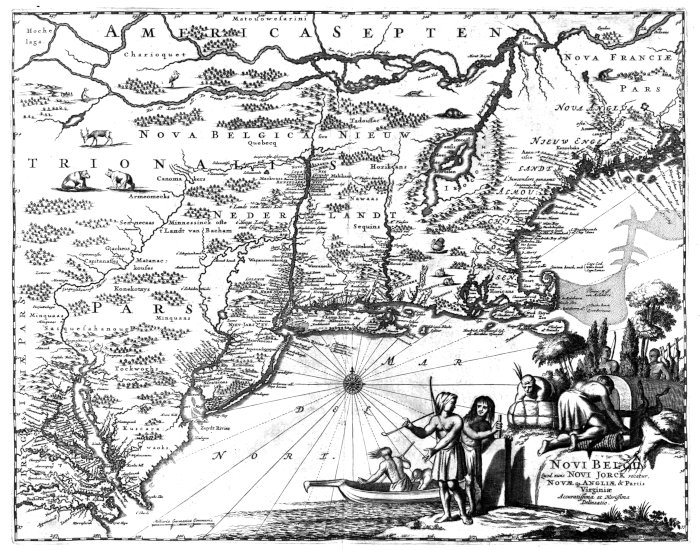
That Tract of Land formerly call’d The New Netherland, doth contain all that Land which lieth in the North parts of America, betwixt New England and Mary-Land; the length of which Northward into the Countrey, as it hath not been fully discover’d, so it is not certainly known: The breadth of it is about two hundred Miles. The principal Rivers within this Tract, are Hudson’s-River, Raritan-River, Delaware-Bay-River. The chief Islands are the Manhatans-Island, Long-Island, and Staten-Island.
The first which discover’d this Countrey was Henry Hudson, who being hir’d by the East-India Company to seek a Passage in the Northern America to China, set Sail Anno 1609. in the Half-Moon Frigat; coming before Terre-neuff, he stood about towards the South-West, where Sailing up a great River, he found two Men Clad in Ruffelo’s Skins; and from thence arriv’d safe at Amsterdam.
New Netherland thus discover’d, invited many Merchants to settle a firm Plantation there; to which purpose they obtain’d Letters Patents in 1614. granted them by the States in the Hague, That they might onely Traffick to New Netherland; whereupon they earnestly prosecuting the Design, sent out Adrian Block and Godyn, who discover’d several Coasts, Isles, Havens, and Rivers.
The Countrey, as they said, being then void, was therefore free for any body that would take possession of it: Notwithstanding which pretence, they were scarce warm in their Quarters, when Sir Samuel Argal, Governor of Virginia, having first spoil’d the French in Accadie, as we said, disputed the Possession with these also. And although they pleaded Hudson’s Right (who by Commission from King James, and upon an English Account, had lately discover’d those Parts) and pretended they had not onely bought all his Cards and Maps of the Countrey, but all his Interest and Right also, and had fully contented him for all his Pains and Charges in the Discovery; yet the said Hudson being an English-man, and acting all that he did by Commission from the King of England, upon Debate it was concluded, That the Land could not be alienated after Discovery without the King of England’s consent, especially it being but a part of the Province of Virginia, already possess’d by the Subjects of England: So that they were forc’d to wave that Title, and the Dutch Governor submitted his Plantation to His Majesty of England, and to the Governor of Virginia, for and under him: Upon which Terms for a good while they held it. Afterwards, upon confidence, it seems, of a new Governor sent from Amsterdam, they not onely fail’d to pay the promis’d Contribution and Tribute, but fell to fortifie themselves, and to entitle the Merchants of Amsterdam to an absolute Propriety and Dominion of the Country, independent of any other; building Towns, as New Amsterdam; raising Forts, as Orange Fort, near the Branch of the Nordt River, which they call Hell-Gate. Complaint whereof being made to King Charles, and by his Ambassador represented to the States, they disown the business, and declare by Publick Instrument, that it was onely a private Undertaking, viz. of the West-India Company of Amsterdam. Whereupon a Commission was granted to Sir George Calvert, made Lord Baltimore in Ireland, to Possess and Plant the Southern parts thereof, lying towards Virginia, by the name of Mary-land; and to Sir Edmund Loyden, to Plant the Northern parts towards New England, by the name of Nova Albion: Which makes the Dutch the second time seem willing to compound; and for the Sum of two thousand and five hundred Pounds, they offer to be gone, and leave all they had there. But taking advantage of the troubles in England, which then began to appear, and soon after follow’d, they not only go back from their first Propositions, and make higher Demands, but also most mischievously (as some report) furnish the Natives with Arms, and teach them the use of them, as it may be thought, expecting to use their help upon occasion, against the English.
169After His Majesties Restauration, His Majesty being truly inform’d of his just Pretences to all that Usurp’d Territory call’d New Netherland, (the same having been formerly part of New England) and of how great prejudice to the Act of Navigation, and how dangerous Intruders the Dutchmen are generally upon other Princes Dominions, what mischief might ensue to all our English Plantations in time of War, if the Dutch were permitted to strengthen themselves in the very heart of His Majesties Dominions, being Masters of one of the most commodious Ports and Rivers in America: His Majesty resolv’d to seize upon the same, as his undoubted Right, and in May 1664. having design’d four Commissioners to the perfecting of Affairs in New England, Collonel Richard Nichols, Sir Robert Carr, George Cartwright, and Samuel Mawrick Esquires, with three Ships of War to convey them to Boston: The matter was so order’d, that the same Ships serv’d for the reducing of the Town and Fort of New Amsterdam, upon conditions, advantageous to His Majesty, and easie to the Dutch.
Now begins New Netherland to lose the Name, for His Majesty having conferr’d by Patent upon his Royal Highness the Duke of York and Albany, all the Acquisitions made upon Foraigners, together with Long-Island, the West end whereof was wholly setled and Peopled by Dutch-men; his Royal Highness impower’d, by Commission as his Deputy-Governor, Colonel Nichols, Groom of his Bed-chamber, to take the Charge and Direction of Reducing and Governing all those Territories; it was by him thought fit, to change some principal denominations of Places, viz. New Netherland into York-shire; New Amsterdam into New York; Fort-Amscel into Fort-James; Fort-Orange into Fort-Albany; and withal, to change Burgomasters, Schepen, and Schout, into Mayor, Aldermen, and Sheriff, with Justices of the Peace; so that all the Civil Policy is conformable to the Methods and Practise of England, whereas New England retains only the name of Constable in their whole Rolls of Civil Officers.
It is plac’d upon the neck of the Island Manhatans, looking towards the Sea; encompass’d with Hudson’s River, which is six Miles broad; the Town is compact and oval, with very fair Streets and several good Houses; the rest are built much after the manner of Holland, to the number of about four hundred Houses, which in those parts are held considerable: Upon one side of the Town is James-Fort, capable to lodge three hundred Souldiers and Officers; it hath four Bastions, forty Pieces of Cannon mounted; the Walls of Stone, lin’d with a thick Rampart of Earth; well accommodated with a Spring of fresh Water, always furnish’d with Arms and Ammunition, against Accidents: Distant from the Sea seven Leagues, it affords a safe Entrance, even to unskilful Pilots; under the Town side, Ships of 170any Burthen may Ride secure against any Storms, the Current of the River being broken by the interposition of a small Island, which lies a Mile distant from the Town.
About ten Miles from New York is a Place call’d Hell-Gate, which being a narrow Passage, there runneth a violent Stream both upon Flood and Ebb; and in the middle lie some Rocky Islands, which the Current sets so violently upon, that it threatens present Shipwrack; and upon the Flood is a large Whirlwind, which continually sends forth a hideous roaring, enough to affright any Stranger from passing farther, and to wait for some Charon to conduct him through; yet to those that are well acquainted, little or no danger: It is a place of great Defence against any Enemy coming in that way, which a small Fortification would absolutely prevent, and necessitate them to come in at the West end of Long-Island by Sandy Hook, where Nutten Island forces them within the Command of the Fort at New York, which is one of the best Pieces of Defence in the North parts of America. It is built most of Brick and Stone, and cover’d with red and black Tyle, and the Land being high, it gives at a distance a pleasing prospect to the Spectators. The Inhabitants consist most of English and Dutch, and have a considerable Trade with Indians for Beaver, Otter, and Rackoon-Skins, with other Furrs; as also for Bear, Deer and Elke-Skins; and are supply’d with Venison and Fowl in the Winter, and Fish in the Summer by the Indians, which they buy at an easie Rate; and having the Countrey round about them, they are continually furnish’d with all such Provisions as is needful for the Life of Man, not onely by the English and Dutch within their own, but likewise by the adjacent Colonies.
Manhattans River.
The Manhattans, or Great River, being the chiefest, having with two wide Mouths wash’d the mighty Island Watouwaks, falls into the Ocean. The Southern Mouth is call’d Port May, or Godyns Bay. In the middle thereof lies an Island call’d The States Island; and a little higher the Manhattans, so call’d from the Natives, which on the East side of the River dwell on the Main Continent. They are a cruel People, and Enemies to the Hollanders, as also of the Sanhikans, which reside on the Western Shore. Farther up are the Makwaes and Mahikans, which continually War one against another. In like manner all the Inhabitants on the West side of the River Manhattan are commonly at Enmity with those that possess the Eastern Shore; who also us’d to be at variance with the Hollanders, when as the other People Westward kept good Correspondency with them.
On a small Island near the Shore of the Makwaes, lay formerly a Fort, provided with two Drakes and eleven Stone Guns, yet was at last deserted.
Wholesom Waters.
This Countrey hath many removable Water-falls, descending from steep Rocks, large Creeks and Harbors, fresh Lakes and Rivulets, pleasant Fountains and Springs, some of which boyl in the Winter, and are cold and delightful to drink in Summer. The Inhabitants never receive any damage by Deluges; neither from the Sea, because the Water rises not above a Foot; nor by the swelling Rivers, which sometimes, for a few days covering the Plains, at their deserting them, leave them fat and fruitful. The Sea-Coast is Hilly, and of a sandy and clayie Soil, which produces abundance of Herbs and Trees.
Trees.
The Oak grows there generally sixty or seventy Foot high, and for the most part free from Knots, which makes it the better fit for Shipping.
The Nut-trees afford good Fuel, and a strange Prospect when the Wood is set on fire, either to hunt out a Deer, or to clear the Ground fit to be Till’d.
Some Plants brought hither, grow better than in Holland it self, as Apples, Pears, Cherries, Peaches, Apricocks, Strawberries, and the like.
171
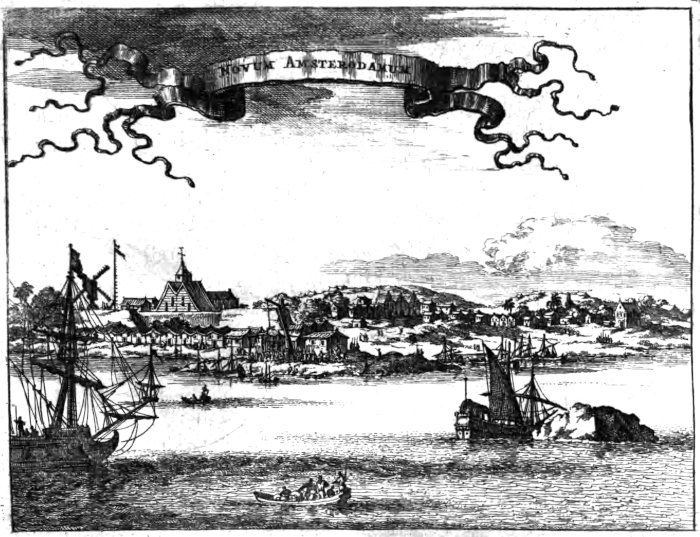
Vines.
Their Vines grow wild in most places, and bear abundance of blue, white, and Muskadine Grapes: Sometime since the Inhabitants made a considerable advantage by the Wine of them, which is not inferior to either Rhenish or French.
Water Lemmons.
All manner of Plants known in Europe grow in their Gardens: The Water-Lemmons, no less pleasing to the Palate than healthful when grown ripe; they are about the bigness of an indifferent Cabbage: the English press a Juice out of them, which if it did not turn sowre in a short time, might well be compar’d with Spanish Wine.
The Calabashes which grow there, made hollow, serve for Water-cups.
Pumpions are also there in great abundance.
Wheat.
Their Wheat though Set six Foot deep, grows very speedily: Kidney-Beans being planted amongst it, they will wind about the Stalks thereof.
Pease.
Gray Pease grow here so fast, that they gather them twice a year.
In one Field Physical Herbs and Indigo grow wild in great abundance; and Barley springs above a Mans heighth.
Moreover, there are divers sorts of sweet-smelling Flowers.
Soyl of the Mountains.
The Hills are most of a fat and clayie Soil, fit to make Pots, Tobacco-pipes, or any other sort of Earthen Ware.
Gold and Silver-Mines.
In some places also is store of Mountain Crystal, and that sort of Mineral which we call Muscovia Glass: Others afford Marble, Serpentine Stone, and other sorts of hard Stone. And though the Natives did not think it worth their while, or were not in a capacity to dig for Minerals themselves, yet it remains without contradiction, that the Mountains inclose both Gold and Silver.
When Captain William Clieff, Anno 1645. us’d the Indian Interpreter Agheroense (to decide the Differences which arose between the West-India Company and the wild People call’d Makwaes,) he observ’d him to paint his Face with a yellow glittering colour, which he judg’d to be of some rich Mineral: whereupon buying some of the said Agheroense, he put it into a Crusible, and gain’d two small pieces of Gold out of the same, valu’d at six Shillings; but keeping it private, and purchasing a 172great quantity of the said Mineral from Agheroense (who had show’d him the Mountain which produced the same) extracted good store of Gold out of it; which possessing Clieff with a belief of having found out a business of great consequence, he sent Arent Corsen of New-haven with the fore-mention’d Mineral to Holland; but the Ship being never heard of afterwards, and the Princess Pink, in which Captain Clieff was himself, with store of the new-found Mineral, being cast away, the Business came to nothing.
Paint after a strange manner.
The Inhabitants, though divided into several Nations, yet agree in many things, as in painting their Bodies, Shields, Clubs, and other Utensils in their Houses. The Colours wherewith they paint themselves they press out of Plants, or make them of certain Stones grownd into very fine Powder. The chiefest Plant is not unlike the Myrtle, onely it hath more Boughs, and bears red Berries; the Juice of which being dry’d in the Sun, is afterwards preserv’d in little Bags. The Natives temper their Colours with Water, and paint their Bodies with the same: It is as good a Purple as can be found. They also draw Ships, Trees, and Beasts after a very rough manner: In stead of Feathers they wear pleited Hair, which being colour’d red, hath an excellent gloss, which never fades though it Rain on the same.
Horses.
The Horses bred in this Countrey, being either brought thither from England or Utrecht, far exceed those of English breed; but are both of them subject to a strange Disease, of which many die in few hours. The same Distemper also seizes on Cattel if they go into Forrest Pasture: But the onely thing to cure the same, is Hay from salt Marshy Grounds.
Hogs.
The Oaken Woods have store of Hogs, which if taken and fatned with Turkish Wheat, are most delicious Meat.
Sheep.
The Sheep, though they breed well there, yet are very scarce, because the Planters not being able to spare Men to watch them, they are often devour’d by Wolves.
There are also abundance of Deer, all sorts of Fowls, Turkies, Geese, Ducks, Pigeons, and the like.
Lyons.
The Lyons, whose Skins the Indians bring to Market, are taken on a high Mountain fifteen days Journey South-West from thence.
Black Bears.
There are likewise many black Bears, fearful of humane kind, but if Hunted, they run direct on those that pursue them: they sleep all the Winter, lying six Weeks on one side, and six on the other, and sucking their Feet all the time: They generally lurk among Brambles, or in the Concavities of some hollow Mountain.
Strange Beasts.
On the Borders of Canada there is seen sometimes a kind of Beast which hath some resemblance with a Horse, having cloven Feet, shaggy Mayn, one Horn just on their Forehead, a Tail like that of a wild Hog, black Eyes, and a Deers Neck: it feeds in the nearest Wildernesses: the Males never come amongst the Females except at the time when they Couple, after which they grow so ravenous, that they not onely devour other Beasts, but also one another.
Towards the South of New York are many Buffles, Beasts which (according to Erasmus Stella) are betwixt a Horse and a Stag: though they are of a strong Constitution, yet they die of the smallest Wound, and are subject to the Falling-sickness: they have broad branchy Horns like a Stag, short Tail, rough Neck, Hair colour’d according to the several Seasons of the Year, broad and long Ears, hanging Lips, little Teeth, and Skin so thick, as not easie to be pierced: The Females differ from the Males, for they have no Horns; both may easily be made tame: when Hunted, they vomit out a sort of scalding Liquor on the Dogs: they have 173great force in their Claws, for they can kill a Wolf with the same at one blow: their Flesh, either fresh or salted, is a good Diet: their Claws also cure the Falling-sickness.
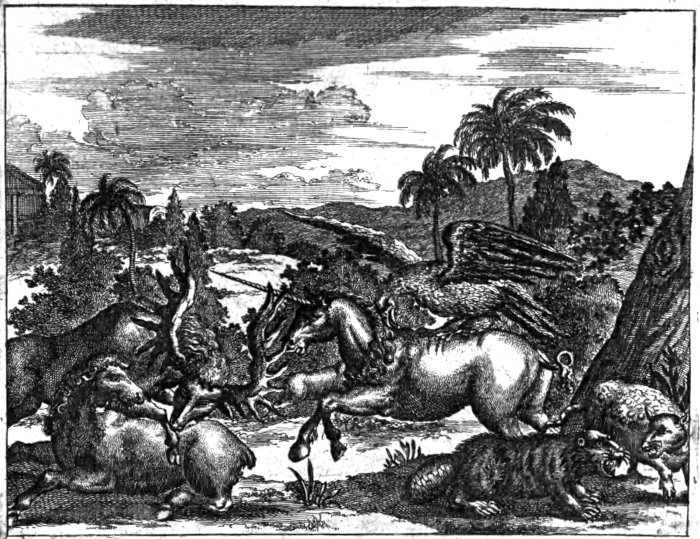
Harts.
But no Beasts are more plentiful here than Harts and Stags, which feed up and down in great Herds: when they are Hunted by Wolves or Men, they immediately take the next River, where they are caught several together, by being cross’d in their Swimming, and affrighted by the Eccho which comes from the Mountains, made by the Hunters hollowing on the other Shore, which makes them fearful of Landing: whilst the Huntsmen joyning several pieces of Wood together get upon them, and Rowing towards these Deer, intercept them, being tir’d and out of breath.
Musk-Cats.
Moreover, this Countrey breeds many Musk Cats, especially in Marshy Grounds. These Beasts are beautiful to the Eye, having black speckled Skins, their Mouths, full of sharp Teeth, and their Tails being long trail after them.
Many of the Learned maintain a Dispute concerning Civet, Whether it be the Seed of the Civet-Cat? the Affirmative, which Cardanus maintain’d, is contradicted by Julius Scaliger. Matthiolus, an Author of no little credit, supposes that Civet is the Sweat of the Cat, because it is most chiefly taken when these Beasts are exceedingly vex’d and wearied: But since the Sweat runs from all parts of the Body, which nevertheless do not all produce Civet, it is impossible that Sweat should be Civet. Others account Civet to be the Dung of the Cats; which last seems to come nearest to truth: for certainly it is nothing else but an Excrement in the fleshy parts about their Pizzle, or near the Fundament. The Cats being in pain to be discharg’d of this Civet, free themselves from it by rubbing a Tree; and also fawn on those which take it from them with a Spoon.
Plin. lib. 32. cap. 3.
Besides all other wild Creatures, the Countrey according to Adrian Vander Donk, produces yearly eighty thousand Beavers. Pliny relates, that these Beasts bite off their Pizzles and throw them to the Hunter, which are an exceeding good Medicine to help Abortion, stop the Monethly Flowers, Giddiness in the Head, 174Gout, Lameness, Belly and Tooth-ach, Rhumes, Poyson, and the Evil. But Pliny makes a great mistake herein, for the Beavers have a small Pissel fasten’d to their Back-bone, in such a manner, that they cannot loose them but with hazard of their lives: They live in the Water, and on the Shore, in great companies together, in Nests built of Wood, which deserve no small admiration, being made after this manner: The Beavers first gather all the loose Wood, which they find along the Banks of the Rivers, of which, if there be not enough, they bite the Bark off from the Trees in the neighboring Woods, then with their Tusks, of which two grow above, and two below in their Mouths, they gnaw the main body of the Tree so long, till it drops asunder: Their Nests very artificial, are six Stories high, cover’d on the top with Clay to keep out Rain; in the middle is a passage which goes to the River, into which they run so soon as they perceive a Man; to which purpose one of them stands Sentinel, and in the Winter keeps open the Water from freezing, by continual moving of his Tail, which is flat without Hair, and the most delicious Meat that can be had. The Beavers go big sixteen Weeks, and once a year bring forth four young, which suck and cry like young Children, for the Dam of them rises on her hinder Feet, and gives her Teats, which grow between the fore-legs to two of her young, each of them one; the foremost legs of a Beaver resemble those of a Dog, the hindermost those of a Goose; on each side of the vent are two swellings within two thin Skins; out of their vent runs generally an Oily moysture, with which they anoint all the parts of their body which they can reach, to keep them from being wet; within they are like a cut-up Hog; they live on the Leaves and Barks of Trees; they love their young ones exceedingly; the long Hairs, which shining, stick out on the back, fall off in Summer, and grow again against Harvest; they have short Necks, strong Sinews and Legs, and move very swiftly in the Water, and on the Land; if incompass’d by Men or Dogs, they bite most severely; the right Castoreum, so highly esteem’d by Physicians, is a long Vesica, not unlike a Pear, within the body of the female Beaver, the Indians mince the Cods of the Male Beavers amongst their Tobacco, because they produce no Castoreum.
Fowls in New York.
This Country abounds also with Fowls; for besides Hawks, Kites, and other Birds of Prey, there are abundance of Cranes, of several sorts, some grey, some brown, others quite white; all of them have firm Bodies, and Bones without Marrow, Claws of a finger long, strong and crooked Bills, their Brains dry, their Eyes little and hollow, hard Features, the left Foot lesser than the right, both deform’d, their Blood thick, and the Excrements of a horrid smell; they breed most in old Woods, whose ground is without Brambles, and also near the Water, for they feed on Fish, and devour all sorts of Fowls, nay, snatch up Hares, Rabbets, Tortels, and several other sorts of Animals, which they carry away with them in the Air; nay, when hungry, they seize on one another; some of them fly abroad for their prey about noon, others at Sun-rising; they fall like Lightning on what e’re they pursue; they drink little, except the Blood of those Creatures which they devour; they are very libidinous, coupling above thirty times a day, not only with their like, but also with the Hens of Hawks, and other Birds; they lay their biggest Eggs in thirty days, and the lesser in twenty days; they generally bring forth three young; those of them that cannot endure to look full against the Sun, are thrown out of their Nests; the young ones when they begin to be fledg’d, are by the old carry’d into the Air, and let flie, but supported by them; their sight is wonderful quick; for though they flie as high as ever they are able to be discern’d, yet they can see the least Fish that is in the Water, and a Hare lying in the Bushes: their Breath stinks horribly, wherefore their Carcases suddenly rot; though they 175are libidinous, yet they live long; most of them die of hunger, because their Bills when they grow old, grow so crooked, that they cannot open the same, wherefore they flie up into the Air against the Sun, and falling into the coldest Rivers, loose their Feathers and die.
Pigeons.
Besides the foremention’d Birds of prey, there are abundance of Storks, Ravens, Crows, Owls, Swallows, Gold-finches, Ice-birds, Kites, Quails, Pheasants, and Winter Kings, and which are most remarkable for their rich Feathers, the Spechtes, they pick great holes in Trees, and make a noise as if a Man were cutting down a Tree. The Pigeons flie in such flocks, that the Indians remove with them to the place where they make their Nests, where the young ones being taken by hundreds, serve them for a Moneths Provision.