The Second Book, CONTAINING A DESCRIPTION OF NORTHERN AMERICA (continued 7)
Reading edition
Much after the same manner, and with such like brutish Ceremonies, not worth mentioning, was also celebrated the Feast of Quetzatcoalt.
In the inner part of the Temple stood a Stage, on which upon Festival Days the People Acted Drolls; in which they sometimes feign’d themselves deaf, blind, lame, and the like, and begg’d to be cur’d of their Idols; sometimes were dress’d like Serpents, Adders, Crocodiles, or other ravenous Beasts, in which postures they fought one with another.
Computation of Time amongst the Mexicans.
Those Feasts were all kept on certain times, according to the Mexican Almanack, in which the Year was divided into eight Moneths, and each Moneth into forty five Days, which together made three hundred and sixty: The five remaining Days, to compleat the Year, they kept apart, on which all Affairs whatsoever were laid aside, as Selling, Buying, Offerings, &c. nothing else being thought on but Feasting one another for the passing away of the time. The first Day of their Year was on the twenty sixth of February. Each Moneth had a peculiar Name and Sign. Moreover, they divided the Year into four parts by as many Representations, viz. a House, a Rabbet, a Cane, and a Flint to strike Fire with; and Figur’d it out by a Wheel with four Spikes jutting out round about it, colour’d green, red, blue, and yellow, and in the middle thereof a Sun; each Spike signifi’d thirteen years, wherefore it had thirteen Divisions, distinguish’d by the four fore-mention’d Representations: At each Division of the Wheel they set down what remarkable things should happen that year by certain Characters; as, a Man in red Apparel typifi’d that Year when Ferdinand Cortesius, clad in Red, conquer’d Mexico. When the Wheel was fill’d with fifty two years Prognostication, then on the last Night they broke all their Pots and Vessels in pieces, and blew out their Candles, because they believ’d, that at the end of the said fifty two years the World would be at an end, and therefore they had no need of Housholdstuff, or ought else: But so soon as the Day appear’d again, they play’d on Pipes, Trumpets, and Drums, rejoycing that God had deferr’d the destruction of the World fifty two years longer; then they bought new Utensils and Candles, and made solemn Processions.
Art of Writing.
Concerning the Art of Writing amongst the Inhabitants of New Spain, Joseph Acosta tells us, That some old Books, containing ancient Passages, the Course of the Heavens, nature of Beasts and Plants, were found in Jucatan, according to the Relation of a Learned Indian, but were all burnt by Command of a Spanish Bishop, because he suppos’d them to be full of Matter touching the Black Art. Their Histories they describ’d with the Representations of the Things. Rhetorick and Poetry the Children were taught by Rote in the Schools, so that they never forgot what they had once learnt; But at present they use Spanish Letters or Characters.
Ancient Government.
Moreover, the Government of Mexico hath ever been kept in a good Order, the King’s Power being exactly limited, that nothing might be lost of the common Priviledges. The fourth King Icoath made Earls, who next to the Lords of Tezcuco and Tacuba, had right to the Crown; which was like a Mitre turn’d up behind, and rising before with a Point. According as they increas’d in Power, so they advanc’d in Royal Dignity; in which Muteczuma the Second exceeded all others: And to manifest his splendor, his House for all sorts of Creatures, and many other things, might serve for a sufficient testimony: for in it he kept Sea-Fish in salt Water, River-Fish in fresh Water, and all manner of Beasts in peculiar places: The Birds were kept in great Aviaries, surrounded with golden Rails. Next to the Kings follow’d four Earls call’d Atlacohecalcatl, which signifies Princes of the Throne Launces, a 280Weapon much us’d amongst the Mexicans. The next in Degree were the Tlacatecatl, or Man-cleavers; Esauahuacatl, or Blood-shedders; Tsallancalqui, or Lords of Blackness, without all which the King durst not take any Business in hand. High and lesser Courts of Judicatory, where Matters of Life and Death were try’d, were in most Cities; and other Courts also for petty Quarrels, Controversies, and the like. The Collectors brought their Revenues to the Court every Moneth. The chief thing which preferr’d both Rich and Poor to Places of Honor, consisted in Valour and heroick Exploits. Their Arms were chiefly sharp pieces of Flint made fast to a Stick, with which they could at one Blow chop off a Horses Head. They also us’d Pikes, Clubs, and Lances, and sometimes Slings: For defensive Armour, they had Helmets and Shields, made of Tygers, Leopards, and Lyons Skins. They always fell upon their Enemies unawares, their Design being generally to take Prisoners rather than to kill them; for they reserv’d them for Offerings to their Idols. Muteczuma made several Commanders over his Armies, giving them a Power one above the other, which were to be distinguish’d by several Marks; for the chiefest ty’d the Hair on the top of their Heads with a red String, betwixt which stuck a brave Plume of Feathers; at the end whereof hung as many Tassels as they had done noble Exploits. To this Order belong’d also the King, who wore one of the same Marks, with which King Muteczuma and his Son stand Carv’d on a Rock. The Ayulas, or The Order of the Eagle, consisted of valiant Men. The Grey Knights were of less Quality, and wore Collars which reach’d up to their Ears, the lower part of their Body being naked. Persons of greater Dignity, when going to the War, were Arm’d from Head to Foot: Which Order was also permitted to wear Cotton-Clothes, and Shoes richly embroider’d with Gold and Silver; they us’d painted Vessels, and had Lodgings provided for them at Court.
Their Education of Youth.
Moreover, it is worthy of observation, what great care the Mexicans took in the bringing up of their Children; to which purpose they had Schools near to their Temples, in which Youth was taught to Sing, Dance, Morality, Obedience, and also Martial Discipline. Children of noble Extract had Learned Men for their Tutors. Their Punishments for Transgressions were very severe, the Masters forcing their Scholars to Fast and Watch, carry great Burthens of Provisions to the Army, and be in the midst of Engagements. Others, whose Fancy led them to a holy Life, willingly embrac’d the Services of the Temple.
Their manner of Dancing.
Their manner of Dancing in New Spain was very strange and differing; they us’d pretty Instruments, and Songs which contain’d antique Passages, according to the Times; they in their Motions imitated Shepherds, Fisher-men, Plowmen, Hunters, and the like: Sometimes they Danc’d in Mascarades, with a Man on their Shoulders, making the same Motion with his Hands in the Air, as the other with his Feet on the Ground. They had also Tumblers and Dancers on the Ropes, which shew’d strange Tricks on an erected Pole. But above all Dances, the Mitotes was the chief, which was generally Danc’d in the King’s Palace, or inner Court of the Temple; in the middle of which they plac’d a great Drum and a hollow Tub on a large Image; round about which the most eminent Persons made a Ring, Sang sweetly, and Danc’d leisurely, when on a sudden two that are more nimble, with divers Motions came into the midst of them, and Danc’d exactly after the sound of the Drum and hollow Tub, which was seconded with the noise of Flutes and Pipes.
281

CHAP. VI. New Gallicia.
Bounds and Extent of New Gallicia.
New Gallicia, by some call’d Guadalajara, from the chief City. This whole Province is the most Northern Countrey of all America, that is inhabited to any purpose by the Spaniards. Here, ’tis true, they are scatter’d up and down in all the parts of it, but it is at a huge distance, and for the most part onely where the Mines are. It is bounded on the East and to the South, with the Kingdom of Mexico or New Spain; on the West, with the Gulf or Bay of California; Northward, for so much as is yet discover’d, with Quivira and Cibola, lying between eighteen and twenty eight Degrees of Northern Latitude, that is, from La Natividad, a Port so nam’d by the Spaniards, in the Confines of New Spain, to the most Northerly Borders of Cinoloa, a part of this Province, containing, as is suppos’d, not much less than three hundred Leagues in length, and in breadth much more; and whereof not a tenth part is either us’d or frequented by the Spaniards.
Temperature and Nature of the Countrey.
The Air is generally here very temperate, inclining rather to Heat than Cold, and subject now and then to sudden Storms of Rain, and great Claps of Thunder, which yet do not hinder, but that the Countrey is held to be reasonably healthful, and the People observ’d to live generally to a good old Age. The Soil, by reason of the Climate, would be a little inclining to Drought, but that, besides the frequent Rains which it hath, it is constantly moistned with fresh Morning Dews, which make it for the most part wonderfully fruitful, almost beyond belief, yielding for every Bushel of Wheat that is sown, threescore; and of Maiz, two hundred for one; besides great plenty of Sugar-Canes and Cochinele; both which nevertheless the Spaniards are said to neglect in some sort, employing themselves wholly about richer Commodities: for the Countrey affords them good store of Mines of Silver and Brass, but of Gold or Iron, not many as yet have been found. The Rivers abound plentifully with Fish, and the Woods with Venison, and some other wild Beasts. The Countrey is generally more mountainous than plain, frequently shaded with Woods, and whole Forrests of the stateliest Pine-Trees and Oaks that are to be seen; amongst which breed abundance of Wolves, which do great mischief to the People, as also Scorpions and Mustiecho’s. The Hurts receiv’d from Scorpions, are heal’d with the Juice of the Fruit call’d Queon; those from the Mustiecho’s, by Vinegar and the Juice of Lemmon. Here is likewise a green Stone, accounted a soveraign Medicine against the Gravel.
Several sorts of Tunas-Trees.
The Trees peculiar to this Countrey, are, the Tunas, already spoken of in Guatimala, and thought to be the same we vulgarly call Indian Fig-Trees, and are distinguish’d into six sorts.
The first, by the Portuguese call’d Cardon, hath sharp Prickles, thick Leaves, full of slimy Juice, an odoriferous Flower, oval Fruit, cover’d with an Orange-colour’d Rind, and small Roots: The Fruit within consists of a white juicy, and well tasted Pulp, full of black Seed.
The second hath a round Body full of Boughs, with Star-like Prickles hanging downwards, the Flower white, and the Fruit very like that of the Cardon, onely smaller.
282
The third is the Caxabra, which shoots up to a great Tree full of prickly Cods; at the utmost end grows a large white Flower; the Fruit, which is as big again as an Egg, is pleasant and cooling.
The fourth sort hath a straight Body full of Prickles, runs lesser and lesser to the top; at the end of the small Boughs, each thick Leaf produces another; the Wood, if kindled, burns like a Candle.
The fifth, nam’d Cumbeba, grows out of small Roots, with three or four corner’d thick Leaves, full of Prickles, the Flower somewhat less than the former, the Fruit oval, hard and red, having a white and juicy Pulp: The Prickles of this Cumbeba-Tree are so sharp, and stick in so deep, that they can scarce be pull’d out. This is that sort of Tunas that produces Cochinele, which is a Worm that grows under the Leaves, and is cover’d with a Skin, which being neatly taken off and dry’d in the Sun, as formerly mention’d, becomes a rich Commodity. Joseph de Acosta tells us, that the Spanish Fleet, Anno 1578. carried so much Cochinele to Spain, as amounted to two hundred eighty three thousand seven hundred and fifty Ryals.
But the last sort of the Tunas is the Unirumbeba, which hath a straight Body full of Prickles, on the top whereof grow divers prickly Leaves, not unlike those of the Palm-Tree: It is onely found in barren places, remote from the Sea.
Moreover, all kind of Fruits transplanted hither from Spain thrive very well, as Apples, Pears, Granats, Figs, Peaches, Apricocks, Muskmelons, &c.
The Root Castanuela.
The Batata.
The Root Castanuela affords a much better Feeding for Swine than Acorns. But amongst many other Roots which are found here, as the Xiquimas, Taca, Cochuco, Cari, Totora and Mani, the chief is the Batata, which is fat, sweet, and windy; it runs over the Ground with a tough green Sprig, the new Fibres taking Root dispersedly up and down, being yellow without, and within full of milky Juice; the Leaf resembling a Heart, is of a pale yellow colour on the top, and douny underneath; roasted in Ashes, it eats better than a Turnip: It is divided into three sorts.
The first, call’d Omenapo yeima, when boyl’d, shews like red Betel, but Dyes of a Skye-Colour; the innermost Skin, which is of a dark Red, yields an Ink-like Juice.
283The second sort, call’d Parro, differs little from the first, onely the Body, Root, and Veins of the Leaves, are of a Purple colour.
The third sort Jetiope, being white, hath a very good rellish, and cures the Ague.
The Pepper, which is here call’d Axi, grows in the warmest Valleys, and the more by being often water’d: there are of it divers kinds, differing in colour, smell, and taste one from the other; for one sort is green, yellow, or red; another sort yields a strong musky scent; and one sort is sharper, another milder: the Veins and Kernels thereof are eaten with Salt.
The Herb Cevadilla cures all manner of Sores.
Beasts.
This Countrey also breeds an innumerable company of Deer, Hogs, Goats, Sheep, Oxen, and Horses; and of hurtful Creatures, Pismires, which do great mischief to the Plants, and Locusts, which fall in huge swarms on the Corn, and cannot be frighted from the same by any means whatsoever. The want of Water is also no small prejudice to the Fields.
The biggest River, call’d Guadalajara, with many windings runs North-westward into the Southern Ocean; and four Leagues from the City of the same, falling down from a steep Rock, it makes such a horrible noise, that it deafens those which approach the same.
The Lake Mechoacan opens here also with a wide Mouth.
Two sorts of Hedge-hogs.
The River before mention’d, produces all manner of Fish in great abundance; and also a sort of Hedge-hogs, call’d Iguana, which live both in the Water, and on the Land, and are of two sorts: The first, call’d Senembi, is four Foot long, of a deep green colour, with black and white Spots, hath a scaly Skin, white Spots on each side of the Head, a row of sharp Prickles from the Head to the Tail, wide Nostrils, great black Eyes, and little Teeth. The second sort, call’d Tejaguacu, differs from the first, in having white Spots on a brown Skin, a longer Tail, and a red Tongue, which is slit. Both sorts are reported to fast eight Moneths together; and though often terribly wounded, and dead to all imagination, yet live a great while after; and though they swim up and down in Rivers, yet they Lay their Eggs in the Sand: their Flesh boyl’d is both wholsom, and of a good relish.
The manner of the Spaniards living.
The Spaniards which inhabit New Gallicia, drive a considerable Trade in Merchandizing, Husbandry, breeding of Cattel, and working in the Mines: They use Wayns and Carrs, drawn by Oxen, Mules, and Horses, to carry their Loads, as also Spanish Weights and Measures. They are little troubled with any other Mischiefs but what may happen from the treacherous Natives, who take all opportunities to run into the Woods, that there they may exercise their Pagan Religion in freedom; in which having spent some time, they gather a considerable number together, and oftentimes fall unawares on the Spaniards, who use Leather Shields and Helmets, and furr’d Cotton Clothes, to secure them from the Arrows which the Indians, lying in Ambuscades, shoot at them out of the Bushes.
The Nature, Habits, and Customs of the Natives.
The Natives, though subtile, are lazy, and will not work, unless for great Rewards. They wear Cotton Shirts, square Cloaks of the same Stuff, made fast with two Buttons on their Breasts; Drawers, and soal’d Shoes: Flag-Matts serve them for Beds, on which they lie under Cotton Clothes: About their Necks, Arms, and Legs, they wear green Stones, and Snale Shells for an Ornament. Their greatest Recreation is Dancing, their Musick being nothing else but the noise or sound of a piece of hollow Wood. Horse-flesh, and Bread made of Maiz, is by them accounted a great Dainty. The Drink Cacao is also highly esteem’d amongst them; but much more the Wine that they make of Maquey, which is the wonderful 284Tree that affords many necessary things, viz. Syrrup, Honey, Oyl, Vinegar, Yarn, Needles, Water, and Wine; every Man making it his Business to plant and preserve the same with great care near his House, notwithstanding they grow in several places of the Fields; they have broad thick Leaves with sharp ends, out of which is drawn a Thorn, which serves them for a Needle or Pin. These Leaves have a hairy Filament about them, which serves in stead of Thred: the young Sprout being cut, produces a sweet Juice, which boyl’d, makes good Wine; when grown sowre, serves for Vinegar; but being twice boyl’d, becomes a Syrrup; and being hung over the Fire a third time, a perfect Honey: Also the Wood being spungie, keeps Fire as well as Match. Moreover, the Inhabitants when they travel, carry Leather Bags with them full of Cacao, Maiz, and Pepper, mix’d together.
Over each Village in this Countrey the Spaniards have plac’d an Indian Casique, Alcalde, and Alguazil, where all sorts of Provisions are sold at a Set-price.
The Casiques are succeeded by their Heirs, who resent nothing worse than Affronts, and take pride in nothing more than their Valour.
The Moors or Negro’s which are brought hither from Guinee, do all manner of hard Labour.
The Guachichiles and Guamares area valiant People, and have each their peculiar Language, utterly different from the Mexican.
Division of Nova Gallicia.
This Countrey comprehends these inferior Provinces: 1. Guadalajara; 2. Xalisco; 3. Chiametta; 4. Couliacan; 5. Cinoloa; all of them on the Western Shore. 6. Zacatecas, to which some add Nova Biscaia and Nova Mexico, though others treat of them as distinct Countreys apart from the rest.
Sect. II. Guadalajara.
Bounds of Guadalajara.
Guadalajara is bounded on the West, with Xalisco; on the South and South-West, with New Spain; and on the North, with Zacatecas. It is a Countrey exceeding pleasant, and rich in all kind of Commodities, but especially in its Mines of Silver. It is well water’d with the River Barania, which runneth through the midst of it, and with divers other Streams: yielding abundantly both Wheat, Maiz, and some other Grain. In a word, there is nothing said of the properties of New Gallicia in general, either for Soil, Climate, or People, but is peculiarly verifi’d of this Province.
Towns and Cities.
The chief Towns are 1. Guadalajara, which gives Name to the whole Province. It is seated on the Banks of the River Barania, in a most delectable and sweet Air, and a rich Soil, by advantage whereof it is become the Metropolis of New Gallicia, honour’d with an Episcopal See, which was translated thither from Compostella in the Year 1570. with the Courts of Judicature, and the Residence of the King’s Treasurers for that Province. This City was built on the Plain Molino, by Nunnez de Guzman, in the Year 1531. The neighboring Mountains afford store of Timber. All manner of Spanish Plants grow here likewise in great plenty. In the City is a Cathedral, several Cloysters, inhabited by Augustine and Franciscan Monks. The Bishop of this City belongs to the Arch-bishop of Mexico. The Air very temperate, neither molesting the Inhabitants with too great Cold, nor excess of Heat.
2. St. Maria de los Lagos, a Town thirty Leagues Eastward of Guadalajara, being a Fronteer Place, and built on purpose to secure the Countrey against the Chichemecæ, which are a barbarous and unreduc’d People of the North-East parts of this 285Countrey who harbouring themselves in Caves under Ground in the thickest huge Woods and Forrests, do oftentimes issue out, and make foul spoil in the Countrey where they come, having first intoxicated themselves with a Liquor made of certain Roots, and would do much more harm, if it were not for this Garrison.
3. Del Spiritu Santo, built by the Founder of the other two, viz. Nunnez de Gusman aforesaid, in a part of the Countrey which they call Tepeque.
Sect. III. Xalisco.
Bounds and Description of Xalisco.
Xalisco, or Galesco, as some call it, is bounded on the North, with Couliacan; on the South, with some parts of New Spain; on the East, with the Province of Guadalajara; and on the West, with the Gulf or Bay of California.
The Countrey is chiefly fertile in Maiz and Mines of Silver, not altogether so apt for Herbage and Pasture as some other Countreys about it. The People were Cannibals before the Spaniards came amongst them, eating Man’s-flesh; were much given to quarrelling and Contentions amongst themselves, but by this time, ’tis suppos’d they are reasonably well reclaim’d both from the one and the other.
Towns of chief note.
In this Countrey, besides many other goodly Streams, is the great and famous River Barania, on the Banks whereof are seated most of their principal Towns, as 1. Xalisco, which gives Name to the whole Province, and to a large Promontory or Foreland on the Western Coasts, which shoots it self out into the Bay of California, right over against certain Islands, which the Spaniards call The Three Maries. This was an ancient City or Town of the Natives, but sack’d and taken by Nunnez de Gusman, in the Year 1530.
2. Compostella, built by the aforesaid Gusman, and so nam’d from the City in Spain, so famous for the Grave of James the Apostle, who (according to the Roman Writers) was buried there, lies near the South Sea on a barren Soil, within the Torrid Zone; yet the Ground breeds many sorts of Vermine, besides other noxious Creatures; amongst which the Capybara roots up whole Trees and other Plants in the Night. This Beast, resembling an indifferent large Hog, hath short Legs and Claws, thick Head, with a Beard, wide Ears, and on each Jaw-bone twenty four Teeth, besides two Tusks, but no Tail; it goes slow, but swims exceeding fast, and dives under Water for a considerable time together; they often feed together in great Herds, and make a terrible noise.
3. La Purification, a small Town on the Sea side, towards the Confines of New Spain.
Sect. IV. Chiametla.
Situation of Chiametla.
Against Xalisco juts Chiametla, along the South Sea, where the Inhabitants wear short cloaks, and Deer-skin Shoes; and in the Wars use Shields made of strong Twigs twisted together. The Women, which are indifferent handsom, are clad down to their Feet.
Towns of principal note.
The chief Town of this Province is Sant Sebastian, call’d from the River upon which it stands; it was built by Captain Franciscus de Yvarra, Anno 1554. who discovering 286many Silver Mines, hath made several Melting-houses, in which the Silver being melted swims upon the Lead.
Sect. V. Couliacan.
Bounds of Couliacan.
Next to Chiametla, Westward and Southward of Cinoloa, lies Couliacan, Coasting all along the Bay of California, which it hath on the West; on the East it hath New Biscay; and on the South, Xalisco. The Countrey is not defective in any kind of necessary Provision, but more especially it aboundeth with Fruits of all sorts. But the Spaniards look onely at the Mines, of which they have some few in this Countrey. The People were generally Cloth’d with Cotton-Wooll when the Spaniards came first amongst them, but yet never a whit the more modest, being exceedingly given to Venery, and that in a more shameless and beastly manner than many other Americans who went naked.
Towns.
The Spanish Towns are these, 1. Hiustula, seated on the Banks of a fair River, distant about a days Journey from the Sea. 2. Quinola. 3. Quatrobarrios, an old Town of the Natives, but new nam’d by the Spaniards. 4. El Leon, an old Burrough. 5. Couliacan, the chief Town of the Province. 6. St. Michael, in the Valley of Arroba, two Leagues distant from the Sea, in a rich and plentiful Countrey, both for Corn and Fruit, whither it was remov’d from the Banks of the River Orala, where it first stood; it was built by Nunnez de Gusman in the Year 1531. after he had burnt the Towns, and destroy’d a great number of the Natives, Inhabitants of the Countrey.
Nunnez de Gusman first Discoverer of this Countrey.
Serpents worshipp’d by the Natives.
This Countrey was first discover’d by the aforesaid Nunnez de Gusman (after he had built Guadalajara) after this manner: Marching from Chiametla to Piatzala, he ruin’d this Province with Fire and Sword: he likewise conquer’d the Countreys of Zapuatun and Piaztla; the first being a Plain, lay inclos’d within high Mountains, where the Spaniards met none but Women, till they came to a great River call’d De la Sall, whose Banks on each side were well inhabited; the second juts against the Ocean, and is water’d by a River of the same Denomination. Here, within the Houses, (which are built after a strange manner) lay thousands of Serpents mingled together, with their Heads sticking out on the top and at the sides, and hissing with open Mouth at those which approached them. The Inhabitants shew’d great Reverence to these Serpents, because (as they said) the Devil often appear’d to them in that form. And this seems to be a Custome amongst them from the Tradition of Eves being tempted by the Devil in the shape of a Serpent: Nor was this Superstition peculiar onely to these Indians, forasmuch as divers Nations of the ancient Heathens of other parts of the World, worshipp’d the Likeness of a Serpent. And even amongst the Greeks, according to Plutarch, Hesychius, Clemens Alexandrinus, and others, it was no unusual thing in their religious Worship to call on Eva, and at the same time to shew a Serpent. Plutarchus and Ælianus say, That the Egyptians honour’d a Serpent for their God. The same saith Erasmus Stella of the old Prussians; Sigismund Baro, of the Liflanders; and Alexander Guaginus, of the Sarmatians and Samogethes. Moreover, some write, that in the Province of Calecut are Serpents with exceeding great Heads, and weighing as much as a great Hog, to which the King shews great Reverence; so that it seems the Devil takes delight to be worship’d in that shape wherein he work’d the Fall of Man-kind.
Gusman leaving Piaztla march’d to Bayla, where he found the great River De Mugeres, 287and the Countrey full of Woods and Pastures: thence travelling upwards along Mugueres, they ascended to the top of a Mountain, where they were assaulted by the Inhabitants of the aforesaid Village Quinola, whom nevertheless they soon put to flight; but not long after receiv’d a shrew’d Repulse at the Entrance into a Wood built full of Houses; yet nevertheless being at length Conquerors, though not without sufficient loss, they march’d farther in amongst the Mountains, till their Provisions beginning to grow scarce, and they seeing no likelihood of getting to an end of this troublesom Journey, at last their Necessities forc’d them to retire.
The Fish Guarapucu.
The Piracarba.
Flying Fishes.
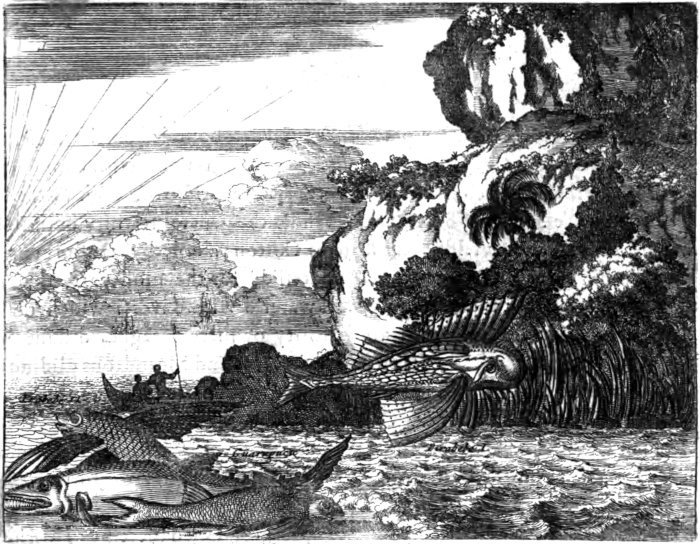
The Flood which comes out of the Sea up to the City St. Michael, through the River Cignatlan, abounds with Fish, and especially the Guarapucu, which is seven Foot long when it comes to its full growth; it hath no Scales, but smooth Skin of a Silver colour mix’d with Green: from the Head to the Tail runs a crooked Line of thin Scales on each side; it swims exceeding swift, feeds on lesser Fishes, and spawns in the Sea: the Flesh being wholsom and good to eat, is salted up against Winter. At the same Place is also the Piracarba, which shines exceedingly, having Silver-colour’d Scales, a broad slit Tail, a long white Beard, four great Fins, and a little Head. Farther into the Sea are a sort of flying Fish, call’d Pirabebes, which rise by thousands up out of the Water, so escaping the Dolphins and other Fish which prey on them; yet sometimes they are snatch’d up by the Birds, or else by the Fishes, when they dive down into the Water to wet their own Wings, which consist of a thin Skin, distinguish’d in length by tough Fins. These flying Fish also differ much one from another, for most of them are like Herrings; others have a thick Head, round before like the Dolphins.
Moreover, the Countrey about St. Michael was always well inhabited. The Houses, being artificially built, were adorn’d on the top with many obscene Images, and venereal Representations: But since the Spaniards have conquer’d this Countrey they have destroy’d them, and built other Houses in their stead, and also bestow’d much cost and labour on the Silver Mines De las Virgines.
288
Sect. VI. Cinoloa.
Bounds of Cinoloa.
Cinoloa is the most Northern part of New Gallicia, bounded on the West, with some part of the Gulf or Bay of California; on the East, with a long Ridge of Mountains, which they call Tepecsuan; on the North, with Cibola; and with Couliacan on the South. This Country, besides the general fertility of the whole Province of New Gallicia, yields great store of Cotton-Wool, by reason whereof both Men and Women here are better Apparell’d, for the most part, than elsewhere the Americans are; is exceedingly well water’d with Rivers, which descend from those Mountains Tepecsuan, not above thirty or forty Leagues distant from the Sea; and which, with the variety of their Streams and Meandrous glidings, do divide the Countrey into many and good Pastures, which are likewise stor’d with abundance of Kine, Oxen, and other Cattel.
Towns.
The chief Towns possess’d by the Spaniards are 1. St. Philip and Jacob, seated towards the Sea side, on the Banks of a fair River, about thirty or forty Leagues distant from the Town of Couliacan.
2. St. John de Cinoloa, an ancient Colony of Spaniards, setled there by Francisco de Yvarra, in the Year 1554, which is all they have in this Countrey, except some few old Forts of the Natives, which they found, after their manner, poorly furnish’d; but have since repair’d them for Defence against the Natives of those Parts, which as yet remain unreduc’d.
Nunnez de Gusman’s Travels.
This Province was also discover’d by Nunnez de Gusman, who having rested some Weeks in St. Michael, proceeding on his Way, he Ferried over the River Petatlan, which receiv’d that Denomination because the Houses were cover’d with Mats, by the Indians call’d Petat.
The People hereabouts were generally Man-eaters.
Eighteen Leagues farther runs the River Tamochala, which hath many Villages on both sides thereof.
Between Petatlan and Tamochala lie several desolate Wildernesses, and Woods of the Brasile-Tree.
But Gusman travelling up twenty seven Leagues along the fore-mention’d River Tamochala, came to the Province Cinoloa, where they stay’d six Weeks, by reason of the abundance of Rains; during which time the Villagers provided them Turtle-Doves, Hares, Rabbets, and all sorts of Fowls; but at last deserted their Habitations in the Night: after which the Spaniards crossing Tamochala went along a barren Desart, where (had they not found Water in certain Wells, and likewise store of Juice out of the Tunas-Trees) they had without doubt perish’d; at last getting over the River Yaguinu, they found a deserted Village, out of which a broad Path led along the Stream; whither Gusman marching, he came into a Plain, where he spy’d several Indians, which after some resistance were routed by the Spanish Horse.
The Villages built on the Banks of the River Yaguinu, as also the Language of the Inhabitants differ little from the former.
Not far from hence a Ridge of Hills runs into the Sea, and also extend themselves a hundred Leagues towards Xalisco.
289
Sect. VII. Zacatecas.
Bounds and Description of Zacatecas.
The Zacatecas, as they call them, are bounded on the South, with Guadalajara; on the North, with New Biscay; on the West, with Couliacan and some part of Xalisco; and on the East, with New Spain. The Countrey, especially the more Western part of it, is very rich in Silver Mines, no Province of this part of America richer; but not so apt either for Wheat or Maiz. But the Eastern parts of it are abundantly stor’d with all sorts of Fruits, the Woods every where replenish’d with Deer, the Fields no less with Corn, and every Tree almost giving Entertainment to some Bird or other.
Towns and Villages.
The Towns are 1. Las Zacatecas, forty Leagues distant from Guadalajara, and fourscore from Mexico, but neighbor’d with most rich Mines, and therefore both Garrison’d and well peopled by the Spaniards; for ’tis suppos’d there are no less than five hundred Families of them in the Town, and about the Mines.
2. St. Martins, twenty seven Leagues distant from Zacatecas, and as rich a Place, having a Colony of four hundred Spaniards at least.
3. St. Lucas de Avinno. 4. Erena, lesser Towns, but both of them rich, and seated in the midst of excellent Mines.
5. Nombre de Dios, in the most Northerly part of this Countrey, sixty eight Leagues distant from Guadalajara, and founded by the aforesaid Francisco de Yvarra; who having subdu’d and quieted the Natives, and thereby gain’d to himself the Government of these Countreys, granted the propriety of some Silver Mines both to the Spaniards and to the Natives, and by that means drew so many of them thither, that in a short time it became the chiefest and best peopled town of the whole Province.
6. Durango, in the Valley of Guadiana, eight Leagues distant from Nombre de Dios, and built by Yvarra.
7. Xeres de Frontera, a Place built on purpose for the repressing of the Chichemecæ aforesaid, and other Salvages that infested the Borders of Guadalajara, in the Regency of the Marquess of Villa Manrique.
8. Last, St. Lewis, built by Alonso Pacheco, in that part of the Countrey which is call’d Uxitipa, and peopled by him with a Colony of Spaniards, being distant about twenty Leagues from Panuco in New Spain, to which the whole Countrey of Uxitipa once belong’d.
Several Mines discover’d by the Spaniards.
The aforesaid Franciscus de Yvarra, Anno 1554. discover’d the Mine call’d Sant Martin, and since also Lucas Avinno, the Mine Del Sombrereto, lying near the City Del Erena: but the Mines De los Ranchos, Chalchuites, De las Nieves, and Del Frisuillo, would produce much more Silver, if the Mine-works were stor’d with Quicksilver. The Vice-Roy of New Spain, nam’d Lodowick de Velasco, order’d a certain number of Soldiers, Slaves, Horses and Mules, for every Mine, to defend the Workmen from the Assaults of the Natives, which oftentimes Sallied out upon them. Moreover, Velasco sent Priests through all the Countrey to Preach the Gospel: But Yvarra having the care of the Priests, guarded them with a company of Soldiers, and in his Way discover’d the Valley San Juan, and the River De las Nacos, where he conquer’d the rebelling Natives.
Near the Silver Mine Sant Martins the Monks built a Cloyster; after which Yvarra gave free leave to all that would, to dig in the Mine at Avinno, which he had 290bought, on condition they should pay the real fifth part of what they got, to the Spanish King: which Priviledge stirr’d up many, insomuch that Avinno in a short time grew very populous. Yvarra, though having brought his Business to this pass, could not rest, but sent Antonius Pacheco to a Valley in Guadiana, to build the foremention’d City Durango, where several Rivers make a convenient and delightful place for Habitation, whither Yvarra follow’d three Moneths after, and finish’d the new Town. But the chiefest Silver Mines, which borrow their Denominations from the Province Zacatecas, are continually guarded by five hundred Spaniards, and as many Slaves.

CHAP. VII. New Biscay.
Bounds of New Biscay.
New Biscay, by some accounted a Province of New Gallicia, hath on the South, Zacatecas; on the West, the Countrey of Cinoloa; Northward it is bounded with New Mexico; the Eastern Borders of it looking towards Florida, not yet well discover’d: so call’d by the Spaniards, onely from its neighborhood to New Gallicia. It is, as the other Provinces, exceeding rich in Silver Mines, and hath some also of Lead; which serve principally, as some say, for the refining or purging of the other Metal. The People generally are of a stout and resolute Disposition, and with much difficulty submitting to the Yoke; yea, the Spaniards themselves confess, that there remain yet to this day four great Towns unreduc’d, though they lie, as it were, in the mid-way, betwixt the Zacatecas aforesaid, and the Mines and Town of St. Barbara of this Province: The Spaniards call them Las Quatro Ceinegas, or The Four Quagmires, as lying, perhaps, in the Marshes, or in some Fenny and lower parts of the Countrey.
Towns and Cities.
The Towns which themselves hold, are, 1. St. Barbara, famous for the rich Mines about it.
2. St. Johns, equal to the other, and not above three or four Leagues distant from it.
3. Ende, the most Northerly Town which the Spaniards have in this Countrey, distant about twenty Leagues from the other.
These be all Colonies of the Spaniards, and built on purpose for securing the Mines; which when they were first discover’d by Yvarra, he order’d Roderigo del Rio to guard the same, and took up his Winter Quarters at St. Juan in a strong House, stor’d with all manner of Provisions, and erected there by him, as a place of defence against the Chichimecæ, who (though the Spaniards kept the place with strong Guards) kill’d above four hundred of their Horses and Mules; which loss no way daunted him, so as to change his Resolution of going to Topia: whither travelling, he found many snowy Mountains, and suffer’d extream Cold, which kill’d most of their Horses; being seen fifteen days after to stand so stiffly frozen, as if still alive: at last getting within the Borders of Topia, after he had suffer’d many inconveniences, he was oppos’d by the Inhabitants, till he pacifi’d them with Presents.
291
Sect. II.
Convenient Havens of New Gallicia.
This Countrey hath many convenient Havens, viz. San Jago, Navidad, Malacca, Chacalla, below the Promontory Corientes, the Bay Xalisco, the Road Massatlan, and Chiametla, so call’d from a Town about eleven Leagues from the Ocean.
Here, and in several places of New Gallicia, grow Lillies, Roses, Violets, Jessamins, and many other Flowers; amongst which the Floripondium deserves peculiar observation, because it flourishes the whole Year; and its white Blossoms, which are bigger than Lillies, opening in the Morning, yield an exceeding sweet smell.
The Flower Granadilla.
In no less esteem is the Murucuia, by the Spaniards call’d Granadilla, which will not grow, if bereav’d of any of its Leaves: it bears a Flower from the resemblance of our Saviour’s Suffering, call’d The Passion-Flower, which exceeds the biggest Rose in circumference; the uppermost Leaves green, those underneath of a purple colour; on the top hangs a round Bush of a thousand interwoven threds of divers colours, distinguish’d by white and red Specks; the pale Stalk which sticks in the middle of the Flower, is divided into five others, that bend downwards with a yellow Button-like Knob; on the middlemost Stalk stands a pale yellow Flower, which appears three hours after Sun-rising, and closes again a little before Sun-set; the Fruit, which is very round, smooth, and of a pale Green, hath white Specks, a thick Rind, Saffron-colour’d Pulp, which is wholsom, of a good rellish, and hath abundance of black Seeds inclos’d in little Husks.

CHAP. VIII. New Mexico.
Bounds of New Mexico.
New Mexico (as ’tis call’d for distinction’s sake) is bounded on the South-West with New Biscay; more directly Westward, with some parts of Quivira; the Countreys Northward of it not yet discover’d; Eastward it extends it self as far as Florida.
This Province doubtless for largeness may compare with New Gallicia, having been search’d and discover’d by the Spaniards above a hundred, some say two hundred Leagues directly Eastward, and to the North-East: and they report Wonders of it, if we may believe them, at least in respect of what was generally found in these Northern parts of America at their first Discovery; as namely, That they have Towns fairly and well built of Lime and Stone, Houses of four Stories high, and most of them provided with Stoves for the Winter Season, as well as any in Europe; the Streets fair and broad, and the People as curious and expert in divers Arts and Manufactures as any of theirs. More particularly they tell us of a Town call’d Chia, of the Province of Cuames, so big, that it is said to contain eight several Market-places. Another call’d Acoma, a great Town, but seated on the top of an high Rock, without any ordinary way of access to it, but by a pair of Stairs hewn out of the hard Stone, or else by certain Ladders, which the Inhabitants let down and take up as they please. And likewise of a third, which they call Conibas, containing, as they say, no less than seven Leagues in length, and about half so much in breadth, 292seated upon a Lake, but scatteringly built, and much of the space taken up with Mountains and many fair Gardens, in the midst of which the Town standeth; of all which more hereafter. This is certain, that the Countrey to which they give the Name of New Mexico, is of a vast extent, reaching from the Mines of St. Barbara in New Biscay Eastward, and to the North-East, above two hundred Leagues already discover’d, but doubtless taking up no small part of those Countreys which are sometimes assign’d to Florida, if not of the Confines of Virginia also.
Travels of Ruyz, Espejus and others.
This Countrey was first, Anno 1581. discover’d by a Franciscan Monk, nam’d Augustine Ruyz, who with two other Monks of his Order, got eight Soldiers of Conde de Coruna, Vice-Roy of New Spain, for his Companions; with whom he travell’d from the Valley Sant Bartholomew, to the Province De los Tiguas, where one of the two Monks was kill’d by the Natives, which occasion’d such a fear amongst the Souldiers, who judg’d themselves too weak to make any resistance, that they resolv’d to return, notwithstanding all the arguments which Ruyz us’d to disswade them from it; yet nevertheless he and his Brother Franciscus Lopez and four Indians, went onward of their Journey; which news the Souldiers carried back to the Franciscans in Sant Bartholomew; who fearing their Brethren would be destroy’d, sent several Souldiers and a Monk, call’d Bernardyn Beltran, after them, who were also accompanied by Antony Espejus, who spent a great part of his Estate in raising of Men, providing Arms and Provisions, loading therewith a hundred and fifty Horses and Mules; with which he travell’d direct North from the fore-mention’d Valley, and after two days Journey found a People call’d Conchi, who went naked, and liv’d in Huts built together like a Village: They were Govern’d by Casiques, fed on Hares, Deer, Rabbets, Maiz, Calabashes, and Melons. Several adjacent Rivers afford them plenty of Fish. They were amaz’d at the Crosses which the Spaniards there erected, till they were inform’d of a Crucifi’d Saviour. Espejus being every where kindly Entertain’d amongst them, and conducted twenty two Leagues farther, came amongst the Indians call’d Passaguates, of the like Constitution with the Conchi’s; who had skill in Minerals, and judg’d that there were many Silver Mines in that Countrey. From whence the Passaguates travell’d with the Spaniards to the Borders of the Los Tobosos, who no sooner saw them, but they fled, because a few years before they had been miserably dealt with by the Spaniards; but being inform’d by the Interpreters, that they needed not be afraid of any thing, they all appear’d, and conducted Espejus to the Borders of the Patarabueyes; which People possess a large Countrey, Stone Houses and Villages built in good order. Great Rivers which come out of the North, and others that disembogu’d into the North Sea, afforded them all sorts of Fish; as also the Woods plenty of Venison, Fowls, and wholsom Plants. In some Pools also the salt Water afforded Salt.
The Valour of the Inhabitants may sufficiently appear by the rough Entertainment which the Spaniards met withall the first Night; for the Patarabueyes fell so fiercely upon them, that had not the Watch given notice thereof in time, none had escap’d with Life; nevertheless five Horses were kill’d, and a considerable number of Men wounded: after which retreating, they went upon a neighboring Hill, whither Espejus sent his Interpreter, and an Indian the same Countrey, to inform them, That the Spaniards came not to molest them, and if they pleas’d to come to them, they should meet with none but Friends; which was the more easily credited, because the Casiques receiv’d some Presents; after which being reconciled, they conducted the Spaniards twelve days Journey up a long River, whose Banks were inhabited in several places. From thence they reach’d to a Place, inhabited by a People richly Cloth’d, who also seem’d to have some knowledge of God; for in 293their Discourse they pointed up to Heaven, call’d the Creator and Preserver of all things Apalito, and signifi’d that they had receiv’d that Knowledge formerly from those that were left of Pamphilius Narvaez’s Army, who having rang’d through Florida were driven hither.
These People also Presented Espejus many tann’d Skins, with which he went to a great Village, the Inhabitants whereof were very courteous, and barter’d them for brave Plumes of Feathers and Cotton Cloaks, streak’d with blue and white: but Espejus having no Interpreters whom they could understand, could not learn by what Name they were known; yet by signs they express’d what time of the year they had Precious Stones brought to them; and also what their Countrey produced; and also that abundance of those Riches was to be found in a Province about five days Journey Westward from thence, whither they freely offer’d to conduct the Spaniards, which accordingly they did, bearing them company one and twenty Leagues to the next Province, inhabited by a People whose Name also they could not be inform’d of, yet staying three days amongst them, they were Entertain’d with Presents and Dances both Night and Day. The Countrey afforded them also store of Venison and Fruits: Those that understood Minerals, judg’d that there were likewise several Gold Mines.
Leaving this Province, they entred into a great Wilderness of Pine-Trees, in which they travell’d twelve Leagues in fifteen days, without seeing either Man or House; but at the end of the Wood they spy’d a Village of Straw Huts, where there were great quantities of white Salt, and Deer Skins neatly dress’d. The People of the Place courteously Entertain’d the Spaniards, and conducted them along the River Del Norte, to New Mexico: The Banks of the River on each side was planted with Nut-Trees and Vines, which spread themselves out above three Leagues; through which they had scarce pass’d three days together, when they saw ten populous Villages pleasantly seated on the said River, from whence came many thousands of the Natives to meet Espejus, who was not so much amaz’d at the great number of People, as at their extraordinary Civility and decent Habits; for they Entertain’d him with well dress’d Meat, roasted Poultrey, and pleasant Fruits: Their Garments were Cotton Cloaks, Deer-skin Breeches, Shoes and Boots of good Leather. The Women wore their Hair neatly Comb’d and Pleited. Their Houses were almost four Stories high, handsomely built, and divided into fair Chambers, had Stoves or Cells under Ground against the Cold in the Winter. Every Village was Govern’d by a Casique, whose Commands were publish’d by the Alguaziles. Each House had a peculiar place in which their Idol stood, before whom they set Meat twice a day. Near the High-ways stood Temples very curiously painted, wherein their Deity, as they say, diverted himself in his Progress from one Village to another. At certain Distances near their Plough’d Lands, stood Portico’s, supported on four Columns, under which the Husband-man us’d to eat, and take his Noon-sleep. Besides their Swords, which were strong enough to cut a Man through the Middle, they us’d Bowes and Arrows: Their Shields were made of Deer Skins.
Espejus having stay’d here four days, went to the Province De las Tiguas, which had sixteen Villages; in the chiefest whereof, call’d Poala, Augustine Ruyz and his Brother Monk Franciscus de Lopez had been slain, besides four others; wherefore the People being conscious of this Crime, and fearing that Revenge would follow, fled to the Mountains, from whence they could not be enticed, whilst the Spaniards found their Houses full of Provisions and some Minerals.
Now those being dead whom they sought for, some thought it convenient to return; but Espejus and Beltran perswaded the contrary, alledging, That farther up, 294according to the Indians information, lay several Provinces which were worth the discovery, and advis’d that the chiefest part of their Forces might stay there, whilst they and some few resolute Men went farther upon the Discovery, which accordingly was perform’d. Espejus having travell’d two days, came into a fruitful Province, jutting against Cibola, in which he found eleven Villages, inhabited by above fourteen thousand People, who were clad in Skins and Cotton, worshipp’d many Idols, and receiv’d the Spaniards with great Civility.
The like Entertainment they met withall in the Countrey Los Quires, wash’d by the River Del Norte; near which stood five Villages, inhabited by about fifteen thousand People.
Thirteen Leagues farther they found De los Cunames, having also five Villages, the chiefest of which being Cia, boasted (as above mention’d) eight Market-places: The Houses, made of Lime, were neatly Painted, and compris’d in all above twenty thousand Persons, all civil People, who presented Espejus and his Company with handsom Cloaks, set good boyl’d Meat before them, and shew’d them rich Minerals, and the Mountains out of which they got the same.
Of the like Constitution were the Inhabitants De los Amires, which being thirty thousand in number, resided in seven well built Villages, lying North-West from Cunames.
After this they march’d Westward, and found the eminent Village Acoma, mention’d before, built on an exceeding high Rock, to which led onely a narrow Path up a pair of Stairs cut in the Rock; as also many Wells to receive Rain, besides what they have out of a River, led by Moats round about their Plough’d Lands. The Spaniards staying here three days, were Entertain’d with all sorts of good Meat, Dances and Drolls.
From hence travelling twenty four Leagues more Westerly, they entred the Province of Zuny; where the erected Crosses which had remain’d there till that time, were sufficient testimonies of Cornaro’s having been there, after he was deserted by Andreas de Cuyocan. Casper de Mexico, and Antonius de Guadalajara, being setled on Zuny, (otherwise call’d Cibola) and speaking the Indian Tongue better than their Native Language, inform’d Espejus, that sixty days Journey farther lay a great Lake, whose Shores were crown’d with many brave Villages, inhabited by a People which wore Golden Armlets and Ear-rings; whither Franciscus Vasquez had gone a second time, had not Death prevented him. This Information so encourag’d Espejus, that notwithstanding it was so great a Journey, yet he resolv’d to venture thither, though the Monk Beltran and most of his Company perswaded him to the contrary; whereupon Beltran return’d: After which Espejus went on to the said Lake; whither he was accompanied with a hundred and fifty Indians. Having gone twenty six Leagues, he found a populous Province, whose Borders he no sooner approach’d, but he was told, That if he was willing to lose his Life, he and his Party might enter into a forbidden Dominion; yet notwithstanding this threatning Message, he wrought so much upon the Casique by the Presents which he sent him, that he was permitted to come in freely; nay, the Inhabitants of Zaguato strow’d Meal on the Earth for the Spaniards to go over, and presented Espejus at his departure with forty thousand Cotton Cloaks, and a considerable quantity of Plate, which he sent with five of his Soldiers, and all the Cibolan Indians, back to Cibola, keeping onely four Companions and one Guide, with whom he travell’d forty one Leagues Westward; where he found a Mountain, to the top whereof led a broad Path; which ascending, he took up Silver Oar with his own Hand. The several sorts of People that inhabited here were all civil and courteous, living in good fashion, in pretty large 295Houses, built on the Banks of a pleasant River, shaded with Vines and Nut-Trees, and thick planted with Flax: They inform’d Espejus, that near a River which runs eight Miles towards the North Sea, were such stately Palaces, as could not be beheld without great admiration. But Espejus going back a plain Road to Cibola, found not onely those whom he had sent from Zaguato, but also Beltran, with the other Soldiers, who having been detained there by the Civilities and kind Entertainments of the Indians, were now upon returning home; so that Espejus was left alone with eight Soldiers, who resolv’d to venture their Lives and Fortunes with him. They travell’d along the River Del Norte, through the Provinces De los Guires and Habutas, whose Mountains, over-spread with Pine-Trees and Cedars, have many rich Mines. The Natives wore painted Cotton Cloaks, and dwelt in stately Houses five Stories high. At the Borders of the Realm Los Tamos they were stopt, and not permitted to come on farther; wherefore being but few in number, and several of them sick, they judg’d it convenient to cross the River De las Vaccas (so call’d from the abundance of Cows that were thereabouts) to the River Conchos and the Village Bartholomew, where Espejus was inform’d, that Beltran was long before his arrival gone to Guadiana.
And now that we may have the better Account of New Mexico (which Ruyz, Espejus, and Beltran endeavor’d to discover) it will be necessary to begin with the first original thereof, according as several ancient Histories make mention.
First original of the New Mexicans.
The most ancient Possessors of that part of Northern America call’d New Spain, were for their fierce and salvage Nature call’d Chichimecæ, who dwelling in Caves, fed on Moles, Rabbets, Hedghogs, Serpents, Roots and Herbs. Whilst the Women accompanied their Husbands in their Travels, the Children were put into Baskets, and hang’d in a Tree. No manner of Government was to be found amongst them. They never Till’d their Ground till the Navatlacans came from New Mexico (which was anciently divided into two Countreys, Aztlan and Teuculhuacan) to New Spain; after which they Sow’d their Lands.
The Navatlacans (who us’d to dwell in Houses, worship Images, plough their Lands, and obey their Governors) were divided into six Tribes, each Tribe possessing their limited Bounds: and there goes a Tradition, That out of six Pits that are to be seen in New Mexico, the Navatlacans had their original. The time when they deserted New Mexico, as their most authentick Histories or Records declare, was (according to our computation) Anno 940. and they farther affirm, that they spent forty years in a Journey, which might have been travell’d in a Moneth: The reason of which tediousness was, because they rested in all places where they found a fruitful Countrey; but as they had advice from their diabolical Spirits, which (as they say) appear’d visibly to them, they still went on farther and farther, yet left behind those that were aged, sick, and decrepid, building convenient Houses for them, and appointing Overseers to look after them. The Ruins of the Houses are yet to be seen on the Way along which they pass’d.
The six Tribes divided themselves after this manner: Four of them setled round about the great Lake of Mexico. The Sichumilans taking the South part, built, besides two other Towns, a Metropolis of their own Name, as the Chalcans on the North. The Tapunecans built Azcapuzalco in the West, which signifies A Pismires Hole, because of the abundance of Inhabitants. The Eastern part was taken up by the Chalhuans. And all these Names have a peculiar signification; the first signifies People of Flowry Fields; the second, People of Mouthes; the third, People of Bridges; and the fourth, Crooked People. Not long after, the Tatluicans, a strong People, went over the Mountains on the other side of the Mexican Lake, where they built several Towns 296on a hot, yet fruitful Soil, the chiefest whereof they call’d Quahunachua, that is, A Place where an Eagles Voice is heard. The Tlascaltecans went near the Snowy Mountains, one of which, being between Mexico and De los Angelos, vomits horrid Flames and Smoke up into the Skie. Here scattering up and down, they built several Villages, besides the City Tlascalla; the Inhabitants whereof assisted the Spaniards, as hath been related in the taking of Mexico, for which good Service they live free, without paying any Tribute.
When these six Tribes came first from Mexico thither, the Chichimecans made little or no resistance against them, but hid themselves amongst the Rocks: yet some of them not long after taking courage, flew to Arms, and had without doubt destroy’d the Tlascallans, had not a subtile Plot sav’d them: for under a shew of Friendship they falling on the unarm’d Chichimecans, kill’d every Man of them.
Joseph de Acosta tells us, that Anno 1586. he saw a Grave in Mexico, wherein a Chichimecan of a Gygantick size lay buried.
After this Conquest gotten by the Tlascallans, the fore-mention’d six Tribes liv’d in Peace and Quiet, and strengthned themselves the more by Marrying into one anothers Families.
The Chichimecæ keeping on the Mountains left the new People in quiet possession of their Lands, nay, learnt some of their Customs, insomuch that they began to build Huts, chuse Governors, and live according to their Laws.
The first March of the Mexicans into New Spain.
The Tlascallans having possess’d New Spain three hundred and two years, a seventh Tribe (a valiant and civiliz’d People) came thither, upon their Dæmon Viztlipuztli’s promise of having the supream Government: wherefore he was carried in an Ark by four chief Priests, whom he inform’d whither and when they should travel or rest, for where ever they stopt, they built a Tent in the middle of their Army for their Idol, whom they set on an Altar; which done, they Sow’d the Ground about them: yet if their Dæmon commanded them to march before Harvest, then they left the Product to the ancient and sick People. But at last Mexi, from whence the Name of Mexico is deriv’d, conducted the Army into Mechaocan, where the pleasant Soil among the Lakes entic’d many to take up their Habitation. But Mexi proceeded on his Journey, yet not without great Crosses, in regard Viztlipuztli’s Sister (some Inchantress probably so call’d) did much hurt to the whole Army by her Sorceries, because they would not honor her as a Goddess, till Viztlipuztli inform’d one of them that carried the Ark, that the Army should march on, and banish the Witch from them: whereupon she accordingly being driven away, built the Village Malinalco, as a Habitation for Conjurers. Mean while, the Army grew weaker and weaker by their leaving so many People behind them in most places; therefore they judg’d it convenient to rest a while in Tula, where a great River water’d the Countrey; which, according to Viztlipuztli’s Commands, being dry’d up, made a large Lake about the Mountain Coatepeck, whose Banks being planted with Willow and Poplar-Trees, were exceeding pleasant, and the more, because of the variety of Birds that made their Nests in the same; which so delighted many of the People, that being tir’d with travelling, they resolv’d to settle there; which Resolution was so ill resented by Viztlipuztli, that he commanded the Bank to be broken, that the Water might have liberty to flow its former Course, and threatned them with heavy punishments: after which in the Night a terrible Cry of Murder was heard in one part of the Army; which being inquir’d after the next Morning, they found divers People lying on the Ground with their Breasts cut open, and their Hearts pull’d out: whereupon those that remain’d went onto Chapultepec, where they fortifi’d themselves in the Mountains against the adjacent People, which Copil, Son to the Malinalcon Witch, had rais’d up against them; and soon after the Tapunecans and Chalcans went against their new Neighbors, with whom they began a bloody Fight, when Vitzilovitli, at that time General of the Mexican Army, pressing in amongst them, broke their Ranks, and made way for all his Army (though with his own Death) to march Conquerors to Culhuacan: The Prince of which Province gave them a Place to settle on, near the white Water Ticaapan, whose Shores swarm’d with Adders and Serpents, upon Design that the Strangers might be destroy’d by them; but it prov’d quite otherwise: for they without regret eat the poysonous Animals; and Dunging the unfruitful Soil, receiv’d a plentiful Harvest: They would willingly have setled here, after their so long ranging up and down, if Viztlipuztli would have approv’d thereof; but he told them, that they must possess themselves by Arms, and make a Culhuacan Maid their Goddess: whereupon they desir’d the Casique’s Daughter of Culhuacan, who was sent them in rich Ornaments, and with a stately Retinue: But she was no sooner entred on the Ticaapan Shore, but they flay’d her alive, and her Skin being stuff’d, and nam’d Tocci, was religiously worshipp’d. But not satisfi’d with this cruelty, they sent for her Father to visit his Daughter in her Dignity; who accordingly coming with great Attendance, was led into a dark Chappel, where by the burning Tapers he knew the Goddess to be no other than his Daughters Skin stuff’d full of Cotton; whereat burning with rage, he afterwards fell upon these Murderers with all his Forces, and drove them to the Place where they afterwards built Mexico.
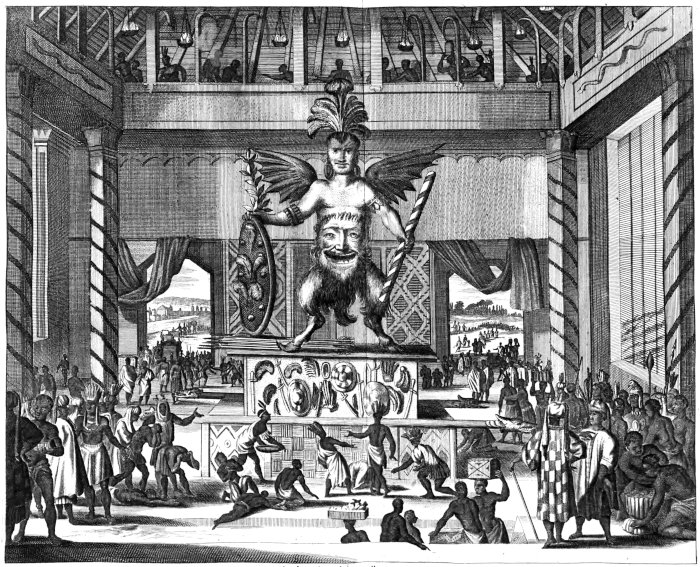
Viztlipuztli idolum Mexicanorum.
297We have often made mention heretofore of the Governor of this Journey, Viztlipuztli, it will therefore be necessary to give an exacter Description of him, as followeth:
Description of the Image Viztlipuztli.
He was a woodden Image like a Man, sitting on a blue Seat in a triumphant Chair; at each end of which was plac’d a Staff with a Serpents Head upon it, from whose Forehead, which was Painted blue, ran a Streak of the same colour, cross his Nose to both his Ears; upon his Head stood a Plume of Feathers, the ends whereof were tipp’d with a golden Varnish; his left Hand held a white Shield, on which stuck five Feathers, and on the top a Laurel Bough; next the Shield lay four Arrows, pretended to be sent from Heaven; in his right Hand a Truncheon, full of blue crooked Streaks like Serpents; behind on his Shoulders appear’d Wings, not unlike those of a Bat, his Eyes large and round, and his Mouth reaching from Ear to Ear, made him terrible to behold, also gaping, and full of Teeth, which stuck out of his Belly; in his Breast also were two fiery Eyes, and under them a shrivell’d Nose; his Feet ended in Claws, hung round about with Precious Jems, golden Boxes and Shields set out with divers colour’d Feathers. The Curtain behind which this Idol sat, was not drawn open except on a Feast-Day.
Next Viztlipuztli stood generally a lesser Image, call’d Tlaboc, and also the Goddess Tocci, Daughter to the Prince of Culhuacan, who (as before mention’d) was flay’d by their Dæmon’s Command. Since which time they suppos’d, that they were never more acceptable to their Gods, than when they appear’d Cloth’d in another Man’s Skin; and accounted no Offering better, than a Heart taken out of their Enemies Breast, since their Spirit destroy’d so many after that manner in the Army at Tula.
Tocci’s Festival.
But Tocci, they say, had also a Son much inclin’d to Hunting, whose Image they carry, attended by a thousand People, with the sound of Horns and Trumpets, to an Arbor on a high Mountain; which being made of green Leaves pleited, had in the middle an Altar, on which they set the Idol, whilst the Multitude surrounded 298the Foot of the Mountain, and set all the Bushes about the same on Fire; which done, they shouted and hollow’d, and play’d on several Instruments; which frighting the wild Beasts that lay shelter’d in the Woods, made them run to the top of the Mountain, where they were more and more inclos’d by the People, insomuch that many of them were slain for an Offering before Tocci’s Son’s Altar; which done, they carried the Idol back to his Temple, and the People made Merry with the slain Venison.
Description of Tezcatlipuca’s Image.
As great Reverence they shew’d to Tezcatlipuca, because (as they said) he pardon’d their Sins. This Idol was made of a black shining Stone, richly Apparell’d, having Golden Ear-rings; in his undermost Lip a Silver Sheath, in which stuck sometimes a green, and sometimes a blue Plume of Feathers; his Hair was ty’d with an embroider’d String, at the end of which hung a Golden Ear, whereon Smoak was Painted, signifying the Prayers of oppress’d Sinners; moreover, the String hung full of Pearls, and about the Neck in a String hung a Jewel; on his Breast, as also on his Navel, a green Stone; in his left Hand he held a Fan made of a Gold Plate, in which stuck many colour’d Feathers: this Plate glittering like Glass, was in stead of a Mirrour for Tezcatlipuca, to observe all worldly Transactions in the same: and to punish Criminals, he held four Darts in his right Hand. His Feast they kept once in four years.
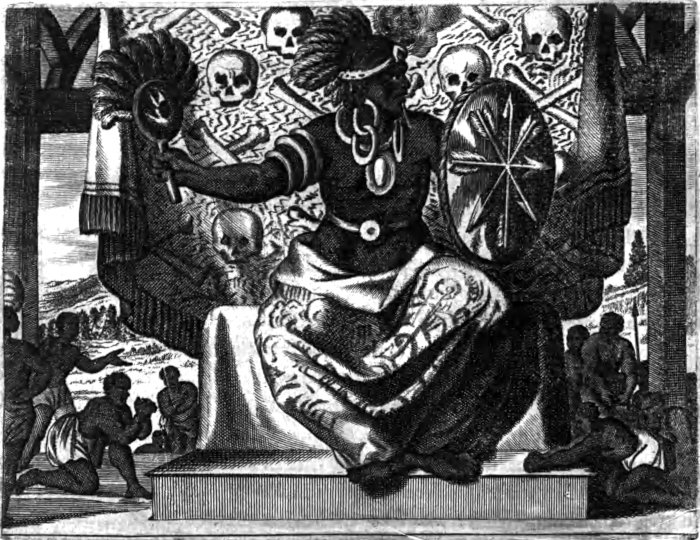
This Idol also had the Command of Hunger, Drought, Famine, and pestilential Distempers; wherefore he had quite another shape, sat on a Stool behind a red Curtain embroider’d with dead Mens Bones and Sculls; his Body Coal black, his Head stuck full of Quails Feathers, a Quiver with four Arrows in his left, and a Rod in his right Hand, which made the Image seem very terrible.
The Idol Quetzalcoalt, being their Guardian over the Merchants, was plac’d in a high Temple, being shap’d like a Man, his Face onely excepted; for that resembled a Bird’s Head, with a red Bill full of Teeth, a Comb, and a long Tongue; on the hind-part of his Head stood a Mitre, and about his Legs Silk Garters beset with Pearls.

CHAP. IX. Cibola, Tontonteac, and Nova Granada.
Though the Province of Zuny above-mention’d in the Chapter of New Mexico, in the Voyage of Espejus, be there otherwise call’d, and appear to be the same with Cibola, yet we find it not treated of by any as part of New Mexico, but by some as a distinct Province, by others as a part of California largely taken; for besides that California, properly so call’d, hath formerly been taken rather for a Peninsula than an Island, and still affords to some an Argument of question, whether it be one or the other. The whole extent of the Province generally so term’d, hath been reputed to comprehend the suppos’d Peninsula it self, Cibola, Quivira, and Nova Albion; but since, according to the best Maps and Discoveries, there seems little doubt to be made, that California, strictly taken, is a perfect Island: and since upon that Consideration we have reserved it to be describ’d amongst the Islands of Northern America, we also consequently judge it most requisite to consider those Countreys apart that were included in the extended California.
Situation, Temperature, and Productions of Cibola.
299Cibola lieth Southward of Quivira, betwixt it and New Gallicia, to the North and East: on the West it hath Mar Vermiglio, or the Bay of California. The Air of the Province is indifferently temperate, especially if compar’d to the sharp Frosts and Colds of Quivira. The Countrey is for the most part level and plain, as Quivira is, having but few Trees in it, except here and there some Woods of Cedars, which yet do abundantly supply the Natives both with Timber and Fewel. The Ground affords plenty of Maiz, and some small white Pease, of both which they usually make Bread. There is great store of Venison, and a kind of Sheep (as they say, and as it should seem by their Fleece) as big as some little Horses or Oxen, some of their Horns weighing forty or fifty Pound: But perhaps by some mistake of Authors, this Beast may be no other than Taurus Mexicanus, elsewhere describ’d, whose Hair is extreamly thick and shaggy, and of which they make Cloth as of Wool, as hath been said. There are also Lyons, Bears, and Tygers in this Province, in such numbers, that the People of the Countrey are not a little troubled with them, and would gladly destroy them if they knew how. The People are generally well Limb’d, tall of Stature, and seem to be a little more Ingenious than their Neighbors of Quivira; yet they go naked many of them, onely cover’d with Mantles made of Skins, which are many times painted, and that with such Curiosity and Art, as do sufficiently argue, that neither themselves nor their Neighbors of Quivira, from whom they have them in Traffick, do make them, but that they are the Merchandise and Commodity of some other Nations, perhaps of Cathay or China, who, by the North-West Seas, do Trade with the Maritime Parts, and People of Quivira.
This part of the Countrey hath been reasonably well search’d by the Spaniards, but as yet nothing discover’d so considerable, as to perswade them to stay in it.
That which seems most observable, is the great Lake Tonteac, situate almost in the midst of the Province; upon which, or near unto it, they found seven or eight old Towns of the Natives, some whereof contain’d four or five hundred of their Cottages or little Houses, and were fortifi’d also with Ramparts, and other Works of Defence, so as the Spaniards could not become Masters of them, but by Force and Storming: In the attempt whereof Vasquez Coronado, their Commander in chief, was twice beaten down with Stones by the Natives; yet at last carrying the Place, he found in it good plenty of Maiz indeed, which was some refreshment to his Army, but nothing else: whereupon having nam’d the Place Granada, in memory of the Vice-Roy of New Spain, who sent him upon that Expedition, he departed. In his return homeward he fell upon a certain Countrey, which he nam’d Tucayan, of which his Companions report great matters; as first, of a certain River call’d Huex, on the Banks whereof, in the space of twenty Leagues, or thereabouts, there stand no less than fifteen good Burroughs, well built, and furnish’d likewise with Stoves or Hot-houses, against the Cold, as in other Countreys of Europe; as also of a very fruitful and pleasant Valley, which they therefore call’d Aroba de Corazones; of another great Town and Territory, call’d Chichilticala; and lastly, of the Valley of Nuestra Sennora, or Our Ladies Dale, in the South parts of the said Territory, all of them describ’d for such rich and delicious Places, that some take them for the Campi Elisii of America, especially seeing the Spaniards were never known to visit them a second time, the Discoveries that have been made since being onely of the North-West Parts of the Countrey, along the Coasts of Mar Vermiglio, and this no farther than onely to give Name to certain Capes or Promontories which they met with, as namely 1. Porto de St. Clara, near to the Mouth of the River which they call Rio del Nordt. 2. Las Playas. 3. St. Michael. 4. Lago del Oro, which bordereth on Quivira; and lastly, El Rey Coronado, Eastward of that.
Tontonteac.
300Tontonteac is mention’d by so few, and by those few so obscurely, that it cannot well be determin’d to be any other than that Countrey which lies about the great Lake Tonteac, above spoken of in Cibola, and which being made Habitable by six or seven Towns not inconsiderable for Habitations of native Indians, might haply pass for a distinct Province. And perhaps the reason why this Province hath been so obscure, and little taken notice of, might be from the ruine of these Towns by War, or some other Accident: and to this purpose are the words of a late Writer, The Province of Tontonteac (saith he) hath five Houses onely left, which stand on the Shore of a salt Lake.
Nova Granada a Province of Northern America.
Nova Granada, besides that it is a generally known and describ’d Province of Southern America, is also nam’d amongst the Provinces of Northern America, particularly by Bertius, Cluverius, and Golnitzius, and in some late Maps of America so conspicuously specifi’d, that it might appear to be all that Tract of Land which contains both New Mexico and the several Provinces adjoyning to it; but since we find it not describ’d by any at large, it will with most verisimility pass for that part of New Mexico where stands the City of St. Foy; and this is most plainly express’d by Monsieur Martini, though there are who confound Cibola with New Granada. Waving which Decision, we shall onely insert a short Description of the Place, according to Cornato, who seems to have been one of the first Discoverers of these Parts, and whose Credit is preferr’d before that of Marcus de Niza.
Its Description.
Nova Granada (saith he) consists of seven Villages, built in the circumference of four Leagues, the chiefest whereof boasts two hundred Houses, which for the most part are four or five Stories high, and built of Stone; the Cellars thereto belonging, being neatly Pav’d, serve for Stoves against the Cold: they ascend to their upper Rooms by Ladders. The Inhabitants go naked, onely some Covering about their Middle, and over their Shoulders Cotton Cloaks, painted with divers Colours. They live on Maiz, white Pease, Hares, Rabbets, and Venison: their Salt wherewith they season the same, they fetch from a neighboring Lake. The Turkies, which they have in great numbers, are kill’d onely for their Feathers, notwithstanding their Flesh is exceeding good Meat. The Soil is for the most part plain, yet hath some high Mountains; and the Pastures flourish with Grass. The Woods abound with Bears, Tygers, Lyons, wild Hogs, Rhinocerots, and the like ravenous Beasts, which make the Ways dangerous for Travellers. Besides large Deer, there are also Sheep, which in bigness may compare with Horses, having exceeding great Horns, and little Tails.
Concerning the abundance of Turkoises, of which Niza makes mention, Cornato could give no certain account, because a little before his Arrival the Granadians had convey’d their Children, which were under fifteen, and the aged People, who were above sixty years of age, with their chiefest Goods, into remote places. However, it is not unknown, that this Countrey affords Turkoises; for Cornato in his Journey to Quivira, Besieg’d a City in these Parts near a great River; the Inhabitants whereof, when they were not able to defend themselves any longer, throwing their Cloaks, Turkoises, and other Riches into the Fire, Sallied out upon the Spaniards, and died not altogether unreveng’d, as shall be specifi’d more at large in the Description of Tignes, which being nam’d among the Towns of Quivira, will upon the comparing of Circumstances, be apparently found to be the same with this.
Lastly, New Granada hath no Fruit-Trees, but little Cedars fit for Building.
301

CHAP. X. Quivira.
Quivira is the next Region accounted of California, largely taken; yet appearing by some Charts to lie so vastly remote, that all New Mexico, Gallicia, and other Provinces already mention’d, lie between that and the Island. And whereas New Granada is by several made a part of New Mexico; yet most certain it is, that by some it is confounded with this Countrey, or at least accounted a part thereof, as hereafter shall more plainly appear, according to the Account of those that have most fully and particularly describ’d it.
Situation of Quivira, and Description of the Inhabitants.
Quivira takes up the most Northern and unknown part of America towards the West, reaching as far as the supposed Straight of Anian aforesaid (if there be any such) or else joyning to the Continent of Tartary. It is likewise the least fruitful of all the West-Indies, especially for Corn. Cattel it hath good store, and Pasturage indifferent good, the Countrey being for the most plain and level, and nothing else but Pasturage. The Natives are few and salvage, living in Hoards or great Companies together, after the manner of the Tartars, to whom they are Neighbors, and (as it is not improbably thought) of their Race. The Men Clothe themselves most commonly in that kind of Oxes Hide, elsewhere spoken of under the Name of Taurus Mexicanus. The Women wear little else but their Hair, notwithstanding the Countrey, especially for one half of the year, is excessive cold. Their Cattel, though they are much less than the ordinary Kine of Europe, are the chief Sustenance and Employment of the Natives; by Pasturing huge Herds whereof from place to place, the People live, and maintain a Traffick with other Parts. Yet some of them inhabit Towns, the chief whereof, as yet discover’d, seem to be these which follow:
Towns of chief note.
1. Acus, or Acuco, a small Town, but seated in a strong defensible place, and being a great Staple for Cotton, the Territory about it hath been taken for a distinct Province, and by some call’d The Kingdom of Acuco.
2. Tignes, a Town seated upon the Banks of a River bearing the same Name, and inhabited, it seems, by a stout and resolute People, and whom the Spaniards, coming amongst them in the Year 1540. had much ado to master: for they endur’d a Siege for the space of six Weeks; and at last finding themselves so strongly begirt by their Enemies, that there was no means to escape but by Death, or yielding up themselves, rather than they would fall alive into their hands, they first buried and spoil’d all such Treasure as they had (which were chiefly Saphires, and a few other Gems, that the Countrey afforded) and after that setting on fire their Housholdstuff, they took their Wives and Children with them, and made a desperate Sally out upon the Spaniards; wherein although they were most of them slain, and trod under the Horses Feet, or drown’d in passing the River, yet was it not without some loss to the Spaniards themselves: nor would those few that were left behind deliver up the Town, till it was fir’d about their Ears, and that they could no longer abide in it. This Town, by all Circumstances, must needs be the same with that before mention’d in Nova Granada, which makes good what we have said above, viz. That New Granada is by some confounded with, or at least taken for a part of this Region.
3023. Cicuic, another small Town, four days Journey from Tignes. The Countrey about this place, although generally it be all good Pasturage, and maintains abundance of Cattel, yet is it so open and plain, that for almost a hundred Miles together, the Spaniards, in their March hither from New Spain, found neither Stone nor Tree, nor any thing else that could serve them for a Land-mark; so that they were forc’d, as they march’d along, to raise up Heaps of Cow-dung, to serve them for direction in their coming back, which was not long after: for not finding the Commodities they sought for, and fearing to be surpris’d by Winter in those cold Countreys, where they had no kind of accommodation, they made somewhat a hasty Retreat, leaving behind them onely some few Religious Men, of the Order of St. Francis, whose Endeavours to do the People good by Converting them to the true Knowledge and Worship of Almighty God, procur’d them not long after, the Crown of Martyrdom, being murder’d all of them, except one, by the Natives, and he not without much difficulty escaping their Hands.
Nova Albion.
Nova Albion was so denominated by Sir Francis Drake, when he was there Entertain’d by the King of that Countrey; but whether it were in Quivira that he was thus Entertain’d, and left that Denomination, or in the Island of California, appears not either from the Relation, or from the common Consent of Cosmographers, since some there are, who will have Quivira and Nova Albion to be one and the same Province; others reckon it to be the utmost North-West part of California; others make it distinct from Quivira, yet determine it not to the Island California, seeming rather to make it an adjoyning Countrey to Quivira: wherefore finding little else that concerns the Description of the Place, except the said Voyage of Drake, we shall here set it down, and leave the farther Disquisition concerning the Situation of the Place, till we come to describe the Island of California it self.
Sir Francis Drake’s Arrival there.
Captain Francis Drake set Sail from Plymouth Anno 1577. and after much hardship getting through the Straights of Magellan, arriv’d in the Haven Guatulco, having before his coming thither taken as many rich Spanish Ships in the Southern Ocean as he could possibly have wish’d for, so that his onely care now needed to have been how to get safe home; yet he put on a Resolution, not to come short of Ferdinandus Magellanus, who Saild about the World. Which brave Resolution of Drake’s was approv’d of by all his Sea-men; whereupon he set Sail along the North of California the fifth of June; being gotten into forty two Degrees, which was the farthest that Cabrillo went, he came on a sudden out of a warm Air into so frigid a Climate, that the Sea-men were almost kill’d with Cold, and the farther they went, the colder it grew; wherefore falling down three Degrees more Southerly, they got into a convenient Haven, where the Natives who liv’d along the Shore brought them Presents; which Drake left not unrequited, by returning them others, that were to them more novel, and not unuseful.
Nature and Habit of the People.
These People are exceeding hardy; for, notwithstanding the extraordinary coldness of the Climate, the Men go naked; but the Women wear Garments of pleited Flags or Rushes, which being put about their Middle, hang down to their Ancles; on their Stomachs hang the ends of a hairy Skin ty’d together, which hanging also over their Shoulders, cover their hinder Parts. They shew great Respect and Obedience to their Husbands. Each House is surrounded with an Earthen Wall, and all the Corners thereof being close stopp’d, and Fires made in the midst of them, they are very warm. Rushes and Flags strow’d thick on the Ground near the Walls, serve them in stead of Beds.
The Indians coming a second time to Visit the English, brought them Plumes of 303Feathers, Neckbands of Net-work, and store of Tobacco: Drake pleas’d with this their kindness, built Tents on the Brow of a Hill, on the top of which the Indians stood that brought the Presents, whil’st one of them with a loud voice maintain’d a long Discourse; which he had no sooner ended, but every one laid down his Bowe and Arrows, and walk’d unarm’d down to the Tents to proffer their Gifts: their Wives staying behind on the top, pinch’d their Cheeks, and made sad lamentation; which Drake suppos’d was because they made Offerings there: whereupon he also caus’d all his Men to kneel down and say their Prayers, which made the Indians to look very earnestly upon them, and to return him the Presents which the day before they had receiv’d of him.
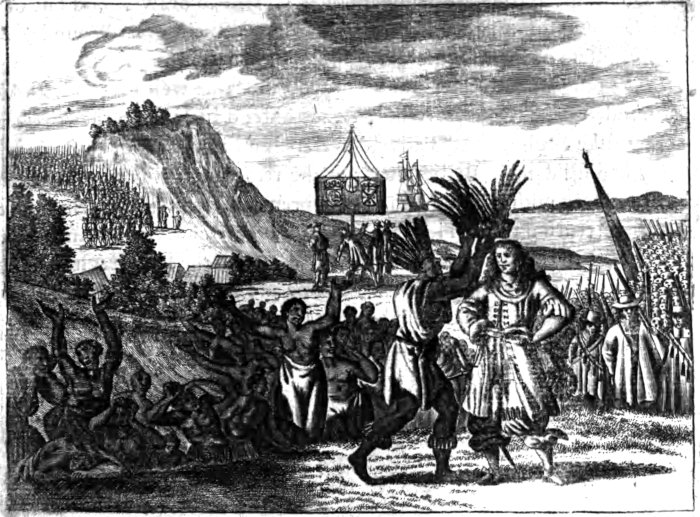
Drake’s Entertainment by the King of the Countrey.
The rumour of these Strangers arrival spreading all over the Countrey, made the Inhabitants far and near desirous to see them; the King himself sending Ambassadors to Drake, to inform him that he was on the Way coming to see him; all which the Agents related at large, and desir’d some Presents, as a testimony that their King should be welcome; which he being assur’d of, came with a Retinue of above twelve thousand Men, before whom walk’d one of a Gygantick size, carrying a costly Scepter, on which, by three long Chains made of Bones, hung a great and a small Crown made of Feathers; next follow’d the King himself in a Sute of Cony-Skins; then came a great confus’d company of People, each of them carrying a Present: whereupon Drake putting his Men into good order, march’d to meet the King; at which the Mace-bearer made a long Preamble, and when he had done, Danc’d to the Tune of a Song, which he Sung himself; then the King and his whole Retinue also fell a Singing and Dancing so long, till being weary the King went to Drake, and humbly desir’d of him, that he would accept of the Realm, assuring him, that all the People should be under his Obedience; which said, he put the fore-mention’d Crown on his Head, and hanging three double Chains about his Neck, call’d him Hioh: whereupon Drake took possession of the Countrey in Queen Elizabeths Name. The King staying alone with Drake, his Retinue went amongst the English, every one looking very earnestly upon them, and 304to those whom they lik’d best, being the youngest, they falling down and crying, proffer’d Offerings, as to Gods, and held their Cheeks to draw Blood out of them; which the English refusing, they desisted; but shew’d them great Wounds, and desir’d some Plaisters of them, which they suppli’d them with.
A Monument erected by Drake before his departure.
The English going up into the Countrey found the same well grown with Woods, which abounded with Coneys, whose Heads differ’d little from the European, but having Feet like Moles, long Tails like Rats, and in their Sides a Bag, wherein when they had fill’d their Bellies they put the remainder. They also saw numerous Herds of Deer, with whose Flesh having been courteously Entertain’d in several Villages, they return’d to the Fleet. Drake, just before he weighed Anchor, caus’d a pillar to be set in the Ground with a Silver Plate on the same, with an Inscription, mentioning the Day of his Arrival, Name and Arms of Queen Elizabeth, and free delivering of that Realm to him by the Indians: he also nail’d a Sixpence with the Queens Effigies on the Plate, under which he caus’d his own Name to be Engraven.

THE
ISLANDS
OF
Northern America.
CHAP. XI. Terra Nova, or New-found Land, with the Island of Assumption.
Having treated at large of all the several Regions and Provinces of the North part of the Continent of America, we come now to those Islands that lie within the same Degrees of Northern Latitude with that part of the Continent: The first is Terre Neuve, or New-found Land, discover’d together with several other Parts upon the Continent before mention’d by Sir Sebastian Cabott, by the Countenance and Charge of King Henry the Seventh of England; whereupon a rightful Claim thereunto, and Interest therein, hath been own’d by the succeeding Kings of England, as hereafter shall be more particularly related.
Situation and Bounds of New-found Land.
New-found Land is situated betwixt the Degrees of forty six and fifty three of Northern Latitude, and is divided from the Continent of America by an Arm of the Sea, in like distance as England is from France. The Island is as large as England in length, greater in breadth, and lies near the Course that Ships usually hold in their Return from the West-Indies, and is near the mid-way between Ireland and Virginia.
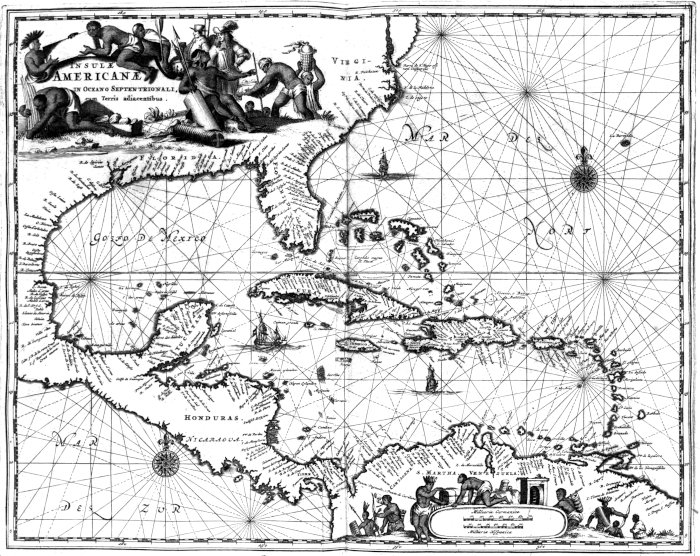
Temperature.
305We shall not much need to commend the wholsom temperature of this Countrey, seeing the greatest part thereof lieth above three Degrees nearer to the South, than any part of England doth, so that even in the Winter it is pleasant and healthful as England is.
Nature of the Inhabitants.
The natural Inhabitants of the Countrey, as they are but few in number, so are they something a rude and salvage People, having neither knowledge of God, nor living under any kind of Civil Government. In their Habits, Customs, and Manners, they resemble the Indians of the Continent, from whence it is to be suppos’d they come; they live altogether in the North and West part of the Countrey, which is seldom frequented by the English; but the French and Biscainers (who resort thither yearly for the Whale-fishing, and also for the Cod-fish) report them to be an ingenuous and tractable People (being well us’d) and very ready to assist them with great labour and patience, in the killing, cutting, and boyling of Whales, and making the Trayn-Oyl, without expectation of other Reward than a little Bread, or some such small Hire.
Commodious Harbors.
It hath the most commodious Harbours in the World, and the most safe Seas to Sail to it, there being not any Islands, Rocks or Sands between the Lands-End in England and New-found Land, and for the most part it is not above three or four Weeks Sail thither, and less coming back; and is the most commodiously situated for the discovering of the North-West Passage, and other Inlets into the South Sea; whereby the ordinary Voyages to China, Japan, and the East-Indies, are much eas’d in the expence of Time and Charge; and the most open to Trade to all Parts, of any Island of the West-Indies.
On the East side of the Land, are the Bays of Trinity and Conception, which stretch themselves towards the South-West.
Tor-Bay and Capelin-Bay lying also on the East, stretch themselves towards the West.
The Bays of Trespassey, St. Mary, Borrel, and Plaisance, on the South part of the Land, extend their Arms towards the North.
The great Bay of St. Peters lying on the South-West side of the Land, and Southerly from the great River of Canada, being about twenty Leagues distant, the same stretcheth toward the East.
Trinity Harbour lies in near forty nine Degrees of North Latitude, being very commodiously seated to receive Shipping in seasonable Weather, both to Anchor in, and from thence to Sail towards either the East, West, or South. It hath three Arms or Rivers, long and large enough for many hundred Sail of Ships to moare fast at Anchor near a Mile from the Harbours Mouth. Close adjoyning to the Rivers side, and within the Harbour, is much open Land, well stor’d with Grass sufficient, Winter and Summer, to maintain great store of ordinary Cattel, besides Hogs and Goats, if such Beasts were carried thither; and it standeth North most of any Harbor in the Land, where our Nation practiseth Fishing: It is near unto a great Bay lying on the North side of it, call’d The Bay of Flowers; to which Place no Ships repair to Fish, in regard of sundry Rocks and Ledges lying even with the Water, and full of danger.
The bottom of the Bay of Trinity lieth within four Leagues through the Land South-West, Southerly from Trinity, as by experience is found; and it comes near unto the Bay of Trespassey, and the bottom of some other Bays.
Trespassey in like manner is as commodious a Harbour, lying in a more temperate Climate, almost in forty six Degrees of North Latitude, and is both fair and pleasant, and a wholsom Coast free from Rocks and Shelves; so that of all other Harbours 306it lies the most South of any in the Land, and most conveniently to receive our Shipping, passing to and from Virginia and the Bermuda Islands; and also any other Shipping that shall pass to and from the River of Canada, and the Coast thereof, because they usually pass, and so return in the sight of the Land of Trespassey, and also for some other purposes, as shall be partly declar’d in the following Discourse.
Fruitful Soil.
The Soil of this Countrey in the Valleys and sides of the Mountains is so fruitful, as that in divers places the Summer naturally produceth without Tillage, great plenty of green Pease, and Fitches, fair, round, full, and as wholsom as ours in England.
Berries and Fruits.
Of Berries and Fruits, there grows Strawberries, red and white, and as fair Raspice-berries and Goose-berries as there be in England; as also Bilberries, which are call’d by some Whortes, and many other delicate Berries peculiar to the Countrey, in great abundance. Likewise small Pears, Cherries, Filberds, &c.
Herbs and Flowers.
There are also Herbs for Sallets and Broth, as Parsly, Alexander, Sorrel, &c. and also Flowers, as the red and white Damask Rose, with other kinds, which are most beautiful and delightful, both to the sight and smell. And questionless, the Countrey is stor’d with many Physical Herbs, though their Vertues are not known.
When Corn was first Sow’n here, it was observ’d to grow very fair, the increase was great, and the Grain very good; and several sorts of Kitchin Plants that have been Set here, have prov’d very well.
Beasts.
In divers parts of the Countrey there is great store of Deer, and some Hares, many Foxes, Squerrils, Beavers, Martins and Otters, yielding excellent Furrs, Wolves and Bears, with other sorts of Beasts, serving as well for Necessity, as for Profit and Delight.
Birds.
Variety both of Land and Water-Fowl is in this Countrey infinite: The chief Land-Fowl, besides a great number of small Birds, that live by scraping their Food from the Earth in the hardest Winter, are Hawks, great and small Partridges, Thrush, and Thrussels abundance, very fat; as also Filladies, Nightingales, and such like, which sing most pleasantly. There are also Birds that live by prey, as Ravens, Gripes, Crows, &c. For Water-Fowl, there is certainly so good, and as much variety, as in any part of the World, as Geese, Ducks, Pigeons, Gulls, Penguins, and many other sorts. These Penguins are as big as Geese, but do not flye, for they have but a little short Wing; and they multiply so infinitely upon a certain flat Island, that men drive them from thence upon a Board into their Boats by hundreds at a time, as if God had made the innocency of so poor a Creature to become such an admirable Instrument for the sustentation of Man: And also Godwits, Curlews, and such like; which Fowl do not onely serve those that Trade thither for Food, but also they are a great furthering to divers Ships Voyages, because the abundance of them is such, that the Fisher-men do bait their Hooks with the quarters of Sea-Fowl on them; and therewith some Ships do yearly take a great part of their Fishing Voyages with such Bait, before they can get others.