The Third Book, CONTAINING A DESCRIPTION OF PERUANA OR, Southern America. (continued 9)
Reading edition
The Brasilian Women and Children usually go to Wars with their Husbands and Fathers.
The Brasilian Slaves were some years since bought of the Tapuyans, or made Slaves, because they assisted Boudewyn Henrickszoon, when he Landed in the Inlet Traluson; but they have since obtain’d their Freedom of the Portuguese. The Angolan Slaves can undergo greater Labor than any other.
The Brasile Wood grows generally ten or twelve Leagues up in the Countrey from the Sea, not in particular Woods, but amongst other Trees.
The Negro’s, when the Sugar-Mills work not, are employ’d in pulling off the white Bark, three Fingers thick, from the Tree, which bears dark-green Leaves, small and prickly at the ends, and hanging on thin Stalks, but bearing neither Blossoms nor Fruit.
Osnabrig Linnen is highly esteem’d amongst the Brasilians, as also colour’d Wax, Copper, Tin, Wine, Beer, Butter, Cheese, Meal, Stock-fish, Pork, Hung-beef, and Gammons of Bacon.
The Papists Teach and observe their Religion in publick, their Spiritual Men being divided into Priests and Monks; the Monks consist of Franciscans, Carmelites, and Benedictines; the Franciscans being the most eminent, possess six fair Cloysters, besides which they have neither Land nor other Revenues, but live on what is given them daily; their Cloysters stand in Frederick-stadt, Iguaraca, Olinda, Pojuca, Serinhain, and Antonio Vaes. But the Carmelites have three Structures at Parayba, and as many more in Frederick-stadt and Olinda, where they live plentifully on what they reap from Tillage, Rents of Houses, and Legacies of deceased Persons. The Benedictins, though they possess onely two Cloysters, one in Frederick-stadt, and the other at Olinda, yet they have the greatest Income from the Sugar-Mills of Muserapa, and the Countrey about Parayba, as also Cattel and Cane-Fields.
Reciffa, the Seat of War, hath two Horn-works towards Olinda; the first rais’d with Stone, defends the Haven with seven Brass Demi-Culverins; the other lies opposite to the River Biberi, and hath five Brass and two Iron Guns. Reciffa also hath a strong Rail about it, and many Guns plac’d in good order. Near the Powder-house stand two Batteries with Guns.
On the Shore towards Olinda, lies the Stone Castle St. Joris, on a Hill opposite to the Haven, fortifi’d with a Bulwark and thirteen Iron Guns.
The Water-Castle, built round, rises out of the Sea, and stands at the end of the Stone Cliff, which makes an Inlet, through which the Ships Sail that come to, and go from Reciffa.
The Fort Bruine hath four Points, seven Brass Guns, and Pallisados round about.
Somewhat farther is the Redoubt call’d The Lady Bruine, which hath two Brass Guns.
The Castle Waerdenbergh, built before the Mouth of the River Capivaribi, in the Bay made by the River Biberibi, hath three Points, each rais’d square, because the fourth Bulwark towards Antonio Vaes, cannot be finish’d, by reason the Earth is sunk away.
The Fort Ernestus stands on the North-side of Maurice-stadt, on the Island Antonio 604Vaez. That part of the City which respects the Fort, lies open, with five Points and a double Horn-work; it is the more secure from any Invasion, because the Countrey round about is overflow’d at High-water. On the Horn-work stand eight Brass Guns; but the four Redoubts along the River Capivaribi are decay’d.
The square Fort Prince William, standing in a low Ground not far from the River Afogados, hath four Bulwarks, and is inclos’d with a high Wall and strong Pallisado’s: the Church appearing above all other Houses in the Castle, may be seen at Olinda.
Description of Maurice-stadt.
Maurice-stadt lies pleasantly along the River Biberibi, and is wash’d behind by the River Capivaribi; It hath a large Wharf, a brave Magazine, a French Church, and a Guild-hall: The Buildings are not altogether so high as those in Reciffa, where they are commonly three Stories, because the Ground is very dear.
Grave Maurice’s Court lying opposite to Reciffa, on the Shore of Biberibi, rises from the middle of a Garden with two high Towers.
Not far from the Castle Ernestus is a Potters Kiln, and on the other side, near the Fort Frederick Henrick seven Wells, and some Morasses, and towards the Water-side, a Stone Battery.
Forts of Brasile.
The Fort Orange at the Southern Mouth of the Haven, hath, by reason of its dry Moats, a strong Pallisado, four Bulwarks, and twelve Guns. The Bulwarks about the Church, and the Battery before the Haven, also secures Schuppen-stadt against the Portuguese. On the Battery stand nine Iron and two Brass Guns. At the Northern Entrance of the Haven appears a Tower with three Guns.
The Fort Margareta hath two Brass and forty Iron Guns.
Restringa, surrounded with Pallisado’s, rises near a sandy Point in the middle of the River.
The Castle Antonio, wash’d by the Sea, hath onely one Tower, but that sufficiently strong to defend it against an Enemy.
The Franciscan Cloyster, strengthned by a Wall and Earthen Works, serve in stead of a Castle to Frederick-stadt, and is the more secure by reason of a Half-Moon, Moats, Rails, and a Battery at the Mouth of the Haven.
The stonie Fortification of Ceulen lies near the Sea. All these are the Fortresses of the Northern Brasile.
To the Southward of Reciffa appears the Promontory St. Augustine, where the Haven is secur’d by the Forts Vander Dussen, Domburgh, and a Stone Battery.
Porto Calvo is fortifi’d by a Castle, built on a steep Hill forty Foot high.
The Fort Maurice Commands the Ferry of Rio Francisco, and is built on a high and steep Hill, with five Bulwarks; the lowermost Plain is overflow’d by the River in the Summer Season. The Store-houses hereabouts are ill furnish’d, and if not suddenly supply’d, ’tis to be fear’d, that a great Famine will follow, as already it is begun, and we may thank the faint-heartedness of the Enemy that it hath increas’d no more.
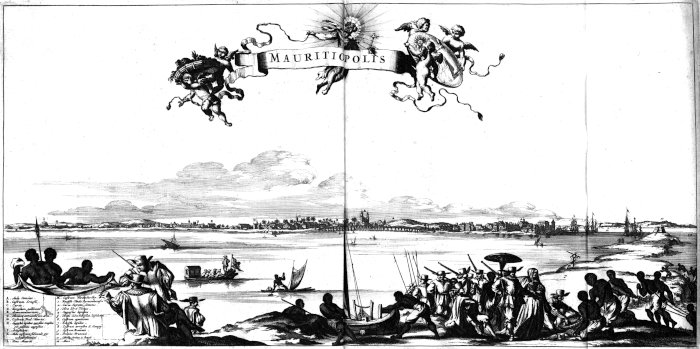
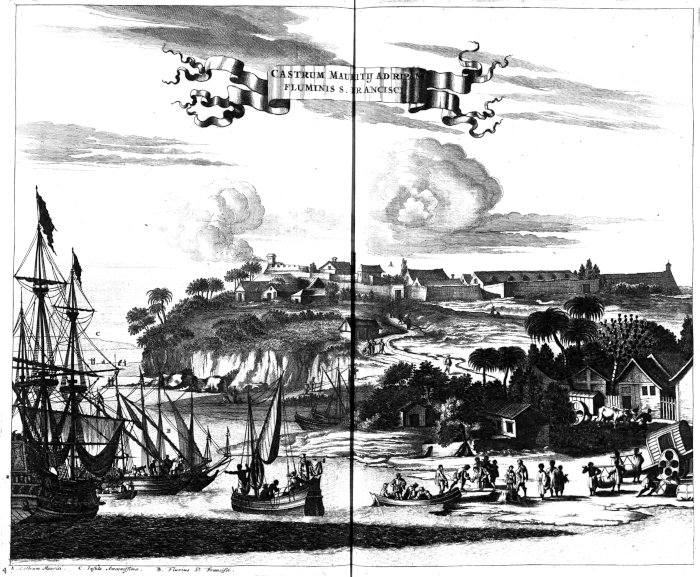
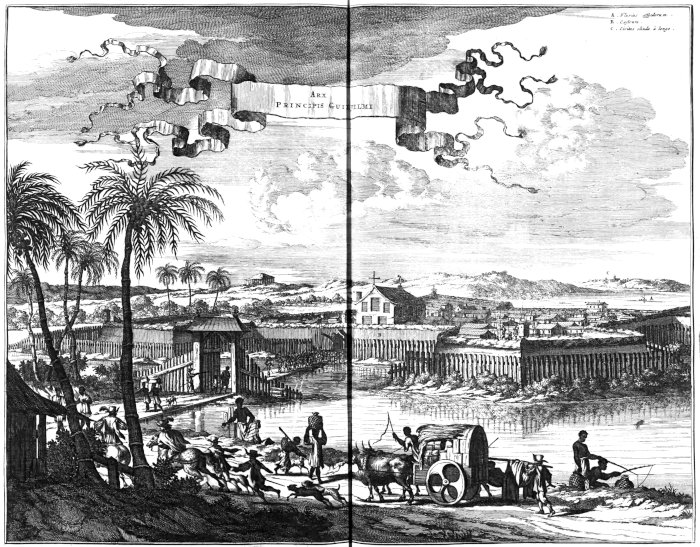
605The Militia is distributed into all the Forts or Villages, that so they may the better procure their Provisions, watch the approach of the Spaniards, and prevent all Incroach-ments of the Enemy. In Maurice Castle are five hundred and forty Men in Garrison; in the Afogados, two hundred ninety three; in Camarigibi and Porto Calvo, four hundred and eighty; in Serinhain, seven hundred and eighty; in Pojuca, twenty five; in the Mills Panterra, ninety seven; at the Promontory Antonio, two hundred and forty; in the Castle Vander Dussen, a hundred and seventy; the like number is in Amaro and Moribeca; in the Village St. Laurence, four hundred and twenty two; in the Fort Prince William, two hundred and sixty three; in Frederick Henrick, hath two hundred and thirty; in Ernestus, two hundred and eighty; in Reciffa, two hundred and seventy seven; in the Castle Bruine, a hundred and twenty five; in Olinda, a hundred and ninety three; in Iguaraza, ninety three; in Orange, a hundred and eighty two; in Goyana, a hundred and sixty five; in Frederick-stadt, a hundred and one; in the Fort Margareta, three hundred and sixty; in the Castle Ceulen, eighty eight; in Antonio Vaes lies Grave Maurice’s Guard; Siara is defended by forty; so that the whole Power consists of six thousand one hundred and eighty Men, too weak a number to resist the Enemy both by Land and Sea; nay, had he had Courage, the West-India Companies Concerns in Brasile would long since have been in a low Condition; for the Spanish Fleet which came lately from Cadis, carry’d three thousand Men, besides seven hundred which they brought from St. Salvador; the Duke of Bagnola was also ready with two thousand Portugueses, and a thousand Brasilians, to joyn with the Seamen, and expected also as great a number from Parayba, Pernambuco, Seregippa, Itamarica, Rio Grande, and Siara, contrary to the Oath taken in Reciffa: But the Spanish Fleet keeping close to the Bay Todos los Sanctos, hath hitherto done nothing, except the sending of several Companies into the Countrey, to rob and pillage the Brasilian Villages. Moreover, the Mulatto’s and Negro’s do great mischief up and down, and so much the more, because they go and come along private Ways, through which none can follow them. Most of the Ships being badly fitted, are scarce able to keep the Sea; and the Soldiers want Clothes exceedingly. The City St. Salvador keeps the Countrey in a continual Alarm, so that five thousand Men are requir’d to conquer it: Eighteen great Ships, and as many Ketches, besides lesser Vessels, ought to be sent thither, the Sea being full of Pyrats. The common Treasury is so much behind-hand, that none can receive any Pay. The Owners of the Sugar-Mills will not deliver any Sugar without ready Money, because of the Netherlanders removal from thence.
This Relation of the Affairs of the Netherland West-India Company in Brasile, was deliver’d to them in Writing by Vander Dussen.
A Description, of the Palace Freyburgh, two Bridges, and a Banquetting-house, all built by Grave Maurice.
Grave Maurice before his coming away from Brasile, built a pleasant Palace along the River Biberibi, before the Fort Ernestus on Antonio Vaes; the outmost Work whereof was shaded by a double Row of Coco-Trees, and had a Pond full of all sorts of Fish; and not far from thence, on one side, a second encompass’d a Coney-Warren, which respected a pell-mell; near it a Garden, curiously divided into round Parterres, which led into a long Park of Bakkoven-Trees; and at the end a great Dove-house. Next the River stood a large Stable, on one side whereof was a Field to whiten Linnen in, and a Kitchin-Garden wherein was a large Spot full of Orange-Trees, a row of Vines, which bore Grapes every three Moneths, and a delightful Walk, beset on each side with Lime-Trees. On the other side of this Palace stood a Banquetting-house, near a row of Pome-granate-Trees, and another of Fig and Cittron-Trees. Behind the Palace was a Fish-pond with two Iles, for the Swans. A Dove-house also appear’d near the Fort Ernestus, where the Negro’s watch’d the Horses, and led them to Water in a Fishpond in a large Wood. Before the Palace appear’d a Stone Pallisado, which like a Half-Moon ran into the River. The Palace it self rose with two Towers, one of which serv’d for a Sea-mark.
606Moreover, Grave Maurice extended his new City to the Fort Frederick Henrick, divided the Morassie Grounds by several Moats, and laid a Bridge cross the River Biberibi, between Reciffa and the City Maurice, another cross the Stream Capivaribi, between the said City Maurice and the Main Land.
In the time when Albuquerque Govern’d Brasile for the King of Spain, it was Disputed among the Portuguese, whether it were not requisite to desert the City Olinda, and causing the Inhabitants to remove to Reciffa, joyn the same with a Bridge to the Isle Antonio Vaes, because those Places are almost invincible, and much more convenient for Ships than Olinda? But the Hollanders surpris’d them on a sudden, before they could bring the Business to pass, and after a while prosecuted the same Design themselves.
Grave Maurice his stately Bridge over the River Biberibi.
Grave Maurice spent twenty four thousand Guilders in laying a Bridge over the River Biberibi, between Reciffa and Antonio Vaes. Having rais’d just fifteen Stone Columns from the Ground, they came to the deepest part of the River Antonio Vaes, when the Architect began to despair of accomplishing the same, because the Ground lay deep under Water, and the Stream ran very swift: Those which dwelt at Reciffa cry’d, That they had undertaken a Business which was not in the power of Man to effect, and that there was above ten thousand Pound already spent in vain on fifteen Pillars: In this sort they began to clamor against Grave Maurice, especially the Owners of Houses in Reciffa, who foresaw that many would remove from thence to the pleasant Isle Antonio Vaes, as soon as the Bridge was finish’d; after which the Houses in Reciffa would be at low Rates. But Grave Maurice judging that the Disgrace would fall upon him, if the Bridge should be left half finish’d, caus’d at his own proper Charge, huge pieces of lasting Timber to be cut, forty and fifty Foot long, and so ramm’d into the Ground, some streight, others sloaping, to support the rest, and in two Moneths finish’d the same. On the first day after this new Bridge was compleated, there went so many People over it, that the Toll which they paid, amounted to above 60 l. Sterl. and was after that Farm’d for twenty eight thousand Guilders yearly, a Citizen that pass’d over the same being to pay 2 d. and a Negro or Soldier 1 d. but a Horseman paid 4 d. and a Cart or Wayn 7 d.
Another over the River Capivaribi.
Since this Grave Maurice built a second Bridge cross the River Capivaribi, which joyn’d Antonio Vaez to the Main Continent. This Bridge being eighty six Rods long of durable Timber, was finish’d in seven Weeks.
His Pleasure-house Bonavista.
Moreover Grave Maurice built a pleasant Banquetting-house, call’d Bonavista, at his own Charge before the said Bridge, from whence he could see the Palace Freyburgh, Olinda, the Fort Ernestus, Maurice-stadt, Reciffa, the French Church, the Ships in the Harbors, and also the Castle Frederick Henrick. This Banquetting-house hath at each corner a Turret, and in the middle thereof a spacious Room, crown’d with a fair Terrace.
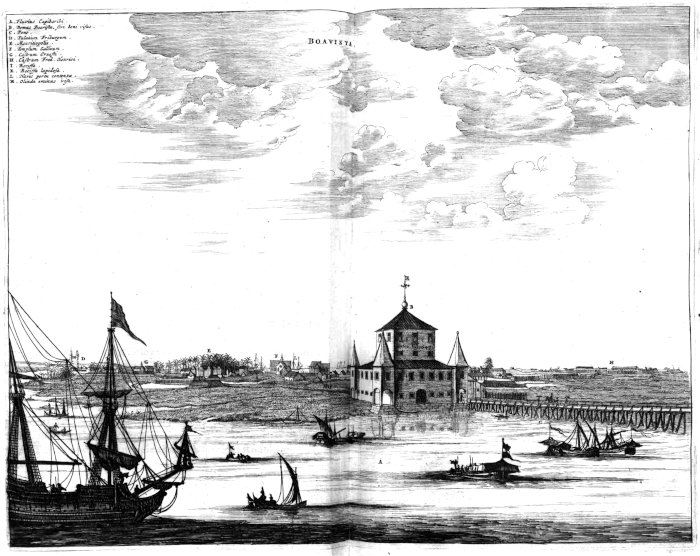
607

CHAP. VIII. Guiana.
Situation and Description of Guiana.
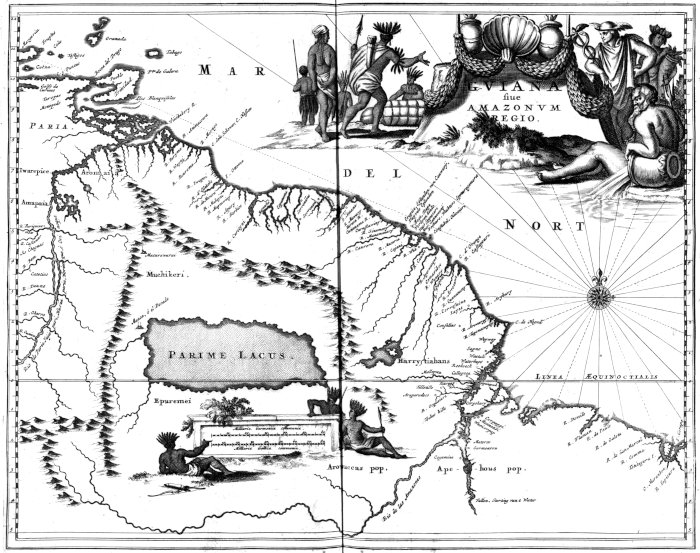
Northward of Brasile, over against Maragnan, the Countrey of Guiana, not improbably suppos’d to be so call’d from the River Wia, one of the principal Rivers of the Province, which yet is said to have more and fairer than any other part of America besides: It is by some call’d The Wild Coast, for what reason is uncertain, it being found to be a very fruitful and pleasant Countrey: It is Bounded on the East with the Atlantick Ocean, or Mare del Nordt; on the West, with some undiscover’d mountainous Countreys, which lie on that side of the Andes, on the North it hath the great River Orenoque; and on the South that of the Amazons, or Orellana; which last Name, as we have said before, it derives from Francisco Orellana, who is said to have first discover’d it in the Year 1543. It was anciently call’d Tobo, Topoi, and Tapera.
This Countrey lieth on both sides of the Æquator, extended from the fourth Degree of Southern Latitude, to the eighth Degree of Northern, yet enjoyeth a temperate and good Air, not oppressed with any excessive Heat; which is chiefly attributed to the Breezes or Easterly Winds, almost perpetually about Noon blowing upon it. Towards the Sea-side it is for the most part a flat and level Countrey, in the more Inland parts mountainous and swell’d with Hills, but in all it is generally of such a rich and fertile Soil, that for Fruits, or any outward Commodities of the Earth, it yields not to any other Province of the New World, but rather far excelleth the most, having as it were a continual Summer, without Winter or Autumn, the Trees never uncloth’d or made bare, Fruits always ripe, or growing to maturity, the Meadows and Pastures always verdant and green, and, as we said, so excellently well water’d with Rivers, that no Countrey in the World seems comparable to it in this respect. But since the several Occurrences of Orellana’s Expedition will give much light to the more particular knowledge of these Parts, we thought good to insert this following Relation thereof.
Sect. II. A Relation of the Journey of Francisco Orellana.
Francisco Orellana travelling with Gonsalvo Pizarro from Quito, to find out the Countrey Cundirumarca (where the Natives, according to the information of a strange American, went Arm’d with Golden Plates) he came after a great deal of hardship to the River Maranon, where Pizarro building a Brigantine, put all his sick and maimed Men into the same, as also all his Baggage under the Command of Orellana, whom he commanded to forage for some Provisions, of which the Army, that was to follow along the Shore, had great want; but Orellana was in few days driven down so far, that he saw no hopes of getting up again in a years time, and Engag’d daily with the Indians, which came aboard of him in little Boats; at last he went ashore and conquer’d a Village, in which he found Provisions, some Gold, and Gems of great value: Not long after which he was in great danger, by reason of a River, which with great force fell into the Channel in which he Sail’d, 608and for the space of two hundred Leagues saw neither Man nor House: Next Landing at a Village, he was by the Governor thereof Presented with Turtles, Partridges, Fish, and other Provisions, and also forewarn’d of the valiant Women, the Amazones, which they call’d Camapuyara. Going from hence, he met for eighty Leagues together, nothing but steep and craggy Mountains on each side of the Shore, insomuch that he could not Land any where for Provisions. Next coming to the inhabited Province Machiparo, he was fiercely assaulted for two days and two nights, by the Casique Aomagua, who pursu’d him with several Boats: Not long after having conquer’d a Village, out of which ran several trodden Paths into the Countrey, he came to a River, in the Mouth whereof there lying three Isles, he gave it the Denomination of La Trinidad, which washeth a fruitful Coast, along which Sail’d divers small Vessels. Somewhat farther in the River Trinidad stood a Village and Banquetting-house, where Orellana took abundance of Provisions, Silver, Gold, and Earthen Ware curiously Glaz’d and Painted, but judg’d it very hazardous to travel far into the Countrey by the common High-ways, in regard of the multitudes of People that frequented them, to whose Civility he durst not trust; therefore Sailing from hence a hundred Leagues farther, he came to the Countrey belonging to the Lord of Paguana, who civilly Entertain’d him, and Presented him with Sheep, not unlike the Peruvians, and all manner of good Fruit, which the Countrey affords in great abundance. After this on his Lar-board side he discover’d a River, whose being black like Ink, and disemboguing into another, discolour’d the Water thereof for the space of twenty Leagues; he also saw several Villages, and at last found the Stream to be so broad, that he could not see from one Shore to the other: he took one of the Villages without any resistance, there being none but Women in the Huts, whither the Men came towards the Evening. Near another Village he espy’d seven Heads sticking upon Poles, from whence the Province receiv’d the Denomination De las Picotas, from whence ran several pav’d Ways, on each side planted with Trees, into the Countrey; where Landing, he furnish’d himself with Maiz, Turtles, Geese, and Parrots, and at Can Island took an American Prisoner, who inform’d him, that he was in the Amazones’ Jurisdiction, and that up in the Countrey liv’d a People not unlike the Spaniards, amongst whom were two white Women, brought thither up the River by a Lord. Going farther he saw divers Villages on each side of him, and at last Landing in a little Town, he found plenty of Oats, Liquor made of Oats, Cotton, Linnen, a Temple hung round about with Arms, and two Episcopal Miters of divers colours. Near a Promontory jutting out into the River, the Tide went so strong, that he was not able to Land; upon the Point stood several fair Buildings, where were also white Women, of a big stature, with long Hair, who animated the Men to fight. This Countrey, which extends it self a hundred and fifty Leagues along the Shore, with Hills, Pasture-Grounds, and Champain, and well inhabited, being discover’d on St. John’s Day, was call’d The Province De San Juan; which leaving, he came to several Isles, the biggest whereof extended fifty Leagues in length, all of them standing on high Ground, pleasant, and full of People, who in Boats, by them call’d Periagues, valiantly Engag’d with the Spaniards; but one of them not long after being taken Prisoner, inform’d them, that the Amazones dwelt in Stone Houses, Wall’d Towns, had plenty of Silver and Gold, and four stately Temples enrich’d with Plates, Dedicated to the Sun. But Orellana Sailing a hundred Leagues farther, along a Coast belonging to the Lord of Caripuna, according to the Prisoner’s Relation, the Inhabitants hereabouts shot abundance of poyson’d Arrows at the Spaniards, but they made a shift to escape them, and Sailing within sight of Land into the Bay of Paria, they came to an Anchor before the Island Cubugua, Anno 1541. after they had been eight hundred Leagues.
The Expedition of Orellana.
He dies with Grief.
609Orellana informing the Spanish Court of his Adventures, desir’d the chief Command of the Province of the Amazones, which after earnest Sollicitations he obtain’d, and accordingly setting Sail from St. Lucar, he went to the Island Teneriff with three Ships and five hundred Men, where he stay’d three Moneths, and two on Cape de Verd. On Teneriff several of his Men ran from him, and on Cape de Verd he bury’d ninety eight, and left fifty sick behind him; yet he Steer’d to Brasile, where, meeting with contrary Winds, he had undoubtedly perish’d for lack of Water, if the great Showers of Rain had not supply’d his Wants, one of his Ships carrying seventy Men and eleven Horses, was never heard of, with the other two he Sail’d by Baxos de San Roque, and from thence a hundred Leagues Northwardly beyond Maragnan, where a great way off at Sea they found fresh Water, in which Orellana Steering, got between the Isles into the River De las Amazones, where he Barter’d for Provisions, Sail’d two Leagues up the River, and came to an Anchor before a few Huts, but slenderly stor’d with Provisions, where he spent three Moneths in breaking up one of his Ships, and building a Ketch. In the mean time fifty seven of his Seamen dy’d. Sailing twenty Leagues farther, he lost his best Ship; whereupon he gave order to build a Barque of the Wreck. Thus he spent thirty days in vain to find the fore mention’d Arm of the River Amazones: the Barque being finish’d in ten Weeks, and going beyond the Isles Maribique and Contan, found the three great Rivers to disembogue into the River Amazones, which there was twelve Leagues broad; but wanting Provisions, and the Men being too weak to go farther, they came back to the fruitful Island Comao, where a hundred Spaniards setled themselves, the rest going down with the Barque to find out Orellana, who, as his Wife inform’d them, dy’d with Grief.
The English and Netherlanders, who Sail’d hither after the Spaniards left off, ascribe a Breadth of fifty or sixty Leagues to the Mouth of the Amazone River, which discharges its Water with such force into the Northern Ocean, that it keeps its colour and taste above thirty Leagues, according to the ocular testimony of Captain Harcourt. The Western Point, by the Netherlanders call’d The North Cape, runs with a long Slip of low Land into the Sea, into which more North-Westerly fall the Streams Taponnowyny, Arowary, Arykary, Cassepouri, and Wiapoca; some of them wash great Wildernesses full of Trees; others glide between pleasant Meadows.
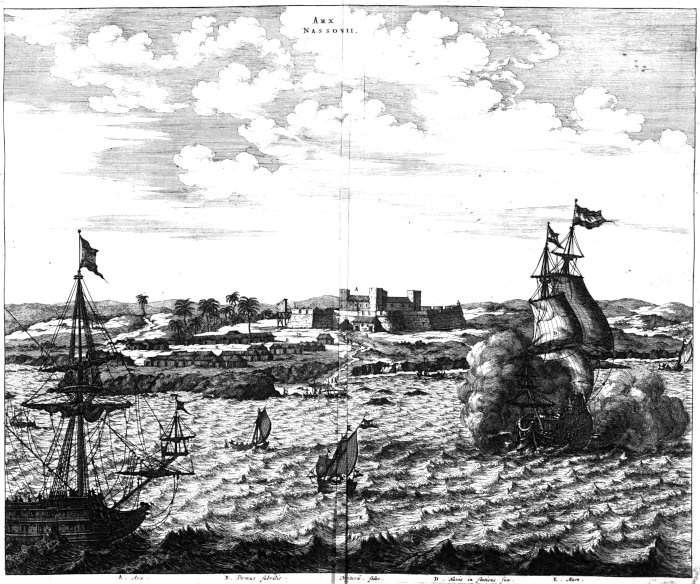
Eighty Leagues up the Amazone River the Vlussingers have built a Fort call’d Nassaw, on the narrow Island Cogemines, which is twenty Leagues long, and separated from the Shore by a Creek, and seven Leagues farther, on another Isle, the Fort Orange; from which two Forts they Trade with the Natives, Arowaccas and Apehous, bartering European Trifles for Tobacco, Cotton, Sugar, Gums, and several Tinctures.
Sir Walter Raleigh sends Fisher to discover Cooshebery Province.
Sir Walter Raleigh, Anno 1595. sending Captain Fisher from Wiapoco to Leonard Ragapo, some years before Baptiz’d in England, and then Governor of the Province Cooshebery, lying between the Amazone River and Wapoco, he receiv’d Fisher very civilly, and conducted him fifty Leagues up into the Countrey, to the Mountain Cowob, on whose top is a deep Pool, full of well tasted Fish, and surrounded with the glittering Stones Topaz; which Raleigh took the more notice of, because the same Ground in the East-Indies where these Stones are found, incloses also Diamonds. Moreover, the Province Cooshebery rises with pleasant Hills, but consists most in delightful Fields and Woods.
The River Arocawo, falling into the Inlet Wiapoco, disembogues also with the 610same between the Capes Orange and Comariboo, into the Northern Ocean.
Most of the Rivers in Guiana lie full of Isles, and cannot be Navigated far, by reason of the great Water-falls.
The Yayos.
The Yayos, who inhabit on the Banks of the fore-mention’d River, are People of a good Disposition, and go naked: they catch Fish after a strange manner; for they onely throw the strong smelling Wood Ayaw in the Water, which works so upon the Fish, that they suffer themselves to be caught with the Hand. The well-known American Root Cassavi serves them for Bread, being bak’d in round Cakes on hot Stones: of the Cakes they also make the Liquor Perrinoe, which tastes almost like stale Beer, and is prepar’d by old Women and little Children, which chew the Cassavi, and spit the same into a Pot full of Water, which having stood a while, they strain the same through a Cloth, and set it a working with Potato-Roots.
They are troubled with no Vermine, not so much as the little Fleas Niquas, by the Spaniards call’d Chigos, which creep in between the Nails.
On the Sea-Coast are many Tortoises, whose Flesh is of a delicious taste, but heavy to digest.
Sheep and Oxen will not thrive here, but Swine would thrive exceedingly, if their Dugs were not bit off in the Night by the Bats.
The River Wiapoco hath many dangerous Water-falls, the one much higher than the other; a little way beyond the first of them the Stream Army falls into Wiapoco.
The Marashewaccas.
Three days Journey Westerly dwell the Marashewaccas, whose Ears hang down on their Shoulders; they worship for their Deity, an Image representing a Man, who sitting flat on the Ground, with his Legs stretch’d out, leans with his Elbows on his Knees, and holding up his Hands, gapes and stares up towards Heaven.
North-West from Wiapoco rises the Mountain Gomeribo, which produces Maiz, Tobacco, Cotton-Trees, and Vines.
In the same place the Creek Wainary runs Westwardly with fresh Water a days Journey into the Countrey; and from the said Creek a high Mountain, fit for the production of Sugar and Tobacco, extends it self to the River Apurwaca, where the Wiopocaries inhabit a great Tract of Land.
The Harrithiahans.
North-West from Wiapoco flows the River Aperwacque, whose mountainous Shores bear Brasile Wood and wild Cinamon. The Stream it self takes its original out of a large Lake, in the middle whereof lies a three-corner’d Isle. South-East from the Lake dwell the Harrithiahans, beyond whose Countrey are the Rivers Cauwo, Wia, and Cajani. On the Banks of the first dwelt, Anno 1596. according to the Relation of Laurence Keymis, a People call’d Jaos, driven by the Spaniards from Moruga, and who formerly possess’d the greatest part of Guiana; they distinguish themselves from other People, by pricking their Faces full of Holes with the Tooth of a Beast not unlike a Rat: But at present, the Jaos being departed from hence, the Countrey lies desolate.
The Wia, which springs a great way up in the Countrey, hath a wide Mouth, and near several Islands convenient Harbors: The biggest of the Isles, inhabited by the Shebaios, is full of Provisions, viz. Fowl, Fish, excellent Fruit, wild Hogs, and other Beasts.
The triangular Isles, lying more Westerly, are also very fruitful, but not comparable to Gowatery. So far as the Coast extends it self with high Mountains, it is overgrown with Brasile Wood, but the lower Grounds produce Cotton, Pepper, Silk, Balsam, and the Root Wiapassa, tasting like Ginger, and exceeding good against a Lask, or the Head-ache.
611Before the Mouth of Cajani appears the high Island Mattoory, surrounded by the lesser Isles Sannawony, Epenesari, and Eponeregemeræ.
Between the Rivers Cajani and Maccaria, lies the low Island Muccumbro, out of whose Center rise two Mountains, and which is inhabited, as the Main Coast by Caribbeeans, whose General Arrawicary shew’d great friendship to the Netherlanders: They observe no certain Laws for Government; Adultery and Murder they punish with Death; they are very tyrannical towards their Wives, who for the least act of incivility have their Brains beat out; they esteem one another according to the number of their Wives, the eldest of which performs all Houshold-Offices.
Caribbeeans the Inhabitants of Guiana.
The Caribbeeans are accounted to have been the first Inhabitants of this Countrey, for the Jaos, Sappaios, Arowaccas, and Paragotos, were driven hither by the Spaniards from Trinidad or Oronoque.
The wild Caribbeeans live farther up into the Countrey, and often fall with great rage upon the other; but since the Netherlanders have furnish’d them with Arms, they have not been so much molested by them.
Rivers.
Beyond Macavia lies the River Caurora, which is very narrow and deep; and next in order the Rivers Manamonary, Sinamary, Cunanama, Juraca, Mawary, Amana, and Marawyny, full of Isles, and four Leagues broad at the Mouth; along the Shore grow little Trees, whose Leaves wither as soon as touch’d by Mankind, but revives again within half an hour.
Next follow the Rivers Sorrenam, Sorrenamme, Copanama, Marateca, and Curetiny, where the Netherlanders, by virtue of a Patent granted by the States General, drove a Trade for several years.
Somewhat farther the Berbice, Apari, Maycawini, Mabeyca, Mirara and Essekebe, discharge their Waters into the Ocean, twenty days Journey from their Spring-Head, where a great Lake (by the Jaos call’d The Roponowini, and by the Caribbeeans, Parime) spreads it self a great way; and on its Northern Shore hath the Town Manoa.
Along the River Essebeke is an excellent sort of Wood, the Dye call’d Orellano, and abundance of Cassavi: In the Mouth of the River also lies the Isle Ottoma.
Lastly, between Essebeke and the great River Orinoque, glide the lesser Streams Iwapoi, Pauroma, Gayni, Moruga, Ammacoura, and Parima, before which lie several nameless Isles.
The Discovery of these Parts begun by Columbus.
Diego de Ordas his Expedition.
Christopher Columbus, in his third Voyage to the West-Indies, discover’d the great Island Trinidad, where before the Mouth of the Bay Vallena he was in great danger, as also the Ship Commanded by Alonso de Ojeda, by reason of the Waves, with which the great River Yuyapar, otherwise call’d Orinoque, coming out of the High-lands of Paria, falls into the Sea, which made him call the said Mouth Bocca del Drago; so that Columbus, Anno 1599. discover’d the Main Coast of America to the Northward of Guiana, as far as the Promontory De la Vela, before Americus Vesputius; whither Diego de Ordas Steer’d with three Ships, Mann’d with four hundred Castilians, in the Year 1531. and before Guiana took four Caribbeeans Prisoners in a Canoo, and finding an Emerauld about them as big as a Man’s Hand, they inform’d him, that up the River was a Rock all of such Stones, and a Mountain on which grew high Trees, yielding store of Myrrh; but the strong contrary Tides and Water-falls prevented Ordas from going thither; and being troubled at the loss of one of his Ships, he ran along the Shore to Paria, and took the Fort which Antonio Sedenno, Governor of Trinidad, had cast up there, and left the Command thereof to Juan Gonsalvez, Ordas pretending that Sedenno had built it contrary to the Emperor’s Order, and that he had made Slaves of the Natives. Martin Jannez Tafur stay’d in the conquer’d Fort according to Ordas his appointment, who went up the River Orinoque not 612without great hardship; for his Provisions were not onely short, but he was tormented in the Day by the Muschitoes, and in the Night by the Bats; at last coming to a Village Commanded by Viapari, he was kindly Entertain’d, which made Ordas contrary to the will of his Men, who would willingly have gone farther into the Countrey, stay there all the Winter; but as soon as the rainy Moneths were over, Ordas went farther up the River Orinoque, where his Ship was stav’d against a sandy Shelf, which forc’d him with two hundred Foot and forty Horse, to travel along the Shore, where he was much scanted of Provisions, and for forty days together met none but a few poor wild Fishermen, and at last stopt at an unknown River, which fell into the Orinoque. The Guianian Guide which Viapari had given Ordas, advis’d him to go along the Shore of the new River; because it would lead them to a well Cloth’d and rich People: But Ordas went along by the River Oronoque till he came where the Water falling from the Mountains makes it so terrible rough, that Ordas his Vessels, which were Toed along, were not able to be got any farther, so that after two hundred Leagues advance, he was necessitated, by reason of the fore-mention’d Water-falls, to go aboard and Sail down the Stream: His Men being weary’d with so troublesom a Journey, forsook him on the Island Cubagua, which made him return over Hispaniola to Spain, where not long after he dy’d with Grief.
The Expedition of Hieronimo Ortall.
This unsuccessful Expedition of Ordas no way daunted Hieronimo Ortall from prosecuting the same Design; for setting Sail from St. Lucas, Anno 1533. to the Fort which Ordas had taken from Juan Gonsalves, he Steer’d from thence over to Cubagua, to fetch some Men, and sent the Lieutenant Alonso Herrera with five Ketches, carrying two hundred Men, the same way which Ordas had been. Herrera coming to the fore-mention’d Water-falls where Ordas return’d, caus’d his Vessels to be unladen, then Toed them by meer force over the Water-falls, where he discover’d plain Fields without any Inhabitants, extending themselves to the Mouth of the River Meta, where he quitted his Vessels, and with no small trouble got over Morasses and Pools to the fruitful Countrey of the Xaguas, a People both cruel and valiant; whom after a sharp Conflict vanquishing, he became Master of their Village, in which he found plenty of Provisions, as also in another neighboring Town, where his tir’d, and almost starv’d Army began to take Breath, being exceedingly refresh’d with the delicious Meat of a sort of wild Dogs, which were here in great abundance. Having spent the Winter Season here, they were often set upon by the Caribbeeans, by whose poyson’d Arrows several of them being shot, dy’d Distracted, and amongst the rest Herrera himself; after which his Successor Alvaro Ordas return’d to the Vessels, which were left at the Mouth of the River Meta, from whence he Sail’d back without any other success, the Design being to find out the Golden City Manoa, on the Banks of the great Lake Parime.
Is follow’d by Hermandes and others.
Not long after Peter Hermandez de Serpa undertook the same Work with three hundred Spaniards, several Brasilians and Negro’s; but before he could reach the River Orinoque, he was destroy’d by the salvage People Wikiri, eighteen of his Men onely escaping to bring the news of this sad Disaster.
Peter de Orsua following the footsteps of Gonsalvo Pizarro, went to seek for Gold in Guiana; but being kill’d by Lopes Agira near the Amazone River, that Expedition also prov’d fruitless.
Berreo’s Relation of his Adventures to Sir Walter Raleigh.
With the same desire of finding Gold in Guiana, Antonio Berreo went from New Granada thither; but being taken by Sir Walter Raleigh, was interrupted in his Design; however, he gave him an Account of his Adventures, so far as he had gone, viz. That he went to find out a Way along the River Cassanor, between New Granada 613and New Guiana, went from Cassanor to the Stream Meta, and from thence to Orinoque, where he was in great danger, by reason of sharp Rocks, over which the Stream flowing, washes several Isles; That he spent a whole year before he came to the utmost Borders of Amapaia; near which he lost several of his Barques, and on the Shore, not onely divers Horses, but also many of his Men, who either dy’d of hardship, or were kill’d by the Natives with poysonous Arrows, so that sixty of his Men were kill’d in the Countrey of Amapaia, which extends along the River Orinoque, besides a great many that dy’d there by drinking the Water, which was full of poysonous Animals, and glided over a slimy and muddy Ground, which made it thick and troubled: Six Moneths he stay’d in the Countrey Amapaia, where he made Peace with the Inhabitants of Anebas, who gave him ten curious Images of massie Gold. The River Orinoque is about four Leagues broad here, and about seven hundred Miles long, before it fall into the Ocean, and is every where enrich’d with the Waters of many Rivers which fall into it from the North and South: He added moreover, that he endeavor’d to go down Southerly to Guiana, but was prevented by steep Mountains, and therefore went on Easterly till he came to the Countrey Emeria, where he found a courteous People, and plenty of Provisions; that the Governor of Caripana, being about a hundred years of age, had a long time Convers’d with the Christians on the Islands Trinidad and Margareta, and learn’d a Form of Civil Government; that Sailing down the River Orinoque between many Isles lying at the Mouth of the River to Trinidad, and from thence to Margareta, he took sixty Men into his Service; but that he himself, being tir’d with so great a Journey, and staying to refresh himself at Trinidad, fell into the hands of another Party of the English; that before he was taken he sent several of his Men to Caripana, to find the King of Morequito, who three years before had been with abundance of Gold at Cumana and Margareta, and inform’d a Spaniard call’d Vides so much concerning the Golden Countrey Guiana, that he obtain’d a Patent at the Spanish Court to discover Guiana; but that Vides, jealous that he might be there before him, had not onely incens’d Morequito against him, but so instructed him, that he suffer’d his Men to pass through the Countrey to fetch Gold from the City Manoa, and as they return’d, set upon them and slew them on the Borders of Aromaia, together with a Monk that was in their Company, one Man onely escaping; by whom being inform’d of the Murder, he immediately sent divers Soldiers to take Revenge of Morequito, who flying to the Governor Vides, was nevertheless, upon his demanding him in the King’s Name, deliver’d to him; and notwithstanding he proffer’d a great Sum of Money for his Ransom, was cruelly put to Death; but not satisfi’d with that Revenge, he over-run all the Countrey of Aromaia, took Morequito’s Uncle, call’d Topiawari, Prisoner, who bought his Life for a hundred Plates of Gold, and some Precious Stones; That Listing many Men in Spain for the Gold which he sent thither, he Row’d with Barques up the Rivers Barema, Pattroma, and Dessequebe, where he barter’d Trifles for Men, Women, and Children, of whom he made great Sums of Money on the Island Margareta.
This Information which Sir Walter Raleigh got from his Prisoner Berreo, made him desirous to make an Expedition to Guiana; to which purpose he sent Captain George Gifford with a Ketch and a Barque to the River Capuri, where the Water fell before the Vessels could get beyond the Sands in the Mouth of the River.
John Donglas had better success, being likewise sent out by Sir Walter Raleigh, for he with his Boats found that Orinoque had nine Arms to the North Sea, and seven to the South, which embrace divers Isles, of which those on the right side are call’d Pallamos, and those on the left, Horotomaca. The Mouth of the River gapes a hundred 614Leagues. On the fore-mention’d Isles dwell the Titiriras, a modest People, who speak a bald Language; in the Summer they live under the open Skie upon the bare Earth, and in the Winter (being there between May and September) on the tops of the Trees, because during that time the River Orinoque rising thirty Foot higher, overflows all the Isles thereabouts, which are very high and mountainous. But Raleigh himself Rowing up the River Amana, endur’d great hardship, his Men being most of them sweltred with the Heat, and great want of Provisions; and had not their Indian Pilot shew’d them another Stream much easier to Navigate, he would have been forc’d to return successless; but being stor’d with Provision out of a Village built along the Shore, he chased four Canoos, of which he took one, and also an Atwaccas, which in fifteen days time brought him into the River Orinoque, where he saw the high Mountains of Guiana; afterwards Anchoring before a fair sandy Bank, which lay near the Mouth of three Rivers, he took abundance of Tortoises, and was furnish’d with plenty of all sorts of Provisions, sent him from the Governor Toparimaca, who inhabited the pleasant Village Arowocay, built on a little Hill, surrounded with delightful Gardens, and Fields till’d by the Negro’s; who accommodating Raleigh with an experienc’d Pilot, he set Sail with a fresh Easterly Wind, and Westward saw the Isles Assapana, twenty five Leagues long, and six broad, and Iwana, of the same bigness. The River Orinoque hath here thirty Leagues in breadth, and receives the Rivers Arrawopana and Europa: He Sail’d next by the Isles Ocaywita and Putayma, opposite to which on the Main Land appears the Mountain Oecope, whose top reacheth the Clouds; on the right side a Plain Countrey discover’d it self a vast way, which the Pilot said was call’d The Plain of Sayma, extending Northerly a hundred and twenty Leagues to Cumana and Caracas, inhabited by four sorts of People, viz. the Saymas, Assaways, Wikeries and Aroras; which last, being a Coal-black People, us’d poyson’d Arrows. Raleigh passing between the two Mountains Aroami and Aio, came to an Anchor near the Island Murscolima, and from thence into the Haven Morequito, where the King Topiawari, a hundred and ten years of age, brought all sorts of Fruit, Poultrey, Fish and Flesh, and gave him an Account of the Condition of Guiana, viz. That the whole Countrey from the Mountains Waccarima to Emeria, bore the Name of Guiana, the Inhabitants calling themselves Orinoque Poni; on the other side of the said Mountains lies the spacious Valley Amariocapana, where the Guianiatas reside. Southerly the Oreiones and Epuremei, who coming out of a strange Countrey, have destroy’d the ancient Inhabitants, leaving onely the Awaawaqueri and Cassipagoios. The Epuremei built the stately City Macurewarai there. But Raleigh going on his Journey saw the Island Caiama, and came to the Mouth of the River Caroli, whose strong Current he was not able to stem, wherefore he desir’d Aid from Wanuretona, Governor of Canuria, who furnish’d him with Provisions, and Men to Toe him up the fore-mention’d Stream; and inform’d him that the River Caroli, which sprung out of the Lake Cassipa, was inhabited on one side by the Iwarawakeri, and the Lake Cassipa by three powerful People, viz. the Cassiapagotos, Eparagotos and Arawogotos, all mortal Enemies to the Spaniards: whereupon Raleigh sent some of his Men thither, who return’d with great hopes of finding rich Gold-Mines. The fore-mention’d Lake also produces the Rivers Aroi, Atoica, and Caora, near which dwell the Ewaipanoma, who have neither Necks nor Chins, but their Mouthes just upon their Shoulders. Towards the North the River Cari falls into the Orinoque, and on the West the Stream Limo; between both which the Cannibals reside, whose Metropolis call’d Acamacari is very famous for their strange way of Trading; for there the Women are brought to Market, and bought by the Arwaccas: But because great Showers of Rain fell daily, and the 615Stream Caroli glided downwards with extraordinary force, Raleigh return’d to Morequito; from whence Putima, King of Warapana, conduced him to a rich Golden Mountain in his Countrey, and along the Rivers Mana, Oiana, and Cumaca, to the place where the Orinoque divides it self into three excellent Streams, the chiefest whereof, call’d Cararoopana, washes the Province Emeria, out of whose Mountains the Rivers Waracayari, Coirama, Akaniri, and Iparoma, glide to the Northern Ocean; as also the Araturi, Amacura, Barima, Wana, Morooca, Paroma, and Wyni, all Branches of the River Orinoque: From whence Raleigh return’d home to England.
Not long after he sent Laurence Keymes and Thomas Masham back to Guiana: Keymes found out all the Rivers between the Amazones and the Orinoque, and Masham the Stream Wiapoco; from whence both return’d without any farther success.
Sir Walter Raleigh condemn’d for Treason.
He is Repriev’d and sent again to Guiana.
Raleigh upon Gundamor’s Accusation Beheaded.
After this the Business lay still for a while, in regard Sir Walter Raleigh being (together with Grey, Cobham, and the Romish Priests, Watson and Clark) found guilty of High Treason, was Condemn’d to die; but being Repriev’d by the King, was kept a Prisoner in the Tower for the space of fourteen years; during which time he wrote a Description of Guiana; which the King perusing, was so well pleas’d with it, especially since he undertook to make out by several Reasons, that England might make it self Master of divers Gold-Mines there, to which Spain could lay no manner of Claim, that he discharg’d him out of Prison, and permitted him to make a second Expedition: Whereupon with ten Ships, Anno 1617. he set Sail for Guiana again; being toss’d with divers Storms, he at last came with five Sail to the River Calliana, where he fell dangerously sick, and therefore sent Captain Keymes with five Sail to the River Orinoque, to conduct the Men to the Gold-Mines; each Ship carrying fifty Men, and the other Captains being Parker, North, Thornap, and Sir Walter Raleigh’s Son. The Spaniards having a Garrison at Orinoque, fir’d very fiercely at the English, who suffer’d great damage, and amongst divers others, Captain Raleigh himself was slain, whilest the other five Sail lay near the Island Trinidad, under John Pennington’s Command, who daily fear’d the Spanish Fleet. But Keymes found it very difficult to Land in Orinoque, by reason of the Banks along the Shore, which Diego de Palameque from Puerto Rico kept strongly guarded; therefore going to an even Shore with intention to Land, he was so sharply receiv’d by a Body of Spanish Musquetteers, that divers of his Men were mortally wounded; yet breaking in amongst them, he went towards the Gold-Mines, to which the Way led through a Wood where the Spaniards lay in Ambuscade; but he judg’d himself too weak to do any good upon the Mines, one of which belong’d to Peter Rodrigo de Parama, a second to Herviano Frontino, and the third to Francisco Fashardo: The English also were fearful, by reason of the Spaniards Cruelties, who not long before had flay’d several Merchants alive; so that Keymes contented himself with pillaging and burning the Town St. Thomas, which the Spaniards had deserted. Soon after which Captain Whitby ran away with a Ship from the Fleet, whilest Keymes return’d back to Raleigh, who laid several things to his Charge concerning the unnecessary Expence and shame of such an unsuccessful Voyage; which so wrought upon Keymes, that he offer’d to lay violent hands on himself in his Cabbin. At length Raleigh returning to London, was accus’d by the Spanish Ambassador Gundamor for the burning St. Thomas, urging that his Master resented it so ill, that he threatned to wage a War with England if Raleigh was not Executed; who notwithstanding he alledg’d, That the Spaniards shew’d the first Acts of Hostility against the English, who onely defended themselves; and that St. Thomas was burnt without his knowledge or Order; and that Keymes had not observ’d his Command in the discovering of the Gold-Mines, (which Apologies were generally look’d upon as real Truths) yet 616the King esteeming the Peace with Spain of more value than one Man’s Life, without taking notice of Gundemor’s Accusations, commanded that the Sentence formerly pass’d on him for Treason should be Executed, and accordingly in the sixtieth year of his Age he was Beheaded, discovering himself, by his Christian Behavior and Profession at his Death, to be a far other kind of Person than what the World had censur’d him to be.
Since this last Expedition of Sir Walter Raleigh, we find not that there hath been any great Resort or Trade unto this Countrey, except by a few Netherland Merchants, who have yearly sent eight or nine Ships to the River Orinoque for Tobacco.
The temperature of the Air.
As for the Air or Climate of Guiana, it is very differing, for about the Amazone River, dry Weather begins about August, and the windy and rainy Season about February; but Westward towards Orinoque, the Summer takes beginning in October, and the Winter in April; the Days and Nights are almost of an equal length, and the difference of Heat and Cold is but little.
Burning-Feavers, Dropsie, and the Jawnes, destroy many People here; which last is not unlike the POX, and proceeds from carnal Copulation with the Guianian Women, who are naturally subject to this Disease.
The Nature of the Inhabitants.
The Inhabitants are divided into several sorts, the chiefest whereof being the Caribbees go naked, covering onely their Privities with a Lappet. The Women, though yellow, are very comely; and both Men and Women paint their Bodies with Netto, which grows on little Trees in Cods: They make Holes through their Noses, Lips and Ears, and hang Glass, Bells, pieces of Copper, or any other Trifles that they get from the English and Netherlanders, in them: About their Necks, Arms and Legs, they wear Strings of Beads, or Cockle-shells.
Their Houses with low Roofs, serve them onely to sleep in the Night upon Cotton Hammocks, for in the day-time they sit under high Arch’d open places, that the Wind may blow full upon them. Their Houshold-stuff consists of Earthen Pots and Dishes neatly painted. They live in Tribes or Families together in a Town, which is Govern’d by the eldest of them; and their Militia is Commanded by one that is able to endure most Stripes with Switches without any shew of pain. The chiefest of their Families have commonly three or four Wives, whereas others are contented with one. The Men seldom do any toilsom Work, but make their Wives do all, insomuch that as soon as a Woman is Deliver’d of a Child, she must immediately go about her usual Employment, whilest her Husband lies lozelling out his Moneth on a Hammock.
Their Language sounds not unpleasantly, but is hard to learn, because many words differ but little in the pronunciation, and yet have quite another signification.
When they march into the Field against their Enemies, then the General sends a Stick to all the Villages under his Jurisdiction, on which are cut so many Notches as there are Days appointed before he intends to set forth, which they cut out again as the Days expire, and on the last they repair to the appointed place.
A not much unlike Custom they observe in all Promises and Bargains; for they give one another as many Sticks as they desire Days to perform the same in, and so throw away every day one, till they have onely one remaining, and then they begin to think of performing their Promise or Bargain.
They know no word whereby to express any greater number than Ten; Twenty they express by laying their ten Fingers on their Toes, and all that exceeds Twenty, they compare to the Hairs of their Head, crying Ounsa awara.
617Some of the painted Canoos made of the Trunks of Trees, will carry five or six Tuns.
Their manner of Fighting, Religion, &c.
In their Wars they use Bowes, poyson’d Arrows, short Truncheons of speckled Wood, and Shields full of carv’d Images, and Fight without any Order. They go upon no Design but in the Night, and upon certain advantages. All Women and Children which they take Prisoners, are sold for Slaves, but the Men are cruelly put to death.
There is but little of Religion that can be ascrib’d to these People, onely that some shew Reverence to the Sun and Moon, which they believe are both living Creatures; but they make no Offerings to them.
Their Funeral-Feasts for great Persons are strangely kept, viz. all the Men making themselves Drunk with the Liquor Parranoro, Dance three or four days one after another, and he that drinks most, and is worst Drunk, gains the greatest Honor, whilest the Women lament and mourn for the Deceased.
Their Priests, call’d Peeaios, are in great esteem amongst them, because they pretend that they Converse with the Spirits Wattipa and Yarakin, which the Guianians exceedingly fear, apprehending themselves often beaten black and blue by them.
The Peeaios also profess themselves to be Chirurgeons and Doctors, but if they cure not their Patients, they go in danger of their Lives, unless they speedily get away.
They burn their dead Bodies, together with those things the Deceased affected most in his Life-time. A Prince or Governor also hath his Slaves put to death at the time when he is burn’d, that they may serve him in the other World.
Their Bread-Corn.
The Cassavi-Root press’d, boyl’d with Pepper, dry’d and bak’d on hot Stones, serves the Natives for Bread.
Each Grain that is Sown here produces in Harvest above fifteen hundred.
Their Corn makes wholsom and well tasted Beer, call’d Passiaw, and of their stamp’d Cassavi they make the Liquor Parranow.
In hollow Trees, and Caves under Ground, they find abundance of Honey; and their Vines afford them excellent Grapes twice a year.
No Plant is ever seen here without either Leaf, Blossom, or Fruit, except the European Apple-Tree, which never changes its nature, but blossoms and bears Fruit at the same time of the year as in Europe.
The wild Hogs Pokkiero, whose Navels grow on their Backs; and the Pangio, not unlike our Swine, afford the Inhabitants excellent Food.
Here are also Water-hogs, of a very delicious taste; but because they are very apprehensive, and dive at the least noise, they are seldom taken.
The Woods are full of Baboons and Apes, as also the slothful Beast Ai.
The Hares here, being of a brown Colour, with white Specks, and the red Rabbets, are accounted great Delicacies.
There is no Countrey in America, which breeds greater Armadillo’s than Guiana, some of them weighing eighty Pound.
Here are also Bears, which live on nothing but Pismires; they have long hairy Tails, with which they cover their Bodies in rainy Weather; they put their Tongues a Foot deep into the Pismires Nests, and so pulls them out.
The Tygers here are either black, spotted, or red; but the black exceed the other in cruelty, yet are seldom seen near inhabited places; the spotted and red devour abundance of Cattel, but will seldom set upon a Man, especially in the day-time.
The Woods are also full of Land-Turtles, which the Inhabitants take, and keep till they have occasion to make use of their Flesh.
618The Eagles that are here with their Claws, Engage with those that go about to take them.
The Catamountains make such an exceeding noise at a certain hour, both in the Night and in the Day, that it is heard two Leagues off.
The Marmozets, a little Beast, biting the Catamountains and Apes in the Ears, forces them to leap from one Tree to another.
The black Beast Quotto hath a Face like an old Woman, and hanging by the Tail, swings from one Tree to another.
The Cuscary is a brown four-footed Creature, about the bigness of a little Dog, but hath the shape of a Lyon.
Birds.
Moreover, Guiana produces Teal, Geese, Crains, Phesants, Partridges, Pigeons, Marlins, Snipes, Falcons, Plovers, and Parrots of all sorts, besides many other strange Fowls; amongst which the chiefest are a sort whose Feathers glitter like Scarlet, and walk along in Rank and Fyle like Soldiers.
Fish.
The Sea produces abundance of Turbots, Soals, Thornback, yellow Salmon, Sturgeon, Black-fish, Gurnets, Crabs, and Oysters.
Amongst other Fishes, the Cassoorwa, which is somewhat bigger than an Eel, is very strange, having two Sights in each Eye, of which it always holds one above, and the other underneath the Water when it swims.
Here are also the great Fishes call’d Manati and Num-eel, by which if any part of a Man be touch’d, it immediately becomes stiff.
Vermin.
There are likewise divers Vermine, which trouble the Countrey Guiana, among which are Serpents, of thirty Foot long, that come out of the Water and feed on the Land; they do little hurt, as not being poysonous: but there are many of a lesser size, whose biting is so venomous, that it causes the Flesh of a Man to rot in twenty four hours time: others there are which have forked Tails, and Tusks in the Roof of their Mouthes.
The Crocodiles here also devour abundance of Cattel.
Strange kind of Scorpions.
The Scorpions, which are black, and resemble a Lobster, breed under dry Wood or Corn; their Stings are hid in their Tails, with which if any one be touch’d, he is sure to endure an intolerable pain, but without danger of losing his Life for the present, yet nothing can perfectly cure the same, except the Scorpion kill’d and laid on the Wound.
The Bats here are as big as Pigeons, and they suck the Blood of Men and Beasts so gently, that they seldom perceive the same.
The Pismires also do great mischief, especially in sandy Grounds; and likewise the Musketo’s, whose Stings cause painful Swellings; but these most of all trouble them that inhabit near the Sea side on low Lands, insomuch that the Fisher-men bury themselves in the Night in Sand, leaving onely Holes to breathe at.
Frogs and Toads also make a terrible noise here, and especially after Rain.
Commodities of the Countrey.
The Soil is inferior to none in the World, for the production of Sugar; but the general Commodities of the Countrey are Flax, Cotton, Hemp, the Berry Annoto, which Dyes an excellent Orange colour, another Berry which Dyes a deep Blue, a Tree whose Leaves Dye a Red, and the Wood of another Tree whose Juice Dyes a Purple and Crimson.
Moreover, Guiana produces the Gums Lemnia, Barattu, and Carriman, which being black and prickly, smells very pleasantly, and cures the Head-ache, Bruises, Pains in the Limbs, Gouts, and green Wounds. The same operation hath the Gum Baratta.
Here are also good Sena, Bolus Armenius, Cassia-Fistula, Terra-Lemnia, the Berry 619Kelette, very effectual against the Bloody-flux, the Juice of the Leaf Upee, which cures the Wounds of poyson’d Arrows, and a sort of somniferous Apples, whereof the least bite occasions a deadly Sleep.
There is also a Tree, generally growing about the Houses of the Natives, the Boughs whereof bruis’d between two Stones, and thrown into the Creeks of deep Water full of Fish, cause them to swim above Water upon their Backs.
The Letter-Wood call’d Pira timinere, turns also to a good account, much more the excellent Stones, Jasper and Porphyr.
Nor are there wanting Gold and Silver-Mines, which doubtless would yield great profit, were they open’d.
The Grain of the Countrey grows on Stalks seven Foot long, on the tops whereof hang two Ears full of Kernels as big as Pease, which ripens in four Moneths.
The Sugar-Canes, being of the bigness of a Man’s Arm, and about six Foot long, are at the years end cut off, broken and press’d in a Mill; after which the Juice boyl’d in Copper Kettles to a certain Substance, is put into woodden Tunnels, square at the top, and narrow at bottom, with a small Hole, which is open’d as soon as the Sugar is sufficiently hardned, to let out the Syrrup; after which it is put into Hogsheads, and so Transported.
The Negro’s which are brought from Angola and Guinee, are so cruelly us’d, that they oftentimes through despair destroy themselves.
The whole Countrey of Guiana is by several modern Writers methodically divided into these inferior or lesser Provinces, 1. Rio de las Amazones. 2. Wiapoco, or Guiana, properly so call’d. 3. Orenoque; and 4. The Islands of Guiana.
Rio de las Amazones.
Rio de las Amazones, or the Countrey of the Amazones, contains all that part of Guiana which lieth on both sides of the River Orellano, of a rich and good Soil, generally, abounding with all sorts of Fruits, and especially with those which the Americans call Totok, and love it extreamly, out of an opinion, they say, that it excites them to Venery, whereunto they are of themselves but too much inclin’d; and another which they call Pita, of a taste far more delicious and pleasing, and not so hurtful as the other. The Countrey was first discover’d by the fore-mention’d Francisco Orellana, a Spaniard from Quito, but it was onely by the River Orellana; and though he be credibly reported to have Sail’d no less than eighteen hundred Leagues down the Stream, and to have discover’d a rich and fair Countrey on both sides the River, well peopled with Natives, and giving in divers places no small Arguments of greater Wealth and Riches more within Land; yet such was the bad success of his second Endeavors, and likewise of those that follow’d him, as is evident from what hath been before related, that, as yet, there seems no farther Report to be given, at least not of any thing special, concerning that part of the Countrey.
Wiapoco, or Guiana, properly so call’d.
Wiapoco, or Guiana, properly so call’d, taketh up the middle part of this Province, being divided, as the other, almost into two equal parts, by the River Wiapoco, which runs through the midst of it. The Countrey on both sides of the River is very rich and fertile, and so naturally apt, both for Sugar-Canes, Cotton-Wooll, and Tobacco, that they are said to grow here (all of them very good) without Planting, or any art of Husbandry. In this Countrey likewise should be the famous Dorada, as the Spaniards call it, or City of Gold (if it could be found) with the reports and hopes whereof some of our own Nation seem to have been not a little possess’d as well as the Spaniards: nor can we much blame them; for if the Stories of it had prov’d true, it must have been one of the goodliest and fairest Cities in the World (not to speak of the Wealth.) Diego de Ordas, the Spaniard of whom we have 620lately had occasion to make frequent mention of, being reported by some to have travell’d one whole day, and half another in it, before he could arrive at the King’s Palace; which yet must be suppos’d to have stood but in the midst of the City. Places of less Magnificence, but more Certainty, are 1. Caripo, which was once a Colony of English, setled there by Captain Robert Harcourt, Anno 1608. upon the Banks of Wiapoco, and not far from the Mouth of it; being a place, by the advantage of a Rock, which it hath on the one side of it, of great strength and very difficult access; the Air about it sound, and said to be very agreeable to English Bodies. 2. Gomaribo, a Colony formerly of the Dutch, on the North-West side of the Bay of Wiapoco, but since deserted by them. 3. Woyemon. 4. Crewinay, both of them Towns of the Natives, not far distant from the other.
Orinoque.
Orinoque, or the third Division of this Province, comprehendeth the most Northerly parts of Guiana, lying upon, or towards the Banks of this famous River: a Countrey likewise reported to be very rich, and comparable to Peru it self for hidden Treasure, which, they say, is not yet discover’d, onely for want of diligent and industrious searching. The Places in it already known are onely 1. Coniolaba, as they call it, which seems to be some Town of the Natives, lying a few Leagues distant from the Orinoque, towards the South. 2. Morequito, a known Port or Haven-Town upon a Branch of the Orinoque, much frequented, and of great use to the English when they discover’d these Coasts. 3. Wenicapora: and 4. St Thomas, the onely Town which the Spaniards hold upon this part of the Continent, situate upon the principal Channel of the Orinoque, and consisting of two hundred Families, or thereabouts: It is now a fortifi’d Place, and was taken by Sir Walter Raleigh, in that unfortunate Action of 1617. above related more at large.
Islands belonging to Guiana.
The Islands that belong to, and are commonly reckon’d as parts of Guiana, are either such as lie scatter’d about the Shore of the Province, or such as are found at the Mouth, and sometime far within the Channel of those great Rivers, which empty themselves at several parts of this Countrey into the Sea, viz. Orinoque, Wiapoco, Rio de las Amazones, &c. There are many of them, but of any great name or esteem, onely two, viz. Trinidado and Tabago, the Description whereof we shall here omit, as having already taken notice of them amongst the Sotaventi and Caribbee Islands.

CHAP. IX. Paria, or New Andalusia.
Situation and Description of Nova Andalusia.
VVestward of Guiana lieth the Countrey of Paria, so call’d from its chief River: It hath also the Denomination of New Andalusia, but for what resemblance with Andalusia of Old Spain, they do not tell us.
This Countrey lying as it doth, brings us back again by the Eastern Coast to the Isthmus or Strait, which, as we have often said, joyns the two parts of the Continent of America together, at least to those Countreys that lie next upon it to the South, viz. the Kingdom of Granada, &c. It hath on the East Guiana, and those Islands which lie about the Mouth of Orinoque; on the West, the Gulf or Bay of Venezuela, with some part of the new Kingdom abovesaid; on the North it is wash’d with the Atlantick Ocean; and on the South hath some Countreys yet undiscover’d, toward the Andes. The whole consisteth partly of Continent, and 621partly of Islands near adjoyning to it, and is commonly divided into five several Precincts or Parts, which are 1. Cumana. 2: Venezuela, being upon the Continent, 3. Margareta. 4. Cubagua, two Islands above-mention’d, famous for Pearl-fishing; and lastly, some lesser islands.
Sect. II. Cumana.
Bounds and Description of Cumana.
Cumana is bounded Eastward with the Gulf of Paria and the River Orinoque; on the West, with Venezuela; Northward it hath the Atlantick; and on the South, those undiscover’d Countreys above mention’d; extending along the Northern Ocean, over against Margareta two hundred Leagues or more, as some say, in length, and not much less than a hundred in breadth.
The Coast of this Countrey, as well as of the Islands Margareta and Cabagua, hath formerly been much fam’d for the rich Trade of Pearls and Pearl-fishing; which failing, its principal esteem now is for an excellent Vein of Salt, which they dig here as out of a Mine, and gather it naturally made ready to their Hands, not half a Mile from the Sea side, on the back side of the Promontory or Cape, by some call’d Punto de Araya, and by others for this reason Cape de Salinas.
Towns and Places of note.
Places of chiefest consideration here, are 1. Cumana it self, a Colony of Spaniards seated on the Banks of a little River two Miles distant from the Sea, where it hath a good Harbor.
2. St. Jago, a very strong Fortress, which the Spaniards of late years have built, for the defence and security of the Salt-works against the Dutch, who began to Trade much that way, and in the Year 1622. had a Design to have made themselves Masters of the Place.
3. St. Michael de Neveri, another Fortress of theirs, standing upon a River bearing the same Name.
4. Guaniba, a Town of the Natives.
This Countrey of Cumana, being generally infested with terrible Crocodiles, hath a large Inlet call’d Cariaco, which flows fourteen Leagues into the Countrey.
Manners and Customs of the People.
The Men of this Countrey wear Cotton Cloaks, and anointing their Bodies with Gum, stick the same full of Feathers.
When they go to Wars, or to a general Feast, then they shave their Hair off above their Ears, pull out their Beards, and black their Teeth with a certain Herb.
Their Princes and Grandees take as many Wives as they please, and give to those of their Guests whom they intend most to oblige, their choice of the fairest of them to lie with.
Whoring is accounted no shame, except amongst Marry’d Women, who generally live very Chaste, unless their Husbands consent to their Adultery.
The Women also Hunt, Fish, Shoot, and Swim, and are diligent in Tilling their Lands, and other Houshold Affairs. Most of them have sore Eyes, occasion’d not so much (as some wrongfully suppose) by their drinking of the Water out of the Stream Cumana, but proceeding rather from their unwholsom Food, as Spiders, and the like.
Amongst the several sorts of Trees that grow here, there are some that yield a white well scented Gum, or delicious Juice like Milk, and produce a Fruit not unlike a Mulberry, which may be boyl’d to an excellent Syrrup; the Wood also strikes Fire: There are others, whose Timber is good for Shipping.
622The Soil also produces Cassia-Fistula, Roses, and other strong smelling Flowers and Herbs.
Beasts.
For Beasts, besides Lyons, Tygers, and wild Hogs, there are several strange kinds here, as the Cappa, which is bigger than an Ass, having shaggy and black Hair; it runs away from Mankind, but devours whatsoever else it meets with.
The Aranata, which hath a Goats Beard, and is of the bigness of a Greyhound; it howls very dreadfully, and feeds on Fruits.
The wild Cats which breed here, leap, though great with Young, from one Tree to another.
In the Evening a Beast like a lean Dog comes to their Huts, cries like a Child, and devours all those it meets abroad; wherefore every one that goes out in the Night carries a lighted Stick with him, for this Beast dreads the sight of Fire.
The Trees give Harbor to great numbers of Parrots, and other fine Feather’d Birds.
The Bats here are very large and hurtful, sucking the Blood from Men and Beasts.
The Muschito’s also do very much plague and vex the Inhabitants.
The Spiders, much bigger than those of Europe, and of divers colours, make very strong Cobwebs.
Along the Sea-Coast, and in the Rivers is plenty of delicious Fish.
Dominicans put to death by the Natives.
Alonzo de Ojeda slain by Gonzales.
Anno 1513. two Dominican Fryers went over from Terra Fiona to Cumana, where the Natives kindly Entertain’d them, till a Spanish Ship Anchoring there for the Pearl-Trade, carry’d away by violence the Governor and seventeen of his Servants; whereupon the Natives threatned, that unless their Lord was restor’d, they would put the two Dominicans to death; the Spaniards promising restauration of him in four Moneths time, inform’d the Council at Hispaniola of it, who not consenting to his Releasement, the two Monks were, according the former threatning, presently put to death. Yet after this the Franciscans and Dominicans built each of them a Cloyster in the Province of Chiribichi, where they kept friendly Correspondence with the Cumana’s, till Anno 1520. when Alonso de Ojeda coming to an Anchor before Maracapana, under pretence of bartering Maiz for Spanish Goods with the Tagarez, who came about fifty from the Mountains on which they liv’d, being three Leagues up in the Countrey, and brought Maiz down to the Shore, the Spaniards took thirty six of them Prisoners, and kill’d or wounded the rest: Whereupon the Governor Gonzales being complain’d unto by the neighboring Prince Maraguey, and his assistance desir’d in taking Revenge of the Dominicans and Franciscans, who had urg’d and perswaded Ojeda to the fore-mention’d Act, Gonzales hereupon made an Agreement with Maraguey, that he should destroy the Monks, whilest he himself would kill Ojeda, which they accordingly perform’d. The Council in St. Domingo inform’d hereof, immediately sent three Ships, Mann’d with three hundred Men, under the Command of Gonzalvo de Ocampo, who Anchoring in the Haven of Maracapana, feign’d as if he came newly from Spain, and that he knew nothing of the Business between Ojeda and Gonzales, that so he might entice the Natives into his Ship, and accordingly when divers of them came aboard, the Armed Spaniards started from under the Decks, and hung them up at their Yard-arms, burnt the Village Maracapana, and ruin’d the Countrey far and near with Fire and Sword.
Soto with all his Men destroy’d by the Indians.
Ocampo also built the Town Toledo, about half a League farther into the Countrey, where the Bishop Bartholomew de las Casas, making his Visitation, commanded Ocampo to forbear his cruelty against the Natives, he having daily either burnt, hang’d, beheaded, or made Slaves of some or other of them. Casas also caus’d a 623little Fort to be built at the Mouth of the River Cumana, to be near to prevent the inhumane Murders and Oppressions committed by his Countrey-men; but because the Inhabitants of Cubagua bereav’d him of his chief Builder, his Fort was left half unfinish’d; wherefore Casas leaving the Command of this Countrey to Francisco de Soto, went back to Hispaniola, where in St. Domingo he made his Complaints to the High Court of Justice of the Spaniards Cruelties; but being little regarded, he went into the Dominicans Cloyster, till he was call’d out and made Bishop of Chiapa. Mean while Soto, contrary to Casas his order, had fitted out two Ships to Trade along the Coast of Paria; but the Expedition prov’d very unsuccessful, for he and all his Men were destroy’d by the Natives; not without just reason, for the Spaniards (according to the Relation of Casas from an Eye-witness) destroy’d this Countrey after such a manner, that a Ship Sail’d between Lucago and Hispaniola sixty Leagues without any Compass, finding the Way onely by the floating of dead Bodies, thrown out of the Spanish Ships. Moreover, the Prisoners fainting, were set ashore on Hispaniola, and divided into Companies, each Company consisting of twenty; Parents separated from their Children, and Husbands from their Wives, and Lots cast for them: those that had either sick, decrepid, or old People fall to their share, us’d to cry (as Casas testifies he hath often heard,) What do I do with this sick, decrepid old Dog? give him to the Devil; I will not put my self to the trouble to kill and bury him.
But Soto’s Death was not left unreveng’d; for not long after Jacob Castellon setting Sail from St. Domingo, left several Companies on Cubagua, to re-build the Town Cadiz, and rais’d a Fort at the Mouth of Cumana, which hath ever since been kept by the Spaniards, who made great slaughter amongst the Natives.
Hieronymo Ortall deserted by his Men.
Hieronymo Ortall Sailing up the Stream Negeri, sent his Lieutenant Augustine Delgado through the populous Provinces Guacharuco and Parimatuotu to the River Unare, where, not without a sharp Conflict, he took abundance of Provisions in a Village. In the mean time Ortall travell’d to Meta, acting inhumane Cruelties all the way; but approaching Guiana (where Delgado was kill’d) he was deserted by his mutinous Men, who ran over to Nicholas Federman; so that he was forc’d to return back to the new Fort Miguel de Neveri, and from thence to St. Domingo with ten Soldiers, fearing that Antonio Sedenno (who judg’d himself wrong’d by Ortall, because Cumana belong’d to his Lordship) would fall upon him.
Sedenno being five hundred Men strong discover’d the Sea-Coast all along to Patigutaro; where Setling himself, he regarded no Discipline; which the Natives observing, kill’d many a Spaniard, and others the Tygers also devour’d, especially in the Night, they being forc’d to keep lighted Fires about them against the wild Beasts.
The Death of Sedenno and Juan Fernandez.
About the beginning of the Year 1537. Sedenno travell’d to the Countrey Anapuya and Orocomay, to the Province Goioguaney, where the Inhabitants defended themselves very valiantly in a woodden Fort, before which many Spaniards were kill’d with poyson’d Arrows, and those who were not mortally wounded, had no way to escape but by burning the Poyson out with hot Irons; yet at last the Defendants were forc’d to flie with their Wives and Children up to the Mountains, overgrown with Brambles. Sedenno marching through barren Fields, and over troublesom Rivers, came to the mountainous Countrey Catapararo, where he found abundance of Maiz, and some little pieces of Gold, and was advanc’d about a League and a half in Cumana, when dying, he made room for his Successor Juan Fernandez, who surviv’d him not long; yet the Expedition was not left unprosecuted: for Sedenno’s Men, after the Decease of him and Fernandez, went farther, and discover’d a low 624Land, which in the Winter being overflow’d, forc’d the Inhabitants to remove to the Mountains: But at last the Spaniards, being weary with travelling, fell out amongst themselves, and dividing into several Parties, went several ways, some to Venezuela, others to Maracapana, and the rest to Cubagua.
Sect. III. Venezuela.
Situation and Description of Venezuela.
The principal part of the Province of Venezuela is border’d on the East with Towns and principal Places of Venezuela. Cumana; on the West, with a great Gulf or Bay, call’d The Bay of Venezuela, with the Lake Maracabo, and some part of New Granada; Northward it hath the Ocean, or Atlantick Sea; Southward, some undiscover’d Countreys, which, as we said, lie betwixt the Andes and it. It stretches out in length from East to West, a hundred and thirty Leagues, or thereabouts, but in breadth little more than half so much; it was nam’d Venezuela, or Little Venice, by Alonso de Ojeda, a Spaniard, who at his first discovery of the Countrey fell upon a Town of the Natives, which stood like another Venice, all upon the Water, and having no passage to it but by Boats. It is a Countrey extraordinary rich in all sorts of Commodities, affords good Pasture for Cattel, and abundance of fair Herds of them, Oxen, Sheep, Swine, &c. plenty of Corn, and other Grain, great store of Venison in the Woods, of Fish in the Rivers, Gold in the Mines, and therefore not likely but to be well peopled and inhabited, especially by the Spaniards, whose Towns and Places of chief importance are these, 1. Venezuela, at the most Westerly Confines of the Countrey, built upon the Sea, with the advantage of a double Haven, in a temperate and good Air, and the Soil round about it the best in the whole Province: It is now a Bishop’s See, who is Suffragan to the Arch-bishop in Hispaniola, and the ordinary Residence of the Governor.
2. Caravalleda, call’d by the Spaniards, Nuestra Sennora de Caravalleda, fourscore Leagues distant from Venezuela towards the East, upon the Sea.
3. St. Jago de Leon, in the Countrey of Caracas, four or five Leagues Southward of Caravalleda, and six or seven distant from the Sea.
4. New Valentia, twenty five Leagues distant from St. Jago.
5. New Xeres, a Town but lately built, fifteen Leagues Southward of New Valentia.
6. New Segovia, but one League distant from Xeres.
7. Tucuyo, a Place well known and frequented, for the abundance of Sugar that is made there, and in the Countrey round about it.
8. Truxillo, or Our Lady de la Paz, eighteen Leagues Southward of the Lake Maracabo, a Place of great resort, and much frequented for Trade both by Spaniards and Natives.
9. Laguna, a Town lying more towards the bottom of the Lake, said to be much haunted with Tygers; and more than this, not much is said of it.
According to the ancient Division of the Natives, this Province contains the Countreys Curiana, Cuycas, Caracas, Bariquicemeto, Tucuyo, and Carora; in which there are estimated to be about a hundred thousand Inhabitants that pay Taxes; which Charge, according to a Law made at the Spanish Court, all Men above fifty, and Youth under eighteen, are freed from: yet this Countrey had formerly much more People, great numbers of them being destroy’d by the Germans, Anno 1529. for the Bishop Bartholomeus de las Casas relates, That above fifty hundred thousand of the Inhabitants were kill’d by them; nay, they rooted out whole Countreys, notwithstanding the Natives were ready to Entertain them with all Civility imaginable; the Particulars of the Story are as followeth:
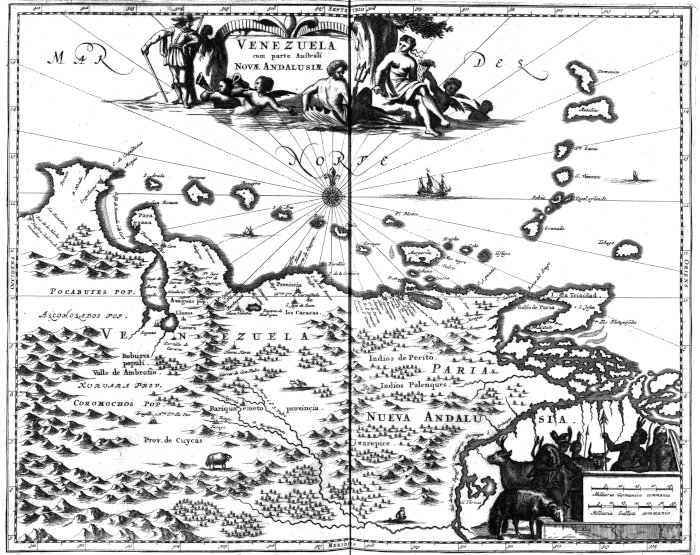
The Expedition of Alfinger and Sayltar to Venezuela.
Alfinger’s horrid Cruelties upon the Natives.
625When the Emperor Charles the Fifth Marry’d with Isabella, Daughter to the King of Portugal, Anno 1526. the Welsares, being Dutch Gentlemen in Augsburgh, made an Agreement with him for a Sum of Money, to Conquer Venezuela; whither they sent Ambrosius Alfinger, and Bartholomeus Sayltar, with four hundred Foot and eighty Horse: These Forces Landing at Venezuela, drove away Juan de Ampues, who Sailing from St. Domingo thither, had discover’d the Coast along Coriano, and already made an Agreement with a mighty Prince of that Countrey, call’d Manaure. But Alfinger marching to the Lake Maracabo, destroy’d all the Inhabitants of the Countrey Axaguas, though they came to meet him Dancing, with rich Presents of Gold; which he not regarding, kill’d them, drove some into a House, and there cut them in pieces, and burnt those that were got upon the Roof. From hence going towards the Pocabuyes, who dwelt on the West side of Maracabo, amongst high Mountains, he was Entertain’d by them a considerable time very courteously, and Presented with rich Gifts, for which at his departure he shut up both Men, Women, and Children, into a high Wall’d Park, where they were all to perish, if they did not every one pay a certain quantity of Gold to be releas’d, which not being able to raise, they all dy’d for want of Food. After the same manner he dealt with the neighboring People Alcoholados, of whom he got much Gold, but not without unheard of Cruelties, for he burnt all their Villages and Houses, ruin’d the Countrey with Fire and Sword from Thamaleque to the River Lebrixa, carry’d away many of the Natives coupled together with Chains about their Necks, and each of them loaded with at least a hundred pound weight of pillag’d Goods; and as soon as any of them began to faint under their Burthens for want of refreshment, their Heads were immediately cut off. But Alfinger coming to certain cold Mountains, was resisted by a valiant People; in which Conflict he receiv’d a Wound, of which he dy’d at his return to Coro, Anno 1532. Upon which the Welsares sent John Aleman to succeed him; but he also dying, made place for George de Espoira, and Nicholas Federman, of which two Espoira being the chief, spent three years in ranging up and down the Countrey, without any remarkable Transactions, being continually at variance with his Lieutenant Federman.
The afore-mention’d City Venezuela, otherwise call’d Caro, and by the Natives Corana, was, Anno 1559. taken and burnt by the English.
The Provinces Paragoana and Bariquicemeto.
Northward from the City, the Promontory St. Roman, in the Province of Paragoana, runs into the Sea, opposite to the Islands Aruba and Quuracao.
The Countrey Paragoana is low and full of Venison; out of the middle of it rises a high Mountain, the Inhabitants whereof are very hospitable and courteous.
The Lyons that breed in this Countrey run away from Men; but on the contrary, the Tygers are exceeding cruel.
From Coro there leads a Way up into the Countrey over the Mountain Xizaezaras, to the Province Bariquicemeto.
Between both these Provinces very fruitful Valleys, which produce Maiz in great abundance, are surrounded by wooddy Mountains, inhabited by Man-eaters, call’d Axaguas.
Segovia built by Juan de Villegas.
Anno 1552. Juan de Villegas discovering the Province Tucuyo, he found several rich Gold-Mines near the Mountain Pedro, out of which springs the River Burio. Near this place he built the Town Segovia, which, by reason of the unwholsom Air, was soon after transplanted, and built on the Shore of the River Bariquicemeto, so call’d, 626because the Water when touch’d, turns to an Ash-colour. The Plain Countrey round about would be intolerable hot, did not the cool Winds that blow from the Mountains temper the same.
The Natives of the Province Bariquicemeto, their manner of living.
The Natives divided into Tribes that understand not one another, live on Callibashes, Deers-flesh, Rabbets, and the Juice of the Cocuy.
In the Rivers Hacarigua and Boraute, they throw the stamp’d Root Barbasco, which causes the Fish to appear above the Water, and suffer themselves to be caught with the Hand.
In the Summer they all store themselves with Venison, which they catch after this manner: They set the dry Bushes and Brambles on fire, which makes the wild Hogs, Goats, Deer, Armadillo’s, Tygers, the great Serpents Bobas, and other wild Creatures, to leap forth from their Holes and Receptacles to shun the same, whilest the Hunters standing ready with their Bowes and Arrows, seldom miss one of them.
In the hollow Trees near the Rivers, the Bees make abundance of Honey for them.
Most of the Rivers here fall into the Stream Huriapari, which glides from the Peruvian Mountains to the Northern Ocean.
The Province Chioas produces plenty of Gold.
Also of the Natives about Segovia.
The Natives about Segovia go naked, are very ignorant, and much addicted to Drunkenness; in which humor they kill one another: They live without care, feeding on Roots till their Maiz is ripe, which in some places comes to its full maturity in forty days time, and in others in three Moneths.
Close by Segovia glides the Rivulet Claro, whose clear Water goes but a small Course from its Fountain Head, before it sinks into the Ground; in the Summer it is very high, and in the Winter almost destitute of Water.
The Commodities of the Countrey hereabouts.
This Countrey breeds all sorts of Fowls, but especially Quails and Turtle-Doves.
Cattel, Sheep, Goats and Hogs, increase wonderfully here, insomuch that many of them are driven to be sold at New Granada.
The Cotton-Clothes that are woven here, also turn to a good account.
From Segovia runs a Way through a Valley twelve Leagues long, to the Town Tucuyo, which stands low, but in a healthful Climate, and surrounded with Mountains.
The Countrey hereabouts produces plenty of Corn, Pot-herbs, Sugar, and Cotton; and feeds Oxen, Cowes, Horses, Sheep, Deer, and Goats, to which the Tygers and Lyons do great mischief.
Here are Gold-Mines, but they are not open’d by reason of the great want of Men.
There is likewise plenty of the Bezoar-Stones to be had here.
The Cuycas, in whose Countrey stands the Town Truxillo, are a valiant, but very cruel People.
The Lake Maracabo, running forty Leagues up into the Countrey, is ten Leagues broad, Ebbs and Flows, and feeds the great Fish Manati.
Westward dwell the Pocabuyes, and Alcoholados, both quiet and rich People.
The Province Xuruara.
The Province Xuruara lies towards the South behind high Mountains, inhabited by the valiant Coromochos; and towards the North from Xuruara, the Bobures, hard by the City Merida; the Countrey about which is unhealthful and Morassy, and the Inhabitants exceedingly plagu’d by the Muschito’s.
Havens of Venezuela.
The Haven Maracapana is the best in Venezuela, and lies in the Eastern part of the 627Province, where the Mountains are inhabited by the wild Chiugotos, who kill and eat all the Spaniards they can get.
The other Havens Westward, not comparable to Maracapana, are Flechado, Sardinas, and Burburute, where some Spanish Families have a Salt-pit.
Islands and Promontories.
Six Leagues up in the Countrey you come to the fresh Lake Tocarigua, full of little inhabited Isles; the People whereof live quietly, and barter Gold.
Towards the North-West the Ocean makes the great Inlet Triste, before which lies the Island Bonaire, very full of Cattel, and on each side appear the Aves and Quaraco, which abound with Fowl.
The Promontory St. Roman runs twenty Leagues into the Sea, and the Cape Coquibocoa extends farther. Between both these runs the Channel of Venezuela, which touches the Lake Maracapabo.
Before Coquibocoa are seen the four low Islands Monjes, with white sandy Creeks, and full of Trees: out of the middlemost rises a high Mountain.
On the Main Continent also the Mountains De Azieyto appear with scraggy tops beyond the Point: And the Bay Honda affords a safe Road.
The Cape De la Vela hath on one side the Inlet Portete, and on the other, the Villages Rancheria and Nostra Sennora de los Remedios; between both which runs the Stream La Hacha.
The German Commander, Nicholas Federman, intended to have built a City on Cape Vela, Anno 1535. but finding the Ground too low and unfruitful, the Pearls hereabouts very small, and the Natives living onely on Fish and wild Herbs, he chang’d his Resolution.
Sect. IV. The Islands Margareta, Cubagua, and Coche.
Notwithstanding we have already spoken something of the Islands Margareta, and Cubagua, in regard they are by some reckon’d amongst the Isles of Northern America; yet because they are by many accounted to make up a part of the Division of New Andalusia, we shall add in this place what we have found most worthy of Re-mention, though much to the same purpose as before.
The Island Margareta, discover’d by Christopher Columbus, Anno 1498. contains thirty two Leagues in circumference, hath many Woods and Pastures, yet little fresh Water. To the Eastward of it lie the Cliffs Testigos, where it is very mountainous, as also on the East. Round about the same are delicious Fish, without which the Natives could not live, because the brackish Soil produces but little Provision.
The Pearl-Fishing of Margareta.
The chiefest thing for which this Island Margareta is famous, is the Pearl-Fishing, for which in times past a great Trade was driven, though of late it is come to little or nothing. The Spaniards, with inhumane cruelty, taught the Negro’s to Dive for the Pearls, for those that were not nimble or dextrous enough, they beat unmercifully, dropt scalding Wax or scalding Oyl upon them, or stigmatiz’d them with hot Irons. The Pearl-Banks were cover’d with five, six, seven, or eight Fathom Water; from whence the Negro’s pull’d the Oysters with such force, that the Blood gush’d out of their Mouths and Noses when they came above Water to breath; after which, to refresh them, they receiv’d a Glass of Wine and a Pipe of Tobacco. The Spanish Kiay receiv’d a fifth part of the best Pearls that were taken here; but whether the Oysters have forsaken this Place, or 628their growth hinder’d by often Fishing for them, we know not, but however it is, few Pearls are found here of late years, which makes Margareta to be more and more deserted.
The Nature of the Island of Cubagua.
Between the Main Continent of Paria lie the Islands Cubagua and Coche; the first whereof hath an unfruitful and sultry Soil, without either Trees, Birds, and four-footed Beasts, except Pock-Wood, Sea-Fowls, or Parrots; and Castilian Hogs being carry’d thither, change their Nature strangely; for in a short time their Claws grow long and crooked.
The City Nova Cadiz built there, but at length totally deserted.
The King of Spain us’d formerly to receive fifteen thousand Ducats yearly for his fifth part of the Pearls that were taken; which Gain invited many thither, who built the Town Nova Cadiz on Cubagua in the Year 1521. but when the Arayans demolish’d the Monks Cloyster on Paria, the Spaniards, being three hundred in number, fled from Nova Cadiz to Hispaniola, where the High Court, displeas’d at their cowardly deserting the Place, gave them but cool Entertainment, and sent five Ships under the Command of Jacomo de Castellan to Cubagua, to build new Store-houses in Nova Cadiz, which was afterwards re-inhabited; but when the Pearl-Fishing ceased, the Island and Town was at once deserted.
Opposite to Margareta lies the Promontory Araya, behind which lies a salt Lake, in which is found abundance of Salt, not onely above, but under the Water; with which the English, Spanish, and Dutch Ships are fraighted.
Du Verne’s Description of the Salt-pans on Araya.
Isaac du Verne describes the Salt-pans on Araya thus: “Round about the same (saith he) the Ground is craggy, barren, and of a brackish taste, and destitute of fresh Water, which is therefore fetch’d three Leagues farther out of a Brook, flowing from the Mountain Bordones into the Bay of Comena; likewise all manner of Provisions are brought from other Parts. Westward from the Point Araya there is a convenient Harbor where the Ships take in their Salt. Three hundred Paces from the Shore lies a great Salt-pan, where the Salt being first beat in pieces, is carry’d in Wheel-barrows to the Ships. The little Salt-pan produces less Salt, and lies also out of the way, which makes few Ships take in their Lading from thence.”
The Countrey is every where overgrown with Brambles and Bushes, in which breed Tygers and very poysonous Serpents. There are likewise abundance of Stags, Bucks, Hares, and Coneys, besides other strange Beasts.
The Netherlanders beaten out of their Salt-Trade here by the Spaniards.
Till Anno 1605. the Netherlanders came hither unmolested for Salt, when eight Spanish Gallions falling unawares upon them, strangely misus’d their Seamen; but afterwards the United Netherlands having made an Agreement with Spain for a certain time, renew’d their Trade to Araya, till the King of Spain, having for the better security of the Place, built the Fort St. Jago, which Commanded the great Salt-pan, forbad the Netherlanders from lading any more Salt; who thereupon Storm’d the Fort, though to their cost, for several of them were kill’d, and the rest return’d home empty.
Sect. V. Of the Islands of Southern America.
The chiefest islands of note in the Southern part of America, that is to say, those that lie remote from the Continent in Mare del Zur, are Los Ladrones, and the Islands Fernandinas; for the rest being, as we may call them, Mediterranean Islands, fall naturally under the Description of the Continent.
The Isles Los Ladrones.
6291. Los Ladrones, in English, The Islands of Thieves, lie as it were in the mid-way betwixt the Main Land of America and the Philippine Islands, but some hundreds of Leagues distant from either, in the fourth Degree of Northern Latitude; so nam’d by Ferdinand Magellan, from the pilfering disposition he observ’d in the Natives, when he Sail’d that way for the Moluccæ Islands. They were a nimble and active sort of People, yet light-finger’d, tall of stature, and going for the most part naked, excellent Swimmers and Divers, and have not much more to be said in their commendation.