The Third Book, CONTAINING A DESCRIPTION OF PERUANA OR, Southern America. (continued 4)
Reading edition
The Miracle of an Augustine Monk.
The Augustine Monks are believ’d to have wrought also another Miracle in the Province Conchucos, upon this occasion: A Conjurer call’d Chaumango, boasted himself to be God, deny’d our Saviour, in testimony whereof he gave out that he would kick a Mountain to pieces, with his Foot; which Report spreading all over the Countrey, all the adjacent People flock’d to see this strange Wonder on an appointed Day, on which Charimango being, it seems, as good as his word, and kicking the Mountain, caus’d it to rent from the top to the bottom, and the pieces to flie all about the People, who were exceedingly amaz’d; but the Sorcerer upon the Augustine Monk’s rebuking him was (as they affirm) immediately eaten up with Worms.
471Many other Stories of Miracles go currant amongst them, as of Marco Garcia and Didaco Ortez driving the Devil from a white Stone which hung over a Fountain in Chiquipalpa, and several others, but it would be very impertinent to dwell too long upon Discourses of this nature, especially since we are not oblig’d to make them a part of our Creed.
To conclude our Description of this famous Kingdom of Peru, the People thereof at the Spaniards first Arrival viewing their Shipping, their Guns, and other Accoutrements, unknown to them before, had them in great admiration, as Men descended from Heaven; but when they began to be oppress’d by their Tyranny, and to be tortur’d by them, they look’d upon them as the Spawn of Hell, and curs’d the Sea that had brought so wicked a People to them.

CHAP. V. Chile.
Situation and Description of Chile.
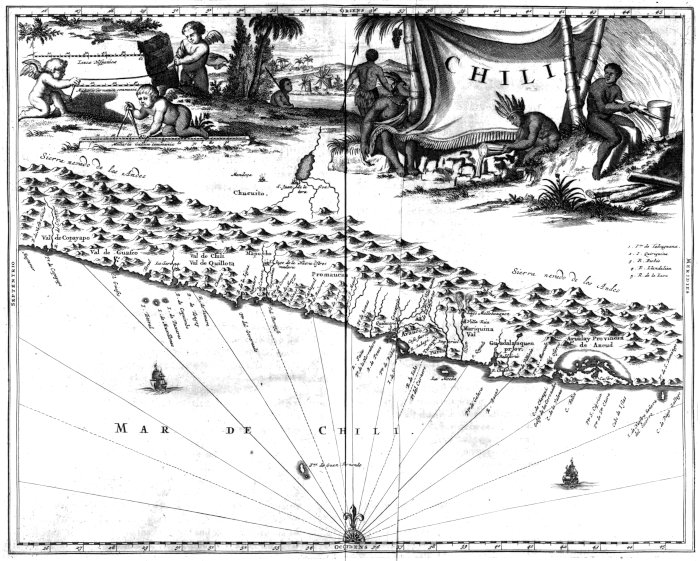
Following the Coast of Mare del Zur, or the South Sea, the next great Province pertaining formerly to the Kingdom of Peru, is that of Chile. This is the most Southerly Province of the whole Countrey of America, reaching up as far as the Magellane Straights, with which to the Southward it is bounded; Northward it hath a Desart, and an undiscover’d Countrey lying betwixt it and the Confines of Peru, call’d Atacama; on the West it hath Mare del Zur; and on the East, up to Rio de la Plata, the Atlantick, or North Sea, with some Countreys undiscover’d, which interpose betwixt it and Paraguay to the North-East: It lieth all of it beyond the Tropick of Capricorn, in a temperate Zone, and extendeth it self in length from the Borders of Peru, to the Mouth of the Straights five hundred Leagues or more; but the breadth of it neither equal nor certain: They say ’tis call’d Chile from the word Chil, which signifies Cold it seems in their Language as well as ours, it being generally a cold and bleak Countrey, the Air in many parts of it so extreamly sharp and piercing, that both Horse and Rider sometimes in travelling are frozen to death, as the Spaniards found by experience in their first Search and Discovery of the Countrey, under the Conduct of Diego Almagro, who is said to have left the greatest part of his Men dead behind him: But this is chiefly towards the Andes, and on the Sea-Coast, the more Inland parts of it, though mountainous also in some parts, yet are more temperate, and being also well water’d with Rivers, are much more fruitfull than the other, affording both Wheat and Maiz, and likewise other Grain, excellent Pasturage in many places, and great store of Cattel, Wine, Honey, and not without many and rich Mines both of Gold and Silver.
Pedro Baldivia taken Prisoner and put to death by the Arucans.
The Natives of this Countrey were found to be the most stout and warlike of all the Americans that the Spaniards had hitherto met withal, fighting with them, and oftentimes defeating them in the open Field, surprizing and sacking their Towns, and last of all taking their Captain and Commander in Chief Prisoner: This was Pedro Baldivia, one of those good Men that consented to the death of Attabaliba, the last King of Peru, after a greater Ransom accepted and paid, then perhaps the King of Spain could well raise on a sudden, if he had occasion to use it for himself. The Arucans (for so are the People call’d that had him Prisoner) are said to have Entertain’d him for a while with great Jollity and Feasting, but for his last Draught gave him a Cup of melted Gold, which the poor Man was forc’d to take down, and so died a cruel, though costly Death.
472The whole Province generally is divided first into Chile, specially so call’d, and secondly Magellanica, or that part which lieth more Southward down to the Straights of Magellan.
Sect. II. Chile, properly so call’d.
The Bounds of Chile specially so call’d.
Chile, specially so call’d, is border’d Northward with the Desart and barren Countrey of Atacama above mention’d; on the South, with Magellanica; on the West, with Mare del Zur; Eastward, and to the North-East, with some parts of Paraguay, or rather with some undiscover’d Countreys lying betwixt them both: The length of it from North to South is reckon’d to be little less than three hundred Leagues, and generally of a fruitful Soil, affording besides abundance of Gold and Silver, both Corn, Cattel, Vineyards, and divers sorts of Fruits, equal both for kind and plenty to Spain it self, and sundry other parts of Europe. The Air likewise temperate, and the People in their Manners and Conditions come much nearer to the Civility, and likewise subtilty of the Europeans, than other Americans did; which doubtless may be attributed to the conformity of the Climates under which they lie, agreeable to those of Europe; though otherwise in respect of the Sphere and Seasons of the Year, there be a diametrical difference betwixt us; As for Example, their Spring beginning in September, which is our Autumn, and their Autumn in March, which is our Spring; their longest Day being that of St. Lucy, on the eleventh of December, which is our shortest; and their shortest being St. Barnabas, viz. the eleventh of June, which is our longest, &c.
Towns and Places of Importance.
The Towns of chiefest note and importance in this Province, are 1. Gopiapo, an old Town in the most Northerly parts of this Province towards the Sea, where it hath a very commodious Haven belonging to it.
2. La Serena, a Town situate on the Banks of Coquimbo, a pleasant River a little above its Influx into the Sea, built by Baldivia in the Year 1544. the Countrey about very rich in Mines of Gold, and the Town it self so well Garrison’d for fear of the Natives, that when the English under Sir Francis Drake, about fourscore years since, attempted the gaining of the Place, they found hot Service of it, being stoutly resisted and beaten back again to their Ships, by a Sally of no less than three hundred good Horse and two hundred Foot.
3. St. Jago, the principal Town of the Province, a Bishop’s See, and the ordinary Residence of the Governor, lying on the Banks of the River Tapocalma, in the thirty fourth Degree of Southern Latitude, fifteen Leagues distant from the South Sea, at which it hath a very commodious and much frequented Haven, which they call Valparayso, and where the English met with better fortune, as hath been said already in the report of Sir Francis Drake’s Voyage.
4. La Conception, a strong Town, seated on the Bay call’d Penco, sixty or seventy Leagues distant from St. Jago towards the South, a Place not a little fortifi’d both by Nature and Art, having the Bay and a certain Ridge of high Mountains begirting it almost round about; and where it is otherwise accessible, a Castle, and certain Bulwarks with Ordnance, besides a Garrison of five hundred Soldiers at least continually in it, and all little enough to defend it against the Araucanes, their deadly Enemies, who live thereabouts, and are ever and anon making Incursions almost up to the Walls of it. Over against this Place in Mare del Zur, but very near the Shore, there lieth a certain Island call’d St. Maries, exceeding plentiful in Swine and all sorts of Poultrey, which the Garrison of La Conception make good use of.
4735. Los Confines, a Fronteer Town, built by the aforesaid Baldivia, for defence of the rich Mines of Gold at Angol, a Place near adjoyning.
6. La Imperiale, another strong Garrison of this Place on the Banks of the River Cauten, near to which that great Battel was fought, where Baldivia, with divers other Soldiers, were taken Prisoners, who were no otherwise overcome, but by being over-wearied with killing of their Enemies, and by that means not able to make their Retreat.
7. Villarica, another Colony of the Spaniards in these Parts, sixteen Leagues distant from Imperiale, and twenty five from the Sea.
8. Baldivia, so nam’d from the Commander Pedro Baldivia, who built it in the Valley of Guadallanquen, two or three Leagues distant from the Sea, where it hath a good and capacious Port; but nearer to it the best Mines of Peru, so rich, that ’tis said they yielded Baldivia every day so long as he could enjoy them, twenty five thousand Crowns.
9. Osorno, a Town lying in the Bay of Chilue in a barren Soil, but otherwise neither less rich, nor less populous than Baldivia it self.
These three last mention’d Towns, viz. Baldivia, Imperiale, and Osorno, were in the Years 1596, 1699, and 1604, surpriz’d by the Araucanes, and other Salvages confederate with them, sack’d and burnt; and though the Spaniards be said to have recover’d and Garrison’d some of them with fresh Soldiers, yet how long they were able to hold them, or whether they be Masters of them at this day, we cannot say.
10. Castro, the most Southerly Town of the whole Province, built on a certain Island within the Bay of Chilue.
11. Mendoza; and 12. St. Juan de la Frontera, both which lie towards Paraguay and Rio de la Plata, but on the other side of the Andes, forty Leagues distant from any of those we have spoken of, and perhaps more, not above a hundred from Buenos Ayres, and the Atlantick Ocean.
Sect. III. Magellanica.
Situation and Description of Magellanica.
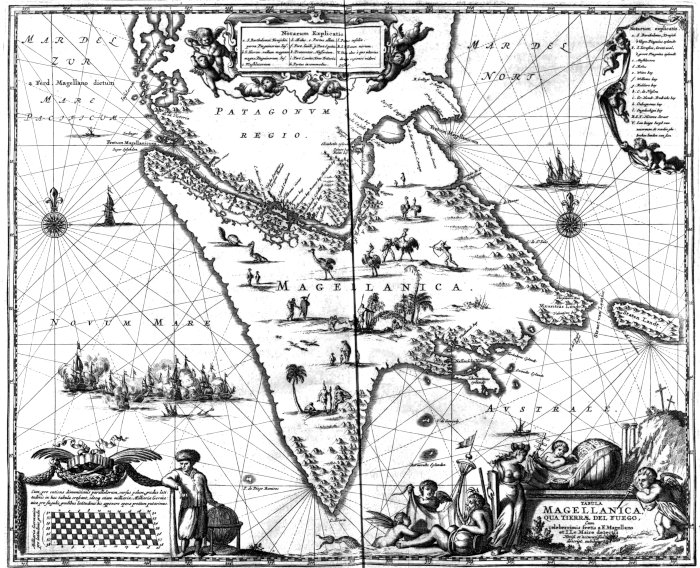
Magellanica, the other part of this Province, is bounded Northward, with Sea-Port, Towns, Isles, and Straights. Chile abovesaid, and some parts of the Countrey De la Plata; on the South, with the narrow Sea call’d Magellans Straights; having Mare del Zur on the West, and on the East the Atlantick Ocean. It contains in length from the Borders of Chile to the Mouth of the Straights, a hundred Leagues, and in breadth from the North to the South Sea, somewhat more, viz. towards Chile and the North-West parts of it, for towards the South and South-West it straitens still more and more, insomuch that they who resemble the Southern part of America to the form of a Pyramid revers’d, make this part of the Countrey to be the Spire or top thereof. It beareth the Name from Ferdinand Magellan, a Portuguese, who first discover’d that narrow Sea, so famously known by the Name of Magellans Straights. It is a large Countrey, and suppos’d not to be altogether barren of Metals; but as yet no great Discovery hath been made of it, partly by reason of the excessive Cold to which ’tis thought to be subject, and partly perhaps by reason of the difficulty of the Enterprize, it being so far remote, and very hardly passable in many places, by reason of the huge Mountains the Andes, which bar it as it were against all Adventurers; but chiefly by reason of the stoutness and untameableness of the Araucanes 474and other Natives of Chile, through whose Countrey the March lieth, and who must first be conquer’d, so that very little can be said more of this Countrey, than onely to name the Ports and Places upon the Sea-Coasts, at which the Spaniards, and likewise some other Nations at several times have touched, the chief whereof upon the South Sea are, 1. Cabo de las Islas, a Promontory or Foreland, twenty six Leagues distant from that of St. Felix on the Confines of Chile.
2. Puerto de San Stephano, fifty Leagues from that, towards the South.
3. La Villa de Nuestra Sennora, or Our Ladies Dale, a large and secure Bay, eighteen Leagues Southward of St. Stephens.
4. La Punta Deglada; 5. Puerto de los Reyos; and 6. Ancona Sin Salida, all of them opening towards the Straights. There is also at the opening of the Straights, Cabo de la Vittoria, Cabo Desseado, and some others.
Upon the North Sea, and up towards Rio de la Plata, the chief Places observable, are 1. Rio de la Crux, and the Cape which they call De las Rameras, about thirty Leagues distant from the Straights Mouth.
2. The Bay of St. Julian, forty Leagues Northward of the former.
3. El Puerto Desseado; 4. Puerto de los Leones; 5. The Bay of Anegada, all of them good and capacious Havens for the security of Shipping upon these Coasts, and lying at a distance of thirty or forty Leagues one from another, up towards Rio de la Plata, and the Countrey of Paraguay, of which we are next to speak.
Description of the Magellan Straights.
As for the Straights themselves, so much spoken of, and likewise so necessary to be known by those who frequent these parts of the World, they are a narrow Sea or Frith, by which the Atlantick Ocean, or rather some parts of it, doth fall into Mare de Zur, or the South Sea: the Passage is long, running, as ’tis commonly suppos’d, well nigh a hundred Leagues together, almost in a paralel Line, or in the same Degree of Latitude from one end to the other; and likewise extreamly difficult by reason of the many windings and turnings of the Sea, which force them to be ever and anon altering of their Course, and a mountainous high Countrey on both sides of it, from whence it is almost continually beaten with Storms, both dangerous and terrible: They were first discover’d by Ferdinand Magellan, by Nation a Portuguese, but in the Service of the King of Spain, and by him nam’d Magellan’s Straights; who although himself liv’d not to return into Spain, being slain in the Conquest of the Molucca Islands, yet his Companions did, in the Ship call’d Vittoria, from whence the Cape De la Vittoria abovesaid took its Name. The Mouth or Entrance of them, by the Atlantick Ocean, lies in fifty two Degrees of Southern Latitude, and hath not above fifty three and some Minutes at the Exit or opening into the South Sea.
The Straights of Le Maire.
There is likewise since this, and but of late times, viz. about the Year 1615. another Straight discover’d by the Dutch, and call’d from the Discoverer Fretum Mairi, or The Straights of le Maire, four or five Degrees more to the Southward than those of Magellan, and suppos’d to be a much earlier and safer Passage.
The Intention by the discovery of these Straights, was to have found a shorter Way to the East-Indies and the Kingdoms of Cathay and China, than that which was then onely us’d, viz. by the Cape de Buena Speranza, and the Coast of Africk, but by reason of the great difficulty, as ’tis to be suppos’d, and uncertainty of the Passage, neither the one nor the other is much frequented, the Spaniards for the most part serving themselves of their American Ports upon the South Sea, from whence they make their Voyages and Returns to and from the other Indies, and from thence home to Spain; and the English, with other Nations of Europe, Trading still by the Coast of Africk and Cape of Good Hope, or else by the way of Alexandria and the Persian Gulf, as heretofore.
475

CHAP. VI. Paraguay, or Rio de la Plata.
We have seen in Magellanica the farthest, that is, the most Southerly part of the New World, and before it in order all the Western Coasts of America that lie either upon or towards Mare del Zur, viz., from Panama, the first Province of this Southern part down as far as the Straights. We are now to return and take a view of the Eastern Coasts, and those Countreys which lie upon the Atlantick Ocean, steering our Course henceforth Northward, not directly, but as the Coast leads us for a while Eastward and by North, forasmuch as the Land of America, from the Straights of Magellan up as far as Brasile, and almost to the Æquator, runneth out with a long Point, little less than three thousand Leagues together.
Situation and Description of Paraguay, or Rio de la Plata.
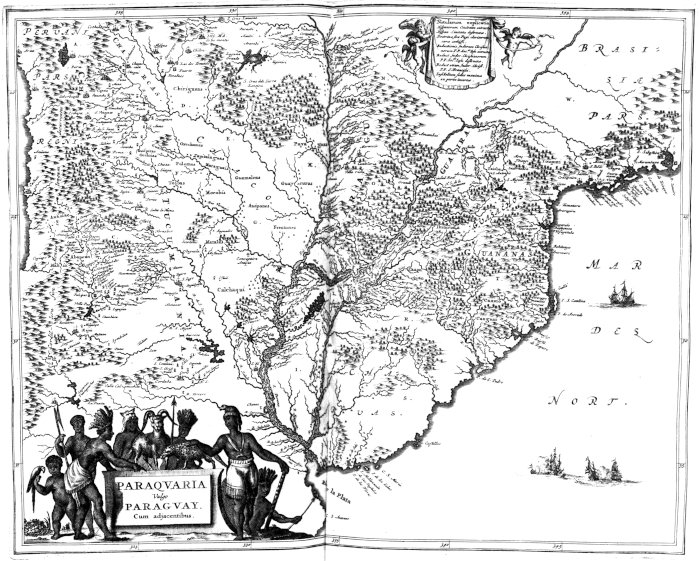
The first Province we meet with on this side next to Magellanica, is the Countrey of Paraguay, oftentimes call’d Rio de la Plata, from the Name of an huge River, which runneth for the most part through the midst of it: It is border’d, as we said, to the South and towards the Straights with Magellanica; on the East, with the Atlantick Ocean; more Northward, or to the North-East, it hath Brasile; and on the West those undiscover’d Countreys of the Province of Chile, of which we have spoken.
The Countrey on both sides the River is reported to be a very lusty and fruitful Soil, bearing besides those which are proper and native, all sorts of European Fruits and Grain in great abundance, with Sugar-Canes, both large and good, as any other Province of the New World. Nor is it excell’d by any other for good Pasturage and great Herds of Cattel, Sheep, and Swine; in particular, Horses are said to have multiply’d so here, that of thirty Mares, and about six or seven Stallions, which the Spaniards left there, in forty years the whole Countrey thereabouts was fill’d with the Breed of them, running wild in great Companies together, through all the Woods and Forrests of the Countrey, and being of excellent Mettle and Service if they could be tam’d. It affordeth likewise great store of wild Deer and Stags, some Lyons, Tygers, &c. nor is it without good Mines, some both of Gold and Silver; but chiefly, as to what is yet discover’d, of Brass, and Iron; and the People altogether salvage.
The River De la Plata.
The River De la Plata, which (as we said before) divides this Countrey, is one of the largest of the whole World, rising, as ’tis suppos’d, out of the Lake call’d De los Xarayes, three hundred Leagues or more within Land, and falling into the Atlantick Ocean, or North Sea, in thirty four Degrees of Southern Latitude, with an Estuary or Mouth of thirty, or two and thirty Leagues over.
The whole Countrey is usually subdivided into three inferior Provinces, which are 1. Rio de la Plata properly so call’d. 2. Tucuman. 3. La Crux de Sierra.
476
Sect. II. Rio de la Plata, properly so call’d.
Situation of Rio de la Plata, properly so call’d.
Rio de la Plata, properly so call’d, is that part of the Countrey which extendeth it self on both sides the River, in length many Leagues together, but not answerable in breadth.
Towns and Places of note.
The chiefest Towns of note in this Province, are 1. Buenos Ayres, by some call’d La Trinidad, on the Southern Banks of the River De la Plata, sixty four Leagues, as they say, from the Mouth of it: It is seated commodiously at the foot of a little Mountain, and fortifi’d with a Mud-Wall, a little Castle, and some Pieces of Ordnance.
2. San Fe, in English St. Faiths, fifty Leagues above Buenos Ayres, upon the same River, and a richer Place, chiefly by reason of their Cloth, of which there is here one of the greatest Manufactures of all these parts of Peru.
3. Nuestra Sennora de la Assumption, commonly call’d Assumption onely, lying yet higher up the River almost a hundred Leagues, a well built and well frequented Town, long since inhabited by two hundred Families at least of natural Spaniards, besides Mestizos, as they call them, which are the Breed of Spaniards by the American People, Men or Women, and Mulattos, which are likewise their Race, but begotten upon Negro’s, of both which there are reckon’d to be here some thousands.
4. La Cividad Real, or more commonly call’d Ontiveros, fourscore Leagues Northward from Assumption, seated on the Banks of the River Parana in a fruitful Soil, as the Countrey generally is about all these Places; but the Air hereabouts is not so healthful.
5. St. Anne, upon the same River; and 6. St. Salvador.
Sect. III. Tucuman.
Situation of Tucuman.
Westward of La Plata lieth the Countrey of Tucuman, extending it self as far as the Borders of Chile, a Countrey not yet well discover’d either to the North or the South. That part of it which lieth towards Chile is well Manur’d and Husbanded, and likewise very fruitful; but that towards Magellanica, neither the one, nor the other, remaining altogether untill’d and barren.
Towns and chief Places of note.
The chief Towns and Places of note, are 1. St. Jago de Esteco, the principal Town of the Province, and a Bishop’s See, seated upon the River Esteco, a hundred and fourscore Leagues distant from Buenos Ayres.
2. St. Michael de Tucuman, seated at the foot of a huge rocky Mountain, but otherwise in a Soil the fruitfullest and best, both for Corn and Pasturage, in all this Countrey, twenty eight Leagues distant from St. Jago.
3. Talavera, or Nuestra Sennora de Talavera, as the Spaniards call it, situate upon the Banks of Salado, in a good Soil, and inhabited by an industrious People, grown exceeding rich and wealthy, chiefly by their Manufactures of Cotton-Wooll, whereof they have great plenty, and by which they drive a Trade as far as the Mines at Potosi, and other parts of Peru.
4774. Corduba, another rich Town of this Province, and of great Trade, as lying at an equal distance, viz. of fifty Leagues, both From San Fe, as they call it, or St. Faiths in the Province of La Plata abovesaid, and from St. Juan de la Frontera in the Country of Chile, and almost in the Road-way from Potosi and those parts of Peru, to Buenos Ayres and the North Sea.
5. Chocinoca; 6. Sococha; 7. Calebinda; 8. Morata, and others, but belonging for the most part to the reduced Natives.
Sect. IV. La Crux de Sierra.
Situation of La Crux de Sierra.
La Crux de Sierra is a little Territory (at least in comparison to some others) lying towards Peru, and reckon’d by some for one of the Provinces of Peru: It lieth betwixt the two great Rivers Paraguay and Guapay, a hundred Leagues distant, as ’tis said, from Charcas, to which yet in some Causes it is subordinate.
The Soil of this Countrey is abundantly fertile in all sorts of American Fruits, besides good plenty both of Wheat and Maiz, and scarsity of nothing useful for Man’s Life, unless it be fresh Water in some places.
Chief Towns of this Province.
The chief Towns of this Province, are 1. San Crux, situate at the foot of a great Mountain or Hill, but opening upon a large Plain, whose thirsty driness is well refresh’d by a certain Brook or Torrent, which issueth out of a neighboring Mountain, and a few Leagues distant from the Town maketh a pretty Lake, which supplieth the Countrey thereabouts, both with fresh Water and Fish in good plenty.
2. Barranea, a Town suppos’d to be not above threescore Leagues distant from Potosi.
3. Nova Rioia, once a Colony of Spaniards, but sack’d and spoil’d by the Salvages of these Parts about the Year 1548. and the first Discoverer of the Countrey, namely Nunno de Chaves, treacherously murder’d by a Native, since which time ’tis said to have been deserted.

CHAP. VII. Brasile.
Situation and Description of Brasile.
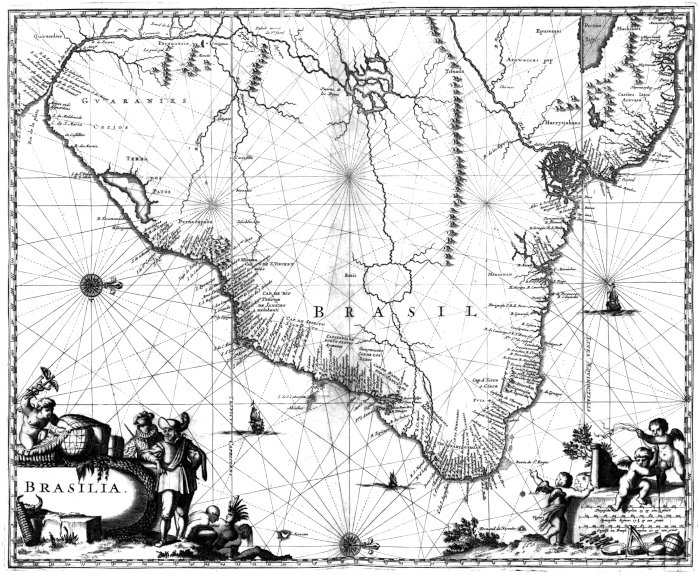
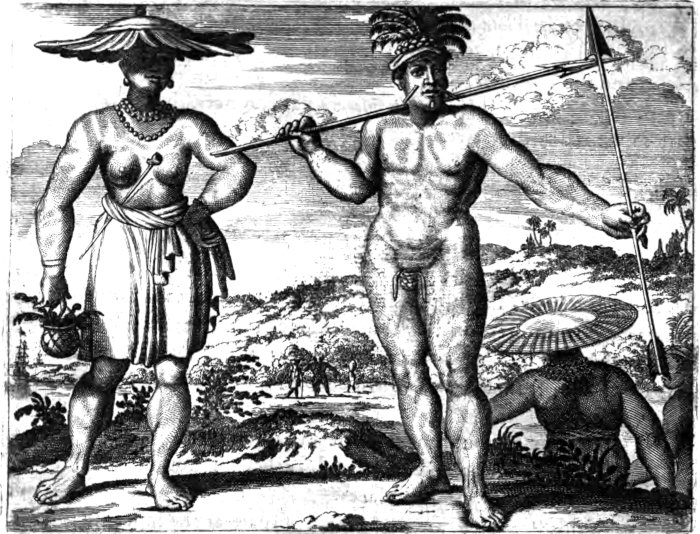
Brasile by Capralis call’d San Cruz, because it was discover’d on the Day dedicated Pedro Alvarez Capralis his Expedition to Brasile. to the holy Cross, but generally Brasile, from the red Wood, which it produces in great abundance, extends, according to the Account of the Portuguese, between the Rivers Maranon and De la Plata: But according to the Division which Pope Alexander the Sixth made upon the Approbation of the Kings of Castile and Portuguese, Brasile extends not so far; for it begins in the North along the Stream Para, and ends at the River Capybora, two Leagues beyond the Town St. Vincent: Eastward it is wash’d by the Northern Ocean, and on the West separated from Peru by desolate Mountains: It lies between 4 and 22 Degrees of Southern Latitude. Historiographers differ much concerning the first Discoverer; but without contradiction the first honor belongs justly to Americus Vesputius, who being sent out by Ferdinand, King of Castile, in the Year 1497. arriv’d first with four Sail 478at Brasile; whither he was follow’d two years after by Vincent Aynez Pinzon, Associate to Christopher Columbus; but with ill success, for two of the Ships were cast away in a Storm, and the other two return’d sadly weather-beaten into the Spanish Haven Palos, yet not before he had made a farther Discovery of Brasile than Americus Vesputius; which so stirr’d up Emanuel, King of Portugal, that he sent Pedro Alvarez Capralis thither with five hundred Men in thirteen Ships, that so he might get sure footing on Brasile; where Landing he erected a Stone Cross, and inform’d the King of his whole Proceedings by Gasper Lemnius, with whom he sent over two Brasilians, a Man a Woman, the strangeness of whose Garb caus’d great admiration in Portugal amongst the Spectators: the Man, having a flat Nose, went stark naked, and in his nether Lip hung a Stone call’d Matara; through each Check there was stuck a piece of Brasile Wood, on his Shoulders he carry’d three long Darts, and on his Head he wore divers colour’d Feathers; the Hair about his Privities was all pluckt out, and his Membrum Virile ty’d about with a String call’d Tacoaynhaa, which he unty’d when he Urin’d; his Body was strong and well proportion’d, and painted with several Colours. The Woman wore a Lappet girt about her Middle, in which Girdle stuck a Cane Tobacco-pipe; the Lappet reach’d just to the top of her Knees, the rest of her Body was also naked; on her Head she wore a broad Hat made of Feathers, on the top of which stuck two Plumes; in her Ears hung Bells, and about her Neck three Strings of Pearl; and her Body was also painted with red and yellow Colours. Lemnius also gave so much Information concerning the fruitfulness of Brasile, that several Portuguese Families went thither, accompanied with some Italian Fryers, which scattering up and down, began to build several Villages, but were soon after most of them kill’d and eaten up by the Indians.
Anno 1549. King John the Third fitted out a great Fleet, which set Sail from Lisbon under the Command of Thomas de Sosa.
Jesuits sent to Brasile by Pope Paulus the Third and Ignatius.
Also the Jesuits Aspilcueta, Antonio Pireo, Leonardo Nonno, Didaco Jacobo, Vincent Roderico, and Emanuel Robrega, were sent thither by Pope Paulus the Third, and Ignatius Loyola, whose Fleet came to an Anchor in the Bay afterwards call’d Bahia de Todos 479Sanctos, where Sosa built the City Salvador; since which the Portuguese have spread themselves farther and farther over Brasile.
Temperature of the Climate.
The United Netherlands also sent Colonies thither with good success, for they took several vast Countreys from the Portuguese, by force of Arms, and built new Forts and Towns in several places. But we will first give you a general Description of it, that so we may the better render a Relation in particular of every Province thereof, it being a considerable part of the New World, and both pleasant and fruitful, and the Sea-Coasts refresh’d by Easterly Winds, which begin before Day-break, when the North Sea ebbs or flows, for then the Wind rises with the Sun, and continues till Mid-night: Towards the West, where the Mountains divide Brasile from Peru, it is made temperate by Westerly Winds, which though judg’d unwholsom, because they seem to arise out of the Moorish Grounds, yet they hurt not the Inhabitants along that Coast, because they either break against the high Mountains, or are driven by the strong Wind which blows from the Sea.
The difference between Summer and Winter, shorter and longer Days, in the main part of Brasile, is scarce discernable, warm Weather lasting all the year round; and for the length of the Day and Night, the Sun being hid under the Horizon twelve hours, shines for the most part just as long, the greatest difference never being above an hour. Three hours before Day-break the Dew makes it exceeding cold till Sun-rising; wherefore the Brasilians make Fires in the Night near their Hammocks, not onely to keep wild Beasts from them, but also against the Cold. After the coldest Nights follow the fairest Days, and the contrary after sultry Nights; nevertheless (except in the rainy Season, which begins with March and ends about August) the Skye is generally clear, yet it Lightens much towards the Evening. Rainbowes often appear in the Skye, and bout the Moon Halos. The Rain generally falls in great Drops, and with a mighty noise; before which it is generally very sultry hot, or else soon after. The Dew, which is fruitfuller than in Europe, is saltish, which makes it oft to rot things that lie in the open Air. During the rainy Moneths, a South-East Winds blows from a cloudy Skye, much stronger than the Northern in Summer. The South-East Wind drives the Stream to the North, as the North Wind drives it to the South: And more than this, there is little to be discern’d of the Seas ebbing and flowing hereabouts: At the highest Tides the Brasilians go several Leagues from the Shore to Fish, upon Planks made of the spungy Wood call’d Jangada fastned together. The Sea, which seems to burn in the Night, is so clear in the Day, that the Fish may be seen to swim above twenty Fathom deep. A calm Ocean when the Days and Nights are of an exact length, and especially when dark Clouds appear, is a certain sign of a dreadful Storm. At Full or New-Moon the Sea rises twelve Foot, and continues either a longer or shorter time, according as it is more or less turbulent, and the Rivers fall stronger or more gently into the same.
Before most part of the Coast of Brasile lies a Stone Cliff of above twenty or thirty Paces broad, which is never cover’d with Water, though in the time of Spring-floods. In this Cliff Nature in several places hath made a Gap, through which the Ships sail near the Shore, and ride safe at an Anchor.
The whole Countrey of Brasile is divided into thirteen Præfectures, or Lordships, and hath about as many Rivers, which more or less empty themselves into every one of these Countreys. The Eastern part hath several Brooks and Fountains, which afford good Water both for Man and Beast. In some parts the Water is so strong, that the wild Beasts making themselves Drunk therewith, are easily taken. During the Winter Season the Rivers glide with great force, and swell on a 480sudden, overflowing all the neighboring Countrey, onely the River San Francisco runs strongest and rises highest in the Summer Season, whenas in the Winter it flows low, and poures but little Water into the Ocean. The original of this River is as yet unknown, yet is by most believ’d to come out of a great Lake lying near the Peruvian Mountains: The Hollanders, who sail’d forty Leagues up the same, found it every where broad and deep, and scatter’d full of Isles and Rocks. The Portuguese sailing ten Leagues farther, discover’d the great Rocks Cocoeras, from which the said River falls down with great violence, and extends it self North-West. In the other Brasilian Streams, though wide at the Mouthes, which generally are not above two or three hours walking from their Fountains or Springs, no Barque is able to Row up, they being exceeding shallow, although much Rain falls into them; the reason whereof is because the barren Mountains lying between Brasile and Peru, discharge abundance of Water through the Rivers of Amazones, Maranon, Francisco, La Plata, and the Juaeiro, with such force into the Ocean, that they keep their sweetness for thirty Leagues. Near the Sea side are several Lakes and Pits which are drinkable, and others up in the Countrey that are brackish.
The Nature of the Soil.
The Countrey differs exceedingly, for where it extends in Plains the Soil is fat and clayie, and produces all sorts of Fruit, but especially Sugar-Canes. During the rainy Seasons the Trees flourish most; after which the heat of the Sun, and fertility of the Soil speedily ripen the Fruit: wherefore they Dung not their Land, but on the contrary endeavor to make it lean with Sand, that the Plants might not have too many Leaves, and wither before the Fruit can be ripened. They Sowe in the beginning of the rainy Moneths, and especially take care that the Seed lie not too deep in the Ground, because then the Sun-beams being not able to come at it, suffer it to perish in the cold Ground.
The high Cocoa and Palmito-Trees, are transplanted all the year round, the Roots being onely cover’d with a little Earth, because they can endure no cold.
Several Trees here bear a cooling Fruit, as if kind Nature took care to provide against excessive heat.
Description of the Tamanda.
All manner of Plants and Herbs brought hither from Angola, Portugal, the Netherlands, and the East-Indies, grow here very plentifully. But the Countrey generally would be much better, if some way could be found out to destroy the innumerable company of Pismires, which though three times bigger than the European, resemble them very much, and cover the Paths in Woods and Fields for three or four Miles together; and raising Hillocks, make them hollow, and fill them with Corn: in the Full of the Moon they gather an incredible quantity of Grain, which they bite at each end, because it should not sprout: against the rainy Moneths they stop up their Holes, that the Water may not damnifie their Store. But these Animals have a mortal Enemy of the Tamanda, of which there are two sorts, the bigger call’d Guaca; the lesser Miri; the Guaca, notwithstanding it is no bigger than an ordinary Dog, yet it destroys Tygers, and other wild Beasts, with such a raging fury, that it never lets go what once it hath got hold of, but holds it fast so long till sometimes it dies of Hunger. The Guaca differing from the Miri onely in bigness, hath a broad Tail full of grey and black Bristles, which sticks up when he is vex’d, but when he goes to sleep, covers himself with the same. The Miri winds his long smooth Tail about the Boughs, by which hanging he searches the Holes in the Trees with his Tongue, which being thin and round, hath a Gutter in the middle, in which when it feels any Pismires, it suddenly swallows them down: If he perceives them to have their Nests under Ground, then he scratches up the Earth, and 481puts his Tongue in at the Holes. Both the Guaca and Miri have a thick Skin, and a broad black Streak from their Breasts on each side up half way their Bodies, and through the black runs also a white Streak. No Beast in the World is hardier than this, for though it fasts twelve days, and is afterwards flay’d alive, yet it will live several hours after.
The Plant Manyle.
Description of the Tree Ibriptanga.
The Tree Tatai-iba.
The Lakes in Brasile are for the most part overgrown with Weeds just like a Field, yet are exceeding full of Fish and Fowl. Where the Sea runs into the Lakes, great multitudes of Crabs are seen crawling along the Ground, and the Oysters hang in Clusters on the Boughs of a Plant call’d Manyle or Mangues, which grow with their Roots either near or in the Water, in such a manner, that new Bodies still shoot from the old Roots, which prevents easie access to the chief Plant, on whose uppermost Leaves after Sun-rising sticks very white Salt, which in the Night, or in a cloudy Day turns to a brackish Dew. Moreover, those places where Brasile rises with Hills and Mountains, are likewise very fruitful, except the barren tops of some, which seem to kiss the Skyes; and though the fruitful Mountains flourish in the time of the rainy Months, yet many of the Trees which grow on them die in Summer, and their Ashes being burnt by the Inhabitants, are us’d in stead of Dung. Some Woods extend themselves three hundred Leagues in length, and are full of Trees, so tall, that an Arrow shot upwards falls short of the top of them, and a Boat may be made out of the Body, which can carry a hundred and fifty Men. On the great Boughs of these mighty Trees grow other excrescent Shrubs after the manner of Misseltoe, which proceed from the Kernels swallow’d and muted upon them by the Birds that light there. In some places also grow also Sweet-wood Trees, which afford either excellent Gums or Wood to Dye with; amongst which the chief is the Ibiripitanga, which yields the Brasile Wood, that gives Denomination of Brasile to this vast Tract of Land. The Tree Ibripitanga is tall and spreading, hath sad colour’d Bark full of short Thorns; the Leaves are green, and differ in form but little from the Box-Tree Leaf; the Boughs shoot forth other lesser, full of yellow and sweet-smelling Flowers, which falling off are succeeded by a flat long Cod, of a dark grey colour, full of little red Pulse; the upper part of the Tree is not good to Dye with, but onely the lower part of the Body, which because the Tree grows far up in the Countrey, is not transportable without much trouble. But the Tatai-iba grows in the Woods along the Shore; the Bark being of an Ash-colour, invests a yellow Wood; the Leaves are sharp and notch’d, the Fruit not unlike Mulberries, pale, juicy, and full of white Seed; the Wood boyl’d Dyes a pure Yellow. It is observable not onely of this Tree, but generally of the Trees of this Countrey, that they neither flourish, nor shed their Leaves all over at once, nor do several Trees of the same kind, and growing here germinate or fade together; for whilest one is fullest of Blossoms, the other is without Leaves; and whilest the same Tree sheds its Leaves on one side, the other side is newly Budded.
The European Plants and Herbs with soft Roots, being once Planted in Brasile, come to be hard and lignifi’d. There is also great difference, according to the Ground in which they are Planted; for such Plants and Trees as in the Plains are but small and tender, grow ten times higher if Planted in the Woods.
All sorts of Indian Pulse grow higher than the tallest Trees, like high Arbors, under which both Men and Beasts may shelter themselves from the Sun or Rain.
We find not upon Record or Tradition, that Brasile was ever troubled with an Earthquake, which is the reason that it hath neither Silver nor Gold-Mines, because sulphurous Fires are found under Ground, which are a cause of the production of 482Gold and Silver, so likewise they occasion Earthquakes: yet in that part of Brasile call’d Ceara, there are some Mines of Silver, out of which the Hollanders would have got greater Riches, had not they been employ’d in the Wars against the Portuguese.
Far up into the Countrey amongst the Mountains, inhabit Canibals, or Man-eaters. The Europeans that first travell’d that way, found the Countrey very fertile and full of People, especially in the Valleys, but somewhat incommoded by the want of Water, and the excessiveness of the Heat in the Day, and of the Cold in the Night. In some places the Countrey is so over-grown with Brambles, that they are forc’d to cut their way through the same. But there are a sort of Thistles, which having concave Leaves, receive the Dew and Rain for the accommodation of the Natives.
Besides Serpents and Dragons, the Tygers are most of all to be fear’d when hungry, but once satisfi’d are easily taken.
Dogs, Oxen, Sheep, and Horses thrive also exceedingly in most parts of Brasile.
The Nature of the Brasilians.
The Brasilians live to be very old without being Bald or Grey: There are seldom or never to be seen squint-ey’d, lame, decrepid, or any deformed People, notwithstanding the Children are never Swath’d but thrown into cold Water as soon as born. The Men generally have a very near resemblance one with another, as also the Women, so that there is not such a difference betwixt Man and Man there, as amongst other People. There is scarce any Sickness heard of in these Parts; for besides a long Life, they enjoy the benefit of Health so long as they live. They trouble not themselves with much Business; and in one Hut, whose Covering consists of Palm-Leaves, dwell several Families together.
Their manner of Living.
Their several sorts of Drinks.
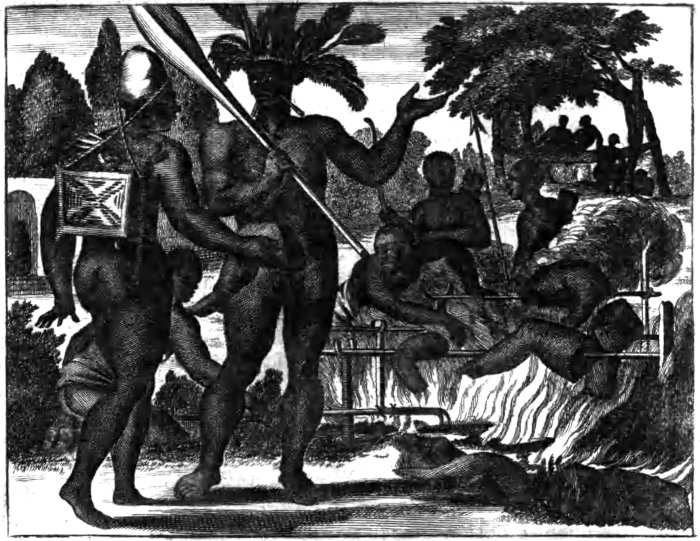
The general Bread of the Brasilians is the stamp’d Root Mandihoka; besides which they also eat all manner of Fruit and Plants, and many times Flesh, which they either eat boyl’d, broyl’d, or stew’d; their Boyling is after this manner: First they kindle their fire with two Sticks, the one of hard, and the other of soft Wood; the hard they make sharp at the end, and fix the same into the soft, which setting on fire they immediately lay Cotton thereupon, or else dry Leaves, and so boyl the Flesh in round Earthen Pots call’d Camu: but they account that better which is 483stew’d in a Pot, the bottom whereof is cover’d with Leaves, on which they lay the Flesh, then stopping the same close on the top with Earth and Leaves, they make Fire over it so long till they think the Flesh to be sufficiently stew’d. Their Broyling they perform by fixing forked Sticks into the Ground, over which they lay several others like a Gridiron; and upon them the raw Flesh, cut in long Slices, and Pepper’d and Salted, then make a Fire under the same till it is enough; and their Meat so dress’d keeps good fourteen days. Their Fish either boyl’d or broyl’d is eaten with the Sawce Juquitinga. The little Fish Piaba and Piquitinga they make up in Rolls, and lay them under hot Ashes. Both with their Flesh and Fish they eat for Bread, as hath been said, the Meal of the Root Mandihoka, which they taking up with three Fingers throw into their Mouthes so dexterously, that not the least scrap falls besides. They never observe any set hours to eat, for they make several Meals in the Day, and sometimes in the middle of the Night, if their Appetite serves, and neither drink nor speak whilest they are at their Meat. They sleep in spread Hammocks made fast between two Poles, near which burns a constant Fire with which in the Day-time they dress their Meat, and at Night keep themselves warm, the Nights being there somewhat cold, because of their equal length with the Days. Their usual Liquor is cold Water, taken out of the Fountains, Rivers, or Brooks; but to Carouse they make the Drink Caoi, of the Fruit of the Ocaiiba-Tree, which being stamp’d in a woodden Mortar, is strain’d, and at first looks like Milk, but after a few days standing turns to a darker colour, and is strong enough to make Astronomers of those that drink largely of it, but if long kept, it turns to be excellent Vinegar.
They have another Drink call’d Aipu, which is made two several ways; the first is thus: An old Toothless Woman chews the little cut Root Aipimacaxera to a Pap call’d Caracu, which spitting in a Pot they pour Water on the same, and afterwards boyling it leisurely, stirring it all the time it stands over the Fire. The other way of making this Aipu, which is much the more cleanly, is to boyl the said Root so long, till it comes to be like Butter-milk, and then letting it stand till it hath done working, it will be no unpleasant Drink.
Another sort of Drink amongst them is their Pacobi, made of the Fruit of the Tree Pacobehe and Pacobucu; besides others made of the Tree Abatu, of Indian Barley and Maiz. Also their Liquor call’d Jetici is press’d out of Potato-Roots.
In like manner the Plant Nana, by the Portuguese call’d Ananas, makes the Drink Nanai, which is exceeding strong and heady, but good against Faintness, Vomiting, Gravel, and stoppage of Urine, as also against Poyson.
Their Deboches.
The Tapuiyans, sur-named Cariri, meet at a certain time to make the Liquor Aipu, whereof each takes as much to his Hut as falls to his share, and when it hath done working, they begin in the Morning very early at the first House in the Village, and drink out every drop which they find there, and so from House to House till they have drunk one another drie; and he is look’d upon to be the best Man that hath drunk and evacuated most.
Their manner of Taking Tobacco.
The Brasilians take generally very strong Tobacco, which they first drie in the Sun, and afterwards before the Fire, the better to rub it in pieces: Their Tobacco-pipe is a Cane and a hollow Nut cut off at the top, and a round Hole bor’d in the middle, into which they put the Cane. They forbear not to take Tobacco even in the midst of their religious Ceremonies, which are perform’d with Singing and Dancing in this manner:
Their religious Ceremonies.
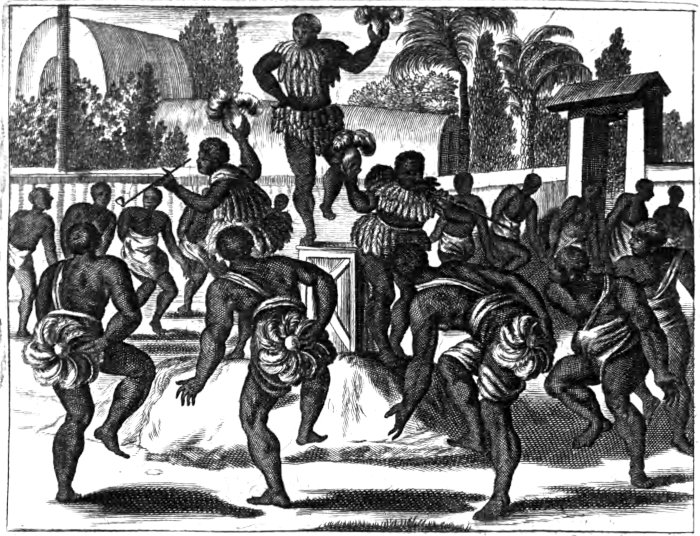
The Tapuiyans making a round Ring at an equal distance one from another, all of them being stark naked, tie divers colour’d Plumes of Feathers on their back-sides 484with a String made fast on their left Shoulders and about their Wastes; about their Legs they have Cotton Garters; each in his turn bowing to the Left, stretches down his left Hand to the Ground, and puts his right Hand in between the Strings which tie the Plume of Feathers, and stamps continually with his right Foot, whilest all the rest begin to Sing a doleful Song, which by degrees they change into a merry one, not without some appearance of understanding the Art of Musick. Their Songs contain first a mournful Relation of a general Deluge, which drowned their Predecessors, all but some few, who escap’d by climbing up high Trees and Mountains; next the Acts of those old Heroes from whom they boast themselves Extracted, who lost their Lives, or valiantly fought for the publick good, and were rewarded with the enjoyment of all pleasures and Delights, of Singing, Playing, Dancing, and the like, in a remote Countrey, whither after their Deaths they hope to be translated: Whilest they thus Sing over all their Songs, three Priests stand in the middle of the Ring, each holding the Idol Maraka (in their left Hand) resembling an old Ostritch’s Egg stuck full of Feathers on the top: about their Wastes they wear a Girdle of rich Plumes, on their Heads also a Crown of Feathers; the middle Priest looks with a stern Countenance, and holds up his left Leg from the Ground, whilest the other two standing on each side of him, hold in their right Hands a Pipe, out of which blowing Tobacco-smoak in one anothers Faces, they utter these words, Receive the Spirit of heroick Strength: The Dance ended, they Entertain their Priests with Meat and Drink eight days together, and also put Meat before their Idol Maraka, who is the chief Deity they adore.
Their Arms.
Their Arms consist of Bowes made of hard Wood, Strung with twisted Cotton Thred; their Arrows they make of the Cane Tacaara, made very sharp at the end, or headed with some Beasts sharp Tooth, or pointed with the Bones of the Fish Iperu. Some of the Tapuiyans use great Darts, and long Clubs of black Wood, broad before, and full of sharp Spikes; the Handles being wound about with Cotton Strings call’d Jatirana, under which hangs a Tuft of the Bird Arara’s Feathers, as also about the middle. Their Trumpets, call’d Canguenca, are the Shin-bones of Men, though 485they have others also made of great Shells and Canes. They us’d to be continually at War one with another, which they wag’d neither for Lands nor Riches, but either to make themselves eminent, and to be accounted valiant Soldiers, or most especially for the sake of Man’s-flesh to feed upon, which they love beyond all things in the World, wherefore they fatten all their Prisoners for the slaughter. Their Battels are always cruel, for they fight very desperately. Emanuel de Moraes relates, That he saw a Brasilian fight with three Armed Portugueses, who slew him not till after he had wounded them all three.
The Languages of the Brasilians.
The Languages of the Brasilians are several, each Countrey speaking a peculiar Tongue, but so different that they cannot understand one another. The Tabuyans are divided into above eighty Tribes, each speaking a peculiar Language, which have no resemblance one with another; nevertheless they have a general Language which is understood by most of them. The Jesuit Joseph Anchieta publishing a Brasilian Dictionary in Conimbrica, Anno 1595. shewed that the fore-mention’d Language wants the Letters f, l, s, z, r, and hath no double Consonants in any word, except mb, nd, ng, so that the sound of the word falls generally on the last Vowel. The fore-mention’d Moraes well experienc’d in the Brasilian Tongue, writ an Alphabet of all the most familiar words thereof us’d in common Discourse, of which it will not be unnecessary to give this following Extract:
A.
Aba, a Man, also Hair.
Acu, the Left-hand.
Acuabeimae, Sweet.
Amaberaba, Lightning.
Amacuminga, Thunder.
Amandiba, Hail.
Anama, a near Relation.
Anga, the Soul.
Angabara, Lean.
Angaipata, Angry, or Wicked.
Angaturama, Thankful, or Acceptable.
Apara, a Crown.
Apecum, the Tongue.
Apicaba, a Stool.
Ara, the Time, Skye, or Day.
Ara-ibi coquime, Noon.
Araya, Grandmother.
Atapuana, Light.
Atapuatia, Swift.
Atucupe, the Back.
Atyba, the Shoulder.
Ay cig, a Mother.
Ayura, the Neck.
B.
Boya, a Slave.
C.
Cama, a Sucking-Breast.
Canga, a Leg.
Caraibebe, apiabebe, an Angle.
Caruca, the Evening.
Capii, Grass.
Capii goacu, Straw.
Catu, Dainty.
Cay, an Ape.
Ceba, a Loaf.
Cibera, the Buttocks.
Cemiracoaobae, a Widower.
Ceo, a Breast.
Ceteeimibae, a Ghost.
Cig cygra, an Aunt.
Coaraci, a Son.
Cobra, a Serpent.
Coemitanga, the Dawn.
Coriba, Rejoyce.
Coya, Twins.
Cunha, a Wife.
Cunhaiba, a Bride.
Cunumigoacu, a Youth.
Cunumi, a Boy.
E.
Ecatuaba, the right Hand.
Eyruba, a Bee.
G.
Giba, an Arm.
Guaibino, an old Woman.
Guirarupia, an Egg.
I.
Jaci, the Moon, or Month.
Jacitata, a Star.
Iba, a Tree.
Ibiaia, the Heavens.
Ibatinga and Ibitinga, a Witch.
Ibateba, High.
Ibi, the Earth.
Ibitira, a Mountain.
Ibitu, the Wind.
Icapi, the Dew.
Ig, Water.
Iguaba, a Cap.
Ipeca, a Goose.
Igue, the Side.
Ita, Iron, or a Stone.
Itacira, a Spade.
Itapigua, a Nail.
Juba, Yellow.
M.
Maupiara, the Gall.
Mbabeaubora, Sick.
Mbiu, Meat.
Mbo, a Hand.
Membeca, Softly.
Menearaa, a Wedding.
Micu, a Toe.
486Mita, the Heel.
Mocu, an Eel.
Mormotara, Angry.
Muapendaba, a Joint.
N.
Nbia, the Heart.
O.
Opacatumba, the World.
P.
Potia, the Breast.
Paranga, Fair.
Porerobiara, Faithful.
Porucuicobora, Poor.
Potivi, a Duck.
Poxi, Ugly.
Pi, a Foot.
Pia, the Liver.
Pira, Fish, or a Skin.
Piquiira, Younger in years.
Pitanga, a Child.
Pua, a Finger.
Pua-guacu, a Thumb.
Purva, the Navel.
Puou, Long.
Putuma, the Night.
R.
Roig, Cold.
T.
Tagica, a Vein.
Tagui, Blood.
Tagira, or Membira, a Daughter. The first of these words is us’d by the Fathers, and the other by the Mothers.
Taira, Children, or a Son.
Tamua, a Grandfather.
Tata, Fire.
Tecoacu, Luck.
Tecoateima, Covetousness.
Temerico, Man or Woman.
Tendiba, a Chin.
Tendi, Spittle.
Tendipia, a Knee.
Tecobecatu, Wholsom.
Tema, a Shin-bone.
Tete, a Body.
Tiaya, Sweet.
Tibira, Younger: for so the Brothers call one another, but the Sisters name their younger Brothers Quibira, and Brothers their younger Sisters Teindira.
Tigue, the Belly.
Tique perg, the Guts.
Tinga, White.
Tipiba, Melancholly.
Tiquera, eldest Sister.
Tiquiera, eldest Brother.
Tuba, Parents.
Tutira, Father’s Brother.
Tubei-ima, an Hospital Boy.
Tuibaem, an old Man.
Tupana, God.
Ty, Piss.
Tyuris, the Bladder.
U.
Uba, the Hip.
Unhapuapem, a Nail.
Y.
Yja, a Fountain.
Ymeneoba, a Widow.
Yyaobuamba, Naked.
The Words for Action, are these following:
A.
Abi, Erring.
Abiqui, Coming.
Acanhem, I die.
Acoy, Covering.
Aei, Missing.
Ami, Squeezing.
Amotareima, Hating.
Anduba, Opinion.
Anguipaba, Sinning.
Abba mandeba, To put on.
Apina, Shaving.
Apition, Binding.
Aroca, a Lesson.
Ayaima, Feigning.
B.
Beraba, Shining.
C.
Coanga, Measuring, Proving, or Speaking.
Cacaba, Passing by.
Cae, Curing.
Capucaya, Calling, or To be vex’d.
Carom, Hoping.
Caruca, Pissing.
Cauccuba, Loving.
Cecaraya, Forgetting.
Cema, Going out.
Cenduba, Hearing.
Cenoya, Naming.
Cepiaca, Seeing, Punishment.
Cerura, Carrying.
Cetuna, Smelling.
Ceyara, Relating.
Cica, Ploughing.
Cipya, Making wet.
Ciquye, Fearing.
Co, Going.
Cobaitim, Meeting.
Coquendaboya, Opening.
Cuaba, Knowing.
Cupira, Performing.
Cuu, Defending.
E.
Ecatu, To be able.
G.
Genonheca, Praying.
Goameenga, Biting.
Guapua, Sitting.
Guata, Walking.
Gueena, Vomiting.
I.
Jababa, To run away.
Jecoacuba, To remember.
Jenumuna, Spitting.
Jerure, Demanding.
Igtaba, Swimming.
Igu, Drinking.
M.
Maenduara, Thinking.
Mano, Dying.
Maramonbanga, Warring.
Mayaoca, Dividing.
Mba-eraca, Buying.
487Mbacu, Eating.
Meenga, Delivering.
Menbirara, Barring.
Moaibaba, Bewitching, or Preventing.
Mongueba, Putting out.
Moanga, Thinking.
Moaquima, Making wet.
Mobibua, Sowing.
Moete, Praising, or Honoring.
Moendi, Setting on fire.
Mogiba, Boyling.
Mogyco, Polishing.
Momiya, Moving.
Momita, Lodging.
Monberaba, Bruising.
Monbeu, Delivering of a Message.
Monbuca, To bore through.
Monbuja, Boring.
Mondoca, To cut, take away, or cleave asunder.
Mondoroca, Breaking.
Monguy, Grinding.
Monguya, Making loose.
Monhanga, Doing.
Moperua, Being cold.
Mopotaya, Buttoning.
Moriba, Consenting.
Moropiana, Changing.
Moeyeceara, Mixing.
N.
Nheangeru, Sighing.
Nheenga, Speaking.
Nhemboe, Learning.
Nhengara, Singing.
P.
Paepua, Answering.
Paraboca, Chusing.
Paronduba, Enquiring.
Pea, Abstaining.
Pitu, Remaining.
Pitanga rempi, To cast off.
Pitera, Kissing.
Pitibo, Helping.
Aittiba, Anointing.
Poacema, Mourning.
Pobana, Spinning.
Pocuaba, To use.
Pocaucuba, Dreaming.
Porabiqui, Working.
Porara, Lying.
Potareima, Refusing.
Potara, Desiring.
Puama, Rising.
Puaya, Commanding.
Puca, Laughing.
Pura, Using.
Q.
Quera, Sleeping.
Querara, Waking.
R.
Raba, Untying.
Qereco, Having.
Rura, Coming.
T.
Tara, Catching.
Tecobe, Living.
Tiguioca, Bleeding.
Tiu, Disgracing.
Tima, Ploughing, Warring, or Burying.
Y.
Yaceo, Crying.
Yeaoboca, Pulling off.
Yeupira, Climbing.
Yuca, Killing.
These are of the most usual words of the general Language in Brasile, besides which every distinct Tribe or Division of People hath its peculiar Tongue, as hath been said, of which the chiefest and most eminent are the Tupinambu, Tabaiaras, Potigi-iguaras, Marhuites, Waimoores, Tomonimenos, Waitaquazes, Wainasses, Topinaques, Pories, Molopaques, Motaias, Biheros, Wainawasons, Tamoies, Tocomans, and the Cariogs; of all which the Tupinambu are the most comely, especially their Women, which (according to the testimony of the aforesaid Emanuel Moraes, an Eye-witness) may stand in competition with the European Beauties. These Women accompany their Husbands when they go into the Wars, and carry their Provisions, especially store of Tobacco. In the Lips both of the Men and Women hang little Stones. The Men take as many Wives as they please; and amongst the generality of the fore-mention’d Nations, there is scarce any sign of Religion to be discern’d.
The Tobaras and Potigi-iguaras.
The Tobaras are accounted the best Horsemen; but in Singing and Discourse, the Potigi-iguaras exceed all the other Brasilians: They place twenty or thirty Singers in a Row, which observing Time, Sing the Transactions of their Predecessors with good Voices.
The Waimoores.
The Waimoores are a strong People that inhabit the large Tract of Land between Bahia and Isleos, and having well timber’d Bodies, can keep pace with a Horse running full speed. Five or six of them often set upon a Sugar-Mill, though a hundred Men be at work in the same: They are all over bedaub’d with Dirt, because they lie like Beasts on the Ground: They wear long Hair, and have no certain Abodes.
The Tomonimenos.
488The Tomonimenos, living about Spirito Santo, are more civilis’d; they make Walls of Stone about their Huts; and these Walls are full of Holes, through which they shoot Arrows at those that Invade them; their Bodies are Painted red and black, and cover’d with Feathers. The Portuguese taking sixteen thousand of them Prisoners at once, kill’d most of them, and destroy’d the Countrey all along the River Paraiva.
The Waitaquazes.
At the South and North Point of Cape Frio dwell the Waitaquazes, bigger and stronger than the Waimoores; and they also sleep like Hogs on the Ground about a Fire, hold all People for their Enemies, and their Flesh for the greatest Dainty. The Women Arm’d with Bowes and Arrows stand by their Husbands in Battel.
The Wainasses.
The Description of the Plant Vruca.
On Isla Grande reside the Wainasses, a little People, which have very long Bellies, go stark naked, shave the Crown of their Heads, and let the other part of their Hair hang down long on their Shoulders. The Women, which are of gross Bodies, colour themselves Red with Vruca, which is a wild Plant, but much us’d amongst them: the Kernels are inclos’d in Husks full of red Fibres. These Kernels are not onely mix’d with the other Ingredients of the Chocaletta Drink, but also us’d to Dye of a red Colour: The Wood of this Plant is very white, and the Bark grey, like the Hazle; the Leaves being of a deep Green, resemble a Heart; at the end of the Boughs grow several Blossoms, each as big as a Rose, consisting of five Leaves, partly red and partly white, in the middle whereof are yellowish Threds with purple Points, which give little or no smell: after the Flower follows the Fruit, two Fingers long; when it begins to be ripe it grows still redder and redder, each Cod containing thirty or forty round Kernels, which being touch’d leave a red tincture upon the Fingers; the Cod when ripe opens of it self, and shews the Kernels speckled white, which dry’d, pounded, and mix’d with Piss, Dye so strong a Red, that Linnen dipt into the same will never receive any other Colour. This Root also boyl’d in Broth, makes it not onely red, but gives it a pleasant taste.
The Topinaques.
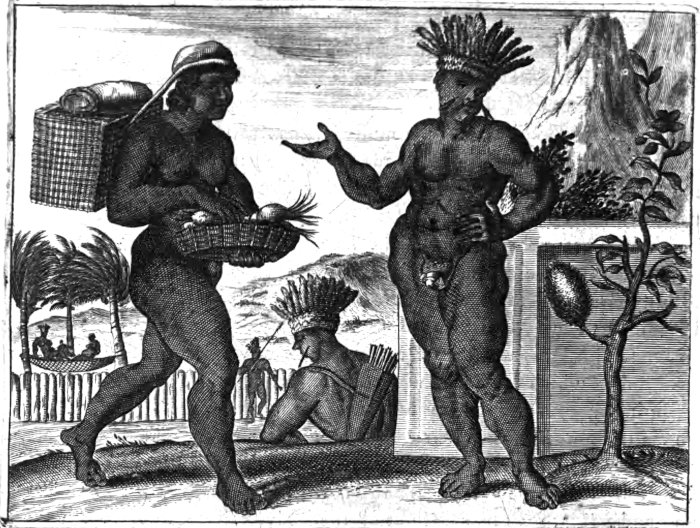
The Topinaques, which dwell about St. Vincent, are a strong and gross People, go stark naked both Men and Women: when they kill any of their Enemies they Paint themselves with the Fruit Janipano, put a great Plume of Feathers on their Head, and two Sticks in their Mouths, Dancing with strange motions of the Body, inclining sometimes towards the right, and sometimes towards the left side, for three day together; during which time they drink a filthy kind of Liquor. The Women, who have well proportion’d Bodies, onely covering their Heads with a Cap, about which they tie a bread of Hair, to which a square Basket being fastned, hangs below their Backs when they travel.
The Pories.
The Mountains along the Ocean, which inclose much Gold, are inhabited by the Pories, a peaceable People, molesting none of their Neighbors; they sleep in Nets of Flags, and have no other Houses than three Poles plac’d triangular, and cover’d with Palm-Leaves; they feed on Pine-Nuts and Eyrires, Apples that have Shells like a Walnut, and have also the precious Balsam-Oyl in great abundance.
The Molopaques.
Along the River Paradiva inhabit the Molopaques; the Men strong and well timber’d, have Beards long enough to cover their Privities. The Women also fair, modest, prudent, and never laughing, tie their Hair, painted with several colours, round about their Middle with a Cord, so that it serves in stead of an Apron. They observe a set-hour for Dinner and Supper, which is not us’d by any other Brasilians. The Mountains in these Parts consisting of a black Mold, have plenty of Gold, but it is of no esteem or regard amongst them, onely that which is wash’d down by the Rain they gather up, but put to no other use than to make Hooks to hang their Nets on.
489
The Motayas.
The Motayas, being of a low Stature and brown Complexion, shave off the Hair of their Heads, or else pluck it up by the Roots; they are eaters of Man’s-flesh.
Not far from whose Dominions appear the Mountains Pinos up in the Countrey, which abounding with Gold and Precious Stones, are inhabited by the Biheros, otherwise call’d Lopos, which live under the Trees like Beasts.
The Waianawasons.
The Tamoyes.
The Waianawasons have little Villages, built along a nameless River; they are a Gigantick People, but very ignorant. Thirteen Portuguese undertaking some years ago to travel through this Countrey to the South Sea, found on some Mountains abundance of Gold and Precious Stones; and amongst many strange things they saw a Crystal Mountain ten days before they came near it, over which they could not travel because of its steepness; at the foot thereof sprung a broad Stream, making a great noise. From thence travelling forward, they came to the Tamoyes Countrey, the Men whereof, being well proportion’d, wore great Bunches of Feathers on their Heads: The Women, exceeding fair, had carv’d Breasts. The said Portuguese being taken here, were put into Prison, and all slain and eaten, excepting one, who escap’d after this manner: Thirty thousand Tamoyes falling into the Countrey of the Amazons, by the Americans call’d Mandiocuysyams, made a great Feast with three hundred of them, whilest the rest fled to the River La Plata, where they got help from the Portuguese, who kill’d ten thousand of the Tamoyes, made the rest Slaves, and releas’d their imprison’d Countreyman.
The Tocomans, Caryogs, and Maraquites.
The Tocomans, a little People, dwell between La Plata and St. Vincent.
The Caryogs possess much Gold and Precious Stones.
The Maraquites, by the Western Indians sur-named Tapuiyers, that is, Wild People, are divided into seventy six sorts, all differing in their Languages; amongst which the chiefest are the Arodera, Cajau, Maquaru, and Poyme, which all live without Law, Religion, setled Abodes, or Friendship with any Neighbors; and the Women Fight as well as the Men. Jacob Rabbi, who dwelt a considerable time, and convers’d amongst these People, describes their Customs thus:
Their Customs describ’d.
“Their King Jandui, sir-named Otshicayayna, from the River which flows through 490the Countrey of the Tapuyans, causes (it he thinks fit) to be publish’d through the whole Camp of the Enemy, whither he will go the next Morning, and what he will do all the Day following, having first consulted with his Council of Sorcerers. Before they march they wash their Bodies in the River; rub themselves all over with Sand, and afterwards wash it off again, then stretch themselves till all their Joynts crack, run to the Fire, and when throughly warm, scratch their Bodies with certain Fish-Teeth, insomuch that the Blood gushes out of several places, all which they judge to be good against wearisomness. About a Stones-cast from the King’s Tent lie two thick Logs, a large Stride one from the other, against which the whole Multitude stand divided into two Parties, each of whom chuse the strongest Man accounted amongst them to carry the Log for a Wager, and when these two are tir’d, they are releas’d by others, and he that comes last to the appointed place with the Log, is laugh’d at by the Party to which he belong’d that was there first, where they all stay for the Youths that bring their Arms, which when they have deliver’d, they all fall to work, cutting down Trees, breaking off the Boughs, sticking them in the Ground, and tying them together on the top for Tents, which are built in rows one against another, leaving a broad Path between. Mean while the Women and Children coming with their Baggage, the Men run to Fish and Hunt, or to seek Honey. The old Women dig up Roots, which stamp’d serve them for Bread, whilest the young Women help one another to prepare the Meat in the Huts. Moreover the Men spend their time in several Exercises, as Wrestling and Running, of which two Women, appointed for that purpose, are the Judges. When the Evening draws on upon them, then the Youths dividing themselves into Companies, go Singing from one Tent to another, and are follow’d by the Maids Dancing and Leaping, every one standing behind him whom she loves best; and this is look’d upon as a singular sign of affection. When a young Man is inclin’d to Marry, he carries Honey and Venison to his Mistresses Father, who if he hath more than one Daughter acquaints the Soothsayers with it, who inform the King concerning it; he then causes all the young Men and Maids to be call’d together out of the Camp, sends them into the Woods to Hunt out a wild Beast, which they no sooner see, but they return and acquaint the Multitude therewith, who immediately surrounding the Place, soon catch the Beast, whose Entrails they pull out and throw to the Dogs, and give the Flesh to the Women to roast, which when ready they make merry with, Singing and Dancing after they have eaten; then if the Youth hath behav’d himself well in pursuing of the wild Beast, the King grants him the Maid which he desires for his Wife: Four days before the Wedding they bore a Hole through each of the Bridegrooms Cheeks with a sharp piece of Wood, which done they solemnize the Marriage; at which the King himself distributes the Meat to every Guest as he thinks fit; after Dinner they extol the Mothers Care, in preserving her Daughters Virginity for the Bridegroom in strange Songs. If a Maid be Marriageable, and no Suitor comes to her, then the Mother draws red Strokes under her Eyes, and conducts her to the King, who sets the Maid down by him on a Mat, warms his Hands against the Fire, then stroaks himself and the Maid, and also blows Tobacco-Smoak on her and himself, which done, he performs the part of a Husband with her. But their making Holes through their Ears and Lips is done whilest they are Children, after this manner: The Boys who undergo this Ceremony, come to the Place appointed, where the whole Multitude Dance and Sing, and the Conjurers (who are the onely Priests they have) sit in two rows opposite to one another; 491one of them starting up, takes a Boy by the Head, ties him Hand and Foot that he cannot stir at all; which done, a second Sorcerer comes to his assistance, and with a sharp-pointed Stick bores Holes through his Ears and Lips, whilest the Mother of the Boy makes a sad Lamentation. Women refuse to have any familiarity with their Husbands as soon as they perceive themselves to be with Child; and as soon as any Woman is Deliver’d, she runs into a neighboring Wood, where with a Shell she cuts off the Childs Navel, which boyling she eats with the After-birth; then washes her self and the Child every Morning and Evening in cold Water; as long as she gives Suck her Husband lies not with her, unless it be a Man that hath but one Wife. If a Woman commit Adultery, her Husband beats her out of his House, but if he takes her in the Act, it is lawful for him to kill both. In the middle of the King’s Tent stands a great Calabash full of Stones call’d Kehnturah, cover’d with the corner of a Mat, which none dares approach without the King’s leave, unless it be to smoak the same with Tobacco, or to lay Venison or Honey before it.”
Strange manner of curing the Sick amongst the Tapuyans.
It is also remarkable how the Sorcerers deal with their Sick; the aforesaid Jacob Rabbi, in Eye-witness relates, That the King Drarugh being extreamly troubled with pains in his Sides and Legs, and finding no help amongst his Sorcerers, who pretended to be Physicians, went to the neighboring King of the Tapuyans, where three undertook to cure him, which they did after this manner: One of them blew Tobacco-smoak on his Body, suck’d his Knees, roar’d like a Lyon, and after much ado vomited a little Eel into his Hand, which he pretended had put the King to so much pain; whilest the second suck’d his Belly, and also roar’d exceedingly, and vomited forth at last a Stone, on which appear’d a Rose; the third suck’d his left Side, till he vomited something like a Root; after which the King is said immediately to have recover’d.
Their Feasting in honor of the Stars.
There is but little Ceremony of Religion to be found amongst the Tapuyans, onely they shew Reverence to the Seven-stars when the Fruits of the Field are ripe, after this manner: First they spend three days in Dancing and Singing, then the Youths prepare themselves to Fight with Lances and Clubs, tie tough Twigs about their Legs, pour Honey on their Heads, tie their Hair behind in Knots after it is powder’d with red Powder, Paint their Faces and Bodies with several Colours, stick a long Feather in their Necks betwixt their Hair, and on their Heads set Garlands of red Feathers pleited, down their Backs hang Bundles of Branches like Tails, and have their Arms adorn’d with the Wings of the Bird Kosetug; thus dress’d they fight three days, at the end whereof the Conquerors shew great joy.
It deserves special observation what the Learned Gerard Vossius relates of them from the Mouth of Christopher Arcisseusky, a Polish Nobleman, famous for his heroick Exploits for the United Netherlands in Brasile.
Arcisseusky’s Relation of the Manners of the new Married.
“The Tapuyans (saith he) are a People that range up and down, never staying long in one place, between Siara and Meranthon, a vast Tract of Land, and go almost naked, having onely a slight Covering about their Middle. When the Hollanders gave them Clothes, they admir’d the strange Fashion thereof, and after two days return’d them again: In their Lips, Nostrils, Ears and Cheeks they hung Ornamentals of Wood, Bones, Feathers, or Stones; a great Club, and a strong Bowe made of hard Wood serve them for Arms; Gold and Silver they esteem’d not, wherefore they barter’d whole Chests full (buried there by the Portuguese and discover’d by them) with the Hollanders for Greyhounds: They judge themselves to be better than other Man-eaters, because they eat not the Flesh of their Enemies, but of their own Relations, and those neither kill’d in the Wars, 492nor dying a natural Death; by which they pretend to express their exceeding love to the Deceased, who else would, say they, be eaten by the Worms and rot, wherefore they rather chuse to eat them, that they may receive the nourishment themselves.”
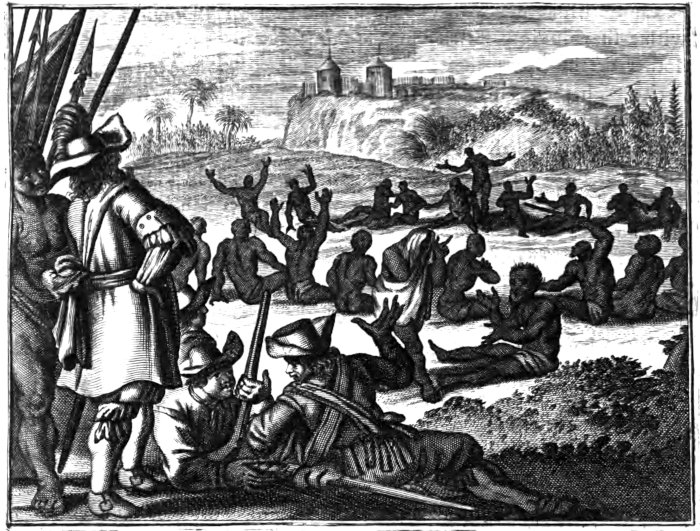
The same Author relates also, That he saw a Tapuyan yield up the Ghost not far from the Castle Rio Grande, after which his nearest Relations taking the Body, wash’d the same, together with the Entrails, and cutting the Corps into several pieces, roasted the same on a Spit, preserving the Fat that dropt from it in Pans, and eat the Flesh with a greedy Appetite. None were admitted to this Feast but his chief Relations; and that which they could not eat, as the Hair, Teeth, Nails, and Bones, they burnt to Ashes, which gathering up they mix’d with their Liquor till it was all drunk up.
The Religion of the Tapuyans.
The Tapuyans acknowledge two Deities, the one good and the other bad; to the good they shew no Reverence, because, say they, he is bountiful of himself, and doth them no hurt; whereas on the contrary they zealously call upon their Devil-Deity, because they think he destroys all those who worship him not.
Their foretelling of things to come.
They never Travel nor go to War before they have consulted with their angry God, and that not without great Ceremonies; whereupon they ascribe to themselves the knowledge of future things; and indeed they often foretel future things which are beyond humane apprehension; as a testimony whereof that may serve which Sapo Amama, a Friezland Gentleman, found by experience: for he keeping Guard before Conjahu with a Troop of Horse against the Portuguese, had several Tapuyans in his Service, who foretold, That the following day the Lieutenant Amama and a Trooper should be kill’d by a Shot from a great Gun; which, though slighted, was confirm’d by the exact fulfilling of the Prediction. The like Passages hapned daily, and amongst many Arcisseusky relates one very remarkable Accident, viz. He remov’d a considerable number of Men of the Garrison Rio Grande, to surprize the Spanish Fort Barra-Canium, and nothing could more promote the Design than secrecy; but fifty Tapuyans having joyn’d with the Hollanders, Arcisseusky fear’d 493they might discover his Plot, wherefore he charg’d them that they should not stir a foot from his Company, which they accordingly promis’d, and having march’d three days through By-ways, they daily perform’d their Devotion in open view, and Arcisseusky desir’d that they would call him when their Devil appear’d, which they granted, on promise that he should not do him any hurt: On the third day the Army being sufficiently refresh’d, he being call’d, found the Tapuyans sitting in a Semi-Circle, with their Feet spread asunder; opposite to them sat their Priest on the Ground, whom they ask’d concerning all manner of Affairs, and he question’d them again, on which they gave their several Answers, but could not be understood for want of Interpreters, for those whom the Hollanders us’d spake only two Languages, one of which is us’d commonly by the Brasilians along the Sea-Coast, and the other by the Portuguese, in which they Interpreted to the Hollanders as much as possibly they could understand of what the Tapuyans said, whose Language differs very much from the vulgar Brasile Tongue, because they live up in the Inland, and are divided into divers Tribes, so that the Interpreters could not understand the Tapuyans, but judg’d their meaning more by nodding of the Head, and the like signs: after the Assembly had done speaking, the Priest rose up and went out of their sights into the Wood, where with a loud voice he call’d three times upon the Devil; but he not answering, the Priest return’d to his Company, who began their Questions and Answers afresh, which could not be understood by the Interpreters; and soon after the Priest (seeming to be commanded by the rest) went again to the Wood, but calling still in vain, return’d; then going a third time, and calling as before, was by a small, but shrill Voice, answer’d from the middle of the Wood, from which the Tapuyans concluded that their Business would come to perfection, and that the Devil would soon appear to them: The Priest hereupon going backwards and forwards three times one after another to his Company, they began to talk as before; at last going into the Wood again, they all spoke louder, and with more vehemency than before, whilest the fore-mention’d shrill Voice approached nearer and nearer, and at last the supposed Dæmon came forth with the Priest, who commanded him to sit opposite to the Congregation, which had a great deal of Discourse, and sometimes the Priest speaking was answer’d by the Devil in his shrill Voice; but some of the People calling aloud, catch’d up their Arms, and threatned to beat the Devil, as they often us’d to do upon the like occasions. At the departure of the Dæmon, the Multitude conducted by the Priest into the Wood, cry’d out in so terrible a manner, that they affrighted the Hollanders, who judg’d it rather to be Lyons and Tygers that roar’d than Men. During these Transactions, a German Soldier in the Rere quitted his Arms and fled, but being miss’d was pursu’d, found in a Hedge, and laid Hold on as a Person suspected to carry Advice to the Spaniards, and being brought before Arcisseusky and Examined, gave such ridiculous Answers as increas’d the suspicion, insomuch that he was led to a Tree to be tortur’d; where as he stood ty’d he solemnly declar’d, That the reason of his running away, was because he had not Pray’d in ten years, so that he was exceedingly afraid, lest when he saw the Devil amongst the Tapuyans, he would have known him, and carry’d him away to the Place prepar’d for all such Wretches.
The Imposture.
The Learned Gerard Vossius made a particular Enquiry after this Story, whether the Spirit’s appearance were a Reality, or an Imposture; and the truth is it was no better than a subtile Cheat, and so it was apprehended by Arcisseusky, who not long after, on a convenient time, ask’d the Tapuyans why they feign’d him to be a Devil that was a Man, whom he had often seen before? which they denying, affirm’d 494that it was a real Devil; but Arcisseusky knew their pretended Friend, who spake so shrill by reason of a Grass-blade which he held in his Mouth. However, though the main of the Fable was acted by Man, yet the Devil without doubt play’d his part with them, as appear’d by those Predictions, which no Man could possibly know, viz. That the Portuguese Fort should with the loss but of three Men fall into the Hollanders hands; for so accordingly it hapned. But because the Devil cannot foresee all things, therefore they often erre; for they said that the Hollanders should cross the Moat on Boards nail’d together in stead of a Bridge, and that the Enemy should not perceive it; and indeed Arcisseusky had resolv’d so to do, but was discover’d by the Portuguese, who defended themselves with great Guns, which so affrighted the Tapuyans, not us’d to such a noise, that they ran away and never return’d, so that by Morning the Fort was conquer’d, and all things quieted.
A pleasant Story between Arcisseusky and a Tapuyan Priest.
After this Arcisseusky burnt several Portuguese Ships in the River Monguoape, and kept one, carrying ten Demi-Culverins, laden with Sugar and Spanish Wine; which to carry to a safe Harbor a short Way, he requir’d the Tapuyans assistance; but they refus’d to enter, pretending the Ship would perish by some or other unfortunate Accident, which accordingly hapned as they had said; for the Ship was split against a Rock in the Mouth of a narrow Haven, insomuch that nothing of it was sav’d; all which the Tapuyans knew beforehand by the Devil’s information, for they never go upon any Business of consequence before they have consulted with him, and done him worship. Yet, it seems, they cannot secure this Devil of theirs from the Stripes of a Mortal, as appears by this pleasant Story: A Tapuyan Priest was promis’d a Shirt from Arcisseusky, upon condition the Devil should pull the same out of his Hand and carry it up in the Air: The Tapuyan liking the Proposal, promis’d immediately to call the Devil; but when Arcisseusky desir’d leave to Drub him with a Stick which he had in his Hand, he could by no means perswade the Priest to call for his Dæmon; at which every one began to laugh: and to carry on the Mirth farther, Arcisseusky Joking with the Priest, said, I will shew you that I am a greater Artist than you, for to Morrow I will bring it about by my Art, that great Horns shall grow on your Head, so big, that you shall not be able to pass these Doors; which so affrighted the Tapuyans, that all of them fled, onely the Priest return’d the next day with an Interpreter to Arcisseusky, desiring him that he would use him mercifully, and not cause any Horns to grow on his Head.
At the time when Jacob Rabbi convers’d amongst the Tapuyans, they were Govern’d by Janduy, a Man of above a hundred years old, whose chief Seat was on each side of the River Otschunogh, and round about the Lake Igtug, in which none durst Swim, because of the many biting Fishes in the same.
The King Pritigaba having entred into a strict League with Janduy, Warr’d continually against the Kings Arygpoygh, Wanasewasug, Tshering, and Dremenige; and had not the Portuguese taken the four last into their Service to aid them against the Hollanders, they could never have held out long against the Forces sent by Janduy, who destroy’d Man, Beast, and Houses, sparing nothing they met with; for they murther and destroy all things where e’re they come.
Brasile by whom possess’d at present.
The several Nations that now possess Brasile, besides its native Inhabitants, are Portuguese, English, Hollanders, Germans, and French, which the Brasilians by a general Name call Ajuru-juba; otherwise they call all Strangers Caraiba or Pero. But from the commixing of several Nations proceeds a fifth sort, for one that is born of European Parents in Brasile is call’d Mozombo; of an European Father and Brasilian Mother, Mameluc; of an European Father and a Moor, Mulatto; of a Brasilian and Moor, Curiboca, or Cabocles; of two Negro’s, Criolo. But above all others the Portuguese are 495the strongest along the Sea-Coast, who when first they began to settle on Brasile, found great resistance; and had not the Natives been at Wars amongst themselves, they could never have got so much footing, but now they are sufficiently Masters; for they have either slain all the old Inhabitants, or driven them up into the Inland: However, the Brasilians are so valiant, that they will Encounter a great Army, being brought up in the Wars from their Cradle. When they Engage one with another they shoot their Arrows exceeding thick, Hooting, Hollowing, and Leaping from one side to the other to shun the Arrows with a wonderful dexterity: The Conquerors spare none, but kill all, and Feast on the slain Bodies; but some they hale away Prisoners with a Rope about their Necks, to each of whom they allot a young Maid, who cherishes and fattens them up for five Moneths, at the end of which they make a great Feast, and drink to a pitch beyond Sense or Reason, having first fill’d their Bellies with the Flesh of the slain Prisoners roasted. If the Woman be got with Child by the Slain, they imagine that they can take no greater revenge of their Enemy, than to devour the Child as soon as it comes into the World; but it often happens, that the Woman really loving her Husband the Prisoner, runs away with him, and so bereaves her Friends of a Banquet.
Sect. II. St. Vincent.
Places of note in the Præfecture of St. Vincent.
The continual Wars which the Portuguese have maintain’d against the Brasilians, have hindred them from Setling any where but along the Sea-side, where their Residences are divided into thirteen Præfectures or Lordships, by them call’d Capitanias; the Southermost whereof being 1. St. Vincent, hath a City of the same Denomination, which lies near a River that coming out of the Ocean runs round in the Countrey, and so returns into the Sea.
2. Sanctos los Leyes, which reckons four hundred Houses and three Sugar-Mills. Here great Ships take in their Lading in the middle of the City.
3. Hitauhacin, the most Southern, is inhabited by the Portuguese. Twelve Leagues from thence up into the Countrey the Jesuits have built the Village St. Paulo, near the Gold-Mines that lie in the Mountains, extending from East to West thirty Leagues. This Village, long since containing eighty Houses, is inhabited by Brasilians and a mix’d People; the Way thither is troublesom, over rough Mountains, and Ways overgrown with Brambles.
On the Island Britioga, at a sandy Inlet which makes a good Harbor, lies a Fort for defence of the Haven St. Vincent: and since the English, Anno 1582. sunk a Ship there, a second Fort hath been built to prevent the coming in up the River; yet notwithstanding Captain Thomas Candish ran by both the Forts, and burnt St. Vincent, but spar’d Sanctos.
Before the River which washes St. Vincent, appears the Island Sebastian, pretty large, wooddy, and well stor’d with Venison; It hath wholsom Water, good Herbage, and a secure Road for Ships against all Winds.
Farther into the Sea appears the high and rocky Isles Alcatraces, as also Victorio des Busires, Porto des Castellanos, Monte de Frigo, Muella, and Queimadas.
The Nature of the Tupinikinsi, Natives of St. Vincent.
The Natives of St. Vincent, which are in League with the Portuguese, are call’d Tupinikinsi, inhabiting the Mountains which extend above twenty eight Leagues up into the Countrey: They maintain continual Wars against the Carioes, a civiliz’d People, and white of Complexion, as also against the Cupin Imbas on the North, 496and a nameless People bordering on Peru. Moreover, the Miramumins, a very wild People, range all the Countrey over, but are much lessen’d since the Portugueses Arrival.
Sect. III. Rio de Janeiro.
First Discovery and Possession of Rio de Janeiro.
The second Lordship Rio de Janeiro, formerly by the French call’d Ganabara, was discover’d Anno 1515. by Juan Dias de Solis; but the French first Setled themselves here forty years after Dias de Solis: for setting Sail from Havre de Grace with three well Mann’d Ships, Commanded by Nicholas Durandus Villegagnon, they arriv’d at Rio Janeiro in November, and at the Entrance into the River, which is about half a League broad, built a woodden Fort of a hundred Foot long, and sixty broad, and giving it the Name of the French Admiral Coligni, put several Guns into the same to secure the Entrance, inclos’d on each side by two steep Mountains. In the River, which is very broad, lie several wooddy Isles, on one of which, near the Fort Coligni, Villegagnon Setling himself, suffer’d great Inconveniences for want of Water, because he durst not Land on the Main, for fear of being surpris’d by the Natives. Here he stay’d a year and a half in a deplorable Condition, when Philip Corguileray and Du Pont set Sail with three Ships from the Haven Honfleurs; but they also, though they had many Men, yet were ill stor’d with Provisions, insomuch that Hunger increas’d amongst them daily: wherefore Villegagnon return’d home without any farther Exploits.
Jean Leri his Description thereof.
Jean Leri, who went with Corguileray, describes Rio Janeiro after this manner:
“The River (saith he) lies twenty three Degrees Southward of the Equinoctial Line; the Inlet of the Sea, twenty four thousand Paces broad, and in some places broader, is hemm’d in by hills; the Mouth of the Inlet is somewhat dangerous, by reason of three rocky Isles; beyond the large Bay is a narrow Channel, on the left-hand whereof there rises a high Mountain, which the French call’d Le Pot de Beure, because it resembles a Butter-pot. Somewhat farther lies the Rock Ratier, where Villegagnon thought to build a Fort, but the Water in stormy Weather washing over the Rock, he was forc’d to give over his Design. Half a League farther is an Island a thousand Paces in length, and a hundred and fifty in breadth, surrounded with Rocks, on which the French resided: at each end of the Isle rises a Hill, and from the middle a Rock sixty Foot high; on the Hill Villegagnon pitcht his Tent till he had built him a handsom House on a Rock; the other Houses were built in the Valley. Three Leagues and a half farther lies a fruitful Isle nine Miles in circumference, inhabited by a salvage People call’d Touoebinambauti: there are several other Isles, on which breed good Oysters with little Pearls, which stick so fast to great Stones, that they can scarce be pluckt off. The River Janeiro abounds with Fish.”
Towns and Places of chief note.
The French once possess’d this Island, but were dispossess’d by Emanuel de Sa, Governor of Brasile, for the Portuguese.
The City Sebastian, which contains three hundred Houses, is built on the Southern Point of Janeiro; opposite to which, on the Northern Point, lies the Fort; a large Church, the Jesuits Cloyster, and two Sugar-Mills, give no small lustre to the City, where the chief Trade consists in Brasile Wood and Cotton. The French Storm’d this Town Anno 1581. but march’d off without any success. Dirk Ruiters, an Eye-witness, gives us this Description of Sebastian:
497“The Town (says he) lies two Leagues up the River Janeiro, in a Bay, about which it is built like a Semi-Circle in a sandy Soil along the Water, and is about a Mile long; at each end rise steep Mountains, besides which it hath neither Walls nor Gates; but its strength consists of four Forts, the chiefest whereof stands towards the East on a Rock in the Mouth of the River; the second towards the West, an Isle which on the South-East rises with a Mountain resembling a Sugar-Loaf: the third crowns a Rock South-East from the Town; and the fourth, in the North-West, a high Mountain. The Natives, call’d Tououpinambauti, are very serviceable to the Portuguese.”
Besides the fore-mention’d Towns Coligni and St. Sebastian, some make mention of another in this Præfecture, call’d Angra de los Reyes, twelve Leagues distant from St. Sebastian Westward.
The Burroughs of the Natives are populous, but neither strong by Nature, nor fortifi’d, and so not by any one thought worthy the naming.
Sect. IV. De Spirito Sancto.
Description of the Lordship De Spirito Sancto.
Next to Rio Janeiro lies the Lordship or County De Spirito Sancto, exceeding Several strange sorts of Fish. fruitful, having divers Woods abounding with Venison. The Rivers Parayva, Manangea, Itapemeri, Iritibi, and Guarapari, are stor’d with all sorts of Fish, and amongst others the Fish Piratiapua, which in the Winter Moneths lives in the Rivers, and against the Summer returns to the Rocks wash’d by the Ocean. This Fish hath a wide Mouth full of Teeth, a reddish Tongue, little Fins, except those on their Backs, divers colour’d Scales, yet most of a dark Red, and generally weighs fifty Pound.
Here is also the Fish Paru, full of yellow Scales like Half-Moons over a black Skin; it hath long Fins near the Tail, and a little Head.
No less remarkable is the Guebucu, which hath a long Body, a sharp bonie Snout, the upper Jaw reaching over the other, no Teeth, a Tail divided in the middle, sharp Fins on the Back, and a Skin full of Silver-colour’d Prickles. This Monster not onely devours great Fishes, but also Men; when it is hungry it often runs its Snout through the side of a Ship.
But there is no Fish more deform’d than the Abacatuaja, which being oval and flat, hath two long Fins underneath, and one on the top, a divided Tail, green Fins, a smooth Skin, and fiery Eyes; as soon as it is taken it cries like a Hog.
The Serpent Boiguacu.
In this County stands a Town of the same Denomination, which contains two hundred Houses, a Sugar-Mill, and a Cloyster of Jesuits, and drives a great Trade in Cotton and Brasile Wood. Before the City lies an Inlet full of Isles, the Mouth of which is guarded by a Castle. The Natives, call’d Maigaias, are in League with the Portuguese, but the Tapuyans and Apiapetangas do them all the mischief they can possibly; so that the Portuguese travel in great danger of their lives, when any Business calls them, through the Countrey of these salvage People. But besides these People, the Way is pester’d with strange wild Beasts, especially on the Mountain Mestre Alvaro, which is seen at a great distance off at Sea; on which, amongst other Creatures, breeds the terrible Serpent Boiguacu, whose length is generally twenty four Foot; it is of an Ash colour, with great and small black Spots, with a little white Speck in the middle; when hungry, it leaps out of the Hedges, or from the tops of Trees, raises it self upright on its Tail, and winding about either Man, 498Beast, or whate’re it be, squeezes it to death, or puts its Tail, which ends in a sharp Point or Sting, in at the Fundament in such a manner, that it kills the Creature on which it seizeth in a moment, and then swallows it up. This Serpent hath strong Ribs inwardly, and more than seventy bonie Joynts; wherefore it turns it self with great ease; the Joynt-bones near the Head are the biggest, and grow smaller and smaller towards the Tail: It also feeds on Pismires.
The Bird Jabicu-guacu.
This County also breeds the Bird Jabicu-guacu, which exceeds the Crane in bigness, and hath a long thick Bill, but no Tongue; on his Head appears a white grisly Crest or Mitre; the Wings and Tail are short, and the Feathers most of them white, except the Pinions, which shine like Rubies; their Flesh is of a good rellish, but somewhat dry.
Near the River which washes the City Spirito Sancto, the Paraibes dwell in Huts, not unlike Ovens.
Sect. V. Porto Seguro.
Description of Porto Seguro.
Next to the fore-mention’d County borders Porto Seguro, discover’d by Pedro Alvares Capralis, who gave this Countrey the Name of Terra de Santa Cruiz, but afterwards chang’d it to Porto Seguro, because he found a secure Harbor there. The Town, built on the top of a white Rock, gives its Denomination to the whole Countrey, and harbor’d long since two hundred and twenty Families, and hath five Sugar-Mills. The Land on the North side of the Rock rises high, but Southwardly a smooth Coast runs along the Ocean, from which two Leagues off at Sea lie several Cliffs, against which the Waves break with a great force.
The Towns Santa Cruiz and Amaro are left desolate, because the Portuguese were continually Invaded by the salvage Aymures, whom they were not able by any means to repress.
Southward from Porto Seguro appear the Shoals Abrolhos, twenty six Leagues from the Coast; they are of one breadth, but one is longer than the other.
499
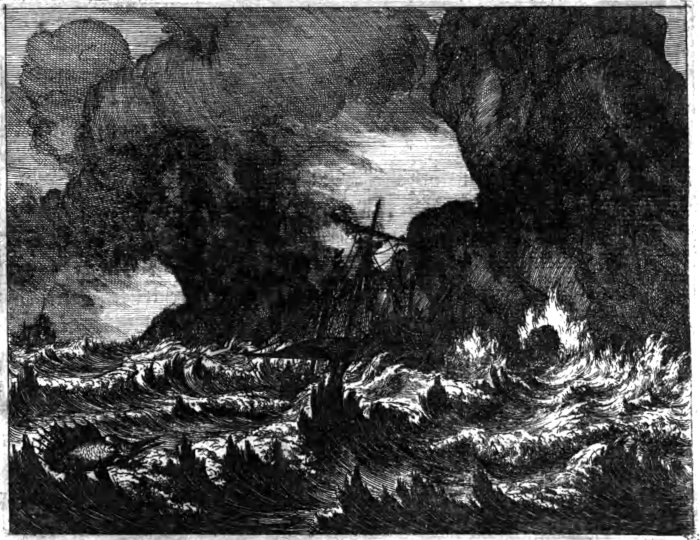
Remakable Wreck of the Ship Batavia.
Corneliszoon: his villainous Attempt.
On this Coast the Ship Batavia was cast away Anno 1629. which Accident is the more remakable for the Murders committed by the Factor, Hieronymus Corneliszoon, who with some Confederates resolv’d to run away with the Ship, and to Sail to some Spanish Haven, or Dunkirk, and so to pillage the Netherland Vessels; but their Design was frustrated by the Ships running against the Abrolhos: Francis Pelsaert, chief Commander, first caus’d the Sick, with the Women and Children, to be put on an Island, or else on two Rocks about three Leagues distant from the place where the Ship lay, in which remain’d seventy Men, whom Pelsaert in vain endeavor’d to carry away; for the Sea was so rough that a Boat was not able to abide in the same, and also the Storm beginning to increase, beat the Ship more and more against the Sands, and the Seamen venturing towards the Isle on pieces of Timber, were some drown’d, others by the Waves, were driven ashore, amongst whom was Hieronymus Corneliszoon, who preserv’d his Life twenty four hours on the Boltsprit after the Ship was stav’d; but not terrifi’d with such an Accident, he continu’d in his fore-mention’d Resolution. On one of the Cliffs were forty Persons with eighty Cans of Water, but on the Island a hundred and eighty with much less; upon which Pelsaert, who when the Storm ceas’d, thought to save somewhat more out of his Wrack, was necessitated to seek for fresh Water on one of the said Cliffs, but not finding enough, trimm’d up his Boat and set Sail homeward, from thence to fetch a new supply of People: During which time Cornelisszoon perform’d his Vilany; for he chose David of Zeevang, Gysbrecht Welderen, Coenraed Huissen, Cornelis Pieterszoon, Rutger Frederickszoon, and Hans Heilwerk, for his Assistants, besides several others, and destroy’d all the People on the Island, except five, who escap’d on pieces of Timber to the Rock where Weyber Hays resided with forty Men, who being inform’d what the aforesaid Villains had done, prepar’d for resistance with sharp-pointed Sticks, those People on the second Rock being also slain by Zeevang, who spared onely some Women and seven Boys; after which Hieronymus Corneliszoon took Lucretia Jans for his Wife; in like manner Huissen took Judith Sebastiaens; the remaining Women serv’d the rest for Concubines. Not long after twenty of them going in Sloops, fell upon Weiber Hays, who valiantly resisted them: but because Hays’s Life was of great consequence, by reason he might give notice of their Actions to the Ship which was expected from Holland, and which they design’d to run away with, therefore they renew’d their Assault with fifteen Men more, and were again beat off; wherefore they resolv’d to make a Peace, which Hieronymus Corneliszoon promis’d to ratifie the next day; nevertheless this Peace was but feigned, for under pretence thereof they deliver’d Letters to several French Soldiers that were under Hays’s Command, promising each six thousand Guilders if they would joyn with them; but they shew’d the Letters to Hays, who keeping it secret, that he might draw on Hieronymus Corneliszoon, not mistrusting the Discovery, to come thither at the appointed time, took him Prisoner, and caus’d Zeevang, Huissen, Welderen, and Cornelis Pieterszoon to be put to death; but Wouter Loos making his escape, was chosen chief of the Rebels, who ventur’d a fourth Assault, but returning without any effect left off making any farther Attempt. Mean while Pelsaert arriving with the Sardam Frigat from Holland, sent a Boat ashore, which by a little Skiff dispatcht by Hays, was inform’d of all the Passages; whereupon the Boat returning, Pelsaert as he was putting himself into a posture of Defence, espy’d a Sloop coming about the Southern Point of the Island, in which were eleven of the Rebels clad in Scarlet with Silver Lace, which making directly towards the Ship, as soon 500as they came up, were commanded to throw away their Arms over-board; which having done, and coming aboard the Frigat, they were all put in Irons, as also their remaining Party, and condemn’d to die.