The Second Book, CONTAINING A DESCRIPTION OF NORTHERN AMERICA (continued 9)
Reading edition
In the Province of Camaguey is a Valley three Leagues in bigness, where Nature produces a great number of large Stones so exactly round, that no Man with a Compass can make a more exact Circle.
Though the Gold, which is digg’d out of the Mines, and found in Rivers, is none of the purest, yet the Copper which this Countrey affords is accounted excellent.
Serpents.
333The Serpents here are about the bigness of a Hare, having Heads like Weezles; they prey on little Beasts call’d Guabiniquinazes, and have been accounted delicious and wholsom Meat.
Antient Customs of the Natives.
The antient Natives went formerly naked. The Men made it a Custom to forsake their Wives when they pleas’d; yet the Women were still oblig’d to be faithful to them, though from the very first day of their Marriage they were taught to Cuckold them, by a certain wicked Ceremony in use amongst them; for the Bridegroom lay not with his Bride the first Night, but suffer’d her to be enjoy’d by one of his Friends of equal Quality with himself, whether he were Lord, Merchant, Laboring-man, or what Estate soever.
The Spaniard at first beaten by the Natives.
This Island was reduc’d under the Spanish Government not without great effusion of Blood; for the Natives having had continual Wars with the Cannibals, as hath been said, were not ignorant in the Exercise of Arms. The first Spanish Commander sent against them was Valdivia, whom they slew with all his Men, and hew’d his Ship in pieces. Little better escap’d Fogeda, whose Men were all cut off, and he himself escaping very miraculously, died not long after of his Wounds in St. Domingo.
St. Jago built by Valasquez.
Within two years after, viz. Anno 1514. Diego Velasquez with better success set forth for Cuba, where the first thing he did was to build a City, which he call’d St. Jago, lying near a Southern Bay, full of Fish, and defended with several small Isles, behind which the Ships in the greatest Storm may Ride very secure; by reason whereof the new City increas’d so much, that in a short time it could shew two thousand Inhabitants, a brave Church, a Cloyster, and was made a Bishop’s See, but subordinate to that of St. Domingo.
The Copper Mountains.
St. Jago taken by the English.
Three or four Leagues from the City are those famous Mountains, by the Spaniards call’d Sierra de Cobre, or The Copper Mountains, from the abundance of that Metal which the Mines in them afforded, and do yet afford; but the City was afterwards almost left desolate, (divers Houses in the same standing empty) having in it scarce two hundred Inhabitants; which made it the easier to be taken by a hundred and sixty English-men, led by Captain Cliff, Anno 1601. who carried from thence a hundred thousand Pieces of Eight, and a Ships Lading of Hides and Sugar.
Baracoa.
2. Besides St. Jago, Valasquez built the Town Baracoa, on the Eastern Shore of Cuba, wash’d by the River Mares, which falls into the Ocean between two Mountains on one side, and a flat Point on the other, and is a most excellent Harbor: Not far from which grows the best Ebony Wood.
St. Salvador.
3. He also built the Town St. Salvador, one of the most healthful Promontories of all Cuba, near the River Bayamo, which produces round Stones, us’d there in stead of Bullets.
Trinidad.
4. He likewise built Trinidad, before which hardly accessible Harbor many a Ship hath been cast away: But this Fort was by a mighty Storm levell’d even with the Ground.
Puerto del Principe.
5. Near the Haven before the Town Puerto del Principe is a Fountain, out of which at certain times flows liquid Pitch.
Villa Sancti Spiritus.
6. The Town call’d Villa Sancti Spiritus, six Leagues from the Ocean, boasts fifty brave Houses, and is wash’d by the River Saaz.
Havana.
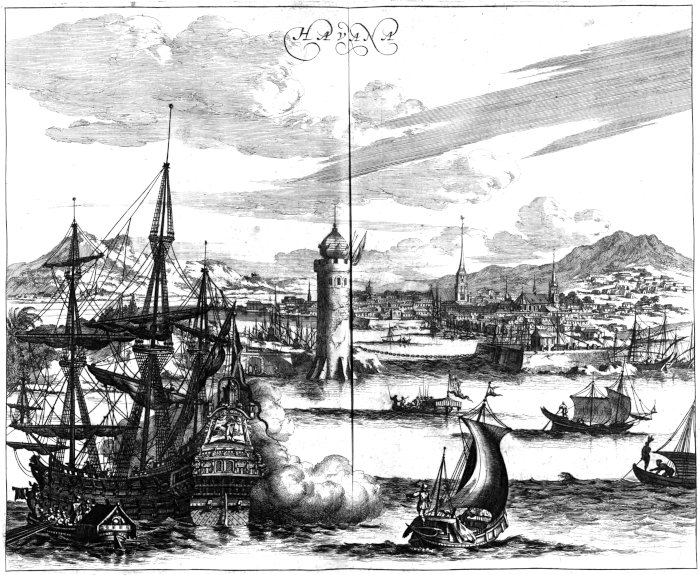
7. The chiefest City which the Spaniards possess in the West-Indies, and the present Seat of their Governor, is Christovall de Havana; which stood first on the South side of Cuba, but was afterwards built on the North, opposite to Florida: The Harbor before it is large and safe, for it is able to contain a thousand Ships, without the least endangering of one another, and yet the Entrance so narrow, between a 334Promontory and a square Fort, that two Ships cannot Sail in together: the shallowest part thereof hath six Fathom Water. On each side the Mouth of the Harbor is a Fort, the one call’d Mesa de Maria, which stands built on a Champain Ground; the other call’d Morro, which lies at the Foot of two Hills, on whose tops several Guns are planted, which Command the Town and Haven.
Betwixt these two Forts is a Tower cover’d, on the top whereof is a round Lantern, wherein stands continually a Watch-man, who puts forth as many Flags as he discovers Ships at Sea, to give notice thereof to the City, which is a Mile from thence.
Before Havana stands a third Castle, well stor’d with Guns, as likewise the rest are, in all to the number of two hundred and forty, and strongly Garrison’d; of which great care was taken by the General Jean de Texeda, and Baptista Antonelli, an Architect, sent thither by Philip the Second, King of Spain, to secure the Place from all foreign Assaults, because the Plate-Fleet, and other Ships that come out of the West-Indies, have their place of Rendezvouz here, and from hence set Sail altogether for Spain. The City stands along the Haven, and hath two Churches with spiry Steeples. The Houses are now built after the Spanish manner.
Havana several times Assaulted and taken.
But Havana was not so strongly fortifi’d in former times, for Anno 1536. it could not resist a mean French Pyrate, who losing the rest of his Fleet was driven hither by Storm, and conquering Havana, had burnt the same, consisting at that time of woodden Houses cover’d with Thatch, had not the Spaniards redeem’d them from the Fire for seven hundred Ducats; with which Money the French set Sail, when the day following three Ships arriv’d from New Spain before Havana, and having unladed their Goods, and preparing themselves for Battel, pursu’d the Pyrate; whom getting sight of, the Admiral, who Sail’d before, durst not venture to Engage him alone, but staid for the other two Ships: from which cowardly Action the French Pyrate taking Courage, fell on the Spanish Admiral, who without firing a Gun ran his Ship ashore, and deserted the same: the next Ship thereby discourag’d Tacking about, made away from the Enemy; on which the third also follow’d, insomuch that at last they were all three taken by the French; who encourag’d with this unexpected Victory, steer’d their Course a second time to Havana, where they got as much more Money from the Inhabitants as before. After this the Spaniards built all their Houses of Stone, and a Fort at the Mouth of the Harbor, yet nevertheless the City lay open on the Land side; of which the English Fleet, Cruising about in those Seas, being inform’d, Landed not far from Havana, and enter’d the City before Day-break: the Spaniards thus suddenly surpriz’d, fled into the Woods, whilest the English plunder’d and ransack’d the City without any resistance. But this was not the last Blow which Havana receiv’d, for during the Wars between the Emperor Charles the Fifth, and the French King Henry the Second, a Ship set Sail with ninety Soldiers from Diep to Cuba, where they made themselves Masters of St. Jago, and carried great Treasure away with them: Thus enrich’d, they set in the Night on Havana, but found their Expectations frustrated, for all the Houses were empty, the Spaniards (being so often Plunder’d) having remov’d all their Goods to their Countrey Houses, which lay scattering about the Island. Whilest the French were searching the Houses, two Spaniards came under pretence of agreeing with them, but their Design was chiefly to take an Account of their Enemies Forces. The French demanded six thousand Ducats of them: to which the two Spaniards reply’d, That all their Goods would not raise so much: then going to their Party, inform’d them of the number of the Enemies, and their Demands; whereupon Consulting, some judg’d it best to comply with a forc’d Necessity, and 335if they could not get any thing abated, to pay the demanded Sum: but most of them were of another opinion, alledging, That the number of the French was not equivalent to their Demands, and that it would not be for their Credit, to yield up their Estates so tamely, without trying their Title by the Sword: This being judg’d fittest, they march’d to Engage them with a hundred and fifty Men, which about Midnight fell on the French, and at the first Onset slew four of them; but upon the firing of the Gun they were all alarm’d, and after a small Skirmish, put the Spaniards to flight. The Conquerors enrag’d at this treacherous Plot of the Spaniards, set fire on Havana, in which at that time was a good quantity of Pitch and Tarr; with which the Gates, Windows, Roofs, and Pent-houses being all bedaub’d over, were in few hours all in a light Flame; after which the Churches in order for their firing, were also going to be over-laid with the same combustible Matter; at which a Spaniard boldly desir’d, that the Temples erected for Gods Service might be spar’d: to which he was answer’d, That People who keep not their Promise, nor had any Faith, had no need of Churches to profess their Faith in. The French not satisfi’d with burning, pull’d down the Walls, and utterly demolish’d the Fort.
The Haven Xagua.
The Haven Xagua also is not inferior to any, the Mouth thereof being a Boweshot wide, and within, ten Leagues: The Ships are securely shelter’d behind three Islands, and also the Mountains, which rise along the Shore.
The Success of Admiral Peter Hein.
Moreover, the Inlet Matanca is not onely eminent, by reason of the round Mountain Elan de Matancas, which rises from a low Ground; but chiefly for the Expeditions of Admiral Peter Peterson Hein, who being sent out by the West-India Company, to Cruse up and down before Havana with one and thirty Sail, was from thence by a strong Current driven down to Matanca; where he stood from the Shore, when ten Ships came just running amidst his Fleet, and were all taken but one: About Noon they discover’d nine Ships more, which Sailing along the Shore, got into the Inlet Matanca, where they ran aground; whither Hein following, came up to them the next Morning by Break-of-day, and after a small Resistance took them, being valu’d to be worth above a hundred and fifteen Tun of Gold, besides the Musk, Ambergreece, and Bezoar with which two other Ships were laden, and another rich Prize.
This large Island Cuba (as we have before observ’d) formerly divided into so many populous Territories, is now in a manner desolate; for according to the Spaniards Relation to the Admiral Henry Jacobson Lucifer, when he was before Havana, Cuba had upon it not above sixty thousand Persons in all, in Anno 1627. But who-ever Reads that which Bishop Bartholomeo de las Casas hath written in his Book, (Printed first in Sivill in the Spanish Tongue, and afterwards, with the King of Spain’s leave, in French at Antwerp) will easily find the reason, why Cuba and many other Indian Countreys lie so desolate; and how sensible the Indians were of the Spaniards usage, appears by this following Story, related by the said Bishop, of a Casique call’d Hathuey, who before the Spaniards approach’d his Countrey, Anno 1511. fled from Hispaniola to Cuba; where afterwards he was taken by the Spaniards, and condemn’d to be burnt alive with green Wood: whilest he was tying to a Stake, a Franciscan Monk Preach’d to him the Mysteries of the Christian Religion, of which he had never heard; and likewise that he should ascend up to Heaven if he dy’d in that Belief; but if not, burn perpetually in Hell: Whereupon Hathuey asking the Franciscan, If there were any Spaniards in Heaven? and being told there were, answer’d, I will rather converse amongst the Devils in Hell, than amongst the Spaniards, whose Cruelty is such, that none can be more miserable than where Spaniards are.
336Before we conclude the Description of Cuba, it will be material to add some Passages of a Letter from Major Smith, Governor of the Isle of Providence, who was taken there in the Year 1665. which will give light to the knowledge of the present State, not onely of Cuba, but of some other parts of America, belonging to the Spaniards; which is as followeth:
Maj. Smith’s Letter concerning Cuba and other Parts.
Cuba is a very good Island, and in it is generally the best Land, for so large a Countrey, as I have seen in America, although I have travell’d the main Continent in several places, and have cross’d from the North Sea to the South Sea, as also the North side of Hispaniola, and most parts of Jamaica.
This great Island is easie to be conquer’d, and would make the best Plantation, besides the prejudice it would be to the Spaniard, and the great advantage to our Nation; for instance, Had we the Port and City of Havana, which might in all probability be reduc’d with two Regiments of good Soldiers from Jamaica, carrying with them two or three Sloops or Shallops for Landing Men, fitted with good Arms and other Necessaries for an Assault, presently after their Armado hath pass’d out of the Indies, which is once in two years, towards the latter part of the Summer. There is good Landing on the West side of the City, where it lies open; and you need fear no Ambuscado’s: but not on the East side on the Harbor, for there you will be gawl’d by the strong Castle of the Moare, until the City be secur’d; but when that is once taken, you may easily reduce that Castle also, there being no danger of their re-taking it, until the next Armado arrives there, which will be almost two years, against which time you will have Planters enough from other of our Islands, to Manure the Land, and assist the Soldiers in defence thereof: This once effected, would utterly ruine the Spaniards, for these Reasons: Our Ships lying both here and at Jamaica, would be at all times ready to gather up their stragling Fleet, which it is difficult to keep imbodied without the help of that Port of Havana, it being impossible for their great unruly Ships to turn up to Windward from the Bay of Mexico, or Puerto Bello, without separation; and on the other side, to pass the Gulf of Florida, is for them as impossible, where they always Rendezvouz, Victual, Water, and provide all things necessary for their Return into Spain; after all which they diligently wait for a convenient Season of Winds and Weather (being much observ’d from the Changes of the Moon) when to pass that dangerous Straight: for to say truly, the Spaniards are neither very fit for Sea nor Land-Service, excepting some Officers and Soldiers bred in Flanders for Land-Service, and a few Biscainers for Sea-Affairs. They are so sensible of their Weakness, and jealous of their Riches in those Parts, that it is very difficult for any ingenious Man to get his Liberty, being once taken, fearing he might give such Intelligence, as to be thereby the cause of their ruine, witness their blind-folding of all Strangers, when they pass their Cities and Castles; for they much dread an old Prophecy amongst them, viz. That within a short time the English will as freely walk the Streets of Havana, as the Spaniards now do; which indeed had been easily perform’d with a third part of the English Army sent to Jamaica, and a far greater advantage to the Nation: for I esteem that Port and Harbor of Havana in the West-Indies, equivalent (against that Nation) to Tangier in the Straights of Gibraltar; and if we were at once Masters of both, it would without doubt so straiten the Spaniards, as absolutely to admit us a free Trade into their Ports of America, where they impart our Commodities, and sell them for ten times more than they first cost in Spain, by reason of the great plenty of Silver: which Trade would not onely be of infinite advantage to us, but also prevent them of their future enslaving of our Nation in Chains as now they do; for being employ’d about their Fortifications, they are worse us’d, all things consider’d, than if they were taken by the Turks.
337I have seen other parts of the West-Indies, where the Spaniards might be fleec’d of considerable quantities of Riches, as at Panama, where their Silver Bars lie pyl’d up in Heaps in the open Streets Day and Night without Guard for five or six Moneths together, waiting the arrival of the Armado; which when arriv’d in Puerto Bello, they Transport it thither with so slender a Guard, for so great a Treasure, as would be an easie Prey to a thousand resolv’d Men (although of extraordinary value for so small a Charge;) but here is no resting, nor long remaining, they being so numerous (as in all other places of the main Land) though of great Wealth, and easily gotten with a Catch and away: But to my purpose,
This Island of Cuba hath adjacent to it great Conveniences of Salt and Fishing; and in it are very great plenty of Horses, Neat, Sheep, and Hogs, both wild and tame, of a far larger and better breed than any other parts of America: It hath also many very rich Mines of Copper already open, and is the onely Place that supplies all the West-Indies with Metal for the infinite number of Ordnance they have in all their Ports and Castles, both in the North and South Seas; but whether it hath any Mines of Silver or Gold, I know not; but if there were any such, they would not adventure their opening and discovery, fearing the Invasion of that Island, whereunto is so easie access by Sea, and of so great import to their whole Interest in America: for which reason also they refuse to work any Mines in Florida, that are nigh the North Sea, (although they have there very many) but do rather employ themselves about others farther up in the Countrey, although with greater Labor and Cost, for conveyance of the Product by Land to Mexico. And lastly, (for its full praise) this Island hath many very good Ports and Harbors of great advantage to Ships, for safe passing the Gulf; and should the Spaniards keep three or four Frigats always plying between the Western end of Cuba and that of Havana, off and on, it were impossible for any Ships of ours that came from Jamaica to escape them; the Scales turn’d would be their Case to all America. Neither wants it great Sugar-works, which have Water-mills and Horse-mills, and very many large Cocoa Walks, the most and best Tobacco: and in short, it produceth all other Commodities, that any of our American Islands have knowledge of.

CHAP. XVI. Jamaica.
Situation and Extent of Jamaica.
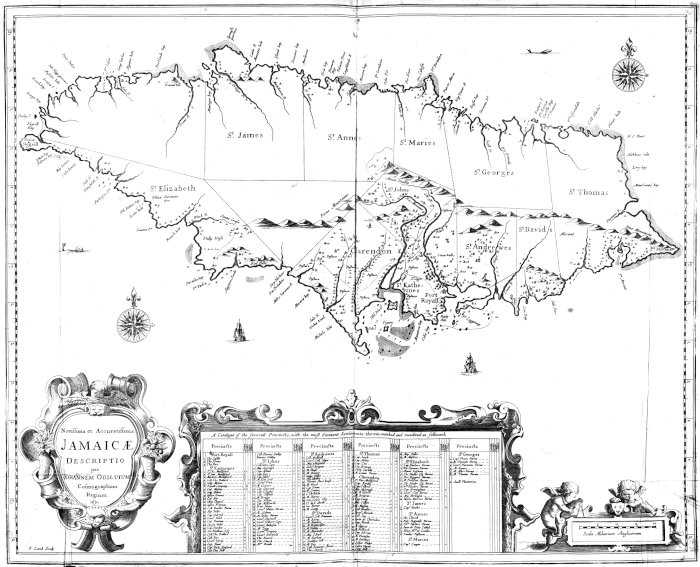
The Island of Jamaica lieth North from the Southern Continent of America, in the Sea call’d Mare del Nort; and South from the Isle of Cuba about twelve Leagues; and West from Hispaniola twenty, in eighteen Degrees of Northern Latitude; and beareth from Rio de Hacha North-West, a hundred and fifty Leagues; from Santa Martha North North-West, a hundred and thirty five; from Rio Grande North-West, a hundred and thirty; from Carthagena North, fourteen; from Porto Bello North-East and by North, a hundred and ninety; from the Bay of Darien, North and by East, a hundred and seventy; from the Bay of Mexico, a hundred and fifty. It is of Form something nearly resembling oval, being in length from East to West, about fifty four Leagues, or a hundred and seventy Miles; 338from North to South in the broadest and middlemost part, about three and twenty Leagues, or seventy Miles over, and so groweth narrower and narrower towards each Extream; in circumference about one hundred and fifty Leagues, or four hundred and fifty English Miles.
Nature of the Country.
This Island is well water’d with Springs and Rivers, and is all over, especially in the Western parts, full of high Hills and Mountains: It is also well Wooded; for the North and South parts chiefly abound with tall and large Woods: Nor are there wanting every where Savanas, or Pastures, which are thought to have been Fields of Indian Maiz, till the Spaniards arriving here, brought in Horses, Cows, Hogs, and Asinego’s to feed.
Temperature of the Air.
The Air in this Place is more temperate, and the Heat more tolerable, than in any of the rest of the Barloventi, by reason of the cool Breezes which constantly blow from the East, and the frequency of Showers of Rain, and refreshing Dews which fall in the Night.
This is also the onely Island of the Barloventi, which is not subject to violent Storms and Hurricanes; and the Diseases which are predominant here, are onely bred by Intemperance, as Surfets, Feavers, and Agues, or occasion’d by ill Diet or Slothfulness.
Commodities of the Island.
The Commodities of this Island are very many; and first for Vegetables, the Sugars are so good, that they now out-sell those of Barbado’s 5 s. per Cent.
Cocoa, of which there are many large Walks; and greater plenty by improvement may easily be produc’d.
Tobacco, so good, that the Merchants give Six pence a Pound for it, and buy it faster than the Planters can make it.
Indigo is producible in great abundance, if there were Hands sufficient employ’d about it.
The Cotton of this Place is accounted very firm and substantial, and preferr’d before any that grows in the neighboring Islands.
Of Tortoise-shell there is also good store, by reason that much of that sort of Tortoise is taken on this Coast.
Here are also great variety of Dye-woods, as Brasiletto, Fustwick, Red-wood, a kind of Log-wood, and several others, besides divers of those that are accounted the most curious and rich sorts of Woods, as Cedar, Mohogeney, Lignum-vitæ, Ebony, Granadilla, and others, which are frequently Exported.
Moreover, there are very probable testimonies, that there are Mines of Copper here, since both there have been those who affirm to have seen the Oar wrought out of one of them, and the Spaniards report the Bells that hang in the great Church, to have been Cast out of this Island Copper. As for Silver, the English are said to have been shew’d a Silver-Mine behind the Mountains, West of Cagway.
Ambergreece the Spaniards report to have been often found on this Coast.
Salt might be made here in great abundance, there being three good Salt-pans; and Salt-petre hath been found in many Parts.
Ginger is reported to grow better here than in most of the Caribbee Islands; and Cod-pepper very plentifully; and also a certain kind of Spice call’d Piemete, being in the form of East-India Pepper, of a very aromatical and curious taste, partaking as it were of divers species together: it grows wild in the Mountains, and is very highly valu’d amongst the Spaniards.
Of Drugs and medicinal Plants there is here a very great abundance, as Guaiacum, China-Root, Cassia-Fistula, Veuillard, Achiotes, Tamarinds, Contrayerva, Ciperas, Adiantum Nigrum, Aloes, Cucumis Agrestis, Sumach, Acacia, Misselto, with several others, both Drugs, Balsoms and Gums.
339Cochinele is produc’d by a Plant that grows in this Countrey, but it is not made without much care and curiosity, and the English are not yet well experienc’d in the Husbanding thereof, besides that the Growth of the Plant is much obstructed by Easterly Winds.
Beasts.
There is here greater store of Cattel than in any of the rest of the English Plantations in America, as Horses, which by reason of the great number of them, are bought very cheap.
Cow’s, of a large size, and of which vast numbers are yearly kill’d.
Asinego’s and Mules, both wild and tame, being a very serviceable sort of Cattel in those Countreys.
Sheep, large and tall, and whose Flesh is counted exceeding good, but the Fleece worth little.
Goats in great abundance, being a sort of Cattel very peculiar to that Countrey.
But of all other Cattel, Hogs are here in the greatest plenty, both wild in the Mountains, and tame in the Plantations; and they are more in request for Food than any of the rest, their Flesh being counted both of a better rellish, and more easily digestible than the Hogs-flesh of our Parts.
Fish.
The Fish that is very plentifully caught in these Coasts is of infinite variety, and quite of another kind from what we have in this part of the World, the principal whereof is the Tortoise, which is taken in great abundance both on these Coasts, and in the Islands Camavas.
Birds.
The tame Fowl in this Place, are chiefly Hens, Turkies, and Ducks; but of wild Fowl infinite store, as of Guinee Hens, Flamingo’s, Teal, Ducks, Wigeon, Geese, Pigeons, Snipes, Plovers, Parrots, Turtles, Parachites, Machaw’s, with divers others.
Fruit-Trees and other Plants.
Choice and excellent sorts of Fruits are here in great abundance, as Cocao-Nuts, Mannes, Maumees, Supatas, Suppotillias, Avocatas, Cashuds, Prickle-Apples, Pickle-Pears, Sower-Sops, Custud-Apples, and many others.
For Timber-Trees, Platanes and Pines.
And for Garden-Herbs, Radish, Lettice, Parsley, Cucumbers, Melons, &c.
The antient Inhabitants us’d two sorts of Bread, the one made of stamp’d Roots, and the other of Corn, which is Reap’d thrice every year, and grows with such success, that one Pint sow’n yields two hundred.
They had a strange way to make their Cazari Cakes of the Root Juca, which keep good a year: They first press’d out the Juice with great Weights, which if drunk raw, occasions sudden Death; but boyl’d, is pallatable and good.
Potato’s are here in great abundance, and grow like Artichokes in a moist Soil, and shoot forth Leaves of a dark-green Colour, like Spinage; they spread upon the Earth by Stalks, and bear a Flower like a Bell, at the end of which grows the Seed: the Roots are generally White, but sometimes Red, Marble-colour’d, Yellow, and Violet; they are not onely pleasing to the Pallat, but accounted very wholsom when stew’d in a close cover’d Pot, with a little Water.
But much daintier are the Ananas, which grow on a Stalk of a Foot long, surrounded with sixteen large sharp Leaves, between which grows a Fruit like a Pine-Apple, but much bigger, with an uneven Rind, of a pale Green, and inclining to a Carnation on a yellow Ground; on the top shoots out a red Bunch of Leaves and Flowers; the innermost Pulp melts on the Tongue, and is of so delicious a taste, that it exceeds all other Dainties; the Seed produces Fruit once.
Of this Fruit there are several sorts, the chief whereof is accounted a special Remedy against a bad Stomach, Gravel, Poyson, and Melancholy.
340The Drink made of Ananas is no way inferior to Malvasia Wine.
A sort of sensitive Plant.
Here you may observe a remarkable Secret of Nature in a certain ever-green Plant, which grows either on the Bodies of old Trees, on the Rocks, or in the Woods; the Stalk whereof surrounded with Leaves, full of dark red Spots, bears a sweet-smelling Violet-colour’d Flower, the Leaves whereof as soon as touch’d, close up together and die, and according as they are held in the Hand a shorter or longer time, this strange alteration continues.
Ginger.
Since the Spaniards planted Ginger on Jamaica, it hath grown there in great abundance; the Male Plant (for it is divided into Male and Female) hath generally bigger Leaves than the Female; the Stalks, which are without Knots, have more Leaves upwards than downwards, and spreads along the Earth, still take Root anew; when the Leaves wither, then the Ginger is commonly ripe, but it hath not that poinancy whilest green as when dry’d.
Cotton.
The Cotton of this Island (of which the Clothes and Hammocks that are made, are vended in most parts of the Western World) grows on a Tree of equal heighth with a Peach-Tree, with a straight Stem or Body, out of which shoot Boughs of an equal length, and at equal distance; between the Leaves, which are narrow and long, grow red Flowers, and from them, oval Cods, which when ripe, inclose the Cotton, and a Seed like Pepper.
Description of the Alligator.
Of hurtful Creatures here, besides the Manchonele, and a sort of Snakes call’d Guaana’s, wherein ’tis thought there is little or nothing of a poysonous quality; the most observable is the Alligator, with which many Rivers and Ponds abound; it is a very voracious Creature, but is seldom known to prey upon a Man; it moves swiftly and strongly forward, but turns slow; the biggest of them are about twenty Foot long, their Backs scaly and impenetrable, so that they are hardly kill’d but in the Belly or Eye; they have four Feet or Fins, with which they go or swim indifferently; are observ’d to make no kind of noise; their usual course for getting their Prey, is to lie on their Backs as dead, then with a sudden onset to surprize what-ever Fowl or Beast comes fearlesly near them; the best caution other Creatures have of them is from the strong smell that flows from their Bodies: to requite the harm done by them, they have something of vertue, for the Fat or Oyl of their Bodies hath been experienc’d to be an admirable Ointment for all kinds of Pains and Aches; they Lay Eggs no bigger than a Turkies by the Water side, still covering them with Sand, which heated by the Sun-beams, hatcheth the young ones, who naturally creep into the Water.
Muschilli and Merrywings.
In some parts of the Countrey there are also a sort of stinging Flies, call’d Muschilli and Merrywings, but the English Quarters are little infested by them.
Hugh Linschot writes, That the antient Natives of this Place were a subtile and sharp-witted People, skilful in Handicrafts, and expert in warlike Affairs, above all the Americans besides.
First Discovery of the Island.
The Island was discover’d by the Spaniards under the Conduct of Columbus, who first built there the Town of Mellilla; which disliking, he remov’d again to Oristana; and finding that an incommodious and unhealthy Situation, he remov’d again to another Plantation, where he built a very fair Town, first call’d Sevilla, afterwards St. Jago de la Vega, consisting of about seventeen hundred Houses, two Churches, two Chappels, and an Abbey, being the chief, if not the onely Seat of the Spaniards before the arrival of the English, for their Estanchas, or small Plantations, were committed wholly to the custody of their Slaves.
Diego, the Son of Christopher Colonus, (or, as he is vulgarly call’d, Columbus) was the first that was constituted Governor of this Island, and sent Juan de Squibello 341Commander, who upon their first arrival here committed such horrid Cruelties and Massacres, that (as the fore-mention’d Bartholomeo de las Casas writes) five thousand Inhabitants were in a short time reduc’d to less than three hundred, multitudes being put to death in a most inhumane and barbarous manner, some roasted alive, others torn in pieces by the Spanish Dogs, besides many other studied ways of Butchery, too dreadful to be read with patience; nor were they free from Civil War amongst themselves, which first began in this Island.
Attempts of the English upon his Island.
The first and onely Attempters upon this Island since the Spaniards made themselves Masters thereof, have been the English, who in the Year 1592. under the Conduct of Sir Anthony Shirley Landed upon it, & got clear possession thereof, none of the Spaniards that were then upon the Place daring to make the least resistance; but not thinking it worth the keeping, they soon deserted it, and made Sail back again for England: after which they remain’d unmolested for a long time, till in the Year 1654. a Fleet of English was set out for Hispaniola by Cromwell, under the Command of Colonel Venables, with a Design for the taking of St. Domingo; but meeting with ill success in the Enterprize, and being forc’d to quit that Island with loss of Men, and frustration of their hopes, they steer’d their Course for Jamaica, and on the tenth of May in the Year abovesaid, with little opposition possess’d themselves of it. Upon their approach to St. Jago the Inhabitants thereof deserted it, and betook them to the Mountains, gaining time by a pretence of Treaty, to secure their Women and Goods; and oftentimes making Incursions upon the stragling Parties of the English, slew and took many Prisoners by surprize: but being weary of this wild and irregular kind of living, they betake themselves at last to the Isle of Cuba, where many of them, the Grandees especially, were permitted by favour to continue, the rest being by the Vice-Roy commanded back, with promise of speedy and considerable Supplies; by that time this remnant of the Spaniards was near tir’d out with hardship and necessity, some being very much discourag’d and driven to utter despondence of Mind, others destroy’d out-right, part of the long promis’d and expected Supply arrives, the greatest part being to follow soon after; but 342finding the Islanders so few in number, and in so sickly and necessitous an Estate, they would not joyn with them, but maugre all the Governor’s Perswasions or Commands, retreat to the North part of the Island, and there fortifie at a place call’d Chireras, expecting every day fresh Recruits; which not coming time enough, and their Quarters being discover’d, they were set upon by the English, and most of them either slain or taken Prisoners: not many Moneths after the rest of the Spanish Forces Land, being in all about thirty Companies, with Ordnance and good store of Ammunition; who falling presently to make strong Fortifications at Rio Novo, are nevertheless in a short time utterly defeated by the English: Upon which, and several other ill Successes, despairing to re-gain the Island, they Ship off their Women and the richest of their Goods; and the Negro Slaves grown Masterless, by the general either slaughter or departure of their Patrons, shake off their Obedience to the Spaniards, and constitute a Governor of their own, a Black, yet submit themselves, and own Subjection to the English Government, the Spaniards from Cuba, both by their Perswasions and monethly Contributions, in vain endeavoring to reduce them; onely some few there were that stood out, whom the rest not onely made it their business to discover, but help’d the English to take them, insomuch that at last the Spanish General not having above fifty Men left him, was forc’d to seek for Peace, and offer’d Terms of Accommodation; which the English General would not be drawn to accept of, unless upon Condition that he should deliver up to Justice as many as were left of those that had barbarously murder’d any of our Men, either in time of Treaty, or after Quarter given.
The English in this Island are setled for above a hundred Miles along the Countrey from the Eastward.
Chief Towns.
Their chief Towns are 1. St. Jago, (built by the Spaniards, as afore mention’d) which lieth six Miles within the Land, North-West from the Harbor of Cagway. Here the English have built a small Fort.
2. Passage, a small Town, built also by the English six Miles from St. Jago, for the convenience of going to Cagway, consisting of about fifty Houses and a Fort, whence cross this Harbor, about three Leagues distant is the Town of 3. Cagway, seated on the Extream end of the Point, containing in it above six hundred Houses, all built by the English, besides the Governor’s Palace, and the Houses where the Stores for the Army are kept.
This is counted the most healthful Place in all the Island, and the very Scale of Trade, where all Merchants, Strangers, and Sailors reside.
Here, upon the utmost Angle of the Point towards the Sea, is a round Tower, built of Lime and Stone; about which is rais’d a strong and regular Fort, containing sixty pieces of Ordnance.
Port Royal.
This Town is now call’d Port Royal, and is thought to contain about sixteen thousand Inhabitants.
Landward.
A Mile from hence is another Fort, call’d Landward, which runs from the Harbor to the Sea, to defend the Town from any Attempt by Land.
Little Island.
Off the Mouth of the Harbor towards the Sea, lie divers small Islands, the most Western of which being within half a League of the Fort, and between which and the Fort every Ship that comes into the Harbor is necessitated to pass: It is call’d Little Island; where a Fort is likewise rais’d, to defend the Mouth of the Harbor, containing eight pieces of Ordnance.
Another Fortification is at Portmorant, which we shall make mention of amongst the Harbors.
Chief Ports and Harbors.
343The chief Harbors of this Island, are 1. Port Anthony, on the North, a very safe Land-lock’d Harbor, onely the coming in is somewhat difficult, the Channel being narrow’d by a little Island that lies off the Mouth of the Port.
2. On the East of the Island is Portmorant, a very capacious Harbor, where Ships do conveniently Wood and Water, and Ride safe from all Winds.
3. On the South is Port Cagway, a Harbor wonderfully convenient, secure and capacious, being five Leagues over in some places, in others four, and at the narrowest, three; it is Land-lock’d by a Point of Land that runs twelve Miles South-West from the Main of the Island, having the great River that comes by Los Angelos, and St. Jago running into it, and divers Springs about it, where Ships do conveniently Wood and Water. Here is every where good Anchorage, the Road being so deep, that a Ship of a thousand Tun may lay his sides to the Shore of the Point, and load and unload with Planks afloat.
4. On the West is Point Megrill, a Port very convenient and secure; to Windward from which, a little North-West, is the Seat of the old Town of Mellilla, founded by Columbus, as afore mention’d.
The chief Plantations of this Island, are 1. Portmorant, above the Harbor before mention’d, and by the two Rivers that run into it. Here are good Plantations of Sugars, Cottons, Tobacco’s, &c.
2. Hence about ten Miles lieth Morant, where a thousand Acres of Land have been taken up for my Lord Willoughby, and a Company of Merchants.
3. Hence farther Leeward lieth Yallow, having good Plantations of Cotton, Tobacco, and other Provisions, excellent Savana’s, and some store of tame Cattel.
4. Thirty Miles hence, on the North side of Cagway is Ligonce, where are excellent Plantations of Sugar, Cotton, and Tobacco, very pleasant Savana’s and some store of wild Cattel.
5. Twenty Miles farther West, nine Miles from the Harbor of Cagway, is Los Angelos, having some Plantations of Sugar, Cacao, and Tobacco, all which were old Spanish Plantations, and are less considerable than those made by the English in other places.
6. Eight Miles from hence, North-West, is Guanaboa, where likewise were some Spanish Plantations, since improv’d by the English, who have very many excellent Plantations of Sugar, Cacao, &c.
7. Hence West South-West lieth Guatabacoa, a most pleasant rich and fertile part of the Countrey, abounding with Cattel, and excellent Savana’s. Here the Negro’s setled that revolted from the Spaniards, who are endeavouring to make some Plantations of Tobacco’s and Provisions, and with them are setled some few English, who have divers Walks of Cacao.
The several Governors of the English in Jamaica.
The several Governors of this Island since the taking of it by the English, are as followeth: General Robert Venables staid upon the Place about three Moneths after the taking of it, and at his coming away for England he left the chief Command to Major General Richard Fortescue, who liv’d Governor about three Moneths; after which Lieutenant General Edward Doyly was by the Army elected President; but upon his coming away soon after for England, Lieutenant General William Brain was sent over Governor in his room; who living in the Government about three quarters of a year, did as it were bequeathe it again to Doyly, for he was chosen by vertue of a Blank Commission, wherein Brain had inserted his Name whom he would have succeed, and remain’d Commander in Chief both by Land and Sea till His Majesty’s Restauration, and then by His Majesty’s Letters Patents was confirm’d in the Government, and so was the first that was Governor there for His Majesty: 344The next that succeeded was the Lord Windsor, upon whose coming away Sir Thomas Muddiford was sent Governor, and after him Sir Thomas Linch, who remains Governor at present.

CHAP. XVII. The Islands call’d the Lucaies.
Situation and Description of the Lucaies.
Having done with the four Islands of Barlovento, as they are term’d, viz. Hispaniola, Cuba, Porto Rico, and Jamaica, we come next to the Lucaies, so call’d, as some think, from Lucaioneque, one of the biggest of them; they lie over against Florida, Westward from the Bermudas, South-West and North of Hispaniola, and the rest of the Barloventi; and because they are but small ones, and lie so near the Continent, Geographers sometimes describe them as a part, or appertaining to the Continent. The chiefest of these Islands are Lucaioneque afore-mention’d, Bahama, and Guanahani; Lucaioneque is accounted the biggest of them all, and lieth in twenty seven Degrees between Bahama and Guanahani. Bahama lies nearest to the Coast of Florida, and gives Name to the Straights so call’d, which run between the Cape of Florida and it, with such a violent Course and Torrent, that although it be above sixteen Miles broad, yet many times neither Wind nor Oars, can prevail against it; that though the Winds be prosperous, Ships cannot enter it; and if it be cross, they go with the Current; yet those Straights the Spanish Fleet must pass in their Return from the Havana towards Spain. Guanahani was the first piece of American Ground discover’d by Christopher Columbus, and therefore by him call’d San Salvador, or St. Saviour, because that thereby he was deliver’d from the mutinous rage of the Seamen, who threatned to throw him over-board, if they discover’d not Land in such a time. There are besides a number of small Isles scatter’d up and down, which are generally comprehended in the number of the Lucaies; one is Little Island, encompass’d with a company of Shelves call’d the Bimini, so that it is hardly accessible: there goes a Tradition, that it hath been inhabited by very beautiful Women, the fame of whom drew many to attempt to Land there and take up their Habitation; in which Attempt many were cast away: There is said to be a Fountain in the midst of it, of such a Vertue, that whosoever drank of the Waters of it, had their Youth renew’d. Also three Islands, or rather Rocks, call’d Los Martyres, lying to the South-East of Cape Florida, and cover’d for the most part with a whitish Sand and a few Bushes growing on them: they seem at a distance to bear a resemblance of Men, impal’d, or bound to Stakes, as the Martyrs in the primitive Times usually were, which occasion’d the Spaniards so to Name them; ’tis very dangerous to come too near them, but to have sight of them is of great use to Men at Sea; for by passing these Rocks, and leaving them on the South-East, they certainly know, that they are now entred the Straights of Bahama, that is, that they have left the Ocean, and are fall’n in amongst those many Islands, which do, as it were, Barracado and Block up the Eastern Coasts of America, towards Nombre de Dios and Terra Firma, as they call it, through which the Continent is sometimes dangerous, by reason of contrary Winds; and always such, that it requires the skill and care of an experienc’d Pilot to conduct the Ships well thither. The rest are Abacoa, twelve Leagues long; Yuma, twenty Leagues in length, and eight in breadth, between twenty four and 345twenty five Degrees; Yumeata, fifteen Leagues in length, between twenty three and twenty four Degrees; Jamana, seven Leagues every way; Yabague, ten Leagues likewise, and lying between twenty two and twenty three Degrees; Magaguana, twenty Leagues long, and ten broad; Quagua, ten Leagues every way, and lying between twenty and one and twenty Degrees; Caycos, five Leagues in length, and in the one and twentieth Degree; Mackre, in the twentieth Degree, encompass’d with Shelves; Abreo, environ’d also with Shelves, and fifteen Leagues long; also Guatao, Cigateo, Guanima, Jabaka, Triangulo, and several others.
The Lucaies left desolate by the Spaniards.
On these Islands are no Inhabitants; those that did live there were a harmless simple People, and therefore the easier taken and carried away by the Spaniards that have made them so desolate: Many of them seem of a good Mold, and the Latitude promiseth much fertility. The Air is certainly good and wholsom, and not so extream hot as other Parts of that heighth. There is scarce any Beast on them, save a Coney that hath a Tail like a Rat, but Pigeons and other Birds in great numbers.
There is the Gum Benjoin, of the best and worst sort; Guaiacum, Sasaparilla, and Sassafras; and on some of them Red-wood and Ambergreece.
Our English Sea-men are little acquainted with these Islands, though they Sail round them yearly.
English landing upon them.
In the time of the Rebellion one Captain Sail and others, obtain’d a Patent, making thither on the Coast of an Island, which was call’d Illutheria; his Ship was wrackt, but the People recover’d the Shore with a few Necessaries.
The Coasts of most of them are dangerous, and bad to make, and that Ship that shall be near or amongst them, must keep the Lead always going; but with a wary Pilot, and care in giving the Islands a fair Birth, they are easily recover’d.
The Spaniards know this Place well, and have a yearly Trade thither for the aforesaid Commodities, and amongst the Islands are Wracks of divers of their Ships.

CHAP. XVIII. The Caribby Islands.
Situation and Names of the Caribbee Islands.
The Caribbee Islands, as they are generally call’d, are a Row or Ridge, as it were, of lesser Islands, which extend themselves almost in fashion of a Bowe, from the Coast of Paria as far as St. John de Porto Rico; they are otherwise call’d The-Caraibes, sometimes The Camercanes, and by some The Islands of Cannibals, or Man-eaters, (though this Appellation cannot in reality be more appropriated to these Islands, than to many other, either Islands, or Parts of the Continent of America;) lastly, whereas all the Islands between Florida and New Spain, and Southern America, are by some comprehended all under the Name of The Antilles; yet the Caribbees and the Antilles are most generally, and, we conceive, most properly accounted the same; and they are so call’d, either as lying like a Bar before the greater Islands, or Quasi Ant-Isles, i. e. Opposites Isles; they lie all under the Torrid Zone, between the eleventh and nineteenth Degrees of Northern Latitude, and are twenty eight in number; but before we come to treat of each of them in particular, we shall take notice of the most observable of those things which are common to them all in general.
Temperature of the Air.
346The Air of all these Islands is of a good temperature and healthy, and the Heat not so excessive in them at any time of the year, as might be conjectur’d from their Situation under the Torrid Zone, by reason of a gentle East Wind, which rising in the Morning, continues most commonly till towards the Evening, allaying the scorching heat of the Sun, and refreshing the Air; but the Nights are commonly very cold; and it is observable, that by how much the hotter any Day hath been, so much the colder the Night following happens to be; whereof this reason is given, That the Vapors rais’d in the Day-time by the Sun, and falling down condens’d at Night, do very much cool the Air; but it is never so cold as to Freeze.
For half a year together Day and Night are equal in these Parts, and the rest of the Year the Day fourteen hours long, and the Night ten.
From April to December there commonly fall here great Rains, and all that Season is accounted Winter, and the Drought and Heat of the other Moneths is taken for Summer; but the Woods of these Parts looking ever green, make as it were continual Summer.
Nature of the Soil.
The Soil is generally as fertile as in most places of Europe, and each Island furnish’d with fair Rivers, Brooks, Lakes, Springs, Wells, and other Sources of fresh Water, besides in many places Mineral Waters, which are us’d with good success in the cure of several Diseases; also out of some Mountains store of Brimstone is digg’d, and it is conjectur’d that there are not wanting Mines of Gold and Silver, if they were well look’d after; and there hath been often found Crystal upon the Sands by Rivers sides.
Vines growing naturally in the Caribbees.
The Vine, though wild, and naturally growing in the Woods, yet yields a very large fair Grape; and those which are cultivated in their Gardens or Vineyards, bear excellent Grapes twice a year, but very little Wine is made of them, in regard they find it will keep but very few days.
Wheat not apt to grow there.
Wheat in the Caribbees grows up no farther than the Blade, and the reason is judg’d to be, because through the rankness of the Soil, and for want of Winter, this Grain springs up fast, and hath not substance enough left in the Root to supply it up to maturity; but no doubt but Barley, Rye, and those other Grains, to the ripening of which more Heat is requir’d, would thrive there very well.
Besides Lemmon-Trees, Orange-Trees, Citrons, and Pomegranates, and other Fruit-Trees growing in Europe, there are very many sorts of Trees, Herbs, Pulse, and other Plants, of a different kind from those amongst us, and peculiar for the most part to these Islands.
Fruit-Trees.
Of Fruit-Trees, the most observable are the Goyavier, somewhat resembling the Laurel, onely having a softer Leaf, and of a brighter Green; its Fruit about the bigness of a Pearmain, but full of little Kernels like a Pomegranate.
The Papayer, which is of two kinds, one generally growing in all the Islands, the other proper to Santa Crux; the first hath a Leaf not much unlike that of the Fig-Tree, and the other bears a Fruit about the bigness of a Melon, which by the Portuguese is call’d Mamao, from its resemblance of a Womans Breast: the Tree is hollow and spungy within, and grows up sometimes to the heighth of twenty Foot.
The Monick, call’d by the Islanders Corsot, from the Name of an Island from whence the Seeds were first brought by the Dutch, and bearing a Fruit like a small Cucumber not perfectly ripe.
The Junipa, or Jenipa, by the Portuguese call’d Jenipapo; and by the Brasilians, Jenipaba; having Leaves like those of the Walnut-Tree, Flowers like the Narcissus, and a Fruit like a bak’d Apple, which when it falls from the Tree makes a noise like the Report of a Gun discharg’d, which is said to proceed from the bursting 347forth of the Seed out of the thin Skin enclosing it, and breaking with a violence; the Juice of it Dyes of a Violet-colour, and the Swine and Birds that feed upon it, are said to have their Flesh and Fat of the same colour.
A sort of Vine commonly call’d The Raisin-Tree and by the Caribbeeans, Ouliem; whose Fruit being like a large Violet-colour’d Grape, hath in stead of the several small Grain-stones which are inclos’d in the Husks of common Grapes, one hard Stone, like that of a Plumb.
The Acajou, bearing for Fruit a kind of Chesnut, in form of a Hares Kidney, which serves for a Crest to a very fair Apple that by degrees grows under it, of which the Islanders make a Drink, very much in esteem amongst them, being of an excellent taste.
The Icaco, a kind of small Plumb-Tree, so much coveted, and held for a Delicacy by some People that live near the Gulf of Hondures, that they are from thence call’d Icacos.
The Monbain, which Fruit being a kind of yellowish Plumb, is chiefly made use of to mix in the Drinks of Ouicon and Maby, to make them taste the better.
The Courbury is by some reckon’d to be but a species of the Monbain, onely more full of Leaves, and growing higher and bigger; but the Fruit of the Courbury is sufficiently different from that of the Monbain.
The Indian Fig-Tree, differing in Leaf from the common Fig-Tree, but whose Fruit both in figure and taste is not much unlike the Fig growing in these Parts: This Tree is commonly of such a vast Bulk, that the Branches of some of them have been seen to afford shelter to two hundred Men.
A kind of Service-Tree, differing from ours, by its exceeding heighth, fair Leaves, and pleasant Fruit.
The Prickly or Thorny Palm, so call’d from its being arm’d all over with Prickles, both Trunk and Leaves; by incision into its Branches a sort of Wine is made, and it is conjectur’d to be the same Tree which the Brasilians call Ayry.
The Franc-Palm, an exceeding high and streight Tree, bearing on the top of its Trunk a whitish marrowy substance, by the French call’d Choude Palmiste, or Palm-Cabbage; for being boyl’d with the thin Leaves that incircle it, and well season’d, it is reckon’d amongst the Delicacies of the Caribbees.
Latanier, another kind of Palm; and Cocoa, which is also reckon’d amongst the several sorts of Palms; this last is a Fruit-Tree famous all over America, and hath been at large describ’d elsewhere.
There are also many other Trees fit for Dying, Joyners Work, and Building, (besides the Acajou before mention’d, of the single Trunks whereof are made those long Shallops call’d Pyrages, which are able to carry fifty Men) as
The Acomas, of the same bulk and heighth with the Acajon, and equally esteem’d by Joyners and Carpenters, and of the Fruit whereof the Woodquists grow fat at a certain time of the year.
The Rose-wood, to be rank’d amongst the chiefest of those Trees that are made use of by Work-men.
Indian Wood, a very precious and useful Tree for several sorts of Materials, and of a very fine scent.
The Iron-Wood, so call’d from its hardness, weight and solidity, above all that have hitherto been spoken of, and beyond either Cypress or Cedar for incorruptibility.
Brasile-Wood, so call’d as growing most plentifully in Brasile.
Yellow-Wood, denominated from its Colour, and much esteem’d for its usefulness 348in Dying green Ebony, easily taking the lustre of the true Ebony, and being very useful for the making of Cabinets and other curious Pieces of Work; It also Dyes of a very fair Grass-green.
The Roncon, by the Brasilians call’d Urnex, in the Husks, succeeding the Flowers whereof, which grow in little Bushes at the end of the Branches, is enclos’d a most rich Vermilion Dye, of a very soft and viscous Matter.
Here are also many other Trees, either useful in Medicine, or other ways advantageous, as the Cassia-Tree, of the bigness and figure of a Peach-Tree; the long Pipes or Cods whereof, containing the Medicinal Fruit, are well known amongst us by the Name of Cassia-Fistula, and to be had at every Apothecaries.
Medicinal Nuts, each Nut containing three or four Stones in so many Cells, every one of which is inclos’d within a thin white Pellicle, pleasant enough to the taste, and out of which is extracted an Oyl, us’d by the Portuguese in several both Culinarie and Physical occasions.
The Cinamon-Tree, so noted for its aromatick Bark; also Sandal-Wood, Guaiacum, and Sassafras.
Cotton-Tree and Soap-Tree, whose Uses the very Names imply, and which Trees have been touch’d upon elsewhere.
The arch’d Indian Fig-Tree, the Bodies of which Trees have been antiently the sculking Holes and Retreats of the Inhabitants from their Enemies; the Bark is useful for Tanners.
The Gourd-Tree, of the bigness and heighth of a great Apple-Tree, and of which are made most of the Houshold Vessels and Utensils, which are in common use at present amongst the Inhabitants.
The Mahot-Tree, of the Bark of which are made Laces and Points.
The Manyoc, or Mandioque, of whose Root the Cassava Bread is made, and which growing in several places of America, hath been already taken notice of; as likewise the Banana-Tree, and that call’d The Apple-Tree of Paradice, otherwise Adam’s Fig-Tree, the Fruit being reported to be of a very delicious taste.
Other Trees not known in Europe, are the Maposu, divers kinds of Thorny Wood, the Milky Tree, being of a venomous quality, the Mancenilier, and that whose Root beaten to Powder, and thrown into Rivers, intoxicates the Fish, with several others of less note.
Innumerable sorts of Shrubs might here in like manner be reckon’d up, but the chiefest are, That remarkable Plant, anciently known by the Name of Ricinus, and commended for its Vertues by Galen and Dioscorides.
Coral-Wood, so call’d from its little Seeds, which being as red as any Coral, are us’d for Bracelets.
The Jasmin, bearing a Flower of an admirable sweet scent.
The Candle-Wood, so call’d from its combustibleness, by reason of an aromatick Gum which is within.
The Herbs, Flowers, Roots, and Pulse which grow here, are some of them common in all parts of Europe, as Cabbages, Onions, Chibols, Melons, all sorts of Millets, Cucumbers, Citruls, Parsnips, &c.
Others, if not peculiar to this Island, yet growing chiefly there, and in some few parts of America besides, as the Raquettes, so call’d from the resemblance its Leaves have with a Racket, a thorny-spreading Bush, whose Fruit being of a Vermilion colour, makes the Urine of those that eat of it as red as Blood. Some liken this Plant to the Tunas, already describ’d, which yields that rich Scarlet Dye call’d Cochinele.
349The Torch, so call’d by the European Inhabitants; by the Native Islanders, Akoulerou; a great Thistle, or thorny Bush, putting forth from the middle of it long streight Stalks like Torches, and bearing Fruit like a great Fig, not unpleasing to the taste.
The Lienes, creeping upon the Earth, and spreading up and down like Ropes, and bearing brown Husks of a Foot long, wherein are enclos’d a Fruit call’d Sea-Chestnuts, of which are made Boxes to keep Snush, Tobacco, or the like.
A sort of Sempervivum, which runs twisting upon Rocks, Trunks of old Trees, like Misseltoe, and sometimes on the Ground.
A sort of sensitive Plant, call’d by the Inhabitants Haestiel, or The Living Herb; of which kind of Plant something hath been already touch’d upon, and which being transplanted, is kept in several Gardens of the Curiosi as a Rarity.
The Sweet-Rush, whose small Root dry’d, and reduc’d to Powder, helps Women in Travail.
The Balisier, whose Leaf apply’d, mollifies and cools inflammations of Wounds.
The Dart-Herb, whose Root bruis’d and apply’d, draws away the Venom of empoyson’d Darts; besides Scolopendria, a sort of Aloes, several kinds of Maidenhair, and other medicinal Herbs.
The Granadilla, or Passion-Flower, growing in several other parts of America, and describ’d elsewhere.
There is also a sort of Pease in some of these Islands, differing from ours, and call’d The Pease of Angola, as first brought from thence. Likewise a sort of Beans call’d The Seven-years Beans, by reason the same Stalk bears seven years one after another.
The Herb call’d The Musk-Herb, from the dusky colour of its Flower, and the sweet scent of the Seed, grows also in these Parts very frequent.
The Pyman, or American Pepper, is the same with that before describ’d under the Name of Axi.
Their Potatoe is a Root not unlike the Topinambous, or Jerusalem-Artichokes, otherwise call’d Saligots, growing plentifully in our Gardens, but more wholsome, and of a better taste.
The Anana’s, or Pine-Apple, accounted a most delicious Fruit, of an admirable sweet scent, and very pleasant to behold, grow not onely plentifully in these Islands, but in most places of America; besides the Sugar-Canes here, and in many other places, but not so generally.
The Plant from which is got the Dying Material call’d Indico, is very different from that which grows in Madagascar, which bears small odoriferous Flowers, of a white and purple Colour mix’d together.
Of these Trees, Herbs, and other Plants, which are produc’d in these Caribbee Islands, some are more peculiarly of the Growth of one Island, some of another; so that we shall have occasion to speak more largely of some of them, when we come to speak of each Island in particular.
The four-footed Beasts found in these Islands, are chiefly the Opassum, the Javaris, the Tatan, the Agouty, and the Musk-Rat, which being all of them no less known in other Parts of the New World, have been already taken notice of, and of which we may have also occasion to treat more at large in the particular Islands, we shall therefore onely name the other Animals, whether Birds, Reptiles, Insects, or Fishes, as partly having been heretofore treated of, and partly to be describ’d hereafter.
The Birds are, the Fregates, Fauves, Craw-fowl, or Grandgawsiers, Flammans, Swallows of America, Arras, Canides, Parrots, Parroquito’s, Tremblo’s, Sparrows of America, Eagles 350of Orinoca, Manstenys, Colibrys, besides what are common amongst us, as Herons, Coots, or Moor-hens, Black-birds, Feldivars, Thrushes, Turtles, Woodquists, Pintado’s, &c.
Reptiles.
The Reptiles are, Anotis, Zoquets, and Maboujats (of which farther mention will occur in the Isle of St. Christopher) Globe-mouches, nam’d by the Caribbeeans, Oulleouma, Scorpions, and several sorts of Lizards, call’d by the Caribbeeans, Ouamayaca; by the Brasilians, Senembi; and by other Indians, Jaquanas.
Insects.
The Insects are, besides these common with us, as Glow-worms, Palmer-worms, Spiders, Bees, &c. the Cucuyos, mention’d in Hispaniola, and the Flying Tyger.
Fishes.
The Fishes are, Sea-Parrots, the Dorada, by some call’d The Sea-Bream, by others, The Amber-fish; the Bonite, the Needle-fish, the Epadon, or Sword-fish, the Marsovin, the Requiem, the Remora, the Lamantin, the Becune, the Sea-Urchin, the Sea-Woodcock, besides Whales, and a certan Fish call’d, for its hideous shape, The Sea-Devil, and lastly, the Sea-Unicorn, with a particular Description of which we shall conclude, as having it from Monsieur du Montel, who was an Eye-witness thereof.
Description of the Sea-Unicorn.
“This Unicorn (saith he) was pursuing a Carangue, or some other lesser Fish, with such earnestness and impetuosity, that not considering that it needed a greater depth of Water than the other, it stuck with half the Body dry on a Sand-bank, whence it could not recover the deeper Waters ere it was destroy’d by the Inhabitants: It was about eighteen Foot in length, being at the largest part of its Body about the bigness of a Barrel: It had six great Fins like the ends of Galley-Oars, whereof two were plac’d near the Gills, and the other four on the sides of the Belly at equal distances; they were of a Vermilion red colour: All the upper part of the Body was cover’d with great Scales, about the bigness of a Crown-Piece, which were of a blue colour, intermix’d with several Spangles of Silver; near the Neck the Scales were closer, and of a dark colour, seeming as it were a Collar; the Scales under the Belly were yellow, the Tail forked, the Head somewhat bigger than that of a Horse, and near the same figure: It was cover’d with a hard and dark-colour’d Skin; and as the Land-Unicorn hath one Horn in his Fore-head, so this Sea-Unicorn had a very fair one issuing out of the fore-part of his Head, about nine Foot and a half in length; it was as streight as could be, and from the place whence it came out it grew smaller and smaller to the very Point, which was so sharp, that being thrust hard, it would enter into Wood or Stone, or some more solid Substance; it was at the place where it came out of the Head, about sixteen Inches about, and from thence to two thirds of the length it was like a Screw, or, to say better, made waving like a wreath’d Pillar, save that the Channels grew smaller and smaller, till they gently ended in a Point, which was two Inches beyond the fourth Foot: All the lower part had over it an Ash-colour’d Skin, which was all over cover’d with a small soft Hair, short as Plush, and of the colour of a wither’d Leaf, but under that it was as white as Ivory: As to the other part, which seem’d naked, it was naturally polish’d, of a shining Black, mark’d with certain small white and yellow Strokes, and of such solidity, that a sharp File could hardly get a little small Powder from it: It had no Ears standing up, but two spacious Gills, as the other Fishes; the Eyes were about the bigness of a Hens Egg; the Ball, which was of a Skye-colour Enamell’d with Yellow, was encompass’d with a certain Vermilion, which had beyond it another as clear as Crystal: The Mouth was wide enough, and furnish’d with several Teeth, whereof those before were extreamly sharp, and those towards the Throat in both Jaws were broad, and a little knobbed: The Tongue was of a length and thickness proportionable, and cover’d with a rough Skin of a Vermilion colour. What was further remarkable, is, that this Fish 351had upon the Head a kind of Crown, rising above the Skin about two Inches, and made oval-wise, the Extremities whereof ended in a Point. Above three hundred Persons of that Island did eat of the Meat of it, and that plentifully, and thought it extreamly delicate; It was interlarded with Fat, and being boyl’d it came up in flakes like fresh Cod, but it had a much more excellent taste.
“Those who had seen this rare Fish alive, and had with great Levers broken the Back of it, affirm’d, That he had made prodigious Attempts to thrust them with his Horn, which he turn’d with an inexpressible dexterity and nimbleness, and that if he had had as much Water under him as would have born him up, he would have been too hard for them all. When the Entrails were taken out, it was found that he liv’d by Prey; for there were within him the Scales of several kinds of Fish.
“What could be preserv’d of this miraculous Animal, especially the Head, and the precious Horn fastned in it, hung up near two years at the Guard-house of the Island, till Monsieur Le Vasseur, the Governor of it, presented one Monsieur Des Trancarts (a Gentleman of Xaintonge, who had given him a Visit) with the Horn. Not long after, coming over in the same Ship with the Gentleman, who had that precious Rarity put up in a long Chest, our Ship was cast away near the Island of Payala, one of the Assores, and all the Goods were lost, but nothing so much regretted as the loss of that Chest.”
The Natives how call’d.
The Natives call themselves Cubao-bonon, that is, Inhabitants of the Islands, and Caribbeeans; which last Denomination was not onely receiv’d amongst the American Isles, but also on the Main Continent of the Northern and Southern America, long before the Spaniards coming thither.
Their Original.
The Cofachites come to Terms of Agreement with the Apalachites.
Concerning the original of these People, there are several Opinions; for those who make them to be Extracted from the Jews, have no other testimony, but that they abstain from Swines-flesh: Those that take them for a People fled from the great Islands, Hispaniola, Jamaica, Cuba, and Porto Rico, to save themselves from the Spaniards Cruelty, dispute against a known Truth; for who knows not, that the Indians who escap’d the Spanish Slaughter, have not the least resemblance either in Language or Customs with the Cannibals? nay more, they are mortal Enemies to them; besides that, the Cannibals at that time when Columbus first arriv’d, possess’d those Places which they now inhabit. The Cannibals seem ignorant themselves in this Point: for they affirm their Extraction to be from Guyana, where the Calibites speak the same Language, and also observe the same Customs and Religion: The occasion of their removal they ascribe to the King of the Arovages, who made all the adjacent People about his Court, Slaves to him; which to prevent, they first went to Tabago, where being strengthned by new Comers, they resolv’d to take revenge on him; and Engaging with him in a Field-Battel, utterly defeated him, and spar’d none of his Party alive, except the Women; whence it proceeds, that the Arovage Women have the same Customs and Language with the Caribbeans. But Bristock, an English Knight, by long Conversation experienc’d in the several American Tongues, saith, That the Caribbeeans have their Original from the Apalachites in Florida, who being a valiant People, destroy’d many of the Natives that inhabited Mexico, that so they might Settle themselves there; to which purpose they built a City like that of Apalache. The Cofachites inhabiting Northerly, and spread over a barren and Rocky Countrey, made use of this opportunity to conquer their deserted Habitation: for on a set-time they set fire to all the Villages, and spoyl’d all things which they could not carry away with them, that not the least hopes of returning might be left them; therefore they must either Conquer or Die: which resolv’d 352upon, they fell unawares on the Apalachites, whose King had nevertheless so much time, that he Guarded the usual Paths which directed to the inhabited Villages: But the Apalachites leaving the common Roads, climb’d over almost inaccessible Mountains, and so got into the heart of the Countrey, which exceedingly amaz’d Paracousis (for so that King was call’d) who lay Encamp’d at the Foot of a Mountain, whether the Van of the Apalachites were marching: whereupon he sending his Army to meet them, they began a most fierce Combat; when at last both Parties wanting Arrows, they fell upon one another with Clubs till the Night parted them; and neither could boast of the Victory. At last this War was turn’d into Peace, and the Articles of Agreement were these, viz.
That the Cofachites should for ever possess the Province Amana, and become one People with the Apalachites, and acknowledge the King of Apalache for their Chief Governor.
They fall off.
Are brought to worship the Sun.
After which the Cofachites were call’d Caribbeeans, which signifies Accidental Subjects: But these two sorts of People did not long agree; for the Caribbeeans sleighted the Customs of the Apalachites in the Countrey Bemarin, and at the same time threw off their Obedience to the King, chose one Ragazin for their Governor, subdu’d the neighboring Province Matika, and at last defi’d the Apalachites; who inferior to them in Strength, and making use of subtilty, suppos’d it the best way to make a Difference amongst the Caribbeeans themselves; to which the Priests freely proffer’d their Assistance, and their Design prov’d also successful; for the Caribbeeans regarding no Religion (onely dreading the angry Deity Mabouya) the Apalachite Priests call’d Jaova’s, took great pains to perswade their Neighbors to the worshipping of the Sun; which so prevail’d, that a considerable number of them ascending the Mountain Olaimi, fell down and shew’d Reverence to that celestial Luminary; which Opportunity Paracousis taking notice of, caus’d the Jaova’s to publish amongst the Caribbeeans, That in the beginning of the Maairims, or March, a great Feast should be held in Reverence to the Sun on the usual place, where the King would Entertain, and give Presents to all the Worshippers thereof.
The Sun generally worshipp’d by the antient Heathens.
How great a Religion this Sun-worship was antiently amongst the Gentiles, appears from the Writings of several authentick Authors.
The Syrians, whose Idolatry the Israelites learn’d, honor the Sun by the Name of Babal, which signifies Lord.
The Phenicians call’d the Sun Beel-samen, Lord of the Heavens; and the Citizens of Accaron, Baal-zebahim, Lord of the Offerings; but God chang’d the Name to Baal-zebub, or The God of Flyes.
Moloch, or Milcom also signifi’d the Sun amongst the Ammonites; in honor of which Children were carried by their Parents, and set between two great Fires, or else by the Priests, upon pretence of cleansing them; and sometimes parch’d to death in an Image of Moloch, which had seven Cavities heated like Ovens.
Macrobius tells us, That the Assyrians ascrib’d the supream Command to the Sun, under the Name of Adad, and to the Goddess Adargatis, representing the Image of Adad with Beams darting downwards, and Adargatis with those that shot upwards: by the first they express’d, that the celestial Power consisted in Sun-beams, which shooting downwards warm the Earth; and by the second, that all things by those Beams were cherish’d and enliven’d.
The most magnificent Temple which Syria Apamena boasted, was Consecrated to the Sun.
The Arabians Offer’d Myrrhe on the tops of their Houses at the Rising of the Sun; who also was the Chamos and Baal-Peor of the Moabites and Medians.
Near the Red-Sea, lay the City Baisamsa, which signifies The House of the Sun, famous for the many Feasts which were kept there in honor of this Planet.
353The Persians accounted this Luminary for the greatest God, and Consecrated to him three several Feasts, looking upon him as the Author of Wisdom, Goodness, and Power, and is express’d by three several Operations, viz. Warmth, Light, and Distinction of Time.
The Egyptians honor’d the Name of Osiris, whom some will have to be the same with Misraim, or Chamszoon, the first Founder of the Egyptian Monarchy.
In Egypt also was famous amongst many other Cities that of Heliopolis, which signifi’d The City of the Sun; where the Ox Mnevis or Menapis being Consecrated to the Sun, was religiously worshipp’d. This Image is describ’d by Macrobius.
The Moors made likewise great Offerings to their Assabin, for so they call’d the Sun; and allow’d their Priests onely the priviledge to gather Cinamon, and that with this Proviso, That they should first Offer forty four Oxen, besides Goats and Rams, to Assabin, nor should fetch the least Stick of Cinamon either immediately before or after Sun-set: The Cinamon brought altogether, was to be divided by the Chief Priest, and the rest having each their Portion assign’d, that which remain’d was sold to the Merchants, to Trade with into Foreign Parts; but if the Sun chanc’d to set the Cinamon on fire, then they concluded they had not dealt justly.
The Greeks, according to Proclus, hung a long Pole full of Laurel and Flowers on every seventh day of the Moneth; on the top thereof was a great Copper Ball, from which hung others still lesser and lesser; about the middle of the Pole hung three hundred and sixty five Garlands; and the bottom thereof was cover’d with a Womans Garment of a yellow colour: The uppermost Ball represented the Sun, the lesser the Stars, and the Garlands the Days of the Year; in which manner they worshipp’d the Sun.
Why Divine Worship so generally given to the Sun.
The same Luminary the Massagetes and old Germans ador’d in antient times; and to this day the People in the utmost North, Japanners, Chineses, Tartars, and the East and West-Indians, pay their chief Devotions to the Sun; the reason of which may easily be made out: for it is the common Opinion of all Men, as Aristotle, Simplicius, Themistius, and other Heathens witness, to place the Omnipotent Godhead in the uppermost Orb, which surrounds the Earth; wherefore those that Pray, lift up their Hands to Heaven: but because the rest of the Heavens appear not so resplendent as the Sun, therefore they take the Sun for the onely chief God, whether for its exceeding lustre and glory, or for its being a hundred and sixty times bigger than the Earth; or for its swift Course, in running ten hundred thousand Leagues in so short a time, or for its nourishing and genial Warmth, which gives Life to all things, or for its necessary Light, by which all worldly Affairs are manag’d, or for its measuring the Days by its moving from East to West, and the Seasons of the Year, by a Course from the South to the North; for all these excellent qualities being well consider’d by the most Learned Heathens, or observ’d by those of lesser Judgment, have made them shew that Honor to a visible Creature, which is onely due to the invisible Creator.
These and such like Arguments induc’d the Caribbeeans to go to Bemarin, where the Feast of the Sun was to be kept.
The Apalachites and Caribbeans make an Offering to the Sun on the Mountain Olaimi.
Part of the Caribbeans revolt from the Apalachites.
They people the Caribees and grow powerful.
The Apalachite King also Entertain’d the neighboring People exceeding courteously in the chief City Melilot; from whence he was carried in a Chair on the Shoulders of four Men, with sound of Pipes and Drums, and an innumerable company of People, to the top of the Mountain Olaimi, where he made a stately Offering to the Sun, and afterwards Feasting and Caressing the Caribbeeans with Gifts, he sent them home all well contented and satisfi’d with their Entertainment. This Custom 354was yearly observ’d, when at last they began to neglect their Duty, wherefore Toltlabin resolv’d to proclaim War against the Caribbeeans, if they did not continue paying their Devotions to the Sun: which Injunction was differently receiv’d; some judg’d it to be inconsistent with their purchas’d Freedom, to receive Laws for Religion from a neighboring King, alledging, That if any Reverence was due to the Sun, it might as well be given on the Mountains of Amana as within Toltlabin’s Realm: others, who lov’d Peace, and had a zeal to the Olaimi Religion, would not be against the Proposals, which occasion’d a Contention amongst themselves, and every one apply’d himself to those that were of his Opinion; nevertheless those that stood upon their Freedom, were of the greatest Party; wherefore the Worshippers of the Sun clos’d with the Apalachites, who going out with their Forces, routed the other Party, and receiv’d those Caribbeeans that joyn’d with them in Religion into Co-partnership also in the Government, so that they united into one People: But those that were routed rally’d again, and not without thousands of Inconveniences made towards the Sea, where Embarquing, they Landed first on the Isle Ajay, now call’d Sancta Crux, and in process of time grew very populous; for from thence by degrees have been peopled all the little Isles which lie before America, and grew so considerable, that they were sought to by the Calabites, to side with them against the Arovaces, Yaos, Sappayos, and other People their Enemies on the Main Continent, where they have taken many large Countreys, extending as far as Brasile, where they are greatly respected and fear’d for their Valor and Policy in warlike Affairs.
But because the memory of antique Passages hath no firm foundation in Books, having been onely taken by Tradition from time to time amongst the Caribbeeans, therefore we cannot give you an exact Account of their Removal from Florida; yet it remains without contradiction, that it hapned above five Ages before the Spaniards Arrival, which time at least was requir’d to the peopling of so many great Islands and Kingdoms.
Original of the Apalachites.
Concerning the Original of the Apalachites, they themselves affirm, that they cannot certainly determine the time when they first Setled here: however, they report that they have peopled the Provinces Bemarin, Amana, and Matika, many Ages ago. That they are Extracted from the Tartars, appears not obscurely, by their Customs, Idolatry, and Language. Amongst other things, they have learn’d from the Tartars religiously to remember those Kings which perform’d any grand Exploits in the Service of their Countrey. Amongst others, the Apalachites make mention in their Areitos, or Songs, of a King call’d Maydo, eminent for his noble Atchievements, and prudent Governing of his People.
Their opinions in Religion.
They believe that the Sun many Ages since was Darken’d or Ecclips’d twenty four Hours together, during which time the Waters over-flow’d the highest Mountains, except that of Olaimi, where there stood a stately Temple, built in honor of the Sun; in which all those that fled thither were preserv’d, and dispers’d afterwards into several parts to re-people the World as soon as the Waters were abated, and the Sun appear’d in his full lustre again: whereupon they imagine, that to this day their Bird Tonatzuli, at the Rising of the Sun congratulates his appearance with great joy, and at his Setting, requests his speedy return from under the Horizon.
The Bird Tonatzuli.
The Tonatzuli is a Bird like a Bull-Finch, onely its Belly and Wings are of a Golden colour, the Back and Tail blue, its Head adorn’d with divers colour’d Feathers, its Claws and Bill like Ivory, and it Sings like a Nightingale.
Description of the Mountain Olaimi.
As for Olaimi, it is a perfect round Mountain; the Way which leads to the top 355thereof runs winding two Leagues long, and is planted on each side with Cedar, Pine-Trees, Cassine, and Sassafrass, the top of which is a fair Plain a League in circumference; Eastward from it is a Cavern, to which Nature hath afforded more Convenience and Ornament than could be given to the same by Art and Charges: The first Beams of the Rising Sun dart into the Cavern, which being oval, appears like a white Vault, which on the top hath a great Hole for the Air to go in at: The bottom is like the purest Marble; on the Floor stands a Stone Cistern to receive the Moisture which drops out of the Rocks. Whilest the People Danc’d on the fore-mention’d Plain, Feasted and Sung, the Priests Offer’d Myrrhe, and all manner of Perfumes.
The Clothes which the Rich gave to the Sun, were distributed amongst the Poor, according to a List which was taken of them.
The occasion of the Apalachites embracing Christianity.
But in process of time the Apalachites have most of them embrac’d the Christian Religion; the first occasion thereof was this: When John Ribauld had brought a French Colony to Florida, and gain’d a Fort, (which from King Charles the Ninth he nam’d Charles-Fort) the Spanish Commander Peter Melendez fell unawares upon him, and so far impower’d his Men, who had of themselves a natural hatred against the French, that they spar’d neither Man, Woman, nor Child; onely ten Men escaping the bloody Banquet, fled to the Floridan King Zaturiona, where they were kindly receiv’d, and hearing of the Civility and Power of the King of Apalache desir’d that they might go thither; which Zaturiona not onely granted, but also furnish’d the seven French-men (for the other three were dead) with good Guides, who visited Zaturiona’s Relations, living in several Villages along the pleasant Stream Selay, over which they pass’d on large Boughs artificially joyn’d together, and travell’d through Woods, Marshes, and Mountains full of ravenous Beasts, and sometimes Engag’d with the stragling Floridans which lurk’d in the most desolate Wildernesses: having travell’d two days Journey, by an Ambuscade of King Timago’s People, they lost two of their Guides, the rest being dangerously wounded, and through many Difficulties came at last to Avoeka, and from thence to the King of Apalache’s Court, who receiv’d them all with great kindness: Whereupon they resolv’d, being induc’d thereto by their courteous Reception, fruitfulness of the Soil, and good Customs of the Inhabitants, to Settle themselves, all but two of them, who return’d with the Guides to Zaturiona: the rest that stay’d there, endeavor’d by promulgating the Christian Religion, to reduce the Pagans to the belief thereof; which many embrac’d, and also learn’d the French Tongue, notwithstanding their Priests Jaova’s oppos’d the same. After the death of the French (which the Apalachites much bemoan’d) their Idolatry had like to have gotten the upper hand again, had not some English Families, fleeing from Virginia from the Cruelties of the Indians, and not able to reach New England, Landed at Florida, with intention at first onely to get fresh Provisions, but Rowing up the River Selay, and taken with the pleasantness, they chose the Province Bemarin for their Habitation, where accordingly they Setled Anno 1621. Amongst them were several Learned Men, which so effectually perswaded the Heathens to embrace the Christian Faith, that in twenty eight years time the King and most of his Nobles were Converted and Baptiz’d by them in the chief City Melilot.
But since our Design is onely to give you an exact Account of those People which inhabit the Islands lying before America, it is sufficient that we have shew’d you how they are Extracted from the Cosachites and the Apalachites.
As to the Customs of the Caribbeeans, since they are very much alter’d by their long Conversation with the Europeans, we cannot better inform our selves of their 356antient Customs, than from those which to this day are observ’d on St. Vincent, and some parts of the Main Continent, where the Caribbeeans have learn’d nothing from any Strangers.
Description of the Caribbeeans.
The Caribbeeans are a well proportion’d People with broad Shoulders and Hips, round Faces, without Beards, wide Mouthes, white Teeth, little Eyes like the Tartars, Feet so hard, that they are almost Dart-proof, flat Noses, so made by squeezing them down in their Infancy, and long black Hair. There are few or no deformed People amongst them; all of them go stark naked, and paint their Bodies Red with a Plant call’d Rocou, and Oyl; about their Eyes they draw a black Circle with the Juice of the Apple Junipa. This their Painting serves them both as an Ornament, and to make them strong. Others anoint their Bodies all over with a glewy Stuff, on which they stick all sorts of Feathers. Others use Gum and Flowers. Moreover, they adorn their Head with Plumes, their Ears with Fish-bones, or Scales of the Caret, or pieces of Crystal, which they also hang in their Lips and Noses. The Men wear Armlets near their Shoulders, and the Women about their Wrists; about their Legs they tie for Garters Strings of Seeds: others take a pride in wearing the Bones of their slain Enemies, and the Teeth of the Agouty, Tygers, wild Cats, or Cockle shells. When they appear in greatest lustre, then they wear Armlets under their Arm-pits, and also Scarfs of Feathers, which either hang over their Shoulders, or are girt about their Middle, so that one end thereof touches their Thighs. They set an exceeding value on certain pieces of Copper call’d Caracolis, the least of which they hang in their Ears, and the biggest before their Breasts: and because they are fetch’d out of the Province of the Arovages their Enemies, they are esteem’d as Marks of true Valor, and he is highly esteem’d that wears them.
Their Language.
The Caribbeeans which Converse with the Europeans, speak two sorts of Languages, the oldest of which is smooth, acceptable, fluent, and for the most part spoke between the Lips. According to the several pronunciations one word hath divers significations: but the Mystery of their oldest Language they will discover to none. It is very observable, that the Caribbeean Men speak several words, which though the Women understand, yet are never spoken by them: and also the antient People use several Sayings which the younger never mention, and the Youths such likewise as are never spoken by the Antient, which being spoken apart by each in the time of War, are understood by none but their Soldiers, that so their Designs may the better be kept secret. But their mix’d Language hath many of the European words, especially of the Spanish, which they speak whensoe’re they converse with the Europeans. Moreover, though the Caribbeeans on the least occasion laugh aloud, yet they are of a dull Spirit, stubborn, and nothing to be got out of them but by fair means.
Their Manners.
Their Employment is Hunting, Fishing, Tilling, Building of Houses, and the like. Theft is not known amongst them, so that no Man is suspicious of his Neighbor; wherefore they leave their Huts open both Night and Day. They are also seldom at Variance one with another, but generally Love sways amongst them; yet if a Quarrel doth happen, then the injur’d Person revenges himself to the heighth. Persons that profess Chastity are much honor’d amongst them; and here Youth bears great respect to Age.
Their Ignorance.
They are also very ignorant in natural Knowledge, insomuch that when the Moon is Eclips’d, they suppose that it is devour’d by Maboya; and wheresoe’re they smell any ill scent, they believe the Devil to be not far from thence. Gunpowder they suppose to be a Grain, and are very fearful of Fire-Arms: Though 357they have many brave Salt-pits, yet they use no Salt, nor eat any Swines-flesh, though all those Islands abound in that sort of Animal, fearing that if they should eat the same, it would cause them to have little Eyes, which they account very homely, though it is a property generally incident to them; neither will they eat any Tortoise, because they would not be so gross as that Creature. Lastly, they know now no greater Number than they reckon on their Fingers and Toes, for what exceeds twenty is to them innumerable: They hold that good Spirits, whom they call Akamoue, residing in Heaven, never trouble themselves with Earthly Affairs.
Their Offerings consist in Cassave and the first of their Fruits, which are set at the end of their Huts in Vessels on small Tables, cover’d with Leaves or Rushes, without uttering any Prayers; for they never Pray but in publick in company of the Boyez or Priests, and that either for revenge against Injuries, or for recovery from Sickness, or that they may know the Events of War, or for Protection against the Maboya.
Each Boye hath his peculiar God, which, Singing with a conjuring Verse, he calls to him in the Night whilst he Smoaks a Pipe of Tobacco.
Their Fear of the Maboya.
Some have been of Opinion, that this Conceit of the Maboya proceeds from the phlegmatick Nature of the Caribbeeans, who in their melancholy Dreams imagine themselves to be grievously beaten by the said Maboya. But there are sufficient testimonies to prove, that these Heathens have often really suffer’d much by this Maboya, often appearing to them in such horrid shapes, that the poor Caribbeeans would sweat and quake at the sight thereof, and inflicting such sad Pinches and bloody Stripes all over their Bodies, that they liv’d in perpetual fear of this evil Spirit: and yet notwithstanding these cruel Sufferings, they shew’d no manner of Worship to Maboya, onely they believ’d that they had some ease, when they wore little Pictures about their Necks, made resembling the Shapes in which Maboya appear’d to them; but their best Remedy was to flye to the Christians.
Their Consultations about the Death of any Relation.
They believe their Boyez able to resolve any Question they ask of them; particularly, when any one dies, the nearest ally’d to him asks the Boye this Question, Who is the occasion of his Death? to which if the Boye names any one, they never rest till they have dispatch’d him to the other World. Concerning their original brutish way of living, they give much credit to an ancient Fable, which is to this effect:
Fabulous Tradition.
The most antient Caribbeeans, living under no other Roof than the Canopy of Heaven, fed on nothing but what the Fields naturally produc’d, which salvage Life an old Man much beamoan’d; when a certain Deity clad in white Apparel descending down on the Earth, said, That he would have come sooner to have shew’n them the way of a civil Life, had they requested it before. Moreover, the Angel shew’d them a place along the Shore where there lay sharp-cutting Stones, with which he told them they might cut down Trees, and with the Timber build themselves Houses, and cover them with the Leaves of the Palm-Tree to keep out the Rain; which said, he broke his Staff into three pieces, which being Planted, soon after produc’d the Root Manioe, which stamp’d and dry’d, made good Bread.
Their Opinion concerning the Soul.
The Caribbeeans have also a strange Opinion concerning the Soul, that is to say, That every one hath as many Souls as he hath Pulses, but the chiefest is the Heart it self, which after Death removes with Jeheizi, (that is every ones peculiar God or Genius) to the Company of the other Deities, where they live after the same manner as here on Earth; wherefore those that are Persons of Quality give Charge at their Deaths, that their Servants may be kill’d and buried with them, that so they may serve them in the other World; That the other Souls, which are the Pulses, 358are of two sorts, whereof the first call’d Maboya’s, range through Woods and Wildernesses; and the other call’d The Oumekous, reside along the Sea, and over-turn the Ships that Sail by; That the Souls of Heroes remove to pleasant and delightful Islands, where they are serv’d by the Arovages; That Cowards at their Death go behind a high Mountain, where they become perpetual Slaves to the Arovages.
So soon as they hear a clap of Thunder they run into their Huts, and place themselves on little Stools round the Fire, cover their Faces, and laying their Heads on their Knees, make a doleful noise, as supposing that Maboya is exceedingly enrag’d against them.
Their manner of Dwelling.
Their Huts, for the most part built near Rivers and Streams, are of an oval fashion, their Roofs made of Palm-Tree Leaves or Sugar-Canes, the Walls nothing but Boughs set in the Ground and pleited together, and the Floor of sifted Earth or Sand, rammed in and kept very even and smooth; besides a Room wherein they Sleep and Entertain their Friends, they have also a Kitchin to dress their Meat, and a place to lay their Bowes, Arrows, Clubs, and the like, in; they use Mats in stead of Walls, to separate one Apartment from the other. Their Houshold-stuff is little; the richest of them have Hammocks in stead of Beds; the meaner sort use Sticks laid cross one another, and cover’d thick with the Leaves of the Banana-Tree, made fast at the four corners with Cords. Hollow Calabashes, and Earthen Ware call’d Canaris, serve them for their Kitchin Utensils. In the little Canaris they prepare their Tumalis, or Pepper-pottage, and in the biggest their Liquor Ovicou.