The Second Book, CONTAINING A DESCRIPTION OF NORTHERN AMERICA (continued 8)
Reading edition
Springs.
The fresh Waters and Springs of that Countrey are many in number, and withall so very pleasant, delightful and wholsom, that no Countrey in the World hath better: And Fewel for Fireing, no where more plentiful.
Trees.
In like manner there is great abundance of Trees fit to be employ’d in other serviceable uses: There are Fir and Spruce-Trees, sound, good, and fit to Mast Ships with, and as commodious for Boards and Buildings as those of Norway; and out of these come abundance of Turpentine. Moreover the Pine and Birch-Trees here are scarce to be compar’d for heighth and greatness.
307The Rivers also and Harbours are generally stor’d with delicate Fish, as Salmons, Peals, Eels, Herrings, Mackrel, Flounders, Launce, Capelin, Cod, and Trouts, the fairest, fattest and sweetest, that ever were seen in these Parts. The like for Lobsters, Cra-fish, Mussles, and other variety of Shell-fish.
The Seas likewise all along the Coast, do plentifully abound in other sorts of Fish, as Whales, Spanish Mackrel, Dorrel, Pales, Herrings, Hogs, Porposes, Seals, and such like Royal Fish, &c.
But the chief Commodity of New found Land yet known, and which is grown to be a setled Trade, and that it may be much better’d by an ordinary Plantation there, (if the Traders thither will take some better course than formerly they have done, as shall be declared) is the Cod-fishing upon that Coast, by which our Nation and many other Countreys are enrich’d.
Almost incredible is the benefit of the Fish, which the French, Biscainers, and Portuguese fetch yearly from this Coast of New-found Land, and the Bank, which lieth within twenty five Leagues from the South Cape of that Countrey, where the French use to Fish Winter and Summer, usually making two Voyages every year thither. To which Places, and to the Coast of Canada, which lieth near unto it, are yearly sent from those Countreys, more than four hundred Sail of Ships.
This Island of Terra Nova belongs properly and justly to the Crown of England, having been under the sole Jurisdiction of the English from the first Discovery thereof, which was by Sir Sebastian Cabot, Employ’d by King Henry the Seventh, to find out some other part of America, than what had been discover’d by Columbus, as hath been above declar’d in several places.
Afterwards King Henry the Eighth continu’d the English Interest there, and Employ’d one Rutt into that Island, in order to the Plantation thereof.
Queen Elizabeth no less careful to preserve that Plantation, sent Sir Humphrey Gilbert, a Devonshire Knight, to plant a Colony there, the better to secure the same, and to increase Trading there; and accordingly the said Sir Humphrey with two good Ships and a Pinnace in her Name, took possession of that Countrey, in the Harbour of St. Johns. He Sail’d from thence towards Virginia, and by reason of some unhappy direction in his Course, the greatest Ship he had struck upon Shelves on the Coast of Canada, and was there lost, with most part of the Company in her; and he himself, being then in a small Pinnace of twenty Tun, in the company of his Vice-Admiral (Captain Hays) returning towards England, in a great Storm, was overwhelm’d in the Sea, and so perish’d.
In the Year 1608. it was undertaken anew by John Guy, a Merchant of Bristol, and with so good success, that the Colony in a short time were well furnish’d with Wheat, Rye, Barley, and other Grain of their own Sowing, with Turnips, Coleworts, and abundance of other necessary things, not without some probable hopes of Metals, a certain and plentiful Trade of Sables, Musk, and other rich Commodities.
The Province of Avalon in New-found Land.
In the Year 1620. Sir George Calvert Knight, then principal Secretary of State, and a Privy Councellor to King James the First of England, &c. purchas’d a part of New-found Land, which was afterwards in the Year 1623. granted to him and his Heirs by Patent from the said King, under the Great Seal of England, bearing Date the seventh of April, in the One and twentieth Year of his Reign: by which means the said Tract of Land was erected into a Province, and at the Instance of the said Sir George Calvert, call’d Avalon, from Avalon in Sommerset-shire, where Christianity was first Planted in England.
This Province lies in the forty seventh Degree of Northern Latitude, and is thus 308bounded: It begins Southerly from the middle part of a certain Neck of Land or Promontory, situate between the two Harbours, Fermose and Aquafort; and from thence following the Shore towards the North unto the middle part, or half way over a little Harbour, call’d in that regard Petit Port, or Petit Harbour, which boundeth upon the South part of the Plantation of St. Johns, including the one half of a certain fresh River, that falleth into the said Port of Petit Harbour; and so tending along the South Border of the said Colony of St. Johns, extendeth it self to a certain little Bay, commonly call’d Salmon Cove, lying on the South side of the Bay of Conception, including the one half of the River that falleth into the said Cove, as also one half of the Cove it self; from whence passing along the Shore of the said Bay towards the South, and reaching unto the bottom thereof, where it meets with the Lands of the fore-mention’d John Guy, nam’d Sea-Forrest, is bounded with a certain River or Brook, which there falleth into the Sea, and from the Mouth of the said Brook ascendeth unto the farthest Spring or Head thereof; from thence passing towards the South for six Miles together along the Borders of the said John Guy’s Plantation, and there crossing over Westward in a right Line, reacheth unto the Bay of Placentia, and the space of one League within the said Bay from the Shore thereof; whence turning again towards the South, passeth along the Harbour of Placentia, with the like distance from the Shore, and descending unto New Falkland towards the North and West part thereof, stretcheth it self in a right Line Eastward, continuing the whole Southerly length upon the Bounds of the said New Falkland, unto the middle part or Point of the Promontory, or Neck of Land before mention’d, between the Ports Fermose and Aquafort; at which place is describ’d and finish’d the Perambulation of the whole Precinct, whose Extent may be thus computed, commencing from the Promontory between the Ports Fermose and Aquafort, which is fifty or sixty Miles from South to North distant from Petit Harbour; from whence crossing Westward to the Bay of Placentia, is judg’d to be sixty Miles more or upwards, from East to West.
And thereby was also granted to the said Sir George Calvert and his Heirs, all Islands and Islets, within ten Leagues of the Eastern Shore of the said Region towards the East, together with the Fishing of all sorts of Fish, saving unto the English free liberty of Fishing, as well in the Seas as in the Ports and Creeks of the Province aforesaid, and the Priviledges of salting and drying their Fish upon the Shores of the said Province, as heretofore they reasonably us’d and enjoy’d the same, so as they do no injury or notable loss or detriment unto the Lord Proprietary, his Heirs and Assigns, or to the Inhabitants of the said Province, in the Ports, Creeks, and Shores aforesaid, and especially in the Woods growing within the said Province.
And by the said Patent all Royal Jurisdictions and Prerogatives, both Military and Civil, within the said Province and Islands thereunto belonging, were farther granted to the said Sir George Calvert and his Heirs, and he and they thereby created the true and absolute Lords and Proprietaries of the said Province, saving the Allegiance due to His Majesty, His Heirs and Successors, to be held of them in Capite, yielding and paying unto them therefore a white Horse, when, and as often as any of them shall come into the said Province, and the fifth part of all Gold and Silver Oar which should be found there.
Sir George Calvert, before the obtaining of this Patent, had caus’d a fair House and Fort to be built in the said Province, at a place call’d Ferryland, and in the Year 1624. having obtain’d a Dismission from his Employment of Secretary of State, and being then created Lord Baltemore of Baltemore in Ireland, he did in the Year 1627. Transport himself to Avalon, to inspect his Concerns there in Person; from 309whence returning the same year, he Embarqu’d himself again, together with his Lady and all his Family, except his eldest Son, for Avalon the year following; at which time (there being then War between England and France) he redeem’d above twenty Sail of English Ships, which had been taken there that year by French Men of War, whereof one Monsieur De la Rade had the chief Command, and shortly after took six French Fishing-Ships upon that Coast, and sent them the same year, with a great many French-men Prisoners, into England. Coming thence, he left a Deputy there, and continu’d the Plantation till his Death, which was in April 1632. After whose Decease it descended of right to his Son and Heir Cecil, now Lord Baltemore; who thereupon sent one Captain William Hill as his Deputy thither, to take possession thereof, and to manage his Interest there for him. Captain Hill, according to his Commission, shortly after repair’d thither, and liv’d some years at the Lord Baltemore’s House at Ferryland above mention’d.
In the thirteenth Year of King Charles the First, of England, &c. about the Year of our Lord 1638. Marquess Hamilton, Earl of Pembroke, Sir David Kirk, and others, under pretence that the Lord Baltemore had deserted that Plantation, obtain’d a Patent of all New-found Land, wherein Avalon was included, and shortly after dispossess’d the Lord Baltemore of his Mansion House in Ferryland, and other Rights there, and during the late Rebellion in England kept possession; but His now Majesty King Charles the Second, immediately after his most happy Restauration in the Year 1660, upon the now Lord Baltemore’s Petition, thought fit to refer the whole Matter to be Examin’d by Sir Orlando Bridgeman, then Lord-Chief-Justice, now Lord Keeper of the Great Seal of England, and others, to report the true state thereof to His Majesty, together with their Opinions thereupon: The Referrees accordingly, upon full hearing of Council on both sides, certifi’d, That they conceiv’d the said Patent to Sir George Calvert, to be a good Patent, in force, and not avoided by the later to Sir David Kirk and others; and that the Title and Interest to the said Province did therefore belong to the Lord Baltemore. Whereupon His Majesty, on the twentieth of March in the same Year, Order’d the Possession thereof to be re-deliver’d to his Lordship, which was accordingly executed: Since which time his Lordship has peaceably enjoy’d the possession thereof, and continues the Plantation to this day, by deputing Lieutenants there from time to time, for the better Government of that Province, the rest of New-found Land remaining still to the aforesaid Proprietors, claiming by the Patent of 13 Car. 1.
The Commodities that are either by Art or Nature produc’d there, are the same with those of the remainder of New-found Land. The Winter there is extream cold, the Summer very hot, but withal pleasant; and during that Season there is great plenty of Pasture for Cattel.
The Coast of this Province is very safe, and as well furnish’d with variety of bold and pleasant Harbors, as any other part of New-found Land; where the English likewise Fish for Cod, the lesser sort whereof is call’d Poor-John, which is there caught in great abundance, especially at Ferryland, and in the Bay of Bulls. Besides these two there are divers other excellent Harbors on the Eastern Shore of Avalon, as Capling Bay, Cape Broyle, Brittus, Isle of Spears, Barrom Cove, Whitburns Bay, and Petit Harbour above mention’d. On the West are the Bay of Placentia, and several other good Harbors.
There are no Indians in Avalon, and but few English, by reason of the excessive Cold in Winter, though Sir David Kirk and his Lady, and also his Family, liv’d in the Lord Baltemore’s House at Ferryland for the space of ten years and upwards.
The Soil seems to promise great store of Mines, which probably may in time be 310discover’d. The late Lord Baltemore took accidentally a piece of Oar up that lay there upon the surface of the Earth, and brought it with him into England, which was found upon trial to yield a greater proportion of Silver, than the Oar of Potosi in the West-Indies, but hitherto no Mine of it hath been discover’d there.
The Trade of Fishing being of so great concernment to the Nation of England, the same (if it be well manag’d in this Island of Terra Nova) will employ every year above two hundred Sail of English Ships, and ten thousand Mariners, besides the great benefit which may accrue unto the Nation by Imposition upon Strangers there, which would amount to several thousands of Pounds per Annum; with which those Coasts may be Guarded, and Ships Trading thither secur’d: besides the great Customs by the Ships call’d The Sacks (being commonly in great numbers every year) who carry Fish from New-found Land into the Straights, France, Portugal, and Spain, and who bring their Returns into England, as Bullion, and all other native Commodities of those Countreys.
If the Island were well fortifi’d, we might Command all those of other Nations that come to Fish in New-found Land, to pay Contribution in Fish or otherwise, for their Priviledge to Fish there, the said Island being first Planted by English, and pertaining to the Kingdom of England; or if occasion should require, they might be utterly debarr’d of Fishing there.
The Trade of Fishing is of so great concernment to France, Spain, Portugal, the Straights, and other Parts, that they cannot well be without that yearly Supply in Fish which comes from that Island: Neither can the Hollanders, Spaniards, or Portuguese, well set any Ships to the West-Indies, without New-found Land Fish, there being none that will endure to pass the Line sound and untainted, but the Fish of that Countrey, salted and dry’d there. And so long as the Act continues still in force, That no Fish be Transported from the said Island, but in English Bottoms, it will contribute very much to our encrease of Shipping there, and by consequence, of the employment of Mariners; and the Fishing of that part of the Island will be solely appropriated to the English Nation, to whom of right it belongs, which will prove the greatest Ballance of Trade in that part of the World; and that whereas above two hundred Sail do Trade thither yearly to Fish, if a thousand Sail come, if there be but Fisher-men enow, they may all have Fraughtage there.
The French, if once the Island be fortifi’d, will be depriv’d of their Nursery of Mariners, this being the onely place, besides Canada, and one or two adjacent Coasts, where they come for supply of Fish, with which that Nation cannot be furnish’d so well from other Parts.
By well Planting and Fortifying New-found Land, the Trading to Virginia, New England, and those Parts, would be much encourag’d, New England having had of late great Traffick with New-found Land, where they vend the Growth of their Plantation. Besides, New-found Land is a Key to the Gulf of Canada, which if the English had again in their possession, as they had in the Years 1628. and 1632. they might give a Law to all foreign Kings and People interested in any of the parts of America, and a Protection to all the English Plantations upon that Continent, whereby great security, comfort and profit would arise to the Nation and People of it: whereas on the contrary, if the French, Spanish, or Dutch, should possess themselves of the said Plantation, they would not onely deprive this Nation of all the Advantages aforesaid, but would also derive to themselves so great a Power to prejudice all the Plantations of the Coasts of America belonging to this Nation, that the Inconveniences thereof are scarce to be imagin’d or express’d.
311After the granting of the Patent aforesaid of 13 Car. 1. Sir David Kirk’s great Pains there, and constant Endeavours, were beyond expectation bless’d with a continuance and preservation of Trade in that Place; in the carrying on of which, he had always a special regard to the real Advantage of this Kingdom, and the particular Service of His Majesty.
The wonderful Bank of Terra Nova.
The Baccaloos.
Before this Island, right over against Cape Ray, at the distance of twenty four Leagues or more, there lieth an huge Bank or Ridge of Land, extending it self in length out of the Sea, above a hundred Leagues, but in breadth not above four or five and twenty, when it is broadest, and in other parts much less, sharpning towards each end into a Conus, or narrow Point. It is accounted one of the Wonders of the Sea, which round about, at some distance, is very deep, and hardly to be sounded, especially betwixt the Bank (for so they commonly call it) and Cape Ray, but drawing nearer, it grows by degrees more and more shallow, insomuch that nigh the Land there is not much more Water than is necessary for the Ships to Ride in. It runneth out in length, as was said, from North to South, from forty one Degrees of Latitude to fifty two; and round about it there lie scatter’d a multitude of lesser Islands, which Sir Sebastian Cabot, when he first discover’d the Place, call’d by one common Name Los Baccaloos, or The Islands of Cod-fish, from the great quantity of that sort of Fish he there found; which was such, that they hindred the passage of his Ships, and lay in such multitudes upon the Coasts, that the very Bears would come and catch them in their Claws, and draw them to Land.
The Isle of Assumption.
In the Gulf of St. Laurence, towards the Mouth of the River Canada, is another less considerable Island, said to have been first discover’d by Quartier, and by him call’d The Island of Assumption; by John Alphonso, The Island of Ascension; by the Natives, Natistcotec: It extends it self from the forty eighth to the fiftieth Degree, between the South-East and North-West.
Quartier makes mention of a strange kinde of Fish, found in the River of Canada, like unto a Sea-Hog, but having the Head of a Hare, it is call’d by the Natives Adhothuys.
Not far from this is a little Island, call’d by the French, Isle de Sable, or The Sandy Island; and another on the West of Terra Nova, call’d Isle de Bretons, or The Island of St. Laurence, besides several little scatter’d Islands in the Gulf of St. Laurence, as Menego, and The Three Islands of Birds; in which are found a kind of amphibious Animal, call’d by the French, Cualrus, and by the Russians, Morsh; somewhat like a Sea-Calf, but more monstrous.

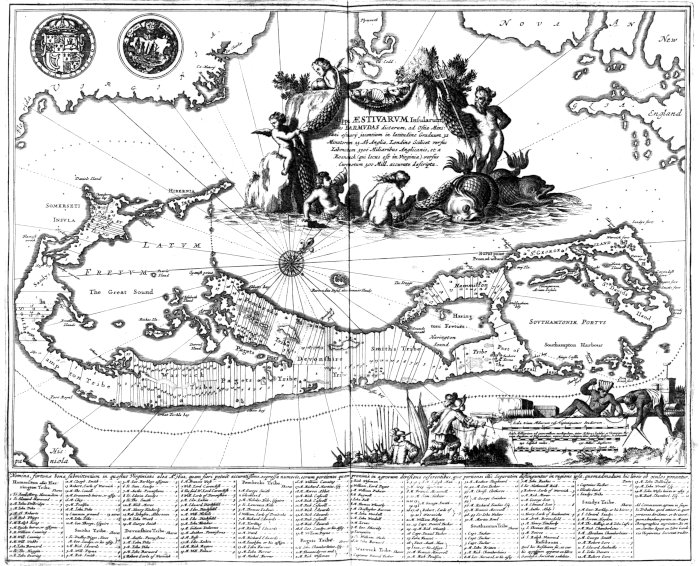
CHAP. XII. The Bermudas, or Summer-Islands.
Situation of the Bermudas.
The Bermudas, or Summer-Islands (probably so term’d as to the first Appellation from certain black Hogs, by the Spaniards call’d Bermudas, which from a Ship bound with them to some other parts of the West-Indies, and cast away upon that Coast, swam ashore, and there increased; or, as others say, from John Bermudes, a Spaniard, who is said to have been the first Discoverer; or, as to the second, from one George Summers, an English-man, who there suffer’d shipwrack) 312are situated in thirty two Degrees and twenty five Minutes of Northern Latitude about sixteen hundred Leagues from England, twelve hundred from Madera, four hundred from Hispaniola, and three hundred from the nearest Coast of Virginia. The first that endeavour’d to settle Plantations here was a Spaniard nam’d Hernando Camelo, being design’d Conductor in this Expedition: And this Undertaking was so much the more eagerly prosecuted, upon consideration that the Plate-Fleet Sailing from Havana through the Straights of Bahama, might here have a convenient Harbour; but those who were invited to become Adventurers, with proffers of great Advantage, shewing themselves very slack in the Business, and Charles the Fifth being at that time intangled in War and other troublesom Affairs, the Design came to nothing, and for above sixty years after no farther Attempt was made by any for the Planting of these Islands, till at last the French made a Voyage thither under Captain Barboriere, but by Shipwrack were frustrated of their hopes; nor made they any more Preparations in this Design. In which nevertheless the English were not so easily discourag’d, for first Captain Gosnol and Smith set forth, at the Charges of Mr. Edward Wingfield; next, Captain Nelson; then successively West, Gates, Argal, and Wyat, but all with little or no success, till at length in the Year 1612. a Company was establish’d in London by the King’s Letters Patents, who sent one Mr. Richard Moor with sixty Men to the Bermudas, where he spent three years in fortifying those Islands: but that which put a little stop to this good beginning, was a kind of Misfortune that hapned; for the Rats which were gotten ashore from a Shipwrack increas’d so exceedingly, that they devour’d all the Plants in the Field, and the Provision in the Houses, insomuch that a great Famine proceeded from thence, all means to destroy the Vermine being in vain; till at last Providence sent a Disease amongst them, which kill’d them all in a very short time. Mean while Moor went on in the fortification of the Island, and was ere long supply’d with fresh People. Mr. Barlet was sent over with sixty Men, and carried from thence with him eighty Pound of Ambergreece. And soon after three Ships more, viz. the Blessing, the Star, and the Margaret, convey’d thither four hundred and ten, Men and Women. As soon as Moor was call’d away, Daniel Tuckard coming from Virginia to succeed him, bestirr’d himself very much, Planting all places full of Trees fetch’d from the West-Indian Islands; as also Tobacco, with which he fraighted a Ship to London. Moreover, the Countrey was divided into Acres, that every Planter might have an equal share, and know his own Lands. Anno 1619. Tuckard was succceded by Nathaniel Butler, who in four Ships brought thither five hundred Men and Women, to supply the first Plantation, which was much decay’d since the Rats had devour’d their Provisions, so that it was little look’d after by the Company in London: But now they built a Church and erected a Court of Judicature, and all things were order’d conveniently for the publick good. After which many Noble Persons set Sail thither in the Magazine Frigat; and the Planters being now fifteen hundred in number, inhabited twenty Leagues of Land in length.
Forts built upon the Bermudas.
On the longest Island, call’d St. George, (for the Bermudas consists of several Islands, great and small) they built Warwick and Dover Forts, with other Fortifications and Towers, which had their Denominations from those Noble-men and Gentlemen that were Undertakers in this Plantation, as Cavendish, Paget, Herbert, &c. from the Earl of Devonshire, the Lord Paget, the Earl of Pembroke and others.
Ports and Havens.
Amongst the Havens the eminentest are, Southampton, the Inlet Harrington, and the Great Sound.
All these Islands lying together resemble a Half-Moon, and are surrounded with Rocks, which appear at Low-water, and at High lie but shallow; for it seldom 313Ebbs or Flows above five Foot. The Shore, for the most part Rocky, and hardned by the Sun and Wind, receives no damage by the Waves which continually beat against the same.
Nature of the Soil.
The Ground it self differs; for in some places it is sandy or clayie, and in others partly black, and partly white, or Ash-colour’d Earth; which last is accounted the worst, and the black the best. Three Foot deep under the Ash-colour’d Earth lie great Slates, and under the black, a white spungie Stone, like the Pumice, in whose moist Crevises Trees take root.
The Pits or Wells, though they Ebb and Flow with the Sea, yet produce a wholsom and sweet Water.
Temperature of the Air.
The Skie is generally serene, but when over-cast with Clouds, is subject to Lightning and Thunder; yet the Air is of a good temper, being neither exceeding cold, nor excessive hot: for which reason the European Fruits grow better there than in their natural Soil.
Their Harvest is twice a year; for that which they Sowe in March, is ripe and gather’d in June; then what they Sowe again in August, they gather in January.
Productions of the Countrey.
These Islands breed no hurtful Creatures; nay, the yellow Spider which spins silken Cobwebs, is free from Poyson.
The Plant Nuchtly, which bears speckled Pears, grows betwixt the Rocks which are drench’d with Sea-water.
The Hogs which above a hundred and fifty years since swam ashore out of the Spanish Wrack, are exceedingly increas’d there, but because of their poorness are scarce eatable, they feeding onely on the sweet Berries which fall from the Palmito-Trees.
About the white and red Mulberries, which grow plentifully there, breed thousands of Silk-worms, which spin Silk according to the colour of the Mulberries.
The Sea produces some quantity of Pearls and Ambergreece.
From the beginning of the year till May, the Whales are seen to swim not far from the Shore.
A strange sort of Sea-Fowl breed in Holes like Rabbets; and amongst other Birds, here are also store of Cranes.
The Tobacco which the English have planted here grows very well.
Tortoises Laying of Eggs.
Here are likewise great Tortoises, which Lay their Eggs in the Sand on the Shore, where they are Hatch’d by the Beams of the Sun, and are taken after this manner: In the Night some are set to watch where they Land, and whilest they are digging a deep Hole in the Ground, are thrown on their Backs, and not being able to get upon their Legs again, they lie and groan very pitifully: some of them having above two Basons full of Eggs in their Bellies; which being about the bigness of a Tennis-Ball, have a thin Shell, which incloseth a Yolk and White. If these Eggs lie buried six years, then the young Tortoises breaking the Shell, come out of the Sand, and instantly creep into the Sea. Their Flesh is not onely wholsom but toothsom. The Oyl made of them is not inferior to Butter.
Cedars of an excellent kind.
Moreover, the Bermudas produce Cedars, the like of which are not to be found in the whole World: The Leaves are douny and prickly at the ends, almost like those of the Juniper Tree: The Wood hath a sweet smell, and the Berries, which are like the Myrtle, of a pale Red, inclose four white Kernels; the outermost Skin whereof is sweet; the innermost, which covers the Kernel, sharp, and the Pulp tartish: The Trees are always flourishing, being at the same time full of Blossoms, green, and ripe Fruit: The Berries, when grown ripe, begin to gape, and fall off in rainy 314Weather, leaving a round Stalk on the Boughs, which loses not its Rind till two years after; half which time the Berry requires, before it attains to its perfect ripeness, which generally happens in the Winter: The Boughs shoot straight upwards, and become in time so heavy, that they cause the Body of the Tree to bend. This most excellent Wood grows in divers places of the Bermudas.
We shall conclude with the resolute Exploit of five Sea-men, Anno 1616. who, to the great admiration of all People, set Sail from thence in an open Vessel of three Tun through the main Ocean, and after having suffer’d terrible Tempests, arriv’d in the space of seven Weeks safe in Ireland.
These Islands are remarkable for divers sorts of Plants, unknown in other Parts, as the Prickle Pear, Poyson Weed, Red Weed, Purging Bean, Costive Tree, Red Pepper, and the Sea Feather. Also several strange Birds, as the Egg Bird, Cahow, Tropick Bird, and the Pemlico, which presageth Storms.

CHAP. XIII. Hispaniola.
The Islands call’d De Barlovento, by which are understood Hispaniola, Cuba, Jamaica, and Boriquen, as also the Lucaies, with the Caribes, and lastly the Isles call’d De Sotavento, viz. Margareta, Cabagua, and Tabago, are by some comprehended all under the general Name of The Isles Antilles; though others reckon the Antilles to be the same with the Caribes onely. But leaving this Controversie undecided, we shall begin with the Isles De Barlovento, the chief whereof is Hispaniola.
Bounds and Description of Hispaniola.
Hispaniola, or Little Spain (as Columbus nam’d it) is, though not the largest, yet the fairest and goodliest of all the American Islands, call’d by the Natives anciently Hayti and Quisqueia: It lieth about fifteen Leagues Westward of Porto Rico, and distant from the main Land of America about one hundred and twenty; ’tis of a triangular form, the sharpest Point whereof is that towards Porto Rico, which they call Cabo de Enganno: that towards the West inclines to a Semi-circle, containing a good and convenient Bay betwixt the two Points, viz. St. Nicholas to the North, and Cabo de Donna Maria towards the South. It is not thought to be less than a hundred and fifty Leagues in length, and in breadth from threescore to thirty, and to contain in the compass of the whole, four hundred Leagues at least, lying betwixt eighteen and twenty Degrees of Northern Latitude, having an Air somewhat infested with the Morning Heats, but well cool’d again in the Afternoon, by a constant Wind from the Sea, which they call there Virason. It is, for the fertility of the Soil, one of the richest and most flourishing Countreys in the World; the Trees and all things else there continually clad, as it were, in their Summer Livery, the Meadows and Pastures always green, and of such an excellent Herbage, that Cattel both breed and thrive there beyond belief; both great Cattel and small, as Kine, Sheep, Hogs, &c. brought thither out of Spain, having multiply’d to such numbers, that they live wild now in Herds in several places, and are both hunted and kill’d, like Stags or other Venison, onely for their Hides, which they send yearly into Spain and other parts of Europe, as a great Merchandize and Commodity of huge profit to them.
315
Wild Hogs also have been formerly seen to feed in the Woods in great multitudes, but the Dogs since they were brought over hither, have made great havock amongst them.
Beasts peculiar to Hispaniola.
The Animals peculiar to this Island are 1. A little Beast call’d Hutias, not much unlike our Coneys. 2. Chemi, almost of the same form, but a little bigger. 3. Mohui, A Beast somewhat less than the Hutias. 4. A Beast call’d Coxi.
The Fly Cuyero.
Likewise amongst other strange sorts of Creatures here, the Cuyero is very observable, being about an Inch big, and having four Wings, of which two are larger than the other: when they flie they shine after such a manner, that in the Night they make a Room as light as day, insomuch that some have made use of them in stead of Candles to Read by.
The Fish Manate.
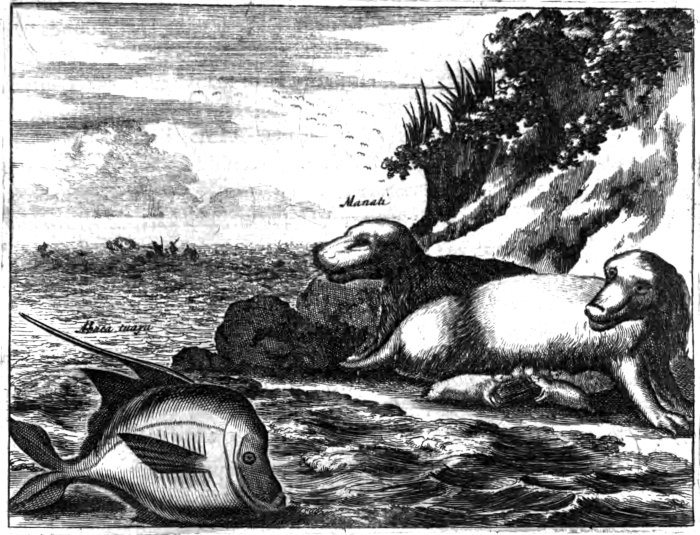
No less wonderful is the Fish Manate, whose shape hath been describ’d elsewhere: It breeds for the most part in the Sea, yet sometimes swimming up the Rivers, comes ashore and eats Grass. The Casique Caramatexi kept one in the Lake Guaynato, which was so tame, that when call’d by the Name Maton, it us’d to come out of the Water, and go directly to the Casique’s House, where being fed, it return’d to the Lake, accompanied with Men and Boys, who with their Singing seem’d to delight the Fish, which sometimes carried ten Children on its Back over the Water; but at last a Spaniard striking at it with a Pike, it would never come forth again when it espy’d a Cloth’d Man: It liv’d twenty six years in the fore-mention’d Lake, till by accident the River Hayboaic over-flowing into the said Lake, the Fish return’d to the Sea.
The Fish Abacatuaia.
Besides this great Fish, here is also a sort of small Fish, call’d Abacatuaia, with a little Mouth, black Eyes encompass’d with Silver-colour’d Circles, four black Fins, two long ones under its Belly, one on the Back, and one on each side of the Head, the Tail slit and cover’d with a glittering Skin: It is as big as a Flounder, and not ill Meat, but thick and round.
The Insect Nigua.
When the Spaniards first setled on Hispaniola, they were exceedingly tormented with a sort of leaping Insects call’d Nigua, which us’d to eat through their Skin into 316the Flesh in such a nature, that many of them lost their Arms and Legs; but at last they found out a Remedy against this Evil, viz. the searing the Wounds with hot Irons.
Fruits.
Besides the aforesaid plenty of Flesh, they have many excellent Fruits all the year long, as Banana’s, Pine-Apples, Custud-Apples, Plantens, Papans, Musk-melons, Water-melons, and many other peculiar Plants, as 1. the Auzuba, a fair large Tree, the Fruit whereof is call’d Pinnas, resembling a Malecotoon: Of this Tree there are three sorts, Jaima, Boniama, and Jaiqua; 2. Quauconex; 3. Axi; of which there are also several sorts, as Carive, Huarahuac, Axiblanco, Acafran-Axi, and Axi-Coral; 4. Yuca, the Root of which serves in stead of Corn; 5. Certain Trees call’d Guaibes, besides plenty of Mint and Potato’s.
The Provinces of this Island.
The Island of Hispaniola was formerly divided into several Provinces, amongst which the Mountainous Countrey Hyguey lies towards the Isle of Porto Rico. On the Mountains, which are flat on the top, are great variety of sharp-pointed Stones. The Soil is a sort of colour’d Earth, which produces all sorts of Fruit, especially the Root Casabi, and Melons.
Hyguey also conterminates with Ycayagua; Northward lies Samana; Southward, Yaquimo, where there is store of Brasile Wood: And between the City Domingo and Yaquimo, is the Countrey Baoruco, which with its Mountains extends sixty Leagues in length, and above twenty in breadth, without any Water, Pasture, or Food for Cattel or Mankind.
Next follows the Countrey Xaragua, lying at the great Inlet which divides Hispaniola; for one side extends to the Promontory of St. Nicholas, and the other to the Point Tiburon. This Countrey produces abundance of Cotton.
Lastly, the Provinces Guahaba, Haniguagya and Cahay, are very eminent; as also Cibao, which is full of Gold-Mines; and Lavega Real, with Magnana, which lie between the two great Rivers Neyba and Yagui; the stony Countrey Ciguayos, and the low Coast Darica, where Christopher Columbus built the City Navidad, which he afterwards deserted.
Ginger was formerly brought hither from the East-Indies, but now grows here in such great abundance, that above two and twenty thousand Kintalls are yearly Transported from thence to Spain.
With as good success grow here also the Sugar-Canes and Maiz.
Peter Martyr, a Councellor to the Emperor Charles the Fifth, relates, That Hispaniola produc’d in his time, besides Silver, Copper, and Iron, five hundred thousand Ducats in Gold: Nevertheless the rich Mines lay undisturb’d, because they wanted People to work in them, insomuch that had they not planted their Royal Seat in Domingo, the Island had long since been deserted, notwithstanding the exceeding fruitfulness of the Soil, because the Spaniards exercis’d their Cruelty in such a nature, that of sixty thousand Inhabitants from the Year 1508. to Anno 1514. scarce fourteen thousand of them were left alive; all which is affirm’d by the Bishop De las Casas. Nay, the fore-mention’d Peter Martyr relates, That the Men wearied with working in the Mines, kill’d themselves, despairing of ever being releas’d from their Slavery; and Women with Child destroy’d the Infants in their Wombs, that they might not bear Slaves for the Spaniards. He adds hereunto, That of a hundred and twenty thousand Persons, few were left in a short time.
The Gaiety of the antient Casiques.
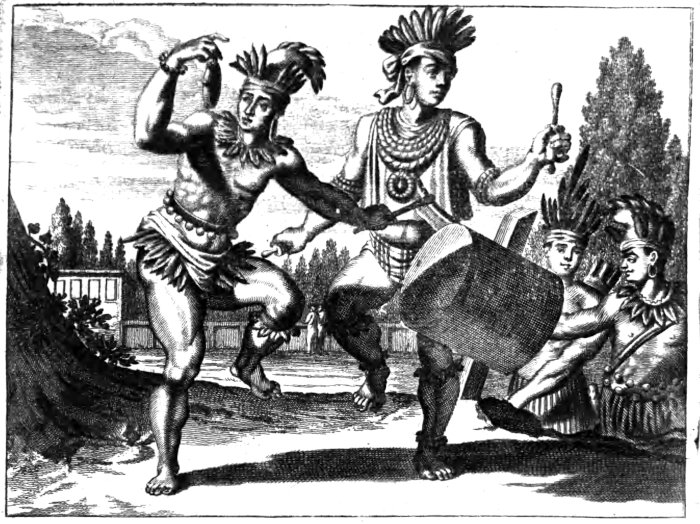
These Provinces in former times had each of them their Casique, whose splendor consisted chiefly in Dancing to his Devotion, with a Girdle full of Bells about his Middle, a String of Pearls about his Arms, a Covering over his Privities, and a 317Plume of Feathers on his Head, with a Drummer before him, and a small Train of Arm’d Men after him.
Ports and Havens.
On the Coast are first the Point of Nisao, ten Leagues to the West of Santo Domingo.
Eighteen Leagues farther is the Port Ocoa, which is a Bay where the Fleets of Nova Hispania take refreshing, when they do not Anchor in the Nook of Sepesepin, which is near unto it, or in another call’d The Fair Haven, two Leagues before you come to Ocoa.
Twenty Leagues beyond Ocoa is the Port of Asua.
Thirty Leagues more Westwardly is a large Point right against the Island of Bola, which lieth five Leagues from the Coast.
The most Westerly Point is call’d Cape Tiburon: It hath an Island three Leagues from it Westward, call’d Caprio; and Sailing along the Coast, you will see an Island call’d Camito, and farther in the Nook of Yaguana another call’d Guanabo of eight Leagues long.
On the North side of the Island, the most Westerly Cape and Port is St. Nicholas, from whence North-East and by East, lieth the Island of Tortuga, near the Coast of Hispaniola: It is of five Leagues length.
Farther along the Coast is Monte Christo, the West Cape of Natividad; to the East of which there is a great Bay call’d Port Real.
This Island is so full of Harbours, that he that will Coast it, cannot well miss of one where he pleaseth, most of which afford fresh Meat and good Water.
Moreover, Hispaniola hath many brave Rivers, the chiefest of which are Hayna; Nizao, along whose Shore the first Sugar-Canes were planted; Neyba, a great River; Yaquimo; Yaqui, which Columbus call’d Rio de Oro, because the Ground thereof glitter’d like Gold; and lastly, the Rivers Nicayagua, amongst whose Sands is Gold; Nigua, which borrows its Denomination from the fore-mention’d leaping Insect; the swift Stream Juno, whose Banks are crown’d with handsom Houses; and Jaquin, which hath many Salt-pans.
318The Rivers Itabo, Ocoa, Cepi, Bia, Cazui, Sanate de Plata, and Chiabon, have some one, others more Sugar-Mills upon them.
But the chiefest River is Ozama, broad, and so deep, that the biggest Vessel may lie close by the Shore; and also washes St. Domingo.
Description of the City of St. Domingo.
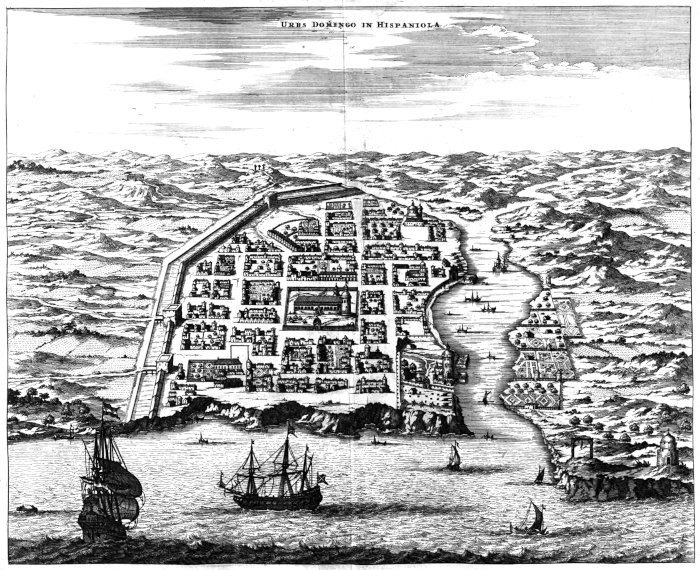
This City, the Metropolis of all the Isles round about, was built by Bartholomeus Columbus, and was peopled Anno 1494. after which it flourish’d eight years, when, a terrible Storm blowing the same down to the Ground, Nicholas Olanda remov’d it to the Western Shore of Ozama, that the Spaniards, who had for the most part setled towards the West, might not be necessitated to Ferry over: but the first place stood much more conveniently, being not onely provided of a Fountain of sweet Water, but also freed of those unwholsom Vapours which daily rise with the Sun at this new-built City. To prevent the inconvenience of crossing to the foremention’d Fountain, of which the Inhabitants found themselves oftentimes in great want, Olanda went about to lead the neighboring River Hayna into the Ozama, but the Design not being prosecuted, bereav’d Domingo of the onely thing which would have made it able to stand in competition with any City in the World; for it lies on a Plain, the South side whereof is wash’d by the Sea; the East side, by the River; on the North and West are many delightful Fields.
The City, which in a manner is built square, is divided into long straight Streets, full of fair Houses after the Spanish manner: in the middle thereof is a square Market-place, with a handsom Church, the Yard whereof is encompass’d with a high Wall, which upon occasion would serve for a place of great Defence.
The Collectors of the King of Spain’s Revenue dwell in stately Palaces; and the Dominicans, Franciscans, and Monks De la Merced, have brave Cloysters, besides two more for the Nuns.
The Latine School and Hospital belonging to the City, are Endow’d with great yearly Revenues.
The Arch-bishop of St. Domingo hath Command over the Bishoprick of Conception, La Vega, Cuba, Venezuela, and Porto Rico.
The City is surrounded with a Stone Wall, and fortifi’d with a Castle, which with two Bulwarks reaches to the River Ozama, and within them two Half-Moons.
On the utmost Shore stands a round Tower near the Southern Bulwark.
Before the new discover’d Countreys entic’d away many People from St. Domingo, and the Silver Fleet put into Havana, the Inhabitants drove a great Trade in Hides, Tallow, Sugar, Cassia, Horses, and Hogs.
Anno 1586. Sir Francis Drake Landed here with twelve hundred English-men, took the City by Storm, staid a whole Moneth in the same, and upon Composition with the Spaniard, left it undestroy’d.
Other chief Towns of Hispaniola.
Other chief Towns in Hispaniola are 1. Salvaleon, twenty eight Leagues distant from St. Domingo, towards the East.
2. Zeybo. 3. Cotny, formerly inhabited by those that work’d in the Gold-Mines; the last especially was once a rich Town, and much frequented, but now in a manner deserted.
4. Azua, or New Compostella, eight Leagues distant from St. Domingo, famous for the Sugar-Mills not far from it, and one of the Ports before-mention’d.
5. Yaguana, for its brave Harbour also call’d Maria del Puerto, in the more Western parts of the Island; a small Town not above a League distant from the Sea; It was burnt by Captain Christopher Newport.
3196. Conception de la Vega, adorn’d with a Cathedral and Cloysters of Fryers, and lying twenty or thirty Leagues Northward of St. Domingo: It was built by Columbus, and from thence he had his Title of Duke de la Vega.
7. Sant Jago de los Cavalleros, a very pleasant Place, ten Leagues Northward of St. Domingo.
8. Puerto de Plata, or The Silver Haven, four Leagues distant from St. Domingo towards the North: It hath been counted the second Place of Trading and Wealth in the whole Island, being commodiously seated on an Arm of the Sea, and fortifi’d with a Castle.
9. Monte Christo, one of the Ports also above-mention’d: It lies fourteen Leagues Westward of Plata, and extends it self along the Northern Coast: it is wash’d by the River Yagui, on whose Banks are many Salt-pans.
The Island dispeopled by the cruelty of the Spaniards.
Their barbarous usage of Guaccanarillo and others.
All those Cities are much decay’d, and thinly inhabited, the Spaniards being most of them drawn by the temptation of new discover’d Gold and Silver Mines in other places, and the first Inhabitants having been miserably destroy’d. The Bishop De las Casas, an Eye-witness, relates, That the King Gauccanarillo secur’d the Goods of a stranded Ship, of which Columbus was Commander, and receiv’d the Spaniards very courteously; but not being able to continue supplying them with that quantity of Gold they requir’d, wanting Men to gather so much out of the Streams and Mines, and seeing no way to rid himself from the Spaniards Oppressions, fled to the Province of Ciguayos, the Casique of which was his Deputy; whereat the Spaniards were so enrag’d, that they burnt all that they could meet with, neither sparing young nor old; and at length taking Guaccanarillo, put him in Irons, and thought to have carried him to Madrid; but the Ship in which he went suffering Shipwrack, he with many others was cast away, being before almost dead with grief for his Consort, who had been Ravish’d by a Spanish Commander, Likewise Anacoana, Sister to the Casique, or Governor of the Province Xarana, and Partner with him in the Government, seeing three hundred of her Councellors burning in a great House, set on fire by the Spaniards, and her Subjects torn by Dogs, or cut in pieces, hung her self out of despair. The same Death died Higuanama, Queen of Huguey. Others say that Anacoana was put to death together with her Brother in a most barbarous and cruel manner, by Nicholas de Olanda, who succeeded Diego de Arana in the Government of this Island. Many Women and Children were kept alive onely to Manure the Ground. The Men dying of their hard Labour in the Gold-Mines, and those which endur’d stoutly the cruel Labour under Ground, were never suffer’d to go to their Wives; from whence proceeded a great decrease of People, the Spaniards seeming purposely to design the destruction of the Natives of Hispaniola, though they receiv’d great benefit by their Service; for Gold in former times was found between the Cracks and split Stones of the Mountains, whose Veins the Mine-workers digg’d for not without great and dangerous Labour.
First original of the People of Hispaniola.
The first Planters of Hispaniola are, according to the common opinion, deriv’d from Matinio, a high and Mountainous Isle, from whence the most eminent Inhabitants were driven by certain Rebels, as formerly the Syrians under the Government of Dido, were driven from Tyre to Lybia, and the Batavians from Hessen to the Countrey between Rhyne and Wall, at present inhabited by the Gelders and Hollanders. These Matininoensians thus expell’d from their native Countrey, setled themselves on Cahonao, near the River Bahaboni: The first House they call’d Camoteia, and afterwards turn’d it into a Temple, to which they shew’d Reverence, and made great Presents: In like manner the Tyema, which stood on a high Rock belonging to one 320of the Canary Islands, was by the ancient Inhabitants of the Place had in great veneration, insomuch that many leap’d down from the same, being perswaded by the Priests, That the Souls of those which threw themselves off this sacred Break-neck, should immediately be translated into a place of everlasting happiness.
The ancient Name of this Island.
This Island was, as we said before, first call’d Haity which signifies Wild, because in many places it swells with wondrous high Mountains, and in other places is over-grown with great Woods: it was afterwards by the ancient Inhabitants nam’d Xusqueia, that is, Unmeasurably great, because they suppos’d it to be the whole World, and that the Sun shin’d in no other place.
Indian Songs or Ballads call’d Areitos.
The Natives of this Island, though wholly rude of acquir’d Knowledge or Literature, like the generality of the Americans, yet they took care to instruct their Children in the Original and Antiquities of their Countrey, and the Wars and Exploits of their Predecessors, both which they contain’d in Songs call’d Areitos which they us’d to Sing to the sound of Drums and Trumpets; but especially their Persons of chiefest Quality study’d most these Areitos, and exercis’d themselves in Dancing.
Strange Prediction of the Spaniards Arrival.
The most remarkable of these ancient Areitos, were such as pretended to prophesie of things to come, which if of sad consequence, were Sung very mournfully and with many Sighs; nor were they always, however inspir’d, without effect, as appear’d at last by woful event: for long before the Spaniards Landed on Hispaniola, it was foretold by one of them, that Maguacochios, signifying Clothed People, should Land on Hispaniola, who with sharp Weapons should cut off Heads and Arms, and under whose insupportable Yoke their Successors must spend their days without hope of ever being releas’d.
It might be disputed whether these Predictions were dictated by good or evil Spirits; but it is generally believ’d, that all their Oracles, whether hapning true or false, were suggested by diabolical Spirits to the Priests, who commonly convers’d with them; and that these Spirits knew the Design of several People to discover new Countreys.
The Images of their Zemes.
Their Images Zemes, stuff’d full of Cotton, were fashion’d into very frightful Shapes, and might pass for those things which we call Terricula, or Bugbears; of which some were made very small, and those they ty’d on their Foreheads when they went to the Wars. Every Governor had a peculiar Zemes, to whom he shew’d Reverence, in return whereof he expected Rain, fair Weather, and to conquer his Enemies, supposing him to be a Messenger of a perpetual and endless Being, by them call’d Jocauna Guamaonocon; whom nevertheless they suppos’d to have a Mother, to whom they gave five Names, viz. Attbeir, Mamona, Guacarapita, Liella, and Guimazoa.
The Islanders Opinion of the Creation.
Their opinion of Man’s Creation was thus: They say, that out from a Mountain in the Province Cuanana, out of certain small and great Caverns therein, came little and great People: The biggest Hole, call’d Cazibaragua, and the little one, nam’d Amaiauna, were said to be lock’d up every Night, that none might pass the Sentinel Machchael, who out of curiosity leaving the Mountain Cuata, and going up into the Countrey, was discover’d by the Sun, whose Beams he not being able to endure, was turn’d into a Rock. The like Mischance hapned to many others, who in the dark Night going to Fish, in the Morning at their Return were chang’d into Oaken Trees, onely one of the Fishermen was sent away by the chief Commander Vaguoniana, who moved at the Complaint of a Nightingale’s Singing, suffer’d all the Men to go into the Hole, and the Women and Children he Transported to Matinino. But to make short of these non-sensical Stories, in conclusion, the Men being let out of their Caves, saw many strange Beasts amongst the Woods, which 321being turn’d into Women, were entertain’d by them, and brought forth a numerous Progeny, which spread over all Hispaniola.
Their foolish Opinion of the Original of the Sea.
No less ridiculous an Account do the Priests give concerning the Original of the Sea, viz. That Jaia, a mighty Man, buried the Body of his deceased Son in a Pumpion, which some Moneths after, out of meer affection to the Deceased, he cutting open, abundance of Whales sprung out of it. This Wonder being every where known, amongst others, entic’d four Brothers born at one Birth (whose Mother died in Childbed) to get the Pumpion into their possession; which their Design prov’d successful: but afterwards struck with a pannick fear of Jaia’s coming thither (who oftentimes came to mourn over the Bones of his dead Son) they fled, and threw away the Pumpion, which breaking with the fall, the Sea gush’d out of all places thereof, and cover’d the Plains in such a manner, that nothing of them was seen, onely the tops of the highest Mountains appear’d; at which the four Brothers terribly afrighted, rang’d through barren Desarts, in which they had died of Hunger, had they not come to a Baker’s House, which one of them entring, ask’d for Cazabi; but the Baker denying them Bread, spit on them, which caus’d a mortal Dropsie, which the Brothers upon consultation found no way to cure, but by cutting a hole in the Skin with a sharp Stone, and to let out the Water; but out of each running Wound sprung a Woman, who bare them four Sons and four Daughters.
The Cave Jovana-beina.
There is a certain Cave call’d Jovana-beina, which is adorn’d with a thousand Pictures, in great esteem amongst them; at the Entrance on each side whereof stands a Zemes; that on the right side is call’d Binthaitelles, the other Marohur, to which they come from all places to pay their Devotions, because (they say) the Sun and Moon came out of the said Cave to lighten the World.
Their absurd Opinion of the Deceased.
Much after the same absurd rate is their Opinion of the Deceased; for they suppose that they range through Woods and Forrests in the Night, eat of a Fruit call’d Guannaba, and steal to the Embraces of Women in Moon-shiny Nights. A Traveller, say they, if he be frighted at the appearance of a deceased Person, great inconveniences will certainly attend him, but if he goes stoutly towards it, then the Goblin vanishes.
These Delusions are made great Mysteries amongst them, and contain’d in Songs, which their Priests Boiti Sing to a kind of Tabor made of a piece of hollow Wood, pretending that they have familiar Conversation with the Zemes concerning future things.
Their Ceremonies about their Sick.
Their Ceremonies about their sick, especially if Persons of Quality, are likewise very remarkably odd and conceited: First they chew a strong kind of Herb, call’d Cohobba, with which having sufficiently intoxicated their Brains, they foam at the Mouth, and run with a Stone and a piece of Flesh in their Mouths to the sick Person, whose Family they drive all out of Doors, except one or two, whose presence the Patient requires; then the Boiti walks four times about the sick Person’s Bed, making strange Gestures, pinching his Lips and Nose, blowing upon his Forehead, Throat and Temples, and sucking several parts of his Body, alledging, that thereby he draws the Distemper out of the Veins; after that he chafes and rubs his Shoulders, Thighs and Legs, and ties his Hands and Feet together, then running to the Door, proclaims, That the Sick in a short time shall be restor’d to his former Health; which said, he returns with his Arms stretch’d out towards the sick Person, takes the piece of Flesh out of his Mouth, which he gives him backwards, saying, You shall rise and go forth in Health, for I have taken away your Sickness: But if he judges the Distemper not curable, he makes the Sick believe, that Zemes is 322displeas’d with him, because he did not build a House for him, or consecrate a Garden to him, or in some respect or other did not worship him as he ought to have done. When the Soul departs out of the Body, they conjure the Body with many Adjurations, to reveal whether it died according to God’s decree, or through neglect of the Boiti, as not having sanctifi’d himself enough by Fasting when he went first to the Sick, or not prescrib’d sufficient Medicines: wherefore if (as they say) the Devil answers them from the Mouth of the Deceased, that the Boiti did not perform his due Office, then the nearest Friends revenge themselves on the Boiti, but if otherwise, then they are highly esteem’d amongst them. The Women taking the Stones which the Boiti kept in his Mouth, wrap them up in a fine Cloth as a holy Relique, supposing that they will much facilitate their Child-birth.
Their manner of Consulting with their Zemes.
The Casiques desirous to know future Events of War, or whether the approaching Years will be fruitful, go into a Chappel consecrated to the Zemes, and snuff the intoxicating Herb Cohobba up their Nostrils; whereupon they break out into loud Exclamations, and some kind of strange extravagant Actions, till the power of the Cohobba begins to decay, and the Frenzie cease; then coming again to their Senses, they bow their Heads, and lay their Elbows on their Knees, in which posture they sit for a considerable time, then lifting up their Eyes they yawn as if they came from sleep; then they mutter to themselves whilest their Retinue which stand about them (for no common Person is suffer’d to be there) thank them with a loud Voice, for the pains they have been at in discoursing with the Zemes; then the Casiques begin to declare what hath been reveal’d to them, viz. whether they shall be fortunate in the Wars or not; whether it will be a fruitful or unfruitful, healthy or sickly Year.
Gossipping.
Moreover, at the Birth of the Casique’s Children, the neighboring Governors visit the Women in Child-bed, and every one gives the Child a peculiar Name, from whence it happens that one Man hath oftentimes forty Names, and is highly incens’d if any one of them chances to be forgot in any Writing directed to him.
Manner of Succession.
Their manner of Succession in Government is not unremarkable; for not the eldest Heir-male of the Family, but first the King or Casique’s Brother, if he have any, and after his Decease the eldest of the Sisters Inherits the Realm or Seigniorie: if the Sisters have no Male-issue, then the Brothers Sons Inherit; and in case they have no Male-heir, then the next of Blood, whether Male or Female: but if the Prince or Casique dies without Children, Nephews, or other near Relations, the next in Power in the Countrey Inherits, and Marries as many Wives as he pleases; of which she that he loves best is burn’d alive in her best Apparel with her Husband when he dies, and near the Corps stands a Cup of Water and some of the Bread Cazabi.
Languages.
There are several Languages in Hispaniola, but differing from each other: for in the Province Bainoa they have a different, both Pronunciation and Dialect from that in Caizimu.
In the said Province of Caizimu is a very remarkable Rock, or vast Stone to be seen, at the Foot of a high Mountain; and underneath the said Stone is a great Cave, into which they go through a large Passage, not unlike a Temple Door; near which conjoyn many deep Rivers, with such a Noise and Foam, that they lose both their Sight and Hearing, whoever approach the same.
An Example of the Bainoan Language.
Of the Language of the Province Bainoa, Peter Martyr gives us this Specimen: “The Wife of a Casique (says he) went to Prayers in a Chappel which was built by the Spaniards; at her Return from whence her Husband desiring to enjoy her, she refusing, said, Teitoca, teitoca, techeta Cynato guammechina, that is to say, Be contented, 323Be contented, God would be highly incens’d: to which the Casique answer’d, Gnaibba Cynato machabucha guamechyna, that is, What care I if God be angry.”
The taking of St. Domingo by Sir Fran. Drake.
Since the Spaniards had first possession of this Island, it hath been twice Invaded by the English, the first time under the Conduct of Sir Francis Drake, who took the Town of San Domingo, staid in it a good while, and could if he had pleas’d, have totally dispossess’d the Spaniards; the second time under Colonel Venables, sent thither by Oliver Cromwell during his usurp’d Dominion; at which time it might as easily have been taken as at first, had not the Business been rashly and indiscreetly manag’d, as shall presently be declar’d more at large. The first Expedition of Sir Francis Drake hath been already hinted, but for the memorableness of that bold Exploit, we shall give a particular Account of it from a late Writer, who hath set forth the Life of that brave English Heroe. In the Year of our Lord 1580. about the end of February setting Sail from St. Christophers for Hispaniola, by the Way they met with a small Frigat bound for San Domingo, and the Men of her being Examin’d, one assur’d them that the Haven of it was a barr’d Haven, and the Shore well fortifi’d, so that there was no convenient Landing within ten English Miles of the City, whither this Man undertook to conduct them. January the first they Landed ten Miles from the City, and marching thither under the Command of the Lieutenant General, arriv’d about one a Clock in the Afternoon; when they came near, about a hundred and fifty Gentlemen well Mounted, presented themselves against them; but the small Shot playing upon them, they departed, and the English proceeded towards the two Gates of the City that lay towards the Sea, both which the Spaniards had Mann’d, and planted their Ordnance without the Gates, and some small Shot in an Ambush by the Way-side: The English being about twelve hundred Men, divided themselves; the Lieutenant-General leading the one half to one Gate, and Captain Powel the other half to the other Gate, vowing that with God’s assistance they would not rest till they met in the Market-place: No sooner had the Spaniards discharg’d their Ordnance, doing some little Execution, but the Lieutenant-General hasted, or rather ran upon them, to prevent their Charging again, and notwithstanding their Ambush, entred Pell Mell with them into the Gate, not staying till he came into the Market-place, unto whom shortly after came Captain Powel with his Companies. This Place they strengthned with Barricado’s, the City being too large to be guarded by so small and weary an Army. And after Mid-night they in the Castle, hearing some of the English busie about the Gate, quitted it, some being taken Prisoners, and others escaping by Boats. The next day the English enlarg’d their Quarters, and fortifi’d themselves, and held the Town for a Moneths space. During this time the General sent a Negro Boy with a Flag of Truce to the Spaniards, who by the Way was met by some Officers of the Galley which the English had taken, together with the City, who furiously thrust the poor Boy through the Body; who returning to the General, and having declar’d how barbarously they had us’d him, fell down and died in his Presence. The General being much mov’d herewith, commanded the Provost-Martial to take two Fryers, and to carry them to the same place with a sufficient Guard, and there to hang them; and withal he sent one of the Prisoners to inform the Spaniards why he did it, and to tell them, that till the Party who had thus murder’d his Messenger were deliver’d to him, there should no day pass wherein he would not hang two Prisoners, till all were consum’d. Hereupon the day following the Murtherer was brought, and an Offer made to deliver him to the General, who yet thought it more honorable to make them perform the Execution themselves in the sight of the English, which was done accordingly.
324During their abode here, Commissioners oft pass’d between the Spaniards and them about the Ransom of the City, but not agreeing, the English spent every Morning till the heat of the Day in firing and destroying the Houses in the outward part of the City, two hundred Mariners being employ’d therein for divers days; yet were the Houses built so magnificently and strongly of Stone, that they could not consume one third part of the Town all that time; whereupon the General was contented to accept of twenty five thousand Ducats of 5s. 6d. apiece to spare the rest.
Here his Soldiers met with good Pillage, especially of rich Apparel, but Treasure they found none; for the Spaniards by their Cruelties had so destroy’d the Natives, who us’d to work in the Mines of Gold and Silver, that they were wholly given over; and in that Island they were forc’d to use Copper Money: yet they found store of Wine, Oyl, Vinegar, Wheat, Woollen and Linnen Cloth, some Silks, &c. which much reliev’d them: there was but little Plate found, but good store of Porcelane, or China Dishes; yet some they found, and very costly Houshold-stuff.
Venables his Expedition to San Domingo.
Venables his Expedition was in the Year 1654. when Cromwell having gain’d the supream Power under the Title of Protector, and having us’d so many Engines for the getting of Money to maintain his Greatness and usurp’d Authority, that he was almost brought to his last Shifts, bethought himself of this Project, (or, as some suppose, had it put into his Head by Cardinal Mazarine, the then great Minister of State in France, with whom he had intimate Correspondence) thinking thereby to kill two Birds with one Stone: for on the one side, he thought by this notable Exploit to advance his Fame abroad, and gain Credit and Applause with the People at home, by enlarging his Empire, and spreading the Renown of the English Nation, and so consequently to establish himself the more firmly in his new gotten Power; and at the same time by the great Riches he promis’d to himself from this Adventure, to recruit his Stock, which all his griping Exactions, especially from the King’s Party, could scarce supply for the keeping up of his Army, maintaining Intelligence, and other vast Expences: To this end he sets forth a considerable Fleet with extraordinary speed and secrecy, it not being known whither this Fleet was design’d till they were almost upon the very Place, that the Spaniard might not be forewarn’d to provide against them, onely in general terms it was given out, that the Design was both advantageous to the Nation, and would prove a great enrichment to all that went upon it; so that it is no great wonder, if within a short space a good competent Army was got together of such as having neither Estates nor Employments, willingly offer’d themselves, as Men that went from the fear of Iron Grates, to the hopes of Golden Ingots; and many of them were such as having been in the late King’s Army, and disdaining to take any Employment at home under that Government, were easily induc’d to List themselves in this Armada: nor was Oliver a little glad of this occasion of sending out of the Land, and employing upon a desperate Adventure those Men, who he had reason to suspect would, upon any opportunity offer’d, be the first Opposers of his usurp’d Power. This Army being sent to Portsmouth for Embarquation, and there making such Preparations as was convenient, which a Moneths time or thereabouts was thought would accomplish, a Messenger came from Desborough (who was there to set them going) to the General, that he should prepare to Embarque on Christmas-day; which at the first the General receiv’d with great impatience, alledging, That it was not possible so to do, and that he would not set Sail without his Arms and other Necessaries, which were not yet come from London: however, at his going to Desborough he was 325prevail’d upon to set Sail, with a promise that the Ships with the Arms should immediately follow him to the Barbado’s, where he was to stay till their arrival; so on Christmas-day they set Sail, and about the fourteenth of February arriv’d at Barbado’s with three thousand Men, and a Company of Reformado’s, which there were doubled, and then, and not till then, it was told them, That the reason of their so sudden going away, was because there was a Plot forming in England for restoring the King, and that they were not thought fit to be left there at the Head of their Regiments, to be tempted with the advantage of joyning with any such Party. At Barbado’s they staid till they had almost undone that Place by eating up their Provisions, the Planters there seldom preparing more than they have occasion to spend in their Houses, and for their Servants (having better and more profitable Employments upon their Hands) and the Soldiers not being content with such Provisions as their Servants would be well pleas’d with, so that they were in danger of starving the Island and themselves too: Thereupon a Council of War was call’d, and the necessity of leaving that Island declar’d, and Orders issu’d out to set Sail for Hispaniola, where they might make such Attempt as their Condition would allow, wanting Arms and other Necessaries; when they came within five or six Leagues of Hispaniola the Fleet lay by, and a Council of War was call’d by the Commissioners (for such they had who were never Soldiers) with some few Officers of the Army, where it was resolv’d to attempt San Domingo, and an Order made, That in case it be taken, no Soldier should offer to Plunder, but that satisfaction in lieu thereof should be given by the Commissioners; the Officers of the Army in vain opposing and protesting against it, which occasion’d the Soldiers to say, That the Commissioners should take the Town themselves, for they would not; Lots were there drawn by the several Colonels who should first Land, which fell upon the Black Regiment, who had no Arms but Half-pikes of eight Foot long, made of Cabbage-Tree in the Barbado’s; And Orders were then given out to the several Colonels to Land at the River Hind, within two Leagues of San Domingo; so they steer’d their Course thither, as was thought, by Night, but the next Morning found themselves twenty Leagues at least from the place of Rendezvouz, though one Regiment Landed there, who durst not attempt the Town for want of Orders, though doubtless they might have taken it, had they not staid in expectation of the General and the rest of the Fleet; but when they were thus cast Leeward of the Town, they must Land their Men, who no sooner went on Shore, but the Order against Plundering was read, and the Soldiers in a Mutiny to whom it was read, which made the rest forbear to read it, judging it no time now to disoblige them, who had in their Officers opinion too just a cause of discontent: However this was made known to the rest, and discours’d as they march’d, That they had not thought to be under a Committee here, but they would make them weary of their Employment ere they had done: And this indeed was enough, besides the faintness and unusual Heat of the Countrey, to disanimate Men of good Resolutions, especially the ordinary Soldiers, whose hopes of Plunder is the chiefest prop to their Courage, and expected Gain the spurr to their Valour. After they had Landed their Men, next Morning early they march’d towards San Domingo; but before Noon the Heat and Drought which they felt made them sensible of their first Errour and Inadvertency, in coming from England without their Necessaries; for through want of Bottles, which were left behind, and came not till three Moneths afterwards, the Men fell down dead in the High-ways, every one fainting and languishing, and crying out for Water: shortly after they met with a Field of Oranges, which was no unwelcome sight, with which they stor’d themselves; but ere they had march’d 326four or five Miles thought they had quench’d their present Thirst, and their Drought began to increase however, they march’d on, leaving some of their Men dead on the place, others fainting, were set upon the Troopers Horses till they came that Night to some Water, which gave them new life, and the Morrow early march’d again till they came within some Miles of the appointed Rendezvouz, where they heard of the other Regiment that Landed at the right place: And now having refresh’d themselves with Rest, Water, and Provision, they march’d to the taking of the Town; the General himself, with a small Party and a Guide, went towards the Town to find out some Water, which he knew the Soldiers would want, (not having Bottles to carry any) but as they were on their March, which was very leisurely by reason of the Heat, they heard a firing of Musquets, then making more speed in their March, supposing an Engagement, in the Highway, about a Mile from the Town, was found one of the General’s Secretaries, with others, dead; and not long after some came back to the General, and told him, That looking for Water with the Guide, an Ambuscade issu’d out, and had kill’d the Guide that should have shew’d them the place of Water, and some others; and although some which Commanded the foremost Regiments were very forward and willing to assault the Town, yet it was not thought fit so to do till the Army came up, by which time it was Night; and though they were then within half a Mile of the Town, yet the Soldiers were so impatient for Water, that they could not stay till the next Morning to assault the Town, but were forc’d to march back to the River Hind about eight Miles; (and this Relater did at that time drink his own Water) there they staid till they had again refresh’d themselves, and then prepar’d for their Return to attaque the Town; and notwithstanding the March it self in a hot Countrey was irksom enough, yet they were forc’d to make the Soldiers to draw the Ordnance and other Carriages for want of Harness and other Necessaries, which were left behind; however, they willingly underwent it by Turns: And now a Forlorn was drawn out, and other Orders given for a March, especially it being taken notice of, that the Enemies manner of Fight was and would be by Ambuscades, a File in every Company were order’d to stand till the other came up, and to face to the Right and Left to the Woods, which were all along as they went, for fear of a Surprize; and the Forlorn marching near an old Fort, call’d Jeronymo, which we had been possess’d of before, but thought not worth the keeping, and fearing they might meet with some small opposition there, began to fortifie themselves, and took a Dram of the Bottle, which as they were drinking, and others eating a bit, suddenly rush’d forth an Ambush of about a hundred and twenty Blacks, with a Spanish Commander in the Head of them, which so amaz’d and surpriz’d them, that some few onely Discharging, the rest immediately fled; the Blacks quickly falling in with their Lances, and doing such Execution as the time would allow them; for presently the Alarm being taken, and Supplies marching out for their relief, the Enemy, who had done more than they could possibly expect to have done, retreated into their Fort, which they had better fortifi’d than before, and had planted some small Drakes there upon it; the Execution was so short, that they had not time either to strip or pick a Pocket, lest they had paid too dear for it. After this Defeat a Council of War was call’d, and there it was agreed the next Morning early to fall on upon that little Fort, and so proceed to the taking of the Town; but very early, as they were in that expectation, Orders came from the General to the Army to march back to the River Hind, for what reason this Relator (though a considerable Person) never yet knew; where after they had staid some time, that Miscarriage was question’d at a Council of War, and one of the chief Officers of the Forlorn order’d to have his Sword broke over his Head, with other disgraceful Impositions, and two Colonels of the Army were order’d to draw up the Causes of this Miscarriage to send to England; which, because ’twas thought would too much reflect on them in Power that were to supply them, was by those Colonels judg’d inconvenient, and so ’twas never done. The number of Men lost by Stragling, Sickness, and this unhappy Engagement, amounted in the whole to about two hundred and thirty. In a short time after this, it was order’d to Ship the Men; which done, after some Debates amongst the Commissioners what was best to be done, Provisions nor Utensils yet coming fit for the Design intended, which was to possess some considerable Place in the Main, it was agreed, That they should steer their Course for the Island of Jamaica; which they did accordingly, and on the tenth day of May 1654. with little opposition possess’d it: where the same Soldiers have shew’d not onely such Courage and Resolution upon all occasions, (in many and frequent Encounters and Invasions made by the Spaniards, not onely with Soldiers of those Parts, but such as have been sent from Spain, Naples, Catalonia, and other Places) as might speak them English-men but such hath been their Patience and Sufferance, as none of this Nation in the memory of Man have ever been put to, the Effects whereof their King and Countrey, ’tis hop’d, will have occasion to remember, to their immortal Honor and Renown.
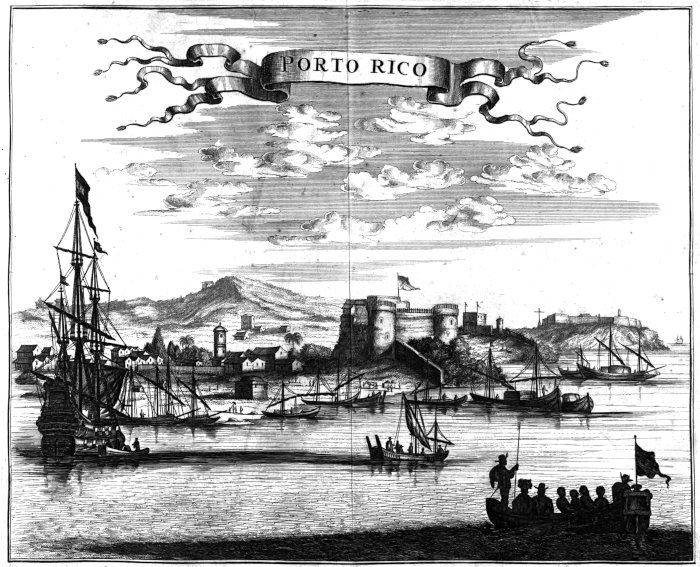
327Hispaniola is surrounded with several other Isles, as 1. Eastward appears Saona, full of pleasant Woods and Pastures, with Cattel feeding on them: in former times it produc’d much Cazabi for the City Domingo; but since the Spaniards murder’d all the Inhabitants Anno 1502. it hath never been inhabited. 2. The Rocky Shelf St. Catalina. 3. Abaque. 4. Navaza. 5. Guanabo. 6. Tortuga, abounding in Hogs, and 7. Beata, famous for the excellent speckled Wood which grows there, and a swift River, which oftentimes detains the Ships there whole Moneths.

CHAP. XIV. Porto Rico, and Monico.
Bounds and Extent of Porto Rico.
Another of those call’d The Isles of Barlovento, is Boriquen, anciently so nam’d, but now more generally Porto Rico, from St. Juan de Porto Rico, its chief Town, is an Island fifteen Leagues distant from Santa Crux, to the North-West, and about as many from Hispaniola to the South-East, but from the Continent or main Land of Paria (which seems to be the nearest) a hundred and thirty, or a hundred thirty six, as some reckon. It lieth almost in a quadrangular Form, being suppos’d to contain about thirty Leagues in length, and not less than twenty in breadth, in eighteen and nineteen Degrees of Northern Latitude.
The Island on the North, which is less fruitful than the South part, produces Gold, and is generally water’d with many Rivers. There is also Silver, Tin, Lead, Quicksilver, and Azure, us’d by Painters. The Rain generally falls there between May and August. A little before, or in the beginning of Harvest, the Hurricanes breaking forth from the Clouds, rage in such a manner, that it is impossible for any Ships to endure the Sea, and a Northern Blast generally doth great damage to the Plants here.
Sierra del Loquillo.
Ten Leagues towards the South-East beyond Porto Rico, appears Sierra del Loquillo, 328being a continu’d Ridge of Mountains which runs through the whole Island from East to West, extending both ways to the very Sea-shore.
Rivers.
Twenty three Rivers discharge their Waters also into the Ocean; amongst which the chiefest is Cairabon, particularly noted for ten Sugar-Mills which are erected upon its Banks.
Trees.
The Hills, Plains, and Valleys, are invested with variety of Trees peculiar to this place, as Tabunuco, which affords a medicinal Gum, good against Lameness, and green Wounds: it is also of great use to preserve a Ship’s Keel from the Worms.
Another Tree call’d Maga, is everlasting Wood, and bears a great Flower like a Rose.
The Leaves of the Higillo Pintado-Tree cures all manner of Bruises.
The same power is also in the little Tree Sancta Maria; as likewise in another by the Spaniards call’d Balsamo.
The Body of the Tree Zoyla is so thick, that fifteen Men holding Hands together, cannot encompass the same.
The speckled Wood, and Cassia Fistula grow also here in great abundance.
The poisonous Apple-Tree.
Here is likewise Apple-Trees, which grow by Rivers sides, or on the Sea-shore, whose Fruit is rank Poyson, and who-ever sleeps under the shadow of them, will certainly be Lame: The Fruit eaten generally causes Death; or if Nature be so strong in him that eats of it, to overcome the same, yet he is certain to lose his Hair.
As hurtful is the prickly Herb Quibey, which bears white Flowers like Violets.
The Tree Guiaba.
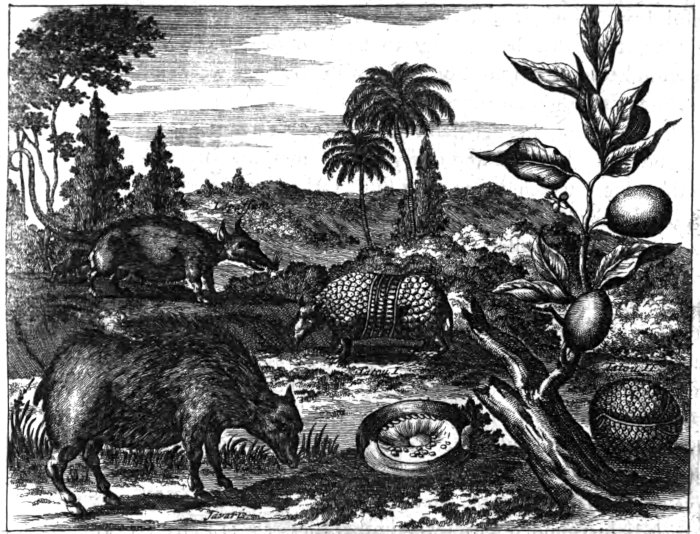
But this Island receives the greatest prejudice by the Tree Guaiaba, because it grows in most places, and over-runs Plains and Hills, so spoiling all the Grass, between which and the fore-mention’d Tree there is such an antipathy, that none will grow near it. The Tree bears a brown Apple full of Kernels, which are eaten by Beasts and Fowls, and from which falling on the Ground when ripe, grow up in new Trees, which makes the Countrey a meer Wilderness: The Body of it is smooth and of a pale colour, the Leaves hard, and glittering, and grow two and 329two over one another; the Flowers have also five Leaves, in the middle of which rises a Crown like that on a Peacock’s Head: The Fruit, which is cover’d with a soft Doun, and somewhat longer than the European Apple, when cut through, hath a pale red Pulp, full of eatable Kernels: before it is ripe, it is of a sharp taste, yet good boyl’d, but when ripe, of a most delicious and pleasant rellish; nevertheless too much of it causes a Lask: The Roots, which are red without, and white within, are juicy, sweet, and very long, the Leaves sallow and sowre of taste.
The Beast Javaris.
Amongst the strange Beasts the Javaris, Opassum, and Tatow are the most remarkable. The Javaris are taken for a sort of wild Hogs, and have short Ears and a Navel on their Backs, little Tails, some black, and some spotted white.
The Opassum.
The Opassum is as big as a Cat, hath a sharp Mouth, the upper Jaw-bone hanging over the lower, long, straight, and broad Ears, and a very long Tail, bald at the end, which winds in a Circle; on its Back black Hair sprinkled with grey Spots, and with its sharp Claws climbs up the Trees, where it feeds on Fruit, and sometimes preys on Fowls. Nature hath furnish’d this Beast with a strange Bag under its Belly, whereof the in-side hath a far softer Doun than the out-side, in which the young ones lie and suck, after which the Bag opening, they creep out upon the Ground. The Males have also a Bag, which serves onely to carry their Young in, for they and the Females carry them by turns.
The Tatow.
The Tatow, which is arm’d with sharp Scales, hath the Mouth of a Hog, and at each Foot five sharp Nails: when it is Hunted, or goes to sleep in the Night, it draws its Head, Legs and Tail under its scaly Coat of Mail, like a Tortoise, and in that manner lies secure against all manner of danger.
The Venison taken here is very delicate, but difficult to be got; for this Beast having a breathing-place in its Back, never tires with running, and when encompass’d by the Dogs, falls valiantly on those that are nearest to it, and often tears them in pieces.
Chief Towns and Cities.
The chief Towns in this Island, are 1. Porto Rico it self, commonly call’d St. John de Porto Rico (so term’d by Christopher Columbus, as being the first Land discover’d by him in the Year 1493. at that time when he could not perswade his Seamen, wearied out with continual hardship, from returning, if they discover’d not Land in two days) a strong and neat Town, built by the Command of Philip the Second, King of Spain: It was attempted by Sir Francis Drake in the Year 1595. without success, but a few years after taken by the Earl of Cumberland.
2. St. Germans, in the West part of the Island, three or four Leagues distant from the Sea.
3. Arrecibo, Westward from Porto Rico, where the most noted Haven is of those Parts, for all the others are full of Rocks and Sands.
The antient Inhabitants of this Island maintain’d continual Wars with the Cannibals (probably the Natives of the Islands so call’d) who us’d every year to come thither: those that were conquer’d, as well of the one side as of the other, were eaten by the Conquerors, so that in effect, both sides were but a different sort of Cannibals.
Columbus Landing here, found a great House surrounded with twelve others, but all of them empty and desolate.
This Island (which formerly is said to have been under the absolute Power of one sole King) the Spaniards not much regarded at first, having enough to do with Hispaniola, where they found more Gold than on Porto Rico.
The building of St. Germans.
Anno 1510. John Ponce de Leon obtain’d a Commission from the Court of Spain, to be chief Governor of this Island, and built Caparra, which Place was inhabited 330twelve years, notwithstanding it stood behind a scraggy Mountain, in a desart place far up in the Countrey; but their thirst after Gold, of which some Veins were discover’d there, made them dispence with all other inconveniences: yet at last beginning to be weary of this desolate and barren place of Settlement, they remov’d to Guanica, water’d by many Rivers, whose Sands had great quantities of Gold-dust. Not staying long there, they went four Leagues farther, and call’d their new Plantation Soto Major. Lastly, returning again, they setled themselves in the former Valley Guanica, and built the fore-mention’d Town St. Germans by the River Guaorabo, which makes an inconvenient Haven.
The Situation, Description and Fate of St. Juan de Porto Rico.
Juan de Porto Rico stands Eastward at the beginning of the North Coast, on a small Peninsula, joyn’d to the Island by an high Isthmus call’d Puente de Aguilar. Near the Mouth of the Haven lies on a rising Hill the Fort Morro Empinado, built triangular by John de Texila and Baptista Antonelli (who also planted there forty Guns), and surrounded with the Sea, which renders it a well fortifi’d place. The Governor Diego Mendez de Valdez had in it fifteen hundred Men and eighty Horses, when the fore-mention’d valiant Duke of Cumberland with a far less number fell upon him in the Year 1597. and not onely took the City Porto Rico, but several other Fortifications; and besides an invaluable mass of Treasure he carried away eighty Guns. Sometime before this Defeat the Spaniards under the Government of Christopher, Son to the Portuguese Duke of Camigna, were Invaded by the Cannibals, and all that were then upon the place utterly destroy’d, none of them escaping but the Bishop and his Servants, who betimes fled away with the Church Ornaments; so that the Islanders from that time were put out of doubt that the Spaniards were mortal, for they suppos’d them immortal when first they saw their great Ships, and heard the noise of their thundering Cannon.
The Casique Yaguara’s Experiment.
Hugh Linschot relates, That the Casique Yaguara threw a Spaniard into the Water, to try whether he would drown or not, and seeing him wholly depriv’d of Life, he concluded by consequence that the rest of them were mortal, and thereupon he set upon them when they were seeking for Gold, and kill’d above a hundred and fifty of them.
Peter Martyr relates farther, That these People, though very expert in Arms, yet were oftentimes beaten by the Cannibals, who at one time carried above five thousand People out of Porto Rico for their Winter Provisions.
The Avarice and Cruelty of the Spaniards.
Nor was their Condition better’d after the Spaniards conquer’d the Island, for those that could not furnish them with Gold, were certain of Death: Nor were their Cruelties in other places undivulg’d to this People before their Arrival; whereupon (as is related by Peter Ordonnez de Carellos) the Casique Hatvey being inform’d of the Spaniards Approach, took an Oath from his Subjects, That they should never discover where the Gold lay, though they should be put to death for it; For (said he) Gold is their God, for which they make so many cursed Blood-baths where-ever they come; therefore throw the Gold into some very deep Waters, for when the Spanish God is sunk, the Spaniards will lose their Courage, and not plague us so much for it.
Ceremonies of the old Natives.
Many were the Idolatrous Ceremonies of the old Natives of this Place, which would be too tedious to relate; but amongst the rest, they annually kept a great Feast, at which the Casiques summon’d all their Subjects to a Temple appointed for that purpose, where the Priests had prepar’d an Idol ready set forth in all its Pageantry; near which the Casique plac’d himself, when upon the beating of a Drum all the Commonalty came also into the Temple; the Men painted with divers Colours, having on their Heads Plumes of Feathers, about their Necks, Legs, and Arms, Strings of Sea-shells. The Married Women had a light Covering about 331their Middle, but the Maids went stark naked, all of them Dancing and Singing Songs in praise of the Idol; after which having saluted the Casique, they thrust little Sticks down their Throats, so to bring up all they had upon their Stomachs; which done, and sitting down with their Legs under them, they began to Sing anew, often bowing and shewing Reverence to the Casique; whilest some Women carried Baskets of Bread amongst those that Sang, and utter’d certain Prayers, which were answer’d by some of the Men; the Bread being bless’d by the Priests, they gave every one a piece, with which they return’d home very merry and jocund.
But the God of this Island, whoever he was, hath been a long time left without Worshippers; for those that were left by the Invading Cannibals, were cruelly massacred by the Spaniards, insomuch that they have been thereby necessitated to furnish themselves with Negro’s to work in their Mines and Sugar-Mills; and these also not able to endure such hard Entertainment, ran most of them away; for when a Negro did not bring Gold enough home at Night, his Master tying him naked to a Stake or Post, and beat him with Rods or Switches so long, till the Blood ran down his Back, then pour’d boyling Oyl into the Wounds, and then threw Pepper and Salt into them, and so let him lie, or else put him into a Pit, out of which his Head appear’d onely. But those that fled gathering together, sometimes met with the Spaniards, and paid them in their own Coin.
The Islands Mona and Monico.
Eastward of Porto Rico, and betwixt it and Hispaniola, there lieth a little, but fruitful Island call’d Mona; and Westward of that, another call’d Monico, or Monetta; which last the English, when time was, found so admirably stor’d with a sort of wild Fowl, that the huge Flights of them seem’d to darken the Air over their Heads, and upon their Landing found such plenty of their Eggs upon the Shore and Ground thereabouts, that they presently laded two of their Boats with them. But how peopled or possess’d, not so well known.

CHAP. XV. Cuba.
The several Names of Cuba.
Westward, or rather to the North-West of Hispaniola, lieth Cuba, accounted Its Bounds. one of the four Isles of Barlovento, and by Columbus, upon his first Discovery, call’d Joanna, afterwards Fernandina, then Alpha and Omega, till at last the present Name prevail’d; it is parted from the other by a Frith, or narrow Channel, which runneth betwixt the Capes of St. Nicholas, belonging to Hispaniola, and that call’d Mayzi, belonging to Cuba: On the North it hath a Frie of little Islands call’d The Leucayæ Islands, of which more in their proper place, so many and so thick scatter’d, that they serve for no small Security and Defence of the Island on that side; besides, a part of the Peninsula of Florida, which Coasteth it likewise Northward; on the West it hath the Countrey of Jucatan, which is part of the Continent, but at a distance of forty or fifty Leagues; and on the South, Jamaica. It is reckon’d to be in length from Cape Mayzi, which looks towards Hispaniola to the Cape of St. Anthony, which is upon the Bay of Mexico, two hundred and thirty Leagues; but in breadth in some places not above fifteen or sixteen Leagues over; in the broadest place from Jardines to Lucanaca, not above forty, 332in others sixty five. But for fertility of Soil, contending with Hispaniola it self, and for temperature and healthiness of Air, much exceeding it; nor less rich formerly in good Mines both of Gold and Silver, and plentifully stor’d at present, not onely with Sugar-Canes of the best Growth, but likewise with abundance of Ginger-Roots, Cassia-Fistula, Mastick, Aloes, Cinamon, Long-Pepper of America, as they call it, and divers other sorts of Spices. The Pastures no less abounding with Cattel of all sorts, especially of European Breed; the Rivers and Coasts of the Sea with good Fish; no scarcity of Fowl, whether wild or tame; good Brass and Iron still found, with some Gold in the Rivers, especially those which fall into the Bay Xagua on the South side of the Island; the chiefest thereof are Arimao, La Luna, De Mares, and Cauto; the biggest of them falls Southward into the Sea; all of them breed store of Crocodiles, which have oftentimes seiz’d both upon Men and Beasts, and carrying them into the Water, devour’d them there.
Trees.
The Cedars breathe forth a most excellent sweet smell, and grow so large, that out of the single Trunks of some of them Boats are said to have been made, capable to hold forty, sometimes sixty Men.
There are also many other very odoriferous Trees, yielding a certain Rozen or Gum, no less precious than the Storax.
Birds.
But nothing grows here more plentifully than Vines, the Bodies or Stocks of which are as thick as a Man’s Middle, and bear excellent Grapes.
Besides Partridges, Turtle-Doves, and other Fowl, the Sea-shore breeds thousands of Cranes, which when young, are white, but when old, become of several Colours; they stand commonly with their Legs in salt Water, which they drink.
Manner of taking Parrots.
The Parrots which breed here us’d to be taken by the Natives after a strange manner: A Boy having a Bundle of Herbs about his Head, climbs up to the top of a Tree, holding a Parrot over his Head, which by griping he forces to make a noise, and thereby draws others to come flying about him; upon which, being expert in this Art, he throws a String with a Noose made fast to a Stick about them, and pulls them to him.
There are a sort of four-footed Serpents, by the Natives call’d Yguanas, of which they us’d to eat.
The Flesh of Tortoises or Turtles, was accounted a great Dainty amongst them, especially those of the biggest size, of which some have been known to weigh a hundred and thirty Pound: The Feet of them are said to cure the Leprosie and Scabs.
Amongst the peculiar Trees of this Countrey, are the Zagua and the Caninga.
The Cotton, which is of the natural Growth of this Place, is exceeding fine.
Here is also the Bird Flamingo, and another sort of Bird call’d Bambayas.
In former times Cuba was Govern’d by several Lords, each Commanding over his own Province.
Chief Provinces of Cuba.
The chiefest of these Provinces are Mayzi, Bayamo, Cueyba, Camguey, Macaca, Xagua, Habana, and Uhima; some of them are plain, others mountainous, and being more or less fruitful, were very populous, before the Spaniards came thither, but since their cruel Massacres, scarce any of the antient Natives are left: Nor are the Spaniards here at present very populous, considering the largeness of the Island.