XXVI ADAMS COUNTY
Reading edition
FORMED January 22, 1800. Named for John Adams, then President of the United States; notable for the Battle of Gettysburg; chief industry, agriculture. County seat, Gettysburg, founded in 1786, population 4439. First court held in residence of General James Gettys; present courthouse contains portraits of Justices Marshall and Gibson. Federal Building, the post office, marble, Corinthian, architect, J. Knox Taylor, Washington, D. C., contains interesting battle-field museum, maps, and miniature reproductions. The United States Battle Field Commission has offices here. The Wills Building, at the corner of Center Square and Lincoln Highway, is where President Lincoln stayed November, 1863, before his famous address. Presbyterian Church, nearly 176 years old, where President Lincoln worshipped November 19, 1863; the pew he occupied has a bronze plate; church used as hospital during the battle.
Lutheran Theological Seminary, west of town, on Seminary Ridge, contains large copy of Leonardo da Vinci’s “Last Supper,” painted by the late James B. Sward, Philadelphia; also used as hospital by Union soldiers; it is said that General Lee took observations from its tower; near, in Reynolds Grove, General John F. Reynolds was killed, place marked by bronze equestrian statue, sculptor, H. K. Bush-Brown. In the Dobbin House, stone, on Steinwehr Avenue, built, 1776, was conducted first classical school in Pennsylvania, west of the Susquehanna. Southeast corner of Washington and High Streets was the first home of Pennsylvania College, established in 1832; now northwest of the town on a beautiful campus; main building, “Old Dorm,” is fine colonial architecture. Jennie Wade War Museum near cemetery, shows bullet marks, home of only citizen killed during the battle, has collection of relics and curios. Artists of note born here are Charles Morris Young and Lytton Buehler.
The Battle Field covered 16,000 acres, not including cavalry field four miles east; Union Army was commanded by General George G. Meade, 80,000 to 90,000 men; Confederate Army, commanded by General Robert E. Lee, about 80,000 to 85,000 men; desperate charges were made in hand-to-hand conflicts. The cyclorama, “Battle of Gettysburg,” painted by Paul Philippoteaux, is on exhibition. The Gettysburg Battle Field Memorial Association was incorporated by the Legislature of Pennsylvania to hold and preserve the battle ground, with natural and artificial defenses, as at time of battle, and to mark definitely lines of battle of all troops. It is now a national park and cemetery, in charge of a commission, appointed by the Secretary of War, including over 7000 acres with fifty miles of macadam roads amid most beautiful scenery.
Here we have the greatest number of memorials in Pennsylvania, erected by the various states. Among the 404 monuments and 894 markers are, The National Monument, white granite, four figures at base, representing War, History, Peace, Plenty; shaft supports
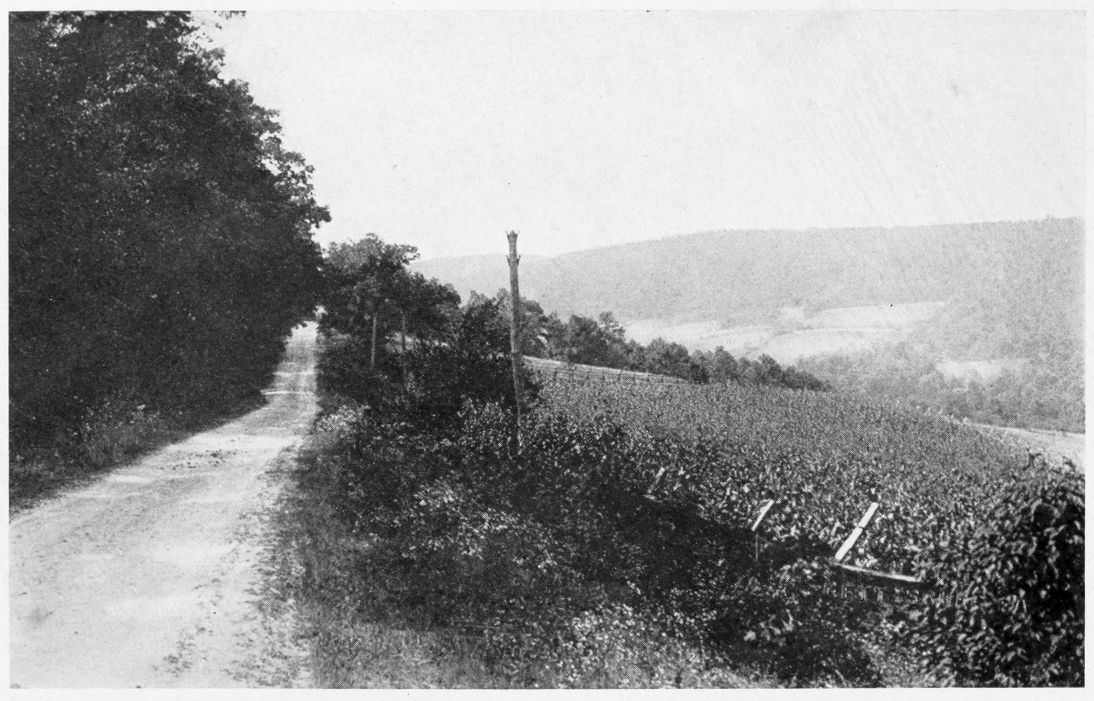
OLD PITTSBURGH AND PHILADELPHIA PIKE
This pike, in Adams County, was used by both armies during the Civil War
Statue of Liberty; all figures are of Italian marble, carved in Italy, sculptor, Randolph Rogers; bronze equestrian statue, General George Gordon Meade, near center of line of battle, sculptor H. K. Bush-Brown; bronze equestrian statue, General John Sedgwick, north of Little Round Top, sculptor H. K. Bush-Brown; bronze equestrian statue, General Winfield Scott Hancock, east Cemetery Hill, sculptor, F. Ellwell; bronze equestrian statue, General Henry W. Slocum, on Steven’s Knoll, near Culp’s Hill, sculptor, E. C. Potter; bronze statue, General John F. Reynolds, at entrance to National Cemetery, sculptor, J. Q. A. Ward; bronze statue, General Alexander Stewart Webb, sculptor, J. Massey Rhind, placed at the Bloody Angle where Pickett’s charge was halted and beaten back; General Webb was the officer in command at this spot; bronze statue, General Warren, on Little Round Top, sculptor, Gerhart.
Pennsylvania State Monument, double arch, 110 feet high, 80 feet square at base, crowned with dome surmounted by a bronze Victory, eight bronze statues at base of Ionic columns, Lincoln, sculptor, J. Otto Schweizer; Curtin, sculptor, W. Clarke Nobel; Meade, sculptor, Lee O. Lawrie; Hancock, sculptor, Cryrus P. Dallin; Pleasanton, sculptor, J. Otto Schweizer; Reynolds, sculptor, Lee O. Lawrie; D. McM. Gregg, sculptor, J. Otto Schweizer; Birney, sculptor, Lee O. Lawrie; bronze tablets around base contain names of every soldier of Pennsylvania in Battle at Gettysburg, 34,530. New York State Monument, tall granite shaft, supporting bronze statue of liberty, with four bronze battle reliefs in pedestal; bronze trophy, state shield and corps badges at base of shaft, sculptor, Casper Buberl. Vermont State Monument, fluted shaft surmounted by statue of General George J. Stannard. Irish Brigade Monument, Celtic cross, with Irish hound at base, sculptor, Rudolph O’Donovan.
In the National Cemetery are buried 3589 Union soldiers; it was dedicated November, 1863, when President Lincoln delivered his immortal address, ending, “This nation, under God, shall have a new birth of freedom—and that government of the people, by the people, and for the people, shall not perish from the earth.” Fiftieth anniversary of the battle, fought July 1-2-3, 1863, was celebrated here in 1913 by reunion of veterans.
The Russell Tavern, now a residence on old Shippensburg Road, three miles north of Gettysburg, is where Washington stopped in 1794, after quelling the Whiskey Rebellion. In Cashtown, the Civic League has formed a recreation park, using the old tavern for a Library; west of this town is the old Pittsburgh and Philadelphia Pike, used by both armies during Civil War. Conewago Mission at Edgegrove was established in 1741 by two Jesuit missionaries; present church, colonial, stone, was built in 1787; enlarged, 1851; paintings over the altar and in the transepts were made by Francis Stecker; Roman Catholic missions were established within a radius of twenty miles from this mother house.