I THE COMMOMWEALTH, OR STATE OF PENNSYLVANIA (PENN’S WOODS) (continued 2)
Reading edition
The Reformed Church in the United States, which brought its beautiful and significant emblem, “The lily among thorns,” from the fatherland, is derived from the Reformed Churches of Switzerland and Germany; these churches are largely to be found in the counties east of the Susquehanna River. William Penn’s mother, Margaret Jasper, was reared in this faith; noted members who came here were Michael Schlatter, in 1746, from St. Gall, Switzerland; sent to establish an ecclesiastical organization; he was practically the first superintendent of public instruction in Pennsylvania; died, 1790, and was buried in the Reformed graveyard in Philadelphia, now Franklin Square; Colonel Henry Bouquet, from Switzerland, proved the saviour of the early settlers in Pontiac’s war and obtained the restoration of all captives to their homes; three hundred and seventy were brought back; and Baron von Steuben, who had served on the staff of Frederick the Great at the siege of Prague, drilled our men into efficiency to cope with the British regulars; later he commanded at the Siege of Yorktown, which he pressed so vigorously that Cornwallis was obliged to surrender. Zion Reformed Church at Allentown sheltered our Liberty Bell and the Christ Church bells during the Revolution; among their thirty churches in Philadelphia and vicinity, of Gothic architecture, stone, are the First Church, Fiftieth and Locust Streets; oldest of this denomination in Philadelphia; moved from Tenth and Wallace Streets; Palatinate, Fifty-sixth Street and Girard Avenue; St. John’s, Fortieth and Spring Garden Streets; and Trinity, northeast corner of Broad and Venango Streets. There are also five churches of the Dutch Reformed.
Roman Catholic. The churches of this denomination are all notable for good architecture, interior sumptuous, ecclesiastical decoration. Cathedral of SS. Peter and Paul, finely situated on Logan Square and the Parkway; Classic Renaissance, brownstone; built 1846-64; architect, Napoleon LeBrun; “The Crucifixion,” back of the high altar, genuine fresco painting, is by Constantine Brumidi, who, about the same time, executed important decorations, in the same medium, in the dome of the Capitol at Washington; on entering the church, in chapels on both sides of the door, are mural decorations by Henry J. Thouron, said, by high authority, to be the best mural paintings in the United States; the first was placed in 1911 as a fitting background for a statue of the Virgin and Child by Louis Madrazzi, which Mr. Thouron brought from Paris as a gift to the Cathedral; in the north transept is a painting, “The Dead Christ,” attributed to Titian; a work of art of exceptional merit is a large ivory crucifix, the master work of Carlo Pazenti, an Augustinian lay brother, about 1840; acquired for the church, with much difficulty, by the venerable John N. Neumann, fourth Bishop of Philadelphia; when, during the Civil War, the Sanitary Fair was being held in Logan Square, Archbishop Wood, then Bishop Wood, exhibited this beautiful work daily, for the benefit of the great cause; it was returned each evening to its place in the Cathedral. St. John the Evangelist, Thirteenth Street above Chestnut, for a short time the cathedral; early English, Gothic; interior, perpendicular Gothic; cornerstone laid by Bishop Kenrick, third Bishop of Philadelphia; church opened April 8, 1832: a flagellation of Christ, much darkened, by Garacci, was presented to the church by Joseph Bonaparte soon after its completion: Mozart’s “Requiem Mass” was rendered, for the first time in America, at St. John’s Church, and the music there today, is said to be the best church music in Philadelphia. St. Patrick’s, Twentieth Street below Locust, originated in a frame church in 1839, on east side of Nineteenth Street near Spruce; the seventy-fifth anniversary was celebrated in 1916, was attended by many notable dignitaries of the church. Windows by d’Ascenzo. St. Francis de Sales, Forty-seventh Street and Springfield Avenue, Romanesque, with Byzantine details; built, 1907-10; architect, Henry D. Dagit, Philadelphia; the leaded glass is particularly beautiful; windows are of the antique school and extremely rich in color, including four rose windows, designed and made by Nicolo d’Ascenzo, Philadelphia. Four old historic churches rather near together, St. Joseph’s, on Willing’s Alley, south of Walnut, below Fourth Street; built on site of first Roman Catholic Church in Pennsylvania, established by a member of the “Society of Jesus” from Maryland, in 1731; St. Mary’s, Fourth Street, above Spruce; St. Augustine’s, Fourth Street, above Race; and Holy Trinity, northwest corner of Sixth and Spruce Streets, had their origin in the eighteenth century, the first two long before the Revolution. St. Augustine’s is on site of a building erected in 1801, by the hermits of the Order of St. Augustine; it had William Rush’s wooden sculpture “The Crucifixion,” but this was burned in 1847. Holy Trinity, German, is of somewhat earlier date; the wayfarer who now looks in on any of them may readily picture them as they were over one hundred years ago. In St. Mary’s Church is a very fine pieta by Boucher, a modern French sculptor.
Swedenborgian, or The New Church, grew out of the teachings of Emmanuel Swedenborg, scholar, traveler, scientist, and religious writer, born in Stockholm, Sweden, in 1688. A school of the New Church was started in Philadelphia in 1854. First “New Jerusalem” Church, Twenty-second and Chestnut Streets, Gothic, brownstone, was built in 1884; architect, Theophilus P. Chandler. Connected with it is a free library and reading room.
Unitarian. First Church, Chestnut Street near Twenty-second, built, 1885; was organized, 1796, in a room of the University of Pennsylvania; in 1797 Dr. Joseph Priestly delivered an address to this Society, and enrolled himself among the members. William Henry Furness was ordained pastor in 1825, in the church at the corner of Tenth and Locust Streets; present church contains some interesting memorials, Dr. Furness, bust by M. Launt Thompson, New York; circular window to Dr. Priestly by John LaFarge; other windows are English; and some are by Tiffany, New York. Girard Avenue Unitarian, Girard Avenue above Fifteenth Street, organized by the Rev. Charles G. Ames, in the late seventies; Gothic, granite. Germantown Unitarian, corner of Chelten Avenue and Greene Street, built, 1866; Gothic; architect, Frank Furness; has good stained glass windows, made by Heaton, Butler and Bayne, London. Rev. Samuel Longfellow, brother of the poet, was pastor for some years; also the Rev. Charles G. Ames.
FAIRMOUNT PARK
On east and west banks of the Schuylkill River, and Wissahickon Creek; second largest municipal park in the world, 3597 acres; its only superior in acreage being Blue Hills Park, Boston, with 4906 acres. The ravines, “unkempt and wild,” all have springs of clear, cold water. Main entrance at Green Street is also approach to the proposed Philadelphia Museum of Art, on a raised terrace, like a Greek Temple, facing the Parkway; Horace Trumbauer, C. C. Zantzinger, and Charles L. Borie, Jr., architects; part of the plan for development of Philadelphia within a radius of thirty miles: here also is the “Washington Monument,” sculptor, Professor Siemering of Berlin, erected by the “Society of the Cincinnati.” Continue drive, to the Schuylkill River, proposed Ericsson Memorial, Paul B. Cret, architect, was commissioned to prepare a design for development of the entire basin, from boat houses to Spring Garden Street, including the Aquarium, formed, 1911, using the classic marble buildings of the old waterworks; it is said to be the best equipped in the world; walls of exhibition tanks are covered with calcareous tufa, rock shell formation from the Ohio River Valley, full of holes, in which deep water vegetation is planted to suggest sea bottom; Arctic and tropical life have their own temperatures; also hatching rooms. This tract and Rocky Hill, of the old waterworks, five acres, between Green and Callowhill Streets, was named by William Penn, Fair Mount; it was used as the terminal pillar of the British redoubts, stretching across the city from the Schuylkill to the Delaware, in 1777-78. Acquired by the city in 1812 as site for the city waterworks, moved from Centre Square, for park purposes. This was the beginning of Fairmount Park; to beautify the grounds, walks were laid out up to the reservoir, and the rock decorated with sculpture, chiefly woodcarving, by William Rush, including the groups, “The Schuylkill in an Improved State,” and “The Schuylkill in Chains,” which are still over the entrances to the wheel houses; “Justice” and “Wisdom,” full-length statues, carved for decoration of the triumphal arch in front of the State House at Lafayette’s reception in 1824, are now in the hatching room; and “Leda and the Swan,” modeled in 1812 from Miss Vanuxen, a Philadelphia belle, a bronze reproduction is here now. Boat houses are of decorative construction. The Schuylkill Navy, said to be the most complete association devoted to rowing in the world, is the center for test trials of skill and endurance, of national interest; it is known as the American Henley; the course above Columbia Avenue bridge is ideal for oarsmen, and the banks rise like seats of an auditorium. On the main drive from the Aquarium are the Lincoln Monument, bronze, sculptor, Randolph Rogers, made in Rome, cast in Munich; Iron Spring, and a bronze group, “Lioness Carrying to Her Young a Wild Boar,” sculptor, August Cain; near Brown Street entrance is bronze group, “Silenus and the Infant Bacchus”; original in the Louvre, credited to Praxiteles; and the bronze group, “The Wrestlers,” from original antique in the Royal Gallery, Florence; both reproduced by Barbedienne, Paris.
Lemon Hill Mansion, built by Henry Pratt about 1800, near site of favorite home of Robert Morris. “The Hills,” planned by Major L’Enfant, built, 1773; the property was bought by the city in 1844, and dedicated, in 1855, as a Public Park. Northwest on main drive is Grant’s Cabin, headquarters of General U. S. Grant in siege of Richmond, 1864-65, brought to the Park from City Point, Virginia, at close of Civil War; opposite is Sedgeley Guard House, formerly the porter’s lodge of the Sedgeley Park Estate, site of a Gothic mansion, built, 1800, by William Crammond; acquired for the Park by public-spirited citizens; on same drive, near east end of Girard Avenue bridge, is the replica bronze equestrian statue of “Jeanne D’Arc,” sculptor, Fremiet, Paris; among the best examples of modern French equestrian sculpture. The original is in “La Place des Pyramids,” Paris.
River Drive near boat houses, “Tam O’Shanter,” four figures, red sandstone, sculptor, Thom; from the last boat house, or the Beacon Light, to Girard Avenue bridge will be the Ellen Phillips Samuel Memorial, for which she left $500,000 in 1913; Fairmount Park Art Association, legatee; “On top of stone bulkhead I will have erected, 100 feet apart, on high granite pedestals, uniform in size and style, the History of America, symbolized in a system of statuary”; model made by Edgar V. Seeler. Near are the heroic bronze bust of James A. Garfield, with allegorical figure, sculptor, Augustus Saint Gaudens; the colossal bronze equestrian group, “Lion Fighter,” on natural jutting rock, sculptor, Professor Albert Wolff, cast, 1893; and scattered along, five bronzed iron fountains, replicas of those at Rond Point, Champs Elysees, cast in Paris at foundry of Val D’Osne.
North of tunnel, above Girard Avenue bridge, on River Drive, bronze equestrian statue, “Cowboy,” sculptor, Frederick Remington; a band of cowboys and Indians participated in the unveiling; River and Fountain Green Drive, heroic bronze equestrian statue, “General U. S. Grant”; sculptors, Daniel Chester French for Grant, Edward C. Potter for horse, modeled from the nineteen-year-old gelding, “General Grant,” sired by an Arabian stallion (Leopold), presented to the General in 1878 by the Sultan of Turkey; cast by Bureau Bros., Philadelphia, mounted on Jonesboro granite pedestal, designed by Frank Miles Day and Brother. Columbia Avenue entrance, fountain of “Orestes and Pylades,” bronze group, on Richmond granite pedestal, with bronze masks; sculptor, Carl Steinhauser, Calsruhe, Germany; cast in Philadelphia; near is the Children’s Playground building, erected by Richard and Sarah Smith in 1898; and a park mansion, Mt. Pleasant, land bought from Phineas Bond by John MacPherson, who built the house in 1761, after style of a house in Scotland owned by the chief of his clan, the MacPhersons of Clunie; in 1779, purchased by Benedict Arnold; on his conviction for treason, it was confiscated by the state; in 1781-82 Baron von Steuben occupied it, and here wrote the army regulations which created the American Army; in 1868 it became property of the city, and was added to Fairmount Park.
Rockland comes next, on west side of Dairy Ball Field, occupied 1750-65 by John Lawrence, a notable mayor of Philadelphia; near Rockland is Ormiston, colonial, owned by Edward Burd, prothonotary, Supreme Court of Pennsylvania, named for Scotch home of Mrs. Burd, daughter of Lord Haliburton of Ormiston, who founded the Burd Orphan Asylum; near Dauphin Street entrance, Grand Fountain, bronze and iron, and park trolley station.
Northwest is Woodford mansion; ground deeded by Penn to Dennis Rockford in 1693; house built, 1742, by William Coleman, an original member of the Junto Club; friend of Franklin and Judge of the Supreme Court of Pennsylvania, colonial, brick; original oak floor is still in fine state of preservation; boards doweled together; laths are hand-cut, and handwork on cornices and wainscoting most beautiful; fireplace and mantel in main room are worthy of attention, although now marred by paint; later it became the home of the Franks family; Edgeley ball field, site of residence built by Philip Syng Physick, 1828-36, Professor of Surgery at University of Pennsylvania and first American to be elected member of the Royal Academy of France; the Randolph Mansion is west of Edgeley; interesting colonial house with beautiful handwork in cornices.
Strawberry Mansion, near Dauphin Street entrance; residence of William Lewis; then called Summerville, now used as a restaurant; name was given when added to the park; fine colonial architecture; main hall shows still how beautiful it must have been, with exquisite handwork on cornices, wainscoting, and niches in the hall ornamented with hand tracery.
Along the river drive we pass other country seats known as Harleigh, Fairy Hill, and the Laurels, now South, Central, and North Laurel Hill. Near the Falls on east side of Ridge Road, stood the home of Governor Thomas Mifflin, the fighting Quaker; from the Falls bridge a fine view is obtained of the Schuylkill Navy’s race course.
Farther up is the Wissahickon Creek, Wisamickan (Catfish Creek), or Wisaucksickan (yellow colored stream); we enter the deep recesses of this ravine, where the waters empty into the Schuylkill River; tradition says that on the northwest bank stood a flour mill; in Revolutionary times the owner ground glass or plaster, with the wheat, for the patriot army, for this crime some of Washington’s soldiers hanged him on a tree in front of his mill; here General Armstrong’s corps attacked the Hessian and British soldiers, October 4, 1777, while the Battle of Germantown was in progress: up the Wissahickon drive is Maple Spring Hotel, decorated by grotesque figures of animals and birds, carved out of native laurel; beyond this, across the stream, are abrupt bluffs, from one, the most prominent, called Lover’s Leap, tradition says, a young Indian and the girl whom he loved, being forbidden to marry, plunged into the waters below and were drowned; a steep grade leads to the six-mile stone; here Paper Mill Run empties into the Wissahickon, and here Nicholas Rittenhouse had his grist mill; just beyond, close beside an old bridge, is a quaint old house, inside is a stone tablet marked “C. W. R. 1707,” here David Rittenhouse, the famous astronomer, was born; on Paper Mill Run, the first paper mill in this country was erected, about 1690, by William Rittenhouse: a portion of this land near Tulpehocken Street, within park limits, once belonged to the Queen of Spain; farther is the Blue Stone Bridge, and just beyond is Lotus Inn.
Northward, the east shore becomes more steep, to Mom Rinker’s Rock, she is said to have been a witch; upon the height stands a statue of William Penn, with the single word “Toleration” cut on the pedestal; the statue and land were given to the city, for park purposes, by Hon. John Welsh, ex-minister to England.
One quarter mile farther is Kitchen Lane, and the Hermit’s Well, dug by Johannes Kelpius, scholar and mystic, who came from Germany with his followers, forty men, the number of perfection, in 1694, “to the new world, to see the dawn of the millennium; the pathway to the Light Illumitable, in the glory of religious liberty in Pennsylvania”; they were followers of the Essenes who lived in the solitudes of the Dead Sea, of which St. John the Baptist is said to have been a member; the Ridge and Valley of the Wissahickon gave them a temple of sacred grandeur; places there are now known as Hermit’s Land, and Hermit’s Glen; the piety and humility of Kelpius made him renowned; John Rogers of Connecticut and leaders of other colonies came long distances to consult this great Magister, he lived wholly to the service of God and his fellow men; the Baptistry, a place in the creek, is shown where the monks immersed their converts; after Kelpius’ death, about 1710, his followers built the monastery, replaced in 1752 by a stone house, built by Joseph Gorgas, also called the monastery; ruins still there: the bones of these faithful men are interred under the floor, in the chancel of St. Michael’s Protestant Episcopal Church, High Street, Germantown; also some of their original headstones are there: their books were given, in 1728, to Christ Church, Philadelphia, where they may still be seen: the cult is now found about Ephrata, among the Seventh Day Baptists.
Beyond the monastery, near Livezey’s Lane, are caves, said to have been the abode of hermits. Half a mile farther is Livezey’s mansion, built, 1698, said to have been neutral ground where British and American officers met during 1777-78; now headquarters of the Valley Green Canoe Club; above is Cresheim Creek, a small tributary flowing into the Wissahickon Creek, among great masses of huge rocks, under tall pines, making a dark pool, called the Devil’s Pool; said to be bottomless; scene of an engagement during the Battle of Germantown. Just beyond is Valley Green, a quaint old wayside inn; here is a stone bridge with strong buttresses and single arch; the reflection makes a clear oval; farther is the first drinking fountain erected in Philadelphia, “Pro Bono Publico,” placed in 1854; white marble; half a mile beyond, at east end of Rex Avenue Bridge, is Indian Rock, summit crowned by heroic statue of Tedyuscung, last of Indian chiefs to leave the shores of the Delaware. Northwest the ravine is deep and the hills steep, winding toward Chestnut Hill. It is proposed by the city to extend Fairmount Park, on both sides of the Wissahickon, to Fort Washington, and include Militia Hill at Whitemarsh, famous in the Revolution, making the Park one thousand acres larger.
West Park, west end of Girard Avenue Bridge, Zoölogical Gardens, open daily, including Sundays; in front, bronze group, “The Dying Lioness”; sculptor, Professor Wilhelm Wolff, Berlin, cast in Munich. The inclosure embraces Solitude, a mansion built in 1785 by John Penn, the poet, grandson of the founder and cousin of John Penn of Lansdowne; was last property owned in America by the Penn family; notable decorations are in the ground floor room; ceiling, fine example of French stucco, Louis XV period. The Zoölogical Gardens were incorporated in 1859; oldest incorporated body of its kind in America; on an area of forty-one acres arranged by H. Schwarzmann in 1873, opened, 1874, with large and attractive buildings, in which representative species of living animals are shown; it is a private organization; the Pathological Laboratory has for its objects, assistance in the hygienic control of the Garden; collection of statistics upon diseases of wild animals; and research: many species of water, and other birds, are on the large lake, and inclosures scattered through the Garden.
Opposite, on Girard Avenue, is William Penn’s House, originally in Letitia Street, near Second and Market; first brick house in Philadelphia, built, 1683, removed in 1883; Landsdowne Entrance to the Park, under two spacious elliptical arches of the Pennsylvania Railroad viaduct, carrying the railroad across Girard Avenue, is a dignified and handsome structure. Near is bronze group, “Hudson Bay Wolves,” sculptor, Edward Kemeys, cast in Philadelphia.
In 1732, “The State in Schuylkill,” a fishing club, first social club in Philadelphia, leased an acre of land near here, and built a hut; annual rental, three sun perch, presented on a pewter plate; they were here for ninety years; now in New Jersey; the members espoused the Revolutionary cause, and in 1774 formed a Company, called “The Light Horse,” afterwards, in 1778, became the First City Troop.
On Lansdowne Drive is Sweet Brier Mansion, built by Samuel Breck about 1810; colonial, in the hall is an interesting wrought iron grill; in front is bronze Indian group, The Stone Age, sculptor, John J. Boyle; cast in France. The Smith Memorial Gate, to Pennsylvania men distinguished in the Civil War, is at entrance to the Esplanade; architects, James and John T. Windrim, erected, with statuary, 1897-1912; sculpture all colossal; equestrian, Major General Hancock, sculptor, J. Q. A. Ward; and Major General McClellan, sculptor, Edward C. Potter; statues, Major General Meade, sculptor, Daniel Chester French; Major General Reynolds, sculptor, Charles Grafly; Richard Smith, sculptor, Herbert Adams; busts, Admiral Porter, sculptor, Charles Grafly; Major General Hartranft, sculptor, A. Stirling Calder; Admiral Dahlgren, sculptor, George E. Bissel; James H. Windrim, sculptor, Samuel Murray; Major General S. W. Crawford, sculptor, Bessie O. Potter Vonnoh; Governor Curtin, sculptor, Moses Ezekiel; General James A. Beaver, sculptor, Katharine M. Cohen; John B. Gest, sculptor, Charles Grafly; two eagles and globes, sculptor, J. Massey Rhind.
The John Welsh Memorial, President of the Centennial Expositon, formal Garden, with fountain, on site of Centennial main building, Parkside Avenue approach to Memorial Hall; “Florentine Lions,” cast by Harrison, Winans and Eastwick at Alexandroffsky, Russia, in 1849, from pair at entrance of Imperial Mechanical Works, originals at entrance to Loggia di Lanzi, Florence; Memorial Hall, front terrace, bronze, Spanish cannon, Miltiades, date, 1743; bronze, Spanish cannon, Semiramis, date, 1737; bronze, Spanish mortar, date, 1731, from fortifications in Cuba; carved decorations with Spanish royal arms of Philip and Elizabeth Farnese; two bronze groups: “Winged Horses,” led by muses of epic and lyric poetry, Calliope and Clio; sculptor, Pilz, made for Vienna Opera House, Austria; Memorial Hall, German Renaissance; architect, Hermann J. Schwarzmann; contains complete model of the arrangement of the Centennial buildings, made to scale by John Baird; first International Exposition held in America; when our national art was invigorated by competition with masterpieces of other lands, and now challenges comparison with the best: also Pompeian collection of paintings, illustrative of Pompeian life; and bronze face and hands of Abraham Lincoln; casts taken from first replicas, of original casts from life, in 1860; sculptor, Leonard W. Volk, Chicago; for collections, see Art. North of Memorial Hall is heroic bronze equestrian statue, Major General George Gordon Meade, sculptor, Alexander Milne Calder.
Horticultural Hall, erected 1876, on site of Lansdowne Mansion, built by Governor John Penn in 1773; stone; Italian; in 1816, leased by Joseph Bonaparte for two years, accidentally destroyed by fire in 1854. In 1866, the land was acquired from Barney family for the park; Moorish style, architect, Hermann J. Schwarzmann, also responsible for plan of adjacent sunken garden: no other building for similar purposes in this country can approach it, in dignity of design: contains marble statue “Il Penseroso,” sculptor, Mosier, acquired, 1874. Notable plants housed in this building are a gigantic specimen of Attalea Cohiene, bay oil palm, from Central America, possibly most superb palm to be seen under glass anywhere; Phœnix Canariensis from the Canary Islands; Seaforthias from Australia; Howeas from Lord Howe’s Island; Cocoa palms; Ceroxylon, wax palms, towering sixty or seventy feet; giant Rubber trees; Araucarias from Australia; Bamboos from the Orient; and lofty Tree Ferns from New Zealand unite to produce a wonderfully impressive scene, not unlike a glorified tropical forest, emphasized by training creepers up the lofty stems, growing ferns and orchids in crotches of the limbs, and by the strange aerial roots which reach down from these clinging plants to seek nourishment in the soil below, as in the tropical jungle. The Cactus house is arranged to give something the effect of arid regions, by planting in sterile soil; the Fern houses, with superb collections of Tree Ferns, and smaller growing Adiantums, Nephrolepis, Acrostichums, recall the effect of mountain ravines. A special house is given to the Cycads or Sago palms, survivals of vegetation of fossil beds, of which this collection is unique in this country. Another tropical house contains the Bromeliad or pineapple family, collection unique in many respects.
In the gardens, most striking features are the rare trees, golden larch, Pseudo-Larix; the Gordonias, Franklinias; oaks. East front has bronze busts of Schubert, granite pedestal with bronze bas-relief; “Music,” sculptor, Henry Baerer, New York; Hayden, a trophy won by United Singers of Philadelphia at the National Saengerfest; Verdi, on artistic sandstone pedestal, with carved figure; “Religious Liberty,” marble, sculptor, Moses Ezekiel; presented by the Hebrew Society B’nai B’rith. A short walk east, near Columbia Avenue bridge, is said to be Tom Moore’s cottage; the poet was a frequent guest both at Belmont and Ormiston, with communication by boat.
The Sunken Garden, west, rearranged to conform to Moorish ideals of garden approaches, is now a pool, about eight hundred feet long, similar to that before the Taj Mahal, flanked on both sides by spreading Oriental planes; beyond this central feature are flower gardens, following the Oriental in color arrangement, making an effect of noble proportions. A bronze Sundial shows the variations for each month of the year, and the time at twelve o’clock in twelve principal cities of the world; on Tennessee marble pedestal, with four supporting female figures, emblematic of the four seasons; sculptor, A. Sterling Calder. Bronze statues of Schiller, made in 1886, granite pedestal with bronze panels in bas-relief representing poetry, history, drama; and of his friend Goethe, made in 1890, granite pedestal decorated with bronze laurel wreaths.
Roman Catholic Centennial Fountain, erected by the Total Abstinence Societies, sculptor, Herman Kern. Japanese Temple Gate and lotus pond, near Belmont Avenue, part of Japanese exhibit in St. Louis, in 1904, showing best Japanese work of three hundred years ago; also on way to George’s Hill are, the Ohio, English, and Rhode Island Centennial buildings. George’s Hill, eighty-three acres, acquired by bequest to the City of Philadelphia, in 1868, through the Fairmount Park Commission, for the health and enjoyment of the people forever.
Belmont Mansion, built, 1743, by William Peters, stone, on estate of two hundred acres, approached by avenue of tall hemlocks, ninety feet high. Washington and Lafayette both planted trees here; view down the Schuylkill is like the Rhine; City Hall Tower focuses the eyes in the distance; Richard Peters, his son, wit and scholar, born here, was made Judge of the United States District Court of Pennsylvania by Washington; who was entertained here; also Hancock, the Adamses, Jefferson, Steuben, Talleyrand, and Louis Philippe.
North of Belmont is Ridgeland, once private residence; continue northeast near Park Trolley Station, Chamounix mansion, formerly known as Mount Prospect for its fine situation; built, 1802, by George Plumstead, a Philadelphia merchant.
OTHER SQUARES AND PARKS
William Penn, in his city plan, laid out five squares. Penn Square, Broad and Market Streets, site of early waterworks; now occupied by City Hall; Washington, Sixth and Walnut Streets; first Potter’s Field; Rittenhouse, Eighteenth and Walnut Streets, remodeled like a French park; playground for children of city’s social center; Lion and Serpent, bronze; sculptor, Barye; replica of one in the Garden of the Tuilleries, Paris; The Duck Girl, bronze; sculptor, Paul Manship; Billy, sculptor, Albert Laessle. Logan, on the Parkway; Swan Memorial Fountain to be in center, sculptor, A. Sterling Calder. This was the second Potter’s Field, and place of public executions; site of Sanitary Fair, in 1864, for the Civil War, visited by President and Mrs. Lincoln, pronounced most brilliant affair ever held in America. Franklin, Sixth and Race Streets, formerly a burial ground.
Broad Street, running north and south, is 113 feet wide and 12 miles long from League Island to City Line. Burholme, near Fox Chase, museum and library given and maintained by provision in will of Robert W. Ryerss; over forty-eight acres; opened to public in 1910. Clark’s, Forty-third Street and Chester Avenue, has artistic bronze group, Dickens and Little Nell, made in 1890; sculptor, Frank Edwin Elwell; awarded gold medals, Philadelphia, 1891; Chicago, 1893. Cobb’s Creek, 338 acres, formed, 1904; follows Cobb’s Creek on east bank; chiefly steep, tree-covered slopes for 107 acres; crossing at Mount Moriah Cemetery; widens, north of Market Street, into rolling landscape; has public golf links. Fernhill, ten acres, bounded by Wissahickon Avenue, Roberts Avenue, Schuyler Street, and Abbottsford Avenue, Germantown; memorial to Mr. and Mrs. Thomas McKean, part of their old homestead, given by their children to Park Commissioners with endowment. Fisher, twenty acres; near North Penn branch, Reading Railway; acquired by gift, 1909. Hunting Park, with lake, eighty-seven acres; crossing Northeast Boulevard at Nicetown Lane. League Island and United States Navy Yard; part of Southern Boulevard. Morris, twenty acres; extension of Cobb’s Creek Park; beautiful forest, watered by Indian Run Creek, acquired by gift, 1912. Pennypack, near mouth of Pennypack Creek to Rhawn Street, 532 acres, acquired in 1905; beautiful fertile valley with stream, widened in places, with half ruined mill dams and their waterfalls; quaint masonry bridges, either in single arch or series of spans. Reynolds, Snyder Avenue and Seventeenth Street, contains memorial to General John F. Reynolds, a hero of Gettysburg; granite shaft, six feet high, with bronze medallion of General Reynolds; sculptor, H. K. Bush-Brown;
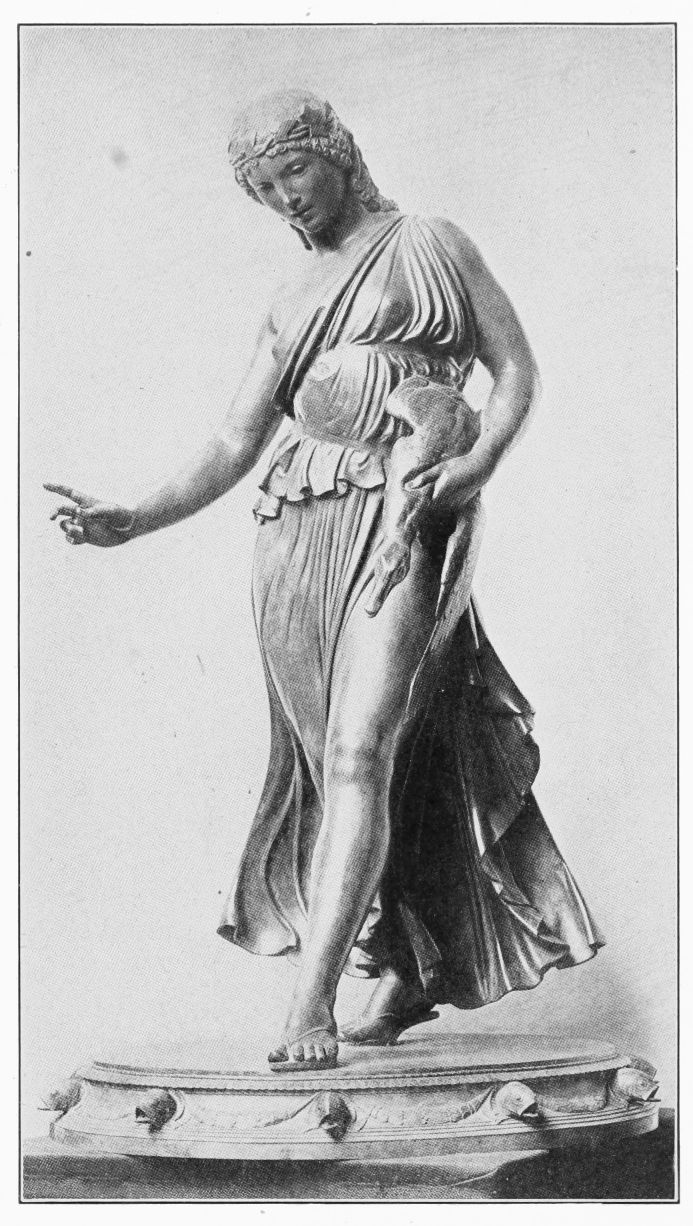
THE DUCK GIRL
From the Fountain in Rittenhouse Square
Paul Manship, Sculptor
unveiled, 1915. Wister’s Woods, contains fine trees and profusion of dogwood; forty-four acres; East Germantown; bird sanctuary.
Total amount of space devoted to park, square, and boulevard purposes within city limits is 8,037.32 acres.
The Fairmount Park Art Association organized 1871, to express high civic ideals, in forms of beauty and dignity, synonymous with art, have had large mounted photographs of the sculpture in Fairmount Park placed in Philadelphia public schools.
HISTORIC INSTITUTIONS OF PHILADELPHIA
Academy of Natural Sciences, on the Parkway at Logan Circle, was founded, 1812, in the house of Thomas Say, Esq., northwest corner of Second and Market Streets. The Museum, for its historic value and extent of its collection, is one of the most important in existence; arranged in two series, an exhibition for the public, and reference for specialists. Library contains about 60,000 volumes, nearly all on natural sciences; several important publications are issued by the Academy, and numerous lectures on natural history are given annually. Contains portraits of founders, Thomas Say, Gerard Troost, William Maclure, Charles Lesueur, Sir Joseph Banks, Samuel L. Mitchell. All painted by Charles Willson Peale, and hung in Peale’s Museum; others by noted artists are Robert Bridges, Isaac Lea, Joseph Leidy, by Bernard Uhle; Jacob Gilliams by P. F. Rothermel; William Hempbell and George Ord by John Neagle; Samuel G. Morton by Paul Weber; W. S. W. Ruschenberger by William K. Hewitt; Isaac Wistar by Robert Vonnoh; also a fine study model of Alexander Wilson, the ornithologist, by Charles Grafly, and statuette of same by Alexander Calder.
American Philosophical Society, 103 South Fifth Street, on lot in State House yard, given the Society by the state in 1785; colonial, brick; built, 1789: originated in “The Junto” formed by Benjamin Franklin, 1727, with the object of mutual improvement; received its name 1769, “The American Philosophical Society in Philadelphia, for Promoting Useful Knowledge.” Benjamin Franklin, then in Europe, sole American plenipotentiary to France from the thirteen provinces, was elected first president, and continued until his death in 1790. David Rittenhouse, second president, served until his death in 1796; he, with other members, successfully observed the Transit of Venus, June 3, 1769, giving the first approximately accurate results to the world, in the measurements of the spheres; he also constructed an orrery for measuring heavenly bodies. Thomas Jefferson, third president, served eighteen years, while he was also Vice-President and President of the United States, and established its library and cabinet. Present President, Dr. W. W. Keen. Its membership is world wide. At the meetings, held regularly, the most advanced thought in scientific investigation is presented. The Society now owns most of the Franklin papers in existence, recently calendared in five volumes by Dr. I. Minis Hays; field notes of Lewis and Clark expedition; original copy of Penn’s Charter of Privileges, dated 1701; manuscript volume, Laws of Pennsylvania prior to 1700, and original broadside, Declaration of Independence. Oil portraits of all its Presidents are here and of many leading members; notably, George Washington, by Gilbert Stuart; President Jefferson, Benjamin Rush, John Vaughn, Caspar Wistar, P. S. DuPonceau, all by Thomas Sully; David Rittenhouse and Samuel Vaughn by C. W. Peale; Joseph Priestly and Chief Justice William Tilghman by Rembrandt Peale; Daniel G. Brinton by Thomas Aikens; Professor Alexander Dallas Bache by Huntington; General Isaac Wistar and Joseph Henry by Bernard Uhle; several notable busts of Jefferson, Turgot, and Condorcet by Houdon; Benjamin Franklin by Caffieri; and of Lafayette, Alexander Hamilton, and Nicholas Biddle.
The Franklin Institute, Seventh Street above Chestnut; organized, 1824; open free daily; classic, marble, built, 1825; John Haviland, architect. First organization in the United States to combine science with practice; the lecture course presents, free to the public, latest advances in useful arts and sciences, by distinguished technologists; also popular illustrated addresses on topics of the day; school of Mechanic Arts includes instruction in mechanical and architectural drawing, said to be one of the most thorough and practical in the United States. Library is second to none, in extent and completeness, as reference for scientific literature; The Franklin Journal, published since 1825, monthly, is the only record extant of a number of early United States patents. They held first exhibition in America of American manufactures, 1824, in Carpenters’ Hall, and first electrical exhibition in America. Portraits include Dr. Benjamin Franklin and Matthias W. Baldwin by Sully, Daguerre by Abraham Whiteside, and bust of Henry Clay by William Rush, carved wood. Among relics are typesetting and electrical machines, used by Benjamin Franklin, and early models of machinery. Will be moved to Parkway, Race Street, east of Nineteenth Street.
The Historical Society of Pennsylvania, 1300 Locust Street, in mansion of General Robert Patterson, enlarged and made fireproof; founded, 1824. Open 10.00 A.M. to 6.00 P.M.; July and August, closes at 4.00 P.M.; publishes the Pennsylvania Magazine of History and Biography; contains probably the largest collection of sources of American history assembled in any one place; includes over 100,000 bound books, 250,000 pamphlets, 7000 volumes of manuscripts and some 3500 volumes of newspapers, which are invaluable to the student of colonial and Revolutionary history; an Index to the Marriages and Deaths, in Dunlap, Claypoole and Poulson’s American Daily Advertiser, creates a constant demand for the files of that newspaper for genealogical purposes; Tom Paine’s American Crisis, 1776, and many other rare imprints of Americans. The Society has a large and exceedingly rich collection of oil paintings; practically all the governors of the state are represented in portraiture on its walls, some of the mayors of Philadelphia, and portraits of many Revolutionary officers; a portrait of Johannes Kelpius, the “Hermit of the Wissahickon,” by Christopher Wick, in 1704, is believed to be the earliest portrait in oil painted in America; portraits of Gustavus Hesselius, his wife, and of Robert Morris, Sr., father of the financier, painted by Gustavus Hesselius, are of historic interest; a fine collection of original
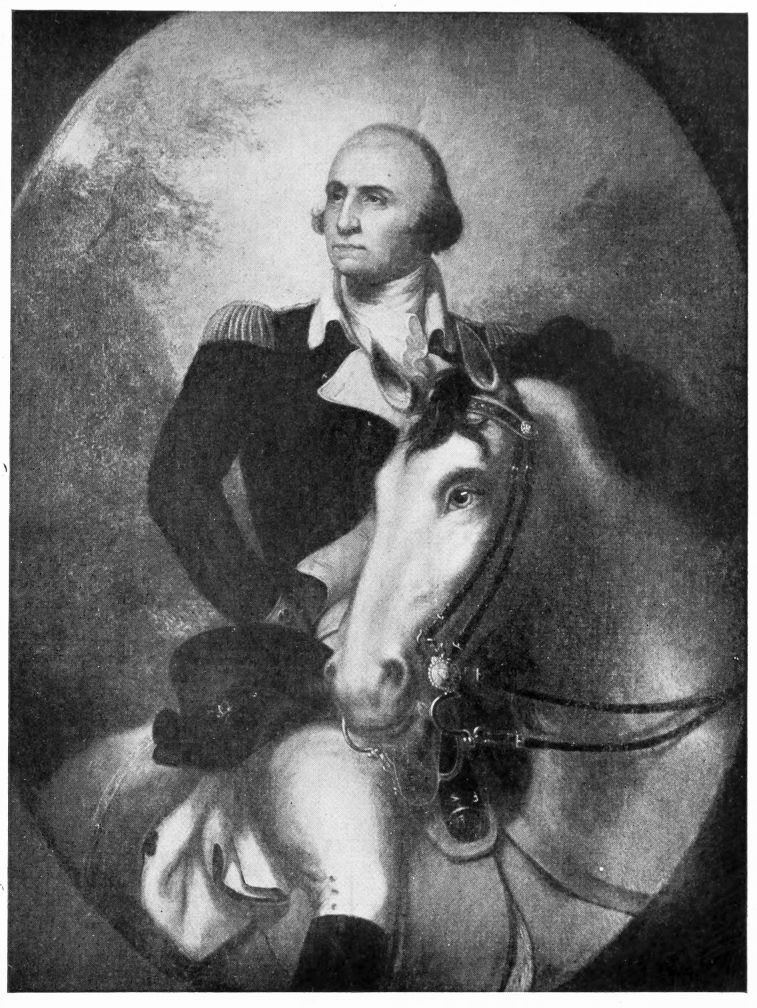
GEORGE WASHINGTON
From the collection in Independence Hall
Painted by Rembrandt Peale
portraits, drawings, studies, and manuscripts by Benjamin West, includes the full length portrait of William Hamilton of the Woodlands, and his niece, Mrs. Ann Hamilton Lyle, probably the most beautiful of West’s portraits in this city; other artists represented are Charles Willson Peale, Jacob Eicholtz, Thomas Sully, Rembrandt Peale, John Neagle, Charles Gilbert Stuart, Robert Edge Pine, John Singleton Copley, Walter G. Gould, Henry Inman, Paul Weber, and William E. Winner. Among the miniatures are those by John Trumbull, James Peale, and Robert Fulton. Marble busts are of Washington, Franklin, Milton, Henry Clay, Major General Robert Patterson, T. Buchanan Read, and Dr. Joseph Parrish. Relics of great historic interest include the Ephrata Printing Press, the Charter of the City of Philadelphia, and the “Great Belt of Wampum,” representing the famous Shackamaxon Treaty between William Penn and the Indians, “never signed and never broken.”
Masonic Temple, Broad and Filbert Streets; Norman architecture; built, 1870; John T. Windrim, architect. Rooms with notable decorations are the Egyptian; Oriental, Moorish style from sketches made in the Alhambra by John Sartain; and Corinthian, copied from well-known standards of architecture, ornament and familiar figure composition. Museum said to be the greatest existing Masonic museum, contains aprons of Past Grand Masters of the three oldest Lodges in the world; and George Washington’s apron, made by Madame Lafayette and presented to him by the Marquis, worn by Washington at laying of the corner-stone of the Capitol at Washington; an ancient Templar Cross, original Crusader’s Cross, found in a grave at Tyre, Syria, A.D. 1250; notable jewelers’ art of England, Denmark, Germany, France, and Great Britain, in badges, including one owned by Napoleon I; tablet from Temple of Herod; Sephar Torah, ancient scroll of the law found in Germany, over eighteen feet long, and from three hundred to five hundred years old. Library, Byzantine decorations, with coats of arms, of various Guilds and Grand Lodges, in the ceiling. The Great Hall, or front entrance, contains portraits and paintings, among them “The Puritans” by F. J. Waugh and “A Marine Scene” by Richards; Seals of the States of the Union, and paintings portraying the Pan Athenia, Greek festival. On the second floor are the Grand Lodge Room, representing a Corinthian temple, constructed to appear roofless; the columns, reproductions of the Lysicrates, Athens; mural paintings represent the mythology of the Greeks, “Weighing of the Soul,” “Ulysses Passing the Island of the Sirens,” “Birth of Athena,” “Judgment of Paris,” “The Golden Fleece.” Renaissance Hall, the Tabernacle, contains the Veils of the Temple. Two paintings at either end represent a High Priest, and a Scribe. Ionic Hall and Norman Hall have characteristic ornamentation; Egyptian Hall, decorations are copied from Temples of Karnak, Elephanta, Philae, Rameses, the Cataracts and Tombs; Ceiling from Temple of Denderah; also the scene “Weighing the Soul,” showing Egyptian mythology allied with Greek.
Mint of United States at Philadelphia, Sixteenth and Spring Garden Streets, open daily, except Sundays and holidays, 9.00 A.M., to 3.00 P.M. Classic Ionic, granite, built, 1901, by the Supervising Architect of Washington, D. C. Main lobby finished in Italian marble with mosaic ceiling; panels illustrate ancient methods and processes of coinage; artist, W. B. Van Ingen. Largest and most completely equipped Mint in the world. Numismatic room, accessible to the public, contains large collection of coins and medals; among them the widow’s mite, found in ruins of Temple in Jerusalem.
Pennsylvania Bible Society, 701 Walnut Street, organized in Philadelphia, 1808. First Bible Society on American continent; present building erected, 1853. First President, Right Rev. William White, D.D.; first meeting, called by Robert Ralston in his own home; object, to further our country’s welfare through the Bible, the Book teaching love, unity, and forbearance; therefore qualified to band the people together and advance national betterment. The establishment of such an organization in our land was recognized by gift of £200 by the British and Foreign Bible Society, London. All denominations have been represented in the line of Presidents; during Bishop Whitaker’s incumbency the Pennsylvania Bible Society was connected with the American Bible Society in New York, now the national organization. General Lafayette in 1824 was presented by this Society with a specially prepared copy of the Scriptures. At the centennial of this Society, in 1908, celebrated in the Academy of Music, Bishop Ozi W. Whitaker, D.D., presided; Right Hon. James Bryce, British Ambassador, made an address and presented to Bishop Whitaker a beautifully embossed Bible, sent by the British and Foreign Bible Society, emblems on the cover were from early Christian examples, similar to those on the Coronation Bible given to King Edward VII; Ambassador Bryce was in turn presented with a richly made copy of the Scriptures, by the Pennsylvania Society; greetings were received from President Theodore Roosevelt and Governor Edwin S. Stuart of Pennsylvania, and from other Bible societies. At the Tercentenary celebration of King James version of the English Bible, in the Academy of Music, 1911, James A. MacDonald, LL.D., of Toronto, spoke of “The Influence of the Bible Upon the Commonwealth.” Letters were read from King George V of England, and President William H. Taft. This Society now circulates between two and three hundred thousand Bibles per annum, printed in over fifty languages and dialects, for Pennsylvania, New Jersey, and Delaware, over which this house has especial jurisdiction. Any separate book of the Bible may be obtained for two cents.
Philadelphia Commercial Museum, Thirty-fourth Street below Spruce, organized, 1894, is the only Commercial Museum in the United States; it received immense collections from the Chicago “Columbian Exposition,” over forty governments being represented; many subsequent collections from other international expositions; and special exhibits, illustrating the people and products of the world. A free reference library is here, of Foreign and American Commerce and Travel, which could not be duplicated, and courses of free lectures are given which cover subjects of geographic, commercial, and industrial importance, illustrated by colored lantern slides and motion pictures; colored slides, with lantern screen and type-written lectures, covering same field of geography, commerce, and industry, are loaned, free of cost, to public-school teachers, in all parts of Pennsylvania; they reach tens of thousands; also collections of specimens, to aid teachers, are sent free of cost, as a gift to Pennsylvania public schools; they are arranged, showing important raw material, and process of manufacture. Manufacturers are furnished with information on all matters pertaining to foreign trade; the Foreign Trade Bureau is the acknowledged leader of such organizations in the world.
The Pennsylvania Horticultural Society, 1600 Walnut Street; first in America, organized at meeting in Franklin Institute, 1827, to promote horticulture and create love for flowers, fruits, and vegetables by their cultivation. Minutes of the Society and list of membership is complete from formation to present time. Lectures by an expert in the various branches of horticulture are given at each monthly meeting, from November until May. Annual exhibitions are, Spring Flower Show before Easter, three days; Peony, outdoor grown Rose and Sweet Pea Show in Philadelphia suburbs, from May to July, according to season; Dahlia Exhibition, in September; Chrysanthemum, early November. The Society has a library of several thousand books on agriculture and horticulture, some very rare and of great value, and all recommended works, of recent publication, in Europe and America. “Great gardens educate people in gentility as well as in horticulture.”
Wagner Institute, southwest corner of Seventeenth Street and Montgomery Avenue; founded by Professor William Wagner, 1847. Circulating and reference library open daily except Sunday, 9.00 A.M. to 9.00 P.M. Museum collections, chiefly in reference to geology and mineralogy, open Wednesday and Saturday afternoons. Courses of lectures conducted through the collegiate year.
LIBRARIES
The Library Company of Philadelphia, Locust Street, east of Broad; first circulating library in the United States; founded by subscription in 1731, by Benjamin Franklin and his friends of the Junto Club; charter granted by John, Thomas, and Richard Penn in 1781; original building, Fifth and Library Streets, designed by Dr. Thornton, now the Drexel Building; present building, architect, Frank Furness in 1889; is a haven for scholars interested in historical research; also has important collections of books on costume, foreign literature, and complete set of Punch, begun in 1840; among historic relics are original sketches made for Watson’s Annals of Philadelphia; William Penn’s desk from Pennsburg; John Dickinson’s reading desk, and Heraldic Hatchment, used at his funeral; and the André collection. The Ridgeway Branch, Broad and Christian Streets, founded by bequest of Dr. James Rush; architect, Addison Hutton; built, 1878, Doric, granite; contains terra cotta bust of Minerva, heroic size, probably French work; formerly behind the Speaker’s chair in the Continental Congress, Sixth and Chestnut Streets, given to the Philadelphia Library, 1783, also some articles of Boule, and illuminated manuscripts.
Mercantile Library, Tenth Street above Chestnut; was established 1821, at 100 Chestnut Street, present building, originally a market house, with room seventy-four by two hundred feet, and high-arched ceiling, makes ideal condition for library work on one floor; this is a circulating library of general literature for stockholders and members, who only are admitted into the reading room, where they have unrestricted use of books.
Philadelphia City Institute, 218 South Nineteenth Street, was founded, 1852, by public-spirited citizens, for the purpose of benefiting young men, by establishing a free library and night school; library free to the public.
The Free Library of Philadelphia, northeast corner of Thirteenth and Locust Streets, chartered, 1891, from endowment fund, left in will by William Pepper, M.D., LL.D., for a free library in the city of Philadelphia: opened temporarily in City Hall; removed to old Concert Hall, 1217-21 Chestnut Street, now in old building of College of Physicians; contains bust of Dr. Pepper, by Carl Bitter, and portraits; a large new library building is in process of construction on the Parkway, Nineteenth and Vine Streets. Growth and usefulness, from its inception, are due to the management of the late Dr. John Thomson, Librarian; now includes a main building, 26 branches, as well as deposit stations and traveling libraries; total circulation for home use in 1916, 2,767,310. Hearty coöperation exists between the public schools and the Free Library; school extension lectures are given to the children of the grammar grades; and “story hours” are weekly events for younger children in the branch libraries. Reference and periodical departments contain works on art, architecture, and archæology, extremely valuable to the practical student and designer; here are facsimiles of many most noted, of early printed books and manuscripts, Bible codices, etc.; the “open shelf” system is used in all departments. Fine buildings of the branch libraries have been developed in their architectural proportions and decoration, on the traditions of French and English Renaissance, or local expression of the Georgian; always with top lighting, considered extremely important: in the basement of the branch at Seventeenth and Spring Garden Streets is a large and valuable collection of government documents; the Josephine Widener Memorial Branch, Broad Street and Girard Avenue, has reference books of priceless nature and rare prints, issued before A.D. 1500.
HISTORIC MEDICAL COLLEGES, HOSPITALS, AND DISPENSARIES
Christ Chruch Hospital, Wynnefield Station, Park Trolley and P. R. R.; Gothic stone building; organized, 1772, by Dr. John Kearsley; endowed by Jacob Dobson in 1804; is a home for gentlewomen, communicants of the Protestant Episcopal Church, in the Diocese of Pennsylvania; 150 acres; the Board of Managers include three of the vestry, each, of Christ Church and St. Peter’s Church.
College of Physicians of Philadelphia, Twenty-second Street, above Chestnut; founded about 1787, and modeled on lines of The Royal College of Physicians in London. A scientific paper was read by Dr. Benjamin Rush at the first meeting. English Renaissance, brick, laid Flemish bond, with basement, cornices, pilasters, and other trimmings of Indiana limestone; finest building of a medical society in the world, with the largest medical library, save one, in the United States, and a fine collection of portraits of presidents of the Society, painted by most notable artists. This is not a teaching institution, but a Medical Society, composed of men of professional distinction.
Hahnemann Medical College and Hospital, 226 North Broad Street. Oldest homeopathic college in the world; founded in 1848; first located at 229 Arch Street. Consolidated with the Homeopathic Medical College in 1869; moved to present site in 1901. Its collections include the world-famous dissection of entire cerebro-spinal nervous system by Dr. Rufus B. Weaver; Dr. Hering’s complete writings of Paracelsus; Dr. A. R. Thomas’s library of old and rare anatomical books; Hahnemann’s works in the original; it has the most complete library of homeopathic literature in existence. Portrait of Dr. W. B. VanLennep; artist, Henry Rittenberg.
Home of the Merciful Saviour, 4400 Baltimore Avenue, on grounds adjoining the Clarence Clark Park; incorporated, 1882; eight houses and chapel, all memorials, with a summer home at Avon-by-the-Sea. A home for crippled, homeless, and helpless children. First of its kind in America where vocational training is taught.
Hospital of the Protestant Episcopal Church, Front Street and Lehigh Avenue. Main group of buildings, pure Norman. Founded by the Right Rev. Alonzo Potter, Bishop of Pennsylvania, and Dr. Caspar Morris, in the ancestral home of two parishioners on the present site. Jenny Lind made the first cash contribution.
Jefferson Medical College, Tenth and Sansom Streets; founded through the efforts of Dr. George B. McClellan; opened, 1825. Present building erected, 1904.
Jefferson Hospital, Tenth and Sansom Streets; last word in hospital construction and equipment; originated in the Infirmary established in Jefferson College, 1825; present site was bought, 1875, and the building opened for use in 1877. Amphitheatre is one of the largest in the world. Museum contains casts and wax models of interesting cases. Notable portraits in the building are Dr. Forbes, by Aikens; Dr. DaCosta, by Vonnoh; Dr. Keen, by Chase; Mr. William Potter, by Breckenridge; Dr. William Pancoast, by Uhle; also bronze bust of Dr. Marion Sims, by C. Duboi, Paris, 1876; marble bust of Dr. George McClellan; bronze busts of Daniel Webster and Thomas Jefferson.
Jewish Hospital, Logan Station; Old York Road and Olney Avenue, entrance is marked with six granite columns from the old United States Mint, formerly on Chestnut Street. Includes twenty buildings, on twenty-two acres of ground, with modern scientific equipment for treatment of sick, care of aged and incurable. A number of art works said to be of considerable value are here.
Municipal Hospital, Luzerne, near Front Street, 4000 north; on extensive grounds bisected by a well-wooded ravine. Established in 1774, on State Island, for the isolation and treatment of contagious diseases; probably most complete of its kind in the world.
Pennsylvania Hospital, between Spruce and Pine Streets, Eighth and Ninth Streets; colonial; brick; with great trees and beautiful open spaces in the grounds. First hospital in the United States, founded, 1751, by Dr. Thomas Bond and Benjamin Franklin. Corner-stone on present site, laid, 1755, can still be seen; part of this land belonged to William Penn, which he donated. In 1756, here was the first clinical amphitheatre in America. Noah Webster delivered a lecture for the benefit of the hospital in 1786; other benefits received about this time were, a charity sermon preached by Rev. George Whitefield in St. Paul’s Protestant Episcopal Church; and a painting by Benjamin West, “Christ Healing the Sick,” made while he was in London; the English refused to allow the original to come to America; they used it to start the National Gallery; so a replica was painted; it now hangs in the hall; for years the hospital made money by charging a fee to see it. At the Pine Street front is a leaden statue of William Penn, presented by his grandson, John Penn, from Wycombe Park, Bucks, England, estate of Lord le Dispenser. Benjamin Franklin was the first Secretary and the second President; his minute books are still to be seen there, with clear fine handwriting; and interesting letters and documents of colonial and Revolutionary times.
Philadelphia Almshouse and General Hospital, Thirty-fourth and Pine Streets, Blockley; first almshouse was opened in 1713 by the Quakers; not municipal, open only to their sect; located on Walnut, between Third and Fourth Streets. First city almshouse was established in 1732; second in 1767; in 1772 it was the most extensive hospital on the continent. During the Revolutionary War, wounded were cared for here. In Longfellow’s poem, Evangeline becomes a Sister of Mercy and ministers here to the yellow fever sufferers in Philadelphia. Present institution built, 1834; architecture of administration building, Corinthian, marble. The Medical Department antedates the Pennsylvania Hospital.
Philadelphia College of Pharmacy, 145 North Tenth Street; established, 1821, at meeting in Carpenters’ Hall: consists of five large buildings connected by a central building, Romanesque, Pompeian brick and Seneca red stone; largest and first institution in the United States devoted to pharmaceutical and chemical instruction. Laboratories and equipment are without a peer, for most advanced training of men and women as pharmacists and chemists. Museum has a large number of paintings of famous scientists, also the Martindale Herbarium of over 200,000 plant specimens. Library has about 14,000 volumes; around the gallery hang portraits of men who have given largely of their time and substance to the development and advancement of the College, and to the progress and betterment of the city; artists represented, Charles Willson Peale, Hugh H. Breckenridge, Henry R. Rittenberg. Collection of photographs of pharmaceutical subjects, many rare and very valuable.
Preston Retreat, Twentieth and Hamilton Streets, on site of William Penn’s residence; classic, marble: founded by Dr. James Preston in 1837, for married women of good character and indigent circumstances, about to be confined. One of the best equipped in the world.
St. Joseph’s Hospital, Girard Avenue and Sixteenth Street; colonial, brick. Established first in the parish of St. Joseph’s Church, near Fourth and Walnut Streets, for Irish famine refugees who became ill on overcrowded and unventilated ships. Incorporated, 1849. Was third general hospital in Philadelphia.
Wills’ Hospital, Eighteenth and Race Streets, facing Logan Circle; classic, marble; founded, 1832, by James Wills, Jr., for the indigent blind and lame. Now one of the best in the world as an institution for the study and practice of ophthalmy.
Women’s Hospital of Philadelphia, North College Avenue. Oldest and largest hospital in the world for women and children: organized, 1861. Its motto is, “Woman’s work for woman by women.”
Woman’s Medical College of Philadelphia, Twenty-first Street and North College Avenue; first college in the world organized for the education of women for the medical profession. Incorporated, 1850. Dr. Ann Preston, of first class to be graduated, was the founder of the Women’s Hospital. Contains bas-relief tablet, “The Woman Physician”; sculptor, Miss Clara Hill.
HISTORIC MUSICAL INTERESTS OF PHILADELPHIA
Academy of Music, Broad and Locust Streets. Seats 3000; established, 1857, for representation of operas in English, and distinguished entertainments; opened with a magnificent ball, such as was never before witnessed in Philadelphia; now home of the Philadelphia Orchestra, which has had three conductors since its organization in 1900, Fritz Scheel, Carl Pohlig, and Leopold Stokowski; all of whom have brought the splendid body of players to a high standard of musical excellence. Dr. Stokowski has said of the Academy: “The architect must have had great knowledge of the laws governing sound, as the volumes are marvelously arranged.”
The Mahler Symphony was given here in 1916, first time in America, Stokowski, director, with chorus of 1000 voices. A memorial to Siegfried Behrens will be in wall of lobby, portrait figure in relief, with Muse of Music holding laurel wreath, Cararra marble, seven feet high, on base of dark marble; sculptor, Guiseppe Donato.
The Maennerchor Society, 1643 North Broad Street. A men’s chorus of active and associate members, founded, 1835, by Philip Mathias Wolsieffer, director for eighteen years. The Maennerchor was the first men’s chorus in America; they have sung for twenty-eight years at opening of the German-American Charity Ball, in the Academy of Music. They sang with the Vocal Union, choral parts of Beethoven’s Ninth Symphony in 1874, first time given in America, William W. Wolsieffer conducting. Won three prizes at National Saengerfest in Brooklyn, Baltimore, and Newark.
Musical Fund Hall, Locust Street, west of Eighth Street, built, 1824. Acoustic properties unsurpassed. Jenny Lind sang here. Now used by a Labor Organization.
Philadelphia has over two hundred singing societies, and a long list of very prominent musical organizations.
The Presser Foundation of Philadelphia, organized 1916, is the first institution of its kind to be established in America. All of its resources have been given by Mr. Theodore Presser. It includes a Home for Retired Music Teachers, suggested by the Founder’s visit to the Verdi “Casa di Riposo per Musicisti,” in Milan in 1899. Scholarships to institutions of learning, the students to be selected by the President, and Directors of the Musical Departments, and emergency aid relief to musicians.
THE UNIVERSITY OF PENNSYLVANIA AND OTHER HISTORIC SCHOOLS
The University of Pennsylvania, Thirty-fourth Street and Woodland Avenue, with a campus of one hundred and seventeen acres along the west bank of the Schuylkill River and equipment of seventy buildings; originated in the Charity School, organized, 1740, at Fourth and Arch Streets; made an academy through the interest of Benjamin Franklin, in 1749; chartered, “The College of Philadelphia,” with power to confer honorary and collegiate degrees, being the third oldest college in the United States; in 1799 was organized and chartered as “The University of the State of Pennsylvania,” making it the first institution in the United States designated a university; also the first to establish professional schools distinct from the college. The School of Medicine was added in 1765, and has always maintained the most advanced requirements and highest standards of scholarship for graduation; it was founded by Dr. John Morgan, who held the first medical professorship in America; he was physician in chief of the Continental Army, 1775-77. The first American University Professorship in Law was established here, 1790; James Wilson held the position; President Washington attended his lectures. In 1799, the University conferred on Washington the degree of LL.D., and later, in 1826, set apart his birthday as University Day, on which honorary degrees are conferred, with appropriate exercises. Nine sons of this University signed the Declaration of Independence; seven, the Constitution of the United States; twenty-one were members of the Continental Congress; nine, in the United States Senate; eight were Attorney-Generals of states or of the United States; six were Justices of the Supreme Court; seven, Governors of states; and many others were Officers in the Army and men in public life, who had received their education in the old building, Fourth and Arch Streets, before 1800.
In 1802 the University was moved to Ninth and Chestnut Streets, and occupied the presidential mansion, now site of the Post Office; in 1872, moved to the present site in West Philadelphia. In 1912, under the administration of Provost Edgar Fahs Smith, The University Extension Courses were formed, and the college made into three departments with a dean for each. The College, founded 1740, includes School of Arts; Summer School; College Courses for Teachers; Courses in Biology and Music. The Towne Scientific School, founded, 1875, includes, Architecture, Chemistry, Science, Technology, Mechanical, Electrical and Civil Engineering. Wharton School of Finance and Commerce, founded 1881, includes, School of Accounts and Finance in Philadelphia; and the Extension Schools of Finance and Accounts in Scranton and Wilkes-Barre.
Department of Music, through the unceasing and wise direction of Dr. Hugh A. Clarke, has graduated hundreds of students in music, after a four years’ course in Harmony, Counterpoint, Composition, and Orchestration. The degree of Bachelor of Music has been conferred on many who qualified to meet the requirements. The Graduate School was founded, 1882; courses lead to degrees of master of arts, and doctor of philosophy.
Other Departments are, the Law School, Thirty-fourth and Chestnut Streets; building dedicated University Day, 1900, architects, Cope & Stewardson, style similar to the English Renaissance as developed by Sir Christopher Wren; Indiana limestone and dull red brick; contains the Biddle Law Library, 55,000 volumes; The Black Memorial Collection of English Legal Engravings, most complete in America; several original documents by Benjamin Franklin, George Washington and other colonial men; many objects of historical interest to members of the bar; a fine collection of portraits include those of Algernon Sydney Biddle, by Cecilia Beaux; Charles Chauncey, by Henry Inman; Thomas McKean, LL.D., by Robert W. Vonnoh; Richard Coxe McMurtrie, LL.D., by William M. Chase; James Wilson, LL.D., by Albert Rosenthal, from a miniature; marble busts of Daniel Webster and Jeremiah Sullivan; tablets and memorials.
Laboratory of Chemistry, Thirty-fourth and Spruce Streets; dedicated, 1894; shows the broad projecting eaves of brick architecture in the Italian Renaissance; architects, Cope & Stewardson; it is one of the best equipped chemical laboratories in America. The Engineering building, Thirty-third and Locust Streets; dedicated, 1906; Georgian, dark brick with limestone trimmings, architects, Cope & Stewardson; houses the civil, electrical, and mechanical engineering departments; best equipped of its kind. In its collection of portraits is that of John Henry Towne, by William M. Hunt.
Laboratory of Hygiene, includes the Psychological Clinic; Department of physical education; and Franklin Field, Thirty-third and Spruce Streets, dedicated, 1895, seating capacity of the stadium about 62,000, was for many years scene of annual football between the United States Military and Naval Academies; gymnasium, facing Thirty-third Street, erected, 1903, English Collegiate, Gothic, dark red brick, with black headers laid in Flemish bond, terra cotta and Indiana limestone trimmings, floors and columns concrete; comprises Weightman Hall, exercising rooms, and a large swimming pool; architects, Frank Miles Day & Brother; in front on the terrace is statue of Benjamin Franklin at seventeen, as he first entered Philadelphia in 1732; sculptor, Dr. R. Tait McKenzie, pedestal designed by Professor Paul P. Cret. In the entrance is bronze tablet in relief, full figure portrait of Charles S. Bayne in baseball uniform, “1895 College,” sculptor, R. Tait McKenzie; also other memorials.
Department of Archæology, founded, 1889, by the late Provost William Pepper, M.D., LL.D., museum, Spruce Street, near Thirty-fourth Street, open free daily, 10.00 A.M. to 5.00 P.M.; Sunday 2.00 to 6.00 P.M. The treatment of this building and the courtyard, begun 1897, is among the most successful works of architecture in this country; it was inspired by the round, arched, brick architecture of Northern Italy, about twelfth century; details especially suggesting the old Church of San Stefano in Bologna; roof of Spanish tiles gives added charm; architects in coöperation, Wilson Eyre, Jr., Cope & Stewardson, Frank Miles Day & Brother. Has valuable collections illustrating the history of mankind; Egyptian, Cretan, Etruscan, and Babylonian antiquities, famous tablets from Nippur, and the Dillwyn-Parish collection of Græco-Roman papyri, among which are the oldest known fragments of the Gospel of St. Matthew. During 1916, the museum maintained four expeditions in the field: in Egypt, China, Siberia, and one on the Amazon, which will return with collections they have gathered. Among the portraits in the museum are, Mrs. William D. Frismuth, donor of collection of musical instruments, and Franklin Hamilton Cushing, ethnologist, both by Thomas Eakins; bronze statue of Dr. William Pepper, by Carl Bitter, is in the Italian garden; free public illustrated lectures are given Saturdays, 3.30 P.M., from November to March.
Library, founded, 1749, with volumes bearing accession dates of 1749, given by Benjamin Franklin; First Provost, William Smith; Louis XVI of France; and others, now contains about 450,000 volumes, and many special collections; present building dedicated, 1891, Thirty-fourth and Locust Streets, red brick, sandstone, and terra cotta, Furness, Evans & Company, architects; among the portraits here are Benjamin Franklin, LL.D., replica, by Thomas Gainsborough, R.A., of his original; William Wordsworth, poet, from life, by Henry Inman in 1844; Joseph G. Rosengarten, LL.D., by B. A. Osnis, and the entire class of 1811 minus one, in silhouette, cut at Peale’s Museum; here also is the famous orrery and large clock made by David Rittenhouse for this university.
Houston Hall, memorial to Henry Howard Houston, Jr., class of ’78, Spruce Street above Thirty-fourth. North Conshohocken and Indiana limestone; architect’s design of two students of the School of Architecture, developed by Frank Miles Day; was planned by Provost C. C. Harrison, to weld the cosmopolitan body of students into one democratic brotherhood, which has now become a world-wide movement in college life; contains trophy rooms, pool tables, and publication office of “Old Penn,” until 1918 the official weekly; courses of Free Public Lectures are given by members of the Faculty, and men from other American and foreign Universities; services by eminent ministers are conducted each Sunday morning. Among the many portraits in Houston Hall are, Henry Howard Houston, Jr., by Cecilia Beaux; David Rittenhouse, by Charles Willson Peale; Henry Reed, and Henry Vethake, both by Sully.
The University Hospital, Thirty-fourth and Spruce Streets; founded by the late Provost Dr. William Pepper, 1874, covers two city blocks; medical staff consists of more than one hundred and fifty physicians and one hundred nurses; the Surgical Building erected, 1914; Jacobean style, brick and limestone, architects, Brockie & Hastings, contains marble bust on pedestal of Dr. William Pepper, Provost, 1881-94; bronze mural tablet with portrait of late Dr. John H. Musser, sculptor, Dr. R. Tait McKenzie; and many bronze memorials. The Medical Laboratory, dedicated, 1904, on Hamilton Walk, English Collegiate, of Middle seventeenth century, hard burnt brick and buff Indiana limestone; architects, Cope & Stewardson; interior finished in white Italian marble; is one of the largest and best equipped in America. Contains nearly complete collection of oil portraits of staff of physicians from 1765, including painting of David Hayes Agnew, M.D., LL.D., at the close of a clinic in Medical Hall, all the subordinate figures in the group are likenesses, among them, Dr. J. William White, Dr. Joseph Leidy, Jr., and the artist, Thomas Eakins; Professor John Morgan, founder of the Medical School, after the original by Angelica Kauffman; Professor William Osler, LL.D., and De Forest Willard, by W. M. Chase; Professor Philip Syng Physick, first American to be elected member of Royal Academy, France, by Henry Inman, from life in 1836; Professor Benjamin Rush, by John Neagle; Dr. J. William White, by John S. Sargent; and bronze bust on pedestal of Dr. Joseph Leidy.
The Wistar Institute of Anatomy and Biology, Thirty-sixth Street and Woodland Avenue, founded, 1892, for extension of Wistar and Homer Museums; first university institute exclusively for research in anatomy and biology, buff brick and light terra cotta, fireproof, built, 1808, architects, George W. and W. D. Hewitt; in 1905 this institute became the clearing house for anatomy in America, and in 1906 was appointed Central United States Institute for Brain Investigation; the five principal independent anatomical journals of the United States are published here. Open to the public daily, except Sundays and holidays, 9.00 A.M. to 4.00 P.M., Saturdays, 9.00 A.M. to 12.00 M. Contains bronze bust, sculptor, Samuel Murray, 1890, of General Isaac J. Wistar, Sc.D., who gave the building and endowment; in bronze vase are his ashes; also in three bronze vases are the ashes of Joseph Leidy, M.D., LL.D., John Adams Ryder, Ph.D., and Professor Edward Drinker Cope. Opposite is The Architectural School, Thirty-sixth Street and Woodland Avenue, second only in importance and numbers to the Ecole des Beaux Arts, Paris: the esprit de corps of faculty and students is most pronounced; students and graduates, of late years, have won more competitive prizes, and scholarships, than those of all other American schools combined. The four years’ course leads to degree; special two years’ course, and summer six weeks’ course.
The Botanic Gardens, established, 1894, face Hamilton Walk, open to visitors from sunrise to sunset; greenhouses filled with rare plants from all the world; lily and lotus ponds are attractive feature of the campus. Open-air plays are given here. The Vivarium, established 1898, has fresh and salt water aquaria, first vivarium ever connected with any educational institution. Zoölogical Laboratory, on Hamilton Walk and Thirty-ninth Street, built, 1910; architects, Cope & Stewardson, hard burnt brick and Indiana limestone, English Collegiate, of middle seventeenth century; considered best working laboratory for its purpose in this country, contains many famous collections.
Veterinary Building and Hospital, Thirty-ninth Street and Woodland Avenue, constructed about a square courtyard; one of best equipped of its kind. Architects, Cope & Stewardson, English Collegiate, seventeenth century, hard burnt yellow brick and limestone trimmings, roof green slate, built, 1906-07.
School of Dentistry, “Thomas W. Evans Museum and Dental Institute,” Fortieth and Spruce Streets, Collegiate Gothic, time of Henry VIII, hard burnt red and black brick and Indiana limestone, built, 1914, architect, John T. Windrim; the grotesques ornamenting the band courses, while in the spirit of the Middle Ages, are modern in subject and caricature; most complete edifice in the world, devoted to the science of dentistry. Museum contains the priceless Evans collection, gifts from the nobility of Europe, portraits and busts of Dr. Evans.
Henry Phipps Institute for the study, prevention, and treatment of tuberculosis, founded, 1903, northeast corner of Seventh and Lombard Streets; facing Starr Garden Park, a civic center of the Playgrounds Commission; is colonial style, designed by Grosvenor Atterbury, New York, brick trimmed with white marble.
Flower Astronomical Observatory at Llanerch on West Chester Pike, architect, Edgar V. Seeler, 1895. Open to visitors every Thursday evening during collegiate year, 7.00 P.M. to 10.00 P.M.; is equipped with an 18 inch equatorial telescope, and other instruments of latest and most approved design.
Dormitory Houses, Jacobean, thirty in number, begun in 1895, suggest the Oxford and Cambridge colleges; carved grotesque bosses on main cornices are reminiscent of the Gothic period; they are amusing, and display an unusual amount of imagination; material, hard burnt yellow brick and Indiana limestone; architects, Cope & Stewardson; entrance through two gateways known as Memorial Tower, gift of the Alumni, dedicated in 1901, in memory of University of Pennsylvania men who served in the Spanish-American War, corner-stone was laid by General Miles, in 1900; and the Provosts’ Tower, named as memorial to the Provosts of the University of Pennsylvania, whose twelve names are carved on medallions, from William Smith to Charles Custis Harrison.
William Penn Charter School, 8 to 10 South Twelfth Street, was planned in 1684 at a meeting of the Provincial Council, Governor Penn presiding. In 1689, William Penn, writing from England to Thomas Lloyd, President of Council, instructed him to set up a “Public Grammar School in Philadelphia,” the school was incorporated in 1698, and George Keith engaged as head master, 1699. In 1701, William Penn, while on a visit to America, granted the school a charter from his own hand; on the same day he chartered the city itself. This school is the oldest existing chartered school in America; a second and more liberal charter was granted, 1708, and a third charter, under which the school is still conducted, 1711; the originals of all three of these charters are in the school’s possession. The school will be moved to Pinehurst, the Waln estate, twenty-two acres on School Lane near Wissahickon Avenue, Germantown, acquired by gift; field now used for their athletic sports, surface having been adapted for the purpose by the Newhall Engineering Company, Philadelphia, who made there a football oval; an eighteen foot quarter-mile track; and an eighteen foot 220 yard straightway; drainage of these tracks and oval is such, that in eight years, not one scheduled contest has been postponed on account of condition of the ground.
Central High School, Broad and Green Streets; established, 1836. In view of the increasing income and diminishing debt of the nation, the United States Congress in 1836 passed a law, authorizing the distribution of surplus revenue among the states, to be disposed of as their legislatures might enact; Pennsylvania devoted her share, over $70,000, to public education, and the controllers erected a high school in Philadelphia, which was completed, 1838, east side of Juniper Street, below Market Street. In 1853, the original building was sold; present structure occupied in 1900. Conferring of academic degrees dates from 1849. Memorial window to Edward T. Steel in assembly room.
Girard College, College and Corinthian Avenues, for the care and training of orphan boys; founded by Stephen Girard, a native of France, who at his death, in 1831, left his estate for this purpose. Main building, architect, Thomas Ustick Walter, architect of the Capitol at Washington, probably the finest architectural specimen in Philadelphia, modeled after a Greek temple, white marble, covers an area of 34,344 feet, exclusive of eleven marble steps by which it is approached on every side; a colonnade of 34 Corinthian columns aid in supporting the marble roof, each column 6 feet in diameter and 55 feet high, the diameter of corner columns being increased 1½ inches to overcome apparent reduction of size from their insulated position; bases 9 feet 3 inches in diameter, 3 feet 2 inches high, capitals 8 feet 6 inches high and 9 feet 4 inches wide; each shaft, as well as the bases, consists of a single piece, without vertical joints; at each end of the three story building is a vestibule, the ceilings of which are supported by eight columns, whose shafts are composed of a single stone; corner-stone was laid July 4, 1834, and the completed building transferred to the Board of Directors, 1847. In the first vestibule is white marble sarcophagus, with body of Stephen Girard, and his statue by Gevelot; the memorial room contains portrait of Girard, by J. R. Lambdin, copy from posthumous portrait by Bass Otis in Masonic Temple; interesting collection of furniture; pictures; china; silverware, and fine marble bust of Napoleon I, by Canova, presented to Girard by Joseph Bonaparte.
Present capacity, 1520 boys, admitted from six to ten years of age and graduated fourteen to sixteen years of age, preference of admission is given to those born within the old Philadelphia city limits, next in consideration those born in Pennsylvania, and third group, boys born in the cities of New York and New Orleans. There are several hundred on waiting list.
Equipment comprises ten white marble buildings for school and house purposes, chapel seating 1600, and other buildings, also plant for heat, light, and power, inclosed on forty acres with a ten-foot high stone wall. Endowment now about $29,000,000. Soldiers’ and sailors’ monument on campus, in memory of the graduates who served in the Civil War; sculptor, J. Massey Rhind. Clergymen are excluded by Girard’s will, “that the boys might be kept free from denominational controversies.” Bible has always had a foremost place in the teaching of the college; Chapel speakers are laymen of prominence in the professional and business world.
OTHER PLACES OF HISTORIC INTEREST
Residence of John Fitch in 1791, 462 North Second Street; in 1790 John Fitch’s steamboats made regular trips; Petty’s Island was used as a port for the Perseverance, one of the five steamboats that Fitch constructed for use on the Delaware, before Robert Fulton placed his Clermont on the Hudson; it was blown up at moorings on this island. Residence of Edgar Allan Poe from 1843-44 west side of Seventh Street, above Spring Garden (old number 234). Bush Hill Mansion, on west side of Seventeenth Street below Spring Garden, erected by Andrew Hamilton in 1740; front lawn sloping to Vine Street, was scene of a Fourth of July celebration held in 1788, after the last of the nine states that made the Constitution effective came in; the procession dispersed here at “Union Green,” James Wilson, a signer of the Constitution, delivered an oration, and there were other ceremonies. Springettsbury, built 1736-39, called after the name of William Penn’s first wife, manor-house of the Penns; burnt in 1808; part of site is now occupied by the Preston Retreat, Eighteenth Street below Spring Garden. Northeast corner of Broad and Walnut Streets, site of Vauxhall Garden; a ball was given here in honor of General Andrew Jackson after his victory at New Orleans, January 8, 1814. Penn Treaty Park, Beach Street and East Columbia Avenue. Knight’s Wharf at edge of Green Street, in Northern Liberties; near here Poole’s bridge crossed Pegg’s Run at Front Street, it was named after one Poole, a Friend, whose mansion was here, recalls the Mischianza invitation: “The favor of your meeting the subscribers to the Mischianza at Knight’s Wharf, near Poole’s Bridge, tomorrow at half past three, is desired. (Signed) Henry Calder. Sunday, 17th May, 1778. For river parade to the Garden.” Preparations for this magnificent entertainment, the erection of numerous and vast pavilions around the Wharton mansion, and their decorations by André, Delancey, and other gallant officers, was the talk of the town for weeks. The Wharton mansion, Walnut Grove, used by the family in summer, was where Fifth Street, near Washington Avenue, is now; the British had possession there in the spring of 1778; Miss Peggy Shippen’s portrait was sketched by Major André in Mischianza costume. Philadelphia then excelled all other colonial cities in size, culture, and importance. Southwark Shot Tower, built, 1809, Carpenter Street between Front and Second, first plant in the United States which made bullets. Site of Hill’s Shipyard, Queen Street wharf below Cathrine Street. Original Swedish houses on both sides of Queen Street below Front. Site of United States first navy yard, 1201 South Front Street.
Obelisk northeast corner Twenty-third and Market Streets gives a history of the old Market Street bridge, built 1801-05; inscriptions to be recut.
HISTORIC GERMANTOWN
Colonial and Revolutionary suburb, six miles from Philadelphia; founded in 1683 by Francis Daniel Pastorius from Sommerhausen, Germany, one of the best educated men in the Colonies; he had received the degree of Doctor of Laws at Nuremberg; was a member of the Assembly from 1687-91. Earliest settlers were Friends and German Religionists, highly cultivated, and skilled in weaving, paper-making, printing, and other trades. First railroad in America to use steam was the Philadelphia and Reading to Germantown in 1832. First successful locomotive made in America was Matthias Baldwin’s “Old Ironsides,” used on this road, only taken out in fair weather. Germantown Avenue follows an old Indian trail, made a turnpike in 1800, on which are still many historic houses of quaint colonial architecture; rough native stone with overhanging hipped roofs and a projecting pent, over doorstep. Stenton, built in 1728, brick, colonial, near Wayne Junction, residence of James Logan, Secretary to William Penn, 1727-34;
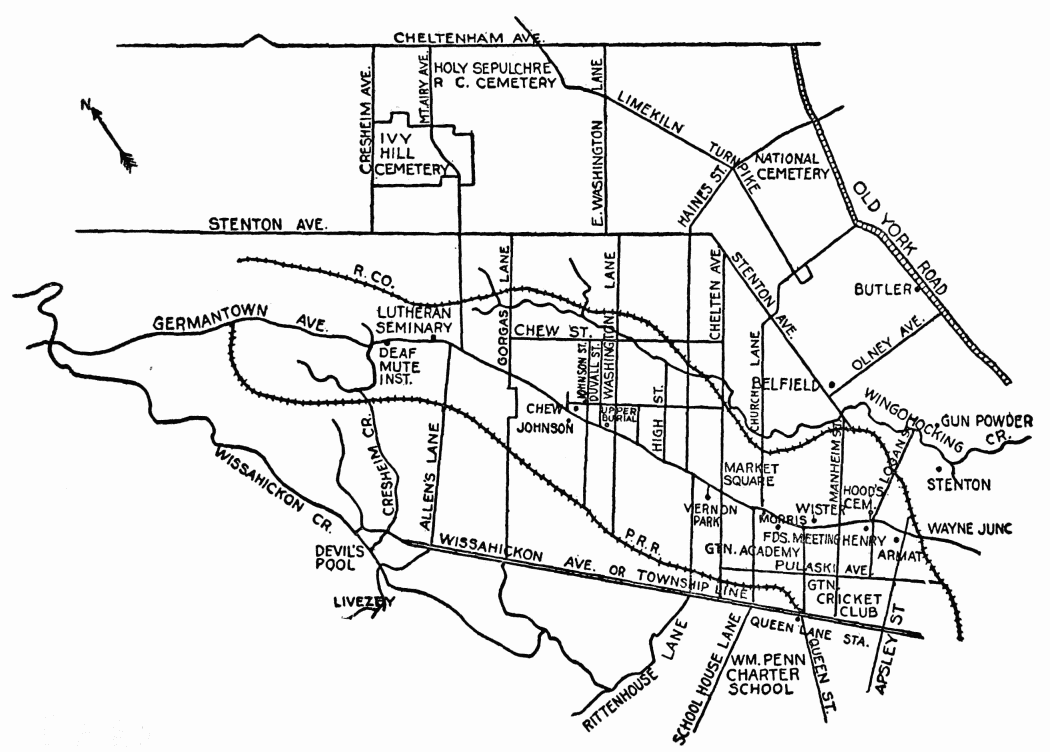
Germantown
President of Council, Chief Justice of the Supreme Court of Pennsylvania; his guests were Franklin, Jefferson, Madison, Monroe, Lafayette, John Randolph; occupied by General Washington, August, 1777, on way to the Battle of Brandywine; by General Howe during Battle of Germantown; Washington dined here with Dr. Logan, July, 1787, while the Constitutional Convention was in session. There is a curious underground passage from cellar to stable; the stream on the place was named “Wingohocking” for an Indian chief, who himself took the name of Logan; now in charge of the Pennsylvania Society of Colonial Dames, who have refurnished it with original pieces and relics of the Logan family; open daily 1.00 P.M. to 6.00 P.M., excepting Sunday and Thursday. Admission fee, fifteen cents. Northwest corner of Apsley Street and Germantown Avenue, Loudoun, built in 1801, residence of Thomas Armat, now occupied by Armat and Logan descendants; many wounded Americans died and were buried here in Battle of Germantown. 4825 Germantown Avenue, house built by Christopher Ottinger in 1781; walls two feet thick; rafters unhewn trees; his son, born here in 1804, was Captain Douglas Ottinger in the United States Revenue Marine; he invented the Ottinger life car which, in 1849, equipped eight life-saving stations on the New Jersey coast. 4810 Germantown Avenue, site of Wagner house, built, 1747; used as hospital after the Battle of Germantown, stable doors were taken for operating tables; many died and were buried in a trench in the rear. 4908 Germantown Avenue, built in 1760, was bought, 1828, by John S. Henry, whose son, Alexander Henry, was three times Mayor of Philadelphia and a member of Congress.
Northeast corner of East Logan and Germantown Avenue, Lower or Hood’s Burial Ground, presented to borough in 1693 by Jan Streepers; John F. Watson placed stones over graves of General Agnew and Colonel Bird, British officers killed in Battle of Germantown; see Burial Grounds. 5109 Germantown Avenue, site of Thones Kunder’s home, part of original north wall is still standing; first meetings of the Society of Friends in Germantown were held here; and a public protest against slavery was made in 1688; the paper, written and signed by Pastorius and three others, was forwarded to the Yearly Meeting in Burlington; Thones Kunder, by trade a dyer, was the ancestor of the Conard and Conrad families, also of Sir Samuel Cunard, founder of the Cunard Steamship Line; he died in 1729.
South side of Manheim Street, west of Germantown Avenue, residence of Jacques Marie Roset, who came to America in 1792, first to introduce the tomato plant into Germantown; his granddaughter was the wife of Anthony J. Drexel, Esq.; opposite, 153 Manheim Street was Taggert’s field; British Infantry encamped here. Manheim Street, corner of Morris Street, Germantown Cricket Club, organized in 1854; William Rotch Wister, was the first American to study the science and points of the play, and teach it; he was known as “The father of American cricket”; first American field, “Belfield Cricket Club,” Stenton and Olney Avenues, was the Wister pasture and orchard; second club, “Young America,” field, rear of residence of Thomas A. Newhall, Esq., Manheim and Hansberry Streets; they consolidated in 1889. Queen Lane, west of Pulaski Avenue, site of Potter’s Field in 1765, a burial place for “all strangers, negroes and mulattoes as die in any part of Germantown.”
5106 Germantown Avenue, residence of Commodore James Barron, Commandant Philadelphia Navy Yard in 1842; Captain of the Chesapeake, when captured by the British ship Leopard; in 1807 he killed Commodore Stephen Decatur in a duel at Bladensburg, Maryland. 5157 Germantown Avenue, residence and printing office, now altered, of Philip R. Freas; publisher of The Village Telegraph, in 1830; later The Germantown Telegraph. St. Stephen’s Methodist Church, opened in 1856; site of Frederick Fraley’s carpenter shop; gun carriages were made here for the American Army; Washington was a frequent visitor. 5140 Germantown Avenue, residence of Gilbert Stuart, 1794-95; the barn was used as his studio; portrait of Washington, now in the Athenaeum of Boston, was painted here; also a full length portrait of “Cornplanter,” the Indian chief. 5253-55 Germantown Avenue, formerly one dwelling, Owen Wister, novelist, was born here July 14, 1860, son of Dr. Owen J. and Sarah Butler Wister; his mother was a daughter of Pierce and Fanny Kemble Butler. 5219 Germantown Avenue, residence of John Bringhurst, carriage maker, 1775-95; a founder of the Germantown Academy; in 1780 he made a “chariot” for General Washington, whose arms and crest were properly displayed; cost £210 in gold; Martha Washington rode to Mount Vernon in it. Colonel Bird, British officer, died here. 5249 Germantown Avenue, built by Dr. Owen Wister, was his residence from 1860-70, he then moved to Butler Place on York Road; 5253 Germantown Avenue site of Christopher Saur’s residence and printing office, who arrived in Germantown, 1724; secured a printing outfit from Germany in 1738; published the first German newspaper in America, 1739; printed the first Bible in European language in America, 1743; Christopher Saur, Jr., was Bishop of the Dunkard Church, 1753. 5242-44 Germantown Avenue, site of Indian Queen Tavern, which gave the name to Queen Street. 5261 Germantown Avenue, erected by John Wister in 1744, stones were quarried from a hill in the rear; joists from oaks in Wister’s woods; family removed to Penllyn during occupancy by British, where Sally Wister, a daughter, wrote her charming “Diary.” The British General, James Agnew, lived here at the time of Battle of Germantown; was brought back wounded, and died here; now owned and occupied by Wister descendants. 5300 Germantown Avenue, corner of Queen Street, parsonage of Trinity Lutheran Church; was one of the Saur properties; first type cast in America, in 1772, was made in the cellar of this house; church built, 1837; many well-known Germantowners lie in the graveyard. 5275-77 Germantown Avenue, Germantown National Bank, 1825-68; John Fanning Watson was cashier, he lived at 5277; building was occupied by Thomas Jefferson, Secretary of State, and Edmund Randolph, Attorney General of the United States, in 1793, during the yellow fever in Philadelphia.
Northeast corner of Germantown Avenue and Coulter Street, St. Luke’s Protestant Episcopal Church, first Episcopal Church in Germantown, built, 1811; land given by Thomas Armat, Esq.; John Fanning Watson, the annalist, is buried in the churchyard. Northwest corner of Germantown Avenue, and Coulter Street, Friends’ Meeting, land given by Jacob Shoemaker, fifty acres, in 1693; in the library is a photograph of the first protest against slavery. 5425 Germantown Avenue, Masonic Lodge room; site, residence of A. Bronson Alcott, where Louisa May Alcott, authoress, was born. 5430 Germantown Avenue, residence of Captain Albert Ashmead, of the Philadelphia County Troop who commanded a troop of cavalry, and escorted General Lafayette from Bristol to Philadelphia in 1824; French Embassy during 1793. 5434 Germantown Avenue, residence of John Ashmead, father of Captain Albert Ashmead; who designed and made the first carriages known as Germantown wagons, in 1824, in the shop at rear of house; also first plows with wrought iron mold board; Lafayette purchased four, for his La Grange farm in France.
Market Square, Battle of Germantown fought here, September 25, 1777; here was the market house, prison, stocks, and public scales; in February, 1764, several hundred Paxtang boys, from banks of the Conestoga and Susquehanna Rivers, encamped here; they came east to murder the peaceful Moravian Indians, sheltered in Philadelphia, and were met by Benjamin Franklin, Thomas Willing, Benjamin Chew, and others, who persuaded them to return. Monument erected in 1883, to Civil War soldiers and sailors, pedestal with tablets, containing names of Germantown soldiers and sailors, at base are two coast defense mortars from the Civil War, two bronze cannon on wheels from the United States Arsenal; the enclosure is of musket barrels and bayonets, used during Civil War, and broken cannon from British frigate Augusta, sunk by American batteries during Revolutionary War. Market Square Presbyterian Church, originally German Reformed, built in 1733; Count Zinzendorf preached his first sermon in America here, December, 1741, and last on leaving, June, 1742; Washington worshiped here while living in the Morris house opposite; a battalion of Ninth Virginia, captured by the British, was confined here.
5442 Germantown Avenue, Morris House, Washington’s summer residence, in 1793-94, built by David Deshler, 1772-73; Sir William Howe occupied it after the battle in 1777; in 1804, it was bought by Mr. Perot for a country residence, and became the property of his son-in-law, Mr. Morris; the yard is kept in the simple elegance of colonial times. 5450 Germantown Avenue, in 1790 residence of Thomas Armat, who lived later at “Loudoun.” 5452 Germantown Avenue, erected in 1711 by John Ashmead, great grandfather of Captain Albert Ashmead; front rebuilt 1790. 5454 Germantown Avenue, occupied in 1742 by Count Zinzendorf; commencement of Moravian Seminary, now in Bethlehem, Pennsylvania. Saving Fund Building, site, residence of Jacob Tellner, first stone house built in Germantown; William Penn present at the roof raising; he once preached here.
School House Lane and Greene Street, Germantown Academy, built, 1759; colonial, native stone; founded by Christopher Saur, and others of German birth, to furnish education in “English, High Dutch, and the German language.” It has always held high rank as a school; the bell was brought to Philadelphia in 1774, in the tea ship Polly, the cargo was not allowed to land, it was taken back to England, and returned here when the war was ended; telescope used by Washington during battle, when the building was used as a hospital, is here; several British soldiers were buried in the yard; cricket was first played in America here, by British officers; Bank of Pennsylvania was brought here, escorted by McPherson’s Blues in 1798, during the second yellow fever epidemic in Philadelphia; gymnasium on Green Street, modern. On School House Lane, farther west, is Cricket Field of the William Penn Charter School.
Northeast corner of School House Lane and Germantown Avenue, Mutual Fire Insurance Company, in the office is “Shag Rag,” an old hand engine, imported from England, 1764; site, De la Plaine house, Whitefield preached from balcony to about 500 people in the Square. Northwest corner of Germantown Avenue and School House Lane, Germantown Bank, chartered, 1813; site of Germantown Library in 1806; used by United States Bank in 1798, escorted from Philadelphia by body of Light Horse. 5516-18-20 Germantown Avenue, site, King of Prussia Tavern in 1757, the sign was painted by Gilbert Stuart; a stage coach, with awning, ran from King of Prussia to the “George Inn,” Second and Arch Streets, three times a week. Germantown Avenue north of Chelten Avenue, Vernon Park, residence of John Wister, member of Congress until 1883; now belongs to the city; mansion, built in 1803, is used as museum by the Site Relic Society; marble statue of John Wister, near the door, made in Italy, given by his son, Jones Wister, who posed for the figure. Free library building in Park. South side of Haines Street, east of Chew, still stands a farmhouse; residence of Christopher Ludwig in 1777; appointed “Baker General” to American Army; said to be the original of Harvey Birch in Cooper’s novel, “The Spy.”
Southeast corner Germantown Avenue and High Street, site of the Morris-Littell house, was residence of Dr. Christopher Witt, physician, botanist, musician, artist, astronomer, poet; originally one of the hermits of the Wissahickon; friend of John Bartram and Francis Daniel Pastorius; an oil portrait of Johannes Kelpius, painted by Dr. Witt in 1705, is said to be the first oil portrait painted in America, now at Pennsylvania Historical Society; he started the first botanical garden in America, twenty years earlier than Bartram’s. Now yard of high school building. South side of High Street, two squares east from Germantown Avenue, St. Michael’s Protestant Episcopal Church; window of St. Michael after Guido Reni by William and Annie Lee Willet; grave of Dr. Christopher Witt is here; died in 1765, aged 90; site of old Warner burial ground; British and American soldiers were buried here.
Methodist Church, 6019 Germantown Avenue, site, Green Tree Tavern in 1748, kept by Francis Daniel Pastorius until 1754; General Anthony Wayne came this far, time of battle; Pastorius was the hero in Whittier’s “Pennsylvania Pilgrim.” Died in 1719; was buried, probably, in the Friends’ burial ground, Germantown Avenue above Coulter Street. Southwest corner of Walnut Lane and Germantown Avenue, “Wyck,” built in 1690; thought to be the oldest house now in Germantown; was used as hospital and operating room after battle; Lafayette was entertained here July, 1825. 6043 Germantown Avenue, southeast corner of Walnut Lane, was bought in 1775 by Dr. William Shippen as a summer home; center of fierce skirmish during battle; Pennsylvania manual training school was here under Dr. George Junkin, who was afterwards President of Washington and Lee University; his daughter was married to General Stonewall Jackson; in 1832, Dr. Junkin was President of Lafayette College, Easton; in 1851 this property was bought by Charlotte Cushman, actress.
Germantown Avenue above Herman Street, Mennonite Meeting House, founded, 1708; present building erected, 1770; William Rittenhouse, first pastor; Brigadier General Agnew was mortally wounded near here. 6205 Germantown Avenue, site of house built in 1738 by Dirck Keyser, a silk merchant, who came from Amsterdam in 1688. 6239 Germantown Avenue, was known as Washington Tavern in 1793. 6306 Germantown Avenue, Johnson House, in thickest of fight; time of battle the British swarmed through, and cleared everything edible; family fled to the cellar. Germantown Avenue, north of Washington Lane, built, 1775, Concord School House; now Charter Oak Library. North of library is the Upper Burial Ground; has probably the oldest existing stone to a German in Pennsylvania, Cornelius Tyson, buried in 1716; graves of the Lippard family are here, ancestors of George Lippard, author; American soldiers’ memorial stone was erected by John Fanning Watson. Southeast corner of Germantown Avenue and Duval Street, site, “Pomona,” residence Colonel Thomas Forrest, artillery officer; later member of the Sixteenth and Seventeenth Congress. 6338 Germantown Avenue, site, the Ship House, built, 1760; had representation of a ship on south gable; rear, site of first public hall in Germantown.
Northeast corner of Germantown Avenue and Johnson Street, Chew House, “Cliveden,” known as the “Germantown Battle Field,” built in 1760 by Benjamin Chew, Attorney General of the Province, member of Council, later Chief Justice; colonial, solid and heavy masonry; forming admirable fortification; was the scene of most important battle in Germantown, October 4, 1777; family were away; house partly furnished was left in charge of servants, the building was battered with bullets, holes still shown in the doors. Northwest corner of Germantown Avenue and Johnson Streets, Upsala, one of the finest examples of colonial architecture; built in 1798 by John Johnson; is still occupied by his descendants; during the battle, Americans put their cannon in the yard to fire on the Chew House, opposite. Northeast corner of Germantown Avenue and Upsal Street, Billmyer house, built in 1727; Washington stood on the horse block, telescope in hand, to penetrate the smoke of battle, and discover force of the enemy at Chew House. Woodwork bears marks of bullets and attempts by soldiers to set it on fire; bought by Michael Billmyer in 1788, a celebrated German painter, whose business plant was here; tablet placed by Site and Relic Society.
6611 Germantown Avenue, parsonage of Dunkard Meeting House, said to be over two hundred years old; near it, in the battle, General Nash was mortally wounded and Major Witherspoon, son of Rev. John Witherspoon, President of Princeton College, killed by the same cannon ball; they were buried in St. Michael’s Lutheran Churchyard. 6613 Germantown Avenue, mother church of the Brethren, or Dunkards, in America; who came here in 1719; Church was organized by Peter Becker, first pastor, in 1723, present building, erected, 1770, has tablet to Christopher Saur in the meeting house, he published the first American quarto edition of the Bible, 1743; in the graveyard is buried Alexander Mack, founder of the Dunkard sect in Germany, who came to America, 1729.
Southeast corner of Germantown Avenue and Phil-Ellena Street, St. Michael’s Lutheran Church, founded 1737; in 1742, Rev. Henry Melchoir Muhlenberg had charge here, and of St. John’s in Philadelphia; pews were placed in 1750; during the battle, the organ was destroyed by British soldiers, who ran along the streets blowing the pipes; in the graveyard is buried Christopher Ludwig, and other patriots. 6749 Germantown Avenue, residence George Hesser; Elizabeth Drinker’s journal, written while staying here in 1793, during yellow fever epidemic in Philadelphia, gives interesting local details of life in Germantown.
7301 Germantown Avenue, opposite Allen’s Lane, Lutheran Theological Seminary, site, “Mount Airy,” summer residence of Chief Justice William Allen; Lafayette was entertained here; later a school was conducted by Benjamin C. Constant, “The American Classical and Military Institute.” General Meade and his brother, also General Beauregard, were educated here. Southeast corner of Germantown and Gowen Avenues, now part of Lutheran Theological Seminary; residence, in 1792, of Joseph Miller, whose daughter was married to James Gowen; their son, Franklin B. Gowen, was born and lived here many years, also his brother, James E. Gowen.
7406 Germantown Avenue, Mount Airy, Pennsylvania Institution for Deaf, semi-deaf and blind-deaf; founded in 1820 by David G. Seixas, who gathered deaf street roamers in his home, taught, fed, and clothed them; a school was planned, Bishop White presiding; constitution adopted, and directors chosen; now a splendidly equipped trade teaching department for boys and girls; articulation, and lip reading taught; architecture, Norman.
INTERESTING PLACES WEST, NOT ON GERMANTOWN AVENUE
Queen Lane, two blocks west on Wissahickon Avenue, Carlton, residence of Henry Hall; Washington’s headquarters, August, 1777, and two days in September, before and immediately after the Battle of Brandywine; when the British occupied Germantown, the Hessian detachment encamped from here to the Schuylkill River: General Kuyphansen’s headquarters: beyond the house, toward Queen Lane reservoir, is a granite monument erected by Sons of the Revolution in 1895 to commemorate the earlier encampment of the American army at this point. Corner of Rittenhouse Street and Lincoln Drive, birthplace of David Rittenhouse, Pennsylvania’s first and greatest astronomer, born April 8, 1732; house erected in 1707; his grandfather, William Rittenhouse, came to America in 1690; first paper maker in America; mill located near the house.