XX MIFFLIN COUNTY
Reading edition
FORMED September 19, 1789; named for General Thomas Mifflin, then President of the Supreme Executive Council of Pennsylvania, 1788-90, and first Governor under the Constitution of 1790. Scenery throughout is very beautiful; the twelve mile stretch of State highway through the famous long Lewistown Narrows, gives glimpses of the Juniata, the peerless little river of more song and romance than any other in America, made famous by Mrs. Sullivan’s song, “The Beautiful Blue Juniata,” telling the love story of Alfarata, the roving Indian girl; the space between the mountains is barely wide enough to contain the highway, canal, river, and railroad. Mountains slope one thousand feet and are popular hunting grounds for bear and wild turkeys; quite a number of caves are found in the limestone formations of this county, though not easily accessible; Alexander’s, in Kishacoquillas Valley, abounds in stalactites and stalagmites, preserving in midsummer ice formed in winter; Naginey’s Cave, near Milroy, is most spacious; Hanawalt’s Cave, near McVeytown, is of vast dimensions and contains calcareous concretions; crude saltpetre has been obtained here; McVeytown is birthplace of Joseph Trimble Rothrock, M.D.
Celebrated springs are Mifflin, near Painterville Station, has medicinal waters; and Logan’s, six miles from Lewistown, near Reedsville, on left of the old
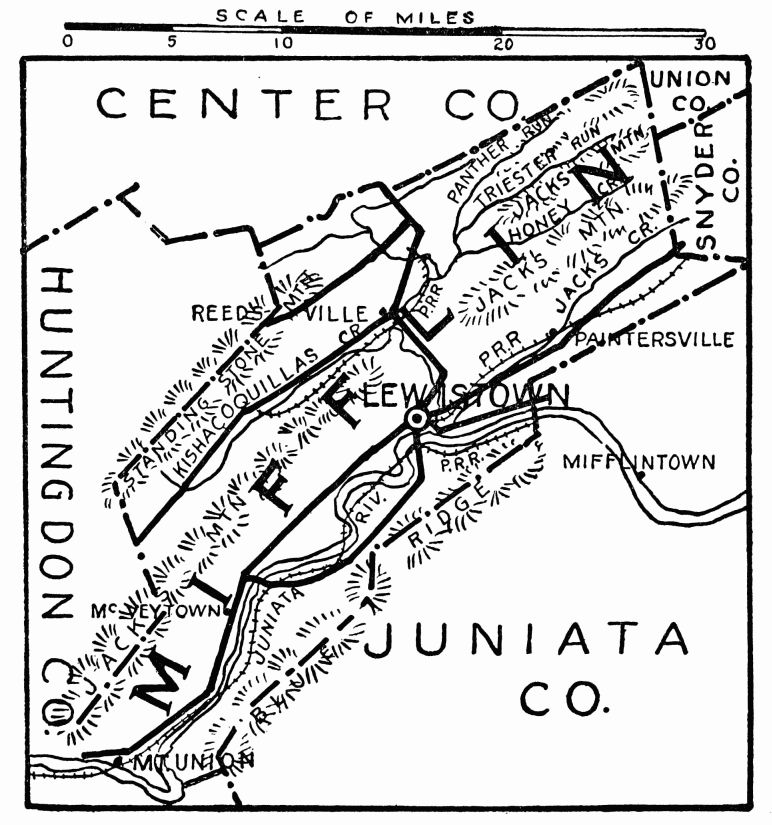
Mifflin County
stage road between Lewistown and Bellefonte, Center County; here the Mingo Chief, Logan, friend of white man, Shikellimy’s son, had his cabin, prior to 1771, when he left this region; he made the famous speech sent to Lord Dunmore in 1774, considered, among American classics, as a rare specimen of Indian oratory: “I appeal to any white man to say if ever he entered Logan’s cabin hungry, and he gave him not meat; if he ever came cold and naked, and he clothed him not; during the course of the last long bloody war Logan remained idle in his cabin, an advocate for peace. Such was my love for the whites that my countrymen pointed at me as they passed, and said: ‘Logan is the friend of white men.’ I had even thought to have lived with you, but for the injuries of one man, Colonel Cresap, the last spring, in cold blood and unprovoked, murdered all the relations of Logan, not sparing even my women and children; there runs not a drop of my blood in the veins of any living creature; this called on me for revenge; I have sought it; I have killed many; I have glutted my vengeance; for my country, I rejoice at the beams of peace, but do not think that mine is the joy of fear; Logan never felt fear. Logan will not turn on his heel to save his life; who is there to mourn for Logan? Not one!” (Colonel Michael Cresap was not responsible for the murder of Logan’s family; some white men, led by a liquor dealer, murdered them.)
First settlers, Scotch-Irish, in 1754, were not molested by Indians until 1756. Fort Granville was built, one mile northwest of Lewistown, on the old turnpike, site to be marked by the Pennsylvania State Historical Society; it was destroyed when the canal was constructed. In 1829 the Pennsylvania Canal was opened and first packet boat run from Lewistown to Mifflintown. Chief industries are agriculture, and iron and steel works. Iron ore of the best quality abounds; two furnaces, belonging to the Glamorgan Iron Company, were destroyed in July, 1874, by a tornado that left scarcely a property without damage; the bridge over the Juniata was also destroyed, rebuilt, and again destroyed by ice freshets in December, 1874, and February, 1875. In Limestone Ridge, extending from Kishacoquillas Creek, is found hard, white sandstone, almost pure silicon, used in glass manufacture.
Lewistown, population 9849, made county seat, 1790, was at first Kishacoquillas’ Village, a chief of the Shawnees, with a population in 1731, of twenty families, located at the mouth of the stream. Courthouse, facing the square, brick, colonial with Ionic portico, and cupola, built, 1843, enlarged in the rear. Granite monument, dedicated, 1906, in honor of Mifflin County soldiers and sailors, is in the square. One block away on South Main Street is the Kishacoquillas Creek bridge, stone and concrete, built, 1902, a reconstruction of the old two-arch stone bridge built in 1807, the first was wood, in 1794; on the left is an old stone building, erected about 1794, a historic landmark that has served for many uses, once the “Seven Stars Inn,” 1828-29; also a Masonic hall, 1830-39, it has two cellars, one beneath the other. At a point along the creek, just above the old building, is where Commodore David Conner, as a boy, made little boats and pitted
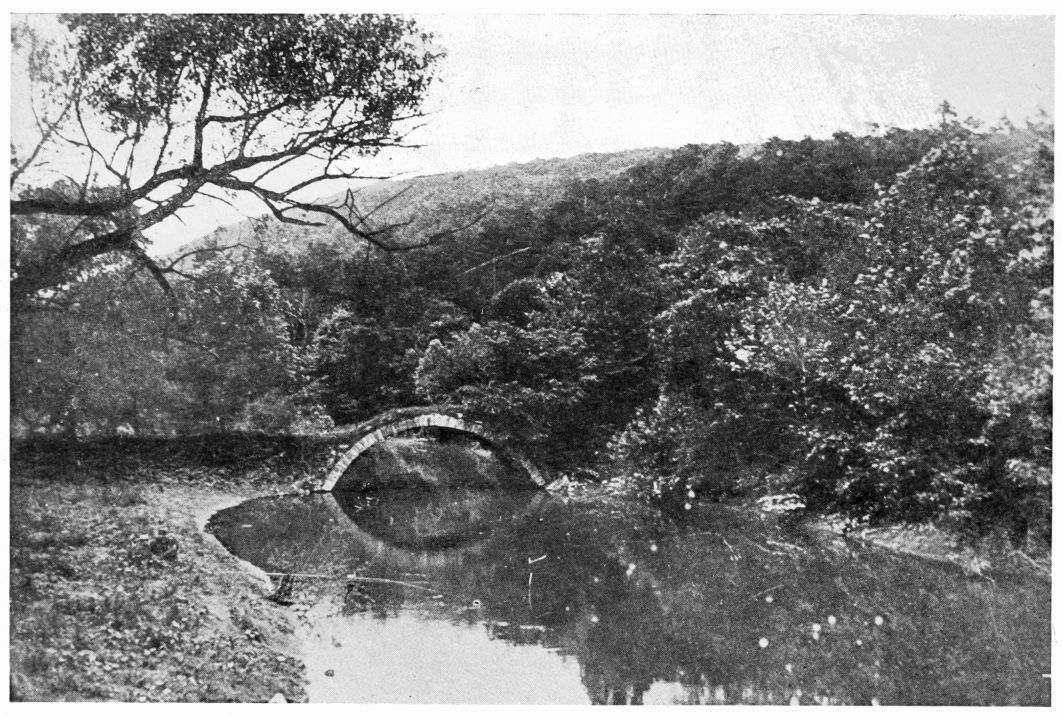
OLD STONE ARCH ON JACK’S CREEK
Built over one hundred years ago
them against each other in mimic warfare, thus foreshadowing his brilliant naval career in the War of 1812 and the Mexican War. Just above, on the high bank, fronting on Water and Brown Streets, is Lewistown’s oldest burial grounds. Here are the graves of the Buchanan family, first settlers and owners of the land on which Lewistown is built. One mile east of Lewistown, on the oldest wagon and stage road running parallel with the present state highway, is an old stone arch bridge, over one hundred years old, a favorite subject for artists; it is near the bridge crossing Jacks Creek, on the state highway through Lewistown Narrows. Mount Union, on southern boundary, lies at entrance to Jacks Narrows, made by the river forcing its way through Jacks Mountain.
Delaware County