I THE COMMOMWEALTH, OR STATE OF PENNSYLVANIA (PENN’S WOODS)
Reading edition
WITH a royal grant for 40,000 square miles of land in the New World, William Penn, thirty-eight years old, came up the Delaware River in 1682 and landed at the Blue Anchor Inn, built by the Swedes in 1636. The state now covers 45,126 square miles.
No eastern state contains forests of such varied and abundant timber, or extensive mineral deposits. According to official reports of the state geologist, one and one-third billion dollars’ worth of mineral products were taken from below ground in 1916; of these coal is the greatest wealth producer, over $1,000,000,000 annually, the production being nearly one-half that of the entire United States; the supply is still ample and new fields are being opened. Over $100,000,000 in coke; and more than $42,000,000 in its by-products. Petroleum counts for $26,000,000. Gold, silver, platinum, and asbestos are found in small quantities. Natural gas has been used in this state for manufacturing purposes since 1874. This is the greatest manufacturing region in the world, and has the richest agricultural land in the United States. Pennsylvania stands first among the states in the Union in the number of towns over 5000 in population, making it a remarkable selling market. Philadelphia, the chief city, and third in population, 1,823,779, in the United
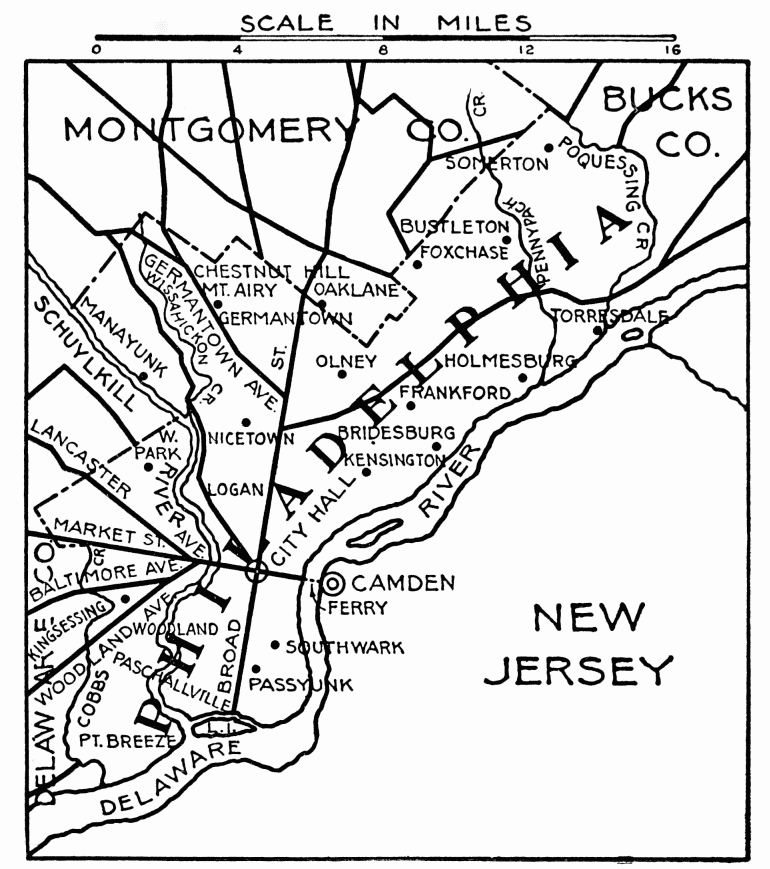
Philadelphia County
States, is on the site of a village of the Lenni Lenape or Delaware Indians, called Coaquanarck. Through William Penn’s liberal policy to early settlers, and later being the seat of government of the United States, many national institutions were originated here, and many more historical buildings are here than in any other city in America. It comprises the whole of Philadelphia County, and has a distinctive character of its own, reminiscent of the old Quaker life, which is given in this book in two Colonial Walks; the Revolutionary Period is given in automobile routes, framed on Washington’s itinerary; and modern institutions, many of them continuing from colonial times, are in chapters, schools, galleries and museums, hospitals, libraries, music, churches. Philadelphia was the leader in the fight for “Liberty of Conscience.”
The obvious picturesqueness of Philadelphia is in the Pennsylvania Hospital, Independence Hall, Christ Church, Old Swedes’, St. Peter’s. Down in lower Spruce Street and neighboring streets are beautiful colonial houses, stately doorways, decorative ironwork, dormer windows, great gables, facing each other at street corners in harmonious proportions. In not another town were the old streets so well worth keeping unchanged. The early Friends, when they left England, packed up, with their “Liberty of Conscience,” the love of beauty in architecture and the money to pay for it. In a fine period of English architecture, they got good English architects—Wren is said to have been of the number—to design, not only their public buildings, but their private houses; and carried over in their personal baggage, paneling, carvings, ironwork, furniture and the various details they were not likely to procure in Philadelphia.
Long straight lines of streets give the town serenity and repose.
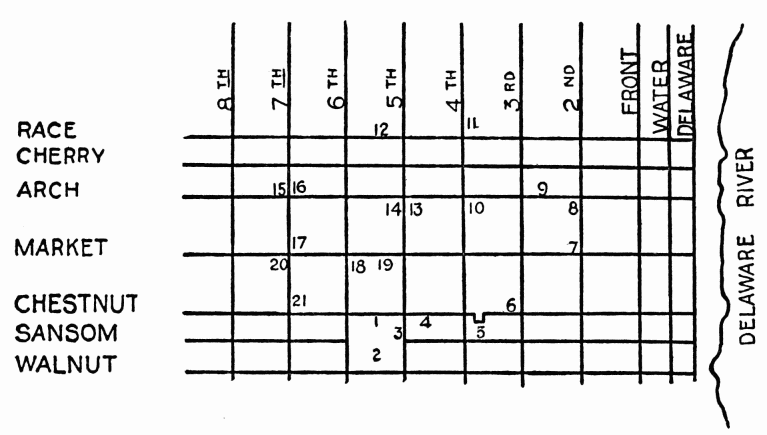
1. Independence Hall. 2. Independence Square. 3. Philosophical Society. 4. U.S. Custom House. 5. Carpenters’ Hall. 6. Bank of North America. 7. Christ Church. 8. Site St. George and the Dragon Inn. 9. Betsey Ross House. 10. Friends’ Meeting House. 11. St. George’s M. E. Church. 12. St. John’s Lutheran Church. 13. Christ Church Burial Ground. 14. Free Quaker Building. 15. Fort Rittenhouse. 16. Mikveh Israel Synagogue. 17. First U. S. Mint. 18. Site Robert Morris Residence. 19. Site President Washington’s Residence. 20. Site Pennsylvania National Bank. 21. Franklin Institute.
COLONIAL PHILADELPHIA, WALK NO. 1
The Quaker City; Penn’s “Green country towne.”
Start at the State House, called Independence Hall in 1776; open free 9 A.M. to 4 P.M.; south side of Chestnut Street between Fifth and Sixth. The most interesting building historically in the United States. Architect, Andrew Hamilton, speaker in the Assembly; Georgian, brick; erected for the Province of Pennsylvania as a Colonial State House. Tower has wooden cupola built in 1828, containing clock and bell, presented to the City by Henry Seybert, in 1876.
First occupied by the Assembly in 1735. Second Continental Congress met here May 10, 1775. George Washington was chosen Commander in Chief of the Continental Army June 15, 1775. Declaration of Independence approved July 4, 1776. Articles of Confederation and perpetual union between the States were adopted and signed July 9, 1778. Constitution of the United States of America, long the pride of Americans, and the model for friends of freedom throughout the world, was formed and signed September 17, 1787.
Lafayette was received here in 1824.
The body of Abraham Lincoln rested in state, April 22-24, 1865.
Second National Encampment, Grand Army of the Republic, January, 1868, when annual Memorial Day, May 30, was instituted by Major General John A. Logan. It was observed the same year by posts of the Grand Army of the Republic and the public.
The Liberty Bell was rung July 8, 1776, in celebration of the Declaration of Independence; inscription on bell, “Proclaim liberty throughout all the land, unto all the inhabitants thereof” (Leviticus XXV: 10). It was hung in the tower in 1755, and it was cracked while being tolled for the death of Chief Justice John Marshall July 8, 1835; not rung since 1843.
Portraits of the Signers of the Declaration of Independence, painted chiefly by Charles Willson Peale, and his portrait of Washington are here. Benjamin West’s
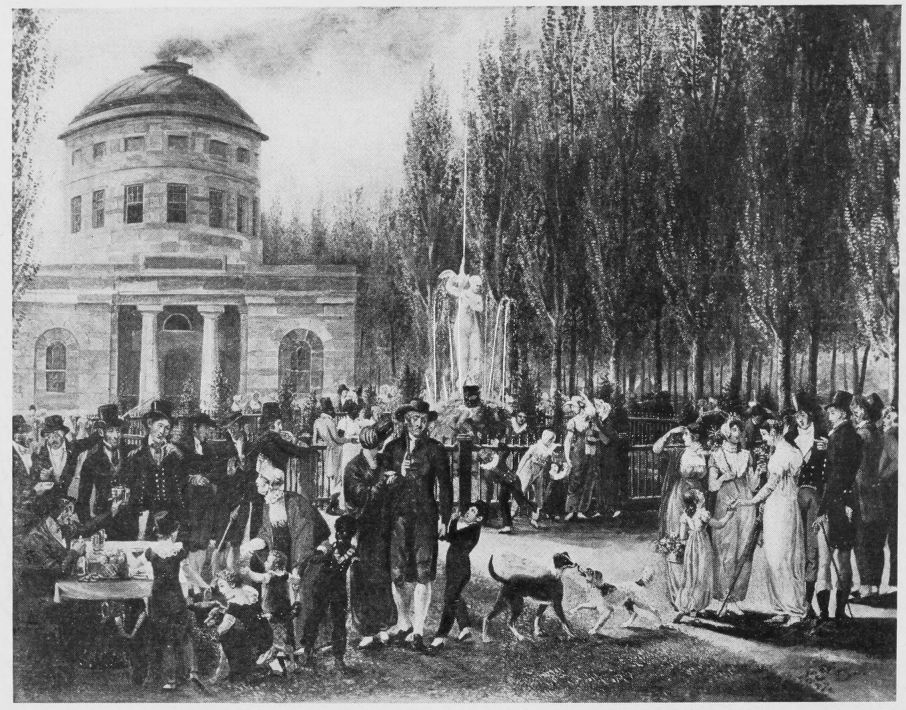
FOURTH OF JULY IN CENTER SQUARE, PHILADELPHIA
Painted by John D. Krimmel Courtesy of the Pennsylvania Academy of the Fine Arts
painting, “Penn’s Treaty with the Indians”; a large collection of portraits of Pennsylvania men notable in the government of the Commonwealth; and a collection of forty-five small historic portraits in pastel by James Sharples. On Chestnut Street front is a marble statue of Washington; sculptor, J. A. Bailey; erected in 1869 by contributions of the public-school children of Philadelphia.
The building was renovated and restored in 1897 to its early appearance. Small buildings connecting west, contain colonial relics; east, Revolutionary relics. West, open porch leads to Congress Hall, corner of Sixth Street, built in 1789 for Court House of Philadelphia County; Georgian, occupied by the Federal Congress, 1790-1800, after necessary alterations by Major L’Enfant. First floor, House of Representatives; second floor, Senate Chamber; gallery added in 1795. Here Washington was inaugurated President, second term, March 4, 1793; and John Adams, second President of the United States, in 1797. National Currency was established. First National Bank founded. Army and Navy organized. Jay’s Treaty determining relations with England considered and ratified. Official announcement of Washington’s death in 1799 was made, and resolution offered by Chief Justice John Marshall, to pay honor to the man “First in war, first in peace, first in the hearts of his countrymen.”
Contains sculptures in wood by William Rush; statue of Washington carved in 1815; also eagle on globe, portrait of Michael Hillegas, first Treasurer of the United States until 1789, and other paintings.
Building restored 1896, through the Pennsylvania Society, Colonial Dames of America; architect, William Ziegler.
Corner of Fifth Street, Supreme Court House, or the old City Hall, built in 1789. Second floor occupied by the First Supreme Court of the United States, 1791-1800. Mayor’s Office until 1896. Later headquarters Boy Scouts and Grand Army of the Republic. Now restored to first appearance; museum, Colonial and American Indian collections, paintings.
In 1783, State House Yard was improved, elms planted, walks laid out, and seats placed. Contains statue of Commodore Barry. 104 South Fifth Street, in State House Yard, the American Philosophical Society, built 1789, brick, Georgian; originated in “The Junto,” formed by Benjamin Franklin 1727. See Historic Institutions.
Southeast corner of Fifth and Chestnut Streets, site residence of William Moore Smith, son of first provost of the University of Pennsylvania. Washington’s portrait was painted here by Gilbert Stuart.
Northeast corner of Fifth and Sansom Streets, site Philadelphia Library 1790-1830.
427 Chestnut Street, site of Lawrence mansion, Howe’s headquarters, 1777-78.
421 Chestnut Street, site of United States Hotel. Charles Dickens stayed here March, 1842, first visit to America.
South side of Chestnut Street, below Fifth, United States Custom House; marble, classic; Doric portico; built 1819; architect, John Haviland.
Northwest corner of Fourth and Chestnut Streets, Provident Life and Trust Company, of Philadelphia, modern; contains oil portraits of the directors; among the artists represented are Bernard Uhle, Cecilia Beaux, and Thomas Eakins.
Southeast corner of Fourth and Chestnut Streets, site of Friends meeting-house in 1701, later site of Mathew Carey’s book store in 1800.
320 Chestnut Street, head of Carpenters’ Court. Carpenters’ Hall; open free daily 9 A.M. to 3 P.M., Saturdays to 12.30 P.M.; Georgian, brick; built, 1770 for use of the Carpenters’ Company, founded in 1724.
307 Chestnut Street, Bank of North America; founded in 1781 on the same ground; oldest and first bank, chartered by Congress, in the United States. Through Robert Morris, the first president, victory was made possible to Washington and the Continental Army. Contains portrait of Robert Morris.
Third Street above Chestnut; Post Office in 1713; later Judd’s Hotel during war of 1812.
27 South Third Street, site United States Post Office, 1792.
250 Chestnut Street, site first United States Treasury, 1798.
243 Chestnut Street, site of residence of Governor Thomas Lloyd in 1684, appointed by William Penn.
Letitia Street, west side above Chestnut, east of Second; site of Letitia House, William Penn’s residence, moved to Fairmount Park.
Southeast corner of Second and Black Horse Alley, above Chestnut Street, site Bradford House and printing office, used for colonial Post Office, 1728; Andrew Bradford, postmaster; in 1719 he published the first newspaper in Pennsylvania, The Mercury, a weekly, second in America.
Southwest corner of Front and Market Streets, site of London Coffee House, in 1754, where, in 1780, Robert Morris met with others to consider the establishment of the first bank. Horses, slaves, and cattle were sold here.
About 221-23 North Water Street, site Stephen Girard’s last residence.
111 Spring Street, west of Front, above Race, said to have been residence of Benjamin Franklin 1723-26; brick, three stories and attic; still standing.
Jones’s Alley, above Market Street, west from 14 North Front Street, site Robert Grace’s residence, where the “Junto Club” met in 1727.
110 Market Street, site Robert Aitken’s Printing Office in 1782; he printed the first English Bible in America.
Southwest corner of Second and Market Streets, site Friends’ first meeting-house, 1695-1808, on land donated by George Fox, founder of the Society.
Middle of Market Street, at Second, facing east, site of old Court House, built 1710; used as town hall and seat of the Legislature until the State House was built in 1735. Acceptance of the United States Constitution was here proclaimed to the people December 13, 1787; shown in large painting by Birch, made in 1829, now in City Hall, Broad and Market Streets.
25 North Second Street, office Peter Porcupine’s Gazette, edited by William Cobbett, a keen satirist.
Christ Church, west side of Second Street, north of Market, built 1695. (See Churches.)
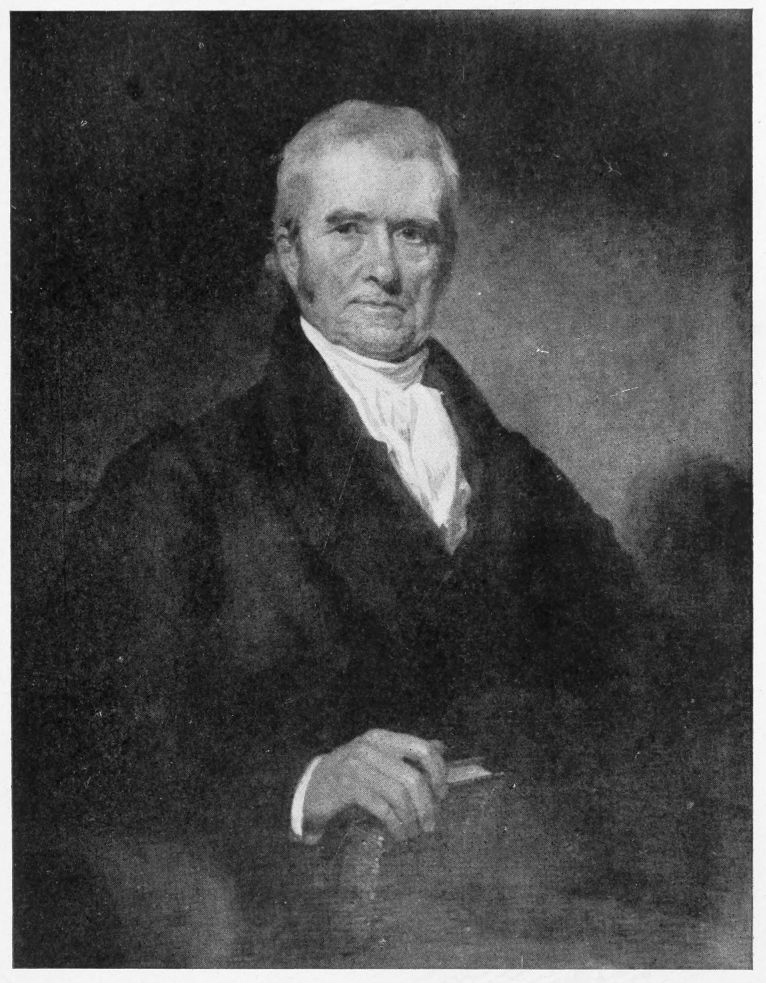
JOHN MARSHALL, CHIEF JUSTICE OF THE UNITED STATES, 1808-1835
From the original in the possession of the Law Association of Philadelphia
Painted by Henry Inman
200 Arch Street, site Saint George and the Dragon Inn, built 1700, kept by Nicholas Scull, member Franklin’s “Junto,” in 1727; sheriff in 1744; he published a map of the city in 1750. Oldest Inn building standing; from 1791-93 it was kept by John Inskeep, Mayor of Philadelphia, 1800-05. Stage coaches for New York and Baltimore left here regularly.
No. 239 Arch Street, Betsy Ross House, two-story, brick, marked by tablet; now property of American Flag House and Betsy Ross Memorial Association. She made the first flag adopted by the United States, from pencil drawing by Washington, who with Robert Morris and George Ross, called on her to give the commission; the flag was accepted by Congress June 14, 1777, and is now one of the oldest flags in the world, older than those of France, Spain, Germany, Russia, Italy, and Austria. John Paul Jones was first to fly the new flag. Betsy Ross lived to be eighty-four, dying in 1836; she is buried in Mount Moriah Cemetery, where a flag continuously flies over her grave, instituted by the Sons of Veterans. Flag Day was first inaugurated in Philadelphia, 1893.
226 Race Street, site First Moravian Church, 1742-1856.
267 Race Street, site residence of Benjamin Franklin about 1749.
325 Market Street, site residence of Benjamin Franklin, where he first invented the lightning rod, about 1749-50; in 1752, first lightning rod used in the world was set up by Franklin, southeast corner of Second and Race Streets.
229 North Fourth Street, Saint George’s, oldest Methodist Church in the world, used continuously for worship; dedicated November 24, 1769.
Fourth Street above Race, St. Augustine’s Roman Catholic Church, 1796; destroyed in the riot of 1844; rebuilt in 1846.
Old St. John’s Church, Race Street between Fifth and Sixth; first English Lutheran Church in America, built 1806.
Southeast corner of Fourth and Cherry Streets, site Zion Lutheran Church (German), built 1766; in 1790 its organ was considered the finest in America.
Northeast corner of Fourth and Arch Streets, James Russell Lowell stayed here with his bride in 1845.
Southeast corner of Fourth and Arch Streets, Friends meeting-house; oldest in Philadelphia, built in 1804; since 1811 it has been used for the Philadelphia Yearly Meeting of Orthodox Friends, and is said to be largest in the world. (See Historic Burial Grounds.)
Southwest corner of Fourth and Arch Streets, site of residence built for William Smith, D.D., before 1762. First provost of the University of Pennsylvania.
Fourth Street, west side, below Arch, site of the Academy in 1749; beginning of the University, marked with tablet.
Southeast corner of Fifth and Arch Streets, Christ Church burial ground. (See Burial Grounds.)
Southwest corner of Fifth and Arch Streets, Free Quaker Building; tablet, inscription “By general subscription for the Free Quakers; erected in the year of our Lord 1783, and of the Empire 8.” “Fighting Quakers,” who fought in the Revolutionary War against peace principles of the sect. The Apprentices’
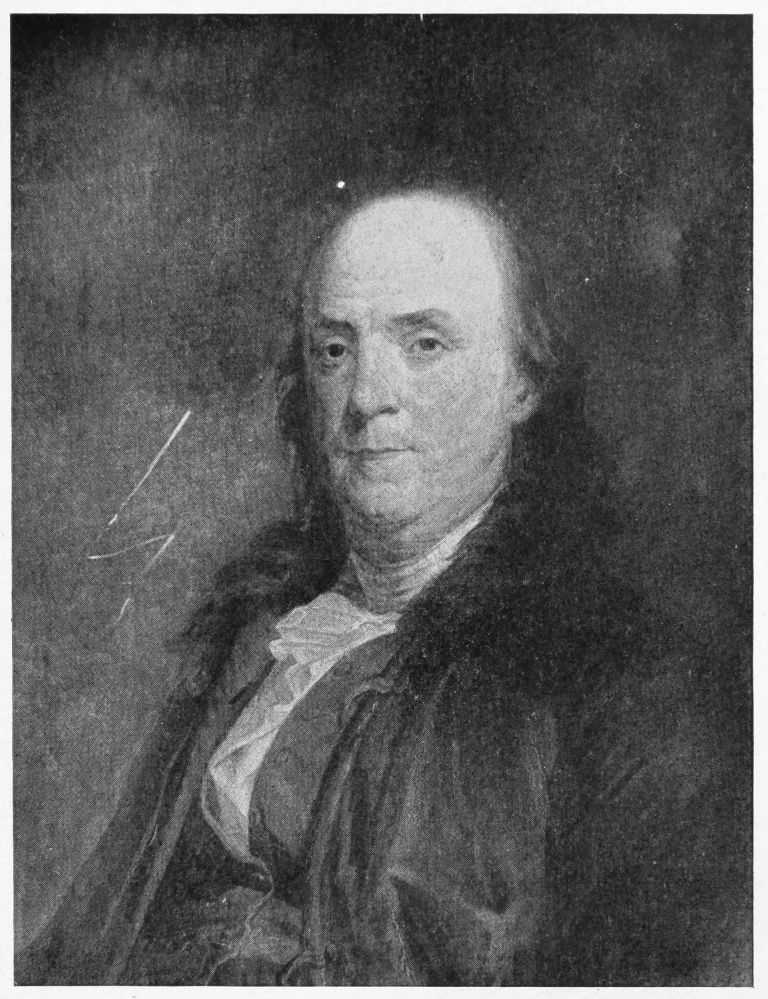
BENJAMIN FRANKLIN
From the collection in Independence Hall
Painted by B. T. Welch
Library, organized 1820 in Carpenters’ Hall, for many years only free library in Philadelphia, occupied the building after 1850. Later used by the Grand Lodge of Masons.
515 Cherry Street, residence of Bass Otis in 1819, who made the first American lithograph.
528 Arch Street, site, Pennsylvania College of Dental Surgery, first in Philadelphia, founded 1852; now absorbed by the University of Pennsylvania.
627 Arch Street, site, Woman’s Medical College, first in America to graduate women physicians, founded 1850.
Southeast corner of Seventh and Arch Streets, residence of David Rittenhouse in 1770.
Northwest corner of Seventh and Arch Streets, Fort Rittenhouse; residence of David Rittenhouse, 1787; treasurer of Pennsylvania.
117 North Seventh Street, site, Mikveh Israel Synagogue, built in 1747. Removed to Broad and York Streets.
37-39 North Seventh Street, first United States Mint, 1792. David Rittenhouse, superintendent.
Southeast corner of Sixth and Market Streets, site of Robert Morris residence; next to it, on Market Street, 530-536, site of President Washington’s mansion and John Adams, second President; originally built for Richard Penn.
700 Market Street, Penn National Bank. House where Thomas Jefferson wrote the Declaration of Independence.
801 Market Street, site, office of Thomas Jefferson, Secretary of State.
About 808 Market Street, site, residence of Thomas Jefferson, in 1791.
15 South Seventh Street, Franklin Institute, founded 1824; classic architecture, marble; John Haviland, architect.
COLONIAL WALK NO. 2
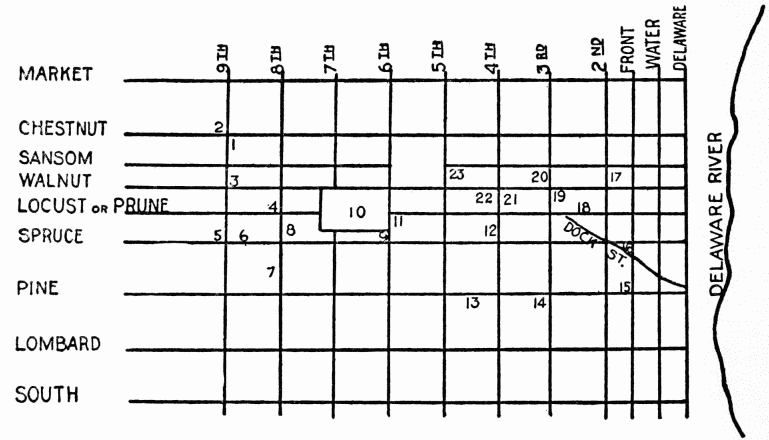
1. Continental Hotel. 2. Post Office. 3. Walnut Street Theatre. 4. Musical Fund Hall. 5. Potter House. 6. Jewish Cemetery. 7. Pennsylvania Hospital. 8. Morris House. 9. Holy Trinity R. C. Church. 10. Washington Square. 11. The Anthenaeum. 12. St. Mary’s R. C. Church. 13. Old Pine Street Presbyterian Church. 14. St. Peter’s P. E. Church. 15. Market. 16. Site Blue Anchor Inn. 17. Site Slate Roof House. 18. Stock Exchange. 19. St. Paul’s P. E. Church. 20. Girard Bank. 21. St. Joseph’s R. C. Church. 22. Contributionship Fire Insurance. 23. Dispensary.
Southeast corner of Ninth and Chestnut Streets, site, Cook’s Museum and Circus; first mummies brought to the United States are said to have been shown here.
Northwest corner of Ninth and Chestnut Streets, United States Post Office, built in 1884 on site of the Mansion House, built for the official residence of President Washington, but never occupied; used for the University of Pennsylvania. Bronze statue of Benjamin Franklin, sculptor, John Boyle; Chestnut Street front, inscription by Washington: “Venerated for Benevolence, admired for Talent, esteemed for Patriotism, beloved for Philanthropy”; bronze bust, President McKinley in corridor; sculpture group on roof by D. C. French.
Northeast corner of Ninth and Sansom Streets, site, Chinese Museum; later, in 1835, Peale’s Museum; exhibitions by the Franklin Institute were held here.
Northeast corner of Ninth and Walnut Streets, Walnut Street Theatre, built in 1808; oldest theatre in the United States.
808 Locust Street, Musical Fund Hall, built in 1824; oldest building in Philadelphia in continuous use as a hall; Dr. Charles H. Jarvis conducted classical soirées here before the Academy was built; has fine acoustic properties; it is on the site of the Fifth Presbyterian Church, which was moved to Tenth and Arch Streets.
260 South Ninth Street, Potter House, built 1812; Joseph Bonaparte lived here two years; the cartoons, “Birth of Psyche,” brought by him from Versailles, still form the mural decorations of the banquet hall.
Northeast corner of Spruce and Darien Streets, below Ninth, Jewish Cemetery, founded 1740; Rebecca Gratz, heroine in Scott’s “Ivanhoe,” is buried near the entrance.
225 South Eighth Street, Morris Mansion, built 1787; typical colonial model.
Eighth and Pine Streets, Pennsylvania Hospital, founded, 1751, by Dr. Thomas Bond and Benjamin Franklin; Georgian. Contains Benjamin West’s famous painting “Christ Healing the Sick”; woman with white head shawl is said to be likeness of West’s mother.
715 Spruce Street, residence of Nicholas Biddle in 1820; now used by the American Roman Catholic Society.
705 Locust Street, residence of E. L. Davenport, tragedian.
Southwest corner of Seventh and Locust Streets, site where Dr. Horace Howard Furness began his great variorum edition of Shakespeare.
618 Locust Street, residence of John W. Forney, journalist.
Southwest corner of Seventh and Walnut Streets, oldest Savings Bank in America; established 1816, by Mr. Condy Raguet with twelve directors; classic adaptation; Furness, Evans and Company, architects; among the oil portraits to be seen there are Lewis Wain and John C. Lowber, by Thomas Sully; G. Colesberry Purves, by William M. Chase, and Condy Raguet, artist unknown.
Southeast corner of Seventh and Chestnut Streets, site, residence of George Clymer, signer of the Declaration of Independence.
708 Chestnut Street, site, residence of Jared Ingersoll, signer of the United States Constitution; later, residence George M. Dallas, Vice-President of the United States. Opposite, on Chestnut Street below Eighth, eastern end of Green’s Hotel, site, residence of Thomas Fitzsimmons, signer of the United States Constitution.
632 Chestnut Street, site of Waln mansion.
615-17-19 Chestnut Street, site, The Arcade, built in 1826; the Public Ledger issued its first number here March 25, 1836.
605 Chestnut Street, bronze tablet front, inscription: “Site of First Chestnut Street Theatre, 1793-1855. ‘Hail! Columbia,’ composed by Joseph Hopkinson, first sung here, April 25, 1798, by Gilbert Fox. Fanny Elssler danced here in 1840; Jenny Lind sung, in 1850; Charlotte Cushman acted, in 1851; erected by The City Historical Society of Philadelphia.”
Northwest corner of Sixth and Ranstead Streets, above Chestnut, site, The Falstaff Hotel, from 1814-16; First City Troop met here.
130 South Sixth Street, site, residence Thomas G. Wharton; birthplace in 1824 of the Historical Society of Pennsylvania.
Southwest corner of Sixth and Walnut Streets, Curtis Publishing Company, on site of the Ludwig Building, a school erected by Christopher Ludwig, “Baker General” of the Revolution; see Architecture.
Southeast corner of Sixth and Walnut Streets, site, Walnut Street Gaol, 1775-1838; extended nearly to Fifth Street; in the rear, fronting Locust Street, then Prune Street, was the debtors’ prison; Judge William Moore, also Provost William Smith, were confined here, in 1758, for publishing so-called seditious pamphlets on patriotism; the students went there to recite their lessons to him; Robert Morris, financier of the Revolution, was in prison here, in 1797, for debts incurred in a large private transaction; first successful balloon ascension in America was from the gaol yard, by J. P. Blanchard, French aëronaut, January, 1793.
Sixth to Seventh Streets, on Walnut, Washington Square, patented by William Penn, 1704-05, as burial ground for strangers; hundreds of Revolutionary soldiers were buried here, also victims of the great yellow fever epidemic in 1793; in early times colored slaves gathered here to sing their native songs, and give wild African dances among the graves; named Washington Square by Councils, May, 1825, and improved for public use; monument to the Washington Grays, bronze, life-size figure of a private in original uniform.
215 South Sixth Street, site, residence of Hon. James Campbell, United States Postmaster General, appointed by President Pierce.
219 South Sixth Street, The Athenaeum of Philadelphia, founded, 1813, by students from the University, for a circulating library; first president, William Tilghman, Chief Justice of Pennsylvania; the Law Library was there many years, while Courts were Sixth and Chestnut Streets; was great chess center; architect, John Notman.
245 South Sixth Street, site, residence Commodore Barry, who succeeded John Paul Jones as head of the American Navy.
Locust Street below Sixth, south side, site, Prune Street Theatre; “Home Sweet Home” was sung here for the first time in America.
Northwest corner of Sixth and Spruce Streets, Holy Trinity Roman Catholic Church, built, 1739; circular building, alternate red and black bricks; body of Stephen Girard was buried here for many years; later removed to Girard College.
144-54 South Fifth Street, site, Free Quaker Cemetery.
127 South Fifth Street, site, Philadelphia Dispensary, oldest in United States; founded by Dr. Benjamin Rush in 1786; now merged with Pennsylvania Hospital.
Northeast corner of Fourth and Walnut Streets, residence General Stephen Moylan, military secretary to Washington; Muster Master General of the Continental Army in 1775.
South side Walnut Street, above Fourth. John Marshall, Chief Justice of the United States, died here July 6, 1835.
Willing’s Alley, south of Walnut Street, east of Fourth, St. Joseph’s Church; built in 1731; oldest Roman Catholic Church in Philadelphia; has painting, “Hagar and Ishmael,” by Benjamin West; Washington is said to have been first referred to as “The Father of his Country” by the priest, in his sermon after Washington’s death; Lancaster County makes the same claim.
309 Walnut Street, site, last residence of Bishop White.
212 South Fourth Street, Philadelphia Contributionship for the Insurance of Houses from Loss by Fire, oldest fire-insurance company in America, founded 1752, by Benjamin Franklin; known as “The Hand-in-Hand,” from its seal; Classic architecture, built, 1835; portraits, Horace Binney by Thomas Sully; painted in 1837, and by George B. A. Healy in 1857; Dr. Charles Willing and Hon. John Welsh by Bernard Uhle; James Lewis Smith by Henry Inman; William Sellers and Ellis Yarnall by Percy Bigland, English; Alexander Biddle, Sydney P. Hutchinson and John T. Morris by Vonnoh; James S. Smith, 2d, by Van Morcken.
218-22 South Fourth Street, site, Edward Shippen mansion; President, Provisional Council, and First Mayor of Philadelphia; his daughter, Peggy Shippen, was married to Benedict Arnold.
Southwest corner of Fourth and Prune Streets, or Locust, residence of Dr. Caspar Wistar, in 1799; the garden extended to St. Mary’s churchyard; is now headquarters of the Philadelphia Chapter No. 2 of Colonial Dames.
244-50 South Fourth Street, St. Mary’s Roman Catholic Church, built, 1763, has a fine pieta by Boucher; in the graveyard are the tombs of Commodore Barry and of Thomas Fitzsimmons, members Continental Congress.
338 Spruce Street, residence, Joseph Hopkinson, born 1770, died 1842; author of “Hail! Columbia,” 1798; it was called “The President’s March,” and always sung when Washington held state events; music by Henry Roth; he also wrote “The Battle of the Kegs.”
Southwest corner of Fourth and Pine Streets, Old Pine Street Presbyterian Church, brick, rough cast; classic; porch with Corinthian columns; built, 1857; graveyard is on both sides; east portion belongs to First Church, west to Old Pine.
Southwest corner of Leithgow Street, above Fourth and South Streets, South Street Theatre, 1766-1821; now used as a business building.
East side of Leithgow Street, west of Fourth, between South and Bainbridge Streets, site, Apollo Street Theatre, 1811.
Spruce to Pine Streets, Third to Fourth, site, Old Almshouse, 1731, and Philadelphia Hospital, 1732.
Northwest corner of Third and Lombard Streets, residence of Charles Willson Peale, 1741-1827.
Southwest corner of Third and Pine Streets, Saint Peter’s Church, built, 1761; in the Churchyard are the tombs of Rev. Jacob Duché and Charles Willson Peale, artist, 1741-1827; it is often said, “To belong to old Philadelphia Society one must have an ancestor who entered Paradise through Saint Peter’s graveyard”; (see Churches).
Northwest corner of Third and Pine Streets, site, residence of Colonel John Nixon, who read the Declaration of Independence.
Northeast corner of Third and Pine Streets, site, residence of Rev. Jacob Duché; later, British Military Hospital.
224 Pine Street, site, residence, Mayor John Stamper, 1760; Governor John Penn died here. “His funeral was very great, making quite a crowd.”
237 DeLancey Street, above Pine, site, residence of Horace Binney, the great lawyer.
About 260 South Third Street, site, Bingham residence; later, in 1828, Joseph Head’s Mansion House, known as the most sumptuous inn in America; John Quincy Adams stayed here in 1811; Pennsylvania Society of the Cincinnati gave a dinner in 1811, celebrating the unveiling of a monument to General Wayne; “Sons of Washington” held their annual dinner here on Washington’s Birthday; French citizens gave a dinner in 1830, Peter Du Ponceau presiding, in popular demonstration after the French Revolution of the overthrow of Charles X.
256 South Third Street, site, “Washington Hall,” built, 1814; erected by the Washington Benevolent Society; here General Andrew Jackson was fêted and dined, in February, 1819; Lafayette attended a dinner in 1824 given to Richard Rush, envoy to England from the United States, afterward member of Adams Cabinet; second Horticultural Exhibition was held in 1830.
244 South Third Street, residence of Samuel Powell, Mayor of Philadelphia, 1775-89; fine colonial architecture; many functions were held here during the Revolution; Washington celebrated his twentieth wedding anniversary here, January 6, 1779.
228 South Third Street, site, Thomas Willing residence, in 1746.
217-31 South Third Street, St. Paul’s Protestant Episcopal Church, built, 1761; Headquarters of Philadelphia City Mission; Edwin Forrest, tragedian, is buried in the graveyard; (see Churches).
Southeast corner of Dock and Moravian Streets, below Walnut, publisher’s office of Burton’s Gentleman’s Magazine, while Edgar Allan Poe was editor.
Southeast corner of Third and Walnut Streets, site, residence of Alexander Hamilton, and site of Fort Wilson, residence of James Wilson, a signer of the Declaration of Independence.
301 Walnut Street, site, residence of Dr. Benjamin Rush, in 1791, a signer of the Declaration of Independence.
307 Walnut Street, site, residence of Judge Richard Peters.
Back part of Walnut Court, between 314-318 Walnut Street, site, Friends’ Almshouse, 1713-1841.
Southeast corner of Third and Pear Streets (now Chancellor), Robert Bell’s bookstore; Bell’s imprints are sought by collectors.
116-120 South Third Street, Girard National Bank, oldest banking building in America; Stephen Girard, financier of the War of 1812, bought it in 1812; it was his office until his death, December 26, 1831.
114 South Third Street, site, Jay Cooke’s Banking House, financier of the Civil War.
Sansom Street, formerly Lodge Street, above Second; first successful locomotive, Old Ironsides, built in America was made by Matthias Baldwin in 1828.
Northwest corner of Second and Sansom Streets, site, residence of William Logan, 1750-60.
Southeast corner of Second and Sansom Streets, site, Slate Roof House, 1698-1867, built for William Penn; his son John was born here, January 29, 1700; sold to William Trent, founder of Trenton, in 1803, for eight hundred and fifty pounds; General Forbes, Governor of Pennsylvania, died here. “His funeral was of great splendor.”
121 South Second Street, site, residence of Robert Fulton, artist and engineer.
123 South Second Street, site, residence of Captain Joseph Anthony; Assembly met here in 1828-30.
Back of 145-47 South Second Street, site of Indian reservation.
Second Street, southeast corner of Little Dock Street, site, Loxley House in 1720; Lydia Darrach is supposed to have lived here; Benjamin Franklin used the front door key in electricity experiment with a kite.
Water Street, between Walnut and Dock Streets, Hamilton’s Wharf. First Assembly Balls were held here, in a large room, about 1740.
Second and Pine Streets, Second Street Market, built, 1745.
200 Pine Street, site, residence of Charles Elias Boudinot.
South Street from South Street, corner of American, between Second and Third Streets, inscription on corner house: “In this street was birthplace of Edwin Forrest; Commodore Joseph Cresson; Alexander Wilson; and Joel B. Sutherland, first President of the Society of 1812.”
Second Street below South, west side, Southwark Bank, built, 1825.
30 South Street, site, Plumsted House; Mason and Dixon’s Observatory was near here.
Front and Pine Streets; probable site of the Penny Pot House.
Northwest corner of Front and Dock Streets, probable site of the Blue Anchor Inn, in 1682, where William Penn first landed in Philadelphia.
NOTABLE ARCHITECTURE
Architecture should comprise beauty, fitness, and stability. It is classified by various styles from the past, necessarily developed by modern characterists. Eras of great national vigor invariably express themselves architecturally, by means of great scale. To illustrate, the Pyramids at Gizeh and the great temple at Karnak mark the zenith of Egyptian civilization; the Parthenon echoes the halcyon days of Greece; Imperial Rome boasted the Baths of Caracalla and the Colosseum; the glorious Renaissance in Italy culminated in the grandeur of St. Peter’s Church; and the consecration and craftsmanship of Gothic builders crashed to earth with the lofty vaulting of Beauvais. Also consider, in chronological order, the buildings of our own time, they present a mute record of the ever-increasing virility of the nation; in the lacelike tower of the Woolworth Building, piercing the blue heaven for a thousand feet, we read the tremendous advance and limitless possibilities of the country whose dreams become realities. Among the early Colonial or Georgian buildings are, Carpenters’ Hall, Chestnut Street below Fourth; Christ Church, Second Street above Market; Hamilton Mansion in Woodlands Cemetery, Thirty-ninth Street and Woodland Avenue; Independence Hall, group, Chestnut Street between Fifth and Sixth; Old Swedes’ Church (Gloria Dei), Swanson Street near Front and Christian Streets; Pennsylvania Hospital, Eighth and Pine Streets; St. Peter’s Church, Third and Pine Streets.
Egyptian. Synagogue Adath-Jeshurum, Broad and Diamond Streets; Indiana limestone; architects, Thomas, Churchman, and Molitor.
Classic. Academy of Music, Broad and Locust Streets. Interior classic; brick; built, 1850; architects, LeBrun & Runge; the audience room is very large, modeled after celebrated opera houses in Europe; plan of the balconies is now considered obsolete, but the general effect is undeniably fine, and has a flavor of the Second Empire. Cathedral of SS. Peter and Paul, Logan Square; brownstone, built about 1860; architects, Napoleon LeBrun for the building, John Notman for the façade; it is impressive and dignified. United States Custom House, Chestnut Street below Fifth; architect, John Haviland. Girard College, Corinthian and Girard Avenues; architect, Thomas U. Walters; modeled after the Parthenon. Girard National Bank, 116 South Third Street; portico of the Third Street front is Corinthian, studied from the Parthenon and Temple of Saturnus; it stands on a stylobate, elevated above the pavement by steps on three sides, which gives it emphasis and dignity, and marks it as the feature of approach to the building; this portico is flanked on either side by a pavilion of pilasters, of the same character as the columns of the portico, the space between the pilasters being pierced with windows which are adorned with architraves and cornices supported by carved brackets; the pilasters and columns are surmounted by a cornice pediment and balustrade of great elegance of detail and proportion, studied from the best class of Roman antique work; the tympanum of the pediment is enriched by the date of the erection, 1795, and the American eagle in bas-relief carving, of excellent modeling; from the pavement to the apex of the portico is fifty-six feet; entire front is of Pennsylvania blue marble; the building was erected for the Bank of the United States in 1797, and followed closely the lines of the Dublin Exchange; architect, Samuel Blodgett; marble work was done by Claudius LeGrand in his yard at Tenth and Market Streets; this was the first building in Philadelphia to be erected with portico and pillars; in 1901, it was carefully renovated by James H. Windrim. Girard Trust Company, northwest corner of Broad and Chestnut Streets, built in 1908; architects, McKim, Mead & White, New York; Furness & Evans, Philadelphia; has steel frame and Gustavino dome faced with white marble; while the form of this building was probably suggested by the Pantheon at Rome, details of the order are rather Greek, and the colonetts, forming the mullions of the windows, suggest the Certosa di Pavia. Ridgway Library, South Broad and Christian Streets, Doric; built, 1880; granite; architect, Addison Hutton. Old Stock Exchange, Second, Walnut and Dock Streets, white marble; has semicircular Corinthian colonnade, and lantern modeled after the Temple of Lysicrates; architect, William Strickland. St. Patrick’s Church, Twenty-first and Locust Streets, Roman; classic; brick and granite; built, 1913; architects, LaFarge & Morris, New York; façade of this church is big in conception, full of dignity and repose, and forms a most successful termination to the vista when viewed from Rittenhouse Street. United States Mint, Seventeenth and Spring Garden Streets, built, 1898; light gray granite; architect, James Knox Taylor.
Moorish. Horticultural Hall, Fairmount Park; built, 1876; architect, Herman J. Schwarzmann. Rodeph Shalom Synagogue, Mt. Vernon and North Broad Streets.
Byzantine. First Baptist Church, Seventeenth Street above Chestnut, stone; Edgar V. Seeler, architect. Jacob Reed’s Sons, store, 1424 Chestnut Street, brick, marble, and tile; built, 1904; Price & McLanahan, architects; façade is one of the most interesting in the city; the column caps are symbolic of the business conducted therein, as is also the tile work on the intrados of the arch, which depicts the shearing and manufacturing of wool and has the richness of an Oriental rug.
Gothic. Academy of the Fine Arts, Broad and Cherry Streets, Venetian polychrome Gothic, brick, limestone, and tile; architects, Furness & Hewitt; façade is interesting, as the most prominent example of the Venetian Gothic style, used in Philadelphia in the latter part of the nineteenth century. Broad and Arch Streets Methodist Episcopal Church, white marble. St. Clement’s Protestant Episcopal Church, Twentieth and Cherry Streets, Norman; built, 1857; brownstone; architect, John Notman; later improvements; new roof; apse; Lady chapel and parish buildings by Horace Wells Sellers. St. James’ Protestant Episcopal Church, Twenty-second and Walnut Streets, English decorated Gothic, with sculptured band around the tower; Ohio green sandstone and granite; architect, G. W. Hewitt. St. Luke’s Protestant Episcopal Church, Germantown Avenue and Coulter Street, granite and limestone; architect, Richard Upjohn of New York, who first used the principles of Gothic architecture in America; rectory, St. Margaret’s Home, parish house, and the rood screen in the church are by Cope & Stewardson; organ screen is by Pierson. St. Mark’s Protestant Episcopal Church, Locust Street below Seventeenth, early decorated Gothic; brownstone; architect, John Notman; later improvements include the Lady chapel, architects, Cope & Stewardson. Second Presbyterian Church, Twenty-first and Walnut Streets, French, with early English details; resembles the Parish Church in Norfolk, England; architect, Henry Sims. St. Stephen’s Protestant Episcopal Church, Tenth Street above Chestnut, early Gothic, with two octagonal towers; stone; interior decorated by Frank Furness; rich and unusual color. South Memorial Church of the Advocate, Eighteenth and Diamond Streets, French; architect, C. M. Burns; built, 1897; interior profusely adorned with carving; windows by Clayton & Bell.
Romanesque. Church of St. Francis de Sales, Roman Catholic, Forty-seventh Street and Springfield Avenue, brick and terra cotta; Gustavino dome and mosaic, a very beautiful example of the style; built, 1912; architect, Henry D. Daggit. Holy Trinity Protestant Episcopal Church, Nineteenth and Walnut Streets, Norman, brownstone; architect, John Notman. Masonic Temple, Broad and Filbert Streets, Norman with elaborately carved porch; gray granite; built about 1870; architect, James H. Windrim. Church of the Saviour, Protestant Episcopal, Thirty-eighth Street, north of Chestnut Street, Norman; architect, Charles M. Burns; the half dome and apse are decorated by Edwin H. Blashfield; said to be one of the finest examples of mosaic work in this country; alms boxes and reredos, designed by the late James Warner, are also of considerable interest.
Renaissance. Art Club, southwest corner of Broad and Chancellor Streets, Italian and French influences; brick and Indiana limestone; architect, Frank Miles Day. City Hall, open daily, 9.00 A.M. to 3.00 P.M., Broad and Market Streets, on site of Penn Square, formerly Centre Square, on which was a Friends’ meeting-house in 1685; Rochambeau’s Encampment, 1781; Wayne’s Encampment, 1794; and the first city waterworks in 1801; this is the largest single building in America; covers four and a half acres, French, begun in 1871, white marble with granite base; built in the form of a hollow square, with passageways connecting both Market and Broad Streets; contains 662 rooms; the tower, on the north center, about 550 feet high, is surmounted by a colossal bronze statue of William Penn; center and corner pavilions have attic stories, and hanging stairs of polished granite; architect, John McArthur, Jr.; chief points of interest are the council chambers; mayor’s reception room, with portraits of Philadelphia mayors; and state court rooms; from the roof is an excellent view of the city. To Alexander Milne Calder, Philadelphia is indebted for the applied sculpture, the artistic feature of the building, many scores of figures, symbolic of the history of this nation
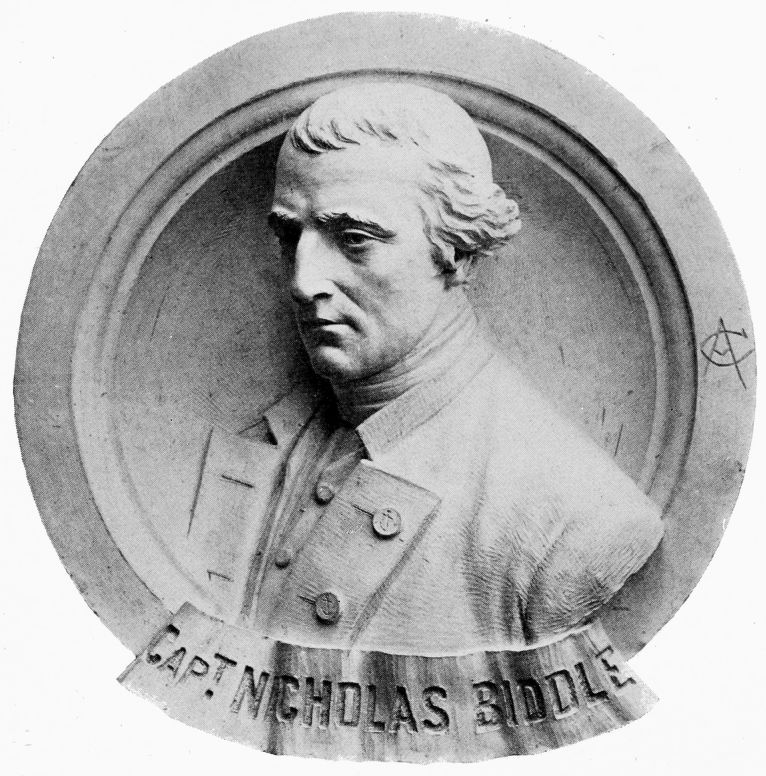
CAPTAIN NICHOLAS BIDDLE
In the Tower Gallery of City Hall
Alexander Milne Calder, Sculptor
and the world, fine types of Indians, and other races; the negro heads being known among artists as the best of their kind; ornamentation symbolic of music, art, science, and commerce, is used as an integral part of this great public edifice, an inherent factor in true decoration, where it comes into its own, as well as in gardens, parks, boulevards, and plazas. Statues outside, on City Hall pavement, are, General John F. Reynolds, by Rogers; General McClellan; the Pilgrim by Saint Gaudens; the Quaker by Giuseppe Donato; Stephen Girard and John Wanamaker by J. Massey Rhind; Joseph Leidy, M.D.; President McKinley, and John C. Bullitt. College of Physicians, Twenty-second Street, above Chestnut, English; built, 1910; architects, Cope & Stewardson. Dropsie College, Broad Street below York, French; architects, Pitcher & Tachau. Hamilton Court, Thirty-ninth and Chestnut Streets, Italian; steel frame faced with brick and limestone; an apartment house built around an open court, recalling very strongly, both in color and detail, the earlier Venetian palaces. Memorial Hall, Fairmount Park, German, granite; built, 1876; architect, Herman J. Schwarzmann; one of the best designed monumental buildings in the city. Union League addition, Fifteenth and Sansom Streets, Italian; steel frame, faced with limestone; built, 1912; architect, Horace Trumbauer: a very dignified and restrained elevation, suggestive of a Roman palace.
Spanish. The First Church of Christ Scientist, Walnut Street above Fortieth; architects, Carrere & Hastings. Pennsylvania Institute for the Instruction of the Blind, Overbrook; Spanish mission; architects, Cope & Stewardson.
English. Mellor, Meigs and Howe Office, 205 South Juniper Street, rough brick; architects, Mellor & Meigs.
The Athenaeum of Philadelphia, 219 South Sixth Street; architect, John Notman; has best points of work done in 1850, showing traditions of the past, with developments and characteristics of its own; interior has a most beautiful reading room. The University Buildings, from Thirty-fourth to Fortieth Streets, Walnut Street to Woodland Avenue, add much to the architectural attraction of West Philadelphia; entrances to the campus, near the dormitories, are fine Tudor gateways, wrought iron, with brick and stone piers. (See University of Pennsylvania.) Hon. James Arthur Balfour said in 1917, “The Americans build Brobdignagian cathedrals, and use them for office buildings.” The Skyscrapers. Adelphia Hotel, Thirteenth and Chestnut Streets, Italian Renaissance, brick and terra cotta; built, 1914; architect, Horace Trumbauer; the arabesque detail on lower stories of the façade, and pattern formed by projecting bricks, on the stories above, are worthy of notice; interiors are pleasing and architecturally correct. Bell Telephone, a Parkway building, corner of Seventeenth and Arch Streets; height above ground 273 feet; stone; with interesting façade; architect, John T. Windrim. Bellevue-Stratford Hotel, southwest corner Broad and Walnut Streets, French Renaissance; steel frame, faced with terra cotta; architects, Hewitt Bros. Most beautifully proportioned and artistic business building in Philadelphia. Bourse, Fourth to Fifth Streets, below Market; adaptation of the François Premier; with fine feeling of dignity, in placing within the broad paving; architects, Hewitt Bros. Bulletin Building, Juniper and Filbert Streets, French; steel frame, faced with terra cotta; architect, Edgar V. Seeler. Curtis Publishing Company, Sixth and Walnut Streets, modern adaptation of Georgian; steel frame, faced with white marble and brick; built, 1910; architect, Edgar V. Seeler; faces Independence Square, and although thoroughly modern, harmonizes perfectly, both in color and design, with the historic Georgian group, of which Independence Hall is the center, and adds to the quiet colonial atmosphere of the Square; interior is excellently designed; entrance, lobby, editorial offices, and the employes’ dining room being of particular interest. Mechanical equipment is the finest of its kind in the world, producing an average of 5,558,600 complete paid for publications per issue of the Ladies’ Home Journal, Saturday Evening Post, and The Country Gentleman for six months ending June 30, 1924. Twenty original paintings, and the mosaic “The Dream Garden,” by Maxfield Parrish, a mural made of Tiffany favrile glass, the work proceeded through an entire year, in the Tiffany Studios, where each piece of glass was fired under the personal supervision of Mr. Tiffany and Mr. Briggs; time can never impair its freshness, color, or luminosity. Visitors will be shown the entire plant daily, except Saturdays and Sundays, between 9.00 A.M. and 5.00 P.M. Farm Journal, Seventh Street and Washington Square, Georgian; colonial brick and Indiana limestone; architects, Bunting & Shrigley. Harrison Building, Fifteenth and Market Streets, François Premier; built, 1895; architects, Cope & Stewardson; an unusual example of well-studied, though elaborate Renaissance detail; notice the graceful roof, recalling the charming chateaux along the Loire. Land Title Building, southwest corner of Broad and Chestnut Streets, modern adaptation of classic; steel frame, faced with gray granite and brick; architects, D. H. Burnham & Co., Chicago; contrast the scale of the order, in the newer portion of the building on Broad Street entrance, with the insignificant order in the old building. Manufacturers’ Club, Broad and Walnut Streets, Italian Renaissance; built, 1914; steel frame, faced with limestone; architects, Simon & Bassett; has a handsome façade, crowned by a daring Florentine cornice; interior unusually interesting in detail. Racquet Club, Sixteenth Street below Walnut, Georgian; colonial brick, marble trimmings; architect, Horace Trumbauer. Real Estate Trust Building, southeast corner of Broad and Chestnut Streets, Renaissance; architect, Edgar V. Seeler. Ritz-Carlton Hotel, Broad and Walnut Streets, modern adaptation, style of the Adam Brothers; built, 1912; steel frame, faced with colonial brick and Indiana limestone; architects, Warren & Wetmore, New York, Horace Trumbauer, Philadelphia, associate. The keynote of this structure is refinement and good taste; a recognition of the fact that commercialism and good architecture are by no means incompatible. Stephen Girard Building, Twelfth and Girard Streets, modern adaptation of Greek classic; built about 1894; steel frame, faced with brick and marble; architect, John T. Windrim; details of this building are interesting; note the bronze caryatid figures which support the heads of the second story windows; the wrought iron gates to the court on Girard Street rank with the best modern wrought ironwork in the city. Wanamaker Store, Chestnut, Market, Juniper, and Thirteenth Streets, modern adaptation of Italian Renaissance, built, 1910; steel frame, with light gray granite; architects, D. H. Burnham & Co., Chicago; exterior of this store is one of the finest in the city, it is simple, dignified, and impressive, without being monotonous; the great scale of the Doric order at the base, the severe wall treatment, and the splendid cornice, combine to express a purity and loftiness seldom equaled in commercial buildings; a guide may be had, upon application, who will conduct visitors through the entire building including the kitchens. West Philadelphia High School, Forty-sixth and Walnut Streets, Tudor Gothic; rough brick and Indiana limestone; built, 1913, by the City Architect. Widener Memorial Home for crippled children, Broad Street and Olney Avenue, Georgian, built, 1906; Harvard brick and marble trimmings; architect, Horace Trumbauer; has a very beautifully designed wrought iron gateway.
To make a “City Beautiful” is to give it wide streets, lined with handsome buildings and houses, plenty of parks, boulevards, and to rid it of rows upon rows of semi-shanty premises, small, ill-kept, and unattractive. Each new building that is put up within the city limits should, in its arrangements and architecture, help toward making the locality in which it is erected more attractive than at the present time. This idea has been carried out in the Carnegie Free Library buildings, scattered about within the limits of the municipality, as their varied exteriors are very distinguished, from an architectural point. The interiors are designed to avoid the multiplication of corridors; principal rooms used for reading, the art and reference rooms, are stately and fine.
An interesting Gateway is the entrance to the Manheim Cricket Club, Germantown, Georgian; consisting of massive brick piers, surmounted by stone caps, connected at the top with a wrought iron supporting lantern, below which are the heavy wrought iron central gates; this, with smaller gateways, and a most attractive brick wall, forms the enclosure for the grounds; architects, McKim, Mead & White.
ART COLLECTIONS AND ART SCHOOLS
Philadelphia being the seat of government of colonial times, is extremely rich in historic portraits. They are in The Pennsylvania Academy of the Fine Arts; Independence Hall; Historical Society of Pennsylvania; Carpenters’ Hall; American Philosophical Society; Pennsylvania Hospital; Academy of Natural Science; The Library Company of Philadelphia; Mercantile Library; College of Physicians; United States Mint; University of Pennsylvania; many banks and insurance companies.
Pennsylvania Academy of the Fine Arts, Broad Street above Arch; open free daily, 9.00 A.M. to 5.00
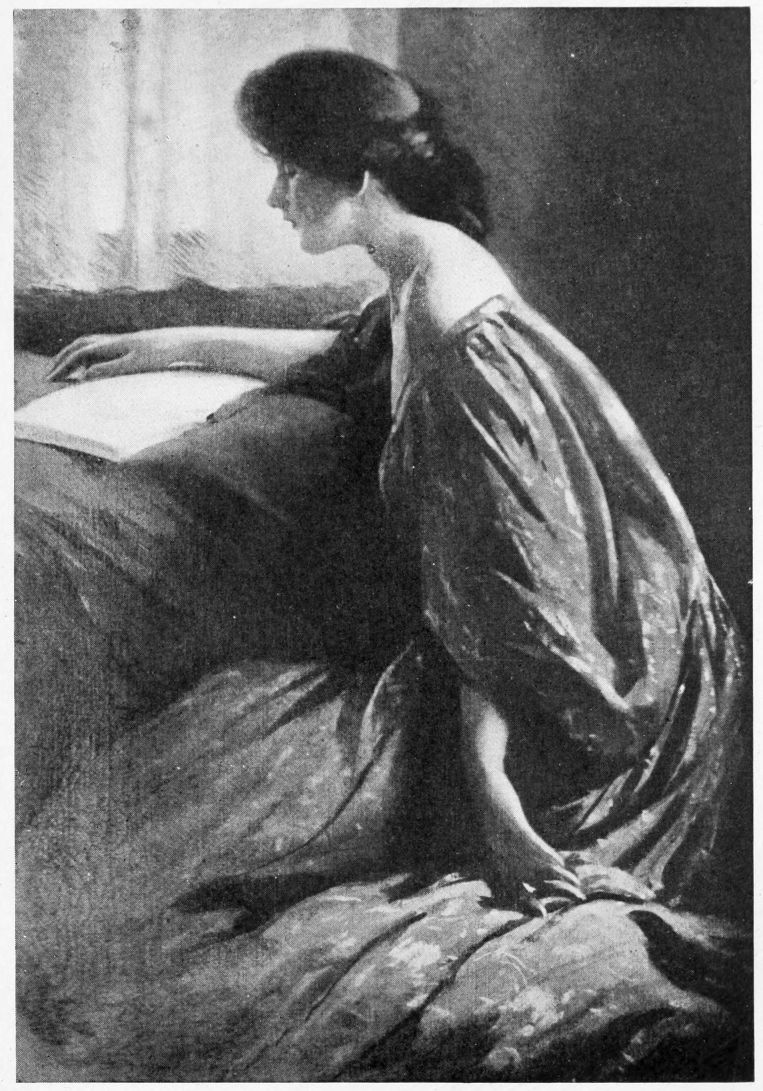
A QUIET HOUR
Painted by John W. Alexander Courtesy of the Pennsylvania Academy of the Fine Arts
P.M., Sundays, 1.00 P.M. to 5.00 P.M.; fee for special exhibitions; was the first art institute in America, founded, 1805; its history is in no small measure the history of American art itself, and dates back to 1791, when Charles Willson Peale attempted to organize in Philadelphia a school of art; from this grew, in 1794, the Columbianum, which held the first exhibition of paintings, in 1795, in Independence Hall. The permanent collection of paintings and sculpture now includes the Gallery of National Portraiture, with the largest number of portraits by Gilbert Stuart to be seen in any museum; and notable works by other early American painters—Benjamin West, Washington Allston, Matthew Pratt, the Peales, Sully, Neagle, Inman, Eichholz, Trumbull, and Bass Otis; the Gibson Collection, largely composed of the Continental schools; Temple collection of modern American paintings; important works by many of the world’s greatest artists; and the Phillips collection of about forty thousand etchings and engravings. Annual exhibitions are, miniatures, water colors, illustration, and etchings in November and December; oil painting and sculpture in February and March, considered the salon of living American artists; also special exhibitions and lectures on art. The Academy coöperates with the system of International Catalogue Exchange.
Since the beginning of the Academy’s existence, men and women whose names have become illustrious in the annals of American art have been enrolled as students. The schools are equipped in every way to teach the technique of painting and sculpture, the faculty is composed of representative artists of the day; collections, galleries, classrooms, models, and casts are admirably fitted to afford instruction fully equal to that obtainable in Europe. Many substantial prizes are awarded annually to students upon the merits of their work. The William Emlen Cresson Travelling Scholarships send, on an average, sixteen students abroad yearly for four months, and enable them to return to the Academy and continue their studies without payment of tuition fee. The Fellowship of the Pennsylvania Academy of the Fine Arts, organized 1897, sends out annually two exhibitions of original oil paintings by notable artists; one to other cities, the other to the Philadelphia public schools, where they remain one month in each school; while there, the paintings are explained by a member of the Fellowship to school children, thus teaching them true appreciation of art. A Picture Purchase Fund was established in 1912, with which pictures have been bought, from Fellowship Exhibitions, and placed in Philadelphia libraries and public schools.
John Graver Johnson Museum of Paintings, 510 South Broad Street, left by bequest April, 1917, to the City of Philadelphia, is open to the public; throughout Europe and America this vast collection of old and modern masters is famous for extent and merit. “No other American collection has so wide a range and so even a quality,” says F. Mason Perkins; it contains scores of examples which could not be duplicated at any price. Noted for the completeness of different schools of painting.
Philadelphia School of Design for Women, southwest corner of Broad and Master Streets; first industrial art school in this country; similar to the “Ecoles Professionelles des Femmes,” in Paris; was founded in 1844 by Mrs. Sarah Peters, the American wife of the British Consul in Philadelphia, in her own house; later, the Franklin Institute assumed charge of the classes until 1853, when it was incorporated, and a Board of Directors elected. Its aim is to put art students in touch with business demands, as well as to cultivate, to the highest degree, their artistic ability. The Normal Art Course embodies all the special studies required by modern educators for teachers of art and design, and with courses in the fine arts, illustration, and costume illustration; has trained many women, now earning handsome emoluments and winning distinction. The residence on Broad Street, forming entrance to the school, which occupies large buildings in the rear, was the home of Edwin Forrest, a famous tragedian; the fine gallery which he erected to house his collection of paintings, now at the Forrest Home for Actors at Holmesburg, is used for annual exhibitions of the school’s painting classes. Edwin Forrest died here in 1872 and John Sartain in 1897; John Sartain was celebrated as a mezzotint engraver, and lived here with his daughter, Miss Emily Sartain, then principal of the school, herself a skilled painter, and engraver in mezzotint; who with her well chosen faculty of eminent artists, carried to a prosperous fulfilment Mrs. Peters’ initiative effort.
Pennsylvania Museum and School of Industrial Art was founded in 1876, as a concrete embodiment of the lessons taught by the Centennial Exhibition, and has developed forms of artistic craftsmanship that were practically unknown in America. The Museum is housed in Memorial Hall, Fairmount Park, memorial of the Centennial; Modern Renaissance; architect, Herman J. Schwarzmann. Open free, Mondays, 12.00 M., other days 9.30 A.M., closing 5.00 P.M., Sundays, 1.00 P.M. to 6.00 P.M. Established as a museum of art in all its branches and technical application, with a special view to the development of the art industries of the state. Among its important collections are the W. P. Wilstach paintings, about five hundred old masters, with their schools; and contemporary international paintings, belonging to the City of Philadelphia; with $700,000 endowment, interest to be used for their care and increase, by the Commissioners of Fairmount Park; among the many brilliant artists represented are, Whistler, Munkácsy, Sorolla, Zuloago, Velasquez, the Barbizon, Italian, and Dutch Schools of Landscape. The famous Bayeux tapestry is here; laces; vestments; porcelains; enamels; carved ivories; period furniture; some of the Edwin Atlee Barber collection of American pottery and porcelains; Lewis collection of Swiss stained glass, sixteenth and seventeenth centuries; Frishmuth collection of colonial antiquities. A Bureau of Identification is maintained where art objects may be classified.
The school is at the northwest corner of Broad and Pine Streets; porch of this building, facing Broad Street, is a fine example of Tuscan architecture, erected, 1828. The school has forty instructors. Free scholarships are given in each county of this state. This is the leading school in America in associating the study of art with practical training; through its equipment students not only design, but actually manufacture; it includes a complete textile plant with looms, dye house, and all related appliances which make possible the production of most artistic fabrics; other courses are cast and wrought metal; furniture; leather work; pottery; garden furniture in cement; mosaic; also the Normal Art Courses, illustration; architectural drawing; modeling; interior decoration; book binding. Classes are attended by men and women, who pursue exactly the same studies. Graduates are sought to fill lucrative positions as designers; artistic craftsmen; and art teachers.
Drexel Institute, Thirty-second and Chestnut Streets. A day and evening technical school of Art, Science, and Industry for men and women; founded by Anthony J. Drexel, 1891; Renaissance, brick; architects, Wilson Brothers. The leading American and European current periodicals relating to art, science, and technology are in the library. Art Gallery contains collections owned by John D. Lankenau, works by modern German masters, and Anthony J. Drexel, works of International, contemporary, modern painters. The Museum, open free 10.00 A.M. to 5.00 P.M. daily, except Sundays, includes examples of Industrial Art and the Decorative Arts of India, Egypt, China, Japan, and Europe.
Graphic Sketch Club, 719 Catharine Street, founded by Samuel S. Fleisher in 1899, to provide, free, an art center which should give the culture craved by many intelligent young people, to whom it had been denied by circumstances. The Club House is open only at night, Saturday afternoons, and all day Sundays. This is an Art Club in effect, as well as name; rooms are artistically furnished in beautiful color harmonies, and embellished with choice bronzes bought at our Academy exhibitions, and fine porcelains. Students are educated in art, for the practical good it will do them, and cultural growth; all are day workers. The faculty is composed of well known artists; classes include portrait and still life painting; illustration and sculpture. From this school have gone some of the most original workers in the schools of the Academy of the Fine Arts. Landscape classes are in session during the summer. Lectures are given on art or musical topics. Membership in the Club is attained by attendance in the classes for three years.
Public Art School, Park Avenue and Master Street, founded by Charles G. Leland, now under the direction of the Board of Public Education; open to pupils in grammar grades of public schools. A course of study was planned, including drawing, clay modeling, and wood carving, to train students to originate design, and do the manual work as well, so that the designer should be the artisan also.
Art Club, 220 South Broad Street. Annual exhibition of paintings and sculpture, gold medal awarded; and special shows by individual artists.
Art Jury, City Hall, Philadelphia, created by Act of Legislature, 1907, providing, “That in every city of first class, there shall be an Art Jury, composed of the Mayor and eight others, of whom shall be, one each, painter, sculptor, architect, and Park Commissioner, to pass upon design and location of all buildings; bridges; arches; fountains; or fixtures to be erected in the city.”
City Parks Association, City Hall.
Darby School of Painting, Fort Washington, Montgomery County. Outdoor classes. Hugh H. Breckenridge, 10 South 18th Street, Philadelphia.
Fairmount Park Art Association, organized, 1871. 320 S. Broad Street.
Pennsylvania Society of Miniature Painters, organized, 1901. Annual fall exhibition, Pennsylvania Academy of the Fine Arts.
Philadelphia Chapter, American Institute of Architects, 1301 Stephen Girard Building; organized, 1869.
The Philadelphia Sketch Club (men), 235 South Camac Street, organized, 1860. Annual fall exhibitions of members’ work; also special exhibitions.
Philadelphia Water-Color Club, Pennsylvania Academy of the Fine Arts, annual international exhibitions; also Traveling exhibitions of members’ work.
Plastic Club, women, 247 South Camac Street; organized, 1897. Annual and special exhibitions; lectures, and sketch classes.
T-Square Club, 204 South Quince Street, founded, 1881. Annual architectural exhibition; drafting; decorative painting; modeling; and architecture in coöperation with Society of Beaux-Arts Architects, New York City.
The D’Ascenzo Studios, for Stained Glass, 1604 Summer Street, founded twenty years ago, include designing; painting; firing; and glazing; work is begun and completed, in both modern and antique, with preference for the antique school, for architectural fitness and conventionality; also glass mosaic and mural decoration. D’Ascenzo’s art may be seen in many important churches and buildings in this country; in the Chapel at Valley Forge, and in Philadelphia may be mentioned St. Mark’s Protestant Episcopal Church, Frankford; St. James’ Protestant Episcopal Church, Twenty-second and Walnut Streets; St. Patrick’s Roman Catholic Church, Twentieth and Locust Streets; Synagogue Rodeph Shalom, Philadelphia.
William Willet and Annie Lee Willet Studios, for Stained Glass, 226 South Eleventh Street, formerly of Pittsburgh. While all the world is deploring the loss of the magnificent old glass in the cathedrals of Europe, here the art of fused glass has been raised to such perfection that their great windows have all that the old work has, of depth, glow, and shadow, under modern conditions of stability; among their notable windows are, the Sanctuary Window, West Point Military Chapel, New York; Proctor Hall, the Graduate School, Princeton, New Jersey, great west window; many in the churches and public buildings of Pittsburgh, Chicago and elsewhere; in and near Philadelphia, in Summit Presbyterian Church, Carpenter and West View Streets, Germantown; St. Michael’s Sanctuary window, High Street, Germantown; John Chambers Memorial Church; The Buchanan Memorial, St. Nathaniel’s Church, Kensington; the Harrison Memorial; Holy Trinity Church, Nineteenth and Walnut; the Leta Sullivan in the Assumption, Strafford.
Notable private art collections in Philadelphia, that may sometimes be seen by writing for permit, which for variety and value, have few peers are:
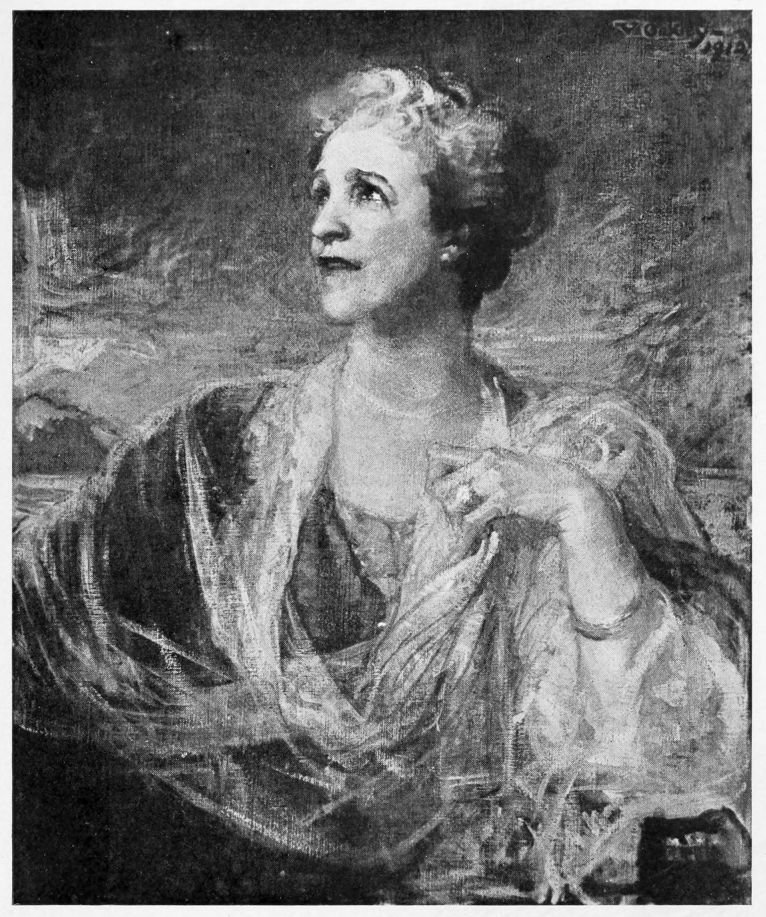
THE TRAGIC MUSE
From the Edward Hornor Coates Memorial Collection
Painted by Violet Oakley Courtesy of the Pennsylvania Academy of the Fine Arts
P. A. B. Widener’s, several hundred choice and rare paintings, mostly masterpieces of great artists of the Renaissance, and modern.
The W. L. Elkins; many fine examples of medieval and modern portraiture, landscape and genre painting.
The John McFadden, best collection of solely eighteenth century English paintings in this country.
The Edward T. Stotesbury, masterpieces of the English School and international contemporary art.
Should these collections accompany the Wilstach, now in Memorial Hall, to the Municipal Art Museum in Fairmount Park, now under construction, it would begin its career with a wealth of paintings, more comprehensive and valuable than any that ever inaugurated a similar institution, not excepting the Louvre, Pitti, Dresden, National in London, and Metropolitan, New York, which grew from small beginnings, thus placing the highest products of art within equal and easy reach of all classes. This Museum will constitute the central feature of a comprehensive plan in progress, at the head of the Parkway, for a real art center, more imposing in scale and impressive in its entire effect than any similar art center in any American City. The Pennsylvania Academy of the Fine Arts has been granted a site facing the Fairmount Plaza, also the Pennsylvania Museum and School of Industrial Art.
ARMY AND NAVY
The First City Troop, Armory, Twenty-third Street, above Chestnut; founded in 1778. An exclusive social organization. Oldest military command in the United States in continuous active service; its traditions of active service are as loyally preserved as its rights as escort of the President, and other distinguished men. In the Spanish-American War in 1898, “The Troop” was the first body of cavalry landed at Porto Rico. The “Gentlemen of Philadelphia” met in Independence Hall, November 17, 1774, and formed a company of cavalry called, “The Light Horse of the City of Philadelphia”; they were dismissed by Washington after the Revolution in 1778, and reorganized immediately as the First City Troop; the Troop voted to give the certificate of dismissal, signed by Washington, to their captain, Samuel Morris; the paper is now in possession of the decendants of Elliston P. Morris, of Germantown. Frankford Arsenal, Bridge and Tacony Streets; local station, Bridesburg; open, free, daily, 7.45 A.M. to sunset. Established, 1814; President Madison was at the opening exercises. Lafayette stopped at the Arsenal in 1824. Here are complete small arms cartridge factory equipment; artillery cartridge factory equipment; and machine plant for the manufacture of inspecting instruments; sights for cannon; range finders; and other instruments for fire control at the fortifications, etc. Philadelphia Navy Yard, League Island, about 1000 acres; junction of Delaware and Schuylkill Rivers; deeded to the National Government by the City of Philadelphia in 1868. Open to the public daily between 9.00 A.M. and 4.00 P.M. Established about 1794 on the Delaware River front, at Prime Street. A large number of the old wooden ships of the Navy were built here, such as the ships of the line, Franklin, Pennsylvania and North Carolina; frigates, United States, Raritan, and Guerriere; sloops of war, Vandalia, Germantown, and Dale; screw steamers, Princeton, Wabash, and Lancaster; side wheel steamers, Mississippi and Susquehanna. At present there are two dry docks; shops employ 2000 men; three large barrack buildings for the use of marines stationed at the Yard accommodate 1400 men. Admiral Benson, former Commandant, considers this the best Navy Yard in the Government’s possession, being in the center of coal and iron industries, within short haul, both by rail and water, for all material required by a great navy yard; its nearness to great private shipyards on the Delaware provides skilled mechanics in the art of ship-building, and the fresh water feature, being unique, is of great importance; barnacles accumulated in salt water drop off in fresh water, simply by docking here for short periods. There is also a large Reserve Basin called the Back Channel, where ships out of commission can be laid up until wanted. The berthing facilities may be indefinitely extended by constructing additional sea wall and piers. Fort Mifflin, below mouth of the Schuylkill, has casement dungeons, and earthen banks of early warfare, and was prominent in the Revolutionary War; designed and built by Major Louis de Tousard in 1798. Now, in the magazines, ammunition from government battleships is stored, before they enter the Navy Yard; the magazines are surrounded by poles, on each pole is a lightning rod. United States Naval Asylum, Gray’s Ferry Avenue below Bainbridge Street, classic, marble; has Museum of Uniforms.
HISTORIC BURIAL GROUNDS
The earliest were connected with churches; some date almost from the beginning of the city.
Baptist. Blockley Cemetery, Meeting-House Lane, between Lancaster Avenue and Haverford Street; ground given, 1804. Church is at Fifty-third Street and Wyalusing Avenue. Dunker, Germantown, on Germantown Avenue above Sharpnack Street; oldest meeting-house of the German Baptists, or Dunkers, in America; erected, 1770. Burial ground opened, 1793; in it lie Alexander Mack, founder of the sect, and Harriet Livermore, the “Pilgrim Stranger” of Whittier’s “Snow Bound.” Mennonite, Germantown Avenue above Herman Street; church was built, 1770; many early Germantown settlers are buried in the yard. Pennypack, or Lower Dublin, Krewston Road near Pennypack Creek, one mile from Bustleton; here is oldest Baptist church edifice in Pennsylvania, built about 1707; in the old time graveyard are many curious moss covered tombstones.
Friends. When the graves are marked the stones are always small and inconspicuous. Fairhill Meeting, Germantown Avenue and Cambria Street; ground granted by William Penn; a large and beautiful old cemetery and near “Fairhill,” the great Norris estate. The Meeting House, Fourth and Arch Streets, was built in 1804, but the ground was used for burials many years before; it is one of the oldest cemeteries in Philadelphia. Some of the most prominent citizens of very early days lie here with nothing to mark their resting-place; it is computed that twenty thousand persons are interred here.
Jewish. Mikveh Israel, on Spruce Street, near Ninth; ground was granted to Nathan Levy by John Penn in 1738; here lies the beautiful Rebecca Gratz, original of Rebecca in Scott’s “Ivanhoe.” In August, 1913, the little burial ground was opened for the interment of her grandniece, the first burial for thirty years. Mount Sinai, Frankford Avenue, near Bridge Street, has imposing entrance, erected, 1854.
Lutheran. St. Michael’s, Germantown Avenue and Phil-Ellena Street, joins the church built about 1730; a notable grave, with flat marble stone resting on four columns, is that of Christopher Ludwig, “baker general” to the American army during the Revolution.
Methodist. St. Paul’s, Catharine Street near Sixth. Church is now used as an Italian mission; has a small graveyard.
Presbyterian. Of First and Third Churches, Southwest corner of Fourth and Pine Streets, First Church, Seventh and Locust Streets, has the eastern section. When the First Church abandoned its old Market Street site for the present locality, the bodies were moved whenever possible, and many of the old headstones were inserted in the south wall of the new graveyard. The Third Church, called “Old Pine,” divides the grounds, using the west section; both are most interesting, with many people of note interred, including David Rittenhouse; William Hurry, who is said to have rung the Liberty Bell when proclaiming independence; Dr. William Shippen, Director General of Hospitals during the war for Independence; many Revolutionary soldiers; and Captain Charles Ross of the First City Troop.
Protestant Episcopal. All Saints, Bristol Turnpike, Torresdale. Established 1772-73, when the first church edifice was built. Christ Church has two burialgrounds, one attached to the church on Second Street, North of Market, dating from the earliest days of the church, the other southeast corner of Fifth and Arch Streets, where first interment was made in 1730; graves of Benjamin Franklin and Deborah, his wife, are in the northwest corner; may be seen from Arch Street through an iron railing set in the brick wall; in these graveyards are buried many distinguished Americans; among them Peyton Randolph, first President of the Continental Congress; Commodores Truxton, Biddle, Bainbridge, and Dale; Robert Morris; several signers of the Declaration of Independence; Dr. Benjamin Rush, Dr. Philip Syng Physick, Bishop White, and Dr. William Augustus Muhlenberg. Gloria Dei (Old Swedes’), Front and Swanson Streets, south of Christian; church built, 1700, being the oldest church building in Philadelphia; a most interesting graveyard surrounds it; the celebrated ornithologist, Alexander Wilson, is buried here. St. James, Kingsessing, Sixty-eighth Street and Paschall Avenue; church erected, 1762; General Josiah Harmer, of the Revolution, is buried in the graveyard. St. James the Less, Hunting Park Avenue and Clearfield Street; this beautiful little Gothic church, brownstone, built 1847, has a number of fine monuments in the burial ground; John Wanamaker is buried here. St. Luke’s, Germantown Avenue and Coulter Street, church dates from 1818; the famous Philadelphia annalist, John Fanning Watson, is interred in the churchyard. St. Peter’s, southwest corner of Third and Pine Streets; in the graveyard lies the body of Commodore Stephen Decatur, the grave surmounted by an Ionic column supporting an American eagle; other notable names here are Chew, Cadwalader, Mifflin, Binney, Biddle, Peale, Waln, Meade, McCall, Duché, Norris, Kuhn, Montgomery. Trinity, Oxford, near Fox Chase, east of old Second Street Pike; present church dates from 1711; began as a log meeting house, 1698; tombstones date as early as 1708; the inscriptions on some are quaint and original.
Roman Catholic. Holy Trinity, northwest corner of Sixth and Spruce Streets, dates from 1789; on the old tombstones may be deciphered names of many of the early German and French inhabitants of Philadelphia. Stephen Girard was buried here until 1851, later his body was removed to Girard College. Most Holy Redeemer, Richmond Street, opposite Hedley Street, Bridesburg; many of the Redemptorist Fathers are buried here.
OTHER NOTABLE BURIAL GROUNDS
North Cedar Hill, Frankford Avenue corner of Foust Street, incorporated, 1857; a soldiers’ monument to the Civil War soldiers from Frankford is in the older part. Crispin, Holmesburg; contains grave of Thomas Holme, who laid out the city of Philadelphia; plot is under care of the Crispin Association, formed of descendants of Holme. Glenwood, Ridge Avenue and Twenty-seventh Street, opened, 1850, has notable monument of the Scott Legion Association, formed among the surviving soldiers of the Mexican War. Greenwood, Asylum Pike and Arrott Street, Frankford; established, 1869, by the benevolent order of the Knights of Pythias, as a burial place for members and their families; occupies the “Mount Airy” estate, once residence of Commodore Stephen Decatur. Hood, or “The Lower Burial Ground,” on Germantown Avenue at Logan Street, opened in 1693, having been presented to the borough of Germantown by Jan Streepers. Many early settlers of Germantown lie here; among them Frederic William Post, the Moravian missionary to the Indians, and Condy Raguet, founder of the Saving Fund in Philadelphia; in 1847, William Hood built the front entrance, of Pennsylvania marble, the wall and railing. Ivy Hill, East Mount Airy Avenue, above Stenton Avenue, chartered, 1867; about 80 acres; the Second Baptist Church has removed to Ivy Hill about 300 bodies from its old burial place on New Market Street; an imposing monument is here in memory of David Lyle, Chief Engineer of the Volunteer Fire Department from 1859-67. North Laurel Hill, East bank of Schuylkill River and Ridge Avenue, organized, 1835; formerly “Laurel,” country seat of Joseph Sims. “Fairy Hill,” seat of Pepper family, now Central Laurel Hill, and “Harleigh,” William Rawle’s place, now South Laurel Hill; historic dead and artistic monuments fill these cemeteries; Commodores Murray and Hull, General George Gordon Meade, and Mrs. Cornelius Stevenson, “Peggy Shippen” of the Ledger, are among those who lie here; the Lea Memorial, sculptor A. Sterling Calder, is very beautiful, the chapel is early English. Just across the Schuylkill River, on Belmont Avenue, at Pencoyd Station, is West Laurel Hill, opened in 1869. General Herman Haupt is among those buried here. Monument, Broad Street and Montgomery Avenue, was laid out by Dr. John A. Elkinton in 1836; an obelisk monument, on a pedestal, erected, 1859, in honor of Washington and Lafayette, was designed by John Sartain, artist, who is buried near base of shaft. Mount Moriah, Sixty-second Street and Kingsessing Avenue, opened, 1855; has grave of Betsy Ross, over which a flag floats perpetually. Mount Peace, Lehigh Avenue and Thirty-first Street, was originally country seat of the Ralston family, known as Mount Peace estate. Mount Vernon, Ridge and Lehigh Avenues, opposite Laurel Hill, chartered, 1856; the Gardel monument was long considered handsomest in the country. National Cemetery, Haines Street and Limekiln Pike, land acquired by the United States Government in 1885, it is well wooded, and the grounds are laid out with flowering plants; about 2700 Union soldiers are buried here; their graves marked by long rows of small granite slabs, bearing their names and the States from which they came. Soldiers of three wars lie here; a granite monument, erected by the United States, marks the burial place of 184 Confederate soldiers and sailors. Palmer, at Palmer, Belgrade, and Memphis Streets, owes its origin to Anthony Palmer; in 1730, he purchased a large tract of land in “The Northern Liberties,” on which he laid out a town and named it Kensington; his daughter carried out his wishes, and bequeathed ground for a burial place for those living in Kensington. Ronaldson’s, Tenth and Fitzwater Streets, now neglected, was founded by James Ronaldson in 1826 as a burial place in which persons of moderate means could find a grave without any of the restrictions which attended interments in the churchyards; he gave the ground, almost a city square, decorated it with trees and shrubbery; so beautifully was it kept that it was considered “The model burial place of the City,” until the opening of Laurel Hill. Upper Burial Ground, or Ax’s, Germantown Avenue near Washington Lane. John Frederick Ax was caretaker from 1724-56; many early settlers are buried here, the oldest known grave being that of Cornelius Tyson, who died in 1716; there are also graves of some American soldiers and officers, killed in the Battle of Germantown; over them, John Fanning Watson placed a marble headstone. Woodlands, Thirty-ninth Street and Woodland Avenue, was in early times the country seat of William Hamilton, known as “The Woodlands”; acquired by Woodlands Cemetery Company in 1840. Many distinguished men and women are buried here, among them Commodore Thomas Stewart, who commanded the Constitution in 1812; General John Stewart, Major Generals D. B. Birney and Abercrombie of the Civil War; Rembrandt Peale; William K. Hewitt and P. F. Rothermel, Artists; John Davenport, Actor; Colonel Thomas A. Scott and J. Edgar Thomson; Frank and Louise Stockton; Dr. S. Weir Mitchell and Anthony J. Drexel.
HISTORIC CHURCHES IN PHILADELPHIA
Among the eight hundred and five churches in Philadelphia, are:
The Philadelphia Baptist, whose Association celebrated its two hundredth and tenth anniversary in 1917. First Church, Seventeenth Street below Chestnut, open daily, is a consistent example of Byzantine architecture with American modifications; stone; architect, Edgar V. Seeler. Windows made by Heinecke & Bowen are copies of the Byzantine leaded glass; lights and shadows in drapery are all done with leaded strips of glass, not painted. Temple, Broad and Berks Streets, famous on account of its pastor, Rev. Russell H. Conwell, was dedicated, 1901; at that time it was the largest church edifice in the United States, excepting the Mormon Temple at Salt Lake City; auditorium seats 3135 people: Romanesque, with two low towers on the front, surmounted by large copper domes, which give an Oriental touch; architect, Thomas Lonsdale. Fine rose window in front, said to have been made by John LaFarge; other windows are by J. & R. Lamb and R. S. Groves: the Hope-Jones organ, built by the Rudolph Wurlitzer Company, is one of the largest in this country; it has all the orchestral accompaniments. Tabernacle, Chestnut and Fortieth Streets, Gothic, stone, has a window by William Willet. There are about one hundred Baptist churches in Philadelphia.
Christian Science. First Church of Christ Scientist, Walnut Street near Fortieth; Spanish architecture.
Congregational. Central, Eighteenth and Green Streets, Gothic, stone, built in 1872; architect, D. Supplee; organized in 1864; first services were held in old Concert Hall, 1217 Chestnut Street, afterwards used as first Free Library Building; sermon “Recognition,” was preached by Rev. Henry Ward Beecher; other sermons of early days, by Richard S. Storrs, D.D. About nine or ten churches of this denomination are in Philadelphia.
Friends’ or Quaker Meeting-Houses.
“What dignity breathes from the lofty space And amplitude of hospitality In these old-fashioned Quaker shrines! Most friendly seems the long, high, sturdy roof, Most friendly the all-welcoming old walls Seen through the sheltering trees. O mighty oaks and noble sycamores, With trunks moss-silvered and with lichened limb, Breathe soft to me the storied memories And treasured records of the long rich years That blessed the meeting-houses.” (From “Old Meeting-Houses,” by John Russell Hayes.)
For more than one hundred years there has been no change in the general style of architecture; before that time, the earliest meeting-house in Philadelphia, at Second and Market Streets, was built with a central lantern or cupola; probably copied from a meeting-house of similar form in Burlington, New Jersey, built, 1682; where the yearly meeting for New Jersey and Pennsylvania was first held: later it met alternately at Philadelphia and Burlington, but since 1750 in Philadelphia, Fourth and Arch Streets. One of the most interesting old meeting-houses, built in 1696, is at Merion, near Narberth Station, Pennsylvania Railroad, in which William Penn preached; another, that he attended, is the old Haverford, built in the early eighteenth century, near Cobb’s Creek, opposite St. Dennis Roman Catholic Church. Radnor and Plymouth are also interesting old houses; all these last named are now owned by the Hicksite Branch of Quakers, who also own over seventy other meeting-houses throughout the state. Among those owned by the Orthodox Branch within Philadelphia are the Fourth and Arch Streets, not only the most important, but of great charm architecturally; it is very large and stands on ground originally given by William Penn to George Fox, and by the latter to Friends in America; and may be taken as typical of the later and best Quaker architecture; built in 1804, following the style of the pre-Revolutionary days of the houses just named, but adapted in material and size to the increased numbers worshiping within; it is of brick, set in ample grounds, with abundant shade; the ground about it, and much also covered now by the building and by Arch Street, is a very old burial ground, filled over several times. James Logan is buried under the pavement of Arch Street. Twelfth Street Meeting-House, brick, built in 1812, is second in importance, and one of the most beautiful bits in old Philadelphia. The oak timbers in its roof are said to have come from the “Great Meeting-House,” which succeeded that with the cupola at Second and Market Streets; oak timbers are also exposed with good effect in the upper room of the Arch Street house; the two houses are of the same general type and severely plain, but form, together with that at Sixth and Noble Streets, a most dignified trio of places for worship; remarkable for true proportion and dignity of outline, they are typical of the wealth and solidity of the Friends at their most flourishing period. The Meeting House, Sixth and Noble Streets, known as “North Meeting,” once accommodating a large congregation, has been reduced in members by removals; the Yearly Meeting has therefore taken over its use as an adjunct to the settlement work, carried on by Friends at “Noble House.”
Jewish. Rosh Hashana, or the Jewish New Year’s Day, is the oldest festival celebrated in the civilized world, 1917 will usher in the year 5678; it commences the great series of fall holidays: ten days later is “Yom Kippur,” the Day of Atonement, most sacred of the year, when the Jews fast from sunset to sunset and attend the synagogues, and a week later “Succoth,” corresponding to our Thanksgiving Day, which lasts a week. The principal synagogues are Adath-Jeshurun, Broad Street above Diamond, Egyptian; limestone and brick; architects, Churchman, Thomas & Molitar, has leaded glass windows by Nicolo D’Ascenzo. Keneseth Israel, Broad Street above Columbia Avenue, Italian Renaissance, brick with limestone trimmings; architect, Hickman. Mikveh Israel, Broad and York Streets, organized, 1747; moved from Seventh Street near Arch; French Renaissance, limestone; architects, Pitcher & Tachau. Rodeph Shalom, southeast corner of Broad and Mt. Vernon Streets, Moorish, sandstone; built, 1869; architects, Furness & Evans; has leaded glass windows by Nicolo D’Ascenzo.
Lutheran. The Theological Seminary of Philadelphia, 7301 Germantown Avenue, was founded in 1864; removed to present location, 1889; site, residence of Chief Justice Allen; afterwards a military school of some distinction, “Mount Airy College.” The administration building was erected by James Gowen for a residence in 1848, and adapted to the wants of the Seminary; on the grounds are twelve buildings, including Krauth Memorial Library, perpendicular Gothic, stone, built, 1908; contains portraits; the Refectory, once residence of the Miller family, built, 1792, colonial; and the Ashmead-Schaeffer Memorial Chapel, Gothic, stone. St. Michael’s, Germantown Avenue and Phil-Ellena Street, first church, built, 1730; British soldiers took refuge in the church and demolished the organ during the Battle of Germantown; corner-stone of present church laid, 1896. Old St. Johns, Race Street between Fifth and Sixth, first English Lutheran Church in America, colonial, brick; congregation organized in 1806, largely through efforts of General Peter Muhlenberg; contains a fine oil portrait by John Neagle, painted in 1853, of Dr. Philip F. Mayer, first pastor 1806-58; and woodcarvings in front of the gallery by William Rush. Zion (German), Franklin Street above Race, Romanesque, brownstone, built, 1870, moved from southeast corner of Fourth and Cherry, founded 1766; a memorial service was held here for Washington in 1799, by General Charles Lee. The Mary J. Drexel Home and Philadelphia Motherhouse of Deaconesses, Twenty-first Street and South College Avenue, modified Gothic with numerous towers, brick trimmed with sandstone, built, 1888; provides a training school for Deaconesses of the Lutheran Church; home for the aged and a children’s hospital; a Gothic chapel on the second floor, has altar cloths from Neuendettelsau, Bavaria; and stained glass by Meyer, Munich; portraits of the Lankenau and Drexel families are here, and an Italian marble bust of Mr. Lankenau by Moses Ezekiel of Rome.
Methodist. Saint George’s, 229 North Fourth Street, oldest Methodist church in the world, used continuously for worship; dedicated, 1769; Bishop Francis Asbury preached his first sermon in America here; three memorial tablets mark the front: to John Dickens, founder of the Methodist Book Concern, buried rear of the church, in 1798; to Ezekiel Cooper, his successor, buried in front, and one commemorating the first Methodist Conference in America, held in this church July 14, 1773. Calvary, Forty-eighth Street and Baltimore Avenue, Gothic, stone, has mural painting, “Sermon on the Mount,” by H. Hanley Parker, and two Tiffany windows. Other Methodist Episcopal churches with good architecture are, Arch Street, Broad and Arch Streets, Gothic, white marble, and Grace, Broad and Master Streets, Renaissance.
Presbyterian. First Church, Seventh and Locust Streets, facing Washington Square; oldest Presbyterian Church in Philadelphia, founded, 1699; present building erected, 1820, classic, brick, rough cast; with Ionic porch; architect, Theophilus P. Chandler: contains Paxton memorial window by Frederick Wilson, interesting old tablets, and a copy of Calvin’s “Institutes.” Second Church, Twenty-first and Walnut Streets, French Gothic, with early English detail; erected, 1872; architect, Henry Sims; Richmond granite is used in the base, the walls are of Trenton stone, Cleveland sandstone for tracery of windows and moulding of doors, with red sandstone, blue sandstone, and green serpentine for special parts, in contrasts of color and decorative effects: interior is faced with buff-colored brick imported from Raubon, Wales: the richly ornamented pulpit is of Caen stone. Windows, a double one, by John LaFarge; seven representing old Testament subjects, by Tiffany; and five apse windows from England. Scotts, Broad Street below Morris, founded, 1766: third oldest organization in the Philadelphia Presbytery; is still under its original charter; original church was at Fourth and Bainbridge Streets, later on at Spruce Street above Third; Louis Philippe lived in the parsonage during his residence in Philadelphia in 1796; John Purdon, father of Purdon’s Digest, was its first elder; President John Adams attended the church. Old Pine Street Church, Fourth and Pine Streets, classic, brick, rough-cast, with Corinthian porch; erected, 1857, one of the walls being that of the original church built in 1768; the first pastor, George Duffield, was chaplain of all the Pennsylvania militia, and also served as chaplain of the First Continental Congress after Jacob Duché; he was with Washington during the retreat through New Jersey; was in the battles of Princeton and Trenton, and the British offered a price of 50 pounds sterling for his head; he is buried under the central aisle of the lecture room, and his portrait is in Independence Hall: John Adams, when President, was a communicant here; when the British occupied the city, they used this church as a hospital; pews and other woodwork were burned as fuel, and later the church was used by the dragoons to stable their horses. Holland Memorial, Broad and Federal Streets, Romanesque; buff Massillon stone, with red sandstone trimmings, from the Ballaclunyle quarries of Scotland; architect, David S. Grendell; windows by Tiffany, in the south arcade, are from originals by Frederick Wilson; other windows are by Alfred Godwin and Maitland & Armstrong; there are four large rose windows, in one, the patriarch Joshua stands in the center, clad in full armor; color scheme is based upon the rose window of Saint Chapelle, Paris; makers, William and Annie Lee Willet: under each window is a group of five arcade windows, some of them copies from originals of Sir Edwin Burne-Jones, for windows in Brighton and Salisbury Cathedrals. Tabernacle, Thirty-seventh and Chestnut Streets, is one of the finest Gothic church edifices in Philadelphia, in decorative English style, with tower 130 feet high, erected, 1886; granite, with Indiana limestone for tracery of windows and doors; no wood being used in its construction, it thus resembles the cathedrals of the old world; chapel is connected with the manse by a cloistered porch. West Arch Street, Eighteenth and Arch Streets, Roman classic, with dome 170 feet above the ground, stone, plastered; has fine Corinthian porch. Market Square, Germantown, founded, 1738: President Washington worshiped here, while living opposite in the old Morris house, during the yellow fever epidemic in Philadelphia in 1793; during the battle of Germantown, a battalion of Virginians, prisoners of the English, were lodged in this church; the old bell, cast, 1725, which was in the shingle roof steeple of the old church, is still intact, and preserved as a relic; also the “Trumpet angels in their gold array,” part of the original organ from Holland: present building, French Gothic, stone, was erected in 1886.
The Witherspoon Building, Walnut Street below Broad, has sculpture by A. Stirling Calder and Samuel Murray.
Protestant Episcopal. St. Alban’s, Olney, consecrated, 1915; decorated French Gothic; buttresses run up to above the cornice line, ending in gables with crockets and finials; there is a belfry tower and porch; interior lines are very beautiful; the high arches and lofty piers give an impression of great dignity and simplicity, well adapted for rendering the services, with all the accompaniment of advanced churchmanship; architect, George T. Pearson. Christ Church, Second Street north of Market; first Protestant Episcopal Church in the province; hours of service, September to July, Sundays 10.00 A.M., 11.00 A.M., 3.30 P.M., open daily 9.00 A.M. to 3.00 P.M.; founded in 1695, under a provision in the original charter of King Charles II to William Penn. John Penn, last male member of this line, is buried near the steps of the pulpit. Present building, Georgian, erected 1747; Dr. John Kearsley, Building Director; the old roof, its wooden balustrade with carved spindles, and the steeple are ever of interest to architects and antiquarians.
Here the colonial governors had their state pew, marked by coat of arms, bearing the monogram of William and Mary; the parish was subsidized by King William III, William of Orange; Communion silver presented in 1709 by Queen Anne; baptismal font dates from 1695, and was used for the baptism of Bishop White in infancy. The chime of bells pealed forth the Declaration of Independence, in response to the Liberty Bell, July 8, 1776; they were made in England, and came over in the same ship with the Liberty Bell, were taken to Allentown with the Liberty Bell, and subsequently rehung; are referred to by Longfellow in “Evangeline.” George and Martha Washington regularly occupied pew 58 from 1790-97; it was also the official pew of John Adams while President, and was used by Lafayette in 1824; Franklin had pew 70, still used by his descendants; Robert Morris’ pew was 52; Francis Hopkinson’s, 65. General Charles Lee, of the Continental Army, is interred beside the southwest door, and near by is General Hugh Mercer; Rt. Rev. William White, D.D., first Bishop of Pennsylvania and long Presiding Bishop of the United States, is interred before the chancel rail, and his Episcopal chair is beside the altar. The church was organized; its constitution framed; and the amended Prayer Book adopted in this church, in 1785; Bishop White and Provost William Smith, D.D., were the Committee for revising and altering the liturgy of the English Prayer Book, for use in America. Rev. Jacob Duché was rector for many years. Windows illustrate the history of the Christian Church; made by Heaton, Butler and Bains. St. Clement’s, Twentieth and Cherry Streets, Norman Gothic, brownstone, built, 1857; architect, John Notman; new roof of nave, apse, and high altar; choir and lady chapel; architect, Horace Wells Sellers; the sanctuary is beautifully designed, with effect heightened by a magnificent reredos; artist, Frederick Wilson of Briarcliff, New York, leaded glass of apse, and lady chapel, by Alfred Godwin,
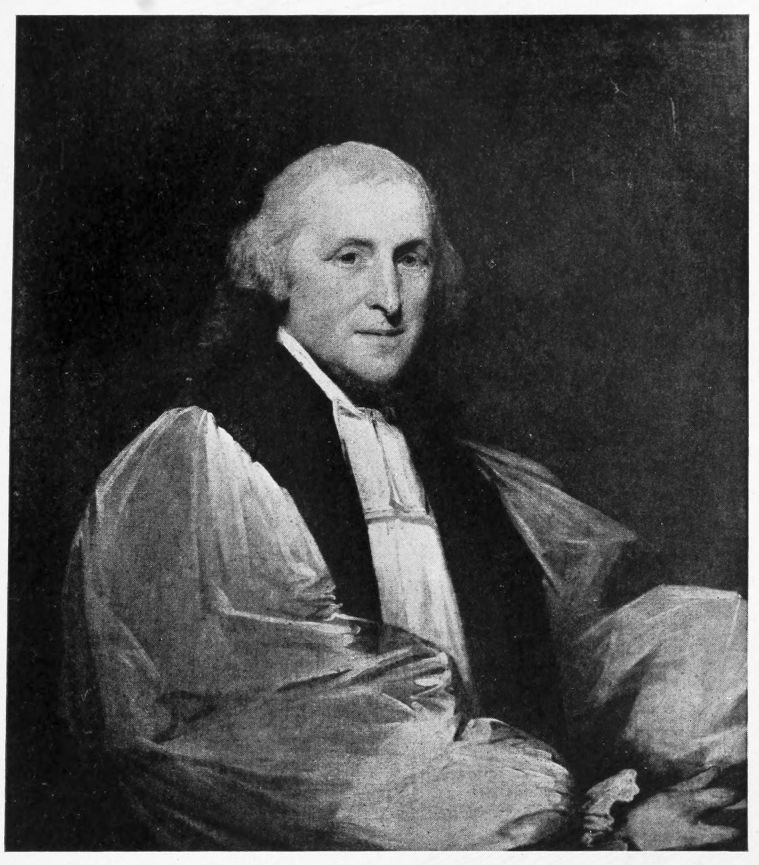
BISHOP WILLIAM WHITE
Painted by Gilbert Stuart Courtesy of the Pennsylvania Academy of the Fine Arts
Philadelphia. St. Elizabeth’s, corner of Sixteenth and Mifflin Streets, early Italian, with high Campanile; medieval exterior and interior give an exact idea of old Italian churches; brick; architects, Bailey and Bassett; the choir is raised eight steps from the nave, giving view of the crypt, and dignified elevation of the high altar; over the altar is a copy of Correggio’s “Marriage of St. Catharine”; fine jeweled door of the Pyx on the altar; Lady chapel has an altar of richly carved and gilded wood, finished with a high reredos, copy of an original in Santo Spirito, Florence; paintings set in are copies of works by Fra Filipo Lippi. Church of the Evangelist, now part of Graphic Sketch Club, Catharine Street above Seventh, brick, is a gem of medievalism; Italian Basilican style; red brick, relieved by stone trimmings; pillars of portico rest on backs of lions; architects, Furness & Evans; frescoes by Nicolo d’Ascenzo and by Robert Henri; original compositions and adaptations of great paintings in Italy; font, late English Gothic, with a richly carved stone; above it is the Strasbourg window, containing a figure of the prophet, Jonas; this piece of glass, before the Franco-Prussian War, was in the Cathedral of Strasbourg, and was taken from one of the windows after the Germans had directed their fire on the church and smashed the glass: paving of the Chapel of the Holy Sepulchre is of Mercer tiles; Rood screen of polished marble, is modeled after that at St. Marco, Venice; Altar rail modeled after that in a chapel at Monreale, Sicily; the reredos, of the high altar, is a copy of a famous altar-piece by Carlo Crivelli; original now in the National Gallery, London. Gloria Dei (Old Swedes’), on land given by Swan Swanson, corner of Front and Swanson Streets, near Christian Street; formerly Wecacoa (Indian name for pleasant place); was dedicated in 1700. Georgian architecture, with steep pitched roof; brick work of walls, Flemish bond, headers coated with vitreous, blue black glaze, doubtless the arch bricks in the kiln; great square windows. Erected by the Swedish Lutherans; after the Revolution, care of the Swedish churches was committed to the American Church, and became part of the Diocese of Pennsylvania. This congregation first worshiped in a block house, used also as a fortress from 1677; the font used then is still in the present church. Holy Trinity, Nineteenth and Walnut Streets; Norman Romanesque; architect, John Notman; has fine memorial windows. St. James, Twenty-second and Walnut Streets, founded, 1807; present building, English decorated Gothic with sculptured band around the tower, from which rises the graceful memorial spire; Ohio green sandstone and granite, built, 1870; architect, G. W. Hewitt: pulpit; altar; reredos of fine perpendicular work in Caen stone, rich in ornamentation and sculpture, which also extends around the chancel, with two marble pilasters having delicately carved capitals; all designed by Cram, Goodhue and Ferguson; mosaics of the twelve apostles, in the walls of the nave, suggest those of the Popes in the Church of St. Paul, outside the walls, in Rome; leaded glass by Nicolo d’Ascenzo; font has a bas-relief in white marble, angel scattering flowers, made in Florence, Italy. St. James the Less, near main entrance to Laurel Hill Cemetery; thirteenth century Gothic; brownstone; once said to be the choicest specimen of church architecture in the United States. St. John Chrysostom, corner Twenty-eighth Street and Susquehanna Avenue, almost an exact copy of St. Stephen’s Church, London, designed by Sir Christopher Wren; Renaissance, granite; architects, Bailey & Bassett; adapted to a square lot, the interior shows form of Greek cross, with inner octagon; rosettes and decorations of the dome are graceful and beautiful; columns, placed on rather high pedestals, are Vermont marble, with very beautiful veining, surmounted by Corinthian capitals: the church is almost entirely white, with no stained glass, and gives an impression of complete harmony. St. Mark’s, Locust Street above Sixteenth, built, 1849; fine specimen of fourteenth century, decorated Gothic, brownstone; plans furnished by the Ecclesiological Society of Cambridge, England; modified by John Notman; altar and reredos are richly carved stone; also the pulpit and choir screen; notable features are the rood beam, with cross and figures; carved sanctuary door; choir and clergy stalls; the altar at head of north aisle is alabaster. Lady chapel, erected, 1900, contains a silver altar of elaborate magnificence, probably finest in the world, of the same style as the one at Florence, Italy, by Pallajnoli, but richer, containing twelve scenes from the life of the Virgin, and studded with precious stones, some four hundred emeralds, sapphires, and opals, a monumental work, which will remain a very splendid presentation of twentieth century English ecclesiastical art; altar rail is silver and bronze; stained glass windows in the church are notable; the sacred vessels and vestments surpass any in the Anglican Communion, in their extraordinary richness; silver processional cross is supposed to be that of the Palermo Cathedral, in 1520; among old vestments are the coronation robes of Louis XV from Rheims Cathedral, of light blue velvet, heavily embroidered with twenty-two karat gold bullion. The first curate was the Rev. Morgan Dix, ordained priest in this church, who became the famous rector of Trinity Church, New York. St. Mary’s, 3916 Locust Street, on ground given by William Hamilton, of Woodlands; first Protestant Episcopal Church in West Philadelphia, organized, 1820; frame church erected, 1824; Bishop White laid the corner-stone; present building, Gothic, consecrated, 1890. Memorial Gothic altar, retable, and reredos are from famous studios in Rome, Italy, said to be the finest example of ecclesiastical mosaic work in this country: windows are from London, Paris, Munich, and Philadelphia. Rev. Thomas C. Yarnall celebrated his fiftieth anniversary as rector of St. Mary’s in 1894. St. Paul’s, east side of Third Street, below Walnut; classic; erected, 1761; third Protestant Episcopal Church in Philadelphia and largest in the province; now headquarters of the City Mission. The General Convention met here in 1814, when Bishop Moore of Virginia was consecrated; Bishop Hobart preached the sermon. St. Paul’s Club, 411 Spruce Street, makes a specialty of giving aid to the down and out drunkard, sobering him up, fitting him for a job, and getting him one; in the five years of its existence to 1917, it has registered 45,000 transient visitors and temporary guests on its books. St. Peter’s, corner of Third and Pine Streets, second church erected in Philadelphia, fine example of Georgian architecture, in beauty of line; brick; built, 1761; tower and spire, 218 feet high, were added, 1842; stone finials of gateposts were cut in England; present wall erected in 1784, after the old wooden fence had been taken for fuel by the British. Interior still retains the high-backed box pews, President Washington’s among them, pew 41; the pulpit, surmounting the clerk’s desk, soars upward at the far end, opposite the altar; Provost William Smith preached the consecration sermon; very beautiful stained glass by Myeres, London; remarkable for richness of color and design; many interesting relics in the church’s history are in the sacristy. Church of the Saviour, Thirty-eighth Street above Chestnut, architect, C. M. Burns, has a splendidly impressive chancel; decoration by Edwin Howland Blashfield and furnishings are memorial to Anthony J. Drexel. Memorial window by William and Annie Lee Willet, “Christ and Nicodemus,” has strong decorative quality and richness of color. South Memorial, Church of the Advocate, Eighteenth and Diamond Streets, French Gothic, suggested by Amiens Cathedral; built, 1897; stone; architect, Charles M. Burns; interior profusely adorned with carving, and sixty-five stained glass windows by Clayton and Bell, London. St. Stephen’s, Tenth Street above Chestnut; founded, 1823; early Gothic, with two octagonal towers; stone; designed by William Strickland; contains notable sculpture; the Burd Memorial, “Angel of the Resurrection,” finest Italian marble, by Carl Steinhauser, native of Bremen, who studied in Rome under Thorwaldsen; and recumbent effigy of Colonel Burd; also font by Steinhauser, represents three cherubs supporting on their wings a large marble bowl, with sculpture in relief; the church, decorated by Frank Furness, with color, rich and unusual, sets off admirably the beauty of the memorial marbles; the stately reredos, with its brilliant Venetian mosaic picture, “The Last Supper,” was made in 1889, by Salviati, Venice, from cartoons by Henry Holiday, London, and under his own supervision; large double window in transept also by Holiday; a Tiffany window is, “Christ Among the Lilies,” the only flower He mentions in the Evangels, and accepted as symbol of the resurrection; the window, showing the angel sitting on the edge of the tomb with partly unfolded wings, is copy of a picture by Axel Ender, over the altar of a church in Molde, Northern Norway; near the reredos is “The Angel of Purity,” sculptor Augustus Saint Gaudens, which suggests his “Amor, Caritas,” owned by the French Government, now in the Luxembourg; here is also a bas-relief by Charles Grafley of Dr. David D. Wood, organist of St. Stephen’s for forty-six years; the great organ was built by C. T. Haskell, Philadelphia, in consultation with Dr. Wood; pipes were voiced in the church, resulting in a sweetness and just proportion of tone; its echo organ, located about two hundred feet away, is in the loft over the chancel. Parish house is on site of the old graveyard, tombstones are in pavement of cloister; architect, George C. Mason, Jr. Trinity, Oxford, Oxford Road and Second Street Pike; colonial; founded, 1698. Present brick church erected 1711-12; the transepts and tower later; was the first house of worship in Pennsylvania, owned and occupied by the Quakers, and presented by them to the Church of England, for Episcopal use and worship. Chalice and paten sent by Queen Anne, engraved “Anne Regina,” 1713; she died in 1714, it is probably the last one she sent to America, and has been used in every Holy Communion for over two centuries. Tiffany altar window, “The Baptism of Christ.” The altar, of walnut and oak, is beautifully carved. This is the mother of many flourishing missions, St. Luke’s, Germantown; Our Saviour, Jenkintown; St. Mark’s, Frankford; Emmanuel, Holmesburg; Holy Trinity, Rockledge; and Trinity Chapel, Crescentville; today it stands, vigorous and full of life, in its old age, greatly enlarged and carefully restored; the utmost care has been taken to disturb none of the old walls, and to keep the historic features intact; the glass, in the body of the church, is an opaque yellow, harmonizing with the colonial buff of the walls and barrel ceiling. The churchyard is of great interest, one stone, dated, 1686, is said to mark the grave of an Indian.