VII NORTHAMPTON COUNTY
Reading edition
FORMED March 11, 1752; named by Thomas Penn; prior to the Revolution comprised all the northeast section of Pennsylvania; chief industries, Bethlehem Iron and Steel Works, where 15,000 men are employed day and night; silk mills, graphite works, and other manufactories. Here were Washington’s storehouses along the Delaware River, with supplies for all branches of the army; a point of attack by the British battling between West Point and Trenton, buildings are still in evidence. The famous backwoods rifles used by two thousand Pennsylvanians against the British at Boston were made here.
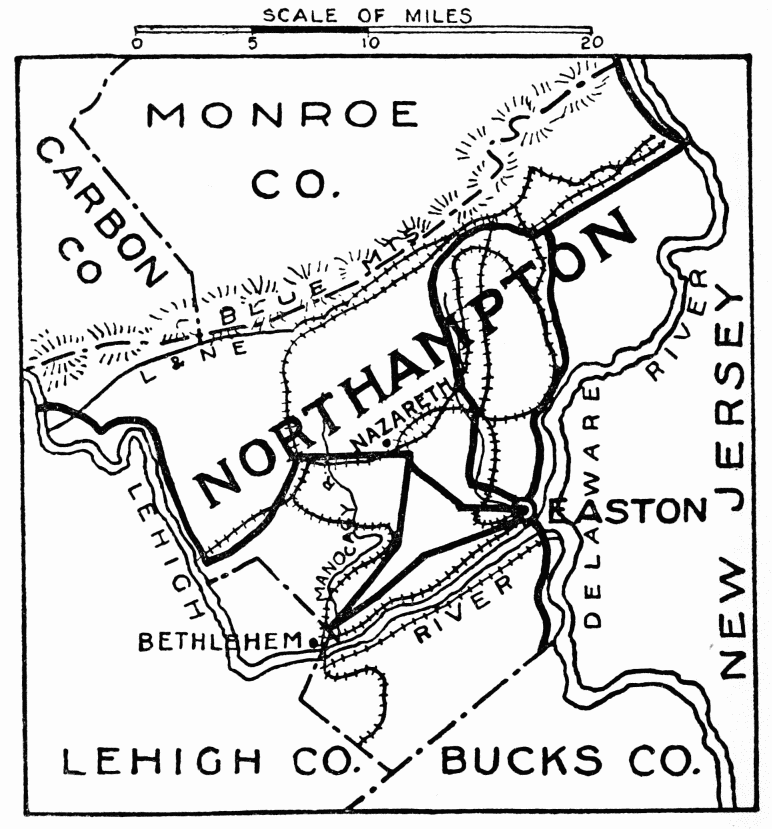
County seat, Easton, founded by Thomas Penn, 1751; at “The Forks of the Delaware, where the water is deep and smooth,” population 33,813. In center of the public square is the monument to soldiers of this county in the Civil War, on site of the old Northampton court house that stood for a hundred years; on its threshold was promulgated the Declaration of Independence, the same day as in Philadelphia; the old court house bell, that rang out then, is still doing public service. The first flag, combining stars and stripes, as an emblem of a new nation, was made here, showing thirteen eight pointed stars and thirteen stripes in the field, this flag is said to be the one now in the Easton Public Library, deposited in 1821, after being used in the War of 1812; in a special room of the
Northampton County
library is the private collection of Samuel Sitgreaves, with rare volumes of American history. Next to Sitgreaves’ office was the home and shop of Henry Derringer, a gunmaker of the Revolution, whose son invented the Derringer pistol. On the public square, Light Horse Harry Lee, from Virginia, recruited his troop of Pennsylvania Germans, and horses. Valuable papers and moneys belonging to the state and national government were placed in the custody of Robert Levers, during British occupancy of Philadelphia.
The old Union Church, now the Reformed, on North Third Street, stone, colonial, built, 1775-76, was used as a hospital in the Revolution; this is the principal residential street, and entrance to Lafayette College, founded, 1832, by James Madison Porter, Secretary of War; has interesting collection of portraits of Lafayette, in oil and black and white, also valuable old engravings; on the campus is statue of Lafayette, by Daniel Chester French, given by Morris L. Clothier, Esq. In the New Century Art Club, New and Porter Streets, lectures on art and exhibitions are given. A bridge leads across the Delaware to Phillipsburg, New Jersey, first wooden bridge built, 1797; north of the bridge is Riverside Park, leading to North Delaware Road and the Delaware Water Gap; the Wind Gap has precipitous sides; very beautiful scenery is on the River Road.
In July, 1782, Washington came from Bethlehem to Easton. Bethlehem, in Lehigh County, is the seat of government of the Moravian economy, from Moravia in Bohemia, in the western hemisphere, dating back to 1740; these pioneers belonged to the Church of the Brethren, organized in 1457 by followers of John Huss about forty years after he had been burned at the stake for conscience’ sake; the little church was revived in Saxony in 1722; to this church Count Nicholas L. Zinzendorf granted an asylum on his own estate; the count visited the Brethren here in 1741. On July 25, 1782, Washington, with Colonel Trumbull and Major Welker, stayed overnight at the Sun Inn; Brother Ettwein and others of the Fraternity called to pay their respects; the Sun Inn was built in 1761, Peter Warbas the first host; the suite occupied by General Washington and his wife is still shown to visitors. During the Revolution the Moravian settlement experienced many horrors and discomforts of war; the tramp of armed men through its quiet streets began in July, 1775; in December most of the houses were taken for hospitals, being on the main route of travel from the eastern states; many distinguished soldiers were here, Greene, Knox, Gates, Stirling, Sullivan, Schuyler, von Steuben, De Kalb, Pulaski, de Chastelleux, also Samuel and John Adams, Hancock, Laurens, Livingston, Boudinot, Reed, Rittenhouse, Gerard; in autumn of 1777, Lafayette, under careful nursing of a Moravian sister, Liesel Beckel, rapidly recovered from a wound received in the Battle of Brandywine. General hospital of the Continental Army was here, 1776-78.
The Moravian Church, plain and dignified architecture, after a German model, is full of sunlight within, contains Moravian archives and Schussele’s large oil painting, “Power of the Gospel,” showing Zeisberger preaching to the Indians; the organ and vocal music is exceptionally fine. The Moravian College and Seminary for young women includes instruction in housekeeping; moral training is a particular feature. The Widows’ house, built, 1768, endowed by John Jordan, Jr., Philadelphia, for widows and daughters of Moravian ministers and other women who have served the church. The Sisters’ house, formerly first Brethren’s house, was used for home of unmarried women of advanced age; now a boarding house. Second Brothers’ house, where unmarried men could live and still gain independent support, is now “Colonial Hall,” a part of the Seminary. Corpse house still stands with its weeping willow tree; because of the small rooms of the houses, the body was taken from the home to the corpse house for three days; the trombone choir announced a death from the church steeple by a particular choral that designated whether it was for man, woman, or child; at the burial the trombone choir met the procession at the cemetery gate and took part in the service at the grave; in the Moravian burial ground are graves of many Indians, among them that of Uncas, in Cooper’s “Last of the Mohicans,” inscription, “In memory of Tschoop, a Mohican Indian, who, in holy baptism, April 16th, 1742, received the name of John, one of the first fruits of the mission at Wycomico, whereby he became a distinguished teacher among his nation. He departed this life in full assurance of faith at Bethlehem, August 27, 1746.” The graves are in rows, sisters and brothers separate, with small stone markers. Bethlehem had the second waterworks system in the United States, 1760.
A covered wooden bridge over one hundred years old, to be replaced by modern structure, crosses the Lehigh River to South Bethlehem, Northampton County, seat of Lehigh University, built, 1866; in 1865, Asa Packer gave $500,000 for founding a free technical college for boys in South Bethlehem, largest single benefaction any American college had received up to this time; this was the beginning of Lehigh University, opened the following year; later a classical department was opened at Mr. Packer’s direction, who gave the University $1,500,000 during his life, and left it by will another $1,500,000, to ease the struggle upwards of boys with whose ambitions he sympathized; this University is particularly noted for its course in engineering, with the Fritz Engineering Laboratory, endowed with over $1,000,000; there are also a gymnasium with swimming pool, and a stadium.
The Bach Festival, announced by the trombone players from the tower of Lehigh University Chapel, has been held annually since 1911, first performance was in 1888. In 1780, the settlement had an orchestra, said to be the first in America, flutes, horns, viols, and trombones were permanent factors in their church music, which undoubtedly led up to the present development; frequently referred to as the American Bayreuth; a quartet of trombones summoning the people, as do the trumpets in Germany; in 1901, the Christmas Oratorio was given in its entirety, first in America; they have also given the Passion, and the Mass in B Minor; J. Frederick Wolle, pupil of Rheinberger, organist of the Lutheran Church, has charge of the music; choir consists of 200 voices, natives of Bethlehem, excepting leading soloists; the orchestra and instrumental soloists vary, the Philadelphia Orchestra has played here. Location of Bethlehem is scenically quite as beautiful as Eisenach in the Thuringian forest, where the famous Wartburg, with memories of Tannhaeuser, Bach, and Luther attract thousands of tourists and pilgrims. In Nazareth are old stockaded forts of the Indian wars, where were maintained 365 settlers from beyond the mountains, now used by the Moravian Historical Society for their collection of relics, curios, and portraits of noted Indians. Whitfield house, built, 1755, old English, contains Moravian Historical Collection; Nazareth Hall, built, 1748, was school for young men. At Boulton, near Nazareth, is Benjamin West’s first tragic painting, “Death of Socrates.”
Berks County