XXI DELAWARE COUNTY
Reading edition
Formed from Chester County, September 26, 1789; named for Delaware River. Automobile Trip to Chester, return by Media and Swarthmore
From Thirty-second and Market Streets, Philadelphia, out Woodland Avenue (Darby Road), laid out in 1687, the old King’s Road, pass University of Pennsylvania buildings, to Woodlands Cemetery, between Thirty-ninth to Forty-second Streets, seventy-five acres, acquired in 1840, contains colonial homestead, residence of William Hamilton, English Deputy Governor of Pennsylvania, under grant from William Penn, built, 1747-50, stone and brick; has portico, with pediment supported by six columns; considered by architects best specimen of colonial architecture in Philadelphia; many rare trees are there, sent by Mr. Hamilton in his trips abroad; to him Philadelphia owes the gingko tree of Japan and many varieties of magnolia.
Bartram’s Garden, 28 acres, open free to the public, one quarter mile south on Fifty-fourth Street, first botanical garden of international importance in United States; ground purchased by John Bartram, in 1728; from here he traveled long distances to Florida, the Adirondacks, everywhere collecting rare plants that he brought home in his saddlebags; he wrote down the results of his explorations, and sent to Europe botanical specimens of great interest, also painted sheets of illustrations, sending one set to the South Kensington Museum, London, which are still there in perfect condition; Linnæus proclaimed him the greatest natural botanist in the world, and sent him books and apparatus; his quaint old stone house is still standing, built by himself in 1731; his son, William Bartram, botanist and ornithologist, published the most complete list of American birds, previous to Alexander Wilson, whom he greatly assisted. Wilson lived at the corner of Fifty-first Street and Woodland Avenue, in a log house with an immense stone chimney. Near Bartram’s Garden, on the Schuylkill River bank, at the western end of Gray’s Ferry Bridge, is site of Gray’s Garden, pleasure resort, time of Washington, reached from Philadelphia by a floating bridge, replaced by wooden telescope drawbridge built in 1808, by the P., W. & B. R. R.; stone monument, still standing, covered with most interesting and historically valuable inscriptions, marks opening of the first railroad to the South.
Sixty-fifth Street and Woodland Avenue, St. James’ Protestant Episcopal Church, Kingsessing, built by the Swedes, 1762, building practically unchanged, has interesting burial ground. Sixty-ninth Street and Paschall Avenue is an old yellow mansion, built about 1723, home of the Paschalls, General Howe’s headquarters after the Battle of Brandywine. Seventieth Street and Woodland Avenue, quaint old building, the Bannaker School, built in 1789, said to be oldest public-school building in Philadelphia, now used in connection with the school garden. Seventy-third Street, Blue Bell Tavern, opposite, was terminus of the great trading path of the Minquas Indians leading from the Susquehanna; Island Road leads to “Cannon Ball” farmhouse, below Penrose Ferry, struck during bombardment of Fort Mifflin in 1777.
Crossing Cobb’s Creek, the southern boundary of the city, and county of Philadelphia, we enter Delaware County, the oldest settled section of Pennsylvania. Darby, an ancient town, birthplace of John Bartram, contains many old houses, and a Friends’ meeting house, dating from the eighteenth century, with picturesque burying ground, where many colonial notables lie in unmarked graves; Sharon Hill, residential suburb, Convent of Holy Child Jesus, occupies buildings erected for John Jackson’s Quaker School, famous in the middle of the last century; new decorated Gothic chapel of stone. Beyond Norwood is the old White Horse Hotel, now abandoned, built, 1720.
One and one-half miles to left, at Essington, on Tinicum Island, first permanent European settlement in Pennsylvania made by Swedes under Governor John Printz, 1643; fort built, named “New Gottenburg”; and government established. Ridley Park, residential suburb; fine view to left, of Tinicum and the Delaware River, old quarantine station known as the Lazaretto; the Corinthian and Philadelphia Yacht Clubs are on the river front. Leiperville, McIlvain house, stone, opposite Colonial Hotel; Washington spent the night here after the Battle of Brandywine, and troops were encamped on slopes to the right. Hendrixson house, very ancient, built by Swedish settlers. Pass Baldwin Locomotive Works and great munition factories into Chester, population 58,030, settled by Swedes about 1644, the oldest town in Pennsylvania, known as Upland until 1682, when Penn, landing here on October 28, named it Chester after the home of his companion, Pearson, in England. Penn convened here, in November, 1682, the first Assembly of the Province, at which was passed the “Great Law”; the Upland court was held here from 1668 to 1682; the courts of Chester County from 1682 until their removal to West Chester in 1786, and the courts of Delaware County from 1789 to 1851; Chester has grown from an ancient country town to a bustling industrial city, but many antiquities are preserved; principal among these are the old City Hall, stone, with pent roof projection and quaint clock tower, erected in 1724; the oldest public building in Pennsylvania, and one of the oldest in America; used as Chester County courthouse for sixty-two years, Delaware County courthouse for sixty-one years, and as hall of Chester borough and city since 1851; now being restored by the Pennsylvania Historical Commission and Honorable William C. Sproul, under contract that the city will maintain it for public uses forever.
Opposite on Market Street is the Washington House, erected and licensed as the “Pennsylvania Arms” in 1747, still maintained as a tavern; in this house, at midnight on September 11, 1777, Washington wrote his report to Congress of the Battle of Brandywine. Hope’s Anchor Tavern, Fourth and Market Streets, built by David Cowpland prior to 1746. Group of old houses at Second and Edgmont Streets, Logan house, 1700, where Lafayette’s wounds were dressed after the
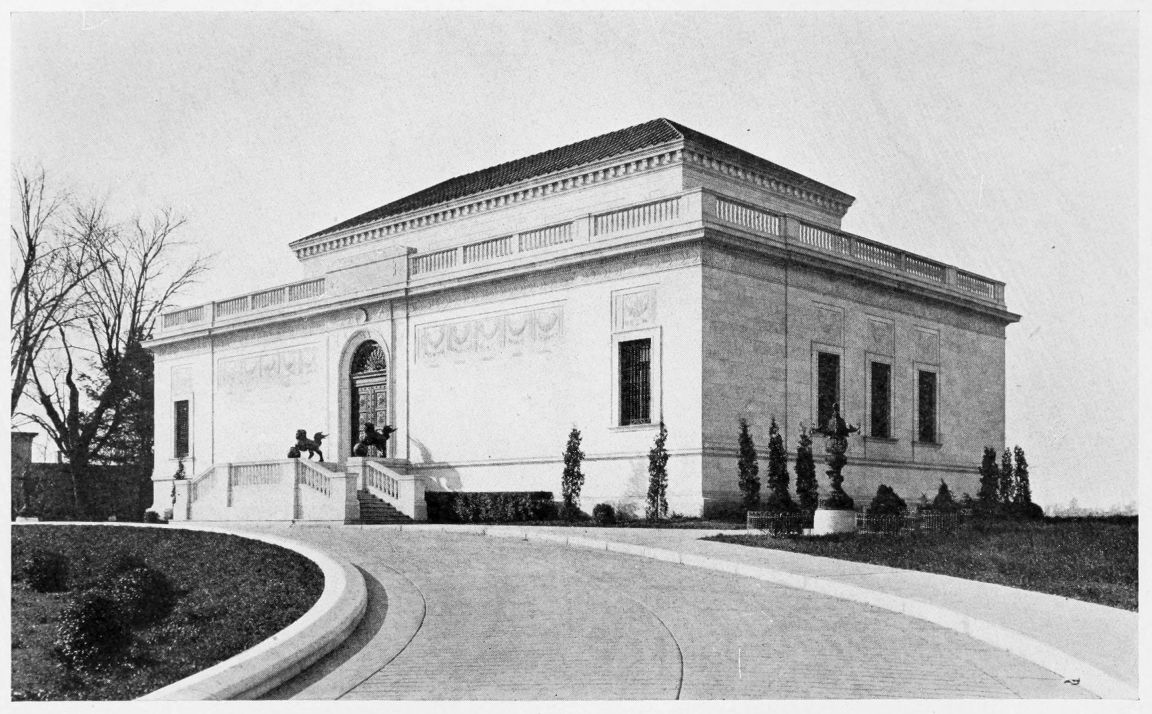
ALFRED O. DESHING MEMORIAL ART GALLERY, CHESTER
Frazer and Robert, Architects
Battle of Brandywine, and Lloyd house, built in 1703 by David Lloyd, chief justice of Pennsylvania; here also stood the first courthouse, or “House of Defense,” and first Quaker meeting.
Across Chester Creek, at the foot of Penn Street, is a memorial stone, erected on the two hundredth anniversary, to mark the spot where William Penn first landed in Pennsylvania; and near by, Lord Baltimore and William Markham, in 1681, took observations to determine the fortieth parallel of latitude, and location of boundary between Pennsylvania and Maryland; also site of Essex House, home of Robert Wade, wherein was held, in 1675, the first Friends meeting in Pennsylvania. Blue Anchor Tavern and Steamboat Hotel, near Second and Market Streets, bear marks of bombardment by the British frigate Augusta in 1777. Friends meeting house, erected, 1736, modernized in 1882; Friends Burying Ground formed, 1692, contains graves of Chief Justice David Lloyd, who died in 1731, and Grace Lloyd, his wife, who died in 1760, Justice Caleb Cowpland, Judge Henry Hale Graham, and, in unmarked tombs, many of the founders and pioneers of the commonwealth.
St. Paul’s graveyard, Third and Market Streets; tomb of John Morton, a signer of the Declaration of Independence, who cast the deciding vote in the Pennsylvania delegation; also of D. Paul Jackson, Burgess of Chester, who was the first man to receive a degree from the University of Pennsylvania; and a quaint old memorial cut in sandstone with oddly carved figures and devices, dedicated to James Sandelands, who died, 1693, taken from the old church, erected in 1703. Chester Rural Cemetery, burial place of General Edward F. Beale, pioneer of California; has many interesting memorials.
Alfred O. Deshong Memorial Park of twenty-eight acres, in the heart of the city, with white marble art gallery, late Italian Renaissance, finished in 1916, designed by Brazer & Robb, New York, for Mr. Deshong’s collection of about 200 paintings, bronzes, ivories, etc.; rare Japanese bronze lanterns and figures are in the grounds, and two remarkable bronze dogs with paws on cloisonné balls, at entrance; fine bronze doors and grills; also his old mansion, all given to the city of Chester with a large endowment, for public use forever. St. Paul’s Protestant Episcopal Church, Broad and Madison Streets, founded in 1702, third building of this congregation, erected, 1900; twelfth century English Gothic, granite and limestone, architects, Nattress & Son; altar by Nattress, white marble; mosaic reredos, “The Supper at Emmaus,” after Rembrandt; chancel window by Tiffany, “Conversion of St. Paul,” after Doré; memorial to Rev. Henry Brown, rector for thirty years; clerestory windows, four Evangelists, by Nicola d’Ascenzo; chalice and salver given by Sir Jeffry Jeffrys in 1705, chalice and salver given by Queen Anne, in 1707, all of beautifully hammered silver, still in use; fine chime of ten bells; large folio Bible given at founding of the church by the Society in London, for the Propagation of the Gospel in Foreign Parts, to which St. Paul’s owed much in its early years.
St. Michael’s Roman Catholic Church, Edgmont Avenue above Seventh Street, granite, Gothic, fine altar and paintings. First Baptist Church, Seventh and Fulton Streets, stone, Gothic, founded, 1850, third edifice endowed by the Gartside and Crozer families. First Presbyterian Church, Fourth and Welsh Streets, brick, stuccoed, erected in 1852, fine memorial windows. Third Presbyterian Church, Broad and Potter Streets, stone, fine windows and carvings in wood. Madison Street Methodist Episcopal Church, Seventh and Madison Streets, organized in 1818 by John Kelly in his home; afterward services were held in the Courthouse for many years, where Bishop Asbury preached; present church erected, 1874, green serpentine. High school, stone, with commanding tower, West Ninth Street, modeled after Post Office Building at Washington.
Pennsylvania Military College, Fourteenth Street, handsome buildings with complete military and academic equipment; incorporated as a military university in 1862, by Colonel Theodore Hyatt; contributed many officers to the nation’s service; present buildings erected in 1882, after a fire which destroyed the original structures. Chester Park and Crozer Park contain about 150 acres in valleys of Ridley and Chester creeks. Chester is a port of entry and contains large shipyards, steel, engineering, and textile industries.
Upland, founded by John P. Crozer in 1845 when he established cotton mills there on the site of the old Chester Mills, on Chester Creek, immediately adjoining the town of Chester; Chester Mills were built by Caleb Pusey in 1683, at the first water power above tide on Chester Creek; the mill, framed in England and brought over in the Welcome, was owned by Pusey, William Penn, and Samuel Carpenter; house, erected by Pusey in 1682, is probably the oldest structure in Pennsylvania. Crozer Theological Seminary, endowed by John P. Crozer, and sons, occupies buildings overlooking Chester, erected by John P. Crozer in 1858 for a normal school, used in Civil War as hospital, and occupied for a time by the Pennsylvania Military Academy; Pearl Hall, the seminary library, was built by William Bucknell, in memory of his wife; green serpentine in form of a cross; contains many rare books and the only known copies of many Baptist theological works; Crozer Hospital and Home for Incurables, fine stone buildings, were endowed by J. Lewis Crozer, who also left a large endowment for a free library in Chester. An old house on Upland Dairy Farm, now much distorted by modernization, built by Thomas Brazey in 1696, was for many years the home of the West family, collateral descendants of Benjamin West.
On Providence Road, first highway to be laid out in Pennsylvania, leading from Chester to the back townships, is Lapidea Manor, residence of Governor William C. Sproul, colonial house, erected by Thomas Leiper, for his son James, enlarged in 1909 by Mr. Sproul, architect, W. L. Price; contains notable library with collection of Pennsylvania and local books and antiquities, paintings, and curios; interior wood carvings by Maene; on the fine grounds is a clock-tower, containing a bell cast in Bristol in 1741, for St. Paul’s Church, Chester, and for 125 years was the only church bell in the town; across the grounds is to be seen the grade of the first railroad in America, built by Thomas Leiper in 1809, to carry stone from his quarries at Avondale to tidewater on Ridley Creek, where it was loaded in barges to be taken to the Delaware breakwater.
Moylan, south of Media, art colony, residence of Charles H. Stephens and Mrs. Charles H. Stephens (Alice Barber), contains valuable North American Indian collection, the old stone building, remodeled for art studios and dwellings, is among the most interesting in the county. Southwest of Media is the Williamson free school of mechanical trades; generously endowed; built in 1888; includes twenty-four buildings on 230 acres; pupils between sixteen and eighteen years of age are received; they live as families, twenty-four in a cottage with a matron; preference to those born in Pennsylvania; benefits of school are entirely free, including boarding, instruction, and clothing during the entire course of three years.
Media, county seat from 1851, population 4109; charter, with famous provision against sale of intoxicants, still intact, was granted, 1850: Courthouse with ample square, formed nucleus of the town; present building, modified colonial, Avondale marble, architects, Brazer & Robb. Old Providence Friends Meeting House, built, 1699; original Taylor log cabin is on State Street, and the old Rowland mansion. Christ Protestant Episcopal Church, stone, Gothic, has altar painting, “Murillo’s Holy Family,” copied by P. McIlhenny. Presbyterian Church, modified classic. Leiper Presbyterian Church, Gothic, Avondale marble, midway between Leiperville and Swarthmore, built in 1800, Andrew Jackson, James Buchanan, and Elisha Kent Kane, while guests of Judge George G. Leiper, worshiped here, slates on the roof were brought from Scotland; near is colonial residence of Perry Lukens on Fairview Road, hardware and other materials were brought from England, has original latch string lock. Avondale, old colonial residence of Thomas Leiper, near Crum Creek, built on plan of his Scotch home.
Wallingford, residence of late Dr. Horace Howard Furness, America’s greatest Shakespearean scholar. He left a working library of several thousand Shakespeare books, including “The Variorum” edited with his son. Swarthmore, college, founded, 1864, by members of the Hicksite Society of Friends, is located on a hill with a fine view of the Delaware River, campus over 200 acres, includes large tract of woodland and rocky valley of Crum Creek; buildings, mostly stone, French Renaissance, include the Sproul Astronomical Observatory, built in 1911, gift of William C. Sproul, contains one of the best telescopes in America; Library, English collegiate Gothic, built, 1907, local stone, with terra-cotta and Indiana limestone trimmings, architect, Edward L. Tilton, New York; the reading room is open through two stories, height twenty feet with gallery on three sides; Gothic beamed ceiling and leaded ceiling lights, interior finished with dark oak. In fireproof tower room is the Anson Lapham Friends’ Historical Library, one of the largest collections of Quakeriana in America, contains original manuscripts of John Woolman’s Journal.
Near the Library stands a house with gambrel roof, built in 1724, marked, with tablet, by Delaware County Historical Society, “Birthplace of Benjamin West, born in 1738, first great American painter, founder and second President of the Royal Academy, London”; exterior unchanged, now residence of college professors; the college owns, and is still collecting original paintings and drawings by West. Meeting house built, 1881, follows the traditions of early colonial style. Parrish Hall, the main building, erected 1864-69, rebuilt after the fire in 1881, contains a portrait of George Fox by Sir Peter Lely, and other interesting portraits of early Friends and later benefactors of the college. Wharton Hall, men’s dormitories, built in form of Oxford quadrangle, architects, Buntley & Sprigley. Stone gateway, north entrance, designed by Frederick B. Pyle.
Lycoming County