XIV FRANKLIN COUNTY
Reading edition
FORMED September 9, 1784; named for Benjamin Franklin, whose fame was then world-wide. Earliest settlers Scotch-Irish, later Germans. Chief industry agriculture, the land east is limestone and very fertile; west, slate lands prevail, abounding in pure streams and rich meadows; the Conococheague and Conodoquinet Creeks drain the central part of the county, they are crossed by many stone arch bridges of graceful architecture, the most notable is at Hiester’s Mill, three arches. The principal road, now part of the Lincoln Highway, enters the county near the historic Thaddeus Stevens Iron Works, built, 1837, at Caledonia, which comprised about 20,000 acres, now in State Forestry Reservation, and with the Mont Alto tract, makes a total of about 40,000 acres; the mill and machinery were entirely destroyed, in 1863, by order of General Early, on account of Stevens’ well-known activity as an abolitionist; this road was route of greater part of Lee’s Army to and from the battlefield of Gettysburg to Chambersburg; site of encampment before the battle, a little beyond the hospital, east from Chambersburg. Other roads leading west, of historic interest, are the Two Mountain, and the Path Valley, formerly Indian trails.
County seat, Chambersburg, settled, 1764, population 13,171. In Centre Square is a boulder with tablet commemorating the burning of Chambersburg by Confederate Cavalry, July 1, 1864. Facing the square are the brick courthouse, Southern colonial with fluted columns, cupola and clock, contains portraits of judges; and the Central Presbyterian Church, with Tiffany windows. Near are, Miller’s drug store on site of Jack Tavern, where the first court was held in 1784, large mortar in front was made from one of the pillars of the burned courthouse. United States Post Office, Main and King Streets, built, 1912, semi-classic, light colonial brick with gray stone facing. Masonic temple, built, 1823, saved by Confederate Masons when the town was burned. Zion Reformed Church, built, 1812, exterior unchanged, particularly good lines in steeple, has Tiffany windows. On King Street stands the house John Brown occupied, second from Union Baptist Church; Nicklas store, on Main Street near Queen, is site of old tavern where President Washington and Alexander Hamilton spent the night, en route to quell the Whiskey Insurrection in 1794; Market House, Second and Queen Streets, built, 1830, brick, colonial, with clock tower.
Wilson College comprises seven buildings, including Thompson Memorial Hall, built, 1904, modified Gothic, with auditorium and fine organ, architect, George C. Baum, Philadelphia. Falling Spring Presbyterian Church and Chapel, organized, 1736, services first held in Benjamin Chamber’s sawmill, present church built, 1803, chapel, 1873, native stone, has Tiffany memorial windows to Judge and Mrs. Alexander Thomson, parents of Frank Thomson, Esq. Rocky Spring Presbyterian Church, four miles northwest from Chambersburg, built, 1794 by the Scotch-Irish, colonial, with high, straight-backed pews, and original old high pulpit, with sounding board, pewter Communion service from England and ten-plate stoves. Dr. McIntosh preached here; has an interesting old graveyard, keys kept at adjoining farmhouse.
The “Mont Alto Park,” formerly a famous picnic ground, now in charge of State Forestry Commission, in the South Mountain, in old maps named “The Valley of a Thousand Springs,” contains an old Protestant Episcopal Church, near which is a native boulder, with granite tablet, marking the place where Captain John E. Cook, of John Brown’s Army of Liberation, was captured and disarmed, October 25, 1859, erected by the Kittochtinny Historical Society, 1909. The State Forest Academy is here, where the state educates its foresters, free of all cost; in 1900, the Bureau of Forestry had grown to the point where it should be raised to the rank of a department, of which the chief should be a member of the Governor’s cabinet; there was strenuous opposition, but owing to the flood of letters received by members of the Legislature, from the women of the State Federated Clubs, the change was made, and Pennsylvania takes a commanding place in the Forestry and Conservation movement. The White Pine, State Sanatorium, No. 1, free for consumptives, is also here, one of the largest in the world. South is Waynesboro; good roads and notably fine scenery in this section.
Greencastle, birthplace of Robert McClelland in 1807, see Honor Roll; directly north, on State Road, is monument, to mark where Corporal William H. Rhil fell, first soldier killed on Northern soil in Civil War.
Mercersburg, settled between 1730-35, population 1663; named for General Hugh Mercer, who was killed in the Battle of Princeton. Mercersburg Academy, Main Hall, built, 1833, used as hospital for wounded soldiers, on retreat from Gettysburg, is a notable example of Southern colonial architecture, with fine pillars and surmounted by a cupola; the ’88 Dormitory, given largely by class of 1888 of Princeton University, is Tudor Gothic, brick and white stone; Kiel Hall, the refectory, interior, baronial Gothic with frescoes and hangings by Tiffany; over mantel, in wood, carved by John J. Maene, is “The Boar Hunt” from design by A. Stirling Calder; notable collection of University shields in glass and wood; mosaic armorial design in hearth; Laucks Hall, Tudor Gothic, has mural painting in trophy room, “The Victor,” representing a Mercersburg boy being crowned victor in athletic skill, artist, Edward Howland Blashfield, also collection of portraits of distinguished men, including President James Buchanan, Thomas A. Scott, and W. M. Irvine, by William Merritt Chase; Dr. E. E. Highbee, by Carroll Beckwith; and Dr. Thomas Apple by John W. Alexander; the new gymnasium, architect, Frank Miles Day, has stained glass by Tiffany.
Historic houses on Main Street, one in which Harriet Lane Johnston was born, built, 1788, by Colonel Robert Parker, friend of Lafayette, has interesting interior woodwork; and residence of Dr. William Magaw, who dressed Lafayette’s wounds after the battle of Brandywine, grounds now in campus of Academy. Near Mercersburg, Irwinton Mills, a picturesque spot on the west branch of the Conococheague,
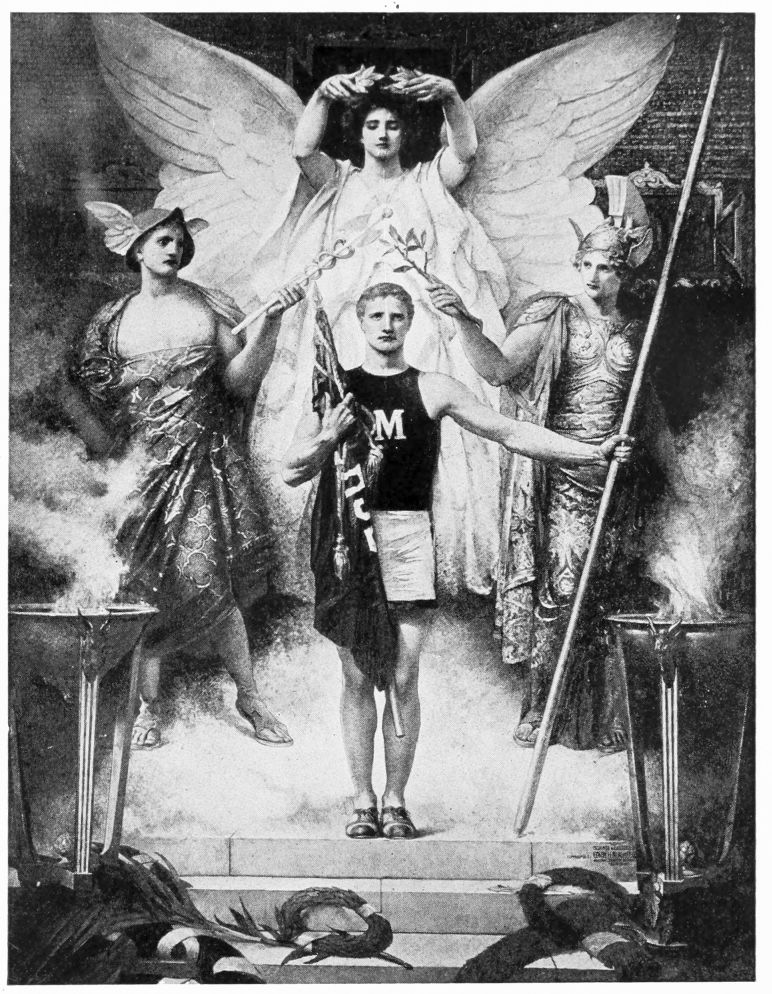
THE VICTOR
In trophy room of the Mercersburg Academy
Painted by Edwin H. Blashfield
birthplace of Jane and Elizabeth Irwin, who were married to the Harrison brothers; Jane was mistress of the White House in 1841, Elizabeth became the mother of President Benjamin Harrison. East of town, birthplace of William Findlay, see Honor Roll. President James Buchanan was born at Cove Gap, three miles from Mercersburg, birthplace marked by monument erected by will of his niece, Harriet Lane Johnston; the house was later removed to Lafayette Street, Mercersburg.
The famous Packer’s Path, used by pack horses, leads from Stony Batter across the mountains to Pittsburgh. Site of Fort McCord, near Yankee Gap, at North Mountain is where twenty-seven pioneer settlers were massacred or carried into captivity by Indians in 1756, and thirty-two provincial soldiers killed or wounded in their effort at rescue; marked by native stone monument 1914, erected by the Enoch Brown Association, and Pennsylvania Historical Commission. Northeast is the Enoch Brown Park, with monument sacred to the memory of Enoch Brown and eleven scholars massacred by Indians here in 1764, during the Pontiac War. Large collection of Indian curios found near here are owned by Benjamin Snively, Jr. South, is site of Fort Loudoun, marked.
Natives of Franklin County, in the World’s Honor Roll are, Samuel Adams, Senator from Mississippi; George Washington Buchanan, United States District Attorney for Dakota; James Buchanan, 1791-1868, schoolboy in Mercersburg, lawyer, member of the legislature and of congress, Minister to Russia, member of United States Senate, Secretary of State, Minister to Great Britain, fifteenth president of the United States; Edmund R. Calhoun, Rear Admiral, United States Navy; Hugh S. Campbell, United States District Attorney for Dakota; George Chambers, 1786-1866, Judge of the Supreme Court of Pennsylvania; Matthew St. Clair Clark, Clerk of the United States House of Representatives; Colonel Thomas Hartley Crawford, Judge of the United States Court, District of Columbia, and Commissioner for Indian Affairs; George Eyster, Assistant United States Treasurer at Philadelphia; William Findlay, 1768-1846, State Treasurer, United States Senator, Governor, Assistant United States Treasurer at Philadelphia; Henry Harbaugh, 1817-67, theologian, poet, hymn-writer; Robert Johnston, Collector of Excise, appointed by President Washington; John Maclay, member of the convention at Carpenters’ Hall; Samuel Maclay, United States Senator; William Maclay, first United States Senator from Pennsylvania, died, 1825; Robert McClelland, United States Secretary of the Interior, Governor of Michigan; James McLane, Member of the Supreme Executive Council and of the Pennsylvania Council of Censors, member of the convention at Carpenters’ Hall; John Williamson Nevin, 1803-86, President of Franklin and Marshall College, theologian, author, preacher; William M. Nevin, 1806-92, poet, teacher; James Potter, Major General of the Continental Army; John Rowe, Surveyor-General of Pennsylvania; Thomas A. Scott, Assistant Secretary of War, President Pennsylvania Railroad; Frank Thomson, President Pennsylvania Railroad; Joseph Williams, Chief Justice of the Supreme Court of Iowa.