XVI DAUPHIN COUNTY
Reading edition
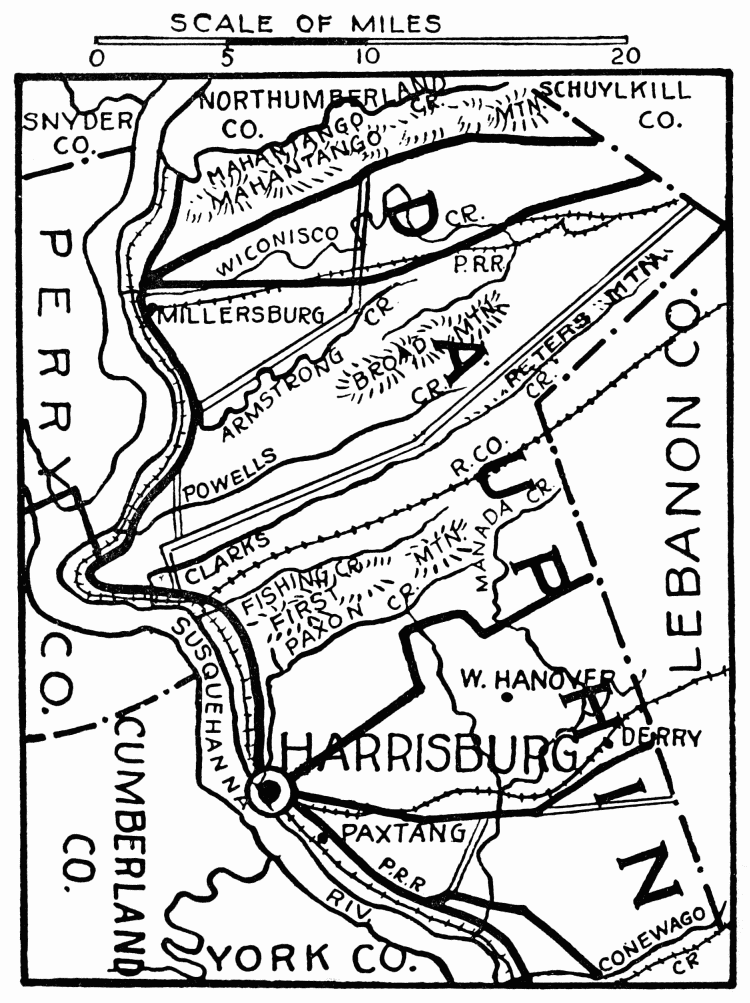
SEAT of state capital; formed March 4, 1785; named for title of the Dauphin of France, then Louis XVI, in recognition of aid rendered to the colonies in Revolutionary War. Chief industries iron and steel; in the north, anthracite coal. High mountain ranges, with valleys of rich rolling farm lands, intersected with many streams, show much scenic beauty.
Harrisburg, county seat; laid out in 1785; population 75,917. The state capitol’s best approach is from Third and South Streets, the massive pile looms up in exquisite proportion, one is impressed with the inherent dignity of the façade, controlled by a well-proportioned dome; dedicated in 1906; architect, Joseph W. Huston; Roman and Italian Renaissance, with influence of Greek Corinthian; dome suggests St. Peter’s in Rome; bronze doors, designed by J. W. Huston, were modeled by Otto Jansen; superb groups of statuary on either side of the main entrance typify, “The Joy, and Burden of Life,” sculptor, George Gray Barnard; within the rotunda is the splendid collection of battle flags, 378, owned by the state; one of the most interesting of the kind.
Mural decorations, the Rotunda; Economic “Triumphs of the State,” artist, Sir Edwin A. Abbey; from large lunettes show the “Spirits of Commerce, Oil (Light), Coal, Steel”; four pendentives contain single
Dauphin County
allegorical figures, Religion, Art, Literature, Science; governor’s reception room; frieze, artist, Violet Oakley, “Foundations of the State of Liberty Spiritual.” Lunettes, artists, John W. Alexander and W. B. Van Ingen, “Growth and Expansion of the State of Liberty Spiritual,” by the establishment of various religious bodies that came to the new colony. House of Representatives; wainscoting of marble from the French Pyrenees; above the large windows are stained glass by W. B. Van Ingen; paintings by Abbey, “The Apotheosis of Pennsylvania,” with figures that stand as portraits, “Penn’s Treaty with the Indians,” and “The Reading of the Declaration of Independence,” planned by Abbey and finished in his studio after his death; the dome contains his exquisitely painted decoration, symbolical of the “Passage of the Hours”; only one of Abbey’s paintings for the senate room was finished, his “Valley Forge,” it has been placed with his others in the House of Representatives; Miss Oakley’s paintings were unveiled there in February, 1917; she will also decorate the Supreme Court Room.
The Moravian tiled pavement was designed and manufactured by Dr. Henry C. Mercer; these artists were all born in Pennsylvania; the consecutive line of historical and idealistic thought in the decorations was a conception of the architect. In Capitol Park, sixteen acres, notable for shrubbery and flowers, is a bronze equestrian statue, General and Governor John Frederick Hartranft; sculptor, Frederick W. Ruckstuhl; also Mexican monument, white marble, erected by the state in 1868, in memory of citizens lost in war with Mexico, 1846-48. An elementary course of art is taught in nearly every public school in Pennsylvania, prepared by the Department of Public Instruction at Harrisburg, the basis of all art instruction in normal schools; nearly every summer school in the state offers a course in freehand drawing, and special courses for both grade teachers and supervisors.
Harrisburg is famous for her park system, the 972 acres extend along the river front, and to the center of the city for over a mile. Harris Park, four acres, from Paxton Street to Mulberry Street; contains monument to John Harris, first settler, and John Harris, Jr., founder of the city; facing the park, below Mulberry Street, is the Harris residence, stone, built in 1766; little changed from the original form; Lincoln Park, two and one-fourth acres, from Mulberry Street to Market Street, contains memorial, “In memory of J. Conrad Weiser, 1696-1764, Provincial Interpreter, and his friend Shikellimy, 1683-1748, an Oneida Chief.” Erected about 1911. Facing this park is the building of the Historical Society of Dauphin County, with interesting museum. Promenade Park, three and one-half acres, Market to State Streets; and the D. W. Gross Park, two acres, Water to Herr Streets, with bronze memorial statue, a charging soldier, in memory of Sylvester P. Sullivan. Reservoir Park, eighty-eight acres, contains the city reservoir, giving a lake setting, with elaborate planting of flowers and shrubs; best scenic view is from this elevation. Wildwood Park, 666 acres, has a large lake for boating. The Boulevard or Parkway, 146 acres, is along streams, through ravines, and meadows; landscape architect, Warren H. Manning.
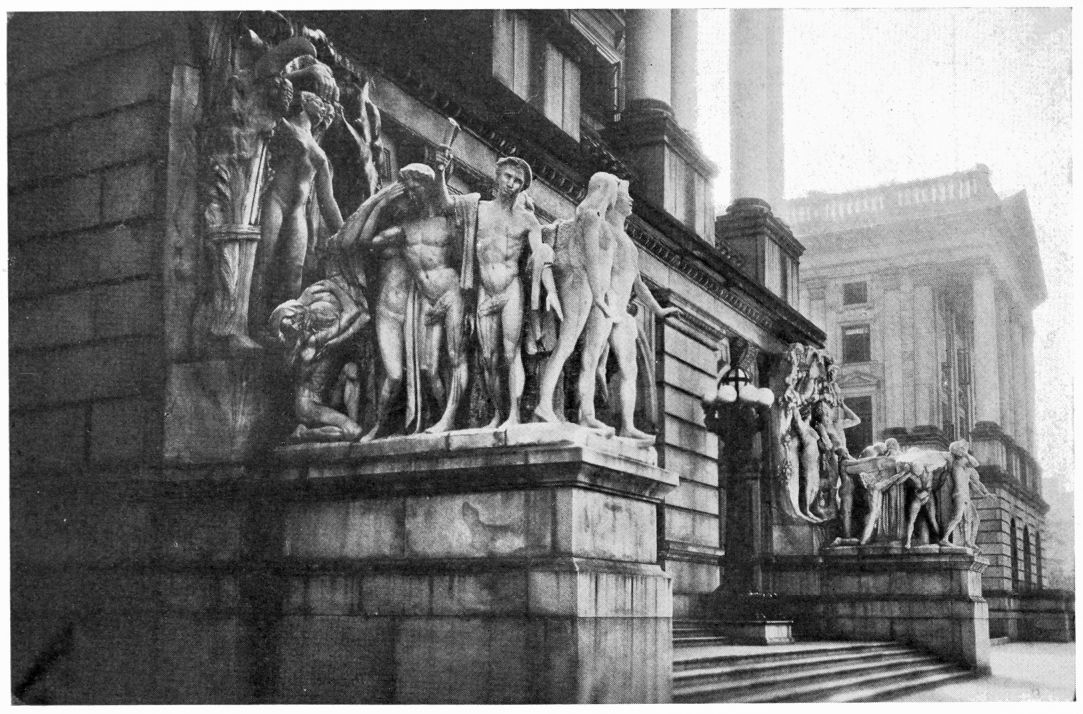
THE JOY AND BURDEN OF LIFE
Harrisburg State Capitol
George Gray Barnard, Sculptor Photographed by Boyd P. Rothrock, Curator
St. Patrick’s Procathedral; architect, George I. Lovatt; Renaissance; main altar, marble, is reproduction of Bernini’s altar in St. Peter’s, Rome. In Grace Protestant Episcopal Church is a painting by E. Irving Couse, “Adoration by the Shepherds.” Soldiers’ Monument, State and Second Streets, “To the Soldiers of Dauphin County, in 1861-65; erected by their fellow citizens in 1869.” Bronze tablet in west wall of the Camp Curtin School House, corner of Sixth and Woodbine Streets; commemorating site of old Camp Curtin, 1861-65; placed in 1911, by Keystone Chapter, United States Daughters of 1812. Memorial Market Street entrance to the City of Harrisburg; eastern approach to new bridge, formerly the old “Camel Back,” includes two columns from the old burned state capitol, and commemorative bronze tablets, designed by A. Sterling Calder; architect, Albert Kelsey; presented by the Henry McCormick Estate under auspices of the Harrisburg Civic Club; erected and dedicated in 1906.
Hershey, the chocolate town, a model village, out of which daily roll fifteen cars loaded with candies and chocolate; in 1915 Dunkards came from all over the United States to the annual conference of the “Church of the Brethren,” held in convention hall which seats six thousand, built for them by M. S. Hershey, largest meeting in the history of their church.
The Susquehanna River, one mile wide here, is spanned by three other bridges; Mulberry Street viaduct is said to be largest reinforced concrete bridge in the world, designed and erected by James H. Fuertes; stone arch bridge of the Pennsylvania Railroad at Rockville, said to be the largest four-track stone bridge in the world. Historic buildings; residence of William Maclay, first United States Senator from Pennsylvania, built in 1791; original building intact, with large wing added; on upper river front above South Street, used later by the Harrisburg Academy. Old Derry Church, Derry Township, a Presbyterian settlement since 1724, first log church built in 1732; present stone building on first site, built, 1883; has burial ground of much historic interest; Old Hanover Church, Presbyterian, eleven miles from Harrisburg, first log church built on Bow Creek in 1735; present building closed; the ancient burial ground is chief point of interest. Old Paxtang Church, Presbyterian, three miles east of Harrisburg, first log church said to have been built in 1716, with burial ground; present stone building built, 1740. Bronze gate and tablet at Paxtang Cemetery is memorial to soldiers of the French and Indian War and the Revolution; dedicated in 1906 by Harrisburg Chapter, Daughters of the American Revolution. Fort Hunter, five miles from Harrisburg on Fort Hunter and Fishing Creek Road, was laid out about 1760, on a high bluff facing the Susquehanna River, colonial house, built in 1814 by Colonel Archibald McAllister, is on foundations of an English blockhouse known as Hunter’s Fort.