XV MONTGOMERY COUNTY
Reading edition
FORMED September 10, 1784; named in honor of General Richard Montgomery; ranks third in state as to amount of money at interest paying state tax; notable for fine suburban residences and for Washington’s itinerary and Camp at Valley Forge, with 11,098 men. The Valley Forge Park Commission acquired, in 1893, 472 acres, partly in Chester County, to maintain and preserve forever the Revolutionary camp ground; American army here from December 19, 1777, to June 19, 1778; soldiers built their huts 16 × 14 feet by 6½ feet high, each to accommodate twelve men, and bore their sufferings from cold, starvation, and sickness like heroes; facts of interest are:
Baron von Steuben came from Germany with his secretary, Peter S. Du Ponceau, after having served as aide-de-camp to Frederick the Great; he was appointed inspector general of the American army, and gave them military training and discipline; Mrs. Washington came to Valley Forge February 27, 1778; on May 18, a detachment under Marquis de Lafayette moved to Barren Hill, but the British came in force against them, and they retreated over Matson’s ford, Conshohocken, on a bridge of rafts; on June 18, British evacuated Philadelphia, June 19, Washington and army left Valley Forge in pursuit.
A marker is placed where General Sullivan and soldiers built a bridge across the Schuylkill in 1778;
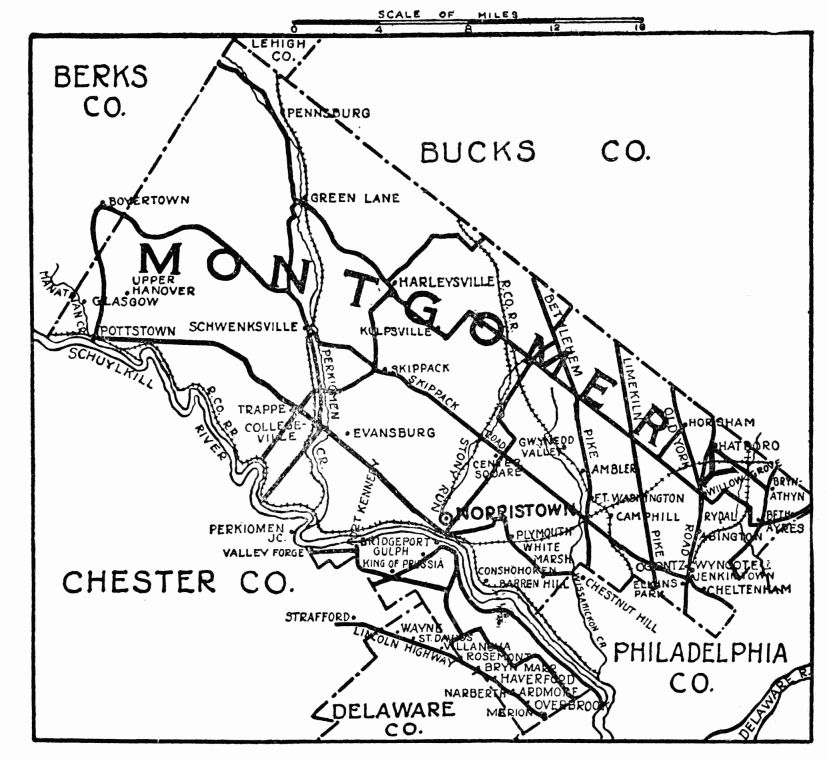
Montgomery County
redoubts and intrenchments have been restored; every point of interest has been marked with granite tablets by various historical societies, and by the states whose sons suffered here; bronze equestrian statue of General Anthony Wayne, sculptor, H. K. Bush-Brown, made, 1908, marks site of cantonment of his troops; near this is replica of a brigade hospital, a soldier’s hut; and the bronze statue of General Friederich Wilhelm von Steuben, granite pedestal with bronze relief; sculptor, J. Otto Schweizer, erected, 1915, by National German-American Alliance. National Memorial Arch, one of the most beautiful structures of its kind, granite, designed by Paul P. Cret, was erected by the United States Government in 1914, as a tribute to General Washington and his regiments.
Washington’s headquarters (home of Isaac Potts), open daily, 8 A.M. to 6 P.M., is arranged as when he occupied it; Washington Inn was used as army bakery during encampment, ovens in basement, originally home of Colonel William Dewees, sheriff of Philadelphia, and owner, with John Potts, of the forge; the Star Redoubt; the Defenders’ Gate; Cemetery; and View from observatory on Mount Joy are interesting; Museum of American History contains rare relics of Washington and the war.
Washington Memorial Protestant Episcopal chapel, and the Cloister of the Colonies, in which each of the thirteen colonies will be represented by a bay, in the center of each is the colonial seal in brass; ceiling, hand carved oak, in the central boss of each, the state coat of arms; the Cloister incloses the Garth in which is a bronze statue, “Sacrifice and Devotion,” by Bela Pratt, in honor of the mothers of the nation; the porch gates were wrought by Samuel Yellin, hammered in the iron are the symbols of the four Evangelists, the lock has a miniature Liberty Bell as a keeper, and the sliding bolt passes through the knapsack of a Continental soldier, guarding the lock; windows in the chapel from D’Ascenzo Studios. Waterman Monument marks the grave of only identified soldier buried here.
Across the Schuylkill is Fat Land built by James Vaux; Washington slept here September 21, 1777; the next day, Sir William Howe came here and almost caught him. At Port Kennedy, one and one-half miles east of Valley Forge, prehistoric bones of sabretooth tigers and extinct animals are found. West of Valley Forge, Mill Grove, built, 1762, still standing, residence of John James Audubon; here he studied, painted, and wrote about “Birds of America” that have made him world-famous. Near, at the mouth of Perkiomen Creek, Washington’s army encamped at Richardson’s Ford, September 21, after marching all night, wet breast-high, and hungry, one thousand men without shoes. Howe moved on west of Schuylkill toward Reading, the depot of American supplies, having burned buildings at Valley Forge on his way, and reached Phœnixville, Fountain Inn. Washington marched his troops to Upper Hanover, within four miles of Pottstown; his headquarters was residence of John Potts, built 1753; and sent General Wayne with fifteen hundred men to harass the rear of British army under General Gray, but they were outnumbered by the British, and massacred at Paoli; marked by two monuments.
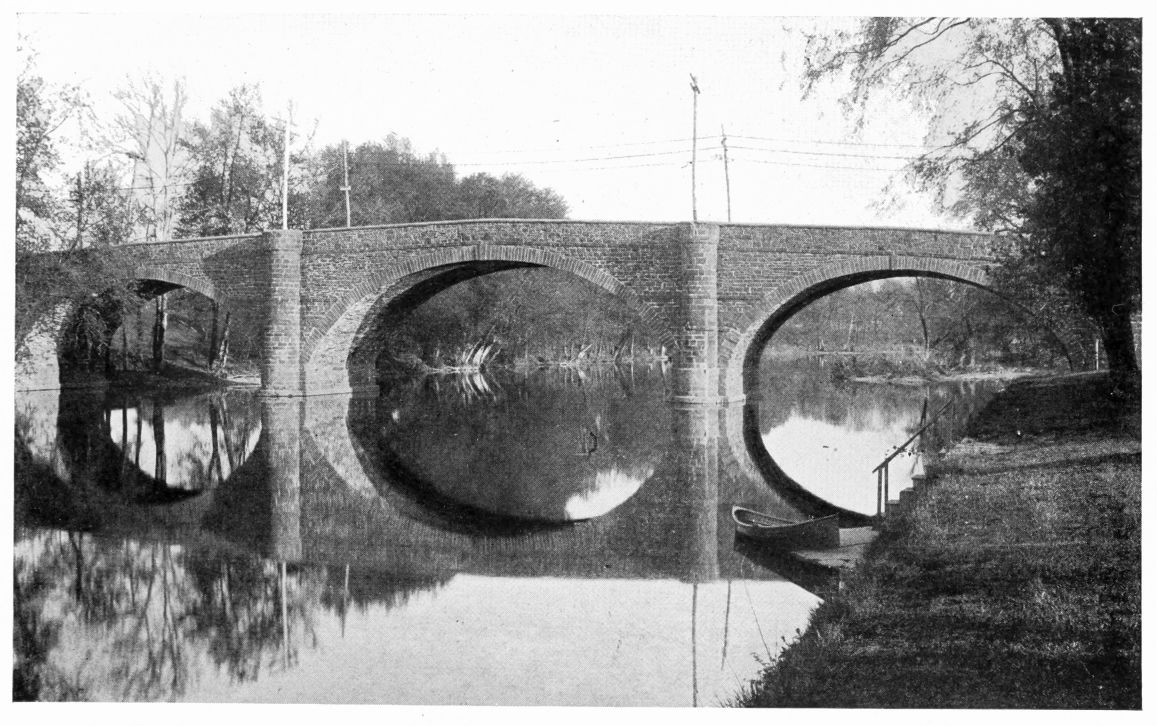
PERKIOMEN BRIDGE, BUILT 1798, COLLEGEVILLE
Photograph by Fred P. Powers
Pottstown, founded by John Potts, population 17,431; noted for its iron industries since 1716; Mill Park Hotel, built, 1752, for residence of founder, who was visited here by Washington. Friends Meeting House, built, 1752, ground given by John Potts; he also gave ground for Zion Lutheran Church, Georgian, 1753. Residences of founder’s three sons, Dr. Jonathan Potts, Director General of Hospitals, Northern Department, in the Revolutionary War, “Stowe,” west of Pottstown; Samuel Potts, east of Pottstown, now “Hill School”; John Potts, Jr., a Tory judge, corner of High and Hanover Streets, center of town, later, residence of General Arthur St. Clair; Daughters of the American Revolution tablet on side. Emmanuel Lutheran Church, architects, Lechman & Murphy, windows from D’Ascenzo Studios; Christ Protestant Episcopal Church, Gothic; brownstone; good memorial windows; was received in Convention in 1827; Pottstown Hospital is controlled by Board of Women Managers, also the Library, in which art exhibitions are shown.
Not until William Penn came was any effort made to manufacture iron in Pennsylvania. Having iron furnaces of his own at Hawkhurst, England, he was interested to encourage the industry here. Thomas Rutter, Bailiff of Germantown from 1705-06, after Pastorius, moved up the Schuylkill on patent of land from William Penn, deed still in the family, and established in 1717, the “Pool Forge,” on Manatawny Creek, three miles above Pottstown; he was first in Pennsylvania to manufacture iron; ore is still being mined from the same beds. Among the great names in our early iron industry, Rutter and Potts stand pre-eminent; the list of forges and furnaces on the Manatawny and its branches, owned by their intermarried families, before the Revolution, include Mount Pleasant furnace and forge; Spring forge; Colebrookdale furnace and forge; Amity forge; Rutter’s forge; Pool forges; Pine forge and Little Pine forge.
Near Boyertown is Ringing Rocks, a natural curiosity; they make a complete octave. Michael Schlatter preached at Manatawny in 1748, also in the Reformed Church, built in 1743. McCalls, or Glasgow Forge, on Manatawny Creek, still in operation, was erected in 1725, on land conveyed by William Penn to his son, John, in 1701; 14,600 acres; sold to George McCall of Glasgow, Scotland, in 1735; who also had interest in Colebrookdale furnace managed by Thomas Potts, Jr., which supplied McCall’s forge with pig iron. Green Lane Forge, on Perkiomen Creek, notable for its excellent blooms, was built in 1733 by Thomas Mayberry; earliest settler in Marlborough township, who bought 1210 acres, supplied with pig iron from Durham Furnace, Bucks County; equipment, water wheel, huge bellows, tuyere pipe, open hearth forge, melting pots, and conelike charcoal kilns.
MONTGOMERY COUNTY AUTOMOBILE TRIP TO VALLEY FORGE
(Return by Schuylkill River Drive to Philadelphia)
From Thirty-second and Market Streets, Philadelphia, out Lancaster Avenue, first turnpike in United States, completed in 1794, pattern for all subsequent roadbeds; main highway to Pittsburgh, once thronged with teams, coaches, and Conestoga wagons with six horses, making twenty miles a day; trip from Philadelphia to Pittsburgh and return, 333 miles, in six weeks; wayside inns were located a mile apart. Originally part of Indian trail; later King’s Highway; Lancaster Pike; Main Line; now Lincoln Highway, made free of tolls July 15, 1917. Overbrook, Roman Catholic Theological Seminary, St. Charles Borromeo, contains painting, “Crucifixion,” by the late Thomas Eakens. The Pennsylvania Institution for the Instruction of the Blind, designed by E. A. Allen, Spanish Renaissance, 1898, architects, Cope & Stewardson, considered finest residential school for blind in the world, particularly well-equipped for the purpose. Montgomery County, near Narberth station, old Merion meeting house, built, 1695, stone, sharp roof, curious pointed gables over doors, peg is still shown where William Penn hung his hat when he rose to preach; beyond is site of Penn cottage, built, 1695. Merion, Dr. Barnes’ Art Museum, built of imported French limestone; modern art. Ardmore, St. Paul’s Lutheran Church and burial ground, log church, built, 1769, present church, 1873. Red Lion Inn, still standing.
Haverford, Haverford College for boys, founded in 1833 by Society of Orthodox Friends, life is focused inward, neither sight nor sound of the outer world reaches the campus of 225 acres, on which are farm and woodland, cricket and football fields, tennis courts, a running track and skating pond; the arrangement of buildings, chiefly modern colonial, from 1833-1912, shows the result that comes only by slow growth and care; architects, W. S. Vaux; Cope & Stewardson; W. F. Price; Baily & Bassett. Library contains over four hundred Babylonian clay tablets, from 2500 B.C.; Harris collection of Oriental manuscripts; seven hundred reproductions in fictile ivory, of ancient and medieval carved ivories in British Museum, from second to eighteenth centuries; Roberts autographs, more than 11,000 items, covering period from late fifteenth century to present day; some portraits of Haverford alumni. Old Haverford meeting house, near Cobb’s Creek, stone, built, 1696, has horse block used by William Penn in dismounting; chimney had curious openings in outside wall, through which fire wood was introduced to the hearth, their position is still traceable. The Buck Tavern, built, 1732, now Haverford House.
Bryn Mawr, 415 feet above sea level (Welsh, great hill). Bryn Mawr College, founded by Dr. Joseph W. Taylor, of Burlington, New Jersey, in 1880, to establish “An institute for advanced learning, for women to have equal advantages with men.” The college has continued a high standard of academic work, and maintains graduate school for women doing research work in all branches. Buildings, chiefly varieties of Gothic architecture, stone, date from 1882-1913, architects, Addison Hutton, Cope & Stewardson, C. Francis Osborne, Lockwood de Forest, and Winsor Soule; the Library, Jacobean Gothic, period, 1630, incloses cloister garden with center fountain, bosses of cloister arches are carved by hand, sculptor, Alec Miller from England. Memorial brasses, set in wall, were designed by Lockwood de Forest. Reading room contains portraits of President M. Carey Thomas, by John S. Sargent, and ex-President James E. Rhoads, by William M. Chase.
Rosemont, residence, Alba Johnson, Esq., late Tudor, is typical of Main Line residences, many of them Norman or English; grounds in woodland and best traditions of English landscape gardening; marble statue of Eve, made 1855, by Bartholomew, Rome; lead statuary, Neptune and horses fountain, from Bronze Grove Guild, Worcester, England, Walter Gilbert, sculptor; the grounds may sometimes be seen by writing to owner for permission. Villa Nova, Roman Catholic College and monastery. Bernard Corr Memorial Hall, old English Gothic, built, 1912-14; architects, Durang & Son.
Radnor, Delaware County, Friends meeting house, built, 1718, used as hospital for Morgan’s riflemen and Potter’s brigade in 1778; St. David’s Church, built, 1715, by the congregation, named for patron Saint of Wales; native stone, used as hospital in Revolutionary War, leaden sash, melted for bullets; Swedish missionary at Wicaco held first services here; General Anthony Wayne, vestryman, is buried in church grounds; his monument was erected by Pennsylvania Society of the Cincinnati in 1809; Judge William Moore and wife, buried under the door-step; their daughter was the wife of the first Provost, William Smith, U. of P. Communion service given by Queen Anne. Wayne, General Wayne Inn, hotel since 1707, Wayne’s encampment near in 1792, before his western campaign against Indians. Chester County, Lincoln Highway to Strafford, Township Line Road to Valley Forge, see page 253.
Return, Montgomery County, Valley Forge road to “King of Prussia” Inn, built, 1749; continue on Gulph Road to Gulph Mills, stone, built, 1747, Boulder Monument, inscription, “Gulph mills, the main Continental Army commanded by General George Washington, encamped in this vicinity December 13 to December 19, 1777, on way to Valley Forge, erected by the Pennsylvania Society, Sons of the Revolution, 1892.” Over Gulph Creek near Gulph station, Philadelphia & Western Railroad, is stone bridge, inscription “Montgomery County, Upper Merian (Merion) Township, 1787; In the second year of the Foederal (Federal) Union.” West Conshohocken. Matson’s Ford, over which Lafayette retreated from the British in 1778, continue along Schuylkill River drive to Belmont Avenue, through Fairmount Park to Philadelphia.
MONTGOMERY COUNTY AUTOMOBILE TRIP ON OLD YORK ROAD, TO DOYLESTOWN, BUCKS COUNTY, LEADING TO CENTER BRIDGE
Old York Road, original stage route to New York, laid out in 1711, from city line to Center Bridge. Elkins Park station. Residence of the late P. A. B. Widener, “Lynnewood Hall,” notable for one of the finest art collections in the United States; near by, residence of William L. Elkins has notable art gallery, both galleries may sometimes be seen by writing to owners for cards of admission. South of Chelten Avenue, stone bridge, two arches, date, 1793; opposite is only milestone of old series south of the Neshaminy, it is the seventh milestone mentioned in Washington’s orders for the attack on Germantown. West, is residence of the late Lucretia Mott, Oak Farm, near La Mott, now Latham Park. Ogontz, residence of the late Jay Cooke, financier of the Civil War; named for an Indian chief whom he had met. Over Tacony Creek is stone bridge, inscription, “Cheltenham bridge, 1798, 7½ miles to Phila.” Church Road, near Myers Mill, Cheltenham, site, country residence of William Penn; on part of this land is country residence of the late John Wanamaker. At Washington Lane, southeast boundary of Jenkintown, is large oak tree where Washington rested his white horse.
A quarter of a mile east of Jenkintown is Abington Friends meeting house, organized, 1682, built, 1697 by William Jenkins from Wales; stone; long piazza; old shutters with strap hinges and iron hooks, door latch and knobs; all in keeping with its period of construction, fine old trees in grounds are well cared for. One mile north, Rydal station, Ogontz School for Girls, lately in Jay Cooke mansion, organized about 1850, by Misses Bonney & Dillaye: Collegiate Gothic, built, 1917; architects, Cope & Stewardson, has Art Department. Through Meadowbrook, one mile east to Bethayres, residence, Henry McCarter, artist.
One mile north, Bryn Athyn, name means “Hill of Cohesiveness,” a Swedenborgian educational community. Library contains the most valuable collection of Swedenborg’s writings in the world. Here is being erected a cathedral; architect, Ralph Adams Cram, gift of John Pitcairn; like the cathedrals of old, all work is prepared on the grounds; wood-carving and stonecutting by hand; glass manufactured, models made; the workmen in consultation with the donor and the architect to obtain the best results. Return to York Road. Abington, library, originally Jenkintown Lyceum, built, 1830, lately remodeled, modern colonial, contains valuable collection of books bequeathed by John Lambert, artist, who also left $50,000 in trust for purchasing paintings by young artists at annual exhibitions in Pennsylvania Academy of the Fine Arts. Presbyterian Church built, 1714, is said to be third in this country; in 1740 George Whitefield preached here to three thousand persons in one day.
Willow Grove Park; pleasure resort; fine concerts given throughout the summer season, by Sousa and others. North on Doylestown Pike, Horsham, Graeme Park, colonial, stone house, hipped roof, residence, Sir William Keith, from Scotland, Baronet of Ludquhairn, Aberdeenshire, Lieutenant Governor of Pennsylvania, 1717-26; he laid foundation of the military system, encouraged putting out paper currency, and inaugurated a military display at Penn’s death; property later owned by Dr. Thomas Graeme, his son-in-law; Governor Keith’s coat of arms is on a large iron plate in the fireplace; in the yard is an antique slave bell and stone strength tester. Quaker meeting house, built, 1803. Approaching Hatboro, stone bridge leads York Road over Pennypack Creek, inscription “Hatborough, 1780, 16 M. to P.” It is said this bridge was built in 1824, stone taken from an older bridge. Battle of “Crooked Billet,” name of near-by tavern, fought in 1778, a small company of Americans under Colonel John Lacy were attacked by British under Lieutenant Colonel Abercrombie, and nearly all killed; white marble monument was erected here in 1861. Continued in Bucks County.
MONTGOMERY COUNTY AUTOMOBILE TRIP FROM CHESTNUT HILL TO CAMP HILL AND FORT WASHINGTON
(Return by Norristown to Philadelphia)
At Chestnut Hill, on Bethlehem Pike, we enter Whitemarsh Valley (Umbilicamince), named from mists of Wissahickon Creek; near by is Erdenheim, Carson College, on one hundred acres of ground, richly endowed by Robert N. Carson, for orphan girls, that they may have the same benefits which Girard College has accorded to orphan boys; the architect, Albert Kelsey, has planned his design to be an allegorical vision of woman’s life, combining beauty, utility, and sympathy; he eliminates the usual large central buildings, the administration and classrooms being in the nature of a college settlement which make up in beauty what they lack in size, and may be expanded as occasion demands. Passing the Wheel Pump and Black Horse, famous early hotels. Colonial houses; Presbyterian and Lutheran churches with their burial grounds; to junction with Skippack Road.
St. Thomas Protestant Episcopal Church, contains Communion service given by Queen Anne, first log chapel built by Edward Farmer, 1690; stone church built, 1710, on first site; during the Revolutionary War, church was occupied by various military forces, used as fort by British with guns in windows; the gravestones, long, flat pieces of slate on four columns, used as cooking stoves, with fires lighted underneath, upright stones were marks for target practice, bullet holes may still be seen in them. American forces camped here November 22, 1777; being warned by Lydia Darragh of a British attack, when the enemy made their appearance, General Wayne opened fire from Fort Washington, the British retreating with a loss of one hundred men. Whitemarsh church is repeatedly mentioned in Washington’s diary as a center of operations; present church, near first site, consecrated, 1881. Gothic, native stone, interesting interior, with high pointed roof and narrow lancet memorial windows, all made abroad but one, “Angel of the Resurrection,” by Tiffany; high on west wall is a rose window; three small lights in the George and Anna Catherine Sheaff window are said to have been painted by Albrecht Durer; reredos, “Christ Breaking the Bread,” painted in Italy; altar, Indiana limestone with carved angels kneeling; the rood screen with loft, English quartered oak, is exquisitely carved. Encircling a window is mural decoration by Marianna Sloan. In the burial ground is an Iona Cross, marking last resting place of Henry Howard Houston, for whose memorial Houston Hall was given to the University of Pennsylvania.
View from north door of church shows, east, Camp Hill; in valley below, Washington’s headquarters, stone house two and a half stories, one-half mile east from Camp Hill station, Pennsylvania Railroad, left wing of army, posted rear of house; here Washington decided to establish fortified encampment at Valley Forge; December 12, whole army ordered to march to Valley Forge, via Swedes Ford, Norristown, where they crossed the Schuylkill on a bridge of wagons, with rails laid over them; “Swedes Ford,” hotel built, 1723, still standing, at Bridgeport.
North of St. Thomas Church we locate Fort Washington by its flagstaff, in center of earthwork thrown up by General Anthony Wayne’s men. West, from Church, Militia Hill, where some of the stones, used as anchors for tents, are still in position; at foot of hill is Wissahickon Creek, over which leads the high railroad bridge belonging to the Trenton cut-off of the Pennsylvania Railroad. Passing Fortside Inn, north, on Bethlehem Pike, is stone marker, inscription “About 700 feet south of this stone is an American Redoubt and site of Howe’s threatened attack, December 6, 1777; from here Washington’s army marched to Valley Forge. Erected, 1891, by the Pennsylvania Society, Sons of the Revolution.”
Farther on Bethlehem Pike, over Sandy Run, is the village of Fort Washington, now home of the Darby School of Painting, a summer art school conducted by Hugh H. Breckenridge, member of the faculty of the Pennsylvania Academy of the Fine Arts, there science of color is taught in its fullest significance. On Engertown Road is old Friends meeting house. Farther, on Limekiln Pike, is Pennsylvania School of Horticulture for Women, post office, Ambler, founded in 1910, thorough training, through all seasons, eliminates waste of costly inexperience, and fits a woman for a life that is healthful, attractive, and remunerative. Near Sumneytown and Butler Pike is “Three Tuns Inn.” Gwynedd, meeting house, built, 1700, Welsh Quakers worshiped here.
Down Butler Pike to Ambler, residence of Dr. R. V. Mattison, built, 1890, Scotch baronial style, wrought iron gates designed in Munich; opposite is Trinity Memorial Church, Romanesque, noted for its beautiful windows, designed by F. S. Lamb, original, and adapted from paintings by world famous artists, of scenes in Christ’s life, made by J. and R. Lamb; interior paneled in oak, similar to House of Parliament, London; font, Italian marble, good design. Through Morris Road, over bridge crossed by Washington’s army, between Morris and Skippack roads, one mile west of Ambler, is stone residence, built by Abraham Dawes in 1736, was Washington’s headquarters, October 21, 1777.
Out Skippack Road, on road from Center Square to Heebnerville, Washington’s headquarters, October 16; residence of Peter Wentz, still standing, two story, stone, built, 1758. Out Township line to Kulpsville, on Sumneytown Road, Baptist or Mennonite meeting house, here are buried General Francis Nash of North Carolina, and other officers who died of wounds received in the Battle of Germantown. Northwest, one mile, Harleysville, residence of Henry Funk, Bishop of Mennonite Church, who with the Dunkards of Ephrata, made translation, in 1748, from the German, of Tielman Jan van Braght’s great historical book of the Mennonites, termed the noblest specimen of American colonial bibliography; Henry Funk’s mill, still standing, known as Musselman’s Mill, contains a parchment deed, date, 1733, with great seal of the province and signature of Thomas Penn.
Return to Skippack Road, to Pennypacker’s Mills, Schwenksville, residence of the late Governor Samuel Pennypacker, two story, stone house, Washington’s headquarters before and after Battle of Germantown; army marched down Skippack Road, 7.00 P.M., October 3, to attack the enemy; here October 7, Washington received a committee of Friends, appointed by the Yearly Meeting, against war; Schwenksville was settled by Schwenkfelders from Silesia in 1734; Casper Schwenkfeld preached, in 1523, doctrines accepted by George Fox in 1648, were forerunners of Quakers. Perkiomen Seminary, at Pennsburg, originated in a school founded by Schwenkfelders, 1764. Down Perkiomen Creek road, over finest old stone bridge in state, five arches, built, 1799, architect, George Lewis, carries Ridge Road over Perkiomen Creek at Collegeville, Ursinus College; Co-ed Lutheran, portraits by Albert Rosenthal. And old Providence meeting house.
One mile west, at Trappe, Augustus Church, oldest Lutheran church in United States; built, 1743; unaltered; used as hospital for American soldiers during Revolutionary war; Henry Melchior Muhlenberg was sent from Halle, Germany, in 1742, to organize this church in Pennsylvania; first regularly ordained preacher, reports he sent to Halle supply much early, original information. His sons, born here, were General Peter Muhlenberg, pastor of church in Shenandoah Valley, who called on his congregation to enlist in the Revolutionary War, and Frederich Augustus, speaker, First National Congress, 1789. Evansburg, St. James Protestant Episcopal Church and schoolhouse, built about 1700, contains Bible, prayer book, and old walnut Communion table, sent over by the English Society in 1723, to its foreign mission. Revolutionary soldiers are buried in the church yard. Here is an eight arch stone bridge, date 1792.
Norristown, county seat, settled, 1784, population 32,319. Courthouse built, 1791, native white marble; on grounds is Rittenhouse monument, granite shaft, dedicated 1876, marks the meridian. Jail, built, 1851, red sandstone, castellated Norman, architect for courthouse and jail, N. LeBrun. Historical Society of Montgomery County has local historical collections. St. John’s Protestant Episcopal Church, Gothic, dedicated, 1815, Revolutionary soldiers are buried in its grounds. Montgomery Trust Company, Greek, Ionic, Westerly granite and Indiana limestone, facing public square, on site of first hotel in Norristown. In Montgomery Cemetery are buried Charles Heber Clark (Max Adler), and General Winfield Scott Hancock.
Plymouth Meeting, old Friends meeting house, built, 1715, stone, used as hospital during Revolutionary War, Thomas Hovenden, artist, buried in grounds; residence of Mrs. Thomas Hovenden (Helen Corson), was a noted underground railway station for refugee slaves. Stone bridge over Plymouth Creek, date, 1796; stone bridge carrying Germantown and Reading Railroad over Plymouth Creek, date, 1802. Barren Hill, Lafayette and detachment of army attacked here by British, May 18, 1778. Roxborough, Philadelphia, St. Timothy’s Protestant Episcopal Church has frieze, procession of angels. Through Ridge Avenue to Wissahickon Drive, Fairmount Park, to Philadelphia.