XI WESTMORELAND COUNTY
Reading edition
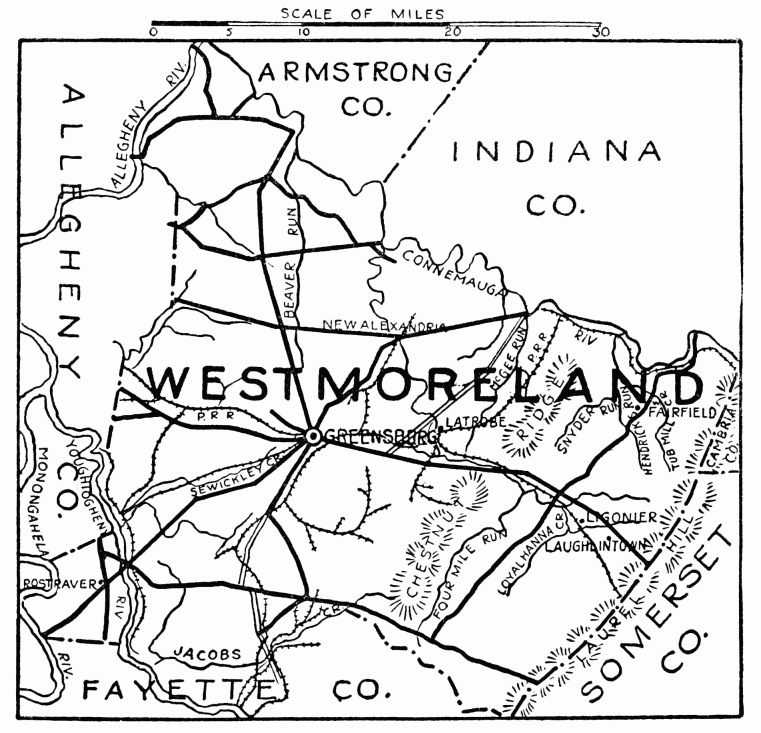
FORMED February 26, 1773, named for the County of Westmoreland, England. Chief industries, coal, coke, gas, and manufactories. Ruins of old furnaces abound in this section, relics of the iron industry about 1800. The Lincoln Highway crosses this county, formerly the Philadelphia and Pittsburgh Turnpike, entering near Laughlinstown, at the base of Laurel Ridge, elevation, 2700 feet; here is a museum of relics, shown in an old tavern of stage coach days, built about 1800, where Daniel Webster is said to have stopped, and Zachary Taylor, in 1848, held a reception. Three miles west is Ligonier, on site of a fort built by Captain Burd under the direction of Colonel Bouquet, a Swiss; named for Sir John Ligonier, a famous English general; all traces of the fort have been obliterated; a descriptive tablet, erected by the Daughters of the American Revolution, is in the town square. In the High School Library is an engraving, from a painting by Sir Joshua Reynolds, of Sir John Ligonier. Near by is Idlewild Park.
At Bushy Run the Indians made a furious attack on Bouquet and his company but were utterly routed and they retreated beyond the Ohio; Bouquet then marched to Fort Pitt and recovered it in 1763; next year he led an expedition beyond the Ohio River, the Indians sued for peace, and he compelled them to
Westmoreland County
bring all their captives to Fort Pitt. One and a half miles west of Ligonier is residence of General Arthur St. Clair, from 1767-72, “The Hermitage,” rebuilt, excepting one room, which is well cared for; there is a well-grounded tradition that Washington sent from Mount Vernon two expert carpenters, whose quaintly designed woodwork, mantelpiece and wainscoting doubtless saved this room from destruction; the house was marked in 1913, by the Phœbe Bayard Chapter, Daughters of the American Revolution, of Greensburg.
Four miles west of Latrobe is St. Vincent’s Monastery and Church, dedicated in 1905, brick and stone buildings, with highly decorated interiors, containing the main altar, onyx, set with jewels, and fine wood carvings from Italy. North, on William Penn Highway, is New Alexandria; here, owned by Elizabeth Craig, is a Rattlesnake Flag, in use before the Revolution, made of crimson silk; in the upper left-hand corner is the English coat of arms; on the field is a rattlesnake with thirteen rattles, indicating the thirteen colonies; underneath are the words “Don’t tread on me,” J. P. F. B. W. C. P.—for John Proctor’s First Battalion Westmoreland County, Pennsylvania; by whom it was adopted.
Greensburg, population 15,033, formerly called Newtown, settled in 1782; made county seat in 1786, and name changed in honor of General Nathaniel Greene, who had died at Savannah, Georgia, that same year; many of the Westmoreland County soldiers served under him in the Revolution. It now has its fourth courthouse, a dignified building, French Renaissance, white granite, the façade surmounted by a well-proportioned dome, dedicated, 1908; architect, William Kauffman; contains portraits of judges and lawyers. Among the churches of good architecture are the United Brethren, classic, Doric, architects, Winkler & Macdonald; and the First Presbyterian on South Main Street, Gothic, stone, architects, Cram & Ferguson. Other notable buildings are the Post Office, classic, Ionic; the Y. M. C. A., an adaptation of Colonial, and St. Joseph’s Academy, with beautiful grounds, overlooking the whole town.
In St. Clair Cemetery is a monument to General Arthur St. Clair, who is buried here. About five miles distant is Oakford Park. Fells Church in Rostravor Township southwest is said to be the second Methodist Church west of the Alleghenies, built of logs in 1792; present stone building in 1834; in the burial ground are many pioneers of western Pennsylvania.