XLVII LEBANON COUNTY
Reading edition
FORMED February 16, 1813; Scriptural name, from the cedar trees covering the range of mountains on northern boundary, “Cedars of Lebanon”; settled by Germans in the east, by the Scotch-Irish in the west. Leading industries, agriculture, iron, tobacco. Three solid hills of rich, magnetic iron ore have been worked for over 170 years, and still seem inexhaustible; they require no mining, simply to be quarried; down to the present these mines have produced more iron ore than any other single iron ore property in the United States. In 1737, Peter Grubb became sole owner of these ore hills; he built Hopewell forge on Hammer Creek, and the large blast furnace was named for Cornwall, his ancestral home in England. The property was inherited by his two sons, who were colonels in the Revolutionary War; cannon balls and stoves were cast here for the Continental Army. In 1798, Robert Coleman purchased five-sixths of these ore banks; they were near the old road between Harris Ferry and Philadelphia, known as the Berks and Dauphin Road. Later his grandsons, Robert and G. Dawson Coleman, built furnaces on the Union Canal, then the great means of transportation; by that time charcoal furnaces were going out.
The construction and operation of the Union Canal through this county, connecting the Schuylkill River at Reading with the Susquehanna at Middletown, was a
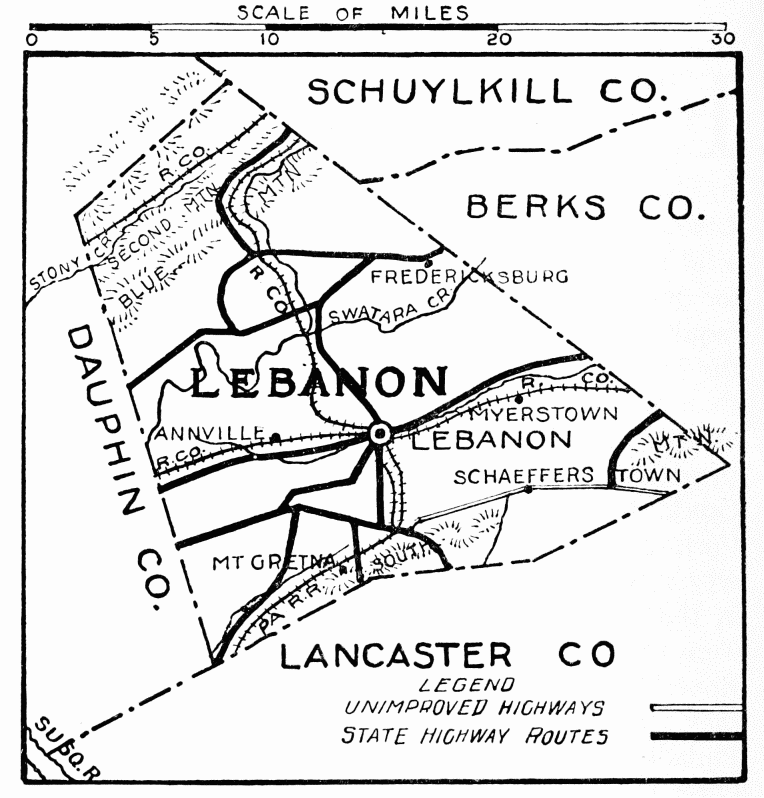
Lebanon County
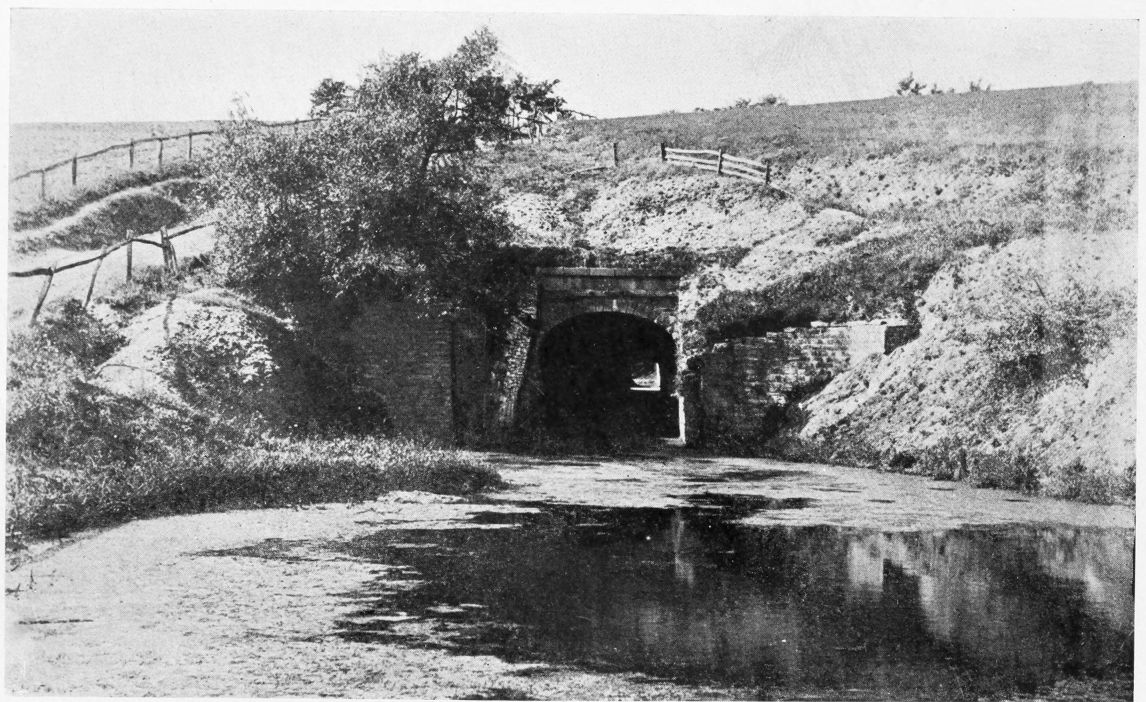
THE OLDEST CANAL TUNNEL IN THE UNITED STATES
North Lebanon
momentous event, with its tunnel 767 feet long, first in the United States. Extract: “Lebanon, June 15, 1827. Last Monday evening, June 11th, the citizens of this town and vicinity had the privilege of seeing the first boat, the Alpha from Tulpehocken, come up the Union Canal and remain at North Lebanon for the night; the next morning it continued its journey westward and passed through the tunnel; this was the first boat to pass through a tract of ground upon which corn and potatoes were being grown.”
County seat, Lebanon, population 24,643, on the William Penn Highway; settled in 1750. Streets run north and south, east and west. Courthouse, at the corner of Eighth and Cumberland Streets, colonial, brick. United States post office, classic, with Doric columns. A historic inn, the St. Eitz, built in 1752, was occupied by George Washington. Hill Church, colonial, brick; in the yard is a monument to Rev. John Casper Stoever, first Lutheran minister in Lebanon County, in 1733. St. Luke’s Protestant Episcopal Church, Gothic, stone, built without a nail, has three memorial windows, “The Nativity,” by Lamb; others made in England; also fine collection of altar cloths, chasubles, and credence cloth made abroad, in filet, of fifteenth century design. Soldiers and sailors’ monument in Monument Park; tall, fluted column with Ionic capital. Lebanon Historical Society has collections of local interest. Annville is seat of Lebanon Valley College, founded by the United Brethren in 1865; a school of high grade under supervision of that church.
Mt. Gretna, a camp ground of 1000 or more acres, 1000 feet above sea level, was purchased by the state for mobilization of the state’s National Guard. It will accommodate 20,000 men, and has been used for this purpose since 1885. The War Department considers Mt. Gretna an ideal military camp, sanitary and well drained. Schaefferstown, one of the earliest and most historic places in this county, laid out in 1744, had the first waterworks system in the United States, in 1753. Franklin House built in 1750; in the cellar there is a remarkable series of carved arches; it served as a place of refuge from Indians. Fountain Hill Park is here. Myerstown is the seat of Albright College. Fredericksburg has the Lick Monument, erected, in 1881, by James Lick, in memory of his grandfather’s services at Valley Forge, and of John Lick, founder of Lick Observatory on Mount Hamilton, California.