LVII CARBON COUNTY
Reading edition
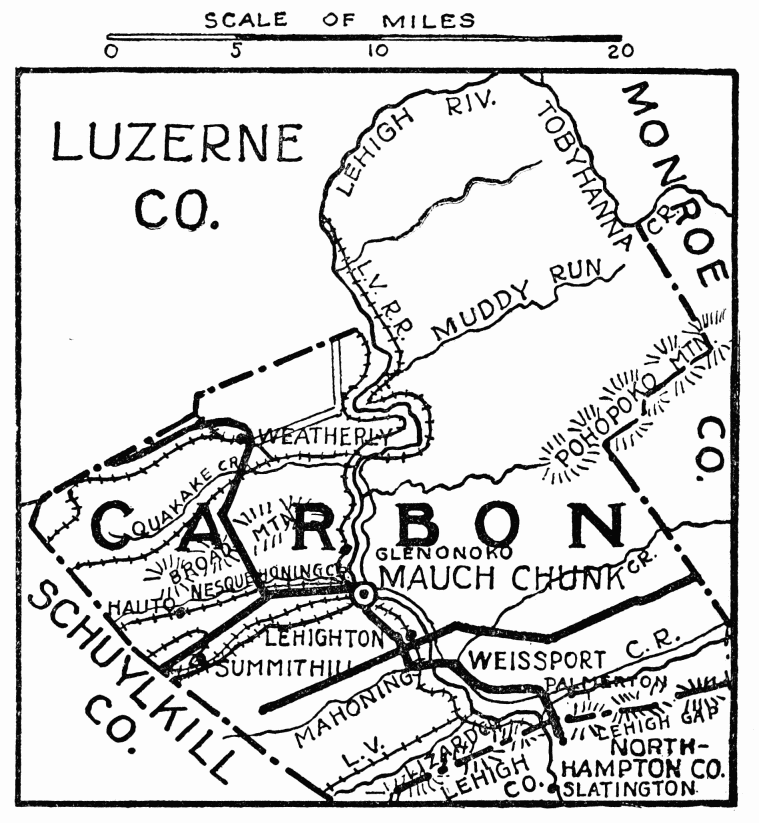
FORMED March 13, 1843; named for its coal deposits; coal was first discovered by Philip Ginter in 1791, on top of Sharp Mountain, now town of Summit Hill, nine miles southwest of Mauch Chunk. In 1818 the Lehigh Navigation Company and the Lehigh Coal Company were formed; under skilful management the almost insuperable obstacles in the way of transportation were overcome; boats 18 feet wide by 25 feet long, two or more hinged together, were floated by artificial freshets on the Lehigh; owing to the great fall in the river and consequent rapidity of its motion, dams were constructed near Mauch Chunk, with sluice gates, invented by Josiah White, a manager of the Navigation Company; they were the first on record used permanently; Lehigh coal is the hardest known anthracite in the world. Other mineral productions are iron, slate, and mineral paint. Wire rope was first invented in Mauch Chunk.
The first settlers were Moravian missionaries who, in 1746, purchased 200 acres on the north side of Mahoning Creek above its mouth, for converted Mohican Indians; each Indian family possessed their own lot of ground and Gnadenhütten became a town; the church stood in the valley, with the Indian houses forming a crescent on one side, on the other side was the missionary’s house and burial ground. The road to Wyoming lay through the settlement, being the
Carbon County
famous Warrior’s Path over Nescopec Mountain. In August all partook of their own first fruits in a love feast. Christian Ranch and Martin Mack were the first missionaries residing here; several parts of Scripture had been translated into the Mohican language; the Holy Communion was administered every month, the Indians calling that “The Great Day.” In 1749 Bishop (Baron) John de Watterville went to Gnadenhütten and laid the foundation of a large church; Indian congregation 500 persons. After Braddock’s defeat in 1755 the whole frontier was open to the savage foe; suddenly in 1757, the mission house on the Mahoning was attacked and burnt by French and Indians, and many inhabitants were murdered; a broad marble slab, placed there in 1788, near Lehighton, marks the grave of those massacred.
In 1756 Benjamin Franklin was authorized by the Provincial Government to erect forts on the Lehigh; one opposite Gnadenhütten was named Fort Allen, for William Allen, the Chief Justice. At Weissport, in the rear of the “Fort Allen House” may be seen the well dug under Franklin’s supervision; it was within the inclosure of the fort and supplied the soldiers with water. Weissport was settled by Colonel Jacob Weiss, Quartermaster General in the Revolutionary Army, on site of Fort Allen. Municipal parks are at Lehighton and Weissport, given by Jacob Weiss. Also at Lehighton is All Saints’ Chapel, early English Gothic.
In 1780 Andrew Montour, leader of an Indian party, captured the Gilbert family, twelve persons, and took them over Mauch Chunk and Broad Mountains into the Nescopec path, across Quakake Creek to Mahoning Mountain and over wild and rugged country to Canada; eventually they were all redeemed at Montreal, in 1782, and returned to Byberry. A view of great scenic beauty is from Prospect Rock, over the Nescopec Valley; Cloud Point, frequently covered by vapor, may be seen; near is Glen Thomas with a picturesque Amber Cascade, named for David Thomas, pioneer in the iron trade. Glen Onoko, two miles above Mauch Chunk, with its wild beauty, total ascent over 900 feet, forms the channel for the clear stream which flows over innumerable cascades to the Lehigh; the most noticeable are “Chameleon Falls,” fifty feet high, and “Onoko Falls,” ninety feet high, with overhanging rocks, covered with moss and ferns.
Mauch Chunk, county seat, population 3666; Indian name means Bear Mountain; first settled in 1815; has one principal street, following the tortuous course of Mauch Chunk Creek as it winds through a narrow gorge between three high, steep, and rocky mountains, averaging 850 feet above the town. The important buildings are directly on this street. Courthouse, Norman, brownstone, quarried at Rockport, Carbon County; built in 1894. Jail, where some of the Molly Maguires were executed. The Dimmick Memorial Library, built in 1890, brick. Churches here and in East Mauch Chunk are unusually handsome. St. Mark’s Protestant Episcopal, Gothic, stone, has memorial windows by J. & R. Lamb; the reredos is very beautiful. First Presbyterian, colonial, brick, has a memorial window by John LaFarge, and one by Tiffany. The Immaculate Conception, Roman
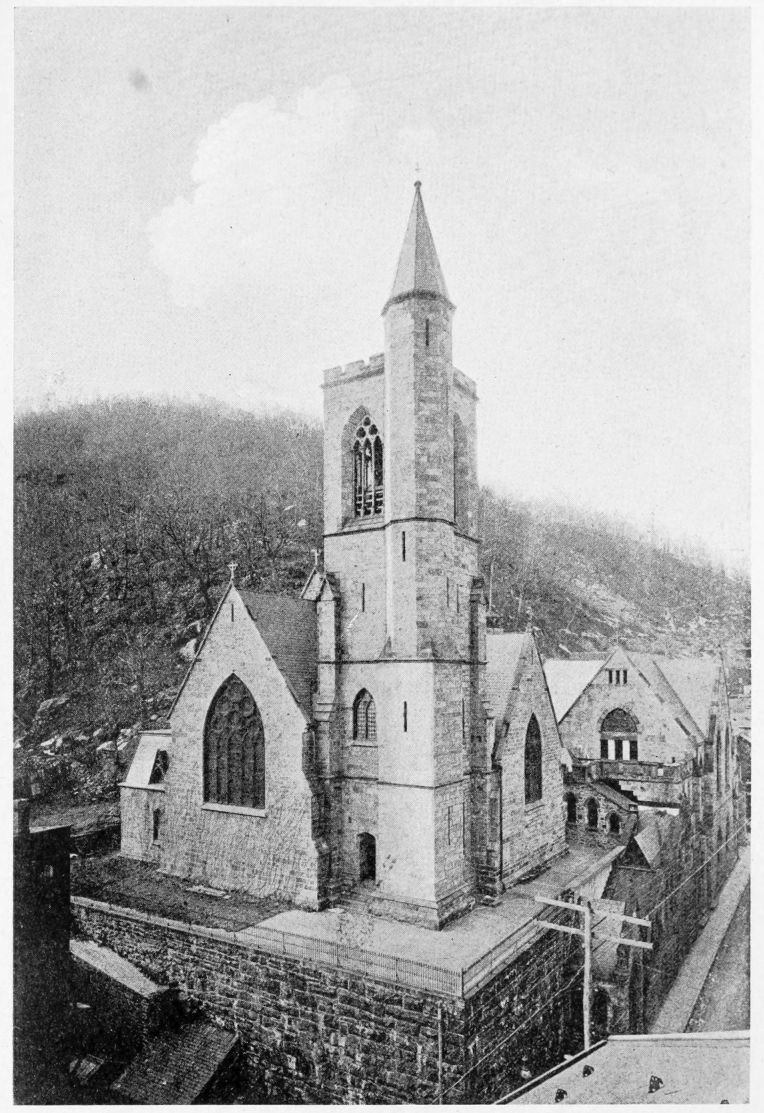
ST. MARK’S P. E. CHURCH, MAUCH CHUNK
This church is built on solid rock
Catholic, also has fine stained-glass windows. St. Paul’s Methodist Episcopal is the oldest church in the town.
The Woman’s Clubs are seeking to improve conditions, sanitary and scenic; to widen the life of the town and in every way make it more in unison with its natural surroundings. In the limited space of the narrow valley, land is too precious to be used except for buildings, but the hills are so magnificent that they look to them for the necessary beauty; Flagstaff Park has natural effect. The first railroad in Carbon County and one of the oldest in the United States, is the famous Switchback, a gravity road, extending from Mauch Chunk to Summit Hill, opened in 1832, for bringing coal from the mines to the canal; used now only for pleasure; a double track is laid to the summit of Mount Pisgah, 2322 feet distant from the foot, at an angle of twenty degrees, with elevation about 900 feet above the river. Scene from the top is superb, with a succession of mountain ridges rising, range after range, with distant view of Lehigh Water Gap, and farther to Schooley’s Mountain in New Jersey. The principal attraction at Summit Hill is the burning mine, discovered to be on fire in 1859. General Craig of Revolutionary fame resided here.
Elk County