VIII BERKS COUNTY
Reading edition
FORMED March 11, 1752; reduced to present limits, 1811; named for Berkshire, England, where Penn family had large estates; has broad, fertile plains and valleys, intermingled with rough hills and mountains containing mineral wealth in iron. First settlers were Germans, and Friends from England, 1704-12, among whom was George Boone, ancestor of Daniel Boone of Kentucky, who was born here, in Exeter Township, 1735. Mordecai Lincoln, great-great-grandfather of Abraham Lincoln, also lived in Exeter Township; he owned one thousand acres of land, had interest in iron forges; and built a small stone house in 1733, that now forms one end of the present homestead, which remained in the Lincoln family until 1912; the Lincoln men of Berks County were all men of note, several holding public positions; one, Abraham, married Anna Boone; he died, 1806.
In 1729, Conrad Weiser came over with Germans from the Palatinate and settled near Womelsdorf, where he is buried in the family burial ground; marked by boulder; his granddaughter was married to the “Patriarch” Henry Melchoir Muhlenberg; farm and burial ground of Conrad Weiser, purchased by the Burks County Historical Society, is to be maintained as a Memorial Park. The Dutch came in 1730; their descendants still reside on their ancestral estates; they named the river, flowing through the county, Schuylkill (hidden creek); Indian name was Manai-unk. When war was declared between England and France, the French found the Indians eager to join them against the British, and after Braddock’s defeat at Fort Duquesne in 1755, they devastated these peaceful settlers, by fire and slaughter, until 1778, when they were driven beyond the Alleghenies. This region has become famous for wine making; vines are grown on Mount Penn, Neversink, and the Alsace Mountain slopes; over fifty years ago, George L. Reiniger left the fertile vineyards of Wurtemberg and settled here, where the soil, scenery, and environment seemed so much like the fatherland; these vineyards are now used for the cultivation of dahlias.
Reading, county seat; population 107,784; was laid out in 1748 by agents of Richard and Thomas Penn; named for Reading, in Berkshire, England. Courthouse on Penn Common, Fifth and Penn Streets, built, 1762; present building in 1840, on north Sixth Street; colonial with Ionic porch; cupola eighty-four feet above the roof. In the park are equestrian statue of General David McMurtrie Gregg, by H. Augustus Lukeman, New York; the Firemen’s Monument; “The First Defenders”; and Frederick Lauer, all designed and made by P. F. Eisenbrown, Sons & Company, Reading; the bronze statue of President McKinley, reliefs and eagles, was designed by Edward L. A. Pausch, Buffalo, New York. Prison, Penn Street and Perkiomen Avenue, red sandstone, castellated Gothic, built, 1846; architect, John Haviland. A two story building, northeast corner of Fifth Street and Penn Square, was built in 1764 for a tavern; Washington stayed here in
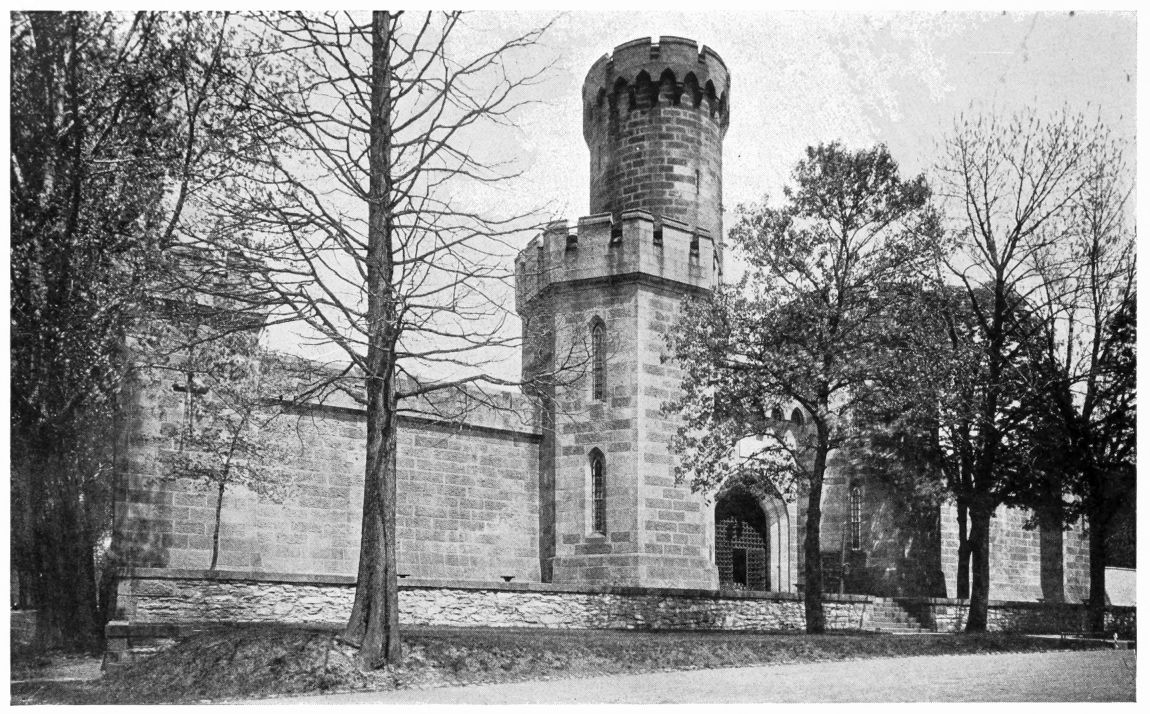
THE JAIL AT READING
John C. Haviland, Architect
1794, en route to join troops against the Whiskey Rebellion; now Farmers’ Bank; it is marked as the oldest building in town. The Hessian camp ground, southwest of Reading, is also marked.
Trinity Church, most important Lutheran Church in this country, is a fine example of Georgian architecture, northwest corner of Sixth and Washington Streets; was built, 1791. Christ Protestant Episcopal Cathedral, Gothic, brownstone; built in 1864; architect, Potter, New York; has good windows. The Reading Museum and Art Gallery, Eighth and Washington Streets, has a good collection of paintings, representing foreign and American artists, including sixty paintings given by Mrs. William Littleton Savage, as memorial to her parents, Mr. and Mrs. George DeBenneville Keim, and other works of art and natural history; it is open free to the public. The Historical Society of Berks County, 38 North Fourth Street, has a good historical collection. Among the notable artists who have lived in Reading are Christopher H. Shearer, represented in permanent collection at Pennsylvania Academy of the Fine Arts, Philadelphia; Benjamin F. Austrian, noted still-life painter, born here, 1870; James A. Benade, landscape; F. D. Devlan, animal painter and cartoonist; during the Civil War he furnished many cartoons for Frank Leslie’s illustrated newspaper; George Seiling, mural decorator, born in Bavaria, 1818, his paintings are in St. James’ Church, “The Transfiguration,” and Calvary Church, “Christ Bearing the Cross.” Calvary Reformed Church has stone mosaic decoration in chancel by H. Hanley Parker.
Charles Evans Cemetery, acquired by gift in 1864, has Gothic gateway, dark sandstone; made in 1847; architects, Calver & Hall, Philadelphia; the chapel is brownstone, Gothic, built, 1854; architect, John M. Gries, who was a major in the Union Army, killed in battle of “Fair Oaks”; here is the Soldiers and Sailors Monument, with bronze tablets; erected, 1889.
Reading was the resort of many fugitives families from Philadelphia while British were there in the winter of 1776-77, and became the scene of much gayety. General Mifflin, afterwards governor, had his country seat at Cumru, three miles southeast of Reading, now used as the County Almshouse and Hospital buildings. In the different wars of this country Berks County men were among the first to offer their services; the Ringgold Light Artillery, Captain James McKnight, is said to have been the first company that reported at Harrisburg in response to President Lincoln’s Proclamation in 1861, and was one of five Pennsylvania companies to arrive first at Washington in defense of the Capital.
At Kutztown, settled by Germans in 1733, is the Keystone State Normal School, originally Maxatawny Seminary, but since 1866, the Normal School, enlarged after most improved models of school architecture. Four miles distant is Virginsville; here is a natural curiosity, the “Crystal Cave,” of vast dimensions, with crystal formations in every shape and color; it is lighted by electricity. Boyertown, with two large academies, and Birdsboro, with fine churches and residences, are noted for their iron furnaces. Hamburg is the home of the Berks County State Sanatorium No. 3 for tuberculosis; Spanish architecture. Berks County has several picturesque old bridges, the oldest, with one arch, stone, built in 1822, spans the Wyomissing Creek at its mouth, opposite Reading. Thirteen other stone arch bridges, the longest, over Maiden Creek, four arches, built in 1854; and twenty-five wooden covered bridges, are decided artistic assets.
Historic iron furnaces in Berks County are at Birdsboro, Hay Creek Forges, built, 1740, by William Bird on land obtained by warrant and survey; he also erected Hopewell Furnace in 1759, and the Berkshire Furnace in Heidelberg about 1760; his son, Mark Bird, inherited the property, and built Spring Forge and Gibraltar Forge; in 1796, John Louis Barde became the owner; his daughter was married to Matthew Brooke, who subsequently purchased the property, which has become an extensive iron works. Colebrookdale, famous as the seat of the first blast furnace in Pennsylvania, was on Iron Stone Creek, named for the Colebrookdale furnace, in Shropshire, England; it was founded by Thomas Rutter and Thomas Potts in 1720: in 1724, the output was forty-eight tons of pig iron per annum, each ton valued at £5; this was the first furnace to cast pots, kettles, and other hollow ware by the use of sand moulds; it had a long and prosperous career. Hopewell, a cold blast, one stack furnace, employed one hundred and seventy men and boys, the iron ore was obtained from the Hopewell mine, about two miles away, water from Hopewell Creek formed the motive power; a dam was constructed a quarter of a mile above the furnace and conveyed by a race to the big water wheel; the property covered 5163 acres, chiefly woodland; stoves were cast here with much detailed design, marked with the name of Bird; also cannon for the Revolutionary Army; Hopewell furnace, although idle for many years, is not dismantled, and the village street of iron-workers’ homes is much the same as it must have been in early times.
Oley Forge, south of the little hamlet called Oley Churches, and about ten miles from the confluence of the Manatawny and Schuylkill rivers, was organized by John Ross in 1744, and was in active operation for one hundred and twenty years. In 1760, a valuable deposit of iron ore was found in Oley Township, and in 1765 Dietrich Welcker erected Oley Furnace, near the mountain; it was owned by General Daniel Udree during the Revolution. Pine Forge was among the earliest of those erected in the Manatawny district, on land conveyed by William Penn to Thomas Rutter; the original patent is in possession of the Rutter family. There is every evidence that the group of early forges and furnaces had a general interchange in their business affairs, as the owners of the plants were almost identical; William Bird, in 1733, was cutting wood for the use of Pine Forge, at two shillings ninepence a day. Ten years later we find him renting one-eighth of Pine Forge at £40 per annum.
The management of the old forges was patriarchal in its character; grist mill, sawmill, and the village store were all under control of the company, and the records of the old forges and furnaces are filled with human interests of an earlier day. Windsor Furnace,
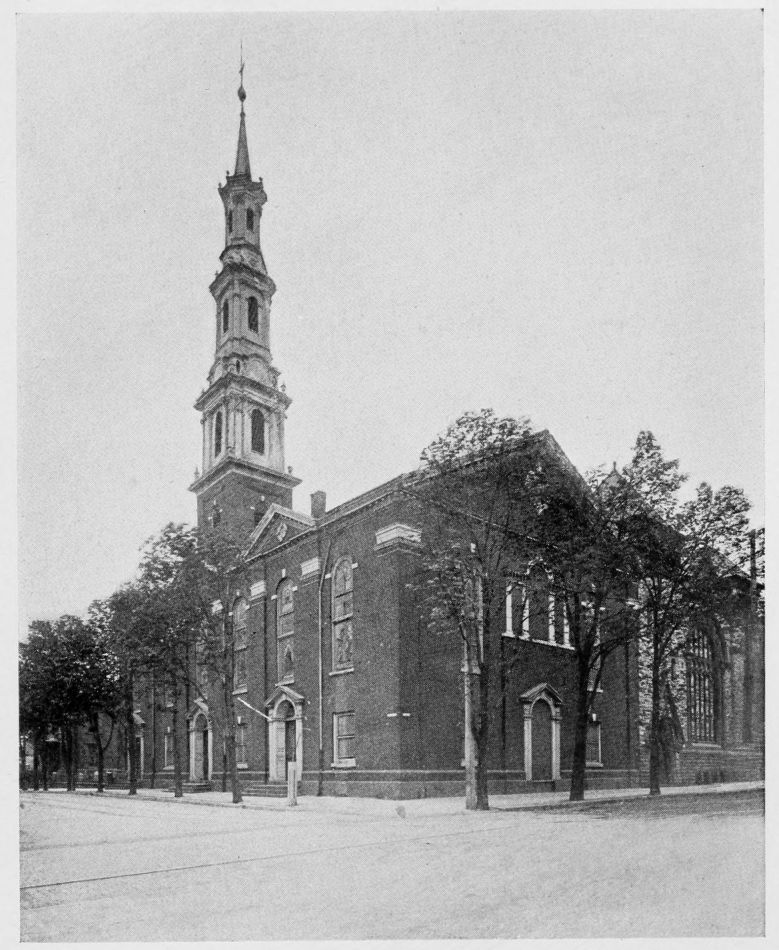
TRINITY CHURCH, READING, BUILT IN 1791
on Furnace Creek, under shadow of the Blue Mountains, besides making pig iron and the usual hollow ware cast in colonial times, was noted for remarkable artistic work under the management of Jones, Keim & Co.; one casting, being a copy of Leonardo da Vinci’s “Last Supper,” is now in possession of the Philadelphia Exchange.
Bedford County