IV LANCASTER COUNTY
Reading edition
FORMED May 10, 1729, by request of the proprietaries, on site of an Indian village; it was named for Lancashire, England, derived from Lan-Castra, the Camp at Lan, permanent camp of Roman occupation of Britain two thousand years ago. Earliest settlers, Swiss Mennonites, who, in 1710, had warrants for ten thousand acres of land on Pequea Creek; leader, Bishop Hans Herr; his stone house, built by himself on this tract, is still standing, with initials and date cut over front door, “C. H. H. 1719.” A fine Mennonite meeting house, lately built, is here; on the grounds is huge boulder, marked by the Lancaster County Historical Society. This is the richest agricultural county in the United States, of unexampled fertility; the tourist is impressed with the mammoth barns of this region; luxuriant crops of tobacco are of special note. The Conestoga River, with its affluents, drains an area of 315 square miles, it is crossed by many bridges. On the border of the city limits is a nine arch stone bridge, built by Abraham Witmer in 1800, which leads the Lincoln Highway over the Conestoga. At Pequea is St. John’s Protestant Episcopal Church, according to a quaint old Vestry Book “Built of wood in 1729, to perform Divine Adoration ... after ye manner of ye Episcopal Church of England,” the itinerant missionaries of the Society for the Propagation of the Gospel of England holding service; cornerstone
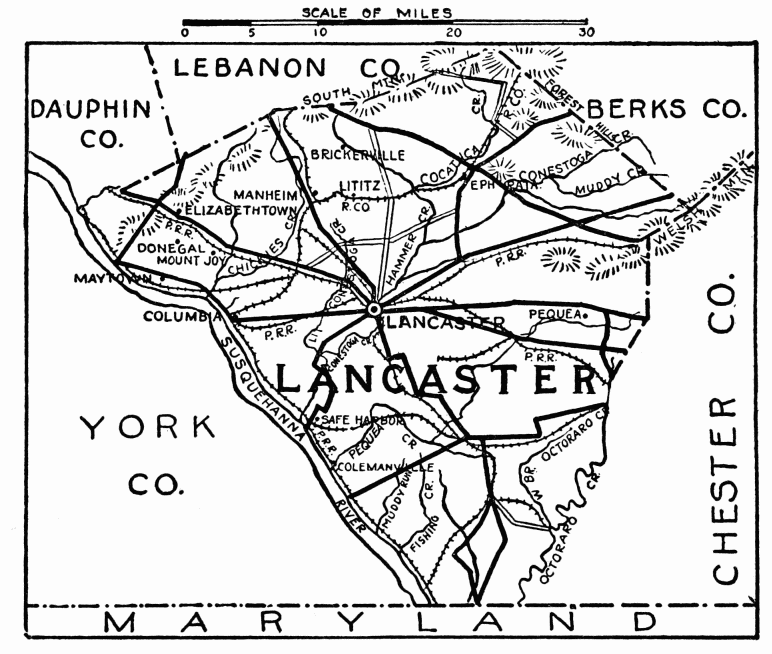
Lancaster County
of present church building was laid by Bishop Onderdonk, the rector at that time being Rev. Edward Young Buchanan, brother of President James Buchanan; the parish possesses two vestry books of great historic value.
Most famous group of historic buildings are those erected by the Seventh Day Baptists, founded by Conrad Beisel in 1722, at Ephrata, on the Cocalico; monastery still in original condition, with cells and rooms; and the adjoining chapel little changed; the brothers and sisters lived, each in their narrow cell, like monks of the Middle Ages; a printing press was set up in 1743, on which were printed the largest books in America prior to 1860; first Sunday schools in America were said to have been started here in 1740; and Henry William Steigel introduced glass making. Joining the Cloister Settlement is Clare Point Stock Farm, now occupied by the Redemptorist Fathers, a Roman Catholic order, founded in 1732 by St. Alphonsus Maria Leguori, in Italy; of strict discipline and singleness of purpose, designed to work among neglected country people; this is their only mission in Pennsylvania.
County seat, Lancaster, 418 feet above sea, population 53,150; laid out by Governor Gordon in 1730; near by is the Conestoga River, named by Conestoga Indians, a tribe of the Delawares; the Dutch who lived here invented the wagon, with big covered tops, drawn by six horses, and named it for the river. It is said that here was first given to Washington the title “Des Landes Vater.” This is a square city, lines run north and south, east and west, with outlying districts; one, Rossmere, was named in honor of George Ross, a signer of the Declaration of Independence.
The Continental Congress arrived here from Philadelphia the very day Sir William Howe entered that city; the next day they moved to York. This was the Capital of the State from 1799-1812, and birthplace of Simon Snyder, Governor of Pennsylvania 1808-1817. In center of Penn Square is a monument to soldiers and sailors of the Civil War. One block away is the court house, on East King Street, built about 1850; architect, Samuel Sloan; Corinthian; contains portraits of Hon. Isaac E. Hiester by Isaac Williams, and Hon. W. U. Hensel by Lazare Raditz, Philadelphia. Jail, East King Street, Norman castellated, red sandstone, built, 1850, architect, John Haviland. Fountain, East King Street, on reservoir grounds, made, 1905, memorial to John Williamson Nevin; bronze lion, sculptor, Blanche Nevin.
Michael Schlatter and Henry Melchior Muhlenberg, leaders of the Reformed and Lutheran Germans, were in favor of higher education, and established Franklin College in 1787, forming the beginning of Franklin and Marshall College; built on an eminence west of city; main building Elizabethan, brick, built, 1854-55, with beautiful entrance door, contains portraits. In the Watts de Peyster Library are bronze busts of the father and mother of General de Peyster. St. Stephen’s Chapel has memorial window to Rev. John W. Nevin, D.D., LL.D., made by Armstrong, New York. On the campus is bronze heroic statue of Abraham de Peyster, made in New York, 1895, replica of one facing New York Custom House. The
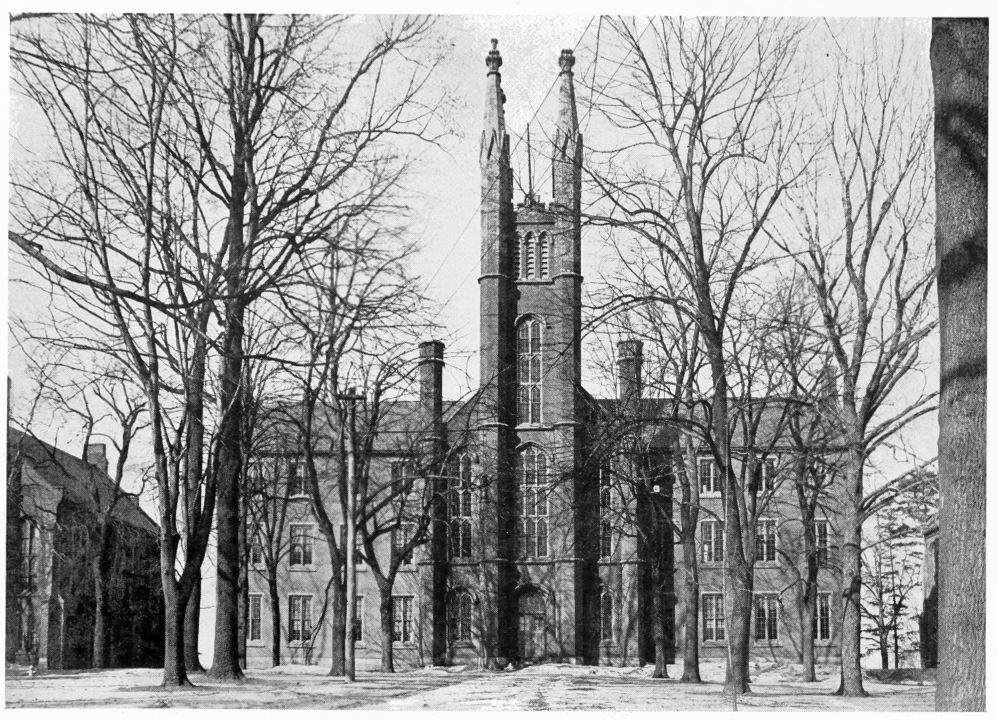
MAIN BUILDING FRANKLIN AND MARSHALL COLLEGE, LANCASTER
scientific building contains oil paintings, among them one by J. D. Wiltkamp, “The Three Women of Grève-Coeur.” Buchanan Park, opened, 1905, joins the college campus and grounds of the Reformed Theological Seminary. “Wheatland,” residence of President James Buchanan, is near, on Marietta Pike, colonial, brick, built prior to 1812. St. Joseph’s Hospital and Roman Catholic Church are near college; hospital contains portrait of Henry E. Muhlenberg, M.D., by Caroline Peart Brinton; the church windows are from Munich and Innspruck.
Among Lancaster’s numerous churches are, the Moravian, West Orange Street, rear part stone, built, 1750, oldest in the city, brick front added, 1820. First Reformed, East Orange Street, brick; Romanesque; built, 1852-54; two steeples, contains lectern and other pieces of woodcarving by A. Lang of Oberammergau, nephew of Anton Lang, made, 1905; decorations by J. F. Lamb, New York; windows from Tiffany and D’Ascenzo studios; bronze memorial tablet by Martha Hovenden. St. James Protestant Episcopal, corner of East Orange and North Duke Streets, Norman, brick; main walls built, 1820, added to 1870 and 1910; chancel windows from England, others by Lamb and the Tiffany Studios, New York; oil painting, “The Crucifixion,” artist, Jacob Eicholtz; pictorial tile base at altar, by Dr. Henry Mercer; in parish house is fifteenth century oil painting, Urbanean School. St. Anthony’s Roman Catholic, East Orange Street, bronze altar and statues from Oux et Cie, Paris; frescoes by Ludwig Reingruber are adaptations of old masters. Trinity Lutheran, South Duke Street, brick; fine old Georgian style, compares with Christ Church, Philadelphia; built, 1761; tower and spire added, 1794; wood sculpture, four evangelists, at base of tower; original pipe organ built, 1771, was utilized in new organ; memorial windows by the Tiffany Company, and by Joseph Lauber, New York City.
Fulton Opera House, Prince Street between Orange and West King Streets, on site of massacre of Conestoga Indians by Paxtang boys in 1763, over entrance, life-size statue, carved wood, of Robert Fulton, made, 1852, sculptor, Hugh Cannon: the Lancaster County Historical Society placed a tablet on the wall of Robert Fulton’s birthplace, built, 1765; southern part of Lancaster County, Fulton Township, A. Herr Smith, Memorial Free Library, North Duke Street; Italian villa style; contains portraits of notable men identified with Lancaster County. Post Office and Revenue Building, North Duke Street, Italian Renaissance; Indiana limestone; built by United States Government. Guaranty Trust Company, North Duke Street, Ionic, marble, built, 1912. The Henry G. Long Asylum, corner of Marietta and West End Avenues, contains two portraits by Jacob Eicholtz. The Iris Club, founded by Miss Alice Nevin, has annual exhibition of paintings.
In Woodward Hill Cemetery, southern part of city, on the Conestoga, is tomb of President James Buchanan. Greenwood Cemetery, end of South Queen Street, has stone entrance, made, 1895, by Rothenberger. Tomb of Thaddeus Stevens, white and black marble and granite, is in Shreiner burial ground. West Chestnut Street, corner of Shippen and Ross Streets, is inclosure and small brick monument topped by stone sphere, site of George Ross’s mansion. Bountiful markets held on the curbs, as well as in the market houses, are a distinctive and picturesque feature of the town; the presence of the Mennonite, Amish, and other sects lends a peculiar aspect to the scene.
Near Rockford, south, is brick colonial mansion, built before 1775, residence of the Revolutionary general, Edward Hand, marked with tablet by local Historical Society. The birthplace of Dr. David Ramsey, historian, built, 1749, is still standing. Williamson Park, end of South Drake Street, on Conestoga River, acquired by gift in 1902, has wild scenic beauty. Long’s Park on Harrisburg Pike, two miles from city, acquired by gift, scenic, opened, 1903. Between Mount Joy and Maytown is Donegal Presbyterian Church, built prior to the Revolution, a quaint building with gambrel roof; interesting burial ground with the witness tree; Cameron family bury here.
Donegal was an early Scotch-Irish settlement. Under the oak witness tree the “Sons of Donegal” dedicated their lives to their country in the Revolutionary War. Tablet records their names, among them James Stephenson, 1770, whose granddaughter Sarah married David McKinley, ancestor of President William McKinley.
Lititz, settled by Moravians, 1748, has Moravian boarding school for girls, “Linden Hall,” founded, 1749; in the town park are the famous Lititz Springs; Lititz is also famous for pretzels, first made by William Rauch in 1710.
Manheim, laid out by Henry William Steigel, 1762, was named for his German home town; here he built a large glass factory, first in the United States; skilled workmen from Europe were employed; a few rare specimens of this glass, owned by collectors, show fineness of quality, richness of color, and a peculiar bell-like ring, some specimens are in the Danner Museum, open Tuesdays, free, to visitors, which outrivals some, more noted, in the rarity and variety of its collections: in 1772 Steigel gave to the Lutherans at Manheim a piece of ground on which to build a church; payment to be five shillings and an annual rental of one red rose; on the second Sunday in June, crowds attend the Baron Steigel Memorial Church, and at these services a descendant of the Steigels receives the red rose; the chancel is often filled with red roses dropped there individually as a tribute; in 1752 Steigel had married a daughter of John Jacob Huber, who owned a small iron furnace near Brickerville, he purchased land and became interested in several furnaces, one he named for his wife, “Elizabeth”; the Elizabeth furnace, in 1776, came into possession of Robert Coleman of Lebanon, in 1777 it was overtaxed with large orders of shot and shell for the Continental Army, and the government sent about two hundred Hessian prisoners, taken at Trenton, to work there; many remained and became good citizens. Mr. Coleman’s residence was at Elizabeth furnace, here he entertained Washington as his guest, who, at his request, sat for a portrait to Gilbert Stuart, which is now owned by B. Dawson Coleman, Esq.
Lancaster County furnaces in the Conestoga Valley, Caernarvon Township, were owned by David Jones in 1736; old mines are still there that bear his name; in 1743 David Branson built the Windsor forges, in the same township; among his partners was Lynford Lardner, who married his daughter Rebecca. On the banks of Furnace Run, near Colemanville, may be seen an old cinder heap, which is all that remains of the Martic Furnace, built 1751-52 on 3400 acres of land, with the usual houses and shops; during the Revolution, round iron was drawn under the hammer at the forge, and bored out for musket barrels; negro slaves were always employed here; among the past owners of this furnace, from 1777-93, was a Philadelphia merchant, Michael Hillegas, who became first Continental treasurer in 1775; in 1777 he was appointed first treasurer of the United States and continued in that office until 1789.
Near, just below Safe Harbor, in the Susquehanna River, is Indian Rock, with a number of inscriptions on it, the writing may be seen when water is low; same writing is found in Beaver County. The bridge over the Susquehanna River from Columbia to Wrightsville has been replaced several times, one was burned to stem the tide of the Confederates. At Elizabethtown are the Masonic Homes of Pennsylvania, on 982 acres, with Grand Lodge Hall, 437 feet long by 160 feet wide, seventeen dwelling houses, and other buildings. Georgian architecture, designed by Zantzinger, Borie and Medary.
York County