II BUCKS COUNTY
Reading edition
AUTOMOBILE ride of historic interest through Washington’s itinerary to New Hope. Return to Philadelphia via Bristol and Frankford.
One of the first three counties established by William Penn, 1682, named for Buckinghamshire (Bucks), England, Penn’s ancestral home. From Hatboro, Montgomery County, take the Old York Road to Warminster, site where John Fitch, in 1785, made a model of the first successful steamboat, marked by monument; he ran a boat, with side wheels, by steam, on a pond in 1786, and on the Delaware River, during session of Federal Constitution at State House in Philadelphia, 1787; twenty years before Robert Fulton’s trial trip on the Hudson; before Fitch, first model of steamboat in United States was made by William Henry, of Lancaster, 1763. Approaching Hartsville, is site of Log College, origin of Princeton University, founded by Rev. William Tennent, 1740, near Christ’s Home, where everything is obtained through prayer. Neshaminy Church in a grove of very old oak trees, where William Tennent preached, is one of the oldest Presbyterian churches in Pennsylvania. Hartsville, Cobe Scout’s shop, on Little Neshaminy; bulk of American army was at Neshaminy Camp, with General Stephen and Lord Sterling, when Lafayette joined it, and was handed his commission by General Washington in Moreland house, near the bridge; marked, inscription,
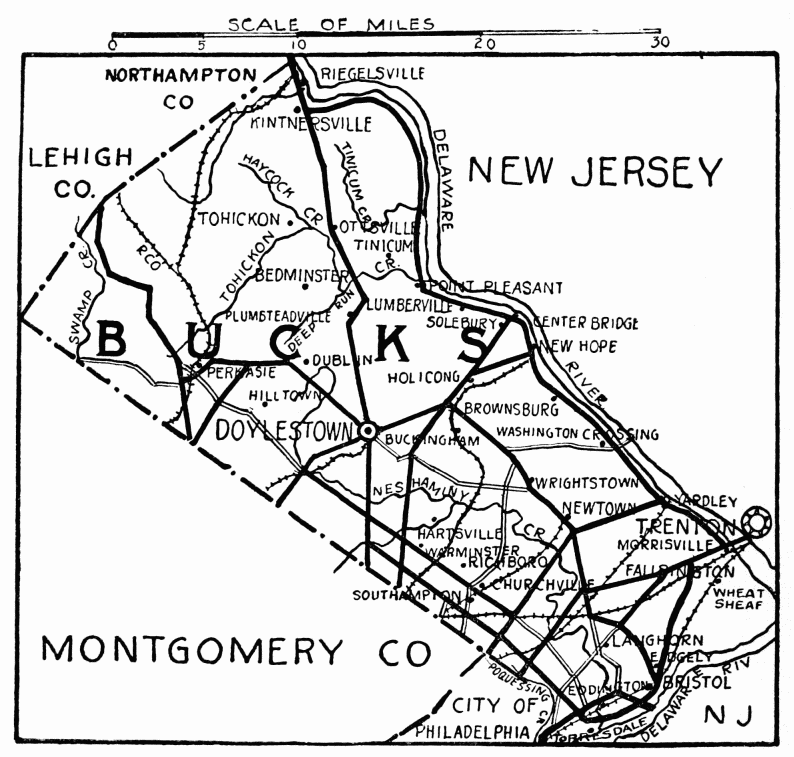
Bucks County
“Washington’s headquarters, August, 1777, Bucks County Historical Society.” First Pike west of Hartsville, wooden covered bridge over Little Neshaminy; inscription, “Bucks County Bridge, 1821, 20 mi. to P.” Continue York Road beyond Jamison’s Corner, seven arch stone bridge over Big Neshaminy at Bridge Valley, built, 1800; beyond bridge, first left road, over Crawford’s Hill, fine view of Neshaminy Valley.
Via Pebble Hill to Doylestown, county seat, settled, 1778, population 3857; court house, native gray stone; concrete fountain in front, Renaissance, with benches and lamp posts, designed by William R. Mercer, Jr., erected by borough, 1912, in commemoration of one hundredth anniversary of the county seat. Bucks County Historical Society, Library and Museum, built, 1915, of reinforced concrete, interior groined arch construction, designed, built, and presented to the Society by Dr. Henry C. Mercer; the court, surrounded by four galleries, contains collections illustrating history of the United States by means of utensils of American pioneers; unique of its kind in America; includes Indian relics, decorated stove plates, illustrated in a booklet “The Bible in Iron”; arms and relics of the Rebellion. Former library building, now the Auditorium, brick, built, 1904; colonial, designed from “Homewood,” Baltimore residence of Charles Carroll of Carrollton; was presented to the Society by William L. Elkins, Esq.
Fountain House, Main Street, opposite National Bank, oldest hostelry in continuous use in upper Bucks County, built, 1745, rebuilt, 1758, low, two story, with porches, was the old stagehouse to Easton; contains large collection of colonial furnishings and old prints. “Aldie,” residence of William R. Mercer, Jr., has notable pheasantry, rare fowls from eastern Asia; concrete garden ornaments made by Mr. Mercer; and antique sculpture from pre-Christian era; Font Hill, outside borough limits, residence, Dr. Henry C. Mercer; beamed and vaulted ceilings; roof terraces and many windows, entirely of reinforced concrete; walls and ceilings adorned with mosaics and tiles made by Dr. Mercer at the neighboring “Moravian Pottery and Tile Works.” Living room decoration, Bible pictures in tiles, adapted from Pennsylvania German stove plates; Columbus room, ceiling and pavement tiles, discovery and exploration of America; Bow room, ceiling tiles, Cortez’ maps of ancient Mexico, pavement, Aztec picture writings; Yellow room tiles, story of Bluebeard; also collection of classical and Renaissance mosaics, and ancient tiles, from historic buildings; may be seen by writing to the owner for admission.
Near Doylestown, National Farm School, four hundred acres, pioneer Jewish institution of its kind in America, founded, 1898. From Doylestown southwest, two miles, Castle Valley, Prospect or Spruce Hill, fine view, and grave, according to county tradition, of Lenape Chief, Tammany, whose name is used in Tammany Hall, New York; continuing the automobile route, Buckingham turnpike near Doylestown, small stone bridge, said to be 179 years old; facing masonry, more modern; date stone, 1814. Buckingham, Tavern, General Green’s headquarters, lunch room restored in ancient style; Friends Meeting House, with lost graves of Continental soldiers along roadside; Buckingham Mountain and Wolf Rocks, center of runaway slave settlement, old negro church on summit; left of Old York Road, ancient limestone quarries and kilns; Holicong or “Conkey Hole” deep funnel-shaped depression with water hole in neighboring field; residence of Colonel H. D. Paxson, contains unique collection of light and fire making apparatus, and of North American Indian objects including the Lenape Stone; Lahaska, Dr. Staveley’s residence, “Bleak House.” Aquetong, Logan’s or Ingham Spring, one of the largest limestone springs in East United States, residence of Samuel Ingham, General Jackson’s Secretary of State; north of York Road, Solebury, Friends Meeting House.
Center Bridge, on the Delaware, house in which William G. Whittier, the poet, lived. Residence of Edward W. Redfield, landscape painter, many of his paintings are made from scenes in this vicinity. New Hope, summer art colony, residence W. L. Lathrop, and other artists; Parry House, “Cintra,” stone, with walls of great thickness, said to have been built by William Maris in 1816, is so strikingly like the famous Octagon House in Washington, D. C, that both were probably from the same model, a wing of the old castle “Cintra” near Lisbon, Portugal; the heavy paneled cherry doors, with silver-plated knobs, on first floor, are said to have been originally part of Robert Morris’ house, “The Hills,” in Fairmount Park; Mr. Maris is credited with several buildings in New Hope, also, near New Hope, “Spring Dale,” with octagonal entrance hall, once the home of Dr. Charles Huffnagle, who was United States Consul to Calcutta and later United States Consul General to British India; who brought a notable collection of curios from the Orient which for many years were on exhibition at Spring Dale.
In December, 1776, four brigades under Generals Sterling, Mercer, Stephen, and De Fermoy, were posted from Yardley’s to Coryell’s Ferry, now New Hope, to guard fords above Trenton. Farmhouse of William Keith above Brownsburg, built, 1763; marked, inscription, “Washington’s headquarters previous to Battle of Trenton, December 14-25, 1776.” Old Eagle Tavern to right, fine view of river, hills, and valley southward; picturesque valley of Knowles Creek along Jericho Hill, site of American Army camp. North, line of William Penn’s first Bucks County purchase from the Indians, near site of Indian town Playwicky; below, “Lurgan,” near river, named in honor of James Logan’s birthplace in County Armagh, Ireland. On December 25, Washington and army crossed the river at McConkey’s Ferry, now Taylorsville, before midnight; nine hundred-foot bridge there now; twenty-four hundred troops were transported by 3.00 A.M. December 26; marched to Trenton, in two divisions, under Generals Greene and Sullivan, conquered the Hessians, and recrossed the river same evening, with nearly one thousand prisoners, arms, and several cannon.
At Newtown, then county seat, Washington wrote of his victory to the President of Congress, December 27, 1776, in residence of John Harris; his headquarters until December 29. Old Brick Hotel, built, 1684, enlarged, 1764, called, “The Red Lion,” Hessian prisoners were brought here; in 1829, residence of Major Joseph O. V. S. Archambault, born at Fontainebleau, France, aide to Napoleon in Battle of Waterloo, member of his household at St. Helena; was visited here by Prince Murat and Joseph Bonaparte. Old Friends Meeting House; old Court House; and Bank, robbed by the Doans after the Revolution. North of Newtown, one mile, Wrightstown, Lenape monument, on site of chestnut tree, land given by Miss Martha Chapman, inscription, “To the memory of the Lenni-Lenape Indians, ancient owners of the region, these stones are placed on this spot; the starting point of the ‘Indian Walk,’ September 19, 1735, Bucks County Historical Society, 1890.” Friends Meeting House; nearby, in fields, site of cave house of John Chapman, first settler: very beautiful views beyond Buckmansville toward Wrightstown, Solebury Mountain in plain view. On Richboro Pike, at Richboro and Churchville are Dutch Reformed churches, about 200 years old; near is Southampton Baptist Church, built, 1764. From Wrightstown, through Yardleyville to Morrisville, population 3639; opposite Trenton; Island off lower part was first Pennsylvania land occupied by Europeans, 1624; first ferry, 1640. “Summer Seat,” built by Thomas Barkley, 1773, conveyed to Robert Morris, 1791, still standing; was Washington’s headquarters December 8 to 14, 1776; Lincoln Highway enters Pennsylvania here. Fallsington, Friends Meeting House and quaint old buildings.
Return to Philadelphia on Bristol and Frankford Turnpike; “The King’s Highway,” laid out by Provincial Council, first road cut through Bucks County; early milestones still standing; pass Wheat Sheaf to Pennsbury, site of William Penn’s country house, frames and other work brought from England; he lived here one year. Edgely, greenhouses where “Queen of Edgely Rose” originated; Landreth’s seed farms above Bristol, population, 10,273, named for Bristol, England, home of William Penn’s wife, Hannah Callowhill; the Keene house, built by Major Lenox, 1816, American minister to England, his niece, Sarah Lukens Keene, inherited and died here, bequeathing it to the Protestant Episcopal Church of Philadelphia, in trust, as home for aged gentlewomen; St. James’ Protestant Episcopal Church, built, 1712, has silver communion service presented by Queen Anne, church was used for stable by cavalry during the Revolution; interesting burial ground, tomb of Captain John Green of American Navy, said to have been first to carry the American flag in voyage around the world. Farmers’ Bank of Bucks County, Radcliffe Street, Grecian, Ionic, built by James Craig, nephew of Nicholas Biddle, for residence, bought for bank, 1830.
Langhorne, residence of Joseph Richardson, Esq., built, 1738, Edge Hill stone, with white oak joists and rafters, sawed by hand with pit saw, now occupied by his descendants; headquarters of Lafayette and Dr. Peter Yarnall. “Night after battle of Trenton, part of Washington’s army came to Attleboro,” now Langhorne: old Galloway House, Trevose, residence of Jeremiah Langhorne, part owner of Durham Furnace. One mile east, on Lincoln Highway, is stone mansion, one of the oldest in Pennsylvania, exterior is in original state, residence of the late A. Haller Gross, Esq., notable for its art, architecture, and landscape gardening; an addition, in French chateau style, built, 1911, has rooms and floors enriched by very beautiful tiles, designed and made by Dr. Henry C. Mercer; his work is further shown on the terraces and gardens; in a fountain of green enameled tiles; the concrete balustrade, and pavilion dragons and other devices are in the sunken Moorish garden; and in the Italian garden, with its pergola, sun dial and fountain. Byberry, birthplace Dr. Benjamin Rush in 1745, house still standing; and Friends Meeting House, with large library. Eddington, St. Francis Roman Catholic Industrial School, built and endowed by the Drexel family; Cornwells, “Castle of State in Schuylkill”; Andalusia, named by John Craig, Philadelphia merchant, in memory of successful ventures in Spain; here is Church of the Redeemer and King Free Library. Old Red Lion Inn, on the Pike, near three-arched stone bridge, over Poquessing Creek, Washington’s army encamped around it in 1781, on march to Yorktown; seven years earlier, Massachusetts delegates to the First Continental Congress stopped here.
Torresdale, Philadelphia County, place of fine residences; Eden Hall now Convent of St. Elizabeth. Bustleton, old Baptist Church, with interesting burial ground. Over Pennypack Creek, two arched stone bridge, date, 1800, style has been reproduced in the Fairmount Park trolley bridges. Holmesburg, Edwin Forrest Home, “Spring Brook,” and one hundred and eleven acres, bequeathed by him, for retired actors, men and women; bought in 1865 for his country seat; House of Correction, accommodates 1000; well-kept grounds. Over Pennypack Creek, stone bridge built 1697-8, in good repair, oldest in Pennsylvania; about a mile distant, near Rowland Station, is old Crispin Cemetery, contains monument, inscription, “In memory of Thomas Holmes, died, 1695, age 71, Surveyor General for William Penn, he drafted the plan and laid out the City of Philadelphia.” Bridesburg, United States Arsenal. Frankford, site of a Delaware Indian Camp, on banks of Frankford Creek; many arrowheads have been found in this locality; Indian names are retained at Tacony, Tackawanna, Wissinoming; an interesting Roman Catholic Church, Gothic, is at Tacony, also Louis A. Burk’s Japanese garden and orchid farm. Swedes settled here in 1667, and were followed by the English. Philadelphia delegates to the First Continental Congress came to Frankford in 1774 to meet the Massachusetts delegates on their way to the city, and held a conference here relative to the Independence of the colonies, which decided the destiny of the nation. In 1781 General Washington and his army marched through Frankford from New York to Yorktown; a stop was made at the “Jolly Post Hotel,” built, 1680, on Frankford Avenue north of Orthodox Street.
In 1824 Lafayette passed through Frankford from Bristol to Philadelphia, riding in an open carriage drawn by six cream-colored horses, with postilions; he was escorted by a detachment of the City Troop under command of Captain Albert Ashmead, Captain of the Philadelphia County Troop; the Washington Grays, and several other companies of mounted volunteers. Rooms of the Frankford Historical Society, Frankford Avenue north of Sellers Street, contain many objects of interest, illustrating this locality in old times. Residence of Commodore Stephen Decatur is on Powder Mill Lane. The old Friends’ Meeting House, corner of Unity and Waln Streets, was organized in 1682; first log church built, 1698; present building, 1775.
Rehoboth Methodist Church, formed in 1830; used the old Academy; the Supreme Court met here in 1800; now on Paul Street below Unity Street; present building Spanish architecture, dark brick, erected, 1879. St. Mark’s Protestant Episcopal Church was a Mission of Trinity, Oxford; started in 1709; present church, Frankford Avenue below Sellers Street, erected in 1908; English, Fourteenth century Gothic; Port Deposit granite with Indiana limestone trimmings; architects, Watson and Huckle; windows by D’Ascenzo and Tiffany. Frankford Presbyterian Church, corner of Frankford Avenue and Church Street, was originally German Reformed; corner-stone laid, 1770; for many years the church was supplied with a preacher from the Market Square Church, Germantown; present building erected, 1859; architect, McArthur. St. Joachim’s Roman Catholic Church, corner of Church and Franklin Streets, built, 1874; Gothic, brownstone and sandstone; has a very beautiful tower, resembling that of Magdalen College, Oxford; architect, Edwin Durang; contains three carved marble altars; also a large mosaic, and memorial windows from Munich.
Automobile, north from Centre Bridge, River Road, to Durham, commands some of the most beautiful views in eastern Pennsylvania; through Lumberville, Devil’s Half Acre; right, at Like Kiln, site of important Indian fishing village, many relics have been found here. Point Pleasant, mouth of Tohickon Creek, Indians quarried argillite rock for blade material; Ridges Island, Indian village site; grave of Edward Marshall of the “Indian Walk,” in his family graveyard. Tinicum Creek, picturesque gorges, ringing rocks, cliffs of the narrows, with fine view from Table Rock, very rare “ice plant” grows here. Hill Presbyterian Church, built, 1761, on Durham Road near Ottsville.
Kintersville, ruins of Durham Furnace, built, 1727, stone, thirty-five feet square at base, thirty feet high; large leather bellows used to give the blast, were operated by a water wheel; charcoal fuel was made in pits close at hand; in 1758, Durham was regarded as best iron works in the country; in 1773, one thousand acres were reserved for the furnace; fire backs and stove plates were made here until 1794, when it blew out; eight genuine, Durham fire backs are at “Stenton,” Germantown, home of James Logan, who was one-fourth owner of the furnace, three bear the date, 1728; cannon balls for the Revolutionary war were made here in quantities, specimens may be seen in the Bucks County Historical Society; in 1773 Joseph Galloway became first individual owner, it then comprised over eight thousand acres, and was leased to George Taylor, at one time a filler at the furnace; he later was a signer of the Declaration of Independence; scanty remains of the once celebrated Durham Cave, destroyed for its limestone as flux for iron ore. The road passes site of Indian village of Pechequeolin, jasper quarries worked by Indians for arrowheads on neighboring Rattlesnake Hill. Fine old stone arch bridges over Tohickon and Durham Creeks. Riegelsville, old Reformed and Lutheran Churches.
Places of interest in Bucks County, north and west of Doylestown, via Easton and Dublin Turnpikes, Plumsteadville, beautiful views of Haycock Mountain, and upper county, Moses Doan’s grave, marked with inscription; west, Dublin to Hilltown, two Mennonite and Amish meeting houses, stone arch bridge over Deep Run. Perkasie, Trinity Lutheran Church, mural painting in chancel, “Angel with Trinity Symbol,” the late H. Hanley Parker, artist.
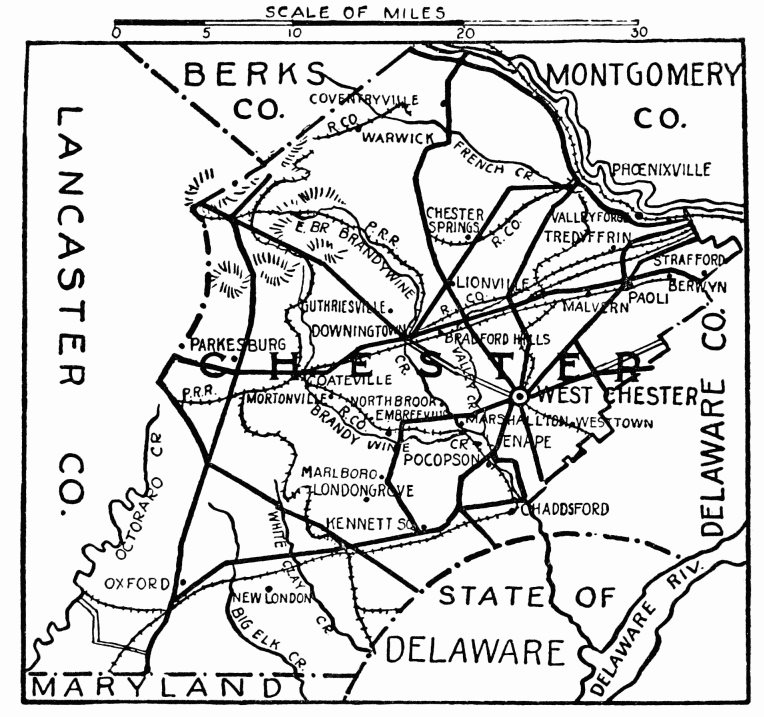
Chester County