XLIII SUSQUEHANNA COUNTY
Reading edition
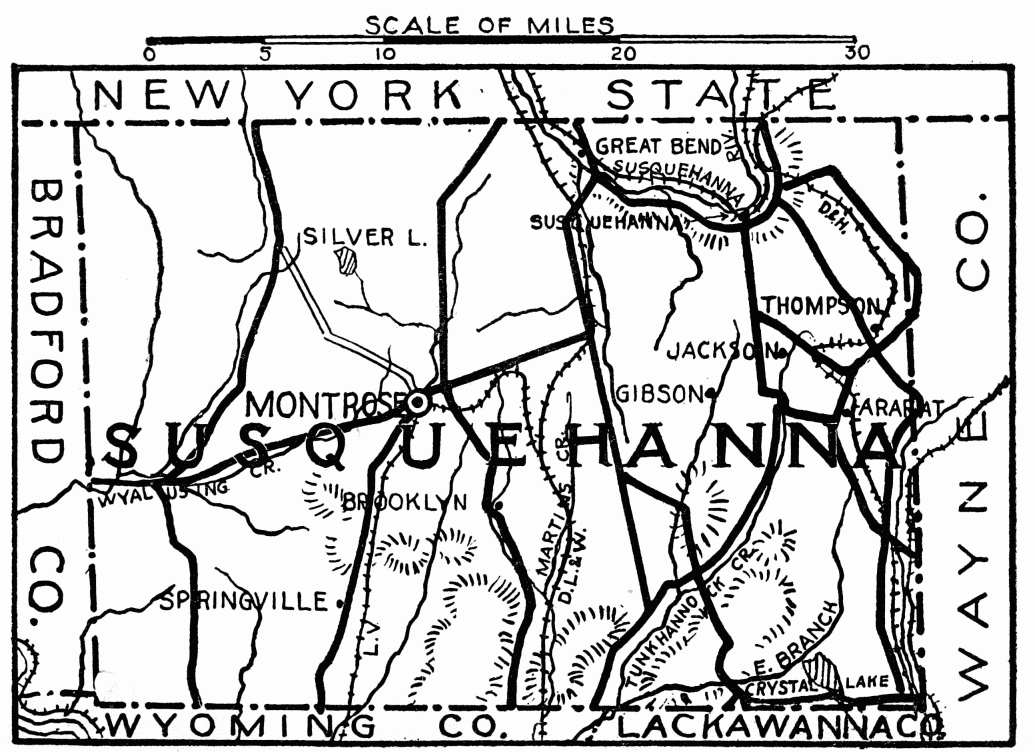
FORMED February 21, 1810; named for situation, at head waters of the Susquehanna River, which completely drains the county, every stream flowing into it as it flows around a spur of the Alleghenies with the highest outline of two mountains; original Indian names, Onaquaga and Miantinomah. The scenery is beautifully diversified; there are numerous lakes, the largest, Crystal Lake, is over a mile long; from Elk Mountain, with its three peaks, sixteen lakes are visible, and the Water Gap is plainly seen on a clear day; from Ararat, 2040 feet above the sea level, is also an extended view. A panorama of great beauty is seen from the heights of Gibson Township; the slopes furnish unsurpassed grazing and abound in orchards and gardens; named for Chief Justice Gibson, the town was first settled in 1792 by Joseph Potter.
The most beautiful auto ride through the county is from Montrose to Susquehanna, incorporated in 1853, called the City of Stairs; Erie Railroad shops are here, the buildings, covering eight acres, include a Library and Lecture Hall. Martin’s Creek Viaduct, 1600 feet long with eleven spans, on the Lackawanna Railroad, is said to be, next to the Tunkhannock Viaduct on same road, the largest concrete bridge in the world; this road is known as the shortest route between New York and Buffalo; owing to its high elevation through this county, the views are of extraordinary
Susquehanna County
beauty. Earliest white settlement was at Great Bend; General James Clinton, with 1600 men, encamped here in 1799, en route to join General Sullivan at Chemung against the Indians. Chief industry, agriculture and butter making.
Montrose, population 1661; made county seat in 1811, first settled by Stephen Wilson of Vermont in 1799, is a notable health resort because of its altitude; it was developed through the liberality of Dr. R. H. Rose and Isaac Post, the latter was first postmaster in 1808. Dr. Rose purchased 100,000 acres in 1807, partly in Silver Lake Township, and developed the resources of the county. Public buildings face the square, in which is the monument to Civil War soldiers. Courthouse, a fine structure, colonial architecture, built in 1842, contains a portrait of Honorable Galusha A. Grow, who was sent to Congress from this county. The conference building seats 3000; here The Bible Institute is held each summer. At Springville was farm of Zophar Blakeslee, whose daughter, Sarah, was married to Honorable Asa Packer. Brooklyn was early residence of George Catlin, who became noted as a painter of Indians. Jackson started as a beaver meadow. When Thomson was first settled, in 1820, an unbroken forest of beech wood stretched eastward for fifty miles.
Bradford County