LXV SNYDER COUNTY
Reading edition
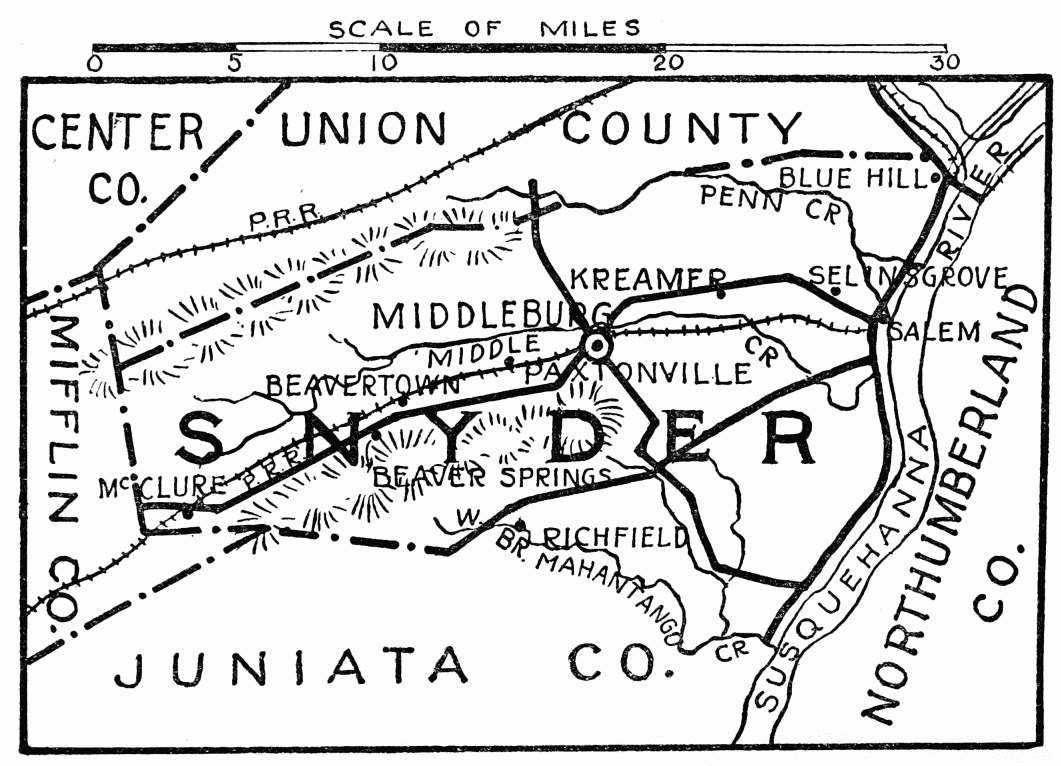
FORMED March 2, 1855, named for Hon. Simon Snyder, Governor of Pennsylvania, 1808-17; three terms; noted as the first governor to urge legislation for free public schools; he was the great war governor of 1812; served in the Assembly from 1789-1808, and was speaker of the House from 1802-08; he lived at Selinsgrove. From end of Northumberland Bridge, built by Theodore Burr in 1814, on West Branch of the Susquehanna; the road leading south to Selinsgrove passes Blue Hill, noted for beautiful scenery. On top was formerly Hotel Shikellimy, burned in 1895; on one of the rocks overhanging is a natural profile named for Shikellimy, who sauntered about here. Farther on is a single arch stone bridge; for half a mile, beginning at this bridge, is a state road built by the Commonwealth of Pennsylvania. Governor Pennypacker handled the first shovel of dirt in 1904; it was laid out first by James F. Linn in 1829, has since been extended.
Selinsgrove, first settlers, in 1755, were all killed by Indians, laid out by and named for Anthony Selin in 1827, population 1937; Governor Snyder mansion, built by himself in 1816, is near center of town, colonial, massive stone walls, with arched door ten feet high and large side porch, in well kept grounds. Due west from Selinsgrove, towards Middleburg, is Susquehanna University, formerly Missionary Institute;
Snyder County
collegiate and theological courses, six large and several small buildings; main building, Selinsgrove Hall, was built in 1859, Gustavus Adolphus Hall in 1895, contains collection of forty-two pictures of Gustavus Adolphus, also brass memorial tablet to the men appointed in 1856, by the Evangelical Lutheran Synod of Maryland, to organize the Missionary Institute; the buildings contain portraits of Governor Simon Snyder, members of the faculty, and other Lutheran clergymen; on the campus is a granite Celtic cross, marking grave of the founder, Benjamin Kurtz, D.D., LL.D.; in the old Lutheran Cemetery is grave of Governor Snyder, Quincy granite monument, surmounted with his bust, life size, erected by the state in 1885.
Two miles west is Salem; Row’s Church, log, built, 1780, modernized in 1897. In Kreamer is the old brick hotel used for special sessions of court before 1855, for cases in immediate neighborhood; a short distance in the field stands the old block house, erected before 1781, where white settlers gathered in defense against Indians. One mile farther west, in 1781, Indians killed five members of the Stock family. Ten miles west from Selinsgrove is Middleburg, county seat; 498 feet above sea level; population 984; laid out in 1800. In Glendale Cemetery is grave of Hon. George Kreamer, nephew of Governor Snyder, and member of the Legislature, 1812-13; member of Congress, 1823-27; also grave of Captain Frederick Evans, member of State Legislature, 1810-11, a defender of Fort McHenry, Baltimore, where, in 1814, the “Star-Spangled Banner” was written by Francis Scott Key.
On the banks of Stump’s Run is shaft monument to soldiers and sailors of this country who fought in the different wars; erected in 1904, by county commissioners; Soldiers’ Memorial Building, open to the public, is near the Lutheran Church; it was dedicated 1908; interior lined with marble, names of all soldiers and sailors of Snyder County are preserved within its walls, John F. Stetler, architect. Wooden bridge across Middle Creek, in good repair, is said to have been built in 1808 by John Aurand. Two miles west of town are the Hassinger Lutheran Churches, General Council east, present building erected in 1871, third on original site, first building in 1785; a split occurred, and the General Synod members built, in 1782, a quarter mile west; present church, in 1915.
Almost due south is Paxtonville, 510 feet above sea level; has wooden bridge over Middle Creek, built in 1851, John Bilger, builder; and ruins of Beaver blast furnace, once busiest industry in Middle Creek Valley, erected by Hon. Ner Middleswarth, the Kern Brothers and John C. Wilson, 1848-56; it was operated until 1866, power secured from a 200-foot head of water, running over two overshot wheels, one over the other. Westward is farm of Ner Feese on which gold and silver were discovered. Beavertown; population 525; 651 feet; originally Swifttown, named for John Swift, who had the land patented in 1760; was residence of Hon. Ner Middleswarth from 1792; he was reëlected thirteen times member of Legislature, twice speaker of the House—in 1828 and 1836; member of Congress, 1853-55; his last public service was that of associate judge. Beaver Springs, elevation 591 feet, laid out in 1806, early chief industry, ore mines. Scenic beauty from Shade Mountain, a long ridge, summit near Beaver Springs, 1672 feet above sea level. McClure, six miles west, is where folding houses are manufactured; the largest ever made was produced here, and shipped to South America.
Cameron County