VI CUMBERLAND COUNTY
Reading edition
FORMED January 27, 1750; named for county of Cumberland, England. One of the two or three rich agricultural valleys in the United States. Early industries were iron furnaces and forges. First settlers, Scotch-Irish, men of stout heart and wonderful nerve; almost contemporaneous with their building forts and providing means of protection for themselves and families, they established Presbyterian churches, the fine springs of the valley being selected as sites, namely, Silver Springs Church, nine miles west of the Susquehanna; Trindle Spring, now a Lutheran Church; Meeting House Spring, now First Presbyterian Church of Carlisle; curious old carvings are in Meeting House Springs burial ground; Big Spring Church, at Newville; and Middle Spring Church, above Shippensburg, a monument to Revolutionary soldiers is here; all continue in active existence. The early pioneer countenanced the institution of slavery, at one period as many as 307 negroes were held as slaves in this county, the last of them in 1840; on November 1, 1780, an act was passed, directing that all slaves and those held as such in Pennsylvania should be registered; but thereafter all should be free men and women.
Shippensburg, population 4372, first permanent settlement in the county, founded in 1730, was the only town on the line of the “Great Road” when it was laid out from John Harris’ Ferry, on the Susquehanna, to the Potomac, from 1735-44; this road was the first effort to connect the wilderness west of the Susquehanna with the civilization in the earlier settlements. First bridge erected in the county was over Letort Spring, on east Main Street, Carlisle, about 1780, replaced in 1795 by a stone bridge; several stone arch bridges are over the Yellow Breeches Creek; at the eastern end is Miller’s Mill bridge, over one hundred years old, three arch stone, in good condition; Alexander’s bridge is one mile north of Carlisle on the Conodoguinet Creek, colonial with wooden cover, one span, is very old.
County seat, Carlisle, named for shiretown of Cumberland County, England; population 10,916; the town is laid off at right angles, with a large public square in center; Bellair Park on the banks of Conodoguinet Creek is one mile from center of town; Lindner Park faces Franklin and Louther Streets, five squares from center; Mount Holly and Boiling Springs Parks are outlying, reached by trolley. The courthouse faces Center Square, Corinthian, Bryant & Witt, architects, built, 1846, one of the portico columns shows marks, in broken flutings, of the shelling of Carlisle, captured by General Lee, during the Civil War; contains portraits of judges of the local court. First Presbyterian Church also faces Center Square, main auditorium built in 1757, Greco-Roman, blue limestone with white marble linings, showing early bonding in stone masonry; tower added and parish house built, 1873. The Young Men’s Christian Association half square from Center, on High Street, French Renaissance, built, 1908; architect, M. I. Kast, Harrisburg. County jail, one square from Center, corner High and Bedford Streets, Tudor, built, 1854, brownstone, is a small copy of the Castle of Carlisle, England, note the limestone arch in east wall of the yard; architects, Myers & Gutshall. Post office, two squares from Center, corner of Pitt and Louther Streets, classic Renaissance, built, 1909, J. Knox Taylor, architect, Washington, D. C. Historical Society, corner of Pitt Street and Dickinson Avenue, brick, built 1878-80, architect, George Rice, contains historical library, papers, and museum.
Dickinson College on campus of seven acres, with law school one square south, Conway Hall one square west, and the Herman Bosler Biddle Memorial Athletic Field, with colonial gateway, made in 1909, architect, H. E. Yessler, three squares west; Main Building, “Old West,” built, 1803; blue limestone mellowed by time, with façade of fine proportions; arched doorways and windows; architect, Colonel Latrobe, first government engineer and architect, brought from England; auditorium contains portraits of John Dickinson, Dr. Nisbet, and others; the James W. Bosler Memorial Hall; Romanesque; built in 1885; George Rice, architect; contains portraits of notable alumni, including President James Buchanan and Dr. Benjamin Rush, also marble bust of James Bosler, and fine copy of Salvator Rosa’s “The Conspiracy of Cataline,” original in the Pitti Palace, Florence; the J. Herman Bosler Memorial Library, architects, Baldwin & Pennington, Baltimore; classic; built, 1899; white marble entrance vestibule, lighted by memorial window, Burne-Jones design, made by Maitland Armstrong & Company; Denny Memorial Recitation Hall, Collegiate Gothic, built, 1905, M. I. Kast, architect.
St. John’s Protestant Episcopal Church faces Center Square, has memorial altar, white marble, with Caen stone reredos, and windows made by Maitland Armstrong & Company; First Lutheran Church, one square east of Center, corner of High and Bedford Streets; Italian Renaissance; yellow brick, black and white trimmings; built, 1900; J. A. Dempwolf, architect, York, Pennsylvania. The second Presbyterian Church, corner of Hanover and Pomfret Streets; Gothic; built, 1869, has memorial window over door, Moorish design; and fine fretwork choir rail. St. Patrick’s Catholic Church; east Pomfret Street, has rose window of Tiffany glass; and other windows from Munich; also memorial marble altar.
Ashland Cemetery, York Street, nearly a mile east from Center, contains bronze statue, “Angel and Child,” made by Lamb & Co., in James W. Bosler’s lot. The “Old Grave Yard,” three squares from Center, on east South Street, contains Mollie Pitcher’s grave and monument; bronze portrait figure standing, on granite pedestal, with bronze reliefs of battle scenes extended on both sides; sculptor, J. R. Schweizer, Philadelphia; a Civil War cannon is in front; old English and German carvings from the year 1700 are in this cemetery. At Mount Rock, five miles west of Carlisle, is the Ionic Monument, in memory of Governor Ritner from 1835-39; erected by the state in 1902; architect, J. W. Ely, Mechanicsburg, Pennsylvania.
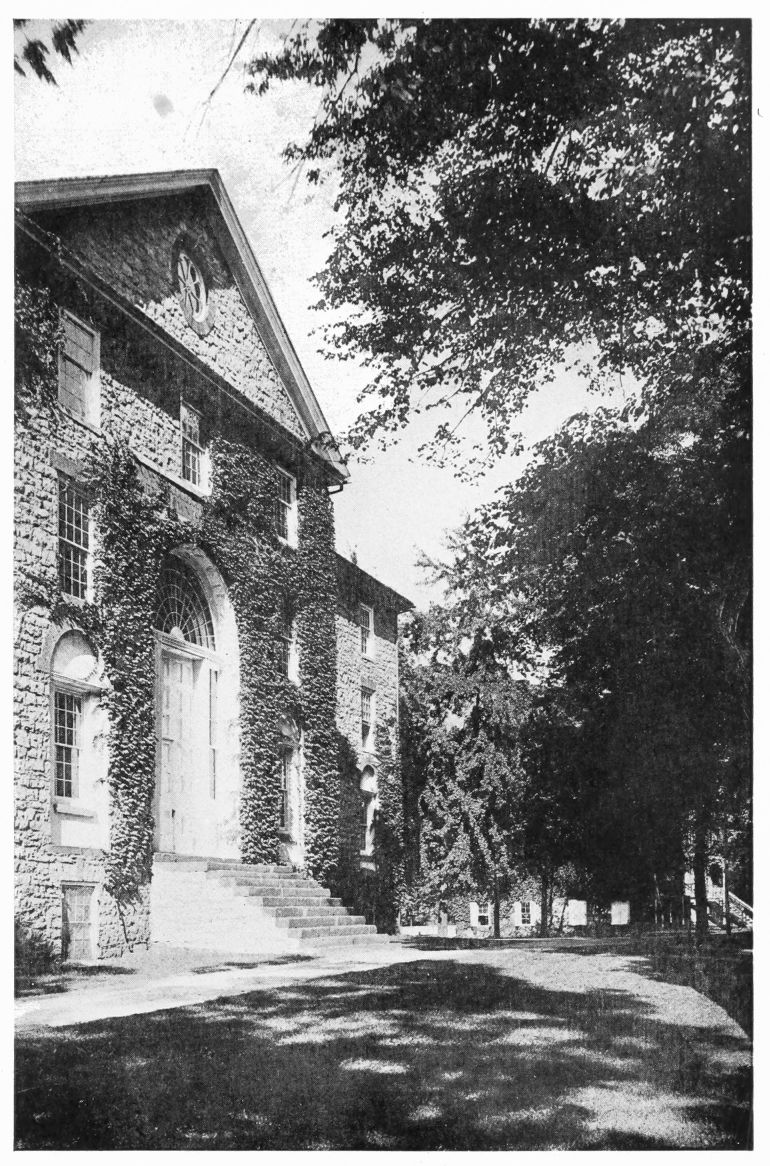
DICKINSON COLLEGE, “OLD WEST,” CARLISLE
The Indian School, one mile northeast from Center, was formerly a military post, buildings were destroyed by Fitz Hugh Lee in 1863, excepting the old guard house, built by the Hessian prisoners during the Revolution, in 1777; this was the original “West Point” for the training of officers and artisans, and for the manufacture of arms and munitions. In 1776, and throughout the War, anthracite coal was taken down the Susquehanna River from the Wyoming mines to the armory at Carlisle, said to have been the first shipment of anthracite coal in this country; there are now about twenty-five or thirty buildings, brick, of varied architecture, on twenty-five acres of ground; gateway, Georgian, M. I. Kast, architect, built, 1910; native Indian art is on exhibition in the Leupp studio. George Washington joined the army of 15,000 men, as Commander in Chief, at Carlisle, for suppression of the Whiskey Insurrection in 1794; he was the guest of Ephraim Blaine; the army was located on the opposite side of the town from the military post.
The Civic Club of Carlisle is placing classic art prints in the public-school buildings. Interesting colonial houses: residence of Ephraim Blaine, built, 1795, now law office and dwelling of Edward Stiles, built, 1815; of Stephen Duncan, built, 1815, used by the Fraternity of Owls; and that of Isaac B. Parker, built, 1820, the home of the Elks.
In 1762, Richard Peters of Philadelphia obtained a patent for 388 acres of land at Boiling Springs, and executed a deed to John S. Rigby & Co., for twenty-nine acres on which they had already commenced the erection of a blast furnace, they bought two ore banks at the foot of South Mountain, and soon after added 1614 acres of land, and called the property “Carlisle Iron Works”; it passed through several ownerships, until, in 1792, Michael Ege became sole owner; the furnace produced twelve to fifteen tons of metal a week, mostly pig iron, but they also cast stoves, fire backs, and hollow ware. William Denning, in 1776, made two wrought iron cannon in Mount Holly Gap, about six miles south of Carlisle, the first ever made; one in use at the Battle of Brandywine was captured by the British and deposited finally in the Tower of London; the British Government offered a large sum of money and an annuity to William Denning, to instruct them how to make wrought iron cannon, but he refused; he died in 1830, age ninety-three, at his home near Newville, his monument there, given by the state, shows a square marble base surmounted by a cannon. Pine Grove Furnace was built on Mountain Creek, halfway between Carlisle and Gettysburg, the recorded ownership dates from a proprietary grant in 1762 for 450 acres on Mountain Creek to Thomas Pope; it is now part of the State Forestry reservation.