THE WATERLOO MEDAL.
Reading edition
A medal was struck for this victory, which was conferred on all present in the three actions of the 16th., 17th., and 18th. of June, 1815. In a letter from the Duke of Wellington to the Duke of York, dated Orville, 28th. June, 1815, His Grace wrote, “I would likewise beg leave to suggest to your Royal Highness the expediency of giving to the non-commissioned officers and soldiers engaged in the Battle of Waterloo a medal. I am convinced it would have the best effect in the army; and if that battle should settle our concerns, they will well deserve it.” In a letter from His Grace to Earl Bathurst, Secretary of State for the War Department, on the 17th. of September, this passage occurs:—“I have long intended to write to you about the medal for Waterloo. I recommended that we should all have the same medal, hung to the same ribbon as that now used with the medals.”
The Waterloo Medal has on the obverse the laureated head of the Prince Regent, inscribed George P. Regent; on the reverse is Victory, seated on a pedestal, holding the palm in the right hand, and the olive branch in the left. Above the 198figure of Victory is the name of the illustrious commander Wellington, and under it the word Waterloo, with the date of the battle, June 18th., 1815. This figure evidently owes its origin to the ancient Greek coin represented in the accompanying engraving. A specimen of the coin is preserved in the British Museum. The name, rank, and regiment of the officer or soldier were engraved round the edge[71] of the medal, which was to be suspended from the button-hole of the uniform to the ribbon authorized for the military medals, namely, crimson with blue edges. In the “London Gazette,” of the 23rd. of April, 1816, was published the following official notification:—
Memorandum.
“Horse Guards, March 10th., 1816.
“The Prince Regent has been graciously pleased, in the name and on the behalf of His Majesty, to command, that in commemoration of the brilliant and decisive victory of Waterloo, a medal should be conferred on every officer, non-commissioned officer, and soldier of the British Army, present upon that memorable occasion.
“His Royal Highness has further been pleased to command, that the ribbon issued with the medal, shall never be worn but with the medal suspended to it.
“By command of His Royal Highness the Prince Regent;
Frederick, Commander-in-Chief.
H. Torrens, Major-General and Military Secretary.”
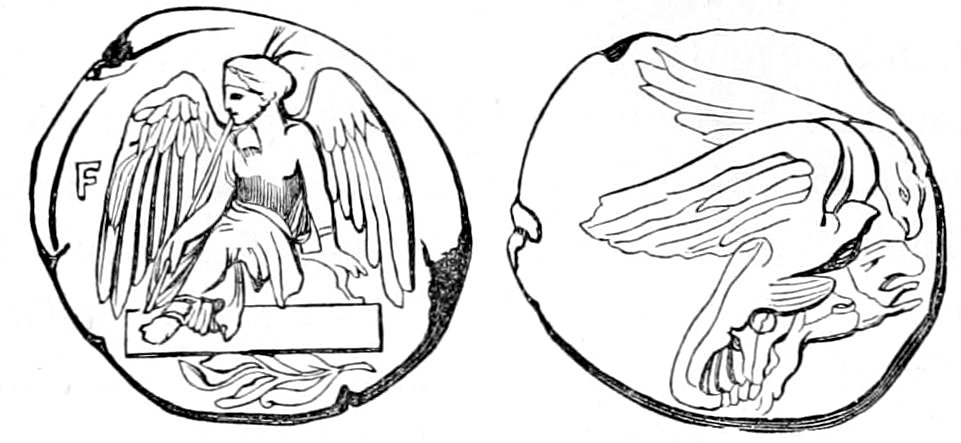
Coin of Elis, about 450, B.C.
The distinction for Waterloo became the more valuable, from the fact that there was only one ribbon and one medal for all ranks of the army, from the Commander of the Forces to the youngest drummer.
The 35th., 54th., 59th., and 91st. regiments forming the brigade of Sir Charles Colville, which was detached, were granted the medal, but these regiments do not bear “Waterloo” on their colours.
The Prince Regent also ordered that medals should be given to the Brunswickers who survived the actions of the 16th., 17th., and 18th. of June. This medal, of bronze, was made from the captured guns. Obverse, bust of Duke Frederick William, who fell at Quatre Bras, with the legend, “Friedrich Wilhelm Herzog.” Reverse, the date 1815, within a wreath of oak and laurel; legend, “Braunschweig Seinen Kriegern—Quatre Bras and Waterloo,” the ribbon yellow, with a light blue border.
The Hanoverian troops present at Waterloo, received a silver medal. Obverse, laureated head of the Prince Regent, with the legend, “George Prinz Regent, 1815.” Reverse, “Waterloo, June 18th.,” above which is a military trophy, below, laurel branches; legend, “Hannoverscher Tapferkeit.” Ribbon, red with blue border.
To the soldiers of the Duchy of Nassau, a small silver medal was awarded, worn with a dark blue ribbon, yellow edge.
199