OPERATIONS AGAINST SEKUKUNI, 1878–79.
Reading edition
Sekukuni was a chief of the Basutos, who in his fastness in the Lulu mountains, between the Oliphant and Steel Poort Rivers, had defied the Colonial Government, successfully resisted 231the Boers, and allied himself with Cetewayo. Occupying a mountain range of fifty miles in length, he was surrounded by all the lawless and warlike spirits in the district, attracted by the hope of plunder; and like one of the robber barons of the Middle Ages, he despatched them in all directions to ravage and lay waste the surrounding country. In February, 1878, some of his men made a raid on a chief under the protection of the English; and Sekukuni, encouraged by Cetewayo, in reply to the complaint of the British Commissioner, answered that “the English were afraid to fight—that the country was his, not theirs, and that he was quite ready for war.”
In October a small body of one hundred and thirty men of the 13th. Regiment, some Frontier Horse, and Mounted Infantry, commanded by Colonel Rowlands, V.C., advanced to attack Sekukuni, but through the roughness of the country, want of water, and the smallness of his force, he could effect nothing, and was obliged to retreat. War in Zululand now being imminent, operations against this formidable chieftain were for a time suspended, but after the capture of Cetewayo, a new expedition against him was organised by Sir Garnet Wolseley.
Sekukuni’s chief stronghold, called his “Fighting Koppie,” and deemed impregnable by the Basutos, was a tremendous natural fortress rising from the plain several hundred feet. Boulders and vast rocks piled one over another formed the sides, the interior was honeycombed by caverns and crannies innumerable, and the base of the hill was covered with trees and jungly brushwood. It was occupied by a population of about twelve thousand, but only five thousand were fighting men. The British force consisted of two thousand two hundred Europeans, of whom fourteen hundred were detachments of the 21st., 94th., and 80th. Regiments, and about ten thousand Swazies, under Major Bushman (9th. Lancers) and Captain Macleod, the whole being commanded by Colonel Baker Russell.
Sir Garnet Wolseley having completed his arrangements, the attack on the stronghold was made November 28th., 1879, at four a.m., in three divisions. Commandant Ferreira, with his 232colonial troops, carried the heights on the south; Major Carrington, of the 24th. Regiment, commanding the left attack, occupied the heights to the north; and Major Bushman, with his Swazies, gained the top of the ridge commanding the “town,” and combining with Carrington’s attack, poured down on the central kraal, which was soon wrapped in flames. The “Fighting Koppie” now being completely surrounded, was shelled by two Krupp guns, and two seven-pounders, directed by Captain Knox, R.A., and at ten a.m., was stormed by the centre column, consisting of the English infantry under Colonel Murray. The kraals below were burning fiercely; Ferreira’s men rushed up on the right, and with the Volunteers and Swazies, raced with the red-coats to be first in the Koppie, but after an obstinate struggle, the men of the 21st. and 80th. gained the summit of the hill, and the place was taken.
The position was captured, but the resistance of the defenders was not at an end. Hundreds of them sought refuge in the caverns with which the hill abounded, and from them kept up an intermittent fire till they were hunted out and slain. Sekukuni for some days escaped capture, but being surrounded on all sides, his supply of water cut off, and his caverns blown up, he surrendered on December 2nd. to Major Clark, and was conveyed a prisoner to Pretoria.
In this brilliant affair the British loss was three officers and seven men killed, and six officers and forty-three men wounded. The Swazies had nearly a thousand killed and wounded, and the five thousand defenders of the Koppie were nearly all slain, as our native allies gave no quarter.
Among the officers who distinguished themselves was Major Herbert Stewart, who shewed great energy and tact in dealing with the Native Contingent, and who in January, 1885, as General Sir H. Stewart, in command of the Gordon Relief Expedition, was mortally wounded, near Metammeh, on the Nile.
The regiments engaged in these harassing operations were: the 1st. Dragoon Guards, 1879; the 17th. Lancers, 1879; the 3rd. and 4th. Foot, 1879; the 13th., 1878–9; 21st, 1879; 24th., 1877, 1878, and 1879; 57th., 1879; 58th., 1879; 60th., 1879; 80th., 1878–79; 88th. and 90th., 1877, 1878, and 1879; 91st., 1879; 94th., 1877, 1878, and 1879; and the 97th., 99th., 1879.
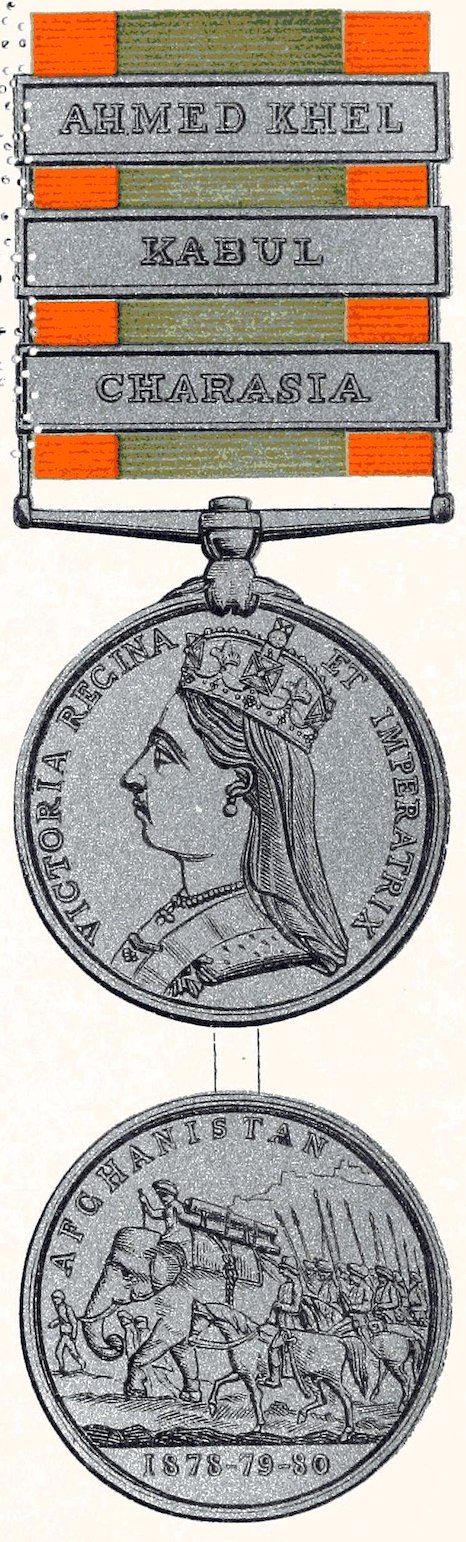
The Afghanistan Medal.
Every incident in these campaigns, which greatly consisted in patrolling and skirmishing in all directions, has not been narrated in detail; yet enough has been stated to show that the military power of Great Britain has seldom contended with more obstinate and braver enemies than the half-civilised Kaffirs and Zulus; and no medal has been more hardly earned than that granted for services in South Africa.
233