THE SUTLEJ AND PUNJAUB MEDALS, FOR THE FIRST AND SECOND SIKH WARS. 1845–6 AND 1848–9.
Reading edition
For the first Sikh War, or Sutlej Campaign, four Silver Medals were issued, for the four battles of “Moodkee, 1845;” “Ferozeshuhur, 1845;” “Aliwal, 1846;” “Sobraon, 1846.” By a general order, if a soldier was present at only one of these battles of the Campaign, he received the medal with the name of the battle inscribed on the reverse; but if he had been engaged in more battles than one, he received for each battle an additional clasp. The medal was designed by W. Wyon, and is considered a beautiful example of art. Obverse: The diademed head of the Queen, with the legend “Victoria Regina.” Reverse: A figure of Victory standing, with a laurel wreath in her right hand, and a palm branch in her left, at her feet a trophy of Sikh arms. Above is the inscription “Army of the Sutlej”; and in the exergue, the name and date of the battle for which the medal was given. Clasps for “Ferozeshuhur,” “Aliwal,” “Sobraon.” The 31st. and 50th. were the only European regiments that received the medal with three clasps for the four battles. Ribbon—dark blue with crimson edges.
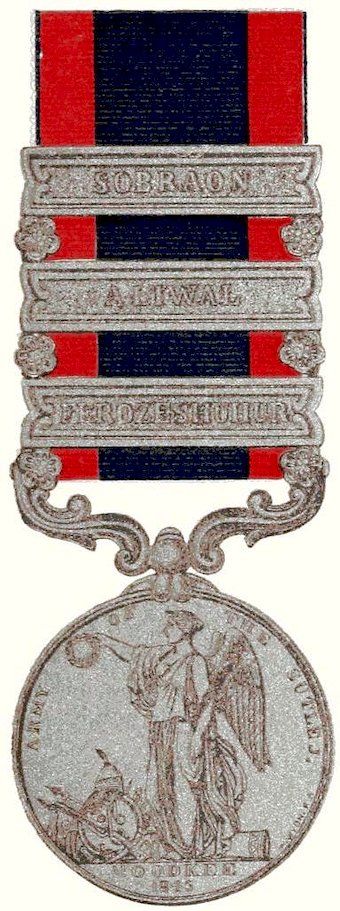
The Sutlej Medal.
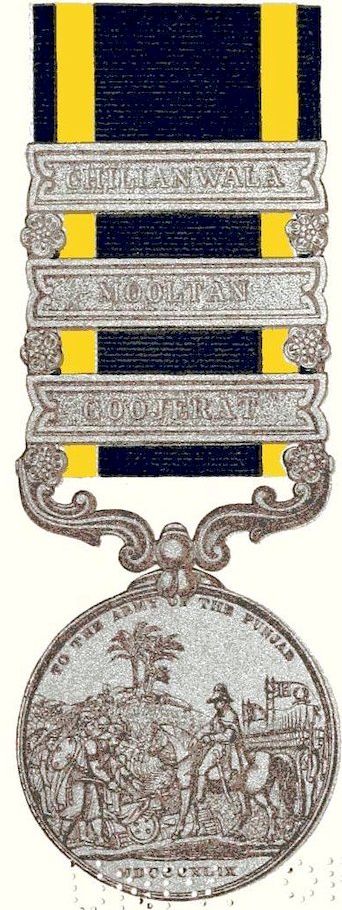
The Punjaub Medal.
By a general order, dated Ferozepore, April 2nd., 1849, a medal (silver) was granted for the Punjaub Campaign, second Sikh War, 1848–9. Obverse: same as the Sutlej Medal. Reverse: Lord Gough on horseback, the Sikh army laying down their arms before him, the British army in line with colours flying, in the background palm-trees. The superscription is “To the army of the Punjaub,” and in the exergue the date, MDCCCXLIX. Three clasps were issued for “Mooltan,” “Chillianwala,” and “Goojerat.” Ribbon—dark blue, with narrow stripes of yellow at the edges. The medal, without a clasp, was given to the officers and men of the Indus Flotilla who took part in the Campaign, and a Naval Brigade of about one hundred men, received the medal, with a clasp, for Mooltan. Two clasps were the greatest number worn with any medal.
309